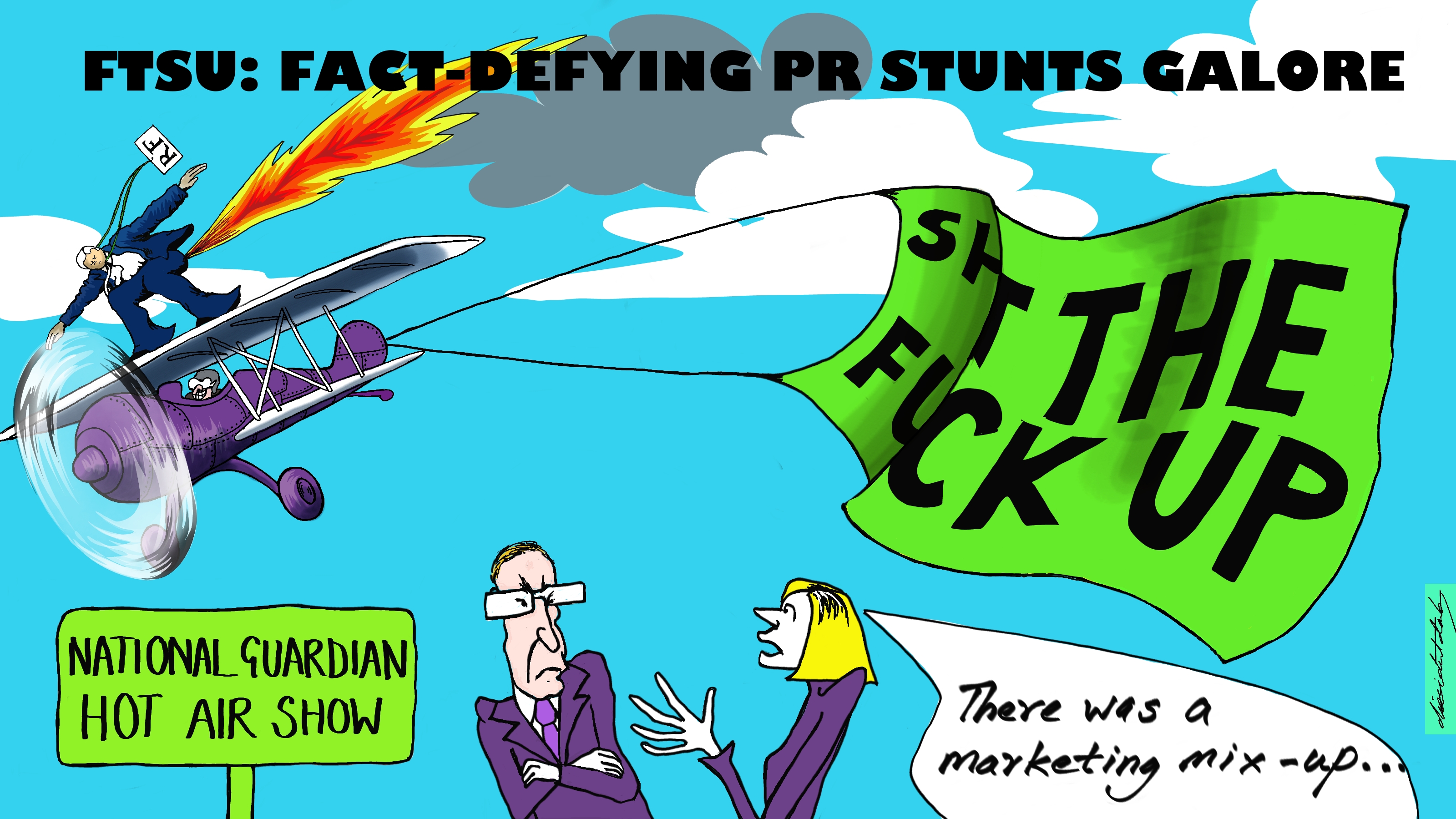
CQC concedes. Four years on from ‘Complaints Matter’, CQC’s whistleblowing governance is still not right

By Dr Minh Alexander NHS whistleblower and former consultant psychiatrist, 23 September 2018

Summary: After much spin, lengthy evasion and denial, the CQC has admitted that its approach to whistleblowing requires improvement. Time will tell if the CQC will take the necessary, serious action.

Following the publication of the report of the public inquiry into MidStaffs and the conclusion of Raj Mattu’s long running case in the Employment Tribunal, the government was under pressure to improve the NHS’ response to whistleblowers.

It responded in 2014 by commissioning the controversial Freedom To Speak Up Review, the efficacy of which remains hotly disputed. 

It was of course a little odd that Robert Francis as a CQC NED was in the position of reviewing his own organisation’s performance on whistleblowing as part of the Freedom To Speak Up Review. The potential conflict of interest was not formally acknowledged in his Review report or by the government. But he did at least acknowledge that system regulators could do more within their existing powers to protect whistleblowers, and he recommended that if necessary, they should seek a change in their regulations to better protect whistleblowers.

Complementing the government’s efforts with the Freedom To Speak Up Review, the CQC put on a show of reviewing its approach to whistleblowers. This culminated in its December 2014 report ‘Complaints Matter’, in which the CQC set out sketchy evidence and insubstantial recommendations on how it would approach whistleblowing in the future.

There was more emphasis on spin. A great CQC triumph was securing the endorsement of a high profile whistleblower. This glowing recommendation was tactically released by CQC within days of the publication of the Freedom To Speak Up report:

Although my secondment ended last year, I was involved in the evaluation of the work once the trials had been completed. I have been keeping a close eye on things as they develop at CQC; I have every faith in them – and that perhaps things can change for the better.”

 But whistleblowers have continued to complain about CQC’s approach. In December 2014, when CQC’s “Complaints Matter” report was published, it was revealed that CQC had outed whistleblower surgeon Shiban Ahmed to his employer. CQC maintained that this was an error on its part.

CQC’s superficial governance of whistleblowing matters continued to be a bone of contention on matters such as:


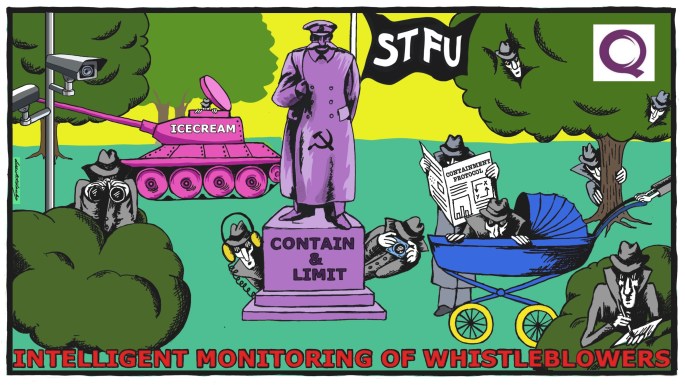
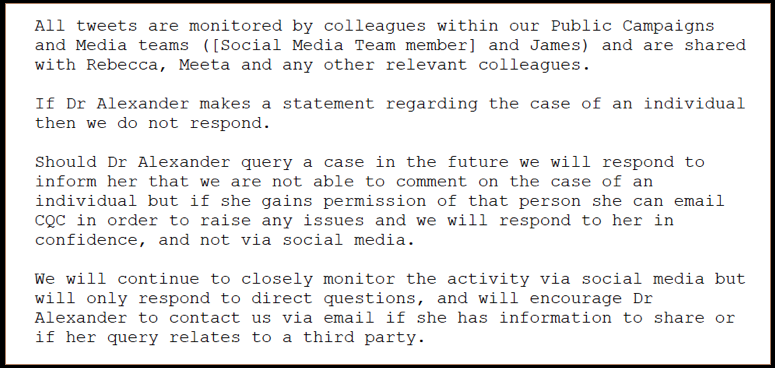
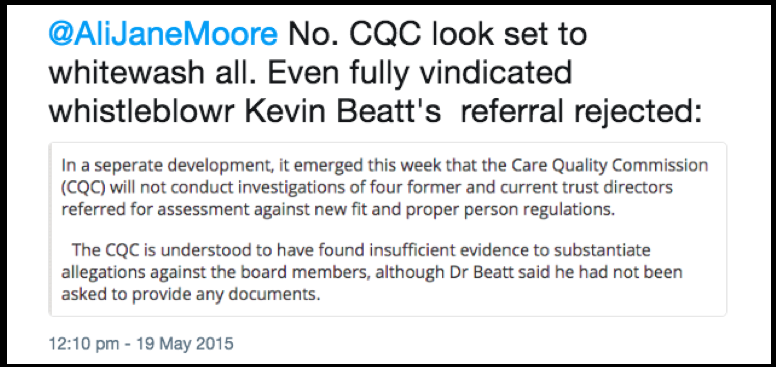
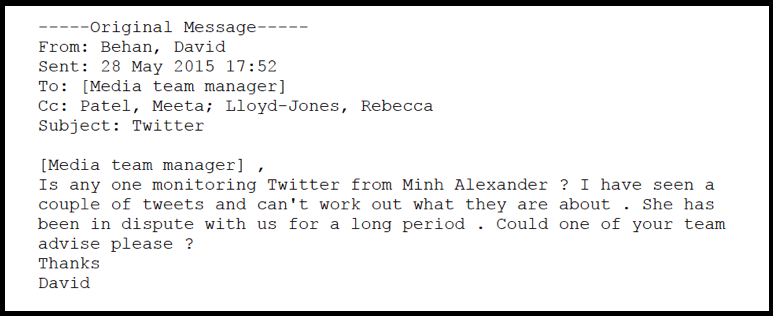
CQC treated concerns about these sort of matters as a nuisance. It even has containment strategies for whistleblowers, myself being one.

In June 2017 Helen Rochester a care home whistleblower attended CQC’s Board meeting to challenge the CQC about its behaviour towards her in two separate whistleblowing incidents, which involved breach of her confidentiality (admitted by CQC) and later complicity in a vexatious referral to the Disclosure and Barring Service. This is information about Helen Rochester’s case and her ordeal at the Employment Tribunal:

Breach of confidentiality by CQC and complicity in referring a whistleblower to the Disclosure and Barring Service

UK Whistleblowing Law is an Ass: Helen Rochester v Ingham House Ltd and the Complicit CQC

In July 2017, I asked the new CQC Chief Inspector of Hospitals to meet with me about CQC’s approach to whistleblowing. This was declined:

“Thank you for your offer of a meeting, but as I am sure that you will appreciate the coming months will be a very busy time for me and reluctantly I will have to decline the offer at present. I can, however, assure you that I am fully committed to listening to the views and experiences of people who use, and work within services as we develop our future approach.”

 In October 2017 I alerted Ted Baker to some issues about CQC’s approach to workforce issues, and lack of attention to Employment Tribunal judgments that are relevant to its Well Led domain. This was curtly received: 

On behalf of Professor Ted Baker, Chief Inspector for Hospitals at the Care Quality Commission (CQC), thank you for your email of 20 October 2017.

 CQC will keep the suggestions you make under consideration. We do not intend to engage in further correspondence with you on this matter.”

I had responses in a similar vein from CQC’s Chair and then CEO when corresponding respectively about CQC’s approach to whistleblower confidentiality and CQC’s handling of coroners’ warnings.

Peter Wyman 21 September 2017: “At the Care Quality Commission we routinely monitor compliance with our policies but have no plans at present to conduct an audit such as you propose. I do not intend to enter into further correspondence on this matter.” 

David Behan 13 October 2017: “We do not intend to engage in further correspondence with you on this matter.”

However, in December 2017, the BBC reported on Helen Rochester’s case and CQC’s approach to whistleblowers.

Rather remarkably, the CQC claimed to the BBC:

“The CQC said it had encouraged Dr Minh Alexander to “share her evidence with us, so that we can look into her allegations further”. 

 In the light of this reversal, I repeated the request for a meeting.

This eventual took place on 5 June 2018, with Ted Baker and also Ursula Gallagher CQC Deputy Chief Inspector, who had been assigned the lead on CQC’s whistleblowing programme. We previously exchanged correspondence in November 2017, when she had held Peter Wyman’s line about audit.

The meeting in fairness was courteous and reasonably conducted. Ted Baker took on board the seriousness of any breaches of whistleblower confidentiality and agreed to re-visit the issue of audit.

It was agreed that I would produce brief bullet points of the meeting, which I submitted the same day. Almost four months later I reminded CQC to get back to me about the accuracy of the meeting record.

This is the final agreed meeting record, received on 19 September, which appears substantively unchanged from my original draft:

Brief summary notes of telephone meeting on 5 June 2018 about CQC’s approach to whistleblowing

Also, a CQC board paper of 18 July 2018 by Ursula Gallagher gave this report on the work in progress:

CM/07/18/07 Responding to Speaking Up and Whistle blowing – Assessment of current practice and Action Plan for Improvements

The work included a paper review of cases that examined amongst other things, looking at 11 whistleblowers’ complaints about such matters such as CQC’s observance of whistleblower confidentiality.

CQC’s board report of July 2018 revealed that:

  • CQC has revised its guidance to inspectors


  • CQC aims to gather feedback from whistleblowers in future


  • CQC aims to improve its tracking of whistleblowing matters


  • CQC aims in 2019 to review the success of any changes


Interestingly, Ursula Gallagher’s board paper acknowledges that due to the pattern of whistleblowing being concentrated in certain areas, some CQC inspectors may have little or no experience of whistleblowers:

Some of the variation may be linked to the fact that the volumes of concerns are concentrated in certain sectors. This means that some inspectors working will rarely receive a disclosure, and this has implications for the support they require when they do.’

 Importantly, these changes represent a tacit concession by CQC, that despite all the puff in 2014, it had still not got its basic whistleblowing governance in order. This is progress, even if it has all been somewhat reluctant.

I have asked for clarification about some aspects, including CQC’s plans to consult whistleblowers and what routine audits CQC will undertake in future of its whistleblowing governance.

CQC is made of many parts and individuals, some more conscientious than others. It will be interesting to see what happens next given the tone set by the arrogance and hostility of some of its most senior officers.

I recently wrote to Ian Trenholm the new CQC CEO about CQC’s inappropriate use of containment protocols. These have the effect of  a contagion, spreading hostility towards dissenting voices. Trenholm seemed to imply that I ought to be grateful to have had the meeting with Ted Baker et al in June:

Letter from Ian Trenholm 14 September 2018

I note that my predecessor attempted to engage with you in a constructive way and corresponded extensively with you, and that you were given the opportunity to discuss your issues and concerns with Professor Edward Baker, Chief Inspector of Hospitals, and Professor Ursula Gallagher, Deputy Chief Inspector Primary Medical Services and Integrated Care, in June 2018. They listened to and noted your concerns.

These sentiments in themselves would suffice for a thesis in historiography. I will return to the substantive contents of Trenholm’s response another time.

With even more charm, Trenholm ended his missive with a warning that I should expect a cool reception in future:

Screen Shot 2018-09-23 at 14.52.42.png

So, let us see how much genuine co-production there will be on CQC’s new whistleblowing standards and procedures.

If there is no genuine involvement of whistleblowers, we may see yet another four year cycle of denial and failure.


RELATED ITEMS

CQC’s conduct towards whistleblowers is an example of the weakness of UK policy on this vital aspect of public protection. The CQC is not alone. Whistleblowers from other sectors also complain about their regulators.

To ensure safe governance, reform of UK whistleblowing law is vital:

Replacing the Public Interest Disclosure Act
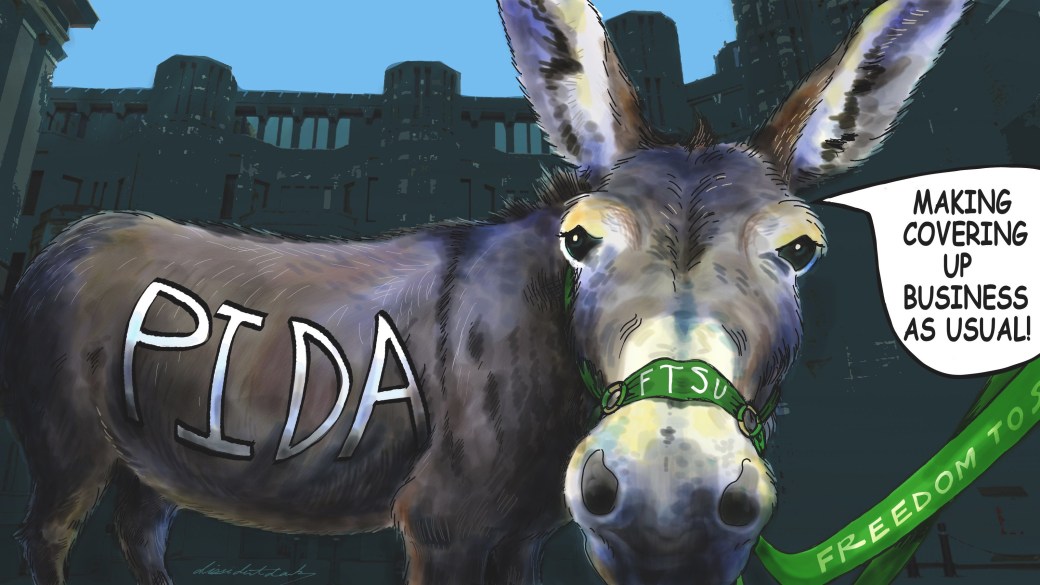
 

Whistleblowing to the CQC


Will the National Guardian come clean about why Freedom To Speak Up Guardians are leaving?

By Dr Minh Alexander, NHS whistleblower and former consultant psychiatrist, 17 September 2018


The Freedom To Speak Up Guardian role, introduced upon Robert Francis’ recommendation from the Freedom To Speak Up Review 2015, is an ill designed mess.

Employees of NHS provider organisations are expected to hold their employers to account for misconduct, such as failure to investigate whistleblowers’ concerns properly or at all, and victimisation of whistleblowers.


Report of the Freedom To Speak Up Review

Page 150

The Freedom to Speak Up Guardian:

– is recognised by all as independent and impartial

– has direct access to the CEO and the chair of the board

– has authority to speak to anyone within or outside of the trust

– is an expert in all aspects of raising and handling concerns

– has dedicated time to perform this role, and is not expected to take it on in addition to existing duties – watches over the process, and ‘oils the wheels’

– offers support and advice to those who want to raise concerns, or to those who           handle  concerns

– ensures that any safety issue is addressed and feedback is given to the member of staff who raised it

– safeguards the interests of the individual and ensures that there are no repercussions for them either immediately or in the longer term

– takes an objective view where there are other factors that may confuse the issue, such as pre-existing performance issues, to enable these to be pursued separately

– identifies common themes and ensures that learning is shared

– raises concerns with outside organisations if appropriate action is not taken by their employer

– works with Human Resources to develop a culture where speaking up is recognised and valued

– helps drive culture change from the top of the organisation.”


To most people of common sense, this is clearly a non-starter.  This system just creates more potential victims. In a corrupt organisation, any honest employee who has the specific role of raising concerns and challenging is vulnerable to reprisal.

But Francis had the chutzpah to refer to these roles as ‘internal and independent’.

There was no evidence base for the Freedom To Speak Up Guardian model. Staffordshire and Stoke on Trent Partnership NHS Trust (SSOTP), the exemplar trust that Robert Francis very sketchily cited in the Freedom To Speak Up Review report, was not an exemplar. Crucially, after the Guardian role had purportedly been established at this trust, staff still had to make serious external patient safety disclosures to the CQC.

Francis’ solution to the problem of local trust Guardians being victimised was to suggest a National Guardian to whom local Guardians could turn if needed, for support and to whom they could escalate concerns. But the National Guardian’s Office (NGO) has not been reliable or robust in supporting whistleblowers in trouble.

It has sat on even mass referrals from distressed trust staff  and has made poor decisions generally.  It refused to support calls for reform of obviously defective UK whistleblowing law. It is now evident that the NGO is flirting with corporate interests, that have a very poor track record on whistleblowing. Instead of a safe harbour, it is more of a fire wall. There is no reason to believe that it would be a reliable support to trust Guardians who need help to progress concerns blocked by their trusts, or that it would always protect them from retaliation by trusts.

A critical and as yet unanswered question is whether local Guardians are escalating concerns appropriately outside of trusts, such as to the NGO or to regulators, if they encounter trust obstruction. To do so would incur the greatest risk that a local Guardian could face.  I asked SSOTP, Robert Francis’ exemplar trust, about how many matters its local Guardian had escalated externally. The trust fudged the answer, then stopped responding to further enquiries. I drew my own conclusions.


SSOTP issued this partial FOI response to my questions on 27 June 2017:

SSOTP Speak Up Guardian FOI response 794


Email to SSOTP FOI Officer 27 June 2017:

“Dear Nigel,

Thank you for the attached trust response.

I do not think it answers my request fully or clearly.

1) I originally requested how many of the 629 concerns raised with the Cultural Ambassador were escalated externally, broken down by financial year. In its reply, the trust only gives indication of external escalation of staff concerns by the Cultural Ambassador from March 2015 onwards, and it gives no exact figure.

Please clearly indicate whether or not any concerns were externally escalated by the Cultural Ambassador prior to March 2015, and please give the numbers of concerns escalated externally by the Cultural Ambassador for each financial year, as requested.

3) I asked the trust how many of the 110 concerns about staffing were externally escalated by the Cultural Ambassador, broken down by financial year. The Trust’s reply does not provide this data. The Trust’s response only indicates that staffing concerns were amongst concerns escalated externally by the Cultural Ambassador from March 2015 onwards, but no clear figure is given. Please provide the information as requested.

Yours sincerely,

Minh

Dr Minh Alexander

cc Helene Donnelly Ambassador for Cultural Change”


Moreover, a FOI disclosure (Ref 1022, 24 April 2018) revealed that only 35% of SSOTP staff who contacted the trust Freedom To Speak Up Guardian gave feedback about their experience of using the service. This is a low figure for an established service, and compares poorly to the response rates in other trusts. Moreover, the trust indicated that feedback questionnaires had only been sent out to trust staff since January 2018.

Some whistleblowers have complained of trust Freedom To Speak Up Guardians who have been unhelpful.

It has been clear from information in the public domain that some English NHS trust Freedom To Speak Up Guardians have left or moved around after relatively short spells in post.

When I did a mailshot to Guardians, I received some out of office messages indicating that some were off sick, had left or taken early retirement.

An FOI disclosure of bulletins for local Guardians from the NGO revealed that the National Guardian was aware that some local Guardians had been leaving their posts. In response to this, the NGO had been sending out exit questionnaires. However, the NGO’s annual report of October 2017 had not mentioned this.

The NGO was asked in July 2018 for data about what it had learned from these exit questionnaires:


“Please may I have…a copy of the protocol or equivalent which the NGO uses to conduct exit interviews with Freedom To Speak Up Guardians who have stepped down – as mentioned in NGO bulletins 6 and 24

Can the NGO advise advise to its knowledge how many FTSU Guardians have stepped down, and what have been the range of reasons that Guardians have given for leaving post?

If possible, can the NGO give a numerical breakdown of the reasons that Guardians have given for leaving?”


The Office has prevaricated and failed so far to comply with its obligations under FOI.

Yesterday, there was important news that Munwar Hussain a Scottish equivalent of a Freedom To Speak Up Guardian has decided to quit.

He did so reportedly because his Health Board NHS Tayside was not responding appropriately to concerns.

NHS Scotland adapted the Freedom To Speak Up model and appointed Non Executive Directors of Scottish Health Boards as ‘Whistleblowing Champions’. This is a letter of September 2015 from Paul Gray CEO of NHS Scotland to Scottish Health Boards setting out how the role would operate:

Paul Gray letter to Scottish Health Board Chairs re NED Whistleblowing Champion role 

To my knowledge, Hussain is the first Speak Up Guardian-type appointee to go public about difficulties with raising concerns. It has been reported that he was been on leave with stress.

If Hussain as a board member and a member of NHS Tayside’s audit committee could not prevail, how do the Department of Health and Social Care and Robert Francis expect trust Freedom To Speak Up Guardians who are not as senior or powerful to fare?

NHS Tayside has been lurching between scandals for some time. There was a row over whether funds had been misused. Its CEO was sacked and departed with a controversial £300K pay off.

More recently, it was reported that an NHS Tayside surgeon Sam Eljamel Head of Neurosurgery had harmed ‘dozens’ of patients for years but the Health Board took insufficient action. It was also reported that colleagues felt too ‘intimidated’ to speak up. According to the BBC, the Health Board tried to obfuscate when asked for a copy of a Royal College Surgeons report into Eljamel’s surgical errors:

“When we originally asked for the report through a Freedom of Information request NHS Tayside said it could not confirm if it even existed.” 

 NHS Tayside’s FOI disclosure log shows that it was also evasive in response to an FOI request which asked about the departure of whistleblowing staff and the underlying reasons.

In another FOI response it disclosed that compromise agreements had been used in recent years, which feature confidentiality clauses.

To whistleblowers who have fallen foul of NHS organisations, these behaviours are recognisable as standard operating procedure. Determined senior managers, bent on self preservation, will go to great lengths.

Hussain’s case adds to the evidence that a properly independent system of whistleblower protection is needed, not half measures.

So, will the National Guardian take a break from churning out Good News, and come clean about why Freedom To Speak Up Guardians are leaving?

It is possible that the information might be embarrassing to Francis and ministers, and it may make it harder for the government to stall on proper whistleblowing reforms. But it is her job to tell the truth. And the whole truth at that.


UPDATE 17 SEPTEMBER 2018:

Clarification: NGO sent the the data on Freedom To Speak Up Guardian departures on 15 August.

At least 15 local Guardians have stepped down. There may have been more departure as the NGO says it is not always informed.

In ten cases Guardians reported they had insufficient time to carry out the role. Of note, in two cases, Guardians stepped down because of ‘conflict of interest’.


“Please note that the NGO is not always made aware when FTSUGs step down from their role. The NGO has conducted exit interviews with 15 FTSUGs.

When the NGO has been informed about a FTSUG leaving, the reasons provided in the exit interview have been summarised as follows: Number of FTSUGs

Summarised reason for stepping down as FTSUG

2

Retired

2

Potential conflict of interest between the individual’s substantive role and their ability to carry out the FTSUG role

10

Insufficient time to perform the role

8

Left the trust/promoted/new opportunities

1

FTSUG post re-advertised at a higher grade

Please note, some of the FTSUGs are included twice, as they provided more than one reason for leaving the role.”

These are the standard questions which have reportedly generated the above results: exit questions

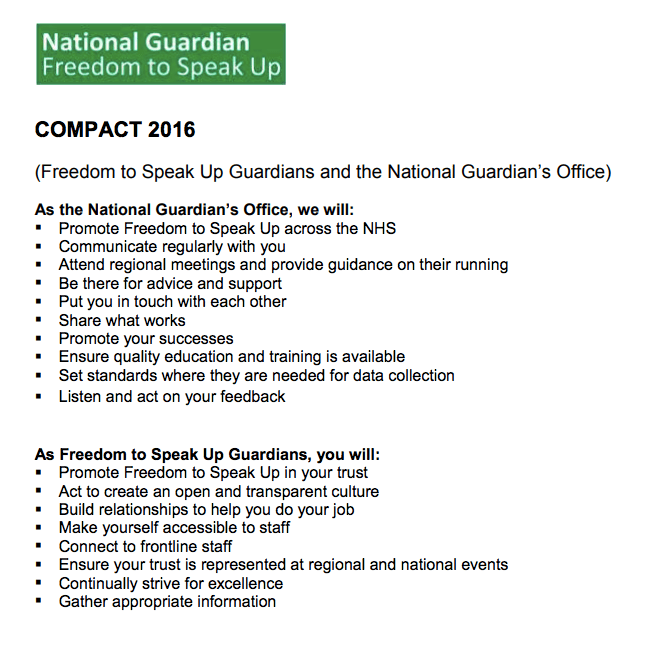
In addition, this is the ‘compact’ between the NGO and local Freedom to Speak Up Guardians. The NGO undertakes to ‘promote successes’ as part of the deal:

Screen Shot 2018-09-17 at 19.57.18

RELATED ITEMS:

Replacing the Public Interest Disclosure Act

delay deny road signs


Corporate schmoozing at the National Guardian’s Office: National Guardian’s Pan Sector Party Planning


By Dr Minh Alexander NHS whistleblower and former consultant psychiatrist, 15 September 2018

 Summary: The National Guardian’s Office turns away NHS whistleblowers in serious trouble. It sat on a mass staff referral from Brighton and Sussex University Hospitals NHS Trust about an unsafe and failing organisation. It has not inspired enough confidence, such that staff at Shrewsbury and Telford Hospital NHS Trust turned instead to the Local Authority as a route for disclosure.

The National Guardian is quick enough to cry limited resources when defending its very selective and minimal choice of cases for review.

But it can find a fat slice of these limited resources to host grandiose schmoozing sessions with corporations that are notorious for harming whistleblowers.

The output from these meetings does not suggest that there is any serious governance work being done in these sessions.

Whose interests are being served? 

The Freedom To Speak Up project is a Department of Health and Social Care PR vehicle.

Its function is not to do any governance heavy lifting or to genuinely challenge the political origins of much of the bullying and suppression in the NHS.

Rather, it is needed to spin the semblance that ‘something has been done’ and to generate endless soundbites and photo ops.

The National Guardian’s Office (NGO) sits at the head of this PR machine. It is supposed to review instances of poor practice but has stayed clear of obvious whistleblowing hot spots such as

Colchester University Hospital NHS Foundation Trust  (now amalgated with Ipswich Hospital NHS Trust to form East Suffolk and North Essex NHS Foundation Trust.)

The NGO failed whistleblowers at Brighton and Sussex who made a mass referral.

It did not review Shrewsbury and Telford Hospital NHS Trust which was also obviously troubled and knee deep in patient safety scandals and complaints from families. We now know from a report this week that Shrewsbury and Telford Hospital NHS Trust staff were so frightened that over a period, they took their concerns about bullying at the trust to a Local Authority councillor.

What does that say about trust and confidence in either the local or National Freedom To Speak Up Guardians?

But illustrating the way that the Freedom To Speak Up project is used for publicity to prop up dysfunctional trust boards, there has been a generous sprinkling of selfies and surreally upbeat promotional material on trust Instagram, Facebook and Twitter about Shrewsbury and Telford Hospital NHS Trust’s Freedom To Speak Up Guardians. Not to mention public displays by the CEO and HR Director  of enthusiasm for the project.

There is probably more case work than the NGO can actually handle given its relatively small establishment and budget of £1million. It certainly has a high case rejection rate.

So, perhaps one would expect to see hard work, no frills, a serious focus on looking after whistleblowers in difficulty and holding erring executives to account?

Wrong! Party on down instead to glitzy conferences and roadshows.

Behold the obsession with getting a mention in the papers. An email revealed that an NGO spin doctor had a strop because the media talked to smelly old whistleblowers  after the appalling findings of the Gosport inquiry report were released, instead of talking to the NGO. Given the issues arising from the unnatural, covered up deaths of hundreds of people and industrial scale collusion between various government bodies, the pettiness and self-interested nature of this protest sits very ill.

As part of the non-stop party planning, the NGO established a ‘Pan Sector Network’. This was kept out of view and not shared with the National Guardian’s official advisory working group, which includes a number of whistleblowers, myself included. But a brief mention in the NGO annual report of October 2017 revealed that the Pan Sector Network (PSN) had been launched.

The National Guardian’s PSN has met on five occasions since it started in July 2017:

17 July 2017

10 November 2017

26 January 2018

8 June 2018

14 September 2018

The National Guardian’s Office was asked for the PSN meeting records in July, but dragged its feet on this FOI and was over a month late in disclosing without good reason.

The NGO initially apologised that there was a delay and advised this was because the request was not recognised as an FOI. It later shifted the goal posts and claimed the delay was due to consulting a large number of third parties (despite the scope of the request having been reduced by negotiation with the CQC’s information governance team.)

The disclosure was incomplete and has been challenged.

These are the papers that the NGO has released:

National Guardian’s Pan Sector meeting papers disclosed 14 September 2018

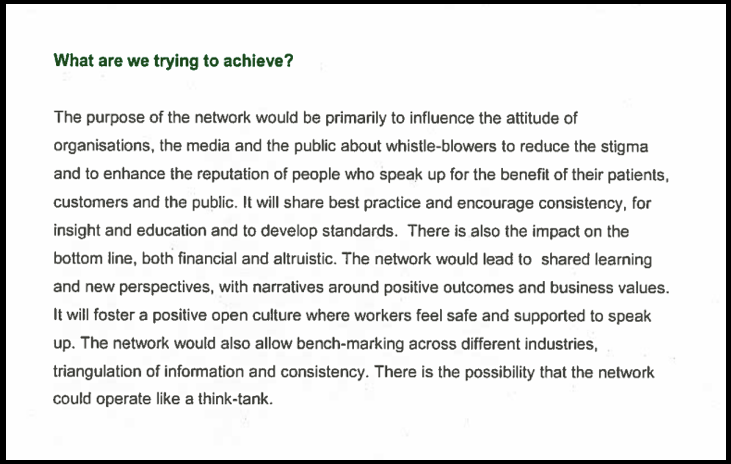
The stated purpose of the PSN is stated to be:

B AIms

A think tank to spread NHS policy that is beautifully crafted to be ineffective?

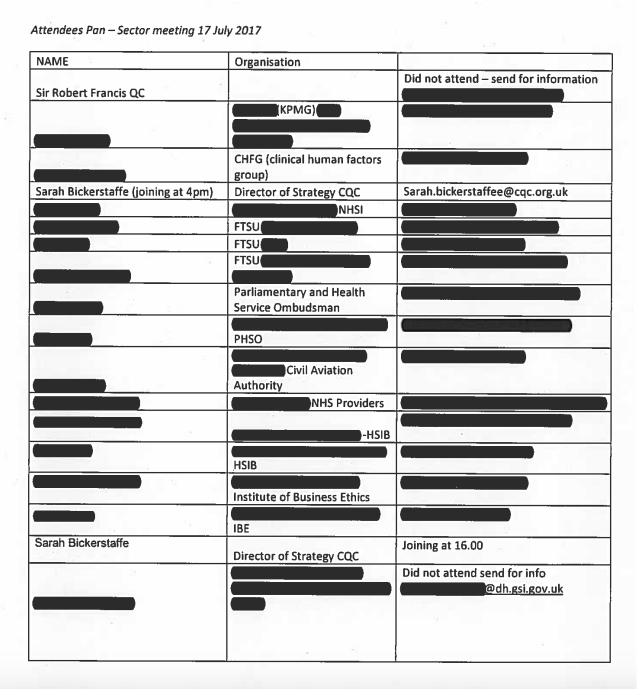
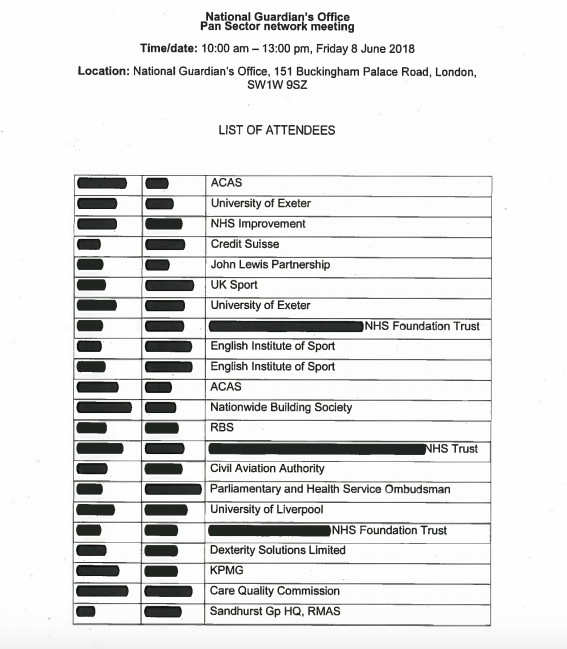
And judging from the record of attendees, apparently one not including whistleblowers, except perhaps for a few employed by the NHS as Guardians (although this is not clearly evident).

Lots of emphasis on soft culture change, and no plans to transfer any power to workers through effective, protective legislation.

A Sir Humphrey special.

Not to mention that the banking sector and MoD – attendees of the PSN meetings – have embraced the same model of internal champions who can also be victimised by any unscrupulous employer. As amply demonstrated by Barclays Bank’s treatment of its head of whistleblowing, as reported by Private Eye Issue 1470, in May:

Cosy nostra

The terms of reference for the PSN claim rather overbearingly and without evidence that:

“…other sectors have much to learn from the NHS, which has come a long way since the publication of the Freedom To Speak Up Review”

And what of the guest list? A preponderance of corporate types and employers. Just the sort of gathering that would have the wrong sort of expertise on how to deal with whistleblowers.

Attendees at the first PSN meeting in July 2017:

Attendees July 2017

The NGO failed to produce an attendee list for the second PSN meeting in November 2017, so it is possible that some inconvenient fact lurks there. A repeat request has been made.

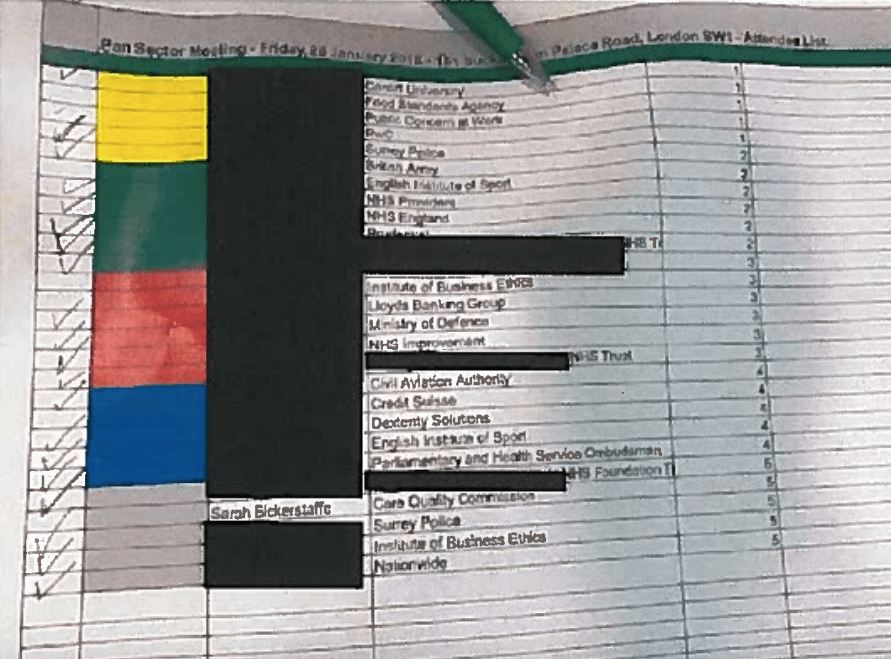
Attendees at the third PSN meeting on 26 January 2018:

Attendees Jan 2018


Attendees at the fourth PSN meeting on 8 June 2018:

B Attendees 8 June


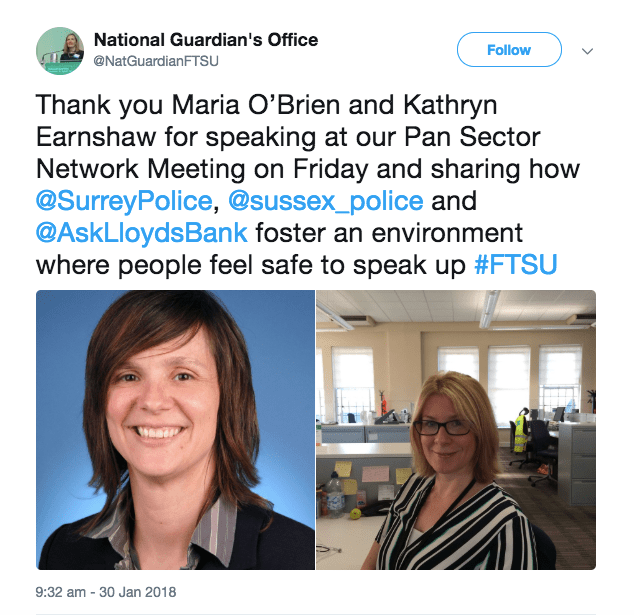
For a venture that is supposed to be about transparency, there has been daft secrecy. Even the identities of specific NHS trusts were redacted. The identities of attendees whom the NGO had happily tweeted about were redacted. For instance, the Surrey Police representative and Lloyds Bank Head of Colleague Conduct Management Team.

B lloyds


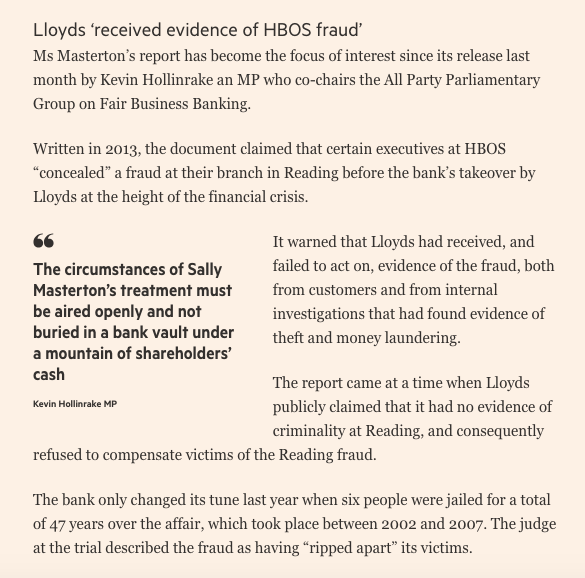
Lloyds has of course been dogged with scandal over the suppression of whistleblower Sally Masterton

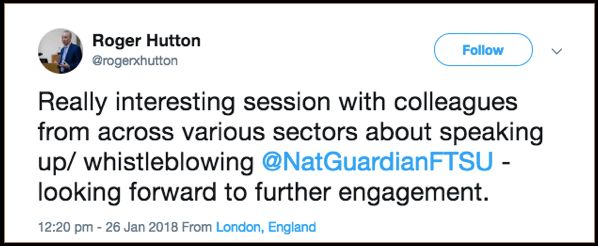
Another example of information in the public domain being withheld is the redaction of the MoD’s Chilcot Guardian from the attendance list of 26 January 2018, when he and the NGO had exchanged jolly tweets.

B Hutton

Interestingly, the NGO also made this disclaimer in a covering email to the FOI disclosure:

Please note, although a Royal Bank of Scotland (RBS) representative is listed as an attendee of the event on 8 June 2018, they did not attend that meeting.”

What was the NGO thinking in any case, inviting a notorious whistleblower slaying organisation to pose as a whistleblowing resource?

The same could be asked about why Lloyds were invited:

Screen Shot 2018-09-14 at 22.30.14

The Nationwide is no innocent either. 

Credit Suisse has recently been accused of complicity in a fraud.

PwC has been accused of many improprieties over the years. A recent allegation by a PwC whistleblower is of fraudulent audits for Silicon Valley companies:

“Botta alleged that, to keep corporate managers happy and to avoid losing their business, PwC was pulling its punches—trying not to flag too many problems with companies’ internal controls.

He said he was concerned about “the risk of collusion between auditors and management in this valley . . . with management paying us the fees and auditors picking and choosing what to call an audit issue.”


PwC is notorious because of another whistleblower scandal – the so-called LuxLeaks:


·       “PricewaterhouseCoopers has helped multinational companies obtain at least 548 tax rulings in Luxembourg from 2002 to 2010. These legal secret deals feature complex financial structures designed to create drastic tax reductions. The rulings provide written assurance that companies’ tax-saving plans will be viewed favorably by Luxembourg authorities.

·       Companies have channeled hundreds of billions of dollars through Luxembourg and saved billions of dollars in taxes. Some firms have enjoyed effective tax rates of less than 1 percent on the profits they’ve shuffled into Luxembourg.”


PwC called for the Luxembourg authorities to prosecute Antoine Deltour the whistleblower who did a tremendous public service by lifting the lid on the tax scam:

“PwC’s official complaint, which triggered the charges for theft and violation of professional secrecy looks arrogant and firmly in the camp of Big Bad Business. It should urgently reconsider its call.”

Thankfully, the conviction against Deltour was quashed and he was rightfully recognised as a whistleblower. 

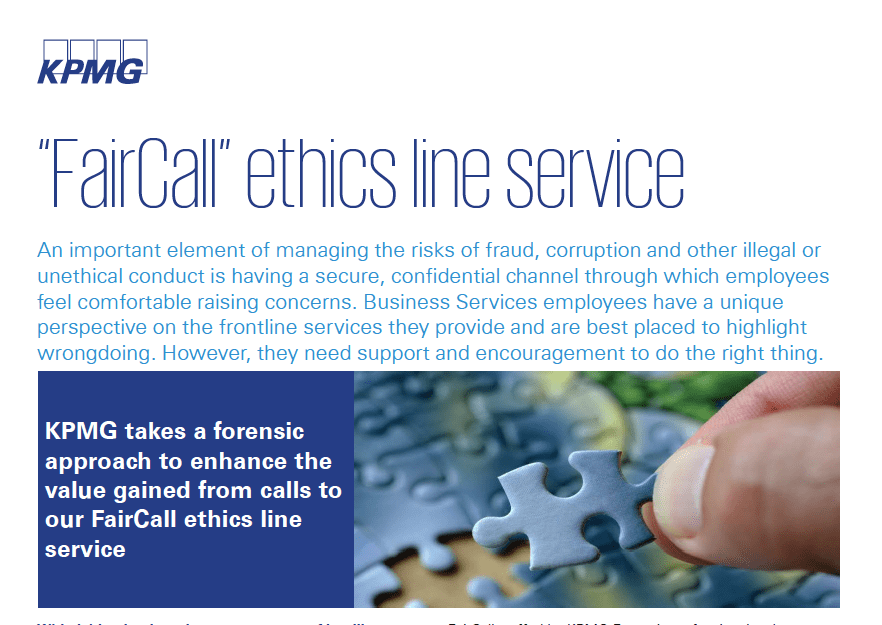
As for KPMG, what is not known about their services to whoever pays? KPMG cash in on whistleblowing by selling services to purportedly improve clients’ governance, and for a fee, they provide purportedly confidential reporting channels:

Faircall

But there have been concerns raised about whether such services are safe for whistleblowers. For example, in the scandal in South Africa over State capture by the Gupta brothers. KPMG was hired by the Guptas and has come under serious criticism for the rigour of its audits, some of which it has been forced to review because of the scandal. Inevitably, the Gupta scandal comes with tales of whistleblower persecution. Some have questioned the independence of KPMG’s whistleblower services in South Africa:

The hotline is hosted by KPMG SA on behalf of its clients so that they can anonymously report to the auditing firm any internal corruption at the client’s company.

It’s not configured to be used internally at KPMG SA for whistleblowing by its own staff. In the past fortnight, KPMG SA has basically admitted to being a Gupta pawn.

It has conceded that its “rogue unit” report for the South African Revenue Service was a work of fiction.

We also now know that when junior auditors at KPMG SA raised red flags over work done for the Guptas, they were slapped down.

Thus, it is not irrational to conclude that any whistleblower at Sars, or any Gupta-controlled company, would similarly have got short shrift if they phoned in their tip-offs to KPMG.”

In June 2018, KPMG came under heavy criticism by the UK Financial Reporting Council for the quality if its audits:


‘Across the Big 4, the fall in quality is due to a number of factors, including a failure to challenge management and show appropriate scepticism across their audits, poorer results for audits of banks. There has been an unacceptable deterioration in quality at one firm, KPMG. 50% of KPMG’s FTSE 350 audits required more than just limited improvements, compared to 35% in the previous year. As a result, KPMG will be subject to increased scrutiny by the FRC.’


So what is it that the National Guardian wants to learn from the likes of Lloyds, RBS, KPMG and PwC?

Or is a mistake to assume that learning is the primary goal of the schmoozing?

The NGO disclosed via another FOI request (CQC IAT 1718 0886, 19 April 2018) that the National Guardian held two un-minuted meetings with KPMG:

KPMG meetings

It is troubling that a senior public servant should meet twice with a commercial organisation, and for there to be no record kept.

Also listed amongst PSN meeting attendees is an entity called Dexterity Solutions. It is not clear what its business is, but a business of the same name  which is listed as Company 06374717 by Companies House, has website which I find difficult to understand in its explanation of the services on offer. But it does post blogs such as ‘Creating a culture in 2 minutes’, and it advocates listening: “Acknowledging that what is said is important to the speaker”.

And what is the output of these grandiose, hugely expensive PSN meetings launched by the NGO? A glance at the impoverished content of the minutes would make any experienced whistleblowing campaigner want to cry.

Suggestions generated by PSN meeting 26 January 2018:

Output

This is all very basic. And some of it is evidence-free, such as the emphasis on internal Guardians employed by the organisations they are supposed to hold to account.

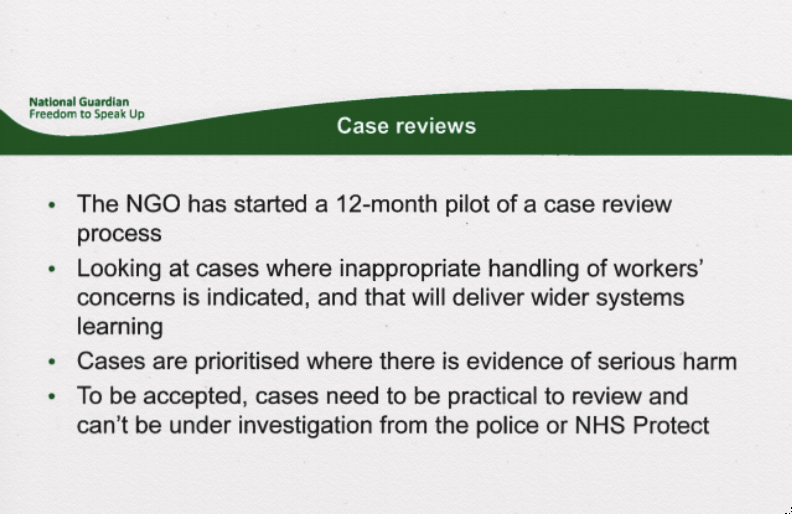
The disclosed papers reveal more barriers that the National Guardian has put in place against whistleblowers seeking help from her office. It appears that cases must be ‘practical to review’, whatever that means:

B Practical to review

It is galling to see precious public money wasted on frippery and empire building when the NGO turns down whistleblowers seeking help, and some whistleblowers are driven to bypass current NHS reporting mechanisms altogether because they cannot trust them

The sub-industry of employers, non-expert experts and hired guns congratulating each other for good whistleblowing governance builds careers and revolving door opportunities for some.

But whistleblowers continue to suffer whilst this unseemly festival of false assurance dances on.

Oh, and brace for a treat. A whole month of Freedom To Speak Up is on its way.

Weather forecast: Hurricane force selfies, torrential self congratulation.

B Oct

UPDATE 5 DECEMBER 2018

A much-delayed FOI disclosure by the Financial Conduct Authority reveals more about the National Guardian’s empire building and efforts to consolidate the government’s ineffective model of internal whistleblowing Guardians/Champions/Ambassadors:

Financial Conduct Authority FOI disclosure 4 December 2018 Ref. 5944

This correspondence was requested on 16 August 2018 and the disclosure was made three months late. It reveals that a meeting took place between the National Guardian and FCA and that the FCA offered the National Guardian’s Office some potential FOIA exemptions to avoid the meeting being made public knowledge. The National Guardian’s Office also did its best to entice FCA speakers to its national conference in March 2017, with the reassurance that this was a by invitation only event, and that it would have a “good deal of control” over this highly choreographed conference. There you have it, the Office is about controlling the narrative and spinning a certain impression, not real Freedom To Speak Up.

UPDATE 15 FEBRUARY 2019

Highlighting the corruptible nature of internal compliance mechanisms, Apple’s Head of it Insider Trading Programme has himself been charged with insider trading:

The Register 13.02.2019: “Head of Apple’s insider trading program charged with… you guessed it… insider trading”


RELATED ITEMS

NHS whistleblowing isn’t fixed yet and this leaves patients exposed. An overview of unfinished policy business

Replacing the Public Interest Disclosure Act
Notably, Peter Wyman Chair of the CQC which employs the National Guardian, was a PwC partner and as Private Eye pointed out, a key figure in de-regulation

STFU not FTSU


Whistleblowing v Bounty hunting. A new whistleblowing APPG with sponsorship from bounty hunters

By Dr Minh Alexander NHS whistleblower and former consultant psychiatrist, 12 September 2018


Summary: UK whistleblowing law is utterly ineffective and fails to protect the public, or indeed whistleblowers.

It needs to be replaced and the campaign continues:

https://minhalexander.com/2018/07/18/replacing-the-public-interest-disclosure-act-pida/

But whenever law change is mooted, some hear opportunity knocking in a different way

There has been increasing lobbying to import a US model of ‘whistleblowing’ bounties. This is a lucrative business but is a far departure from whistleblowing in its truest sense, and raises problems of ethics, fairness and the efficient use of public funds.

There is insufficient data in the public domain on the effectiveness of US bounty schemes in protecting whistleblowers to conclude that they merit replication by the UK. The data that is available raises serious questions.

The use of bounties would be particularly problematic in the public sector as the model conflicts with Nolan principles of selflessness and strict neutrality.

This piece examines some of the background on bounties and a new All Party Parliamentary Group on whistleblowing. This APPG was established with financial contributions from a US bounty hunting law firm. Whistleblowers UK, a private company which has advocated for whistleblower rewards, has been paid by Constantine Cannon to act as APPG secretariat.


Whistleblowing is a social good. The European Commission and others have defined it as work-based speaking up in the public interest.

For many years, whistleblowers were viewed with suspicion and seen as no better than ‘rats’, ‘snitches’ and ‘stool pigeons’.

There have been occasional examples of ‘whistleblowers’ who have themselves been implicated in wrongdoing, such as falsification of records or who were paid bounties despite conviction for criminal breaches. Bradley Birkenfeld was paid $104m in bounties for reporting a tax fraud under US IRS rules, but he withheld some of the relevant information during the resulting investigation. He was eventually jailed for his part in tax evasion.This paper discusses the issues around the Birkenfeld case and others in more detail:

 Bounties for bad behaviour

But whistleblowing in its truest sense is altruistic, done in good faith and motivated only by the public interest.

That said, legal tests which require proof of utmost good faith are problematic, because they invite employers to attack whistleblowers’ character and fabricate smears.

There is also a wider public interest issue in ensuring that serious concerns are aired, even if motives may be ambiguous. For example, if whistleblowing disclosures are made in the context of an employment dispute.

But such pragmatic arguments can only be extended so far. The practice of actively incentivising whistleblowing with financial bounties is a much more ethically difficult matter. In the public sector, bounty models are incompatible with Nolan principles of selflessness, neutrality and the need for public servants to avoid any conflict of interest or actions motivated by personal gain. Bounties could undermine public trust.

In the health service, bounties for whistleblowing would conflict with the professional duty of candour and could erode public trust in healthcare professionals.

Bounty models would also cut across NHS contractual obligations introduced after the Winterbourne View scandal through changes in the NHS constitution, These require staff to raise concerns. From the public’s point of view, why should NHS staff be paid extra to do something which is already part of their job?

There are also practical problems with bounty models. They typically run on recovering financial assets, with a percentage of the spoils going to the person who raised the alarm. But how is such a model to work where there is no financial angle?

And how would it make sense to impose fines on a de-funded NHS that is little more than skin and bones, or take money from patient care for bounties? NHS Improvement has just admitted  that English NHS trusts have an underlying deficit of £4.3billion.

Taking a prime example, the US False Claims Act 1863 (FCA) was an emergency measure passed during the American civil war to stem a tide of fraudulent defence sales to the Union. Senator Howard who proposed the Bill explained that it was intended to induce fraudsters to betray their co-conspirators for a cash bung.

“In short, I have based the…sections upon the old-fashioned idea of hold out a temptation,” and “setting a rogue to catch a rogue…a reward for the informer who comes into court and betrays his co-conspirator”

Or as one author drily put it, ‘Riches for Snitches’. The idea was for anyone to litigate on financial fraud against the US government, on behalf of the US government. These are known as ‘qui tam’ suits (‘qui tam pro domino rege quam pro se ipso in hac parte sequitur’ or ‘who brings the action for the king as well as himself’). Qui tam actions were deployed in medieval England as a crude means of law enforcement by citizens where the Crown provided little infrastructure. Qui tam legislation had long been abolished in England.

The original False Claims Act bounty set in 1863 was an eye watering 50% of all assets recovered. Rough and ready justice. Fair enough under the exigencies of war, but there are better governance tools in quieter times.

The FCA fell into disrepute in the Second World War due to unpatriotic, so-called ‘parasitic’ and opportunistic claims. Adventurers piggy backed private FCA claims onto government criminal actions against fraudsters, which added nothing to the public interest. After representations by a disgusted Attorney General, Congress hogtied the FCA legislation in 1943 and discouraged bounty hunting under this provision for over forty years.

This is a history of the FCA:

False Claims Act – Incentivising integrity for 150 years for rogues, privateers, parasites and patriots

The FCA was revived in 1986 after scandals. This helped to spawn an industry which has netted billions in bounties. Bounties pay for claimants’ legal fees and a cut of the bounties typically go to specialist bounty hunting law firms. Phillips and Cohen one of the best known US bounty hunting law firms, reports that its whistleblowing suits have recovered over $12billion:

Phillips and Cohen


The modern FCA allows bounties of up to 30% of any money recovered by qui tam suits. The US government may join qui tam actions, ignore them or kick them out if, for example, they are considered ‘parasitic’ and a waste of public time and resources. An internal US Department of Justice memo from January 2018 reportedly revealed growing government impatience with the over-proliferation of FCA claims which are counter to the public interest.

According to US Departmen of Justice statistics, between 1986 and 2017 there were 11, 980 qui tam suits, which netted a total of $40,549,645,268 for the public purse. Of this, a total of $6,584,992,211(approximately 15%) was paid to bounty hunters.

Arithmetically, the US government is one up on the fraudsters. But is it right that vast amounts of precious public money have been given to individuals as bounties? Is appealing to greed the right way to tackle greed? Wasn’t legitimising greed and de-regulation of the markets part of the original problem? The jackpot model may get the government results, but also leaves some hungry. It is possible to be a genuine whistleblower who makes reasonable disclosures, but not to qualify for any award under a bounty scheme.

There is no complete, published dataset evident on the nature of FCA claims that have been made since 1986. The great majority of anecdotally reported cases feature financial fraud such as kickbacks and false billing. It is less common to come across FCA claims that are specifically about public safety. Arguments about fraud on the basis that the US government has been billed for health or social care that is so substandard that it is ‘worthless’  and constitutes fraud have been controversial. Some such claims have occasionally succeeded.

Regardless of whether such claims about substandard care succeed, the US government should arguably ensure that these concerns are passed to the relevant regulators as a matter of public protection. I asked the US Department of Justice if it tracked this category of claim and if it could furnish me with a list. It could not.

When the FCA was revived in 1986, anti-retaliation provision was added to the law, but there is no complete, published dataset evident on how whistleblowers have fared under these provisions. Unofficial sources suggest that only a minority of FCA claims result in bounties being awarded, and that many employees who whistleblow under the FCA have poor outcomes, which implies that protection has not been effective:

Whistleblowers, beware: Most claims end in disappointment and despair

There was even a totally bizarre case of Jeffrey Wertkin, a Department of Justice lawyer who was jailed for literally trying to sell out whistleblowers, who had claimed under the FCA, to their employers.

But markets march on. FCA claims need not be confined to US territory. They can be filed from abroad and this is a growing market:

“At least four awards have been made to whistleblowers who reside outside of the US, including SEC’s largest award-to-date of $30 million,” said Tim McCormack, partner at Constantine Cannon.” [2016]

 Two well known US bounty hunting law firms set up offices in the UK, Phillips and Cohen in 2016 and Constantine Cannon LLP in 2017 respectively. Constantine Cannon LLP reportedly tried for years to persuade UK authorities to adopt the US bounty model.

Earlier this year, Forbes reported that Constantine Cannon had teamed up with the organisation Whistleblowers UK. The same article discussed the possibility that a ‘billionaire whistleblower’ will result from the bounty schemes.

There have been multi-billion claims under the FCA. In July this year, Mary Inman of the bounty hunting law firm Constantine Cannon reported on a pending case of $5b healthcare fraud. So, working on a 30 percent bounty, it is theoretically possible for the False Claims Act system to issue a reward of over a billion dollars.

In a parliamentary debate about the finance sector on 18 January 2018 Norman Lamb MP, who secured the debate, called twice for the adoption of US style bounties:


Debate on RBS Global Restructuring Group and SMEs 18 January 2018

‘The truth is that whistleblowers have no real protection in this country. Contrast that with the situation in the United States, where the Dodd-Frank legislation introduced the Office of the Whistleblower, which is there to protect whistleblowers. Whistleblowers are rewarded financially for doing the right thing—they are awarded between 10% and 30% of the sanction collected against the firm, which can run into millions of dollars. What a contrast with the position in this country! We need our own office of the whistleblower, and whistleblowers should be guaranteed anonymity; they should be rewarded for their bravery. Maintaining the integrity of the banking system is of fundamental importance to all of us, and whistleblowers are necessary for that purpose.

… The Minister has not yet mentioned the role of whistleblowers. Does he agree that they are vital to maintaining the integrity of the financial system, that they need proper protection—an office of the whistleblower—and that they should be rewarded for being brave enough to reveal wrongdoing?”


A new whistleblowing All Party Parliamentary Group on whistleblowing was established over the summer. Its officers and full details of its secretariat were revealed on 29 August 2018.

Screen Shot 2018-09-11 at 15.23.30

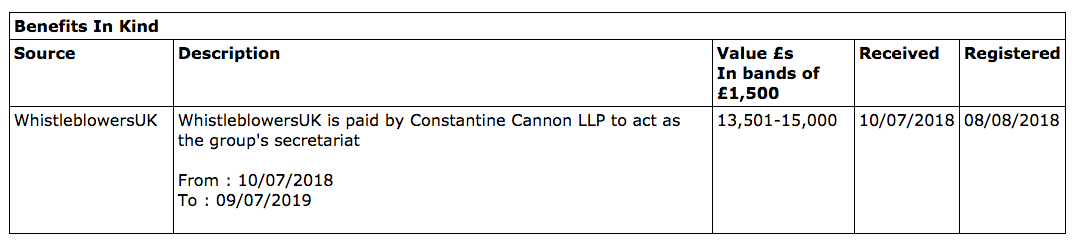
Of great interest to whistleblowers, it became evident that Constantine Cannon had paid Whistleblowers UK to act as the APPG secretariat:

Whistleblowing APPG Constantine Cannon paid WBUK to act as secretariat

Whistleblowers UK is the trading name of a private company WhistleblowersUK Company number 09347927. (This is not to be confused with the original organisation Whistleblowers UK Company number 08112953, which was dissolved in 2015)

The CEO of Whistleblowers UK and her husband established two new  whistleblowing companies in May 2018, Whistleblower Legal Limited and Whistleblowers International Limited.

Whistleblowers UK has advocated for whistleblower rewards:

WBUK and rewards

I asked Whistleblowers UK for details of any disclosable donations under parliamentary APPG secretariat rules,  and whether the organisation had received any other remuneration from law firms with an interest in bounty hunting. The Chair of Whistleblowers UK has advised that there were no disclosable donations, but there was no response on the wider question of other remuneration: Correspondence with Whistleblowers UK 

Corporate funding for APPGs has been a controversial matter, as there is concern about the access that APPGs may provide to parliament and to ministers.

On 29 August when details of the new whistleblowing APPG were revealed, The Times ran a piece about the APPG, Whistleblowers UK and Constantine Cannon. The banner photograph was of bereaved families from the Gosport scandal about unnatural opiate related deaths, where whistleblowers first raised the alarm in 1991 but were ignored. It was eye catching, but this is precisely the sort of disaster that will not fit easily into bounty hunting schemes.

Whatever one makes of the new whistleblowing APPG, and despite Norman Lamb’s proposal to import the US Securities and Exchange Commission’s Dodd-Frank programme, the known facts about the programme are not compelling evidence of ethical governance.

SEC’s Dodd-Frank bounty programme commenced in 2011 and it invites disclosures from both employees and other sources. Tip offs to SEC have increased steadily since the programme’s inception:

SEC tip off statistics

Tipsters may qualify for a bounty of up to 30% if their intelligence contributes to government enforcement action that generates more than $1million in fines.

In its 2017 annual report, SEC advised that its bounty programme has resulted in over $975million fines and over $671million in ‘disgorgement of ill-gotten gains and interest’.  The programme has paid out a total of $160million in bounties to 46 individuals since inception. However, the Commission has been criticised for welching on its bounty deals and attempting to conceal this. In 2015, the Wall Street Journal obtained data which showed that 247 of 297 (83%) claims for bounties since 2011 had not received a decision from SEC.

Moreover, SEC prosecutes hundreds of enforcement actions every year:

SEC enforcement action statistics 2016 and 2017

but since the inception of its whistleblower programme in 2011 the Commission has undertaken only three enforcement actions for whistleblower retaliation under the Dodd-Frank provisions.

It also appears from government data that US financial sector whistleblowers fare poorly when they apply to the US Department of Labour for administrative remedies for reprisal.

The system is very complicated, but two important statutes under which US finance whistleblowers can file complaints are Sarbanes-Oxley and Dodd-Frank.

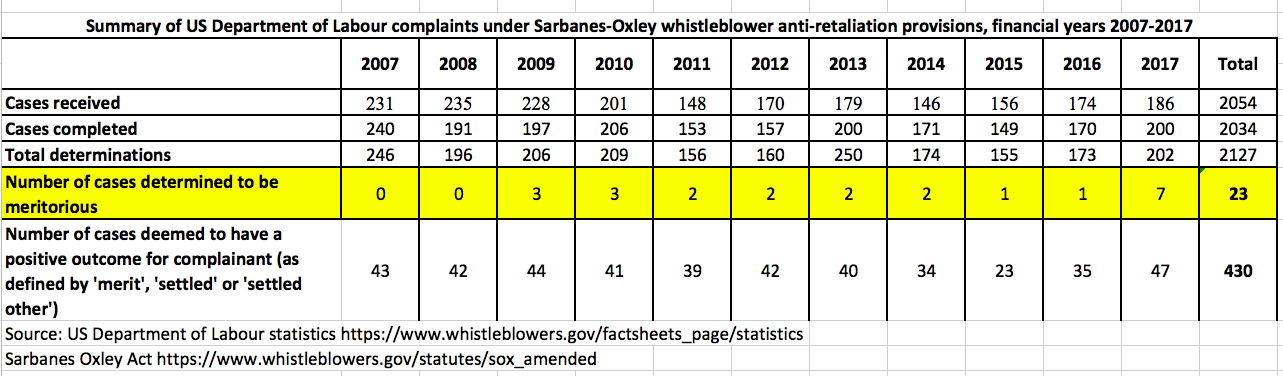
Department of Labour statistics show that between 2007 and 2017, out of 2054 cases received under the Sarbanes-Oxley administrative procedures, only 23 (1%) resulted in a clear win and finding of merit for whistleblowers. About a fifth of Sarbane-Oxley retaliation cases resulted in some sort of positive outcome, even if short of a clear finding of merit.

Department of Labour Sarbanes-Oxley whistleblower retaliation complaints statistics

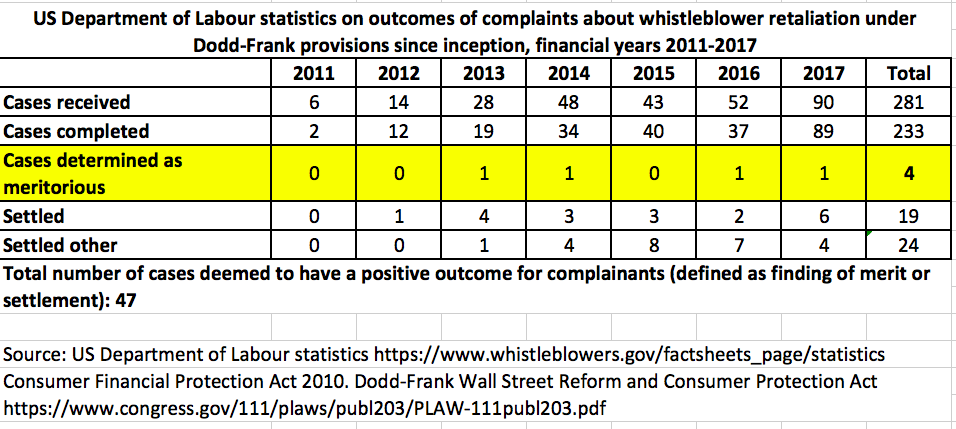
Since the Dodd-Frank administrative procedures for whistleblower retaliation commenced in 2011, only 4 out of 281 (1.4%) complaints received resulted in a finding of merit. Less than a tenth of Dodd-Frank retaliation cases were considered to have a positive outcome for whistleblowers, in terms either of a clear finding of merit or settlement.

Department of Labour Dodd-Frank whistleblower retaliation complaint stats

Under Dodd-Frank some whistleblowers may be permitted to litigate after exhausting the administrative process for retaliation. There is no complete data on how they fare when they seek legal remedies for retaliation in the courts, but anecdotal reports have highlighted problems with how the law is interpreted, pro-employer bias and issues of jurisdiction. Most recently, SEC issued this discouraging clarification:

“On February 21, 2018, the United States Supreme Court issued an opinion in Digital Realty Trust, Inc. v. Somers stating that the Dodd-Frank anti-retaliation provisions only extend to those persons who provide information relating to a violation of the securities laws to the SEC.  To understand how this may affect you, we encourage you to consult with an attorney.”

As with the FCA, tip offs to SEC’s Dodd-Frank programme can be made from outside of US territory. In the Commission’s 2017 annual report, the UK led the field in that year with 84 tip offs, followed by Canada (73) and Australia (48).

Some may feel that the finance sector needs special arrangements for whistleblowing, for the greater good and in consideration of serious disruption to public services and misery that can be inflicted on millions of people from major financial disasters. But the Bank of England is very much opposed to bounties. Whilst some of the BoE’s observations about the effectiveness of bounty models in generating tip offs have been disputed, its general points about the ethical problems with bounties are well made. That said, the BoE’s limp offering of culture change is unacceptable:

“Our aim will be to ensure that the culture in firms is one where people are prepared to speak up, as part of improving behaviour throughout the firm.”

This mirrors the political line and tokenistic measures that the Westminster government has put in place for the NHS.

Neither the extremes of wilful blindness and impunity for retaliators, nor pitiless monetisation of whistleblowing which treats many whistleblowers as disposable, are acceptable. What is needed is seriously implemented protection for all genuine whistleblowers.

When Norman Lamb vice chair of the new whistleblowing APPG, was in power as a minister at BIS in 2012, he made some similar arguments to those made by the Bank of England in rejecting bounties. He warned of the inadvisability of mixing governance up with personal enrichment, the need to discourage “speculative” claims and to prevent speculative claims from harming genuine whistleblowers through disrepute:

Debate on Enterprise and Regulatory Reform Bill 3 July 2012

‘There have been calls to make the penalty payable to the individual, but I would strongly resist that. The measure is intended to benefit all employees by encouraging employers to behave better. That is addressed only at those employers that fall below the standards that any decent person would expect. The measure is not intended to benefit individual claimants directly. The only effect of such a step would be to incentivise employees to bring speculative claims—the very opposite of the steps that we are taking to deal with concerns about weak claims. The employee gains nothing from a decision that an employer has behaved particularly badly in an individual case. They get the compensation for the loss that they have suffered, as I have explained.

… To return to my explanation of the purpose of the clause and of why the Government have designed it in such a way, the decision in the case of Parkins v Sodexho Ltd has resulted in a fundamental change in how the Public Interest Disclosure Act operates and has widened its scope beyond what was originally intended….The ruling has left the Public Interest Disclosure Act open to abuse and is creating a level of uncertainty for business. Concerns have been expressed, underpinned by anecdotal evidence, which I appreciate is a dangerous word to use in this Committee, from lawyers—that is an even more dangerous word—that it is now common practice to encourage an individual to include a Public Interest Disclosure Act claim when making a claim at an employment tribunal, regardless of there being any public interest at stake. That has a negative effect on businesses, which face spending time preparing to deal unnecessarily with claims that lack a genuine public interest element. It also has a negative effect on genuine whistleblowers, by encouraging speculative claims.’


Protecting whistleblowers will never be easy. Bounty models by definition do not try hard enough to ensure that whistleblower protection is effective: the proffer of large rewards is a tacit acceptance of unacceptable levels of reprisal. It is by design a solution – of sorts – but for just a few. The house plays the numbers.

The bounty model of whistleblowing is a glorified one-armed bandit.

And it’s people who should count the most, not cash.


RELATED ITEMS

  • This is Mary Inman of the US law firm Constantine Cannon speaking about whistleblowing bounties and qui tam suits at the Byline festival on 24 August 2018:

https://www.youtube.com/watch?time_continue=1&v=QoY6FEEeTNI

Inman argued that the use of paid informants is an accepted technique of law enforcement.


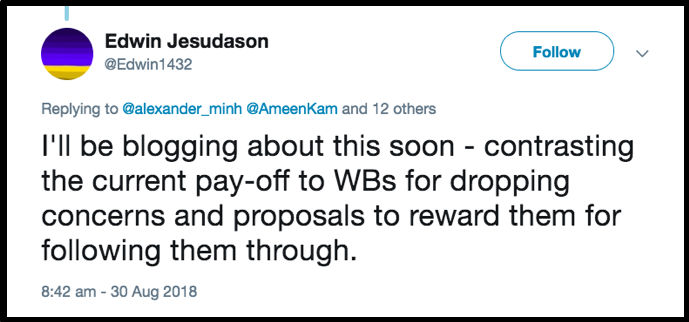
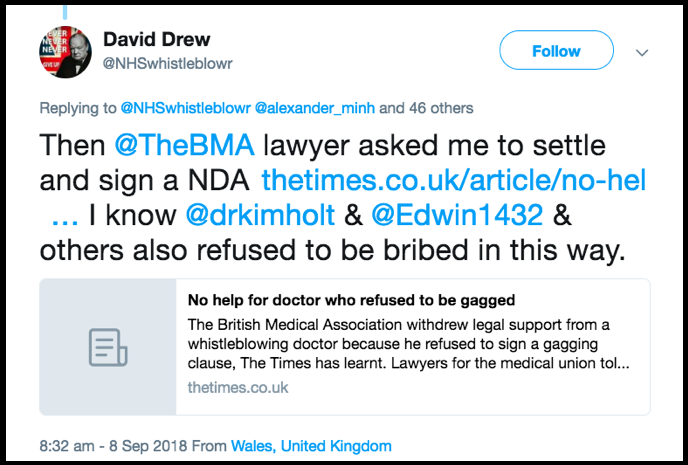
  • In recent debates, there has been conflation of compromise agreements with ‘bounties’ and ‘bribes’. For example:

Ed Jesudason tweet bounties instead of pay offs for dropping concerns

David Drew tweet compromise agreements are bribes

Such statements imply that whistleblowers accept cash to keep quiet against the public interest. The reality is much more complex. Gags unquestionably do discourage some staff from speaking out, but many compromise agreements are implemented after a long battle, and after patient safety disclosures have been made. The clue is the name : compromise agreements are usually substandard and do not even compensate fairly for all serious loss. They quite often leave whistleblowers in chronic economic insecurity. From whistleblowers’ perspectives, settling may be a means of limiting litigation risk when there are mouths to feed, families to protect from the stress of endless disputes or self care when health has been seriously affected. What compromise agreements quite often hide are embarrassing details of what employers do to whistleblowers, as opposed to the whistleblower’s original concerns. So in short, it is mostly victimisation and attrition that leads to compromise agreements. To equate this with ‘bounties’ or being ‘rewarded’ is not a serious argument.

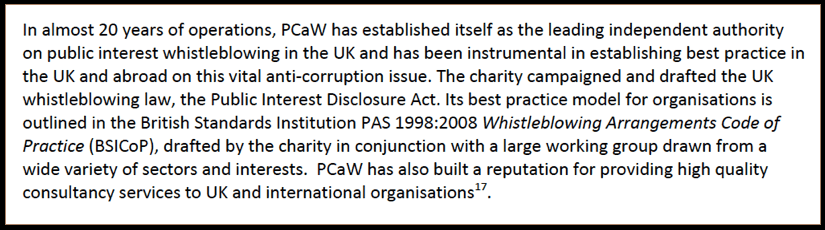
The papers for this APPG show that it was working with the organisation Public Concern at Work (which was just re-branded and is now known as ‘Protect’) and Whistleblowers UK to establish an Office for the Whistleblower:

Banking APPG WBUK PCaW Office For the Whistleblower taken up by BEIS

Some finance sector whistleblowers have expressed concern that this APPG has also accepted industry funding.

UPDATE 12 FEBRUARY 2020

Norman Lamb resigned from the Whistleblowing APPG because he was unable to get answers to questions about finances and probity which I put to the APPG.

Norman Lamb MP has resigned from the Whistleblowing All Party Parliamentary Group

The Whistleblowing APPG brought out a new Bill in January 2020 to establish an Office For the Whistleblower which contains no commitment to protecting whistleblowers, ensuring that their concerns are properly handled nor robustly deterring reprisal. But it does specify items which would be beneficial to whistleblowing industry middlemen.

The Whistleblowing APPG’s new Bill and unanswered questions about finances and potential conflicts of interest


One armed bandit

$$$$$$$$$$$$$$$$$$$$$$$$$$$$$$$$$$$$$$


CQC case study. Snooping, Briefing, Porkies & Vexatiously Applied ‘Vexatious’ Protocols.   Personal data guide for campaigners

Please sign and share:

Petition to replace weak UK whistleblowing law to protect whistleblowers and the public


By Dr Minh Alexander NHS whistleblower & former consultant psychiatrist, 5 September 2018

Summary

This is a piece to raise awareness amongst fellow campaigners about the importance of personal data as a tool when dealing with institutions that are seemingly opaque and unaccountable. I use an example of a ‘Subject Access Request’ for personal data that I made to the Care Quality Commission. This revealed institutional collusion and hostility, close surveillance of my online activity and revealed the reason for some critical failures to respond to some of my protected disclosures. Disclosed documents showed that this inaction was due to a deliberate, covert protocol of treating me as a ‘frequent correspondent’.

CQC’s internal deliberations show a crazy ambivalence. The organisation will largely not engage meaningfully, preferring to demonise and denigrate, yet secretly monitors me like a stalker.

Other whistleblowers have made similar discoveries.

Anyone can request their personal data, under the Data Protection Act, by making a so-called ‘Subject Access Request’ Organisations now have a month to respond. Guidance on your rights and how to make a request can be found on the Information Commissioner’s website. You can not only ask for all your personal data held by an organisation, but also the following questions:

·       What it is using your data for.

·       Who it is sharing your data with.

·       How long it will store your data, and how it made this decision.

·       Information on your rights to challenge the accuracy of your data, to have it deleted, or to object to its use.

·       Information on where your data came from.

·       Whether your data is used for profiling or automated decision making and how it is doing this.

·       If it has transferred your data to a third country or an international organisation, what security measures it took

When making a Subject Access Request it is useful to ask for the organisation’s correspondence about your request, as that too can be revealing.


The Care Quality Commission has a difficult reputation amongst patients, families and whistleblowers. In its troubled history, it has been repeatedly linked to cover ups and failures to be fully open with the public.

In regards to whistleblowers, CQC’s shortcomings include:

  • refusal to investigate individual cases
  • failure to follow up many whistleblowing disclosures (approximately half, according to its own statistics)
  • failures to safeguard whistleblowers’ confidentiality
  • failures to ensure that action is taken to remove unfit senior managers who victimise whistleblowers
  • failures to deter gagging
  • failures to sufficiently track and analyse data on whistleblowing events.


I asked the CQC for my personal data. The CQC exceeded the statutory time limit by over four months, pleading an excessive volume. This was undermined by the fact that I was aware CQC had processed a bigger request, for another whistleblower, in shorter time.

When the data eventually arrived in June 2017, in dribs and drabs, it was not in original format. Instead of scanning documents and redacting conventionally as CQC normally does, CQC had copied and pasted all the data into enormous documents. These had chunks deleted rather than blacked out. I suspect this was in some way a subterfuge.

Even from what was revealed, one could see why CQC might be a bit embarrassed. There is too much to report comprehensively, so I will cover a few highlights.

There is repeated evidence of ‘close’ CQC surveillance of my social media activity, including by ‘James’. This an email from David Behan CQC CEO’s office of 29 May 2015:

B James

This internal CQC email made it sound as if I publicly tried to discuss Dr Kevin Beatt’s case with CQC by twitter.


This was a distortion. What I did was publicise CQC’s questionable handling:

B Beatt

But that is how one creates a monster, by greasing and sliding facts around to give a certain impression.

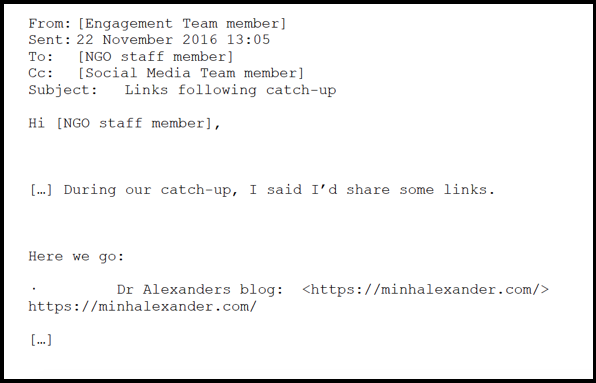
CQC officers repeatedly circulated links to my blogs and tweets amongst themselves.

David Behan himself, CQC’s CEO from 2012 until this July 2018, dog whistled the social media surveillance:

B Behan monitor tweets

CQC’s internal documents showed that the regulator conducted a laughable assessment of the merits of one of the FPPR referrals that I made. This is despite CQC telling some other referrers that it had no remit to make any such judgments of the merits of referrals, and that only providers could make that determination. CQC’s determination of my FPPR referral included taking evidence from a CQC manager who had ceased to be involved in the matter long before certain index events occurred. And as all of this was done covertly by CQC and never disclosed to me at the material time, I had no right of reply.

There was a fair sprinkling of derogatory comments by CQC officers in the disclosed papers, mostly expressing resentment at the level of correspondence from me, with no evidence of any reflection by CQC that my persistence could be due to CQC’s failure to address issues. CQC portrays itself as reasonable and accommodating.

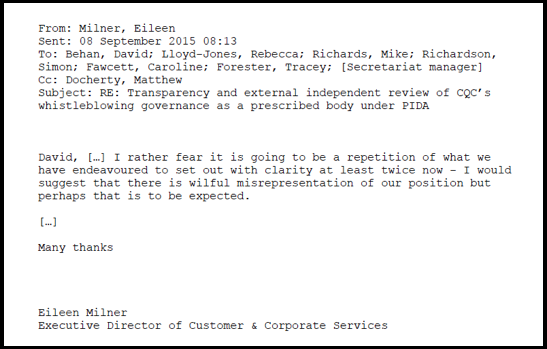
Andrea Sutcliffe a CQC Chief Inspector described me as a “trenchant and relentless” critic of the CQC and Eileen Milner Director of Customer and Corporate Services accused me of “wilful misrepresentation” over a dispute in 2015 about whether CQC was doing enough to track whistleblowing events. History is on my side as CQC has had to change its practices since then. In 2017, CQC started publishing data on whistleblowing events and outcomes.

B WILFUL

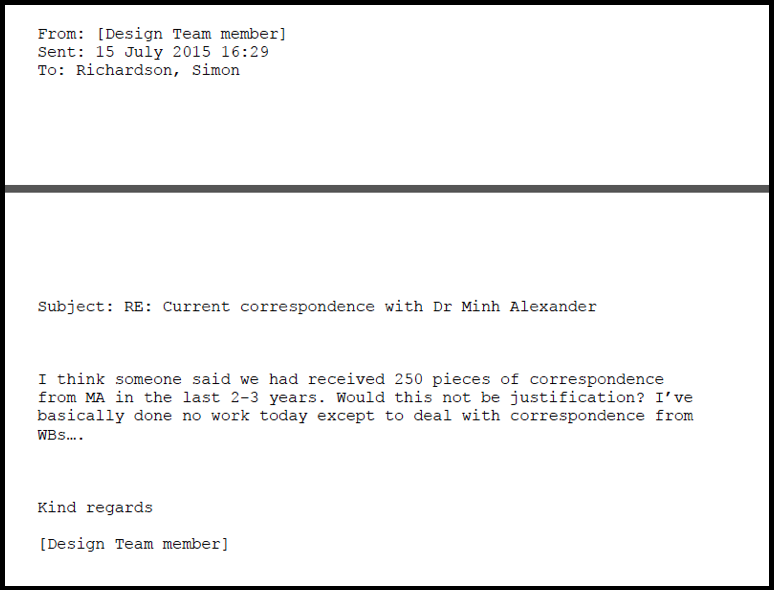
The unpleasant comments by some CQC staff had the quality of Chinese whispers. Misinformation abounds. A good example is this peevish outburst by a CQC member of staff who implied that dealing with whistleblowers was not work, and was wont to believe that I was responsible for 250 items of correspondence:

B 250

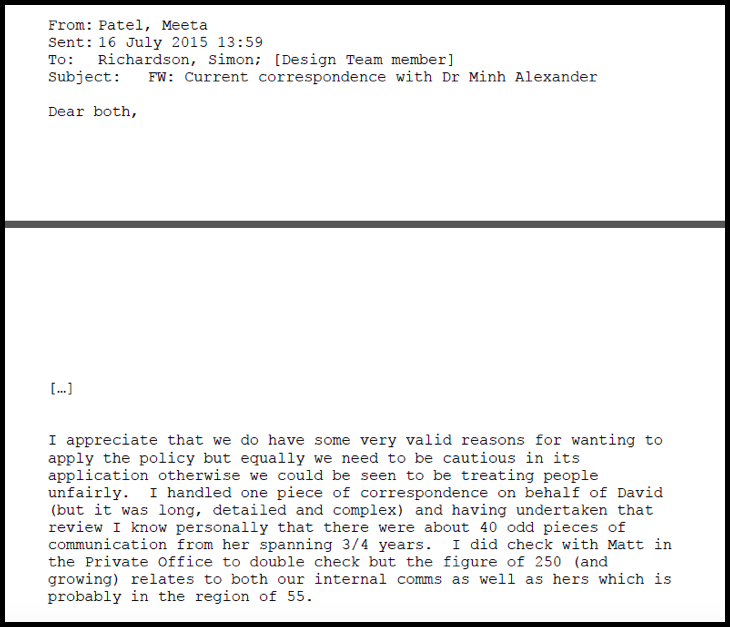
Their colleague put them right on the over-inflated 250 figure:

55

It is clear from the internal correspondence that CQC treated me as if I was vexatious, applying a covert protocol coordinated by the CEO and Chair’s office. Again, Behan had a hand in this:
B Behan ordered protocol

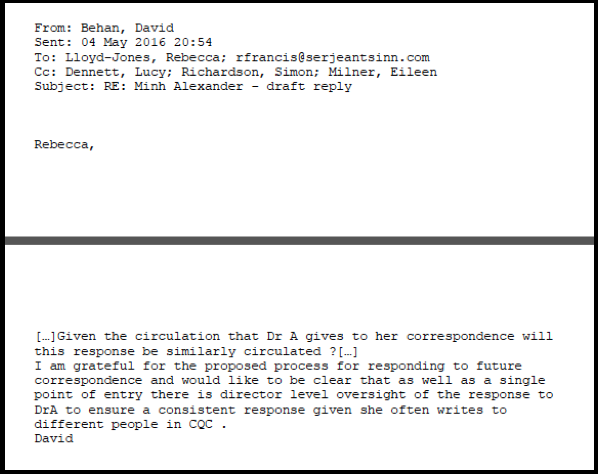
Behan strengthened the subsequent protocol designed by staff at his request by adding an instruction that there should be director oversight of my containment protocol:

B Behan director

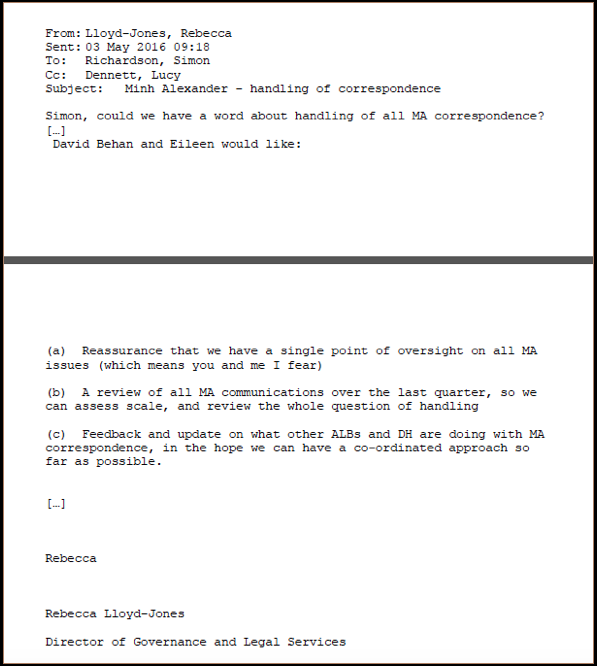
As per the above Director of Legal Services’ email of 3 May 2016, CQC was not content to just denigrate me within its internal workings, but upon Behan’s instruction it explicitly sought to spread its view of me to other bodies and to coordinate approaches.

Because CQC redacted some third party information, I have no idea who some of these people are.

But I do know that when CQC consulted with NHS Improvement as a third party over releasing personal data to me, it unsubtly flagged its reluctance to disclose by writing this warning to NHSI:

B NHSI

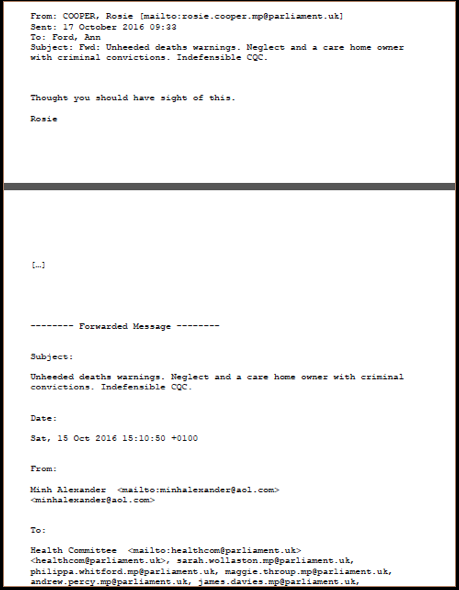
Interestingly, I also discovered that Rosie Cooper MP forwarded one of my letter to the Health Committee to CQC, with no explanation of her purpose in doing so:

B Cooper

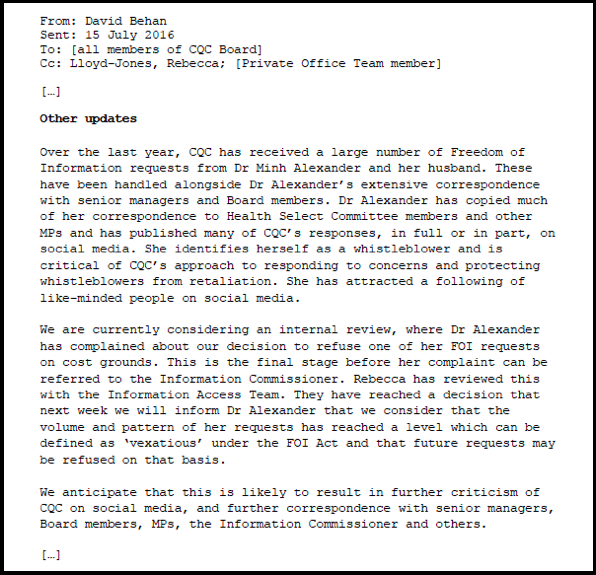
Behan wrote to all CQC Board members about my pariah status, the letter having been crafted by various managers including the head of legal services:

B Behan Board

The ‘she identifies herself as a whistleblower’ is a nice piece of Goebbelism. I made numerous very serious patient safety disclosures to CQC which were vindicated and led to regulatory action. I have repeated correspondence from CQC recording this fact. Behan himself acknowledged in a letter of 25 May 2013 and on subsequent occasions that I made entirely valid disclosures to the regulator:

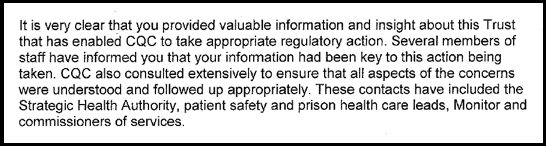
Screen Shot 2018-09-05 at 15.32.32

What a difference three years makes. From ‘valuable’ to ‘vexatious’.

But re-defining the fact of my whistleblowing to a matter of subjective preference was all part of the de-legitimisation game.

CQC never did openly declare me vexatious, but it became very obvious that all my mail was controlled by Behan’s office.

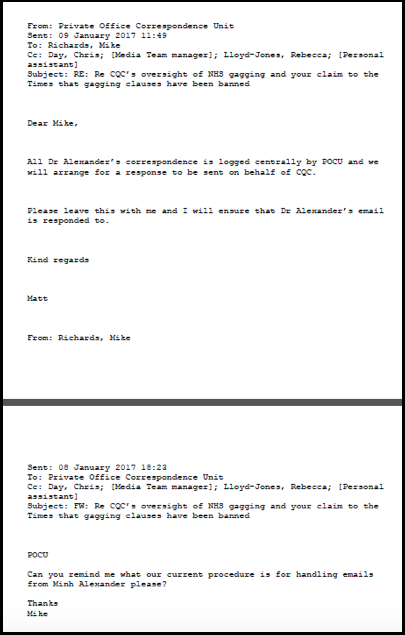
When I questioned Mike Richards CQC Chief Inspector of Hospitals about the fact that he made a factually inaccurate claim to The Times that NHS gagging had ceased, Behan’s office reassuringly took it off his hands and reaffirmed that all my correspondence was centrally controlled:

B Richards

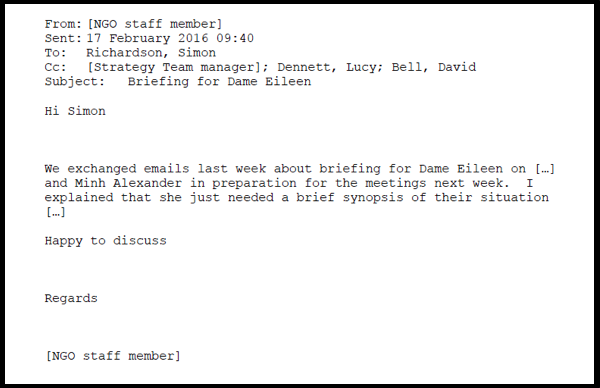
In February 2016 I had a meeting with the first National Guardian, Eileen Sills. I later found out from the Subject Access Request that she asked for a ‘briefing’ on me beforehand from the CQC:

B BRIEFING

The final version of the briefing was not in the bundle, and there is an implication that it was given orally. However, the trail shows an initial draft by Behan’s office was a lengthy rant, and was rejected by another manager as inappropriate in its content. I can only guess what might have been said instead of written. But so much for the mythical independence of the National Guardian’s Office, which is no more than a sub committee of the CQC. There were other examples of collusion and poor boundaries between the CQC and the National Guardian’s Office. Such as this huddle over the contents of my blog:

B HUDDLE

This was around the time that another whistleblower says they were approached by one of the National Guardian’s spin doctors at a public forum, who started berating me in a staged manner.

Ironically the person hired by CQC to improve customer services, including whistleblower engagement, the ‘Customer Experience Lead’, was amongst the most derogatory:

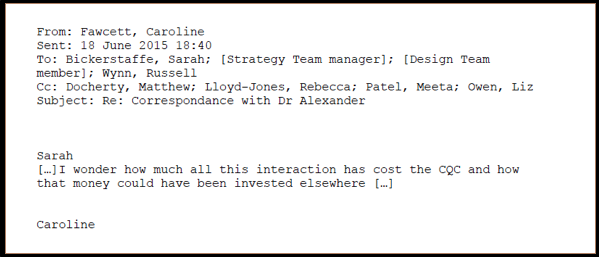
B Fawcett cost

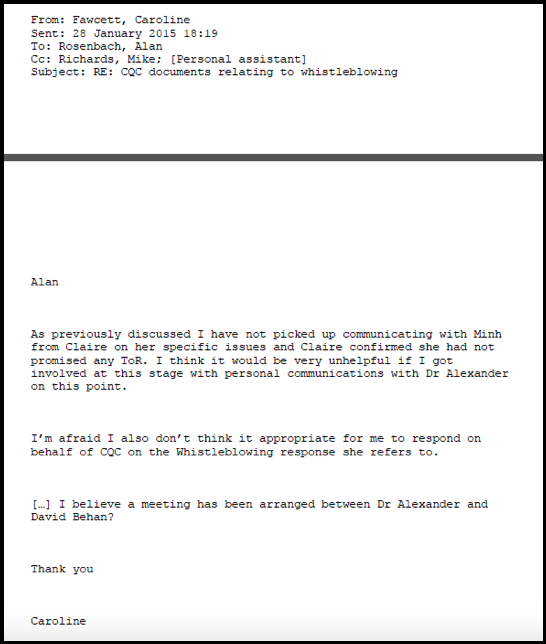
Fawcett added to the heap of Chinese whispers by claiming that I wrongly stated that I had been promised terms of reference for the project on improving CQC’s response to whistleblowers:

B Fawcett ToR

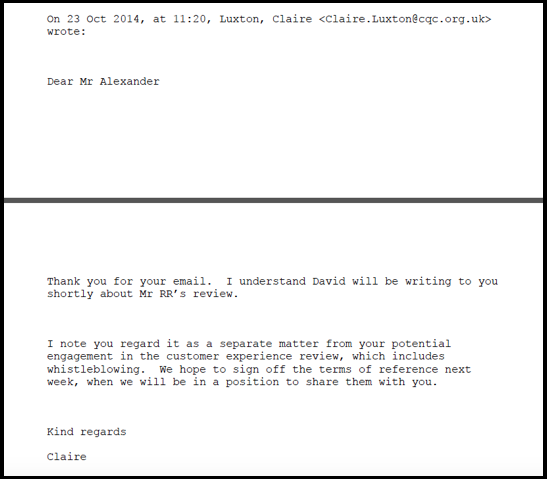
Contrary to Fawcett’s account, this is the written promise by her colleague to provide me with ToR, which Fawcett falsely claimed was never made:

B Luxton

The significance of this is that CQC invited me to take part in the improvement exercise, but I declined to do so unless give sight of the ToR. It then became false CQC orthodoxy that I just refused to take part and that I made up the story about being promised ToR. Monster Myth 101.

And my crime from Fawcetts’s point of view? Asking CQC to do some basic governance work on supporting and protecting whistleblowers which it had already been asked to do by Robert Francis and since by others. That is, ensuring tracking and analysis of whistleblowing data, better inspection methodology of whistleblowing governance and better application of Regulation 5 Fit and Proper Persons. The CQC is in retreat on all of these areas, and I anticipate that it will be forced to concede more ground as its failures are increasingly exposed.

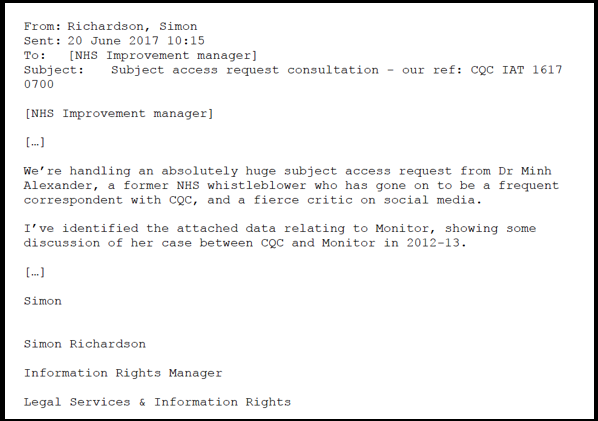
An extraordinary doublethink runs through some of the internal CQC correspondence. For example, the Information Rights Manager claimed on 3 January 2017 that I had just looked for evidence of CQC failure:

B FAILURE

CQC seems to find it hard to ask questions such as ‘Is this a fair challenge? Should we have thought of this before? Should this have been part of our regular governance? What can we learn?’ Instead, CQC’s repeated stance is ‘How dare you’.

In the same email, which is mostly taken up with complaining about dealing with me, the Information Rights Manager conceded that I was correct about fundamental CQC failures of whistleblowing governance:

B Assertions

CQC’s hypocrisy is reflected in its awareness that it ought to engage with its critics’ concerns, but the fact that it mostly only does so if there is any prospect of public exposure.

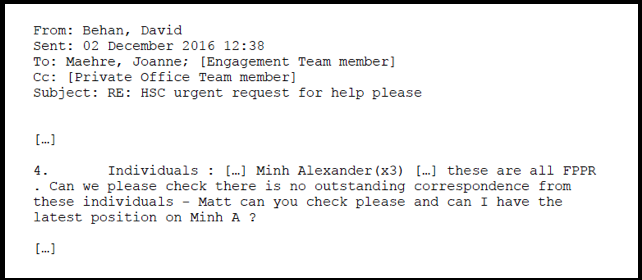
Behan sent out this ‘urgent’ request to his team for help just prior to an accountability hearing with the Health Select Committee, which includes a request to be updated about any outstanding matters in my case:

B Urgent

Readers will note that I was not the only person on Behan’s list.

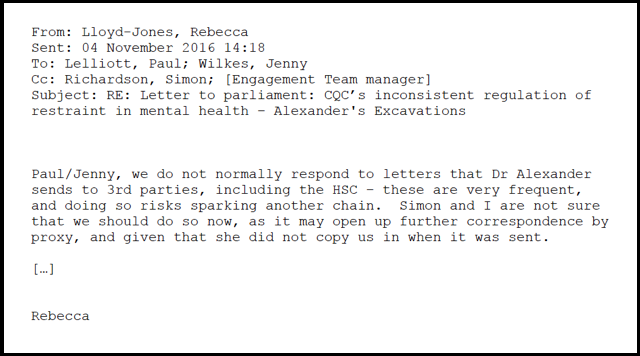
Likewise, in November 2016 CQC initially deliberately did not engage with evidence that I collated about CQC’s failure to adequately regulate the use of restraint in mental health. I had by now stopped writing much to CQC as there was little point given its attitude.

B RESTRAINT

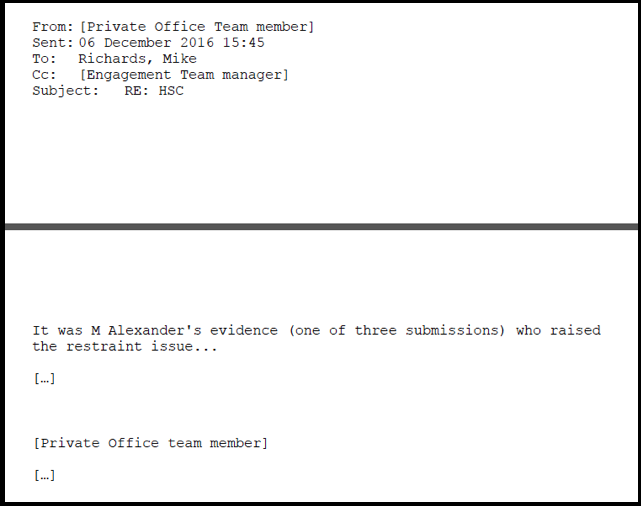
After Behan was publicly quizzed by the Health Select Committee about my evidence in December 2016, there were internal CQC emails identifying me as the person responsible for alerting Health Committee:

B SOURCE

The focus, one way or another, was more on projecting blame onto me and less on dealing with CQC’s serious failure to protect patients from huge variations in use of physical restraint.

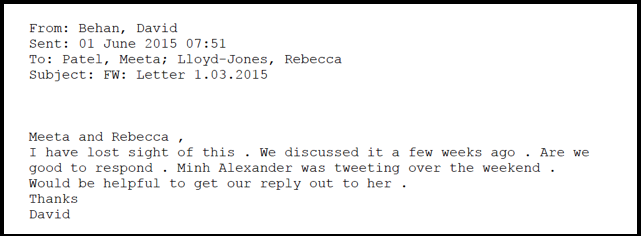
In the same vein, Behan sent this internal email requesting that some correspondence be expedited because I had been tweeting at the weekend at about it:

B WEEKEND

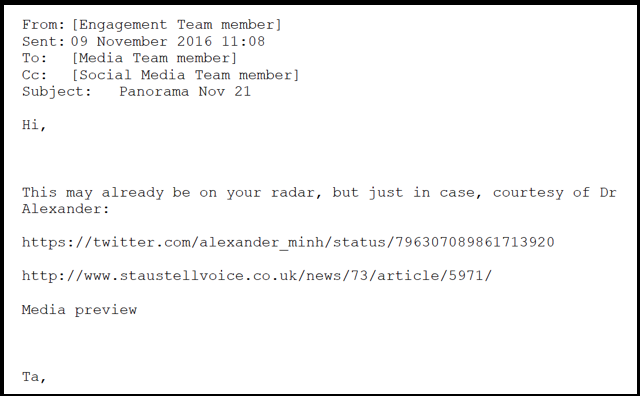
The disclosed papers afforded some comic moments. Here is an occasion when the regulator picked up an undercover media report of care home abuse as a result of snooping on me:

B Panorama

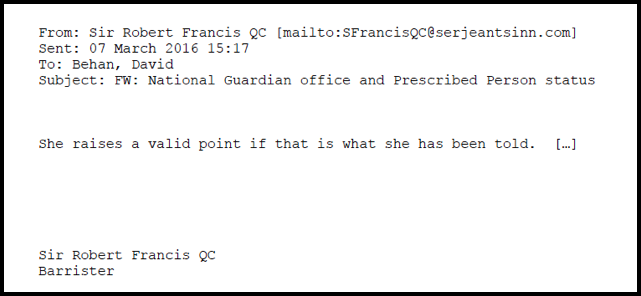
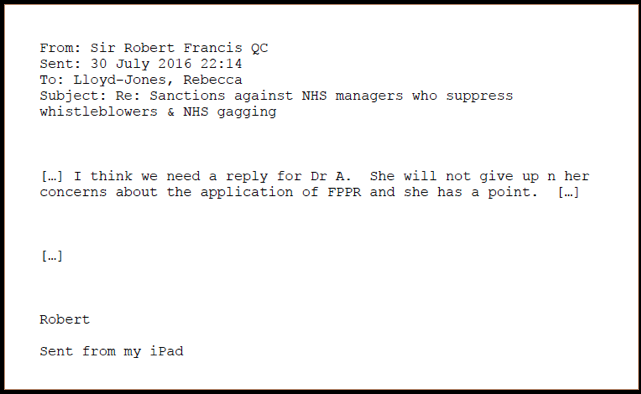
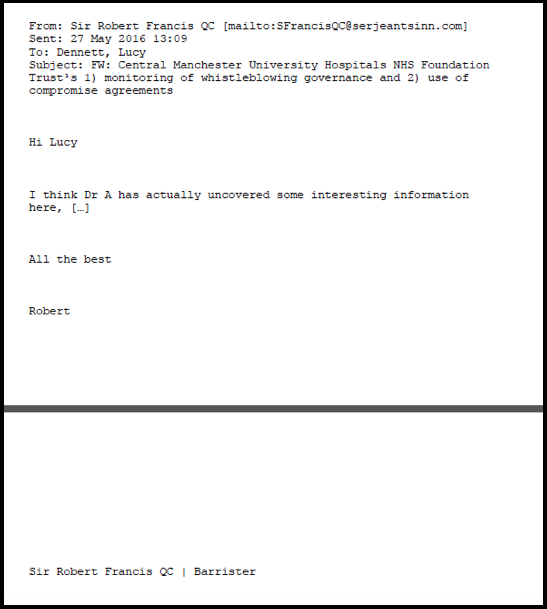
Robert Francis joined in with some of the ‘she’s a pest who writes too much’ chorus, and agreed with the containment protocol that Behan wanted to apply in my case. But interestingly, he was repeatedly a lone voice pointing out that I had a point. For example on:

  • The need to acknowledge the National Guardian’s status and responsibilities as a Prescribed Person under the Public Interest Disclosure Act

B Prescribed


  • CQC’s application of FPPR

B FPPR

  • Some NHS trust’s continuing, heavy use of gagging clauses

B Gagging

Francis opined at one point that CQC needed to either ‘rebut or acknowledge’ points which I had raised.

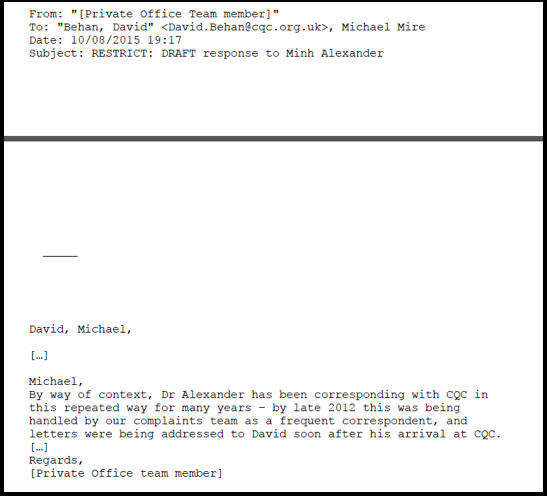
Lastly, the most serious revelation was a little email which must have slipped past the CQC cull of documents to be concealed.

2012

As above, Behan’s office informed Mike Mire NED that CQC had been treating me as a ‘frequent correspondent’ since 2012. The date is very significant.

The internal CQC correspondence from 2012 about how this decision was made, to manage me as a ‘frequent correspondent’, was absent from the disclosed documents.

That is unsurprising as CQC could hardly have justified any decision to treat me as ‘frequent correspondent’ on the basis of my evidenced, measured, stepped disclosure correspondence. Nor could it have explained how a witness it had treated as wholly reliable for two years had suddenly morphed into a purported green ink case.

2012 was the year in which CQC started inexplicably ignoring my continuing, very serious disclosures. Prior to that, whilst the CQC response had not always been ideal, there had at least been a response and action, which had culminated in major leadership changes at an NHS trust.

In 2012 CQC had deemed that through the magical touch of regulation, all was improving. My continued disclosures about persisting safety issues were therefore not welcome. And now I know that CQC simply pressed the mute button.

As a result of CQC repeatedly ignoring my very serious disclosures, I had to escalate to David Behan himself at the end of 2012.  The disclosures concerned matters such as deaths in custody and a patient’s complaint about Winterbourne View type abuse against patients on a locked ward and serious staff reprisal against him for speaking up.  But as CQC had  already declared me persona non grata, Behan ignored me too.

CQC must have eventually realised that they had screwed up. But, instead of taking immediate action to follow up on my patient safety concerns and to ensure that the patient who had complained about abuse was protected from reprisal, Behan knee-jerked by bizarrely launching a complaint investigation which I had not asked for.

Needless to say CQC’s complaint ‘investigation’ exonerated CQC, apart from a small slap on the wrist for inadvertent delay and not answering questions straightforwardly enough. The investigation reported nothing about CQC deliberately not responding to whistleblowing disclosures as a matter of protocol. The investigator indulged in a factual inaccuracy for good measure, by claiming that a complaints manager tried to telephone me several times but could not get through.

“Ms ******* has not been in touch; I know that she has tried to reach you by telephone on a number of occasions.”

I in fact received an email from the same individual stating they did not have my telephone number:

“I apologise I have not been able to speak with you but I have not got a contact number for you.”

And what is the investigator picked by Behan to investigate his conduct towards me doing now? She is CQC’s very own Freedom To Speak Up Guardian.

Other whistleblowers have made similar discoveries through Subject Access Requests. For example, Pam Linton senior midwife who whistleblew to CQC about Homerton maternity services established that CQC failed to act upon her concerns. Another whistleblower found that CQC even has a flow chart for them, as part of a containment protocol. There are others.

So, fellow travellers, be not daunted by overbearing and porkie prone officialdom. Its arrogance is often its weakness. If you feel you are being pushed around or given the runaround, make full use of your rights under the Data Protection Act.


Please sign and share:

Petition to replace weak UK whistleblowing law to protect whistleblowers and the public


RELATED ITEMS

This is a CQC policy which includes procedures for containing members of the public whom it considers troublesome:

https://minhalexander.com/wp-content/uploads/2018/08/cqc-board-paper-complaints-whistleblowing-2010-cm0031008_complaints__whistleblowing_-1.doc

The use by NHS bodies such as the CQC of covert protocols to denigrate and discriminate against patients, families and whistleblowers who are treated as if they are ‘vexatious’ is an unpleasant infringement of rights. Its secret nature means that unfairness and misinformation cannot be challenged, and that name calling becomes a self-perpetuating exercise.

I have asked NHS England in the first instance to coordinate a system-wide response on these issues of rights abuse:

https://minhalexander.com/wp-content/uploads/2018/08/letter-to-nhs-england-neil-churchill-28-08-2018-nhs-approach-to-vexatious-people.docx


APPENDIX

  1. CQC – please file as appropriate
  2. Jed Mercurio – feel free to adapt as a comedy thriller
  3. NB. CQC’s mis-named system of ‘intelligent monitoring’ has been binned. May it rest in pieces.


UPDATE 19 SEPTEMBER 2018:

Alarmingly, CQC’s papers for its board meeting today show that the proportion of whistleblowing concerns for which CQC takes no follow up action has jumped from approximately 50% to 70%.

CQC was given a chance to apologise for its above behaviour and to put better systems in place, so that in future it would not unfairly stigmatise patients, families and whistleblowers.

I received a very unfortunate reply from Ian Trenholm, CQC’s new CEO, to which I will return another time.

In the meantime, in consultation with NHS England and NHS Improvement, the Department of Health and Social Care has agreed to review central guidance about how NHS organisations should handle situations in which they think members of the public are unreasonable or inappropriately persistent. This is the relevant correspondence from NHS England:

Correspondence with NHS England about the NHS treating patients, families and whistleblowers as ‘vexatious’

Anyone who would like to make suggestions for fairer processes and safeguards can direct them to Chris Bostock, Head of Complaints at the Department of Health and Social Care.

NHS England has advised that suggestions for some form of independent review are welcome:

“…we would be interested in ideas about how & in what circumstances external auditing might be appropriate, including oversight by patient and public voice groups locally”


Please sign and share:

Petition to replace weak UK whistleblowing law to protect whistleblowers and the public


STFU not FTSU

A whistleblower’s feedback to the National Guardian

By Dr Minh Alexander, NHS whistleblower and former consultant psychiatrist, 18 August 2018

The NHS National Guardian previously collected only feedback from whistleblowers who had been accepted for review by her Office, which was highly likely to skew results in its favour.

On 11 August the National Guardian’s Office circulated a feedback survey  which for a change was also sent to some whistleblowers whom it had previously turned down for case review.

Strangely, the window for submitting evidence was very narrow. Only five working days was given:


On Saturday, August 11, 2018, 10:29 am, casereviews@nationalguardianoffice.org.uk via surveymonkey.com <member@surveymonkeyuser.com> wrote:

Case Review Pilot Evaluation Survey
The National Guardian’s Office (NGO) launched a pilot of its case review programme in June 2017. A year on from this launch, we have commissioned an independent evaluation of our pilot to help us learn and improve.


We are sending out this voluntary survey as part of this evaluation to hear from individuals who have referred their cases for review by the NGO. We would like to learn from your experience in making a referral to the NGO, to understand what worked well and what did not about the case review process.

This survey contains 13 questions and should take 5-10 minutes to complete. 

Please be assured that your participation and your responses to this survey will be kept confidential, and that your responses are completely anonymous. No personally identifiable information is captured unless you voluntarily offer personal or contact information in any of the comment boxes.

This survey will close at 3.00 pm on Friday 17 August 2018. 

Should you have any questions please do not hesitate to get in touch via casereviews@nationalguardianoffice.org.uk.

One whistleblower who had asked the National Guardian for protection, but was turned down for case review and was subsequently sacked, gave this feedback on 17 August 2018:

“I address this section of my feedback to Dr Henrietta Hughes.

 I asked you for help before I was sacked.

 You and your office repeatedly declined to help.

 I was sacked.

 I asked you to help before the appeal against dismissal confirmed my sacking.

 You and your office declined to help.

 I complained about the handling of my case and the failure to treat me fairly or in line with the original recommendations of the Freedom To Speak Up Review.

 NHS Improvement and Robert Francis dealt with my complaint but they would not find against you. I think they should not be in the position of investigating or adjudicating because they are not neutral parties. I do not understand how you can purportedly be held to account by NHSI and CQC and at the same time hold them to account yourself. That is a structural recipe for unfairness and bias, if not collusion.

 I later discovered that your Office has handled other cases differently and I complained about the inconsistency.

 As far as I am aware, my second complaint disappeared into a black hole of unaccountability.

 I asked your Office a second time to review my case, on the grounds that all processes had concluded and that your Office could no longer cite this as one of the reasons for not helping.

 Your Office responded by insisting that I re-submit the whole thing on a form of its choosing.

 I have no energy left, finding myself in late middle age without a job, having lost my family and children, and soon to lose my home also.

 The lack of humanity with which I have been treated has been appalling. I must question if you and your team have a real understanding of the human consequences of your actions and omissions, and the despair they cause.

 Please spend some time thinking seriously about the health impact of your actions before claiming any further successes or spending any more public money on PR. The sight of it is very distressing to whistleblowers who know the real truth.”

To add insult to injury, this whistleblower has participated in NHS Improvement’s NHS whistleblower employment support scheme since it began to be developed in March 2017. Despite being accepted for the pilot in January 2018 the whistleblower has not even been offered so much as a trial work placement.

Far from the ‘apology and redress’ dangled over three years ago by the parliamentary select committee that (with the honourable exception of individual members) has since proved itself inexplicably disinterested, the Department of Health and Social Care et al seem bent only on inflicting on more cruel and unusual punishment on outcast whistleblowers.


RELATED ITEM:

NHS whistleblowing isn’t fixed yet and this leaves patients exposed

Replacing the Public Interest Disclosure Act

UK whistleblowing Law is an Ass: Helen Rochester v Ingham House Ltd and the Complicit CQC


HSIB’s sleight of hand, CQC and the Care Programme Approach: Comments on HSIB Investigation into the transition from child and adolescent mental health to adult mental health services 12017/18

By Dr Minh Alexander NHS whistleblower and former consultant psychiatrist 10 August 2018

Summary: I have been asked to comment on HSIB investigations. HSIB is purportedly based on aviation models of accident investigation and has been parachuted into the NHS, but there are very considerable difficulties in attempting  a straight translation. Healthcare is a much, much more complex, human endeavour. There are many more actors, a greater range of tasks, greater relational complexity, including different ethical, regulatory and political contexts. HSIB has also been under the Department Health thumb in the early stages of its establishment, with the embedment of a DH deputy director as its director of corporate affairs, who was in charge of comms.

I have looked at HSIB’s second published investigation report, on a mental health case as this is territory with which I most familiar. I concentrate on HSIB’s silence about failures to deliver a central plank of government mental health policy for almost thirty years – the Care Programme Approach (CPA). A young person died in the transition between two services. HSIB spins a line that CQC haplessly lacked a mechanism for regulating such transitions. In truth, since CQC’s inception its regulations and protocols have required it to inspect the interface between services and providers, and to ensure safe transitions. CQC has repeatedly reaffirmed these principles. The question is why policy failed. The government short changed the public and oppressed the mental health workforce by superficially standing by quality standards such as CPA, but not giving the NHS the resources to properly implement them. If HSIB is truly independent, it should be highlighting these issues more robustly.

The Care Programme Approach

In the NHS, CPA was introduced into mental health services in 1990 after an asylum closure programme to ensure that de-institutionalisation did not result in neglect in the community:

The Care Programme Approach for people with a mental illness, referred to specialist psychiatric services. HC(90)23/LASSL(90)11. Joint Health and Social Services Circular: DoH.

Continuing high profile failures of care in the community of people with serious mental illness, and a string of inquiries into serious incidents, avoidable deaths and homicides by mentally unwell people emphasised the need for joined up mental health care. The disturbing images of Ben Silcock in the lions’ pen at London Zoo on New Year’s Eve 1992 where he was gravely mauled, the revelations of his serious mental illness and the fact that  he had been turned down for hospital admission prior to the incident, prompted a public outcry.

As did the unprovoked, fatal attack by Christopher Clunis on Jonathan Zito, a complete stranger, at Finsbury Park Tube station in December 1992. An inquiry revealed that Clunis passed through several mental health services before the killing, with missed opportunities to care for him and to protect the public. Clunis later sued his Health Authority for neglect.

CPA has been revised several times. Some mental health staff perceived its structure as an imposition. There have also been controversies around later attempts to tier and then restrict CPA to the most complex cases. Confusion persists about who should be cared for under CPA:


The CQC has acknowledged in its statistical releases that the proportion of patients on CPA varies greatly between trusts. For example:

2015: “…it is worth noting that there is enormous variation in the proportion of people on CPA between trusts: for respondents to the 2015 survey this ranged from 10% to 61%, which suggests that there are systematic differences in how trusts interpret and apply the CPA policy locally.”

2017: “…it is worth noting that there is a large variation in the proportion of people on the CPA between trusts, which suggests that there are systematic differences in how trusts individually interpret and apply the CPA policy.”


In general terms, CPA applies to patients with the most complex needs and risks. It is possible that more patients would be assigned to CPA if mental health services were under less resource pressure.

CPA is just common sense and a formalisation of good practice. It seeks to prevent blind spots in care planning and risk assessment by providing a comprehensive framework under which such activities take place. CPA provides for a key role – that of the key worker or ‘care coordinator’ whose job it is to drive the care plan and ensure that it is properly carried out, and that all of the patient’s needs are met:

B KeyworkerHealth Service Circular/Local Authority Circular HC(90)23/ LASSL(90)11
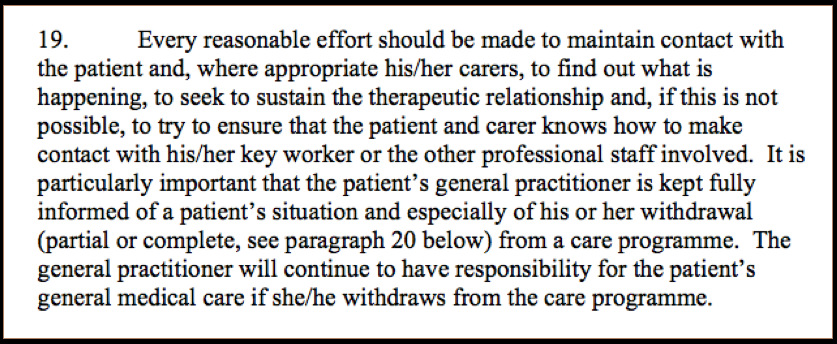
Crucially, CPA also serves to ensure safe handovers within and between teams and services, because poor communication and badly managed transitions lie behind many serious mental health failures. Lost information and risk assessments based on incomplete information, or risk assessments made without due multi-disciplinary process or senior oversight are classic factors in serious mental health incidents.

Importantly, CPA seeks to ensure that the patient, family and or carer voice is heard by giving a structured means of consulting and recording their views, and providing them with a transparent, written record of therapeutic commitments by the treating service.

CPA emphasised the great importance of the therapeutic relationship and of not letting people fall through the safety net:

B therapeutic relationshipHealth Service Circular/Local Authority Circular HC(90)23/ LASSL(90)11
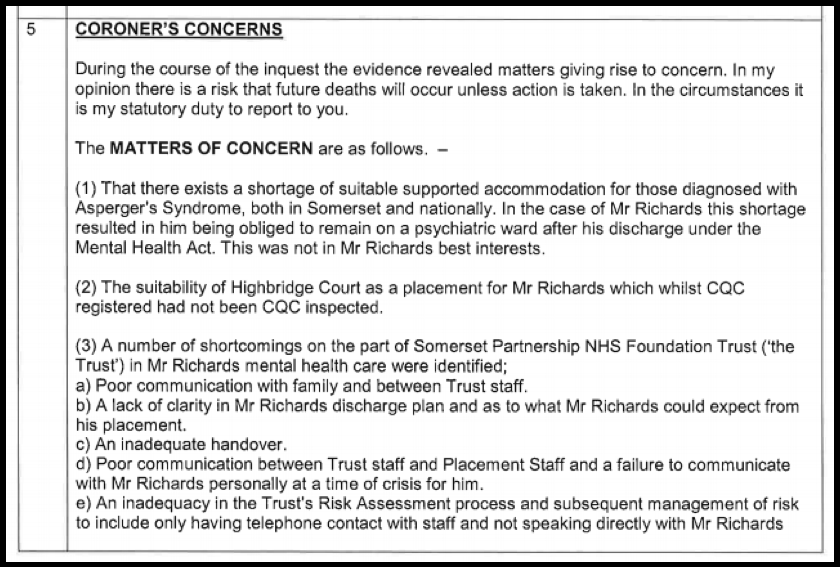
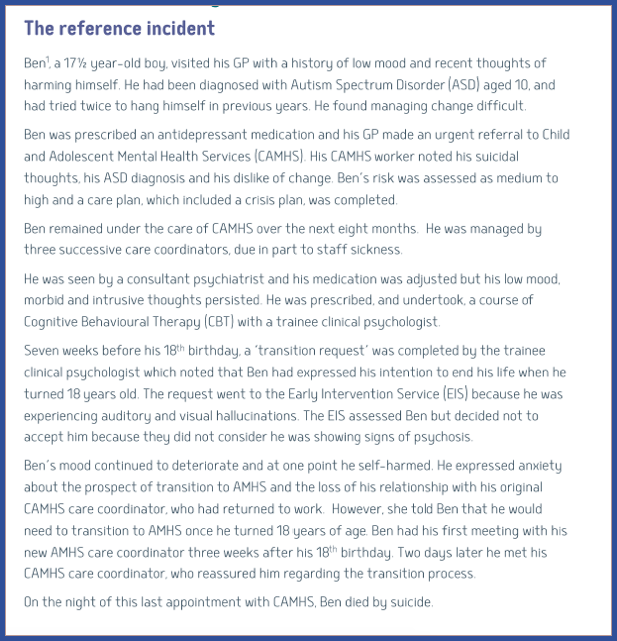
In short, CPA was intended to be a failsafe that ensured thorough, supportive, patient-centred and safe care.

It follows that breaches of CPA may put basic care standards at risk. Inquiries, coroners’ warning reports and independent mental health homicide reports commissioned by Health Authorities, Strategic Health Authorities and NHS England have repeatedly cited care planning/ CPA failures as contributory factors.

For example, this coroner’s report to Prevent Future Deaths (PFD) was recently sent to Jeremy Hunt, about the death of Robin Richards who was on CPA but in whose case there were a number of care planning and communication breakdowns:

B Coroner's concerns

This PFD was issued on 25 May 2018 and there is still no published response by the Department of Health and Social Care.

Under the strain of austerity and de-funding, immense service pressures make it harder for mental health services to meet CPA standards or to meet them well. Care coordinators may not be replaced when they leave or go off sick , or patients may be passed repeatedly between care coordinators, resulting in an impersonal experience with loss of continuity.

Proactive crisis planning is a core part of CPA, and relies on staff who understand early warning signs. This clearly works better when there is a relationship and staff know the patient, as opposed to someone walking in on a crisis and checking off a list. Patients are also more likely to be comforted by and work more easily with staff whom they trust, than a relative stranger.

Under the pressure of staffing shortages and de-funding, the care coordinator role may be delegated to inappropriately inexperienced and inadequately supervised staff. Care planning may also be dictated by service pressures instead of led by patients’ needs. Serious shortages in mental health beds result in premature, chaotic discharges and sometimes emergency re-admissions in short succession. The CPA process may be reduced to hurried, tokenistic form filling or alternatively it runs behind playing catch up, when it should be a meaningful, proactive process.

It is also possible to have perfect CPA paperwork but awful care that is based on poor assessment and is badly prescribed.

The signs of extreme pressure on mental health services have been writ large for some time, but CQC has not revealed the full extent of the failures. CQC rates most mental health trusts as “Good’ or ‘Outstanding’:

“As at 31 May 2017, we had rated 68% of NHS core services as good and 6% as outstanding.”

This is despite systemic failures across the board to meet patients’ needs, as evidenced for example by daily placement of NHS patients in private sector beds sometimes hundreds of miles from home,  because the NHS does not have enough beds of its own.


HSIB’s investigation on ‘The Transition from Child and Adolescent Mental Health Services to Adult Mental Health Services’

The Healthcare Safety Investigation Branch’s second investigation report of July 2018 into the unsafe interface between child and adolescent mental health services (CAMHS) and adult mental health services (ADMHS) leaves much unsaid.

It focuses on the case of Ben. These are the salient facts of his case according to HSIB:

B Reference incident

HSIB’s report did not fully map Ben’s care against accepted CPA standards and national guidance, but it identified that no CPA meeting had taken place in the months that Ben was nominally subject to CPA, that no carer’s assessment had been offered when this was indicated and that there were failings in risk assessment and management.

Almost 30 years after CPA was introduced, HSIB could have said a lot more about the significance of any failure of CPA process. Why are there still frequent failures in this core process for people with serious conditions, that is supposed to ensure safe care? What have the government and NHS regulators been doing in response to the inquiries, coroners’ warnings and mental health homicide investigation reports that have flagged failures in CPA process?

In 2008 the government indicated that it expected NHS regulators to police CPA. CQC’s predecessor the Healthcare Commission examined CPA and in March 2009 concluded:

 ‘However, marked variations between trusts remain and the national averages against which they are compared are relatively low, suggesting that some trusts have been far more successful than others in ensuring that the infrastructure for the CPA is embedded within routine practice.”

CQC took over from HCC in April 2009. What has CQC done since about patchy CPA implementation, including precarious CAMHS to AMHS handovers? If CQC had been regulating CPA effectively, this would have encompassed the transition between CAMHS and AMHS, because safe handover is exactly what CPA was designed to govern.

For decades now, data on CPA compliance has been centrally collated. A critical transition is that between hospital and community. This has been linked time and again to suicides. It remains unreliable. National policy is that patients should be seen within 7 days of discharge from hospital but some still slip through. The data showing the breaches is routinely published by NHS digital. In the last quarter of 2017/18, , ‘Outstanding’ East London NHS Foundation Trust had the second worst rates of 7 day follow up: only 1006 out of 1154 (87.2%). Leicestershire Partnership NHS Trust had the lowest 7 day follow up rate, at 68.8%.

Year in, year out CQC has received intelligence from patients via the annual (adult) community mental health survey of poor experiences of care planning, crisis planning and of being insufficiently involved by services in devising their own care.

Patients’ response rates to the CQC’s annual community mental health surveys have been low and are falling:

CQC annual community mental health survey of patients receiving specialist care Response rate to survey
2012 32%
2013 29%
2014 29%
2015 29%
2016 29%
2017 26%

Source: CQC annual community mental health surveys

It is possible that the results would be worse if data from patients who did not respond was included. Interpretation of survey results is hampered by a change in methodology in 2014, which limits comparability with earlier results. Comparability is also limited by inconsistency in CQC’s presentation of results.

Nevertheless, the surveys have suggested that patients do not reliably receive a care plan or that a care plan is consistently agreed, even when some are deemed ill and disabled enough to require CPA:

Year of CQC community mental health survey Question 27 Have you been given (or offered) a written or printed copy of your NHS care plan?
2012  24% patients on CPA replied ‘No’
2013  24% patients on CPA replied ‘No’
  Question 12 Have you agreed with someone from NHS mental health services what care you will receive?
2014 23% of all patients replied ‘No’*
2015 15% of patients on CPA replied ‘No’
2016 14% of patients on CPA replied ‘No’
2017 24% of all patients replied ‘No’* 

*Specific statistics for patients on CPA not available

The surveys have suggested that crisis care planning has not been reliable enough, even though this is vital to risk management. Recent figures suggest that about a fifth of patients on CPA do not know how to seek help in a crisis:

Year of CQC community mental health survey Question 26 Does your NHS care plan cover what you should do if you have a crisis (e.g. if you are not coping or if you may need to be admitted to a mental health ward)?
2012 14% patients on CPA replied ‘No’
2013 14% patients on CPA replied ‘No’
  Question 21: Do you know who to contact out of office hours if you have a crisis?        
2014 32% of all patients replied ‘No’*
2015 19% of patients on CPA replied ‘No’
2016 20% of patients on CPA replied ‘No’
2017 29% of all patients replied ‘No’*

*Specific statistics for patients on CPA not available

The survey has also suggested that some patients’ care plans are infrequently reviewed, even when they are considered to have serious enough needs to merit being placed on CPA:

Year of CQC community mental health survey Question 28 In the last 12 months have you had a care review meeting to discuss your care?
2012 24% patients on CPA replied ‘No’
2013 26% patients on CPA replied ‘No’
  Q14: In the last 12 months have you had a formal meeting with someone from NHS mental health services to discuss how your care is working?                                                    
2014 26% of all patients replied ‘No’*
2015 17% of patients on CPA replied ‘No’
2016 18% of patients on CPA replied ‘No’
2017 26% of all patients replied ‘No’*

*Specific statistics for patients on CPA not available

NHS England acknowledged some of these core failures in its 2016 Five Year Forward report:

Almost one-fifth of people with care coordinated through the Care Programme Approach (for people with more severe or complex needs) have not had a formal meeting to review their care in the previous 12 months.”

HSIB’s report did not mention these wider, persisting problems in national CPA delivery, nor did it explore what action CQC had taken in response to this.

HSIB’s report made no reference to specific provision for handover between CAMHS and AMHS that appeared in national Department of Health CPA guidance from 2008:

 “Child and Adolescent Mental Health Services

The importance of having a system similar to CPA for children and young people with mental health needs is increasingly recognised. In the Report on the Implementation of Standard 9 of the National Service Framework for Children, Young People and Maternity Services, 68 in delivering good practice for young people it is noted that “The Care Programme Approach, modified to meet the needs of younger people, is used to plan transition, and transition is supported by agreed protocols.”

A similar point is made in Standard 9 of the NSF for Children, Young People and Maternity Services, namely “When children and young people are discharged from in-patient services into the community and when young people are transferred from child to adult services, their continuity of care is ensured by use of the care programme approach.”

However, it is important that where CPA is considered relevant for children and young people it is tailored to their requirements. Guidance on how this can be achieved is set out at Annex B.”

This Annex B is found on page 45 of the DH 2008 guidance and provides guidance on the special needs of children and young people when care planning. It specifically addresses:

– A need for more frequent review than in adult cases

– Very careful coordination between professionals and agencies

– The particular need to involve families and carers given the developmental stage of children and young people

– A need for age appropriate communication and documentation, and special support to participate in care planning


HSIB only summarises the 2008 DH guidance very briefly thus:

B Refocusing the CPA

CQC actually acknowledged that there was unsafe practice around transition from children’s to adult health services in a specific 2014 report. This focussed largely on physical health services but touched on mental health services as well. The question was what happened next.

Instead of confronting the question of CQC’s and other central bodies’ oversight of existing CAMHS-AMHS transition policy, HSIB proffered this wriggly explanation for CQC’s failure to get a grip of CAMHS-AMHS handover issues:

B CQC excuse

This is a bizarre claim by HSIB. Since CQC’s inception, the regulations underpinning its operations have included a requirement for it to regulate co-operation between providers and transfer of service users between providers as part of assessing service safety:

B CQC co op with other providers

HSIB’s report also omitted to mention that in 2013, CQC issued a framework for inspecting mental health services  which specifically emphasised the importance of safely managed transitions between services and providers:

A fresh start for the regulation and inspection of mental health services Working together to change how we regulate, inspect, and monitor specialist mental health services

 ·      Focus on transitions, care pathways and joint working, including where people move between services and where care is provided in an integrated way. Transitions between services will include moving between services within the provider – such as between children and young people’s and adult services or between adult and older adult services – as well as between providers – such as the transition between primary and secondary care or between independent sector and NHS services.

·      For the providers we regulate, this will mean looking at the timeliness of responses and the way they work with other providers to achieve positive outcomes for people who use services. This includes integrated working to address physical as well as mental health needs; to promote recovery, health and wellbeing; to prevent or respond appropriately to crisis; and to achieve quality of life, including in relation to housing, employment and social participation.”


HSIB omitted to mention that in 2015, CQC issued guidance to providers on meeting regulations which reaffirmed the need for safe transitions:


12(2)(i) where responsibility for the care and treatment of service users is shared with, or transferred to, other persons, working with such other persons, service users and other appropriate persons to ensure that timely care planning takes place to ensure the health, safety and welfare of the service users.”


HSIB did not mention that in 2017 CQC issued an inspection framework for children and young people  which repeatedly specifies assessment of transitions between services. There are plenty of other CQC publications from all the years since CQC’s inception in 2009 which make it clear that CQC has been aware of its duty to inspect the critical care pathway changes between services and providers. For example, CQC’s monitoring reports on the use of the Mental Health Act frequently examine high risks aspects of transfer between services. It would have taken a miracle for HSIB to have missed them all.

And if HSIB had examined CQC inspection reports – and I make no assumptions about whether HSIB did or not – it would have found that CQC does at least occasionally inspect transitions. The difficulty is that CQC does not provide evidence that it does so reliably. A quick and dirty check of the most recent CQC inspection reports on mental health trusts by searching under the term ‘transition’ reveals that CQC commented on service interfaces in only 21 out of 54 of the inspection reports, and in 14 of these instances this was in the context of CAMHS services.

Strikingly, HSIB’s report does not actually describe what regulatory action CQC took at the trust where Ben died, in contrast to its detailed description of clinicians’ actions. That does not seem the even handed, fearless approach that we were promised.

But maintaining the artifice, HSIB recommended:

Screen Shot 2018-08-10 at 03.17.04

So in short, a face saving exercise and a slight slap on the wrist for CQC which allows HSIB to claim that it is holding even regulators to account.

And as for HSIB’s claim that it will investigate if problems are widespread and systemic, why is HSIB’s investigation report silent on the full extent of CPA failures in mental health services?

B systemic

HSIB confines itself to the CAMHS-AMHS interface, whilst reinventing the CPA wheel:

B reinventing cpa wheel

This HSIB recommendation appears to be little more than the final step in a highly choreographed dance. CQC had already tidied up the loose ends some months ago in two new publications. One was a thematic review report in March 2018 waxing lyrical about the importance of person-centred care planning and describing the poor transition between CAMHS and AHMS.

The other publication was a March 2018 specific guide for CQC inspectors on how to inspect the CAMHS-AMHS transition:

Evidence required

1. Providers have to provide the following information to their commissioners:

a) A case note audit to assess the extent of Joint-Agency Transition Planning

b) A survey of young people’s transition experiences ahead of the point of transition (Pre-Transition / Discharge Readiness);

c) A survey of young people’s transition experiences after the point of transition (Post-Transition Experience)

2. The CQUIN also specifies a transition meeting, which should include:

a) The young person;

b) The appropriate key worker from the sending service;

c) Where applicable, a dedicated point of contact for transition from the receiving service; and d) Where appropriate and the young person agrees, the young person’s parent(s) /carer(s).

Ask young people and staff about whether these meetings occurred and their experiences of the meetings

3. Review case notes of young people transitioning to adult services or about to leave CAMHS.”

HSIB’s report states theatrically that HSIB has ‘directed’ its recommendation to CQC and that CQC must respond in 90 days. But it is patently obvious that the next dance step will be the usual heart-warming reassurance that CQC has already acted to safeguard patients etc etc..

HSIB additionally makes the recommendation that NHS England should ensure that money earmarked for CAMHS is spent as intended. HSIB also makes a rather timorous ‘observation’ rather than a recommendation, that it would be ‘beneficial’ if NHS England identifies CCGs that spend less on CAMHS than ‘expected’.

HSIB supports NHS England’s incentivisation of safe handover process between CAMHS and AMHS with the use of Commissioning for Quality and Innovation (CQUIN) targets.  These may be self-defeating if the fundamental problem is that trusts are not given enough money for basic operations and that is the reason for unsafe practices

HSIB seeks to manage disparities between CAMHS and AMHS by proposing that younger people should be able to remain within CAMHS up to the age of 25 if necessary instead of 18, citing long waiting lists and steep eligibility criteria in AHMS as part of the case for this proposal.

For anyone who knows anything about the relative length of CAMHS waiting lists compared to AMHS waiting lists, HSIB’s observations about AMHS waiting lists are perplexing.

It is of course common sense that there should be needs-led flexibility at service interfaces, particularly if this is needed for management of serious risk.

However, the more muscular recommendation that HSIB could have made was that the government should provide all mental health services with the necessary funds to implement the government’s policies and the quality standards that the government says it expects for mental health services, such as safe care planning under CPA. But that would be calling the government’s bluff.

So far, HSIB looks less like the professional investigator that we were promised, and more like another, expensive go-faster stripe on the denial machine.

The element of trust is crucial given all the very serious concerns about abuse of the ‘safe space’ provision in the legislation that will govern HSIB’s operations.

The last word belongs to those most deeply affected, but it is not clear what Ben’s family think of the system response. HSIB offered to meet with Ben’s parent but at the time of publication, it reported that the offer had not been accepted.

Screen Shot 2018-08-10 at 03.20.21


RELATED ITEMS

Safe in their hands? Government’s response coroners’ warnings about the NHS

HSIB: Whistleblower-friendly?


Replacing the Public Interest Disclosure Act (PIDA)

Please sign and share:

Petition to replace weak UK whistleblowing law to protect whistleblowers and the public


By Dr Minh Alexander NHS whistleblower and former Consultant Psychiatrist, Martin Morton social care whistleblower and former Social Services Manager, Master of Laws, Clare Sardari NHS whistleblower and former trust head of Organisational Development, 11 July 2018. Published 18 July 2018.


The UK Public Interest Disclosure Act 1998 was passed in a different era and considered progressive in its time but it has not lived up to expectations. It was a private member’s bill and was not properly debated in parliament. Serious flaws in the Act and resulting injustice have been evident for many years. However, key players in the UK whistleblowing scene have not called for its abolition, only adjustments. PIDA is now seriously out of kilter with international best practice. The proposed EU directive on whistleblowing published three months ago underlines PIDA’s unfitness and how far behind it has fallen. It should be replaced. Below is a brief digest of key issues and some recommended principles that any new UK law should encompass. What is needed now is a formal review of the law and in depth, inclusive debate to properly test any alternatives. The government and Law Commission have been asked to review the legislation.

Our thanks to Ashley Savage Lecturer in Law for comments on this paper.


REPLACING THE PUBLIC INTEREST DISCLOSURE ACT (PIDA)

Summary


PIDA:

·      Does not ensure that whistleblowers’ concerns are addressed

·      Does not confer protection

·      Invites further whistleblower reprisal through the legal process

·      Unfairly places a burden on the whistleblower to litigate and does not offer an alternative means of seeking redress

·      Is financially inefficient and its weakness has resulted in waste

·      Only relates to harm caused by employers and fails to address harm caused by regulators and other parties

·      Does not effectively deter reprisal or provide penalties against individuals who harm whistleblowers

·      Fails to protect Human Rights

·      Makes no provision for an effective enforcement structure

·      Contains no requirement for regular review of its own efficacy


We propose that any law which replaces PIDA should feature these key principles:


·      It should serve the public interest in all respects

·      It should ensure timely follow up of whistleblowers’ concerns

·      It should require pre-detriment protection

·      It should provide for civil and criminal penalties for reprisal

·      It should provide expeditious relief from reprisal, and redress, which does not require the whistleblower to litigate

·      It should provide fair remedy for loss, restoring a whistleblower to a position they would have occupied, but for whistleblowing and its consequences

·      It is supported by a dedicated enforcement structure that is independent of government, that has powers

– to investigate where local investigation has failed

– to protect

– to take corrective action against reprisal

– to apply penalties and prosecute where there have been criminal breaches

·      It is regularly reviewed by parliament and any difficulties with implementation are addressed


Whistleblowing is work-based speaking up for the common good. It highlights serious risks and harm to the wider public. It follows that effective whistleblowing law should ensure that concerns are effectively handled and that those who speak up are not silenced and victimised. Current UK whistleblowing law, the UK Public Interest Disclosure Act 1998 (PIDA), achieves neither of these aims.

The Act passed as a private member’s Bill without opposition in parliament and was not sufficiently debated. It was designed to make minimal investigatory demands and not to add regulatory burden to businesses. Doubts that were raised over a closely-related precursor Bill’s ability to prevent disasters, for example the Zeebrugge ferry sinking which claimed 193 lives, were never properly answered. PIDA has only been reviewed once in twenty years, and mostly occasionally adjusted. There is little evidence that the Act has met the expectations of its proposer Richard Shepherd MP that it would ‘ensure that where malpractice is reported in an organisation, the response deals with the message, not the messenger.” Neither did it provide any anticipated accountability.

Repeated failures of whistleblowing governance since the Act was passed have shown that it has not deterred malpractice. Over 23,000 claims have been made under PIDA since it came into force, with claims rising over the years (until the introduction of Employment Tribunal fees in 2013, which discouraged a substantial proportion of claims). This does not suggest that employers are less likely to mistreat whistleblowers as a result of the Act being passed.

PIDA was folded into employment law, which has had the effect of focussing on disputes and putting whistleblowers on trial, instead of protecting the public. Settlements may have the effect of gagging whistleblowers about wrongdoing. PIDA has increasingly fallen behind international best practice standards. Examples of countries that have better whistleblowing law than the UK are  AlbaniaSerbiaBosnia and Zambia.

The emergence from the Gosport War Memorial Hospital deaths inquiry of critical failures to listen to whistleblowers emphasises very painfully that it is vital to ensure more effective legislation. The government has claimed that the failures were historical but there is clear evidence that Gosport could easily happen again. Further information is provided below on PIDA’s key weaknesses.


  1. PIDA does not ensure that whistleblowers’ concerns are addressed

PIDA’s central weakness is that it does not require anyone to investigate or act upon whistleblowers’ concerns. This enables cover ups, defeating the intended purpose of the law. Whistleblower retaliation is driven by cover ups. Law that is meant to protect whistleblowers should not facilitate the prime driver of their reprisal, or allow concealment against the public interest. It is now international best practice for whistleblowing law to require follow up in response to whistleblowers’ concerns.


  1. PIDA does not confer protection 

UK law does not require anyone to protect whistleblowers. It only allows whistleblowers to claim for compensation after they have suffered harm. The law is not even effective in ensuring that harmed whistleblowers receive compensation after the fact: approximately only 3% of claims under PIDA succeed at hearing. It is now international best practice for whistleblowing law to proactively confer protection before detriment has occurred and provide access to relief from reprisal.


  1. PIDA invites further whistleblower reprisal through the legal process

PIDA came about amidst concerns that a whistleblowing law might be a ‘nitpickers charter’ for ‘whingers’, ‘obsessed’ and ‘disgruntled’ individuals with ‘grudges’ who might wilfully damage businesses’ reputations or ‘blackmail’ them into pay outs in return for silence. To overcome such concerns, PIDA introduced legal hurdles with the intention of screening out those who acted unreasonably or in bad faith. In practice this proved very damaging to whistleblowers. Under PIDA, to avoid blame and limit compensation liability, employers must attack whistleblowers’ credibility and character, and fabricate alternative explanations for detriment.

Even when the Tribunal determines that whistleblowers are genuine and have been harmed, they may still be easily persuaded that detriment was unrelated to whistleblowing. Compensation may be reduced if employers convince the court of contributory fault by the whistleblower. Pre-existing legal tests that had been applied to ordinary employment cases, were applied to PIDA cases. This is wrong because in the public interest, it should be harder for employers to tear down whistleblower cases. Workers are often unaware of the complicated legal hurdles that they must clear in order to succeed under PIDA. They may make critical technical mistakes in how they raise concerns. Such overly complex arrangements have been criticised as ‘hollow’ by the UN.

Employers have used the law to punish genuine whistleblowers by pursuing them for costs on questionable grounds. Employers may also prolong litigation to exhaust whistleblowers’ financial reserves or to intimidate them. Living under such legal siege for years is profoundly distressing. Thus, the litigation process has become part of the trauma that whistleblowers suffer. It is very wrong that citizens who act in the public interest are essentially made into targets by the law that is supposed to protect them.


  1. PIDA unfairly places a burden on the whistleblower to litigate and does not offer an alternative means of seeking redress

It is wrong that whistleblowers who perform a public service and are harmed must take the serious risk of litigating against a much more powerful employer entirely on their shoulders. Some whistleblowers may be bankrupted as a result of losing claims under PIDA, especially if costs are awarded against them. The requirement to litigate is particularly unjust to low paid workers, who face the greatest inequality of arms.  PIDA fails to offer whistleblowers a means of redress that does not require litigation, such as the option of seeking protection from a dedicated agency with the necessary powers to take corrective action. It is now international best practice for whistleblowing law to prescribe a dedicated agency with powers to take corrective action against any harassment of whistleblowers.


  1. PIDA is financially inefficient and its weakness has resulted in waste 

PIDA was designed to have low impact on the public purse but its weakness has had unintended consequences. There continues to be a burden on court time because whistleblowers are unprotected and a high number of claims are made. Costs of litigation are high relative to compensation available. Whistleblowers may be left little to live on or even left in debt despite ‘winning’ cases. Costs may be particularly shocking in cases defended by public bodies. Such bodies may squander public resources in terms of legal costs and court time by unreasonably resisting claims and deliberately drawing out litigation. An EU study concluded that better whistleblower protection would generate savings for the public purse.


  1. PIDA only relates to harm caused by employers and fails to address harm caused by regulators and other parties

This is a significant omission as harm done by oversight bodies and senior officials is arguably more serious. Both system and professional regulators are frequently implicated in whistleblowing governance failures. Detriment in law should include neglect and failures to respond and act, which are very common responses to whistleblowers. Moreover, regulators may cause harm by colluding with and prosecuting vexatious cases against whistleblowers, whilst shielding wrongdoers. International best practice now includes protection against harm by all relevant parties and not just employers. Irish whistleblowing law provides an example of this.


  1. PIDA does not effectively deter reprisal or provide penalties against individuals who harm whistleblowers

Under PIDA, organisations only have to occasionally pay compensation. Individuals who victimise whistleblowers are not held to account. This is a significant omission as whistleblower reprisal can be orchestrated and even amount to criminal harassment. ‘Bullying’ is not defined in UK law. The threshold for criminal liability for ‘harassment’ as defined by the Protection from Harassment Act 1997 can be prohibitive and rarely invoked in the employment arena. Whistleblowers will often experience “an impassioned collective campaign to exclude,punish or humiliate” (Leymann) and it is this collective abuse of power within institutions which is often whistleblowers’ undoing and which urgently needs addressing. Other jurisdictions have developed what are known as moral harassment (or mobbing) laws – most particularly Sweden and France. ‘Moral harassment’ would not only give a name to the the reprisals that whistleblowers face but provides an alternative legal framework to impose sanctions on institutions who undertake those reprisals, especially those which seek to use public money to fund this unlawful conduct.


  1. PIDA fails to protect Human Rights

Whistleblower suppression and mistreatment may affect basic rights of free speech, rights to family life and the freedom of the press in that whistleblowers serve a vital role in bringing key information to light that supports democratic processes. PIDA’s weakness allows such rights to be infringed. PIDA should be reviewed against a growing body of jurisprudence from the ECHR. An example of good practice is that Irish whistleblowing legislation acknowledges that whistleblowers’ families may equally suffer the effects of reprisal, and so recognises detriment to third parties.


  1. PIDA makes no provision for an effective enforcement structure

PIDA toothlessly provides for ‘Prescribed Persons’ to receive UK whistleblowers’ disclosures, but gives no guidance on whether or how they should protect whistleblowers or follow up on concerns. PIDA leaves it to the government to designate Prescribed Persons. The result has been a confusing plethora of ill equipped individuals and organisations designated as Prescribed Persons who in reality take limited or no action, may not be regulators and are highly variable in their responses to whistleblowers, leading to an unjust lottery. There has been limited formal study of Prescribed Persons. It is now international best practice for whistleblowing law to prescribe a dedicated whistleblower protection agency that can enforce good practice and protect whistleblowers.


  1. PIDA contains no requirement for regular review of its own efficacy

The natural institutional resistance to transparency about whistleblowing requires safeguards at every stage. PIDA has been reviewed only once in twenty years despite obvious problems, and the review resulted mainly in government plans to merely promote culture change. It is now international best practice for whistleblowing law to contain provisions for review.


UPDATE 19 JULY 2018

Following the release of the inquiry report on the Gosport deaths disaster, Dr Philippa Whitford MP for Central Ayrshire secured a Westminster Hall debate on NHS whistleblowing and the need to replace the UK Public Interest Disclosure Act. This took place on 18 July 2018. The government acknowledged that there were serious concerns about the Act and agreed to consider a review of the law.

https://hansard.parliament.uk/Commons/2018-07-18/debates/960EC9A7-68F3-4E87-9846-10706988378E/NHSWhistleblowers

Please sign and share:

Petition to replace weak UK whistleblowing law to protect whistleblowers and the public


RELATED ITEMS

What could a new whistleblowing law look like? A discussion document

Whistleblowers in Their Own Words: What’s wrong with UK whistleblowing law and how it needs to change

NHS whistleblowing isn’t fixed yet and this leaves patients exposed. An overview of unfinished policy business.

Breach of confidentiality by CQC and complicity in referring a whistleblower to the Disclosure and Barring Service


National Guardian’s Hidden Bulletins & Disappearing Freedom To Speak Up Guardians

By Dr Minh Alexander NHS whistleblower and former consultant psychiatrist, 17 July 2018

The National Guardian agreed hesitantly in February 2017 to publish newsletters  for trust Freedom To Speak Up Guardians which her office had begun to send out.

As is often the case when one private means of communication is forced into the open, another covert channel is quietly opened.

A few months later, weekly ‘bulletins’ for trust Freedom To Speak Guardians were implemented alongside the newsletters. These bulletins only came to light recently after FOI disclosures by trusts.

A full set of bulletins was obtained and a few ‘highlights’ from these follow.


Pick ‘n Mix reasons for delayed disclosure

The National Guardian’s Office (NGO) was asked to disclose the full series of bulletins, but dragged its feet, breaching statutory FOI deadlines by over a month.

Initially, the NGO claimed that the FOI would be delayed because it was seeking permission from third parties to disclose data.

From: “Pook, Simon” <************************************ >

Subject: Your Freedom of Information request regarding NGO bulletins

Date: 13 June 2018 at 15:38:22 BST

To: Ian Alexander <***************************** >

Dear Mr. Alexander,

I am writing in response to your email of 15th May 2018 requesting disclosure of all copies of bulletins issued by the National Guardian’s Office.

We have been processing this request under the Freedom of Information Act and had intended to ensure that we replied to you by the 20 working day statutory deadline, which is today.

However, I must extend my apologies to you and say that there will be a short delay in sending you this information. This is because we are completing consultation with all those who have contributed information to the bulletins as part of ensuring we can provide you with as much information as possible.

Please be advised that we will respond to your request as soon as we can.

Yours sincerely,

Simon Pook
Case Review and Governance Manager
National Guardian’s Office


When it eventually responded, the NGO claimed that the delay was due to initial failure to recognise the request as an FOI:

“The delay was due to an initial failure to identify that this was an FOIA request (for which, additional NGO staff training has been arranged).”

A total of 44 bulletins from the last year were disclosed.


Secret Hotline and Hot Potatoes

The disclosed bulletins revealed that the NGO had set up a separate VIP hotline for trust Speak Up Guardians, because they had complained that it was too difficult to get through to the NGO on the ordinary telephone number.

Yet the latter, steam-powered access point was considered good enough for whistleblowers.

So what sort of a service thinks it’s acceptable to palm its core users  off with second best?

Laughably, the NGO redacted the VIP hotline number from all the disclosed bulletins, giving the justification of exemption under Section 31(g) FOIA – prejudice to law enforcement:

We have a publicly available number to contact the NGO but we consider that it is important that Guardians have a quick and direct line to the NGO so that they can obtain urgent advice and support when required. We consider that public disclosure of this number would defeat this purpose and would therefore prejudice the NGO’s ability to support Guardians in their role to support NHS employees in raising concerns relating to the safety and welfare of patients, and protecting the welfare of the people who raise those concerns. These redactions are made under section 31(g) of FOIA.”

 This argument was curious given that the NGO has zilch enforcement powers. It was void in any case as the hotline number had already been disclosed by trusts.

What the dysfunctional NGO should do of course is ensure that it responds just as promptly to whistleblowers as it does to Speak Up Guardians.

Also implying that whistleblowers may be a distraction or somehow a secondary consideration, Bulletin 5, 5 August 2017 featured a remarkable blog by a Speak Up Guardian (name redacted). This commented that it was all very well to support whistleblowers, but it was better to ‘win big’ by talking to lots of managers.

Bull Hot Potatoes

Is that really the sort of tone that the NGO should be encouraging? But it is certainly consistent with the NGO’s repeated attempts to move away from its original, prescribed core mission of helping individual whistleblowers to vague cheerleading instead.


In it to Spin It

The NGO’s real mission, from the Department of Health and Social Care’s perspective, is only too evident from the bulletins. The now trademark obsession with PR, in a small Office that now has a ridiculous proportion of spin doctors, is revealed in frequent encouragement to Speak Up Guardians to apply for the National Guardian’s awards. Awards are mentioned in eighteen of the 44 bulletins. Also frequently mentioned are promotional materials, the use of publicity films, requests for photographs for use in publicity and a general tone of self-congratulation. The latter without any evidence base and before any evaluation.

Of concern, Speak Up Guardians are being encouraged to think that ‘efficacy’ has been established. Bulletin 5, 5 August 2017:

Bull Time to Shine

Raising the profile of the project is a legitimate goal, but putting a gloss on it most certainly is not.

In bulletin 13, 6 October 2017 the NGO asked Speak Up Guardians to reach out to CQC inspectors and make sure that whistleblowing is reflected in reports.

Bull CQC

However, in bulletin 36, 6 April 2018, the NGO looked as if it was trying to drum up Good News for its master, the CQC:

Bull outstanding


 What’s missing?

Reading these NGO bulletins is an exercise in deep frustration at missed opportunities for real governance and information sharing.

Where are the audit results?

Where are the tutorials on what can go badly wrong in cases and how to handle it?

Where are the discussions about the scenarios that might require a Speak Up Guardian to refer a case to the National Guardian?

Where is the discussion about what happens when Speak Up Guardians themselves suffer from reprisal for raising concerns and supporting those who raise concerns?

But who would want to talk about such nitty gritty realities if the intention is to blow a pink bubble gum fantasy.


Confidentiality

Whistleblowers should be aware of this content from bulletin 2, 13 July 2017, and seek specific clarification from Speak Up Guardians about exactly how their data might be shared with Guardians from other trusts:

Bull confidentiality


A key concession of weakness

In bulletin 19, 1 December 2017 the NGO gave this advice to Speak Up Guardians about HR involvement:

Bull HR

So there it is in black and white. Speak Up ‘Guardians’ will be forming judgments about the soundness of trusts’ processes when they do not have access to all of the information.

Also emphasising the weakness of Robert Francis’ Freedom To Speak Up model, two of the bulletins had an overbearing tone and implicitly reprimanded Speak Up Guardians who had not attended regional meetings, reminding them that they had signed ‘compacts’.

The control, of course, lay with employers.

Bull Regional Meetings

Why design a toothless system? Unless of course one wants to give the appearance of action, whilst avoiding it.


Cribbing

Revealingly, bulletin 38, 19 April 2018 gave a crib sheet on how to talk to whistleblowers.

Bull Cribsheet

This raises all sorts of questions about the implementation of the Speak Up Guardian network and the sophistication of the work that is being done with people in serious crisis.

The disappearance of Speak Up Guardians

I already had some early warnings that Speak Up Guardians were starting to leave after a short period in service. The most recent indicator came from a mail shot which resulted in several out of office messages stating that various Speak Up Guardians had left, taken early retirement or were off sick. The disclosed bulletins now reveal that the National Guardian is also aware of the departures.

NGO bulletin 6, 11 August 2017 admitted that Speak Up Guardians were leaving in that it noted that an arrangement had been made for exit interviews.

Bull Exit Interviews 1

 Bulletin 24, 12 January 2018 made another similar reference to Speak Up Guardians stepping down and to exit interviews.

Bull Exit Interviews 2

It is very worrying, if unsurprising, that Speak Up Guardians are stepping down after such a short time in post.

One would have expected the National Guardian to be open about this and acknowledge the issues in her official reports. I have not so far found any such references.

It is time for fewer hoorays and more honest reflection.

The model is untenable and unworkable and the National Guardian, if a true champion of the public interest, should be the first to admit it and to support real reform.


RELATED ITEMS:

National Guardian, Spin Doctors and Dodging Reform of Whistleblowing Law

A Complaint Regarding the National Guardian’s Management of Concerns About a Spin Doctor

STFU not FTSU


Whistleblowing in the NHS isn’t fixed yet, and this leaves patients exposed. An overview of unfinished policy business.

By Dr Minh Alexander, NHS whistleblower and former consultant psychiatrist, first published by the Centre for Health and the Public Interest  26 June 2018


The deeply shocking Gosport War Memorial Hospital deaths scandal has propelled the unfinished business of NHS whistleblowing to the fore.

The government has claimed that the failings were historical and that it had made improvements in whistleblower protection, but little of substance has actually been achieved.

Many people are under the impression that the well-known Freedom To Speak Up review by Robert Francis in 2015 on NHS whistleblowing addressed the issues. But in reality, it did not.

In the UK, whistleblowing is defined as the raising of concerns in the public interest by a worker, whether to their employer or externally through a range of designated channels (the chief of which are termed ‘prescribed persons’). Ultimately, workers may make a wider disclosure, for example to the media, but for obvious reasons such disclosures need to meet certain strict tests of reasonableness.


Whistleblowing in the NHS

The culture of the NHS is complex. As revealed by the Public Inquiry into the Mid Staffordshire disaster, it can be affected by an imperative not to “do anything to embarrass the Minister”. Repeated cover-ups have been exposed under all governments. There have been well-known failures to listen to whistleblowers or to create conditions in which staff can raise concerns. A few examples:

Graham Pink, a nurse, was sacked and won his Employment Tribunal case against Stockport Health Authority in 1993. His lawyer commented: “His victory represents a triumph for those whose priority is care for patients over those whose first care is for balance sheets.”

Dr Linda Reynolds, a GP, raised the alarm over Harold Shipman.  The Public Inquiry by Dame Janet Smith commented on issues of disbelief, which whistleblowers often encounter: “I accept that DI Smith found it difficult to believe that Shipman might have murdered his patients… I observe that Dr Reynolds had surmounted this difficulty and had made her complaint.”

Dr Steve Bolsin raised concerns about mortality in the Bristol paediatric heart surgery scandal, which resulted in a Public Inquiry report in 2001. He reported being ostracised and famously decided to leave the country.

Several whistleblowers tried to raise concerns about the rogue surgeon Ian Paterson but got short shrift.


In the Mid Staffs disaster, Robert Francis, the Public Inquiry chair, expressed a concern that more staff did not speak up despite failures of fundamental standards:

“The first inquiry heard harrowing personal stories from patients and patients’ families about the appalling care received at the Trust. On many occasions, the accounts received related to basic elements of care and the quality of the patient experience. These included cases where:

  • Patients were left in excrement in soiled bed clothes for lengthy periods;
  • Assistance was not provided with feeding for patients who could not eat without help;
  • Water was left out of reach;
  • In spite of persistent requests for help, patients were not assisted in their toileting;
  • Wards and toilet facilities were left in a filthy condition;
  • Privacy and dignity, even in death, were denied;
  • Triage in A&E was undertaken by untrained staff;
  • Staff treated patients and those close to them with what appeared to be callous indifference.”

The extent to which staff raised concerns is moot, but it is likely that more staff would have spoken up had it not been for an oppressive trust culture, and poor handling of staff concerns:  “…a culture of fear in which staff did not feel able to report concerns; a culture of secrecy in which the trust board shut itself off from what was happening in its hospital and ignored its patients; and a culture of bullying, which prevented people from doing their jobs properly.”


Freedom to Speak Up Guardians

In Robert Francis’ Mid Staffs Public Inquiry report he included a recommendation that any obstruction of whistleblowing should be a criminal offence. However, in his later Freedom to Speak Up review, he distanced himself from such a position.

The Freedom To Speak Up review has been criticised by many whistleblowers for not making strong enough recommendations. Most critically,  “I want to emphasise that I am not proposing an office to take over the investigation of concerns…. this needs to remain the responsibility of the local organisations.”

Where matters of life, death and serious misconduct are concerned, this is a precarious approach. It is not usual to leave putative embezzlers in charge of the accounts. As well as dishonesty, anti-social behaviour which jeopardises the public interest also needs to be prevented by external oversight and restraint. Yet Francis merely proposed a system of internal Freedom To Speak Up Guardians, who should ‘watch over the process’, and ‘oil the wheels’.

However, there was no evidence base for this proposal. The record of Staffordshire and Stoke on Trent Partnership, the exemplar trust which he cited in the FreedomTo Speak Up review, did not bear scrutiny. Brighton and Sussex University Hospitals NHS Trust, a trust which was also a prototype for the Guardian model, has continued to struggle with governance and patient safety problems. Between February 2014 and April 2017 it attracted 21 coroner’s reports to Prevent Future Deaths, many of which were deeply shocking in their detail.

Crucially, the internal Guardians proposed by Francis have no specific powers and no formal role in core processes. They are only facilitators and invigilators. As employees of the bodies whom they are supposed to hold to account, they are vulnerable to pressure and subject to potential conflicts of interest.

When responding to Francis’ review in 2015, the Department of Health “We now expect local NHS organisations to take forward the actions that are for them in an effective, proportionate and affordable manner and that guidance will be published in due course by the Independent National Officer and the national regulators, as described in the Freedom to Speak Up report” (paragraph 27).

This resulted in variation across trusts, for which there was no credible rationale. Importantly, it resulted in some appointments where the role

was added to existing workloads without dedicated time. There were also numerous corporate appointments – i.e. directors of the trusts concerned who might not be seen as approachable by staff –  and poor diversity. Some of these issues were later officially recognised.

It even emerged that one former Speak Up Guardian had fraudulently claimed the qualifications on the basis of which he had been chair of a trust, a fraud for which he was subsequently jailed.


The National Freedom to Speak Up Guardian

In addition to internal Guardians, Francis proposed a national office, now known as the National Freedom To Speak Up Guardian. Francis’ primary reason for the creation of this office was to undertake external whistleblowing case reviews:


Principle 15 – External review

There should be an Independent National Officer resourced jointly by national systems regulators and oversight bodies and authorised by them to carry out the functions described in this report, namely:

  • review the handling of concerns raised by NHS workers, and/or the treatment of the person or people who spoke up where there is cause for believing that this has not been in accordance with good practice


  • advise NHS organisations to take appropriate action where they have failed to follow good practice, or advise the relevant systems regulator to make a direction to that effect”


Francis envisaged that the National Guardian would have no powers, but would have borrowed authority from system regulators and could ask regulators to make directions to ensure good practice. Francis’ expectations of the office were deliberately elastic, introducing the risk of arbitrariness and therefore unfairness. This has proven to be the case  and is an ongoing concern.

Francis did at least expect the National Guardian to make recommendations about redress for individual patients and staff who had been harmed as a resulted of poorly handled whistleblowing. Crucially, the National Guardian’s Office, the CQC (its employer) and the Department of Health and Social Care have all sought to dilute this core function, and so far there is no evidence that the National Guardian has ensured redress for harmed whistleblowers.

The most recent serious concerns arise from the situation at Brighton and Sussex University Hospitals NHS Trust where a mass referral by 24 whistleblowers has not yet resulted in a case review by the National Guardian.  Correspondence reveals that the National Guardian’s Office agreed to conduct a review but then postponed it, claiming that review might disrupt the trust’s improvement work. After this was revealed, and the National Guardian’s Office was questioned by the media, the National Guardian stated that the trust had declined to comply with a timely review. This highlights the structural flaws of the Office.

A very large amount of money has been spent on the Freedom To Speak Up Project. The National Guardian has an annual budget of approximately £1 million.  Over 500 local Freedom To Speak Up Guardians have been appointed, requiring training events and other resources. Health Education England has contributed resources. Various high-profile conferences have been held at considerable expense. Most recently, it has been revealed that the Department of Health and Social Care has spent £628K on forthcoming evaluation research on local and National Guardians. There is concern that this research does not concern itself enough with the experience of whistleblowers, especially the harm (or ‘detriment’) that they may incur.

There is also concern about how the National Guardian’s Office and the Department of Health have represented the progress of the Freedom To Speak Up Project. At the National Guardian’s conference on 6 March 2018 the Secretary of State claimed: “So far this year 4,600 concerns have been raised with Freedom to Speak Up Guardians and 90% say they would speak up again”. This was misleading, because the 90% statistic was based on very incomplete data and also did not relate to a denominator of 4,600, as had been implied.

To give an example of incomplete data, an FOI disclosure by the University Hospitals of Morecambe Bay NHS Foundation Trust of 12 March 2018 revealed that there had been 124 concerns raised with its Freedom To Speak Up Guardian. Related to this, 87 feedback forms had been sent to staff who had raised concerns, but only 32 of these (37%) were returned.

As for the ‘90% would speak up again’ statistic, it had been supplied to the Secretary of State by the National Guardian’s Office. It had not been published and has still not been published, breaching the UK Statistics Authority’s Code and the principle of equality of access to statistics. The UKSA has stated that it continues to pursue publication of the statistic.

The upbeat view expressed by the Secretary of State and the National Guardian is not supported by the fact that the key NHS staff survey metric on whistleblowing – Question 13b “I would feel secure raising concerns about unsafe clinical practice”– has not changed at all in the period during which the National Guardian and Freedom To Speak Up Guardians have been in place. The overall national score was 70% in 2016 and it was 70% again in the 2017 survey.

Added to this is questionable behaviour by regulators, such as failing to protect whistleblowers and hold abusers to account, or even acting to a whistleblower’s detriment.

delay deny road signs


The role of law in protecting the public interest

The government and Robert Francis argue that it is necessary to work on changing culture, and that changes in the law to protect whistleblowers are less important. This is a fallacy: besides providing sanctions, well-written, strong law has a communicative function and can drive culture and behavioural change. The key to protecting both NHS and social care whistleblowers is to protect all UK whistleblowers by means of improvements to the law.

At present, UK whistleblowing law is very flawed. Even one of those who originally helped draft the current law, Lord Touhig, subsequently recognised this. The law does not compel investigation of concerns, confers no legal duty of protection and does not hold individuals to account for acts of reprisal.

Reprisals against whistleblowers can be devastating.  Despite carefully crafted press releases, the NHS has not kept promises to make amends to those whistleblowers whom it has already harmed , sending out a very unfortunate message to its remaining staff.

Alongside much-needed improvements in the law, whistleblowers need the protection of an agency that is independent of government departments and has powers to investigate, remedy and where necessary litigate to enforce good practice and protect the public interest. Safety-critical sectors such as the NHS illustrate the absolute necessity of good whistleblowing governance and what can go disastrously wrong when there is maladministration. In an age of austerity when the risks are all the greater, it is vital that frontline staff have a voice.


RELATED ITEMS

UK Whistleblowing Law is An Ass: Helen Rochester v Ingham House Ltd and the Complicit CQC

Gags still stop whistleblowers speaking out: Government claims about new safeguards are hollow

hole2 (3)