CQC allows National Guardian to make unsubstantiated claims, and ignores harmful behaviour by Freedom To Speak Up Guardians

Dr Minh Alexander retired consultant psychiatrist 12 December 2022

At present the spotlight is on failures of the Freedom To Speak Up model, as a result of BBC Newsnight’s investigation into poor culture and whistleblower reprisal University Hospitals Birmingham NHS Foundation Trust.

Dozens of UHB staff have come forward since the first broadcast and more continue to come forward with stories of bullying and suppression.

Interview evidence from proponents of the Freedom To Speak Up model and the FTSU Guardian at UHB have served only to highlight failure of the model:

Under the microscope: The Freedom To Speak Up model and University Hospitals Birmingham

What the UHB Freedom To Speak Up Guardian told the BBC

But the National Guardian’s office continues to serve its primary political function: to pump out propaganda for the DHSC.

In May 2022 I objected to a blog by Jayne Chidgey-Clark the latest National Guardian, in which she made a claim that NHS staff would be well treated by Freedom To Speak Up Guardians.

She wrote:

Speaking up can take courage, however you are not alone. If you cannot speak up to your manager or HR or your patient safety team, you can talk to your Freedom to Speak Up Guardian. They will listen with empathy, so you need not feel lonely, and will help raise the matter in your organisation.” [my emphasis]

This claim was made without any substantiation.

I advised Chidgey-Clark that there was opposing evidence, and that some Freedom To Speak Up Guardians had harmed or not helped NHS staff who spoke up.

I asked her to withdraw her claims, or to provide the evidence upon which her claim was based, and to consider the likely life-changing effects upon any staff who might whistleblow on the basis of her flawed assurances.

Chidgey-Clark stonewalled and made no changes to her blog. The misleading blog remains on her website to this day.

Neither did she produce any substantiating evidence.

When I sent her additional evidence of a particularly serious example of abusive behaviour by an NHS trust Freedom To Speak Up Guardian, Chidgey-Clark ignored me.

This is the evidence that she ignored:

“My experience with a FTSU Guardian has not been a positive one. I spoke up in REDACTED and initially the FTSU was responsive in listening to my concerns. However it very quickly became apparent that she was having personal friendships with the senior executives who she reported to. She described going out after work with them drinking and openly discussing cases. I witnessed this FTSU take a phone call from a whistleblower and move the phone away from her ear for 20 seconds or more pretending to listen. When this call ended she said she didn’t believe what her was saying.

She became evasive and rejected my calls pretending not to be in the building. On  a number of occasions I went to her office and she was there but just screening calls.

She would say things like don’t share anything else with me because I can’t do anything.

She also broke confidence and shared others experiences of their cases of speaking up.

I would not approach another FTSU Guardian again after my experience and I would not advise anyone else’s to either. How can they be independent when they work in the organisation they represent and often are line managed by senior influential executives.  I have no trust or faith in the position due to my own personal experience.”

As the National Guardian ignored me, I raised the matter with Ian Dilks Care Quality Commission Chair and asked him to ensure that Chidgey-Clark’s blog was corrected to reflect the facts.

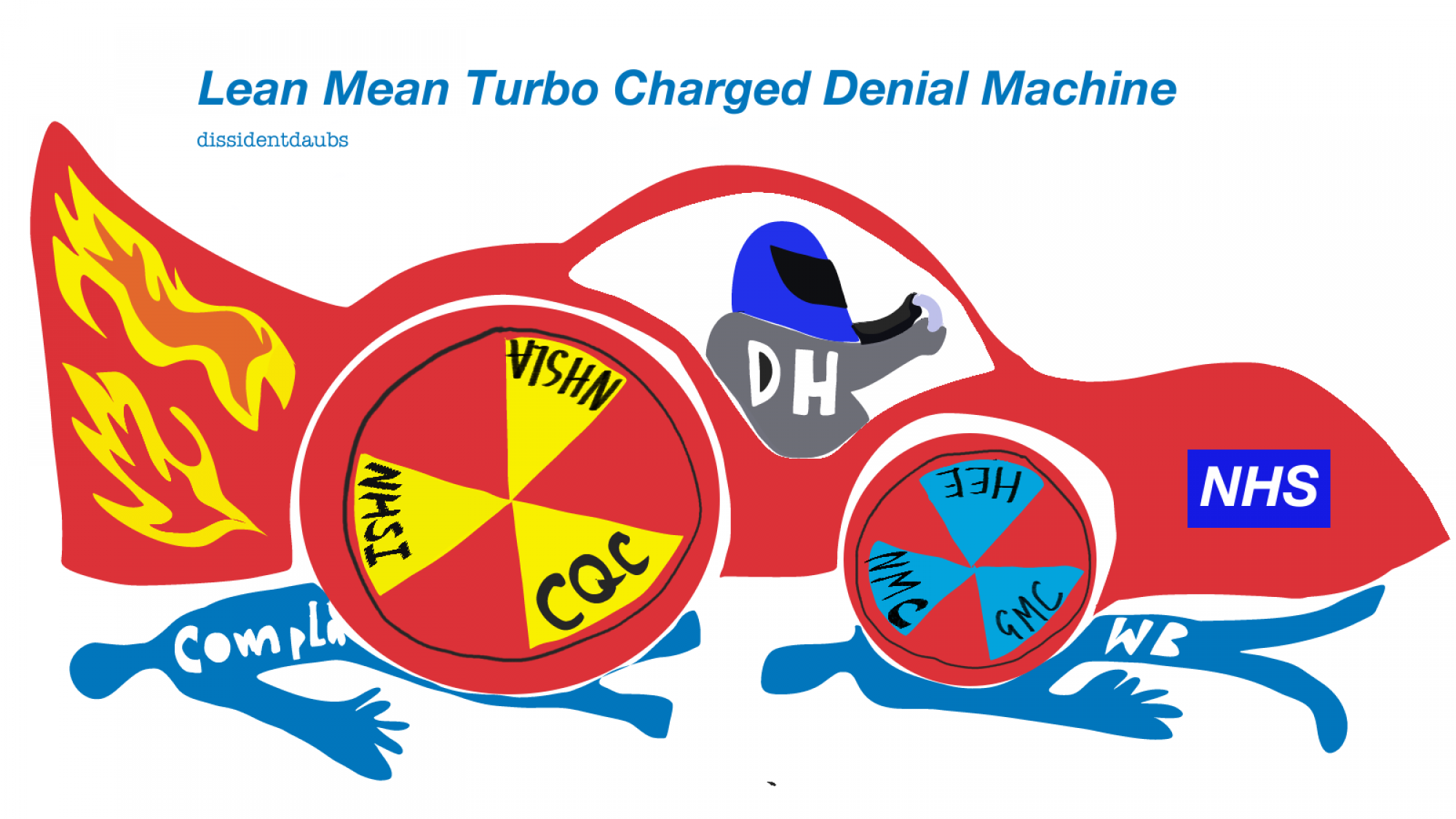
(By that point, NHSE/I had dumped its responsibility for investigating complaints about the National Guardian to the CQC.)

I sent Dilks additional evidence from Portsmouth Hospitals whistleblower Dr Jasna Macanovic about her experience of the Freedom To Speak Up system:

Dr Jasna Macanovic’s experience, shared on 28 May 2022:

“Dear Minh, 

I am forwarding the correspondence with [REDACTED], FTSU Guardian in Portsmouth in 2017/2018. 


We met on 2 occasions and exchanged some emails and text messages. She was present at the meeting I requested with CEO Cubbon on 10th August 2017. I will forward the email relating to that meeting. She has not helped at all, although she appeared to be listening. However, she could not understand a highly technical medical issue and was clearly intimidated by the CEO. She did not speak at all at the meeting on 10th July. 

She sent me a text message afterward “ My job is to remain independent but ensure processes are adhered to. I thought Marc C was fair and has given you an opportunity to express the errors and omissions as you see them best wishes J ‘.

She obviously did not understand the policies and procedures, or the Law as she did not raise any concerns about the case as far as I can see with anyone. From the judgment- you would have seen that ALL Internal procedures have been ignored in my case. [my emphasis]

As it happens – the Trust decided that rules are not applicable in my case, they continued with bullying and discrimination that culminated in my dismissal. The unsafe practice has never been addressed and the practitioners involved in malpractice have been promoted. 

I have several texts from REDACTED indicating that she was in contact with the National FTSU office in the first half of July 2017. 


I contacted the national office myself and was told that they do not get involved in individual cases or disciplinary processes and that I will be free to submit a case review form if/ and when I win a case for unfair dismissal in court. I am trying to locate the correspondence. This approach is appalling. 
[my emphasis]


I was lucky enough as I had a cast-iron case, and was resilient and financially capable of taking the case to the court. I do not know anyone else around me who would have survived this process. The ferocity and avalanche of unwarranted insults would have destroyed anyone. 

I firmly believe that the existence of the FTSU process ( Local and National Guardians) is an intellectually flawed concept. Well-run organisations do not need them, poorly run NHS organisations pay no attention to FTSU Guardians who are generally intimidated by the power and in my case, unable to comprehend their duties, policies, and the law. The FTSU Office has not  help me or the patients at the Wessex Kidney Centre/ Portsmouth Hospitals. 

Kind regards


Jasna”

Caroline Homer the CQC Deputy National Complaints Manager was assigned to the matter.

Caroline Homer initially tried to dismiss and shut down the complaint about the National Guardian without following CQC’s complaint procedure.

She did not liaise with me for particularisation of my complaint.

After an objection, she went through the motions of following CQC’s policy, but still dismissed the complaint.

This was on spurious grounds that the National Guardian was making a claim in her blog about what should happen and not what actually happens.

1 August 2022

“Dear Dr Alexander

Thank you for your emails below.  I have carefully considered the comments you have made and revisited my previous response.

Dr Chidgey-Clark’s intent was for the blog was to set the expectations of the Freedom to Speak Up Guardian role as defined by the supporting job description I previously referenced.  In your correspondence you have presented a different opinion in how you have interpreted the statements made, as is your individual right.  However, this difference of opinion on the intention behind Dr Chidgey-Clark’s message does not render the blog misleading and our position in respect of your complaint remains not upheld. 

As such, I reiterate you may wish to approach the Parliamentary and Health Service Ombudsman via your local Member of Parliament in the event you feel our handling has been disproportionate or unreasonable.

Kind regards

Caroline Homer
Deputy National Complaints Manager – National Complaints Team”

The full correspondence with Chidgey-Clark and CQC can be found here.

CQC seems to have a different understanding of the English language to everyone else.

Moreover, CQC’s complaint decision implies that as far as CQC are concerned, it’s not what you do that matters, but what you intended.

Acts and facts are immaterial.

Is that also how CQC approach their prosecutorial powers?

Neither Chidgey-Clark nor the CQC asked about or followed up on the examples that I gave of inappropriate responses by Freedom To Speak Up Guardians.

Evidence is unwelcome in La La Land.

Two weeks after Caroline Homer’s decision to protect the National Guardian instead of protecting the truth, a shocking Employment Tribunal judgment of 15 August 2022 determined that the Freedom To Speak Up Guardian at the Royal Free had taken part in detrimental actions against a whistleblower.

Fundamental failure of the NHS Freedom To Speak Up Project: Dr Rajai Al-Jehani unfairly sacked by Royal Free NHS Foundation Trust for whistleblowing on breaches of Human Tissue law, with suppression of linked investigations by University College London

Failure is the CQC’s leitmotif.

It would be funny if were not so tragic for patients and whistlebowers.

UPDATE 22 AUGUST 2023

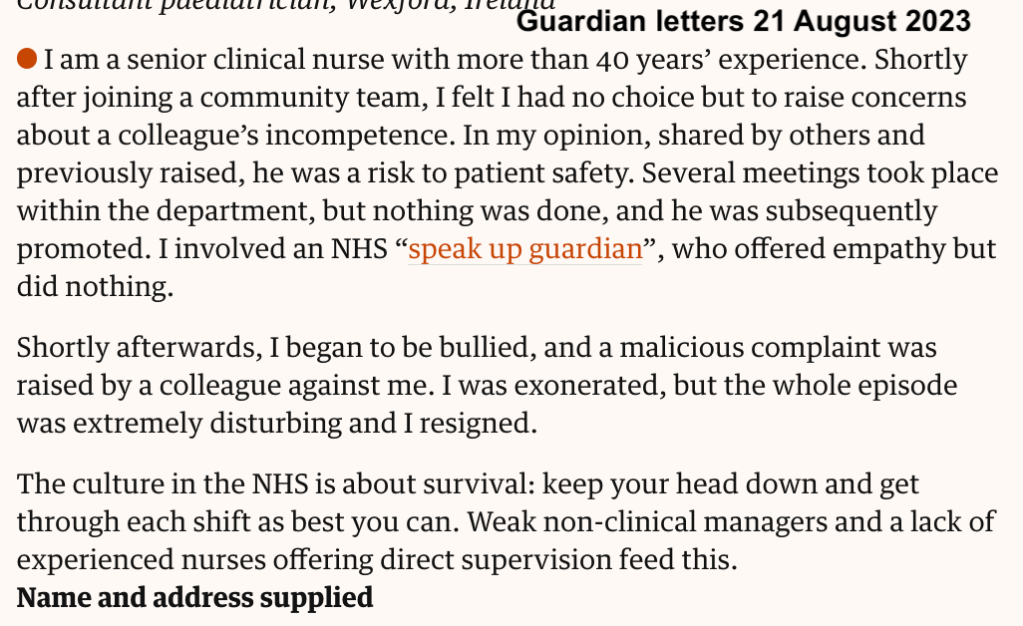
Following Lucy Letby’s conviction for murders and attempted murders of babies at the Countess of Chester Hospital and related revelations that whistleblowers had been silenced, the Guardian newspaper received this account of ineffective support by an NHS Freedom To Speak Up Guardian, published 21 August 2023: 

PETITION

Please click and add your signature to this petition to reform UK whistleblowing law – whistleblowers protect us all but weak UK law leaves them wholly exposed, lets abusers off the hook and it is a threat to public safety.

Replace weak UK whistleblowing law and protect whistleblowers and the public

RELATED ITEMS

The National Guardian’s Office claimed its case records had been twice audited. When further probing revealed that was untrue, the NGO claimed there was no need for these whistleblower case files to be audited:

Why has the National Guardian’s Office given conflicting information about quality assurance of its case records and protection of whistleblowers’ confidentiality?

In 2019 the previous National Guardian shockingly claimed that Freedom To Speak Up Guardians had saved lives and prevented “untold” harm, without producing any evidence to substantiate this:

The low fact National Guardian’s Offic

The National Guardian’s Office finally apologises for a breach of whistleblower confidentiality but fails to demonstrate sufficient learning

National Guardian’s gaslighting exclusion criteria: the never ending story

The National Guardian’s Office does not put a blue light on for ambulance staff.

Staff suicides at West Midlands Ambulance Service NHS Foundation Trust

The toothlessness of the National Guardian’s Office: Why it cannot be a model for protecting whistleblowers

The Disinterested National Guardian & Robert Francis’ Unworkable Freedom To Speak Up Project

SSOTP: Robert Francis’ exemplar trust has feet of clay, and Jeremy Hunt’s safety claims are un-evidenced


What the UHB Freedom To Speak Up Guardian told the BBC

By Dr Minh Alexander retired consultant psychiatrist 10 December 2022

Last night BBC Newsnight broadcast further investigations into poor culture and whistleblower reprisal at University Hospitals Birmingham NHS Foundation.

At the same time, the NHS announced three reviews into material uncovered by the BBC. This will be controlled by the Integrated Care Board, a new commissioning structure that has recently replaced the CCG structure.

There are serious concerns that these reviews will not be independent or rigorous because the trust and the ICB are too close. Indeed, some of the senior UHB managers have now moved to the ICB.

Crucially, the new Deputy Chief Executive of the ICB is Lisa Stalley-Green, who was UHB’s Chief Executive Nurse from 2018 until she recently moved to the ICB. She is therefore steeped in all the events of recent years, and a member of the trust board that was collectively responsible for flawed FPPR process applied to UHB’s former CEO David Rosser.

Moreover, Dr Clara Day the ICB’s new Chief Medical Officer was a consultant renal physician at UHB and latterly UHB’s Assistant Medical Director for Finance.

In a tragi-comic twist, the musical chairs also involves the ICB chair Yve Buckland, who has just been appointed as interim UHB Chair. This poses issues of conflict of interest for the ICB and whether it will rigorously hold Buckland to account as UHB Chair.

Some other members of the ICB board have been NHS senior managers in the local area with responsibility for commissioning services. That also places them in a position of conflict of interest, as commissioners must bear some of the responsibility for UHB’s failings.

Preet Gill MP Birmingham, Edgbaston has criticised the planned ICB reviews, and called for a properly independent investigation.

“It needs to be a fully independent review, not something that sounds like an NHS tick box exercise, as that will not go down well with those who have raised concerns,”

This seems critically important.

I am aware that UHB has gagged some of its critics, and they will not be free to disclose to a low-level review by the ICB.

A judge led inquiry with the legal power to un-gag vital witnesses is needed.

Last night’s BBC Newsnight’s focus turned to UHB’s lead Freedom To Speak Up Guardian since 2019, Professor Julian Bion.

Like UHB’s controversial former CEO David Rosser, Bion was an anaesthetist/ intensivist at UHB, working in this capacity for thirty years (1987 to2017).

In an interview by the BBC, Bion appeared ambivalent about the cultural problems at UHB.

He produced a report for the UHB board last year which made it clear that the trust’s Speaking Up arrangement was not working, because staff both feared and experienced detriment for raising concerns.

In last night’s broadcast, he was asked if he recognised the picture painted of the trust by whistleblowers. Bion replied hesitantly: “A bit”.

When asked if it was not more than a “bit”, Bion defended senior trust managers on the basis that they were working in a difficult system.

This does not of course explain why UHB’s culture is so much worse than other trusts. Nor the fact that UHB used to perform better but deteriorated in recent years.

It is possible that Bion provided balancing testimony of which we are as yet unaware, as not all of his interview would have been shown.

Of concern though, as part of his defence of senior trust managers, he stated that:

  1. He knew all of the UHB board
  2. They did not “enjoy making people frightened”

Did this reflect a loss of objectivity?

In my experience, the most abusive managers have no qualms about harming whistleblowers, and some derive satisfaction from doing so.

Certainly, Bion’s former CEO David Rosser displayed little regret or insight into the harm that he had caused to whistleblower Tristan Reuser, in a revealing interview by the Health Service Journal.

Bion’s comment that he recognised the poor culture reported by UHB whistleblowers only “a bit” is not consistent with further comments that he made later in the interview to explain poor management conduct at UHB .

He stated that the system within which managers works is “tense” and that it takes away their ability to put patients first:

“…so much focus on performance, so many competing demands, fear of failure is corrosive and it’s one of the biggest problems we’ve got. Because it takes away people’s sense of courage, self respect and doing the right thing for patients.”

This suggests to me that Bion in fact feels there is more than “a bit” of the poor culture reported by trust whistleblowers.

But it must be difficult to be fully candid about a community of which you have been a part.

Therein the core problem of the Freedom To Speak Up model.

There is also an issue of proportionality in how pressures on senior managers are viewed in contrast to those experienced by frontline staff. False equivalance should not be drawn.

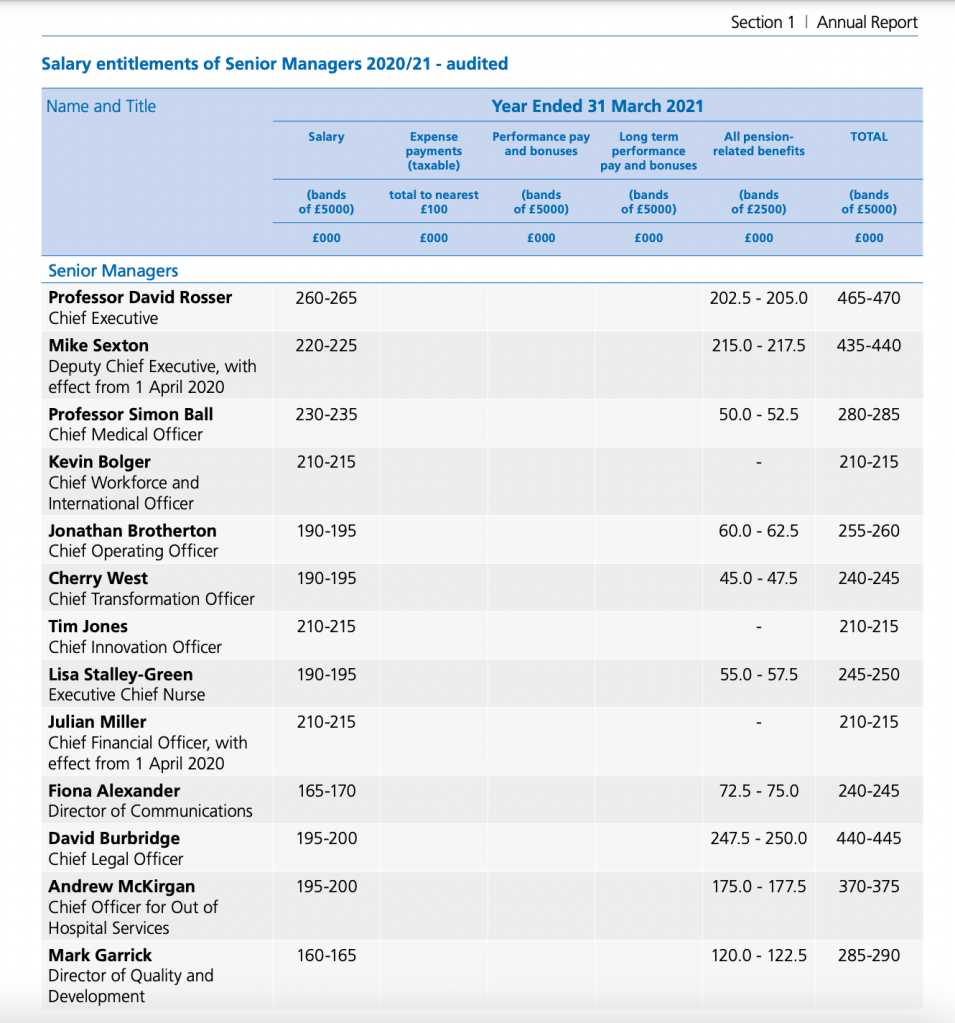
Trust executives have six figure salaries and large pension pots. They are much better buffered against the consequences of doing the right thing than frontline workers, whose lives they sometimes ruin for doing the right thing. Unfair dismissal, serious ill health and loss of economic security are what they inflict on those less powerful than them.

Whilst one might seek to understand what they do to frontline staff, I think there is no excusing it. Not even “a bit”.

These are UHB directors’ unusually large salaries, as published in the trust’s annual report of 2021/22:

Importantly, although I wrote to Bion in June 2022 about FOI data which showed that the trust appeared to be referring too many doctors to the GMC without sufficient grounds, he has not advised me if the trust has acted on this.

I copied him into correspondence of 5 December 2022 to Nick Crombie another anaesthetist and , a UHB Associate Medical Director who had tweeted that he did not “recognise the picture painted by Newsnight”, which again raised the GMC issue.

Bion informed me in response that he would be talking to the BBC, but added no information about the GMC issues.

There was also no response from Bion about the GMC issues in the interview sections shown in last night’s BBC broadcast.

Neither have I received any response whatsoever from the above UHB Associate Medical Director about the GMC issues.

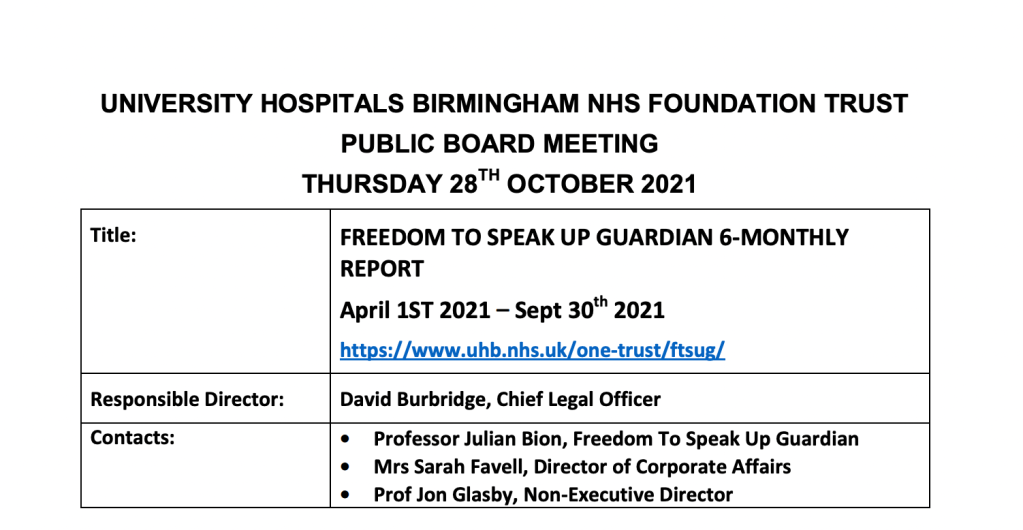
It is relevant to note that the UHB directors reporting to the board (David Burbridge and Jon Glasby) about Freedom To Speak Up are individuals who took part in UHB’s disciplinary action against whistleblower Tristan Reuser, and/or the deeply flawed UHB FPPR process which cleared Rosser. The former UHB CEO. Rosser was cleared by his board colleagues despite very critical Employment Tribunal findings and despite the GMC’s disciplinary action against Rosser.

Burbridge and Glasby are also the trust directors to whom Bion reports as Freedom To Speak Up Guardian:

Has Bion objected to their designated roles for Freedom To Speak Up, given their actions in the Reuser case…..or not?

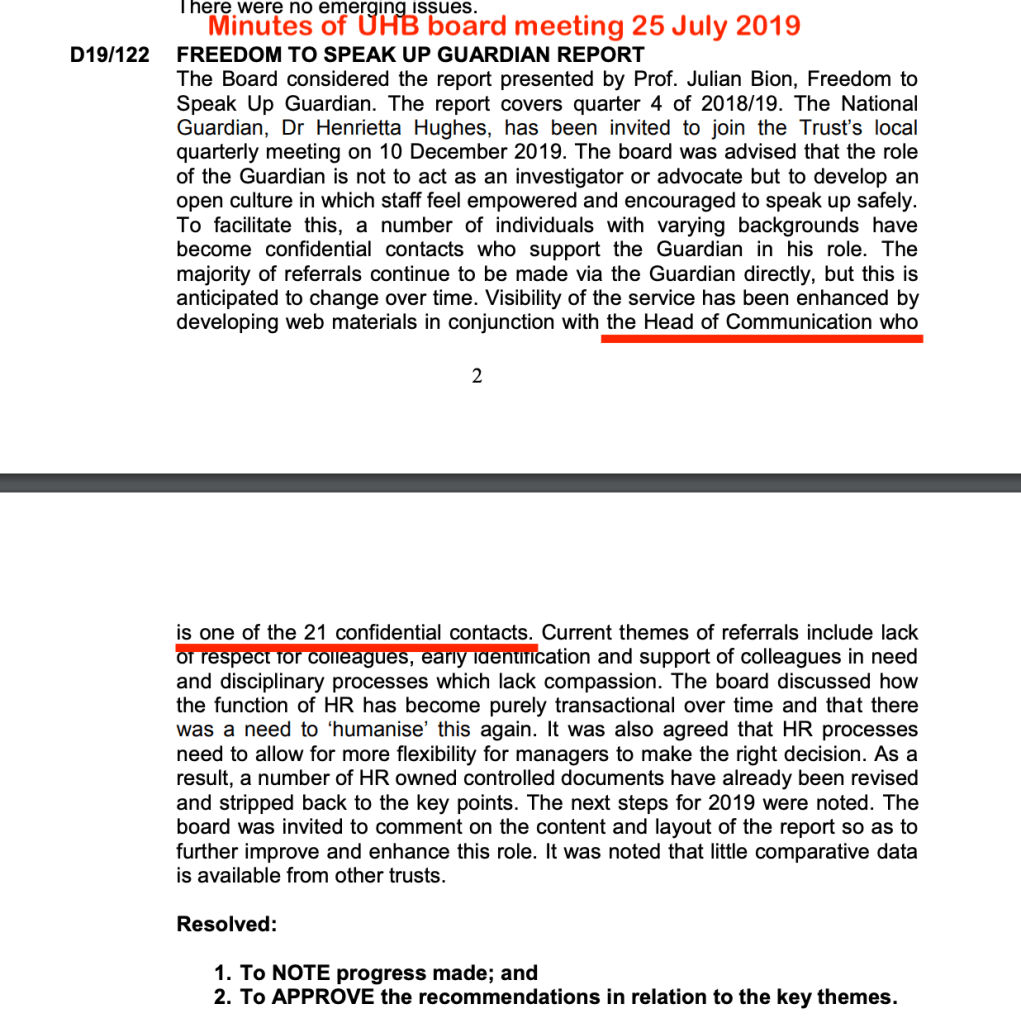
Moreover, Bion seems to have accepted a UHB arrangement where a trust comms manager also had a role as a Freedom To Speak Up “confidential contact”:

This seems to me to be highly questionable and laden with conflict of interest. Those responsible for an institution’s reputation management, and who report to the trust’s Director of Communications, should have no power over whistleblowers nor be entrusted with their sensitive confidential data.

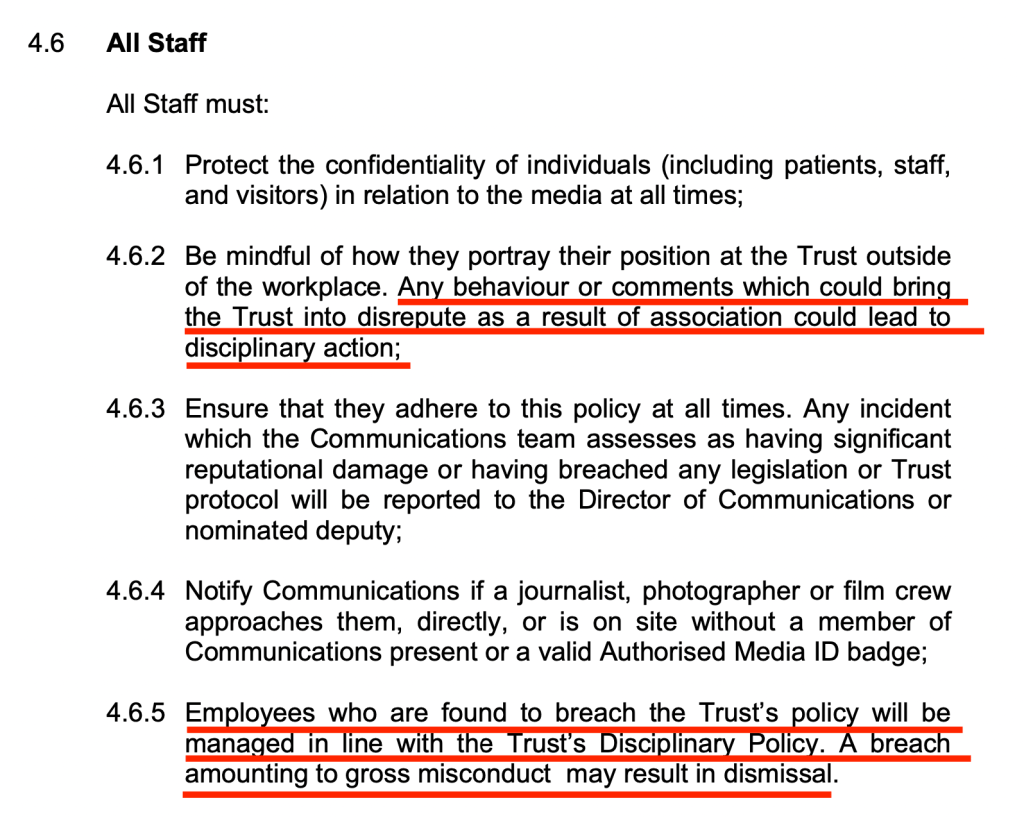
UHB’s media policy emphasises reputation and it spells out disciplinary consequences for staff who break ranks and speak out of turn:

UHB’s policy does not acknowledge that trust staff have a legal right to make a wider disclosure under UK whistleblowing law, such as to the media, in certain circumstances.

It should also be noted that after Newsnight broke the story, internal UHB comms included a statement from management which implicitly denigrated disclosures from unnamed staff.

This of course drove a coach and horses through UHB’s own whistleblowing policy, which like the national NHS whistlebowing policy, purportedly recognises the validity of anonymous whistleblowing.

The ultimate confirmation that a Freedom To Speak Up Guardian is properly independent is if they escalate concerns outside of their organisation, when they have evidence that the trust board is not acting appropriately.

There was no discussion of this with Bion in the clips shown by the BBC last night.

What was Bion’s position on UHB’s response to the critical ET and GMC findings from Reuser v UHB, and the trust board clearing Rosser under FPPR?

Did he question any of it, and did he escalate externally?

My transcript of last night’s BBC Newsnight’s broadcast is provided below.

Newsnight transcript 9 December 2022

Faisal Islam BBC: Now, a week ago a Newsnight investigation uncovered what whistleblowers told us was a mafia-like leadership at one of England’s biggest hospital trusts. A punitive culture, we were told, by current and former clinicians from Birmingham University Hospitals Trust, which frightens from staff raising concerns about patient safety.

In the wake of our report, not one but three reviews have now been announced by the NHS in the region.

The under-fire trust serves two million patients across four Birmingham hospitals recently ranked 119 out of 120 in England. Politicians are now calling for a Mid Staffs style independent inquiry.

Our Chief Correspondent David Grossman has more.

David Grossman BBC: We uncovered what insiders told us was a culture of fear at one of England’s biggest and worst performing hospital trusts.

Unnamed interviewee: I and other consultants have raised concerns about patient safety and we realised that if you do, you will get punished quite quickly, quite harshly. So they will make all kinds of spurious investigations and they will try to intimidate you that way.

David Grossman BBC: Since we broadcast our investigation last week, we’ve been contacted by several clinicians at this hospital trust, both current and former, who told us a similar story: that they felt unable to come forward with their concerns about patient safety because they feared some sort of retribution.

The local MP says that she’s been contacted too, by concerned hospital staff.

Preet Gill MP Birmingham, Edgbaston: Many of them are from different parts of the UHB trust, raising absolute concerns with me which were very, very distressing to see. These are doctors that have worked here for a very long time. These are doctors from different departments. This isn’t just disgruntled doctors. This isn’t just a department at the Heartland Hospital. This much more broader. This is people that have worked here fifteen, ten, twenty years and this is really concerning because this is showing a culture within the organisation there where was bullying, intimidation, and it’s been far, wide reaching. And of course it’s been going on for some considerable amount of time.

David Grossman BBC: Birmingham and Solihull Integrated Care Board has announced three separate reviews of our evidence. The first into the specific allegations made in our report. Second, a more general review into the culture and alleged bullying at the trust and the third, is into leadership. However, the Integrated Care Board was formed only in the summer and some its senior team were until very recently, senior managers at UHB trust.

Richard Burden Chair of Birmingham and Solihull Healthwatch: If it was the board of the ICB that was going to conduct this inquiry, I’d have big reservations about that. But the important thing is will the person or people conducting the inquiry be independent both of the trust, the ICB and indeed, independent of NHS England/ Improvement as well?

Will they be able to go where ever the evidence takes them, to look at whatever they need to look at, and will their findings be made public at the end of it? So everybody can see what’s been found out. Those are the three important criteria in my view.

David Grossman BBC: There is  supposedly already a structure in place to allow people to raise patient safety issues. Each NHS trust has a Freedom To Speak Up Guardian, who can hear concerns and raise them with management.

The Guardian has no real powers, just to listen and warn.

The Freedom To Speak Up Guardian at University Hospitals Birmingham is Professor Julian Bion. His most recent report noted that a majority of staff were worried about raising concerns because they feared adverse consequences, what the report calls “detriment”.

Julian Bion UHB FTSU Guardian: The process of investigation is so slow that people won’t wait…[inaudible, volume trails off]

David Grossman BBC: I spoke to Professor Bion before the reviews into the allegations contained in Newsnight’s investigation were announced.

Julian Bion: The question is does detriment occur? And I think there have been a number of instances of which I am aware, where I’ve taken concerns to the trust and in the end I felt that the individuals who had done so had suffered detriment.

And I raised these with the trust board in public, last year. And I, I didn’t describe the individual cases of course because I can’t, but I did describe what it felt like to the individuals who felt they had suffered detriment. And this was very hard for the trust board to listen to.

David Grossman BBC: Do you feel that characterisation that we heard from several consultants and several people behind the scenes who didn’t wish to be named, that there was something of a culture of fear. Do you recognise that at UHB?

Julian Bion: [pause] A bit.

David Grossman BBC: Not more than “a bit”?

Julian Bion: I know all the individuals on the trust board. They didn’t enjoy making people frightened. But when you work in a such a tense set of circumstances as we are at present, with so much focus on performance, so many competing demands, fear of failure is corrosive and it’s one of the biggest problems we’ve got. Because it takes away people’s sense of courage, self-respect and doing the right thing for patients.

Richard Burden Chair of Birmingham and Solihull Healthwatch: The first important thing is that a Speak Up Guardian has got access to staff. The second important thing is that his or her findings are made public. The third important thing is that they’re acted on. Now the first two of those happened in relation to UHB. The third of those, has a much bigger question mark around that. Which is why we need the investigation that we’ve been calling for since last week’s Newsnight’s report.

Preet Gill MP Birmingham, Edgbaston: We’ve got to have a whistleblowing procedure that has confidence of the staff, knowing that not only will they be able to raise issues but they will be taken seriously and something will happen. It’s very clear that system isn’t working. The doctors that have been contacting me, one of the things that they have been saying is:

“Please do not share our name. Do not share details of where we work. We are really, really worried about reprisals.”

David Grossman BBC: The hospital trust has a new chief executive taking over in January and a new interim board chair, who’s just started in post. Some see the possibility of a fresh start.

Julion Bion UHB Freedom to Speak Up Guardian: The past chair of the trust has been extremely supportive, Harry Reilly. He’s been replaced by Dame Eve Buckland. She has already been in touch with me. She has asked if she can meet online with my entire team, the thirty confidential contacts my two deputies, which is excellent. So I’m very pleased about that.

David Grossman BBC: The reviews of whistleblowing at UHB we are told will be concluded early in the New Year. So far this announcement has not silenced or even reassured the trust’s critics.

Faisal Islam BBC: A spokesperson for University Hospitals Birmingham said “We welcome the support that’s been put in place and we look forward to working positively and constructively with our NHS colleagues. This will build upon the work already underway across UHB to understand the issues that have been highlighted. It’s clear that there is a strength of feeling in a number of areas and we are committed to addressing these.”

UPDATE 11 DECEMBER 2022

I have written to Yve Buckland the new UHB interim Chair (who is Chair of the ICB) about unpleasant messaging by the trust, which appears to have been sent out in her name, which has the effect of denigrating staff and former staff’s disclosures to the BBC.

UPDATE 16 DECEMBER 2022

I have come across data which suggests that a UHB FOI disclosure of April 2022 about the outcomes of trust GMC referrals was incorrect.

I have written to the interim Chair Yve Buckland requesting clarification.

Letter to Yve Buckland UHB interim Chair 16 December 2022

Related items:

Under the microscope: The Freedom To Speak Up model and University Hospitals Birmingham

After Reuser v UHB and Macanovic v Portsmouth: New rules to deter malicious referrals of whistleblowers to the Practitioner Performance Advice service

Why has the National Guardian’s Office given conflicting information about quality assurance of its case records and protection of whistleblowers’ confidentiality?

The National Guardian’s Office finally apologises for a breach of whistleblower confidentiality but fails to demonstrate sufficient learning

National Guardian’s gaslighting exclusion criteria: the never ending story

The National Guardian’s Office does not put a blue light on for ambulance staff.

Staff suicides at West Midlands Ambulance Service NHS Foundation Trust

The Disinterested National Guardian & Robert Francis’ Unworkable Freedom To Speak Up Project

SSOTP: Robert Francis’ exemplar trust has feet of clay, and Jeremy Hunt’s safety claims are un-evidenced

NHS England Mental Health Tsar’s trust does not collect data on long COVID affecting its staff

By Dr Minh Alexander 9 December 2022

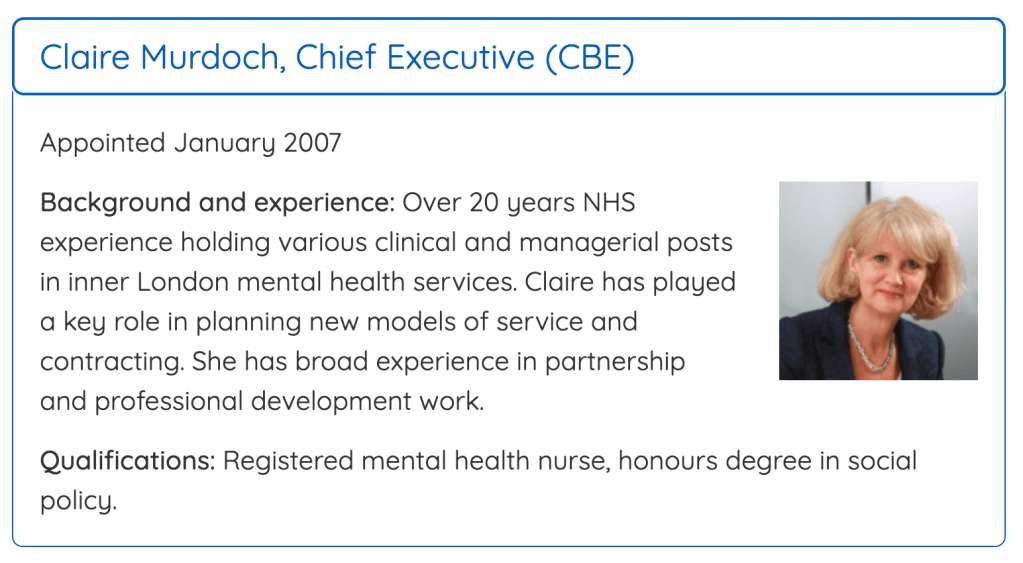
Claire Murdoch is the National Mental Health Director for NHS England.

She is also longstanding CEO of a mental health trust, Central and North West London NHS Foundation Trust.

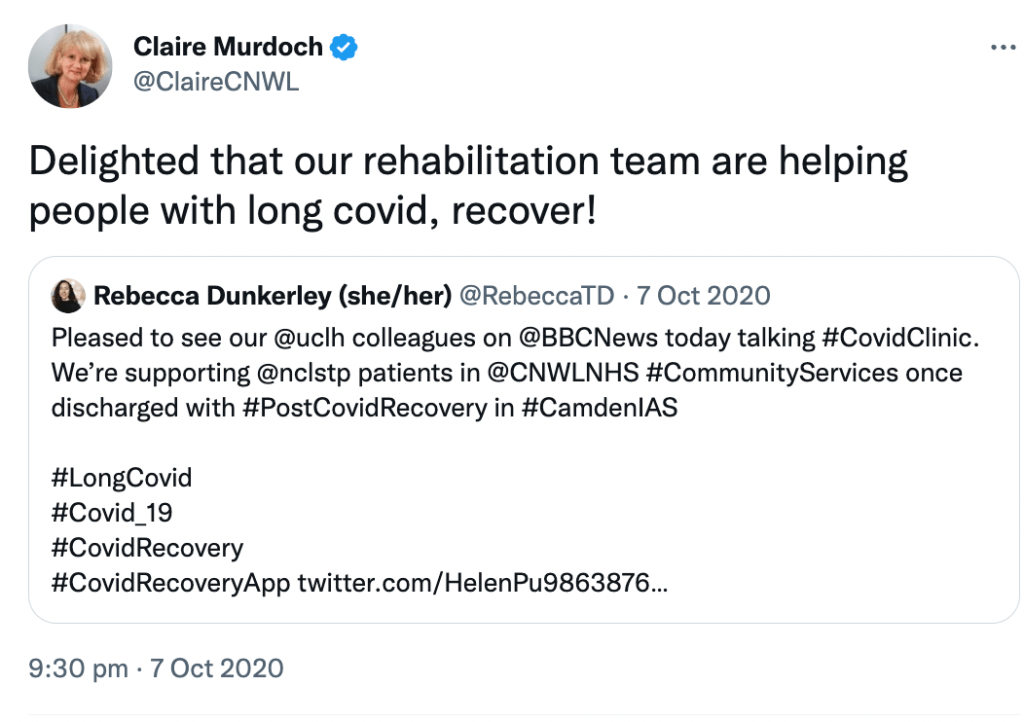
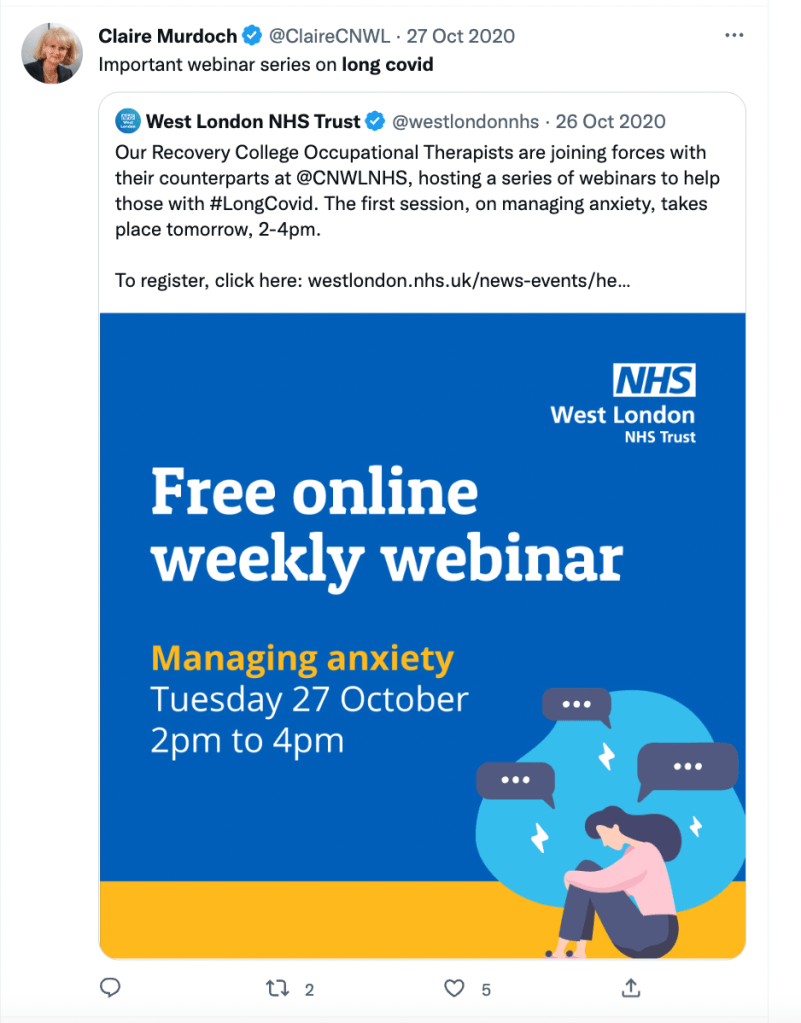
She has made public statements about support for people affected by long COVID:

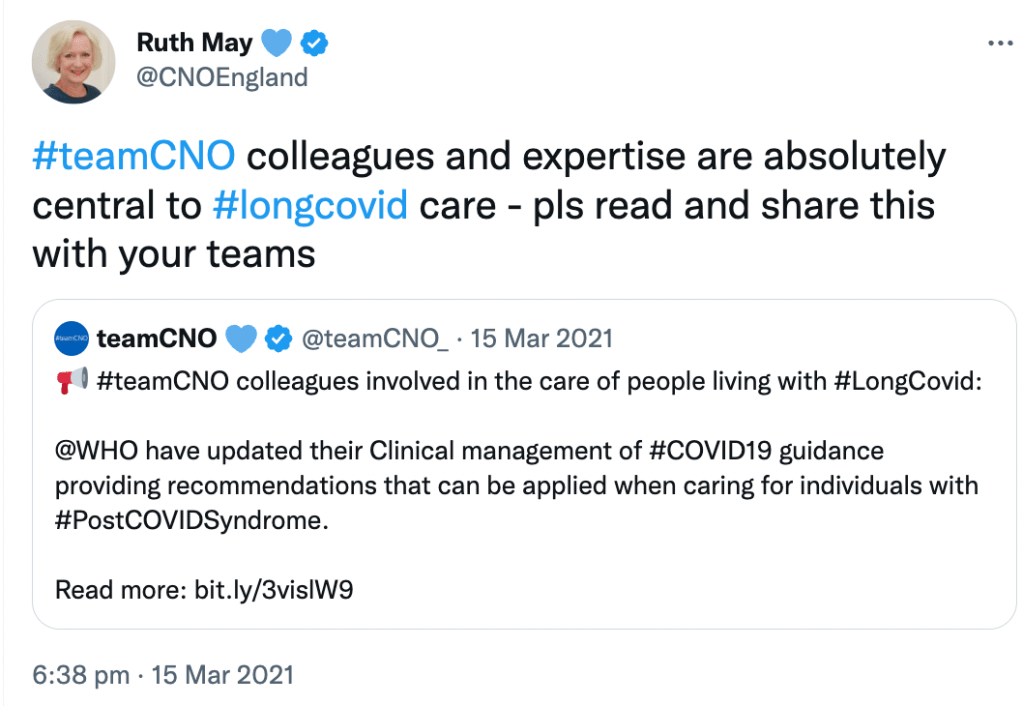
Her NHS England colleague Ruth May Chief Nursing Officer has also made public comments about the importance of addressing long COVID:

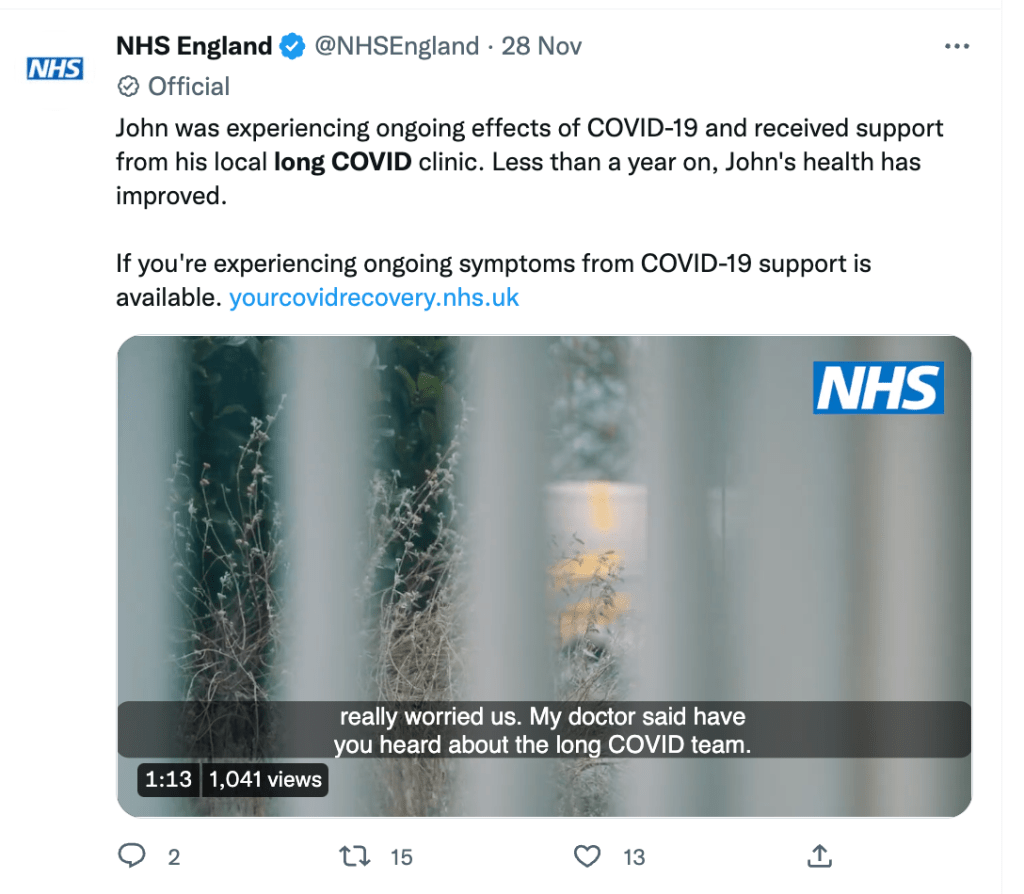
NHS England has made similar public comments:

Last year, Claire Murdoch’s trust ignored an FOI request about long COVID in its staff:

FOI request by Grace Pritchard

I re-submitted the FOI request, with some additional questions.

The response from Claire Murdoch’s trust has now revealed that:

  1. Central and North West London NHS Foundation Trust does NOT collate data on the extent to which its staff have been affected by a long COVID.
  2. NHS England has not asked Central and North West London NHS Foundation Trust for data on long COVID in its staff

The CNWL FOI correspondence can be found here.

Other NHS trusts have also indicated that NHS England has not asked them for data on how long COVID has affected their staff.

I have asked Claire Murdoch if her trust and NHS England will now collect staff long COVID data.

9 December 2022

Hi Claire,

May I ask with respect to your trust’s response below,

1. Will the trust reconsider its current approach and start collating data on how long COVID has affected its staff?

2. Will NHS England reconsider its current approach and start collating data on how long COVID has affected NHS staff?

BW

Minh

Dr Minh Alexander

RELATED ITEMS

The Department of Health holds no data on long COVID in NHS staff and has no intention of collating this data

Transparency about NHS staff with long COVID injuries and NHS staff personal injury claims for long COVID

NHS England does not want to know about long COVID in NHS staff

After Reuser v UHB and Macanovic v Portsmouth: New rules to deter malicious referrals of whistleblowers to the Practitioner Performance Advice service

By Dr Minh Alexander retired consultant psychiatrist 7 December 2022

This post reports on improvements in procedural safeguards for whistleblower doctors who are punitively referred to the General Medical Council and the Practitioner Performance Advice service.

Whistleblowing medics can be victimised through malicious referrals to the General Medical Council.

There is another NHS body which is also used by abusive medical managers to harm whistleblowers: the Practitioner Performance Advice service (formerly known as the National Clinical Assessment Service, NCAS).

It is senior doctors who refer other doctors to the PPA.

The Practitioner Performance Advice service gives NHS trust managers advice on how to apply the Maintaining High Professional Standards (MHPS) procedure – the NHS method for dealing with medical incapability and misconduct.

Under MHPS, employers must liaise with the PPA to explain what they are doing, in order to progress the MHPS process.

The PPA has no investigative role. It merely provides advice based on information provided by employers. It may also assess doctors’ performance at the request of employers.

Bad employers may feed false or distorted information to the PPA to engineer suspensions.

The Employment Tribunal described such false and distorted information given to PPA (previously NCAS) in the whistleblowing cases of Mr Tristan Reuser and Dr Jasna Macanovic.

The PPA had not kept pace with procedural safeguards introduced by the GMC to protect whistleblowers, following the Hooper review in 2015.

But based on the continuing cases of employer misconduct involving the MHPS/ PPA mechanism, the PPA has advised that it will enact the following:

  • Referring employers must provide a statement of truth
  • Referring employers must declare that there are no omissions in their referral and that the referral is being made in good faith
  • Employers must explicitly declare if a referred doctor has made public interest disclosures
  • Employers must declare that they have shared documents with the referred doctor

This broadly mirrors the GMC’s requirements for referring employers. The GMC also added a clause in its referral form requiring the referring senior doctor to consider their due diligence in ensuring that their referral is fair and inclusive:

“…what impartial checks you’ve made to ensure the referral is fair and inclusive.”

 This change was made in December 2021, a few months after the GMC upheld complaints that the medical director of University Hospitals Birmingham made a false declaration in his referral of whistleblower surgeon Mr Tristan Reuser.

The formal declarations that the PPA is introducing increase jeopardy for senior doctors who abuse the MHPS/ PPA mechanism to punish and intimidate whistleblowers.

The declarations open a potential door to disciplinary action by the GMC, as happened when UHB’s former medical director referred Mr Tristan Reuser to the GMC and falsely claimed that Mr Reuser had not made public interest disclosures.

The PPA has also introduced a question to employers on whether referred doctors are well enough to undergo a PPA assessment, so that the needs of unwell doctors must be weighed.

In addition, the PPA’s documentation allows for a submission by the referred doctor, so that they can also provide the PPA with contextual information.  

For example, any concerns that a doctor might have that they are being referred for improper reasons, such as reprisal for speaking up.

This is an advance, because in the past NCAS/PPA failed to weigh referred whistleblowers’ concerns about reprisal.

It remains to be seen how well all this works, and what the PPA will do in cases where it becomes obvious that whistleblower reprisal is the reason for referral.

But PPA’s formal acknowledgement of whistleblower reprisal is a significant step forward.

This is the most recent correspondence with PPA(NCAS):

Correspondence with PPA March – December 2022 Procedural safeguards for whistleblowers

This is Version 30 of the form that the PPA will require referrers to complete, including a section which the referred doctor can complete (Form B, starting page 10):

PPA Referral for consideration of assessment form V30

Version 30 does not contain an additional, agreed question to the referring manager on whether the referred doctor has made public interest disclosures, but it will presumably be updated.

I asked the PPA to consider allowing referred doctors to submit their evidence directly to the PPA, to avoid any employer tampering or manipulation, such as by falsely claiming that there is no submission from the referred doctor.

This was not agreed on grounds that the referred doctor might not respond reliably, although PPA indicated it would continue considering what further improvements could be made to its process.

We have also considered whether a practitioner could send us the referral form back directly.  Our current position is that referral to Advice for an intervention or assessment takes place as part of an employment relationship and a practitioner may not complete or return the form in a timely manner.  However, I do recognise your concern relates to potential extreme scenarios and we will continue to consider whether the process on this could be improved.”

My advice to any whistleblower therefore is to submit evidence through the PPA’s process, via the employer as required, but to also send a copy directly to the PPA.

As is evident, the worst employers are prepared to mislead PPA with false allegations or omission of important information, so it would be wise not to allow them control of whistleblowers’ evidence.

Moreover, employers may conceal any false allegations that they have made to PPA from referred doctors.

In Tristan Reuser’s case, his employer University Hospitals Birmingham NHSFT failed to:

  • Disclose the MHPS correspondence to him (contravening the MHPS rules)
  • Disclose the MHPS correspondence to him after a Subject Access Request
  • Disclose the MHPS correspondence to the Employment Tribunal, even though it was highly relevant to Mr Reuser’s claims.

Mr Reuser resolved this by obtaining the MHPS correspondence through an additional Subject Access Request to what was then NCAS (PPA’s predecessor).

If an employers fails to disclose MHPS documents to a doctor referred to PPA, I would advise the doctor to:

  • Inform the PPA of this breach

This is because the worst employers may flout their legal obligations under GDPR, and the Information Commissioner has no powers to compel disclosure from an employer who is determined to act abusively. Instead, individuals have to apply for a court order to release their data and few can afford that. It is less painful and onerous to ask PPA, as opposed to a hostile employer, for the information.

Lastly, it is relevant to point out that the heavy lifting on securing the improvements to PPA’s procedures has largely been done by whistleblowers.

Successive National Guardians since 2016 have been noticeable by their absence, despite the fact that it is part of their job description to identify and challenge barriers to speaking up in the NHS.

Their failure to protect whistleblower doctors from victimisation through abuse of the MHPS process was also despite the fact that the second National Guardian, who was in post for FIVE years, was a doctor. She should have been aware of the abuses.

RELATED ITEMS

Mr Tristan Reuser’s whistleblowing case: Scandalous employer and regulatory behaviour on FPPR
Mr Tristan Reuser surgeon & GMC. Update on GMC, whistleblowing and implementation of the Hooper recommendations

Mr Tristan Reuser, surgeon, successfully defends an EAT appeal by University Hospitals Birmingham NHS Foundation Trust

Portsmouth Hospitals University NHS Trust sacked Dr Jasna Macanovic consultant nephrologist for whistleblowing to the General Medical Council

Henrietta Hughes former National Freedom To Speak Up Guardian, South Central Ambulance Service, out of touch “extreme positivity” and failures to act on staff concerns

Under the microscope: The Freedom To Speak Up model and University Hospitals Birmingham

Handling of disclosures to the National Guardian since 2016: Double standards and missed opportunities

By Dr Minh Alexander retired consultant psychiatrist 6 December 2022

The NHS Freedom To Speak Up project is discredited by serious continuing whistleblowing scandals in the NHS, despite Robert Francis’ claim that his project would make injustice “very rare”.

The project is currently under extra pressure because of BBC Newsnight’s ongoing investigation of University Hospitals Birmingham NHS Foundation Trust’s culture and mistreatment of staff who speak up.

The National Guardian’s Office (NGO) is part of this system. It is not a liberator of whistleblowers but a government instrument of control.

It helps to keep a lid on NHS whistleblowers whilst spinning endless good news stories.

It has no powers, and it interprets what narrow remit is has in a restrictive manner that deprives whistleblowers of any real support.

It has set its exclusion criteria to delay and withhold help from whistleblowers in extremis.

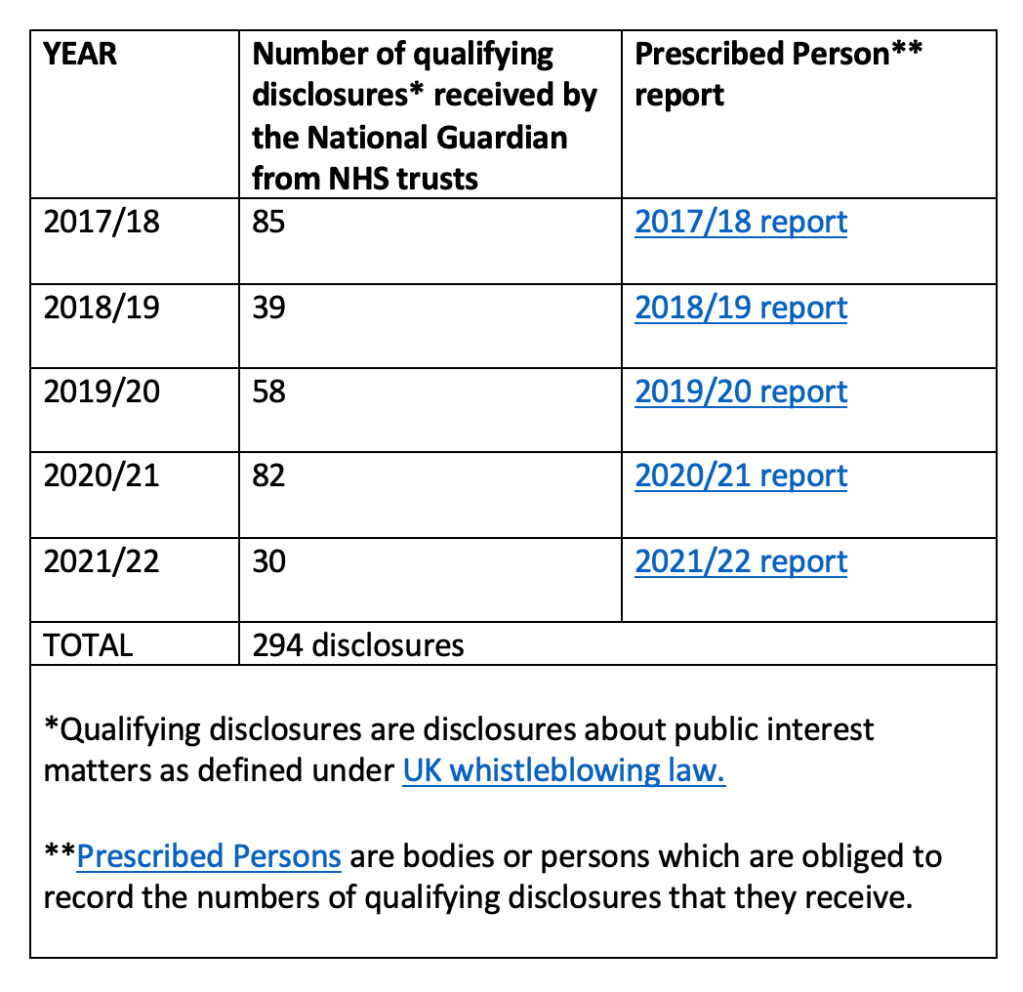
The NGO is not trusted by NHS staff. Few of them whistleblow to the NGO, as evident in the annual statistics of qualifying disclosures received by the NGO from NHS staff.

The National Guardian often tells NHS trust staff to go back to their organisations, which causes great distress to fearful staff, who may already have been victimised:

YEARProportion of staff who made qualifying disclosures whom the NGO signposted to Trust Freedom To Speak Up Guardians
2017/18No data given
2018/1943.5 %  (17 of 39)
2019/2039.6 %  (23 of 58)
2020/2134.1 %  (28 of 82)
2021/2243.3 %  (13 of 30)

It is unclear how many of the qualifying disclosures that NHS trust staff made to the National Guardian resulted in case reviews by the National Guardian, because the reports are worded in a way that does not clearly give this figure.

But extraordinarily, there is an admission that in 2021/22 the National Guardian stopped even giving advice to NHS staff on how to apply for a National Guardian case review:

YEARNumber of cases in which the National Guardian’s Office “Initiated a case review, providing information on how a referral for a case review could be made, or explaining the case review process”  

[following disclosure by NHS trust staff to the National Guardian]  
2017/18No data given
2018/1912 (out of 39)
2019/2024 (out of 58)
2020/2119 (out of 82)
2021/220

What happened in 2021/22?

Was the purportedly independent National Guardian told to resist all requests for case review?  If so, why?

Importantly, a previous FOI request revealed that the National Guardian receives very few qualifying disclosures from NHS Trust Freedom to Speak Up Guardians, even though trust Freedom to Speak Up Guardians are supposed to escalate outside of their trust if needed.

Of 85 qualifying disclosures received by the National Guardian in 2017/18, only 17 came from NHS Freedom To Speak Up Guardians.

The fact that so few NHS Trust Freedom to Speak Up Guardians whistleblow to the National Guardian exposes the lie that Guardians employed by NHS trusts are independent.

Also of concern, the FOI response showed that even whistleblowing  by NHS trust Freedom To Speak Up Guardians did not result in case reviews:

“The actions taken in response to the 17 qualifying disclosures from Freedom to Speak Up Guardians or their equivalents are detailed further below:

  *  14 disclosures led to the office providing information, advice or guidance to a Freedom to Speak up Guardian or equivalent to help them support workers to speak up.

  *  3 disclosures led to the office signposting the worker to other sources of advice or guidance, or to an appropriate regulator, authority or body.”

The NGO has breached confidentiality.

The Office yet again showed itself to be unaccountable when recently asked for audits of its case record keeping and handling of whistleblower confidentiality.

Whistleblowers keep reporting that they are fobbed off by the NGO. Recent examples of this are the cases of Dr Jasna Macanovic and Mr Shyam Kumar, both vindicated whistleblowers.

The NGO has also been accused of trying to persuade people to drop their concerns.

It is wilfully blind to whistleblowers’ concerns both by design and choice.

  1. Robert Francis recommended that the NGO should have no responsibility for investigating whistleblowers’ concerns, and as a matter of policy, he left control of such investigations to employing NHS trusts.
  • The NGO collates data from NHS trust Freedom To Speak Up Guardians, but this expressly does NOT include whether whistleblowers’ concerns are safely resolved, despite a past challenge about this omission.

Further evidence has now arisen which again shows that the NGO does not take its responsibilities to whistleblowers seriously.

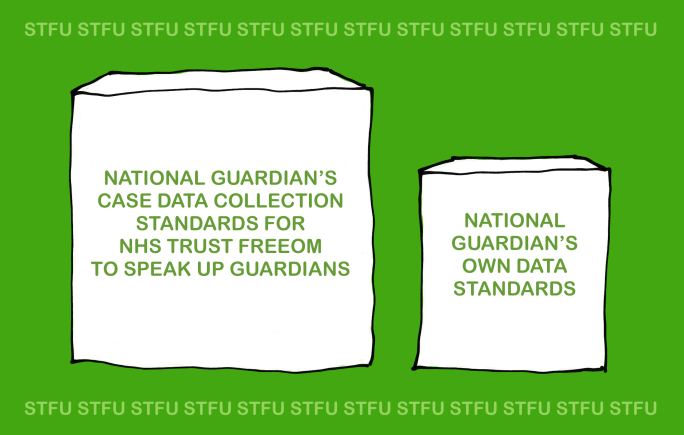
An FOI request has revealed that the NGO does not apply the same standards to itself as those that it expects of NHS trust Freedom To Speak Up Guardians:

FOI response by National Guardian on centrally held data about NHS trust staff who speak up to the National Guardian

The NGO asks NHS trust Freedom To Speak Up Guardians to submit quarterly data on:

  1. The number of cases raised
  2. Whether the cases are raised anonymously
  3. Whether cases feature an element of patient safety/quality
  4. Number of cases with an element of bullying or harassment
  5. Number of cases with an element of inappropriate attitudes and behaviours
  6. Number of cases in which people report experiencing detriment after speaking up.

The NGO also expects NHS Trust Freedom To Speak Up Guardians to track patterns in cases for learning and to identify systemic issues.

The FOI has revealed that with regard to cases of NHS staff who contact the National Guardian, the National Guardian does NOT collate data on:

  1. Whether the cases feature an element of patient safety
  2. Whether individuals report any detriment after speaking up

This failure to collate crucial information suggests that the National Guardian is not tracking important safety patterns, and that she is not fully sighted on important variations in detriment between NHS trust.

Is that because it would be inconvenient to know which NHS trusts are the most abusive?

The FOI shows that the National Guardian’s central database about NHS staff who contact her Office focusses on administrative process and it features the following items:

Name of person
Organisation
Position/Type of contact (FTSUG, worker etc)
Date in
20 working day response date
Date responded
Responsibility
Same day 2-5 days
6-10 days
11-20 days
Overdue
Action taken  

In my opinion, this suggests a tick box attitude.

The FOI shows that since 2016 when the National Guardian’s Office was established, it has received only 223 contacts from NHS staff.

It also shows that the number of NHS trust staff contacts to the National Guardian has ranged between zero to 5 for each of the NHS trusts in question.

In 20 instances, the worker did not even disclose the identity of their trust.

The FOI showed that the National Guardian has received disclosures from all NHS ambulance trusts as follows:

NHS AMBULANCE TRUSTNumber of workers who have spoken up to the National Guardian since 2016
North East Ambulance Service0-5
North West Ambulance Service0-5
East Midlands Ambulance Service0-5
West Midlands Ambulance Service0-5
East of England Ambulance Service0-5
Yorkshire Ambulance Service0-5
London Ambulance Service0-5
South Central Ambulance Service0-5
South East Coast Ambulance Service0-5
South Western Ambulance Service0-5

NB The NGO has not given the exact numbers on grounds of possible identifiability

The National Guardian has also received disclosures from a sample of NHS trusts which have been troubled.

This includes Greater Manchester Mental Health NHS Foundation Trust, where BBC Panorama recently uncovered patient abuse following a tip off from whistleblowers:

NHS TrustNumber of workers who have spoken up to the National Guardian since 2016
University Hospitals Sussex NHS Foundation Trust (and predecessor bodies)0-5
Greater Manchester Mental Health NHS Foundation Trust0-5
West Suffolk NHS Foundation Trust0-5
South Tees NHS Foundation Trust0-5
Royal Free London NHS Foundation Trust0-5
Portsmouth University Hospitals NHS Trust0-5

NB The NGO has not given the exact numbers on grounds of possible identifiability

When did Greater Manchester Mental Health NHS Trust staff whistleblow to the National Guardian?

Did the National Guardian respond supportively to the worker(s) at Greater Manchester Mental Health NHS Foundation Trust?

Did the National Guardian take adequate action in response to these disclosures?

Could the National Guardian have helped to end the abuse?

Or was it the usual story of whistleblowers being fobbed off by her Office?

Did Greater Manchester Mental Health NHS trust staff whistleblow to BBC Panorama because they received no meaningful help from the National Guardian?

These questions need answers and I will ask NHS England to ensure that the independent investigation that it has commissioned considers these questions.

It is time for the government to stop wasting public money on window dressing and to give us fit for purpose UK whistleblowing law and infrastructure.

PETITION

Please click and add your signature to this petition to reform UK whistleblowing law – whistleblowers protect us all but weak UK law leaves them wholly exposed, lets abusers off the hook and it is a threat to public safety.

Replace weak UK whistleblowing law and protect whistleblowers and the public

Related items

The National Guardian’s Office finally apologises for a breach of whistleblower confidentiality but fails to demonstrate sufficient learning

National Guardian’s gaslighting exclusion criteria: the never ending story

The National Guardian’s Office does not put a blue light on for ambulance staff.

Staff suicides at West Midlands Ambulance Service NHS Foundation Trust

The toothlessness of the National Guardian’s Office: Why it cannot be a model for protecting whistleblowers

The Disinterested National Guardian & Robert Francis’ Unworkable Freedom To Speak Up Project

SSOTP: Robert Francis’ exemplar trust has feet of clay, and Jeremy Hunt’s safety claims are un-evidenced

Cases of detriment after speaking up, by NHS trust, since 1 April 2020

By Dr Minh Alexander 5 December 2022

As part of the current discussions arising from the concerns about University Hospitals Birmingham, I have taken a quick and dirty look at the National Guardian’s most recent Speaking Up data, with a focus on reported detriment.

This is data supplied by NHS trust Freedom to Speak Up Guardians, who work for NHS trusts (whether substantively or sub contracted), which is sent to the National Guardian who publishes it.

The data is controlled and potentially filtered by employers, and potentially filtered again when it is processed by the National Guardian, so interpretation should circumspect.

I have looked at years:

2020/21

2021/22

2022/23 Quarter 1

(The National Guardian’s Office seems to have removed data from before 2020 from its website. I have some of the old datasets but not all, if anyone needs these.)

In my view, the data has become more incomplete and now resembles the levels of non-compliance seen when the NHS Trust Freedom To Speak Up Guardian posts were still new.

This means that unsavoury secrets can be hidden.

Unexplained failures to submit defeat the purpose of publication.

21 NHS trusts failed to return any speaking up data for Q1 2022/23, including UHB:

Birmingham Community Healthcare NHS Foundation Trust

Cambridgeshire and Peterborough NHS Foundation Trust

Dartford and Gravesham NHS Trust

East Kent Hospitals University NHS Foundation Trust

Great Western Hospitals NHS Foundation Trust

Imperial College Healthcare NHS Trust

Kingston Hospital NHS Foundation Trust

Leeds Teaching Hospitals NHS Trust

Maidstone and Tunbridge Wells NHS Trust

Northern Care Alliance NHS Foundation Trust

Royal National Orthopaedic Hospital NHS Trust

Sandwell and West Birmingham Hospitals NHS Trust

Shropshire Community Health NHS Trust

South Central Ambulance Service NHS Foundation Trust

South East Coast Ambulance Service NHS Foundation Trust

St Helens and Knowsley Teaching Hospitals NHS Trust

Sussex Partnership NHS Foundation Trust

Tavistock and Portman NHS Foundation Trust

The Clatterbridge Cancer Centre NHS Foundation Trust

University Hospitals Birmingham NHS Foundation Trust

University Hospitals Sussex NHS Foundation Trust

The data on detriment for UHB since 1 April 2020 is as follows:

YEARNumber of reported cases of detriment after speaking up at University Hospitals Birmingham NHSFT
  2020/21  7 cases (but there is also missing data from quarter 3, which was not submitted)  
  2021/22  18 cases (but there is also missing data from quarter 2, which was not submitted)  
  2022/23 Quarter 1  UHB submitted no Speaking Up data at all in Q1, including data on detriment  

This data is insufficient to support meaningful discussion of UHB’s whistleblowing governance. An explanation is needed for the patchy data. The full dataset should be disclosed, or at least an explanation should be given on why data is missing.

In general, the levels of detriment vary hugely between trusts:

YEARRANGE IN NUMBER OF CASES WHERE DETRIMENT WAS REPORTED AFTER SPEAKING UP
2020/21Zero to 51
2021/22Zero to 139
2022/ 23 Quarter 1Zero to 24

The overall numbers of cases featuring detriment are as follows:

YEARTOTAL NUMBER OF CASES WHERE DETRIMENT WAS REPORTED AFTER SPEAKING UP
2020/21666
2021/22784
2022/ 23 Quarter 1182   (If scaled up to a full year, assuming the current trajectory continues, the 2022/23 total would be 728)

The total number of cases of detriment for 2021/22 is especially high partly because East of England Ambulance service recorded a massive spike in detriment – 139 cases.

As we know now, the National Guardian’s Office did not commence work on a planned ambulance review, first planned in 2020, until this year after being asked to account for progress.

This seems all the more troubling seen in the context of the above exploding cases of detriment at East of England Ambulance in 2021/22.

It is also relevant to note that the former, second National Guardian Henrietta Hughes joined the board of South Central Ambulance service, which was recently downgraded to “Inadequate” because of quality issues. The inspection included a finding of “extreme positivity” by trust leaders, which was insensitive to the pressures faced by staff.

The NHS trusts reporting Speaking Up data are different in size and function, and it is not possible to interpret the data on numbers of cases of detriment as a league table.

That caveat apart, these are the trusts which reported the highest numbers of cases of detriment in 2020/21, 2021/22 and 2022/23 YTD:

Importantly, low reported numbers of cases with detriment are not necessarily a good sign. It may reflect staff fearfulness to the point of not engaging at all, or it may reflect on the integrity of the data.

As an example, these are detriment statistics for ambulance trusts from 2020/21, which look implausibly low to me:

I scrubbed the National Guardian’s spreadsheets of non-NHS trust organisations in order to make the handling and analysis of Speak Up statistics on NHS trusts easier.

Here are uploaded spreadsheets, with Speaking Up data on just NHS trusts, for anyone who might have a use for them

Speaking Up data for NHS trusts 2020/21

Speaking Up data for NHS trusts 2021/22

Speaking Up data for NHS trusts Quarter 1 2022/23

Here are the spreadsheets of detriment by NHS trust for years 2020/21, 2021/22 and 2022/3.

Detriment by NHS trust 2020/21

Detriment by NHS trust 2021/22

Detriment by NHS trust Quarter 1 2022/23

For completeness, this is an FOI response from UHB in 2018, which revealed that the feedback from staff who had used the Freedom To Speak Up service was not collected in a structured format.

UHB  FOI response 3 May 2018 collation of feedback from staff who use the Freedom To Speak Up Guardian service

RELATED ITEMs

Under the microscope: The Freedom To Speak Up model and University Hospitals Birmingham

By Dr Minh Alexander retired consultant psychiatrist 3 December 2022

For decades the UK Government has resisted good whistleblowing governance across all sectors. It has refused to meaningfully reform very weak UK whistleblowing law.

It hired lawyer Robert Francis to review whistleblowing in the NHS after the Mid Staffs scandal.

Despite recognising that UK whistleblowing law is weak, Francis declined to support legislative reform.  He claimed in his 2015 review report that it would take too long, and that his go-faster model, the Freedom To Speak Up model, would be more expedient.

Later however, Francis claimed in 2020 correspondence that his model required time to work. A third party sent me correspondence from Francis, which stated:

14 January 2020:

“I fear we are not going to agree about the value of the Freedom to Speak Up National Guardian.  Her office and the network she leads is making a great deal of progress on promoting the freedom to speak up without legislative or regulatory powers.  The concept of guardians in this context is a new one and needs time to develop.”

Francis also claimed expansively in his 2015 review report that his model would make serious reprisal in the NHS “very rare”. Possibly a claim that he now rues, given the steady stream of suspensions, unfair sackings and employment tribunal claims by harmed whistleblowers.

“The climate that can be generated by these measures will be one in which injustice to whistleblowers should become very rare indeed, but is redressed when it does occur.”

Seven years on from Francis’ review, we see yet another scandal about poor care and whistleblower reprisal making its way into the mainstream media – the situation at University Hospitals Birmingham Trust, which has been the subject of two lengthy articles on BBC Newsnight.

Francis was not interviewed by Newsnight, but two individuals who have been party to his project were interviewed last night:

Philip Dunne

Tory MP for Ludlow, Health Minister 2016-2018, member of the Privy Council since 2019 and non executive director for Reaction Engines Ltd, for which he receives £3,400 monthly for eight hours work.

As Health Minister he was an enthusiastic promoter of the Freedom To Speak Up project, appearing at National Guardian’s conference sporting a lanyard.

Last year Dunne was criticised for calling for more military spending without declaring a £425 an hour job at aerospace company.

Helene Donnelly

A nurse who worked at Mid Staffs, reported that she was bullied for raising concerns and gave a statement to the related public inquiry about poor care. She described how records were falsified about A&E target times, including an admission that she went along with some of this, for in her opinion, justifiable reasons:

Donnelly took up a job as an Ambassador for Cultural Change at Midlands Partnership NHS Trust, and it was on this then unevaluated role that the whole National Freedom To Speak Up project was purportedly based.

There is a possibility that the model was in fact based on earlier arrangements in the civil service.

Donnelly has worked with the National Guardian to produce publicity material for Health Education England on Freedom To Speak Up and has blogged for the National Guardian:

U is for Understanding and Uniting

Donnelly has most recently left the NHS and is now reportedly Head of Safety Culture at the Nuffield Trust. I could find no details about this on the Trust’s website.

The BBC Newsnight interview 2 December 2022

I could not clearly hear the whole interview but neither Dunne nor Donnelly seemed willing to acknowledge the flaws of the Freedom To Speak Up model.

When Donnelly was asked about issues of independence, and whether Guardians should be people who have worked for an NHS trust, she stated in response that the responsibility for resolving issues lay with senior managers and not Guardians.

This response did not acknowledge that it was by policy, part of a Guardian’s duty is to escalate matters outside of a trust if the trust is failing to deal with concerns.

Hardly any Guardians do so of course, because they are trust employees and subordinates of the trust directors who they are implausibly supposed to hold to account. And people have families and mortgages.

Therein lies the core unworkability of the Freedom To Speak Up model.

Donnelly spoke about the “right” people being appointed as Freedom To Speak Up Guardians. The flaw of this narrative is that in a bad organisation, directors will appoint either bad apples like themselves, or they will ignore or even harm Guardians. The latter has happened on occasion.

Selecting the “right” people to be Guardians is immaterial in the worst organisations. In a bad organisation, the Freedom To Speak Up model is a recipe for either creating more victims of reprisal – the Guardians – or producing PR material to hide executive misconduct.

Dunne stated that the model works in “the best” NHS trusts. In the process he accidentally indicted his government’s handiwork. He implicitly acknowledged that Freedom To Speak Up does not work in bad trusts and that it is therefore ineffective. Moreover, as the model is unnecessary in trusts with good culture, it is a humongous waste.

Dunne muddied the waters by claiming that Freedom To Speak Up Guardians had not been in place for long in all places. This is strictly true of NHS quangos but the core objective of appointing Guardians in all NHS trusts was achieved about five years ago. So there is no excuse for the model’s failures on grounds that it is recent.

When Dunne was asked if performance targets could be counterproductive, he replied that targets were necessary so that staff could plan their rotas. Hmm.

Donnelly was critical of targets and argued that there should be more realism about what could be achieved.

Neither spoke about the underfunding of the NHS, which is at the heart of so many cover ups, although Donnelly in fairness did touch on understaffing.

I have transcribed the interview and reproduce it below.

One hopes that Newsnight will look further into these matters.

We are almost a decade on from the publication of the Mid Staffs public inquiry, which recommended that criminal penalties should be introduced for whistleblower suppression.

The government rejected this recommendation, and Francis did not later fight for it in his report of the Freedom To Speak Up review.

In fact, Francis seemed faintly derisive in his report of contributors to his 2015 review who asked for criminal penalties to be introduced.

If the media does not explore and report in sufficient depth the legal and political factors that drive continuing whistleblower reprisal and cover ups, we will likely be no further forward in ten years’ time.

The BBC have fallen on the fact that 26 GMC referrals over a ten year period by University Birmingham Hospitals resulted in no action against the referred doctors.  

The GMC advised the BBC that in contrast, nationally, 33% of referrals result in action.  

I sent the FOI data about UHB’s zero rate to UHB’s Freedom to Speak Up Guardian in June this year.   I wonder what trust changes, if any, resulted from that.  

From: Minh Alexander <REDACTED >
Subject: Outcome of GMC referrals by UHB
Date: 18 June 2022 at 15:55:22 BST
To: Julian Bion <REDACTED>  

Dear Professor Bion

I write to pass on information that may be of interest to you in your role as UHB Freedom To Speak Up Guardian:

https://minhalexander.com/wp-content/uploads/2022/05/uhb-referrals-to-the-general-medical-council-foi-2141.pdf

This shows that 26 GMC referrals by the trust, 25 of which had medical director sign off, resulted in no further action by the GMC.

I wonder if this makes UHB an outlier, as employer referrals to the GMC usually have a much higher likelihood of resulting in GMC investigation. 

I have also seen it said that employer referrals are more likely to result in GMC sanction, but I cannot find a supporting reference for this.

Best wishes,

Dr Minh Alexander  

MY TRANSCRIPT OF THE BBC NEWSNIGHT INTERVIEW 2 DECEMBER 2022 WITH DUNN AND DONNELLY

Kirsty Wark: So when a trust is deemed one step away from Inadequate as is the case for the Birmingham University Trust, facing so many allegations, how do you turn it round and change the culture?

We can speak now to Conservative MP and former Health Minister Philip Dunne and also to Helene Donnelly registered nurse and key witness in the Mid Staffordshire NHS Foundation Inquiry. More recently she’s been an ambassador for cultural change in an NHS trust. She’s now Head of Safety Culture at Nuffield Health.

Good evening both of you. This is really a question for both of you. There was a system established As we’ve just been hearing that was meant to improve culture after 2016, after the Mid Staffs inquiry.

Tell me first of all Philip Dunne why hasn’t that worked out the best it could?

Philip Dunne: So good evening Kirsty So I was in post following Sir Robert Francis’ report in 2015 and we introduced when I was a minister in the Department of Health the National Guardian system.

Which began in 2016 by the appointment of Dr Henrietta Hughes who stepped down only last year and she’d gone on to become the patient safety commissioner.

That has recruited a network of Freedom To Speak Up Guardians right across the NHS. I believe there are now 800 Guardians who are there to act as a first point of referral when people have got a concern or a complaint and last year there were over 20,000 cases reported through to these Guardians. They haven’t been in post in all settings for that long. I understand that from the last Freedom To Speak Up Index, taking a look at the questions asked in the annual NHS staff survey, that something approaching two thirds – I think it’s 65.6% of staff said in answer to the question they felt safe to report concerns. Now, I think that is good but clearly it means that there are another one third of trusts where they, staff don’t feel that. And that’s where the focus needs to be.

Kirsty Wark:  Well Helene I wonder because you know all about the Guardians obviously. So is there an issue with who appoints the Guardians. Are they truly independent. And also do people know how to find Guardians? Do they even know that system existed?

Helene Donnelly: Yes there’s a huge amount of advice and guidance that comes through from the National Guardian’s Office. However they are limited because they are under resourced themselves and they don’t have any actual statutory powers [inaudible] ….trusts themselves really….[inaudible] who they’re appointing and how they’re appopinting them and ensuring they have the right people. There are requirements for them to be trained by the National Guardian’s Office and also should be registered with the National Guardian’s Office….[inaudible] but there are here some in posts associated with that. I think there does need to be more on national scale, a national conversation about what why these failings keep happening. Why there’s no accountability? And every time where there isn’t accountability it leads to further corrosion of trust for the public, for the workforce and we’re already seeing workers leaving the NHS.

Kirsty Wark:  Just hearing Sharan talking about the fact that as she was raising concerns, as somebody that was nothing to do with the medical profession, the nurse was keying [?] into a computer what was going on but the nurse felt she couldn’t raise concerns. Clearly her father didn’t have cancer, he’d been treated for cancer and he knew his gallbladder had to come out [?]. That’s so incredibly shocking isn’t it? And it must give pause to people who think I’m not sure things are going right in my own case. People have to have trust in the system, and I wonder in some instances, do you think it should ever be the case that a Guardian should ever have worked at that hospital?

Helene Donnelly:  I think erm that there are Guardians that have worked at the hospital but they are limited… [inaudible] ….they have to escalate the concerns to the senior leadership and the responsibility is on the senior leadership, not the Guardians to resolve the concerns.

Kirsty Wark:  Let me ask Philip Dunne that. Because the trust has told us that they take patient safety very seriously, high reporting culture, rigorous investigation of patient complaint., But of course the Guardians can only as Helene was saying can only go so far They’ve taken to senior management but and of course senior management are under pressure with the targets and so forth, and clearly something is going wrong at the Birmingham Trust and indeed probably at other hospitals [inaudible] Birmingham trust.

Philip Dunne: So when I was in post, when I visited trusts that were in special measures I always insisted on meeting the senior Guardian within the trust and would ask them whether they had direct access to the chief executive or one of the non executive directors of the trust appointed to have that relationship. And I think that’s what’s essential – for the Guardian to be taken seriously they have to be able to escalate issues right to the top of the organisation. And then the chief executive or the non executive, they’re charged to do it, need to have the confidence of the Guardians when they’re taking cases to them that they will get investigated. That happens in the best trusts and should happen…

Kirsty Wark:  Sorry to interrupt. What I was going to say was in our investigations in this hospital, there are allegations that there is mafia style management, and that the mafia style management is allegedly using the threat of the GMC and other threats to silence doctors who want to speak out. How concerned are you about that Philip Dunne?

Philip Dunne: Well I can’t talk about those allegations….

Kirsty Wark:  No, not about those specific allegations

Philip Dunne: Well what I do say is absolutely right is that that the culture within the organisation needs to be one where we learn from mistakes. Mistakes happen. There are 1.5, one and half million patient interactions every day in the NHS. That’s 550 million in a year so things can go wrong. And when they do go wrong, we have to have a culture where we learn from our mistakes. That’s what the whole patient safety culture we’re trying to instil across the NHS is all about.

Kirsty Wark:  Helene do you think excessive targets and different indices for outcome are actually counterproductive at the moment?

Helene Donnelly:  Yes I do. And we saw this ten years ago at Mid Staffs. Even worse now given the current pressures and the knock on effects of that. The fact that I’ve got so many healthcare professionals striking, so many healthcare professionals leaving, it’s just adding more and more pressure and it’s not actually protecting patients more. We need to be more realistic about what can be achieved. We need to listen to our staff, to value the staff. If we keep losing valued and talented, experienced [inaudible] professionals throughout the health and social care system then we will not be able to care fpr patients. We need to value the workforce and listen to them when they speak up to raise concerns.

Kirsty Wark:  The phrase that was used earlier was a phrase that the staff, the nursing staff, are sometimes just too tired to have time to care.

Helene Donnelly:  Yeah I absolutely recognise that. I think there’s a huge degree of apathy that’s creeping in as well. I believe it’s worse than when I was experiencing the issues at Mid Staffs. I think staff are being actively discouraged from speaking up because of the pressures across the country. This isn’t obviously just about Birmingham. There are widespread issues. Of course we understand that, but we are seeing a workforce which is on its knees and it is undervalued and under supported and that leaves the staff not being able to care for patients as they should and it leads to absolute corrosion of trust from the public and from the workforce itself.

Kirsty Wark: So Philip Dunne, I wonder if you concur that targets and the pressures that they’re bringing on at the moment, are not fit for purpose?

Philip Dunne: Well I think targets to recruit more people into the clinical workforce are absolutely right and the government is on its way to meeting the targets that have been set for this parliament. I think since 2010 there are thirty four thousand more doctors working in the NHS and forty four thousand more nurses. So the workforce is growing. I think the fact that there are over twenty thousand cases reported last year of this issue, to the Guardians, suggests that something is going better than it was when there were none before this system existed. But I absolutely recognise there are very significant pressures on everybody working in the NHS at the moment. If we…

Kirsty Wark: But on that question….

Philip Dunne: Going on strike is not going to help

Kirsty Wark: On that question of the pressure I’m seeing, it’s not the targets for recruitment I’m talking about. It’s targets about getting a certain amount of care done by a certain day, a certain degree to day a certain amount of operations through the system. Sometimes that’s actually probably counterproductive and leads to more pressure. I wonder if you recognise that?

Philip Dunne: Well there’s an enormous backlog of cases that have got to be treated so I think trying to set some kind of guidelines about how many cases should be dealt with and by particular specialties, it helps people to plan their rotas. Surgeons have to have rotas.

Kirsty Wark: Let me ask you about that Helene. You think surgeons can organise their rotas and nurses will be able to work as hard as they could without targets to drive them on.

Helene Donnelly:  Absolutely and the bottom line is that there isn’t enough. I can see there have been improvements in the last year, last few years but equally in that time, the population rises, the pressures on the workforce [inaudible] …lots of medics, lots of nurses and other professionals are retiring early. We’re recruiting more, so perhaps you know they’re lacking in expertise and clinical experience. We’re lacking that.

Kirsty Wark: Thank you both very much indeed.

A National Guardian newsletter featured this:

UPDATE 12 DECEMBER 2022

A BBC Newsnight interview with the UHB Freedom To Speak Up Guardian on 9 December 2022 raised further concerns:

What the UHB Freedom To Speak Up Guardian told the BBC

UPDATE 16 DECEMBER 2022

I have come across data which suggests that a UHB FOI disclosure of April 2022 about the outcomes of trust GMC referrals was incorrect.

I have written to the interim Chair Yve Buckland requesting clarification.

Letter to Yve Buckland UHB interim Chair 16 December 2022


PETITION

Please click and add your signature to this petition to reform UK whistleblowing law – whistleblowers protect us all but weak UK law leaves them wholly exposed, lets abusers off the hook and it is a threat to public safety.

Replace weak UK whistleblowing law and protect whistleblowers and the public

RELATED ITEMS

Why has the National Guardian’s Office given conflicting information about quality assurance of its case records and protection of whistleblowers’ confidentiality?

The National Guardian’s Office finally apologises for a breach of whistleblower confidentiality but fails to demonstrate sufficient learning

National Guardian’s gaslighting exclusion criteria: the never ending story

The National Guardian’s Office does not put a blue light on for ambulance staff.

Staff suicides at West Midlands Ambulance Service NHS Foundation Trust

The toothlessness of the National Guardian’s Office: Why it cannot be a model for protecting whistleblowers

The Disinterested National Guardian & Robert Francis’ Unworkable Freedom To Speak Up Project

SSOTP: Robert Francis’ exemplar trust has feet of clay, and Jeremy Hunt’s safety claims are un-evidenced

Decaying Reinforced Autoclaved Aerated Concrete in our NHS hospital roofs: Disclosed engineers’ reports and suppression

Dr Minh Alexander retired consultant psychiatrist 1 December 2022

This is a post to share engineers’ reports and related documents on NHS buildings that are at risk due to unsafe roofs.

It also feedbacks about NHS trusts which have failed or refused to disclose such information, in a context of minimisation by NHS England.

The NHS has always been underfunded, and building hospitals is a complicated business, with a history of good intentions followed by misfires.

Decades ago, some NHS hospitals were built quickly on the cheap, with central government oversight – the “Best Buy” hospitals, which were offered with the slogan “Two for the price of one!”.

East Anglia was the most enthusiastic adopter of the model.

Simple construction techniques included the use of limited-life Reinforced Autoclaved Aerated Concrete (RAAC) beams in roofs.

RAAC roofs were often flat, resulting in later problems with water ingress.

 Reinforced Autoclaved Aerated Concrete  

RAAC was developed in Sweden a century ago.  

It is composed of bubble-filled concrete, without coarse aggregate, which is usually embedded with metal reinforcements.  

The material is lighter, and insulates better, but it is less strong.  

“Compressive strength is significantly lower than traditional concrete at 2-5N/mm², as are related flexural, shear, and tensile strengths. Elasticity and creep are substantially inferior to traditional concrete due to the aerated nature and lack of coarse aggregate, which are reflected in large observed long-term deflections. [Bending]”  

RAAC also does not prevent corrosion of the embedded metal components as effectively as normal concrete.  

“…aerated RAAC’s vulnerability to moisture ingress means any reinforcement lacking sufficient protection becomes ultra liable to corrosion.”  

To compensate for this, in some RAAC beams, the metal elements were coated with bituminous material.   It has been found that this protective coating was not always properly applied.  

Surveys of failing RAAC roofs on school buildings have shown that a lot of the damage has related to water ingress,  resulting in corrosion of metal reinforcements, and loosening of the metal reinforcements from surrounding concrete.  

A worry is that such corrosion may NOT be visible on inspection:  

“Not all defects are visible … panels which appear to be in a good condition may conceal hidden defects which could present a risk to the integrity of the panels,” it said. “The corrosion of reinforcement could lead to large pieces of RAAC falling which presents a risk to occupants.”  

It has also been reported that there are variations in RAAC material, which may create additional unpredictability.    

Problems with RAAC roofs were evident by the 1980s:

“By the 1980s, RAAC roof planks installed in the 1960s had begun to fail. Subsequent case studies revealed significant underlying issues with the RAAC roof planks. The steel reinforcement was often insufficiently covered, allowing corrosion to occur. Many roof planks had a high span to depth ratio, meaning that they did not have the suitable capacity to span between bearing points. Often, the steel reinforcement did not extend throughout the complete length of the product and contained an inadequate number of welded crossbars.”

RAAC beams bend and may disrupt water proofing materials as they warp. Water ingress by this route, or other routes, may pose an added threat to the beams. Some beams were cut to fit particular sites, which would have removed important, extra metal reinforcements located at the ends of the beams and compromised their load bearing capacity. Harsh weather can also pose a threat to RAAC roofs. For example, snowfall can push RAAC roofs to their limit and this has to be factored into the risk management.

Worryingly, in August this year, Collaborative Reporting for Safer Structures UK (CROSS-UK) reported that RAAC beams had been found in the pitched roof a hospital built in the 1990s.

Who knows how many more exist?

And government guidance on identifying RAAC roofs only tells public bodies to look at buildings constructed up to the 1980s:

“RAAC is a lightweight, ‘bubbly’ form of concrete that was commonly used in school and other buildings from the mid-1960s to the mid-1980s.”[my emphasis]

It is thought that the safe life span for RAAC structures is about thirty years.

Some NHS hospitals have RAAC roofs which are known to exceed this 30 year timescale.

Trust board papers by an affected NHS trusts, Queen Elizabeth Hospital King’s Lynn NHSFT (QEHKL), asserted in February 2020 that the life span was even shorter – 25 years.

Consistent with this, QEHKL trust board papers indicate that the problem of the RAAC roofs has been on QEHKL’s risk register since May 2006 – twenty five years after the hospital was built.

An October 2021 report commissioned by NHS Property Services proposed these measures for managing RAAC roofs:

“RULES FOR ALTERATIONS AND REFURBISHMENT WORKS

To help prolong the life of RAAC panels, the following rules should be adopted generally. A structural engineer should be consulted if the following cannot be complied with:

  • No additional loads to be applied to any RAAC panels.
  • No new fixings should be installed to the panels
  • No additional penetrations should be formed through the RAAC panels without a review from a structural engineer

RULES FOR GENERAL OPERATION

The following should be put in place as operational procedures:

  • Where standing water is present on the roof, introduce robust pumping arrangements to discharge excessive quantities of water.
  • Snow build up on the roof should not be allowed to generally exceed 200mm. When removing snow, snow should not be piled in any location to height of greater than 300mm.
  • If snow does build up greater than 300mm, all accommodation below should be closed to access until the snow has been clear and panels re-assessed by a structural engineer.
  • Maintain robust roof permit system to control access to the roof and to inform personnel of restrictions

No roof maintenance should exceed the design loadings of 0.6kN/m2.”

Not all RAAC beams in NHS buildings have been surveyed due to problems of access, which makes risk assessment and management more difficult.

Some trusts have been forced into elaborate risk management arrangements, with frequent checks, physical propping of the roofs and full or partial decanting of some buildings.

Queen Elizabeth Hospital King’s Lynn NHSFT had to evacuate a theatre complex on an emergency basis this July, because of ceiling movement.

Local MP Liz Truss spoke about the problems at King’s Lynn during the recent Tory leadership race, but had reportedly ignored concerns for years.

At some NHS trusts, staff have been issued with guidance on signs of deterioration that should be reported.

But RAAC beams can fail suddenly and with little warning.

The 2018 index case of a school roof collapse, which led to a recent national alert about RAAC, occurred within 24 hours of the first signs:

“There were signs of structural stress on Friday evening and the collapse occurred last evening (Saturday)”

The government has not given the NHS enough money to address these risks promptly, and a replacement programme for the RAAC roofs is not scheduled for completion until 2035.   

In September the Lib Dems shared an FOI request to NHS England which revealed that there were 32 NHS buildings which had RAAC roofs:

 Number of buildings with RAAC roofs
NHS TRUSTS 
  
Queen Elizabeth NHS FT4 (Kings Lynn)
West Suffolk NHS Foundation Trust2
James Paget University Hospitals NHS Foundation Trust1
North West Anglia NHS Foundation Trust2 (Hinchingbrooke Hospital) 1 (Stamford Hospital)
Mid and South Essex NHS FT1 (Broomfield)
Airedale NHS Foundation Trust1
Liverpool University NHS FT1 (Aintree)
Mid Cheshire Hospitals NHS FT4 (Leighton)
Blackpool Teaching Hospitals NHS FT2
Countess of Chester NHS FT1
University Hospital Southampton NHS FT1
Frimley Health NHS FT1 (Frimley Park)
Midlands Partnership NHS FT1 (Haywood)
Doncaster and Bassetlaw NHS FT2 (Bassetlaw)
Worcestershire Acute Hospitals NHS Trust1 (Kidderminster)
York Teaching Hospital NHS FT1 (Scarborough)
East Lancashire Hospitals NHS Trust1 (Royal Blackburn)
Northern Care Alliance1 (Royal Oldham) 1 (Salford)
  
NHS Trust total30
  
NHS Property Services1 Haverhill
 1 Warren Farm
  
NHS Property Services total2

NHS England advised on 28 October 2022 that this may not represent the full extent of NHS buildings affected by RAAC issues, and that effectively, no one knows how many more buildings need remediation.

“The safety of our people within our hospitals is of paramount importance to the NHS. On learning of the issues surrounding reinforced autoclaved aerated concrete (RAAC) beams, NHS England wrote out to all organisations in 2019-20, asking them to assess their buildings for RAAC. The result of this was the instigation of the national RAAC programme.  

Proactive steps are being taken to ensure that all RAAC in the NHS is identified and subsequently eradicated; the list above represents our current understanding of RAAC across the NHS.  

At this time, we cannot state that this is the final list of all instances of the material across the NHS however we have a clear process for tracking and mitigating RAAC if/as/when it occurs.” [my emphasis]

Contrasting with this tone of concern, the Eastern Daily Press reported in August 2021 on FOI request which showed that NHS England criticised the CEO of Queen Elizabeth Kings Lynn NHS Foundation Trust for being “sensationalist” about the RAAC risks.   

To obtain more detailed information on the risks, I asked affected NHS trusts and NHS Property Services for engineers’ reports and risk management documents.

Several trusts did not respond at all, or gave limited responses, which may reflect discouraging attitudes by NHS England and the Department of Health.

Others have upheld the public interest and shared information more transparently.

The data reveals a story of chronic anxiety, disruption and sometimes desperate making do.

It also shows that affected NHS trusts are painfully aware of not just the risks to people, but the likely legal, regulatory and health and safety blowback if the roofs collapse.

The data shared, whether in full or only partially, puts to shame NHS England’s unsupportive comments last year about the QEHKL then chief executive’s advocacy for her service.

She has since left the NHS, after forty years.

Local people continue to campaign.

See @save_lynn

And see the Westminster petition to prioritise for a new hospital for King’s Lynn & West Norfolk (now closed):

https://petition.parliament.uk/petitions/590390

The information shared by affected trusts – or details of their lack of response – are listed below in the appendix.

APPENDIX

York and Scarborough Teaching Hospitals NHS Foundation Trust

This trust provided one of the most detailed and transparent responses.

This gives a helpful comparator to the responses by trusts which were less transparent, showing what will have been omitted by these trusts.

The trust disclosed the following documents:

Structural report 20 December 2021

Workplace risk assessment 23 June 2022

Risk review of affected labs May 2022

RAAC roof weekly checklist form

Action plan June 2022

Poster for staff by Estates, raising awareness of warning signs of structural failure

Blackpool Teaching Hospitals NHS Foundation Trust

This trust also answered transparently and also disclosed the following documents:

Structural report 20 December 2019

Structural report 9 January 2020

Structural report 10 March 2020

Structural report 5 March 2021

Structural report 11 January 2022

The trust gave the following account of its risk management:

“The Trust has made safe the RAAC units in the laundry by providing a fail safe supporting structure. In line with guidance and initial evaluation by the approved structural engineers these are now inspected on an annual basis, The planks are not above patient or public areas, and as they are independently supported no progressive deterioration can be expected. Consequently, no special evacuation plans over and above a standard space evacuation for fire is envisaged, and the area would be re-inspected by engineers in the event of any detectable failure or deterioration of a unit.

The Units on Phase 4 roof are immediately above medical records storage. Each unit is secured between steel supports; therefore no progressive collapse is anticipated. As with the laundry the units are inspected annually, and currently all are in good condition. Additional investigation and evaluation is being undertaken in November. The roof therefore has a low risk score of 2 and consequently no special evacuation plans over and above a standard space evacuation for fire is envisaged, and the area would be re-inspected by engineers in the event of any detectable.”

Queen Elizabeth Kings Lynn NHS Foundation Trust

The trust has had the highest profile with regards to RAAC roof problems.

It was opened in 1980. The site weas mostly constructed with RAAC roofs.

NHS England’s above disparaging comments about the trust’s external comms seems, unsurprisingly, to have dampened the trust’s willingness to reveal details.

The trust has not provided engineers’ reports as requested, with no explanation, and has disclosed only this summary:

“Rolling programme of maintenance and failsafe installation

79% of the hospital buildings have RAAC planks that need monitoring and emergency repairs carried out on a rolling basis. We have a dedicated team of surveyors and technicians who survey the buildings and identify where support props and failsafes are needed to reduce the risk of plank failures in the roof and maximise safety.

In 2021/22, with £20.6m national capital funding we opened new Endoscopy and Outpatient Units to create the necessary theatre and ward decant space for a three-year rolling failsafe programme.

The first year of an £80m three-year programme is currently underway to install failsafes across the first floor of the hospital. The investment maximises safety and does not create additional ward space or capacity.

Evacuation plan in the event of RAAC failure

We have robust plans in place in the event of RAAC failure and these are tested regularly. This includes the East of England RAAC response plan and a smart evacuation system (which is recommended by NHS England in the East of England for implementation across all acute and community providers in the region). There is also an overarching Trust-wide evacuation plan which covers all eventualities.

Appropriate training has taken place and several exercises have been undertaken to test our response to a RAAC emergency. Learnings from these exercises have been used to further strengthen our plans.”

Although the trust has withheld engineers’ reports, there is a continuous summarised narrative in “Significant Risk” reports in the trust board papers.

Risk has been graded at 20 since 2019 (Likely catastrophic harm).

The Board papers also show that the RAAC roofs have been an open item on the trust risk register since May 2006:

The trust has benchmarked with other affected trusts and concluded that it was more badly affected than comparators such as Hinchingbrooke Hospital and James Paget Hospital:

In April 2022 the trust reported:

“We believe we are the most propped hospital in the country with 1,528 steel and timber support props in 56 areas of the hospital – almost three times more props than beds.”

By October 2022 the number of props had mushroomed:

Roof at crumbling hospital serving PM Liz Truss’s constituents is being held up by 2,500 props

There was a deeply concerning incident in July of this year when theatres had to be evacuated after movement was noticed in the ceiling above a theatre complex.

A hospital spokesperson, understandably, commented:

“This demonstrates once again that our hospital is unfit for purpose and the need for an urgent announcement about the desperately needed funding for a new QEH, recognising the impact on patient and staff experience and the operational running of our hospital.”

It beggars belief that a hospital that is incredibly stressed by COVID19 and all the other ills that beset the NHS, has to also juggle emergency evacuations of critical areas because of unpredictably failing infrastructure.

Frimley Health NHS Foundation Trust

Frimley claimed that it could not disclose the requested material because it is intended for future publication.

It has not answered questions about the purported future publication.

The construction of the Frimley site, under the “Best Buy” scheme, was originally monitored by the Department of Health.

Countess of Chester

The trust has failed to respond at all despite chasers.

Mid and South Essex NHS Foundation

Has not responded at all despite reminders.

Northern Care Alliance NHS Foundation Trust

The trust disclosed engineer’s reports:

Structural report Salford June 2022

Structural report Oldham July 2022 

In terms of documents on risk management, the trust stated on 21 October 2022:

“The Trust do not have an over-arching documented plan or protocol available. Work is still on-going to develop these kind of plans.”

Worcestershire Acute Hospitals NHS Trust

The trust has disclosed an engineer’s report:

Structural report August 2021

It gave this account of risk management:

“We can confirm that in line with the following report points, we undertook the following actions:

6.2- the first floor of A block was cordoned off
6.3- immediate mitigation of temporary steel props to underside of ceiling 6.5- we are currently undertaking a programme of works to replace the roof

This work has been funded by the National RAAC Replacement scheme and is regularly monitored by them.”

North West Anglia NHS Foundation Trust

The roof at Hinchingbrooke Hospital, run by the trust, is a well known example of the RAAC roof problems.

The trust has issued a blanket refusal to disclose any engineers’ reports on spurious grounds of “commercial interest”:

“Following a detailed review of both your initial and subsequent request, North West Anglia NHS Foundation Trust (the Trust) is withholding the engineers’ reports. It is the Trust’s view that this information is exempt under Section 43 (Trade secrets and prejudice to commercial interests).”

The trust has disclosed the following documents:

Datix Risk Assessment updated 24 Nov 2022 by Paul Denton Assoc Director of Governance and Risk

Risk action plan updated 26 October 2022

Emergency evacuation plan

Importantly, it is noted in these documents that not all the RAAC beams have been surveyed yet due to access problems.

The trust has identified the following as risks:

A published trust business case of July 2021 on affected main theatres gives additional information.

East Lancashire Hospitals NHS Trust

The trust has refused to disclose engineers’ reports claiming a spurious exemption of third party information:

“The full report is third party data therefore the Trust cannot disclose.”

The trust has disclosed only a fragment from a report, with no indication of date.

The trust has disclosed partial material from Quarter (3) 2022/23 which shows that there are between 300 to 500 RAAC panels in its buildings and 25% have yet to be surveyed.

The trust reported on 22 November 2022 that the affected areas have decanted and mothballed:

“The affected areas have been decanted and it has now become a restricted access construction site. Programme of works to remove the roof panels has commenced. There is no risk to patients, staff or the general public.”

Southampton University Hospital NHS Trust

The trust has not provided a response despite being reminded.

Midlands Partnership NHS Foundation Trust

The trust disclosed these engineer’s reports:

Structural report 28 January 2020

Stuctural report 17 December 2021

It advised on 27 October 2022 that props had been required and that the affected area had been decanted:

“Following a survey in February issues in three locations resulted in acro props being installed. Due to this the services were unable to safely access the day case unit, orthotics and out of hours nursing. Services were temporarily stood down and have now been fully decanted. The section of the Hospital with RAAC planks is now locked off and access managed and restricted to facilities and estates for the purposes of surveying and monitoring whilst the Trust works through the business case process for the replacement of the building.”

West Suffolk NHS Foundation Trust

The trust has disclosed an engineer’s report and details of risk mitigation:

Structural report March 2021

Risk mitigation details

Doncaster and Bassetlaw Teaching Hospitals NHS Foundation Trust

The trust has disclosed an engineer’s report and a diagram of RAAC panels surveyed:

Structural report 22 October 2021

Diagram of RAAC panels surveyed

Liverpool University Hospitals NHS Foundation Trust

The trust disclosed only an extract from an engineer’s report:

Extract from report by Curtins engineers

The trust gave this strange response to the request for details of risk management:

In accordance with Regulation 12(4)(a) of the EIR, we can confirm that the Trust does not record/collate the above information.”

James Paget University Hospital NHS Foundation Trust

The trust has not responded at all despite being reminded.

Mid Cheshire Hospitals NHS Foundation Trust

The trust refused to disclose any information at all, pleading that it would require too much work to collate the documents:

In order to comply with your request it would require an extensive manual review and cross reference of a vast number of reports, plans and protocols. In addition, some of this information is not held in a document format and would require additional work to collate it.”

If true, this is not reassuring evidence that it is on top of matters.

Mid Cheshire has now delayed its response to a request for internal review until 5 January 2023.

Could that be political water treading, pending an NHS England communication of some sort?

NHS Property Services

NHS Property Services did not answer at all despite being reminded.

However, a report on a property that it manages, Warren Farm Health Centre, which has an RAAC roof is in the public domain:

WARREN FARM HEALTH CENTRE Monitoring and Remedial Strategy

Why has the National Guardian’s Office given conflicting information about quality assurance of its case records and protection of whistleblowers’ confidentiality?

Dr Minh Alexander retired consultant psychiatrist 29 November 2022

The National Freedom To Speak Guardian’s Office (NGO) was not designed to help whistleblowers and patients but to help the government control the narrative about quality issues in the NHS.

It has no powers and what narrow remit it has, has been implemented in a mean and cynical way to deprive whistleblowers of any real support.

For example, its exclusion criteria are designed to abandon whistleblowers at the height of their conflict with employers – it tells whistleblowers who are in a legal dispute with their employers to come back when it is all over. This often takes years.

For example, Dr Jasna Macanovic Portsmouth Hospitals whistleblower was unfairly dismissed in 2018 and filed a claim in the Employment Tribunal that year. Her remedy hearing was only held this month. She originally sought help from the National Guardian but was told to come back after her case had finished.

This is extraordinary cruelty and irresponsibility by the Office, which has been repeatedly meted out to highly distressed whistleblowers.

Through this withholding of help from NHS whistleblowers, the NGO has kicked many patients’ interests into the long grass

Patient safety matters should not wait for years at the National Guardian’s convenience.

For over two years now there have been incidents which call into question the National Guardian’s Office’s respect for whistleblower confidentiality and its diligence in keeping proper whistleblower cases files.

I had cause to challenge the Office twice this year.

Because of the NGO’s evasive and minimal answers, and failure to follow up on anomalies brought to its attention, I made an FOI request in September about its quality assurance processes.

In its responses, the NGO appears to have misled me about the existence of quality assurance processes for its whistleblower case records and protection of whistleblower confidentiality.

Bear in mind that failure to protect a whistleblower’s identity and confidentiality is now a criminal matter in some jurisdictions (for example, some EU countries, Australia, Ireland).

The National Guardian has personally also tried to prevent disclosure of accountability data by her Office through an implausible attempt to apply an exemption under FOIA that relates to prejudice to law enforcement.

The reasoning given is laughable. It claims that internal audits should not be published in case it puts people off audit.

This is also at complete variance to the National Guardian’s written guidance to NHS trusts, which advises regular audit of Freedom To Speak Up arrangements, and that audits should be“shared externally to support improvement elsewhere” !!!

The correspondence below gives the broad details of the National Guardian’s obfuscations.

BY EMAIL

Jayne Chidgey-Clarke

National Freedom To Speak Up Guardian

Care Quality Commission

28 November 2022

Dear Dr Chidgey-Clarke

Apparently misleading information provided by your Office and apparent lack of audit of case record keeping and confidentiality by your Office

I have received a response from your Office which suggests that it previously misled me by claiming that there had been two audits of the National Guardian’s case record handling and protection of whistleblowers’ confidentiality. It now appear these audits may not have taken place.

Time line of relevant events

On 13 September 2022, because of a number of events of concern, I asked you if your Office held data on audits undertaken about case record handling by your Office.

On 4 October your Office replied:

Our office has had two audits since its inception in 2016, one in 2017/18 and one in 2020/21. We are due to undertake a further audit in the next financial year. Parts of these audits looked at risk management, including secure record management and confidentiality.”

On 7 October 2022 I asked you for copies of these two audits.

On 7 November your Office said it might not disclose the audit reports, and it was considering whether to apply Section 31 FOIA exemption (prejudice to law enforcement processes) on these grounds:

We have determined that the exemption under section 31(1)(g) of FOIA applies as disclosure of the requested information would be likely to prejudice the exercise of the NGO’s statutory functions.” 

FOI response by National Guardian’s Office 7 November 2022   

I was puzzled as your Office has no powers and only one statutory function as far as I am aware. I asked you to clarify which Section 31 categories of law enforcement you claimed applied.

On 15 November 2022 your Office wrote to:

1.   Disclose what it claimed was the 2017/18 audit which included case records and confidentiality

What it disclosed was in fact a fragment from a document. The fragment contained no information about case record handling or confidentiality.

Fragment of document disclosed by National Guadian’s Office 15 November 2022

2.   Refuse disclosure of the 2020/21 audit.

Your Office claimed that this was because Section 31 FOIA law enforcement, category “Health and Safety” applied:

“Internal audits are a way for organisations to test and improve their processes and improve their effectiveness and efficiency in performing their roles. A disclosure that would prejudice the effectiveness of future internal audits would therefore prejudice the future effectiveness and efficiency of the NGO in delivering on its purposes.

These prejudices would be likely to arise where disclosure of internal audit reports resulted in concern about the likely impact of disclosure of similar reports in the future. This would be likely to have the effect of prejudicing the candid and open approach of colleagues in their future interactions with auditors, and prejudicing the candid and open reporting of auditors findings in future reports. These prejudices to the effectiveness of the internal audit process would therefore be likely to prejudice the overall effectiveness and efficiency of the NGO in supporting Guardians in their work for the ultimate purpose of protecting the health and safety of people who speak up and patients.”

Your Office indicated that it had been your decision to apply Section 31 FOIA.

My reading of this is that your Office is implausibly claiming that the publication of audits will lead to your staff not contributing candidly to future audits, and you claim that this will threaten the health and safety of staff who speak up, and of patients.

I rejected this argument in my response to you of 17 November 2022:

Letter to Jane Chidgey-Clark 17 November 2022 re FOI issues

Not least because your Office has issued written advice to NHS trusts, which urges them to regularly audit their Freedom To Speak Up arrangements, and that their audits should be “shared externally to support improvement elsewhere.”

I did not accept therefore that you genuinely believed there would be prejudice under Section 31 FOAI, as had been claimed.

On 25 November 2022 your Office wrote to say that the 2020/21 audit of record keeping and confidentiality practices which it claimed took place, did NOT take place.

It stated that the 2020/21 audit was about something else:

However, please note that the 2021 audit was not around case handling and the handling of whistleblower confidentiality. The title of the audit is ‘Freedom to Speak Up Guardian role in arms-length bodies and regulators’.

It would therefore appear that your Office made an incorrect claim in its response of 4 October 2022, stating that there had been two audits of its case record keeping and handling of confidentiality, in 2017/18 and 2020/21.

1.    I would very much appreciate an explanation of why I have been given conflicting information about whether your Office’s core processes, of case record keeping and handling of whistleblower confidentiality, have been audited. Please clarify if any such audits have ever been undertaken.

Please disclose the NGO risk register that was audited in 2017/18 as part of your reply, given your Office’s contention that the risk areas managed included record keeping and confidentiality.

I copy this correspondence to Ian Trenholm with respect to the regular accountability meetings that I believe he holds with you, and to Andrew Morris and Robert Francis as members of the National Guardian’s Accountability and Liaison Board.

You will be aware that as result of the recent responses by your Office, I wrote to Andrew asking if the Accountability and Liaison Board should review the National Guardian’s published values and mission, and its operations, to ensure better adherence to Nolan Principles of Accountability and Transparency.

I understand that Andrew gave you a copy of my letter and has forwarded it to Ian Trenholm for investigation of the specific issues.

2.    I ask that the apparent inaccuracy of the 4 October 2022 response by your Office, claiming audits of case records and confidentiality had been undertaken – where none now appear to exist – be added as a matter for investigation.

3.    If it is the case that your Office has NEVER undertaken any audit of its case record keeping and protection of whistleblowers’ confidentiality, despite Dr Campbell’s case and despite the other concerns raised, please advise if you will put this right and put in place an ongoing audit cycle.

Yours sincerely,

Dr Minh Alexander

Cc

Ian Trenholm CEO CQC

Andrew Morris Deputy Chair NHS England and Chair of National Guardian’s Accountability and Liaison Board

Robert Francis CQC NED and member of National Guardian’s Accountability and Liaison Board

UPDATE 9 DECEMBER 2022

An exchange of correspondence with the National Guardian and her office has revealed that the claim that whistleblower case files had been audited on two occasions was not true.

The Office has now changed tack and ludicrously claims that it does not need to audit its whistleblower case files.

I have challenged this:

Correspondence 9 December 2022 about National Guardians Office’s claim that it does not need to audit its whistleblower case files

I have also repeated my request to Ian Trenholm CQC CEO for investigation of why the NGO gave me misleading and conflicting information.

PETITION

Please click and add your signature to this petition to reform UK whistleblowing law – whistleblowers protect us all but weak UK law leaves them wholly exposed, lets abusers off the hook and it is a threat to public safety.

Replace weak UK whistleblowing law and protect whistleblowers and the public

Related items

The National Guardian’s Office finally apologises for a breach of whistleblower confidentiality but fails to demonstrate sufficient learning

National Guardian’s gaslighting exclusion criteria: the never ending story

The National Guardian’s Office does not put a blue light on for ambulance staff.

Staff suicides at West Midlands Ambulance Service NHS Foundation Trust

The toothlessness of the National Guardian’s Office: Why it cannot be a model for protecting whistleblowers

The Disinterested National Guardian & Robert Francis’ Unworkable Freedom To Speak Up Project

SSOTP: Robert Francis’ exemplar trust has feet of clay, and Jeremy Hunt’s safety claims are un-evidenced

Do CQC staff feel safe?

By Dr Minh Alexander retired consultant psychiatrist 27 November 2022

Summary

CQC has a history of poor transparency about its staff surveys. In 2015, I asked for sight of CQC’s staff surveys. CQC subsequently announced that it would routinely publish future staff surveys. However, the data is not presented in a complete and accessible way.  A current CQC staffing transparency page displays only results for 2018 and 2019. Results for 2020 appear to be missing from CQC’s website. It is possible that a survey was not even carried out in 2020. Results for the 2021 survey and surveys before 2018 could only be found only by a manual search of archived CQC board papers.

The 2021 CQC people survey shows:

Only 49% of CQC staff think it is safe to challenge the way CQC does things.

Of those who think it is not safe,

– 29% of these staff fear repercussions if they speak up

– 10% of these staff have actually experienced repercussions

The Care Quality Commission demands accountability from others, but CQC itself is often not accountable.

CQC employs over three thousand staff (FTE). The CQC staff surveys are of interest in that they have showed poor speaking up culture.

This is particularly significant in the wake of CQC’s proven persecution of its whistleblower Shyam Kumar, senior surgeon.

In June 2015 I asked for sight of CQC’s staff survey reports (called “people surveys”) and compiled this table from the results provided:

CQC announced in October 2015 that it would publish future people surveys.

Currently only the results for the 2018 and 2019 People Survey are published on CQC’s transparency web page about staff matters.   

CQC people survey results 2018

CQC people survey results 2019

Some CQC “pulse” staff surveys, which are undertaken more frequently, are published but it seems the public dataset is not complete.

I could find no single place on the CQC website where all of CQC’s people survey reports are transparently gathered in one place.

I asked Ian Trenholm CQC CEO on 11 September 2022 if the missing CQC people survey reports from 2020 and 2021 would be published on the relevant CQC transparency web page.

He has still not answered, despite a reminder.

I have asked the Department of Health Permanent Secretary about his expectations of CQC transparency as an arms length body of the Department.

I have also trawled back through CQC’s archived board papers.

But I could find no 2020 CQC people survey report attached to CQC board papers.

It is possible that no survey was even carried out in 2020, as a survey in 2021 references 2019 results as a comparator, and not 2020.

 The 2021 CQC people survey report was located after a manual search of archived board papers.

It is relevant to point out that the Civil Service People survey results are all displayed in one central place, and benchmark reports transparently provide all previous years’ results, to assist interpretation and show trends more clearly. This is a much more accountable approach.

The 2021 CQC people survey showed that less than half (49%) of CQC staff believe “it is safe to challenge the way things are done at CQC”:

Earlier CQC staff surveys, before 2018, also had to be located by a manual search of archived CQC board papers.

The scores on speaking up culture at CQC across the last six years have been poor overall, with less than half of staff feeling safe to challenge the status quo, but with a recent trend of improvement.

YEAR OF SURVEYPercentage of staff replying affirmatively to CQC people survey question “I think it is safe to challenge the way things are done at CQC”

(Agree or Strongly Agree)
2015 report  The question appears either not to have been asked, or alternatively, not reported in the results
2016 report  43%
2017 report  42%
2018 report  42%
2019 report  47%
2020No data published
2021 report  49%

Of interest, the 2021 CQC people survey report gives a more detailed breakdown of the results for this question:

It showed that of the CQC staff who feel that it is NOT safe to challenge the way things are done at CQC,

  • 29% fear repercussions
  • 10% have actually experienced repercussions.

Even amongst those who think that it is safe to challenge things at CQC:

  • 5 percent indicated that they feared repercussion.
  • 15% thought there would be a lack of action by CQC.

Not great statistics for a regulator who polices other organisations’ culture.

Meanwhile, the CQC has wasted more public money by hiring consultants to assist with one of two insider-controlled review of whistleblowing governance and race discrimination.


CQC’s suppression of problems at Tees Esk and Wear Valleys NHS Foundation Trust  

Barry Stanley Wilkinson former CQC inspector gave evidence to parliament that he had raised concerns about CQC suppression of governance issues at TEWV.  

There has been a string of patient deaths and also a homicide since then.

An independent review of the investigation undertaken by Tees Esk and Wear Valley NHS Foundation Trust into the care and treatment of Mr H


PETITION

Please click and add your signature to this petition to reform UK whistleblowing law – whistleblowers protect us all but weak UK law leaves them wholly exposed, lets abusers off the hook and it is a threat to public safety.

Replace weak UK whistleblowing law and protect whistleblowers and the public

RELATED ITEMS

Mr Shyam Kumar, Surgeon and vindicated NHS whistleblower’s case: CQC sacked a whistleblower for disclosures about its poor regulatory performance, and dug for dirt on the whistleblower

Shyam Kumar’s whistleblowing case and the CQC’s inconsistent claims on how it processes feedback data from Specialist Advisors

Serious Case Review into Winterbourne Hospital Abuse

Witness statement of Amanda Pollard CQC whistleblower, to the Mid Staffs Public Inquiry

Resignation letter 26 January 2016 and disclosures by Barry Stanley Wilkinson, CQC whistleblower

Counting the cost of the CQC: Abuse, Whorlton Hall and CQC spin doctors

The spreading CQC Whorlton Hall scandal – emerging allegations at ‘Outstanding’ Newbus Grange. Another CQC deception?

Mr Tristan Reuser’s whistleblowing case: Scandalous employer and regulatory behaviour on FPPR
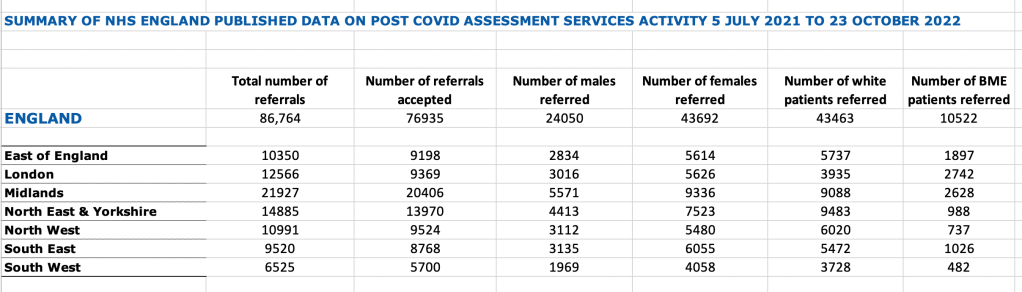
CQC’s Victimisation of Whistleblowers: Failure to Investigate Concerns

Breach of confidentiality by CQC and complicity in referring a whistleblower to the Disclosure and Barring Service

Whistleblowers Unheard by CQC

More CQC denial about collusion with employers against whistleblowers

Carl Beech, CQC inspector, convicted child sex offender and fraudster: Activities at the CQC

CQC’s Asleep on the Night Shift

CQC case study. Snooping. Briefing. Porkies. And vexatiously applied ‘vexatious’ protocols.