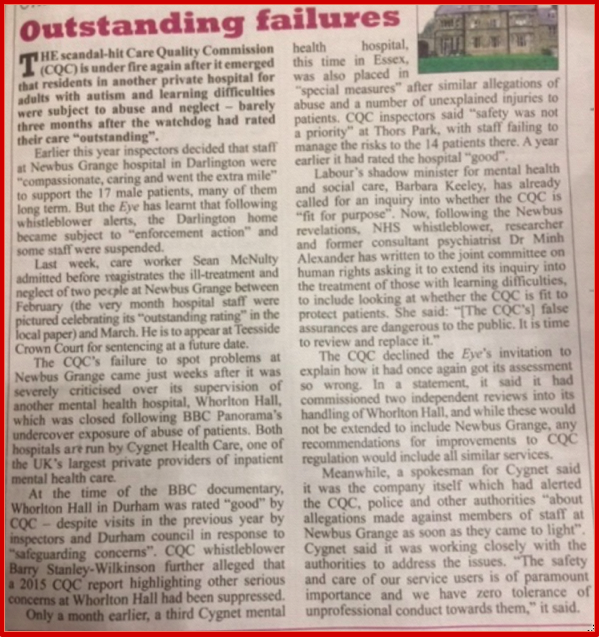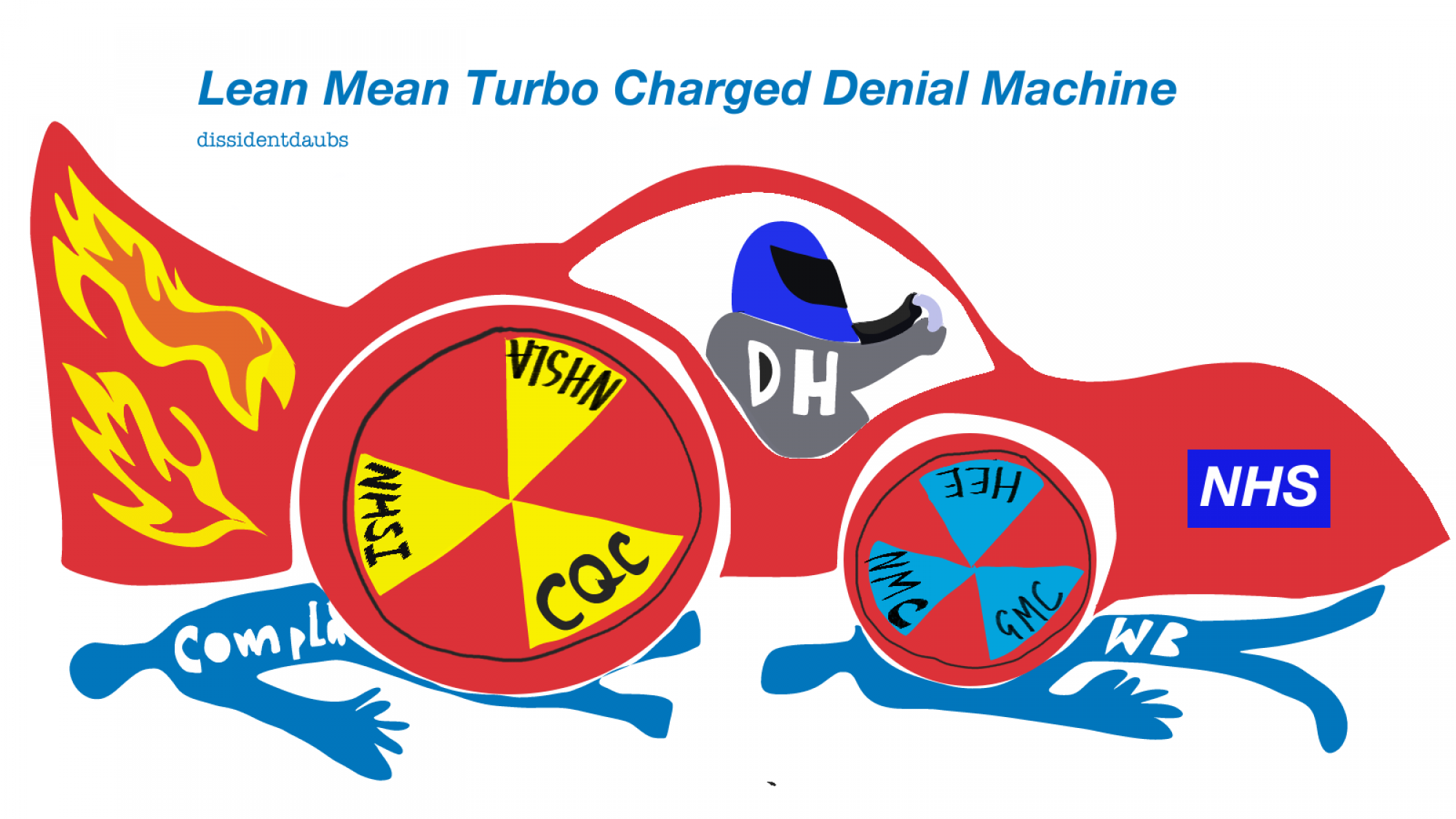

More Fit and Proper Person lies: CQC & University Hospitals of Birmingham NHS Foundation Trust

Please sign and share:

Petition to replace weak UK whistleblowing law to protect whistleblowers and the public


By Dr Minh Alexander NHS whistleblower and former consultant psychiatrist, 26 October 2019

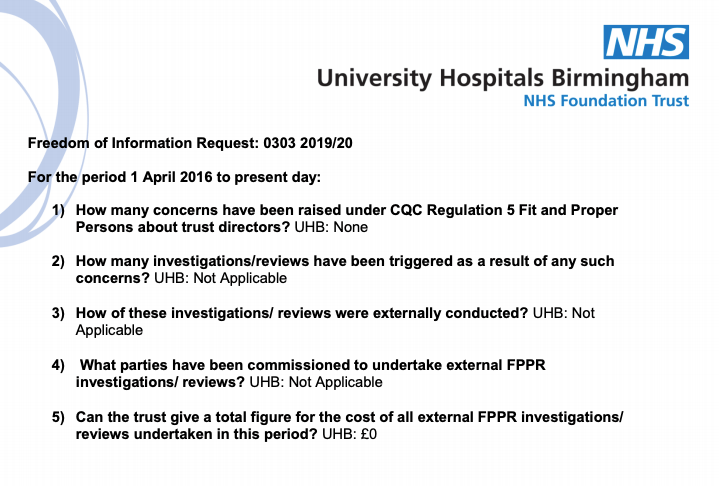
University Hospitals of Birmingham NHS Foundation Trust (UHB) previously claimed falsely under FOI to social care whistleblower Martin Morton that no CQC Regulation 5 Fit and Proper Person (FPPR) referrals had ever been made about its directors.

This was untrue because I had made an FPPR referral about a UHB director.

I am now aware of at least two other FPPR referrals that had been about the same individual.

Moreover, I was concerned that CQC may have colluded with UHB to exclude relevant evidence from the FPPR review triggered by my referral, by arbitrarily parking a later FPPR referral about the same director, for no good reason.

These events were summarised here:

FPPR: CQC’s & University Hospitals Birmingham NHS Foundation Trust’s economy with the truth

CQC was informed of UHB’s false FOI disclosure.

Following this, UHB claimed that it had made an error and admitted that it had received a single FPPR referral:

Dear Mr Morton

It has come to my attention that the information provided to you within our reply to your FOIA request was incorrect. I have conducted a brief investigation into how this may have occurred and it would appear that there may have been a miscommunication between the relevant members of our Corporate Affairs department. My sincere apologies for this error.

Please see attached email from myself to the Director of Corporate Affairs dated 23 August which provided the correct information but which unfortunately did not reach the FOIA team processing your initial request. I can confirm that during the relevant period the Trust has been made aware of one incident of concern raised under Reg. 5 Fit and Proper Persons. This concern was reviewed with the support of the external legal firm responsible for the management of related matters with an approximate cost of £5000 for the review and related matters.”

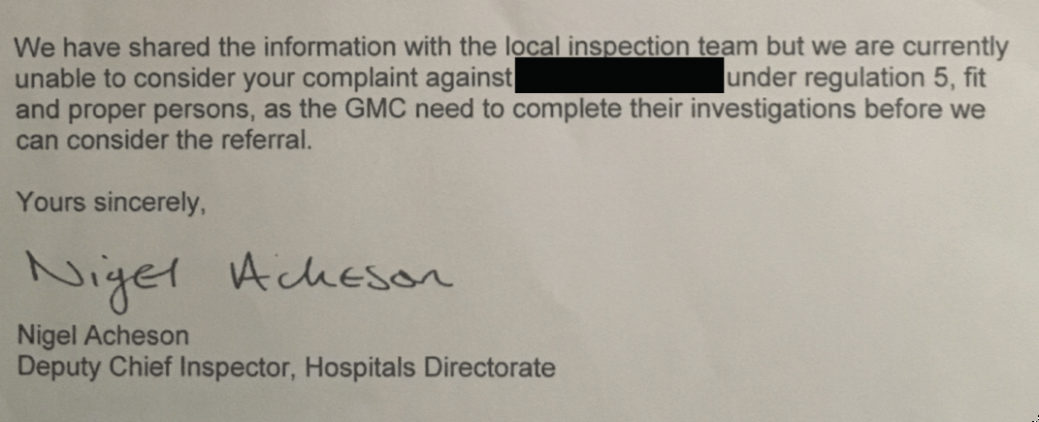
CQC subsequently regurgitated this claim of error to me:
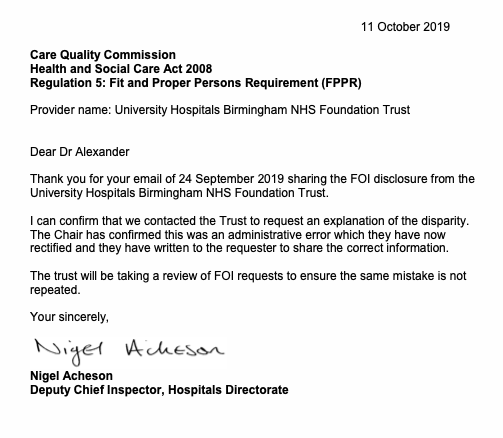
CQC nigel acheson letter 11.10.2019 UHB FOI error


Nevertheless, I asked CQC to disclose the true number of FPPR referrals that it has received on the directors of UHB, including on directors of UHB’s troubled predecessor body, Heart of England NHS Foundation Trust.

This is the essence of CQC’s reply of 25 October 2019:

“CQC has received 6 referrals about the directors of University Hospitals of Birmingham NHS Foundation Trust, including the trust’s predecessor body Heart of England NHS Foundation Trust. We have passed two of these referrals onto University Hospitals of Birmingham NHS Foundation Trust and Heart of England NHS Foundation Trust and we have 3 further referrals at an earlier stage of our process. One further referral was handled by the local team.” [my emphasis]

So it seems UHB was still telling porkies when it “corrected” its original false FOI response of zero FPPR referrals received, and claimed it had received a single FPPR referral. The truth is it knew of at least two FPPR referrals.

Moreover, this latest FOI disclosure by CQC supports what is already known: CQC messes about on a grand scale with FPPR by simply not passing FPPR referrals to provider bodies.

CQC’s phrasing is ambiguous but at least four of six FPPR referrals on UHB directors have not yet made it out of CQC’s stalls. The worst reading of CQC’s FOI response is that only two out of ten FPPR referrals have been passed to the trust.

I have asked CQC to clarify the total number of FPPR referrals received.

It is of course not CQC’s job to withhold valid FPPR referrals from provider bodies, because the determinations on whether directors are fit and proper persons are supposed to be made by the provider bodies, not CQC.

It is CQC’s job to decide if providers’ determinations are adequate and sound.

PHSO has found that CQC should not close down FPPR referrals without seeking adequate evidence of assurance from provider organisations, as exemplified by the case of Paula Vasco-Knight and St Georges:

“We have found that the CQC’s decision to close the FPPR matter in relation to Trust P was made on the basis of incomplete consideration of the evidence.”

It is also troubling to hear that CQC allows its local inspection teams to handle some FPPR referrals. What is the point of CQC’s formal, specialist, lawyered-up central FPPR processes if the local CQC inspectors are allowed to do their own thing with some FPPR referrals?

But snuff out FPPR referrals at an early stage, continue dubiously uprating trusts, and nobody needs to be any the wiser. Job done. Ministers happy.


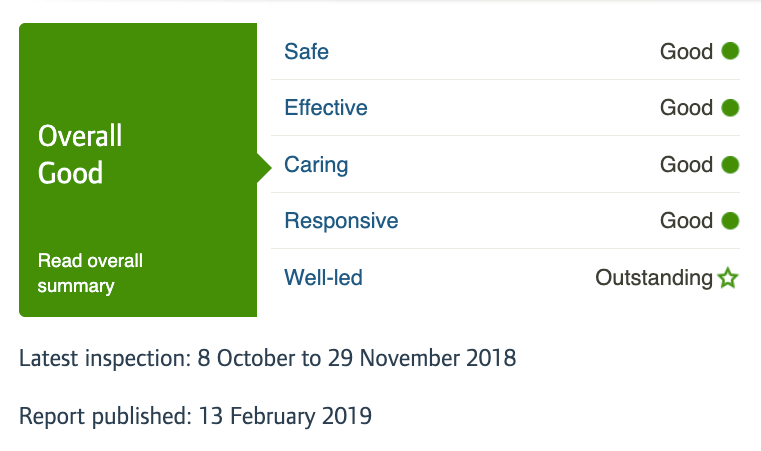
University Hospitals of Birmingham NHS Foundation Trust is currently rated ‘Good’ overall and ‘Outstanding’ in the well led domain:

UHB CQC rating

https://www.cqc.org.uk/provider/RRK

And how could anyone possibly expect CQC to make a fool of itself by admitting that an organisation that it has publicly lauded as ‘Outstandingly’ well led may not be led by a Fit and Proper Person?

Moreover, I asked CQC to produce any policy, law, government guidance or regulation which allowed it to park a second referrer’s FPPR referral on the UHB director on a pretext that a GMC investigation had to conclude first.

CQC has not produced any policy, law, government guidance which allowed it to act in this way.

Instead CQC has claimed that it had to wait for the outcome of the GMC investigation before acting on the second FPPR referral because it might otherwise be subject to a complaint:

CQC will share information of concern in relation to an FPPR referral with the provider. However, for the FPPR panel to fully consider all related information we would require the outcome of any relevant referrals made to other professional regulators to make an informed decision. This information would be essential to the process and if CQC were to take a decision on FPPR compliance before waiting for those outcomes, it would risk reaching a conclusion that could be overturned, criticised by the PHSO or which is unfair to the director concerned.

CQC will not refuse FPPR referrals on the grounds that a professional regulator has received a referral and or is investigating, however we are unable to consider the complaint fully without the outcome of this investigation.”

This claim is plainly nonsense because CQC originally proceeded with my FPPR referral in parallel with my GMC referral, about the same UHB director.


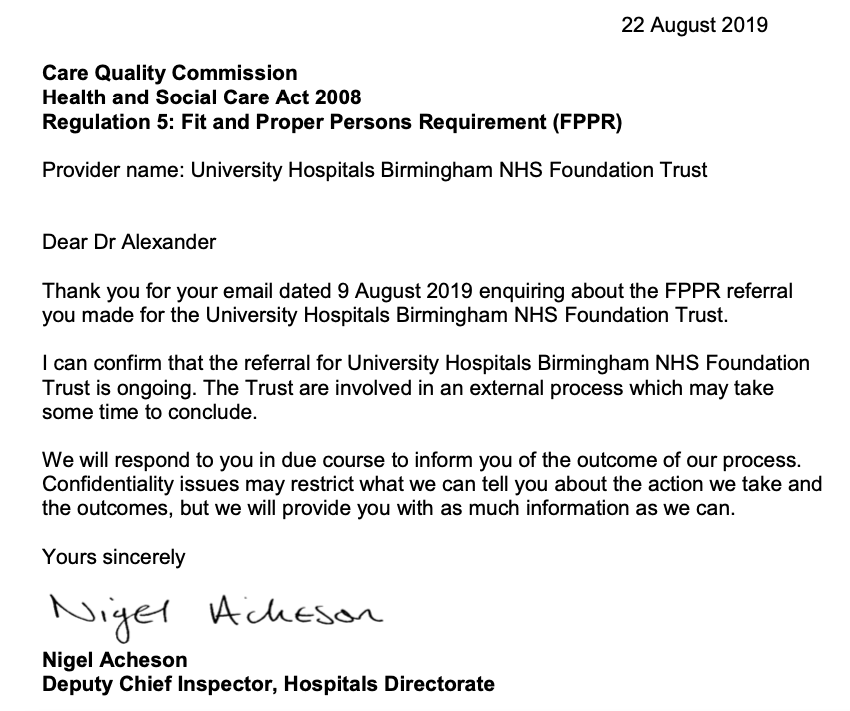
CQC clearly advised me on 22 August 2019 that there was an active FPPR review underway regarding the UHB director in question, at the same time that the GMC investigation into the individual was rolling on:

CQC nigel acheson letter 22 august 2019 ongoing fppr review at university hospitals birmingham nhs foundation trust


There is nothing in CQC’s memorandum of understanding with GMC which refers to delays in FPPR processes contingent on active GMC investigations, or vice versa. There is instead an emphasis on timely cross referrals.

But then, rules are just for plebs to follow. Oligarchs can make the rules up as they go along.

For the time being, there is little end in sight to the abuses. NHS Improvement’s implementation of the Kark FPPR review recommendations, a supposed antidote to these shambles, looks predictably half-hearted.

NHSI’s Kark steering group of vested interests has got the rose tinted specs out and NHSI is comically trying to sell voluntary, “light touch” governance as a remedy for serious managerial misconduct:

NHS Improvement’s Kark implementation process & dissing dissent

Previous exploration of CQC, NHS England and NHS Improvement’s role in the Paula Vasco-Knight FPPR affair illustrated why these bodies should not be calling the shots on how FPPR operates in the future:

Postscripts on Paula. NHS England’s apologia & regulatory reticence

Whistleblowers need major reform of UK whistleblowing law, which includes penalties for individuals who victimise whistleblowers, to deter reprisal.

Penalties directed at organisations, such as as fines currently proposed by Protect (formerly Public Concern at Work)  are pointless in the public sector as this would deprive already struggling services of resources without any effect on senior management behaviour. Fines are water off a duck’s back it is seen as spending nobody’s money.

Likewise, the largest, immensely wealthy corporations would have no trouble spending their way out of trouble.

Real deterrence will only come when would be abusers know they face serious personal consequences, but that day is a long way off.

UPDATE 28 OCTOBER 2019

CQC has today clarified that it has received a total of 6 FPPR referrals on the directors of University Hospitals of Birmingham NHS Foundation Trust:

“Dear Dr Alexander

Thank you for your email seeking clarification as to our response. I have confirmed the following with the FPPR Manager.

There were 6 referrals in total. These 6 are broken down as follows:

  • 2 referred to Trust
  • 3 at early stage
  • 1 handled by local team”

I hope that clarifies our response to you.

Kind Regards

Russell Wynn

Confidentiality, Privacy and Security Advisor

Information Rights

Governance and Legal Services”


Please sign and share:

Petition to replace weak UK whistleblowing law to protect whistleblowers and the public


RELATED ITEMS

Regulation 5, Fit and Proper Persons: Dissecting CQC’s Dissembling

Sorry is the hardest word: CQC, Paula Vasco-Knight and Regulation 5 Fit and Proper Persons

Replacing the Public Interest Disclosure Act (PIDA)
Screenshot 2019-10-26 at 05.17.01


NHS Improvement’s Kark implementation process & dissing dissent

By Dr Minh Alexander, NHS whistleblower and former consultant psychiatrist 22 October 2019 


Summary: NHS Improvement has started a process of deciding which of several recommendations from the Kark Review will be implemented and how. Incomplete information has been publicly shared to date, but some more information has been obtained and the relevant documents are provided below. The documents shared so far show an attempt by NHS Improvement to water things down with an emphasis on “light touch”.

NHS Improvement and other bodies have a history of not consulting openly enough with whistleblowers or making adequate use of their extensive knowledge of system failure. Certain voices may be selected without transparent, sufficient justification, and some may also be paid. Some FOI data giving a past example of the latter is provided.

There is also a tendency to rely on intermediaries such as the National Guardian’s Office, about which many whistleblowers have significant reservations, adding to reduced representativeness and further lack of whistleblower confidence.

Documents and other information provided by NHS Improvement show that many of the organisation and players that have been part of the problem have the most seats at NHSI’s Kark implementation table. Links to the documents follow.

I encourage whistleblowers, patients or families who have not been invited to contribute to the Kark implementation process to do so and to ensure that NHS Improvement listens to all voices, even if they do not say what it wants to hear.


Background

There have been very serious, repeated failures by the CQC to fulfil its responsibilities under Regulation 5 Fit and Proper Persons, and to ensure that the public is Safeguarded from managers guilty of serious misconduct.

In response to mounting criticism of CQC’s blatant FPPR failures, the government eventually conceded and commissioned the Kark FPPR Review which took place last year.

Kark’s review report was published in February and largely let CQC off the hook for its misconduct and mishandling of FPPR, but it did criticise the present FPPR provisions and made a range of recommendations.

The government handed final decisions about implementation of the Kark recommendations to NHS Improvement.

NHSI fell silent in the subsequent months despite occasional whistleblowers’ enquiries as to progress.


NHS Improvement’s behaviour regarding Kark implementation

I wrote on 6 September 2019 to Dido Harding NHSI Chair cc parliament with an example of continuing, characteristic CQC failure on FPPR – including failures to feedback to the referrer, excessive delay and refusal to share adequate information.

A reply of 25 September 2019 Dido Harding gave the following update:

As you know, the Department of Health and Social Care accepted the first two recommendations of the Kark Review and asked that NHS England and NHS Improvement engage with a wide range of stakeholders to consider the remaining five. We have subsequently agreed with the department that we should also implement the third recommendation (to introduce a mandatory reference requirement for NHS directors) and that the department would consider the final recommendation (which concerns the application of the FPPR in social care).  

We intend to write to the department, setting out our implementation approach to the entire Kark Review alongside publication of the People Plan later this year. My team is currently speaking to a range of people to inform the best approach to implementation and I have passed your contact details on to a colleague, who will be in touch with you separately so that you have an opportunity to inform on our next steps.”

This colleague, a policy adviser, proved to be an DHSC employee, previously attached to the Freedom To Speak Up review and currently seconded to NHSI.

Upon request for relevant NHSI Kark consultation documents, the policy adviser shared the following document, which are the slides from an NHS Leadership Academy event that took place in Leeds on 4 October 2019:

‘Transforming Leadership Culture: Implementing the Kark Review’ NHS Improvement 4 October 2019

Some whistleblowers had been notified in early September of this event, but it was not clearly badged as an official NHS Improvement event. There was the usual, rather patronising invitation to contribute experiences:


Session

Facilitator

11:00am – 12:30pm

As part of wider Speak Up Month activities, we invite you to a Lessons Learnt/Shared Experiences session – TBC by Bernie

Bernie Rochford, Russ Parkinson (TBC)

12:30pm – 1:15pm

Lunch – (supplied by the Academy)

N/A

1:15pm – 3:15pm

Focussed Kark session, exploring the themes of your experiences regarding Directors in whistle-blowing incidents

Karl Roberts, Bernie Rochford, Sally Scales (TBC)”


Seeing the involvement of the National Guardian’s Office and not having been advised that this was an official NHSI event on policy, I had decided not to attend.

I questioned NHSI about the fact that whistleblowers were just invited to contribute ‘experience’, and NHSI has clarified that it will accept submissions about policy.

In terms of publicising the 4 October event, NHSI said it asked the National Guardian’s Office and NHS Leadership to send out invitations. Only some whistleblowers received an invitation. Some of those who were not invited had in fact been participants in the Kark FPPR review.

NHS Improvement advised me that about 14 whistleblowers attended the Leeds Kark session on 4th October.

I noticed that the 4 October 2019 event slides mentioned a Reference group.

The DHSC/ NHSI contact explained that this group was set up to help steer NHSI’s Kark implementation.

The Reference group appears to the real business end of NHSI’s consultation process and the key point at which influence is on the process is exerted.

Further enquiry NHSI revealed there was a single whistleblower on this NHSI Kark Reference group. This person was previously a PCT manager, who unsuccessfully claimed for constructive dismissal and whistleblower detriment, against Southwark PCT and currently works as a Freedom to Speak Up Guardian for Mersey Care NHS Foundation Trust including covering the now defunct Liverpool Community Health NHS Trust which was absorbed by Mersey Care.

The presence of a solitary whistleblower took the gloss off a recent expansive claim by Chris Hopson CEO of NHS Providers that the consultation was robust:

“More happily, there is a strong and effective consultation process on the other Kark Review recommendations as part of the work on the NHS People Plan. NHS Providers, frontline trust leaders and a broader group of stakeholders, including whistleblowers are contributing to this exercise and we are having a quality discussion on some highly complex issues. That is how to create the right decisions that can be implemented successfully to deliver the desired outcome.”

https://www.hsj.co.uk/policy-and-regulation/new-rule-to-stop-nhs-directors-revolving-door/7026055.article

Upon enquiry about how the single whistleblower member of the Kark Reference Group was selected, the NHSI response was one of initial uncertainty followed by the following explanation:

“I have also been through my records and confirm that the whistleblower member of the Kark reference group was drawn from the wider membership of the Improving Leadership Culture reference group.”

I have challenged the lack of transparency and equality of opportunity in NHSI’s selection of a whistleblower representative for the Kark Reference group, and pointed out that NHSI previously acted in a similar manner during the establishment of its much criticised NHS whistleblower employment support scheme. 


NHS Improvement’s anointed figurehead for the whistleblower employment support scheme

Without any transparency or equality of opportunity, an individual who was previously an NHS trust HR manager who as far as I am aware had not established in law that they had a whistleblowing case, and who was the subject of conflicting medical evidence about possible factitious illness, was selected as an adviser for the much criticised NHSI whistleblower employment support scheme.

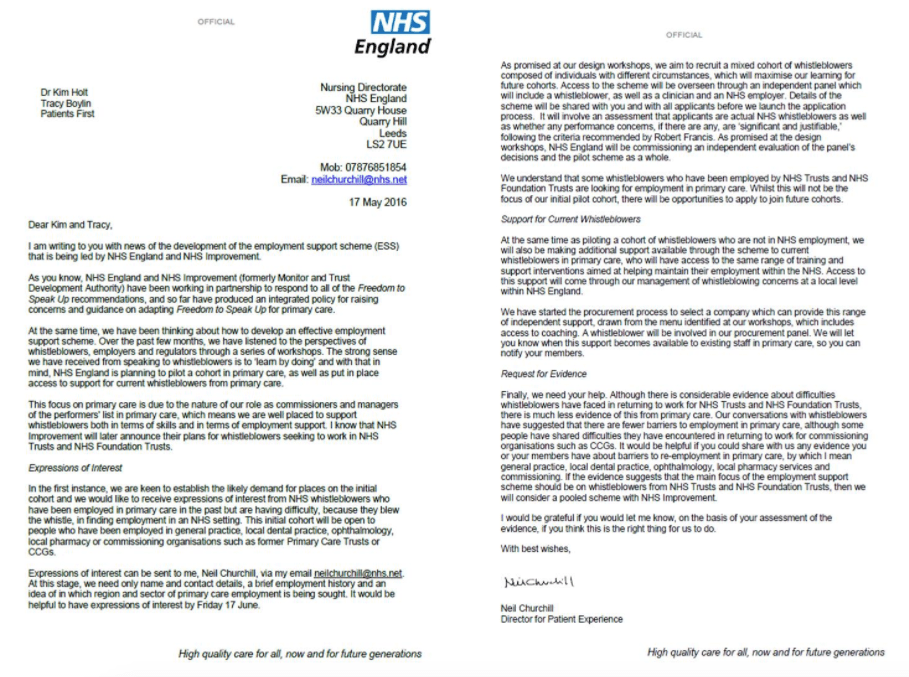
Moreover, NHS England had originally approached two individuals at the (now defunct) organisation Patients First, regarding establishment of the NHS whistleblower employment support scheme:

Screenshot 2019-10-22 at 14.44.43

FOI enquiries later revealed that

1.      NHS England made payments totalling in excess of £18K to one of these individuals, the person selected as an adviser by NHSI, through their company:

Payments totalling £18,536.64 were made to TAB HR Limited between September 2016 and June 2017. These payments were for a range of contractor/consultancy services.”

NHS England FOI disclosure 23 February 2018 Ref 055603

2.     NHS Trust Development Authority, one of NHSI’s constituent bodies, paid the same individual £4,893 for their part in development of NHSI’s whistleblower employment support scheme:

“The NHS TDA spent £4,893.85 on the services of TAB HR Limited which covered services for up to 16 days between February and April 2017. This was to provide support for the development of the Employment Support service.”

NHS Improvement FOI disclosure 7 February 2018


But the failures to be transparent and to ensure equality of access for all are not new on the whistleblowing scene.

It is a cycle that repeats ad nauseam. Power typically seeks out that with which it feels comfortable, finds familiar and or believes it can exploit or mould to its own purpose, providing trouble-free public relations and photo ops, without the nuisance of dissent and robust scrutiny.

Power may deny that it does so, and sometimes this denial may be sincere and the selectivity is based on subconscious bias, but the actions have the same effect.

Controlling tokenism undervalues dissent as a healthy part of normal governance.


The usual suspects

I asked for the terms of reference and minutes of the meetings of NHSI’s Kark Reference group.

Minutes of the first Kark Reference group meeting, and Terms of Reference for the overarching ‘Improving Leadership Culture’ Reference group have been provided:

Minutes of NHSI Kark Reference group meeting 21 August 2019`

NHSI Improving Leadership Culture Reference group terms of reference

Minutes of a second meeting have also been promised and will be posted here when available.

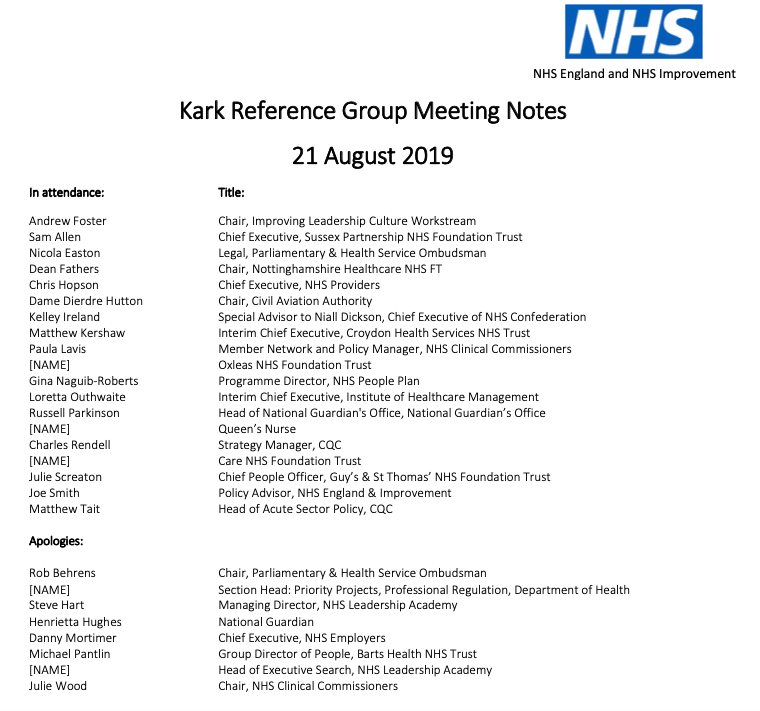
A glance at the list of attendees at the Kark Reference group’s first meeting on 21 August 2019 [redacted by NHSI of junior officials’ names] shows many familiar faces, representing organisations that have firmly been a part of the problem:

NHSI Kark reference group meeting attendees 21.08.2019


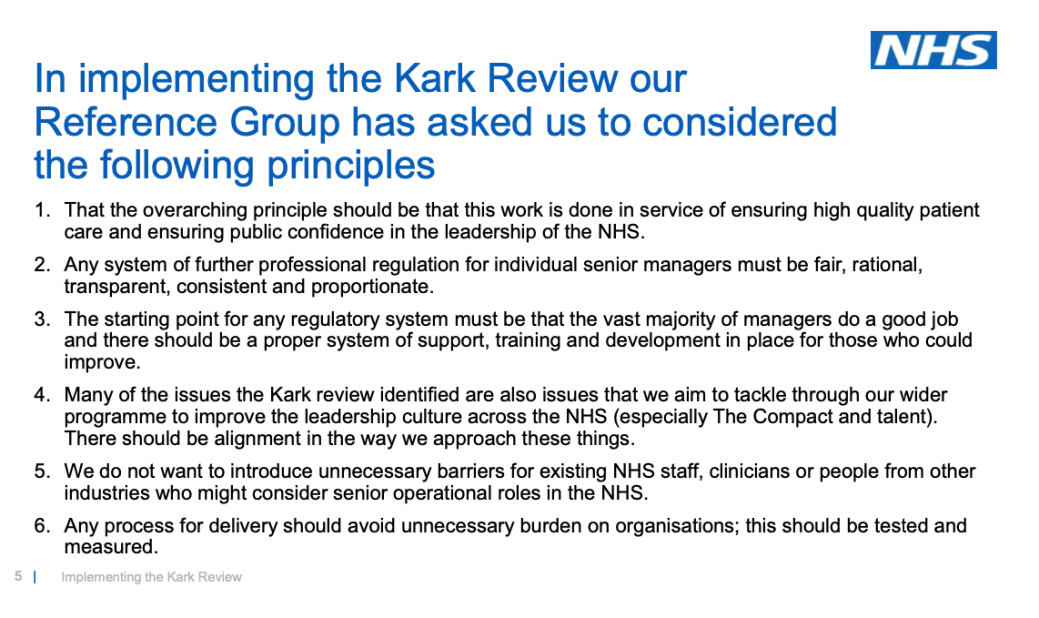
The principles put forward by the Kark Reference group after two meetings convey inertia and low expectations:

NHSI Kark Reference group principles

Upon questioning, NHSI admitted that the above assertion that “the vast majority of managers do a good job” was not based on any evidence whatsoever, but merely a wish to avoid negativity.

I contended that the assertion was improper and provocative in the absence of evidence, especially given the history of recurring avoidable deaths, and that such attitudes were the reason the Kark Review was necessary in the first place.

On that theme, NHSI is trying its best to nudge the Kark implementation process in the direction of doing as little as possible – the words ‘light touch’ stand out:

NHSI preliminary thinking on Kark implementation slide 4 oct 2019

Granted, NHSI has yet to update its slide based on the outcome of the 4th October 2019 event.

NHSI admitted that whistleblowers who attended on 4th October pushed back on the light touch gambit. I have now added my opposition.

This is the agreed record of two telephone meetings with the DHSC policy adviser seconded to NHSI, who is handling the Kark review implementation:

Agreed records of telephone meetings 10 & 11 Oct 2019 with NHS Improvement about Kark Review implementation

My formal written submission to NHSI on implementing the Kark review is also provided below in the appendix.

Any whistleblowers or patients and families who wish to challenge NHSI and DHSC’s attempt to water down what were already compromise solutions by Kark should also add their voices as a matter of urgency, because NHSI plans to finalise a draft of its plans by early November:


Screenshot 2019-10-22 at 15.57.19

The Kark review came after years of serious government failure following Jeremy Hunt’s glib and insincere promises of culture change following MidStaffs.

The issues are at their heart simple and are about decency and honesty. Everybody is qualified to comment. If you feel strongly, just write in however briefly and simply, FAO Joseph Smith Policy Adviser, NHS England and NHS Improvement.


RELATED ITEMS

Sorry is the hardest word: CQC, Paula Vasco-Knight and Regulation 5 Fit and Proper Persons

Twiddling at the edges will not be safe substitute for much needed reform of unfit UK whistleblowing law:

Replacing the Public Interest Disclosure Act (PIDA)

 

APPENDIX

SUBMISSION TO NHS IMPROVEMENT’S KARK IMPLEMENTATION PROCESS

22 October 2019

Dear Joe,


Thanks for your help, all the information provided and the documents shared.

As promised, this is my formal submission to NHSI’s Kark implementation process.

  1. Firstly, I should say that I do not believe that the mistreatment of whistleblowers In the NHS or any other UK sector will reduce until there is substantial reform of UK whistleblowing law, which should include meaningful deterrence of whistleblower reprisal in the form of sanctions for individuals, civil and criminal, as opposed to sanctions for organisations.


  1. The government said it might consider changes to UK whistleblowing law after the publication of the Gosport inquiry report, and meetings between DHSC and BEIS have been held, but little has update has been provided. I doubt that there are present government plans to make the necessary degree of change for safe governance.


  1. At present, some senior NHS managers corruptly squander public money on legal services to intimidate, settle and gag whistleblowers because they know there is almost zero chance that they will suffer any personal consequence.


  1. The fact that regulators such as NHSI rubber stamp some of these payments, help shelter and redeploy senior abusers and avoid taking action in even the most egregious cases is permissiveness of a scale that is tantamount to encouragement of the misconduct. Similar arguments apply regarding the DHSC, the ultimate culture carrier and pace setter.


  1. At present, the DHSC resists even the proper investigation of whistleblower’s concerns, so the Kark implementation exercise is somewhat hollow, no disrespect to you personally.


  1. I also note from the Kark review report that there is understandable fear by managers that any system of managerial regulation will be abused by the centre to unfairly dismiss individuals who are unwanted, as opposed to wrongdoers. Also that there are reports that not only FPPR has been blind to some misconduct but has been improperly weaponised against managers who are not in favour.


  1. Nevertheless, those caveats apart, I make the following summarised points and address some issues that you asked me to.


  1. As I understand it, the government has so far accepted the following recommendations from the Kark review:


  • The introduction of a national competency framework for NHS board roles
  • The creation of a central database about NHS managers’ training and employment history, including upheld grievance and disciplinary issues


  1. NHSI has informed me that it accepted a third recommendation:


  • The introduction of standardised, mandatory references


I understand this should be along the lines of a sample reference form provided by the Kark review report, and a recommendation that mandatory references are signed off by directors who are subject to FPPR (and thus can be held accountable for any false references).


Please let me know if the government and NHSI are not fully implementing any of the above three Kark recommendations as I have understood them.


  1. This leaves much a number of other recommendations to be decided, including:


  • Extension of FPPR to commissioners and ALBS


  • A power to disbar directors for serious misconduct, with a disbarring service located within NHSI


  • Removal of the clause which makes being ‘privy’ to misconduct a criterion under FPPR


  • The application of FPPR in social care provision.


  1. Overall, I believe that there needs to be a step change in the quality of NHS management, commensurate with the gravity of the task in hand. Professionalisation is needed, with clear, explicit, regulated standards, as for all other health professions.


  1. I reject any attempts to lower standards based on concerns that barriers should be lowered for access, as implied by the guiding principles generated by the Reference group steering NHSI’s Kark implementation. It is low expectations, poor controls which have allowed unchecked managerialism and unsuitable senior managers appointing in their own image that have got us to this state.


  1. Patients and the wider public deserve a high standard of management in a vital, safety-critical public service. That should be the core expectation, with no compromise on quality, the latter being short termism which stacks up disproportionate trouble for the future.


  1. It is essential that DHSC and NHSI face up to the need to remove corrupt senior managers from the DHSC, ALBS and provider bodies. Until this is done, there will be little change because these individuals will not change behaviour. They will operate corrupt cultures where meritocracy, safe governance and patients cannot flourish.


  1. Beyond that, I agree with the need for a supportive, proactive system of talent development and supportive remediation where things go wrong due to issues of competency.


  1. However, I also suggest that much more emphasis is given to recruitment of the right individuals, with the right values and character. This is less wasteful than appointing unsuccessfully and throwing resource at managing failure.


  1. The Kark review emphasised competency and proposed that NHS directors should have understanding of the importance of the following:


  • Board governance;
  • Clinical governance;
  • Financial governance;
  • Patient safety and medical management;
  • Recognising the importance of information on clinical outcomes;
  • Responding to serious clinical incidents and learning from errors;
  • The importance of learning from whistleblowing and ‘speaking up’;
  • Empowering staff to make autonomous decisions and to raise concerns;
  • Ethical duties towards patients, relatives and staff;
  • Complying and encouraging compliance with the duty of candour;
  • The protection, security and use of data;
  • Current information systems relevant for health services;
  • The importance of issues of equality and diversity both within the hospital in workforce issues and in relation to appointments to the Board; and
  • The importance of complying on a personal basis with the Nolan principles


Whilst understanding of these matters is obviously necessary, the issues in the worst breaches have been deliberate non-compliance, collusion and conspiracy to misconduct, not inadvertent blunders.


  1. You asked me to comment on NHSI’s competency frameworks.


  1. Regarding “Developing People – Improving Care A national framework for action on improvement and leadership development in NHS-funded services”


https://improvement.nhs.uk/documents/542/Developing_People-Improving_Care-010216.pdf


  1. Page 20 gives the following as the action plan for ensuring “Compassionate, inclusive and effective leaders at all levels”:


“A variety of frameworks are used across the NHS to develop, assess, select, promote and regulate leaders and leadership, and they are often incongruent. People across the system need to agree on ‘what good leadership looks like’ at different levels and develop consistent descriptions, using language common to all organisations and systems.”


  1. Page 23 gives a little more detail:


Screenshot 2019-10-22 at 07.28.07


  1. The emphasis here is on development and training. Whilst these interventions may augment, they cannot substitute for wise, kind, honest character. If the NHS fails to recruit managers with sound character, the rest falls. As cited in the Kark review report, the PSA has observed that: “Technical competence to serve on a Board is as nothing without personal commitment to the public interest”


  1. Looking at NHS Improvement’s resources for “Creating a culture of compassionate and inclusive leadership”

https://improvement.nhs.uk/resources/culture-leadership/

This leads to sample documents from several trusts, some of which briefly nod to “recruiting for values” but give little detail on definitions and methodology.


  1. The Kark review noted huge variation in how NHS directors are recruited:

“The variation in how executives are recruited is huge. At one end of the scale, there is a ‘full service’: full stake holder discussions are held with each candidate, applicants are filmed in order to test media training etc. At the other end of the scale, there is just an interview panel for between 45 and 60 minutes with little other than CVs and references.”


  1. If the NHS does not have sufficient expertise on this subject of recruiting for the right values, it has the options of buying in suitable expertise and of commissioning research to inform future policy decisions. The Kark Review directed the government to the Institute of Directors’ Director Competency Framework which emphasises the importance of evidence of suitable “attitude and disposition that shapes a director’s responses and behaviour”.


  1. Regarding models of regulation, I have looked at the regulation of teachers as you suggested:

https://www.gov.uk/government/collections/teacher-misconduct


  1. I do not think this model offers adequate protection to patients because it only deals with misconduct so serious that it is wholly incompatible with the role and may require a life ban. The model leaves any misconduct short of this extreme level to employers to deal with:

“They [the regulations] cover cases of serious misconduct. This is when a teacher’s behaviour:

  • is fundamentally incompatible with being a teacher
  • uld lead to them being prohibited from teaching

 The regulations don’t cover the cases of less serious misconduct, incompetence or under-performance. A teacher’s employer should deal with these cases.”


  1. I think it would be unacceptable for employers to be left wholly in the control of NHS managers’ misconduct that merits serious but lesser sanctions. There is a conflict of interest for employers to cover up failure, and that conflict of interest becomes acute and unmanageable when it is the directors of the organisation who are the accused.


29. The full model of professional regulation as operated by health and social care professional regulators is preferable and safer, partly because it is in principle proactive and preventative through the basic requirements of standardised qualification, accreditation and registration. It is required for the proper professionalisation of NHS management as a discipline. I believe the additional expense of full regulation is justified to keep patients safe.


  1. Therefore, I would prefer full professional regulation of NHS managers to give parity with the way clinicians are managed, not least to stem the abuses of unchecked managerialism against patients’ interests which have resulted in horrors such as MidStaffs, Gosport and Liverpool Community Health NHS Trust.


  1. I appreciate that the Kark recommendation is only for a disbarring council broadly similar to that which operates for teacher, but with less formality. I do not feel this goes far enough. I also do not agree that a disbarring service should be under NHSI’s control, given political conflicts of interest and the potential for abuses. As I write I am mindful that NHSI currently employs as a director a trust manager who had been personally criticised for causing serious detriment to a whistleblower.


  1. Needless to say, I think this preliminary suggestion by NHSI is wholly unacceptable and I reject it:

“A light touch approach is probably desirable – this might include a voluntary register to help raise standards and professionalise management, and standardised references.”


  1. It is hopeless to expect that the worst offenders who have cheated, lied, fabricated false allegations against staff, referred staff vexatiously to regulators and misled regulators, dismissed honest investigators, committed fraud, perjured themselves, covered up, and knowingly endangered patients out of self-interest would comply reliably with, and act in the spirit of, voluntary arrangements.


  1. The current failure of FPPR and the farce of self-declaration under FPPR are I believe sufficient evidence to show that NHSI’s hopes of a light touch, voluntary system are doomed.
  2. I agree with the proposal to extend FPPR to commissioners, regulators and other ALBs. I also think the DHSC should be included.


  1. NHSI has characterised Kark recommendation 7 as: “That the FPPT be extend [sic – extended] to cover social care provision”


  1. As discussed, I believe from my reading of Regulation 5 and CQC’s supporting material that FPPR already applies to social care (and at the time of writing it occurred to me that I made an FPPR referral to CQC on a director of social care some time ago, about which I had forgotten). On checking the wording of the Kark review report, it says: “We recommend that further work is done to examine how the test works in the context of the provision of social care and whether any amendments are needed to make the test effective.

I would support this.


  1. You asked about definitions of misconduct and red lines – or as NHSI puts it: “what constitutes someone crossing a moral line”.

I think there should be clear definitions of types of serious misconduct that would result in disbarment from senior office. I agree with the suggested red lines set out in the Kark review report, and I would particularly emphasise:

  • Covering up safety issues
  • Suppressing whistleblower concerns
  • Reprisal against whistleblowers or complainants
  • Misuse of public funds in the pursuit of any of the above, including aggressive, meritless appeals by NHS organisations that been the subject of successful claims, and respond by punishing and ruining whistleblowers through vexatiously prolonging the legal process


The Kark review emphasised “deliberate” bullying:

“Deliberate bullying, particularly victimising those who raise concerns should in our view be regarded as ’red line’ behaviour and serious misconduct.”

I am concerned that this might provide a loophole.

I suggest that any bullying of whistleblowers is a red line, whether proven to be deliberate or not, but that if deliberate bullying is found, this should be viewed as an aggravating factor when sanctions are decided.


  1. The Kark review suggests removing the clause which makes being privy to serious misconduct a criterion for consideration under FPPR:

“Amending the Fit and Proper Person Test to remove the reference to directors ‘being privy to’ mismanagement which we do not think promotes clarity”


  1. I am concerned that this will remove proper liability for executive negligence in the form by-standing. Whistleblowers very commonly encounter a wall of silence when after being blocked they anxiously explore more and more avenues to resolving concerns or seek protection from reprisal. It is often concerted failure to respond, to act and to protect that sinks whistleblowers as much as active victimisation. Indeed, in a rare glimpse, it became evident that officials planned to warn a DH minister not to respond to a whistleblower.


  1. I think that if the clause about being ‘privy’ is removed, it must for clarity be replaced with a clause that makes it clear that offences of omission are just as serious, and that failing to act appropriately upon knowledge that fellow directors are guilty of serious misconduct is itself classed as serious misconduct.


  1. There is a note along these lines on page 132 of the Kark review report about red lines: Victimisation or knowingly allowing the victimisation of whistleblowers”

 I think the principle of “knowingly allowing” other forms of serious misconduct should also apply.


  1. The Kark review sets out to prevent unfit managers from moving around the NHS:

“Our recommendation in relation to mandatory references and an independent disbarring service are intended to prevent those proved to have been guilty of misconduct moving around the NHS system.”


  1. I think NHSI should give consideration to wider Safeguarding issues, and set out how it would ensure that other agencies are apprised of risks posed managers who are barred from the NHS and who may seek employment in other areas where they may also pose a risk to the public, especially vulnerable people.


  1. With regard to proposed exceptions in the public interest from a five year statutory time limitation for serious misconduct, I think the principles by which exceptions are made should be explicitly provided in guidance, to avoid arbitrary and widely varying responses.


  1. I recommend that NHSI takes note of resources on the organisational management of seriously sociopathic behaviour. This is one example, which describes how psychopathic individuals may impact on institutions, and what institutions can do to manage this risk:


Tackling psychopathy: a necessary competency in leadership development?

As the author comments, psychopathic individuals excel at kissing up and kicking down, and may manage upwards in a manipulative way, to please regulators such as NHSI:

“The problem for leadership development16 is that psychopathic individuals can achieve most of the key competencies including getting others to follow them, being politically astute, relating to senior colleagues with charm, and possessing excellent communication skills. If the person can muster sufficient ‘charisma’ and achieve set targets (for example, in cost cutting), affective instability and the tendency to damage others could be overlooked by organisations”


  1. Accordingly, as my last word to NHSI, I would stress the importance of valuing voices that the regulator finds less comfortable, whether it is trust executives who honestly say they cannot do the impossible, frontline staff who report the consequences of provider organisations being asked to the impossible or whistleblowers who are more challenging and less complaisant regarding NHSI’s policies. In terms of future policy consultations that may involve whistleblowers, I advise open calls for contributions and publication of consultation papers at an early stage, without reliance on intermediaries such as the National Guardians Office who have any control of the communication.


With best wishes,


Minh


Dr Minh Alexander


Cc Tom Kark QC

Dido Harding NHS Improvement Chair


Letter to the Whistleblowing APPG about the Duke of York Royal Military School whistleblowing matter

The following correspondence is hopefully self explanatory.


BY EMAIL

Whistleblowing APPG

Stephen Kerr MP Vice Chair and Registered Contact

Baroness Susan Kramer Vice Chair

Norman Lamb MP

Anneliese Dodds MP

Andrew Mitchell MP

9 October 2019


Dear APPG members,

Correspondence from the Crown Prosecution Service about whether the CEO of Whistleblowers UK “stood trial”

Please find below the correspondence with the CPS about whether or not the CEO of Whistleblowers UK, the private company which currently acts as the APPG’s secretariat, “stood trial” regarding matters at the Duke of York Military School.

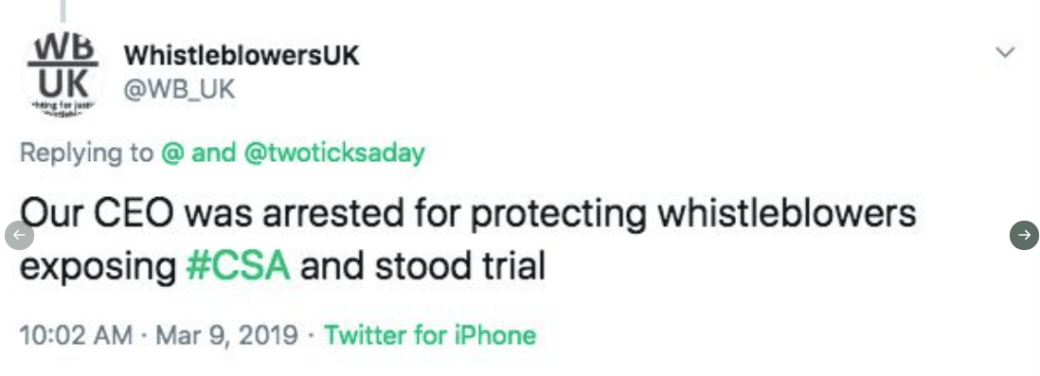
As you may be aware, Whistleblowers UK tweeted on 9 March 2019: “Our CEO was arrested for protecting whistleblowers, exposing CSA and stood trial”.

This is the screenshot of the tweet:

WBUK tweet claim Our CEO was arrested for protecting whistleblowers, exposing CSA and stood trial

Tracy Austin a former teacher at the Duke of York school, who raised concerns, has disputed that a trial took place.

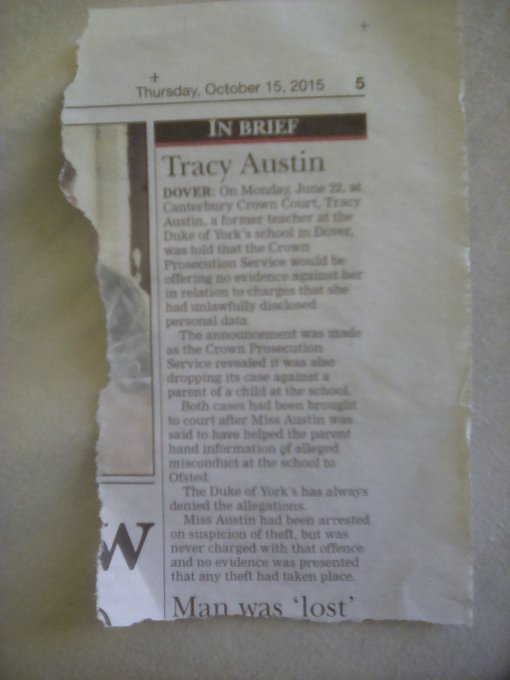
I attach a photograph of an article of 15 October 2015 which noted that the CPS offered no evidence against Tracy Austin with respect to allegations of unlawfully disclosing personal data, and that the CPS had also decided not to proceed with a case against the parent of a child at the school:

Tracy Austin newspaper clipping no evidence offered by police


As other media had reported that the case against Whistleblowers UK’s CEO for handling stolen goods and unlawfully [sic – breaching data protection] came before Canterbury Crown Court, I asked the CPS to clarify if a trial had actually started into these matters.

https://www.telegraph.co.uk/news/uknews/law-and-order/11702655/My-fear-of-jail-for-being-a-whistle-blower.html

https://www.lawgazette.co.uk/lawyer-in-the-news/alleged-school-abuse-whistleblower-arrested/5049933.article

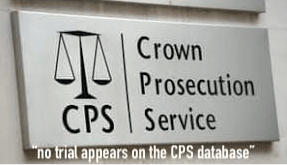
The CPS has advised that: “no trial appears on the CPS database for anyone of this name in Kent, Surrey or Sussex”.

I have invited Whistleblowers UK to offer some sort of explanation and comment on these apparently anomalous facts.

The only response that I have received so far is to be blocked by the Whistleblowers UK twitter account.

Ms Austin also reports that she has now been blocked.

I trust that the APPG may wish to establish on what basis Whistleblowers UK made the claim of 9 March 2019 that: “Our CEO was arrested for protecting whistleblowers, exposing CSA and stood trial”.

I also trust that the APPG may wish to ensure that any sensitive personal data entrusted to the APPG by whistleblowers, some likely to be vulnerable, via Whistleblowers UK in its capacity as APPG secretariat, is properly handled and safeguarded.

Yours,

Dr Minh Alexander

Cc Committee for Standards in Public Life

Lord Jonathan Evans Chair of CSPL


From: South East VRR and Complaints <REDACTED>

Subject: FW: FOI request FAO Crown Prosecution Service South West

Date: 7 October 2019 at 15:24:21 BST

To: Minh Alexander <REDACTED>

Cc: South East VRR and Complaints <REDACTED>


Dear Dr Alexander

Thank you for your email which has been passed to this department.

I can confirm that no trial appears on the CPS database for anyone of this name in Kent, Surrey or Sussex.

Kind regards

South East VRR & Complaints Team


From: Minh Alexander [REDACTED]
Sent: 06 October 2019 15:14
To: Freedom of Information Unit
Cc: Enquiries
Subject: FOI request FAO Crown Prosecution Service South West

FOI request FAO Crown Prosecution Service South West

6 October 2019

Dear Sir,

It was reported in 2015 that the case against Georgina Halford Hall for handling stolen goods and breach of the Data Protection Act came before Canterbury Crown Court but that the case was dropped by the Crown Prosecution Service.

https://www.telegraph.co.uk/news/uknews/law-and-order/11702655/My-fear-of-jail-for-being-a-whistle-blower.html

https://www.lawgazette.co.uk/lawyer-in-the-news/alleged-school-abuse-whistleblower-arrested/5049933.article

Please can you advise if a trial ever actually commenced into the allegations, and if so, on what dates did the trial take place?

Dr Minh Alexander


UPDATE 23 OCTOBER 2019

On 10 October 2019 Ref. 8734 the CPS offered further clarification in which they stated definitively that no trial took place:

“In response to the above, the Crown Prosecution Service can confirm that the case was discontinued and therefore a trial did not commence.”


UPDATE 8 NOVEMBER 2019

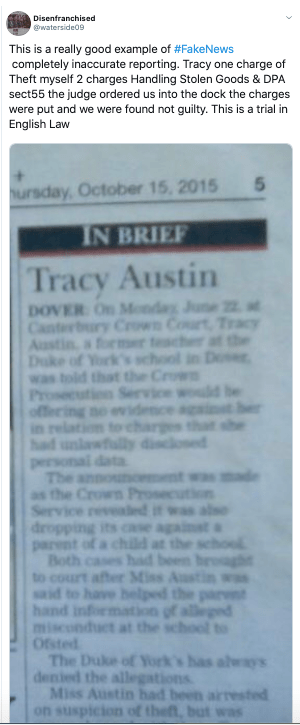
On the 5 November 2019 Georgina Halford Hall the CEO of WhistleblowersUK tweeted from her personal account that a trial took place, and claimed that the article in the Dover Express of 15 October 2015 was “fake news”:

Screenshot 2019-11-05 at 18.17.38

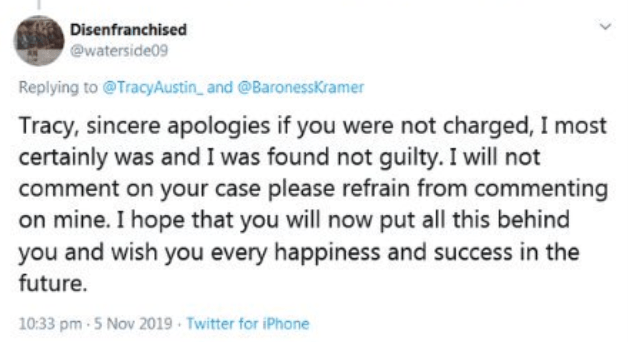
The whistleblower mentioned in the tweet challenged Georgina Halford Hall’s claim that she had been charged with theft.

The CEO of WhistleblowersUK made this further statement, but did not withdraw her claim that a trial took place:

WBUK Georgina Halford Hall partial retraction of theft claim against Tracy Austin


RELATED ITEMS

Whistleblowing v Bounty hunting. A new whistleblowing APPG with sponsorship from bounty hunters

Replacing the Public Interest Disclosure Act (PIDA)
Whistleblowers in Their Own Words: What’s wrong with UK whistleblowing law and how it needs to change

UK Whistleblowing Law is an Ass: Helen Rochester v Ingham House Ltd and the Complicit CQC

Whistleblowers UK has been paid by well-known US bounty hunting lawyers Constantine Cannon to act as the secretariat of the Whistleblowing APPG

Mary Inman of Constantine Cannon speaking about the bounty hunting model at the Byline festival in 2018:

“37.24 “…It’s exactly what you do in law enforcement…we pay informants”

https://www.youtube.com/watch?time_continue=1&v=QoY6FEEeTNI

Screenshot 2019-10-09 at 10.58.10

FPPR: CQC’s & University Hospitals Birmingham NHS Foundation Trust’s economy with the truth

By Dr Minh Alexander, NHS whistleblower and former consultant psychiatrist 30 September 2019


Summary: CQC arbitrarily rejected an FPPR referral on a director of University Hospitals Birmingham NHS Foundation Trust on spurious grounds that a GMC referral had to be resolved first, despite having accepted a previous referral on the same individual under exactly the same circumstance, and despite the existence of a current, active FPPR process. Ian Trenholm CQC chief executive has been asked to examine this anomaly and to consider, if appropriate, whether there has been any collusion between CQC and the trust to exclude relevant evidence from the current FPPR review. Alongside this bizarre refusal by CQC to accept an FPPR referral, the trust issued a misleading FOI response to a third party, claiming that there had never been any FPPR referrals about trust directors. The trust changed its story after the CQC was informed of its misleading FOI response, but it only admitted to a single FPPR referral since 1 April 2016. CQC has been asked to disclose the true number of FPPR referrals on trust directors.


Background

CQC was excoriated for a string of very serious FPPR governance failures.

The government eventually caved in and arranged a formal review of FPPR by Tom Kark QC after Bill Kirkup added his voice to the chorus, through his investigation of major regulatory failures at the now defunct Liverpool Community Health NHS Trust (LCH).

LCH was Jeremy Hunt’s MidStaffs: Staff horrendously bullied and their safety concerns ground into the dust in the pursuit of foundation Trust status. Regulators were asleep at the wheel. They later helped orchestrate the recycling of incompetent trust directors who covered up serious safety issues, and frittered money on even a ‘life-sized elephant’ whilst stripping away essential patient care.


Rosie Cooper MP, whose father suffered poor care at Liverpool Community Health NHS Trust, led a parliamentary debate on the scandal and made these observations:

We might think that an executive team that slashed £20 million from front-line services, causing patient and staff harm, would guard every penny. We would be wrong. They spent more than £350,000 on drumming up support for their application for foundation trust status. They spent more than £1 million on a programme management office of external consultants to tell them how to save money. At the trust’s annual meeting in 2013, the same year the board slashed £7 million from front-line services, its leadership team still managed to find enough money to hire jugglers, unicyclists, stilt-walkers and a life-sized elephant to greet guests—I am not kidding. In the same period, the chief executive’s pay increased by nearly a third, from £95,000 to around £130,000 a year.

… The Trust Development Authority in the end removed the chief executive, the executive nurse and the human resources director from their posts following a review by Sir Ian Carruthers. I was led to believe that because of the information that I had provided and the Carruthers review, those individuals had been sacked. That was untrue. The TDA also left the failing non-exec directors in place on the board, and that hindered the trust’s recovery. If the board was failing and the executives had to go, why leave half the board there to hinder the people brought in to make it better?

I am still astounded that I was told that the chief exec had been fired when the truth, elicited by freedom of information, says that she was given a reference and that Manchester mental health trust was asked to mentor her without being told about the full circumstances. Effectively, she had been moved from one job—because she was doing badly—to be mentored at Manchester mental health trust. Currently, she remains safely holed-up in a senior executive role at Betsi Cadwaladr University Health Board, still earning about £106,000. I am told by the Care Quality Commission that her flight across the borders within the United Kingdom prevents it from taking any action.

Gary Andrews, the former director of finance and a non-clinical clinical governance lead, has been given a senior managerial role in NHS England’s vanguard programme. Craig Gradden, LCH’s former medical director, is employed as a medical consultant in Sefton. Helen Lockett, Liverpool Community Health’s former director of nursing, who I was told had been sacked, got a £25,000 pay-off and a reference. Only the 18-month interim order issued by the NMC while she is under investigation stops her practising. Who referred her to the NMC? Was it the system? No, it was me.

Michelle Porteous, the HR director, was allowed to leave unchallenged and was seen to spend her last days at the shredding machine—no one stopped her. Although outside the remit of the NHS and its regulators, the former chair of the trust continues to work with the health service through her management of a charitable company called Health@Work, which sells health and safety advice, training in emotional intelligence, spotting signs and symptoms of poor mental health in staff members and techniques to manage stress. I will say no more.”


Kark’s FPPR Review report, published in February 2019, was a curate’s egg.

The key recommendations of his Review were as follows:

(a) Requiring the design of a set of specific core elements of competence, which all directors should be able to meet and against which they can be assessed when considering whether they meet the FPPT in terms of qualifications, competence, skills and experience.

(b) Setting up a central database so that information about directors is consistently retained and a history is built up in relation to each individual Board level director within the health service.

(c) Requiring that a mandatory reference form be designed, which must be completed by the employer and signed off by a Board level director, when a director moves from health Trust to health Trust.

(d) Extending the concept of the FPPT to Board level directors of commissioners and appropriate NHS Arms’ Length Bodies (ALBs).

(e) Setting up a body which has the power to bar directors where serious misconduct is proved to have occurred.

(f) Requiring the identification and definition of what is regarded as ‘serious misconduct’ justifying barring.

(g) Providing that ‘normal’ disciplinary and performance issues are still dealt with at Trust level.

(h) Amending the appointment rules for commissioners of health services and appropriate ALBs so that they are prevented from appointing somebody who has been disbarred as a director.

(i) Aligning the test of serious misconduct to be considered by the HDSC with the same definition of misconduct under the Fit and Proper Person Regulations

(j) Amending the Fit and Proper Person Test to remove the reference to directors ‘being privy to’ mismanagement which we do not think promotes clarity.


The government accepted the first two recommendations. Of concern, Matt Hancock the Secretary of State for Health and Social Care delegated the decision on which of the remaining recommendations should be adopted to NHS Improvement.

Regulators like NHSI have in fact been a key part of the problem. NHS Improvement is notorious not just for recycling erring NHS trust directors like Paula Vasco-Knight,  but also for providing shelter in its recesses for those overcome by the rigours of running provider services.

NHSI has been slow and opaque in its response to the Kark Review. The most information so far was provided in an email of 25 September 2019 from Dido Harding, NHSI Chair:

“As you know, the Department of Health and Social Care accepted the first two recommendations of the Kark Review and asked that NHS England and NHS Improvement engage with a wide range of stakeholders to consider the remaining five. We have subsequently agreed with the department that we should also implement the third recommendation (to introduce a mandatory reference requirement for NHS directors) and that the department would consider the final recommendation (which concerns the application of the FPPR in social care). 

We intend to write to the department, setting out our implementation approach to the entire Kark Review alongside publication of the People Plan later this year. My team is currently speaking to a range of people to inform the best approach to implementation and I have passed your contact details on to a colleague, who will be in touch with you separately so that you have an opportunity to inform on our next steps.”

I imagine that if others are interested in contributing to NHSI’s process, they could contact NHSI and ask to be involved.

In the meantime, it seems clear that CQC’s handling of FPPR remains very patchy.

I have had one experience of prompt and appropriate response from CQC recently, which is the first of its kind, but this is set against the seriously questionable handling of another referral.


CQC’s funny FPPR footwork

In October 2018 I referred a director of University Hospitals Birmingham NHS Foundation Trust to the General Medical Council, and then forwarded the GMC referral to CQC, to ask also for an examination under FPPR.

In August this year, after enquiries, Nigel Acheson CQC Deputy Chief Inspector of Hospitals informed me that the FPPR had been accepted but was still ongoing. He indicated that University Hospitals Birmingham NHS Foundation Trust was in the middle of an external FPRR process:

“The Trust are involved in an external process which may take some time to conclude.”

Another person referred the same University Hospitals Birmingham NHS Foundation Trust director to the GMC and also sent an FPPR referral to the CQC. This related to similar but different matters.

Unexpectedly, the same CQC Deputy Chief Inspector of Hospitals refused to consider this additional FPPR referral until the GMC process was completed:

Screenshot 2019-09-29 at 23.46.22.png

I am not aware of any CQC policy, any law or government guidance which allowed CQC to refuse the further FPPR referral on such a basis.

It was mystifying that CQC advised the second referrer that their FPPR could not be accepted before the GMC process was complete, when CQC had accepted my referral under exactly the same circumstances and CQC knew that there was an active FPPR review underway on the same individual, as a result of my referral.

I have asked Ian Trenholm CQC Chief Executive to account for the apparently arbitrary difference in the way the two FPPR referrals were handled. I have asked him, if appropriate, to investigate if there was collusion between the CQC and University Hospitals Birmingham NHS Foundation Trust to exclude relevant evidence by the second referrer from the current FPPR review.


truth false buttons


An untrustworthy trust

In addition to the irregularity in CQC’s response in refusing the second referrer’s FPPR referral, University Hospitals Birmingham NHS Foundation Trust itself appears to have acted in a misleading way.

Martin Morton a social care whistleblower asked University Hospitals Birmingham NHS Foundation Trust for the number of FPPR referrals on its directors over the period 1 April 2016 to the present day. He received the following reply on 23 September 2019, which was of course false:

https://www.whatdotheyknow.com/request/fit_and_proper_persons?nocache=incoming-1439262#incoming-1439262

UHBT FOI response to Martin Morton FPPR


The CQC was informed that the trust had issued a misleading FOI response.

Shortly after this, on 26 September 2019, the trust corrected its FOI response and admitted that there had been a single FPPR referral on a trust director, which was the subject of an external review.

The trust claimed that its original, misleading FOI response was due to miscommunication and administrative error.

“It has come to my attention that the information provided to you within our reply to your FOIA request was incorrect. I have conducted a brief investigation into how this may have occurred and it would appear that there may have been a miscommunication between the relevant members of our Corporate Affairs department. My sincere apologies for this error.”

Even then, it seems surprising that the trust has purportedly received only one FPPR referral, given that one of its predecessor bodies was the troubled Heart of England NHS Foundation Trust, the home of several scandals including the Ian Paterson rogue breast cancer surgeon affair.

I have asked Ian Trenholm to disclose how many FPPR referrals CQC has received about University Hospitals Birmingham NHS Foundation Trust, including its predecessor bodies.

The trouble with our post Truth society and the deterioration of standards in public life is that trust is badly eroded, and little can be taken for granted. Deception and doubt are a self-replenishing toxin, concentrated by every additional casual lie and half truth. One hopes an antidote will come, but it is likely to take many years.

UPDATE 26 OCTOBER 2019

The CQC was asked to disclose the true number of FPPR referrals that it had (1) received (2) passed onto the trust.

CQC’s reply revealed another layer of deception:

More Fit and Proper Person lies: CQC & University Hospitals of Birmingham NHS Foundation Trust


RELATED ITEMS

Sorry is the hardest word: CQC, Paula Vasco-Knight and Regulation 5 Fit and Proper Persons

FPPR is a poor sop for a genuinely enforced system of accountability. In particular, it has failed to ensure that those responsible for whistleblower reprisal are held to account.

FPPR’s failure and the government’s reluctance to provide real alternatives only serve to emphasise the need for proper reform of UK whistleblowing law:

Replacing the Public Interest Disclosure Act (PIDA)
Whistleblowers in Their Own Words: What’s wrong with UK whistleblowing law and how it needs to change

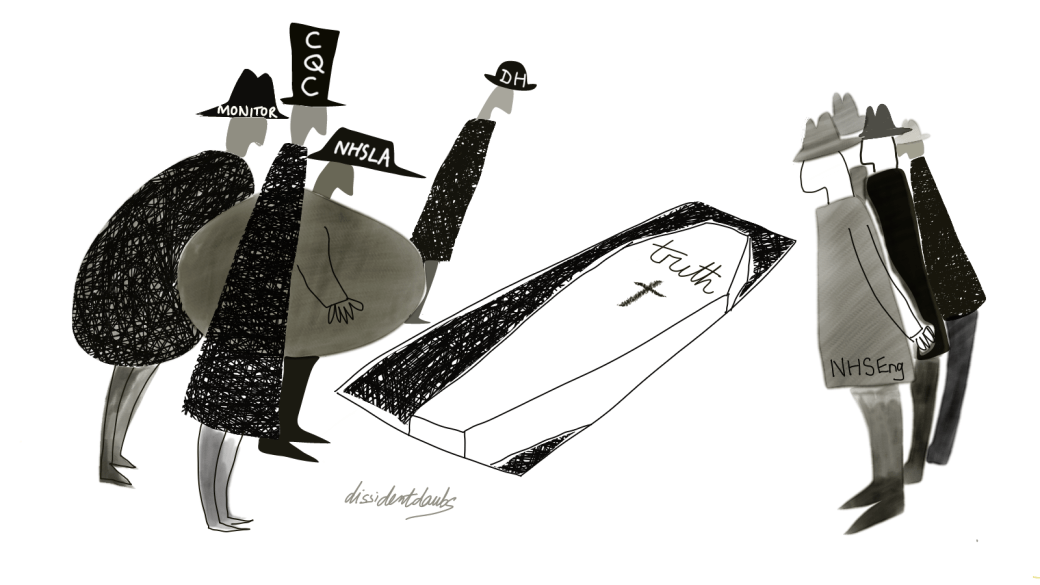
funeral


Super-gagged NHS staff can’t even say that they’ve been silenced. Government still permits super-gags & NHS Improvement won’t audit new Safeguards for super-gagged staff


Please sign and share: Petition to replace weak UK whistleblowing law to protect whistleblowers and the public


By Dr Minh Alexander NHS whistleblower and former consultant psychiatrist, 27 September 2019

 Summary: A most pernicious aspect of the politicised management of the NHS is the use of super-gags to hide bad governance, such the silencing and victimisation of whistleblowers. Whistleblowers may not just be gagged to stop them revealing the contents of agreements reached with employers and details of what happened in the employment relationship, but they may be gagged from even revealing the existence of an agreement. This effectively renders them – and the employer’s misconduct – invisible. Despite past criticism by both Robert Francis and the National Guardian of super-gags respectively as “draconian” and  “insidious”, the National Guardian and NHS Employers reviewed guidance to NHS bodies on compromise agreements this year but still permitted the use of super-gags. They made a minor change by suggesting that employers add a clause to allow super-gagged whistleblowers to communicate with the NHS whistleblower employment support scheme.

This small mercy is tainted by the continuing airbrushing of super-gagged whistleblowers from existence and implicit acceptance of blacklisting as business as usual. Nevertheless, Dido Harding Chair of NHS Improvement was asked if she would at least ensure audit of whether employers comply with new guidance by adding the suggested clause about the employment support scheme. Her head of whistleblowing has replied on her behalf to say that NHS Improvement will not do this, but that the regulator has plans to seek data from trusts. This will of course be subject to the same weakness as all self-reported information. NHS Improvement also offers ad hoc checks of cases that present to its whistleblower employment support scheme, but this will only give a very partial picture. Not all whistleblowers will present to NHS Improvement, and those who are super-gagged without the addition of the clause about the employment scheme would not be able to tell NHS Improvement that they are super-gagged.

Who would want a true picture, if it means stopping the silence and losing political grip?


The gagging of NHS staff was severely criticised during the MidStaffs hospital public inquiry.

The use of super-gags was criticised as unwarranted by Robert Francis in his report of the Freedom To Speak Up Review:

“7.4.21 However, I have seen some which seem unnecessarily draconian or restrictive, for example, banning signatories from disclosing the existence of a settlement agreement.”

The National Guardian acknowledged to me that super-gags were “insidious”.

However, she has co-produced updated guidance on compromise agreements with NHS Employers which does not ban NHS organisations from using super-gags:

Settlement agreements: A factsheet for employers and workers on speaking up

This guidance is designed to be read in conjunction with this NHS Employers’ updated guidance on how to apply compromise agreements:

NHS Employers guidance on settlement agreements February 2019

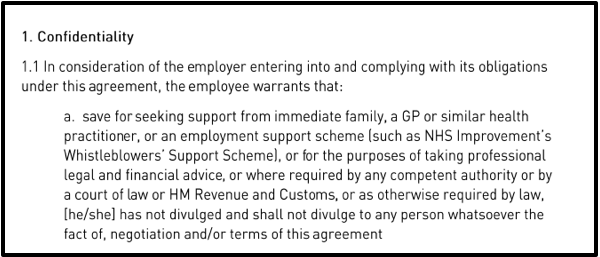
This document gives a template agreement, and it still contains the crucial clause which forbids employees from disclosing the existence (“fact of”) of compromise agreements:

Super gag clause NHS Employers Feb 2019 guidance on settlement agreementsScreenshot 2019-09-27 at 17.22.23

The significant new addition in the above confidentiality section for employees is the clause which allows communication with the NHS whistleblower employment support scheme.

As this guidance is not binding, I asked Dido Harding Chair of NHS Improvement on 23 August 2019 if she would ensure that employers’ compliance is audited, and that they add this new clause.

Tom Grimes NHS Improvement and NHS England lead for whistleblowing replied today on her behalf, and indicated that NHS Improvement had no plans to audit so as it did not consider this to be its role:


Reply from Tom Grimes on Dido Harding’s behalf 27 September 2019:

On that basis, we decided that we would continue our approach of seeking assurance on a case-by-case basis that any associated settlement agreements include an express clause to the effect that nothing in the agreement prevents the individual from making a protected disclosure. In addition, we will improve this assurance by also requiring regular retrospective information to be provided from all providers, within current data returns. This information would confirm that the provisions of any settlement agreements applied during the reporting period complied fully with the guidance issued by NHS Employers. Follow up discussions would be undertaken with individual trusts that cannot provide such confirmation, or who have failed to respond.

Therefore, we do not intend to do an audit as you have suggested because we do not think that is our role, but we are taking steps to improve our assurance.”


As above, NHS Improvement maintains it will take other measures such as “requiring regular retrospective information to be provided from all providers, within current data returns”. I unclear exactly what this means, and will seek clarification of the exact data that will be requested from providers. Obviously, any self-reported data will be less reliable than regular, rigorous audit and unverified reporting may be open to abuses.

As for NHS Improvement’s fall back position of “seeking assurance on a case-by-case”, this is hardly robust oversight of whether providers are applying the guidance reliably. Only a proportion of gagged whistleblowers will contact NHS Improvement’s employment scheme, and those who are super-gagged without the new clause about the employment scheme would be prevented from actually disclosing this fact by their agreement.

Only proactive audit of employers’ practices will give a true picture.

But is a true picture too inconvenient, given the accountability and changes in system behaviour that might it bring?

And if the government had a sincere intention to allow super-gagged whistleblowers access to the whistleblower employment support scheme, surely it would have made the new guidance on compromise agreements mandatory, not optional.

The PR scams and manipulation of media headlines will continue to give an impression that progress has been made on NHS whistleblowing. But the protection for whistleblowers remains highly unreliable and very often illusory.

Only major reforms will do, not tokenistic tinkering.

RELATED ITEMS

The UK Public Interest Disclosure Act not only fails to protect whistleblowers, but it allows employers to attack them:

Replacing the Public Interest Disclosure Act (PIDA)
Whistleblowers in Their Own Words: What’s wrong with UK whistleblowing law and how it needs to change

Gags still stop whistleblowers speaking out: Government claims about new safeguards are hollow

STFU not FTSU

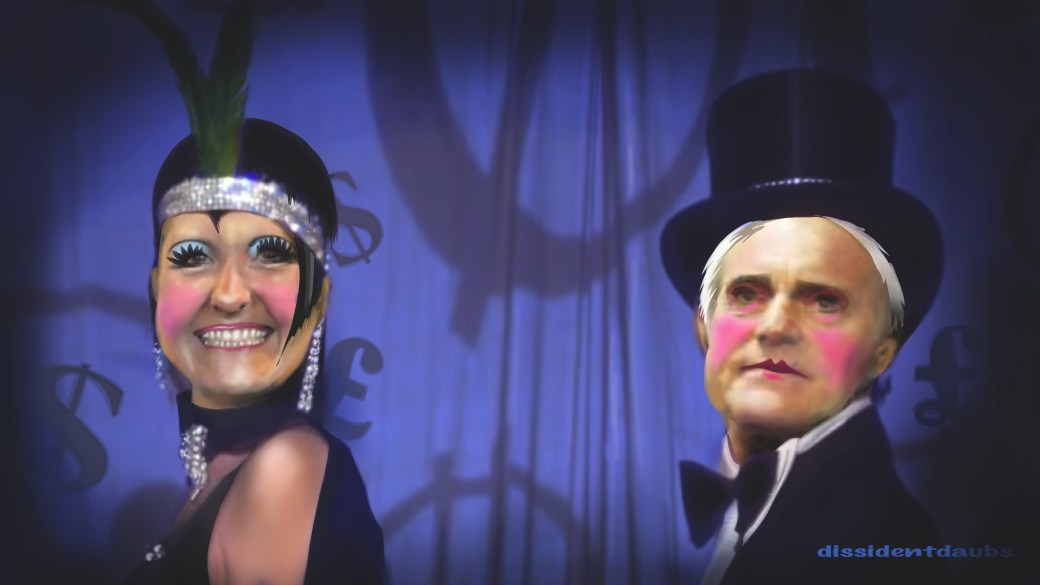
The DHSC, Robert Francis & National Guardian Cabaret: Inconsistencies & Obfuscation about whistleblowers’ concerns

By Dr Minh Alexander NHS whistleblower and former consultant psychiatrist, 19 September 2019


Willkommen! And bienvenue! Welcome!

Summary: The government’s Chief Medical Officer, Robert Francis and the National Guardian publicly rushed to defend a doctor in a high profile Brexit row, giving the impression that they value whistleblowing. The objective facts suggest otherwise. Importantly, Henrietta Hughes the National Guardian breached her own procedures by intervening in this manner, and she did so in a case which did not even clearly meet her official case criteria. This contrasted with repeated cases where she has questionably turned away and let down NHS whistleblowers in dire straits. Moreover, both she and the government continue to skirt around the central, vital issue of the proper handling and investigation of whistleblowers’ concerns. The government’s cabaret plays on. The encores will continue until UK whistleblowing law is properly reformed and power shifts to the public and the genuine protection of citizens.


On 8 September 2019 The Sunday Times published a letter by Robert Francis and Henrietta Hughes NHS Freedom to Speak Up Guardian regarding a row in which a high profile doctor who had campaigned with the anti-Brexit party Change UK on the dangers to health services had exchanged words with Jacob Rees Mogg, the Brexiteer politician on a radio programme. In parliament, Rees Mogg later compared the doctor to Andrew Wakefield, a medic who had been disciplined by the GMC in regards to his controversial claims about vaccination.

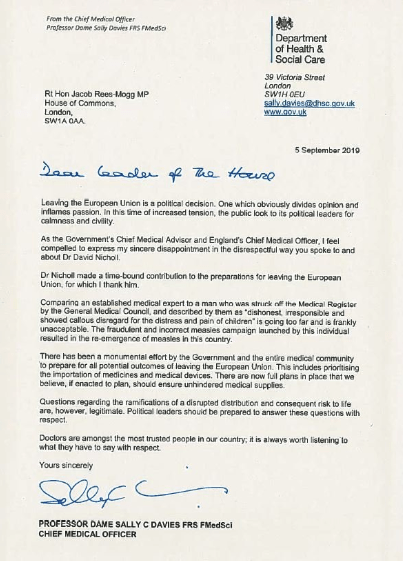
There was condemnation of Rees Mogg’s use of parliamentary privilege to make such a remark, including by the Department of Health and Social Care’s Chief Medical Officer who wrote an open letter as follows:

David Nicholl Sally Davies Jacob Rees Mogg letter 5.09.2019

After it was safe to follow such majority condemnation, Robert Francis & Henrietta Hughes hopped onto the already rolling bandwagon and wrote an open letter to the Secretary of State for Health and Social Care, ostensibly urging him to tell NHS staff that it was appropriate and safe to speak up.

More importantly however, Francis and Hughes took the golden opportunity to pat themselves on the back for purported “positive progress being made with the Freedom to Speak Up agenda”and to claim ( illusory) “freedom to speak up” in the NHS. Of course, they provided no evidence for their dubious claims:


Letter by Robert Francis and Henrietta Hughes published by The Times on 8 September 2019

Dear Secretary of State,

As the author of the Freedom to Speak Up Review and the national Freedom to Speak Up guardian, we write to ask you to reassure National Health Service staff directly that they are not only entitled to raise genuinely held concerns but also under a duty to do so.

We appreciate and welcome your unequivocal tweet on the subject and the forthright letter from the chief medical officer, with every word of which we agree.

We noted with concern the comparison made by the leader of the House of Commons between Dr David Nicholl and Andrew Wakefield.

To see the raising of a concern about possible medicine shortages equated with research statements found by a regulator to be seriously misleading and based on fraudulent research was disturbing to say the least. It implied that Dr Nicholl had been guilty of serious professional misconduct, justifying his erasure from the professional register.

We know how committed you are to creating an open culture in the NHS in which staff feel free to raise concerns and to comply with their professional duties. That Jacob Rees-Mogg has apologised for this statement is to be welcomed. However, we are concerned that this may be insufficient to correct the message implicit in these events that professionals risk their careers if they raise genuinely held safety concerns where these are politically inconvenient, when the very opposite should be the case.

It is even more important, at times of heightened risk, that all professionals should feel free to raise legitimate challenges about the adequacy of the steps taken to mitigate that risk without fear of adverse consequences.

The positive progress being made with the Freedom to Speak Up agenda is always vulnerable to being reversed by what may be perceived as threatening behaviour by persons in positions of authority.

In the circumstances we would be grateful if you would consider writing an open letter to NHS staff reminding them of their freedom and duty to raise issues of safety in accordance with their duty to do so.

Sir Robert Francis, QC

Dr Henrietta Hughes, FRCGP, national guardian for the NHS


This letter, a piece of political theatre, threw up serious questions about inconsistency by Henrietta Hughes.

She and her sponsoring bodies have done their level best to water down Francis’ original recommendations from the Freedom To Speak Up Review, weak as they were.

Francis recommended quite clearly that the National Guardian should have a role in ensuring redress where whistleblowers have been mistreated.

Hughes has stoutly resisted this. Hughes has abandoned NHS whistleblowers in dire straits, some of whom have gone on to lose jobs and homes, claiming that she had no remit to intervene in their employment matters or individual cases.

She has even conjured up reasons for excluding whistleblowers from her case review process that do not feature in her official, published exclusion criteria. 

She even insisted that she cannot even review cases for wider governance learning until absolutely all processes are complete, including Employment Tribunal proceedings, which can take years.

Francis seemed to have acquiesced to these developments. Indeed he refused to meet with me when I asked to discuss concerns with him about the implementation of the Freedom To Speak Up project, writing a rather unfortunate email to Hughes about this.

Yet in the Rees Mogg affair Hughes was intervening in a case which was not clearly within her remit. The Brexit speaking up case was more about government policy and its consequences, in the context of advising NHS England, rather than wrongdoing by an NHS trust employer or its staff.

Moreover it is not clear that the case related to whistleblowing as defined by UK whistleblowing law. The speaking up occurred in the context of advice provided to NHS England, but it is not clear what employment relationship, if any, applied.

A local newspaper report of 26 March 2019  stated that the doctor concerned “has been made the subject of a non-disclosure agreement (NDA) regarding Department of Health and Social Care preparations for a no deal Brexit”. If so, it was possible that some sort of contractual arrangement existed with NHS England. However, a blog by the doctor of 14 May 2019 indicated that he had not been asked to sign a non-disclosure agreement.

The doctor’s primary employer, an NHS trust, was happy for him to speak to the media in a private capacity about his concerns with government policy:

“I warned my Trust, who were happy for me to be interviewed in a personal capacity.”

So the next time that an NHS trust whistleblower who does clearly meet the National Guardian’s case criteria asks her to intervene, what will be her response?

“I’m sorry but I cannot intervene, because your case carries no political/ publicity/ career advantages for me.” ?

As a member (and former Chair) of Henrietta Hughes’ Accountability and Liaison Board for over two years, Francis can be criticised for not ensuring that Hughes discharged her responsibilities fairly and consistently.

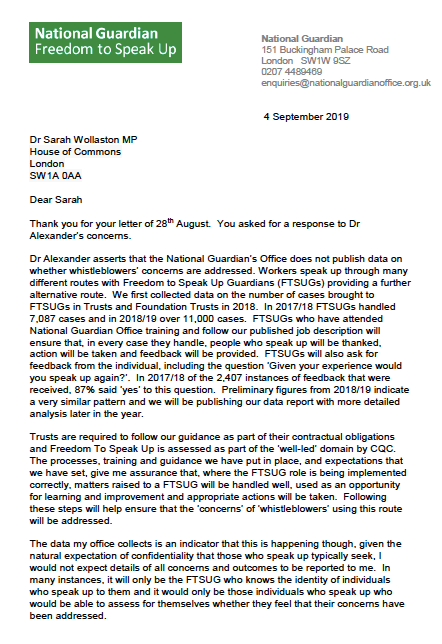
Also undermining the sincerity of the grand gesture letter to Matt Hancock, Hughes continues to evade the question of whether NHS whistleblowers’ concerns are addressed.

In the very basic data that she asks NHS trusts to provide, she does not track whether whistleblowers’ concerns are addressed.


The National Guardian’s current published dataset:

Henrietta Hughes collects the following limited, self-reported data from NHS trusts, and without verification, publishes it quarterly on the CQC website:

–       Total number of cases raised with trust Speak Up Guardians

–       Number of cases raised anonymously

–       Number of cases with an element of patient safety

–       Number of cases with an element of bullying or harassment

–       Number of cases in which the Speak Up Guardian considered the worker suffered detriment as a result of speaking up

This is the National Guardian’s guidance document for Speak Up Guardians on how to collect and report data:

Guidance for Freedom to Speak Up Guardians: Recording Cases and Reporting Data

The data definitions provided to Speak Up Guardians by the National Guardian’s Office are rough in some domains, such as in regards to detriment:

Detriment can be described as any treatment which is disadvantageous and/or demeaning and may include being ostracised, given unfavourable shifts, being overlooked for promotion, moved from a team, etc. You should record the number of cases brought to you where an individual feels they have suffered detriment as a result of speaking up. In addition, should details of a case reveal elements of detriment as described, these should also be recorded even if the individual bringing the case does not identify detriment.”


The proper handling of whistleblowers’ concerns is the central issue in whistleblowing governance.

I raised concerns with parliament last year about the National Guardian’s disinterest and failure to track whether NHS whistleblowers’ concerns are addressed.

The Chair of Health and Social Care Committee advised that she would raise the matter with Hughes.

I heard no more and there was no evidence of any change in the data tracked by Hughes’ Office.

In August I wrote again to parliament. I did not receive a very clear answer on what action had been taken in the intervening months, but Sarah Wollaston did offer once again to raise the issue with the National Guardian.

The correspondence with the parliament to date can be found here.

Below is the latest incredibly weak & wriggly response from the National Guardian. By its style, one senses that it has Sir Humphrey’s imprimatur.

National Guardian letter to Sarah Wollaston 4.09.2019 part 1 tracking whistleblowers' concerns

National Guardian letter to Sarah Wollaston part 2 4.09.2019 tracking whistleblowers' concerns

The observation that there is assurance because things are working well, where they are working well, is a corker of convoluted barrel bottom scraping.

Importantly, Hughes implied that she cannot track whether whistleblowers’ concerns are addressed because that would involve a breach of whistleblowers’ confidentiality.

This is sheer nonsense as Hughes could clearly apply the same process that she uses for all the other data parameters that she already tracks.

It is plainly disingenuous for her to seek and accept Speak Up Guardians’ reports of detriment experienced by whistleblowers, but then in contrast claim that only whistleblowers can determine if their concerns have been addressed.

I will write back to Health and Social Care Committee to raise my concerns about this further obfuscation.

The simple truth is that the government does not want to go anywhere near whistleblowers’ concerns, and Henrietta Hughes will not risk upsetting the government.

As for her and Francis’ comment in their letter about political inconvenience, arguably their greatest hypocrisy is their refusal to date to oppose the government by supporting reform of totally unfit UK whistleblowing law, which Francis acknowledged was ‘weak’.

Hughes’ joint letter with Francis to Hancock was just opportunistic display, for the benefit of those at the top table.

It was not in any way the quiet, unsung altruism of many NHS frontliners who suffer every day for speaking up when their livelihoods are at stake and their managers are hostile.

The government is as hypocritical as ever and despite the recent political panto, it has no intention of acting properly on NHS staff’s concerns.

I am in fact waiting for a reply from Matt Hancock to a letter of 8 September about his Department’s failure for the best part of a year to answer a simple question on the investigation of NHS and social care whistleblowers’ concerns. I doubt I will receive a meaningful response.

BY EMAIL

Matt Hancock

Secretary of State for Health and Social Care

8 September 2019

Dear Mr Hancock,

Will the government ensure that the Care Quality Commission investigates individual whistleblowers’ concerns?

As you will see from the letters copied below, I have been in correspondence with the Department of Health and Social Care for the best part of a year in order to get a very simple question answered:

“It would be very helpful if the DHSC could either clearly confirm that CQC has the power to investigate individual whistleblowers’ concerns, or alter CQC’s regulations to make this unequivocally so.”

I have tried without success to resolve the issue including with the Minister of State for Care, who is ironically the MP for Gosport, who one might hope would be alive to its importance.

The Department has:

  • Initially replied affirmatively
  • Gone silent for extended periods
  • Replied past the point
  • Replied opaquely and or with delphic ambiguity (see the email from Mr Addison of 9 August 2019 and my reply of the same date)
  • Failed to respond as promised after the latest exchange of correspondence, despite this being relevant to CQC event

Ensuring the investigation of whistleblowers’ concerns is the major unresolved issue at the heart of NHS, and indeed all UK whistleblowing governance.

Without addressing this single central issue, all else is effectively noise.

I would be very grateful if you could ensure that the Department finally provides a clear and meaningful response as per my request of 9 August to Mr Addison.

Yours sincerely,

Dr Minh Alexander

Cc Health and Social Care Committee


RELATED ITEMS

A Serious Health Warning about the Freedom To Speak Up Project: What all NHS staff should know before they whistleblow

Replacing the Public Interest Disclosure Act (PIDA)
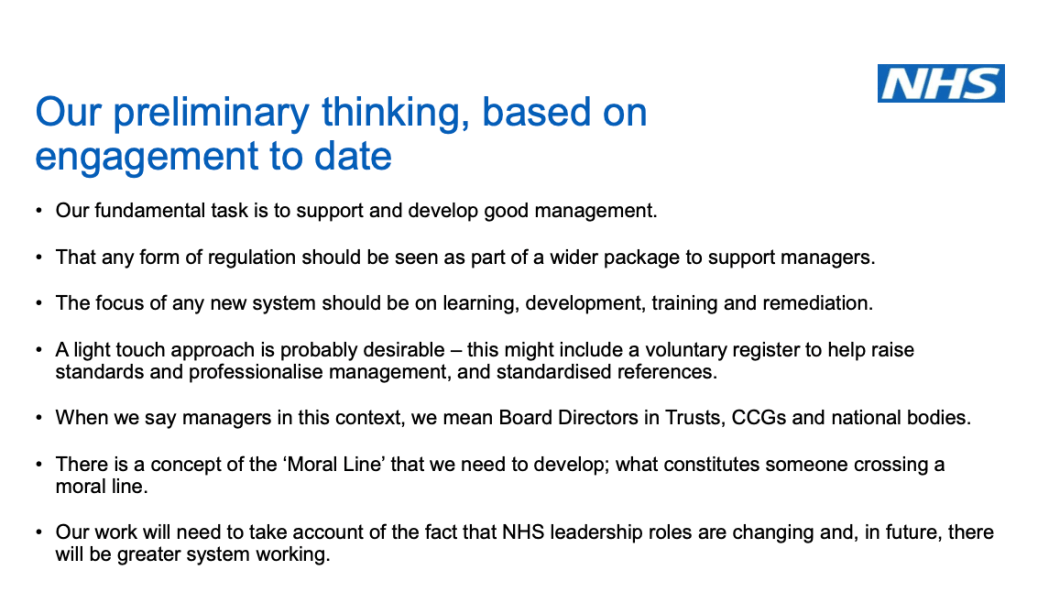
Whistleblowers in Their Own Words: What’s wrong with UK whistleblowing law and how it needs to change

Cabaret

Dissidentdaubs’ Boxing Day Cabaret

http://www.drsarah.org.uk/in-parliament/news-and-speeches/dr-henrietta-hughes/2228

Sarah Wolllaston and Henrietta Hughes selfie


Correspondence with parliament: The Department of Health & Social Care’s obfuscation about the investigation of whistleblowers’ concerns

By Dr Minh Alexander NHS whistleblower and former consultant psychiatrist, 29 August 2018

The government continues to duck and dive when pressed to ensure that whistleblowers’ concerns are properly handled and investigated.

The scope of a forthcoming CQC consultation event which originally included review of CQC’s whistleblowing processes and policy, has now contracted.

This followed a request to the DHSC to clarify its position on the investigation of whistleblowers’ concerns in time for the CQC’s consultation event.

Alongside this, judging from her routinely published data, the National Guardian still does not track whether whistleblowers’ concerns are addressed.

But that does not stop her from claiming that Freedom To Speak Up guardians have prevented “untold harm” and saved lives.

The correspondence with parliament regarding these issues over the last year can be found here.

This is the latest exchange of letters with the Chair of Health and Social Care Committee about these matters:

BY EMAIL

Dr Sarah Wollaston

Chair of Health and Social Care Committee


28 August 2019


Dear Dr Wollaston


UK government does not track whether whistleblowers’ concerns are addressed but claims lives are being saved


Thank you for your letter yesterday replying to my enquiry of 9 August 2019, both copied below, and your offer to seek an update on whether the NHS National Freedom To Speak Up Guardian will in future track whether whistleblowers’ concerns are addressed.


I would be grateful if you would do so.


You will recall that I asked the Committee to consider this issue last September.


The situation now is very serious, because not only is the National Guardian continuing to fail to track whether whistleblowers’ concerns are addressed, but she recently made unjustified claims that NHS Freedom To Speak Up Guardians were preventing “untold harm” and saving lives even though she still has no safe oversight of whether whistleblowers’ concerns are addressed.


This is correspondence with the National Guardian and her Office which revealed the lack of substantiating evidence for her claims about lives saved:


https://minhalexander.com/2019/08/25/the-low-fact-national-guardians-office/


Professor Sir Brian Jarman, an internationally acknowledged expert on mortality in healthcare made these observations about the lack of adequate evidence:


Screenshot 2019-08-29 at 09.19.31

In addition to the concerns about the actions and omissions of the National Guardian’s Office, the Department of Health and Social Care maintains its silence on whether it will ensure that the Care Quality Commission has and uses clear powers to investigate individual whistleblowers’ concerns.


I was invited to attend a CQC event next month which included review of CQC’s policy and processes for handling whistleblowing, and sent relevant policy and guidance documents.


However, after I asked the DHSC to clarify its position on investigation of individual whistleblowers’ concerns in time for this consultation event, the CQC advised me and other whistleblowers that the scope of the event would be much narrower than originally advised in CQC’s invitation letter. Indeed, CQC told us emphatically:


“Therefore the event on the 2nd…will definitely not touch on our current guidance and your concerns about its current limitations.”


I am concerned that the DHSC is continuing to control the narrative in an unhelpful way, and undermining any work to resolve the most fundamental flaw in Health & Social Care whistleblowing governance: the failure to reliably investigate individual whistleblowers’ concerns.


I hope that parliament will seek the clarity that is needed on this vital issue, in the interests of safeguarding the public.


It is an issue replicated across sectors, and reflects the un-rectified, central failure of UK whistleblowing law to compel investigation.


Yours sincerely,


Dr Minh Alexander


Cc Health and Social Care Committee

Meg Hillier

Barbara Keeley

Laura Pidcock

Anne Marie Trevelyan

Matt Hancock Secretary of State for Health

Caroline Dinenage Minister of State for Care


YOUR LETTER


“27 August 2019
Dear Dr Alexander
Thank you for your email of 9 August regarding the tracking of whether whistleblowers’ concerns are addressed.
Naturally, Dr Hughes, the National Guardian, shares my firm belief that matters raised by whistleblowers should be addressed appropriately. I understand that the National Guardian’s Office expects that organisations that receive whistleblowers’ concerns should have appropriate mechanisms for tracking them. The NGO’s office also considers that whistleblowers should receive feedback on what happens as a result of them raising an issue. That means not only being updated of the outcome of their report at the conclusion of the process, but also updates on how the matter is being progressed.
I note your view that the UK Government—and specifically the National Guardian’s office—should itself track whether whistleblowers’ concerns have been addressed. I do not have a further update on this issue from the National Guardian but I am happy to request one.
Yours sincerely,
Dr Sarah Wollaston MP
Chair of the Committee”


RELATED ITEMS
Genuine protection of UK whistleblowers requires the essential step of replacing ineffective UK whistleblowing law.

Replacing the Public Interest Disclosure Act (PIDA)
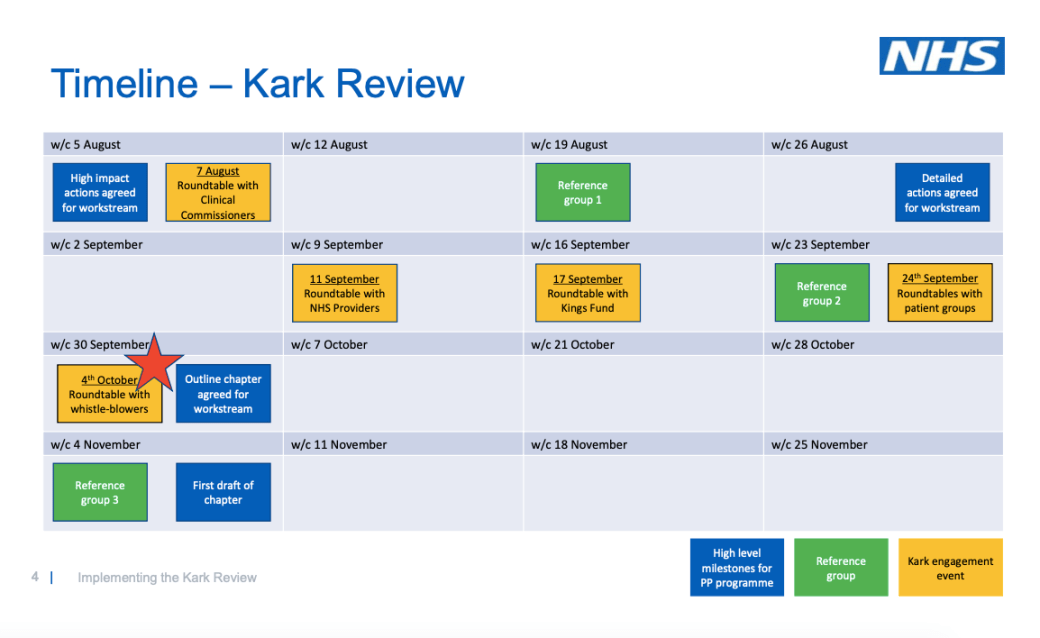
Without a fit for purpose legal framework as a starting point, the same failures will repeat ad nauseam.

Engineered failure to investigate NHS whistleblowers’ concerns

BS FreedomToSpeakUpometer

The Low Fact National Guardian’s Office

 By Dr Minh Alexander NHS whistleblower and former consultant psychiatrist, 25 August 2019


Summary: The NHS National Guardian’s Office could produce no robust evidence for a major recent claim that: Patient’s lives have been saved and untold harm has been prevented because Freedom to Speak Up Guardians have supported workers”


 The Freedom To Speak Up project is based on government duplicity, spin and half truths.

It had no evidence base.

Robert Francis, the government’s frontman, later spun this as heroic pioneering, but even this was not true:

Screenshot 2019-07-28 at 08.10.10

In fact the model is a hand-me-down from the corridors of Whitehall.

It is clear the National Guardian is keen to generate Good News stories, as her newsletters are full of smiling photos.

Her compact with local trust Speak Up Guardians includes promoting their purported successes, although the evidence so far suggests that caution is needed in accepting the National Guardian’s examples of success.

One of her latest projects is to collect a 100 stories of self-reported success. The instructions for submission encourage NHS Trust Guardians to recruit the help of local trust spin doctors:


“Involve your communications team before you make a submission to discuss how you can develop these case studies. They can help you tell these stories by filming short videos; commissioning animated GIFs for social media; shooting high-quality photos; or drafting media releases for the local and regional press. The National Guardian’s Office may get in touch about adapting the case studies for short social media videos, annual reports, news stories and other communications.”


Of course, the message communicated in seeking Good News stories is that Bad News is not welcome. Surreal coming from a whistleblowing agency

The government’s smoke and mirrors also continue in a lack of rigourous monitoring and evaluation.

The National Guardian does not even collect data on whether NHS whistleblowers’ concerns are addressed.

And yet the National Guardian, a senior doctor trained in the proper evaluation of evidence, makes extraordinary claims of success in the absence of clear evidence.

On 16 July 2019 her office tweeted a claim by her that the Freedom To Speak Up project had prevented untold harm and saved lives:

National Guardian tweet prevented untold harm saved lives


Customarily, to reach such conclusions about healthcare interventions and to promulgate them, doctors conduct scientifically rigourous research and have their work peer reviewed prior to publication.

Indeed, the GMC expects all doctors to work in an evidence-based manner:

“provide effective treatments based on the best available evidence”

(Good Medical Practice, Professionalism in Action, 16.b)

To my knowledge, the National Guardian has not produced any evidence that the establishment of the Freedom To Speak Up project, as opposed to other factors, has been specifically responsible for reducing harm and deaths in the NHS.

The evaluation research on the Freedom To Speak Up project commissioned so far by the government avoids core questions such as this. It is designed to faff around at inconsequential edges.

The National Guardian maintains it is a success that staff are raising concerns through Speak Up Guardians, but this is not necessarily a good sign. It can indicate in some cases that there is a difficulty with the line of management and perhaps with the management culture generally.

The tweeted claim of 16 July about lives saved was queried and supporting evidence was requested.

This request was ignored twice. Accordingly, a request for substantiating evidence was formally made by correspondence.

After a chaser, this was the reply from the National Guardian’s Office on 9 August 2019:


“Dear Mr Alexander,

Thank you again for contacting the National Guardian’s Office.

The data we have collected over the last two years from FTSU Guardians in trusts and foundations trusts documents the number of cases that FTSU Guardians handled that include elements that indicate a risk to patient safety or the quality of care.  Our report for 2017/18 shows that FTSU Guardians handled 7,087 cases, 32% of which were reported as including an element of risk to patient safety or the quality of care.  We are finalising our report for 2018/19 but our figures so far indicate that FTSU Guardians handled nearly 12,000 cases and nearly 30% of these were reported as involving an element related to patient safety / quality of care.

I hope this information is helpful for you.

Kind regards,

Ellie Staite

Correspondence Officer

National Guardian’s Office

151 Buckingham Palace Road

London”


This was also extraordinary, but upon checking, it was confirmed to be the ‘evidence’ for the claim about lives saved.

Low Fact Milk.png

So it appears the National Guardian, a senior doctor, has claimed from self-reported data by NHS trusts that patient safety concerns are raised with Speak Up Guardians, that “untold harm” and deaths have been prevented.

The full correspondence is provided in the appendix below.

It is tragi-comical that this is the level of evidence relied upon to make claims that lives are being saved.

But it does go to the political nature of the National Guardian’s Office.

It is a very expensive firewall, that will pump out cheery messages whilst core NHS services crumble around us.


RELATED ITEMS

 Replacing the Public Interest Disclosure Act (PIDA)
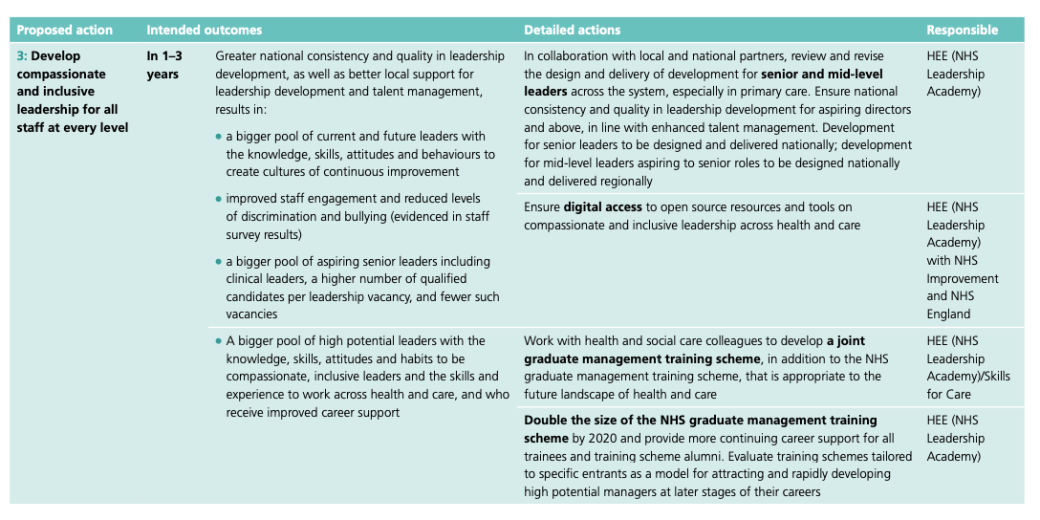
 What is needed is a serious, professional whistleblowing agency established under an umbrella of strong, safe whistleblowing law and direct supervision by parliament, not governments.

The first essential step is the urgent replacement of seriously inadequate UK whistleblowing law.

A portrait of ineffectiveness: Internal whistleblowing champions in their own words


Matt Hancock FTSU bubble with strapline.jpeg


 APPENDIX

 Correspondence with the National Guardian about the claim that Freedom To Speak Up Guardians have prevented untold harm and saved lives

 On Fri, 9 Aug 2019 at 16:25, National Guardian’s Office <REDACTED> wrote:

Dear Mr Alexander,

I can confirm that the email below is in response to your original email of 23rd July.

Kind regards,

Ellie Staite

Correspondence Officer

National Guardian’s Office

151 Buckingham Palace Road

London

SW1W 9SZ

 From: Ian Alexander <REDACTED>

Subject: Re:

Date: 9 August 2019 at 16:21:30 BST

To: National Guardian’s Office <REDACTED>

Dear Ms Staite,

In the interests of clarity, can you advise if your letter of today’s date is in response to, and therefore the answer to, my query of 23rd July addressed to Dr Hughes.

Many thanks,

Ian Alexander


On Fri, 9 Aug 2019 at 15:37, National Guardian’s Office <REDACTED> wrote:

Dear Mr Alexander,

Thank you again for contacting the National Guardian’s Office..

The data we have collected over the last two years from FTSU Guardians in trusts and foundations trusts documents the number of cases that FTSU Guardians handled that include elements that indicate a risk to patient safety or the quality of care.  Our report for 2017/18 shows that FTSU Guardians handled 7,087 cases, 32% of which were reported as including an element of risk to patient safety or the quality of care.  We are finalising our report for 2018/19 but our figures so far indicate that FTSU Guardians handled nearly 12,000 cases and nearly 30% of these were reported as involving an element related to patient safety / quality of care.

I hope this information is helpful for you.

Kind regards,

Ellie Staite

Correspondence Officer

National Guardian’s Office

151 Buckingham Palace Road

London

SW1W 9SZ

From: Ian Alexander <REDACTED>

Subject: Re:

Date: 2 August 2019 at 11:18:55 BST

To: Henrietta Hughes <REDACTED>

Dear Dr Hughes,

I refer to my letter of 23td July copied below for your convenience.

I received a reply by return from your office advising me that I would receive a substantive response within twenty working days.

Given the importance of this issue, and your overarching responsibility to your public office, I was surprised to receive such a casual brush off and indeed made a further, as yet unanswered, enquiry regarding civil service response targets.

As I have still not received any meaningful explanation for your extraordinarily important claim, I confess to being a little uneasy that such a claim, made over two weeks ago still lies on the public record unevidenced.

I would be glad if you could correct that, and publish the evidence on which you made such an important claim without further delay.

Thank you,

Ian Alexander

To: Henrietta Hughes <REDACTED>
Sent: Tue, 23 Jul 2019 11:56

Dear Dr Hughes,

Attached is a screen shot quoting your response to the APPG report. It also shows my request that this claim be evidenced. To date there has been no response. Accordingly I now bring it to your attention in case your comms team have not done so.

Thank you,

ID Alexander


More consultation on the regulatory response to whistleblowing in Health & Social Care (But government is keeping shtum on investigation of whistleblowers’ concerns)

 By Dr Minh Alexander NHS whistleblower and former consultant psychiatrist 22 August 2019

Last year the Health and Social Care watchdog the Care Quality Commission acknowledged that it had still not got whistleblowing governance right.

It agreed to consult again by the end of the year. I advised that this should be an open process.

To give due credit, Ted Baker Chief Inspector of Hospitals also agreed to revisit a request for audit of CQC’s handling of whistleblower confidentiality, despite Peter Wyman CQC Chair having arbitrarily dismissed the need for audit, after breaches.

CQC board minutes subsequently showed that CQC reviewed a series of cases and concluded that there had been no recent confidentiality breaches.

However, the general consultation on whistleblowing did not materialise.

CQC board papers from July this year revealed that CQC pressed on with internal review  of its whistleblowing process.

The CQC has now sent out, at short notice, invitations to a national event on 2 September 2019 which includes consultation on how its whistleblowing process might be improved:

We are also reviewing our policies and procedures as they relate to how we manage information from people who work in the services we regulate and how we communicate and use the information shared. We have listened and heard that we have not always been successful at managing information shared with us. As a result of this, and in line with our commitment to consult on how we can make improvements, we are bringing together people who can help us to determine what good looks like.”

The Department of Health and Social Care, GMC, NMC, NHS England/ Improvement and the National Guardian will be represented.

Some whistleblowers have been invited, but I do not know how many in total.

There also does not appear to be clear open access to the consultation process by correspondence, and I am not aware that the consultation has been advertised.

There is no agenda for the 2 September workshop yet, but the event is scheduled for a five hour slot.

It is led by Professor Ursula Gallagher CQC Deputy Deputy Chief Inspector for Primary Medical Services and Integrated Care, who is the CQC lead on whistleblowing.

I have asked for sight of the policies about which the CQC is consulting. I am advised that these are the two relevant policies:

  1. Published 2013 guidance for providers on whistleblowing governance

Whistleblowing Guidance for providers who are registered with the Care Quality Commission

  1. Internal CQC guidance for its inspectors produced in June 2019, and currently in use

Guidance: Handling concerns raised by workers of providers registered with CQC

The 2019 internal guidance document replaces a document produced last year:

Handling concerns raised by workers of providers registered with CQC

Apart from a different title and a curious new section on RIPA powers, the 2019 CQC guidance for its inspectors looks much the same as the 2018 guidance.


The new section in 2019 CQC guidance on whistleblowing for its staff:

10. The Regulation of Investigatory Powers Act 2000 (RIPA)  “CQC does not routinely as a matter of policy currently undertake or authorise providers or members of the public to undertake either directed covert surveillance or Covert Human Intelligence Sources (CHIS).
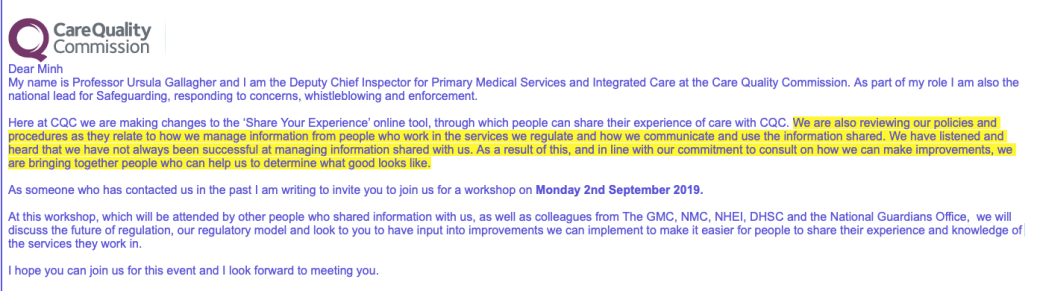
 

In addition, the Regulation of Investigatory Powers Act 2000 (RIPA) places restrictions upon the use of surveillance and covert intelligence sources by public bodies. Under RIPA, the Care Quality Commission does not have the power to undertake intrusive covert surveillance or to authorise providers or the public to undertake intrusive covert surveillance. This prohibits CQC from authorising the use of hidden cameras and listening devices in residential premises.
 

Therefore, CQC currently does not ask people to create recordings on its behalf. For further information about RIPA and covert activity including intrusive surveillance, directed surveillance or CHIS please visit the RIPA intranet page and RIPA awareness video in ED.”


Inevitably, the CQC guidance to its staff toes the government line: UK whistleblowing law is protective, the National Guardian is leading culture change, blah blah blah…

The key issue that is unspoken in these documents is the fact that the CQC declines to actually investigate whistleblowers’ concerns.

The government continues to avoid answering questions about whether CQC should do so under its current regulations, or whether new regulations will be drafted to ensure that CQC has clear powers to do so.

I have asked the DHSC to clarify its position in time for the event on 2 September 2019, but the correspondence fencing bout may well continue. The latest correspondence with the Department is copied below in the appendix.

The event on 2 September 2019 will be an expensive affair, and whilst CQC’s recent staff guidance documents are an improvement on past versions which were technically very rudimentary, little will be achieved until whistleblowers’ concerns are appropriately investigated.

If any Health or Social Care whistleblower who has not so far been invited to contribute wishes to send in comments on how CQC can improve its handling of whistleblowing, I would suggest sending written contributions to CQC FAO Professor Ursula Gallagaher.

UPDATE 24 AUGUST 2019

Some whistleblowers who have expressed interest in contributing to the consultation have received conflicting information about its scope. For clarity, this is the original correspondence from the CQC, sent on 14 August 2019:

CQC Ursula Gallagher invitation to event 2 September 2019

RELATED ITEMS

Under UK whistleblowing law, CQC is part of a network of ineffectual ‘Prescribed Persons’:

Prescribed Persons or the Pretence of PIDA. How UK whistleblowers are ignored

The law needs to be urgently replaced:

Replacing the Public Interest Disclosure Act

Whistleblowers in Their Own Words: What’s wrong with UK whistleblowing law and how it needs to change


APPENDIX

Most recent correspondence with the Department of Health and Social Care about whether CQC will investigate whistleblowers’ concerns:


From: “Benjamin, Jennifer” <REDACTED>

Subject: RE: Will the government ensure that the Care Quality Commission investigates individual whistleblowers’ concerns?

Date: 16 August 2019 at 14:48:57 BST

To: Minh Alexander <REDACTED >

Cc: Caroline Dinenage <REDACTED>

Dear Minh

Thank you for your email.  Just to confirm that your email to Alan has been picked up in his absence and we will be able to provide you with a response.

Jennifer


Jennifer Benjamin

Deputy Director – Quality, Patient Safety & Investigations

Department of Health and Social Care

Email: REDACTED


From: Minh Alexander <REDACTED >

Sent: 15 August 2019 11:03

To: Benjamin, Jennifer <REDACTED>

Cc: Caroline Dinenage <REDACTED>

Subject: Will the government ensure that the Care Quality Commission investigates individual whistleblowers’ concerns?

Hi Jennifer,

I received an out of office message from Alan’s account, advising that he is away until the 5th September.

Are you able to help with my enquiry in his absence?

BW

Minh

From: Minh Alexander <REDACTED>

Subject: Will the government ensure that the Care Quality Commission investigates individual whistleblowers’ concerns?

Date: 15 August 2019 at 09:25:57 BST

To: Alan Addison

Cc: Jennifer Benjamin <REDACTED> Barbara Keeley <REDACTED> Caroline Dinenage <REDACTED> Laura Pidcock <REDACTED>

BY EMAIL

Alan Addison

Ministerial Correspondence

Department of Health and Social Care

15 August 2019

Dear Mr Addison,

Will the government ensure that the Care Quality Commission investigates individual whistleblowers’ concerns?

Since I last wrote on 9 August I have been invited by the Care Quality Commission to a consultation event on 2 September 2019, led by Ursula Gallagher Deputy Chief Inspector PMS and Integrated Care London, which includes reviewing how CQC manages whistleblowing by the staff of provider organisations:

“We are also reviewing our policies and procedures as they relate to how we manage information from people who work in the services we regulate and how we communicate and use the information shared. We have listened and heard that we have not always been successful at managing information shared with us. As a result of this, and in line with our commitment to consult on how we can make improvements, we are bringing together people who can help us to determine what good looks like.”

I also understand that the DHSC will be represented at this event.

In advance of the event, I have asked for sight of the relevant policy and procedural documents that are being consulted upon.

However, it would be surreal for this event to take place without a clear answer from the DHSC on its position on whether the CQC should investigate whistleblowers’ concerns.

I would therefore be very grateful if you could expedite your answer to the questions posed in my letter of 9 August below, before the event on 2 September, which are the subject of matters first put to the Department in December 2018.

Yours sincerely,

Dr Minh Alexander

Cc Caroline Dinenage Minister for Care

Jennifer Benjamin DHSC Deputy Director, Quality, CQC & Investigation

Barbara Keeley Shadow Minister for Mental Health and Social Care


From: Minh Alexander <REDACTED>

Subject: Your recent correspondence to the Department of Health and Social Care

Date: 9 August 2019 at 17:07:49 BST

To: Alan Addison <REDACTED>

Cc: Jennifer Benjamin <REDACTED> Caroline Dinenage <REDACTED>

BY EMAIL

Alan Addison

Ministerial Correspondence

9 August 2019

Dear Mr Addison,

Will the government ensure that the Care Quality Commission investigates individual whistleblowers’ concerns?

Thank you for your email regarding my query, first put to the Department eight months ago.

I asked if the Department would:

  1. Confirm that CQC has the powers to investigate, and should investigate, individual whistleblowers’ concerns

 or

  1. Amend CQC’s regulations to make it unequivocally clear that CQC should investigate individual whistleblowers’ concerns.

I am unsure from your reply today whether the Department considers that CQC has the power to investigate individual whistleblowers’ concerns.

With regard to your comment:

“The CQC has the power to respond where a matter of concern raises any issues about patient safety or quality of care and will intervene in its capacity as a regulator.  If, in the course of that action, it has concerns about the how a provider has responded to a whistleblower’s concerns, it can take regulatory action.  A provider’s systems and processes in place to respond to complaints are assessed on inspection as part of the CQC’s ‘well-led’ key lines of enquiry.”

the CQC does ‘intervene’ sometimes in response to whistleblowers, largely superficially, and its actions are usually short of actual investigation. It tells whistleblowers it has no power to investigate.

Please can you clarify if your above advice means that the CQC has the power to investigate individual whistleblowers’ concerns about patient safety and or quality of care, and not just the way in which the provider responded to their concerns.

If what you are saying is that CQC has no powers to investigate individual whistleblowers’ primary, presenting concerns, as opposed to how their concerns were handled, please can you advise if the Department will amend CQC’s regulations to ensure that CQC has clear powers to investigate individual whistleblowers’ concerns about patient safety and or quality of care.

Yours sincerely,

Dr Minh Alexander

Cc Caroline Dinenage Minister for Care

Jennifer Benjamin DHSC Deputy Director, Quality, CQC & Investigation


From: Department of Health and Social Care

Subject: Your email to Caroline Dinenage

Date: 9 August 2019 at 16:30:20 BST

To: “Alexander, Minh” <REDACTED>

Our ref: DE-1185271

Dear Dr Alexander,

Thank you for your further correspondence of 1 August about the Care Quality Commission (CQC).  I have again been asked to reply.

I was sorry to read that you were unhappy with my reply of 1 August (our ref: DE-1169259).  I should clarify that it was a response to your correspondence of 5 March, 12 March and 28 May to Caroline Dinenage and 23 April to Matt Hancock.

I note your continuing concerns about the role of the CQC.

The CQC treats whistleblowing concerns as it would any other concern, and will use the information as part of its assessment of a provider.

The CQC has the power to respond where a matter of concern raises any issues about patient safety or quality of care and will intervene in its capacity as a regulator.  If, in the course of that action, it has concerns about the how a provider has responded to a whistleblower’s concerns, it can take regulatory action.  A provider’s systems and processes in place to respond to complaints are assessed on inspection as part of the CQC’s ‘well-led’ key lines of enquiry.

The CQC does not have the legal powers to intervene in, or investigate, an individual employment matter or how an individual is treated after raising a patient safety or quality issue.

I hope this reply is helpful.

Yours sincerely,

Alan Addison

Ministerial Correspondence and Public Enquiries

Department of Health and Social Care


From: Minh Alexander <REDACTED>

Subject: Your recent correspondence to the Department of Health and Social Care

Date: 1 August 2019 at 15:57:55 BST

To: Alan Addison <REDACTED>

Cc: Jennifer Benjamin <REDACTED> Caroline Dinenage <REDACTED>


BY EMAIL

Alan Addison

Ministerial Correspondence

1 August 2019

Dear Mr Addison,

Will the government ensure that the Care Quality Commission investigates individual whistleblowers’ concerns?

Thank you for your letter below.

Unfortunately, it is unclear to me to which of my letters you are replying.

Please could you clarify this.

If your letter is not a reply to my letter to Caroline Dinenage of 25 May 2019 about CQC investigation of whistleblowers’ concerns and related reminder letters of 19 June 2019 and 3 July 2019, none of which have been met with replies, please could the Department ensure a swift substantive response.

If your letter today is a reply to my above mentioned correspondence to Caroline Dinenage, it does not address the key issue that I have raised of whether the DHSC will either

  1. Confirm that CQC has the powers to investigate, and should investigate, individual whistleblowers’ concerns

or

  1. Amend CQC’s regulations to make it unequivocally clear that CQC should investigate individual whistleblowers’ concerns.

You will appreciate that this is a critical national patient safety issue.

CQC has avoided investigation of individual whistleblowers’ concerns since its inception 10 years ago, but with an admission to me last October that it might have been wrong to do so.

Your own Departmental lead for whistleblowing policy later advised me that CQC should be investigating individual whistleblowers’ concerns.

I first raised the issue with the Department eight months ago.

Please can the Department finally address this issue.

Yours sincerely,

Dr Minh Alexander

cc Caroline Dinenage Minister for Care

Jennifer Benjamin DHSC Deputy Director, Quality, CQC & Investigation


Carl Beech, CQC inspector, convicted child sex offender and fraudster: Activities at the CQC

Please sign and share:

Petition to replace weak UK whistleblowing law to protect whistleblowers and the public


By Dr Minh Alexander NHS whistleblower and former NHS consultant psychiatrist, 21 August 2019


Carl Beech is the individual at the heart of the bizarre VIP paedophile saga, whose false allegations have left some agencies red-faced and the public purse lighter by several million.

Beech was convicted of child sex offences earlier this year, in relation to possession of indecent images. It was reported that he initially tried to blame his son:

“he was prosecuted and initially pleaded not guilty, and in a police interview, sought to blame his teenage son.”

In July he was additionally convicted of perverting the course of justice and fraud, with regards to his false allegations about violent child sex abuse by various VIPs.

Beech was jailed for eighteen years.

These were the judge’s sentencing remarks:

Regina v Beech 26 July 2019

Beech was first interviewed by the police as a witness in December 2012 regarding the false allegations of sex abuse.

Possibly lending credence to his disclosures was the fact that he held a responsible job as a CQC inspector.

The CQC had been very quiet about this part of the story.

The regulator declined to answer any questions earlier this year, claiming that to do so might prejudice the second criminal trial against Beech.

But after his conviction in July, CQC had to answer re-submitted questions.

The CQC’ s FOI response refers to Beech’s “suspension”. It is not clear if he is still a CQC employee.

The CQC has disclosed that Beech was active and taking part in CQC inspections over a four year period, between 7 March 2012 and 11 October 2016.

He took part in 128 inspections of NHS hospital trusts, mental health and ambulance trusts, GP surgeries, private hospital providers, residential care homes and community care facilities.

This is the full list disclosed by the CQC:

CQC inspections involving Carl Beech

Beech inspected NHS trusts in the South West on fourteen occasions as follows:

CQC NHS Trust inspections involving Carl Beech


Beech’s public facing role meant he was a potential risk to the public, particularly to vulnerable groups. CQC indicated:

 “…we have reviewed all records to identify any risks from the inspections and CQC activities that he was involved in and we have no information of concern about his conduct on any inspection. All of the providers have been notified of his involvement in the inspection of their services.”

 The CQC maintained that it follows best practice when recruiting, and that after appointment, it continues to conduct three yearly enhanced disclosure and barring checks on workers who are in eligible roles.

It indicated that it has no intention of reviewing its process.

It is possible for some highly deviant offenders to successfully con others and few safeguards are insurmountable when someone lies determinedly.

Excessive bureaucracy in response to scandals, such as the glorified paper chase imposed on busy doctors after the Shipman killings, mostly has the effect of wasting resource but without real effectiveness in identifying the seriously psychopathic.

It is also easy to criticise with hindsight.

It is possible that CQC could not have reasonably identified that Beech was a fraudster and a risk to others.

But Beech did work for CQC for at least four years.

And we know from the Whorlton Hall scandal that despite the government hype about replacement of CQC’s chief officers and purported reform after failures, CQC continued to suppress its whistleblowers. Compounding its misdeeds, CQC recently tried to hide this fact.

CQC only gave reassurance in its FOI response that there were no concerns in relation to Beech’s conduct on inspections, based on its paper review.

This circumvents the question of whether other concerns were raised about him.

I have asked the regulator to clarify if any concerns were raised about Beech by its staff or other parties.

As we know from the Whorlton Hall scandal and other matters, relying upon CQC’s assessment of its own performance is far from safe.

We also know that CQC is very ready to gloss over its misdeeds, as illustrated by its recent indication to Private Eye that it has no intention to investigate why it rated Newbus Grange, a sister unit to Whorlton Hall as ‘Outstanding’ in February this year, just before physical abuse at the facility became public knowledge in April.

We also know from CQC’s 2018 staff survey that only 42% of CQC staff replied affirmatively regarding the item:

“I think it is safe to challenge the way things are done in CQC”              

CQC  2018 staff survey safe to challenge the way things are done in CQC


I have sent the data on Carl Beech’s activities at CQC to Health and Social Care Committee and Barbara Keeley, Shadow Minister for Mental Health and Social Care.

UPDATE 21 AUGUST 2019:

The CQC has given the following additional information on Carl Beech’s employment status:

“Carl Beech was suspended on 9 November 2016 following media reports and subsequent confirmation by the individual (on 8 November) that he was being investigated by Northumbria Police for fraud and perverting the course of justice.

A disciplinary investigation was then commenced on 8 February 2017 in relation to failure notify CQC of arrest by Gloucestershire police in relation to indecent images of children on 2 December 2016.

The disciplinary investigation concluded on 27 June 2017. The outcome was dismissal for gross misconduct with immediate effect.”

UPDATE 28 AUGUST 2018:

CQC has today denied that there is any evidence in its records that it received any concerns about Carl Beech:

“Dear Dr Alexander

We write in response to your correspondence of the 21 August in which you made the following request for information:

“May I clarify whether any concerns were raised about him at all, by colleagues or other parties, whether or not this related to his conduct on inspections?”

We have conducted a search and can confirm that no information is held indicating any concerns were raised about Carl Beech by colleagues or any other parties.

Yours sincerely

The Information Access team”


UPDATE 10 FEBRUARY 2026

The Times reported on 9 February 2026 that Carl Beech served seven years of his eighteen year sentence and had been released early the previous week:

Child abuse fantasist Carl Beech freed under early release scheme

Private Eye 1501, 26 July 2019, on CQC’s ‘Outstanding Failures’:

Screenshot 2019-08-21 at 05.47.06


Please sign and share:

Petition to replace weak UK whistleblowing law to protect whistleblowers and the public


RELATED ITEMS

The spreading CQC Whorlton Hall scandal – emerging allegations at ‘Outstanding’ Newbus Grange. Another CQC deception?

Darlington care home worker admits abuse of Newbus Grange patients

Counting the cost of the CQC: Abuse, Whorlton Hall and CQC spin doctors

CQC Whorlton Hall Cover Up: More CQC responses & culpability