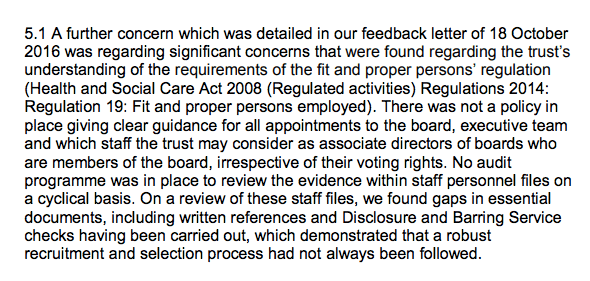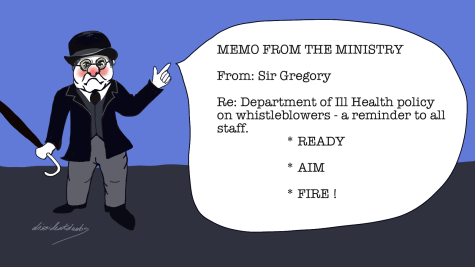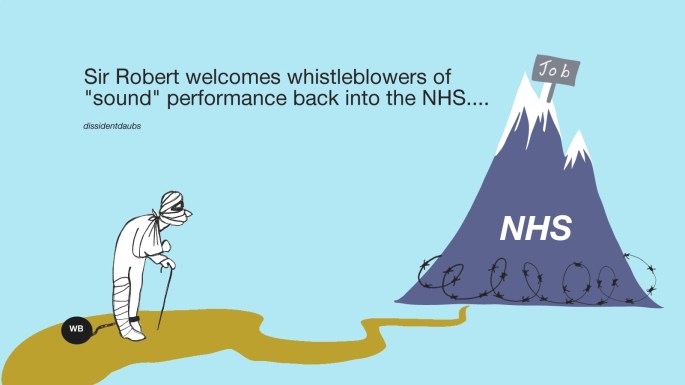
What’s up at Wirral? NHS Improvement’s investigation of executive whistleblowing at Wirral University Teaching Hospitals NHS Foundation Trust

By Dr Minh Alexander NHS whistleblower and former consultant psychiatrist 10 February 2018


Summary

NHS Improvement has commissioned an investigation into mishandled whistleblowing disclosures by directors at Wirral University Hospital NHS Foundation Trust.

The track record of regulators on such matters is described.

FOI data is provided on past NHS commissions undertaken by NHS Improvement’s chosen investigator for Wirral.


Introduction

It is three years tomorrow since Robert Francis published his report of the disappointing Freedom To Speak Up Review, and since Jeremy Hunt grandly promised ‘sweeping reforms to end cover up culture’. 

Yet reports and evidence of NHS bullying, spin and suppression continue. In October 2017 NHS England and the Department of Health were caught out trying to bully journalists when Pulse, a periodical for GPs, reported an explosive story that the government had considered piloting a ban on walk in presentations to A&E Departments. NHS England initially denied all and the Department of Health overbearingly demanded to know when Pulse would take its story down, and it also tweeted unpleasantries. Both retreated when Pulse published an audio recording of an NHS England official which proved the accuracy of their reportage.
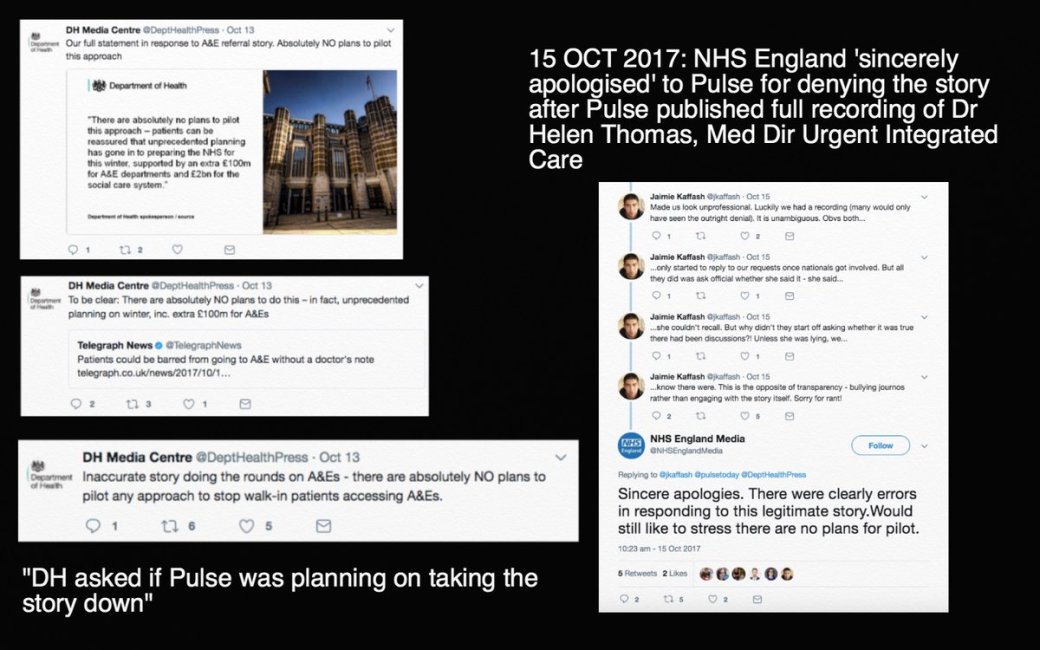
NHS England pilot ban on A&E walk ins

The regulator NHS Improvement announced in December 2017 that it was launching an investigation into whistleblowing allegations by four trust directors about the trust’s recently departed Chief Executive David Allison: NHS watchdog probes former Arrowe Park Hospital boss

NHS Improvement indicated on 12 January 2018 that this will be the scope of the investigation:

“The investigation will:

(i) investigate concerns raised by members of trust staff in late 2017 with NHS Improvement regarding cultural, behavioural and governance issues

(ii) review the trust’s handling of a recent disciplinary case involving allegations of sexual misconduct; and 

(iii) consider NHS Improvements’ response to the concerns raised with it per (i) above”

According to the Health Service Journal, there were a range of governance concerns had been raised with NHS Improvement, and a key issue was that Allison was allegedly appointed to the private health consultancy Draper and Dash without the knowledge of his trust board:

“Multiple sources confirmed Mr Allison was investigated by the chair after he was appointed to the board of digital informatics company Draper and Dash on 20 November without the knowledge of the trust’s executive team. Mr Allison arranged a meeting for trust executives with Draper and Dash managing director Orlando Agrippa. The meeting was arranged via an email from Mr Allison’s trust account but the meetings never took place due to concerns of staff.”

What HSJ did not report was that the outgoing Chief Executive of NHS Improvement, Jim Mackey had also been appointed as a non-executive director to Draper and Dash. According to Companies House, Mackey is listed as a Draper and Dash director from 1 October 2017.
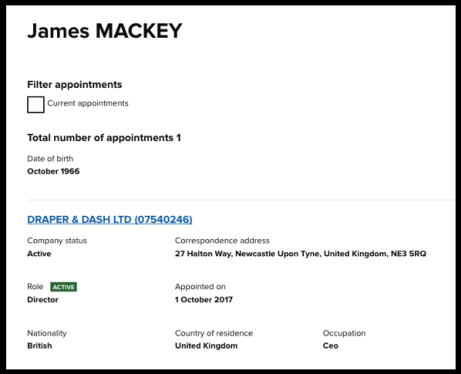
Jim Mackey Companies House

Screenshot taken from Companies House website 10 February 2018

Mackey returned to his old job as Chief Executive of Northumbria Healthcare NHS Foundation Trust in November 2017. The trust’s published register of interests notes that Mackey is a Draper and Dash NED:

Jim Mackey declaration of interests Draper and Dash

After readers debated Mackey’s appointment to Draper and Dash in the comments section of the HSJ article about Allison, HSJ tried to “focus people back on the issues at Wirral”, and indicated that the following statement had been provided by Mackey’s trust:
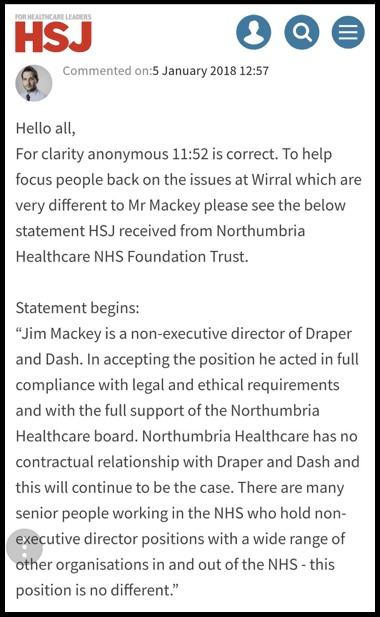
Shaun Lintern Draper and Dash focus away from Jim Mackey

But the question of course is that whilst the current rules permit this, is it right that a revolving door should exist and should it be shut? Should private businesses benefit from the market knowledge of current or recent senior NHS officials and regulators?

And how effectively will NHS Improvement address the issues at Wirral University Teaching Hospitals NHS Foundation Trust given that NHS Improvement’s just-departed CEO is a Draper and Dash NED?

Past regulatory approaches to allegations of misconduct by trust directors

There was much concern previously about NHS Improvement’s handling of a challenging 2016 Verita report on whistleblowing governance at the Royal Wolverhampton NHS Trust.

Verita concluded that a whistleblower “was not treated fairly by the trust” and it criticised David Loughton the controversial CEO of the trust.

Loughton had previously featured in the whistleblowing cases of Raj Mattu and Professor David Ferry.

Mattu’s extraordinary story was summarised by Private Eye: Raj Mattu and the Death of Whistleblowing

Professor David Ferry also suffered a long ordeal including a referral to the General Medical Council by the Royal Wolverhampton NHS Trust . As a marker of what he experienced, Ferry moved his family to the USA. He gave an interview to BBC File on Four last year about his harrowing story:

That night, when I went to my car, there was a sticker on my car that said, ‘Death to the bastard Geordie whistle-blower.”

After the 2016 Verita report resulted in intense media scrutiny, NHS Improvement appointed Deloitte to conduct a governance review on Loughton’s trust..

Deloitte’s review essentially consisted of asking trust directors some questions and reviewing documents. Explicitly, Deloitte did not seek to verify what it was told:

We have assumed that the information provided to us and management’s representations are complete, accurate and reliable; we have not independently audited, verified or confirmed their accuracy, completeness or reliability.”

Deloitte merely observed some issues about Loughton’s style and suggested that he ‘reflect’:

Recommendation 1: “The CEO should further reflect on his personal style and in particular the potential impact his strength of character and impulsive and honest style may have on internal and external stakeholders.”

A similar situation arose at Derbyshire Healthcare NHS Foundation Trust after a former trust director won an Employment Tribunal claim for sexual harrassment and discrimination.

In July 2015 Monitor, a predecessor body of NHS Improvement, announced that it would investigate the trust.

This proved to consist of trust- controlled exercises: a ‘governance review panel’ assessment and a review by Deloitte of ‘governance arrangements and HR related functions’, the reports of which were published amongst the trust’s board papers for March 2016.

The Deloitte review at Derbyshire Healthcare relied on the same methodology as at the Royal Wolverhampton. Trust managers were asked for their views, without verification:

We have assumed that the information provided to us and management’s representations are complete, accurate and reliable; we have not independently audited, verified or confirmed their accuracy, completeness or reliability. In particular, no detailed testing regarding the accuracy of any financial information has been performed.”

The Care Quality Commission has also been embroiled in controversy about its unwillingness to take action against poor directors under Regulation 5 Fit and Proper Persons. This was such that Robert Francis, a CQC NED, revisited managerial regulation in October 2016, after having rejected it in his report of the Freedom To Speak Up Review only 20 months previously: Robert Francis calls for regulation of senior managers.
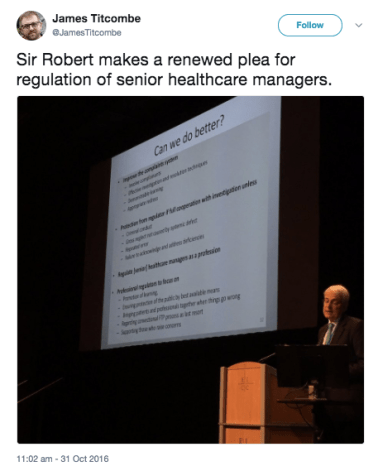
Titcombe Robert Francis managerial regulation

Rosie Cooper MP revealed, in a 2016 parliamentary debate about an investigation of Liverpool Community Health NHS Trust, more astonishing complicity by regulators in protecting and recycling poor managers who had suppressed whistleblowers.

A further review by Bill Kirkup  on Liverpool Community Health NHS Trust was published on 8 February 2018, which concluded that trust managers covered up and caused avoidable harm to patients from mismanagement:

“[incident] reporting was discouraged, investigation was poor, incidents were regularly downgraded in importance, and action planning for improvement was absent or invisible”

 “Serious incidents causing patient harm were not reported, not investigated and lessons not learned. The result was unnecessary harm to patients.”

Kirkup also criticised serious, recurrent failure by oversight bodies and regulators such as the NHS Trust Development Authority and CQC to step in quickly enough. Kirkup expressed much scepticism about inconsistent regulatory judgments:

“We found it impossible to understand how such different conclusions [by CQC] could be reached about the same service over such a short period.”

Kirkup added to the already serious criticisms of CQC’s handling of Regulation 5:

“The Department of Health should review the working of the Care Quality Commission fit and proper person’s test, to ensure that concerns over the capability and conduct of NHS executive and non-Executive Directors are definitively resolved and the outcome reflected in future appointments. Action: Department of Health.”

Arising from Kirkup’s review, Steven Barclay the new Minister of State for Health gave the following undertakings in parliament on 8 February 2018, which hint at some form of barring scheme:

“Secondly, one recommendation is specifically for the Department of Health and Social Care, as set out in paragraph 6.5 on page 64. This relates to a review of CQC’s fit and proper person test. I intend to discuss the terms of that review with the hon. Member for West Lancashire and will appoint someone to undertake that review within the coming days. I believe that review will need to address the operation and purpose of the fit and proper test, including but not limited to: where an individual moves to the NHS in another part of the United Kingdom; where they leave but subsequently provide healthcare services to the NHS from another healthcare role, such as with a charity or a healthcare company; where differing levels of professional regulation apply, such as a chief executive who is a clinician compared to one who is a non-clinician; where there is a failure to co-operate with a review of this nature and what the consequences of that should be; and reviewing the effectiveness of such investigations themselves when they are conducted. I will be pleased to hear the views of the hon. Member for West Lancashire, and those of the Health Committee, on these issues.”

This is a significant development as to date, the CQC has explicitly and repeatedly refused to operate FPPR as a disclosure and barring scheme.


NHS Improvement’s investigation of Wirral University Teaching Hospital NHS Foundation trust

NHS Improvement has announced that its investigation on Wirral University Teaching Hospital NHS Foundation trust will be carried out by Carole Taylor-Brown, whom it describes as:

“an experienced independent investigator with NHS experience, who has undertaken numerous investigations of this type, working alongside multiple agencies. Carole was previously the Chief Executive of NHS Suffolk and NHS Suffolk East PTC.”

Taylor-Brown undertook the investigation into whistleblower allegations about cancer waiting list fiddling and related bullying at Colchester Hospital University NHS Foundation Trust.

Her joint report with Prof Pat Troop was published by Colchester in December 2014. It concluded that there had been no fiddling or bullying:

There is no evidence to support that there was at any time, an instruction to junior staff (or others) to manipulate data or make inappropriate adjustments to cancer data” 

 “There is no case to answer for any individual….in respect of alleged bullying and harassment.”

A detail from this report is that the internal trust investigator who carried out an initial investigation into the fiddling concerns was a Mr Agrippa, whose LinkedIn details state that he was formerly Colchester’s Director of Business Informatics, and is now CEO of Draper and Dash.

Tamarix People Limited

Taylor-Brown states on her company website, Tamarix People Limited:

“My practice has two principal areas of focus: 

Coaching senior people and senior teams and, 

Mediation and Investigations involving senior people in the workplace

alongside which, I undertake some strategic commissions relating to organisational development and design.” 

Taylor-Brown additionally states:

I offer specialist, discreet, independent mediation and investigation services, principally for clients where the matter concerns senior people, inter-Board /organisational relationships or, where there are specific organisational/personal sensitivities. I also provide these services where regulatory intervention or oversight or other external stakeholder scrutiny is evident for the organisation concerned.”

Tamarix People Limited, Companies House No. 07450401, was incorporated in November 2010.

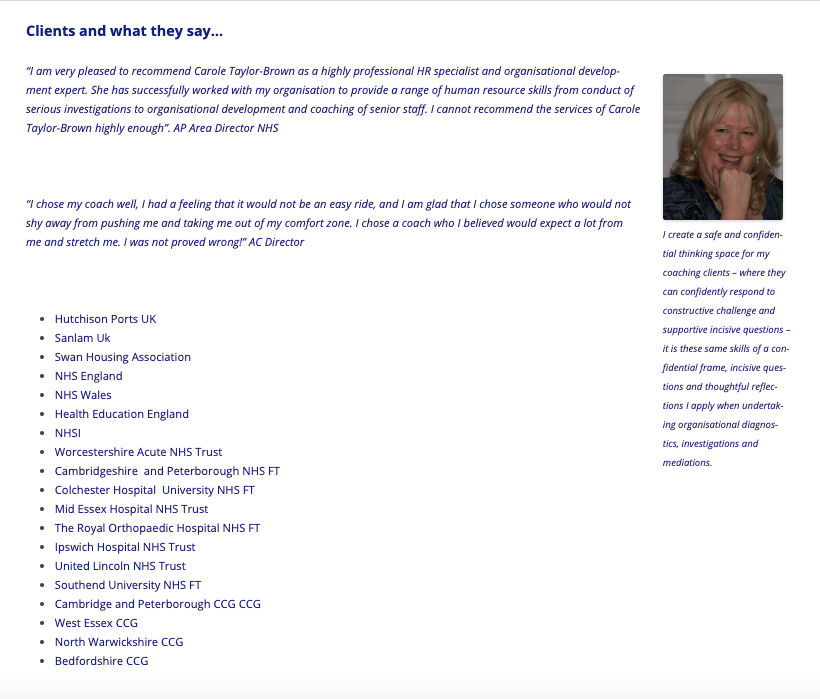
The company’s website gives details of some Taylor-Brown’s former clients, including NHS bodies.

The bodies listed as clients of Tamarix People Limited were asked for details of services they had purchased, and a list is given below.

To give an idea of the sums involved when the NHS buys in such services, the costs of these services are also listed. Relatively speaking, they are modest compared to the overall NHS consultancy bill.

This list of NHS bodies that have purchased Taylor-Brown’s services will be updated as more information becomes available:


Colchester Hospital University NHS Foundation Trust disclosed that it engaged Tamarix People Limited for the a total of £93,071.40 for her work on the cancer list whistleblowing investigation.

This is the investigation report: Report of the investigation into the Management Response to Staff Concerns Relating to the Validation of the Cancer Waiting List 2011/12 at Colchester Hospital University NHS Foundation Trust

Health Education England disclosed that it had paid Tamarix People Limited a total of £54,507 (£52,347 for ‘coaching’ services and £2,160 for mediation services).

Southend University Teaching Hospital disclosed that it had paid Tamarix People Limited a total of £7,920 (£2,640.00 for four ‘coaching’ sessions, £4,620.00 for two ‘coaching sessions and mediation support’ and £660 for one ‘coaching’ session).

Worcestershire Acute Hospitals NHS Trust disclosed that it had paid Tamarix People Limited £12,310.20 for “Investigation into an alleged conflict of interest during October 2016”.

The trust has provided the executive summary of the investigation report: Worcestershire Acute Hospitals NHS Trust Review of Alleged Potential Conflicts of Interest by Mr Stephen Lake and Mr Steven Pandey NHS Consultant General Surgeons

The Royal Orthopaedic Hospital NHS Foundation Trust disclosed that it paid Tamarix People Limited a total of £20,716.44 for “coaching sessions from June 2013 to Sept 2017”

West Essex CCG disclosed that it paid Tamarix People Limited £18,348.00 for “Coaching sessions and OD consultancy from 2014-2018”

Mid Essex Hospital Services NHS Trust spuriously refused to disclose the requested information on the following grounds:

We can confirm that Tamarix People is known to us – however in view of the fact that it is a one-person organisation, to answer your question would be a breach of both Section 20 of the FOI Act, Personal Data and Section 43 Commercial Confidentiality.’ 

Cambridgeshire and Peterborough NHS Foundation Trust also claimed that it could not disclose on grounds of commercial confidentiality.

United Lincolnshire Hospitals NHS Trust confirmed receipt of the FOI request but failed to respond and is now overdue.

Northern Warwickshire CCG was listed as a client by Taylor-Brown’s company website, but the CCG denied that it had ever purchased any services.

NHS Improvement itself has been asked for any history of past transactions with Carole Taylor-Brown’s companies.

The regulator has failed to respond within the statutory deadline and is now overdue.

UPDATE 11 February 2018: Whilst awaiting NHS Improvement’s response, I have learned of this document, which appears to be the report of an investigation on alleged bullying at Worcestershire Health and Care NHS Trust by Carole Taylor-Brown in 2015. The report states that this investigation was commissioned NHSTDA, one of NHS Improvement’s predecessor bodies.

This is the report of the NHSI report which was eventually published:

NHS Improvement’s external investigation of allegations about Wirral University Teaching Hospital NHS Foundation Trust 2018

UPDATE 9 FEBRUARY 2020

Upon reviewing the Tamarix People Ltd company website, I could not find the previous page which gave the list of past clients.

Here is a screenshot of the page that has apparently been removed:
Screenshot 2020-02-07 at 14.46.43

RELATED ITEMS

Postscripts on Paula. NHS England’s apologia & regulatory reticence

Arrowe Park Hospital says sorry for culture of bullying and harassment

Senior nurse at Arrowe Park Hospital investigated over alleged waiting times fiddle

Arrowe Park consultant sacked over sexual harassment claims as hospital troubles grow

Wirral University Teaching Hospital recruitment

After the Bawa-Garba judgment. Some responses from the Court of Appeal, CPS, Criminal Cases Review Commission and GMC.

Dr Minh Alexander NHS whistleblower and former consultant psychiatrist, 8 February 2018


Summary

Institutional responses to enquiries have raised questions about gaps in the criminal justice system’s governance of Diversity and the handling of Gross Negligence Manslaughter, and about the GMC’s handling of offending by registrants.


Introduction

The death of six year old Jack Adcock, a child with Down’s Syndrome, under the care of Leicester University Hospitals NHS Trust and the conviction and striking off of paediatrics trainee Dr Hadiza Bawa-Garba from the General Medical Council register are controversial.

Opposing camps of a medical profession afraid of being criminalised for errors made in good faith, and bereaved families who have endured NHS cover ups, have at times bitterly disputed the meaning of the case.

Ingrained system bias against people with mental illness and learning disability must be acknowledged.

There is persistent disparity of esteem in the funding for mental health. Disrespect by the government was evident following the Mazars Review into hundreds of un-investigated deaths. NHS England managed to airbrush the issues of discrimination against people with mental illness and learning disability.

Years after the Cornwall Learning Disabilities services scandal, Winterbourne View and the report on poor physical care of people with learning disability, Death by Indifference, little has changed.

The fight that bereaved families may face against bureaucracy that may be indifferent, incompetent or unfair can be prolonged.

And it should be acknowledged that one of government’s strategies is to avoid censure of culpable, but favoured, individuals by shifting blame entirely onto systemic factors. Robert Francis was criticised for failing to censure senior figures behind the Mid Staffs disaster.


A Return to the Killing Fields. Dr Phil Hammond. Private Eye 2013

“Knighthood for a whitewash?

One wonders what version of his report Robert Francis was reading at the press conference on 6 February. He looked like a man held hostage. The interminable delay in publication to allow for rewrites had reportedly been because those he was minded to criticise had launched vigorous legal defences. In the end he opted for a ridiculous “no scapegoats, blame the system” approach. This was endlessly debated after the Bristol Inquiry report in 2001, when a culture of “fair blame” was proposed. Ill thought-out, untested, rushed and brutally-enforced reforms undoubtedly contribute to NHS disasters, but individuals also have to be held accountable for their actions. Patients and staff trust a system that is just. But the judge delivered no justice.”


In Dr Bawa-Garba’s case, a concern has been that a junior doctor was sacrificed and there has been insufficient focus on systems issues, for which more senior figures were responsible.

I do not have a clear view on the merits of the Bawa-Garba conviction or erasure. I am not close enough to the case to properly venture opinion. I have seen no original documents nor the transcripts of the court hearings. I do not know if there are important details missing from the public record, which can often be the case.

But it is fair to ask questions.

Was it possible that Dr Bawa-Garba was more harshly treated because she was female and Black?

It is known that BME doctors suffer harsher discipline and that once referred to the GMC, they are more likely to face Fitness to Practice proceedings.

The GMC has in the past excused this as an artefact of referral patterns: employers are reportedly more likely to refer BME doctors, and the GMC in turn tends to sanction more severely doctors who are referred by employers:


Oral evidence by Prof Terence Stephenson Chair of the GMC to an accountability hearing by the parliamentary Health Committee 6 January 2015:

Of greater concern to me are BME doctors who were born, educated and went to medical school in this country and are UK graduates. Within our data they have about a 30% greater chance of having a sanction against them than white UK graduates. That is a subject of great concern. It is clearly not something simple for the following two reasons. One is that BME UK graduates born in this country also do worse in all undergraduate and postgraduate exams, not just medicine; in every university subject in the United Kingdom they do systematically worse. 

… If you are BME UK, or indeed IMG [international medical graduate], you are not more likely to be referred to the GMC by patients but you are more likely to be referred by employers. Again, we need to start understanding that. That affects the sanction, because doctors who are referred by employers are much more likely to get a severe sanction. There are good reasons for that, as well.”


It has been observed that female doctors are more law-abiding but more harshly treated by employers. This mirrors the behaviour of the criminal justice system, despite the effects on families and children when women are jailed.

Was Dr Bawa-Garba treated as fairly as a white male might have been? Such a comparator may exist. Graeme Catto a former President of the GMC gave a personal account of medical error with a fatal outcome with no sign of subsequent prosecution.

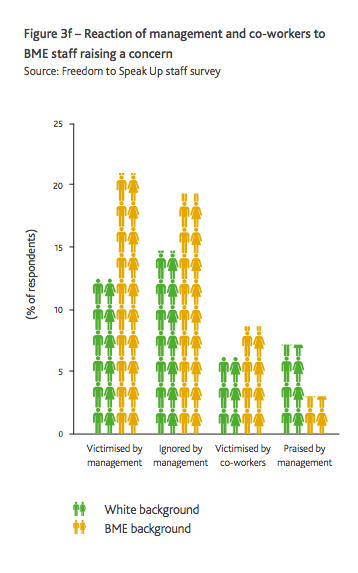
Should Dr Bawa-Garba have refused to cover for absent colleagues? Research by Middlesex University for the Freedom To Speak Up Review showed that BME NHS staff are more likely to be ignored and victimised when they raise concerns.

Francis BME page 66

Those who sit in judgment of BME defendants in Court and BME doctors in GMC proceedings are less likely to be from BME backgrounds. An update review by David Lammy MP demonstrates that disadvantage against BME people persists in the justice system.

There is also debate about the “suitability of a lay jury to determine complex matters of professional competence” and how juries might be directed as to what is ‘grossly negligent’:

The Justice Gap. Poor, bad and truly atrocious: Directing the jury on gross negligence manslaughter

Gross negligence manslaughter – an offence in flux

But policy swings to and fro. After the Shipman murders, a Health minister declaimed that it was necessary to:

“put an end to the idea that the GMC was a representative body for doctors.”

Some years later the GMC was forced to commission a review after criticism of suicides of doctors following GMC referral.

Charlie Massey the Chief Executive of the GMC has controversially claimed that he “had no choice” but to pursue Dr Bawa-Garba’s erasure from the register, because her conviction automatically committed the GMC to this course. There are differing views.


Is the system consistent and fair?

The Court of Appeal, Crown Prosecution Service and Criminal Cases Review commission were asked about their approach to Diversity and the handling of gross negligence manslaughter cases.


The Court of Appeal

The Court of Appeal found against Dr Bawa-Garba in December 2016 and refused her leave to appeal against the Gross Negligence Manslaughter conviction.

No Diversity statistics were evident on the work of the Court of Appeal so this data was requested. The Ministry of Justice initially refused disclosure on grounds of cost exemptions. It eventually admitted that no Equalities analysis had ever been carried out on the work of the Court of Appeal.


The Criminal Cases Review Commission

The Commission was established in 1995 and its job is to:

“investigate cases where people believe they have been wrongly convicted of a criminal offence or wrongly sentenced”

It has the power to refer cases back to the Court of Appeal.

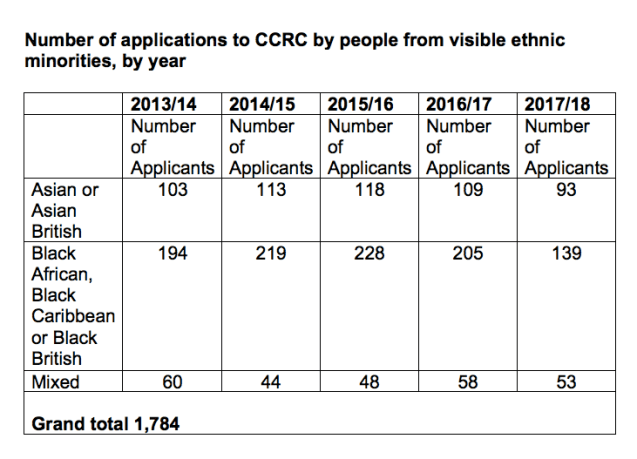
The CCRC dislcosed that it received a total of 7,406 applications between 1 April 2013 and January 2018

At least 1,784 applications were received from visible ethnic minority applicants.  This comprised 536 ‘Asian or Asian British’, 985 ‘Black African, Black Caribbean or Black British’ applicants and 263 ‘Mixed’ applicants.

Screen Shot 2018-02-08 at 21.58.29

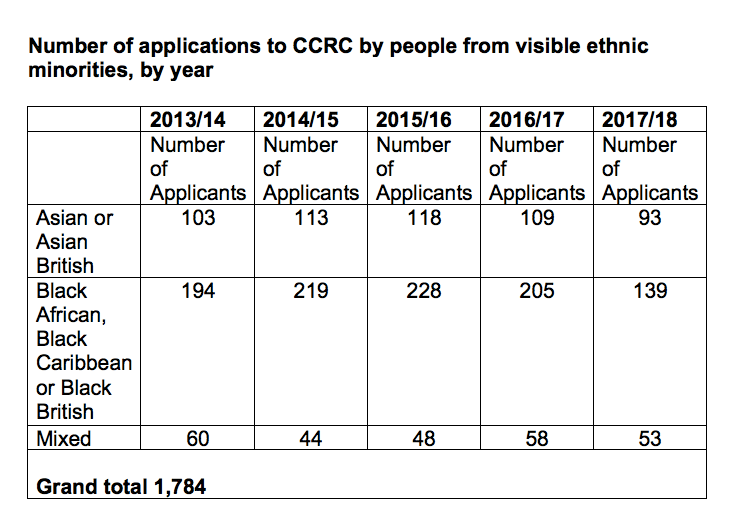
The CCRC disclosed that of a total of 7,406 applications received between 1 April 2013 and January 2018, at least 1,784 were received from visible ethnic minority applicants.

This comprised 536 ‘Asian or Asian British’, 985 ‘Black African, Black Caribbean or Black British’ applicants and 263 ‘Mixed’ applicants:

Screen Shot 2018-02-08 at 21.58.29
The CCRC also disclosed this internal report:

CCRC Applicant stats by ethnicity and other protected characteristics

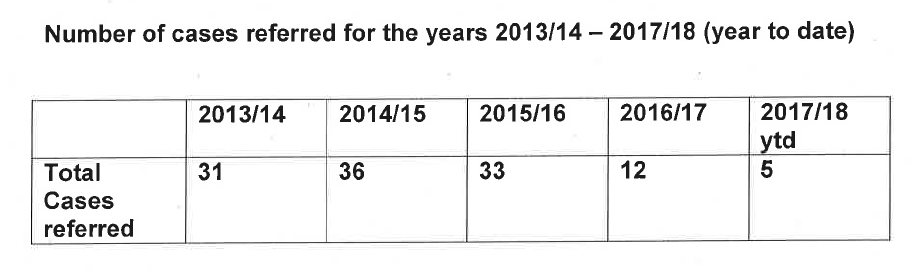
The CCRC advised that it has referred a total of 117 cases to appeal courts of between 1 April 2013 and January 2018:

CCRC number of cases referred by year

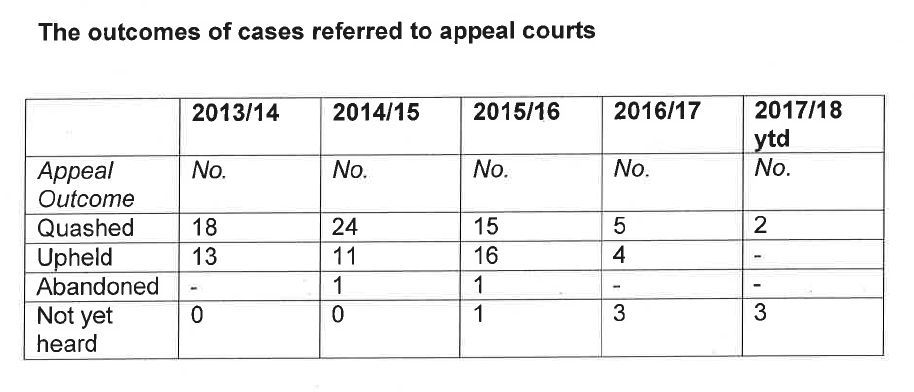
From these 117 cases that the CCRC referred to appeal courts for a fresh look, 64 previous decisions were subsequently quashed:

CCRC outcomes of referrals to appeals courts

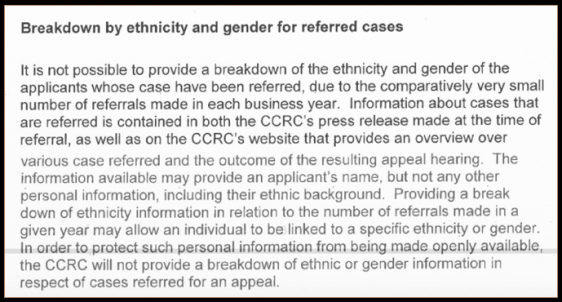
The CCRC said that numbers were too small to safely give a Diversity breakdown of outcomes by year:

CCRC small numbers ethnicity breakdown

A Diversity analysis for the whole period in question has been requested.


The Crown Prosecution Service

An analysis by the Sentencing Council on a sample of 156 manslaughter cases reveal that about 10% of manslaughter sentences relate to Gross Negligence Manslaughter.

This is summary data from the Sentencing Council on sentences for manslaughter in the years 2006 to 2016.

Gross Negligence Manslaughter is handled by a specialist unit of the CPS, the Special Crime and Counter Terrorism Division (SCCTD)

The CPS denied that it held any detailed internal guidance on prosecuting Gross Negligence Manslaughter, and later cited only brief guidance from its website.

The CPS advised that it could not give me a list of prosecutions against doctors for Gross Negligence Manslaughter due to cost exemptions, as a special search for the data would be needed.

Astonishingly, the CPS later claimed that not even the SCCTD had kept central records on cases of Gross Negligence Manslaughter:

“the Crown Prosecution can confirm the Special Crime and Counter Terrorism Division does not keep its own record of the data you have requested.”

CPS 18 January 2018

This purported lack of a central record raises questions about how the CPS is tracking its practice, and ensuring consistency of approach and thresholds for prosecution.

The British Association of Physicians of Indian Origin (BAPIO) has asked the police to consider a prosecution against Dr Bawa-Garba’s trust for corporate manslaughter.

Some may see this as a polite way of asking the criminal justice system to consider whether it effectively scapegoated Dr Bawa-Garba.


The General Medical Council

To my knowledge, there are no complete, published data on manslaughter prosecutions against doctors.

There have been periodic reviews of such cases, found by searching press archives and other records.

Ferner and MacDowell identified medical manslaughter cases between 1795 and 2005.

Doctors were most commonly charged with manslaughter as a result of mistakes (37/85 doctors), which are errors in the planning of an action. Ten of these doctors (27%) were convicted.”

They reported an upward trend in the number of prosecutions from the 1990s, but that the conviction rate had remained stable at around 30%.

Edwards reported on more recent cases,  including that of a urologist who was jailed for Gross Negligence Manslaughter but was later allowed to practice again by the GMC.

Edwards also reported on the case of Mr David Sellu, a surgeon who successfully appealed against his conviction for Gross Negligence Manslaughter. After all that, the GMC is currently pursuing him.

It would be reasonable to expect that the GMC holds good quality, central records on manslaughter cases, given the enormity of such cases.

However, when the GMC was asked to provide information on currently registered doctors who were convicted of a criminal offence in the previous four years, and to give a breakdown of the types of offences, it replied:

We do not hold the information you are seeking in questions 1 and 2 in a way which can be extracted electronically; this means that we would need to manually check though each case file.”

 GMC FOI response 10 January 2018 F17/9285/SW  

If this is correct, this raises questions about the GMC’s grip on offending by doctors, the oversight of its risk management of such cases and issues of consistency.


The future

In July 2016 the Secretary of State appointed Charlie Massey as GMC chief executive amidst concern from many doctors: ‘Doctors embroiled in another dispute over one of Jeremy Hunt’s aides’

Now, after an outcry from a profession not previously known for radicalism, the Secretary of State has announced a a review of Gross Negligence Manslaughter in the NHS.  This will, oddly, be led by surgeon Professor Sir Norman Williams, who has served on controversial government projects such as the Freedom To Speak Up Review on NHS whistleblowing.

GMC HQ protest 3.02.2018.png

Doctors demonstrating outside GMC HQ about the treatment of Dr Bawa-Garba on 3 February 2018


Hunt’s manslaughter review may just be another Department of Health and Social Care exercise in handling public opinion, when what is needed most is safe funding of the NHS.

The harsh punishment of honest error is hard to reconcile with the tenets of ‘just culture’, and the fear amongst doctors is understandable.

However, there has been no comparable protest about patient safety when whistleblowers are strung up. Senior doctors need to do much, much more to preserve professional freedoms and doctors’ rights to speak out without fear, as that is the other side of the coin in the Bawa-Garba case.


UPDATE 14 FEBRUARY 2018

There has been an exchange of correspondence between the parliamentary Health Committee and the GMC, which has now been published. The Committee has expressed particular interest in issues of ethnicity:

Health Committee correspondence with General Medical Council 5 February 2018 and response of 9 February 2018


UPDATE 10 MARCH 2018

The GMC has now disclosed via FOI that in the last five years it has not sought the erasure of one third of doctors (23 of 73) who were convicted of Sex Offences.

This contrasts poorly with its decision to seek Dr Bawa-Garba’s erasure because of errors which the MPTS found were not recklessly made.

The GMC has also admitted that it in fact has no specific policy on the handling of cases where doctors have been convicted of Gross Negligence Manslaughter. Despite the GMC chief executive Charlie Massey claiming that a conviction for Gross Negligence Manslaughter meant that GMC had no choice but to seek erasure, the GMC states in its latest response that each case must be “considered on its own merits”.

This adds further concerns about GMC arbitrariness and inconsistency.

I have shared this information with the parliamentary Health Committee:

Letter 10 March 2018 to Health Committee about GMC consistency


UPDATE 16 MARCH 2018

The Professional Standards Authority (PSA), which oversees the GMC, kindly shared the following internal documents on 19 February 2018:

Click to access psa-document-disclosed-to-hsj-1-180213-bawa-garba-dcr.pdf

Click to access psa-document-disclosed-to-hsj-2-180213-bawa-garba-recommendation-and-managers-final-decision.pdf

They were originally disclosed under FOIA to the Health Service Journal, which reported the PSA’s criticisms of the GMC’s actions.

The PSA documents show that in pursuing Dr Bawa-Garba’s erasure, the GMC actively chose to disregard a relevant, prior Supreme Court decision which held that:

“An appellate court must approach a challenge to the sanction imposed by a professional disciplinary committee with diffidence. In a case such as the present, the committee’s concern is for the damage already done or likely to be done to the reputation of the profession and it is best qualified to judge the measures required to address it.”

Click to access uksc-2014-0214-judgment.pdf

The PSA concluded that the GMC’s argument for pursuing Dr Bawa-Garba’s erasure was “without merit”.


UPDATE 15 APRIL 2018:

There has been a further exchange of correspondence with the Chair of the Health and Social Care Committee:

Another call to the Chair of the parliamentary Health and Social Care Committee to examine the government’s lack of progress on whistleblowing


RELATED ITEMS

Waste Industry. Abuses of the NHS disciplinary process.

BMA Says No to Whistleblowers

UK Whistleblowing Law is an Ass

Sir Robert Francis and Reform of UK Whistleblowing Law


Of arbitrariness and arbiters: The Freedom to Speak Up project three years on.

By Dr Minh Alexander NHS whistleblower and former consultant psychiatrist, 7 February 2018


Introduction

The National Guardian’s Office (NGO) costs the taxpayer £1 million a year, but what help does it give to whistleblowers in difficulties?

The National Guardian rightfully exposed CQC failure to treat whistleblowers fairly at Southport and Ormskirk Hospital NHS Trust.

The CQC accepted as satisfactory a fundamentally flawed FPPR investigation report, produced without anyone speaking to the whistleblowers in question. It would have been risky for the National Guardian not to acknowledge this serious CQC failure, as the evidence of the failure lies in a ticking time bomb of a report that the trust has not yet published but will no doubt surface eventually. Nevertheless, it was the right thing to do and this should be acknowledged.

But what else has the NGO done? Events to date suggest that the NGO makes up its own rules, which fail whistleblowers.

Has Robert Francis has stayed true to his original recommendations in the Freedom To Speak Up Review report or is he supporting a watered down interpretation of his recommendations?

Lloyd Armstrong is an NHS whistleblower who was sacked in the summer of 2017 after he made public interest disclosures about patient safety and poor governance at troubled North Essex Partnership NHS Foundation Trust.

This was after unsuccessfully seeking help from the National Freedom To Speak Up Guardian in January 2017, four months after she took up post.

Armstrong approached the National Guardian for help after his local trust Speak Up Guardian refused to intervene and advised him that the HR process had to be completed before she would examine any concerns about unfairness:

“You have been suspended from work since June and so this process must be followed through and brought to an end. As the hearing is so imminent I do not want to give you false hope that the disciplinary process will be halted. As I have said to you at [sic] the telephone, at this late stage my feeling is that the Guardian Service will proceed to look at the process if you feel you have been unfairly treated once it has ended.”

Email from North Essex Partnership University NHS Foundation Trust Speak Up Guardian 14 January 2017

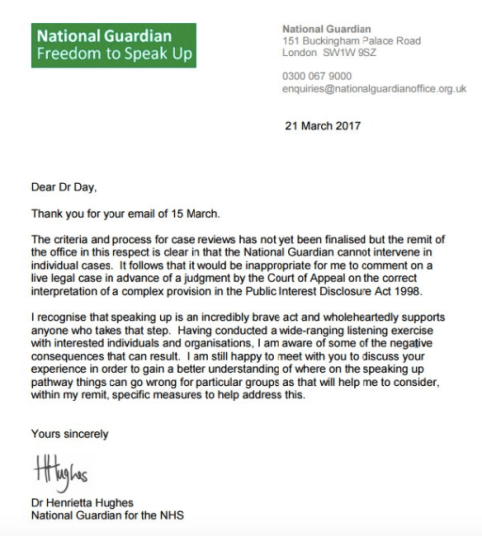
Even though Armstrong was facing dismissal, the National Guardian advised that she could not take his case on because she had not yet established her procedures for handling cases.

Armstrong asked the National Guardian to invite his employer to temporarily pause proceedings against him, to allow her time to decide whether she wanted to take his case on. She refused to do so and Armstrong was subsequently sacked.


What are the National Guardians rules of procedure?

There has been much controversy about the National Guardian’s interpretation of the office’s role and responsibilities.

The 2016 CQC report on the outcome of a public consultation about the Office revealed that contributors believed that the National Guardian should protect whistleblowers from reprisal.

The CQC twisted and turned but its CEO David Behan eventually conceded that the National Guardian should challenge detriment:

Screen Shot 2018-02-07 at 04.59.26`Letter from David Behan 20 April 2017
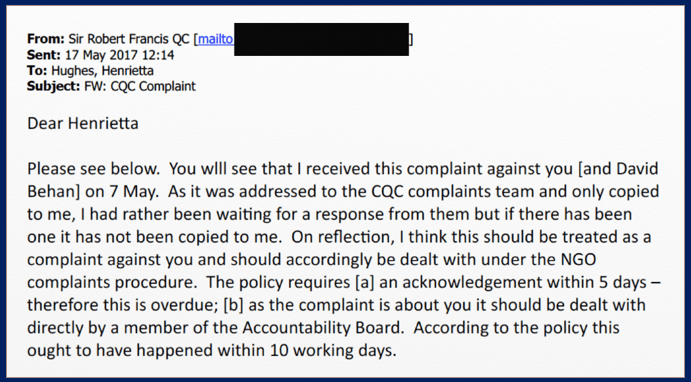
 

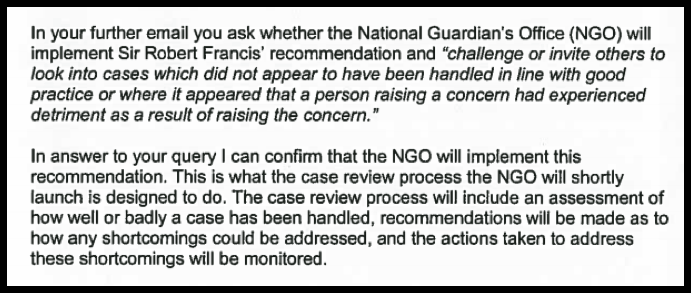
However, the National Guardian later stated in case review guidance, published June 2017, that she sees the role as one of helping employers:

Therefore, the purpose of a case review will be primarily to support NHS trusts to identify how they can improve their own processes and support for staff when raising concerns by reviewing how NHS trusts responded to such concerns.”

This represents very significant drift from the original purpose of the Office as set out in Robert Francis’ report of the Freedom To Speak Up Review.

Francis originally proposed the establishment of the Office to primarily help whistleblowers who had nowhere else to go:

The deficiencies in the way concerns are investigated, and subsequent victimisation of individuals have been addressed in 6.4 and 7.5 respectively. What seems to be missing is any sort of external review mechanism, not to take over investigation of the concerns, but to provide a non-legalistic option to review what has been done locally, and make recommendations for further action as appropriate”

Report of the Freedom To Speak Up Review February 2015


Francis recommended that the Office should help ensure redress for patients and whistleblowers who are harmed as a result of whistleblowing governance failures. 1

Francis originally felt strongly enough to advise that the National Guardian should seek a direction from regulators if needed, to ensure such redress. 1

Moreover, the National Guardian has stated in current case review guidance:

Therefore cases should only be considered for possible review where there is clear evidence received in the referral that the NHS body has already responded to a concern and has failed to do so appropriately.”

This does not help whistleblowers where employers simply refuse to respond.

Moreover, the National Guardian’s guidance states that cases will be reviewed:

Where it is practicable for the NGO to review the case in question”

 ‘Practicable’ has the look of another escape clause.

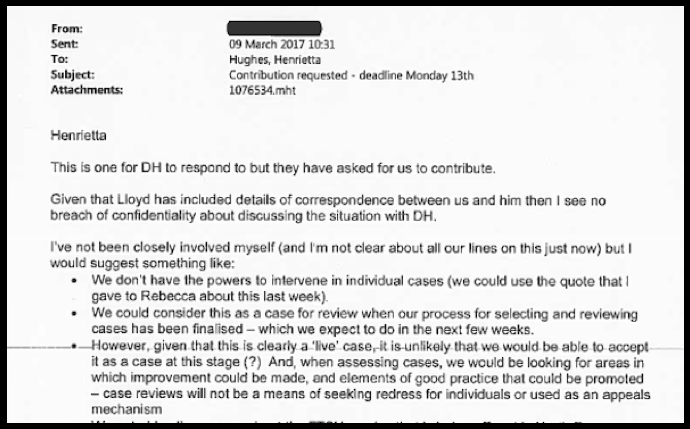
Data obtained via Subject Access Request revealed that the National Guardian’s Office may baulk at cases which are subject to ongoing processes:


Screen Shot 2018-02-07 at 05.07.36

This internal correspondence by the NGO also stated:

 “case reviews will not be a means of seeking redress for individuals”

which contradicts Robert Francis’ original aims for the Office and his explicit view that the Office should have a key role in facilitating redress for harmed whistleblowers.


I asked the National Guardian to clarify what ‘live’ cases were:

Letter to National Guardian 7 May 2017

I have been provided with information which suggests that your office will not accept referrals on ‘live’ cases.

Should I understand from this that your office intends to wait until say, employers’ disciplinary processes against whistleblowers have concluded and have potentially resulted in disciplinary action and dismissal, before the office will consider reviewing the whistleblower cases in question?”

 The reply from the NGO on 17 May 2017 confirmed the intention to exclude cases with ongoing processes

“ …we will initially select cases for review where there are no outstanding decisions to be made. As the trial period progresses, we will review this approach and explore whether we can effectively open up the parameters within which we will be able to accept cases for review.”

I raised concerns about this and asked if ‘outstanding decisions’ included decisions by Employment Tribunals. I have no record of any response by the National Guardian and have sought further clarification. Clearly though, if the National Guardian sits on her hands whilst Employment Tribunals proceed over many months and sometimes years, irreparable damage will be done to whistleblowers.

Neither has the National Guardian responded yet to a question about the clause in her case review guidance which says that she will not touch cases until employers have responded to whistleblowers, which therefore implies there can be impunity for employers who simply ignore whistleblowers.


What is Robert Francis’ position on the National Guardian’s role?

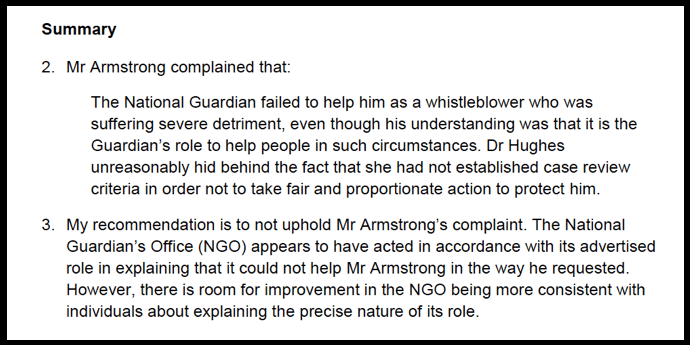
Armstrong complained about the National Guardian’s Office and the decision not to help him. It was investigated by NHS Improvement who found in the NGO’s favour, with the conclusion:

Screen Shot 2018-02-07 at 05.10.11

A fundamental flaw in this complaint response by NHS Improvement is that it judged the fairness and proportionality of the NGO’s actions according to its ‘advertised role’.

This is because Armstrong’s complaint was founded on a concern that the National Guardian had taken an erroneous position and wrongly interpreted her remit. Her ‘advertised role’ had been questioned as part of the complaint, but this was sidestepped by NHS Improvement.

This is to be expected though, as the governance arrangements for the National Guardian’s Office are flimsy and introduce conflicts of interest. The National Guardian is expected to hold all to account, but complaints about the National Guardian are investigated by one of the bodies that she purportedly holds to account, NHS Improvement.

Nevertheless, it was significant that NHS Improvement conceded:

“there is room for improvement in the NGO being more consistent with individuals about explaining the precise nature of its role”.

Robert Francis adjudicates on complaints about the National Guardian, in his role as Chair of the National Guardian’s Liaison and Accountability Board. NHS Improvement’s complaint investigation reports are sent to him for a final decision.

Worryingly, in Armstrong’s case, Francis took the National Guardian’s and NHS Improvement’s view. He concluded that the NGO had no remit for intervening:

“I have considered his report [the NHS Improvement complaint investigation report] carefully and have decided to accept his recommendation that your complaint not be upheld…I do agree that it is not part of the National Guardian’s role to intervene in individual disciplinary processes’

Letter by Robert Francis to Lloyd Armstrong of 4 August 2017

However, Francis concurred with NHS Improvement that the NGO should set out more clearly the range of recommendations that it might make after undertaking a case review:

“I also agree with Mr Grimes’ view that it is desirable that the National Guardian’s Office clarifies what type of recommendations it considers it can make following a case review under the new review process it is in the course of setting up”

Letter by Robert Francis to Lloyd Armstrong of 4 August 2017

Disclosed correspondence also showed that Francis commented on non-adherence to the National Guardian’s complaint procedure:

Screen Shot 2018-02-07 at 05.12.13

There appears to be no evidence that the NGO has acted upon NHS Improvement’s and Francis’ recommendation that it should clarify what type of recommendations might be made following a case review.

The NGO’s original case review guidance from June 2017 remains online with no sign of a later revision. Neither do the NGO’s supplementary guidance for referrers and FAQs provide the clarification that NHS Improvement and Francis thought it should produce. Only broad reference is made to the original Freedom To Speak Up Review report proposals.

Furthermore, on 1 February 2018 the National Guardian published a case review report which revealed that her Office looked at whistleblower cases at Northern Lincolnshire and Goole NHS Foundation Trust despite internal processes not having concluded in these cases.

This report indicates that the NGO intervened and asked questions about an internal disciplinary process in the case of a whistleblower who was subjected to counter-allegations and investigation after whistleblowing, despite the Office’s previous advice to Armstrong that it could not intervene.

Even so, in the case of the Northern Lincolnshire and Goole NHS Foundation Trust whistleblower who was subjected to investigation after whistleblowing, the NGO appeared to accept the trust’s assurance that its internal investigation into the counter-allegations:

had looked for evidence of any malicious motive, but had not found any.

The National Guardian gave no evidence in this report that this claim by the trust was independently weighed by her office.

Neither is there any indication of potential redress for the whistleblower for any detriments suffered.

More generally, there is also a dearth of evidence about how the National Guardian conducts her business. Strangely, her first annual report was silent on how many referrals she had received for case review, and how many of these she had accepted.

The National Guardian has so far attended and held numerous conferences and other high profile events, but has announced only three cases reviews since June 2017 – on Southport and Ormskirk Hospital NHS Trust, Northern Lincolnshire and Goole NHS Foundation Trust and Derbyshire Community Health Services NHS Foundation Trust.

There was also no evidence in her annual report that she has collected satisfaction data from whistleblowers who have contacted her Office. This is despite the fact that she expects local Speak Up Guardians to collect such data.

Armstrong has now lodged a further complaint about the apparent inconsistencies in the NGO’s approach to whistleblowers.

He has formally submitted questions to the National Guardian’s Office on its case review activity.

He has also asked Robert Francis to explain his position more clearly:

“I would be very grateful if you could clarify to me what was in your mind when you made your original recommendation in the report of the Freedom To Speak Up Review that the National Guardian should help ensure redress for harmed whistleblowers, including through a direction by a regulator if necessary.

 Please could you give some practical indications of the sort of cases and scenarios that would in your view qualify for such help from the National Guardian.”

Letter by Armstrong to Robert Francis of 4 February 2018


As more evidence of the National Guardian’s Office’s inefficacy mounts, both in terms of design and execution, will Francis rethink his Freedom To Speak Up Review recommendations?

In lawyerly fashion, he left himself some escape clauses. In February 2015 he rejected the proposal of a properly constituted Office with legal powers to protect whistleblowers. But he did leave the door slightly ajar:

While I do not see the need to go as far as this, certainly at this stage, I do see a need for some form of external review mechanism.”

 Page 168, report of the Freedom To Speak Up Review

What is finally needed to push that door open? More avoidable deaths at scale? It should not take such tragedy to usher in proper reforms.

But whilst they wait for that door to open, whistleblowers would be very glad to hear from the National Guardian exactly what she is doing for them and for patient safety.

That is of course, assuming she knows.


RELATED ITEMS

UK whistleblowing law is an ass. Helen Rochester v Ingham House Ltd and the complicit CQC

Sir Robert Francis and reform of whistleblowing law


NOTES

1 Page 168 of Robert Francis’ report of the Freedom to Speak Up Review:


7.6.12

The INO [National Guardian] should be authorised by these bodies to use his/her discretion to:

  • review the handling of concerns raised by NHS workers where there is cause for concern in order to identify failures to follow good practice, in particular failing to address dangers to patient safety and to the integrity of the NHS, or causing injustice to staff


  • to advise the relevant NHS organisation, where any failure to follow good practice has been found, to take appropriate and proportionate action, or to recommend to the relevant systems regulator or oversight body that it make a direction requiring such action.

 This may include:

– addressing any remaining risk to the safety of patients or staff 

– offering redress to any patients or staff harmed by any failure to address the safety risk

– correction of any failure to investigate the concerns adequately”

http://webarchive.nationalarchives.gov.uk/20150218150953/https://freedomtospeakup.org.uk/wp-content/uploads/2014/07/F2SU_web.pdf


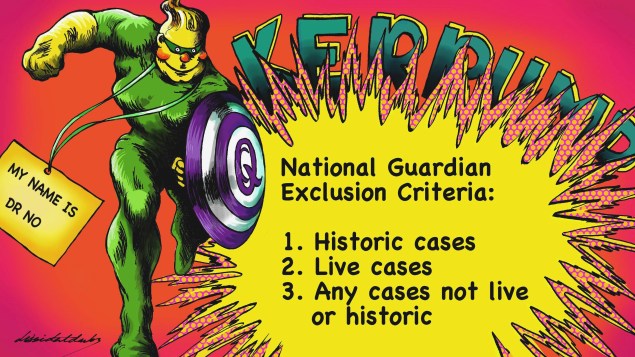
DR NO (1)

The National Freedom To Speak Up Guardian’s Social Media Policy

By Dr Minh Alexander, NHS whistleblower and former consultant psychiatrist, 31 January 2018


Jeremy Hunt’s and Robert Francis’ love child, the National Guardian’s Office, has been beset by PR disasters.

The first National Guardian Eileen Sills, was appointed in January 2016 but had resigned by March 2016 before she had taken up post.


Screen Shot 2018-01-31 at 05.58.24


When asked about her opinion on UK whistleblowing law, the Public Interest Disclosure Act (PIDA), Sills revealed the decorative nature of the Office by replying that it was too soon to tell.

Although clearly unbeknown to Sills, PIDA had in fact been in place for almost twenty years.

The Department of Health and Social Care has been keen to spin that Sills’ replacement, Henrietta Hughes, is a front line GP.  Thus conveniently overlooking that Hughes was an NHS England Medical Director in the London area.

There was a testy exchange about this in parliament, between the excellent Philippa Whitford MP and the then Under Secretary of State for Health Ben Gummer during the debate on badly mishandled whistleblowing at Liverpool Community Health NHS Trust.

An NHS England Medical Director is not a natural choice for a confidante and defender of the front line.

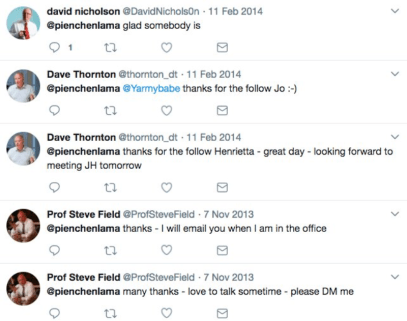
Of great concern regarding transparency and tone, Henrietta Hughes’ twitter account from her previous existence, under the handle @pienchenlama, was deleted around the time that she was appointed as National Freedom To Speak Up Guardian.

All those smiling group selfies and chatty, friendly encounters with fellow senior NHS managers such as David Nicholson the former CEO of the NHS were scrubbed.


Fragments and shadows remain of what was:

Screen Shot 2018-01-31 at 03.49.26


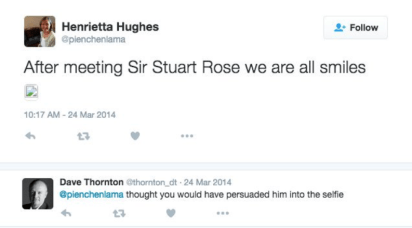
Smiles and selfies had been a theme:

Screen Shot 2018-01-31 at 03.51.43


Indeed, we know that the National Guardian is so keen on smiles that she made it compulsory in her previous role. The specifications were precise:


Screen Shot 2018-01-31 at 06.35.52


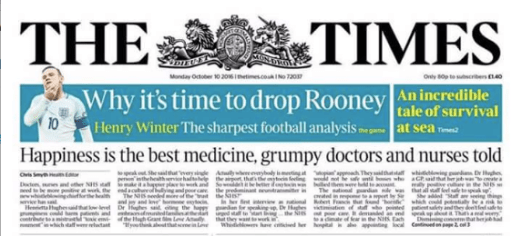
Hughes even gave a press interview about the importance of smiling when she took up post, resulting in some derisive press headlines and workforce responses.

front-page


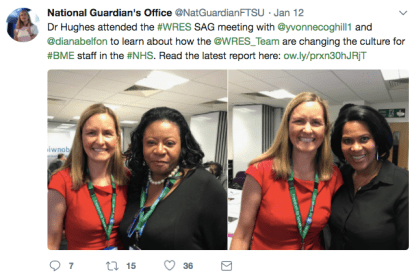
After over a year in post, the National Guardian finally returned to twitter via an official account, which started tweeting earlier this month.

Lots of smiles and selfies. And mutually reinforcing claims of culture change, which to many is not apparent:

Screen Shot 2018-01-31 at 03.57.44


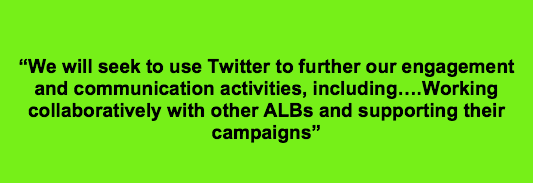
We have already seen the painfully mechanical WRES Communications Strategy, its remarkable cache of stock tweets aimed at pumping out Good News.

What of the National Guardian’s own social media policy? An enquiry has resulted in this disclosure:

National Guardian Social Media Handbook


Ironically, this policy acknowledges that deleting tweets is not transparent:

Screen Shot 2018-01-31 at 04.06.27


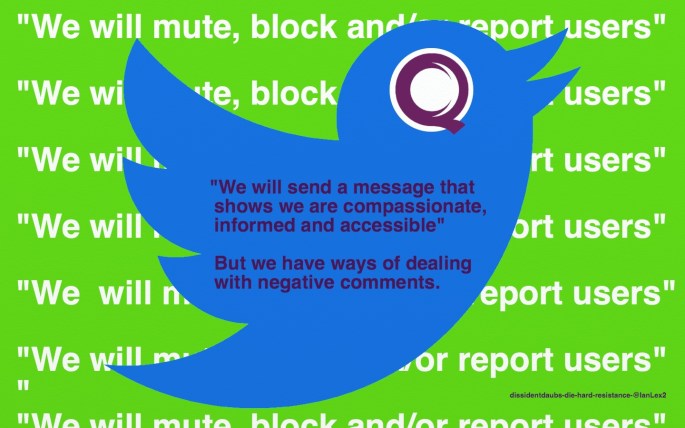
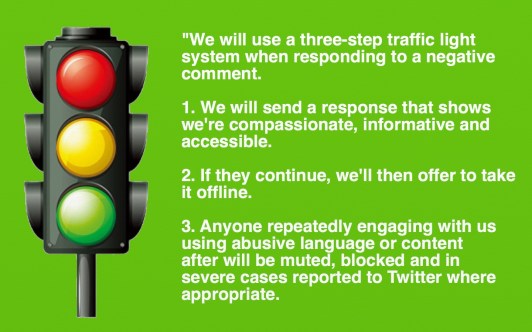
And how does the National Guardian intend that her team should deal with dissent?


Traffic lights:

National Guardian traffic lights negative comments


There is little reflection implied by these few lines. It is implied that ‘negative’ comments are de facto wrong, unjustified and undesirable.

It seems literally unthinkable to the National Guardian and her staff that the Office itself might need to take criticism on board.

An ironic state of a affairs for an entity whose raison d’être is to ensure that the workforce will be heard when it raises concerns.

Instead of genuinely championing the value and energy of dissent, the Office at its heart simply has tired old NHS managerial inclinations to stifle and suppress.

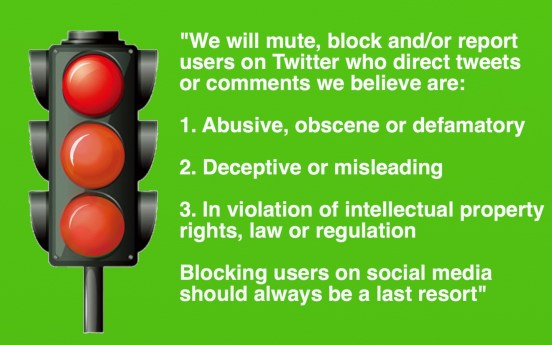
What will incur sufficient ire to warrant a twitter block by the National Guardian’s office? Quite a lot it seems:

National Guardian twitter blocking reasons


Well, that might spare the National Guardian and her staff the inconvenience of unsmiling whistleblowers who continue to be harmed, traduced and starved out by her masters.

But it won’t do much to achieve the Office’s social media policy aim of:

“Furthering the conversation about speaking up” 

 As for her Office’s purported independence, her social media policy shows that she intends to stay on message and with the crowd:

Screen Shot 2018-01-31 at 06.43.17

And patients, where do patients feature in the National Guardian’s grand scheme?

A search of the National Guardian’s handbook gives this result:

Screen Shot 2018-01-31 at 06.17.51


Got the message?

Get with the programme.


UPDATE 1 FEBRUARY 2018

Letter 1 February 2018 to Gavin Rogers the National Guardian’s Comms Manager cc National Guardian and Robert Francis


RELATED ITEMS

Letter of 11 September 2017 to Public Accounts Committee requesing a review of whistleblowing

National Guardian Expects


By day Henrietta, by night Lanyard Woman


Safe in their hands? Government’s response to coroners’ warnings about the NHS

By Dr Minh Alexander, NHS whistleblower and former consultant psychiatrist

In August 2017 I reported on four years of data published on the Chief Coroner’s website, which revealed that over 1700 coroners’ reports on action to prevent future deaths had been issued between July 2013 and July 2017, 57% of which related to NHS organisations.

Worryingly, there were no published responses from the parties who had been sent coroners’ warning reports in 62% of these cases.

I made some further enquiries, focussing on the Chief Coroner’s office and central NHS bodies, from the Department of Health and Social Care downwards. This has uncovered further anomalies and concerns.

My full update findings, with all supporting responses from the Chief Coroner Department of Health and Social Care and arms length bodies and disclosed documents, are reported here

This is the summary of the update report:

“Summary

How diligently does the government protect the public from risks?

This is a follow up paper about the system response to coroners’ Section 28 warning reports on Action to Prevent Future Deaths, and how the NHS in particular responds risks to public safety.

The overall picture at the top of the NHS is one of defensiveness, half-answered questions and some conflicting accounts from different bodies, or even from the same body. It is very unclear to what extent the audit cycle is safely closed after coroners raise a concern.

If that is the example set at the top, this raises concerns about governance through the system.

Since 2013, coroners in England and Wales have been under a duty to issue a Section 28 report on action to prevent future deaths (also known as PFD reports) if they find risk factors that pose a threat to life.

Parties who receive a Section 28 report must provide a written response within 56 days.

By law, Coroners are required to send their report and any responses to the Chief Coroner.

Coroners and Justice Act 2009

“Schedule 5 Powers of Coroners  

Action to prevent other deaths 7 (1) Where— (a) a senior coroner has been conducting an investigation under this Part into a person’s death, (b) anything revealed by the investigation gives rise to a concern that circumstances creating a risk of other deaths will occur, or will continue to exist, in the future, and (c) in the coroner’s opinion, action should be taken to prevent the occurrence or continuation of such circumstances, or to eliminate or reduce the risk of death created by such circumstances, the coroner must report the matter to a person who the coroner believes may have power to take such action. (2) A person to whom a senior coroner makes a report under this paragraph must give the senior coroner a written response to it. (3) A copy of a report under this paragraph, and of the response to it, must be sent to the Chief Coroner.”

http://www.legislation.gov.uk/ukpga/2009/25/pdfs/ukpga_20090025_en.pdf

The Chief Coroner has discretion to publish the reports and corresponding responses, or not:

The Coroners (Investigations) Regulations 2013

 “PART

28. (5) On receipt of a report the Chief Coroner may—

(a)publish a copy of the report, or a summary of it, in such manner as the Chief Coroner thinks fit; and

(b)send a copy of the report to any person who the Chief Coroner believes may find it useful or of interest.”

http://www.legislation.gov.uk/uksi/2013/1629/part/7/made


The Chief Coroner has advised in his 2016/17 annual report that in 2016, 46% (241,211 of 524, 723) of registered deaths were referred to coroners. 40,504 of these cases that were reported to coroners were deemed to need investigation and inquest.

Section 28 reports are exceptionally issued and represent very significant concern by coroners. The Chief Coroner advised that between June 2016 and July 2017, 375 Section 28 reports were issued. My enquiries and other data have shown that whilst an NHS trust may have hundreds of inquests, they may typically be issued only a handful of Section 28 reports.

The coronial system relies on reporting but is hampered by failures of reporting. This context increases the significance of Section 28 reports.

Earlier this year, I analysed four years of data published by the Chief Coroner and found that there were no published responses to 62% of the Section 28 reports on the Chief Coroner’s website.

Four years of published coroners’ Section 28 reports in England and Wales, 24 August 2017

In some cases, this has since proved to be because respondents had failed to comply with Section 28 notices. For example, the government failed to respond to a coroner’s 2015, pre-Grenfell warning about the need for sprinklers in housing stock, especially for vulnerable residents. It only replied to the coroner in December 2017, after an enquiry about its missing response:

https://www.judiciary.gov.uk/publications/emma-waring/

https://minhalexander.com/wp-content/uploads/2018/01/171214-dclg-response-to-coroner-waring175602.pdf

My search of the Chief Coroner’s website was laborious as the website has minimal search capability, and Section 28 data has to be manually sifted.

I also found no published evidence of corresponding central analysis by the NHS of Section 28, from the Department of Health and Social Care downwards.

Subsequent enquiries to the Chief Coroner’s office and the Department of Health and Social Care and other central NHS bodies revealed some conflicting statements about whether responses to Section 28 reports had been withheld from publication by the Chief Coroner.

CQC claimed that it had asked for some its responses to Section 28 reports to be withheld from publication by the Chief Coroner. The Chief Coroner advised that his office had not received any such requests. In the face of this information from the Chief Coroner, the CQC indicated that it did not contest the Chief Coroner’s account of events.

There also appeared to be variance between some coroners and the Chief Coroner’s office. The Chief Coroner advised that he published all or most of the material received from coroners.

A sample of 21 coroners reported that they had submitted all Section 28 reports and related responses to the Chief Coroner. However, the Chief Coroner’s website showed a total of 342 Section 28 reports from these 21 coroners over a four year period, for which there were published responses in only 128 (37%) cases.

Similarly, information from some test enquiries to trusts also suggested not all Section 28 reports that are issued to trusts reach the Chief Coroner’s website. The Chief Coroner was alerted to this.

Nonetheless, the Chief Coroner has now committed in principle to full publication of all Section 28 reports and related responses.

There is no apparent system for ensuring compliance by coroners and the Chief Coroner has stated that he merely encourages coroners to write and submit reports when appropriate.

With regards to government learning from the Section 28 data, there appears to have been a change of policy in that the Chief Coroner’s office stopped producing regular trends analysis of Section 28 reports after September 2013. The office also advised that it was not sufficiently resourced to make improvements to its public facing database, to give the public greater access.

With regards to the NHS, there was limited evidence of systematic analysis and learning, with only relatively recent attempts to track and analyse trends shown by Section 28 reports. Moreover, the learning from thematic analyses has not been shared with service providers or the public.

There was reluctance by CQC to disclose analyses that it had undertaken, with initial claims that these were exempt from disclosure that were eventually waived.

The Department of Health and Social Care (DHSC) showed the greatest resistance to learning. It essentially claimed that analyses of Section 28 data were not worthwhile because the data is insufficiently standardised. This is difficult to square with its arms length bodies’ differing approaches and commitment to better future analysis of this data. Indeed, NHS England considered coroners’ Section 28 reports to be a ‘reliable’ source of data.

There was also no evidence that the arms length bodies are working together to reliably share information on Section 28 reports. NHS Improvement advised that it relies on trusts to notify it of Section 28 reports, when it could in fact make use of routine notifications by coroners to the CQC.

The DHSC, NHS England, the CQC and NHS Improvement all refused to disclose copies of their responses to particularly significant Section 28 reports that had been missing from the Chief Coroner’s website. NHS England, CQC and NHS Improvement relied on a past ICO decision that responses to coroners’ Section 28 reports are court documents and exempt under Section 32 FOIA. This is despite the fact that the ICO has confirmed to me that there is nothing to stop these bodies from voluntarily disclosing their responses to coroners if they chose to do so:

An organisation can choose to proactively publish information even if that information is exempt from disclosure under the Freedom of Information Act, or if the organisation is not subject to the Act.” 

ICO Group Manager of FOI Appeals and Complaints Department 6 December 2017

The DHSC tried to washed its hands of responsibility by claiming that it was the Chief Coroner’s responsibility to publish the documents, and stated that FOI exemptions would likely apply in any case.

This concerted opacity is a failure of leadership and accountability. It leaves major questions about under-resourcing of the NHS and systemic governance flaws unanswered. For example, whether national failings in managing ligature point risk have been addressed.

That said, although the CQC and NHS England refused to disclose key missing responses to some key Section 28 reports, some of the missing responses have now quietly appeared on the Chief Coroner’s website.

For example, the CQC’s previously missing 2014 response to a 2013 Section 29 report about national guidelines on night time staffing levels, which shows that CQC side-stepped the issue of committing to firm standards.

Another previously withheld but recently published CQC response to a high profile  avoidable death at the private facility the London Bridge Hospital, rated ‘Outstanding’ by the CQC, reveals that the hospital initially informed the CQC that the death was ‘expected’.

Overall, there needs to be a more proactive, joined up and transparent system response to coroners’ Section 28 reports.

The government should ensure that all Section 28 reports and responses are published, and the NHS should adopt a policy of open reporting on Section 28 reports, responses and related analyses, subject to redaction of third party personal data where required.

The NHS should not be hiding behind FOI exemption, especially when the Chief Coroner has agreed that all Section 28 reports and responses should be published.

The Chief Coroner’s office should also be adequately resourced so that it can once again report on a regular basis on national trends in Section 28 reports and maintain a database with sufficient functionality to allow meaningful, open access by the public.”


I provide below a vignette to illustrate some of the manoeuvring by central NHS bodies:

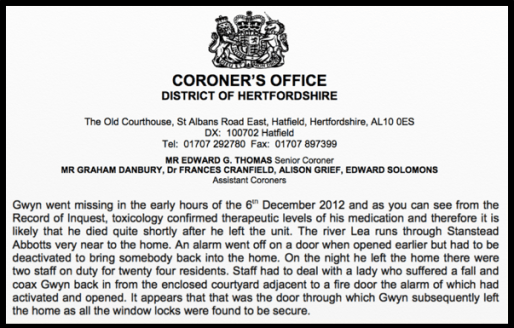
How the Care Quality Commission dodged the coroner’s warning about John Gwynfryn Morris’s (‘Gwyn’s’) death and safe staffing standards 

Screen Shot 2018-01-27 at 15.59.42

Gwyn suffered from dementia and died of hypothermia after going missing from a care home one night in December 2012.

The staff on duty were very stretched. There were two staff caring for 24 residents and Gwyn slipped out of the care home whilst staff were attending to an incident.

The coroner issued a warning report to the CQC on 11 November 2013, stating:

“I am drawing this case to your attention so that you and your inspectors can look carefully at whether staffing levels for night time are adequate to meet the various needs of all the residents/patients in residential, nursing and hospital environments. It seems to me that only two members of staff caring for over twenty four residents, some of whom suffer from dementia and are restless, is not enough to meet all the complex needs, especially with their other duties over a long shift of almost twelve hours.”

In retrospect, this was a significant and politically sensitive coroner’s letter in the context of the subsequent, hugely controversial decision in June 2015 to suspend the National Institute for Health and Social Care Excellence’s (NICE) work on safe staffing.

The CQC should have provided a written response to the coroner’s warning within 56 days. The coroner indicated that he expected a response by the week ending 10 January 2014.

However, I found that CQC’s response was missing from the Chief Coroner’s website as of July 2017.

Accordingly, I asked CQC for a copy but CQC refused to disclose its response, claiming an FOI exemption that according to advice from the ICO was entirely discretionary.

I subsequently noticed that CQC’s response to the coroner had been quietly published on the Chief Coroner’s website.

This showed that CQC did not reply to the coroner’s warning until 16 April 2014.

CQC’s response to the coroner of April 2014 skirted around the issue of safe staffing standards. CQC refused to commit to a clear opinion about whether the home had been under-staffed.

However, CQC assured the coroner:

“The care that is given to people who live with dementia is taken extremely seriously by the Commission.

…In terms of night time inspections, the Commission does currently carry out inspections at night if we have a concern about the care being provided at night, and we will be undertaking more out-of-hours inspections in the future.”

The CQC also informed the coroner that it had undertaken a ‘themed inspection’ on the care of people with dementia between December 2013 and February 2014.

CQC promised it would address safe staffing issues in a national report in May or June 2014, based on its themed inspection.

A national CQC report on the care of people with dementia  was eventually published in October 2014.

This was what the report said about levels of staffing:

4.4 Staffing

Staff have an important role in supporting people living with dementia to have a good quality of life. Having the right knowledge, skills and time is essential to good care. Key to achieving this is ensuring that there is the right number of staff, with the right values, who are supported through training, supervision and access to resources.”

“4.4.3 Numbers of staff  

The time staff had to spend with people, over and above providing the required aspects of personal and clinical care, varied across the care homes and hospitals visited. However, it was often a significant factor in caring for people living with dementia. We spoke to several managers and staff who expressed frustration that, due to a lack of resources, they were not able to provide the care needed.

We saw how people living with dementia were affected when there was not enough staff, including changes to their behaviour that caused distress to them and others around them.”

So, no clear commitment to rigorous inspection, and no measurable, enforceable standards.

In fact, just empty platitudes and nothing to embarrass any Minister.

And despite the CQC’s above emollient assurances to the coroner that it would conduct more out of hours inspections, whistleblowers and FOI data show that CQC’s efforts remain very poor.

The Secretary of State for Health and Social Care promised over two years ago that there would be ‘Learning Not Blaming’. This needs to start at the top.


RELATED ITEMS

Care home deaths and more broken CQC promises

CQC, coroners’ warnings and the neglect of older people in hospital

Who Speaks for the Dead? Ivy Atkin and the Unaccountable CQC

The above update report on the government’s handling of coroners’ warnings has also been summarised in a blog for the Centre for Health and the Public Interest. The Centre’s website features many items on health and the public interest, such as the implications of PFI and the safety of private health services.


UK Whistleblowing Law is an Ass: Helen Rochester v Ingham House Ltd and the Complicit CQC

Please sign and share:

Petition to replace weak UK whistleblowing law to protect whistleblowers and the public


By Dr Minh Alexander NHS whistleblower and former consultant psychiatrist, 25 January 2018


Introduction

The case of vindicated whistleblower Helen Rochester illustrates the weakness of protection for UK whistleblowers.

The current UK whistleblowing law, the Public Interest Disclosure Act (PIDA), came into being in 1998.

It has not upheld the public interest nor protected whistleblowers.

It has not ensured that whistleblowers’ concerns are properly investigated and acted upon. It has failed to give many whistleblowers justice and it has allowed countless wrongdoers off the hook.

Whistleblowers who are unfairly treated by employers may make a claim to the Employment Tribunal under PIDA.

The Employment Tribunal system is meant to be user-friendly so that ordinary people can represent themselves and access justice.

In reality, employers with deeper pockets outgun employees. It is not unknown for whistleblower litigants in person to find themselves pitted against QCs.

Whistleblowers must also run the gauntlet of several tests:

  • They must show they made the right disclosures to be considered a whistleblower within the meaning of PIDA


  • They must show they have raised their concern in the right way


  • They must show that they have suffered detriment


  • They must show that the detriment was due to the whistleblowing


Whistleblowing cases often founder at this last test, with much benefit of the doubt given to employers.

The organisation Blueprint for Free Speech undertook a review of UK whistleblowing law against other jurisidictions, which highlights PIDA’s considerable flaws.


Helen Rochester and the complicit CQC

Helen Rochester, an experienced former nurse and care home whistleblower has added another example of PIDA’s failures to the already towering pile.

Helen Rochester v Ingham House Ltd ET judgment 2301154-2017

Rochester came into conflict with her former employer Ingham House Ltd, which runs Ingham House care home, where she was briefly employed as a Team Leader on nights.

Rochester claimed for whistleblower victimisation in the form of unwarranted referral to the Disclosure and Barring Service, unfair dismissal (this was a protective element of the claim: Rochester had actually resigned but her employer made a spurious, post hoc claim that she had been dismissed) and unlawful deduction of wages.

Rochester represented herself without a penny of assistance from anyone, against a legally represented employer.

She proved the facts of her case, but she still lost on the final hurdle of linking detriment to whistleblowing.

Rochester started working at Ingham House care home in April 2017 but resigned after a few nights’ duty because she was very concerned by what she had witnessed.

Immediately after resigning, she put her concerns in writing to both the care home and to the CQC about poor care standards and serious risk to residents’ safety. Rochester’s disclosure correspondence was impressive in its detail and precision.

Ingham House Ltd, the company which ran the care home, later maintained that Rochester had not resigned but had been dismissed. However, an Employment Tribunal preferred Rochester’s account of events.

Because the Tribunal determined in Rochester’s favour that she had resigned and had not been dismissed, accordingly, Rochester’s protective claim of unfair dismissal fell.

Ingham House also settled the claim for unlawful deduction of wages, albeit at the eleventh hour before the hearing.

Ingham House admitted that Rochester had made public interest disclosures.

The Employment Tribunal determined that Rochester had suffered a detriment because Ingham House Ltd had referred her to the Disclosure and Barring Service (DBS). This was because although the DBS rejected the referral and did not place Rochester on the barred list, the matter was left to lie on file for 10 years.

But crucially, the Employment Tribunal determined that this detriment was not due to Rochester’s whistleblowing.

This was because Employment Tribunal accepted Ingham House Ltd’s assertions that it had formed an intention to dismiss Rochester before she resigned and whistleblew.

The Tribunal concluded this despite:

  • The Tribunal having in effect concluded that Rochester’s evidence was more reliable on the resignation v dismissal issue.


  • The Tribunal accepting that:

“There is a strong chronological link between the protected disclosures made by the Claimant and the referral to the DBS.”


  • The Tribunal accepting that the manager of the care home made the DBS referral as a result of Rochester whistleblowing to the CQC:

“We find that Ms Sterling would not have considered making a DBS referral if the Claimant had not referred the home to the CQC.”


  • A lack of contemporaneous records to evidence Ingham House Ltd’s intent to dismiss Rochester:

“Ms Sterling did not make a note of her conversation with Ms Kemp. At some point she spoke to the other member of staff on duty, ‘Drita’, who had been present when Z had been given medication. She did not make a note of that conversation either, and no written statement was taken from Drita until 8 May, after the DBS referral had been made”


  • A poor internal investigation by Ingham House Ltd and an inconsistent account of the allegations against Rochester:

“We find that the investigation that Ms Sterling had carried out into what had actually happened during the two nights in question was not as rigorous as it could have been. She failed to document a number of conversations that she had with employees. We have observed that the account she eventually provided to the DBS differs from the one contained in the written witness statement received from the employee, Drita, which is dated 8 May, after the referral had been made.”


  • The local authority Safeguarding team not upholding Ingham House Ltd’s allegations against Rochester – it considered that Rochester had acted appropriately and no residents had been harmed


  • A delay between the alleged concerns about Rochester, and the DBS referral. The Employment Tribunal accepted Ingham House Ltd’s explanation that the delay occurred because there was ‘a lot going on’ at the time. The Tribunal evidently failed to understand basic Safeguarding principles. It accepted the care home’s excuse that there was no urgency as Rochester was no longer working at that particular care home, when in fact putative risk to service users in general had not been mitigated.


Although the Tribunal judgment weighed the quality of the investigation into allegations against Rochester, it omitted to mention at all whether Ingham House Ltd investigated Rochester’s whistleblowing concerns.

This surely was relevant information when weighing whether the employer acted in good faith, or was covering up.

Indeed, the recommendations of Judge Sir Anthony Hooper to the General Medical Council on the handling of whistleblowing cases include important advice that the GMC should adduce the probability of vexatious regulatory referral partly based on whether the employer has properly responded to a whistleblower’s concerns.

There is of course also Rochester’s past history of entirely justified whistleblowing about another care home scandal, which caused the CQC embarrassment when its failings were reported by Private Eye in 2015.

Importantly, the Employment Tribunal concluded that Ingham House Ltd only referred Rochester to the DBS because the Care Quality Commission had suggested that it should do so:

“18. On 20 April the Claimant wrote to the Care Quality Commission raising her concerns about the operation of the home. On the same day, anticipating the Claimant’s complaint, Ms Sterling wrote to the CQC setting out her account of what had happened. 

19. CQC notified Adult Safeguarding Services at the local authority of the matters raised. Ultimately Adult Safeguarding took the view that resident Z had been medicated appropriately and that no residents had been harmed and they did not conduct an investigation.

20. On 24 April Beverley Deadman, an Inspector at the Care Quality Commission wrote to Ms Sterling acknowledging the information received and the action which the home had said it was going to undertake. She included this paragraph: “I suggested that you may wish to contact DBS (ISA) to report your concerns regarding this person if you felt the concerns were of a serious nature, and to ensure that all contact and emails, disciplinary action were logged and copies sent to identify a clear audit trail”.

21. We find that if Ms Sterling had not received this advice from Ms Deadman she would not have considered a referral to the DBS. Having received that letter and having previously spoken to Ms Deadman, she now considered whether to make a DBS referral. We find that she was not under any obligation to do so, but had a discretion to refer if she considered that the Claimant was at risk of causing harm to vulnerable adults.”


The CQC advised Ingham House Ltd to refer Rochester to the DBS despite knowing that Rochester had raised multiple serious care standards concerns about the care home. CQC also advised DBS referral without trying to verify whether there was any reasonable basis for these allegations.

Rochester filed a claim against CQC to the ET but this has been struck out on the basis that the ET had no jurisdiction. Rochester could in theory find other legal avenues to sue for negligence, but this would require funds that she has not got.

And has the CQC demonstrated that it has learned from the episode and specifically changed its processes, so that it will not harm and betray future whistleblowers in this manner?

No.

Not even though this was the second time that the CQC had betrayed Rochester, having breached her confidentiality when she previously whistleblew about another care home.

As previously reported, the CQC failed to act upon Rochester’s concerns about Ingham House and did not even re-inspect the care home until she embarrassed the CQC by attending its public board meeting in June 2017 to question this failure.

CQC then failed to follow up her concerns properly and rated Ingham House ‘Good’ across the board despite her serious concerns.


Screen Shot 2018-01-25 at 05.54.47.png

CQC rating on 30 August 2017 from an inspection on 13 July 2017


Most importantly, the CQC did not re-inspect early enough in the morning to detect the institutionally abusive practices that Rochester had alleged were taking place on the night shift, and an FOI by Rochester showed that CQC is failing on a national basis to inspect care homes and hospitals out of hours.

Relevant to this, I will report shortly on how CQC wriggled out of accounting properly to a coroner who had concerns about national standards for night staffing in care home and hospitals.

The Rochester saga is not over yet. More of that another time.

On 4 November 2017 I wrote to the CQC manager who according to the National Guardian is leading a renaissance of CQC’s whistleblowing governance, and I requested that this work should involve whistleblowers. The answer was initially opaque, and then non-committal:


“Dear Dr Alexander

I am sorry if my response was not clear – it is my intention to explore what we do currently and what we should do in the future as part of my assessment of where we are, and that will include considerations of co-production as part of our approach to policy development.

 Best wishes

Ursula Gallagher”

Ursula Gallagher, CQC Deputy Chief Inspector, 16 November 2017


At the time of writing, there is still no sign that the bizarre CQC is transparently involving whistleblowers in re-designing its whistleblowing governance.

In all, serious injustices and cover ups will continue for as long as UK whistleblowing law is so weak, and whilst whistleblowing is handled primarily by lower, non-specialist courts.

Even in cases where whistleblowers are legally represented, there are often losses. Even where whistleblowers ‘win’, the compensation is very inadequate and they are left struggling. PIDA has been tested to destruction for twenty years. It is time to stop throwing good money after bad and to scrap it.

Whistleblowing cases are not simply matters concerning employment contracts between two parties. They are about matters that are crucially important to everybody, and they are often related to public safety.

For example, if the CQC et al had listened more to ambulance service whistleblowers, more might have been done to avert the horrendous ambulance crisis that is now unfolding: Whistleblower claims 20 people died where ambulances were late

The public deserves much better.

Politicians and the Law Commission resist whistleblowing law reform as transparency would result in a real transfer of power to the public.


The National Freedom To Speak Up Guardian has also refused to support Law reform:


I do understand the views of campaigners who say that the current legislation requires reform. However, we are not currently seeking to campaign for changes to the law. Instead, we will be working collaboratively with a wide range of bodies to deliver a reformed NHS culture where freedom to speak up is ingrained and becomes ‘business as usual’.”

Letter from Henrietta Hughes, National Guardian, 16 February 2017


The above Department of Health and Social Care slogan, ‘Making Speaking Up Business as Usual,’ is empty fluff.

The Department of Health and Social Care et al contend that culture change is more important than law reform.

Imagine if crimes against the person were managed with culture change programmes and trite sloganising. ‘Murder isn’t nice’. ‘Make GBH history’. ‘Let’s not be naughty’.

The truth is that effective law drives culture change and shifts behaviour. Think seat belts. Think drink driving.

UPDATE 13 APRIL 2018

Over a year after rejecting a request from campaigners inviting her to support reform of whistleblowing law, the National Guardian asked me during a meeting on 27 March 2018 why law reform is important to whistleblowers.

This is my answer:

Letter to National Guardian 13 April 2018 on ‘Why is Whistleblowing Law Reform Important to Whistleblowers?’


Please sign and share:

Petition to replace weak UK whistleblowing law to protect whistleblowers and the public


delay-deny


RELATED ITEMS

Letter to the Health Service Journal’s Patient Safety Correspondent

Engineered Failure to Investigate NHS Whistleblowers’ Concerns

The Assimilation of Whistleblowers. Patients First and Whistleblower X


BMA Says No to Whistleblowers

By Dr Minh Alexander NHS whistleblower, former consultant psychiatrist 23 January 2018

Powerful and political, the British Medical Association is not short of a bob. Wealth oozes from its gracious grade II HQ in the heart of London, designed by Lutyens. There it wines and dines its important old boys and the great and the good.

Screen Shot 2018-01-23 at 08.56.33

The rank and file’s subs are used to support this largesse, in preference to supporting whistleblowing cases.

In the current system, whistleblowing cases are complicated and expensive. The BMA often claims to whistleblowers that their cases do not pass its legal merits assessments.

The BMA does little to challenge the policy failings that lead to whistleblowers being harassed and that result in protracted employment disputes, and therefore expensive litigation. The BMA seldom agitates for whistleblowing reforms that would make a real difference to NHS staff and patients.

No, the BMA is more likely to issue vapid advice that bears little relation to reality, and may lead unsuspecting members into hot water as a result of raising concerns without fully understanding the consequences. For instance:

You should be guided by this question: if you let the situation carry on is it likely to result in harm to others? If in doubt, you should always err on the side of raising the concern with your manager/immediate superior, and you should do it as soon as you can.”

BMA guide to raising concerns

The BMA over-emphasises the need to raise concerns internally in the first instance, and is overly discouraging of external disclosure:

Only once you have exhausted all local workplace policies and procedures should you consider raising your concerns externally.”

Going directly to your local elected representative (such as your relevant MP, MSP, AM or MLA) or the media is only advisable if your employer has a record of ignoring, discouraging or suppressing concerns that have been raised and this is the experience you are having even after escalating it to the highest level.” 

The relevant law does not actually require whistleblowers to have personally experienced suppression before making external disclosure, but to have a reasonable belief that they may experience detriment or that there may be a cover up if they raise concerns with their employer. Alternatively, they may disclose externally if substantively the same concern has been raised internally already, or with a prescribed regulator

“Public Interest Disclosure Act 1998

43G Disclosure in other cases

(2)The conditions referred to in subsection (1)(d) are—

(a)that, at the time he makes the disclosure, the worker reasonably believes that he will be subjected to a detriment by his employer if he makes a disclosure to his employer or in accordance with section 43F,

(b)that, in a case where no person is prescribed for the purposes of section 43F in relation to the relevant failure, the worker reasonably believes that it is likely that evidence relating to the relevant failure will be concealed or destroyed if he makes a disclosure to his employer, or

(c)that the worker has previously made a disclosure of substantially the same information—

(i)to his employer, or

(ii)in accordance with section 43F.”

And whilst I do not recommend it, Employment Tribunals have even been known to find in favour of whistleblowers who did not meet these preconditions before making external disclosures:

Screen Shot 2018-01-23 at 07.35.03

Source: Public Concern at Work

Screen Shot 2018-01-23 at 07.35.51      Source: Public Concern at Work

But in delaying external disclosure, the whistleblower is subject to more prolonged slings and arrows from their employer. It also allows for a breakdown of ‘trust and confidence’ argument to be more easily cooked up by an employer. This in turn may permit lawful dismissal under Some Other Substantial Reason, even if the employer started the quarrel.

In addition to restraining external whistleblowing through its over-cautious advice, the BMA may also queer the pitch for whistleblowers by aggressively lodging Employment Tribunal claims, and even repeated claims in some cases. This can leave the whistleblowers high and dry when the BMA pulls out. Conflict will have been irretrievably escalated and the whistleblower’s career will by that point be destroyed if not severely damaged.

It must be asked why the BMA takes such aggressive action when it knows that it will not fund many cases to full hearing. Why does it not tell members at the outset of the stats and its likely withdrawal, and thereby give them a chance to make more informed decisions? Whatever the BMA’s motives, its actions have the effect of helping to flush whistleblowers out of the NHS.

Not to mention of course that BME staff were shown to fear and suffer the greatest detriment for whistleblowing, by the research carried out by the Middlesex University for the Freedom To Speak Up Review , and that the white BMA patriarchy does not have a good record on Race.

(Current BMA council count: 10 visible BME, 13 women out of 51 members).

Risibly, the the BMA claimed in its 2014 Freedom To Speak Up Review submission  to Robert Francis’ Freedom To Speak Up Review:`

A doctor making a protected disclosure is protected against detriment or dismissal; the employer must not act against them for making such a disclosure. The protection lies in the doctor’s ability to take legal action for compensation.”

This supposed deterrent effect against dismissal, conferred by a ‘doctor’s ability to take legal action for compensation,’ is invisible to everyone except the BMA. Indeed, it is the BMA’s imaginary little friend.

Such is the power of the club and the perceived advantages of belonging, to my knowledge, none of the BMA’s past presidents have broken ranks and spoken out publicly against the BMA’s ludicrous claims and treatment of whistleblowers. But then it is easy to overlook the club’s shortcomings when it is pouring lavishments and wine.


An important ongoing controversy is the whistleblowing case of Dr Chris Day and unsatisfactory whistleblowing protection for junior doctors

The BMA stands accused of not defending junior doctors’ rights, as does the National Freedom To Speak Up Guardian

Please see Dr Day’s website: http://www.54000doctors.org/

Screen Shot 2018-01-19 at 12.25.08

I asked the Dr Chaand Nagpaul the Chair of BMA Council about some off colour publicity material which BMA had reportedly emailed to some members of the public about Dr Day. The BMA has regrettably not specifically addressed this in its latest response.

Dr Day is a brave and resourceful campaigner, but the BMA should show some grace and remember that he is all things considered, a young doctor, with a young family.


The BMA has long resisted my requests for information about its member services, and in particular the handling of whistleblowing cases. After several years of tooth-pulling correspondence, and the latest BMA reply under the stewardship of the BMA’s new chair of Council, this is all I know:


  • The BMA case file retention period is 6 years


  • The BMA advised that their lawyers reported handling five whistleblowing claims by members between 2006 and March 2015 which were settled via COT3 (compromise settlements)


  • The BMA said it had no Race and Gender stats


  • In March 2015, the BMA promised to keep better records in future, it said it had set up a task and finish group on raising concerns and indicated that it would consider a suggestion to audit its handling of whistleblowing cases

BMA response 5 March 2015 about member services


  • In February 2016 the BMA advised that its task & finish group had concluded, that it was setting up a pilot of trial support for doctors on raising concerns but had decided against external review of its handling of whistleblowing matters

BMA correspondence about task and finish group on raising concerns

Report of BMA task and finish group on raising concerns


  • In its latest response of 29 November 2017, the BMA gives this additional information about it member services:

The BMA is wholly committed to and continues to provide support to individual members who wish to raise concerns about patient safety. We have previously informed you of the pilot arrangements that existed in the North West, were then extended to the South West and are now being rolled out across England. Through this service we provide individual advice to members and educational talks to doctors. Additionally, we advise, support and represent members who believe that as a result of raising a concern they may have suffered a detriment. In total from March 2015 to July 2017 we have supported some 221 doctors in this regard.

 As with all disputes our principle is to work with the member to resolve matters at the earliest opportunity. Many cases have been resolved through the employer’s internal process following advice/support/representation by our advisers. Others have been resolved at First Point of Contact as they required relatively straightforward advice / signposting to information on our website. Sometimes members have decided that they do not wish to pursue the case, or there is insufficient evidence available to support a referral for a merits assessment – the key to this being evidence that links the disclosure (which needs to be one considered as protected) with the detriment suffered.

In terms of support provided at Tribunal, or similar courts, for all types of claim we have pursued 1076 cases since 2006 and secured a total compensation of £14.884m with an average compensation of £13,162. (NB: A number of cases will be considered collective matters and therefore relate to a number of doctors.)”

All the above information combined suggests that a very low number of whistleblowing cases pass BMA lawyers’ merits assessments. There are evidently over a hundred cases a year, but BMA lawyers previously apparently identified only five cases litigated between 2006 and March 2015, assuming that data is broadly accurate.

There is also a self-fulfilling element. The less the BMA supports whistleblowing cases, the more difficult it will seem for whistleblowers to win, and whistleblowing cases are written off as a bad risk.

In retrospect, it is also surprising that the BMA previously refused on 29 November 2016 (under its former Council Chair) to release any information about whistleblowing cases on the basis of small numbers and potential identifiability:

We are proactively reviewing whistleblower cases and collating the more detailed quarterly data on them but, given the small number of cases and the risk of providing information from which individuals could be identified, will not be sharing these data. We continue to give high priority to supporting members who raise concerns about patient care.”

With regards to fundamentally flawed UK whistleblowing law which is at the heart of countless injustices, and failures to protect the public interest that it is supposed to serve, what does the rich and powerful BMA have to say?

We remain very aware of the concerns about the legal position of whistleblowers and the difficulties involved in demonstrating a link between a detriment and a disclosure and will continue to give these issues very serious consideration.” 

That ought to do it chaps.


  • The BMA now says this with regards to supporting whistleblowers with re-employment:

“With regard to sacked whistleblowers re-entering NHS employment, if approached by a member, we would seek to advise, support and represent their interests with prospective employers, the deanery etc, for example with regard to their application and recruitment process, and to challenge employers on their behalf. This might involve subject access requests related to the assessment/appointment process or discussions with the deanery (for juniors) about other opportunities. If the member was protected under PIDA, then clearly there would be opportunities to enforce this under the legal process. This might indeed include trial periods of employment with other employers for retraining purposes. The situation would be more difficult, however, if they were not deemed to be protected under PIDA. Also, as you might be interested in the position we have taken in response to the Department of Health consultation on protecting whistleblowers against discrimination in recruitment, I am attaching the consultation and our response.” 

BMA response to DH consultation on whistleblower blacklisting

 The BMA Director of Policy who penned this BMA response to the DH’s consultation missed the point that legislation to deter blacklisting of sacked whistleblowers is closing the stable doors after the proverbial, and was over optimistic that this piece of DH window dressing would change culture:

We believe that these draft regulations should be treated as part of a wider cultural change that normalises the raising of concerns and the protection of the employees who raise them. It will be important to raise awareness among employers of the prohibition of discrimination against whistleblowers in recruitment and the compensation which may be awarded for such discrimination.” 

And how many unemployed whistleblowers could actually afford to sue anyway, given the BMA’s track record on refusing and dropping whistleblowing cases?


  • Lastly, in response to my request that the BMA supports whistleblowers with the near cost-neutral option of allowing them access to online library services and medical journals, the BMA flatly refuses this: 

With regard to access to our online resources without charge, I have raised this with the membership department. Their response is that the unwaged membership fee has been designed to be a substantial reduction and to be affordable for all doctors not in employment whatever their reason. It also offers full membership benefits, i.e. not just online access to educational material but also free places at BMA CPD courses and events as well as wider benefits.”

I should let you into a little secret dear reader. I already knew that the BMA had agreed to waive the membership fee for one sacked whistleblower. This is what the BMA said:

“Unemployment is an unfortunate reality for some members and we have taken into account the enormous impact this can have on a members’ finances. In order to support them through what is likely to be a financially difficult time, we offer a temporary waiver of their annual subscription. It is not uncommon for members in this situation to be on jobseekers allowance or other benefits and we ask for confirmation of this as part of their claim process.”

So it would appear that when a white whistleblower asks the BMA for free membership it says ‘Yes’.

But when a BME whistleblower asks the BMA to merely allow sacked whistleblowers access to online medical journals, it says ‘Bugger off’.

Pass the port.

This is the latest correspondence with the BMA.

Screen Shot 2018-01-23 at 06.31.18


RELATED ITEMS

Letter to BMA Chair of Council, President and Past Presidents

Is the BMA worth £163? Are new socks better?


At the Court of the BMA:

‘King George V and Queen Mary enter the Gates of Honour, during the opening ceremony [of BMA House], on 13th July 1925’

Screen Shot 2018-01-23 at 08.59.01

‘The royal procession through the Court of Honour during the opening ceremony of BMA House, 13 July 1925’

Screen Shot 2018-01-23 at 09.01.53

Sir Lancelot Spratt, a few words of wisdom, 23 January 2018

Lancelot Spratt

The Assimilation of Whistleblowers

By Dr Minh Alexander NHS whistleblower and former consultant psychiatrist, 20 January 2018


Whistleblowers upset power.

Everything to do with power is complex, multi-layered, frequently involves trickery, decoys, double dealing and the department of dirty tricks.

Power protects itself and dissidents must therefore be contained, controlled or sometimes even destroyed.

The ongoing spycops scandal and public inquiry shows some of the depths to which some elements of the State will stoop to maintain control, even in a seemingly mature, liberal democracy.

The same age old strategies of infiltration, disruption, capture and splitting are applied to whistleblowers, especially when they organise in any way.

The agencies set up to protect whistleblowers, if not corrupt from the outset, become captured too.

These patterns repeat, and have been described before:

Jean Lennane What Happens to Whistleblowers and Why


In July 2015, an unpleasant drama tumbled into my inbox.

A Scottish whistleblower who we shall call X, a then member of the whistleblowing organisation Patients First copied me into acrimonious correspondence between himself and the leaders of that organisation.


About Patients First

This organisation was originally set up by several founder whistleblowers with the aim of specific test litigation.

Some founding members left.

It became a more broadly focussed group, run as a limited company.

According to Companies House, this dissolved on 17 February 2015:

https://beta.companieshouse.gov.uk/company/07783392

On 9 March 2015 Patients First emailed its members with the message:

“The proposal is that PF will no longer be set up as a limited company but will in the future operate as an unincorporated body (ie the members) which is also a charity, with charity trustees”

The following constitution was circulated and was to my knowledge adopted:

PF Constitution

This is information about un-registered charities:

https://www.gov.uk/government/publications/excepted-charities/excepted-charities–2

https://www.gov.uk/government/publications/exempt-charities-cc23

The Patients First website has been sporadically maintained over the last few years, and was sometimes inaccessible. The organisation’s twitter account used to link to the website,

However, even the sporadic web presence seems to have petered out completely now:

www.patientsfirst.org.uk


At the time that this conflict hurtled onto my screen, I too was a Patients First member but have since resigned as the organisation did not reflect my values.

What I now recount is done so with whistleblower X’s express permission.

The nub of the conflict was this: X was concerned that the Scottish government may have acted illegally.

I do not know if he was right, but I do know that he had received relevant expert advice and had consulted with other experienced whistleblower peers.

I have seen some of the summarised expert written advice that he received and correspondence from government agencies refusing to investigate untoward deaths. I have followed group correspondence and press coverage of the debates in Scotland about the concerns.

Screen Shot 2018-01-20 at 17.38.38

http://www.bbc.co.uk/news/uk-scotland-31914170

https://www.express.co.uk/news/uk/731680/Roger-Livermore-exposes-deadly-healthcare-bureaucracy

https://www.dailyrecord.co.uk/news/health/former-prosecutor-calls-health-boards-5350706


It seems to me that X’s concerns were based on reasonable belief.

As a result of his concerns, he covertly recorded a meeting in March 2015 with a Scottish Health Minister, attended by other Patients First members

The matter escalated within Patients First.

The leadership of Patients First took the view that he should not have made a covert recording of the meeting.

One of the senior figures in Patients First made a complaint about him.

Another senior figure carried out an investigation.

X made no attempt to deny the facts of the matter.

The disagreement was about the appropriateness of his actions.

X was asked by Patients First to destroy the audio recording and to apologise to the Minister.

X refused to co-operate with either request.

X pointed out that his actions were not illegal. In fact, X believed it would have been improper of him to destroy evidence of what he believed were likely to have been illegal actions by the Minister.

A Co-chair of Patients First wrote on 24 June 2015 to tell X that he was being expelled.

Screen Shot 2018-01-20 at 21.49.56 I asked Patients First why it was expelling X but not another member, who had made frequent reference on social media to making covert recordings of her employer.

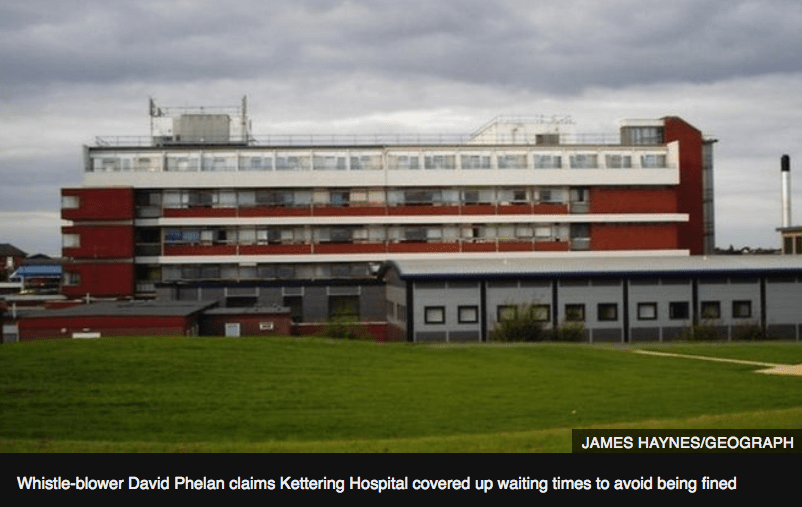
A Patients First Co-Chair wrote to me on 7 July 2015:

“This was a breach of our normal way of going about meetings with politicians and showed a complete disregard for colleagues also present. It was unnecessary as there were many witnesses.

 The Board were unanimous in their condemnation of this occurrence as a unilateral act.

 We have had considerable support for our contistution (sic) and code of conduct.

 People who wish to act unilaterally probably should campaign unilaterally – we try to be fair to everyone. What we will not tolerate is harassment and breach of respect for each other. Sadly this was a perfect example of that unhelpful behaviour. There has been no remorse or apology.

 Of course we understand why people might think such actions are a good idea but they are in our view not helpful. We offered time for reflection and to delete the recording. Sadly X is unrepentant and therefore we cannot see how he could remain within Patients First. Simple as that.”

A Patients First Trustee, delegated by the same Co-Chair after I indicated that I did not feel my specific questions had been answered, wrote additionally to me on 7 July 2015:

“…the decision to make a secret recording by an individual in conflict with her employer over whistle blowing cannot be equated with X’s actions”

“You ask for PF’s “position on covert recording of politicians.” Realistically you would not expect there to be a written policy about every eventuality which could possibly arise, including this one. But venturing my personal view, I think this would only happen in extreme circumstances. The decision to do so, if ever this were to happen, would have to be taken by the leadership of PF in consultation with legal advisers. It would never be the prerogative of a maverick individual to make such a decision.”

So if I understand this correctly, it seems an individual may covertly record their employer, but only the commissariat can sanction political recordings.

Don’t misunderstand me. I don’t advise whistleblowers to covertly record willy-nilly. It’s a limited strategy that can close doors in the long run. You may also shoot yourself in the foot at Tribunal by landing a gleeful ‘loss of trust and confidence’ argument from the opposition.


The Twist in the Tale

When X was asked to destroy the offending audio recording of the meeting with the Minister, the leadership of Patients First did not know if it was evidence of illegal actions by the Minister.

This is evidenced by the fact that the trustee of Patients First, delegated by a Co-chair of Patients First wrote thus to me on 7 July 2015 regarding X’s concerns about deleting evidence of illegal actions:

“Whether the content of the recording reveals the Minister to be acting illegally we do not know.”

I was stunned.

There is a lot more that I could say about this very unfortunate incident, but all the other unpleasantness pales into insignificance set against this one central fact.


X was a bit bruised but ultimately relieved to be marched off the Patients First premises, metaphorically speaking.

Several other Scottish Patients First members who unsuccessfully tried to intervene on his behalf also resigned.

A new campaigning group was born – ASAP Scotland – a heterogeneous group of whistleblowers and other health campaigners.

Judge for yourself:  http://asapnhs.uk/


What is most important now is that a critically important consultation by the Scottish government is about to start on NHS whistleblowing policy and infrastructure.

Invitation from the Scottish government to a consultation event on 30 January 2018:

Background

 The Scottish Government plans to bring forward legislation in 2018 so that the Scottish Public Services Ombudsman (SPSO) can take on the new role of Independent National Whistleblowing Officer for the NHS in Scotland (INWO). This will introduce an external review function for individual staff members who whistleblow and have a concern about a Health Board’s handling of their case. The INWO will consider the application of local process, decision making and the Health Board’s culture and approach to whistleblowing – particularly where a whistleblower claims to have been unfairly treated as a result of raising a concern. 

The INWO will also have a national leadership role providing support and guidance to Health Boards with a focus on continuous improvement, early resolution, good practice and reporting. Our priority is to have a health service which has an open and honest reporting culture and where staff can speak up in the knowledge that an independent, external body can review their case if they feel it has not been handled appropriately. This will allow cases to be brought to a clear, final and fair conclusion.

 Workshop

 This workshop will be led by Tracy Boylin and supported by the Scottish Public Services Ombudsman. Tracy Boylin was formally HR Director at the Christie Hospital, a leading cancer treatment centre in England. As a whistleblower herself, Tracey has first-hand experience of the issues involved. As you may be aware, Tracy is also an active member of Patients First and has worked with NHS England researching the link between bullying and patient safety and with NHS Improvement on a new employment support scheme for whistleblowers”

Moreover, a prominent member of Patients First from the English NHS has been recruited by the Scottish government to help lead this project, but without to my knowledge any sign of advertisement.

What happens next will affect the future of Scottish patients and NHS staff for years.


RELATED ITEMS

Medics appeal to health minister to intervene over suspended Grampian surgeons

http://www.heraldscotland.com/news/13413598.Medics_appeal_to_health_minister_to_intervene_over_suspended_Grampian_surgeons/

NHS whistleblower claims she was sacked to protect HIV infected surgeon

http://www.heraldscotland.com/news/15299703.NHS_whistleblower_claims_she_was_sacked_to_protect_HIV_infected_surgeon/

Just a very few practical tips for the unsuspecting whistleblower, from Mr Spock

  • Be careful
  • Proceed slowly if you can
  • Give your trust judiciously

Spock


The Flexible CQC, FPPR & Kettering General Hospital NHS Foundation Trust

By Dr Minh Alexander, NHS whistleblower and former consultant psychiatrist, 16 January 2018 

The CQC has thoroughly disgraced itself in failing to hold unfit NHS trust directors to account despite being assigned powers in 2014, under Regulation 5 Fit and Proper Persons (FPPR).

CQC’s senior staff have been involved in turning a blind eye to wrongdoing such as whistleblower reprisal and suppression of patient safety issues. CQC’s former Chief Inspector of Hospitals personally shut down an FPPR referral on the hospital boss Paula Vasco-Knight who was shortly after charged with fraud, and eventually convicted.

https://minhalexander.com/2017/01/27/cqc-a-chief-inspector-doesnt-call/

https://minhalexander.com/2017/05/23/fppr-cqc-has-lost-all-moral-authority-but-what-will-the-national-guardian-do/

In May 2017 last year a scandal erupted when the BBC reported allegations of a waiting list fiddle at Kettering General Hospital NHS Foundation Trust, based on information provided by a whistleblower, who had started raising concerns internally in 2015.

Kettering General Hospital ‘fiddled’ waiting time records

By Matt Precey BBC East

26 May 2017

Screen Shot 2018-01-15 at 08.53.23

http://www.bbc.co.uk/news/uk-england-northamptonshire-40014896

The trust denied wrong doing but by July 2017, both the trust CEO and Chair resigned:

http://www.bbc.co.uk/news/uk-england-northamptonshire-40496685

Prior to the BBC coverage of the waiting list allegations, the CQC had rated the trust ‘Inadequate’ in April 2017 and placed it into special measures:

CQC inspection report Kettering April 2017 AAAF9991

Kettering was rated ‘Inadequate’ again in September 2017:

CQC inspection report Kettering September 2017 AAAG6609

Mike Richards the former CQC Chief Inspector of Hospitals wrote the introductory letter for the CQC inspection report on Kettering of April 2017.

Whilst Richards noted that the CQC had judged the trust to be ‘Inadequate’ on the ‘Well-Led’ domain and required Special Measures, he made no comment on Regulation 5 issues or whether trust directors were Fit and Proper Persons.

Neither was the trust’s compliance with FPPR discussed anywhere else in the CQC’s April 2017 report.

Curiously, there were almost no comment in general about the senior leadership of the trust in the report, with most comments in CQC’s report being directed only at the leadership of individual service areas.

The CQC inspection report informed the public that the trust had been served with a formal Section 29A warning notice, but few details were given:

Screen Shot 2018-01-16 at 17.21.11

I later asked the trust for a copy of CQC’s Section 29A warning notice. It proved to be lengthy and detailed:

CQC FOI REF 4060 s29A Warning Notice Kettering General Hospital NHS Foundation Trust.

Of interest, the CQC’s Section 29A letter to Kettering of 18 November 2016 revealed that the CQC had been concerned about weak FPPR procedures at the trust:

Screen Shot 2018-01-16 at 19.19.31

Inexplicably, none of this troubling information appeared in CQC’s subsequent inspection report in April 2017.

It is both interesting and of concern that CQC withheld this information from the public, in addition to the paucity of comment in its inspection report about the trust’s senior leadership.

The more so given CQC’s now long track record of protecting erring and failing trust directors.

It has to be asked what else the CQC has been hiding from the public, and why.

Such economy with the truth may not be unconnected to the fact that trust directors are themselves expected to support political pantomimes and not to make too much fuss about undeliverable policies.

Such a house of cards would fall if folks who know where the bodies are buried are pushed too far.

This example at Kettering also illustrates another typical aspect to CQC’s behaviour. Whether by action or omission, it helps to shield senior managers involved in whistleblowing cases, and is thus an essential cog in the Department of Health’s reputation management machine.

UPDATE 31 DECEMBER 2018

PHSO has partially upheld a complaint about CQC’s mishandling of an FPPR referral about former NHS trust chief executive Paula Vasco-Knight and made a finding of maladministration and systemic failure. Alas, the graceless CQC remains defiant and keeps spinning itself deeper into a hole:

Sorry is the hardest word: CQC, Paula Vasco-Knight and Regulation 5 Fit and Proper Persons

DH Shooting messenger

RELATED ITEMS

This is disclosed FOI material from CQC which includes guidance to inspection teams and a withering internal audit:

Disclosed: CQC’s internal technical guidance on Regulation 5 Fit and Proper Persons and an internal audit on CQC’s woeful handling of FPPR

Post-scripts on Paula, NHS England’s apologia and regulatory reticence

Letter to Public Accounts Committee 11 September 2017 requesting a review of whistleblowing

More loopholes in Jeremy Hunt’s ‘support’ scheme for whistleblowers

By Dr Minh Alexander NHS whistleblower and former consultant psychiatrist 21 December 2017


Super-gagged whistleblowers cannot acknowledge the existence of the compromise agreements that gag them.


To illustrate, NHS Employers charmingly recommends this form of words for a compromise agreement:

“1. Confidentiality

1.1 In consideration of the Employer entering into and complying with its obligations under this Agreement, the Employee warrants that:

a. save for immediate family (having instructed them on all of the confidentiality provisions of this clause) and for the purposes of taking professional legal and financial advice or where required by any competent authority or by a Court of Law or HM Revenue and Customs or as otherwise required by law, [he/she] has not divulged and shall not divulge to any person whatsoever the fact of, negotiation and/or terms of this Agreement

NHS Employers April 2013, The use of compromise agreements and confidentiality clauses

Click to access compromise-agreements.pdf


Whistleblowers’ compromise agreements will also in some cases forbid contact with former employers.

This combined with the super-gags makes participation in the NHS whistleblower employment support scheme impossible.

Not that it is called that anymore. As reported previously, NHSI and NHSE surreptitiously changed the scheme name from ‘whistleblower employment support scheme’ to ‘whistleblower support scheme’.

NHS England was asked to address the issue of gagged whistleblowers’ access to the scheme as early as November 2016.

NHS Improvement was asked to address it in February 2017.

Neither body seems capable of understanding the basic problem and have still not come up with any credible plan to manage the issue safely and fairly.

They should of course seek a waiver from the government to guarantee that gagged whistleblowers may safely disclose the existence of gags and or approach former employers as required. But neither body will agree to do so despite repeated requests that they take this logical action.

As ever, officialdom meanders on its thoughtless way, oblivious to injustice.

Whilst I am not at liberty to reveal all details, I have seen an NHS Improvement list of 18 non-whistleblower panellists for the panels that decide whether whistleblowers will be accepted for the scheme.

Some panellists are managers from trusts that have admitted to super-gagging whistleblowers, or as evidenced by external review, are known to have harmed whistleblowers and covered up wrongdoing.

Just under half of the panellists are also Speak Up Guardians.

NHS Improvement has also not considered the ethnicity of panellists, but has advised that it may consider doing so in future.

Robert Francis recently criticised the delay in establishing the whistleblower employment support scheme, when speaking at a public event. He remarked that he did not think it was working very well.

Click to access francis-culture-and-conduct-comments-7-11-2017-transcript.pdf

Francis also referred to his original vision as being one of a ‘re-employment’ scheme, which both NHS England and NHS Improvement have gone out of their way to stress is not what the scheme is about.

So as usual, a few hundred thousand pounds later, someone has benefited but it’s not the whistleblowers.

Merry Christmas.

Screen Shot 2017-12-21 at 11.18.03


RELATED ITEMS:

Jeremy Hunt’s Secret Whistleblower (Non-Employment) Scheme, 14 October 2017

Jeremy Hunt’s Secret Whistleblower (Non-Employment) Scheme