A complaint regarding the National Guardian’s management of concerns about a spin doctor

By Dr Minh Alexander NHS whistleblower and former consultant psychiatrist, 29 March 2018

In September 2016 I started this blog for the purpose of helping to keep people informed about campaign work on reforming whistleblowing law and governance, and for sharing data and correspondence that might of use to others.

In September 2017 I was informed by a fellow whistleblower, who we shall call Anon, that a spin doctor from the National Guardian’s office approached them at an NHS event involving about 40 people, in November 2016, two months after I started my blog.

Anon said that this person started making derogatory comments about me within earshot of other NHS managers at the event.

Anon tells me they had never met this spin doctor before. Neither had I, nor indeed had I ever spoken with or exchanged a syllable of correspondence with said spinner.

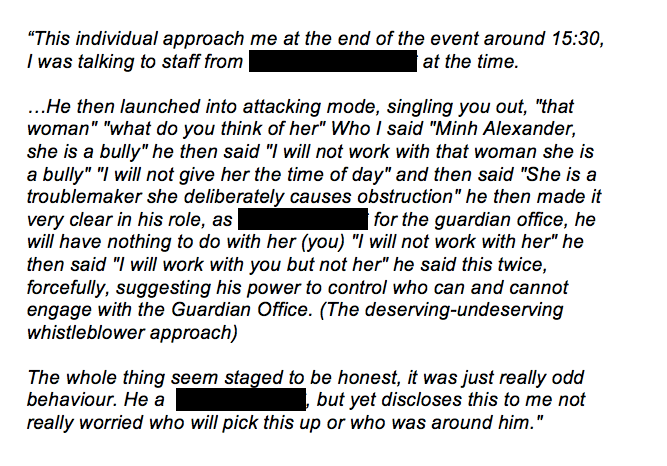
Yet according to Anon, this is how the encounter went:

Noel Finn account of conversation with WF

 Anon made a verbal complaint to the National Freedom To Speak Up Guardian in January 2017. Anon was told that the spin doctor in question was no longer working at the National Guardian’s Office, and that no more could be done. Anon left it at that.

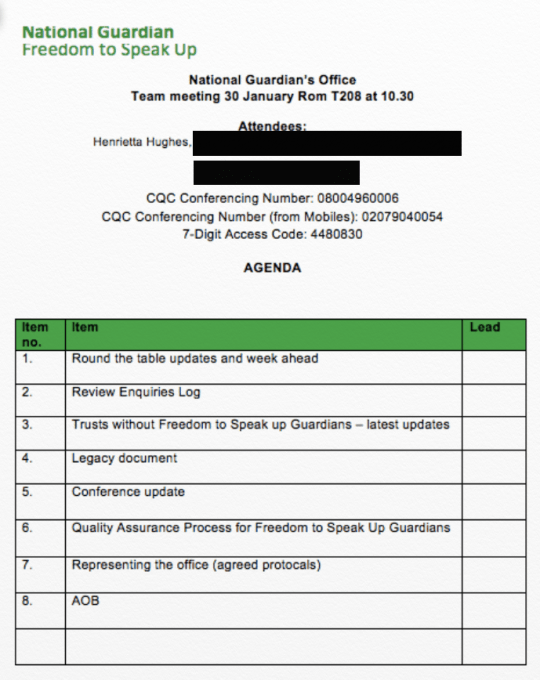
After hearing of Anon’s concerns, the National Guardian reportedly spoke to her team on 30 January 2017 about standards of conduct in representing her Office. Her Office has disclosed the relevant meeting agenda:

Screen Shot 2018-03-29 at 17.30.06


The Office has advised that there are no minutes of the discussion held on this issue.

After Anon told me in September 2017 of these events, I discovered that that the spin doctor had been re-employed by the National Guardian’s Office (NGO), and the Office later disclosed that it was the National Guardian who was the appointing officer.

At the point of this re-employment, no investigation had taken place into the alleged derogatory comments.

Anon and I were concerned by the message sent by such an appointment. We complained to the National Guardian on 1 October 2017 about the fact that her Office, which supposedly has responsibility for helping to protect whistleblowers, had re-engaged someone who was reported to have behaved badly towards a whistleblower.

I additionally raised concerns that the spin doctor had reportedly implied that he had power to bar specific whistleblowers from access to the Office.

The NGO should by its own policy have passed the complaint to NHS Improvement, because it related to the National Guardian’s own actions in re-employing the spin doctor in question. However, the NGO decided to investigate the matter itself, and did so cursorily. No one was interviewed except the spin doctor.

The spin doctor denied that he ever made the comments reported by Anon.

No witnesses from the conference were sought or interviewed by the NGO. The Office asserted that because there was a disputed account of events between Anon and the spin doctor, the complaint could not be upheld. It made no attempt to weigh the credibility and motivations of the differing parties.

The most serious component of the complaint was not addressed – the fact that the National Guardian employed the spin doctor again, after Anon had informed her of concerns about this individual.

Both Anon and I rejected the NGO investigation and asked that the matter should be investigated by NHS Improvement (NHSI) as per policy.

NHSI took over the complaint on or around 16 November 2017. The process was not concluded until 29 March 2018, which was over three months NHSI’s original, estimated timescale.

The marked delay has never been fully and satisfactorily explained.

NHSI established from the National Guardian that she recalled the spin doctor said he would speak to Anon at the conference:

 Henrietta Hughes evidence Noel Finn WF complaint

NHSI interviewed an NHS manager present at the event in question, who said she:

Adele Bunch WF complaint

but that:

Screen Shot 2018-03-29 at 23.06.09

NHSI reported that another NHS manager at the event:

Screen Shot 2018-03-29 at 23.07.29

NHSI reported that the spin doctor in question “denies them [the derogatory comments reported by Anon] completely”.

The NHSI investigator did not speak to anyone else who had been present at the event:

Screen Shot 2018-03-29 at 23.08.31

NHSI did not uphold the complaint relating to the spin doctor’s conduct or the National Guardian’s re-appointment of this individual, despite the fact that she as aware of the concerns that Anon had flagged.

However, NHSI did consider that the complaint had been incorrectly handled originally, in that the NGO only examined the original conduct of the spin doctor, and not the National Guardian’s decision to re-appoint him.

NHSI has advised that consequently, it has provided training on complaints handling to the National Guardian’s Office.

Robert Francis adjudicated on the complaint, as he was the Chair of the National Guardian’s Liaison and Accountability Board when the complaint were made, although he has stepped down from this role since.

He concurred with NHSI’s conclusions and commented that NHSI was entitled to come to a conclusion that:

Robert Francis WF (1)

I expressed concern that Anon was disbelieved, and that this mirrors what happens more generally when staff speak up. I had known Anon, a previously vindicated whistleblower, for four years and that I had not known them to lie. I had no reason whatsoever to disbelieve Anon.

Francis thanked us both for:

Robert Francis WF (3)

He stressed that the fact that Anon’s account had not been accepted should not be seen as a reflection upon Anon:

Robert Francis WF (3)

But this saga raises uncomfortable questions. Did the National Guardian not care about Anon’s concerns when she re-employed the spin doctor? Trust is key for whistleblowers seeking a safe harbour, and the National Guardian’s actions in this matter have not helped to establish trust.

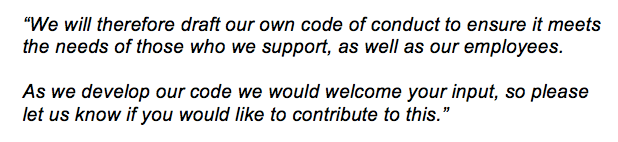
Arising from the complaint, the NGO asked me on 2 November 2017 to contribute to the development of its code of conduct:

Simon Pook code of conduct

I agreed to contribute but have not heard any further or been given sight of this code of conduct, raising questions about whether the NGO’s offer was serious or just a theatrical flourish.

And what truck does an Office that is meant to promote truth-telling  have with spin?


National Guardian’s Office spending on public relations.

The Care Quality Commission, which is the National Guardian’s employer, has disclosed (FOI 1718 0813) that since April 2016 when the Office went live, it has a spent £261,101 on PR staff and conferences.

Cost of PR staff since April 2016:

The total cost for members of staff with direct responsibility for communications and engagement since April 2016 is £173,443.”

Cost of conferences:

October 2016 conference £10,080

October 2017 conference £37,578

March 2018 conference £40,000

Total: £87, 658 

This figure does not include the cost of a national conference held in March 2017 which was funded by Health Education England.

The £261,101 spent on PR and conferences has exceeded the amount spent on developing the Speak Up Guardian network:

“…over the same period, the office has spent £135,678 on staff with responsibility for Freedom to Speak Up Guardian engagement, which involves the provision of training, advice and support for our network of Freedom to Speak Up Guardians. This work does not include any communications, public relations or media functions.”

A product that is evidence-based, sound and respected would sell itself, and would not require such aggressive marketing.


UPDATE 13 APRIL 2018

Whilst NHSI and Robert Francis have been reluctant to believe Anon’s account of derogatory remarks by an NGO spin doctor, the evidence of spin and negative briefing continues to surface. I have written to Robert Francis to draw his attention to this evidence:

Letter to Robert Francis about news management by the National GUardian’s Office, DHSC and CQC


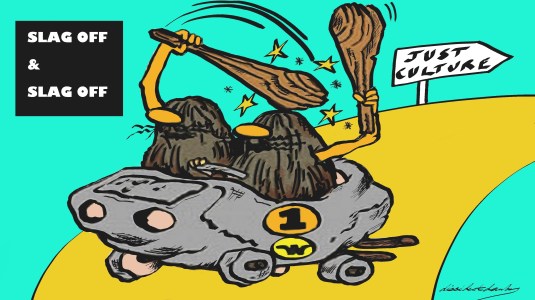
Slag Off & Slag Off


RELATED ITEMS

National Guardian, Spin Doctors and Dodging Reform of Whistleblowing Law

Regulation 5 Fit and Proper Persons: Dissecting CQC’s Dissembling


Regulation 5, Fit and Proper Persons: Dissecting CQC’s Dissembling

Disraeli opined: “There are three kinds of lies: lies, damned lies, and statistics.” Ironically it is the UK Statistics Authority that is the most trusted ALB. Pity the same cannot be said of the CQC where it appears clarity and openness are seemingly rare commodities.

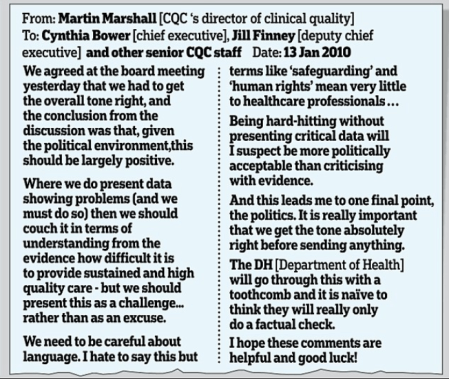
The CQC has a history of deliberate deception. A well-known CQC lie of omission at Basildon consisted of a pretence at being hard hitting, whilst deliberately withholding facts.

Daily Mail Basildon CQC 2010


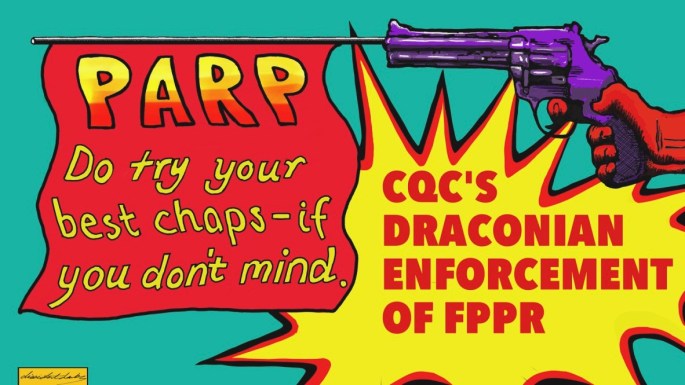
CQC’s application of Regulation 5 Fit and Proper Persons (FPPR) is worth examining. It would seem that some powerful wrongdoers, have been protected.

This is how the regulation, which was introduced in November 2014 is set out in law:


Fit and proper persons: directors

5.—

1.   This regulation applies where a service provider is a body other than a partnership.

2.   Unless the individual satisfies all the requirements set out in paragraph (3), a service provider must not appoint or have in place an individual—

a.   as a director of the service provider, or

b.   performing the functions of, or functions equivalent or similar to the functions of a director.

3.   The requirements referred to in paragraph (2) are that—

a.   the individual is of good character,

b.   the individual has the qualifications, competence, skills and experience which are necessary for the relevant office or position or the work for which they are employed,

c.    the individual is able by reason of their health, after reasonable adjustments are made, of properly performing tasks which are intrinsic to the office or position for which they are appointed or to the work for which they are employed,

d.   the individual has not been responsible for, been privy to, contributed to or facilitated any serious misconduct or mismanagement (whether unlawful or not) in the course of carrying on a regulated activity or providing a service elsewhere which, if provided in England, would be a regulated activity, and

e.   none of the grounds of unfitness specified in Part 1 of Schedule 4 apply to the individual.

4.   In assessing an individual’s character for the purposes of paragraph (3)(a), the matters considered must include those listed in Part 2 of Schedule 4.

5.   The following information must be available to be supplied to the Commission in relation to each individual who holds an office or position referred to in paragraph (2)(a) or —

a.   the information specified in Schedule 3, and

b.   such other information as is required to be kept by the service provider under any enactment which is relevant to that individual.

6.   Where an individual who holds an office or position referred to in paragraph (2)(a) or (b) no longer meets the requirements in paragraph (3), the service provider must—

a.   take such action as is necessary and proportionate to ensure that the office or position in question is held by an individual who meets such requirements, and

b.   if the individual is a health care professional, social worker or other professional registered with a health care or social care regulator, inform the regulator in question.

http://www.legislation.gov.uk/uksi/2014/2936/contents/made

http://www.legislation.gov.uk/uksi/2015/64/pdfs/uksi_20150064_en.pdf


Since 2014, CQC has issued three version of its guidance on FPPR:

CQC FPPR guidance November 2014

CQC FPPR guidance March 2015

CQC FPPR guidance January 2018


As CQC itself admitted in its original FPPR guidance of November 2014, the regulation arose from disasters and its intended purpose was to protect patients from harm:

“Regulation 5 has been introduced as a direct response to the failings at Winterbourne View Hospital and the Francis Inquiry report into Mid Staffordshire NHS Foundation Trust 3, which recommended that a statutory fit and proper persons requirement be imposed on health service bodies.” 

But CQC has applied inconsistent arguments and adopted various stratagems in order to avoid enforcing FPPR.


1.CQC has often claimed that under the regulation only providers, and ultimately the Chairs of providers, can determine whether their directors are Fit and Proper Persons.

This is nonsense of course, and it is merely CQC’s convenient interpretation of the regulations. There is nothing in the regulations which prevents CQC from taking a view on the fitness of regulated organisation’s directors. CQC chooses to wash its hands as a way of avoiding enforcement.

Moreover, CQC’s disingenuous claim falls if the Chair of a provider is referred under FPPR – as the logical conclusion is that CQC must take a view of a Chair’s fitness as there is no one else available in the hierarchy to do so.

Logically, CQC cannot possibly regulate FPPR, and assure itself that a provider has complied with the regulation, without making a judgment on whether a provider has made sound decisions on FPPR.

This point was conceded in CQC’s original 2014 guidance on FPPR:


“It is a breach of the regulation to have in place someone who does not satisfy the FPPR. Evidence of this could be if: 

• A director is unfit on a ‘mandatory’ ground, such as a relevant conviction or bankruptcy. The provider will determine this. 

• A provider does not have a proper process in place to enable it to make the assessments required by the FPPR.  

• On receipt of information about a director’s fitness, a decision is reached on the fitness of the director that is not in the range of decisions that a reasonable person would make.” 


So, CQC was saying here that it would take a view on whether a provider had made a reasonable decision about the fitness of a director. To do so, CQC would need to have a view on that director’s fitness.

CQC’s guidance of January 2018, produced after a purported review undertaken due to sustained criticism of CQC’s behaviour, additionally states:

“CQC does not determine what is and what is not misconduct or mismanagement. But, when we consider whether Regulation 5 has been breached, we will make a judgement about the provider’s decision; for example, whether or not the provider acted reasonably when it made its determination.” 

In reality, CQC has always known that it has the power to effectively veto any flawed decisions by providers about their directors’ fitness. At a teleconference with CQC attended by Mike Richards former CQC Chief Inspector of Hospitals and his entourage in December 2014, Richards indicated that CQC would be able to force trusts to remove unfit directors. He stated that whilst there was no direct power afforded by Regulation 5 itself to do so, CQC could lever compliance using other regulations. The fact is, CQC has chosen not to do so.

CQC hypocrisy in its handling of the fitness of the most powerful individuals is thrown into relief by its memoranda of understanding with professional regulators – in which CQC readily commits to referral of any lowly frontline staff if it has concerns that they are unfit to practice. For example, in CQC’s memorandum of understanding with the GMC states:

“8. In particular, the CQC will refer to the GMC: a. Any concerns and relevant information about a doctor which may call into question his or her fitness to practise.”


2.CQC has contradicted its claim that it cannot make judgments on fitness by refusing to present some FPPR referrals to the providers in question.

Although CQC has insisted that the judgment about directors’ fitness can only be made by the providers themselves, when it has suited, CQC has in fact made decisions that some referrals were meritless. It refused to present these cases to providers.

In doing so, CQC undermined its excuse that it has no remit for making determinations of fitness.

In some FPPR cases which it has refused to pass to providers, CQC has actively avoided evidence of unfitness despite being informed that such evidence exists.

CQC’s latest FPPR guidance of January 2018 ties itself up in contradictory knots. On the one hand the guidance admits that CQC may decide to take no further action in response to FPPR referrals:

“When we receive information about an individual director or a board of directors, we may need to respond by convening a management review meeting (MRM) to determine whether the information indicates a potential FPPR concern.”

“We will determine whether the information is concerning in the context of what we already know about the provider in respect of the quality and safety of care. If we do not consider the information to be significant, the MRM will conclude that no further action is required.” 

On the other hand, the guidance also states that CQC will act only as a passive recipient and transmitter of concerns about provider directors’ fitness:

“CQC makes no judgement about the information, or the fitness of the director. Once we have obtained consent, if applicable, we will send the information of concern regarding the fitness of a director to the provider.” 

This seems a strange position to take when CQC makes judgements about mismanagement of services all the time, with respect to its ‘Well Led’ inspection domain.

A formal complaint has been made to CQC about its arbitrary past failures to present FPPR referrals to providers, and the inconsistency inherent in its guidance and various claims

3.CQC has staged faux FPPR investigations and accepted manifestly flawed evidence from providers in support of their directors’ fitness

For example, CQC triggered an investigation on FPPR at Southport and Ormskirk Hospital NHS Trust. CQC allowed the trust to control the investigation, and CQC accepted the investigation’s findings as valid. In the relevant inspection report, CQC even claimed that the FPPR report was “thorough and comprehensive”.

A subsequent report by the National Guardian’s Office revealed that a cultural review of the trust had criticised the FPPR investigation lauded by CQC as “thorough and comprehensive”, because the investigators had not actually spoken to the whistleblowers whose concerns triggered the investigation.

It would seem that the triggering of the investigation at Southport and Ormskirk had more to do with spinning an appearance and undermining whistleblowers, than a genuine attempt to implement FPPR.

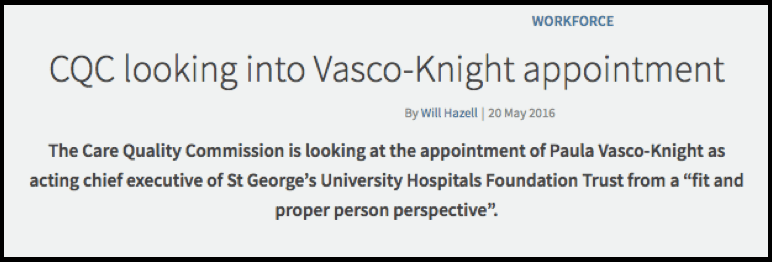
Similarly, at St Georges, Mike Richards CQC’s former Chief Inspector of Hospitals accepted questionable evidence from the trust which claimed that Paula Vasco-Knight, a chief executive who had been criticised by an Employment Tribunal for whistleblower reprisal, had learnt her lesson and was a reformed character.

FPPR closure letter by Mike Richards 16 February 2016

Whilst justice must allow for mitigation in order to call itself justice, upon what authority and evidence base did the CQC accept such improbable claims of reform? Vasco-Knight’s criminal offending and misconduct has been of a pre-meditated nature, with calculated deceit. She has shown attitudes of entitlement and repeatedly sought to blame others for her antisocial behaviour. In the whistleblower reprisal affair at Torbay, she claimed that she had been treated with ‘disrespect’ and implied that the whistleblowers had treated her less favourably because of her Race.

“on a personal level I found the allegations as nothing less than personal slander and I wonder if a white middle-class male chief executive officer would have been treated with such disrespect.”

In the criminal fraud proceedings she sought to blame a colleague from NHS England until a late stage.  Even after conviction and a suspended jail sentence, she resisted the authorities’ attempts to recover the proceeds of her crime.

Indeed, the Employment Tribunal judgment from the whistleblower scandal concluded that Vasco-Knight was not a reliable witness. 

Such a pattern of behaviour would normally raise questions about an individual’s fitness for working with children and vulnerable adults, let alone be in charge of organisation with thousands of lives in its hands.

So upon what grounds did St Georges, Mike Richards and the CQC consider themselves to be qualified to pronounce on the assessment of remorse, personality and its purported mutability in Vasco-Knight’s case?

Parole Board members must be qualified to serve and make highly complex risk management decisions about offenders. What competencies do CQC staff have to make equally serious decisions about providers’ compliance with FPPR?

Regulation 5 opens the door to mitigation in that it states that reasonable adjustment must be made for health issues that throw doubt on fitness. For example, misconduct could perhaps be mitigated by temporary loss of reason – such as an exceptional acute manic episode, when the illness is otherwise well controlled.

Regulation 5 does not state that an apparent apology and indication of regret is sufficient mitigation for past wilful misconduct and serious breaches of the NHS managers’ code of conduct.

The fact Richards et al accepted flimsy evidence of Vasco-Knight’s purported reform was a measure of their willingness to give her a pass, and not the merits of the case.


4.CQC has shown bad faith by triggering investigation of weak FPPR cases but in contrast has avoided doing so in much stronger cases, despite robust evidence from Courts.

CQC cynically triggered an FPPR investigation at Derbyshire Teaching Hospitals NHS Foundation Trust on a case which had already been rejected by the Employment Tribunal and the Employment Appeal Tribunal. Unsurprisingly, the FPPR referral was not upheld.

This led to a predictable outcry against the expenditure of massive public resource on the exercise,  and sympathy for the target of the FPPR referral.

In contrast, CQC did not trigger an equivalent investigation into an FPPR referral by fully vindicated whistleblower Dr Kevin Beatt, in whose case the ET judgment that gave very detailed findings on wrongdoing by trust directors, and by those who operated under their control. Dr Beatt is concerned that CQC did not properly explore his referral and that it failed to examine all relevant documents.  Similarly, CQC did not trigger an investigation about St George’s handling of Regulation 5 with respect to Vasco-Knight.

One interpretation of CQC’s inconsistency is that in arranging for selective investigation of a weak case, it sought to discredit whistleblowers and turn opinion against the usefulness of Regulation 5, thus laying the foundations for further inaction.


5.CQC has shown bad faith by refusing to account for its actions under FPPR and by misrepresenting its activities on FPPR

CQC has been ultra-secretive when handling many FPPR referrals. It came under criticism for ignoring referrers, taking excessive long to respond and giving little information to account for its decisions.

In the case of the Vasco-Knight referral, CQC crucially failed to inform me as the referrer of its decision, which removed the right of meaningful reply and allowed St Georges to promote Vasco-Knight from COO to CEO without any fuss and opposition.

After CQC was later caught in the glare of the scandal caused by revelations of Vasco-Knight’s fraud, it  claimed that it would it re-visit the FPPR process. It spun this line through the Health Service Journal:

Screen Shot 2018-03-27 at 13.02.01.png

This was a porkie because by that point, Vasco-Knight had been sacked by St Georges, and by CQC’s own previous claims, no longer fell under the jurisdiction of Regulation 5 because she was not a current director.

I informed Robert Francis about this irregularity by CQC:


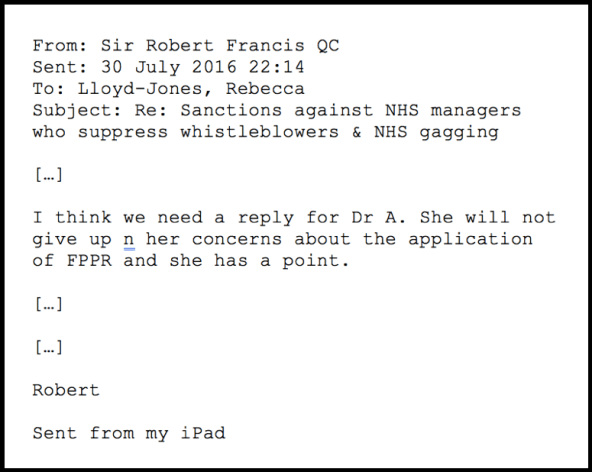
“To Sir Robert Francis QC 30 July 2016

Dear Sir Robert,

Sanctions against NHS managers

Many thanks for getting back to me, it was much appreciated.

To keep you updated, I copy below a blog that I have written about CQC’s handling of FPPR to date, which was posted yesterday.

This follows a discovery that although St. Georges made public statements about “suspending” Paula Vasco-Knight, and CQC made related comments that it was examining St George’s process for appointing her with respect to FPPR, she actually appears to have been sacked by St. Georges on the day of the suspension

The blog contains links to uploaded documents, but for convenience I attach the disclosure by St. George’s, which was sent to me on 27July.

CQC had previously, on 16 February, shut down an FPPR referral on Paula Vasco-Knight.

As CQC had previously informed me that it can only apply FPPR process to current directors, and specifically advised me that it no intention or remit to operate a disclosure and barring service for ex NHS directors who might return, I was perplexed by CQC’s subsequent announcement of its intention to re-open its examination of the FPPR process relating to Paula Vasco-Knight, if she had in fact been sacked.

With best wishes

Dr Minh Alexander

cc Katherine Murphy Chief Executive Patients Association”


Subject Access Request data revealed that he too challenged CQC about its dissembling:

Screen Shot 2018-03-27 at 12.11.27


6.CQC has violated its own policies in not treating whistleblower reprisal as a serious form of misconduct under FPPR

CQC has generated endless hot air on the importance of fostering an open culture and of protecting whistleblowers. It tells providers that they must not victimise whistleblowers or put them in fear of reprisals: 

“The arrangements should reassure staff that their concerns will be received supportively and addressed appropriately without fear of reprisals of any kind.”

But is this is sincere? CQC itself is reluctant to listen to or support whistleblowers, and so tacitly condones such behaviours by provider bodies.

CQC regularly fails to act upon about 50% of whistleblower contacts, as repeatedly evidenced in CQC board papers

CQC FOI data shows that CQC fails to act on even the most serious whistleblower disclosures

CQC insists it cannot investigate individual cases, but largely fails to investigate whistleblower clusters, even though it has powers of thematic review it has powers of thematic review

CQC has breached whistleblowers’ confidentiality but refuses to audit its practice in this area

CQC refuses to systematically inspect gags imposed by providers on workers,  which organisations use to silence disclosures and to conceal evidence of whistleblower reprisal


Indeed, CQC is too close to providers to make genuinely impartial decisions. It recruits provider directors as inspection Chairs.  Enforcing FPPR would be the equivalent of chopping off a hand – something contemplated only if something more prized may be chopped off. Also, some senior managers know where the centre has buried its bodies.

Mike Richards confirmed at the meeting in 2014 that CQC would treat whistleblower reprisal as a form of misconduct under FPPR, but added that it would depend on the seriousness of the reprisal.

But CQC has rejected FPPR referrals which raised whistleblower reprisal as an issue, even when Courts have made findings of serious reprisal. For example, in the cases of Clare sardari and Dr Kevin Beatt, both fully vindicated whistleblowers.

This is a disastrous betrayal of the public interest and of justice.

Serious whistleblower reprisal is essentially a refined form of psychological imprisonment and torture.  There are no physical walls but whistleblowers and their families are subjected to intense fear and uncertainty, usually for years. People live in fear of the next letter, phone call, false allegation or petty punishment. They are trapped in endless processes. In some cases, whistleblowers may be suspended and physically barred from access to the workplace and forbidden from contacting colleagues. The consequences of living under prolonged attack are often life changing.

The CQC is perfectly aware of the seriousness of these matters. It conducted a charade of listening to whistleblowers’ stories, which it spun with insincere sentimentality.

CQC’s trivialisation of reprisal, in its lack of action on FPPR, is therefore a wilful act.

Most seriously of all, whistleblower reprisal is a signal to others not to speak up. The CQC knows this, as demonstrated in all its copious statements acknowledging that a positive culture is needed to encourage disclosures and openness.

In “Complaints Matter” (2014) , CQC’s formal report on complaints and whistleblowing, Mike Richards made these fine sounding claims:

“We will hold health and social care services to a high standard of listening and acting on people’s concerns. We are committed to apply the same standards to ourselves and we know we need to do more to explain to people what we will do with their information if they tell us about their experience of care.”

It’s time for all of us – regulators, providers, professionals and commissioners – to make the shift to a listening and learning culture that encourages and embraces complaints and concerns as opportunities to improve the quality of care.”

In 2015 Ellen Armistead, who took over the Chair of CQC’s FPPR panel in 2016, wrote a blog on the importance of ‘Speaking Up for Whistleblowers’. 

The result of CQC improperly dismissing FPPR referrals from harmed whistleblowers is that it has made whistleblower reprisal acceptable, and CQC must be fully aware of this.

This is deplorable behaviour by a regulator which should be upholding standards.

CQC’s behaviour is further questioned by another body’s robust action over the Winterbourne View scandal. The Insolvency Service disqualified Mr Cruickshank the managing director of Castlebeck, the company which ran Winterbourne View Hospital, for not listening to whistleblowers. And that’s just for failing to listen to whistleblowers, not grossly victimising them.

CQC has acknowledged Regulation 5 was in part prompted by the failures at Winterbourne View. But what would have happened if CQC, and not the Insolvency Service, had presided over the Winterbourne View FPP issues? Mr Cruickshank  would probably have been recycled, promoted and invited to chair CQC inspections by now.

Most recently, the Public Accounts Committee noted that the number of whistleblowing disclosures to CQC had fallen, and the Committee Chair has urged CQC to investigate this.

“Even then, it must ensure the information feeding those systems is adequate to flag the early signs of poor care. That means investing time in building relationships at the frontline with Healthwatch groups, CCGs and others.

The recent decline in whistleblower numbers requires investigation; the Commission must act to understand why this has happened and ensure people can feel confident coming forward with what is often critical information.”

Comments by Meg Hillier MP 9 March 2018


But is it really surprising if health and care staff are becoming more reluctant to disclose to a regulator who may betray them?

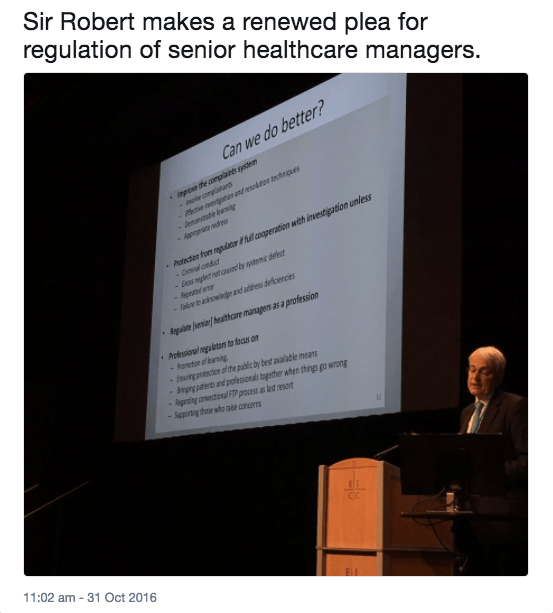
In February 2015 Robert Francis advised that FPPR should be trialled as part of the mechanisms for protecting whistleblowers, in lieu of managerial regulation. 

By October 2016 he was reported to be having second thoughts and suggesting that FPPR might need to be abandoned.

Screen Shot 2018-03-27 at 15.55.53.png

Although CQC has put on a show of reviewing its application of FPPR, the culture of the organisation and its master the Department of Health and Social Care is such that measures short of formal regulation will continue to be gamed.

It is time to re-visit managerial regulation and rein in political abuses of a public service.


RELATED ITEMS

Open letter by Clare Sardari, whistleblower, to the governors of St Georges

A Chief Inspector Doesn’t Call

FPPR: CQC has lost all moral authority but what will the National Guardian do?


National Guardian, Spin Doctors & Dodging Reform of Whistleblowing Law

By Dr Minh Alexander and Clare Sardari @SardariClare , 19 March 2018

Today, the government announced legislation that was three years behind schedule, to outlaw blacklisting of NHS whistleblowers, as if it was a triumph. 

The government is happy to allow whistleblowers this tiny crumb because it poses very little threat to power. It will hardly concern employers. Few cases will succeed, and large institutions are happy to pay compensation to rid themselves of whistleblowers.

What is needed is fundamental reform of UK whistleblowing law  to deter reprisals much more effectively, and to prevent whistleblowers from being persecuted and sacked in the first place.

We reported on 27 February that the National Freedom To Speak Up Guardian had established an Advisory Group, but this has been run tokenistically and with little transparency.

We also reported that she agreed in principle to support an event led by whistleblowers, but that this proved to have strings attached. When we submitted a proposal to lead an event on reform of ineffective UK whistleblowing law with expert speakers, her comms manager intervened. His correspondence suggested that law reform was a banned topic, and intimated that we would be on our own if we would be so naughty as to pursue our interest in law reform.

Since then, we have offered the National Guardian repeated opportunities to set matters straight, and to distance herself from such a position.

The central question put to her was:

“May we clarify if this is saying that your office will support us in running an event, but not if we seek to focus on law reform, as we have suggested?” 

We have made our boundaries clear:

“We would rather not lead an event if law reform is a banned topic.”

We have not received a straight answer.

Instead, the National Guardian’s spin doctor has twice intervened again.

He has continued to claim, incorrectly in our view, that the National Guardian has no remit for pursuing law reform.

The National Guardian will not say in black and white if she shares his view.

Arising from these exchanges, we conclude that the National Guardian is not prepared to support an event on law reform, and in doing so she will not allow expert evidence in support of law reform a fair hearing.

Her failure to listen to all the requests for law reform from whistleblowers on her own advisory group illustrates everything that is insincere about the government’s Freedom To Speak Up project.

This is the full correspondence to date with the National Guardian and her office:

Correspondence with National Guardian about whistleblower led event on law reform up to 19 March 2018

The government’s and its organs’ continuing blockade of genuine, effective whistleblowing law reform means that cover ups will continue unhindered, and that patients and whistleblowers will continue to be harmed.

delay deny road signs


RELATED ITEMS:

UK whistleblowing law is an ass: Helen Rochester v Ingham House Ltd and the complicit CQC

Deaths? What deaths? The Rt Hon Steve Barclay and the Denial Machine

By Dr Minh Alexander NHS whistleblower and former consultant psychiatrist, 11 March 2018


Steve Barclay the recently appointed Minister of State for Health and Social Care was, a leading light in the charge against David Nicholson post MidStaffs, and a fierce interrogator of the CQC’s former Labour-appointed chief officers when he was a member of the Public Accounts Committee.

Fair play to a job well done.

But equally, the political capital made out of Mid Staffs by Jeremy Hunt has been brazen and most distasteful, especially when he has refused to implement some of the most critical recommendations on safe staffing and firm deterrence of whistleblower reprisal.

Whistleblowers learn from experience that there are few lasting and dependable reference points in the complicated corridors of power.

An appeal was made to the Steve Barclay in his new capacity as Minister of State to remedy his Department’s blatant obfuscation on and negligent handling of coroners’ warnings.

After all he had, on the back benches, said many fine things about learning from disaster, and he had previously attacked failures to act upon data:

Stephen Barclay

It is correct that improvements were made in the collation of data. In fact, the Dr Foster data were published in national newspapers from 2001, but what is remarkable is that they were not acted on. That is the central charge for Ministers. We were the world leader in the collation of mortality data. We had the data, but Ministers did nothing with them.”

Hansard: Parliamentary debate 14 March 2013 on transparency and accountability in the NHS


The appeal to Barclay was backed up with evidence from many months’ work, tracing coroners’ warnings about the NHS between July 2013 and July 2017 and the system response to these warnings.

But it was not to be. There was no personal reply. Just a curt note from an official, via the ‘Do not reply’ email account, denying any mishandling. This note ended on a typically defiant trumpet solo:

“a series of actions have been put in place to ensure that safe, high quality ambulance services continues to be provided.”

Continues? Continues?! On Planet Comms with humongous side order of assorted hallucinogenics perhaps.

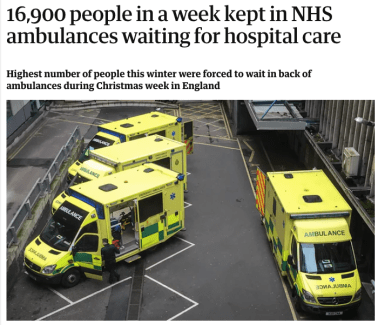
The correspondence with Barclay is provided below, as are some examples of the ‘safe, high quality ambulance services’ that the government claims it is providing.


Screen Shot 2018-03-11 at 07.53.34

16900 people in a week kept in NHS ambulances waiting for hospital care


CORRESPONDENCE WITH STEVE BARCLAY MINISTER OF STATE FOR HEALTH AND SOCIAL CARE ABOUT CORONERS’ WARNINGS (PFDs):

From: Department of Health and Social Care <donotreply@dh.gsi.gov.uk>

Subject: From the Department of Health and Social Care

Date: 9 March 2018 at 12:29:08 GMT

To: “Alexander, Minh” <*************************>


Our ref: DE-1119800


Dear Dr Alexander,

Thank you for your correspondence of 13 February to Stephen Barclay about the Department’s handling of reports on action to prevent future deaths issued by coroners.  I have been asked to reply.


The Department does not accept your assertion that the reports are mishandled and I was sorry to read that you feel the reports are not taken seriously.  This is not the case.  I am aware that the Department has corresponded with you on this matter previously and refer you to the response given on 10 October 2017 (our reference DE-1096208).


I can assure you that the Department takes very seriously its statutory duty to respond to reports on the prevention of future deaths.  The reports play a valuable role in bringing serious matters of concern to the attention of the appropriate bodies that have the ability to take action to prevent avoidable harm.  As explained previously, the Department ensures that the relevant regulators and other bodies are made aware of the matters of concern brought to its attention so that the system can respond as appropriate.


Patient safety is a priority for this Government and learning lessons where things have gone wrong is essential to ensuring the NHS provides safe, high quality care.  Responding effectively to matters brought to its attention through the inquest process is a recognised and important part of this.  I would point out that coroner’s reports and their responses are publicly available once published by the Chief Coroner, thus bringing transparency to the process.


With regard to your concerns about the East of England Ambulance Service NHS Trust, the Department is aware that concerns have been raised about the trust, including questions about whether delays to ambulance responses have caused additional harm to patients during significant demand pressures experienced over the Christmas period.  We take seriously any claims that there was detriment to patients, and have ensured that quick action has been taken to examine these.  The trust has identified any potential cases where there were serious delays, and following an initial investigation the trust is examining 22 cases through the ‘serious incident’ procedure.  This process is being independently assured.


Additionally a risk summit has been held with the input of NHS Improvement, NHS England and the Care Quality Commission, and a series of actions have been put in place to ensure that safe, high quality ambulance services continues to be provided.


I hope this reply is helpful.
Yours sincerely,

Ellie Boyle
Ministerial Correspondence and Public Enquiries
Department of Health and Social Care


————————————————————————————————————————-

Please do not reply to this email. To contact the Department of Health and Social Care, please visit the Contact DH section on Gov.uk

To receive news about DH: sign up to our monthly newsletter


This e-mail and any files transmitted with it are confidential. If you are not the intended recipient, any reading, printing, storage, disclosure, copying or any other action taken in respect of this e-mail is prohibited and may be unlawful. If you are not the intended recipient, please notify the sender immediately by using the reply function and then permanently delete what you have received.

Incoming and outgoing e-mail messages are routinely monitored for compliance with the Department of Health’s policy on the use of electronic communications. For more information on the Department of Health’s e-mail policy click here http://www.dh.gov.uk/terms
This email was scanned by the Symantec virus scanning service and was certified virus free.
Communications may be automatically logged, monitored and/or recorded for legal purposes.

From: Minh Alexander <minhalexander@aol.com>

Subject: Government mishandling of coroners’ warning reports on action to prevent future deaths

Date: 13 February 2018 at 06:23:18 GMT

To: Steve Barclay *************************

Cc: Brian Jarman <**************************>, julie bailey <*************************>, heather wood <*****************************>


BY EMAIL


Mr Steven Barclay


Minister of State


Department of Health and Social Care


13 February 2018


Dear Mr Barclay,


Government mishandling of coroners’ warning reports on action to prevent future deaths


I write to ask what action you think the Department of Health should take in respect of my findings on mishandling of coroners’ warnings by the Government and its arms length bodies.


The full report of my findings can be found here: Safe in their hands? Government’s response to coroners’ warnings about the NHS


The Centre for Health and the Public Interest ran a blog which summarised the findings: Lives at risk. The Government’s inadequate management of coroners’ warnings about the NHS


In short, it seems to me that the Government and its arms length bodies have not taken coroners’ warnings seriously enough and that this has had the effect of concealing serious unmet need and mounting NHS crisis. In particular, there is a trend of deteriorating ambulance safety, which triangulated with other parameters such as numbers of complaints, serious untoward incidents and other performance data, which all should have been acted upon a lot sooner to avert the shocking events that we have just seen with respect to the East of England Ambulance Service.*


I myself live in the same area with a very ill husband. Having spent hours last winter in A&E with my husband on a trolley, I have no confidence that struggling emergency services can reliably meet our needs. I hope you can understand how terrifying that is.


I understand that you were previously very critical of flawed and reckless NHS leadership which covered up safety problems and led to the Mid Staffs disaster **. I hope you will act to ensure that unmet need does not continue to be swept under the carpet by this Government.


With best wishes,


Dr Minh Alexander


cc Prof Sir Brian Jarman

Julie Bailey Cure the NHS

Dr Heather Wood


East of England Ambulance delays linked to 81 deaths


**Police should investigate Labour ministers over Mid Staffs


National Guardian’s Stakeholder Advisory Group: Speaking Up only when permitted?


By Dr Minh Alexander and Clare Sardari @SardariClare , NHS whistleblowers, 27 February 2018


In October 2016 the National Guardian told the Health Service Journal that she intended to establish a stakeholder advisory group:

“She said the cases the office would look at would be decided by a “stakeholder advisory group”, which would include people with experience of whistleblowing.”

However, the advisory group was not established until after the National Guardian and CQC had finalised the processes for selecting whistleblower cases for review, raising questions of tokenism.

The first advisory group meeting took place on 3 November. About 25 people attended. Most of the meeting time was devoted to the National Guardian’s Office’s pre-determined issues. This hugely expensive meeting, which took up the costly time of senior NHS managers, served mainly to change just a few sentences in the National Guardian’s terms of reference and ‘values and expectations’ document for the group itself.


National Guardian’s terms of reference for the advisory group, December 2017

National Guardian’s ‘Values and Expectations’ for the advisory group December 2017


There was limited meeting time devoted to what advisory group members considered should be the work of the National Guardian’s Office, but in that time almost all whistleblowers present indicated that they wanted to see reform of very inadequate UK whistleblowing law.


Communications:

Despite advisory group agreement that:

  • The minutes of the meeting should be detailed enough to reflect the discussions and table notes, and provide meaningful information for whistleblowers and others who were not able to attend the meeting;


  • Details of the advisory group membership would be included in the meeting minutes for transparency,

the minutes of the meeting, sent out on 13 December 2017 , were minimal with no attendance or membership details. Neither was there any mention about the discussion that had taken place about the need for meeting minutes to be informative and so inclusive of all whistleblowers interested in the work of the group.

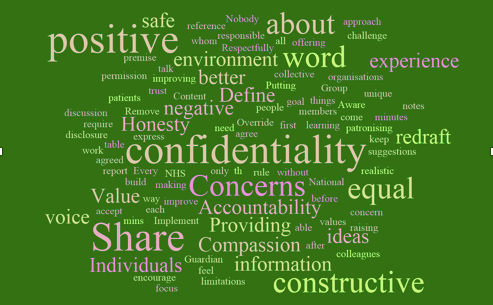
Ideas contributed by group members were largely reduced to ‘word clouds’. For example, this was the word cloud for ‘What matters to you?’, which made no mention of law reform:

Screen Shot 2018-02-26 at 12.47.04


A list of members was finally provided on 29 January 2018:

 List of members of National Guardian’s advisory group


The stakeholder advisory group will meet only four times a year. It is too large to allow more than superficial discussion.

Based on events so far, the advisory group is likely to be just another fig leaf for a programme which the government has no intention of changing, no matter what whistleblowers say.

A suggestion on the 3 November 2017 was that the National Guardian should set up an electronic noticeboard, where advisory group members could post ideas and carry on discussions between meetings. This idea is not mentioned in the meeting minutes and no such facility has been established. But then, why foster a community with alarming tendencies to independent thought if what is required is a rubber stamp?


Power:

A persistent power dynamic of the Freedom To Speak Up project is that whistleblowers are have been repeatedly patronised, and fobbed off, and treated more as passive subjects who are expected to fit around whatever systems and processes are presented to them.

In an attempt to shift this dynamic, we asked the National Guardian at the meeting of 3 November 2017 to consider allowing whistleblowers to lead an event. The reply was affirmative, subject to agreement of details.

The response became less affirmative after we submitted a proposal to lead an event on reform of UK whistleblowing law, the Public Interest Disclosure Act (PIDA). Our proposal was passed to a comms manager who claimed that law reform was not part of the National Guardian’s remit.

However, the National Guardian is free to pursue any issue that may be a barrier to speaking up in the NHS, as was made clear by the Care Quality Commission’s position specification:

“The National Guardian will have a highly visible role in providing support to the system. This will include the sharing of good practice, reporting on common themes in concerns raised and actions taken, identifying barriers to improvement and how these might be overcome, and reporting on progress towards the creation of a safe and open culture.”

The comms manager also declined to provide practical support with sending out invitations, on this creative basis:

“You asked for assistance in sending out invitations and distributing an ‘event pack’. We think that this might compromise the independence of the event so feel that invitations may be better coming from you.”

Appearing to contradict himself, he stipulated that the National Guardian’s Office would only help promote the event after vetting any materials:

“We would, of course, be happy to promote the event to our stakeholders, though any material we use for that will need to go through our normal communications quality assurance process.”

Finally, he required that any event led by us should reflect the Office’s aims:

“…we must be mindful that resources that are used for this event should also advance the general aims of the National Guardian’s Office.”

All this seems to ironically suggest that speaking up within the National Guardian’s advisory group process is only allowed on permitted topics. If so, this defeats the purpose of the group.

The National Guardian herself has been asked to clarify her Office’s position. Her initial response did not provide clarification, and a further request has been made:

National Guardian correspondence about whistleblower led event


Law Reform:

Law reform is key to enforcing good practice and driving culture change.

The National Guardian refused a year ago to seek law reform based on a flawed argument (originally advanced by the government and supported by Robert Francis) that work on culture change should take priority over law reform.

“I do understand the views of campaigners who say that the current legislation requires reform. However, we are not currently seeking to campaign for changes to the law. Instead, we will be working collaboratively with a wide range of bodies to deliver a reformed NHS culture where freedom to speak up is ingrained and becomes ‘business as usual’

Letter by Dr Henrietta Hughes 16 February 2017

It would be disappointing if the National Guardian ignores her own advisory group and continues in this position, without even listening to expert evidence and debate about the need for law reform.


RELATED ITEMS

Sir Robert Francis and Reform of Whistleblowing Law

UK Whistleblowing Law is an Ass: Helen Rochester v Ingham House Ltd and the Complicit CQC

Professor David Lewis Middlesex University ‘Whistle-blowers should be encouraged, protected by law’


PIDA ASS (2)

Letter to Dido Harding Chair of NHS Improvement about un-gagging NHS whistleblowers

By Dr Minh Alexander NHS whistleblower and former consultant psychiatrist, 22 February 2018


The government is reluctant to let go of gagging in the public sector. It is a useful political tool of control, and very handy when embarrassing policy failures need to be minimised and covered up.

The CQC has blatantly dragged its feet and effectively refused to regulate NHS employers’ abuses through the gagging of staff, including whistleblowers:

NHS Gagging: How CQC sits on its hands

However, the NHS’ liberal use of secrecy clauses is causing karmic chaos with respect to the employment support scheme for sacked whistleblowers. Super-gagged whistleblowers cannot access the scheme because they cannot disclose all the necessary information as part of the application process.

More Loopholes in Jeremy Hunt’s Secret ‘Support’ Scheme for Whistleblowers

NHS Improvement (NHSI) and NHS England have resisted seeking a government waiver. A government waiver is still needed as the latest workaround proposed by NHSI, as an alternative to a government waiver, is flawed.

I have asked the Chair of NHSI seek a government waiver and also that NHSI indemnifies any whistleblowers who decide to risk breaking gags on the basis of assurances obtained by NHSI.

The correspondence, including a draft letter by NHSI to NHS trusts about gagged whistleblowers’ participation in the employment support scheme, is provided below.


BY EMAIL

Dido Harding

Chair of NHS Improvement

22 February 2018


Dear Dido,

NHS whistleblower employment scheme – provision for gagged whistleblowers

Thank you for your prompt response of 10 February 2018 to mine of 5 February 2018 on this issue, both copied below.

At a Design and Monitoring Group (DMG) of the Employment Support Scheme (ESS) on 19 February, NHS Improvement (NHSI) informed whistleblowers that its letter to trusts about gags was to be circulated the next day. I asked to see the letter and was advised that a copy would be shared after circulation. On 21 February NHSI decided to share a draft copy of the letter with the DMG and to invite comments.

I do appreciate the effort made to further accommodate the needs of gagged whistleblowers, and acknowledge that this matter predates your arrival, but NHSI’s draft letter does not appear to present a clear solution.

NHSI’s draft letter asks trusts to declare whether they have clauses in settlements that might prevent whistleblowers from applying to the ESS. Legally, trusts that have entered into mutual super-gags, cannot even reveal the existence of such settlement agreements.

Super-gags are usually mutual. Indeed, NHS Employers’ current guidance includes as standard, the use of a mutual super-gag in its template settlement agreement:

“1.2 The Employer shall use its reasonable endeavours to ensure that its directors, officers, agents and employees shall not divulge the fact of, negotiation, nature and/or terms of the Agreement except to its professional advisers in connection with the conclusion of this Agreement or where required by any competent authority or Court of Law or HM Revenue & Customs or as otherwise required by law.”

I am also concerned that NHSI’s draft letter to trusts lacks clarity and presents unfeasible risks to whatever meagre financial security, dependent on strict compliance with gags, is left to whistleblowers. Perhaps an opinion from senior Treasury lawyers may assist.

Notwithstanding, NHSI’s letter to trusts will not substantively move the situation forward. The NHSI ESS manager informed whistleblowers that NHSI was implementing the above workaround as it would “take too long” to implement a government waiver. However, I see no option but a government waiver because of the tight legal seals on super-gagged NHS whistleblowers. If a government waiver had been sought when I first raised it, with NHS England, in January 2017, and subsequently with NHSI in February 2017, we might not be in the position we are now.

I wonder if NHSI could:

  1. Seek a government waiver to release trusts and whistleblowers who are gagged and super-gagged. As both the Secretary of State and Minister of State have been vociferous past critics of gags in the NHS, I would hope that the Department of Health and Social Care would look on this favourably.

2013 letter from Jeremy Hunt exhorting NHS trusts to check secrecy clauses in settlement agreements, with respect to learning the lessons from MidStaffs

2013 report of the Public Accounts Committee, of which Mr Steven Barclay was a member, on on Confidentiality Clauses and Special Severance Payments

Article by Mr Steven Barclay from his constituency website: Uncovering £4m of secret NHS Payoffs to gag potential whistleblowers


  1. For those gagged whistleblowers willing to take the risk of applying to the ESS on the strength of assurances obtained from employers by NHSI, indemnify them against any further action by their former employers including any attempt to recover settlement payments.


Regarding the continuing lack of an employer pool to offer trial employment to sacked whistleblowers, as recommended by Robert Francis, please see my letter to NHS Improvement about the current state of play.

A properly established, safe pool of employers is a key and urgent need. Whilst NHSI says it has been making ad hoc arrangements for some of the seven whistleblowers taking part in the pilot phase (and I am aware that at least two of these people have so far had no offers of trial employment from NHSI), this is not a good basis for safe re-entry. NHSI itself accepts the principle that employers must be properly vetted, as the last thing that whistleblowers need is to be mistreated all over again. As you will see from my above letter to NHSI, not even a draft checklist for vetting employers has been produced yet, so it is hard to understand how exactly NHSI has vetted trusts that have been approached as part of the pilot phase of the ESS. I hope that NHSI can commit to a clear action plan for establishing an employer pool, with timescales for key tasks, as requested.


With best wishes,

Minh

Cc

Jeremy Hunt Secretary of State for Health

Steven Barclay Minister of State for Health and Social Care


NHS IMPROVEMENT’S DRAFT LETTER TO TRUSTS ABOUT GAGS AND THE NHS WHISTLEBLOWER EMPLOYMENT SUPPORT SCHEME:

“To Directors of HR/Workforce in NHS trusts and NHS foundation trusts

You will be aware that we are piloting an whistleblowing support scheme (WSS) for former NHS staff who have raised concerns and are trying to get back into NHS employment, as recommended in Sir Robert Francis’s Freedom to Speak up review. For further detail on the WSS please see attached briefing pack and the link to our webpage at https://improvement.nhs.uk/resources/freedom-to-speak-up-whistleblowers-support-scheme/.

We are advised that some former NHS staff who want to apply for the scheme believe they cannot do so as a result of clause(s) in their settlement agreements.  This appears to be preventing access to the scheme for some relevant former NHS staff.  We would therefore like you to advise us as to whether you have any clauses in settlement agreements with former employees which you would enforce, and which would prevent those employees from completing the WSS application process.   Assuming not, this will then enable us to communicate that your trust would not take action against any former employees for divulging necessary information to complete an application for the scheme. The scheme application form is attached so that you can review the questions asked and documentary evidence required within the application process.

Please use one of the following sentences for your email response to 


NHSI.wbss@improvement.nhs.net by Friday 23 March

1.       The trust has no clauses in settlement agreements with former employees which we would enforce, and which would prevent those employees from completing the WSS application process.

2.       Yes, the trust has clauses in settlement agreements with former employees which we would enforce, and which would prevent those employees from completing the WSS application process.

Any queries should be directed to Wendy Webster WSS Manager at  NHSI.wbss@improvement.nhs.net in the first instance.

Separately, if you have not already committed your support to the scheme (see slide 6 of the attached briefing pack) I would encourage you to do so by contacting Wendy Webster at the email address above.

Best wishes

Maria

Maria Robson | Head of Trust Resourcing”


From: “HARDING, Dido (NHS IMPROVEMENT – T1520)” <*********************>

Subject: Re: NHS whistleblower employment scheme – provision for gagged whistleblowers

Date: 10 February 2018 at 13:55:09 GMT

To: Minh Alexander <********************>


Dear Dr Alexander,

Thank you for your email of 5 February 2018 and I note your comments and concerns. The issue of “gagging clauses” is under discussion between the Whistleblowing Support Scheme lead, Maria Robson and NHS Improvement’s legal advisers and as I shared in a recent meeting, consideration is being given as to how we can ensure that all whistleblowers can access the Whistleblowing Support Scheme.

We are hoping to be able to obtain confirmation from NHS trusts and foundation trusts as to whether they have any clauses in settlement agreements with former employees which would prevent those employees from completing the Whistleblowing Support Scheme application process. We intend to attach the scheme application form so that organisations can fully consider the questions asked and documentary evidence required within the application process. Where organisations confirm that there are clauses in settlement agreements that would prevent their former staff from applying for the scheme, we will then be in a position to follow up this issue with individual trusts and suggest proposed work arounds that ensure full access to the scheme by individuals. These work arounds could include for example, a written assurance that referencing the settlement agreement when completing the application form will not lead to any action by the trust against the individual.

Assuming the current internal conversations are satisfactorily concluded, we anticipate contacting trusts before the end of the month with responses required before the end of March 2018 to give organisations a realistic opportunity to check their records and consider their responses (with their own legal advisors if necessary) before replying. I understand you are a member of the Whistleblowing Support Scheme group, and Wendy Webster has advised that this will be a subject of discussion at the next meeting.

With regards to your concern regarding “a pool of NHS employers,” I understand that there have been discussions at the monthly Design and Monitoring Group meetings, outlining the three employer events during which NHS employers were invited to and did make commitments to support the scheme. The events were very well attended which not only raised the profile of the pilot schemes developed by NHS Improvement and NHS England but also encouraged employers to consider what support they could give to participants on the schemes including access to libraries, training, placements etc. Trusts within the locality of current pilot participants have been contacted directly to consider and offer opportunities within their organisations as part of the pilot scheme. The commitments already made by other trusts will be further explored as part of the development of the main scheme.

NHS Improvement and NHS England continue to work and engage with other organisations such as the National Guardians office, NHS Employers and the Care Quality Commission to address and resolve some of the barriers for whistleblowers resuming their careers.

We welcome and value your continued input and that of other whistleblowers to help us learn from the pilot scheme and develop a successful main scheme.

Many thanks and Best Wishes

Dido


From: Minh Alexander <********************>
Date: Monday, 5 February 2018 at 12:33
To: “HARDING, Dido (NHS IMPROVEMENT – T1520)” <********************>
Subject: NHS whistleblower employment scheme – provision for gagged whistleblowers


BY EMAIL

Dido Harding

Chair of NHS Improvement

5 February 2018


Dear Ms Harding,

NHS whistleblower employment scheme – provision for gagged whistleblowers

I write to ask if you could kindly advise on NHS Improvement’s arrangements and plans regarding this important matter.

Gagging of staff with secrecy and non-disparagement clauses remains a widespread problem in the NHS, and many whistleblowers are forced into accepting compromise agreements as the only option available for total avoiding financial ruin.

Some trusts such as Mersey Care NHS Foundation Trust, Imperial College Healthcare NHS Trust, East Lancashire NHS Trust and Liverpool Community Health NHS Trust have revealed via FOI that they have super-gagged hundreds of staff through clauses in compromise agreements which forbid signatories from revealing the very existence of the compromise agreements. Mersey Care NHS Foundation Trust alone accounted for 443 super-gags over a five year period.

Robert Francis recommended in his report of the Freedom To Speak Up Review that the Care Quality Commission should monitor NHS employers’ use of compromise agreements, but the CQC has shown great reluctance and there is no evidence that it has done so.

Indeed, NHS Employers publishes a template for compromise agreements which include such super-gags.

NHS whistleblowers who are super-gagged may not talk about the contents of their compromise agreements or the existence of agreements. They may also be subject to clauses preventing them from contacting their former employer about employment matters.

This makes it impossible for super-gagged whistleblowers to access the NHS whistleblower employment scheme.

Both NHS England and NHS Improvement were warned about this long ago but failed to address this issue. This has compounded already very serious delay in establishing the scheme, despite the scheme being recommended as an ‘urgent’ measure by Robert Francis in February 2015. *

It is clear that neither body truly understands the issues or is willing to seek a much-needed government waiver. This lack of understanding has been evidenced by the fact these bodies have floundered and given very foolish, unfeasible advice when challenged about their lack of proper preparation.

I understand that you recently advised in a meeting that NHS Improvement believes it may be approaching some sort of legal fix.

I would be grateful if you could you give more information about NHS Improvement’s work in progress, who is leading it and what the timescale is for resolution.

For completeness I should also let you know that there is still no sign of

of a ‘pool’ of NHS employers prepared to offer trial employment to persons being supported through the scheme”

as originally recommended by Robert Francis. This is despite repeated enquiries and corresponding assurances that NHS England and NHS Improvement were working to establish a pool. The most recent response from NHS England appeared dismissive of the need for a properly established, structured and fair system.

NHS England minimised the failure to establish a pool to date on the basis that as so few whistleblowers had applied, that it was possible to make ad hoc approaches to employers. This is not good equal opportunities practice, and serious concerns have already been raised about the scheme’s adherence to equal opportunities principles.

NHS Improvement has not so far commented in response to the most recent queries about the failure to establish an employer pool.

Many thanks,

Dr Minh Alexander


*Robert Francis’ urgent February 2015 recommendation for the establishment of a scheme to support whistleblowers back into employment, page 153 of the Freedom To Speak Up Review report:

“7.3.8

Beyond that, I believe that there is an urgent need for an employment support scheme for NHS staff and former staff who are having difficulty finding employment in the NHS who can demonstrate that this is related to having made protected disclosures and that there are no outstanding issues of justifiable and significant concern relating to their performance. This should be devised and run jointly by NHS England, the NHS Trust Development Authority and Monitor. As a minimum, it should provide:

  • remedial training or work experience for registered healthcare professionals who have been away from the workplace for long periods of time


  • advice and assistance in relation to applications for appropriate employment in the NHS


  • the development of a ‘pool’ of NHS employers prepared to offer trial employment to persons being supported through the scheme


  • guidance to employers to encourage them to consider a history of having raised concerns as a positive characteristic in a potential employee.”


Concerns about Liverpool John Moores University’s evaluation of the NHS Whistleblower Employment Support Scheme

By Dr Minh Alexander and Clare Sardari @SardariClare  21 February 2018


Concerns about NHS England’s and NHS Improvement’s whistleblower employment support schemes rumble on, including from the man who came up with the idea, Robert Francis:

At the NHS Improvement Soup Kitchen

Jeremy Hunt’s Secret Whistleblower (Non-Employment) Scheme

More loopholes in Jeremy Hunt’s ‘support’ scheme for whistleblowers

Comments by Robert Francis on 7 November 2017

Correspondence with an NHS England manager about the whistleblower employment support scheme and issues of equity

Letter to NHS Improvement about continuing delay in establishing an employer pool and lack of equal opportunities process


The evaluation of the scheme commissioned from Liverpool John Moores University by NHS England and NHS Improvement is now part of the concerns.

A letter has been sent today to the University about these concerns.


BY EMAIL

Research Ethics Unit

Liverpool John Moores University

21 February 2018


Dear Sir,

Concerns about Liverpool John Moores University’s evaluation of the NHS Whistleblower Employment Support Scheme

We write to raise concerns about the operation of Liverpool John Moores University’s online evaluation of NHS England and NHS Improvement’s whistleblower employment support scheme. (ESS).

Please see copied in the appendix below the University webpage which gives access to its online evaluation survey about the ESS, and the online evaluation survey questions.

Our concerns about the University’s evaluation of the ESS are as follows:


  1. Lack of meaningful, properly established measurement

It has been revealed that although the evaluation by the University was meant to be predicated on KPIs set by NHS England, no such KPIs have actually been set.

On 8 September 2017 NHS England circulated a ‘High Level Plan’ on evaluation of its ESS by the University which referred to KPIs set by NHS England.

Subsequent repeated enquiries, initially to the University and then to NHS England, failed to reveal what these KPIs were. Eventually, on 29 January 2018, NHS England answered thus:

“Dear Minh

Thank you for your message. 

 The outcome we are seeking from Working Transitions is the provision of a support service to the current participants on the pilot scheme in line with their personal development plan.  Each participant, through engagement with their coach,  develops a bespoke package of support and a personal development plan. This plan is monitored by WT and is confidential between each individual on the scheme and Working Transitions. We have asked that WT report to us on the timing of the development of the action plans, but not the content.

We also hold regular financial and other contract assurance meetings and have ongoing quality improvement conversations with Working Transitions which help shape the support scheme for the benefit of all the participants. As a result of this engagement activity we have made some live changes to the pilot scheme.  

In moving forward as we reflect on the learning from the pilot scheme and move to the final programme of support we anticipate that we will set formal KPIs in the following areas: 

A financial KPI to ensure that the provider works within the budget allocation

A KPI relating to the establishment of the first coaching session

A KPI relating to the development of the action plan (which will probably be by the third coaching session)

A KPI relating to the delivery of the individual development plan.

Sent with kind regards

 Kate,

On behalf of

Whistleblowing Support Scheme

Freedom to Speak Up Programme Team

Experience Participation and Equlaities Group |Nursing Directorate |NHS England”


That is, NHS England effectively admitted that although the University’s evaluation of the ESS had commenced, no KPIs had been set for the ESS.

Partly in consequence of the above, the University’s evaluation will be measuring data that is not meaningfully standardised and therefore not comparable or easily interpretable. Instead, it will be more akin to anecdote gathering.

At an NHS Improvement event on 22 September 2017 attended by Daz Greenop, Daz was asked by whistleblowers to ensure that the evaluation was designed with reference to the original goals set for the ESS in the Freedom To Speak Up Review, which the Government accepted.

 “Whistleblowers stressed the importance that the evaluation should be grounded in the original recommendations of the Freedom To Speak Up Review” 

This does not appear to have happened.

There is no specific reference in the University’s evaluation questionnaire to the essential components of the original Freedom To Speak Up Review recommendations, which included:

  • remedial training
  • trial work experience
  • access to a pool of employers


Report of the Freedom To Speak Up Review 11 February 2015 regarding a re-employment scheme for whistleblowers:

7.3.8 Beyond that, I believe that there is an urgent need for an employment support scheme for NHS staff and former staff who are having difficulty finding employment in the NHS who can demonstrate that this is related to having made protected disclosures and that there are no outstanding issues of justifiable and significant concern relating to their performance. This should be devised and run jointly by NHS England, the NHS Trust Development Authority and Monitor. As a minimum, it should provide:

• remedial training or work experience for registered healthcare professionals who have been away from the workplace for long periods of time


• advice and assistance in relation to applications for appropriate employment in the NHS


• the development of a ‘pool’ of NHS employers prepared to offer trial employment to persons being supported through the scheme


• guidance to employers to encourage them to consider a history of having raised concerns as a positive characteristic in a potential employee.”


Instead, the University’s evaluation questionnaire asks questions about matters of subjective experience. Again, this will end up with much anecdote and not enough hard performance data.

The University’s evaluation will not properly measure what the ESS was established to do.

The University will effectively not be conducting a comprehensive, rigorous evaluation despite whistleblowers pointing out relevant source material, and it will risk giving the government a soft ride.

For the University’s information, NHS Improvement and NHS England continue to seriously fail in their delivery of basic components of the ESS, and it is arguably somewhat nonsensical to be evaluating the scheme in this context:

https://minhalexander.com/wp-content/uploads/2018/02/nhs-improvement-letter-to-wendy-webster-employer-pool-20-february-2018.pdf

Sir Robert Francis, the author of the Freedom To Speak Up Review, has been critical of NHS England and NHS Improvement’s handling of the ESS:

https://minhalexander.com/wp-content/uploads/2017/11/francis-culture-and-conduct-comments-7-11-2017-transcript.pdf


  1. Equity of access to the evaluation

The University has not taken sufficient responsibility for ensuring appropriate distribution of the link to its online evaluation survey, and has thereby allowed NHS England and NHS Improvement to potentially skew the results in their favour by restricting access to groups who are likely to be less critical.

A formal complaint is currently being processed by NHS Improvement about the fact that NHS Improvement did not share the link to the evaluation survey with the official group of stakeholders (mostly whistleblowers) whom it established to help steer the ESS, nor did it publish the link on its relevant webpage about the ESS.

Instead, NHS Improvement gave the link to a small number of whistleblower groups that have been less challenging of the scheme.

This irregularity was discovered through a third party, after which NHS Improvement was questioned about its actions.

Moreover, NHS Improvement was asked to advertise the scheme in the national press but has failed to do.

The University’s evaluation will be skewed by NHS Improvement and NHS England’s omissions in not adequately publicising the scheme and its evaluation.

We ask that the University should at the very least acknowledge this major methodological flaw when it produces its report.


  1. Sampling bias

At the above NHS Improvement event of 22 September 2017 attended by Daz Greenop, Daz was asked by whistleblowers to address a fundamental issue of sampling:

“…issues of sampling should be considered – did NHS England identify all whistleblowers who had been harmed and needed the service?” 

Daz accepted on 22 September 2017 that this was a significant issue.

But there appears to be nothing in the materials shared so far about the University’s methodology to demonstrate that it has given specific thought to this issue or that it has taken steps to reflect this issue in its methodology.

We ask that at the very least, this sampling bias is reflected in the University’s final report.


Briefing by the University to NHS Improvement

Lastly, we have been informed by the NHS Improvement ESS manager that the University has been providing regular ‘verbal updates’ to NHS Improvement about its evaluation and that these are reportedly ‘positive’.

The University has also reportedly disclosed to the NHS Improvement ESS scheme manager that an individual in Australia has taken part in its evaluation.

Please can the University advise what the rationale is for releasing such informal updates prior to final report.

This is with particular reference to the following passage from the University’s Code of Practice for Research:

3.15.1 Researchers should accept their duty to publish and disseminate research in a manner that reports the research and all the findings of the research accurately and without selection that could be misleading.”

Please can the University also confirm that it is abiding by its commitments to confidentiality for those who participate in its evaluation.


Yours sincerely,

Dr Minh Alexander

Clare Sardari

NHS whistleblowers and members of NHS Improvement’s ESS Design and Monitoring Group


Cc

Prof Raphaela Kane JMLU Head of Faculty

Dr Daz Greenop JMLU


UPDATE 26 FEBRUARY 2018

Despite previous objections, NHS Improvement’s consent paperwork for the Employment Support Scheme remains coercive and requires participation in evaluation research as part of signing up for the scheme:

 NHS Improvement’s ‘Learning Agreement’, which whistleblowers must sign when joining the employment support scheme

FAQs produced by NHS Improvement for whistleblowers assumes participation in the evaluation research and does not make it clear that whistleblowers may refuse to take part in the evaluation if they so choose.

NHS Improvements FAQs for whistleblowers about the employment support scheme

I have again protested and copied the correspondence to Liverpool John Moores University, to make the University aware that it is conducting research on subjects who may not be freely consenting:

Letter 26 February 2018 to NHS Improvement Wendy Webster re coercive scheme consent paperwork

Further correspondence with NHS Improvement Wendy Webster about consent paperwork 26.02.2018

Dr Minh Alexander


APPENDIX

Liverpool John Moores University webpage for the online evaluation survey about the NHS whistleblower employment support scheme:

https://ljmu.onlinesurveys.ac.uk/whistleblowers-support-scheme-error-copy

Whistleblowers Support Scheme

Page 1: Participant information

We are currently evaluating the Whistleblowers Support Scheme but are also interested in the work-related / work-seeking experiences and activities of whistleblowers who are not participating in the pilot. If you are a NHS whistleblower and NOT participating in the Whistleblowers Support Scheme we would love to hear from you but before you decide it is important that you understand why this questionnaire is being done and what it involves. Please take time to read the following information. Take time to decide if you want to take part or not.

What is the purpose of the questionnaire?

The purpose of this anonymous online questionnaire is to gain broader views of the work-related / work-seeking experiences and issues facing whistleblowers in the NHS. We are also interested in why people did not participate in the pilot and how enquiries about it were managed.  The questionnaire is not about your whistleblowing experience but it is hoped that learning from this evaluation will help to inform and improve recruitment processes and implementation of future schemes.

Do I have to take part?

No. It is up to you to decide whether or not to take part. If you choose to participate anonymously you are still free to withdraw at any time before or during completion of the questionnaire without giving a reason. However, because the questionnaire is anonymous, you cannot withdraw after your responses have been submitted. If you choose to include contact details you may withdraw at any time up to the completion of the first draft of the evaluation report. A decision to withdraw will not affect your rights or any future support you receive.

What will happen to me if I take part?

The questionnaire asks about your work related experiences, activities and support needs. We are also interested in understanding why you did not apply for the programme. The questionnaire should take around 30 minutes to complete but this depends on how much you wish to write. Once we have received responses the information will be analysed thematically and used in a report for the NHS (and potentially other publications and presentations). We may also use direct quotes from open text comments but you will not be identifiable. We hope to talk to a small random sample of respondents so if you wish to provide contact details at the end of the questionnaire we may contact you again in four-six months time for a telephone interview. Questionnaires will be securely stored on password protected computers for five years after completion in accordance with LJMU policy and the Data Protection Act 1998.

Are there any risks / benefits involved?

There are no risks or benefits involved. However, your participation in the evaluation will help to inform the implementation of future support schemes. If for some reason you become uncomfortable or distressed during the questionnaire you can simply terminate the questionnaire without needing to submit or explain. Your Freedom to Speak Up Guardian should be contacted if additional support and advice is needed.

Will my taking part in the study be kept confidential?

Yes. We take confidentiality very seriously. We do not need your name or any personal information. However, if you wish to be considered for interview, please provide your preferred contact details at the end of the questionnaire. Again, this will be securely stored and not shared with anyone outside the LJMU evaluation team.

This project has received ethical approval from LJMU’s Research Ethics Committee: 17/NAH/019

Contact Details of Evaluators:

D.T.Greenop@ljmu.ac.uk 0151 231 4033

P.B.Clarke@ljmu.ac.uk 0151 231 4450

If you have any concerns regarding your involvement in this project, please discuss these with the researcher in the first instance.  If you wish to make a complaint, please contact researchethics@ljmu.ac.uk and your communication will be re-directed to an independent person as appropriate.


Page 2: Questions

I have read the information sheet provided and I am happy to participate. I understand that by completing and returning this questionnaire I am consenting to be part of this evaluation and for my data to be used as described in the information sheet provided

1.Your professional background

Clinical

Non-Clinical

a.What was your occupation and grade at the time you made your Protected Disclosure / raised concerns?


2.When did you make your Protected Disclosure / raise concerns?

Less than 12 months ago

1-2 years ago

3-5 years ago

6-10 years ago

Over 10 years ago


3.Did you contact your Freedom To Speak Up Guardian?

Yes (go to question 3a)

No (go to question 4)

a.What information were you given?

None

Written

Online

Verbal

This part of the survey uses a table of questions, view as separate questions instead?

i.How  was your query dealt with?

Please don’t select more than 1 answer(s) per row.

Strongly agree Agree Disagree Strongly disagree
Response was timely
Response was friendly
Response was non-judgemental
Response was clear
Response was helpful

a.Please use this space if you wish to explain your ratings


4.What is your current employment status? Please select as many as apply to your current circumstances

Unemployed

Sick

Suspended

Self-employed

Temporary contract

Agency work

Permanent

Full-time

In Education / Training

Other

a.Please use this space if you wish to explain your selections Optional


5.Have you heard of the Whistleblowers Support Scheme?

Yes (complete 5a then go to question 6)

No (complete 5a then go to question 9)

a.How do you think the Scheme could be advertised more effectively to whistleblowers?


6.How did you first find out about the Whistleblowers Support Scheme?

Colleagues

Line manager

NHS support systems / emails / events

Internet research

Whistleblower support systems / emails / events (e.g. Patients First)

Other

a.If you selected Other, please specify:


7.Did you make any further queries regarding the Scheme?

Yes (go to question 7b)

No (go to question 7a)

a.Please tell us why you did not make a query and then go to question 9

Not interested

Not appropriate

Not eligible

Not ready

Other

i.If you selected Other, please specify:

b.What information were you given?

None

Written

Online

Verbal

This part of the survey uses a table of questions, view as separate questions instead?

i.How  was your query dealt with?

Please don’t select more than 1 answer(s) per row.

Strongly agree Agree Disagree Strongly disagree
Response was timely
Response was friendly
Response was non-judgemental
Response was clear
Response was helpful

a.Please use this space if you wish to explain your ratings


8.Why did you not apply to the Scheme?

Not interested

Not appropriate

Not eligible

Not ready

Other

a.Please use this space if you wish to explain your answer


9.What do you wish to achieve in terms of your (re)employment goals?


10.What have you done to achieve your (re)employment goals?


11.What has stopped / is stopping you from achieving your (re)employment goals?


12.What support do you think you need to achieve your (re)employment goals?


13.We hope to to talk to a small random sample of respondents so if you wish to provide your preferred contact details below we may contact you again in four-six months time for a telephone interview.


‘Acceptable’ Hazard? Lack of sprinklers and deliberately caused fires in mental health trusts

By Dr Minh Alexander NHS whistleblower and former consultant psychiatrist


A version of this piece was first published by Open Democracy on 9 February 2018.


Introduction

Coroners have been critical of two recent patient fire deaths at

Cambridgeshire and Peterborough NHS Foundation Trust and at Berkshire Healthcare NHS Foundation Trust , which are both mental health providers.

The 2008 Chase Farm Hospital fire of the locked, forensic psychiatric wards was a reminder of the potential lethality of fire in psychiatric hospital settings.

Chase Farm Hospital Fire 2008

The 2008 Chase Farm Hospital fire

The 2011 fire at Woodlands psychiatric unit at Ipswich Hospital resulted in a damning fire safety report on system failures, which resulted in the alarm being ignored eight times. Norfolk and Suffolk NHS Foundation trust escaped criminal prosecution only because of a legal loophole. The then Chief Executive of the NHS Trust Development Authority acknowledged this serious mismanagement and promised that standards would be tightened up.

Mental health services must deal with the special risks of fires caused by patients who are disorganised by illness, or people who set fires deliberately. The government acknowledges this risk in its fire safety guidance for the NHS.

Vigilance and proactive care are needed. But strain on under-funded mental health services result in understaffing, chronic over-occupancy, escalating acuity and failures of clinical observation. The latter have been cited repeatedly by coroner’s warnings as factors in avoidable deaths. The National Confidential Inquiry into Suicide and Homicide by People with Mental Illness advised in 2015 that there had been 124 in-patient suicides under observation between 1st January 2006 and 31st December 2012 in the UK.

There are also well-known fire safety problems at some PFI hospitals. After the Grenfell Tower fire,  the presence of flammable cladding – banned for some uses in the USA – in NHS hospitals was exposed.

Risk assessment is tangled up with financial imperatives. Some of the flammable cladding in hospitals was left in situ because it was considered too costly to remove.

The general pressure on trusts was also reflected in the fact that some delayed in implementing fire checks ordered by NHS Improvement after the Grenfell fire.

Risk is also posed by an ever-mounting backlog of repairs and maintenance work in our hospitals, as NHS trusts struggle to make ends meet. This includes fire prevention work.

Fast staff reaction in the 2008 Royal Marsden Hospital fire prevented deaths, but there was major damage.

Worryingly, subsequent enquiries by BBC File on Four revealed that Fire Services had been driven to serving enforcement notices against NHS trusts. A glance at the enforcement register shows that this continues despite promises of improvement.

How much fire risk is tolerable, in hospitals with accelerant medical gases and infirm or detained evacuees?

The investigation report on the London Underground fire at Kings Cross, which claimed 31 lives, criticised London Underground’s complacent culture and argued:

“A mass passenger transport service cannot tolerate the concept of an acceptable level of fire hazard”


NHS Digital’s data on fires in mental health trusts

Data from routine notification of estate fires by NHS trusts to NHS Digital shows that there were 1701 and 1462 fires in all trusts in 2015/16 and 2016/17 respectively. Mental health trusts accounted for 1138 (67%) fires in 2015/16 and 895 (61%) fires 2016/17 respectively.

Over these two years, 88 people were injured in all NHS trust fires, with 64 of these people being injured in fires related to mental health trusts. There were four deaths in trusts fires, three accounted for by mental health trusts. 


Data from the National Confidential Inquiry into Suicide and Homicide by people with mental illness (NCISH)

A request to NCISH under the Freedom of Information Act has revealed a total of 259 patient suicides and 14 inpatient suicides by burning over the ten years between 2005 and 2015. 

FOI data from NCISH also suggests that roughly a fifth of suicides by burning are due to patient suicides by burning.

Underlying these deaths, there will be many more injuries and near misses.


Sprinklers in mental health trusts

The Chief Fire Officers Association promotes the use of sprinklers. The London Fire Brigade has advocated for the use of sprinklers in healthcare premises. As the London Fire Commissioner has explained, 

“Sprinklers are the only fire safety system that detects a fire, suppresses a fire and raises the alarm. They save lives and protect property and they are especially important where there are vulnerable residents who would find it difficult to escape”

 The government’s fire standards for the NHS briefly mention but do not commit to installation of sprinklers. The guidance also repeatedly states that where sprinklers are used, other fire prevention measures may be reduced for cost-effectiveness. 1

Since Grenfell, the government has been pressed on the adequacy of its regulations for sprinklers in hospitals, and whether sprinklers are required in all hospitals. Last month, the Minister of State advised that all guidance was under review.

The exact distribution of sprinklers across the NHS estate is uncertain. The data is not collected centrally by NHS Digital. Expectations do not appear high. A fire safety policy by Northumberland Tyne and Wear NHS Foundation Trust states:

“Healthcare premises do not normally have water delivery systems fitted.”

Recent FOI data reportedly showed that thousands of multi-storey buildings, including hospitals, do not have sprinklers.

Even some new builds such as Forth Valley Royal Hospital have not included sprinklers. The troubled Cumberland Infirmary PFI development will not have sprinklers fully installed until 2020. Corporate documents and FOI releases by some NHS organisations, for example by Sheffield Teaching Hospitals NHS Foundation Trust, NHS Grampian and NHS Lothian show patchy sprinkler coverage.

It has also been alleged that some hospitals, for example The National Children’s Hospital in Dublin, may be built just below the limit of 30m to avoid legal obligations to fit sprinklers.

Moreover, working on the ‘acceptable hazard’ principle, where one safety precaution is installed, others may be trimmed. For example, one architect reported that on one Scottish NHS PFI project, because sprinklers were specified, there was corner cutting on other safety features:

“…lacks exit stairways and exceeds size limits on fire compartments, while a hose-reel for firefighters is too short and some fire doors open in the wrong direction”

However, the deadliness of fire was shown last week by a fire in a Korean hospital with no sprinklers, that killed 37 people.

A Freedom of Information request was sent to 51 mental health trusts, to which 49 trusts responded.

This revealed that almost no mental health trusts have sprinklers. Three trusts had sprinklers in 10% of their inpatient areas, and in one of these trusts this was only because a retrofit took place after a contribution by the local Fire service. Two other trusts trust leased four community properties equipped with sprinklers, but none of their own properties had sprinklers.

Some trusts stressed that installing sprinklers was “not a requirement under current legislation”. However, legality is a moot point after Grenfell and given the controversy about UK fire safety standards.

East London NHS Foundation Trust, rated ‘Outstanding’ and praised the Care Quality Commission for its learning culture was one of the trusts which failed to respond to the FOI at all. NHS Digital data shows that there was a fire related death at East London NHS Foundation Trust in 2016/17 and that a total of seven people were injured in fires in 2015/16 and 2016/17.

The 49 trusts which responded to the FOI request accounted for a total of 1800 fires over 2015/16 and 2016/17, at least 790 of which were deliberately caused and at least 801 of which were caused by patients. 2

Conservatively, at least 1000 of the fires occurred on inpatient units, some in rooms that might potentially be locked or barricaded such as patients’ bedrooms and bathrooms.

One mental health trust acknowledged that there is risk inherent in all fires: “they all carry a potential risk of harm”, whereas another claimed that all fires on its wards were “minor in the sense that items burnt were limited to paper and clothing”. Better data is needed on the seriousness of the fires.

Questions arise about whether this level of risk management in mental health trusts is acceptable, and whether it is valid to trim back on failsafes. For example, relying on fire alarms instead of sprinklers. This was a justification given by Mersey Care NHS Foundation Trust for not having sprinklers.

In particular, the absence of sprinklers in patients’ bedrooms and bathrooms bears further debate, because such areas may not be accessible quickly enough in an emergency. Heather Loveridge died as a result of a fire in a ward toilet and Sarah-Jane Williams died as a result of a fire in a ward bedroom at trusts which had no sprinklers.

There are also unanswered questions about sources of ignition on mental health trust wards despite the NHS smoking ban. How many ward fires set by patients due to failures to search and remove lighters, reflecting the acute strain on services?

I asked NHS Improvement, NHSTDA’s successor body, if it was doing any work on the special needs of mental health patients with respect to fire safety.

NHS Improvement referred me to the Department of Health

NHS Improvement referred me to the Department of Health and Social Care, based on its impression that the Department had undertaken a 10 year review. This was followed by a hasty retraction, and then a denial from the Department of Health and Social Care itself that it held such data. The Department finally suggested that I ask ask NHS Improvement for information.

This bureaucratic merry-go-round suggests that either little thought has been given to this matter, or worse, that pass-the-parcel is being played with embarrassing truths whilst mental health patients remain insufficiently protected.

The Department of Health and Social Care’s own fire guidance states that it is important to demonstrate “due diligence and effective governance” and recommends that the “performance of the fire safety management system is periodically audited and assessed against the organisation’s fire safety objectives”

The Department should follow its own advice, ensure better oversight and rectify any unwarranted risks to which mental health patients are currently exposed. If risk continues to be tolerated at a systemic level, the government should at least transparently provide justification for this.


UPDATE 17 FEBRUARY 2018

‘Outstanding’ East London NHS London Foundation Trust, which had a fire death in 2016/17 and seven people injured in fires in 2015/16 & 2016/17, belatedly responded to my FOI request of 29 October 2017 on 15 February 2018. Outstandingly, ELFT pretended in its response that the FOI clock started on 29 January 2018, when this was actually the date of a reminder. Most importantly, ELFT admitted that it had no sprinklers.


UPDATE 12 FEBRUARY 2019

Today, The Times reported a destructive fire from suspected arson at Midlands Partnership NHS Foundation Trust, which provides mental health care:

Man held after suspected arson attack at Tamworth mental health centre

In November 2017, South Staffordshire and Shropshire, the predecessor body of Midlands Partnership NHS Foundation Trust revealed via FOI that there had been 9 deliberate fires at the trust, eight of which were caused by patients, but no sprinklers were installed in its buildings:

South Staffordshire and Shropshire NHS Foundation Trust FOI reply 16.11.2017 on Fire Safety and Sprinklers FOI 574

Seven of the fires took place in patients’ bedrooms and one was set in a seclusion room. The potential for tragedy from de-funding of the NHS, neglect of the NHS estate and corner cutting on safety is clear.

NOTES

1 The Department of Health and Social Care’s fire safety guidance states:

5.68 With the exception of buildings over 30 m in height, the guidance in this document does not require the installation of sprinklers in patient care areas of healthcare buildings. However, the design team is expected to consider the advantages that might be gained by installing life-safety sprinklers throughout the building or to specific areas. Where specific hazards are identified in the building, it may be more appropriate to consider the application of an alternative fire suppression system, such as high pressure water mist technologies.”

Throughout the guidance, it is stated that where sprinklers are used, other fire prevention measures may be reduced, and this explicitly linked to saving money. For example:

5.85 In those parts of healthcare buildings where sprinkler systems are provided, the effect of sprinklers on the overall package of fire precautions has to be considered to ensure that a cost-effective fire safety strategy is provided. Where sprinklers are installed in healthcare premises in accordance with the above guidance, some of the requirements of this document may be modified to take account of the effect of sprinkler operation at an early stage of fire development.”

5.86 Where sprinklers are installed, the guidance may be modified subject to a suitable and sufficient risk assessment being undertaken and the information being recorded in the fire safety manual. Examples include:

  1. progressive horizontal evacuation (paragraphs 3.6–3.15);


  1. glazing in sub-compartment walls (paragraphs 5.23–5.25);


  1. elements of structure (paragraphs 5.1– 5.7 and 5.14–5.15);


  1. compartmentation (paragraphs 5.8– 5.13);


  1. fire hazard rooms and areas (paragraphs 5.40–5.44);


  1. external fire spread (paragraphs 6.5– 6.15);


  1. number and location of fire-fighting shafts (paragraphs 7.11 and 7.13).”


3.12 Where sprinklers are installed, the fire resistance of the compartment walls may be reduced to 30 minutes (integrity and insulation)”

5.15 Where sprinklers are installed throughout the whole building, the requirement for elements of structure and compartment walls to be constructed of materials of limited combustibility does not apply”

5.25 Where sprinklers are fitted, there is no limit on the use of glazed screens that provide a minimum period of fire resistance of 30 minutes (integrity only), provided the glass is not of the type referred to as “modified toughened”

“5.43 Where sprinklers are installed, the need to enclose fire hazard rooms in fire-resisting construction should be risk-assessed.”

Department of Health Technical Memorandum 05-02: Firecode, 2015 Edition

2 Both data from NHS Digital and the FOI material from trusts should be viewed with caution. It became clear that some mental health trusts are reporting all fires involving patients to NHS Digital, and not just fires on their own premises. One trust claimed that the NHS Digital figures on its fires was greatly inflated because they included false alarms and not just actual fires. Conversely, some NHS Digital data was placed in doubt after a few apparent zero returns were directly queried with the trusts in question, who gave conflicting data.

Some mental health trusts volunteered that all or most their arsons were carried out by patients. Fires were also most frequently located in inpatient areas.

By comparison, FOI requests to three acute trusts that had also reported high numbers of fires showed a much lower proportion of fires that were caused deliberately or by patients: there were only 4 deliberately caused fires and three fires caused by patients out of a total of 178 fires over the two years.

Rough though the quality of this data is, the differences do support received wisdom that the risk of arson by patients is higher in mental health trusts, and that unsurprisingly, many of the fires are set on inpatient psychiatric wards. This might be expected as the most unwell people will be found on the wards.


St. Andrews Healthcare, Whistleblowing, Safeguarding and Public Protection

By Dr Minh Alexander NHS whistleblower and former consultant psychiatrist, 16 February 2018

On 23 February 2018 a preliminary hearing will take place of a whistleblowing Employment Tribunal claim against St. Andrews Healthcare. The hearing will take place in private at 10 am Cambridge County Court, for two hours. The claim is by Noel Finn, who who previously whistleblew about Yarl’s Wood Immigration Removal Centre. He tweets at @Nolliag66 


Some background data on whistleblowing, Safeguarding and public protection issues in relation to St Andrews Healthcare is presented below.

Policy background

The NHS has shut down all its asylums and has lost many of its mental health beds:

Brian MH Beds

Graph of NHS Mental Health beds via Professor Brian Jarman

Every day there are hundreds of acutely unwell NHS mental health patients in out of area placements, hundreds of miles from home. This is inherently risky as it removes patients from normal support networks, and affects clinical communication and planning. In 2016 the National Confidential Inquiry into Suicide and Homicide described the risk associated with discharge from out of area placements and advised that acutely ill patients should not be sent out of area:

90. 195 (9%) died after being discharged from a non-local in-patient unit. This proportion increased to 11% (67 cases) of those who died within 2 weeks of discharge. The number of suicides after discharge from a non-local unit increased from 85 (8%) in 2004-2008 to 96 (10%) in 2009-2013.”

Key elements of safer care in mental health services…No ‘out of area’ admissions for acutely ill patients”

The mental health deinstitutionalisation movement was well-meant and predicated on government promises to fund good quality care in the community, but these never fully materialised. As one leading light of the NHS de-institutionalisation programme once said ruefully:

“Any fool can close an asylum”.

In fact, a programme of mental health investment to deliver a National Service Framework of quality standards, introduced in 1999, has been reversed under the current government. Essential services for helping people with serious illness to cope, such as assertive outreach teams and day hospitals, have been shut down or diluted.

The most seriously ill patients with the most complex needs have sometimes ended up in prison or secure psychiatric care as a result of not receiving adequately proactive care in the community.

St Andrews Healthcare is a large private mental healthcare provider that mainly provides specialised inpatient care for patients detained under the Mental Health Act, but also provides some acute general care. It mops up need that is not accommodated by the NHS and its patients are almost wholly NHS funded:

The Charity receives essentially all its income from NHS entities.”

St Andrews Healthcare Annual Report 2016/17

St Andrews reports that NHS England is its biggest funder. NHS England’s spending transparency data shows that it has directly purchased at least £294,796,282.22 of services from St Andrews Healthcare over the period January 2014 to July 2017. (For some reason, NHS England’s spending transparency data on purchases over £25K stops after July 2017). £300m is almost the annual budget for three NHS mental health trusts.


NHS England direct spending on St. Andrews Healthcare services (purchases over £25K):

Year Amount spent directly by NHS England on services by St. Andrews Healthcare
2014 £ 45,354,111.47
2015 £ 89,938,611.82
2016 £ 103,238,855.07
2017 to July £ 56,264,703.86
Total £294,796,282.22

Source: NHS England spending transparency data

Extracted data for St. Andrews Healthcare: NHS England spend over £25K on St Andrews Healthcare January 2014 to July 2017


The main site, St Andrews Hospital in Northampton, was the old county asylum and traces of its history remain in that it has a Court of Governors.  According to the CQC, the main St Andrews hospital site in Northampton currently has 659 beds.

The hospital is a powerful institution and a significant part of the local economy in Northamptonshire.

St Andrews has swum against the tide of de-institutionalisation. Some may object to institutional care per se, and perceive all detention as oppressive. Indeed, poorly prescribed and delivered care in detained conditions can be harmful, cause disability and may increase disturbed behaviour. But there is nothing innately wrong with institutional care, if it is of high quality and delivered strictly according to need. Some people have highly complex needs and need the sanctuary of a locked environment to manage all the risks associated with their clinical conditions. Moreover, the Mental Health Act can safeguard rights to care and importantly, to aftercare in the community once detention ends.

Providing care in closed environments is challenging. Staff need to be well trained and well led to cope with the nature of the work, to ensure that care is therapeutic, and not custodial or punitive. Institutions can very easily take on a life of their own, and develop an unhealthy culture that subverts their original mission. Repeated inquiries into prison and mental health failures attest to that. For example:

Ashworth Special Hospital: Report of the Committee of Inquiry

Joint investigation into the provision of services for people with learning disabilities at Cornwall Partnership NHS Trust

Added to this is a context of low societal expectations and disparity of esteem, which can affect staff as well as patients. As the 2009 Healthcare Commission into West London Mental Health Trust noted:

many services were starting from a low baseline and, despite these initiatives, the need for modern mental health services remains a relatively low priority in society”

St Andrews Healthcare had a good reputation nationally for many years for highly specialised care of very challenging behaviour and complex need. Latterly, its business model changed and it expanded greatly. It was incorporated in 2004 and published annual accounts show that income has increased from £80,936,000 in 2004/5 to £205,600,000 in 2016/17. There have been some concerns over quality and governance since this expansion.


Concerns about St. Andrews

In 2011 there were a cluster of four deaths within a six month period on Grafton ward, a long stay, locked male ward at St Andrews Northampton. These deaths remain an unresolved concern because NHS England refused to ensure that the deaths were investigated as a cluster, despite intervention by Healthwatch England.

Letter by NHS England to Healtwatch England 14 August 2014

Letter by Healthwatch England to NHS England 8 December 2014

NHS England letter to Healthwatch England 8 January 2015

Letter by Anna Bradley Chair of Healthwatch England to Simon Stevens CEO NHS England 2 February 2015

Fifteen months after NHS England committed to carrying out the review into St Andrews, nothing has emerged and I am frankly concerned at the lack of action and urgency shown by NHS England on ensuring that lessons have been learnt and appropriate action taken”

Anna Bradley to Simon Stevens 2 February 2015


There is limited information in the public domain about these deaths, but concerns have been raised by several parties about the rigour of investigations to date, including by whistleblowers.

Sara Ryan mother of Connor Sparrowhawk who died in the care of Southern Health NHS Foundation Trust received a copy of the internal St Andrews report.

Four deaths heads and a medical director

Of concern, the CQC rated the Mens Service at St. Andrews where the four deaths occurred was rated as fully compliant  at the time of the deaths, and also shortly afterwards in 2012:

St Andrews Healthcare CQC rating

But by August 2017, the CQC rated the St. Andrews Mens Service at Northampton as ‘Inadequate’ , commenting that the provider had not responded adequately to previous CQC concerns.

Bill Johnson, one of the four Grafton ward patients who perished, died through severe constipation. Mr Mark McGhee, the lawyer for Bill Johnson’s family, was reportedly critical of both his care and the system response to his death, including the CQC’s failure to investigate:

“Nothing that I have read or been told to date gives me any reason to believe that in the case of these four deaths there has been any appropriate or adequate public scrutiny by the CQC or indeed any any other non-judicial body.”

The systemic issues underlying such deaths of vulnerable adults have been raised once more by the inquest on Richard Handley’s death on 8 February 2018.

In 2013, St. Andrews was warned about safe staffing on its child and adolescent wards, support for staff and other matters:

St Andrew’s Hospital must make “urgent improvements” to Adolescents Service after highly critical inspection

In 2013, HSCIC data from a government census of Learning Disability services showed that of 241 patients receiving care from St Andrews Healthcare, 70 (29%) had been secluded, 95 (39%) had been restrained and 30 (12%) had been physically assaulted in the three months up to September 2013.

In January 2014, it was reported that a St. Andrews nurse who grabbed a patient’s throat, and would not let go, was struck off.

In 2015, St. Andrews was warned about its use of prone (face down) restraint. This is because it is government policy that this should be used minimally and for the shortest time possible , because prone restraint is dangerous to patients.

In February 2017 concerns were raised by the Channel 4 Dispatches programme ‘Under lock and key’ , which asked whether the care at St. Andrews for young people with learning disabilities and autistic spectrum disorders was excessively restrictive and might actually be causing behavioural problems. Importantly, a high use of prone (face down) restraint was revealed: 600 instances of prone restraint on young people over a six month period.

In March 2017 the Bureau of Investigative Journalism reported that St. Andrews was charging some families top up fees, in addition to substantial fees already paid by the NHS, for extra care beyond that which the home area authorities were prepared to fund. One mother, who lived hundreds of miles away, was reportedly charged £64 a day in return for extra care to encourage her daughter to increase physical activity.


Another mother told the Bureau of Investigative Journalism:

“A mother whose son is currently a patient at St Andrew’s, who asked to remain anonymous, said she had repeatedly complained about her son’s weight gain. She claimed that denying access to exercise facilities was used by staff as a form of punishment for infringement of strict behavioural rules.

“My son became clinically obese in less than a year at St Andrew’s,” she claimed.

St Andrew’s website claims that patients get more than “the recommended 25 hours of meaningful activity” and a spokesman told the Bureau patients were encouraged to exercise.

“I questioned them about this ‘25 hours’ thing and was told that eating – breakfast, coffee break, lunch, snack time, dinner – are counted as meaningful activities,” the mother said.

She said patients had to be escorted to use the gym and other facilities, use of these facilities was seen as a privilege, and staff shortages meant there were often insufficient personnel to act as escorts, she claimed.

“My son’s need for exercise should have been seen as a medical emergency and not a privilege he needed to work towards,” she said. After repeatedly complaining, she said her son’s treatment improved.

“But I fear for patients without people on the outside who can make a fuss on their behalf,” she said.”


In November 2017 it was reported that the coroner criticised St. Andrews and others over the death of Stephen Martin, who was died three days after being discharged from St. Andrews on a Community Treatment Order.


Whistleblowing by St. Andrews staff to the CQC

The CQC disclosed national data on whistleblowing contacts from all registered providers  for the period 2015/16 and 2016/17.

Extracting the data for St Andrews Healthcare gives 19 whistleblowing contacts over this two year period, 15 of which related to the Northampton site. 


Whistleblowing contacts to CQC by St. Andrews Healthcare staff in 2015/16 and 2016/17:

St Andrews Healthcare whistleblower contacts to CQC 201516 201617


Safeguarding at St. Andrews

I asked for data from Healthwatch Northamptonshire, Northamptonshire County Council and Essex County Council.


Information from Healthwatch Northamptonshire


Healthwatch Northamptonshire gave information as follows:

“2014/15 – no negative feedback received about St Andrew’s Healthcare

2015/16 – 7 issues raised with us by patients or relatives

2016/17 – no negative feedback received about St Andrew’s Healthcare

2017/18 year to date – no negative feedback received about St Andrew’s Healthcare

The seven issues raised in 2015/16 can be summarised as follows: one safeguarding (this is a correction to my previous response, we have made one safeguarding referral), three patients unhappy with aspects of care or treatment, one concerned relative and one member of the public re. social media comments.”


Information from Northamptonshire County Council

This the disclosure correspondence from the council: FOI response FR7861 by Northamptonshire County Council


Child Safeguarding referrals:

The Council declined to provide data for the five years 2010/11 to 2014/15 on the basis that it did not hold digital records for these years and a search would have exceeded the cost limits.

For the years since 1 April 2015, the council has received the following number of Child Safeguarding concerns relating to St. Andrews:

Year Number of Safeguarding concerns received about care at St Andrews Healthcare Number of concerns upheld or partially upheld
2015/16 45 7
2016/17 26 8
2017/18 26 8
Total 97 23


In regards to the Council’s response to Channel 4’s ‘Under Lock and Key’ investigation, this is the action that it reportedly took in response:

“The Northamptonshire Safeguarding Children Board (NSCB) discussed the BBC Panorama programme on St Andrews Healthcare, based in Northampton, at Board meetings and took the following actions: 

  1. Reassurance from the regulatory bodies (Ofsted, Care Quality Commission and NHS England) that they had taken consideration of the programme in their inspection and monitoring visits. This reassurance was provided both in writing and verbally. The Independent Chair of the Board personally spoke to senior representatives of the organisations.


2. Considered the subsequent Ofsted inspection of the adolescent facility at St Andrews, which contained no concerns regarding immediate safeguarding issues at the unit.


  1. Responded to a letter from a member of the public which referenced concerns about safeguarding practices at the adolescent unit. These concerns were based on a visit to the unit prior to it formally opening. These concerns were relayed to the senior management representative at St Andrews, who is a full member of the NSCB. A satisfactory response to these concerns was received and the Board was assured that the potential safeguarding problems outlined in the letter had been addressed.


  1. The Independent Chair of the NSCB visited St Andrews and discussed these concerns with the Head of Safeguarding, seeking and obtaining further assurance.


  1. Members of the NSCB have been invited to visit the unit and to meet with both managers and staff.”


Reassurance from the CQC? This is what Bill Kirkup said about ‘circular’ assurance in the Morecambe Bay maternity scandal:

The Report of the Morecambe Bay Investigation

“5.162 Assurance had become circular. The CQC was taking reassurance from the fact that the PHSO was not investigating; the PHSO was taking assurance that the CQC would investigate, the NW SHA was continuing to give assurances based in part on the CQC position. Monitor asked for assurance and received the perceived wisdom – that the issues were under control and minimal. At no time did Monitor question these circular arguments or the improbability of cultural concerns being resolved within six months.”

Adult Safeguarding referrals:

Abysmally, the Council claimed that its systems could not support an easy search:

“Data around providers is not currently something that we are able to pull easily from the system due to the fact that provider detail is not available on the client’s assessment within the ‘source of risk’ section in a reportable format. 

Information could be entered on the assessment as any number of things within the ‘Name/Organisation’ question of the assessment i.e. name of person, team, organisation, ward etc. all of which could be St Andrews but not listed as St Andrews. We would therefore need to undertake a manual search of all relevant records in order to locate any information matching the criteria and parameters of question 4.” 

Accordingly, the Council refused to disclose any Adult Safeguarding data on the basis that it would exceed cost limits.

We are to believe that Northamptonshire CC has a huge hospital site with over 600 highly vulnerable, locked up people on its doorstep, and it cannot tell easily whether the custodian may have been mistreating any of these vulnerable adults.

I must question the Council’s claim that it was unable to search easily for Adult Safeguarding data in relation to St. Andrews. Its 2016/17 Adult Safeguarding Board report shows that it holds aggregate data on Safeguarding contacts relating to St. Andrews. For quarters 1,2,3 and 4, Adult Safeguarding contacts from St. Andrews accounted for approximately 6.5%, 7%, 4% and 6% of a total of all sources of concern.

Northamptonshire County Council Adult Safeguarding bar chart

Bar chart from Northamptonshire Adult Safeguarding Board annual report 2016/17

In 2016/17, Northamptonshire CC received a total of 6,392 Adult Safeguarding concerns. Extrapolating roughly from the above bar chart and assuming St. Andrews was the source for approximately 5% of these concerns, this gives a rough figure of 319 Adult Safeguarding concerns relating to St Andrews. And yet the Council says it is not tracking this activity.

I am writing to the Council to query its claims that it cannot produce the requested data on Adult Safeguarding concerns about St. Andrews.

Of additional concern, the Council disclosed that there had not been any serious case reviews on adult cases in the last 10 years:

“There have not been any Serious Case Reviews in the last 10 years involving St Andrews Healthcare.” 

This is surprising given the cluster of four deaths on Grafton ward.

According to the Council,

“A Safeguarding Adults Review (SAR) was concluded in September 2016 and published June 2017 where the individual concerned had spent some time at St Andrews.” 

This is the only published SAR on the Northamptonshire Adult Safeguarding Board webpages that may correspond to the above report, but I am awaiting confirmation from the Council that this is indeed the report:

Northamptonshire Adults Safeguarding Board, Safeguarding Adults Review on ‘Claire’

The report favourably mentions a period of care at St. Andrews from 1994 to 2010 in which a patient made progress.


Information from Essex County Council

St Andrew’s Healthcare site in Essex reportedly has 79 beds.

Essex County Council advised that a total of 67 Safeguarding concerns had been received about the St Andrews service since 2011, 25 of which had been had been upheld or partly upheld.


YEAR Number of Safeguarding concerns received
2011/12 1
2012/13 10
2014/15 13
2015/16 31
2016/17 12
2017/18 0
Total 67


A patient, Beverly Higgins, died on escorted leave from St Andrews in 2008, but Essex County Council claimed that it held no Safeguarding data about this. The police reportedly investigated in 2009 with respect to potential corporate failures of duty of care.

A St Andrew’s Healthcare spokesman was quoted by the Basildon, Canvey and Southend Echo about the death:

“St Andrew’s Healthcare, an established charity specialising in mental health care and rehabilitation, is co-operating fully with police and external enquiries into this tragic incident.

“It takes confidence, in the light of an independently commissioned investigation, that there will be no finding of culpability on its part and is satisfied with systems and structures in place to safeguard the well-being of those in its care.”

Essex County Council advised that there had been no Serious Case Reviews on deaths of St. Andrews patients.


Public Protection

The other side of the Safeguarding coin is public protection. This is particularly relevant to the Northampton site where the hospital, which houses many mentally disordered offenders, some subject to Section 41 Home Office Restriction Orders, is situated in the town centre near residential areas. Risk management and patient absconding are of special local sensitivity.

Risk management in such cases is a skilled and challenging task. Therapeutic risk-taking, must be carefully balanced with public protection.

These are some of the past escapes by St. Andrews patients that have come to press attention:

‘Paedophile on unescorted leave from secure unit tried to rape boy’

‘Warning over men on the run from hospital’

‘Another mental health patient goes on run from hospital’

‘Two patients abscond from St Andrew’s mental health unit at Rainworth’

‘St Andrew’s Hospital patient caught after running out of breath following attack on staff’

‘Residents demand improved security at mental hospital’

‘Paedophile’s freedom bid opposed by cops’

Press Complaints Commission decision in favour of the Basildon Echo following a complaint by St Andrews Healthcare

Absconding by patients is not of itself evidence of poor care and risk management, as all care needs to contain an element of therapeutic risk-taking in order to be fair and therapeutically effective. However, it is important that private providers like St. Andrews, which draw from the public purse, can transparently demonstrate sound governance, monitoring and learning from any adverse events.

I asked both Northamptonshire and Essex police for information on calls to incidents at St. Andrews but at the time of writing, I have received no data.

A past analysis of absconding from the Northampton site over a three year period gives a rough idea of frequency, albeit these figures relate to a much smaller number of beds than now exist at the site:


Absconding from St Andrews 1997 to 1999

Absconding of patients from an independent UK psychiatric hospital: A 3-year retrospective analysis of events and characteristics of absconders, Dickens and Campbell, Journal of Psychiatric and Mental Health Nursing 8(6):543-50 · January 2002

I have not found any published, recent audit or analysis of absconding by patients from St. Andrews facilities.

Due diligence by the NHS

NHS England tethered itself more firmly to St Andrews with a joint venture, as announced via an item on the Birmingham and Solihull Mental Health NHS Foundation Trust website on 19 July 2016:

West Midlands successful in bid to provide innovative secure mental health service

A partnership of mental health care providers in the West Midlands has been announced by NHS England as one of just four in the country to be successful in a bid to develop a new and innovative model of care for adults in secure mental health services.

The three core partners – Birmingham and Solihull Mental Health NHS Foundation Trust, South Staffordshire and Shropshire Healthcare NHS Foundation Trust and St Andrew’s Healthcare – currently provide all adult secure inpatient services in the region. They have come together formally for the first time to develop a transformational new model, ‘Reach Out’, which will be supported by a range of NHS, charitable and private sector providers.

There are approximately 600 people from the West Midlands currently in medium or low secure care, of whom around 40 per cent are cared for in units outside of the region.  The new model will introduce a more personalised intensive outreach service and provide comprehensive and responsive support in the community.  This will focus on aiding recovery, enabling earlier discharge and reducing the likelihood of readmission to hospital. As well as clinical care, the new service will provide practical support such as accommodation, community activities, social networks and employment advice. As a result, outcomes for service users will improve and inpatient beds will be freed up to allow those currently placed out of the area to be brought back to the West Midlands, closer to their home and family.  It is estimated that, in the first two years alone, around 90 people from the West Midlands will come back to the region for their inpatient care.”

There was a corresponding NHS England press release on the same date.

What due diligence does the NHS undertake when contracting from private sector providers like St. Andrews? I have found no published details other than references in St. Andrews annual reports to CQUIN targets:
St Andrews Healthcare 201617 CQUIN

From St. Andrews Quality Account 2016/17


However, as a former St. Andrews whistleblower (see declaration of interest) I found that NHS commissioners and teams from home areas rarely took much interest once patients were placed. Few regularly made the long trek to care plan review meetings. It seemed to me that broadly speaking, the NHS took an out of sight, out of mind approach. This is understandable at one level when the NHS is so hard pressed, but it is not a recipe for Safeguarding success. The geographical separation can certainly be very distressing for families who feel more powerless when they have concerns to raise.

What the government should do of course is re-stock NHS beds and in house expertise in the competent care of the most serious mental illness. But I doubt I shall see that in my life time. Why bother when there are prisons and convenient corporate alternatives.

I suspect there would need to be an extreme nadir before the pendulum swings back.

Assuming there will still be an NHS.


Declaration of interest: I am a former St. Andrews whistleblower. I was employed as a Consultant Psychiatrist in Rehabilitation Psychiatry at St. Andrews between 2003 and 2007 in the Mens service, looking after patients on a slow stream low secure rehabilitation ward and a medium secure admission ward. I occasionally covered for colleagues’ annual leave, which at times included Grafton ward. During my employment, I raised issues of quality of care and Safeguarding.


RELATED ITEMS

4 years of CQC mental health whistleblowing data

UK Whistleblowing Law is an Ass: Helen Rochester v Ingham House Ltd and the Complicit CQC

Sir Robert Francis and Reform of Whistleblowing Law
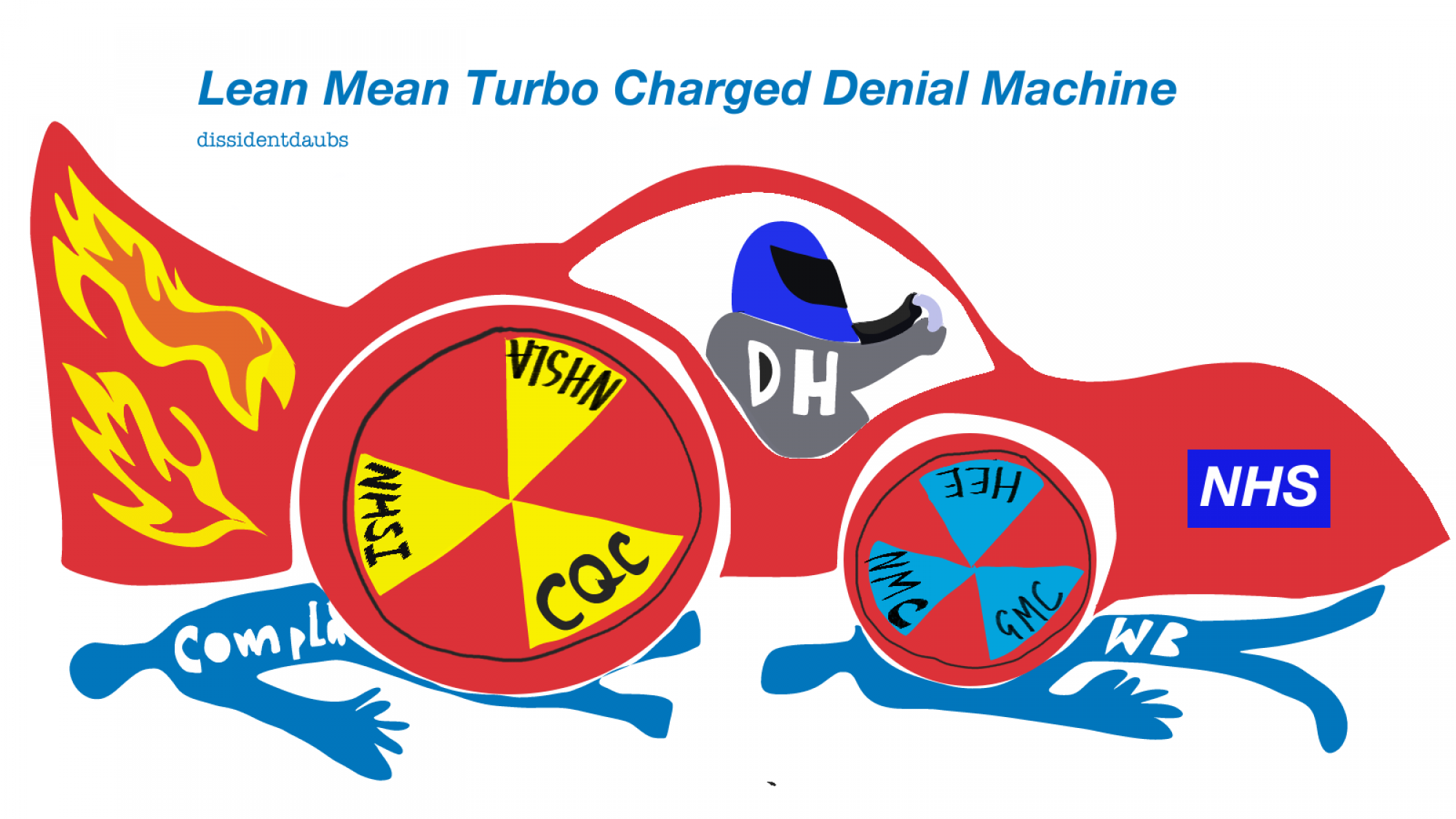
Letter to David Behan CEO CQC requesting review of previously rejected Regulation 5 Fit and Proper Person referrals

By Dr Minh Alexander NHS whistleblower and former consultant psychiatrist, 13 February 2018

The CQC’s much criticised antics over Regulation 5 FPPR, which have served to protect and help recycle poor managers have been thrown into relief by the publication on 8 February 2018 of Bill Kirkup’s review of events at Liverpool Community Health NHS Trust.


Steven Barclay Minister of State for Health and Social Care gave undertakings in parliament on 8 February that a wider review will be undertaken of Fit and Proper NHS arrangements, to encompass action required after poor directors leave the NHS.

I have today written to David Behan chief executive of the CQC to ask if CQC will now review FPPR referrals that it previously rejected out of hand, even in the most serious and robustly evidenced cases:


BY EMAIL

Sir David Behan

Chief Executive

Care Quality Commission

12 February 2018


Dear Sir David,

Request for review of FPPR cases rejected by the CQC

I write to ask if CQC is formally reviewing FPPR referrals that it rejected whilst operating FPPR prior to publication of its new guidance in January 2018.

CQC had admitted that its previous way of operating FPPR was flawed and required review.

The need for better FPPR process has now been additionally highlighted by the latest report on the troubles at Liverpool Community Health NHS Trust where Bill Kirkup has concluded that poor leadership led to unnecessary patient harm.

Dr Kirkup has recommended further review of CQC’s operation of FPPR.

The Minister of State indicated on 8 February 2018 that he believes a wider application of FPPR is required, which encompasses what action should be taken after any unfit director leaves the NHS. I raised this point with CQC as long ago as January 2015.

CQC has to date refused to operate FPPR on this basis, and has repeatedly told referrers that it believes Regulation 5 only applies to current NHS directors.

The most recent CQC letter that I have seen to a whistleblower, stating that an individual is not subject to FPPR because they were no longer a director (albeit still employed by the NHS), is dated 5 February 2018.

CQC has also not followed sound process in even some of the most serious and proven cases of misconduct by NHS directors. For example, CQC rejected Dr Kevin Beatt’s FPPR referral without reviewing relevant papers, even though he was a vindicated whistleblower.

“In a separate development, it emerged this week that the Care Quality Commission (CQC) will not conduct investigations into four former and current trust directors referred for assessment against new fit and proper person regulations.

The CQC is understood to have found insufficient evidence to substantiate allegations against the board members, although Dr Beatt said he had not been asked to provide any documents.”

Croydon Guardian 28 April 2015 Fresh twist in whistleblower Kevin Beatt’s legal battle as Croydon NHS trust wins right to appeal unfair dismissal ruling

After Dr Beatt won his whistleblowing Employment Tribunal claim in December 2014, the directors of Croydon Health Services NHS Trust chose to repeatedly pursue him through the Courts, all the way up to the Supreme Court. The most shocking thing in this matter is that regulators did not stop the trust despite being asked to do so. Indeed, when NHS TDA (later NHS Improvement) was asked to review the trust’s actions, it only accepted evidence from the Trust and rebuffed an offer from Dr Beatt to provide counter-posing evidence:

Letter 31 March 2016 from Andrew Hines NHSTDA Associate Director cc Kathy McLean Medical Director NHSTDA

Regulatory reluctance to pursue senior managers who have harmed whistleblowers and suppressed disclosures is marked. I wrote as suggested by Andrew Hines in the above letter, to the relevant NHSTDA manager about reviewing the issues arising from the Employment Tribunal decision in Dr Raj Mattu’s favour. However, I never even received a reply.

In some cases, CQC has come to sweeping conclusions that there was insufficient evidence of the referred directors’ individual culpability, but it did so without investigating, even though referrers had indicated to CQC that there was evidence of such individual culpability. It is difficult to see how CQC could have fairly and safely reached such conclusions without even speaking to referrers or considering case papers.

Things have gone awry in some cases after CQC has refused to take action under FPPR. For example:

  • Trusts have been placed in special measures for poor care and governance
  • There has been financial mishandling costing the public purse millions, as well as disrupting patient care, necessitating investigation and inquiries
  • Irregularities in competitive processes between trusts
  • Criminal conviction


As a specific example, please see Diana Johnson’s letter to the Secretary of State regarding regulators’ refusal to take action in response to her referral on Phil Morley

Diana Johnson MP letter to Jeremy Hunt 16 July 2015

This was followed by his trust being rated ‘Inadequate’ and placed in special measures in 2016:

Boss of troubled hospital stepped down

Please also see this summary of evidence obtained about regulatory failure with respect to FPPR in the Paula Vasco-Knight case and NHS England’s admission that it did not share information about Paula Vasco-Knight’s suspected fraud:

Postscripts on Paula, NHS England’s apologia and regulatory reticence

Moreover, some of the individuals who were involved in serious service failures after CQC refused to take action under FPPR, have been nevertheless been recycled to other director roles in the NHS. As a worst case scenario, some failed managers have been recycled to director roles in failing organisations.

Some remain outside of the NHS but have sold their services to the NHS since leaving.

Bearing in mind the evidence arising from Bill Kirkup’s review of Liverpool Community Health NHS Trust about the serious harm that can befall patients when poor managers are unchecked, I would be grateful to know if the CQC will re-visit its decisions to reject FPPR referrals and remedy its previous arbitrary actions and omissions.

Yours sincerely,

Dr Minh Alexander

Cc Steven Barclay Minister of State DHSC

Prof Edward Baker Chief Inspector of Hospitals, CQC

Rob Behrens PHSO

Bill Kirkup

Diana Johnson MP

Meg Hillier MP

Public Accounts Committee

Sir Amyas Morse NAO

Health Committee

Sir Robert Francis CQC NED

Dido Harding Chair NHS Improvement

Sir Ian Dalton Chief Executive NHS Improvement

Kathy McLean Medical Director NHS Improvement


UPDATE 15 MARCH 2018:

The Man from Del Monte He Say ‘No’

David Behan CQC refusal to review previously rejected FPPR referrals


delay deny road signs

RELATED ITEMS:

What’s up at Wirral? NHS Improvement’s investigation into executive whistleblowing at Wirral University Teaching Hospital NHS Foundation Trust

Letter to Public Accounts Committee 11 September 2017 requesting a review of whistleblowing

CQC: A Chief Inspector doesn’t call

FPPR: CQC has lost all moral authority, but what will the National Guardian do?


GOOSE