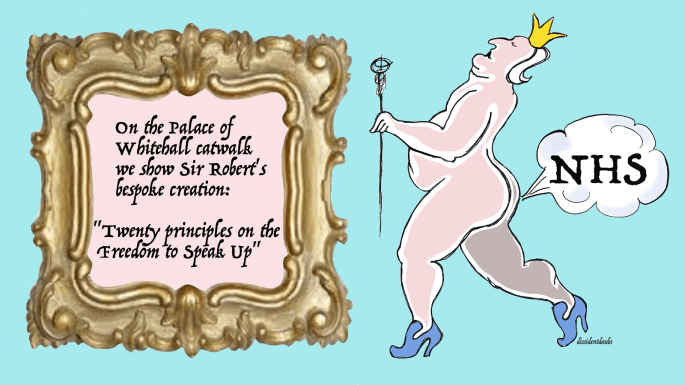
Call for Just Culture Taskforce core members to step down

As part of the establishment of the Healthcare Safety Investigation Branch, there was a proposal by the related Expert Advisory Group that there should be a national Taskforce on Just Culture:

Click to access hsibreport.pdf

It has become evident since the weekend that Jeremy Hunt has launched the Just Culture Taskforce by asking a small inner circle to kick off the process. The group say they will bring different thinking to transform NHS safety culture.

just-culture-twitter-profile

However, there has been no public consultation – or evidence of other due process – regarding the establishment of the Taskforce. I have called on the core group members of the Taskforce to support Just Culture by stepping down, and asking the Department of Health to start again from scratch, with proper public consultation.

The open letter calling for this was sent today and is provided below.

Dr Minh Alexander

NHS whistleblower and former consultant psychiatrist

LETTER

BY EMAIL via NHS Litigation Authority

Open letter to Martin Bromiley and other members of the Taskforce core group  24 January 2017

Dear Martin,

NHS Just Culture Taskforce

 I write as a member and a critical friend of the Just Culture Taskforce ‘movement’, having applied to join and having been accepted by Suzette Woodward of NHSLA.

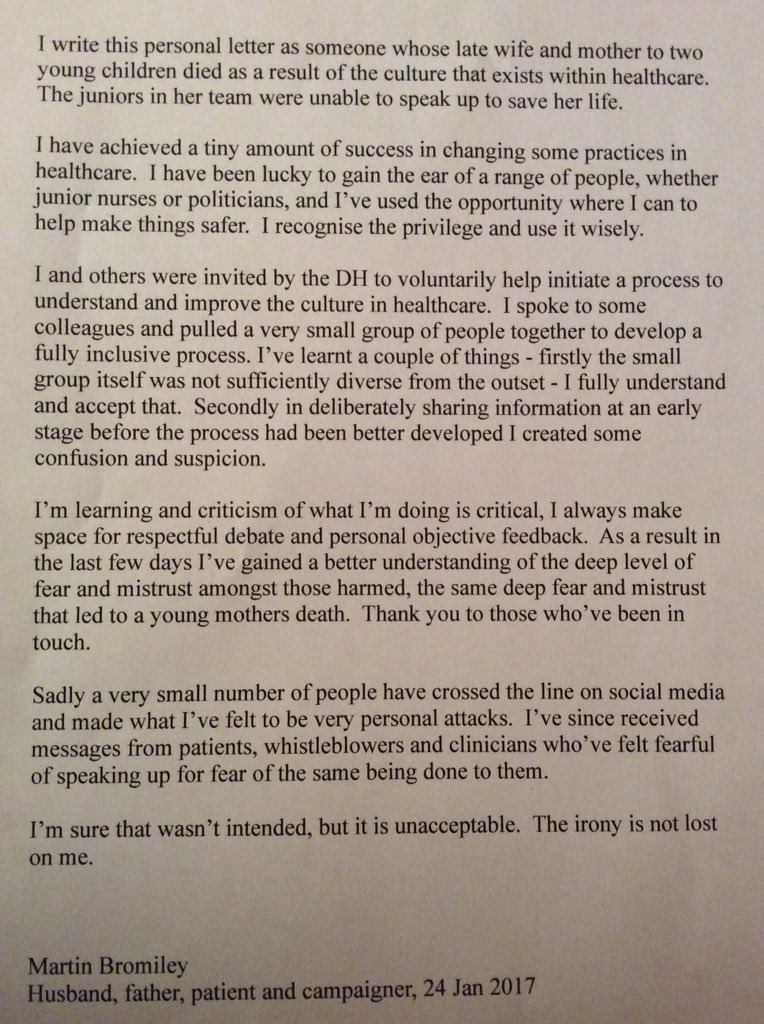
I am writing to respond to your tweeted open letter. 1

It is very welcome that you now acknowledge there have been errors regarding the lack of diversity of the Taskforce. Indeed, your work on learning from errors and Human Factors is widely valued.

As the Just Culture Taskforce is a government instigated and publicly financed project, it is appropriate to re-visit Lord Keith’s comments on the importance of people being allowed to criticise the government:

“It is of the highest public importance that a democratically elected government body, or indeed any government body, should be open to uninhibited public criticism” 2

Many were mystified when the Just Culture Taskforce launched last weekend, with a twitter account and unofficial looking WordPress website. 3 The website gave very little information about the origins and nature of the project. The website stated that the Taskforce was ‘not an organisation’ but a ‘movement’. This was repeated in tweets and correspondence by Suzette Woodward. 4

After I asked questions by twitter and email 5 about the context of this initiative, you advised that:

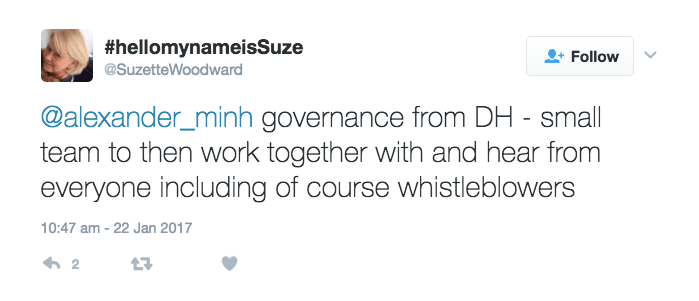
  • The Department of Health was financing the Taskforce. This was also confirmed by Suzette Woodward, who added that the governance of the Taskforce lies with the DH 6, and that the DH would “support” the movement.4
  • You advised me that you and James Titcombe had been asked to initiate the process. You later added that you had been approached by a DH Deputy Director. Suzette Woodward added that the invitation in fact also came from Jeremy Hunt.

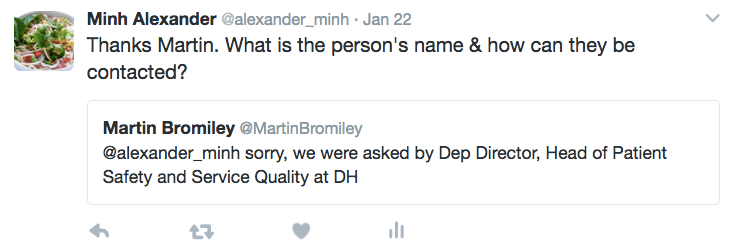
I asked you for the name of the DH contact. 7 I received no reply but I now gather that the two DH senior officials are members of the core group: Tim Jones Head of Patient Safety and Service Quality (formerly the DH Head of News) 8  and Paul Stonebrook DH Senior Policy Adviser. 9

As you may be aware, I have since formally asked the DH for information about terms of reference, how the Just Culture Taskforce was established, whether it is subject to DH Equality and Diversity policy, any identified outcome measures and arrangements for future transparency, as regards whether the proceedings of the Taskforce will be subject to Freedom of Information provisions. It would have been better of course if it had not been necessary to resort to FOI, or to have to do so again in future.

To my surprise, the Just Culture TaskForce’s website was subsequently arbitrarily edited, with substantial deletions. This is despite the fact that it is customary for official records to be transparent, and added to, not removed. Membership details of the core group have now been removed. To my great concern, I see that even the original NHSLA contact email address and contact portal have been removed.

Regarding your comment “..in deliberately sharing information at an early stage before the process had been better developed I created some confusion and suspicion”1, I do not think it was sharing of information that caused concern. It was that a group of individuals had been assembled to take this project forward without any evidence of due process, and without any public consultation. It was clear that important decisions had already been made about this project – such as adoption of a reportedly unconventional leadership model – without the involvement of all concerned. There was in fact a lack of information about many things. When I later requested information as a member of the ‘movement’10, I was told that it could not yet be provided. 11

I have flagged to you that I think the way in which the Taskforce was established so far is an example of club culture, even if the club lacks insight into this. You thanked me for doing so politely, but you disagreed.

In your open letter, you characterise the many objections raised so far about the Taskforce as “fear and mistrust”. 1 Rather,  I think it would be fairest to see them as evidence based arguments against the manner in which this project has been handled.

In all, I think the project has been poorly handled by the Department of Health. There is no evidence of staffside or whistleblower involvement from the outset. This is an extraordinary omission at a time when there are serious morale issues in the NHS. From the staff survey, we know that almost half of NHS staff do not feel confident that concerns would be properly addressed by their organisation. 12  Any effective project on Just Culture must involve staff and those with lived experience of suppression from the outset.

I am sure you entered into this project in good faith. I hope you can see now why the handling of this project has been inimical to Just Culture.

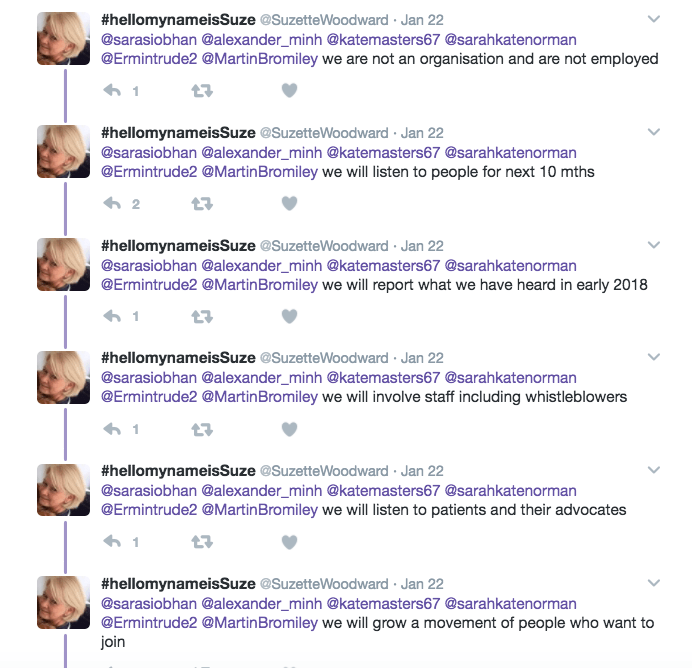
Whilst you, Suzette Woodward and the Taskforce website originally indicated that there would be a different leadership model, what is now clear is that there is a “core group” which has power, and is distinct to a “wider taskforce” (Suzette Woodward’s phrase) which anyone can join. 13 It does not matter that, as Suzette Woodward has maintained, you are not employees. 4 As members of the core group, you are all in a privileged position of influence and greater access to information about a nationally important project.

Accordingly, I call on all members of the current Taskforce core group to support Just Culture by stepping down and asking the DH to start again from scratch.

What is needed first is a process of totally open public consultation on what a Just Culture Taskforce should look like, how it should be established and how it should be governed. This is a highly sensitive, publicly funded government project, with ongoing contribution by senior DH officials. Thus, there needs to be clarity, real inclusiveness, fairness, structure and formality as to how its business is done.

With best wishes,

Minh

Dr Minh Alexander

cc Jeremy Hunt

Keith Conradi Chief Investigator Healthcare Safety Investigation Branch

All other members of the Just Culture Taskforce core group

AvMA

INQUEST

Katherine Murphy CEO Patients Association

RELATED ITEMS

https://minhalexander.com/2016/09/24/hot-air-about-just-culture/

https://www.opendemocracy.net/ournhs/minh-alexander/is-there-club-culture-at-heart-of-nhss-quality-regulator

REFERENCES

1 Open letter tweeted by Martin Bromiley 24 January 2017

martin-bromiley-open-letter-24-january-2017

2 Derbyshire County Council v. Times Newspaper Ltd. [1992] 1 Q.B. 770 at 809 and the leading opinion in the House of Lords in the same case, at [1993] A.C.534, Lord Keith of Kinkel at page 547E

3 Just Culture Taskforce twitter account: @JustcultureTF

Just Culture taskforce WordPress website: https://justculturetaskforce.com/

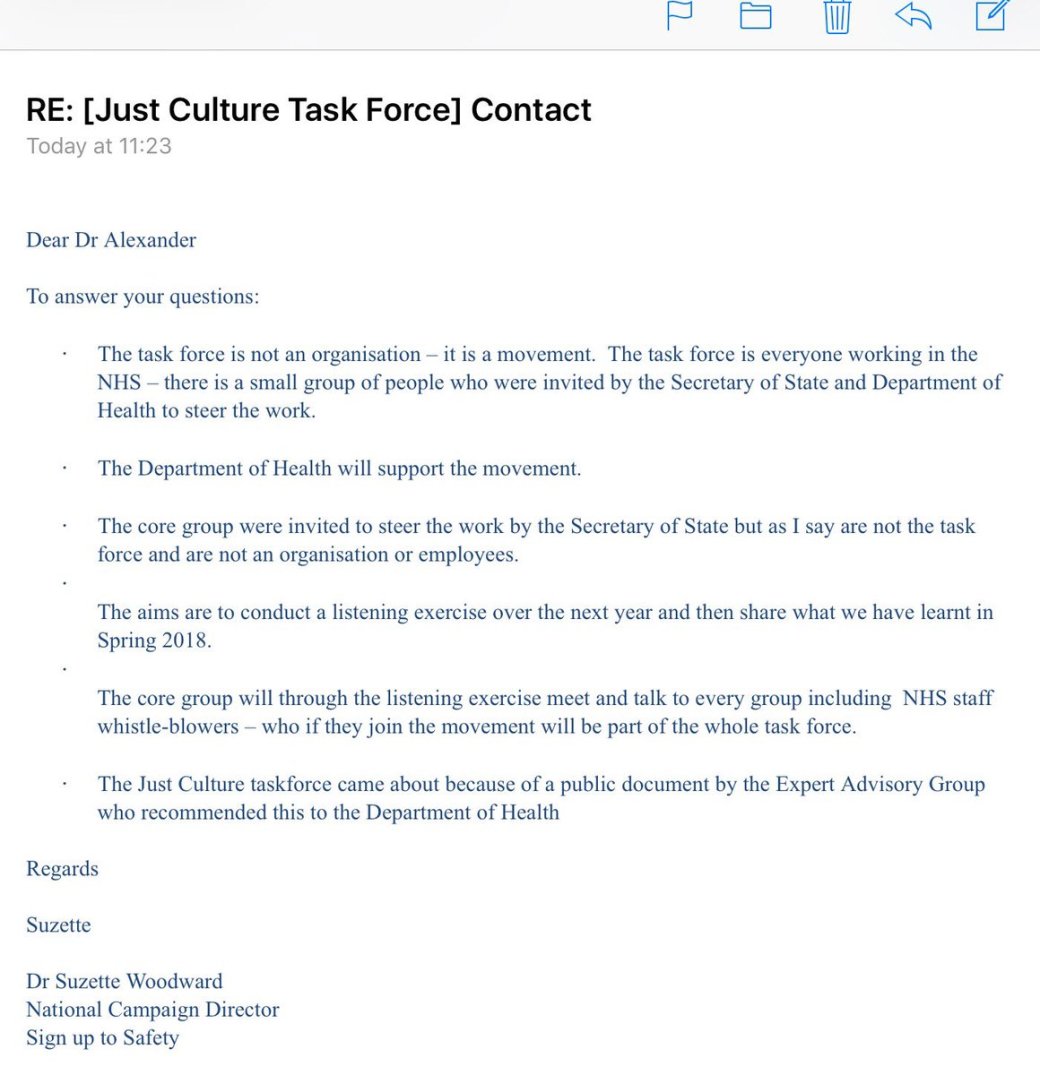
4 Tweeted copy of an email from Suzette Woodward, NHS Litigation Authority 22 January 2017:

tweeted-copy-of-email-by-suzette-woodward

Similar email from Suzette Woodward, NHS Litigation Authority 22 January 2017:

“Dear Dr Alexander

Thank you for your email.  I have just sent you an email answering your questions.  I have repeated them below:

The task force is not an organisation – it is a movement.  The task force is everyone working in the NHS – there is a small group of people who were invited by the Secretary of State and Department of Health to steer the work.

The Department of Health will support the movement 

The core group were invited to steer the work by the Secretary of State but as I say are not the task force and are not an organisation or employees. 

The aims are to conduct a listening exercise over the next year and then share what we have learnt in Spring 2018.

The core group will through the listening exercise meet and talk to every group including  NHS staff whistle-blowers – who if they join the movement will be part of the whole task force.

The Just Culture taskforce came about because of a public document by the Expert Advisory Group who recommended this to the Department of Health

To assure the patient groups and others on this email list – we will be engaging with you all in this process – it is very early days and we will inform you as we progress.

Kind regards

Suzette

Dr Suzette Woodward

National Campaign Director

Sign up to Safety”

5 Email to all members of the Just Culture Taskforce 22 January 2017

“To all members of the Just Culture Task force for the NHS in England 22 January 2017

 Dear All,

Can I ask how this task force is financed, whether its accounts will be published and which NHS body is overseeing or has stewardship of this project?

Could you also let me know how the members of the taskforce were appointed, and by whom, and what the selection criteria were?

Do you have terms of reference and any timetable for your work? If so, could these be shared?

Also, I don’t see (to my knowledge) that there are any NHS staff whistleblowers in this group. This seems an extremely serious omission. Please could you explain why this is so, and if you agree that it was an omission, whether you will now put that right? If so, how?

I have to say that a Just Culture taskforce that is assembled without public consultation is something of a contradiction in terms.

Yours sincerely,

Dr Minh Alexander 

cc Katherine Murphy CEO Patients Association

    AvMA

    INQUEST”


6 Tweet 22 January 2017 by Suzette Woodward NHS Litigation Authority

suzette-woodward-dh-governance

7 Tweeted question about the name of the Department of Health contact:

q-about-dh-contact

8 Tim Jones

http://www.prweek.com/article/1175503/department-health-defends-london-pr-spend

https://www.linkedin.com/in/tim-jones-987a1b134

9 Paul Stonebrook

https://www.linkedin.com/in/paul-stonebrook-bb1ab9104

10 Email 22 January 2017 to Suzette Woodward NHS Litigation Authority

“To Suzette Woodward, National Campaign Director, Sign Up to Safety 22 January 2017

Hi Suzette,

Thanks for your email – or the screenshot of your email (below). I’m not sure what happened as I gather some cc’d people received a copy of your reply, but my copy never arrived.

Notwithstanding, I gather from your tweets that anyone can join your movement.

I’d like to join your movement, thank you.

What happens now and who’s making the decisions about how I can contribute?

Who’s doing the organising/ admin, that I can link with?

Best wishes,

Minh

cc All other Task force members

    AvMA

    INQUEST

    Katherine Murphy CEO Patients Association”

11 Email 22 January 2017 from Suzette Woodward NHS Litigation Authority

“Dear Minh

Thank you.  That’s great.

We are building up the list of interested people and would be really keen to involve you.

At the moment because we have literally just started we are still working through the details as I think you have probably seen on twitter today 

We will be in touch soon.

Kind regards

Suzette

Dr Suzette Woodward

National Campaign Director, Sign up to Safety

Twitter: @suzettewoodward”

12 Annual NHS staff survey 2015

“Fifty six percent of staff had confidence that their organisation would address their concerns if they were raised.”

http://www.nhsstaffsurveys.com/Caches/Files/20160322_NHS%20Staff%20Survey%202015%20National%20Briefing_V2.pdf

13 Tweets on 22 January 2017 by Suzette Woodward, NHS Litigation Authority

suzette-woodward-wider-taskforce

suzette-woodward-tweets

Ticket to ride

By Dr Minh Alexander NHS whistleblower and former consultant psychiatrist 19 January 2017


Alyson O’Connell is an NHS whistleblower, nurse and cancer patient with experience to offer.

She also needs just £26 to pay for a coach ticket from Wales to London.

She is attending the National Freedom to Speak Up Guardian’s consultation event on Friday 20th January, to contribute to discussions on how an advisory group should be established.

She is paying out of her own pocket to make this long journey by coach, in mid winter.

That’s commitment.

O’Connell was initially told by the National Guardian’s office that the event was only about the English NHS, and she was deterred from taking part.

She pointed out that Robert Francis had accepted her evidence for the Freedom To Speak Up Review, that NHS England had recently involved her in the development of its whistleblower employment support scheme, and that her contribution would be relevant.

A place was then offered…but she was told she would have to pay her own travel expenses.

She asked the National Guardian’s office to reconsider, and advised that she needed the princely sum of £26 to cover her coach fare, but the National Guardian’s office has not so far acquiesced.

This is the email correspondence:  emails

O’Connell was dismissed by the NHS seven years ago after whistleblowing about patient safety risks:

http://www.walesonline.co.uk/news/wales-news/nhs-whistleblower-urges-concerned-staff-1908602

She survived for a while on agency work, but says her former employer refused to let her work shifts for them.

She has been unemployed for five years whilst battling pancreatic cancer.

There have been periods of severe financial hardship, and she and her husband still live with uncertainty about whether they can meet their mortgage payments.

O’Connell says that unlike the National Guardian office, NHS England was more generous when she contributed to the development of its employment support scheme:

“NHS England booked and paid for all my rail travel and overnight accommodation with breakfast included. All I had to do was collect the rail tickets.”

 So, is it wise of the National Guardian’s office to insist that ‘rules is rules’?

Many whistleblowers cannot make the National Guardian’s event due to the short notice given. The National Guardian’s travel expense budget is unlikely to be creaking.

£26 is not even a hiccup in the CQC’s £200m plus budget.

£26 for a long distance coach journey is not luxury.

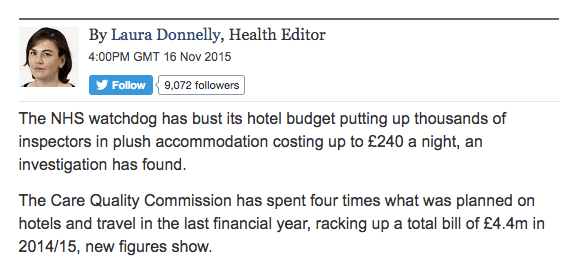
In contrast, CQC officers are used to commodious conditions and they are not strangers to nice hotels on the public tab. [1] [2] [3] [4]

screen-shot-2017-01-19-at-21-12-54

Will the great public service that O’Connell performed in speaking up, at immense personal cost, be at least recognised by the very small token of reimbursing her tiny coach fare?

It’s not the money – although it’s an expense that O’Connell doesn’t need – it’s about respect and valuing people.


UPDATE 21 JANUARY 2017

Alyson O’Connell spent over eight hours travelling from Wales to contribute to Henrietta Hughes’ consultation event on 20th January, which was a scant two hour slot.

Seven of those hours travelling were spent on a coach. Not comfortable for anyone, but worse for someone in fragile health.

She reports that Henrietta Hughes has decided not to contribute a token of £26 for the coach fare.

“She said that she wished that the NGO could pay my expenses but as Wales not included it wasn’t possible and was very apologetic.”

It is a great pity that the National Guardian is not showing more flexibility. Her role is complex and requires a great deal of insight, skill and judgment.

It is unlikely to work if it does not include some wisdom about when “rules is NOT rules”.


REFERENCES

[1] NHS watchdog staff put up in luxury hotels, stately homes and country houses. Laura Donnelly Telegraph 16 November 2015

http://www.telegraph.co.uk/news/health/news/11999102/NHS-watchdog-staff-put-up-in-luxury-hotels-stately-homes-and-country-houses.html

[2] NHS watchdog’s £81K hotel bill for a single inspection: Freedom law reveals officials’ extravagance. Sophie Borland 16 November 2015

http://www.dailymail.co.uk/health/article-3320939/Health-watchdog-blew-8-7-million-luxury-hotels-dinners-travel-expenses-hospital-care-home-inspectors-year.html

[3] CQC health watchdog racked up £123,000 hotel bill whilst inspecting NHS organisations in Suffolk, Essex and Norfolk. Andrew Hirst. East Anglian Daily Times, 8 February 2016.

http://www.eadt.co.uk/news/cqc_health_watchdog_racked_up_123_000_hotel_bill_while_inspecting_nhs_organisations_in_suffolk_essex_and_norfolk_1_4409417

[4] NHS watchdog spent over £5 million on hotels and accommodation last year. Keir Mudie. Mirror 7 May 2016

http://www.mirror.co.uk/news/uk-news/nhs-watchdog-spent-over-5million-7920207

National Guardian independence: the CQC denies some more….

By Dr Minh Alexander, NHS whistleblower and former consultant psychiatrist 19 January 2017


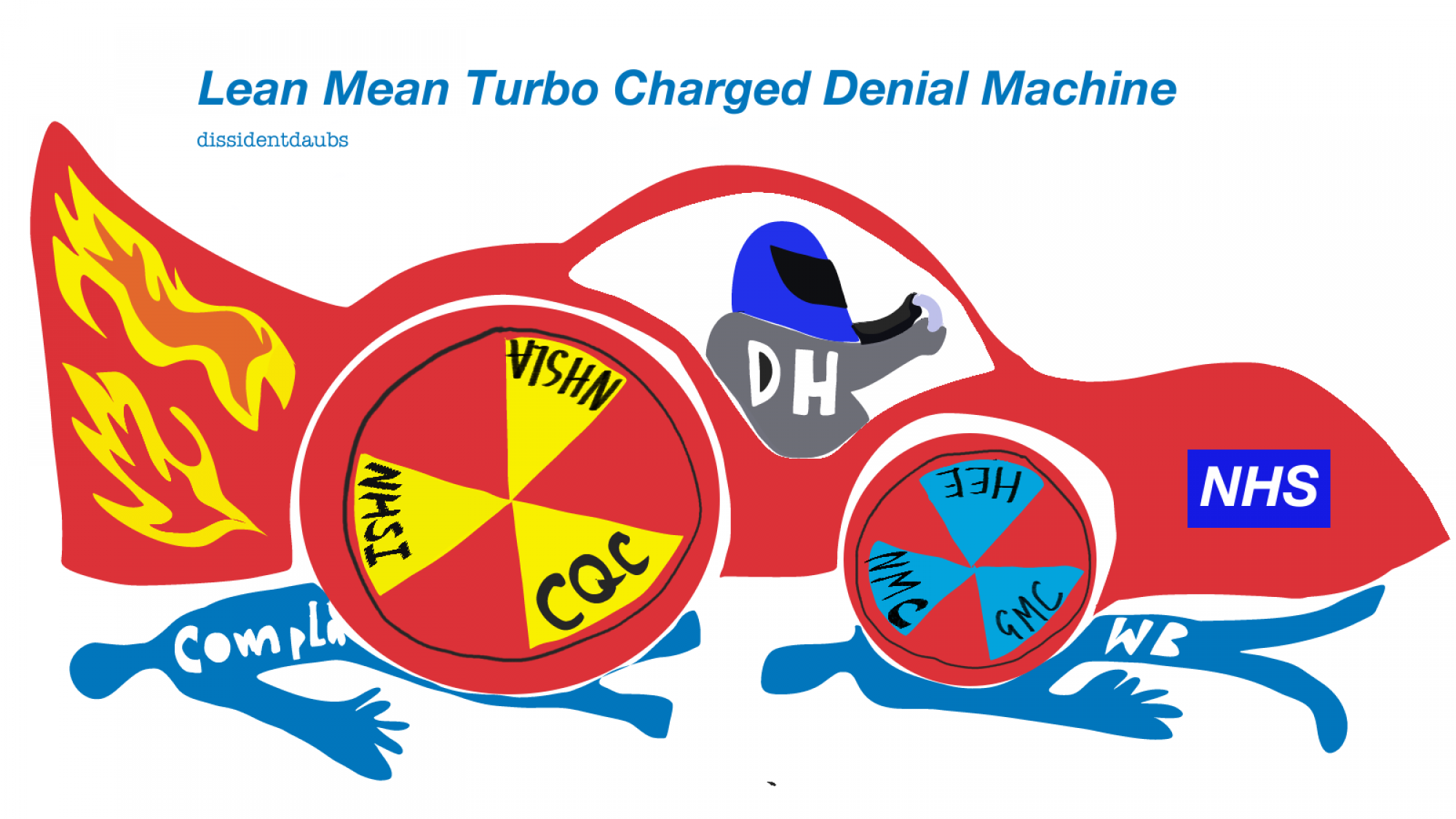
Governments have a habit of establishing satellite bodies that they pretend are independent, for public relations purposes, and for deniability and outsourcing of accountability for controversial decisions.

The fragmentation of the NHS in recent years often allows the government to claim that it has no operational responsibility or cannot answer questions because it holds no information.

CQC the health watchdog has been criticised as a government device for denial. The latest criticism comes from the Centre for Welfare Reform, whose Director commented:

“The illusion that it [CQC] is performing a useful function is critical to Government policy. As severe cuts and rising cost savage an already inadequate social care system, it may be that the Government will not want to address these problems. For the CQC adds a patina of respectability to its failed policies”

http://www.centreforwelfarereform.org/news/why-cqc-failre-correctly/00316.html

A similar masquerade seems to be unfolding with regard to the National Freedom to Speak Up Guardian’s office. Its independence has been much questioned because the Department of Health located the office within CQC. CQC, along with NHS England and NHS Improvement also fund the office.

The accountability arrangements for the National Guardian are not entirely clear, yet there has been repeated insistence by Robert Francis, the Department of Health and CQC that the office is operationally independent.

However, CQC has also repeatedly made comments which indicate that it will have some oversight of the National Guardian’s office. A CQC Board paper stated:

“The Commission consists of the Board (including committees), Chief Executive and employees. Whatever the manner of appointment, the Board will require some oversight of the National Guardian role, given its own accountability for CQC to Ministers and Parliament.  

There needs to be a formal arrangement with Monitor, TDA and NHSE that governs their responsibilities in terms of funding, and expectations in terms of input into the delivery of the role.” 1

A CQC consultation document stated:

We propose that the relationship between the National Guardian and appointing arm’s length bodies (Monitor, TDA and NHS England) would be governed through memorandums of understanding (MoU), an annual steering group, and an annual report from the National Guardian presented to each arm’s length body’s Board” 

They remain accountable to the Chief Executive of CQC for the overall delivery of their role and functions, just like the Chief Inspectors.2

In May 2016, CQC’s response to the consultation about the National Guardian’s office stated:

The National Guardian’s Office will be hosted by the CQC, reporting to the CQC’s Chief Executive as its Accounting Officer.” 3

 (This report was issued as if the decisions therein came from the National Guardian’s office, but the office was in fact vacant at this point and being steered by Robert Francis CQC NED).

Moreover, the latest National Guardian has also just issued a report, about her first 100 days in office, which stated:

“The National Guardian meets with the main sponsor boards once a year; more frequent meetings with Sir David Behan as the lead Accountability Officer (AO) for the National Guardian’s Office. The National Guardian provides an annual report to the Board of each of the sponsor boards.” 4

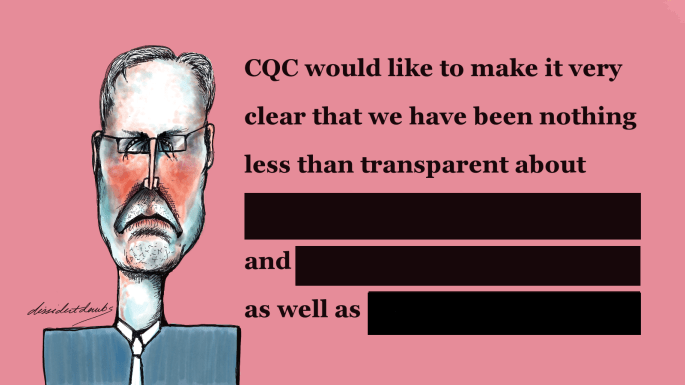
Curiously, at a CQC Board meeting on 18 January 2017, David Behan CQC’s Chief Executive cheerfully denied any oversight at all of the National Guardian’s activities, save for accounting for how the National Guardian’s budget is spent, in his role as Accounting Officer.

Accounting Officers of course do not simply scrutinise the use of funds, but must link this to performance measures, to make judgments about value for money.5

Behan also contradicted past CQC statements by stating that his relationship with the National Guardian would NOT be the same as his relationship with CQC Chief Inspectors.

For those who are not aware, Behan was also the appointing officer both for the first National Guardian Eileen Sills, and her replacement, Henrietta Hughes. The CQC has also stated that the appointment will be reviewed periodically, possibly every three years.

The National Guardian appointment will be reviewed periodically (eg every three years).” 2  

It would be unrealistic to pretend that this could not be a potential compromise to the office’s independence, if this review is conducted by the DH or its allegedly arms lengths bodies.

The transcript of the relevant comments by Behan at yesterdays Board meeting is given below.

It would be a rum do if the National Guardian, who is responsible for leading improvement in culture, is not truly accountable to anyone.

Notwithstanding the additional muddle caused by Behan’s denial, there is perhaps an argument that the National Guardian should answer only to parliament.

The National Guardian’s recent report states that she will provide “updates to the Health Select Committee” but no details are given about how this will be achieved and whether hearings will be held. 4

There have been calls for her to seek statutory independence, as Keith Conradi, HSIB Chief Investigator has done. 6 Whether she does so will surely be a test of her mettle.


TRANSCRIPT OF A DISCUSSION ABOUT THE INDEPENDENCE OF THE NATIONAL FREEDOM TO SPEAK UP GUARDIAN AT CQC BOARD 18 DECEMBER 2017

Member of the public at 26.18: “Is there any clarification around the 20th ….it seems there’s a group of whistleblowers only being allowed to go in the afternoon, but the meeting is in the morning, so not really quite clear how that’s working. Does anybody have any ideas?”

David Behan at 26.43: “That’s not something that this Board is overseeing. The National Guardian…..”

Member of the public: “I thought she was reporting to you though?”

David Behan:No, she has an operational independence. I need to account for the money. We host the function but Henrietta has the role and she discharges that function on behalf of CQC and NHSI and NHS England.”

Member of the public: “But doesn’t she report back to you?”

David Behan: “No. She doesn’t report to me, no. She’s not accountable to me.”

Member of the Public: “Who’s she accountable to then?”

David Behan:It’s a role which is established… I occupy the role of Accounting Officer so that if the Public Accounts Committee wants to know what the money is being spent on, they would expect me to explain what she’s doing and what the money is. But in the same way that I’m the Accounting Officer for this organisation but I am managerially accountable for Mike, Andrea, Steve etc…I do not enjoy, or she does not enjoy that relationship as Mike, Andrea and Steve will tell you…”

David Behan: “So it’s completely independent of the…you ask Henrietta – it’s a completely independent office of the National Guardian”


THE FOOTAGE OF THE CQC BOARD MEETING ON 18 JANUARY 2017 CAN BE VIEWED HERE:

http://www.cqc.org.uk/content/care-quality-commission-board-meeting-18-january-2017


RELATED ITEMS

https://minhalexander.com/2017/01/17/smile-shine-sag/

https://minhalexander.com/2016/10/10/hooray-henrietta/

https://minhalexander.com/2016/09/24/no-one-believes-jeremy-hunt-on-patient-safety-or-whistleblowers-not-even-his-own-appointees-unmasking-the-faux-national-guardian-office/


REFERENCES

1 CQC Public Board Paper 29 July 2015, by Charles Rendell / Sarah Bickerstaffe, Sponsor: Eileen Milner, CQC Executive Director of Customer & Corporate Services

http://webarchive.nationalarchives.gov.uk/20160420154801/http://www.cqc.org.uk/content/care-quality-commission-board-meeting-29-july-2015

2 A National Guardian for the NHS – have your say. CQC consultation document September 2015

https://www.cqc.org.uk/sites/default/files/20150916_national_guardian_consultation_final.pdf

3 The National Guardian for the NHS – Improvement through openness. CQC May 2016

https://www.cqc.org.uk/sites/default/files/20160526_consultation_response_document_v8_for_publication_01.pdf

4 Dr Henrietta Hughes. First 100 Days Report. 12 January 2017

https://minhalexander.com/wp-content/uploads/2016/09/dr-henrietta-hughes-first-100-days-report-final.pdf

5 Accountability to Parliament for taxpayers’ money. National Audit Office, February 2016

https://www.nao.org.uk/wp-content/uploads/2016/02/Accountability-for-Taxpayers-money-summary.pdf

6 NHS has nothing to fear from new investigation body says chief. Shaun Lintern HSJ 5 January 2017

“The head of the NHS’s new patient safety watchdog has said it needs statutory independence and extra powers to demand that NHS organisations respond to its warnings.”

https://www.hsj.co.uk/topics/policy-and-regulation/nhs-has-nothing-to-fear-from-new-investigation-body-says-chief/7014490.article


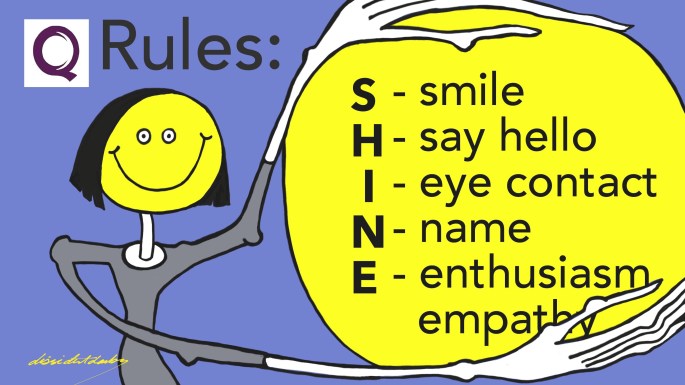
SMILE, SHINE & SAG

Dr Minh Alexander, NHS whistleblower and former consultant psychiatrist 17 January 2017


The saga of Robert Francis’ much derided National Guardian for NHS whistleblowing rumbles on.

After rowing back on an important consultation that initially excluded most whistleblowers, the National Guardian has now provided a segregated consultation process with most of the whistleblowers physically corralled in a different session.

I have made a written submission and raised questions as copied below, which I will be sending to the Great and the Good who are sheltering in the safe harbour of the other, largely whistleblower-free session.

Additional background information about the National Guardian’ office can be found here:

https://minhalexander.com/2016/10/10/hooray-henrietta/

https://minhalexander.com/2016/10/04/clubadoodle-doo/


CORRESPONDENCE AND SUBMISSION TO NATIONAL FREEDOM TO SPEAK UP GUARDIAN:


Dr Henrietta Hughes

National Freedom to Speak Up Review

Care Quality Commission

17 January 2017


Dear Dr Hughes,

Establishment of a ‘stakeholder advisory group’ (SAG)

I write to apologise that I may not be able to attend your consultation event on 20th  January about establishment of a ‘stakeholder advisory group’. My husband was admitted to hospital as an emergency and is still not well enough for me to travel to London.  Things may not have improved sufficiently by the 20th. Therefore, I write instead to make an initial written submission to the consultation – copied below. Depending on further information received and whether you give access by agreeing to stream the whole event, I may make an additional submission.

Yours sincerely,

Dr Minh Alexander

cc Sir Robert Francis

Katherine Murphy CEO Patients Association


SUBMISSION

Introduction

In February 2015 Sir Robert Francis proposed that the National Guardian should ‘review’ whistleblower cases against good practice principles and make recommendations, but should not investigate the cases, make determinations or provide an appeal against employers’ actions. 1 It is exceedingly difficult to understand what this means or to envisage how it will work. Nevertheless, it has been accepted by the Department of Health and the CQC, and you confirmed these arrangements in an interview with the Health Service Journal.2

The Health Service Journal also reported that you said a ‘stakeholder advisory group’ would be established, which would include whistleblowers, and that this group would decide the cases that you would ‘review’.2a

A communication from your office subsequently indicated that your current consultation is intended to “identify the key roles and responsibilities of the stakeholder advisory group and potential membership”. 3

The materials you have issued for the event on 20 January now say that you propose:

“Co-production group to provide advice and guidance on establishing selection criteria [of cases to be reviewed]”

and that

“NGO selects cases to review on the basis of suggested criteria” 4 


Definition of ‘review’

I think this is a pivotal matter. In order for your consultation to be meaningful, it should be clear how you propose to ‘review’ cases, and how this will differ from investigation.

What will be your ‘review’ methodology?

What sources of evidence will you draw upon when ‘reviewing’ cases?

How will you deal with disputed facts?

For example, if a whistleblower provides evidence of poor practice, but an employer denies this, how will you deal with this and what finding or recommendation will you make, if any?

If you do not investigate and test evidence, how will you be able to make valid, effective recommendations that address root causes?

As per my email to you of 15th January, I would be grateful to know what substance there is to a written report by David Drew that a way “around” your lack of investigatory powers has been found. 5 If correct, there should be transparency about this so that all whistleblowers who need your help can potentially benefit.

It would also be useful if there is clarity on whether your office is now in fact taking referrals, based on David Drew’s report that he and you are liaising about a current case.

There are other whistleblowers with current cases who would like to seek your help.


Criteria for cases to be reviewed by the National Guardian

I think the National Guardian should review:

  • All whistleblower cases referred by local Guardians because they have not been able to resolve them locally with employers.
  • All cases of self referrals by whistleblowers who have been unable to resolve issues with their local Guardian.

If the National Guardian’s office does not have the resources to do this, it should seek more resources.


Establishment of the Stakeholder Advisory Group (SAG)

I suggest:

  1. At least half of the members of the SAG should be whistleblowers who have been clearly established as having made public interest disclosures in good faith, either by Employment Tribunal, independent investigation or some other equivalent.
  1. The Chair of SAG should be a whistleblower.
  1. Members of SAG who are not whistleblowers should nevertheless have clear credentials and expertise in whistleblowing, and should be independent of the NHS. Representatives of bodies which receive funding or have contracts with the DH or other NHS organisations should not sit on SAG.
  1. SAG should have good access to data, sufficient for it to function effectively and not just be a rubber stamp for the National Guardian’s office. The datasets to which SAG has access should be clearly defined and agreed in advance with all stakeholders.
  1. For example, SAG should have access to all analysed data held by the National Guardian on the numbers of whistleblowing disclosures, nature of whistleblowing disclosures, action taken in response to disclosures and originating organisations. The National Guardian’s office should ensure that such data is actively tracked and regularly updated, and that SAG has access to information that is up to date and relevant.
  1. SAG should have access to analysed data on intelligence supplied to the National Guardian by local Guardians about the degree to which local employers are following good practice, activity data by local Guardians, and the numbers and nature of referrals that local Guardians are making to the National Guardian because of failures by local employers. The National Guardian should also collate and share information with SAG about whether local Guardians themselves are being well treated.
  1. SAG should have access to financial data about the National Guardian’s office, how resource is allocated within the National Guardian’s budget and any details of unmet need arising from budget constraints.
  1. SAG should have access to ‘user’ satisfaction data, about how all whistleblowers who approach the National Guardian’s office experience their contact with the office. This information should be produced by the National Guardian at least annually and shared with SAG.
  1. SAG should have access to audit data on whether the National Guardian is meeting performance standards and adhering to its operational policies.
  1. SAG should have access to Equality and Diversity performance data relating to the National Guardian’s office. This is especially important given the established, disproportionate detriment experienced by BME whistleblowers. Replication of bias and discrimination is a risk given that Robert Francis has advised that the office should have ‘wide discretion’, which could have the unintended consequence of  inconsistency and arbitrariness:

The office should be more nimble and less bound by legalistic process than a statutory body, with wide discretion to decide whether it is appropriate to get involved in a particular case.”1

  1. SAG should be able to act upon appeals from individual whistleblowers and to challenge the National Guardian’s decisions with respect to individual cases.
  1. SAG should be able to review information on the rate and pattern of acceptance cases for review by the National Guardian, and to give an opinion on whether the National Guardian is making valid and fair decisions.
  1. SAG should meet frequently enough to be effective. In the first year, SAG should meet at least every two months.
  1. There should be an operational protocol on how SAG functions and interacts with the National Guardian’s office, and this should be devised with whistleblower involvement and it should be published.
  1. All SAG meeting records and papers should be published, save for any identifying, confidential information about individual cases.
  1. SAG should report periodically on its work, no less than annually.
  1. As part of its regular reporting, SAG should include feedback from SAG members about how well they believe the model is working and what improvements may be needed.


REFERENCES

1 Report of the Freedom to Speak Up Review by Robert Francis, February 2015

I want to emphasise that I am not proposing an office to take over the investigation of concerns.” 

“It is not my intention that the INO should have binding powers. I do not see this role as strictly comparable to that of an Ombudsman.”

“It [National Guardian’s office] is not, however, a means of appeal for the results of an investigation that an individual disagrees with.”

http://webarchive.nationalarchives.gov.uk/20150218150343/https://freedomtospeakup.org.uk/wp-content/uploads/2014/07/F2SU_web.pdf

2 Whistleblower guardian will not be an ‘investigation body’. Will Hazel Health Service Journal, 12 October 2016

https://www.hsj.co.uk/topics/workforce/whistleblower-guardian-will-not-be-an-investigation-body/7011388.article

2a She said the cases the office would look at would be decided by a “stakeholder advisory group”, which would include people with experience of whistleblowing.”

3 New Employment Scheme (but not as you know it). Minh Alexander, 19 December 2016

https://minhalexander.com/2016/12/19/new-employment-scheme-but-not-as-you-know-it/

4 Paper on case reviews, issued to whistleblowers by National Guardian’s office 13 January 2017

https://minhalexander.com/wp-content/uploads/2016/09/20170113-paper-2-case-review-slides.pptx

5 Email 15 January 2017 to Henrietta Hughes National Freedom to Speak Up Guardian

BY EMAIL

Dr Henrietta Hughes

National Freedom to Speak Up Guardian

Care Quality Commission

15 January 2017


Dear Dr Hughes,

Possible investigation of cases by the National Guardian’s office

Yesterday I received written indication from David Drew, whom you have invited to the morning session of your consultation event on 20 January, that you may be effectively investigating whistleblower cases now. He reported:

“We have got around the inability for NG [National Guardian] to investigate and are pleased with the NG response in line with Principle 15 so far.” [1]

If this is correct, is it possible to share how your lack of investigatory powers has been circumvented, so that other whistleblowers may also potentially benefit from this?

Many thanks,

Dr Minh Alexander

cc Sir Robert Francis


[1] Principle 15 of Freedom to Speak Up Review, 11 February 2015

“Principle 15 – External review

There should be an Independent National Officer resourced jointly by national systems regulators and oversight bodies and authorised by them to carry out the functions described in this report, namely:

  • review the handling of concerns raised by NHS workers, and/or the treatment of the person or people who spoke up where there is cause for believing that this has not been in accordance with good practice
  • advise NHS organisations to take appropriate action where they have failed to follow good practice, or advise the relevant systems regulator to make a direction to that effect
  • act as a support for Freedom to Speak Up Guardians
  • provide national leadership on issues relating to raising concerns by NHS workers
  • offer guidance on good practice about handling concerns
  • publish reports on the activities of this office.”


Lights! Camera! Inaction?


Request for streaming of an important National Guardian consultation on 20 January

The current National Freedom To Speak Up Guardian made plans to hold an important consultation event on 20 January without advertising it or inviting the majority of whistleblowers.

https://minhalexander.com/2016/12/19/new-employment-scheme-but-not-as-you-know-it/

Whistleblowers asked for the event to be live streamed.

This is what has happened so far:


DATE


5 January 2016 National Guardian asked to live stream her consultation event 20 Jan, so that whistleblowers could follow proceedings
10 January 2016 National Guardian reminded of the request for live streaming
11 January 2016 National Guardian’s office said that streaming would not be possible on 20 January but was a good idea in principle, and future events could be streamed

The National Guardian also agreed to hold a second session on 20 January for whistleblowers who had not previously been invited.

11 January 2016 National Guardian asked if whistleblowers could arrange their own streaming and filming at 20 January event
12 January 2016 National Guardian reminded of whistleblowers’ request to arrange streaming and filming themselves
13 January 2016 National Guardian’s office advises that whistleblowers can film the National Guardian’s presentation, but would only be able to film other delegates with their consent
13 January 2016 All known delegates for session 1, 20 January (the original event organised by the National Guardian before whistleblowers asked her to consult them as well) asked if they object to streaming and filming.

Today’s letter asking all known delegates invited to the first session on 20 January if they object to streaming or filming is copied below.

I will update this article regarding the responses received.


LETTER TO DELEGATES OF SESSION 1, 20th JANUARY 2017 , TO ASK ABOUT STREAMING AND FILMING


 To (by bcc) :

Jerina Brown, Corporate Secretary CQC

Heather Bruce University Hospitals of Morecambe Bay NHSFT

Cassandra Cameron NHS Provide

Claire Campbell George Eliot Hospital NHST

Georgina Charlton Guy’s & St Thomas’ NHSFT

Chris Chrysochou Salford Royal NHSFT

Neil Churchill NHS England

Keith Conradi HSIB

Mary Cridge CQC

Helene Donnelly Cultural Ambassador Stoke On Trent & Staffordshire on Trent

David Drew

Ginny Edwards West Hertfordshire Hospitals NHST

Kate Erskine Imperial College Healthcare NHST

Judith Graham Rotherham Doncaster and South Humber NHSFT

Tom Grimes NHS Improvement

Chris Ham King’s Fund

Cathy James Public Concern at Work

Paula Johnson South Staffordshire and Shropshire NHSFT

Narinder Kapur Psychologist

Roger Kline NHS England

Sharon Landrum

Chris McGhee Liverpool Women’s Hospital NHSFT

Neelam Mehay Speak Up Guardian West Midlands

Danny Mortimer NHS Employers

Katherine Murphy Patients Association

Newcastle Speak Up Guardian

Sonia Pearcey Gloucestershire Care Services NHST

Susan Robinson Healthwatch England

Nick Ross

Anne Sharp CEO ACAS

Lisa Smith York Teaching Hospitals NHSFT

Wayne Walker Torbay and South Devon NHST

Elaine Williams Berkshire Healthcare NHSFT


13 January 2016


Dear All,


Streaming and filming of National Guardian event on 20th January 

I gather that you have been invited to attend an important consultation event on the morning of 20 January by the National Freedom To Speak Guardian, on how a ‘stakeholder advisory group’ will be established. Dr Hughes has indicated that this group will choose the whistleblowing cases that are reviewed by her office.

The majority of whistleblowers have not been invited to this event, and are keen to follow the proceedings.

Since the above event was first organised, Dr Hughes has set up a duplicate event for the majority of whistleblowers which will take place on the afternoon of 20 January. However, we will not have access to what is said in the morning session, where decision makers will be present.

Therefore, we have asked if the events on 20 January can be streamed. Dr Hughes has indicated that streaming will not be available on this occasion, but has agreed that it is a good idea in principle and could be arranged for future events

.Whistleblowers have subsequently asked if they may stream the events themselves (ie via Periscope or Face Time) or film. Dr Hughes has agreed that her presentation may be filmed, but other delegates would need to agree to be filmed.

To that end, I would be most grateful if you could all let me know if you have any objection to streaming and filming by whistleblowers as above. (One of the whistleblowers attending the morning session has suggested that they could stream the event, if this is agreed).


Many thanks,

Yours sincerely,


Dr Minh Alexander

NHS whistleblower and former consultant psychiatrist

cc

Dr Henrietta Hughes, National Freedom to Speak Up Guardian, Care Quality         Commission

Lorraine Turnell National Engagement Manager, National Guardian’s office

Sir Robert Francis


RELATED ITEMS

https://minhalexander.com/2016/09/24/no-one-believes-jeremy-hunt-on-patient-safety-or-whistleblowers-not-even-his-own-appointees-unmasking-the-faux-national-guardian-office/

https://minhalexander.com/2016/10/10/hooray-henrietta/


The CQC Denies…

According to a statement made to the Times, the CQC doesn’t seem to accept that the NHS continues to merrily gag its staff.

The CQC’s Chief Inspector said:

“People’s disclosures to us are very important and they will be listened to – and to the point that the CQC “does little to deter gagging”, it [sic] worth saying that “gagging clauses” were banned in the NHS by the Department of Health in 2013.”

I have written to CQC to give an alternative perspective, as below.

delay-deny

LETTER TO PROFESSOR MIKE RICHARDS CQC CHIEF INSPECTOR 7 JANUARY 2017:

Prof Mike Richards

Chief Inspector of Hospitals

Care Quality Commission

7 January 2017

Dear Professor Richards,

Re CQC’s oversight of NHS gagging and your claim to the Times that gagging clauses have been banned 

I understand that you gave the Times the following statement with regard to its article of 6 December 2016 about CQC’s various failures to listen to, act upon concerns and to protect whistleblowers1:

“Professor Sir Mike Richards, Chief Inspector of Hospitals, Care Quality  Commission. “CQC takes concerns raised by staff extremely seriously, and  we act on these concerns where appropriate – whether this action is carrying  out or bringing forward an inspection, raising concerns directly with the provider, or alerting another organisation – including the police – who might be  better placed to deal with the issue. In the past six month reporting period we have received around 4,000 concerns raised by staff or ex-staff from across health and social care settings – around 10% of these resulted in an inspection, around 40% were noted for future inspections (some of which were already imminent), around 20% were referred to other bodies, and in 10% of cases it was determined that no action was required. The remainder remain under review currently. People’s disclosures to us are very important and they will be listened to – and to the point that the CQC “does little to deter gagging”, it worth saying that “gagging clauses” were banned in the NHS by the Department of Health in 2013.”

The term “gagging clauses” 2 is common parlance for clauses that require signatories not to disclose the contents or the existence of agreements, and non-disparagement clauses.

Despite repeated criticism by the Mid Staffs Public Inquiry and others of their injudicious use in the NHS, including by CQC in the past3, such gags are still used routinely by some NHS bodies and are common place. For example:

  • Mersey Care NHS Trust which you rated ‘Good’ admitted to 443 super-gags (clauses that required staff not to disclose the existence of settlement agreements).4
  • Your former trust (and the first National Freedom to Speak Up Guardian’s trust), Guy’s and St. Thomas’ admitted to not only using confidentiality clauses, but also using them in settlement agreements with whistleblowers.5
  • Even the CQC Chair’s former trust admitted to super-gagging 22 staff 6 and the CEO of NHS Improvement’s former trust admitted to super-gagging 45 staff.7

I was therefore most surprised to see that you informed the Times that gagging clauses were banned from the NHS in 2013.

The only action that the NHS took in 2013 was to start inserting a qualifying clause into settlement agreements, which stated that signatories were still free to make public interest disclosures.8 9

However, this just created confusion, fear and paralysing ambiguity for staff, as acknowledged by your own Non Executive Director Sir Robert Francis, in his report of the Freedom to Speak Up Review 10:

It is also clear that there is an atmosphere of fear and confusion surrounding the obligations of confidentiality in such agreements so as to make them a deterrent against public interest disclosures even where they do not have that effect in law.”

“There were some however which contained restrictions that seemed unnecessarily draconian, and I can appreciate how individuals might think they were ‘gagged’.”

Staff are not lawyers and are not in a position to understand the usually legalistic and intimidating language (also noted by Sir Robert) in settlement agreements. 11 Moreover, even lawyers argue about what meets the legal definition of a public interest disclosure, and staff can therefore be anticipated to struggle even more.

There are many staff who would like to reveal their experiences but refrain from doing so out of fear that this may jeopardise their settlement agreements.

There is no justification in particular for the widespread and continuing use of secrecy clauses that prevent staff from disclosing even the existence of settlement agreements, as acknowledged by Sir Robert:

I have seen some [settlement agreements] which seem unnecessarily draconian or restrictive, for example, banning signatories from disclosing the existence of a settlement agreement.” 10

It is disappointing that the CQC has neglected this important aspect of whistleblowing governance, despite Sir Robert’s advice that CQC should review settlement agreements.12 And it is disappointing that CQC admits that it has no structured methodology for inspecting NHS bodies’ use of gags 13, that it says it has no intention to review the use of NHS gags in the NHS 14, that there is no evidence that CQC inspects any organisation’s use of gags 15  and that through your above statement to the Times, CQC seems even to deny the continuing use of gags.

Please let me know if you would be willing to schedule a call to discuss these issues.

In the meantime, I draw your attention to this paper on CQC’s inaction on inappropriate use of gags by NHS trusts:

https://minhalexander.com/2016/09/23/nhs-gagging-how-cqc-sits-on-its-hands-2/

Yours sincerely,

Dr Minh Alexander

Health Committee

Public Accounts Committee

Public Administration and Constitutional Affairs Committee

Peter Wyman Chair CQC

Sir Robert Francis

Katherine Murphy CEO Patients Association

Dr Henrietta Hughes National Freedom to Speak Up Guardian, CQC


RELATED ITEMS

Whistleblowers unheard by CQC

A report on CQC’s failures to listen to, act upon disclosures and to protect whistleblowers, with supporting FOI and other evidence, and a related Times article of 6 December 2016 which reported on these matters.

https://minhalexander.com/2016/12/05/whistleblowers-unheard-by-cqc/

Tall stories by the CQC

A challenge to CQC’s evidence to Health Committee on 6 December 2016, which played down CQC’s failures on whistleblowing, and in which David Behan insisted that CQC had a “good story to tell”

https://minhalexander.com/2016/12/09/tall-stories-by-the-cqc/


REFERENCES

1 Patients at risk as thousands of safety warnings are ignored. Chris Smyth, The Times, 6 December 2016

http://www.thetimes.co.uk/article/patients-at-risk-as-thousands-of-safety-warnings-are-ignored-qtv5gr6cl

2 Under the section of the Mid Staffs Public Inquiry report headed “Non-disparagement clauses and gagging clauses”, Sir Robert Francis commented thus of a non-disparagement clause in CQC’s settlement agreement with Dr Heather Woods the lead investigator who uncovered failings at Mid Staffs:

Therefore the agreement had a “chilling effect” inimical to the public interest and inconsistent with the role of the CQC as a regulator in a sector in which the public have a distinct right to know about concerns affecting their health and well-being.”

3 Health regulator ‘gagged own staff against speaking of failures’. Rebecca Smith, Telegraph, 30 March 2012

http://www.telegraph.co.uk/news/health/news/9170951/Health-regulator-gagged-own-staff-against-speaking-of-failures.html

4 Freedom of information disclosure by Mersey Care NHS Foundation Trust 27 July 2016

http://twitdoc.com/view.asp?id=298262&sid=6E52&ext=PDF&lcl=Mersey-care-received-28-07-2016.pdf&usr=alexander_minh

5 Freedom of information disclosure by Guy’s and St. Thomas’ NHS Foundation Trust 21 March 2016

https://minhalexander.com/wp-content/uploads/2016/09/guys-compromise-foi-response-foia-53147_alexander-final-response.pdf

6 Freedom of information disclosure by Yeovil District Hospital NHS Foundation Trust 4 January 2016

https://minhalexander.com/wp-content/uploads/2016/09/yeovil-foi-disclosure-compromise-agreements-4-january-2016.pdf

7 Freedom of information disclosure by Northumbria Healthcare NHS Foundation Trust 15 February 2016

northumbria-compromise-agreements-foi-disclosure-15-02-2016

8 NHS can use gagging clauses as long as employees know they don’t apply to safety issues, guidance says. Clare Dyer BMJ 13 April 2013

http://careers.bmj.com/careers/advice/view-article.html?id=20011942

To illustrate, this an example of the sort of clause that the NHS, since 2013, has been inserting into agreements that contain gagging clauses:

Equally, nothing in this Agreement, including but not limited to clauses 10 and 11, shall

prejudice any rights that you have or may have under the Public Interest Disclosure Act 1998

(“PIDA”) (or any other enactment which PIDA amends) and/or any obligations that you have

or may have to raise concerns about patient safety and care with regulatory and other

appropriate statutory bodies pursuant to your professional and ethical obligations including

those obligations set out in guidance issued by regulatory or other appropriate statutory

bodies from time to time.” [disclosed by Mr Mackey’s former trust Northumbria Healthcare

NHS Foundation on 11 May 2016]

9 In 2013 the Secretary of State wrote to NHS Trusts urging them to use gags more appropriately but his letter contained no clear standards, performance targets or compulsion.

https://www.gov.uk/government/uploads/system/uploads/attachment_data/file/217036/open-culture-letter.pdf

10 Report of the Freedom to Speak Up Review February 2015

http://webarchive.nationalarchives.gov.uk/20150218150343/https://freedomtospeakup.org.uk/wp-content/uploads/2014/07/F2SU_web.pdf

11 Report of the Freedom to Speak Up Review February 2015

Often confidentiality clauses are drafted in complex legalistic language and such agreements are often made at times of particular stress and anxiety for the member of staff involved.”  

12 Report of the Freedom to Speak Up Review February 2015:

All settlement agreements should be available for inspection by the CQC”

13 Letter from Rebecca Lloyd-Jones CQC Director of Legal Services 2 August 2016

https://minhalexander.com/wp-content/uploads/2016/09/cqc-further-response-gags-2-08-2016.pdf

14 Letter from Alex Baylis CQC Head of Acute Sector Policy 11 January 2016

https://minhalexander.com/wp-content/uploads/2016/09/cqc-response-re-inspecting-review-of-compromise-agreements-alex-baylis-11-01-2016.pdf

15 NHS Gagging: how CQC sits on its hands. Minh Alexander 23 September 2016

National Clinical Assessment Disservice

By Dr Minh Alexander NHS whistleblower and former consultant psychiatrist, 6 January 2017

Summary: The National Clinical Assessment ‘Service’ (NCAS – previously known as the National Clinical Assessment Authority) is an important but little known NHS quango that was established in 2001. It purportedly helps to manage poor medical performance but is implicated in the mistreatment of whistleblowers, as I shall set out below. NCAS agreed in 2015 to review its processes with respect to whistleblowers, but appears to have resisted reform. This is more evidence of the ineffectiveness of the Freedom to Speak Up Review.

NCAS was created on the back of the Chief Medical Officer’s paper “Supporting Doctors, Protecting Patients” 1 This proposed that there should be speedier, more standardised processes for dealing with poor medical performance in the NHS.

The government in fact took the opportunity to remove doctors’ rights of external appeal: we are intending to abolish the “Paragraph 190” rights of appeal that are still held by certain doctors and dentists, replacing this right with a process internal to the employing organisation”. 2

Some might say this was part of a long term strategy of managerialism and deliberate weakening of the power of frontline professionals within the NHS.

Notwithstanding, NCAS was in theory meant to help moderate wasteful and oppressive NHS suspension culture, which had caused many outcries 3 4 5 and by the DH’s own admission, had run amok. 5

The plight of suspended doctors was repeatedly raised in parliament, for example by Baroness Knight:

“I know of a case in which the wife of a suspended hospital doctor was dying of cancer in the same hospital and, because of his suspension, he was not even allowed to visit her.”

“Even if all the doctors were guilty, there is no justification for treating them in that way. Even felons who commit the worst crimes in the criminal calendar are treated better than those trained and dedicated hospital doctors. However, the overwhelming majority of them are not guilty; they are found to be innocent of all charges. In the debate last year, I stated that out of 201 cases of suspended doctors that I knew of, only 25 were subsequently found to be guilty of the charges against them. I repeat: only 25 out of 201 were found to have acted wrongly. Some of the remaining 176 must wait years to be cleared.” 3

 Establishing NCAS was part of the government’s claims that it wanted to “offer support and help to put things right where possible rather than a regime of punishment.” 2

NCAS describes its role thus:

NCAS works to resolve concerns about the practice of doctors, dentists and pharmacists by providing case management services to health care organisations and to individual practitioners. Our aim is to work with all parties to clarify the concerns, understand what is leading to them and make recommendations to help practitioners return to safe practice.” 6

It assesses the behaviour and performance of practitioners deemed to be problematic by NHS organisations. There have been controversies about abuse of this facility by employers to bully doctors, and the validity of NCAS’ method and assessments. 7 8

Crucially, NCAS also has a role in advising NHS employers who suspend practitioners under procedures euphemistically named “Maintaining High Professional Standards in the Modern NHS” (MHPS) 9.

Under MHPS, practitioners are at the mercy of internal procedures, which in too many cases are just kangaroo courts. As above, MHPS replaced more rigorous provisions that protected doctors against false allegations. It has been criticised thus by a leading employment barrister:

“Without doubt Maintaining High Professional Standards in the Modern NHS, in relation to allegations of professional misconduct, constitutes a downgrading of consultants’ protection which appears to have met surprisingly little resistance and was agreed by the BMA (and the BDA). The most striking features are the abolition of the independent and legally chaired panel to hear serious disciplinary allegations, and the removal of the right of legal representation.” 10

Whenever practitioners are suspended under MHPS they are automatically referred to NCAS, which then supposedly gives their employers advice on adherence to MHPS, general good practice principles and the fair treatment of suspended practitioners. 11 In short, NCAS is supposed to be a safeguard.

However, NCAS has in too many cases proved to be an instrument of reprisal for NHS staff whom bullying managers want to put through the wringer, whistleblowers being a case in point.

Many whistleblowers report that NCAS uncritically rubber stamps NHS employers’ decisions, and stonewalls when whistleblowers report that disciplinary action against them is in fact reprisal for raising concerns.

NCAS’ typical response to whistleblowers’ appeals is to wash its hands, and to claim that it is an advisory body that does not investigate, and so cannot verify what it is told by either employers or referred practitioners.

In fact NCAS fails to follow its own advice when it gives this passive response. This is because its guidance says that employers should instigate parallel investigations into any concerns raised by referred practitioners 12, and NCAS should actively advise employers accordingly.

Quite often, NCAS carries on a correspondence with employers that is not openly shared with referred practitioners. NCAS advises employers to disclose this correspondence, but does not compel them to do so. Many referred practitioners only get to see the full correspondence about their cases by making a Subject Access Request for personal data.

In short, bewildered whistleblowers who find themselves referred based on fabricated allegations of misconduct, mental disorder or poor clinical performance can expect little help from NCAS. The whole experience is often Orwellian and extremely disempowering.

In March 2015 Sir Anthony Hooper issued recommendations for reform of the similarly shabby way in which the GMC treated whistleblowers. 13

In April 2015 I opened correspondence with NCAS, via the CEO of the NHS Litigation Authority (NCAS has been under NHSLA’s auspices since 2013), to ask if NCAS would consider similar changes. 14

After a meeting in September 2015 between whistleblowers and the Director of NCAS, NCAS agreed to review its process and involve whistleblowers.

A whole year then passed with no further contact from NCAS.

A reminder was sent in September 2016, which also pointed out gross failure in NCAS’ handling of Race Equality issues, which had by then been revealed by an FOI disclosure:

https://minhalexander.com/2016/09/24/letter-to-director-of-national-clinical-assessment-service-ncas-22-september-2016/

NCAS promised to provide a response some time in October 2016.

On 26 November 2016 the Director of NCAS promised a substantive response within a week, but did not make good this promise.

A further reminder was sent on 17 December 2016.

What came next? You guessed it – more silence.

So the body that helps to pass judgment on sometimes entirely innocent clinicians is itself showing little sign of accountability and professionalism.

There seems to be no urgency about treating whistleblowers fairly, even though this is an important aspect of safety culture, and NCAS purports to be a patient safety agency.

Robert Francis opted for warm and fuzzy trust in people’s better nature when designing his recommendations from the Freedom To Speak Up Review. Two years later, it is clear that some NHS officials are still behaving as badly as ever.

That is two years in which more innocent staff will have been terrorised simply for doing their duty by speaking up.

And two years in which more risk and harm to patients will have been suppressed by smearing and neutralising whistleblowers.

I have written to the Chief Executive of the NHSLA about this further failure and I have copied the correspondence to Robert Francis.


LETTER TO HELEN VERNON CEO NHS LITIGATION AUTHORITY 6 JANUARY 2017:

To Helen Vernon Chief Executive NHS Litigation Authority 6 January 2017

Dear Ms Vernon,

Protection of NHS whistleblowers who are vexatiously referred to the National Clinical Assessment Service

It is almost two years since the Freedom to Speak Up Review was published, when serious failures of whistleblower protection were acknowledged by the Department of Health.

Very seriously, NHS whistleblowers may be vexatiously referred to professional regulators and to NCAS as part of reprisal.

I asked you in April 2015 if NCAS would review its processes and ensure that it treated vexatiously referred whistleblowers more fairly.

I still have no substantive response, despite NCAS promises to act.

I copied you into correspondence in September 2016 about NCAS’ silence and apparent inaction (and also its failure on Race issues). There were subsequently a couple of notes from NCAS assuring me that a substantive response would be provided. The last communication from NCAS was a brief note from the Director of NCAS on 26 November 2016.

However, nothing has materialised, despite a further reminder.

I cannot see that there is any seriousness at all about protecting whistleblowers and treating them fairly, or by extension, protecting patients.

I would be grateful for your help in resolving this situation and to hear from you on how you will ensure a more appropriate response from NCAS.

Many thanks,

Dr Minh Alexander

cc Health Committee

Public Accounts Committee

Public Administration and Constitutional Affairs Committee

Sir Robert Francis

RELATED ITEM

When Managers Rule patients may suffer, and they’re the ones who matter

BMJ Editorial by Prof Sir Brian Jarman

Click to access when-managers-rule-brian-jarman-bmj-dec-2012.pdf


REFERENCES

1 Supporting doctors, protecting patients. Department of Health January 199

http://webarchive.nationalarchives.gov.uk/20081006105248/http://dh.gov.uk/en/Publicationsandstatistics/Publications/PublicationsPolicyAndGuidance/DH_4005688

2 Assuring the quality of medical practice: implementing Supporting doctors, protecting patients. Department of Health January 2001

http://webarchive.nationalarchives.gov.uk/+/www.dh.gov.uk/en/Publicationsandstatistics/Publications/PublicationsPolicyAndGuidance/DH_4006753

3 Hansard 12 April 2000 Suspension of Hospital Medical Practitioners Bill

http://www.publications.parliament.uk/pa/ld199900/ldhansrd/vo000412/text/00412-06.htm

4 Hansard 13 January 1999 Hospital Disciplinary Procedures

http://hansard.millbanksystems.com/lords/1999/jan/13/hospital-disciplinary-procedures

5 The Management of Suspensions of Clinical Staff in NHS Hospital and Ambulance Trusts in England. National Audit Office. November 2003

https://www.nao.org.uk/wp-content/uploads/2003/11/02031143.pdf

6 NCAS published information:  http://www.ncas.nhs.uk/about-ncas/

7 NCAS performance assessment is seriously flawed. Helen Birch BMJ 3 May 2013

http://www.bmj.com/content/346/bmj.f2775

8 Why is bullying rife in the NHS? BMJ rapid response by Dr Stephen Novak 11 May 2015

http://www.bmj.com/content/350/bmj.h2300/rapid-responses

9 Maintaining high professional standards in the modern NHS. Department of Health February 2005.

http://webarchive.nationalarchives.gov.uk/20130107105354/http:/www.dh.gov.uk/en/Publicationsandstatistics/Publications/PublicationsPolicyAndGuidance/DH_4103586

10 Employers’ discipline of doctors in the NHS, John Hendy QC from “A Savage Enquiry Re-visited” 2007

https://minhalexander.com/wp-content/uploads/2016/09/john-hendy-qc-on-doctors.pdf

11 Handling Concerns about the Performance of Healthcare Professionals:

Principles of good practice. NPSA, NCAS, DH 2006

http://webarchive.nationalarchives.gov.uk/+/www.dh.gov.uk/en/Publicationsandstatistics/Publications/PublicationsPolicyAndGuidance/DH_4140207

12 NCAS guidance: Handling concerns about a practitioner’s behaviour and conduct Version 1 – June 2012

“Any counter allegations by the practitioner should be fully investigated separately and robustly.

http://www.ncas.nhs.uk/resources/handling-concerns-about-a-practitioners-behaviour-and-conduct/

13 The handling by the General Medical Council of cases involving whistleblowers Report by the Right Honourable Sir Anthony Hooper to the General Medical Council presented on the 19th March 2015

http://www.gmc-uk.org/Hooper_review_final_60267393.pdf

14 Letter to Helen Vernon CEO NHS Litigation Authority 30 April 2015:

To: Ms Helen Vernon Chief Executive NHS Litigation Authority, 30 April 2015

Dear Ms Vernon,

Re: NCAS handling of whistleblowers who are referred by their employers

I write following the recent publication of Sir Anthony Hooper’s review of the GMC’s handling of whistleblowing issues, and the way in which whistleblowers have been treated.

As Sir Anthony and Sir Robert (Freedom to Speak Up review) have both acknowledged that there is serious persecution of NHS staff who raise concerns; and that this is a substantial and current issue.

It has also been acknowledged by reviews, Health Committee and Public Accounts Committee that the poor handling of whistleblowing results in unnecessary and costly litigation which drains the public purse.

As you will no doubt be aware, in order to manage the risk of malicious counter-allegations against doctors who have raised concerns, Sir Anthony made a number of new and important recommendations on how the GMC should improve its

procedures; including suggesting that all referrals should be signed by registered doctors, and should include a statement of truth.

He also recommended that organisations should declare in their referrals whether the referred practitioner has raised concerns.

There are three specific areas on which I would be grateful if you could comment:

Will NCAS, now under the purview of NHSLA, will accept the learning from Sir Anthony’s review, and make the corresponding policy changes necessary to ensure that whistleblowers are treated fairly?

What safeguards do NCAS intend to employ henceforth, to ensure appropriate handling of malicious referrals and untrue allegations by employers against staff who raise concerns?

Will NCAS adopt Sir Anthony’s recommendation that all referrals should be signed by a registered doctor and include a statement of truth, and that organisations are required to declare whether a referred practitioner has raised concerns?

Yours sincerely,

Dr Minh Alexander

Former consultant psychiatrist

cc Sir Jeremy Heywood, Head of Civil Service

Health Committee

Public Accounts Committee


National Guardian: Tidings of comfort and Joy


A patient safety campaigner has reported that Henrietta Hughes the National Guardian has indicated that she is seeking good news stories about NHS whistleblowing:

https://minhalexander.com/2016/12/23/good-news-culture-at-the-national-guardians-office/

Good news culture has been highlighted as an obstacle to patient safety and NHS transparency, by the Mid Staffs Public Inquiry and other authorities.

I have now written to Dr Hughes about lack of engagement by her office and the need for robust evaluation of NHS whistleblowing governance, rather than spin about selected cases.


LETTER:

BY EMAIL

Dr Henrietta Hughes National Freedom to Speak Up Guardian

Care Quality Commission

26 December 2016

Dear Dr Hughes,

Comfort seeking organisations and other matters

Further to your email to me of 7 July 2016 1, advising that you could not liaise or answer my questions about your role at that point but would be consulting widely, I note no invitation to participate in any consultation has been sent to me by your office.

Rather, I was refused when I asked to attend and observe an event for local trust Guardians. Indeed, a further enquiry to you about the timetable for your office’s development resulted in no response, such that I asked CQC to confirm your correct email address. This resulted in an incorrect and misleading reply from CQC, which insisted that you had to be contacted via a CQC email address. CQC later retracted this false claim. I twice wrote, without reply, to your National Engagement Manager. Furthermore, I sent you a copy of correspondence from me and other whistleblowers to the CQC chair about CQC’s serious and continuing failures on whistleblowing (see attached and below). 2 3  I have yet to hear from you about these important matters.

I hope therefore that you can appreciate that whilst you have undertaken numerous public engagements since starting your post in October,  I – as a whistleblower – have to date found you largely inaccessible. This is disappointing as there are important, unresolved issues of NHS whistleblowing governance that require discussion. The majority of whistleblowers have serious concerns about government inaction since the Freedom to Speak Up Review. 4

I understand from Richard von Abendorff, Patients Association Patient Safety Ambassador and NHSI Public and Patient Voice, that you recently indicated at a patient safety conference that you plan to seek good news stories about whistleblowing in the NHS. 5

As the Mid Staffs scandal and other evidence shows us, it is important that NHS institutions listen to all voices and not just those that provide comfort and good news.

In 2008, external auditors concluded thus of Mid Staffs trust’s comms:

“The communications strategy lacked credibility, as it consisted of releasing good news stories.” 6  

Sir Robert Francis wrote in his 2013 report of the Mid Staffs Public Inquiry:

“The Trust’s culture was one of self promotion rather than critical analysis and openness. This can be seen from the way the Trust approached its FT application, its approach to high Hospital Standardised Mortality Ratios (HSMRs) and its inaccurate self declaration of its own performance. It took false assurance from good news, and yet tolerated or sought to explain away bad news” 7

Dixon-Woods et al found that NHS mortality measures were inversely related to positive organisational culture:

“Our analyses of NSS data showed that hospital standardised mortality ratios were inversely associated with positive and supportive organisational climates.” 8  

Dixon-Woods et al described negative cultures as “comfort seeking” and “preoccupied” with good news. They also tended to be dismissive of concerns and to view dissent as “disruptive”:

“Comfort-seeking behaviours are defined here as being focused on external impression management and seeking reassurance that all was well; consequently, what was available to organisations was data, but not intelligence. Serious blind spots could arise when organisations used a very limited range of methods for gathering data, were preoccupied with demonstrating compliance with external expectations, failed to listen to negative signals from staff or lacked knowledge of the real issues at the frontline. Comfort-seeking tended to demonstrate preoccupation with positive news and results from staff, and could lead to concerns and critical comments being dismissed as ‘whining’ or disruptive behaviour.” 8

Dixon-Woods et al concluded that a defining characteristic of safe and successful (“problem sensing”) organisations was their active search for evidence, in all forms 

“While sometimes discomfiting, this less routinely gathered knowledge enabled fresh, more penetrating insights to complement quantitative data.” 8  

Dixon-Woods et al concluded that safe and successful senior teams were also cautious about claiming success:

“Senior teams displaying problem-sensing behaviours tended to be cautious about being self-congratulatory” 8  

In the Freedom to Speak Up Review, Francis quoted some evidence that he received about dysfunctional good news culture:

“Ultimately there needs to be a change in culture across the NHS which must start at the top. Significant pressure for positive results and good news stories from politicians and senior management often results in efforts to hide problems for fear of reprisals” Page 59 Freedom to Speak Review report 4

Francis also suggested in his report of the Freedom to Speak Up Review that examples of successful whistleblowing should be “celebrated”:

“Employers should show that they value staff who raise concerns, and celebrate the benefits for patients and the public from the improvements made in response to the issues identified.” Page 25 Freedom to Speak Up Review report 4

Whilst this may sound like a good idea, it is important that there is balance in how matters are reported. I am aware that some NHS employers have publicised such purported ‘good news’ whilst simultaneously seriously victimising whistleblowers behind closed doors.

Accordingly, I hope that you will take a circumspect view of any purported good news and seek out robust evidence of progress beyond the mere self report of employers and selected cases brought to your attention.

It would be very useful to meet and discuss your intended approach to evaluation of NHS whistleblowing governance and how in particular you propose to respond to the evidence of regulatory failure to listen to and help protect whistleblowers.

I look forward to your response.

Yours sincerely,

Dr Minh Alexander

cc Sir Robert Francis

     Katherine Murphy Chief Executive Patients Association

     Health Committee

     Public Accounts Committee

     Public Administration and Constitutional Affairs Committee

delay-deny

RELATED ITEMS

New Employment Scheme (But not as you know it)

Published 19 December 2016

Leaked information about the National Guardian’s plans reveals that a very important forthcoming consultation event is a largely corporate affair with few frontline whistleblowers invited. This reluctance to engage with those whose very misfortunes and insights led to the creation of the National Guardian’s office undermines the office’s credibility. The last body that should be replicating comfort-seeking club culture is the National Guardian’s office.

https://minhalexander.com/2016/12/19/new-employment-scheme-but-not-as-you-know-it/

REFERENCES

1 Email from Henrietta Hughes 7 July 2016

“Dear Dr Alexander

Thank you very much for your kind email.

I plan to start in my new role in October and until then I am not dealing with any queries about the office as I have ongoing responsibilities in my current job. Over the coming months the precise scope and design will be defined. I will be seeking views from a wide range of individuals and organisations both from within the NHS and externally to ensure that best practice can be shared. 

For any specific queries that you have at this time please may I redirect you to the office at the  following phone number 0300 067 9000.   

With warm regards 

Henrietta

Henrietta Hughes

Medical Director”

2 Tall Stories by the CQC, letter to Peter Wyman 9 December and related article

https://minhalexander.com/about/

3 Whistleblowers unheard by the CQC, report 30 November 2016 and related Times letter and article 6 December 2016

https://minhalexander.com/2016/12/05/whistleblowers-unheard-by-cqc/

4 Report by Robert Francis of the Freedom to Speak Up Review, 11 February 2015

http://webarchive.nationalarchives.gov.uk/20150218150343/https://freedomtospeakup.org.uk/wpcontent/uploads/2014/07/F2SU_web.pdf

5 Stop the tokenism used as cover. Letter by Richard von Abendorff 23 December 2016

https://minhalexander.com/2016/12/23/good-news-culture-at-the-national-guardians-office/

6 Volume 2 of the report of the Mid Staffs Public Inquiry

http://webarchive.nationalarchives.gov.uk/20150407084003/http://www.midstaffspublicinquiry.com/sites/default/files/report/Volume%202.pdf

7 Executive summary of the report of the Mid Staffs Public Inquiry

http://webarchive.nationalarchives.gov.uk/20150407084003/http://www.midstaffspublicinquiry.com/sites/default/files/report/Executive%20summary.pdf

8 Culture and behaviour in the English National Health Service: Overview of lessons from a large multi-method study. Mary Dixon-Woods et al 9 September 2013

http://qualitysafety.bmj.com/content/early/2013/08/28/bmjqs-2013-001947.full


Good news culture at the National Guardian’s office?

Letter by Richard von Abendorff to the Patients Association 22 December 2016

Richard von Abendorff is a patient safety campaigner. He campaigned against the odds to secure a patient safety alert about an important potential drug interaction. He is a Patient Safety Ambassador for the Patients Association and a Patient and Public Voice for NHS Improvement (NHSI). Richard is working to raise awareness of an NHS safety reporting portal which is open to everyone, including patients and families, and he is also working with NHSI on the system’s response to concerns raised via this route:

http://www.nrls.npsa.nhs.uk/report-a-patient-safety-incident/

Richard has written to the Chief Executive of the Patients Association, copied to Sir Robert Francis the President of the Patients Association about his concerns regarding the National Freedom to Speak Up Guardian’s office.

Both Sir Robert Francis and the Patients Association took part in the appointment process for both the current and previous National Guardian. The Patients Association is also invited to a crucial National Guardian event in the New Year, that will discuss how a ‘stakeholder advisory group’ for the National Guardian’s office will be established. Dr Henrietta Hughes the National Guardian has informed the Health Service Journal that this stakeholder advisory group will choose the whistleblowing cases to be reviewed by the National Guardian.

LETTER:

Stop the tokenism used as cover

I am a patient whistle-blower to harmful healthcare failings. NHS Improvement has asked me to be candid and challenging as a Patient Public Voice. The Patients Association asked me to be their Patient Safety Ambassador.

For these reasons, I will be candid about Minh Alexander’s continuing revelations on the scandalous failures to listen to and protect whistle-blowers. They need attention and action now.

There are three things I have learned on my more than 5 year journey:

1) Harmful events need diligent, robust, honest expert attention leading to learning and action. All authorities agree this is not happening nearly often enough

2) How patient and health care whistle-blowers are treated is key indicator of the extent of systemic cover up in the NHS. The labelling of patients and families as vexatious and horrific sanctions against whistle-blowers leading to career and life changing consequences reveal an unacceptable system.

The failure of regulators and other bodies of last resort (e.g. CQC, PHSO) to do their job to address these matters is truly shocking and shameful.

3) The final damning cap on it all is when potential solutions to these systemic failings are designed from the outset to be weak and feeble, with only tokenistic representation from those on the front line directly affected e.g. patients and whistle-blowers.

I urge the Patients Association and any other body purporting to represent the urgent needs of harmed patients not to be used as a ‘human shield’ to legitimise tokenistic and ineffective measures, even if with good intentions.

I write this all in reference to the list of those invited to the new National Guardian’s table, to scrutinise and help develop her proposed plans, which includes very few whistle-blowers.

We cannot connive any more with establishment cover up.

The advocates of harmed patients must be at the centre of any scrutiny processes. They must be able to speak out strongly and honestly. Berwick’s report effectively urged this. We need to act on it.

I recently heard Henrietta Hughes say words to the effect that she wants good news stories about whistle-blowing. Any good news must come from robust evidence of real progress and genuine staff confidence, not spot lighting of anecdotes and only selected cases. We have all had enough of NHS spin.

Mere hope and aspiration, as I have heard Henrietta Hughes describe it, is not nearly enough. In fact it is worse than nothing. As it raises false hopes and is cover for continuing harm to too many.

Richard von Abendorff

December 2016

If you’d like to contact Richard about his ongoing work or have questions about the above safety reporting portal, drop a line through the contact page on this website and it will be passed on.

RELATED ITEMS

1. New Employment Scheme (But not as you know it)

Published 19 December 2016

The National Guardian’s office is designed to be ineffective. The National Guardian has not reviewed any cases to our knowledge and the machinery for choosing cases will not be established until next year. Leaked information shows that there are few frontline whistleblowers invited to a crucial National Guardian consultation event on 20 January. The delegate list suggests that this is a largely corporate affair and thus likely to be remote from the harsh realities that staff experience on the ground.

https://minhalexander.com/2016/12/19/new-employment-scheme-but-not-as-you-know-it/

2. Hot Air About Just Culture

Published 1 September 2016

This article argues that NHS cover ups are ultimately due to  top down political pressure, and that whilst governments say they want to ensure NHS learning on safety issues, the NHS is managed in a bullying way by politicians, which encourages suppression and unfairness to patients and staff.

https://minhalexander.com/2016/09/24/hot-air-about-just-culture/

 3. National Guardian: Tidings of comfort and joy

Letter to Henrietta Hughes 26 December 2016 about harmful good news culture in the NHS, and a request for clarity about how she intends to evaluate the state of whistleblowing governance in the NHS.

https://minhalexander.com/2016/12/26/national-guardian-tidings-of-comfort-and-joy/

New Employment Scheme (but not as you know it)

By Dr Minh Alexander NHS whistleblower and former consultant psychiatrist, 19 December 2016

Against advice and calls for independence, the Department of Health safely lodged the new office of the National Guardian for NHS whistleblowing with its accommodating regulator, the CQC.

The National Guardian answers directly to CQC’s Chief Executive David Behan, a Department of Health old boy.

Two successive corporate appointees were chosen. The first resigned within two months.  Henrietta Hughes, an NHS England Medical Director was appointed as the replacement National Guardian in July and took up post over two months ago.

The National Guardian’s remit is restricted to the point of irrelevance.

She will reportedly not investigate any whistleblower cases, merely ‘review’ a select few, whatever that means.

I’m not an investigation body; I’m not an ombudsman body; I can’t determine..” 1

She is taking her time. No cases appear to have been ‘reviewed’ yet 2 and an FOI disclosure revealed that the machinery for choosing cases won’t even be established until next year. 3

That of course means that even more whistleblowers may be turned away on the grounds that their cases are ‘historic’. The National Guardian does not do ‘historic’ 4 and has said that she doubts it would be value for money to look back.

Dr Hughes said attempting to “unpick historic situations that may be in organisations which no longer exist, with members of staff who’ve moved on” would not be the “best use of the small and limited resources that I have”. 1

I contacted Henrietta Hughes in July and was told that she would be consulting widely in due course. 5 No public announcements or invitations followed.

I asked to attend an event for Local Guardians, to observe, and was refused. In October I wrote enquiring about a timetable for the office’s development, but I have not received a reply.

My sources tell me that there will be a National Guardian event on Friday 20 January, that has not been advertised.

This is a critically important meeting because the event’s purpose is to discuss how a stakeholder advisory group – which according to HSJ will reportedly pick the cases to be reviewed by the National Guardian 1 – will be established:

we are planning to hold a meeting on the 20 January 2017… to identify the key roles and responsibilities of the stakeholder advisory group and potential membership”

It looks a corporate affair, with a lot of familiar faces and some added local Trust Guardians, some of whom worryingly are also senior managers. For example, a non executive director and a director of corporate affairs.

Whilst this may all be very agreeable and comfortable for participants, is it right that so many frontline whistleblowers have been shut out of a key discussion about the mechanism for choosing cases for review?

But perhaps whistleblowers will be comforted by the thought that their travails have launched an industry, and created employment for others.

Pass the oxytocin please.

Have a look at the delegate list and judge for yourself:


REPORTED LIST OF DELEGATES FOR A NATIONAL GUARDIAN STAKEHOLDER EVENT ON FRIDAY 20 JANUARY 2016

Jerina Brown, Corporate Secretary CQC
Heather Bruce University Hospitals of Morecambe Bay NHSFT
Cassandra Cameron NHS Providers
Claire Campbell George Eliot Hospital NHST
Georgina Charlton Guy’s & St Thomas’ NHSFT
Chris Chrysochou Salford Royal NHSFT
Neil Churchill NHS England
Keith Conradi HSIB
Mary Cridge CQC
Helene Donnelly Cultural Ambassador Stoke On Trent & Staffordshire on Trent
Ginny Edwards West Hertfordshire Hospitals NHST
Kate Erskine Imperial College Healthcare NHST
Judith Graham Rotherham Doncaster and South Humber NHSFT
Tom Grimes NHS Improvement
Chris Ham King’s Fund
Cathy James Public Concern at Work
Paula Johnson South Staffordshire and Shropshire NHSFT
Narinder Kapur Psychologist
Roger Kline NHS England
Sharon Landrum
Chris McGhee Liverpool Women’s Hospital NHSFT
Neelam Mehay Speak Up Guardian West Midlands
Danny Mortimer NHS Employers
Katherine Murphy Patients Association
Newcastle Speak Up Guardian
Sonia Pearcey Gloucestershire Care Services NHST
Susan Robinson Healthwatch England
Nick Ross
Anne Sharp ACAS
Lisa Smith York Teaching Hospitals NHSFT
Wayne Walker Torbay and South Devon NHST
Elaine Williams Berkshire Healthcare NHSFT

delay-deny

RELATED ITEMS

Hooray Henrietta

About Henrietta’s penchant for Love Actually and oxytocin, as revealed by an Times interview, and a rule that she introduced for staff on compulsory smiling at 10 feet.

Hooray Henrietta

Why no one believes Jeremy Hunt on patient safety and whistleblowers, not even his own appointees

A little stroll down memory lane regarding events surrounding the short lived first National Guardian’s appointment

No one believes Jeremy Hunt on patient safety or whistleblowers – not even his own appointees. Unmasking the faux National Guardian Office.

REFERENCES

1 Whistleblower guardian will not be an ‘investigation body’. Will Hazel Health Service Journal, 12 October 2016

“She said the cases the office would look at would be decided by a “stakeholder advisory group”, which would include people with experience of whistleblowing.”

https://www.hsj.co.uk/topics/workforce/whistleblower-guardian-will-not-be-an-investigation-body/7011388.article

2 NHS whistleblowing tsar hasn’t investigated a single case and won’t review any patient neglect claims until 2017, Andrew Gregory, Mirror 13 December 2016

http://www.mirror.co.uk/lifestyle/health/nhs-whistleblowing-tsar-hasnt-investigated-9452059

3 CQC FOI disclosure 6 December 2016

foi-disclosure-by-the-cqc-about-the-national-guardians-office-6-december-2016

4 CQC FAQs about the National Guardian’s office

The office is not an appeal body and does not have powers to review historic cases.”

http://www.cqc.org.uk/content/frequently-asked-questions-about-national-guardian

5 Email from Henrietta Hughes 7 July 2016:

Dear Dr Alexander

Thank you very much for your kind email.

I plan to start in my new role in October and until then I am not dealing with any queries about the office as I have ongoing responsibilities in my current job. Over the coming months the precise scope and design will be defined. I will be seeking views from a wide range of individuals and organisations both from within the NHS and externally to ensure that best practice can be shared. 

For any specific queries that you have at this time please may I redirect you to the office at the  following phone number 0300 067 9000.  

With warm regards 

Henrietta

Henrietta Hughes

Medical Director”