By Dr Minh Alexander retired consultant psychiatrist 25 April 2026
This is a brief summary report to raise awareness of a recent case of NHS whistleblower retaliation and mobbing against a nurse who refused to fall in with medication administration practices that deviated from trust policy, and involved falsification of medical records.
This is the ET judgment:
In March 2023 Mr Thomson took up a substantive post as a nurse at University Hospitals Bristol and Weston NHS Foundation Trust and after three months switched to a bank contract to accommodate family circumstances, which included his wife’s ill health. For the purposes of UK whistleblowing law, he was still a “worker” under the Act.
Mr Thomson also had disabilities of autism and dyslexia.
In July 2023 he raised concerns about trust staff giving 08.00 iv medications at 06.00 am and falsely recording that the medications had been given on time. He refused to do this and continued to raise the matter.
Mr Thomson had other concerns about patients being woken up too early. For example: “…confused/dementia patients being made to get up, washed and dressed from 5am “to help the day shift staff”. There was also a concern about staffing levels.
A ward manager emailed the Modern Matron thus:
“The RN has refused to give the morning IV antibiotics between 06.00 and 07.00 as they are prescribed for 08.00. The SOP for administration of medicines says all critical medications should be administered within one hour of the prescribed time, but practices are that 08.00 IV medications are given at the end of the night-shift as workload in the morning does not usually allow for tis [sic] to happen, normally being administered around 06.00.”
The Tribunal accepted that Mr Thomson’s concerns were protected public interest disclosures and observed:
“The Claimant said that he refused to do this as he felt it was incorrect practice and moreover was resulting in documentation being falsified, as the medications were being recorded as being administered at 8am. The Claimant was concerned that this was being done in order to reduce the workload of the day shift. Essentially, his view was that the convenience of the nursing staff was being prioritized over patient comfort and safety.”
Mr Thomson’s conscientious objection set off a cascade of events at the trust, with complaints made against him. The Tribunal determined that these were “exaggerated” and led to retaliatory restriction and then a ban from bank work in August 2024, which constituted whistleblower detriment.
The Tribunal emphasised that senior nurses were involved in exaggerating the allegations against Mr Thomson: “The nursing staff, including senior nursing staff, produced a complaint which was misleading.”
The Tribunal criticised the overall fairness of the process by which the trust arrived at the bank work ban, including failure to call all relevant witnesses.
The Tribunal also questioned the use of an exceptional mechanism for terminating Mr Thomson’s bank contract, which the trust’s former Associate Director of HR Operations indicated was used for “tricky cases”:
“145. The Tribunal was concerned about the fact that a DMG [Decision Making Group] was chosen as the appropriate vehicle for dealing with the matter. This appears to have been Sarah Dodds’ decision but there was no evidence about her reasons for this. Mr Dickson said that the DMG was used for “tricky cases”. However, the Respondent’s policy makes clear that DMG meetings are used for serios [sic] and urgent cases. There did not appear to be anything urgent in relation to the situation.”
As NHS trusts are near-monopoly employers in any given area, such bans can have serious implications for any bank NHS worker. In Mr Thomson’s case, it was potentially even more serious because of his family circumstances and his own disabilities and issues with change.
The Tribunal concluded:
“The Claimant’s disclosure raised an issue which put pressure on the nursing staff, as it involved weighting the convenience of the staff against the comfort and safety of the patients. We consider that the nursing staff provided misleading information about the Claimant to the Bank and this is what resulted in the restriction and the subsequent ban on his working in the ED, which does not seem to have been properly recorded and for which no proper reasons are given.”
“The Respondent is liable for the detriment of restricting the Claimant form working in the ED caused by the misleading and exaggerated complaint raised by the nursing staff. We are satisfied that the complaint was materially influenced by the Claimant’s disclosures.”
The Tribunal was satisfied that Mr Thomson was a credible witness.
“16. We found the Claimant’s evidence to be clear and consistent. We considered that he was an honest witness, and indeed the Respondent did not suggest that he was being untruthful in relation to any matters.”
It was less content with the trust’s witnesses. For example:
“54. We are satisfied that the nursing staff in the ED exaggerated the seriousness of what the Claimant did when they raised the complaint and, in relation to the move to Sandford ward and his leaving at 2am, supplied false information to the Bank office.”
“20. In relation to Ms Cordeiro-Sorroche [Modern Matron], we did not consider that any proper explanation was given for her failure to mention that she was aware of the Claimant’s protected disclosures, in her meeting with him on 08 August 2024, despite the fact that the Claimant was seeking to discuss the fact that he had made these with her. Her witness statement also said that she discussed and agreed with Alex Rossiter, another manager, following the DMG meeting, that Alex Rossiter would send the letter notifying the Claimant’s of his removal from the Bank. However, Alex Rossiter had not attended the DMG meeting.”
“132. We had some difficulties with evidence of Sam Trumble [Clinical Lead for the Bank]. On many occasions she seemed vague and unclear in her evidence and did not appear to understand questions relating to it, even when they were explained to her.”
“18. For example, Ms Trumble’s evidence in her witness statement was that “several wards” had raised complaints about the Claimant and there was “a catalogue of complaints with a theme arising” about him. However, it was accepted that there were only two complaints, from the same ward, about the Claimant, and no evidence in relation to other complaints had been disclosed to either the Claimant or the Tribunal. When this discrepancy was put to Ms Trumble she seemed unable or unwilling to understand the question, and when it was eventually explained to her, after intervention from the Tribunal, was still unable to provide a coherent response.”
“143. The Respondent relied on the judgment of Sam Trumble, in support of its argument that what the Claimant did was serious and justified the termination of his Bank contract, but as stated above the Tribunal does not accept that Sam Trumble was a credible witness in relation to this and finds that the information she gave the panel [Decision Making Group which decided on the bank ban] about the Claimant was misleading and was affected by his protected disclosures.”
The Tribunal also determined that the trust discriminated against Mr Thomson on grounds of disability:
“The Respondent subjected the Claimant to direct discrimination because of the protected characteristic of disability (s.13 Equality Act 2010) by terminating his Bank contract.”
“The Respondent subjected the Claimant to discrimination arising from disability under s.15 Equality Act 2010 by restricting the Claimant from undertaking Bank shifts in November 2023 and thereafter when the restriction was lifted continuing to restrict him from undertaking any shifts in the Respondent’s Emergency Department until the termination of his contract.”
The Tribunal noted that before being sacked from the bank, Mr Thomson clearly identified himself as a whistleblower. For example: “The fact that the Claimant considered himself to be a whistleblower is referred to expressly in the email.”
Mr Thomson also reportedly escalated his concerns to the Trust’s Chief People Officer: “On 16 July 2024 the Claimant emailed Emma Wood, an Executive Director of the Respondent. His email stated, “I am currently trying to raise grievance and discrimination harassment and bullying and also whistleblowing against the Trust.”
As is standard in the NHS, the trust’s whistleblowing policy promises that no one who whistleblows will lose their job and that victimisation of whistleblowers is never tolerated.
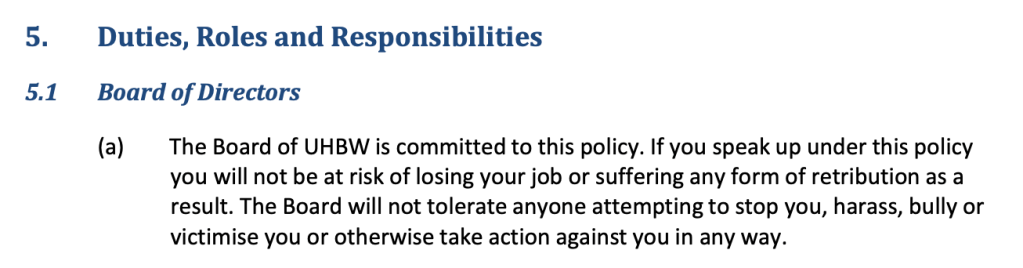
Will the trust take any meaningful action in light of the Tribunal’s finding of whistleblower detriment?
Cough.

 Alexander's Excavations
Hi Minh,
Yet another shocking read, thank you. Where have I heard of Sarah Dodds before?
Julie ________________________________
LikeLike
Hello. I am not sure. It doesn’t ring any obvious bells with me. But that could be Anno Domini 🙂
LikeLike