Public Health England’s response to the finding of Race discrimination and victimisation against Dr Femi Oshin: Discrepant Race and grievance statistics

By Dr Minh Alexander NHS whistleblower and former consultant psychiatrist 13 February 2019

Public Health England (PHE), as an executive agency of the government with oversight functions, should set an example.

It seriously failed to do so in the case of its former employee Public Health Consultant Dr Femi Oshin. An Employment Tribunal determined on 17 January 2017 that PHE had racially discriminated against Dr Oshin and constructively dismissed him. Most seriously, the ET concluded that PHE victimised Dr Oshin for raising concerns about Race discrimination. Despite attempts by PHE to cast aspersions, the ET concluded that there had been no contributory conduct by Dr Oshin:

Race Discrimination by Public Health England

The aftermath of the case rumbles on. Public Health England delayed in completing a review of its governance failure. It produced a voluminous report of October 2018 by Professor Parish a PHE NED, which was published  in board papers of 21 November 2018. The report was accompanied by a submission from Capsticks LLP,  counsel’s opinion from Old Square chambers, a ‘Management response’ document by PHE and annex D, a PHE document entitled: Analysis of Appraisals, Employee Relations and Engagement by Ethnicity and Other protected Characteristics”:

PHE Advisory Board parish report and associated material 21 November 2018

I focus on Annex D of the Parish report, which starts at page 140 of the bundle and reassuringly states:

PHE excerpt from Parish report on Femi Oshin

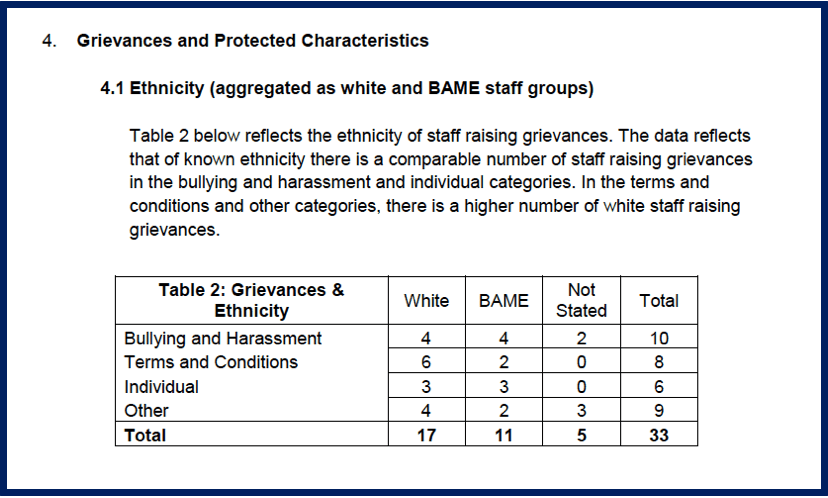
This is curious, because the same document gave PHE grievance data for 2018/19 year to date as follows. Page 145 of the bundle:

Screenshot 2019-02-13 at 15.30.57

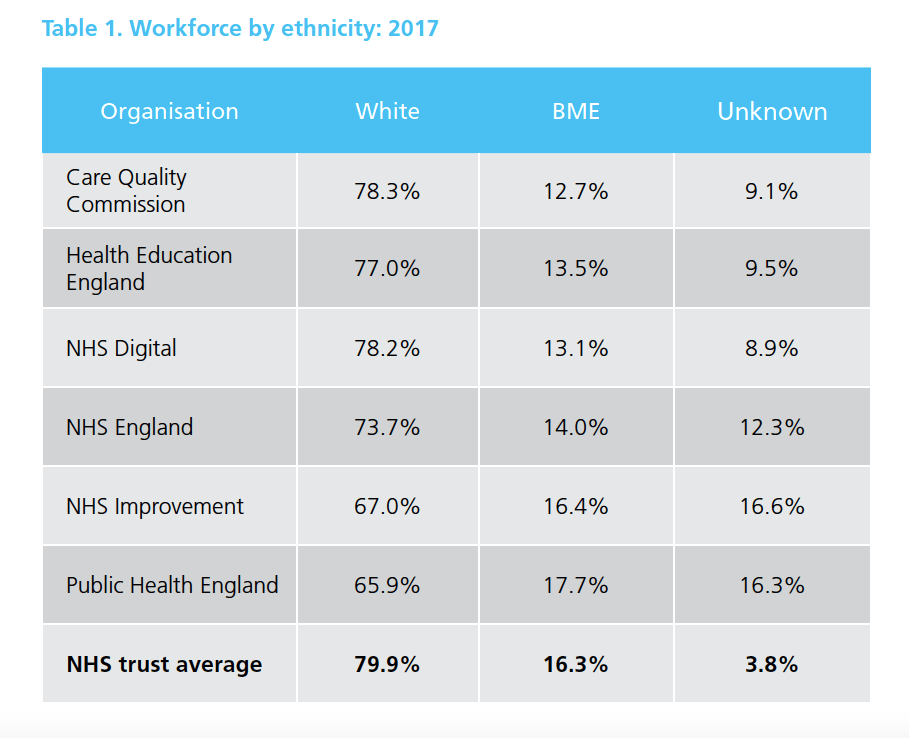
This gives 33% (11 of 33) BME grievances, which is higher than expected because PHE has approximately 18% BME staff:

NHS England WRES analysis of ethnicity in ALBs

Source: 2017 WRES report for NHS national bodies

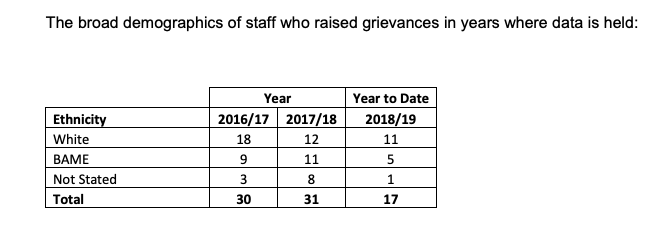
Over two months after the publication of the Parish report, an FOI disclosure by PHE of 11 February 2019 gave different, lower grievance numbers for 2018/19 YTD, but a pattern of over-representation of BME staff in grievances since at least 2016/17:

Screenshot 2019-02-13 at 13.33.24

Based on the above PHE FOI data, taking the whole period from 1 April 2016 to the present time, gives 32% BME grievances (25 of 78).

PHE claimed it held no central data for 2013/14, 2014/15 and 2015/16.

Whatever the truth of the matter, it is disconcerting that PHE has released discrepant Race statistics for grievances even at this late stage.

It would also seem rather selective of PHE to only provide 2018/19 grievance figures in the Parish report, when the data from preceding years would also seem relevant to a picture of Race disadvantage.

The discrepancies have been questioned.


RELATED ITEMS

Waste Industry: Abuses of the NHS disciplinary process

The NHS in the Employment Tribunal: A five month sample


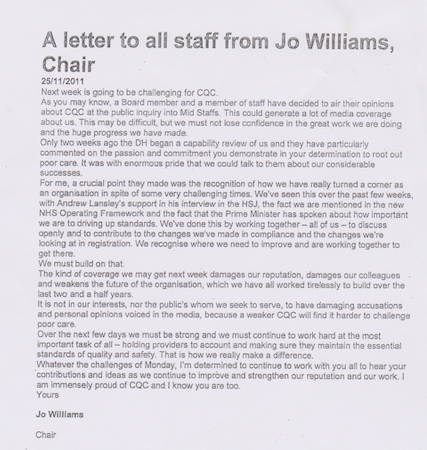
Jo Williams’ letter of 25 November 2011 to all CQC staff, about two CQC whistleblowers who were about to give evidence at the Mid Staffordshire Public Inquiry

Dr Minh Alexander NHS whistleblower and former consultant psychiatrist 10 February 2019

On Monday 28 November 2011, two Care Quality Commission (CQC) whistleblowers Kay Sheldon Non Executive Director and Amanda Pollard Senior CQC Inspector gave evidence at the Mid Staffordshire Public Inquiry on serious concerns about the health and care regulator

These are their witness statements and exhibits, and a transcript of the Inquiry session on 28 November 2011:

Amanda Pollard witness statement and exhibits to Mid Staffs Public Inquiry

Kay Sheldon witness statement and exhibits o Mid Staffs Public Inquiry

Mid Staffs Public Inquiry session 28 November 2011 Transcript

There had been publicity in advance of the hearing:

CQC non-exec to blow the whistle at Mid Staffs inquiry

On the Friday before the two whistleblowers gave their evidence to the Inquiry, Jo Williams CQC Chair sent the following message to all CQC staff, about the damage that might be done to the CQC’s reputation. The letter stated:

“The kind of coverage we may get next week damages our reputation, damages our colleagues and weakens the future of the organisation, which we have all worked tirelessly to build over the last two and half years.

It is not in our interests, nor the public’s whom we seek to serve, to have damaging accusations and personal opinions voiced in the media, because a weaker CQC will find it harder to challenge poor care.”

Jo Williams letter to all CQC staff 25 November 2011

Jo Williams eventually announced her departure  from the CQC in autumn 2012.

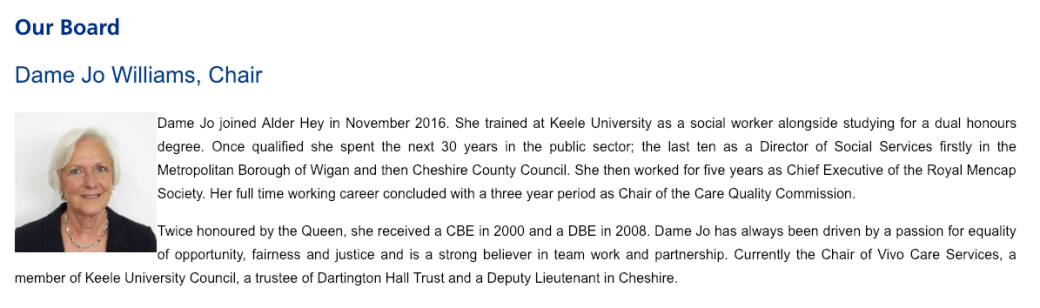
She returned to the NHS in November 2016 when she was appointed as a trust Non Executive Director at Alder Hey Children’s NHS Foundation Trust:

Alder Hey Jo Williams biog

Williams was also for a period appointed as a Non Executive Director at Liverpool Community Health NHS Trust.

Earlier this month, it was revealed that she had been promoted to Chair of Alder Hey Children’s NHS Foundation Trust:

The Times 1 February 2019: “Disgraced CQC chief Dame Jo Williams given top job at children’s hospital”

The CQC twice inspected Alder Hey after Jo Williams was appointed as a trust NED. On the most recent occasion in 2018, CQC rated the trust as “Good” on the well led domain,  and it commented favourably on the trust’s compliance with Regulation 5, Fit and Proper Persons. This regulation requires that regulated bodies must appoint suitable directors:


Overall trust

Our rating of the trust stayed the same. We rated it as good because:

• We rated well-led as good because the trust had a vision for what it wanted to achieve with plans to turn it into action. Staff throughout the trust were aware of the vision and values. There was an experienced and stable leadership team who were committed to improving services, through learning research and innovation. The trust had made improvements to the fit and proper person process since the last inspection.”


UPDATE 8 MARCH 2019

Alder Hey Children’s NHS Foundation trust has disclosed details of how the great and the good gave references and helped to recycle Jo Williams back into an NHS board position:

Another turn of the Magic Roundabout: Jo Williams’ referees


RELATED ITEMS

Liverpool Echo 15 November 2010 “Alder Hey Children’s Hospital boss Richard Glenn quits over David Henshaw appointment”

The unfair sacking of Andrew Smith, NHS whistleblower and trade union representative. A heady cocktail of tainted ingredients. Or how CQC, NHS Improvement & Mid Essex Hospital Services NHS Trust worked together on FPPR.

Sorry is the hardest word: CQC, Paula Vasco-Knight and Regulation 5 Fit and Proper Persons

What could a new whistleblowing law look like? A discussion document


The unfair sacking of Andrew Smith, NHS whistleblower and trade union representative. A heady cocktail of tainted ingredients. Or how CQC, NHS Improvement & Mid Essex Hospital Services NHS Trust worked together on FPPR.

Please sign and share:

Petition to replace weak UK whistleblowing law to protect whistleblowers and the public


By Dr Minh Alexander NHS whistleblower and former consultant psychiatrist 7 February 2019

Summary

 The government and its arms length bodies continue to protect poor senior NHS managers. The Kark FPPR Review report was published yesterday, but is a curate’s egg. Matt Hancock has wasted no time in undermining its findings and recommendations, and has astonishingly delegated the response to Kark’s report to one of the most heavily conflicted bodies, NHS Improvement. On the same day as Kark’s report was published, CQC shut down yet another FPPR referral about a case of proven serious whistleblower reprisal. This related to Mid Essex Health Services NHS Trust. One of the trust managers criticised by the Employment Tribunal in this case is employed as an NHS Improvement Director. CQC also issued a puff piece in July 2018 extolling this individual’s virtues, after the critical ET ruling of whistleblower reprisal in March 2018. Whatever propaganda gushes from the National Guardian’s Office, Covering Up, not Speaking Up, is business as usual.


Background and the Kark FPPR Review

Yesterday, the government published the report of the review by Tom Kark QC on CQC Regulation 5 Fit and Proper Persons.

 A review of the Fit and Proper Person Test Commissioned by the Minister of State for Health by Tom Kark QC and Jane Russell (Barrister)

The review had been ordered by former Minister of Health Steve Barclay after mounting pressure about the continued recycling of poor NHS senior managers, and the CQC’s failure to take effective action under Regulation 5 to stop this. The recycling of failed directors of Liverpool Community Health NHS trust was one of the catalysts.

In January 2014 as part of the government’s attempts to manage the news on the MidStaffs deaths disaster, it claimed that FPPR would be trialled but if that was not successful, it would “legislate” to ensure that there was an effective barring mechanism:


53. There will be a new stronger fit and proper persons test for Board level appointments which will enable the Care Quality Commission to bar directors who are unfit from individual posts at the point of registration. This will apply to providers from the public, private and voluntary sectors. The Government believes that the barring mechanism will be a robust method of ensuring that directors whose conduct or competence makes them unsuitable for these roles are prevented from securing them. The scheme will be kept under review to ensure that it is effective, and we will legislate in the future if the barring mechanism is not having its desired impact.”

Hard Truths The Journey to Putting Patients First Volume One of the Government Response to the Mid Staffordshire NHS Foundation Trust Public Inquiry


Kark was of course, Counsel to the Mid Staffs Public Inquiry.

Kark’s FPPR review report was originally scheduled to be published in October 2018 but was delayed.

An FOI request by @JadeTaylor8  revealed that Kark’s report had been repeatedly revised and that ‘feedback’ was sought from many parties including the NHS managers’ union, Managers in Partnership.

However, whistleblower participants were not given the same opportunity to comment prior to publication. A specific request  for whistleblower participants to be allowed to comment before publication was ignored.

There is a lot to say about Kark’s report. In brief it provides some interesting insights such as a glimpse into CQC’s Well-Led inspections, but it ducks and dives, makes some excuses for the CQC despite recent criticism of CQC’s FPPR process by the PHSO which as far as I can see is not even mentioned by Kark. The report also gives the Department of Health and Social Care a pass, and strews about some lawyerly escape clauses.

Nevertheless Kark made some potentially interesting recommendations:


Page 14 Kark FPPR Review report:

(d) Extending the concept of the FPPT to Board level directors of commissioners and appropriate NHS Arms’ Length Bodies (ALBs).

(e) Setting up a body which has the power to bar directors where serious misconduct is proved to have occurred. We have suggested that this body be called the Health Directors’ Standards Council (HDSC) and that it should have the powers to investigate, require the production of information and, following a fair hearing, to bar directors from director level appointments in the health service;  

(f) Requiring the identification and definition of what is regarded as ‘serious misconduct’ justifying barring. This should focus upon deliberate or reckless but not inadvertent behaviour. Apart from obvious misconduct such as dishonesty and crime, we think there should be a focus upon behaviour which suppresses the ability of people to speak up about serious issues in the health service, whether by allowing bullying or victimisation of those who ‘speak up’ or blow the whistle, or by any form of harassment of individuals. There should be a focus on discouraging behaviour which runs contrary to the duty of candour, so any deliberate suppression or falsification of records or relevant information should be regarded seriously. Further, serious misconduct should include reckless mismanagement which endangers patients;”


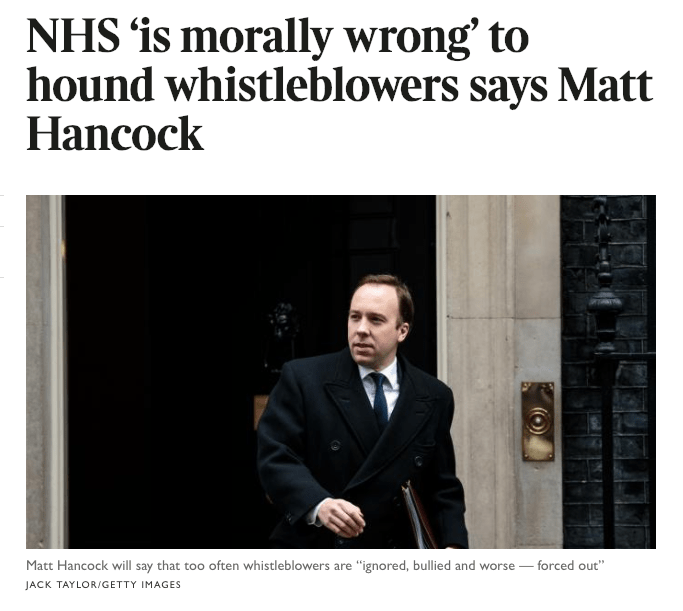
The trouble is, the government shows little sign of good faith in response. The Secretary of State paid lip service yesterday to preventing ‘morally abhorrent’ mistreatment of whistleblowers.

Times photo headline morally wrong to hound whistleblowers

But according to the Health Service Journal (HSJ), Hancock has reportedly accepted  only two of Kark’s less threatening recommendations: 

  1. Definition of core competencies for NHS directors

2. Establishment of a central database on NHS directors’ experience and previous employment, including disciplinary and grievance issues.


Moreover, the Department of Health and Social Care initially claimed to HSJ that the government’s proposals did not include striking off poor managers:

However, a DHSC spokeswoman told HSJ the government’s proposals did not include the ability to “strike off” directors or managers.”

 second HSJ article yesterday   stated:

“The government has delayed making a decision on whether to introduce a regulator for NHS managers, after a review recommended those guilty of misconduct should be banned from sitting on NHS boards”

and it reported that Hancock had washed his hands by passing these decisions to NHS Improvement.

This was an especially contemptuous touch by Hancock, given that Kark had acknowledged that bodies like NHS Improvement are a part of the problem by suggesting that the concept of Fit and Proper Persons should extend to such bodies.


Mid Essex Hospital Services NHS Trust and Andrew Smith

The CQC chose yesterday to demonstrate that it was very much business as usual, by responding in its usual fashion to an FPPR referral on the directors of Mid Essex Hospital Services NHS Trust, for their actions towards Andrew Smith.

Andrew Smith was an RCN steward at Mid Essex who raised concerns, some about patient safety, in the course of his duties as a trade union rep. The Employment Tribunal (ET) concluded that “he was doing no more than his job as a trade union representative”.

Alas, Mid Essex lacked the organisational integrity and maturity to deal with this fairly and reasonably. It suspended him in 2014 and then sacked him a year later in May 2015  – after the Freedom To Speak Up Review was published. The ET judgment referred to a “witch hunt” against Smith.

Mid Essex Hospital Services NHS Trust classically not only persecuted and unfairly sacked Smith as a whistleblower, but it wasted public money by futilely fighting an Employment Tribunal ruling on 5 March 2018 in his favour. It prolonged the immense stress that he suffered by not reasonably acknowledging fault. But the trust lost again, and the EAT sent the case back to the ET which decided once more in his favour.

EAT Judgment 5 March 2018, Mid Essex Hospital Services NHS Trust v Mr A Smith UKEAT/0239/17/JOJ 

ET judgment 16 July 2018, Mr A Smith v Mid Essex Hospital Services NHS Trust 3202272/2015

The trust persisted, through its appeal to the EAT, in claiming that Smith had been dismissed because he made a nuisance of himself, and not because he whistleblown. It contended that the ET had shown incomplete consideration of the case in this respect.

The EAT judge accepted that the ET had not shown all of its reasoning for its verdict, but did not consider that the omission invalidated the whole. He sent it back to the ET for a fuller judgement.

The ET subsequently concluded on 16 July 2018:


16.9. The dismissal and appeal officers were very much aware of the protected disclosures and what a nuisance those disclosures had been, which is not to say the reason was the nuisance factor, it means as a whistleblower, he was a nuisance, and so they dismissed him because he was a whistleblower, because of the protected disclosures.”


On this basis, I asked CQC to review the fitness of the trust directors responsible for causing detriment to Andrew Smith and for prolonging his ordeal in the courts at public expense. My request to CQC of 28 July 2018 is provided in the appendix below.

This is CQC’s FPPR decision letter yesterday from CQC Deputy Chief Inspector Ellen Armistead:

CQC FPPR outcome letter from Ellen Armistead on Andrew Smith v Mid Essex 6.02.2019

In short, CQC has taken nearly 7 months to tell me that it will not be taking action because:


  1. The Trust has informed CQC that the directors of nursing most closely associated with the Smith case no longer work for any NHS provider:

“The Trust has informed us that the Director of Nursing and Deputy Director of nursing who were referenced in the employment tribunal are no longer working for an NHS provider and therefore as they are no longer employed in a director role, they are outside the scope of Fit and Proper Person Requirement (regulation 5).


  1. The trust has told the CQC that it has pulled its whistleblowing governance socks up:

“ The local team engaged with the Trust again on the well-led inspection in October 2018 to follow up on the outcome of the employment tribunal. The Trust informed us they have undertaken work following the judgements including group work focus on the whistle blowing policy at the trust. The development of the policy has included all stakeholders including staff site representatives as well as non-union affiliated staff representatives. There has been the full implementation of the freedom to speak up network. The Trust has nominated a NED for FTSU. There has been a dignity and respect campaign in 2017 and a further raising of executive’s visibility. The inspection team received positive feedback at inspection, particularly about the daily staff briefings that are given by executives. There has been ongoing work against an action plan in response to the staff survey. The trust acknowledged an historic disconnect between staff side representatives and senior trust management. They were also aware that further work was required with staff side. There has been an increase in executive attendance at staff side meetings as well as a more formal approach to contact which the trust believes is working. The local team are continuing to engage with the Trust”


By focussing only on the nurse managers specifically cited by the ET, CQC glosses over who signed off the continuing mistreatment of Andrew Smith through the Employment Tribunal process.

The trust nurse managers who were explicitly criticised in the ET’s original judgment of 5 March 2018 on the Smith case were Cathy Geddes Chief Nurse and Deputy Chief Executive and Lyn Hinton, deputy chief nurse:

293. The reason for dismissal was, we conclude, on the balance of probability, that Mr Smith had made the protected disclosures relied upon. This is what was in the mind of Ms Geddes and Ms Hinton in their decision making. It was not the content of any one disclosure in particular, it was the collective of the disclosures, the fact that he had made them at all, that was in the mind of Ms Hinton and Ms Geddes.”

If Kark’s FPPR review recommendations had been accepted in full by the government, this would have included his red lines that specify whistleblower reprisal as a form of serious misconduct. These managers above would be under serious scrutiny in such a system. But to all appearances, they have not been put through a proper process of accountability.

Worse still, what the slippery CQC failed to acknowledge to me yesterday was that Cathy Geddes, according to her LinkedIn page,  is currently an NHS Improvement Director of Improvement and Quality, NHS Midlands and East region.

So there we have it. The body to whom Hancock has handed the critical decision on which of Kark’s recommendations will be adopted is still brazenly sheltering those proven to have seriously harmed whistleblowers.

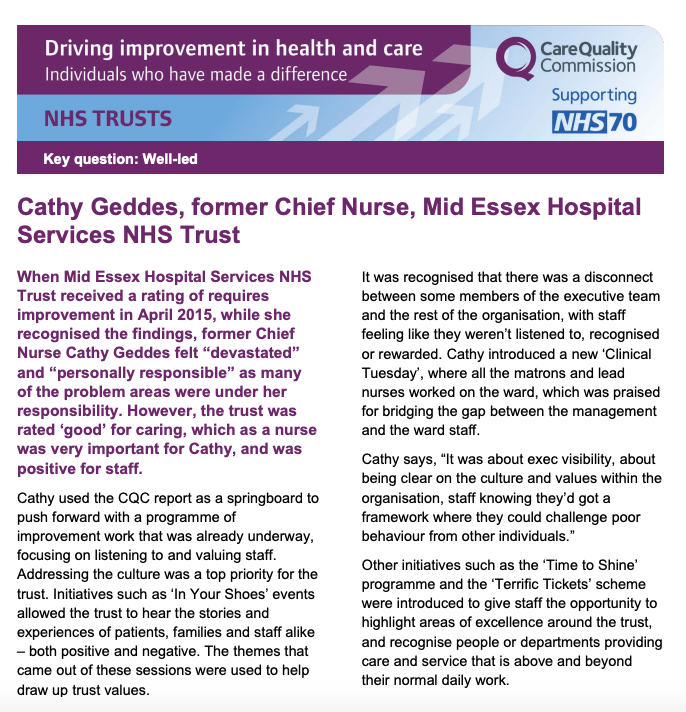
Ten days before the final ET verdict against Mid Essex in July 2018, CQC published a questionable report  which puffed various senior NHS managers for making a difference, including Cathy Geddes. CQC even picked out quotes by Geddes about the importance of building a culture in which it was possible for staff to safely challenge things:

Cathy Geddes excerpt CQC Driving Improvement report

Hand up, anyone who thinks NHS Improvement will volunteer its own directors, and those of other dubious bodies like CQC, for scrutiny under FPP?

The repeatedly sleazy behaviour of NHS regulators, and their master the Department of Health and Social Care, brings our long suffering NHS into disrepute. This is convenient for those who do not wish our NHS well.

But hark, do not despair entirely. Geddes is “passionate about working with others to improve care for our patients.”

Cathy Geddes linkedin profile 7.02.2019


UPDATE 9 JANUARY 2020

Andrew Smith asked the National Guardian’s Office last year to do a case review on his whistleblowing experience at Mid Essex Hospital Services NHS Trust.

His request was declined despite the fact that he had been vindicated by both the Employment Tribunal and the Employment Appeal Tribunal.

He believes he has been blacklisted and has suffered financial hardship. As is the usual turn of events, compensation received through the Employment Tribunal has not made up for all losses suffered as a result of being unfairly sacked.

He has asked the National Guardian to honour a 2017 promise to seek the reinstatement of unfairly sacked NHS whistleblowers. He has also repeated his request for a case review:

Andrew Smith, unfairly sacked NHS whistleblower and trade union rep, asks the National Guardian again for help


Please sign and share:

Petition to replace weak UK whistleblowing law to protect whistleblowers and the public


RELATED ITEMS


Letter 7 February 2019 to Dido Harding Chair of NHS Improvement

Dear Dido,

NHS Improvement’s role in recycling managers with a proven track record of whistleblower reprisal

I write following the publication of the Kark FPPR Review report yesterday, and the Secretary of State’s reported decision to put NHS Improvement in charge of deciding which of Tom Kark’s recommendations will be accepted.

I believe NHS Improvement still employs an NHS Director who was personally criticised by the Employment Tribunal for the unfair dismissal of a whistleblower and trade union representative at Mid Essex Hospital Services NHS Trust. Please follow the link below for the relevant evidence.

I wonder if NHS Improvement can advise what, if anything, it will do about this.

I ask you to bear in mind that falling across this matter is the terrible shadow of the Gosport War Memorial Hospital deaths disaster, in which hundreds of unnatural deaths followed the suppression of whistleblowers,

With best wishes,

Minh

Dr Minh Alexander

Cc Tom Kark QC

      Matt Hancock Secretary of State for Health

      Stephen Hammond Minister for Health

      Caroline Dinenage Minister for Social Care and MP for Gosport


Letter 8 February 2019 to Peter Wyman Chair of CQC:

BY EMAIL

Peter Wyman

Chair of Care Quality Commission
8 February 2019
Dear Mr Wyman
CQC’s promotion of provider managers, including those who have been found to have harmed whistleblowers, and regulatory capture
I write to raise some concerns about a regular bulletin that CQC has been issuing – ‘Driving Improvement’. This gives vignettes of supposed good practice and learning from CQC action against regulated bodies.
However, its effect in some instances is to promote some senior managers of regulated bodies.
There is one case that I would like to draw your attention to: CQC’s July 2018 ‘Driving Improvement’ bulletin on ‘Individuals who have made a difference in NHS Trusts’ featured the former Chief Nurse of Mid Essex Health Services NHS Trust. The bulletin highlighted the Chief Nurse’s credentials in turning culture around and creating an environment where staff could challenge poor behaviour:
In fact, she had been criticised by the Employment Tribunal judgment of 5 March 2018 for seriously harming a whistleblower and trade union representative, when in the Tribunal’s view he was doing “no more than his job as a trade union representative”:
I wonder if CQC could review whether it should be promoting individual senior managers this way and whether such action could undermine its regulatory independence and neutrality.
But if CQC intends to continue such promotion, could it at least ensure that it does not promote those who have been found, through a formal process, to have harmed whistleblowers. Particularly as this would seem to conflict with CQC’s duty to enforce Regulation 5 and ensure that regulated providers comply with the requirement not to employ unsuitable directors.
Yours sincerely,
Dr Minh Alexander
cc Health Committee
    Sir Robert Francis CQC NED
    Prof Ursula Gallagher Deputy Chief Inspector and CQC lead on whistleblowing
    Prof Ted Baker Chief Inspector of Hospitals
    Ellen Armistead Deputy Chief Inspector and CQC lead on NHS FPPR
    Rob Behrens PHSO

Regulation 5, Fit and Proper Persons: Dissecting CQC’s Dissembling

Sorry is the hardest word: CQC, Paula Vasco-Knight and Regulation 5 Fit and Proper Persons

What could a new whistleblowing law look like? A discussion document

Whistleblowing in the NHS isn’t fixed yet, and this leaves patients exposed. An overview of unfinished policy business.


APPENDIX

FPPR referral to CQC about Mid Essex Health Services NHS Trust directors and the mistreatment of Andrew Smith, whistleblower:

BY EMAIL

Ian Trenholm

Chief Executive

Care Quality Commission

28 July 2018

Dear Mr Trenholm,

FPPR referral on directors of Mid Essex Hospital Services NHS Trust in regards to serious whistleblower reprisal

I understand that you have taken up or are about to shortly take up post at CQC.

I write to ask the CQC to look into the actions of the relevant directors of Mid Essex in respect to the unfair dismissal of an RCN steward for whistleblowing.

This is the relevant final ET judgment in the case of A Smith v Mid Essex:

https://minhalexander.com/wp-content/uploads/2018/07/a-smith-v-mid-essex-final-judgment-mr_a_smith_v_mid_essex_hospital_services_nhs_trust_32022722015_remission.pdf

This is the core of the matter from the ET’s perspective:


“16. We review why we considered whistleblowing was the reason for the dismissal:

16.1. The coincidence of timing;

16.2. Everyone pointedly ignoring the possible link between the disciplinary action and the protected disclosures;

16.3. The witch hunt against him;

16.4. The flawed, cursory investigation report;

16.5. The failure to disclose the CQC email by the appeal officer;

16.6. The weakness and lack of merit in the disciplinary charges;

16.7. It was not at all clear that there was a breakdown in employment relationship;

16.8. Mr Smith was not unmanageable as claimed, and

16.9. The dismissal and appeal officers were very much aware of the protected disclosures and what a nuisance those disclosures had been, which is not to say the reason was the nuisance factor, it means as a whistleblower, he was a nuisance, and so they dismissed him because he was a whistleblower, because of the protected disclosures.

17. We remain of the view that Mr Smith was dismissed because he made the Protected Disclosures.”


You will I imagine be aware that Robert Francis advised in his report of the Freedom To Speak Up Review that whistleblower reprisal should be considered an a matter of serious misconduct under FPPR.1

Also, the current Kark review on FPPR has been asked to specifically consider whether FPPR should henceforth explicitly consider “conduct which might inhibit or discourage appropriate whistleblowing” and “any conduct designed to conceal or disguise” such acts.

Mid Essex trust squandered public funds by unreasonably resisting Mr Smith’s justified claim and appealing to the EAT, which sent the case back to the ET. As well as wasting large amounts of public money, this will have added significantly to the suffering experienced by Mr Smith and his family.

The case of Mr Smith will not have reached the EAT without the complicity of several Board members. It is also likely that the appeal officers, and possibly the dismissing officers, who were criticised by the ET were trust directors.

I would be grateful if the CQC would therefore look into this matter under Regulation 5.

The CQC will of course already be aware of Mr Smith’s case as he made repeated disclosures to your organisation.

Yours sincerely,

Dr Minh Alexander

Cc Steve Barclay Minister of State for Health


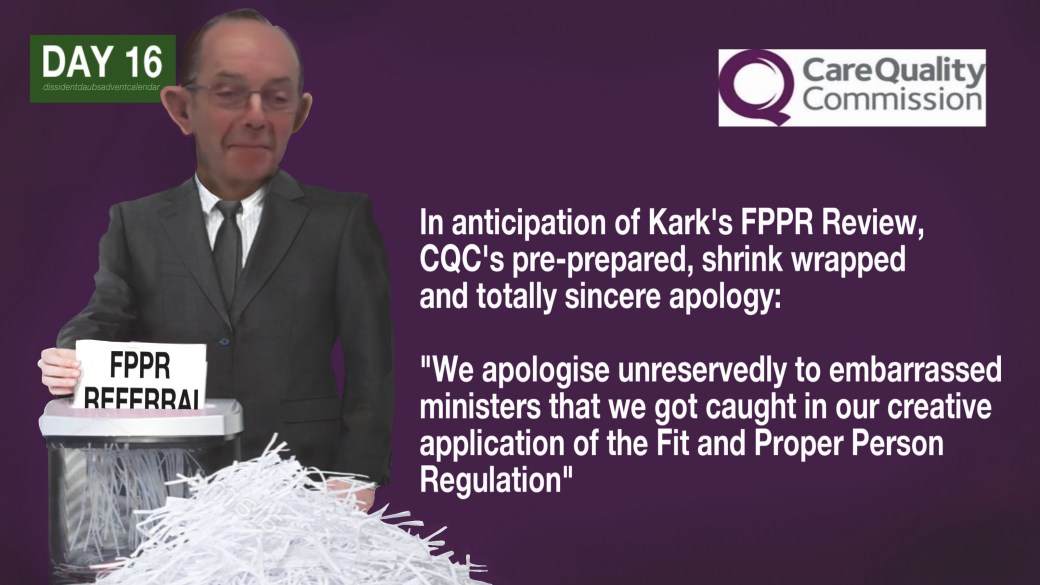
Day 16 FPPR shredder wyman


Staff Surveys and FOI adventures with AAIB and HSIB

By Dr Minh Alexander NHS whistleblower and former consultant psychiatrist 27 January 2019


Jeremy Hunt the former Health Secretary’s great gimmick was patient safety crusading.

Marvellous false colours to sail under whilst his government destabilised and defunded the NHS.

MidStaffs, Morecambe Bay and other pennants fluttered from his mast.

Robert Francis was knighted and nailed onto the prow of Hunt’s HMS Safety.

Another piece of political theatre was the importation of aviation safety, amidst many a glib soundbite.

The small and largely toothless Healthcare Safety Investigation Branch was established as a shiny beacon of aviation safety expertise. It came with Keith Conradi  former Chief Inspector of the Air Accident Investigation Branch (AAIB) a part of the Department for Transport.

But there were questions about the nature of HSIB.

In a recent mental health services investigation, HSIB produced an inaccurate investigation report which had the effect of protecting the CQC and minimising the regulator’s negligence.

I asked for historic AAIB staff survey data, including the period from when Keith Conradi was AAIB Chief Inspector.

AAIB takes part in the annual Civil Service People Survey, the results of which are published by individual department.

Staff survey transparency is now an established part of public service culture.

But in spite of this, AAIB resisted the FOI request.

This was also despite the fact that, as another party has now established via FOI, AAIB routinely shares its staff survey results with its staff:


AAIB FOI disclosure 18 January 2019 Ref F0016928

“AAIB shares the results of its annual staff surveys (people surveys) with all AAIB staff. 

The surveys include aggregated data.”


An internal review of my FOI request was personally signed off by the current AAIB Chief Inspector Crispin Orr, who also refused disclosure of AAIB’s staff survey data.

An appeal to ICO later led to a decision in favour of disclosure.

But AAIB continued to resist.

Its parent the Department for Transport lodged an appeal against the ICO’s decision to the First Tier Tribunal (Information Rights), Number EA/2018/0286, dated 22 November 2018.

This was received by the Tribunal on 20 December 2018 according to the First Tier Tribunal website. 

I have applied to join the appeal as a party, so I will say no more about the proceedings at this stage.

In the meantime, a subject access request for personal data showed that AAIB and HSIB acted in concert in response to my request for historic AAIB data. The box below shows a disclosed, copied and pasted fragment from an email exchanged between AAIB and HSIB personnel on 23 November 2018:


Hi

  Are you able to share the AAIB surveys with me?

  The ICO has said they are to be released to Min [sic] so I wondered if I could have copies as I suspect she will be FOI-ing us soon 

 I want to prepare some lines to take in prep for our FOI – Min [sic] is a frequent commentator on HSIB on social media”


AAIB denied that there were any other emails accompanying the above email.

AAIB also disclosed – bit by bit – that the following sequence of briefing emails (supplied as copied and pasted fragments) were exchanged between AAIB, the Department of Transport and the Cabinet Office:


Email between AAIB and DfT Sat 01/12/2018 12:32

“Q2 – why the applicant might be interested in the AAIB?

A2 – Doctor Minh Alexander is specifically interested in the AAIB ex-Chief Inspector Keith Conradi who is currently the Chief Inspector at the Healthcare Safety Investigation Board (HSIB). She describes herself as a NHS Whistleblower and on her website she has a document called “Alexander’s Excavations” stating “mostly whistleblowing , NHS underbelly but other stuff too!”. This includes comments and details of a large number of FOIs directed at the Department for Health and the NHS. Regarding the recent ICO response to the AAIB she tweeted “Upon appeal, @ICOnews has decided that AAIB must disclose the requested AAIB staff survey data. So we will get to see what sort of #justculture existed under Keith Conradi’s tenure at AAIB”


Email between DfT and AAIB (all names redacted)

From: xxxxx

Sent: Fri 30/11/2018 10:08

To: xxxx

Subject: FW: FOI

Dear xxx ,

Please see message below from xxx at Cabinet Office.

Clearly only the AAIB can answer the first bullet! And are best placed to respond to all the others. 

On the reports issue, I guess it was only the top level AAIB report that was requested; not the Inspector / admin team splits that sit below that. I have reports back to 2009 or AAIB, by the way.

Regards,


Email between Cabinet Office and DfT (all names redacted)

From: xxxxx On Behalf Of Employee Engagement Program Mailbox

Sent: 29 November 2018 17:44

To: xxxx

Subject: FOI

Hi xxx


We’ve asked an FOI expert here for more information to help us decide whether to appeal.

We need some info from you too. 

Do you know: 

if the AAIB are content to release their results?

why the applicant might be interested in the AAIB?

how many years reports you have?

if the AAIB employs any SCS staff?

the status of the AAIB? It is listed in the ‘Other’ category of your list of agencies and public bodies on GOV.UK

https://www.gov.uk/government/organisations#department-for-transport

thank you


UPDATE 2 SEPTEMBER 2019:

Staff at HSIB have alleged problems with culture and governance, as reported by the Health Service Journal in June:

Safety Watchdog Hit by Poor Governance and Culture

The government’s response to a ruling by the Information Tribunal regarding disclosure of AAIB staff surveys is due today.


RELATED ITEMS:

NHS Bodies: 5 years of ICO decisions

HSIB’s sleight of hand, CQC and the Care Programme Approach: Comments on HSIB Investigation into the transition from child and adolescent mental health to adult mental health services 12017/18

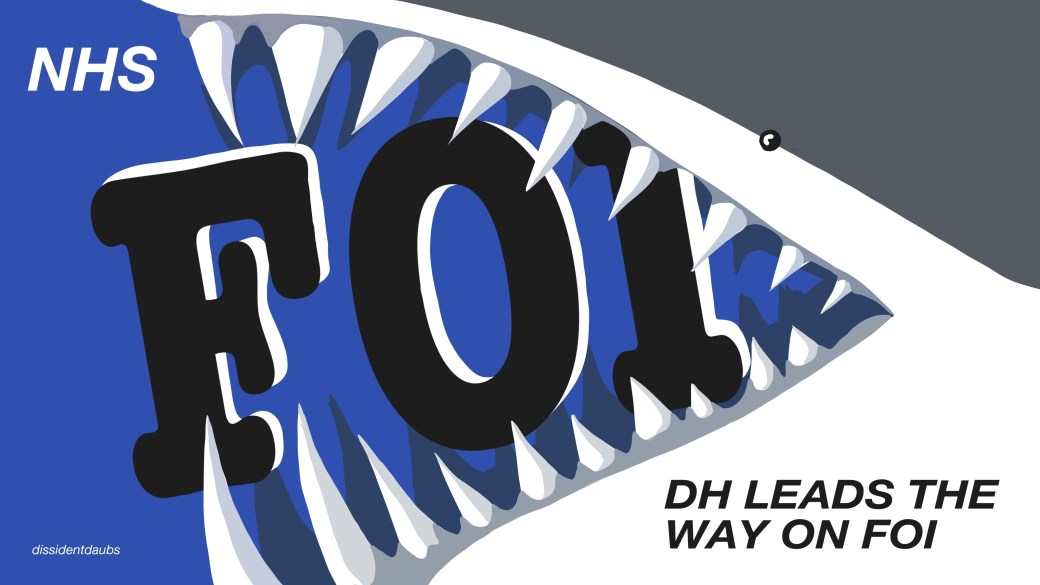
FOI shark

Whistleblowing APPG: Whistleblowers UK and questions about funding by Constantine Cannon LLP

By Dr Minh Alexander NHS whistleblower and former consultant psychiatrist 24 January 2019


Summary:

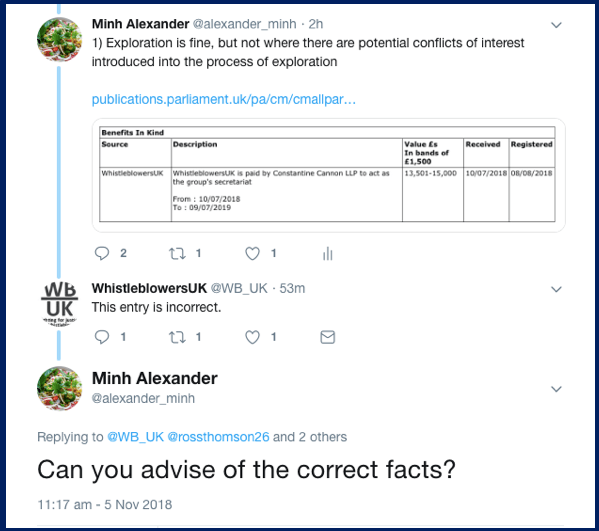
A controversial whistleblowing All Party Parliamentary Group (APPG) was established last summer, with reported funding from Constantine Cannon a well-known US bounty hunting law firm.

A subsequent denial about the funding by the APPG’s secretariat, the private company Whistleblowers UK (WBUK), has not been clarified or resolved.


The back ground to the establishment of the above APPG and the ethical questions posed by the US bounty hunting model has been set out previously:

Whistleblowing v Bounty hunting. A new whistleblowing APPG with sponsorship from bounty hunters

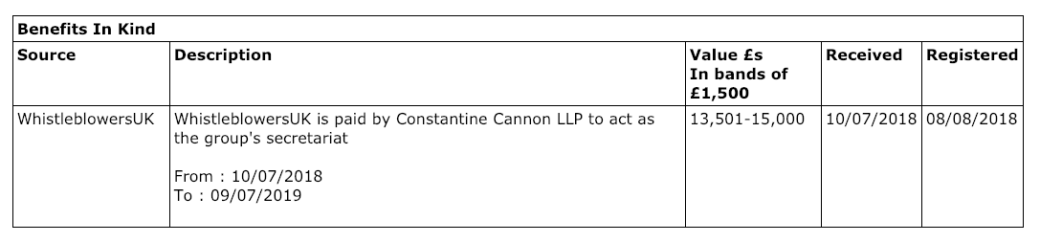
There has been much concern that the APPG reportedly accepted funding from Constantine Cannon LLP to operate a secretariat administered by WBUK, as per details published in the August 2018 parliamentary APPG register.

These are the financial details for the whistleblowing APPG that appeared in the parliamentary register in August 2018:

screenshot 2019-01-24 at 12.42.20

For those unfamiliar with APPGs, they are special interest groups with no official status, but they can influence:


All-Party Parliamentary Groups (APPGs) are informal cross-party groups that have no official status within Parliament. They are run by and for Members of the Commons and Lords, though many choose to involve individuals and organisations from outside Parliament in their administration and activities.”

https://www.parliament.uk/about/mps-and-lords/members/apg/


There has been concern that APPGs can be a means of lobbying by private interests:

Are APPGs a ‘dark space’ for covert lobbying? (The Guardian 6 January 2017)

APPGs are required to comply with certain rules, including declaring benefits, financial and in kind, such as of hospitality, gifts, overseas visits.

Guide to the Rules on APPGs

On 5 November 2018 an unidentified person at the end of the WBUK Twitter account denied that the financial details published in the parliamentary APPG register were correct:

screenshot 2019-01-24 at 12.45.50


The individual who tweeted the denial did not provide alternative facts.

The office of the parliamentary Registrar of Members’ Financial Interests advised on 6 November 2018 that it would enquire further into the matter.

On 22 November 2018, the office advised that it was still awaiting a formal response from the whistleblowing APPG. It additionally clarified:


In the meantime I should say that the register entry does not indicate that the secretariat has already been paid by Constantine Cannon LLP; only that this is the payment expected over the year.

I will let you know when I hear anything further.”


I have not heard from parliament since the last communication on 22 November 2018.

On 2 January 2019, an updated register of APPGs was published by parliament.

This showed the same financial details for the whistleblowing APPG as was originally published in August 2018.

I have asked the office of the Registrar of Members’ Financial Interests if there has been any response from the whistleblowing APPG.

I have also written to the chair of WBUK, to ask if he can help shed any light on the facts.

I await a response from both.


Email 23 January 2019 to Tom Lloyd, Chair of Whistleblowers UK:
“Dear Tom,

Accuracy of published details about the whistleblowing APPG

I write to ask if you could clarify the financial arrangements between WBUK and the law firm Constantine Cannon.

The published whistleblowing APPG details that first appeared in August 2018 stated:

WhistleblowersUK is paid by Constantine Cannon LLP to act as the group’s secretariat

 From : 10/07/2018

To : 09/07/2019”

and they indicated that the sum paid was between “£13,501-15,000”.

On 5 November 2018 someone on the WBUK Twitter account tweeted to me that the APPG register details were incorrect: “This entry is incorrect”.

However, the person tweeting on behalf of WBUK did not provide alternative facts.

The latest January 2019 version of the published APPG register still shows the same details for the Whistleblowing APPG as published in August 2018.

Please can you advise if these details are correct.

If they are not correct, please can you advise of the correct details.

Many thanks,

Minh

Dr Minh Alexander

cc Stephen Kerr MP  APPG Chair & registered contact

Norman Lamb MP APPG Vice Chair

Andrew Mitchell MP APPG Vice Chair

Baroness Kramer APPG Co-Chair

Anneliese Dodds MP APPG Vice Chair”


It would seem desirable for a working group about whistleblowing to have straightforward governance.

I do not intend to engage with this APPG given my concerns about the bounty hunting model, which I think works against both the public interest and the welfare of the majority of whistleblowers.

Norman Lamb MP a Vice Chair of the APPG has advocated in parliament for the UK to import US Frank Dodd style bounties.

I doubt that engaging with and legitimising this APPG will help deliver genuine reform.

The reform of UK whistleblowing law is a sober and critically important matter.

I urge all whistleblowers who take part in the debate to read as widely as possible.

The debate needs to be informed and evidence-based, and any solutions need to be just, credible, sustainable and realistic for law reform to become a reality.

UPDATE 4 FEBRUARY 2019

I wrote to Stephen Kerr MP the Chair of the whistleblowing APPG on 31 January 2019 as I had not heard from the Chair of WBUK in response to my above query of 23 January.

Today, the parliamentary Registrar of Members’ Financial Interests has advised that Stephen Kerr MP has confirmed that the published APPG financial details are correct:

“Dear Minh

This is just to let you know that I have corresponded with the chair of the APPG on Whistleblowing who has confirmed that he believes the Group’s Register entry is indeed accurate. It sets out the sum which the secretariat expects to receive over the year.

This answers the question about the group’s register entry.

With best wishes”

This of course begs the question of why someone at Whistleblowers UK denied that the published details were accurate, and then did not or could not substantiate that denial.


HOW TO HELP

If you are a member of the public who would like to help protect future whistleblowers, a really simple and effective thing you can do is write to your MP to ask for the law to be reviewed. Here is a handy template letter that you can send off in couple of minutes:

Send this letter to your MP to help protect UK whistleblowers


RELATED ITEMS

What could a new whistleblowing law look like? A discussion document

Whistleblowers in Their Own Words: What’s wrong with UK whistleblowing law and how it needs to change

Whistleblowing in the NHS isn’t fixed yet, and this leaves patients exposed. An overview of unfinished policy business.

Mission Drift by the National Guardian: Further, proposed dilution of NHS whistleblower case reviews


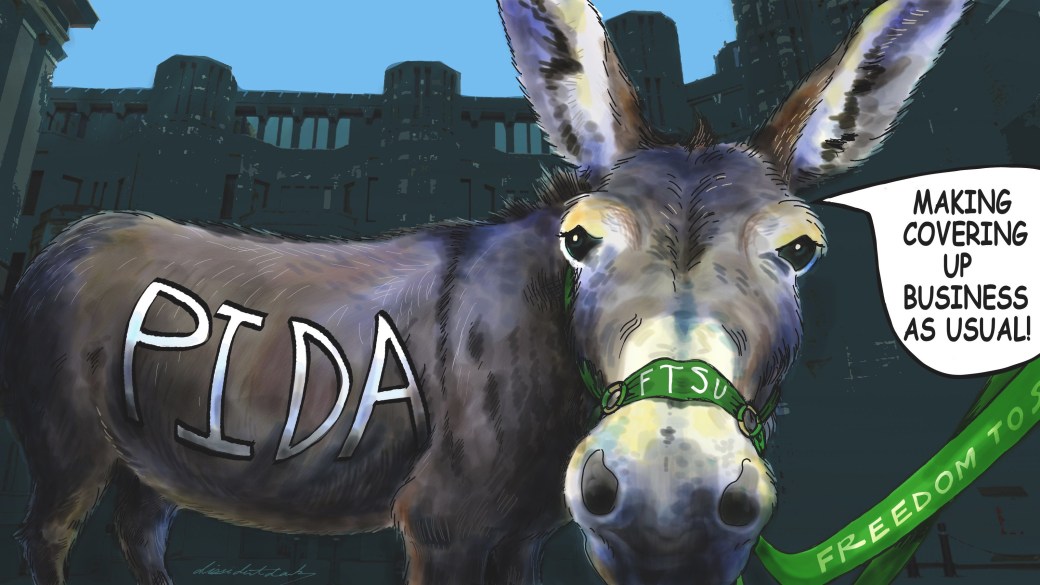
PIDA ASS (2)

Mission Drift by the National Guardian: Further, proposed dilution of NHS whistleblower case reviews

By Dr Minh Alexander, NHS whistleblower and former consultant psychiatrist 29 December 2018


The Freedom To Speak Up Review on NHS whistleblowing was a sop to public opinion, which in reality protected the government and allowed continuing control of information against the public interest.

The Review made weak recommendations, but even these have been watered down by the CQC and National Guardian, without demur by the Department of Health and Social Care.

The National Guardian’s Office has moved away from its original primary function of helping individual whistleblowers in serious difficulties, to making vague recommendations for culture change.

The National Guardian has avoided thorny issues of personal accountability for whistleblower reprisal, and even denied on a national broadcast that there were “bad guys”. 

The National Guardian’s Office has also acted arbitrarily in its handling of requests for case review. It has allowed whistleblowers to be seriously harmed by refusing to accept cases on questionable grounds. Alongside this, the National Guardian failed to review the handling of patient safety concerns in these cases.

At Brighton and Sussex, the National Guardian protected a favoured NHS trust board by arbitrarily delaying case review for many months, whilst the Brighton and Hove coroner continued to issue warnings about lethal poor care:

Coroner’s report to Prevent Future Deaths on Rita Giles 11 July 2018

Coroner’s report to Prevent Future Deaths on Ronald Harman 19 July 2018

Report 20 September 2018 of coroner’s intention to issue a PFD on death of Joan Blaber

The list of preceding coroner’s warnings was already lengthy. Brighton and Sussex University Hospitals NHS Trust has generated one of the highest numbers of coroners’ warnings nationally.

There were 21 published coroners’ reports to Prevent Future Deaths (PFDs) which related to BSUH between February 2014 and April 2017:

Stephen Palmer 25/02/14, 2014-0072 – copied to Secretary of State for Health

Herta Woods 26/02/14, 2014-0081 – copied to Secretary of State for Health

John Adams, 1/07/14, 2014-0293 – copied to Secretary of State for Health

Martin Hill, 22/08/14, 2014-0382 – copied to Secretary of State for Health

Linda Rignall, 19/09/14, 2014-0414 – copied to Secretary of State for Health

Isaac Bahar, 15/06/15, 2015-0229 – copied to Secretary of State for Health

Evelyn Kennedy7/05/15, 2015-0178 – copied to Secretary of State for Health

Anthony Geerts, 24/06/15, 2015-0240 – copied to Secretary of State for Health

Thelma Jones, 12/08/15, 2015-0318 – copied to Secretary of State for Health

Marion Howes, 11/02/16, 2016-0046 – copied to Secretary of State for Health

Geoffrey Moyse, 20/02/16, 2016-0067- copied to Secretary of State for Health

Graham Watts, 3/04/16, 2014-0149 – copied to Secretary of State for Health

Jack Molyneux 29/04/16, 2016 – 0168 – copied to Secretary of State for Health

Christine Street, 10/05/16, 2016 – 0177- copied to Secretary of State for Health

Jean Stockley, 12/08/16, 2016 – 0286

[17 August 2016 CQC placed the trust into special measures]

Diana Ritchie, 18/08/16, 2016 – 0296 – copied to Secretary of State for Health

Leslie Lerner, 28/10/16, 2016-0487 – copied to Secretary of State for Health

Mary Muldowney, 8/12/16, 2016-0440

Raymond Pollard, 25/01/17, 2017-0023 – copied to Secretary of State for Health

Ronald Bennett, 5/04/17, 2017-0097 – copied to Secretary of State for Health

Patricia Webb, 20/04/17, 2017-0130 – copied to Secretary of State for Health


The National Guardian finally announced a case review on 21 December 2018 as follows:

The purpose of the review is to support the trust to develop its speaking up culture, by identifying any areas for improvement and commending good practice”

As the trust’s CEO Marianne Griffiths features in today’s New Year’s Honours list as a new Dame, “For services to the NHS”, what is the betting that the eventual case review report on Brighton and Sussex will lean towards “commending good practice”?

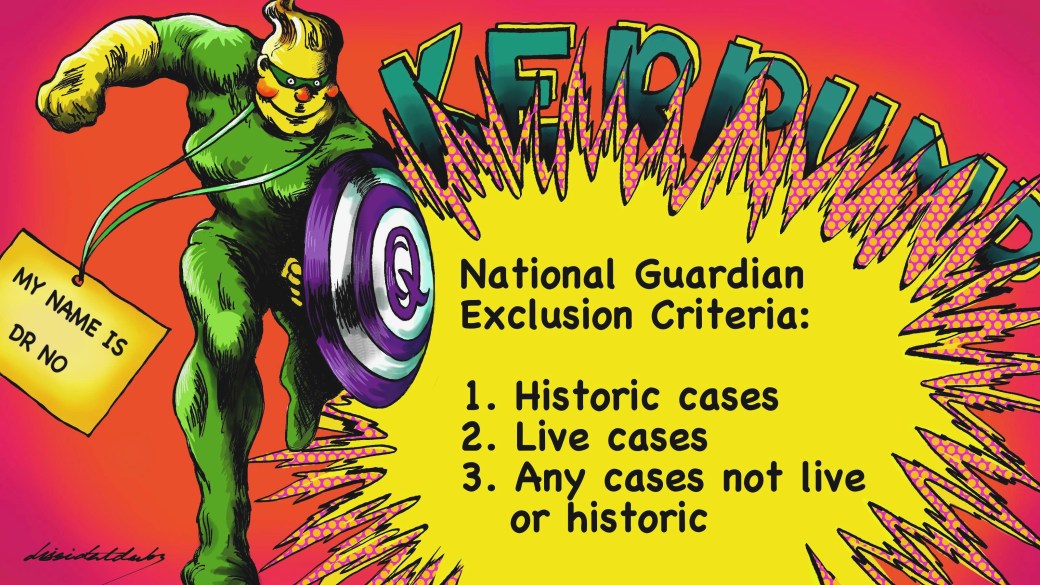
I have been in correspondence with the National Guardian and her Office about her case review exclusion criteria.

This has resulted in disclosure of suggestions by her Office to dilute its case review process even more:

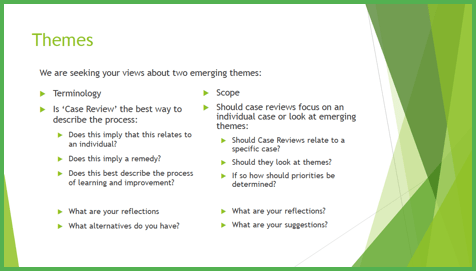
National Guardian Presentation 7 September 2018 on revision of case review process and criteria

These are the key suggestions from this presentation by her Office on 7 September 2018:

Screenshot 2018-12-29 at 09.38.07

There has been reluctance by her Office to clarify whether and how it will consult on any new case review process. I am pressing for full, open consultation.

If you agree there should be open consultation, you can make a request to the National Guardian’s Office via this general address: enquiries@nationalguardianoffice.org.uk


In the meantime, this is my initial feedback to the National Guardian in response to the above suggestions:

1. I think you should remain grounded in the original reasons why your Office was proposed by Robert Francis – it was proposed primarily to benefit NHS whistleblowers who had no place to go, regarding the handling of their concerns.

“7.6.5 It became apparent during the course of the Review that there is a gap in the mechanisms for oversight of how an NHS body deals with concerns raised by staff”


2. Francis also proposed that your Office should use its influence to ensure redress for harmed whistleblowers and patients who had suffered as a result of poor whistleblowing governance, page 168 Freedom To Speak Up Review:


“7.6.12 The INO should be authorised by these bodies to use his/her discretion to: 


• review the handling of concerns raised by NHS workers where there is cause for concern in order to identify failures to follow good practice, in particular failing to address dangers to patient safety and to the integrity of the NHS, or causing injustice to staff

 • to advise the relevant NHS organisation, where any failure to follow good practice has been found, to take appropriate and proportionate action, or to recommend to the relevant systems regulator or oversight body that it make a direction requiring such action. 


This may include: 

– addressing any remaining risk to the safety of patients or staff

 – offering redress to any patients or staff harmed by any failure to address the safety risk – correction of any failure to investigate the concerns adequately

3. I am very concerned that your Office has been drifting away from the core focus of righting wrongs in individual cases, to just learning general lessons that arise from cases.

4. A particularly serious concern is the continuing denial by your Office that it has any remit for helping to ensure redress when this is plainly part of the original intention and was a principle accepted by the government. Redress in this context was clearly intended to be a patient safety mechanism, and it is disturbing that your Office has not accepted this.

5. I am even more concerned now to see the suggestion that your Office could de-couple itself entirely from focus on specific cases and look at themes. In seeking to drop even the term “case review”, your Office marginalises whistleblowers even more and the fate of individual whistleblowers and patients harmed by suppression is given even less importance. This is serious mission drift.

6. I believe that if you continue to leave injustices uncorrected, this will be very damaging to Speaking Up culture. In time, these injustices will accumulate and be apparent to all, no matter what staff are told through official briefings.

7. You stated in your latest annual report that the victimisation of staff who speak up must stop:

“This type of behaviour has to stop.”

Statements are not enough and your Office needs to take proactive measures as set out originally in the report of the Freedom To Speak Up Review, to help reverse harm to whistleblowers and patients in specific cases.

8. I repeat my request that you stop the blanket exclusion of cases from review on the basis that there is an active employment process. This excludes the most serious cases for years, as they languish in the Employment Tribunal. It is vital that all issues relating to poorly handled patient safety issues are examined as a matter of priority, whether or not you side step the employment issues. Although I think the latter would be a shame, as whistleblower detriment is also ultimately relevant to patient safety. Inaction and delay allow great harm to be wreaked in whistleblowing cases, and early intervention was acknowledged to be important by the Freedom To Speak Up Review (Principle 8 and Principle 9).


RELATED ITEMS

A Serious Health Warning about the Freedom To Speak Up Project: What all NHS staff should know before they whistleblow

CQC’s Victimisation of Whistleblowers: Failure to Investigate Concerns

A Study in Delay: The National Guardian & Brighton and Sussex University Hospitals NHS Trust

Mr Tristan Reuser surgeon & GMC. Update on GMC, whistleblowing and implementation of the Hooper recommendations

Replacing the Public Interest Disclosure Act (PIDA)

What could a new whistleblowing law look like? A discussion document


DR NO (1)


Dissidentdaubs’ Boxing Day Cabaret

Whistleblowers! Sick of government propaganda? Got indigestion from being force fed over-cooked porkies? Take a swig of refreshing counter-culture seltzer and pull up a chair.

Willkommen! And bienvenue! Welcome!
Fremder, étranger, stranger
Glücklich zu sehen
Je suis enchanté
Happy to see you
Bleibe, reste, stay
Willkommen! And bienvenue! Welcome!
….Dissidentdaubs’ Alternative #SpeakUpMonth of December 2018:


RELATED ITEMS

The National Guardian’s Day Out with the PHSO: Claims & Rebuttals

CQC’s Victimisation of Whistleblowers: Failure to Investigate Concerns

Whistleblowers in Their Own Words: What’s wrong with UK whistleblowing law and how it needs to change

What could a new whistleblowing law look like? A discussion document


Sorry is the hardest word: CQC, Paula Vasco-Knight and Regulation 5 Fit and Proper Persons

By Dr Minh Alexander NHS whistleblower and former consultant psychiatrist 19 December 2018

UK whistleblowers are not protected. Instead, powerful wrongdoers are protected.

That is the bald truth, and the situation is enabled by very weak UK whistleblowing law. 

We even have an NHS National Guardian for whistleblowing who recently and astonishingly dismissed a suggestion that there are ‘bad guys” responsible for suppressing staff who speak out.

This echoed previous remarks by the National Guardian, in which she re-framed accountability as ‘blame” and suggested that it was undesirable:

“I’m not going to perpetuate harmful, negative cultures, blame shifting.”

There is now a further twist in the saga of the Care Quality Commission’s mishandling of Regulation 5 Fit and Proper Persons (FPPR), which is supposed to prevent the recycling of poor managers but does not.

The Parliamentary and Health Service Ombudsman has partially upheld a complaint about CQC’s perverse closure of the FPPR referral on Paula Vasco-Knight, disgraced former NHS chief executive and convicted fraudster. This is PHSO’s report and its accompanying press release:

Blowing the whistle. An investigation into the Care Quality Commission’s Regulation of the Fit and Proper Person Requirement

PHSO press release

The PHSO criticised CQC’s slippery minimisation of the Employment Tribunal’s serious criticisms of Vasco-Knight’s conduct towards whistleblowers at South Devon Healthcare NHS Foundation Trust.

Also criticised were CQC’s conveniently fuzzy record keeping, and the way its senior officers contradicted and tripped over each other with inconsistent claims and excuses, in a Keystone Cops attempt to justify what CQC had done.

CQC’s misrepresentation of information supplied by the NMC was also highlighted.


Key PHSO criticisms of CQC’s handling of the Vasco-Knight FPPR

“…they [CQC] dismissed the criticisms of the chief executive in the 2014 Employment Tribunal findings”

“…CQC’s record keeping was poor” 

“The FPPR panel members cannot demonstrate consistency in the considerations they made of the case”

“The Deputy Chief Inspector said that the Professional Regulator found there was ‘categorically no case to answer when the Professional Regulator’s report said that some of the Chief Executive’s actions were concerning (in relation to the second matter considered by the Professional Regulator) and that it could not be sure the incidents were isolated ones, but it did not think it would be able to progress these concerns further”


However, PHSO maintained that that the outcome of the FPPR referral would not have been clear even if CQC had followed a fair process:


“It would be speculative to establish what would have happened had the CQC undertaken a robust consideration of Trust P’s handling of the FPPR, therefore we are unable to uphold this element of Ms K’s complaint”

“…it is possible they [CQC] might have reached the same decision on this case if their actions had been administratively sound”


This is despite the Employment Tribunal’s findings of whistleblower reprisal, breach of the NHS managers’ code of conduct and suppression to which Vasco-Knight was most likely party.

This position by the PHSO is another trivialisation of the grave betrayal of the public interest whenever whistleblowers are harmed and their concerns are covered up. It is simply not excusable because it is wilful behaviour that costs lives, both directly and through general intimidation of the workforce.

PHSO’s report contains an important, unchallenged factual inaccuracy by the CQC:

Para 59 “The CQC had not known that the Chief Executive had moved into an interim Chief Executive role until their suspension in May 2016″

This was an attempt by CQC to minimise its culpability. CQC knew full well about Vasco-Knight’s promotion to CEO, from at least April 2016, when I sent this letter to David Behan and Robert Francis, and commented on the promotion:

“Six months is a long time for there to be no transparency or accountability regarding CQC’s FPPR process, especially as Ms Vasco-Knight has now been promoted to Acting Chief Executive at St. George’s.”

It is more likely that CQC knew well before this. The factual inaccuracy was pointed out to PHSO prior to the publication of its report but curiously, it has not been corrected.

But then, PHSO has supported the National Guardian’s public relations campaign and allowed her to make and disseminate unsubstianted claims about her Office’s illusory achievements via a broadcast by PHSO.

Moreover, PHSO had no quarrel with CQC’s policies on FPPR. Its report stated that it had no remit to examine CQC’s interpretation of Regulation 5.


“The approach and process of the 2015 guidance for FPPR appears to have enabled the CQC flexibility in considering the actions of providers on their individual merits and allowed the CQC to take account of the evidence before them in the round”.

“It is not our role, or within our power, to impose our interpretation of regulations on organisations in our jurisdiction…”


In contrast, Tom Kark QC who has been conducting a a review of FPPR in the NHS, raised the possibility of writing ‘red lines’ into a future Fit and Proper Person test, including the serious mistreatment of whistleblowers.

This the relevant passage from an agreed record of an evidence session with Kark on 30 August 2018:


It was agreed that it would be helpful in future if explicit ‘red lines’ could be written into FPPR rules, which would prevent the trivialisation of whistleblower reprisal and suppression as has happened in cases handled by the CQC.

For example, red lines should include:

–       Unfairly sacking a whistleblower

–       Trying to improperly influence/interfere with an investigation about a whistleblower

–       Attempting to or actually perverting the course of justice.”


It remains to be seen if Kark will recommend this in his final report, or whether the government would adopt it if he did. But it is vital that a more robust approach is taken and that there is no permissiveness regarding whistleblower reprisal and suppression by senior officials.

PHSO has no powers of enforcement. It can only recommend. PHSO recommended that CQC should apologise and learn from the Vasco-Knight FPPR debacle, but this already looks futile.

At PHSO’s suggestion the CQC has issued an apology to South Devon whistleblower, Clare Sardari, but this was was so grudging that it only added insult to injury:

Ted Baker apology letter to Clare Sardari 14.12.2018 PVK FPPR

CQC indicated in the “apology” that it will carry out yet another review of its FPPR practice, but the regulator appears unwilling to genuinely do its duty.  It may be more careful to cover its tracks in future, but the bias against whistleblowers will most likely persist.

Day 16 FPPR shredder wyman

Neither have all those who protected Vasco-Knight, and who continued to help her after her wrongdoing was exposed, been held to account. The full scale of the governance failure has been obscured by NHS England, NHS Improvement and CQC closing ranks.

According to PHSO, the NMC was unsure if concerns raised about Paula Vasco-Knight were isolated incidents. It would be surprising if they were. It is more likely that opportunities to stop her were missed.

It is also quite possible that even as CQC ‘apologises’ for the Vasco-Knight FPPR debacle, it is concealing other FPPR failures, in the way that it concealed FPPR failure at Kettering General Hospital NHS Foundation Trust.   CQC’s economy with the truth only came to light because of an FOI request to the trust.

Nor has there been any recommendation for CQC to review all the many other FPPR referrals that it spiked, allowing unfit and unsafe directors to continue unimpeded in the NHS.

It is useful that PHSO has at least partially upheld the complaint against CQC, but this will be mere theatre if there are no statutory changes which embed real improvement

Clare Sardari has written to the Secretary of State calling for managerial regulation and reform of UK whistleblowing law:


BY EMAIL

Mr Matt Hancock

Secretary of State

Department of Health and Social Care

17 December 2018

Dear Mr Hancock,

NHS managerial selection, development, accreditation and regulation, and reform of whistleblowing law

I write as a seriously harmed NHS whistleblower to ask that the government takes more effective action on ensuring that senior NHS managers are Fit and Proper Persons.

An Employment Tribunal concluded that after whistleblowing, I and a colleague suffered serious detriment at the hands of disgraced former chief executive Paula Vasco-Knight and my former trust, South Devon Healthcare NHS Foundation Trust. The Tribunal also concluded that there had been serious dishonesty by our former employing trust in its attempts to suppress our disclosures of nepotism and its concealment of a related, unfavourable report. Vasco-Knight was suspended and then resigned after the Tribunal issued its judgment.

Despite the Tribunal’s damning findings, senior NHS managers and regulators rallied  to protect Paula Vasco-Knight and provided her with well-paid locum work. With their help, she was recycled to two Board positions at St Georges. The CQC protected her and perversely shut down an FPPR referral. In my view, it kept this decision quiet, to allow her promotion from COO to CEO at St Georges.

St. Georges’ 2017/18 annual report  shows that the trust paid £470K in total to the locum agency through which Vasco-Knight worked for the trust, for just a few months.

It all ended in more predictable scandal when a financial fraud by Vasco-Knight against the NHS emerged in 2016 and led to her conviction. It transpired that NHS England had known about the fraud  for over two years before the scandal became public.

Vasco-Knight falsely accused a former co-worker who was dragged into the scandal. There are still unanswered questions and I am concerned that the full extent of the governance failures has not yet been admitted by senior NHS officials.

It is now also clear to me from recent developments that the CQC remains unrepentant about its handling of the FPPR referral on Vasco-Knight. Whilst CQC may be more careful not to be caught out in future, the regulator’s attitude does not give me confidence that it has genuinely reflected or will act without reservation to defend the public interest in the future.

The system remains populated with too many senior officials who collude, cover up and protect each other. The fundamental problems are that the NHS too often selects the wrong people for promotion into managerial roles, and it has no rigorous system for developing and accrediting them.

Paula Vasco-Knight was promoted by the NHS Leadership Academy, which for all its superficial rhetoric has singularly failed to embed the right values.

I call on the government to introduce long overdue measures to tighten up the selection, development, accreditation and regulation of NHS managers.

I also call on the government to reform UK whistleblowing law to mandate the proper handling of whistleblowers’ disclosures, provide proactive protection and robustly deter reprisal.

If my case had been properly handled from the outset, this would have saved the public purse millions and avoided serious harm to all the individuals affected by the above trail of devastation.

Yours sincerely,

Clare Sardari


UPDATE 20 DECEMBER 2018

CQC chief executive Ian Trenholm has further disgraced the CQC by dismissing the PHSO’s findings, and effectively taking back even the grudging apology made to Clare Sardari by his Chief Inspector of Hospitals.

Trenholm hit back at PHSO through an article for the Health Service Journal, which featured Trenholm’s lengthy, self-justifying rant.

A complaint has been made about this behaviour and parliament has been asked to consider what should be done when organisations defy the PHSO in this way, via evidence to  an upcoming PHSO scrutiny hearing by the Public Administration and Constitutional Affairs Committee.

The CQC’s recalcitrance is all the more remarkable when FOI data shows that the PHSO in fact – and improbably – finds in CQC’s favour in the great majority of cases:

PHSO FOI response 21 September 2015 about outcome of complaints about CQC

Of 354 enquiries received about CQC between 2009 and 2015, PHSO accepted only 17 for investigation, had completed 11 investigations, and had not upheld any at the time of the FOI response:

PHSO FOI data 21 September 2015 outcome of complaints investigated


RELATED ITEMS

Clare Sardari’s evidence to the Health and Social Care Committee for the hearing on 12 March 2019 about the Kark FPPR Review report

The National Guardian’s Day Out with the PHSO: Claims & Rebuttals

The Flexible CQC, FPPR & Kettering General Hospital NHS Foundation Trust

CQC’s Victimisation of Whistleblowers: Failure to Investigate Concerns

Regulation 5, Fit and Proper Persons: Dissecting CQC’s Dissembling

Whistleblowers in Their Own Words: What’s wrong with UK whistleblowing law and how it needs to change

What could a new whistleblowing law look like? A discussion document

Sir Robert’s Flip Flops


MEDIA COVERAGE

The PHSO findings of CQC maladministration were widely covered including by the BBC and ITV. These are some of the print stories:

The Independent – Health watchdog says lessons must be learned after NHS fraudster landed multiple top jobs

Daily Mail – Health regulator slammed for giving a top NHS job to a fraudster under investigation for paying her husband £11,000 in public funds to write a research paper he never completed

Western Daily Press – Review of top jobs in NHS urged after fraud


Steve Field and Vasco Knight co-signature

Screen Shot 2017-10-10 at 02.29.55

Steve Field well done PVK

Mr Tristan Reuser surgeon & GMC. Update on GMC, whistleblowing and implementation of the Hooper recommendations

By Dr Minh Alexander NHS whistleblower and former consultant psychiatrist 13 December 2018

In 2015, shortly after Robert Francis published his government-pleasing offering on NHS whistleblowing, the Freedom To Speak Up Review, a more robust but less well known report was published. This was the report of a review by Sir Anthony Hooper former Court of Appeal judge, on how the GMC treats whistleblowers.

Hooper recommended that the GMC should be more active in protecting medical whistleblowers who may be referred vexatiously to the GMC, as a form of punishment and intimidation. He also advised that the GMC should consider the fitness to practice of senior doctors in management who vexatiously referred whistleblowers. Hooper advised that the GMC should require medical managers to:

  • Declare whether any doctors they had referred were whistleblowers
  • Personally sign off referrals
  • Make a statement of truth about their referrals.

The GMC indicated that it accepted these recommendations and would run a pilot scheme.

On 8 October 2018 the Employment Tribunal (ET) issued a judgment which recognised that Tristan Reuser, an NHS opthalmic surgeon, had made a protected disclosure and had later been unfairly dismissed by his NHS trust. The ET did not conclude there was a causal link between the detriment that Mr Reuser experienced and his whistleblowing. This often happens in whistleblowing cases and can be an artefact of the weakness of current UK whistleblowing law.

A significant aspect of the judgment is that it criticised a senior doctor, who is now an NHS Trust Chief Executive, who had referred Mr Reuser to the GMC. This was reportedly on the basis that the GMC referral wrongly claimed:

“…Mr Reuser has not been involved in any whistleblowing episode or other attempt to raise concerns within the organization.”

This would have reduced the chances of Mr Reuser being protected by the GMC through its new procedures for handling whistleblowing cases.

As there had still been no substantive report on the GMC’s Hooper pilot, which began in July 2016, I asked the GMC for an update on its implementation of the Hooper recommendations.

I also drew the GMC’s attention to the ET judgment and asked the regulator to deal with the issue in line with Sir Anthony Hooper’s recommendations. The correspondence was copied to the Professional Standards Authority (PSA), which oversees professional regulators.

This is the GMC’s response, received on 12 December 2018:

Letter from Charlie Massey 12 December 2018 on Hooper implementation & ET judgment Reuser v HEFT

GMC advises that it hopes to publish the outcome of its Hooper pilot early next year.

GMC also reports that since March 2015, when the Hooper report was published, it has made enquiries in a single case about possible whistleblower reprisal by a senior doctor, but closed the case:

“I can confirm that since March 2015 we have carried out provisional enquiries in one case (involving a number of doctors including a responsible officer) relating to patient safety issues and concerns that those safety issues had not been dealt with locally. Having reviewed the further information obtained by those enquiries, we concluded that there were no fitness to practise concerns and closed the case.”


RELATED ITEMS

Dr Kevin Beatt NHS whistleblower & the negligent GMC

National Clinical Assessment Disservice

Whistleblowers in Their Own Words: What’s wrong with UK whistleblowing law and how it needs to change

What could a new whistleblowing law look like? A discussion document


CQC’s Victimisation of Whistleblowers: Failure to Investigate Concerns

 By Dr Minh Alexander NHS whistleblower and former consultant psychiatrist, 11 December 2018

Summary: Whilst we wait for publication of the delayed Kark Review  into CQC’s appalling handling of Regulation 5 Fit and Proper Persons (FPPR), I focus in detail on the fact that failure to investigate or properly investigate whistleblowers’ concerns is an act of detriment.

The Employment Tribunal concluded in the whistleblowing case of disgraced former trust chief executive Paula Vasco-Knight, that her trust South Devon Healthcare NHS Foundation Trust, had repeatedly acted dishonestly in its investigation into the concerns of two whistleblowers.

Blog 1 trust acted dishonestly PVK ET judgment

Relevant details from the judgment are set out below.

The unanimous judgment of the ET panel was that South Devon’s failure to conduct a fair investigation into the whistleblowers’ concerns constituted a “significant” act of detriment:

Blog 2 Failure to investigate is a detriment PVK ET judment

The CQC compounded this victimisation through its protection of Paula Vasco-Knight and through in its poor handling of FPPR, which helped to whitewash the trust’s dishonesty.

The whole saga illustrates how so-called independent whistleblowing investigations commissioned by employers can be easily manipulated.

And yet Robert Francis in his report of the Freedom To Speak Up Review expressly recommended that such “independent” investigations should remain the mechanism for investigating disputed issues, and he pretended that this was safe. This was despite the fact that Francis was aware of the South Devon/ Vasco-Knight case and had previously condemned it as an example of “oppressive managerial behaviour”.

At present, the Department of Health and Social Care, Robert Francis and CQC are being pressed about CQC’s longstanding, unsupportable refusal to investigate whistleblower’s concerns. Healthwatch England and CQC have both apologised for Francis’ silence, but still no answer is forthcoming. The DHSC has given initial indication that CQC has the power to investigate. Further liaison continues.


South Devon Healthcare NHS Foundation Trust’s dishonest handling of the investigation into whistleblowers’ concerns

Clare Sardari and Penny Gates raised concerns about nepotism by Vasco-Knight whom they believed had improperly favoured and employed Nick Schenk, who was the boyfriend of Tahnee, Vasco-Knight’s daughter, without declaring an interest.

They were supported in their concerns by Anthony Farnsworth chief executive of Torbay and Southern Devon Health and Care NHS Trust, which was the whistleblowers’ primary employer.

The Employment Tribunal found that the whistleblowers were threatened by Adrienne Murphy the Director of Workforce and Organisational Development who said words to the effect that they would be “immediately sacked” if they pursued their concerns (para 28).

CQC also rejected an FPPR referral on Murphy, who is now a director at Cornwall Partnership NHS Foundation Trust.

According to the ET, Murphy tried to dissuade Peter Hildrew the chair of South Devon Healthcare NHS Foundation Trust from instigating an investigation into the whistleblowers’ concerns:

Blog 3 Murphy tried to block investigation PVK ET

Hildrew commissioned the investigation, with agreement from Torbay and Southern Devon Health and Care NHS Trust, but he removed Nick Schenk from the list of witnesses:

Blog 4 Hildrew removed Nick Schenk from witness list PVK ET judgment

Within a day of each other, Nick Schenk and Vasco-Knight’s daughter Tahnee wrote to Hildrew claiming that their romantic relationship had not started until after Schenk had been given a job by Vasco-Knight’s trust:

Blog 5 Schenk & PVK's daughter denials PVK ET judgment

The ET noted that Hildrew failed to disclose these letters to the whistleblowers:

Blog 6 Hildrew hid Schenk & daughter's letters PVK ET judgment

The ET noted that Hildrew initially denied having any input into drafting the investigation report but admitted under cross examination that he had sight of and commented on a draft investigation report:

Blog 7 Hildrew lied about draft report PVK ET judgment

The investigation report nevertheless concluded that Vasco-Knight’s behaviour required further examination as regards adherence to the NHS managers’ code of conduct.

The ET noted that Vasco-Knight’s trust tried to dishonestly conceal this finding:

Blog 8 South Devon suppressed report PVK ET judgment

Under FPPR, a trust director should not be “party” to serious misconduct.

It seems hard to believe that Vasco-Knight was not party to South Devon’s mishandling of the investigation of the two whistleblowers’ concerns. This is especially as according to the ET judgment, Vasco-Knight’s trade union representative made representations on her behalf that the investigation report should not be shared with the whistleblowers’ primary employer, Torbay and Southern Devon Health and Care NHS Trust:

Blog 9 Unions tried to hide report PVK ET judgment

Vasco-Knight’s trust misled Torbay and Southern Devon Health and Care NHS Trust by misrepresenting the contents of the investigation report:

Blog 10 Hildrew misrepresented report to Torbay PVK ET judgment

Vasco-Knight’s trust chair, Hildrew, wrote thus to the two whistleblowers:

Blog 11 Hildrew misrepresented report to whistleblowers PVK ET judgment

Vasco-Knight maintained a narrative that she had she had been unfairly accused, and went as far as implying that the whistleblowers were racially biased against her:

Blog 12 whistleblowers racially biased PVK ET judgment

The ET found that Vasco-Knight was instrumental in refusing to allow the whistleblowers back to work at her trust. They were seen as “vexatious”.

Blog 13 whistleblowers vexatious PVK ET judgment


The CQC and whistleblowers’ concerns

It is breathtaking that Mike Richards, former CQC Chief Inspector of Hospitals, Rebecca Lloyd Jones CQC Head of Legal Services et al turned their backs on this damning trail of deliberate wrongdoing, and quietly shut down the FPPR referral on Vasco-Knight  without even informing me, the referrer. This allowed her to be promoted to chief executive at St Georges without fuss and opposition.

But it is perhaps worth remembering this revealing passage from a Manchester Business School evaluation of the CQC:  

“To recruit external inspectors or inspection chairs, senior CQC staff had used professional contacts and formal and informal networks (such as royal college affiliations) predominantly, rather than the open recruitment advertising process. One interviewee claimed that ‘my recruitment process was Mike Richards badgering me until I said yes’ (Doctor, CQC inspection team).”

Club culture is part of why CQC has failed to do its duty under FPPR, and why it has belittled and minimised whistleblowers’ concerns about poor whistleblowing governance by unfit managers.

This is consistent with CQC’s fierce refusal these last nine years since it was established, as a neutered alternative to predecessor health regulators who had embarrassed ministers, to investigate individual whistleblowers’ disclosures about poor care.

CQC has increasingly shoved whistleblowers’ disclosures in a drawer. In the last few years it dealt with about half of disclosures in this manner. But worryingly, CQC’s latest 2017/18 annual report  shows that the majority of disclosures are now long grassed as no ‘further action’ or ‘filed as information for a future inspection’, as shown in the purple ‘Other’ category in this bar chart:

Bar chart of whistleblowing outcomes 2017/18 from CQC annual report 2017/18

CQC pretends that “something is done” by occasionally ringing up trusts, claiming that inspections are brought forward as a result of disclosures or passing the disclosures to other agencies. But it simply will not do what matters most: investigate.

Recently, CQC told me that it would be reviewing this policy of not investigating whistleblowers’ disclosures, and by implication admitted that it might have got it wrong all along.

Robert Francis concluded in his report of the Freedom To Speak Up Review of February 2015 that all system regulators currently have the power to investigate whistleblowers’ concerns.


“All the systems regulators who are prescribed persons can take action to investigate the issues in any protected disclosure made directly to them”

Page 19 Freedom To Speak Up Review


Francis didn’t seem to have done much about this as a CQC NED, because after his Review report was published, CQC continued to merrily insist that it could not investigate individual whistleblowers’ concerns. I wrote to him on 24 October 2018 as Chair of Healthwatch, and therefore a member of the CQC board, and have chased subsequently. Both CQC and Healthwatch England have apologised for the lack of response, but there has still been no reply.

In the meantime, CQC shared revised guidance for its inspectors on whistleblowing matters.  The section on how to respond to whistleblowers contains no instruction to investigate whistleblowers’ concerns.

I also raised the issue with the Department of Health and asked it to either confirm that CQC has the power to investigate whistleblowers’ concerns, or to change CQC’s regulations to make this unequivocally so.

So far, the DHSC seems to believe that this passage from the government’s response to the Gosport Independent Panel’s report on the Gosport deaths disaster is confirmation that CQC has the necessary power to investigate whistleblowers’ concerns when appropriate:

“2.16 All whistleblowing concerns raised with the CQC are forwarded to the local inspector for consideration. This allows the CQC to spot problems or concerns in local services that it may need to act upon.”

I have asked the DHSC for clarification and confirmation that this is definitely so, and have suggested that if the DHSC’s intention is that CQC should investigate whistleblowers’ concerns, it should straighten things out with its miscreant regulator.

Else, we shall continue with more State abuse of Health and Social Care whistleblowers’ human rights, added detriment inflicted by the regulator that is supposed to uphold values and standards and betrayal of the public interest.

What is really needed is statutory compulsion of the proper handling and investigation of whistleblowers’ concerns, as part of substantive reform of currently unfit UK whistleblowing law.


UPDATE 26 DECEMBER 2018

In a report published on 19 December 2018, PHSO have partially upheld a complaint about CQC’s serious mishandling of the FPPR referral on Paula Vasco-Knight.

CQC has disgraced itself by wriggling against even PHSO’s partial finding.

The events, with correspondence to the Secretary of State, are summarised here:

CQC’s Victimisation of Whistleblowers: Failure to Investigate Concerns


RELATED ITEMS

What could a new whistleblowing law look like? A discussion document

Witness statements about concerns at Gosport War Memorial Hospital

Breach of confidentiality by CQC and complicity in referring a whistleblower to the Disclosure and Barring Service

The Disinterested National Guardian & Robert Francis’ Unworkable Freedom To Speak Up Project


hole2 (3)