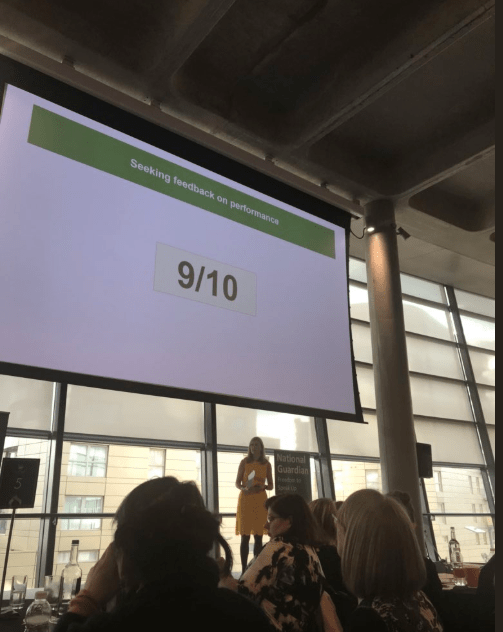

Behind the performance: A postcard from the National Guardian’s Conference of 6 March 2018
 By Dr Minh Alexander NHS whistleblower and former consultant psychiatrist, 22 April 2018 

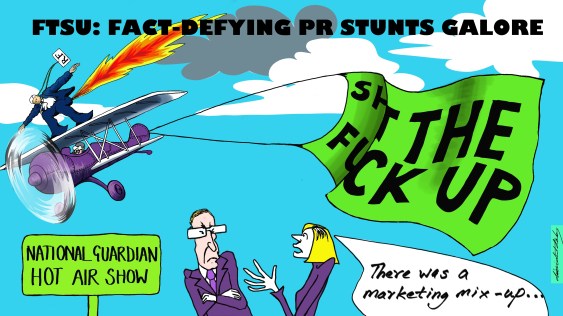
The smoke and mirrors on NHS whistleblowing by Jeremy Hunt et al continue, and this piece chronicles some more evidence of government manipulation.

A handful of whistleblowers were invited to the tightly controlled, high gloss, well-polished conference held by the National Guardian last month. Whilst the invitations were manifestly related to our membership of the National Guardian’s advisory group, it was unclear why we had been included.

We were not invited to lead any discussions or to present. We were given no role and allowed little voice. Time for audience questions and discussions was limited. Although there was an attempt to place whistleblowers in seats at the back and edges of the conference hall, some of us made other arrangements.

We were treated to a speaker – the King’s Fund Head of “Thought Leadership” – who referred to “angry” whistleblowers. He suggested that trust executives needed to deal more understandingly with irate whistleblowers. In doing so, he seemed not to acknowledge the fact that the vast majority of whistleblowers are very reasonable in raising concerns, and that it is only after repeated suppression and reprisals that some become angry.

I had a tussle with Henrietta Hughes on being allowed to respond to this distortion. We spent longer disagreeing on whether I could comment than it took me to rebut the Thought Leader’s misrepresentation. Several Speak Up guardians were brave enough to later privately express approval that I had spoken up, which rather said it all about the nature of the Freedom To Speak Up project.

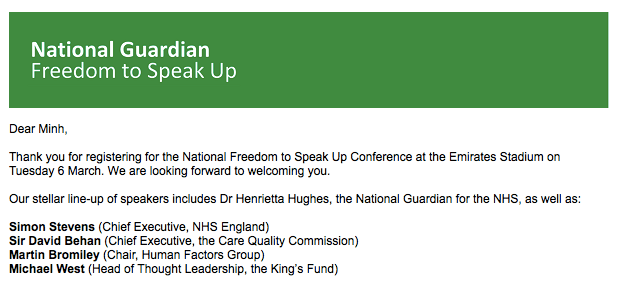
Cult of personality was the order of the day. The National Guardian’s Office’s billed the key speakers as ‘stellar’. So much for public service values of selflessness.

Stellar

This was the official conference slide pack produced by the NGO:

National Guardian’s conference 6 March 2018 slides
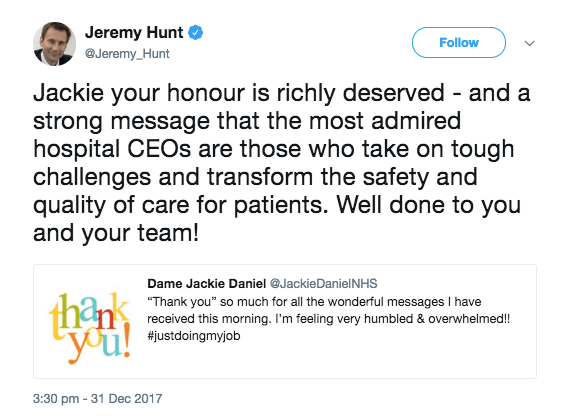
 

Uneven Stevens and a static 70% statistic

Simon Stevens triumphantly announced that an expansive promise which he made a few months previously to appoint one third of BME Speak Up Guardians at NHS England (NHSE) had been fulfilled.

Behind this theatre lay a great deal of evasion by NHSE. It had avoided answering questions for some time, prior to the conference about its achievement of the one third target, no doubt saving up for Stevens’ conference splash.

NHSE’s National Director for Transformation and Corporate Operations (NHSE’s Lead Guardian), has still not fully substantiated Stevens’ claim of one third BME despite several and increasingly specific enquiries. In short, NHSE has claimed that the crude headcount of BME Guardians is one third of the total, but has repeatedly failed to evidence that the WTE of BME Guardians genuinely comprises one third of its Speak Up Guardian service.

On 8 March NHSE shared internal documents which indicated that its Speak Up Guardians would have designated time for the role:

 “With sufficient designated time to carry out their role, participate in external FTSU activities, and take part in staff training , induction and other relevant activities”

but did not provide details of the WTE of its BME Speak Guardians.

When I continued to press for disclosure of the WTE details, this was the reply from NHSE on 16 April 2018:

“I will not be able to provide data on this time commitment, as Guardians are not required to record how much time they spend within their FTSU roles. Time is not considered a reporting factor; Guardians are focused more importantly, on ensuring colleagues feel empowered to raise their concern(s) via the FTSU process without any time constraints.  Any time spent within the Guardian role is protected time and the Guardians are fully supported to take as much time necessary to ensure the FTSU process fully supports colleagues when raising their concern(s).”

One might be tempted to wonder if NHSE hurriedly designated a selection of BME staff as ‘Guardians’ just to help shine up its CEO’s Race credentials, but without giving these staff ring fenced time to for the role.

This is the correspondence with NHS England, copied to Stevens:

NHS England correspondence re appointment of BME Speak Up Guardians

Simon Stevens one third (1)


Of relevance, I asked NHS England to share a previously suppressed report on the experience of its BME staff, which had been leaked and was the subject of a report by the Health Service Journal in December 2017.

NHS England agreed but omitted to attach the report to its reply. After a further request, NHSE gave me the link to a more favourable report but this was dated March 2018. On the third attempt, the report was disclosed:

NHS England Deep Dive BME staff survey 2017

This showed that 58 out of 163 (36%) of BME NHSE staff who took part in the survey reported personally experiencing bullying, harassment or abuse at work, based on their race since joining NHS England”.

A debate on Diversity was organised as part of the NGO’s conference on these lines:

Motion

The chair of NHS England’s advisory group for the WRES programme spoke against the motion.

Astonishingly, the conference voted against the motion.

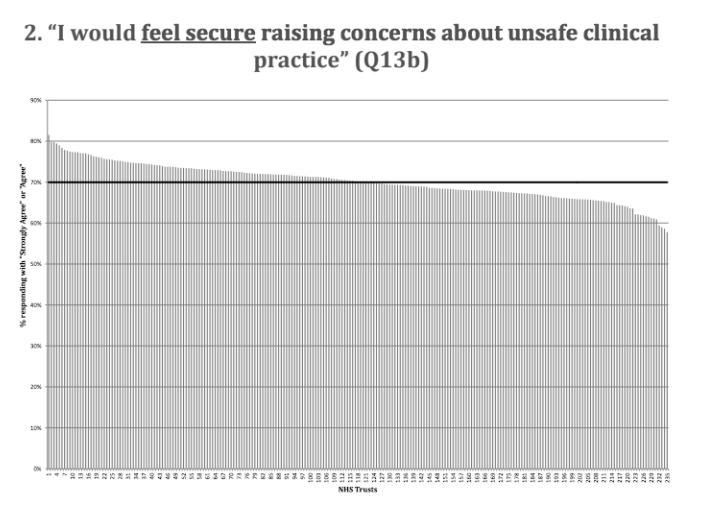
But at least Stevens came clean about the fact that the key metric on NHS whistleblowing, question 13b of the national staff survey about staff security in speaking up, had remained static at 70%. This was despite the appointment of hundreds of Speak Up Guardians and the millions spent on the NGO and the Freedom To Speak Up project. However, neither Stevens nor the rally organisers openly acknowledged this enormous elephant in the room.

Screen Shot 2018-04-22 at 18.44.44

The static 70% statistic was omitted from the briefing report for the 2017 NHS Staff Survey.   The CEO of the Picker Institute, which conducts the survey, later advised:

…the briefing report for the survey is intended to provide a summary of results rather than to fully list the results for every item.”

Email from Chris Graham 8 March 2018

But one would have thought that the overall score on question 13b would have been of great interest this year, after establishment of the Freedom To Speak Up Guardian network.

The score of 70% implies that 30% of 1.3 million NHS staff (390,000 staff) do not feel secure in raising concerns. That potentially represents a great deal of unreported patient harm and risks.

Nevertheless, Steven tacitly conceded that things were awry, because he indicated a need for increased measures. He floated a suggestion that the NHS might start tracking whistleblowing metrics in the annual NHS staff survey, broadly in the same way that the WRES programme tracks Race indicators.

However, a debate would be needed first on the validity of the current survey measures, and whether any changes are needed. Monitoring without enforcement, à la WRES policy, would be of little use.


‘Sorry’ is the hardest word for the CQC

As I arrived at the conference I came upon David Behan in obviously relaxed conversation and laughing heartily with a trustee of Patients First. They continued their discussion for some time as I followed them into the building.

When David Behan later spoke, he held forth on the importance of Just Culture, which was like the governance equivalent of watching dad-dancing.

In a cringeworthy contrivance, he repeatedly characterised the Freedom To Speak Up Guardian network as ‘social movement’, even though the project has been wholly centrally driven.

Behan subsequently approached me in unusual, tense manner for a very uncomfortable encounter. His approach was most unexpected given that he has avoided interaction where possible in the last few years. He even deployed snippy letters by his Head of Legal services. The interaction was also in marked contrast to the conversation that he had earlier with the Patients First trustee. I remain mystified as to why Behan approached me.

Whilst bestowing himself thus Behan asked my companion, a sacked and blacklisted fellow whistleblower, what they were doing now. He tersely dismissed the whistleblower’s concerns about CQC failure on FPPR.

Entertainingly, Behan managed to breached my confidentiality during the encounter. Whilst there was no real harm done by the breach, it was not his data to give away. He apologised at the time, but studiously ignored a mention of the incident in later correspondence. Despite demonstrating how easily slips may occur, Behan still declined to reconsider CQC’s previous refusal to audit its practice in safeguarding whistleblower’s confidentiality. 

Peter Wyman the CQC chair has since maintained this position, with the trademark charm that is now all too familiar.

This is the correspondence exchanged after the conference:

Correspondence with CQC about whistleblowers’ confidentiality March and April 2018

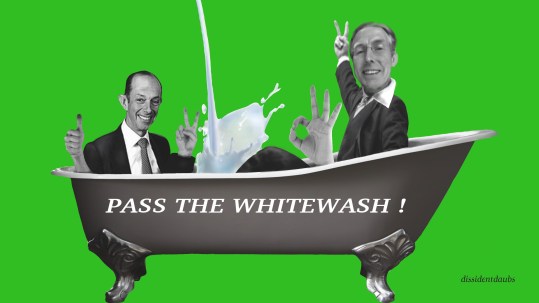
wyman and behan in a bath


Jeremy Hunt’s statistical slipperiness

Jeremy Hunt deigned to appear at the conference. Subsequent FOIA disclosures by the National Guardian’s Office (NGO) and the Department of Health and Social Care (DHSC) revealed that there was careful stage management by the two bodies.

DHSC disclosure 9.04.2018 – correspondence between DHSC and National Guardian’s Office about the conference

CQC disclosure 9.04.2018 – correspondence between DHSC and National Guardian’s Office about the conference

The DHSC was keen to be supplied with ‘Good News’ items:

Good News DHSC re NGO conference

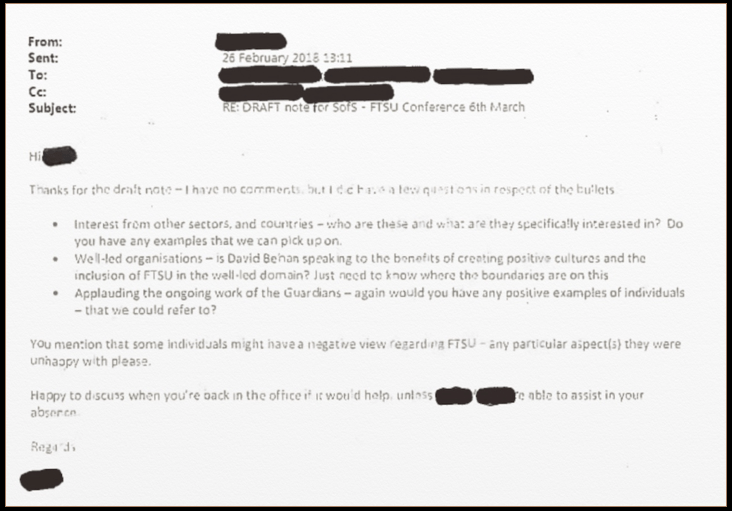
The NGO was careful to brief Hunt’s team about the presence of whistleblowers who were “less supportive” of government policy:

NGO briefing less supportive

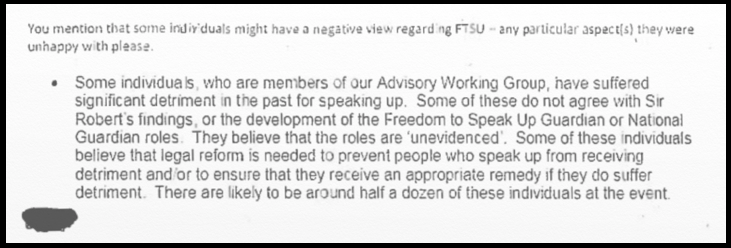
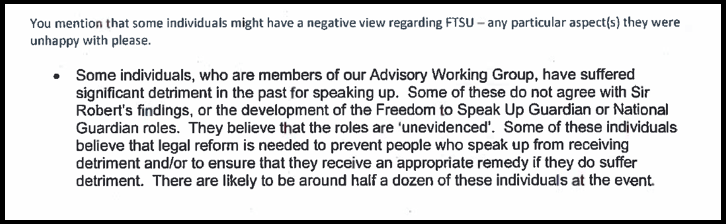
The NGO also briefed Hunt’s team that whistleblowers whom it had invited to the conference might have opinions:

NGO briefing members of our advisory group

NGO officials even solicited retweets from the DHSC, consistent with the social media strategy of central NHS bodies to prop each other up.

Potential answers to questions about the private sector were rehearsed:

Rehearsed answers about private sector

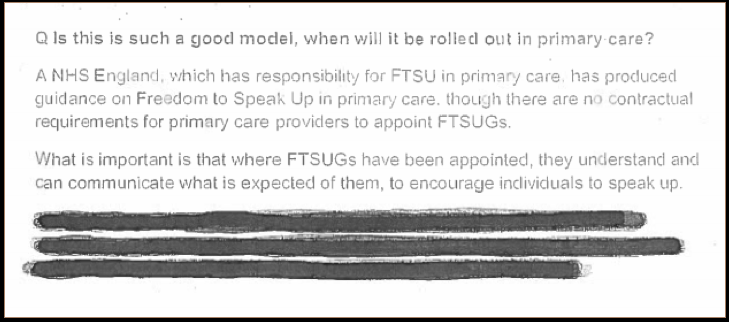
Where there were anticipated questions about weaknesses, the strategy deployed was one of deflection. For example:

  1. On the lack of compulsion for primary care providers to appoint Speak Up Guardians:

Deflection 1


  1. “Q Where are the ‘teeth’ in the system to bring employers to account for bullying?”

Answer:

Deflection 2

The NGO also briefed the DHSC that CQC will assess how well the Speak Up Guardian role is implemented in any given trust:

CQC will assess FTSU implementation

This is bound to work well for the Secretary of State then, as the CQC has helped to bury whistleblowers whether by act, omission or both. The CQC has through its various failures made whistleblower reprisal acceptable.  It has no transparent, fit for purpose inspection methodology on whistleblowing governance. CQC’s guidance notes on whistleblowing for inspectors are painfully basic and do not give confidence that inspectors have the necessary expertise.

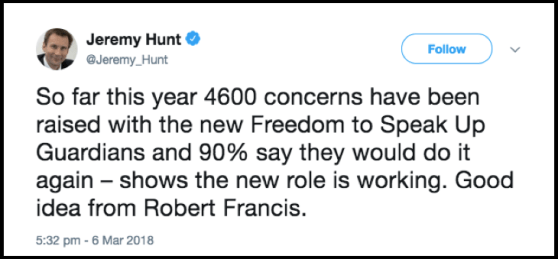
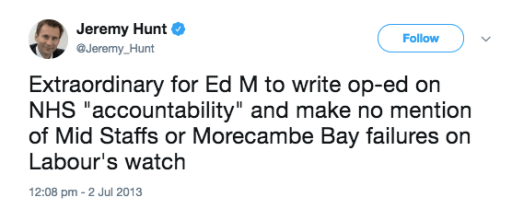
Hunt brazenly claimed during his speech to the conference that 90% of staff who had raised 4600 concerns through trust Speak Up Guardians would speak up again. He then tweeted the claim for good measure:

Hunt 90% tweet

Whilst Hunt waved the ‘Robert Francis’ kitemark about, Sir Robert Francis was noticeable by his absence.

The NGO supplied the 90% statistic:

HH 9:10

Dr Henrietta Hughes National Guardian speaking on 6 March 2018
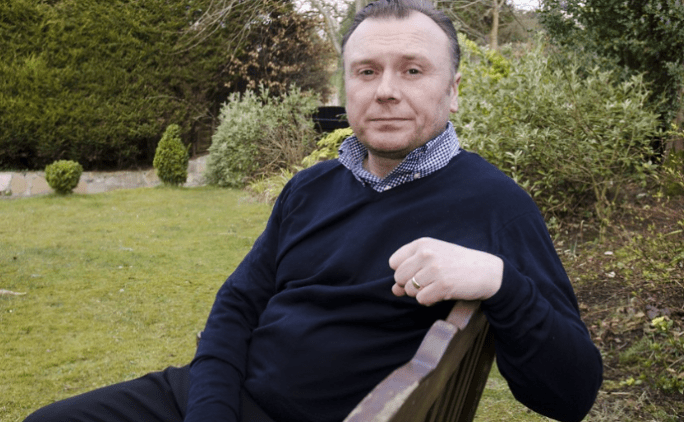
 

The 90% statistic was based on incomplete, flawed data – more about that another time. It was unpublished, and has been confirmed to be so by a UK Statistics Authority investigation. Hunt breached the UK Statistics Authority’s code by citing an unpublished statistic. The code seeks to restrain dissemination of dodgy digits by Ministers for political gain. Hunt has done it before. 

From a letter 18 April 2018 by the UKSA’s Director General of Regulation to me about Hunt’s use of the 90% statistic:

Ed Humperson 18.04.2018 re Hunt use of statistics

But then, what’s a fib or two when you’re ‘stellar’?


UPDATE 29 JULY 2018

The National Guardian’s Office has still not published the 90% statistic despite the further UKSA correspondence. It has additionally cited what appears to be another unpublished statistic. I have written to question these behaviours, copied to UKSA.

Letter to Russell Parkinson Head of Office National Guardian’s Office re NGO’s use of unpublished statistics 29 July 2018


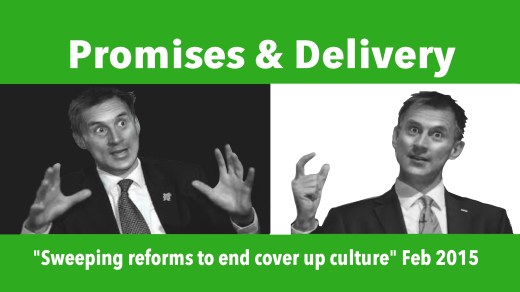
promises and delivery


Jeremy Hunt et al’s re-branding of Morecambe Bay and a suppressed report on Race concerns

By Dr Minh Alexander and Russell Dunkeld @RussellDunkeld , NHS whistleblowers, 21 April 2018

As many NHS whistleblowers are aware, the Department of Health and its arms length bodies sometimes declare failing organisations as turnaround successes whatever the truth of the matter.

CQC slaps on the green ratings and the trust executives start being showered with conspicuous accolades. Ministers may contribute a plug or two.

University Hospitals of Morecambe Bay NHS Foundation Trust is an example of re-branding. Morecambe Bay was notorious for the maternity safety scandal, which was the subject of a major report by Dr Bill Kirkup in March 2015

Morecambe Bay was also exposed for  victimising whistleblowers who raised concerns about the accuracy of breast cancer screening. The trust admitted in 2016 that it was still gagging whistleblower, details of which follow below. In 2016, a former nurse who was treated by Morecambe Bay revealed a picture of chaotic shortages. 

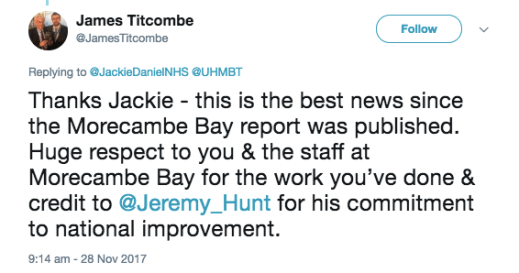
Despite such ongoing governance issues, Morecambe Bay has featured prominently in Jeremy Hunt’s publicity schemes and his superficial claims to be a patient safety champion, whilst overseeing a programme of disinvestment and resultant NHS crisis.


Maternity safety has been a key element of Hunt’s patient safety shtick.

Screen Shot 2018-04-20 at 07.37.42


Hunt has repeatedly used Morecambe Bay for political gain:

Screen Shot 2018-04-20 at 07.34.49


Although Hunt et al have been spinning the above line of transformation,  Morecambe Bay staff have not stopped whistleblowing outside of the organisation. Such external whistleblowing usually reflects internal whistleblowing governance problems – staff are either deterred in some way from using internal routes, or they have tried internally but been unable to progress their concerns.

FOI data from the regulator the Care Quality Commission (CQC) revealed that Morecambe generated the third highest number nationally of whistleblowing contacts to the CQC over 2015/16 and 2016/17.

Additional FOI data from the CQC, obtained by former Morecambe Bay whistleblower and nurse Russell Dunkeld revealed more detail about whistleblowing disclosures to CQC between 2014/15 to 2016/17:

CQC FOI disclosure Ref IAT 1718 0653 on whistleblowing contacts by Morecambe Bay staff


Russell Dunkeld is a nurse who whistleblew about serious patient safety issues at Morecambe Bay, including incorrect, undetected insertion of a nasogastric tube into a patient’s airway. This is a so-called ‘Never Event’ because it is a very serious but avoidable form of medical harm and should never happen. Dunkeld also whistleblew about concerns that a nurse colleague was hastening patients’ deaths by tampering with intravenous fluids.

Dunkeld’s safety concerns have never been fully resolved.

He believes a recent offer of employment from the trust to help improve its whistleblowing governance was withdrawn because he would not stop pursuing the unresolved patient safety and Safeguarding issues. The trust denied all:

“Different people within the Trust have tried to engage with Mr Dunkeld over the past three months, and it is disappointing that he has yet to take up these offers as we believe that insight would help us in developing our approach to Freedom to Speak Up further”

Former nurse blasts Morecambe Bay Health Trust’s whistleblowing policy


Out of 47 recent whistleblowing contacts to CQC about Morecambe Bay, only one triggered a follow up inspection. CQC dealt with the rest of the concerns mostly by speaking to the trust or sticking the information in a drawer, purportedly to be used at the next inspection.

Notably in 2017, the CQC was contacted twice by trust whistleblowers about the trust slipping back into old ways:

 Concerns about returning to old practices to save money”

The CQC simply noted in its log that an investigation was ongoing.

As regards a 2015 disclosure of ongoing concerns about the breast cancer screening affair, CQC played pass the parcel with a related concern and appeared to it brush off with the conclusion:

Met with complainant. Matter raised with  Public Health England . This was a matter between the whistleblower, Public Health England and NHS England.”

Not only were significant patient safety failings revealed by a November 2014 Public Health England investigation report , but other evidence of patient harm continued to emerge in 2015: New calls for Morecambe Bay breast cancer review.

Moreover, Morecambe Bay has continued to gag staff, including whistleblowers. The trust was evasive when questioned about its practices in this area but eventually admitted that it had gagged two whistleblowers and spent £92,519 on legal services in two whistleblower cases.

In October 2016 the Health Service Journal lavished praise on Morecambe Bay for revealing that past trust managers had reached an irregular settlement with one of the midwives from the maternity scandal, which included an undertaking from the trust not to investigate her performance.

But beneath this razzamatazz, the trust failed to fully answer enquiries about whether or not there were other such past non-investigation agreements.  The trust disclosed a summary report which waxed lyrical about how much had been learned:

Morecambe Bay redacted summary report disclosed November 2016 FOI request 6065

A snapshot analysis of Employment Tribunal decisions about NHS organisations revealed that Morecambe Bay was in the top ten of employers most claimed against.

The trust has also scored poorly on the Workforce Race Equality Standard (WRES). There have been pledges to improve. Morecambe produced a glossy strategy document featuring the obligatory token gesture by a smiling CEO, with a zippy declaration slapped across the cover: ‘Our Journey to Effortless Inclusion’.

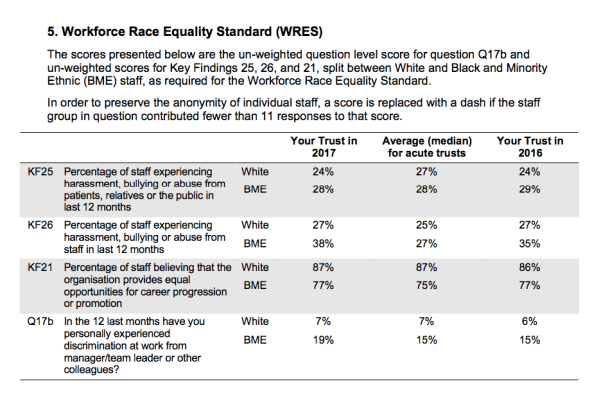
But the trust’s WRES score remains poor. 38% of BME trust staff reported bullying by other staff in the previous 12 months, compared to a national average of 27% for comparable trusts. 19% of BME staff reported experiencing discrimination in the previous 12 months, compared to a national average of 15% for comparable trusts.

Screen Shot 2018-04-20 at 07.02.49

University Hospitals of Morecambe Bay NHS Foundation Trust 2017 Staff Survey results


In view of the poor WRES scores, Morecambe Bay was asked about its governance with respect to Race concerns. It twisted and turned in response. The trust initially tried not to answer at all, and would not even confirm or deny that it had conducted or commissioned any review into its poor WRES scores. It speciously claimed that no data was disclosable under exemption 41 FOIA – information given in confidence.

Q5, 6 and 7 The Trust considers the request in questions 5, 6 and 7 exempt under Section 41 (1) of the Freedom of Information Act (2000) regarding the disclosure of confidential information The Trust considers this information exempt under Section 41 (1) (a) regarding information obtained by the public authority from any other person and (b) that disclosure would constitute a breach of confidence. We consider our obligation of confidence and will be unable to provide you with this information.”

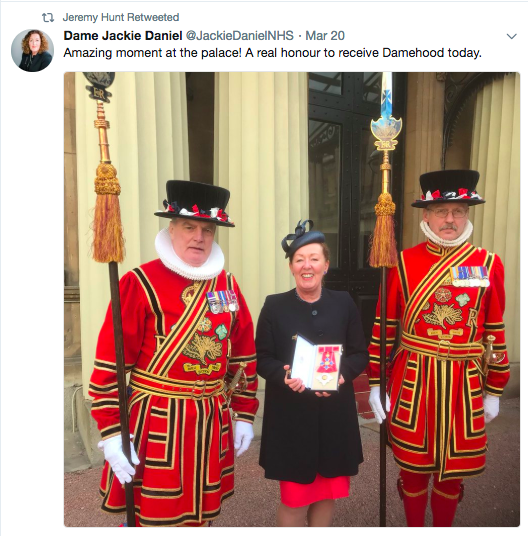
After challenge, Morecambe Bay then delayed a response until two days after its outgoing CEO Jackie Daniel had been anointed and enthroned as the new CEO at Newcastle, following the acrimonious removal of Newcastle’s previous   CEO amidst recriminations of wrongdoing on both sides.

Morecambe Bay admitted that there had been Race concerns serious enough to warrant an external review by Prof Carol Baxter which had cost the trust a total of £25,000.

“The total cost of the external reviews commissioned by the Trust as referred to in our response to your question 5 was £25k.” 

 But the trust still maintained that none of the contents were disclosable.

The same FOI disclosure dated 2 March 2018, and received on 9 March 2018 revealed that a total 124 staff concerns had been raised through the trust Speak Up Guardian, but fewer than 5 of these related to Race issues.
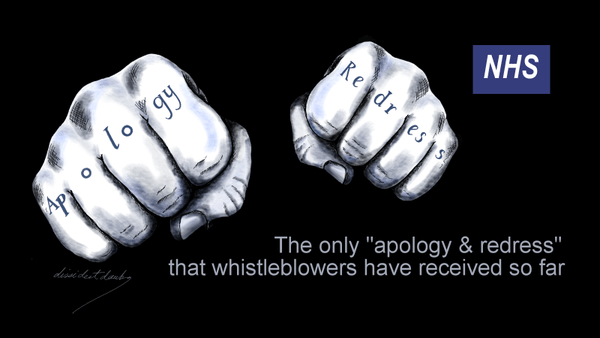
The trust has also later revealed that 87 feedback forms were sent to staff who raised concerns through the Speak Up Guardian from April 2017 onwards, of which 32 (37%) had been returned.

In the course of the above wrangling with the trust about release of the data, a trust governor was copied into the correspondence. He commented:

“…as governors, we are aware of, and support, efforts made by the Trust to improve staff morale and the quality of relationships throughout the organisation. To this end we are aware that internal surveys of staff views in relation to the issues you raise are carried out on a routine basis, the results of which are shared with governors.

For my part I am confident that good work is being done by the Trust in these areas and that progress is being made.”

 Email 1 February 2018

One wonders if the trust has been totally open with its governors about the full extent and seriousness of its Race issues.

In complicated twist, it has just been reported that a white male surgeon alleges that he was persecuted at the trust for whistleblowing, and was subject to false Race allegations.

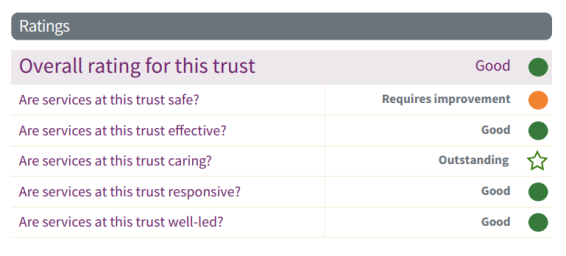
As for the CQC, it last rated Morecambe Bay as ‘Good’ overall (despite admitting that Morecambe Bay was sub-standard on ‘Safety’) and ‘Good’ on the well-led domain.

Screen Shot 2018-04-20 at 07.24.31

CQC inspection report on UHMBT February 2017


With regards to Race Equality, the CQC was contradictory – it largely gave Morecambe Bay a good report, but conceded that bullying of BME staff had increased.

Perhaps CQC’s Chief Inspector of hospitals should take another look at what are clearly very troubling and complicated issues of Equality and Diversity. Assuming CQC is bothered, and is not fettered by political instructions from on high.


RELATED ITEMS:

Race Discrimination by Public Health England

WRES, CQC and More NHS Hot Air on Race

Screen Shot 2018-04-20 at 15.37.01

Screen Shot 2018-04-20 at 15.42.39


Martin Morton social care whistleblower and Wirral Council

By Dr Minh Alexander NHS whistleblower and former consultant psychiatrist 19 April 2018


Whistleblowing cases can take years to resolve.

A very serious and interesting social care whistleblower case is that of Martin Morton’s whistleblowing about financial abuse of vulnerable adults who should have received care and protection by Wirral Council.

Morton was vindicated after a long fight, and the Council had to re-pay approximately half a million pounds to care home residents, that should not have been charged:

Wirral whistleblower Martin Morton’s six year fight for justice finally is over

The Equality and Human Rights Commission criticised Wirral Council for Disability discrimination:

Watchdog accuses Wirral Council of discrimination against disabled people

Morton’s case was featured by the specialist periodical Community Care, in which lack of effective protection for whistleblowers was highlighted:

Wirral social care whistleblower says “there’s not enough money in the world” to make uo for his family’s trauma

Notably, Morton successfully pursued his whistleblowing case using criminal harassment provisions, thereby underlining how serious whistleblower reprisal can sometimes be.

His case is important in helping to highlight the deficiencies of current civil UK whistleblowing law (the Public Interest Disclosure Act), which does not hold individuals responsible for misconduct and criminal behaviour in the course of suppressing and victimising whistleblowers.

His case also featured in reportage about widespread local authority use of gagging clauses:

Council whistleblower who signed gagging agreement speaks out

Morton is still seeking answers. The ICO ruled partly in his favour after the Council withheld a relevant report about the treatment of whistleblowers in its entirety.

ICO decision reference FS50649341


An Upper Tribunal (Administrative Appeals Chamber) will now hear an appeal for further disclosure at Field House, 15-25 Breams Buildings, London, EC4A 1DZ on 26 April 2018.

This is a blog about the forthcoming hearing:

Upper Tribunal (Administrative Appeals Chamber) case involving information request to Wirral Council by Martin Morton listed for public hearing on Thursday 26th April 2018


RELATED ITEMS:

UK Whistleblowing Law is an Ass: Helen Rochester v Ingham House Ltd and the Complicit CQC

Wirral whistleblower Martin Morton speaks up for truth and justice at Hillsborough Law event

Another call to the Chair of the parliamentary Health and Social Care Committee to examine the government’s lack of progress on whistleblowing

By Dr Minh Alexander NHS whistleblower and former consultant psychiatrist, 16 April 2018


Whistleblowers are crucial to the public interest and the protection of people’s rights, but can be viewed as a vexation by those in power, who want to stay in power.

Whistleblower protection will always be very hard-won. Parliament called for better whistleblower protection with two major reports, published respectively by the Public Accounts and Health Committees in 2014 and 2015.

There has been plenty of government spin since, but no real progress has been made.

The controversial case of Dr Bawa-Garba has caused much alarm about the professional risks that healthcare staff may face if they are forced to work in unsafe conditions over which they have limited control and in which speaking up is still risky.

I asked the Chair of the Health Committee a year ago to review the continuing failures of whistleblowing governance, and I understand that others have also asked for review. I now ask again.

All recent correspondence is laid out below.


BY EMAIL

Dr Sarah Wollaston

Chair of Health and Social Care Committee

16 April 2018

Dear Dr Wollaston,

Implications of Dr Bawa-Garba’s case and whistleblower protection

Thank you for responding to my previous correspondence of 10 March and 23 March, which for convenience I copy below.

Therein, you advise that the Committee does not review legal decisions and point me to Sir Norman William’s review on Gross Negligence Manslaughter.

To clarify, I did not write in the expectation that the Committee would review matters that are decided by the Courts.

Rather, I wrote to you about the conduct of the General Medical Council (GMC), and in my letter of 10 March I shared data that raised questions about the consistency of the GMC’s decisions. These were similar questions to those raised by the Committee itself especially with regards to possible Race bias. 

The Professional Standards Authority has also questioned why the GMC would deviate from case law established by the Supreme Court, in order to increase the severity of punishment against doctors:

PSA document disclosed via FOIA to the Health Service Journal (A)

PSA document disclosed via FOIA to the Health Service Journal (B)

I hope the Committee will help to ensure that there is fairness.

I am aware of the Gross Negligence Manslaughter review by Sir Norman, who also assisted Sir Robert Francis and the Department of Health with the Freedom To Speak Up Review. The recommendations from the Freedom To Speak Up Review were not strong. The relevant arms length bodies and the National Guardian’s office have over the last three years sought to further dilute even the modest help that Sir Robert proposed for whistleblowers.

In all, the Bawa-Garba case and other events leave doctors – and other Health and Social Care workers – in a cleft stick of being damned if they speak up, and damned if they do not.

The Secretary of State recently claimed misleadingly in a speech that 90% of staff who had raised 4600 concerns with Freedom To Speak Up Guardians would do so again. He also tweeted the misleading claim:

Screen Shot 2018-04-16 at 13.24.03

This figure of 90% was a flawed, unpublished statistic supplied by the National Guardian’s Office, the very body charged with upholding values of transparency and accountability.

The UK Statistics Authority has confirmed that the statistic was unpublished, and advised that it will write to the National Guardian’s Office to make suggestions for improvement. Discussion continues on the matter, and I will share further evidence with the Committee about these irregularities.

The truth is there is still no effective, reliable protection for Health and Care workers who speak out, at a time when service quality is deteriorating and there is a great deal of unsafe unmet need to report.

But whistleblowing to the Care Quality Commission is in fact decreasing, to the point that the Public Accounts Committee recently advised that the CQC should ensure that whistleblowers can be confident in contacting the Commission. (Page 7, Section 6)

And yet the conduct of the regulator itself is likely to be part of the problem, for example by admitting to breaches of whistleblower confidentiality but refusing to transparently audit its practice.

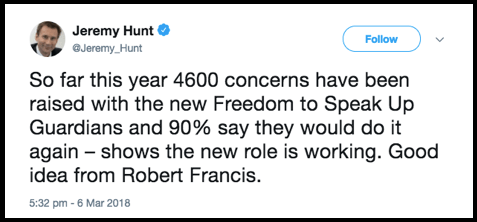
I wrote to you almost exactly a year ago to ask if the Committee might hold a follow up hearing on whistleblowing, particularly as its recommendations from January 2015 have not been implemented by the government to any real degree. I do not know of any whistleblower who has received genuine ‘apology and practical redress’ as set out by the Committee. (Page 36, para 115)

In fact, I know only of a single, seriously harmed whistleblower who has received an apology, which they consider is insincere because the DHSC has not helped to remove blacklisting.

I wonder if you would consider a follow up inquiry, as the failures of protection continue, at a serious cost to patients:

Of Arbitrarness and Arbiters: The Freedom To Speak Up Project Three Years On

There are concerns about whether the National Guardian’s Office is reviewing enough cases, selecting cases for review in a fair way and being open and accountable about its activities. The Office has  disclosed via FOIA that it spent more on comms than on establishing the Speak Up Guardian network. It has also announced only three case reviews, which focus on systems and not on helping individual whistleblowers in difficulty.  Further evidence will be shared with the Committee in due course.

With best wishes,

Dr Minh Alexander

Cc

Health and Social Care Committee

Harry Cayton CEO Professional Standards Authority

David Isaac Chair ECHR

Rob Behrens PHSO

Dr Philippa Whitford MP

Meg Hillier MP Chair of Public Accounts Committee

Secretary of State for Health and Social Care

Minister of State for Health and Social Care

Sir Terence Stephenson Chair GMC


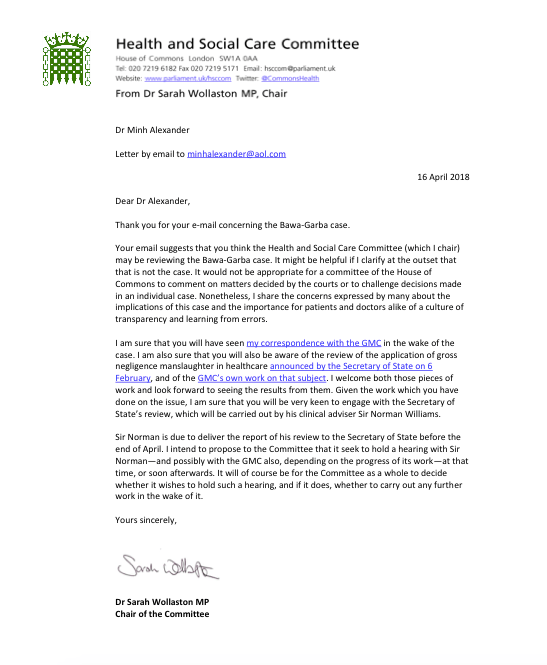
CORRESPONDENCE FROM CHAIR OF HEALTH AND SOCIAL CARE COMMITTEE 16 ARPIL 2018


Dear Dr Minh Alexander,

Please find attached a letter from the Chair of the Health and Social Care Committee, Dr Sarah Wollaston MP.

Kind regards,

Health and Social Care Committee

House of Commons | London | SW1A 0AA


Screen Shot 2018-04-16 at 12.59.03


CORRESPONDENCE 23 MARCH 2018:


BY EMAIL

Health Committee

23 March 2018
Dear Dr Wollaston and colleagues,

Re Consistency of GMC decisions on erasure of doctors after convictions after conviction for criminal offences

I wrote to the Committee on 10 March to pass on disclosed GMC data, which showed that in the five years between 2013 and 2018, 50 out of 73 doctors subject to Fitness to Practice proceedings as a result of sexual offences were subsequently erased from the register.

The i newspaper published an article yesterday about the statistic of ‘1 in 3 doctors convicted of sex offences still able to practice medicine’, after it liaised with the GMC about these figures.

Today, the GMC has advised that it supplied incorrect data and that 60, and not 50 of the 73 doctors were struck off.

The relevant correspondence from the GMC is copied below

Yours sincerely,

Dr Minh Alexander


From: “Simon Willis (0161 923 6310)” <***********************>

Subject: RE: Your Information Access Request – F18/9323/SW

Date: 23 March 2018 at 13:32:15 GMT
To: Ian Alexander <************************>


Dear Mr Alexander,

I have noticed a typographical error in my email below and I am writing to provide you with the correct information.

In respect of your question 2, the number of doctors struck off was actually 60.

I apologise unreservedly for my mistake and for any inconvenience caused.

Yours sincerely

Simon Willis

Information Access Officer

Resources & Quality Assurance Directorate


LETTER 10 MARCH: 

BY EMAIL

Health Committee

10 March 2018
Dear Dr Wollaston and colleagues,

Re consistency of GMC decisions on erasure of doctors after conviction for criminal offences

I write to submit evidence pertinent to the debate around the case of Dr Bawa-Garba.

  1. The GMC has admitted via FOIA that it has no policy on the automatic erasure of doctors convicted of gross negligence manslaughter.

This is despite its chief executive Charlie Massey asserting that the GMC had no choice but to seek erasure after Dr Bawa-Garba’s conviction for gross negligence manslaughter, implying automaticity.

The GMC is clearly more open to questions of arbitrariness and discrimination in the absence of a clear policy.

  1. The GMC has admitted via FOIA that in the last 5 years it has chosen not to seek erasure in one third of cases where doctors had been convicted of sex offences (23 out of 73).

It seems a peculiar and unjust state of affairs when the GMC overrides its own Tribunal to strike off a doctor who made errors that the Tribunal considered were not made recklessly,


Medical Practitioners Tribunal Service decision 13 June 2017:

“There is no evidence to suggest that your actions on 18 February 2011 were deliberate or reckless.”

https://minhalexander.com/wp-content/uploads/2018/03/mpts-dr-hadiza-bawa-garba_13_june_2017.pdf


but it applies lesser sanctions to doctors who have been convicted of wilful, often premeditated, criminal sexual offences.

This is the FOI correspondence with the GMC and the disclosed data which is summarised above:

https://minhalexander.com/wp-content/uploads/2018/03/gmc-foi-response-on-erasure-for-sex-offences-and-policy-on-gross-negligence-manslaughter-9-03-2018.pdf

Yours sincerely,

Dr Minh Alexander

Cc

Harry Cayton CEO Professional Standards Authority

David Isaac Chair ECHR

Rob Behrens PHSO

Dr Philippa Whitford MP

Secretary of State for Health and Social Care

Minister of State for Health and Social Care

Sir Terence Stephenson Chair GMC


RELATED ITEMS

After the Bawa-Garba judgment: Some responses from the Court of Appeal, CPS, Criminal Cases Review Commission and GMC

Waste Industry: Abuses of the NHS Disciplinary Process & Dr John Bestley

Briefs, whistleblowers and Jeremy Hunt’s Top Secret Evaluation

By Dr Minh Alexander, NHS whistleblower and former consultant psychiatrist, 10 April 2018

There is no evidence base for Robert Francis’ model of Freedom To Speak Up Guardians, employed by the very trusts whom they are supposed to hold to account:

SSOTP: Robert Francis’ exemplar has feet of clay and Jeremy Hunt’s patient safety claims are unevidenced

Good trusts don’t need them, poor trusts will most likely obstruct, ignore or bully them, or appoint Guardians in their own image.

It’s a waste of time and money for the public, but an investment by Jeremy Hunt for political capital.

This time last year, the national NHS staff survey was published and showed that only 70% of NHS staff felt secure to raise concerns:

25 ‘Best’ and 25 ‘Worst’ NHS trusts for Speaking Up, Allegedly

A year later, millions of pounds later – spent on appointing local Guardians and fuelling the Department of Health and Social Care PR machine that is the National Guardian’s Office, the dial has stayed firmly stuck at 70%.

This fact was omitted from the NHS Staff survey briefing report, but was publicly acknowledged by Simon Stevens on 6 March 2018, and the CEO of the Picker Institute has since confirmed it.

Both the National Guardian and the CQC have conceded that there was no evidence for Francis’ model of Speak Up Guardians.

At one level, it was breathtaking that the government squandered so much money without a pilot. But on the other hand, why bother with a pilot if the intention is merely to spin, and not to seriously administrate an issue fundamental to patient safety?

On 2 February 2017 the National Freedom to Speak Up Guardian told me that she was discussing evaluation of the Speak Up Guardian model with academics. 


HH We’re commissioning our own research on SUGs 

We want it to be external and credible 

– Find out more about the roles 

– How they’ve been established 

– Number of cases”

MA That sounds like a descriptive piece of work on how the SUGs were set up. Anything on effectiveness? 

HH We’ll be looking at SUGs’ measures of their effectiveness 

MA How will you measure SUGs’ effectiveness? 

HH We’re having a conversation with academics about that”

Over a year later, there was no activity evident and to my knowledge none of the specialist academics in the field had been approached. Notably, not even David Lewis Prof of Employment Law who led the research which informed Francis’ review, had heard anything.

I wrote to Henrietta Hughes to ask for information and I also raised questions on social media.

Dr Aled Jones from Cardiff who largely researches on nursing practice responded to my questions on twitter and advised that he and others were conducting an evaluation.

Further enquiries revealed that this time, the NGO and DHSC were playing safe and keeping it all under an NHS umbrella. The research was commissioned by NHIR, which for the purposes of FOI requests is legally constituted as part of the DHSC.

Aled Jones has advised that his fellow researchers are Danny Kelly, Davina Allen (Cardiff), Russell Manion (Birmingham), Jill Maben (Surrey) and Mary Adams at KCL.

Aled Jones kindly sent me a copy of the research protocol, but asked me to keep it confidential until the official release.

However, review of the protocol showed that an expert group has been established to help steer the research, which includes as yet undisclosed whistleblower organisations and the charity/ lobby group Action Against Medical Accidents (AvMA).

So most likely the usual suspects from the whistleblowing scene have been quietly consulted when the majority of whistleblowers have been shut out, including significantly, those appointed by the National Guardian to her own advisory group.

That is, opponents of DHSC policy have been tokenistically installed on the advisory group, whilst cosy chats with more agreeable voices continue uninterrupted behind closed doors.

It is perhaps unsurprising, given that this is how the NGO views whistleblowers on its advisory board:

Screen Shot 2018-04-10 at 06.48.06

FOI disclosure CQC/IAR/1718/0854 by CQC, 9 April 2018

As for AvMA, it does good work but it is hardly expert on whistleblowing. I have on several occasions interacted with AvMA’s chief executive when he has taken the line that doctors who do not speak out are not fit to practice and should be subject to action, to point out why staff are sometimes terrified. It would be better if AvMA pursued the underlying pathology rather than the symptoms. For example, by focussing on the need for managerial regulation, to prevent overbearing managers from bullying frontline clinicians into silence.

I have significant concerns about the remit handed down to Aled Jones and his fellow researchers. Whilst I have been asked not to share details, it strikes me that the fundamental research questions that have been set lean towards generating more PR fodder for the DHSC, as opposed to looking at the effectiveness of the guardian model.

More public money down the drain for political ends and not public service.

After Aled Jones’ informed me of the research plans, the NGO confirmed that the research had been commissioned and that data collection starts in September 2018.

I have written again to the NGO to question yet again its secretive behaviour and failure to be fair and inclusive.

Is that not surreal for a body that is meant to promote safe, just culture and transparency?

This is the correspondence to date with Henrietta Hughes and her Head of Office:

Correspondence with National Guardian about evaluation of Speak Up Guardian model


RELATED ITEMS

Of arbitrariness and arbiters: The Freedom To Speak Up project three years on

A Complaint Regarding the National Guardian’s Management of Concerns About a Spin Doctor

HSIB: Whistleblower-friendly? An interesting appointment and other everyday tales of NHS Just Culture

Sir Robert’s Flip Flops


STFU not FTSU


Race Discrimination by Public Health England

By Dr Minh Alexander NHS whistleblower and former consultant psychiatrist 7 April 2018

An Employment Tribunal (ET) made a finding of Race Discrimination by Public Health England (PHE) against a senior doctor, Dr Femi Oshin Public Health Consultant, on 17 January 2017:

ET judgment Dr Babafemi Oshin v Public Health England

Oshin ET discrimination

Dr Oshin found himself subject to a complaint, which he refuted, and he came into dispute with PHE over the way in which the organisation handled this matter.

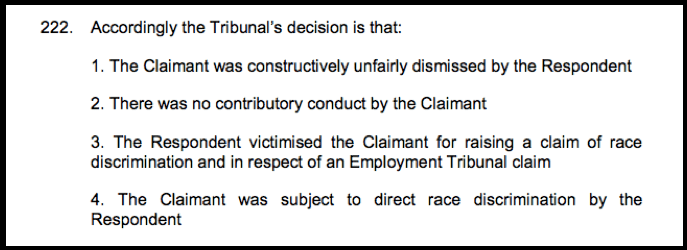
Importantly, the ET concluded that PHE constructively unfairly dismissed and not only racially discriminated against Dr Oshin, but also victimised him for raising concerns about discrimination and for making a claim to the ET regarding the discrimination.

Screen Shot 2018-04-07 at 10.26.16

The ET determined that there had been ‘unconscious race discrimination’, ‘group think’ and ‘institutional racism’ by PHE.

Screen Shot 2018-04-07 at 10.26.53

Anyone who follows the fate of NHS employees in the ET will be aware of how rare it is for claimants to succeed. A huge number of cases against the NHS are simply withdrawn.

A 2006 DTI government survey of tribunal applicants found that employees typically reported deterioration of previously cordial employment relations after they raised issues of workplace race discrimination. It also found that:

“Claimants’ primary reason for taking their case was the pursuit of justice. They felt that their employer should be told they had been wrong, and they should be made to change their behaviour towards ethnic minority employees.”

But discrimination cases, especially race claims, are particularly difficult to win. A 2013 BIS report noted “Claimants were most likely to be successful at tribunal in Wages Act cases (14 per cent) and least likely in discrimination cases (three per cent).”

A culture of disbelief has been described.

The damning ET judgment against PHE in Dr Oshin’s case is all the more significant when understood in this context.

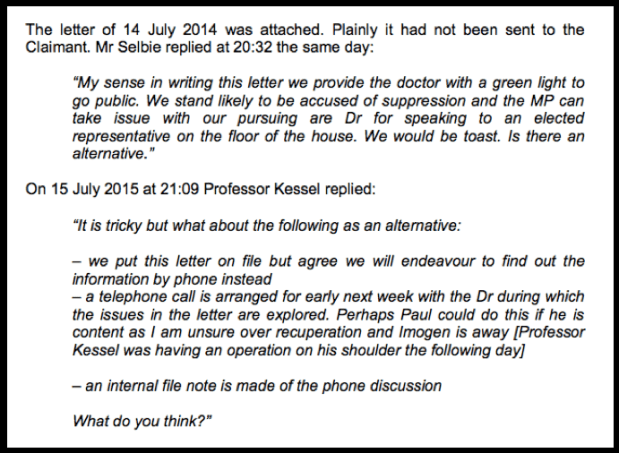
The judgment gives interesting glimpses into what happens behind the scenes. For example, this is an exchange between the Duncan Selbie CEO of PHE and another senior manager:

Screen Shot 2018-04-07 at 10.27.51

PHE told the ET that it would conduct a review of its processes.

However, PHE has been reluctant to respond to questions about its race equality governance. It missed an FOI deadline and failed to respond to a reminder. Only after a complaint to the ICO, and an email to Duncan Selbie, was a response forthcoming.

The tone of PHE’s response is defensive.

“The Employment Tribunal did not make a finding of institutional racism, something that Judge Housego made clear personally at the remedies hearing in April 2017 at the Exeter Employment Tribunal, stating that he had deliberately stopped short of using this term.”

 “We were identified as one of the UK’s Top 100 Employers in the Race for Opportunity /Business in the Community Race Equality Awards in 2017.Sixteen BAME staff participated in BITC mentoring circles. A copy of the presentation to the PHE Advisory Board in February 2018 is attached.” 

 PHE has provided a copy of a February 2018 presentation to its board on its achievements on Equality and Diversity.

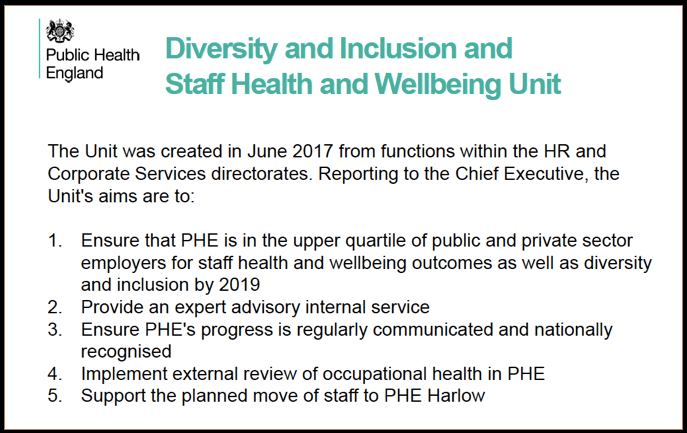
This reveals that after the Oshin judgment in January 2017, PHE established a ‘Diversity and Inclusion and Staff Health and Wellbeing Unit’.

Screen Shot 2018-04-07 at 10.29.13


This presentation includes the reassuring observation:

“In 2013, white external applicants six times more likely to be appointed – now three times” 

That’s alright then.

PHE indicated that in July 2017 it commissioned a review, to be undertaken by Prof Parish, one of its non-executive directors into the soundness and fairness of its procedures around various issues such as the application of disciplinary procedures against doctors and medical revalidation. Curiously, PHE describes this as an ‘independent’ review.

This review has not yet been undertaken, reportedly due to illness, but these are the terms of reference:

PHE terms of reference for review of issues arising from the Oshin case

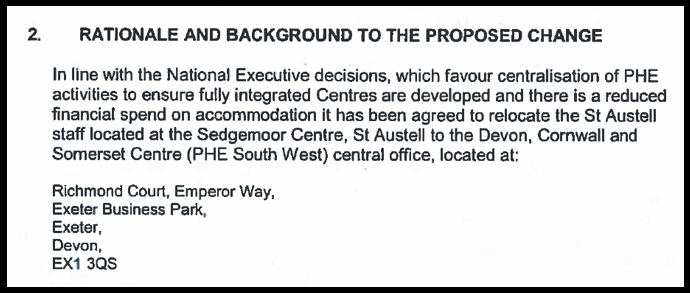
During the course of events leading up to his constructive dismissal, Dr Oshin was concerned about PHE’s plans to close its office in Cornwall and the effect on service provision. He flagged his concerns to an MP.

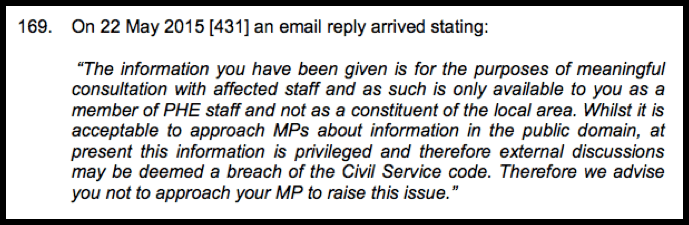
PHE attempted to block this disclosure:

Oshin PHE attempt to restrain disclosure to MP

However, the ET determined that this was a properly made public interest disclosure:

The meeting with the MP would fall clearly within the public interest provisions of the Employment Act 1996. The disclosure was made in good faith, without prospect of gain, to an MP, with the aim of getting the MP to exert pressure on the CEO of the Respondent, the matter having previously been raised by the Claimant at a senior level in the organisation.”

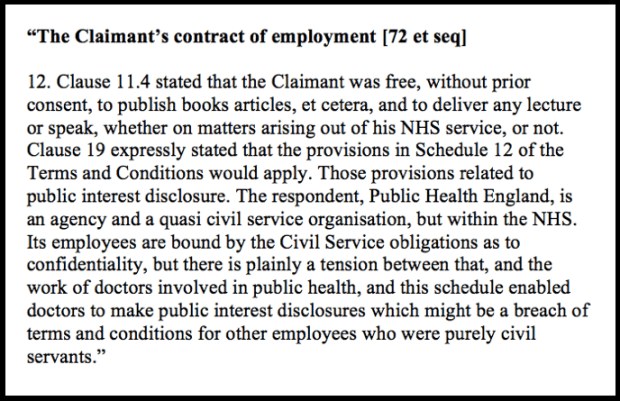
 Importantly, the ET upheld Dr Oshin’s contractual right as an NHS doctor to speak out:

 Oshin contractual right to speak out

The above clause, which in theory allows NHS consultants to publish and speak freely, is contained in the 2003 consultant contract.

PHE was asked for its risk assessment regarding the closure of its Cornwall office. It has provided a  personnel consultation document.  This indicated that part of the rationale for closing the office was to save money.

Screen Shot 2018-04-07 at 10.34.15

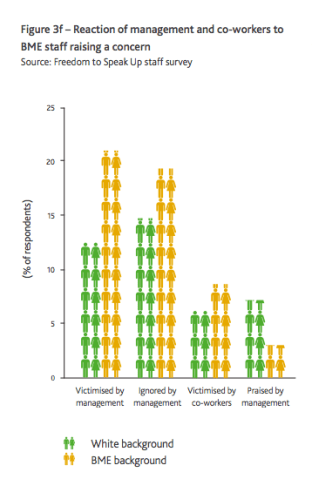
It is relevant to note that BME whistleblowers are more likely to be both ignored and victimised.

Francis BME page 66.png

Source: Freedom To Speak Up Review February 2015


So if PHE is amongst the ‘best’, what does that say about the rest?

The NHS is in the throes of a severe workforce crisis which threatens patient safety. It cannot afford to continue taking its BME work force for granted.


UPDATE 14 FEBRUARY 2019

PHE has responded formally and verbosely to the damning ET judgment, but it seems that PHE continues to twist about and has a problem with factual accuracy:

Public Health England’s response to the finding of Race discrimination and victimisation against Dr Femi Oshin: Discrepant Race and grievance statistics


RELATED ITEMS

Waste Industry: The NHS disciplinary process & Dr John Bestley

NHS Gagging: How CQC sits on its hands

HSIB: Whistleblower-friendly?

By Dr Minh Alexander NHS whistleblower and former NHS consultant psychiatrist, 6 April 2018


The Healthcare Safety Investigation Branch (HSIB) has been erected as a temple to Just Culture and Human Factors theory.

It was established in response to a parliamentary report which was rightly critical of highly variable NHS incident investigations and persistent failures of learning.

The temple has however been dogged by concerns about cronyism and controversies.

In the last week, it was reported that the head of HSIB had his knuckles rapped for claiming unusual expenses.

Health Chief told to repay helicopter fee

The Air Accident Investigation Branch where Keith Conradi was previously the Chief Investigator, has refused to disclose past staff surveys including from the period of his tenure.

This is troubling behaviour by a public body which should understand the importance of psychological safety in building a safety culture.

There has also been considerable controversy about so-called HSIB ‘safe space’, which many patient safety campaigners are concerned will result in important information being improperly hidden from patients and bereaved families.

The government’s enthusiasm for safe space is based on a claim that it is necessary for staff disclosures to HSIB to be protected, in order to encourage full disclosure.

This rings hollow when seen in the context of general government inaction on whistleblower protection, and its acceptance of the NHS’ continuing and frequent use of gags.

Incredibly, the government even flew a kite on whether ‘safe space’ could be extended to investigations by trusts, but this was met with an outcry. The government has temporarily retreated on this front, but Jeremy Hunt has left the door open:

Letter by Jeremy Hunt to Chair of Public Administration and Constitutional Affairs Committee 21 April 2017

For an organisation that claims to be interested in protecting sources in order to foster reporting, HSIB has been stubbornly resistant to genuine engagement with whistleblowers.

This is the correspondence with HSIB to date, which includes exchanges with a Department of Health Deputy Director who was embedded at HSIB from inception:

HSIB correspondence about whistleblowing governance

The initial phase of HSIB’s establishment lacked transparency. Enquiries about whether HSIB was educating itself about whistleblowing and making provisions for whistleblowers were variously ignored and deflected.

Revealingly, HSIB’s chief referred to “dealing with whistleblowers”.


Email from Keith Conradi 6 January 2017

“Dr Alexander,

Thank you for your email.  I note your concerns regarding the CQC; however please understand that my current priority is to establish an investigation capability that will become operational on 1 April 17. We are currently working on criteria to select our 30 investigations a year and also our protocols on dealing with whistleblowers.  The criteria will be published on our website when it becomes fully functional.

Regards,

Keith”


HSIB’s medical director characterised intelligence from staff – i.e. whistleblowers – and families as “soft”.


From an email by Dr Kevin Stewart 18 January 2018:

“….HSIB will be looking to gather information and intelligence from all possible sources in order to inform our focus.

To me this means being open to the possibility that helpful information may come from “soft intelligence” gained from staff members or from patients’ families that might not be detected by formal data reporting, inspections, reports or other systems.”


Eventually, HSIB claimed that there had been some whistleblower input into the design of its processes, but when it eventually published its operational details, whistleblowing was not mentioned.

Moreover, I have seen current documentation which supports the impression that HSIB has not hitherto done any substantive work on incorporating whistleblowing into its protocols, despite claiming to have done so. I am not in a position at present to share this documentation. This in itself is part of the lack of genuine inclusiveness and transparency by HSIB.

The continuing absence of whistleblowing from HSIB’s protocols is  despite the fact that HSIB eventually admitted in April 2017 that it was a ‘Prescribed Person’ under UK whistleblowing law, by virtue of being constituted as a part of NHS Improvement. This means that it has a legal duty to formally receive and record whistleblower disclosures.

As I write, HSIB still has no published, specific protocol for receiving and handling whistleblowing disclosures.

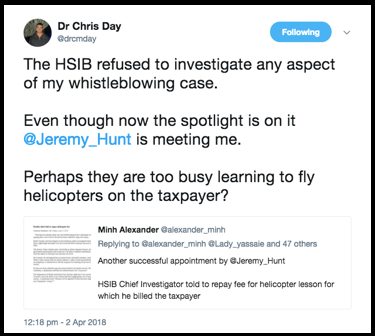
HSIB has also apparently distinguished itself by refusing to investigate any of the patient safety issues raised by Dr Chris Day’s whistleblowing case:

Screen Shot 2018-04-06 at 16.21.01

After considerable pushing, HSIB agreed in March 2017 to consider a process of open engagement and meeting with whistleblowers. This meeting never materialised, and HSIB ignored an enquiry in November 2017 about this.

In parallel to this, HSIB then established an advisory panel, through a competitive process, which initially comprised seven members but had no whistleblower.

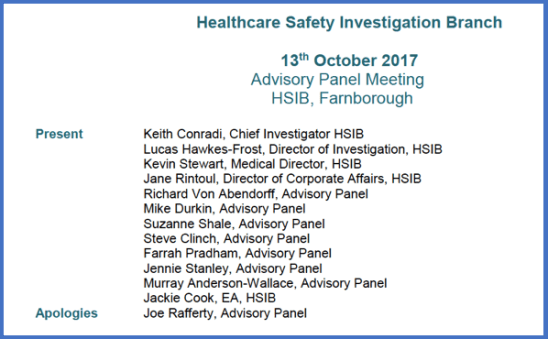
Mysteriously an eighth member later appeared in the minutes of the first panel meeting, which took place on 13 October 2017: Jennie Fecitt (Stanley) a member of the organisation Patients First.

Screen Shot 2018-04-06 at 16.23.12

Minutes of HSIB advisory panel meeting October 2017


For those unfamiliar with Patients First, it is an organisation which considers itself to be a charity.

About Patients First

This organisation was originally set up by several founder whistleblowers with the aim of specific test litigation.

Some founding members left.

It became a more broadly focussed group, run as a limited company.

According to Companies House, this dissolved on 17 February 2015:

https://beta.companieshouse.gov.uk/company/07783392

On 9 March 2015 the organisation emailed its members with the message:

“The proposal is that PF will no longer be set up as a limited company but will in the future operate as an unincorporated body (i.e. the members) which is also a charity, with charity trustees”

The following constitution was circulated and was to my knowledge adopted:

PF Constitution

This is information about un-registered charities:

https://www.gov.uk/government/publications/excepted-charities/excepted-charities–2

https://www.gov.uk/government/publications/exempt-charities-cc23

The organisation’s website has been sporadically maintained over the last few years, and has sometimes been inaccessible:

www.patientsfirst.org.uk


When questioned about this irregular addition of an eighth advisory panel member, HSIB was slow to respond and vague about the process by which this appointment had been made.

After three months, HSIB admitted that this late appointment had not made through an open process.

This is the full correspondence:

Correspondence with HSIB about Jennie Fecitt (Stanley)’s appointment to HSIB’s advisory panel

This is a recurring pattern, where NHS bodies seek to create the impression of inclusivity when they may be in fact behaving in the opposite fashion.

This is a classic method of selecting preferred voices, and shutting out the most rigorous challenge and dissent.

The rewards for individuals allowed into the club typically include the usual NHS puffery and the swish of more doors opening to other opportunities.

Indeed, NHS England and NHS Improvement installed another Patients First member in a position of leadership on the persistently ineffective NHS whistleblower employment support scheme, without any apparent open process of selection. Trebles all round. But more of that another time.

A non-whistleblower member of the Advisory Panel has now asked HSIB about how it will approach the issue of super-gagged whistleblowers. Keith Conradi has agreed to seek legal advice. This could presage interesting developments.

However, if AAIB will not even release staff surveys from under Conradi’s reign, it is difficult to imagine that he will help unchain NHS staff.

Nevertheless, his agreement to explore the issue is at least a tacit acknowledgment that there is relevant safety evidence lurking behind gags, so it will be interesting to watch this matter unfold.


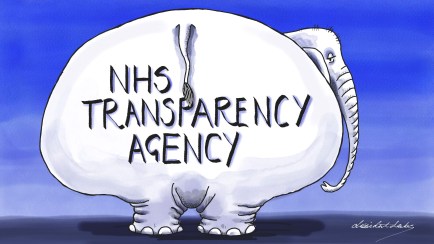
white-elephant

RELATED ITEMS

Whatever happened to Jeremy Hunt’s Just Culture Task Force?

The Assimilation of Whistleblowers


Gagged whistlers, the Whistleblower Employment Support Scheme and other NHS Silence

 By Dr Minh Alexander NHS whistleblower and former consultant psychiatrist, 5 April 2018


On 22 February 2018 I reported that I had asked NHS Improvement (NHSI) to better meet the needs of gagged whistleblowers who are unable to access the NHS whistleblower employment support scheme, such as it is.

I shared the correspondence with NHSI’s new Chair, Dido Harding, in which I asked her to:

  1. Indemnify any gagged whistleblowers who decide to apply to the scheme, and take the risk of breaking gags in order to give the required account of themselves, on the basis of NHSI’s assurances that former employers will not pursue them.


  1. Seek a government waiver for gagged NHS whistleblowers, which I believe is a safer option.


The answer to both requests was subsequently ‘no’.

But NHSI has amended the wording of its correspondence to trusts, asking them about whether they would pursue whistleblowers who broke gags for the purposes of applying to the employment scheme.

Unfortunately, I cannot share this amended wording as NHSI has now gagged that data thus:

NHS Improvement gag on ESS documents

However, it does not seem to me that NHSI’s new wording will make any difference.

This is the correspondence to date with Dido Harding:

Correspondence with Dido Harding about whistleblower employment support scheme and gags, up to 4 April 2018

Moreover, it has come to light that NHS Improvement has required panellists, who decide on whether whistleblowers’ applications to the whistleblower employment support scheme will be accepted, to sign a ‘confidentiality undertaking’ that includes a ban on contact with the press unless it is approved by NHSI’s Chief Spinner:

“I hereby acknowledge that I am subject to a duty of confidentiality with respect to this activity (and any other associated work I undertake for NHS Improvement), and undertake not to disclose, otherwise than with the consent of NHS Improvement or in the proper discharge of my duties within the office of NHS Improvement, confidential information to which I have had access or information which has been communicated to me in confidence within the office of NHS Improvement or received in confidence from others.

I further acknowledge that this duty of confidentiality does not cease on any termination of the provision by me of services to NHS Improvement.

 I understand that NHS Improvement has strict rules about breaches of confidentiality and my attention has been drawn to the office rules and policies of NHS Improvement on the intranet with respect to confidentiality, conflicts of interest and data protection including the ‘Information and Data Handling’ and ‘Procurement’ policies (which have been supplied with this undertaking). 

 I will not speak to the press regarding any activity undertaken at NHS Improvement without prior consent from the Executive Director of Strategic Communications and/or the Director of Media Relations. I understand that any press enquiries (telephone or email) should be forwarded immediately upon receipt to the Media Relations Director or the Media Relations Managers and that I should not respond to them under any circumstances, except where there has been explicit prior agreement from the Media Relations team.”


NHS Improvement’s Director of Comms is Tim Jones, formerly of the Department of Health, and part of the glittering success that was Jeremy Hunt’s Just Culture Task Force.

It may be a small point to some, but in the context of the whistleblower employment support scheme, it would have been good practice for NHSI to make it clear that this confidentiality undertaking does not restrict public interest disclosures.

One whistleblower who was accepted as a scheme panellist asked for the wording of the confidentiality undertaking to be changed, to make it clear that public interest disclosures are not restricted. NHSI refused to do so on that occasion, on the basis that all the other panellists had signed the same undertaking, but said it might consider adding such a qualifying clause in future.

NHSI has in fact advised via FOIA that it makes a similar requirement of all employees, consultants and contractors.

NHS Improvement FOI disclosure about gagging workers 3 April 2018

These are NHSI policies disclosed along with the substantive FOI response:

NHS Improvement Procurement Policy disclosed 3 April 2018

NHS Improvement information and data handling policy disclosed 3 April 2018

Mum’s the word.

laurel and hardy shhh


A complaint regarding the National Guardian’s management of concerns about a spin doctor

By Dr Minh Alexander NHS whistleblower and former consultant psychiatrist, 29 March 2018
In September 2016 I started this blog for the purpose of helping to keep people informed about campaign work on reforming whistleblowing law and governance, and for sharing data and correspondence that might of use to others.

In September 2017 I was informed by a fellow whistleblower, who we shall call Anon, that a spin doctor from the National Guardian’s office approached them at an NHS event involving about 40 people, in November 2016, two months after I started my blog.

Anon said that this person started making derogatory comments about me within earshot of other NHS managers at the event.

Anon tells me they had never met this spin doctor before. Neither had I, nor indeed had I ever spoken with or exchanged a syllable of correspondence with said spinner.

Yet according to Anon, this is how the encounter went:

Noel Finn account of conversation with WF

 Anon made a verbal complaint to the National Freedom To Speak Up Guardian in January 2017. Anon was told that the spin doctor in question was no longer working at the National Guardian’s Office, and that no more could be done. Anon left it at that.

After hearing of Anon’s concerns, the National Guardian reportedly spoke to her team on 30 January 2017 about standards of conduct in representing her Office. Her Office has disclosed the relevant meeting agenda:

Screen Shot 2018-03-29 at 17.30.06


The Office has advised that there are no minutes of the discussion held on this issue.

After Anon told me in September 2017 of these events, I discovered that that the spin doctor had been re-employed by the National Guardian’s Office (NGO), and the Office later disclosed that it was the National Guardian who was the appointing officer.

At the point of this re-employment, no investigation had taken place into the alleged derogatory comments.

Anon and I were concerned by the message sent by such an appointment. We complained to the National Guardian on 1 October 2017 about the fact that her Office, which supposedly has responsibility for helping to protect whistleblowers, had re-engaged someone who was reported to have behaved badly towards a whistleblower.

I additionally raised concerns that the spin doctor had reportedly implied that he had power to bar specific whistleblowers from access to the Office.

The NGO should by its own policy have passed the complaint to NHS Improvement, because it related to the National Guardian’s own actions in re-employing the spin doctor in question. However, the NGO decided to investigate the matter itself, and did so cursorily. No one was interviewed except the spin doctor.

The spin doctor denied that he ever made the comments reported by Anon.

No witnesses from the conference were sought or interviewed by the NGO. The Office asserted that because there was a disputed account of events between Anon and the spin doctor, the complaint could not be upheld. It made no attempt to weigh the credibility and motivations of the differing parties.

The most serious component of the complaint was not addressed – the fact that the National Guardian employed the spin doctor again, after Anon had informed her of concerns about this individual.

Both Anon and I rejected the NGO investigation and asked that the matter should be investigated by NHS Improvement (NHSI) as per policy.

NHSI took over the complaint on or around 16 November 2017. The process was not concluded until 29 March 2018, which was over three months NHSI’s original, estimated timescale.

The marked delay has never been fully and satisfactorily explained.

NHSI established from the National Guardian that she recalled the spin doctor said he would speak to Anon at the conference:

 Henrietta Hughes evidence Noel Finn WF complaint

NHSI interviewed an NHS manager present at the event in question, who said she:

Adele Bunch WF complaint

but that:

Screen Shot 2018-03-29 at 23.06.09

NHSI reported that another NHS manager at the event:

Screen Shot 2018-03-29 at 23.07.29

NHSI reported that the spin doctor in question “denies them [the derogatory comments reported by Anon] completely”.

The NHSI investigator did not speak to anyone else who had been present at the event:

Screen Shot 2018-03-29 at 23.08.31

NHSI did not uphold the complaint relating to the spin doctor’s conduct or the National Guardian’s re-appointment of this individual, despite the fact that she as aware of the concerns that Anon had flagged.

However, NHSI did consider that the complaint had been incorrectly handled originally, in that the NGO only examined the original conduct of the spin doctor, and not the National Guardian’s decision to re-appoint him.

NHSI has advised that consequently, it has provided training on complaints handling to the National Guardian’s Office.

Robert Francis adjudicated on the complaint, as he was the Chair of the National Guardian’s Liaison and Accountability Board when the complaint were made, although he has stepped down from this role since.

He concurred with NHSI’s conclusions and commented that NHSI was entitled to come to a conclusion that:

Robert Francis WF (1)

I expressed concern that Anon was disbelieved, and that this mirrors what happens more generally when staff speak up. I had known Anon, a previously vindicated whistleblower, for four years and that I had not known them to lie. I had no reason whatsoever to disbelieve Anon.

Francis thanked us both for:

Robert Francis WF (3)

He stressed that the fact that Anon’s account had not been accepted should not be seen as a reflection upon Anon:

Robert Francis WF (3)

But this saga raises uncomfortable questions. Did the National Guardian not care about Anon’s concerns when she re-employed the spin doctor? Trust is key for whistleblowers seeking a safe harbour, and the National Guardian’s actions in this matter have not helped to establish trust.

Arising from the complaint, the NGO asked me on 2 November 2017 to contribute to the development of its code of conduct:

Simon Pook code of conduct

I agreed to contribute but have not heard any further or been given sight of this code of conduct, raising questions about whether the NGO’s offer was serious or just a theatrical flourish.

And what truck does an Office that is meant to promote truth-telling  have with spin?


National Guardian’s Office spending on public relations.

The Care Quality Commission, which is the National Guardian’s employer, has disclosed (FOI 1718 0813) that since April 2016 when the Office went live, it has a spent £261,101 on PR staff and conferences.

Cost of PR staff since April 2016:

The total cost for members of staff with direct responsibility for communications and engagement since April 2016 is £173,443.”

Cost of conferences:

October 2016 conference £10,080

October 2017 conference £37,578

March 2018 conference £40,000
Total: £87, 658 

This figure does not include the cost of a national conference held in March 2017 which was funded by Health Education England.

The £261,101 spent on PR and conferences has exceeded the amount spent on developing the Speak Up Guardian network:

“…over the same period, the office has spent £135,678 on staff with responsibility for Freedom to Speak Up Guardian engagement, which involves the provision of training, advice and support for our network of Freedom to Speak Up Guardians. This work does not include any communications, public relations or media functions.”

A product that is evidence-based, sound and respected would sell itself, and would not require such aggressive marketing.


UPDATE 13 APRIL 2018
Whilst NHSI and Robert Francis have been reluctant to believe Anon’s account of derogatory remarks by an NGO spin doctor, the evidence of spin and negative briefing continues to surface. I have written to Robert Francis to draw his attention to this evidence:

Letter to Robert Francis about news management by the National GUardian’s Office, DHSC and CQC


Slag Off &amp; Slag Off


RELATED ITEMS

National Guardian, Spin Doctors and Dodging Reform of Whistleblowing Law

Regulation 5 Fit and Proper Persons: Dissecting CQC’s Dissembling


Regulation 5, Fit and Proper Persons: Dissecting CQC’s Dissembling

Disraeli opined: “There are three kinds of lies: lies, damned lies, and statistics.” Ironically it is the UK Statistics Authority that is the most trusted ALB. Pity the same cannot be said of the CQC where it appears clarity and openness are seemingly rare commodities.

The CQC has a history of deliberate deception. A well-known CQC lie of omission at Basildon consisted of a pretence at being hard hitting, whilst deliberately withholding facts.

Daily Mail Basildon CQC 2010


CQC’s application of Regulation 5 Fit and Proper Persons (FPPR) is worth examining. It would seem that some powerful wrongdoers, have been protected.

This is how the regulation, which was introduced in November 2014 is set out in law:


Fit and proper persons: directors

5.—

1.   This regulation applies where a service provider is a body other than a partnership.

2.   Unless the individual satisfies all the requirements set out in paragraph (3), a service provider must not appoint or have in place an individual—

a.   as a director of the service provider, or

b.   performing the functions of, or functions equivalent or similar to the functions of a director.

3.   The requirements referred to in paragraph (2) are that—

a.   the individual is of good character,

b.   the individual has the qualifications, competence, skills and experience which are necessary for the relevant office or position or the work for which they are employed,

c.    the individual is able by reason of their health, after reasonable adjustments are made, of properly performing tasks which are intrinsic to the office or position for which they are appointed or to the work for which they are employed,

d.   the individual has not been responsible for, been privy to, contributed to or facilitated any serious misconduct or mismanagement (whether unlawful or not) in the course of carrying on a regulated activity or providing a service elsewhere which, if provided in England, would be a regulated activity, and

e.   none of the grounds of unfitness specified in Part 1 of Schedule 4 apply to the individual.

4.   In assessing an individual’s character for the purposes of paragraph (3)(a), the matters considered must include those listed in Part 2 of Schedule 4.

5.   The following information must be available to be supplied to the Commission in relation to each individual who holds an office or position referred to in paragraph (2)(a) or —

a.   the information specified in Schedule 3, and

b.   such other information as is required to be kept by the service provider under any enactment which is relevant to that individual.

6.   Where an individual who holds an office or position referred to in paragraph (2)(a) or (b) no longer meets the requirements in paragraph (3), the service provider must—

a.   take such action as is necessary and proportionate to ensure that the office or position in question is held by an individual who meets such requirements, and

b.   if the individual is a health care professional, social worker or other professional registered with a health care or social care regulator, inform the regulator in question.

http://www.legislation.gov.uk/uksi/2014/2936/contents/made

http://www.legislation.gov.uk/uksi/2015/64/pdfs/uksi_20150064_en.pdf


Since 2014, CQC has issued three version of its guidance on FPPR:

CQC FPPR guidance November 2014

CQC FPPR guidance March 2015

CQC FPPR guidance January 2018
 

As CQC itself admitted in its original FPPR guidance of November 2014, the regulation arose from disasters and its intended purpose was to protect patients from harm:

“Regulation 5 has been introduced as a direct response to the failings at Winterbourne View Hospital and the Francis Inquiry report into Mid Staffordshire NHS Foundation Trust 3, which recommended that a statutory fit and proper persons requirement be imposed on health service bodies.” 

But CQC has applied inconsistent arguments and adopted various stratagems in order to avoid enforcing FPPR.


1.CQC has often claimed that under the regulation only providers, and ultimately the Chairs of providers, can determine whether their directors are Fit and Proper Persons.

This is nonsense of course, and it is merely CQC’s convenient interpretation of the regulations. There is nothing in the regulations which prevents CQC from taking a view on the fitness of regulated organisation’s directors. CQC chooses to wash its hands as a way of avoiding enforcement.

Moreover, CQC’s disingenuous claim falls if the Chair of a provider is referred under FPPR – as the logical conclusion is that CQC must take a view of a Chair’s fitness as there is no one else available in the hierarchy to do so.

Logically, CQC cannot possibly regulate FPPR, and assure itself that a provider has complied with the regulation, without making a judgment on whether a provider has made sound decisions on FPPR.

This point was conceded in CQC’s original 2014 guidance on FPPR:


“It is a breach of the regulation to have in place someone who does not satisfy the FPPR. Evidence of this could be if: 

• A director is unfit on a ‘mandatory’ ground, such as a relevant conviction or bankruptcy. The provider will determine this. 

• A provider does not have a proper process in place to enable it to make the assessments required by the FPPR.  

• On receipt of information about a director’s fitness, a decision is reached on the fitness of the director that is not in the range of decisions that a reasonable person would make.” 


So, CQC was saying here that it would take a view on whether a provider had made a reasonable decision about the fitness of a director. To do so, CQC would need to have a view on that director’s fitness.

CQC’s guidance of January 2018, produced after a purported review undertaken due to sustained criticism of CQC’s behaviour, additionally states:

“CQC does not determine what is and what is not misconduct or mismanagement. But, when we consider whether Regulation 5 has been breached, we will make a judgement about the provider’s decision; for example, whether or not the provider acted reasonably when it made its determination.” 

In reality, CQC has always known that it has the power to effectively veto any flawed decisions by providers about their directors’ fitness. At a teleconference with CQC attended by Mike Richards former CQC Chief Inspector of Hospitals and his entourage in December 2014, Richards indicated that CQC would be able to force trusts to remove unfit directors. He stated that whilst there was no direct power afforded by Regulation 5 itself to do so, CQC could lever compliance using other regulations. The fact is, CQC has chosen not to do so.

CQC hypocrisy in its handling of the fitness of the most powerful individuals is thrown into relief by its memoranda of understanding with professional regulators – in which CQC readily commits to referral of any lowly frontline staff if it has concerns that they are unfit to practice. For example, in CQC’s memorandum of understanding with the GMC states:

“8. In particular, the CQC will refer to the GMC: a. Any concerns and relevant information about a doctor which may call into question his or her fitness to practise.”


2.CQC has contradicted its claim that it cannot make judgments on fitness by refusing to present some FPPR referrals to the providers in question.

Although CQC has insisted that the judgment about directors’ fitness can only be made by the providers themselves, when it has suited, CQC has in fact made decisions that some referrals were meritless. It refused to present these cases to providers.

In doing so, CQC undermined its excuse that it has no remit for making determinations of fitness.

In some FPPR cases which it has refused to pass to providers, CQC has actively avoided evidence of unfitness despite being informed that such evidence exists.

CQC’s latest FPPR guidance of January 2018 ties itself up in contradictory knots. On the one hand the guidance admits that CQC may decide to take no further action in response to FPPR referrals:
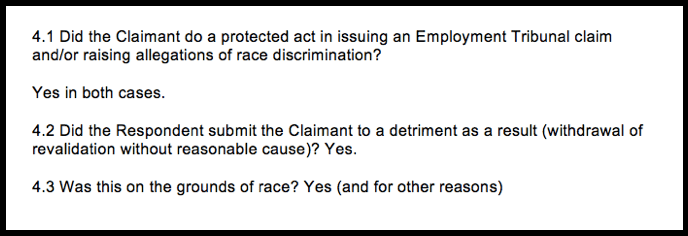
“When we receive information about an individual director or a board of directors, we may need to respond by convening a management review meeting (MRM) to determine whether the information indicates a potential FPPR concern.”

“We will determine whether the information is concerning in the context of what we already know about the provider in respect of the quality and safety of care. If we do not consider the information to be significant, the MRM will conclude that no further action is required.” 

On the other hand, the guidance also states that CQC will act only as a passive recipient and transmitter of concerns about provider directors’ fitness:

“CQC makes no judgement about the information, or the fitness of the director. Once we have obtained consent, if applicable, we will send the information of concern regarding the fitness of a director to the provider.” 

This seems a strange position to take when CQC makes judgements about mismanagement of services all the time, with respect to its ‘Well Led’ inspection domain.

A formal complaint has been made to CQC about its arbitrary past failures to present FPPR referrals to providers, and the inconsistency inherent in its guidance and various claims

3.CQC has staged faux FPPR investigations and accepted manifestly flawed evidence from providers in support of their directors’ fitness

For example, CQC triggered an investigation on FPPR at Southport and Ormskirk Hospital NHS Trust. CQC allowed the trust to control the investigation, and CQC accepted the investigation’s findings as valid. In the relevant inspection report, CQC even claimed that the FPPR report was “thorough and comprehensive”.

A subsequent report by the National Guardian’s Office revealed that a cultural review of the trust had criticised the FPPR investigation lauded by CQC as “thorough and comprehensive”, because the investigators had not actually spoken to the whistleblowers whose concerns triggered the investigation.

It would seem that the triggering of the investigation at Southport and Ormskirk had more to do with spinning an appearance and undermining whistleblowers, than a genuine attempt to implement FPPR.

Similarly, at St Georges, Mike Richards CQC’s former Chief Inspector of Hospitals accepted questionable evidence from the trust which claimed that Paula Vasco-Knight, a chief executive who had been criticised by an Employment Tribunal for whistleblower reprisal, had learnt her lesson and was a reformed character.

FPPR closure letter by Mike Richards 16 February 2016

Whilst justice must allow for mitigation in order to call itself justice, upon what authority and evidence base did the CQC accept such improbable claims of reform? Vasco-Knight’s criminal offending and misconduct has been of a pre-meditated nature, with calculated deceit. She has shown attitudes of entitlement and repeatedly sought to blame others for her antisocial behaviour. In the whistleblower reprisal affair at Torbay, she claimed that she had been treated with ‘disrespect’ and implied that the whistleblowers had treated her less favourably because of her Race.

“on a personal level I found the allegations as nothing less than personal slander and I wonder if a white middle-class male chief executive officer would have been treated with such disrespect.”

In the criminal fraud proceedings she sought to blame a colleague from NHS England until a late stage.  Even after conviction and a suspended jail sentence, she resisted the authorities’ attempts to recover the proceeds of her crime.

Indeed, the Employment Tribunal judgment from the whistleblower scandal concluded that Vasco-Knight was not a reliable witness. 

Such a pattern of behaviour would normally raise questions about an individual’s fitness for working with children and vulnerable adults, let alone be in charge of organisation with thousands of lives in its hands.

So upon what grounds did St Georges, Mike Richards and the CQC consider themselves to be qualified to pronounce on the assessment of remorse, personality and its purported mutability in Vasco-Knight’s case?

Parole Board members must be qualified to serve and make highly complex risk management decisions about offenders. What competencies do CQC staff have to make equally serious decisions about providers’ compliance with FPPR?

Regulation 5 opens the door to mitigation in that it states that reasonable adjustment must be made for health issues that throw doubt on fitness. For example, misconduct could perhaps be mitigated by temporary loss of reason – such as an exceptional acute manic episode, when the illness is otherwise well controlled.

Regulation 5 does not state that an apparent apology and indication of regret is sufficient mitigation for past wilful misconduct and serious breaches of the NHS managers’ code of conduct.

The fact Richards et al accepted flimsy evidence of Vasco-Knight’s purported reform was a measure of their willingness to give her a pass, and not the merits of the case.


4.CQC has shown bad faith by triggering investigation of weak FPPR cases but in contrast has avoided doing so in much stronger cases, despite robust evidence from Courts.

CQC cynically triggered an FPPR investigation at Derbyshire Teaching Hospitals NHS Foundation Trust on a case which had already been rejected by the Employment Tribunal and the Employment Appeal Tribunal. Unsurprisingly, the FPPR referral was not upheld.

This led to a predictable outcry against the expenditure of massive public resource on the exercise,  and sympathy for the target of the FPPR referral.

In contrast, CQC did not trigger an equivalent investigation into an FPPR referral by fully vindicated whistleblower Dr Kevin Beatt, in whose case the ET judgment that gave very detailed findings on wrongdoing by trust directors, and by those who operated under their control. Dr Beatt is concerned that CQC did not properly explore his referral and that it failed to examine all relevant documents.  Similarly, CQC did not trigger an investigation about St George’s handling of Regulation 5 with respect to Vasco-Knight.

One interpretation of CQC’s inconsistency is that in arranging for selective investigation of a weak case, it sought to discredit whistleblowers and turn opinion against the usefulness of Regulation 5, thus laying the foundations for further inaction.


5.CQC has shown bad faith by refusing to account for its actions under FPPR and by misrepresenting its activities on FPPR

CQC has been ultra-secretive when handling many FPPR referrals. It came under criticism for ignoring referrers, taking excessive long to respond and giving little information to account for its decisions.

In the case of the Vasco-Knight referral, CQC crucially failed to inform me as the referrer of its decision, which removed the right of meaningful reply and allowed St Georges to promote Vasco-Knight from COO to CEO without any fuss and opposition.

After CQC was later caught in the glare of the scandal caused by revelations of Vasco-Knight’s fraud, it  claimed that it would it re-visit the FPPR process. It spun this line through the Health Service Journal:

Screen Shot 2018-03-27 at 13.02.01.png

This was a porkie because by that point, Vasco-Knight had been sacked by St Georges, and by CQC’s own previous claims, no longer fell under the jurisdiction of Regulation 5 because she was not a current director.

I informed Robert Francis about this irregularity by CQC:


“To Sir Robert Francis QC 30 July 2016

Dear Sir Robert,

Sanctions against NHS managers

Many thanks for getting back to me, it was much appreciated.

To keep you updated, I copy below a blog that I have written about CQC’s handling of FPPR to date, which was posted yesterday.

This follows a discovery that although St. Georges made public statements about “suspending” Paula Vasco-Knight, and CQC made related comments that it was examining St George’s process for appointing her with respect to FPPR, she actually appears to have been sacked by St. Georges on the day of the suspension

The blog contains links to uploaded documents, but for convenience I attach the disclosure by St. George’s, which was sent to me on 27July.

CQC had previously, on 16 February, shut down an FPPR referral on Paula Vasco-Knight.

As CQC had previously informed me that it can only apply FPPR process to current directors, and specifically advised me that it no intention or remit to operate a disclosure and barring service for ex NHS directors who might return, I was perplexed by CQC’s subsequent announcement of its intention to re-open its examination of the FPPR process relating to Paula Vasco-Knight, if she had in fact been sacked.

With best wishes

Dr Minh Alexander

cc Katherine Murphy Chief Executive Patients Association”


Subject Access Request data revealed that he too challenged CQC about its dissembling:

Screen Shot 2018-03-27 at 12.11.27


6.CQC has violated its own policies in not treating whistleblower reprisal as a serious form of misconduct under FPPR

CQC has generated endless hot air on the importance of fostering an open culture and of protecting whistleblowers. It tells providers that they must not victimise whistleblowers or put them in fear of reprisals: 

“The arrangements should reassure staff that their concerns will be received supportively and addressed appropriately without fear of reprisals of any kind.”

But is this is sincere? CQC itself is reluctant to listen to or support whistleblowers, and so tacitly condones such behaviours by provider bodies.

CQC regularly fails to act upon about 50% of whistleblower contacts, as repeatedly evidenced in CQC board papers

CQC FOI data shows that CQC fails to act on even the most serious whistleblower disclosures

CQC insists it cannot investigate individual cases, but largely fails to investigate whistleblower clusters, even though it has powers of thematic review it has powers of thematic review

CQC has breached whistleblowers’ confidentiality but refuses to audit its practice in this area

CQC refuses to systematically inspect gags imposed by providers on workers,  which organisations use to silence disclosures and to conceal evidence of whistleblower reprisal


Indeed, CQC is too close to providers to make genuinely impartial decisions. It recruits provider directors as inspection Chairs.  Enforcing FPPR would be the equivalent of chopping off a hand – something contemplated only if something more prized may be chopped off. Also, some senior managers know where the centre has buried its bodies.

Mike Richards confirmed at the meeting in 2014 that CQC would treat whistleblower reprisal as a form of misconduct under FPPR, but added that it would depend on the seriousness of the reprisal.

But CQC has rejected FPPR referrals which raised whistleblower reprisal as an issue, even when Courts have made findings of serious reprisal. For example, in the cases of Clare sardari and Dr Kevin Beatt, both fully vindicated whistleblowers.

This is a disastrous betrayal of the public interest and of justice.

Serious whistleblower reprisal is essentially a refined form of psychological imprisonment and torture.  There are no physical walls but whistleblowers and their families are subjected to intense fear and uncertainty, usually for years. People live in fear of the next letter, phone call, false allegation or petty punishment. They are trapped in endless processes. In some cases, whistleblowers may be suspended and physically barred from access to the workplace and forbidden from contacting colleagues. The consequences of living under prolonged attack are often life changing.

The CQC is perfectly aware of the seriousness of these matters. It conducted a charade of listening to whistleblowers’ stories, which it spun with insincere sentimentality.

CQC’s trivialisation of reprisal, in its lack of action on FPPR, is therefore a wilful act.

Most seriously of all, whistleblower reprisal is a signal to others not to speak up. The CQC knows this, as demonstrated in all its copious statements acknowledging that a positive culture is needed to encourage disclosures and openness.

In “Complaints Matter” (2014) , CQC’s formal report on complaints and whistleblowing, Mike Richards made these fine sounding claims:

“We will hold health and social care services to a high standard of listening and acting on people’s concerns. We are committed to apply the same standards to ourselves and we know we need to do more to explain to people what we will do with their information if they tell us about their experience of care.”

It’s time for all of us – regulators, providers, professionals and commissioners – to make the shift to a listening and learning culture that encourages and embraces complaints and concerns as opportunities to improve the quality of care.”

In 2015 Ellen Armistead, who took over the Chair of CQC’s FPPR panel in 2016, wrote a blog on the importance of ‘Speaking Up for Whistleblowers’. 

The result of CQC improperly dismissing FPPR referrals from harmed whistleblowers is that it has made whistleblower reprisal acceptable, and CQC must be fully aware of this.

This is deplorable behaviour by a regulator which should be upholding standards.

CQC’s behaviour is further questioned by another body’s robust action over the Winterbourne View scandal. The Insolvency Service disqualified Mr Cruickshank the managing director of Castlebeck, the company which ran Winterbourne View Hospital, for not listening to whistleblowers. And that’s just for failing to listen to whistleblowers, not grossly victimising them.

CQC has acknowledged Regulation 5 was in part prompted by the failures at Winterbourne View. But what would have happened if CQC, and not the Insolvency Service, had presided over the Winterbourne View FPP issues? Mr Cruickshank  would probably have been recycled, promoted and invited to chair CQC inspections by now.

Most recently, the Public Accounts Committee noted that the number of whistleblowing disclosures to CQC had fallen, and the Committee Chair has urged CQC to investigate this.

“Even then, it must ensure the information feeding those systems is adequate to flag the early signs of poor care. That means investing time in building relationships at the frontline with Healthwatch groups, CCGs and others.

The recent decline in whistleblower numbers requires investigation; the Commission must act to understand why this has happened and ensure people can feel confident coming forward with what is often critical information.”

Comments by Meg Hillier MP 9 March 2018
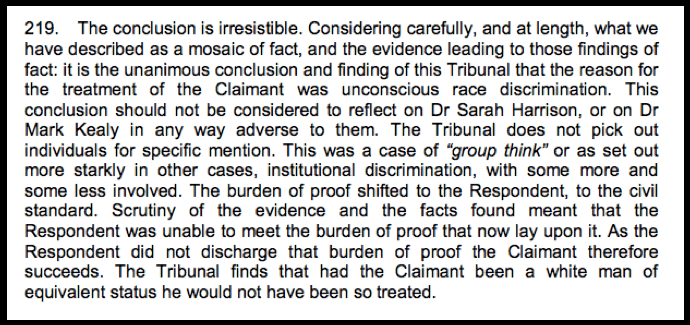
 

But is it really surprising if health and care staff are becoming more reluctant to disclose to a regulator who may betray them?

In February 2015 Robert Francis advised that FPPR should be trialled as part of the mechanisms for protecting whistleblowers, in lieu of managerial regulation. 

By October 2016 he was reported to be having second thoughts and suggesting that FPPR might need to be abandoned.

Screen Shot 2018-03-27 at 15.55.53.png

Although CQC has put on a show of reviewing its application of FPPR, the culture of the organisation and its master the Department of Health and Social Care is such that measures short of formal regulation will continue to be gamed.

It is time to re-visit managerial regulation and rein in political abuses of a public service.


RELATED ITEMS

Open letter by Clare Sardari, whistleblower, to the governors of St Georges

A Chief Inspector Doesn’t Call

FPPR: CQC has lost all moral authority but what will the National Guardian do?