Engineered failure to investigate NHS whistleblowers’ concerns

By Dr Minh Alexander NHS whistleblower and former consultant psychiatrist 8 April 2017

There is a big hole at the heart of NHS whistleblowing governance that is most likely there by design.

In reality, it’s nobody’s job to investigate whistleblowers’ concerns.

Of course, employers are supposed to.

But no one makes them do so.

Current UK whistleblowing law, the Public Interest Disclosure Act (PIDA) 1 , does not compel them to do so.

Instead, PIDA is focused on employment disputes. 2 This only serves to support poor employers’ main tactic of hiding whistleblowers’ concerns by focussing on – and sometimes manufacturing – employment disputes.

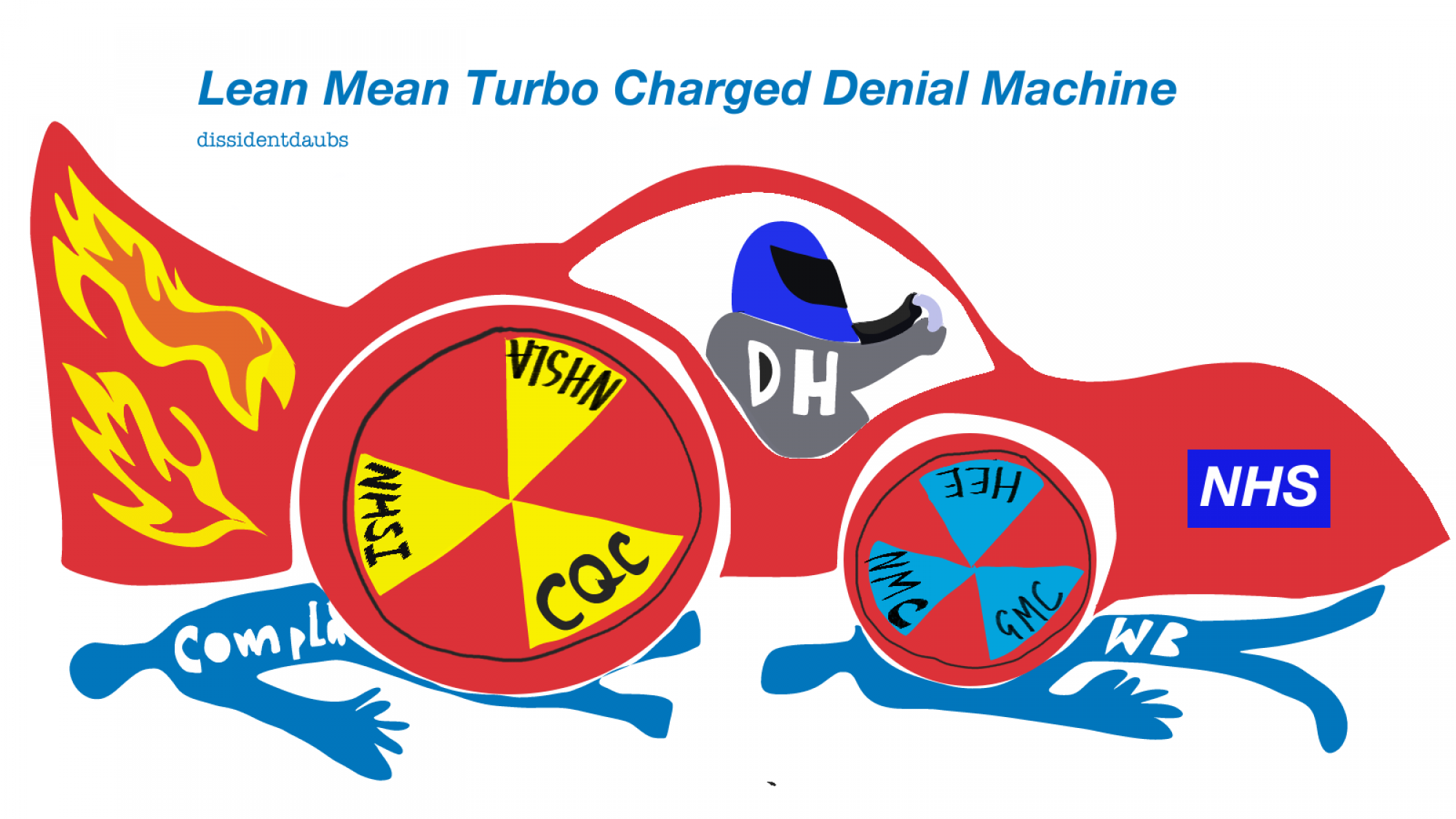
NHS regulators pay lip service to the need for investigation of concerns, but very often look the other way when whistleblowers report failures by their employers. 3

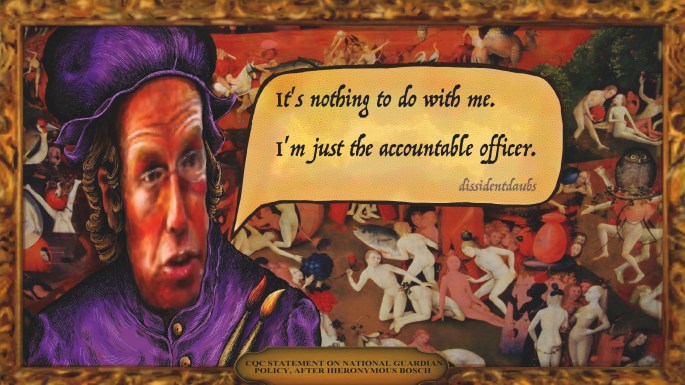
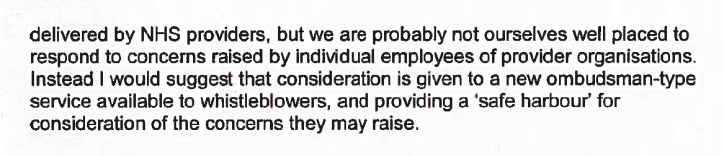
For good measure, the NHS regulator the Care Quality Commission also repeatedly maintains that it has no remit to investigate individual whistleblowers’ concerns. 4

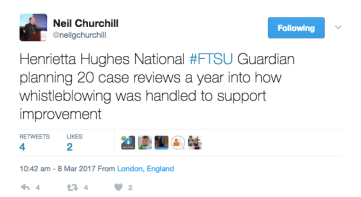
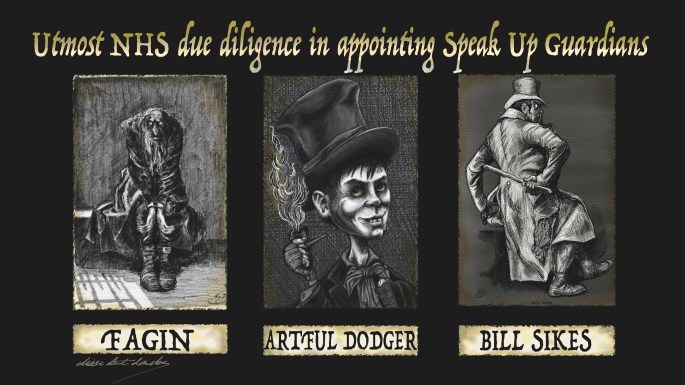
When the government was embarrassed into ‘doing something’ about recurrent NHS whistleblower scandals, it came up with local Freedom to Speak Up Guardians and the National Freedom to Speak Guardian. Unsurprisingly, they too were specifically designed not to investigate whistleblowers’ concerns. 5

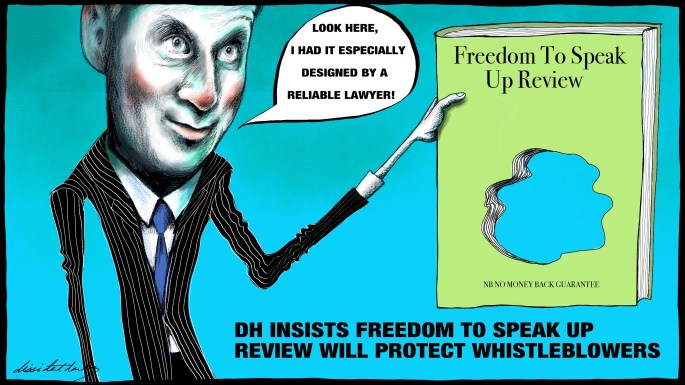
Sir Robert Francis, through his report of the Freedom to Speak Up Review, left investigation firmly in the hands of employers. 6

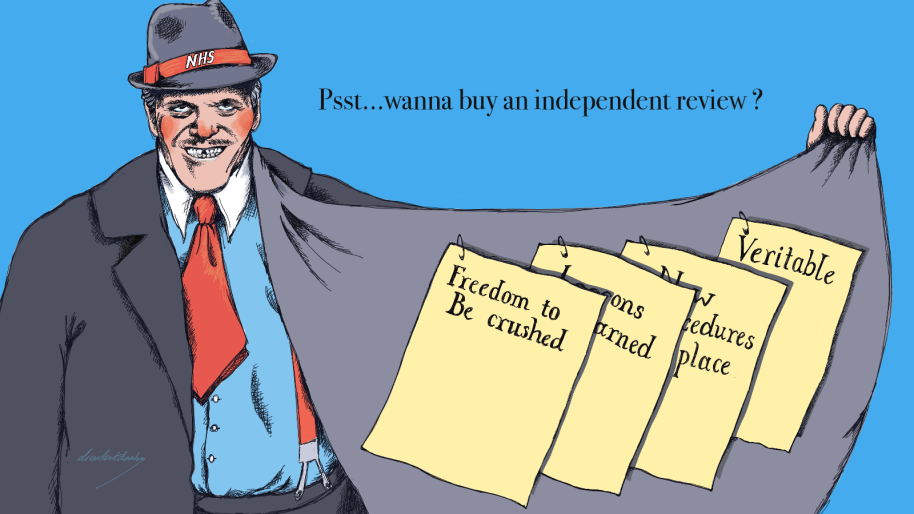
This was with a fig leaf proviso that employers could arrange external investigation where appropriate. 7 But investigations commissioned by and paid for by employers are hardly guaranteed to be independent.

There have been too many examples of such ‘independent’ investigations that proved to be little more than public relations exercises.
 

Spiv .png


As a typical example, NHS whistleblower Hayley Dare reported that she was offered an ‘independent’ investigation by her former chief executive, but discovered that the investigator was in fact her employer’s solicitors’ hireling.

NHS whistleblower Hayley Dare’s statement to the Employment Tribunal:

https://www.dropbox.com/home?preview=Hayley+Dare+Witness-Statement.pdf
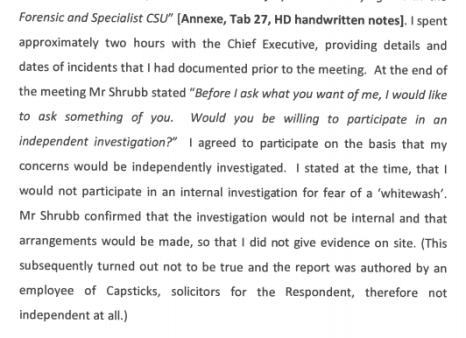
Hayley Dare Capsticks investigator

So, was this edifice of non-investigation arrived at by pure accident and incompetence?

That is most unlikely. Those clever folks at Whitehall know that investigation of whistleblowers’ concerns – about matters for which the government is ultimately responsible – is crucial to the public interest and to protecting whistleblowers.

Power protects itself. It follows then that if the status quo is to be maintained, investigation of concerns must be resisted and potential political embarrassment contained.

Genuine reform requires an enforceable legal duty upon employers to properly investigate whistleblowers’ disclosures.

Will the much criticised National Guardian help ensure that concerns are investigated? Unlikely. Her current position is that her office will not seek law reform 8 and her office has quickly become part of the problem.

Will the just-launched Healthcare Safety Investigation Branch (HSIB) fully discharge its remit to ensure good investigative practice in the NHS 9 10 11, including of whistleblowers’ concerns?

After all, the Department of Health promised us:

The Service [HSIB] will have the capacity to investigate only a small proportion of the many safety incidents that occur each year, and therefore a key part of its role will be to champion the need for good quality local investigations and lead on approaches that will enhance the capabilities of providers to conduct their own investigations. 9

I’ve seen little sign so far of serious interest and expertise at HSIB regarding whistleblowing. HSIB resisted meaningful engagement on whistleblowing and a meeting was only offered after lengthy correspondence.

I have put it to HSIB that it should closely examine failures to investigate whistleblowers’ concerns, and that it needs to openly consult with whistleblowers to tap into an important part of the NHS organisational memory on cover ups.

However, at the time of writing, there is no confirmation from HSIB that it will do so.

Also, HSIB indicated that it would publish its protocols for “dealing with whistleblowers” and repeatedly refused to share this material prior to publication. However, when HSIB became operational on 1 April and published its materials, I could find no specific documents on whistleblowing.

HSIB has also not yet responded to repeated questions about how it will discharge its Prescribed Person functions under the Public Interest Disclosure Act. HSIB has not even acknowledged its status as a Prescribed Person, which it must certainly have given that it is currently constituted as part of NHS Improvement, a Prescribed Person.

This is the relevant correspondence, which includes agreed records of a telephone meeting with the head of the HSIB intelligence unit about these matters on 24 March 2017.

Click to access hsib-correspondence-on-whistleblowing-records-of-meetimg-24-03-2017.pdf

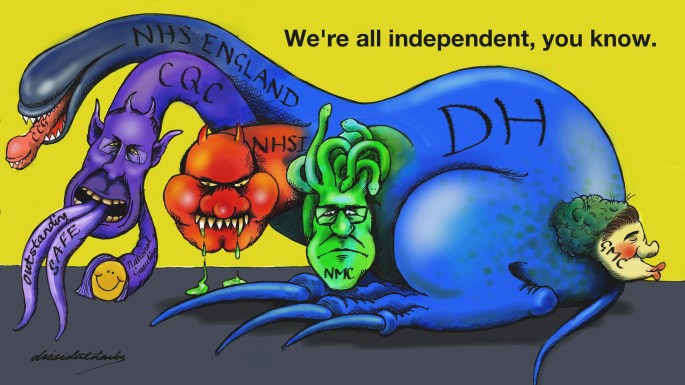
HSIB’s hesitance to embrace whistleblowers is perhaps not surprising given that it seems to be under the DH thumb: a DH Deputy Director is currently seconded to HSIB as HSIB’s Director of Corporate Affairs.

Despite this DH embedment, HSIB claims:
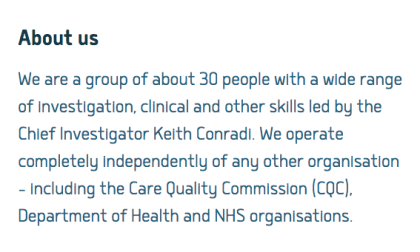
HSIB independence website 7.04.2017

Do note that HSIB seems to be whittling down its already restricted quota of 30 investigations a year. The official, public HSIB wording is up to 30 healthcare safety incidents in England each year”. The conversation with HSIB on 24 March reveals that the intention is to carry out 25 investigations.

Until the gaping investigative breach – that literally swallows whistleblowers whole – is closed by effective law and a willing enforcement structure, expect more whistleblowing failures.


RELATED ITEMS

(1) Edna’s Law, proposed by the campaigning charity Compassion in Care, seeks to enforce investigation of whistleblowers’ concerns:

http://www.compassionincare.com/node/162

(2) https://minhalexander.com/2017/03/03/white-elephants/

(3) https://minhalexander.com/2017/03/12/national-guardian-behan-replys/


REFERENCES

1 Public Interest Disclosure Act 1998

http://www.legislation.gov.uk/ukpga/1998/23/contents

2 The Public Interest Disclosure Act does not protect whistleblowers and only gives them the right to sue for compensation after they have been harmed. It does not include any requirement upon employers to investigate concerns.

3 Whistleblowers unheard by the CQC. Alexander, Linton, Sardari and a fourth NHS whistleblower, December 2016 https://minhalexander.com/2016/12/05/whistleblowers-unheard-by-cqc/

4 Complaints matter, CQC report December 2014

https://minhalexander.com/wp-content/uploads/2016/09/cqc-20141208_complaints_matter_report.pdf

“People [whistleblowers] with historic cases also contact CQC in the hope that we can help resolve their concerns or hold a provider to account for its actions. While each case provides learning for us about the problems that can occur, and how we need to mould our new methods of inspection to detect similar problems and take effective action, we do not have the remit to resolve an individual case. As with complaints, we believe there is a regulatory gap in this area and we welcome the Freedom to Speak Up review, including its focus on historic cases.”

5 Robert Francis’ report of the Freedom to Speak Up Review February 2015

Click to access F2SU_web.pdf

Page 19:

78 The INO [National Guardian] will have discretion to consider how an existing case is being or has been handled, and to advise an organisation on any actions they should take to deal with the issues raised. The officer would need to operate in a timely, non-bureaucratic way. He/she would not take on the investigation of cases themselves, but would challenge or invite others to look again at cases and would need sufficient authority to ensure that any recommendations made were taken seriously and acted upon.”

Page 169:

“7.6.13 I want to emphasise that I am not proposing an office to take over the investigation of concerns. As I have already said, this needs to remain the responsibility of the local organisations.”

“7.6.17 The INO would in essence fulfil a role at a national level similar to the role played by effective Freedom to Speak Up Guardians locally. They would not take on cases themselves, but could challenge or invite others to look into cases which did not appear to have been handled in line with good practice or where it appeared that a person raising a concern had experienced detriment as a result of raising the concern.”

6 Robert Francis’ report of the Freedom to Speak Up Review February 2015

Click to access F2SU_web.pdf

Page 167:

7.6.2 There was considerable discussion in the written contributions about the potential role of an independent body to manage disclosures by whistleblowers. Some contributors were supportive of this option, others were unsure but thought it at least worthy of consideration. Most of the reasons given in support of this idea were related to mistrust of managers and internal processes which led to concerns that treatment of whistleblowers would be biased and prejudicial. “ Trusts cannot be left to mark their own homework.” 7.6.3 We were also told about the risks associated with establishing such a body. In particular, removing responsibility for dealing with the concern from local level to a more remote organisation could create delays, affect local ownership of issues, and require the establishment of potentially bureaucratic systems to allow the external organisation to investigate concerns. Equally importantly, there would be a real risk that serious patient safety issues may not be addressed sufficiently quickly locally, if someone reported them to an external body for investigation rather to their own organisation

7.6.3 We were also told about the risks associated with establishing such a body. In particular, removing responsibility for dealing with the concern from local level to a more remote organisation could create delays, affect local ownership of issues, and require the establishment of potentially bureaucratic systems to allow the external organisation to investigate concerns. Equally importantly, there would be a real risk that serious patient safety issues may not be addressed sufficiently quickly locally, if someone reported them to an external body for investigation rather to their own organisation.

7.6.4 These risks seem to me to be powerful arguments. It is certainly not my intention to propose anything which could in fact make the practical handling of patient safety concerns more complex rather than less so. I am therefore not minded to propose establishment of an external body to consider and investigate concerns. Primary responsibility for investigating concerns should remain with the local organisation taking into account the good practice set out in 6.4.”

7 Robert Francis’ report of the Freedom to Speak Up Review February 2015

Click to access F2SU_web.pdf

Page 25:

Principle 8

Investigations: When a formal concern has been raised, there should be prompt, swift, proportionate, fair and blame-free investigations to establish the facts. 

Action 8.1: All NHS organisations should devise and implement systems which enable such investigations to be undertaken, where appropriate by external investigators, and have regard to the good practice suggested in this report.”

8 Letter from Henrietta Hughes National Freedom to Speak Up Guardian 16 February 2017

9 Learning not Blaming. Department of Health, July 2015

https://www.gov.uk/government/uploads/system/uploads/attachment_data/file/445640/Learning_not_blaming_acc.pdf

10 The National Health Service Trust Development Authority (Healthcare Safety Investigation Branch) Directions 2016

https://www.gov.uk/government/uploads/system/uploads/attachment_data/file/514217/HSIB_directions.pdf

11 Healthcare Safety Investigation Branch, website: http://www.hsib.org.uk/

“We investigate up to 30 health safety incidents each year in order to provide meaningful safety recommendations. We share what we learn across the whole of the healthcare system for the benefit of everyone who is cared for by it and works in it.

In this way, we can raise standards, improve patient safety and support learning across the healthcare system in England.

In essence we are here to:

  • conduct thorough, independent, impartial and timely investigations into clinical incidents
  • engage patients and relatives, NHS staff, and medical organisations in the investigation process
  • treat the patients and relatives of incidents sympathetically and help them understand ‘what happened?’ and what’s being done to prevent similar events in the future
  • produce clearly written, thorough and concise reports with well-founded analysis and conclusions that explain the circumstances and causes of clinical incidents without attributing blame
  • make safety recommendations to improve patient safety
  • improve patient safety by sharing the lessons learned from investigations as widely as possible
  • raise the standard of local investigations of healthcare safety incidents by establishing common standards and skills development

In the future, we will act as global ambassadors for safety investigations.”
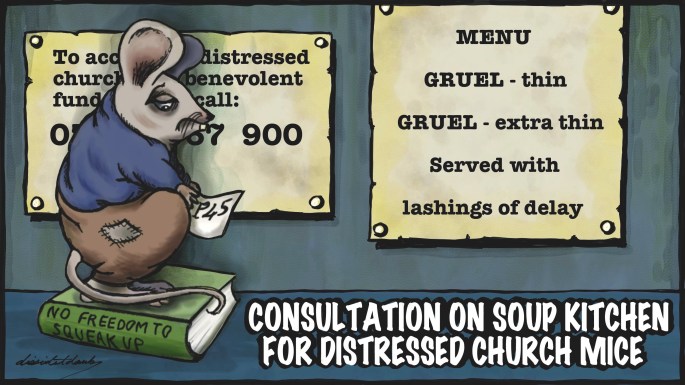
 

At the NHS Improvement Soup Kitchen

By Dr Minh Alexander NHS whistleblower and consultant psychiatrist 26 March 2017

NHS Improvement held a workshop on the design of its whistleblower employment support scheme for trust whistleblowers, on 24 March 2017. It was co-facilitated by two members of of Patients First, with Chatham House rules agreed.

In brief, there is little sign of serious help on the horizon. In fact, we were told that the service may be diluted if there are many applicants and or if the scheme is expanded to re-deployment of whistleblowers still employed by the NHS, on the same budget.

The NHS whistleblower employment support scheme is another unlovely love child of Robert Francis’ assignation with the Department of Health, under the blanket of the Freedom to Speak Up Review.

Note that it is not a re-employment scheme, but only an employment support scheme.

The scheme does not provide jobs, but support to find jobs. 1

The scheme is not designed to deliver robust justice to badly harmed whistleblowers.

With due respect to individuals on the regulatory shop floor doing their best with a flawed remit and scant resources, the scheme is just more ministerial PR tinsel.

Over a year ago exiled whistleblowers traipsed to a similar workshop hosted by NHS England, which has responsibility for primary care whistleblowers.

After this, the NHS England board assigned a budget of only £250K and NHS England slowly rolled out a small pilot.

No formal report has been published about NHS England’s pilot, but at the workshop on Friday we were informed that there had been only eight applicants, as a number of whistleblowers who expressed interest decided not to apply. The scheme coordinator thought this was because the scheme did not do what whistleblowers wanted.

Will NHS England take this on board and change its scheme, so that it provides what whistleblowers want (ie. Jobs)? No, was the answer.

But nevertheless, NHS England will purchase formal, external evaluation of the scheme. And in response to questioning, we were assured that whistleblowers will be involved in designing this through an open process, and that the evaluation will include the experience of whistleblowers who decided not to apply.

It became evident that NHS England has a “decision template” for the panels that judge whistleblower applications, but it does not have a written protocol setting out how the panels should weigh evidence or make decisions.

At the NHS England workshop last year, it was put to NHS England that the burden of proof should rest with the NHS to prove that whistleblowers are not fit, as opposed to whistleblowers having to prove that they are fit. This is on the basis that the government has accepted that the body of whistleblowers consists of individuals who have been unfairly pushed out, through no fault of their own.

This suggested burden of proof has not so far been reflected in NHS England’s documents. However an NHS England manager and panellist, who presented at the workshop assured, us that this is broadly the approach that has been taken in practice, and that the presumption has been in whistleblowers’ favour. All eight applicants were accepted for the scheme.

We were advised that better guidance for panels will now be drafted and include specific criteria to be taken into account when any past allegations against whistleblowers are evaluated. For example, whether the chronology of events suggest that allegations against whistleblowers were reprisal for raising concerns, and whether whistleblowers’ performance was maliciously and implausibly downgraded by employers in response to whistleblowing.

NHS Improvement has been dawdling at the back of the whistleblower employment class, allegedly because of its internal reorganisation. It promised to start it scheme sometime last year. It did not do so and was decidedly tetchy when asked for information about progress, treating requests as FOIs and ducking out of answering on silly technical exemptions.

NHS Improvement was asked at the workshop about its progress on establishment of a proposed pool of employers willing to employ whistleblowers. We learnt that a discussion was recently held with some 15-20 or possibly more trust employers, but that things are at an early stage.

NHS Improvement now clarifies that it has not yet set a budget for the scheme. But after questions, both NHS Improvement and NHS England disclosed on 24 March that they have set a ceiling of £10K expenditure per whistleblower case. It was said that the support provided may vary according to individual need and preference, but could include liaison with prospective employers, mediation with a past employer for a reference, coaching and help with interview and job application skills, training or other help to find alternative employment outside of the NHS. The scheme will not be fully operational immediately but will start with only a pilot of a limited number of whistleblowers (the currently proposed number is ten whistleblowers).

It is of course worth pointing out that a flat rate of £10K per person is not a personalised approach. One official acknowledged to me that this amount would in no way suffice to re-skill say, a surgeon.

Most worryingly, we were told that there might be dilution of this service depending on

  • The number of applicants – we were asked to mull over whether a better service should be given to a smaller number of whistleblowers, or whether the service should be spread out amongst a larger number of people.
  • Shockingly, it was also casually mentioned that the budget for helping exiled whistleblowers might be spread thinner if there was a decision to add a redeployment service for whistleblowers who are still in employment. The best bit was….this redeployment service might be needed especially as there are multiple reports that the trust Speak Up Guardians are not proving sufficiently effective in preventing harm to whistleblowers.

How dysfunctional can you get? The government committed millions of precious public money to a flawed National Guardian office and non-evidence based local Guardian model, and when these are failing as expected, it is the most severely harmed, exiled whistleblowers who are expected to pick up the tab for this inexcusable waste and inefficiency.

It is totally unacceptable to put whistleblowers in the position of choosing whether they want their gruel thin…or extra thin.

There are also other important issues which are far from resolved, such as the disadvantage to gagged whistleblowers who cannot defend themselves properly for the purposes of accessing the scheme. Also, a question was raised about issues of due diligence in not exposing whistleblowers who have been harmed to more abusive employers, given the propensity of some NHS organisations to merely say the right things to gain regulatory favour. Of relevance to this, it recently emerged that a senior manager who had been a Freedom to Speak Up Guardian was recently jailed.

Both NHS England’s existing application form and NHS Improvement’s draft protocol contain an objectionable passage which precludes discussion of how the NHS treated the whistleblower2. This is very clearly unworkable if the whistleblower needs to present evidence about false allegations that they have suffered if these present a continuing barrier to employment.

In all, there was serious concern and anger expressed by whistleblowers who attended the workshop. Some comments are not reportable. Some commented to me that they didn’t know what planet NHS Improvement and NHS England were on. One person injected a note of reality and urgency at the workshop by reminding officials that they were worried about feeding their children that night.

As far as I could see, there was a unanimous show of hands by whistleblowers in the audience in favour of a needs led approach ie. a scheme that is properly resourced to provide all of the whistleblowers who need help all of the help that each person needs.

The NHS has a moral duty to fix what it broke. It also needs to send an unequivocal message that it will no longer cause, aid and abet or walk past serious harm to whistleblowers.

I have suggested that if the government is serious, it should disband the ineffective trust Guardian network and use the money saved to help fund a real employment scheme.

The scheme should include paid jobs and highly supported, graduated and safe re-entry for whistleblowers. It could be done if the government really wanted to.

As was pointed out at the workshop, the NHS demonstrates that it is quite capable of shifting itself when it recycles seriously erring managers at the drop of a hat.

We need serious, responsible policy not ‘cruel gruel’ or disingenuous barrow boy schemes from the Department of Health.

But then again, how would anyone feel about working again for an abusive employer who has still not delivered a fully operational re-employment support scheme two years after it was first promised? There are official and there are unofficial messages.


NEXT STEPS

NHS Improvement is looking for expressions of interest in terms of

  • Trust whistleblowers who want to apply to its pilot scheme
  • Whistleblowers who are willing to help review and develop documents
  • Whistleblowers who might be willing to sit on application panels (these will be comprised of a manager, a whistleblower and a professional of matched professional background to the applicant).

NHS Improvement has also agreed to consider opening a specific website page about the scheme, so that documents and developments can be shared, and to enable more open consultation than has taken place so far – the process to date has relied upon access via a small number of whistleblowing organisations which are not representative of the full body of whistleblowers.

You may also wish to comment on the working draft of the NHS protocol that has been shared via the workshop (the document is marked ‘confidential’ but its publication has been agreed):

DRAFT NHS IMPROVEMENT PROTOCOL WHISTLEBLOWER EMPLOYMENT SUPPORT SCHEME Received 23 March 2017

The NHS Improvement lead manager for this project, who has recently taken over from Tom Grimes, is Maria Robson, NHS Improvement Head of Trust Resourcing enquiries@improvement.nhs.uk

For completeness, this is the agenda for the workshop on 24 March 2017:

NHS IMPROVEMENT EMPLOYMENT SUPPORT SCHEME WORKSHOP AGENDA


UPDATE 23 SEPTEMBER 2017

Brief report from NHS Improvement_s secondary care whistleblower employment support scheme launch 22 September 2017


UPDATE 8 OCTOBER 2017

Things have been rather stirred up by a revelation that NHS Improvement surreptitiously helped to secure NHS re-employment for a sacked NHS whistleblower without any of the vetting that NHSI has claimed is required, and whilst telling the majority of other whistleblowers that the employment support scheme on offer consists merely of preparation for return to work.

Mr Mackey NHSI Chief Executive has been asked about this special treatment and whether NHSI will provide similar help to other whistleblowers:

Letter to Jim Mackey re-employment 8 October 2017


RELATED ITEMS

https://minhalexander.com/2017/03/20/whistleblower-discrimination-hunts-razzmatazz/

https://minhalexander.com/2017/03/07/freedom-to-speak-up-guardian-jailed/

https://minhalexander.com/2017/03/12/national-guardian-behan-replys/


REFERENCES

1 Page 153 Robert Francis’ report of the Freedom to Speak Up Review February 2015

“7.3.8 Beyond that, I believe that there is an urgent need for an employment support scheme for NHS staff and former staff who are having difficulty finding employment in the NHS who can demonstrate that this is related to having made protected disclosures and that there are no outstanding issues of justifiable and significant concern relating to their performance. This should be devised and run jointly by NHS England, the NHS Trust Development Authority and Monitor. As a minimum, it should provide:

  • remedial training or work experience for registered healthcare professionals who have been away from the workplace for long periods of time
  • advice and assistance in relation to applications for appropriate employment in the NHS
  • the development of a ‘pool’ of NHS employers prepared to offer trial employment to persons being supported through the scheme
  • guidance to employers to encourage them to consider a history of having raised concerns as a positive characteristic in a potential employee. 7.3.9 All NHS organisations should support such a scheme. Doing so would send a clear signal to their staff, and to staff across the NHS that they are willing to value people who are brave enough to raise concerns. Organisations that do should be given appropriate recognition (see 7.8).”

Click to access F2SU_web.pdf

2 This is the passage included in both NHS England’s application form (page 4 of 27) – handed out at the workshop on 24 March – and in NHS Improvement’s draft protocol:

NHS Improvement draft protocol:

In providing evidence of eligibility to the Employment Support Scheme, it is important to highlight that the application is an opportunity to demonstrate suitability and eligibility to apply for the scheme and to focus on employment aims and support needed to return to employment. It should not be used to raise specific whistleblowing concerns or re-iterate whistleblowing experiences.  How the whistleblowing case was handled or the management actions that were taken as a result of any employment disputes will not be reviewed as part of the process to join the scheme.”

NHS England whistleblower employment support scheme application form (highlighted in bold on the form):

In providing evidence of eligibility to the Employment Support Scheme, it is important to highlight that the application is an opportunity to demonstrate your suitability and eligibility to apply for the scheme and to focus on your employment aims and support you need to return to employment. It should not be used to raise your specific whistleblowing concerns or re-iterate your whistleblowing experiences.  How your whistleblowing case was handled or the management actions that were taken as a result of any employment disputes will not be reviewed as part of the process to join the scheme.”


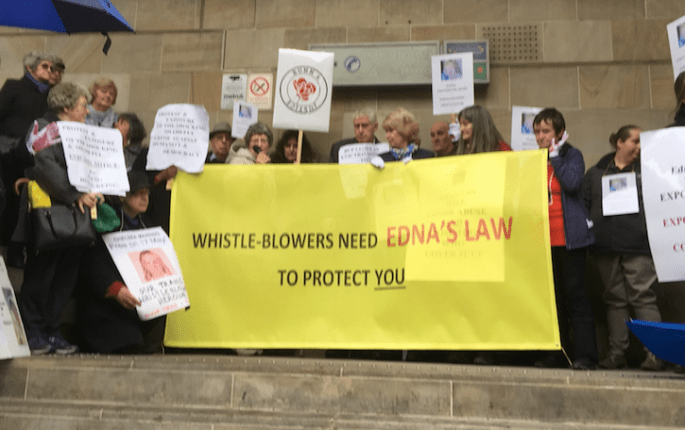
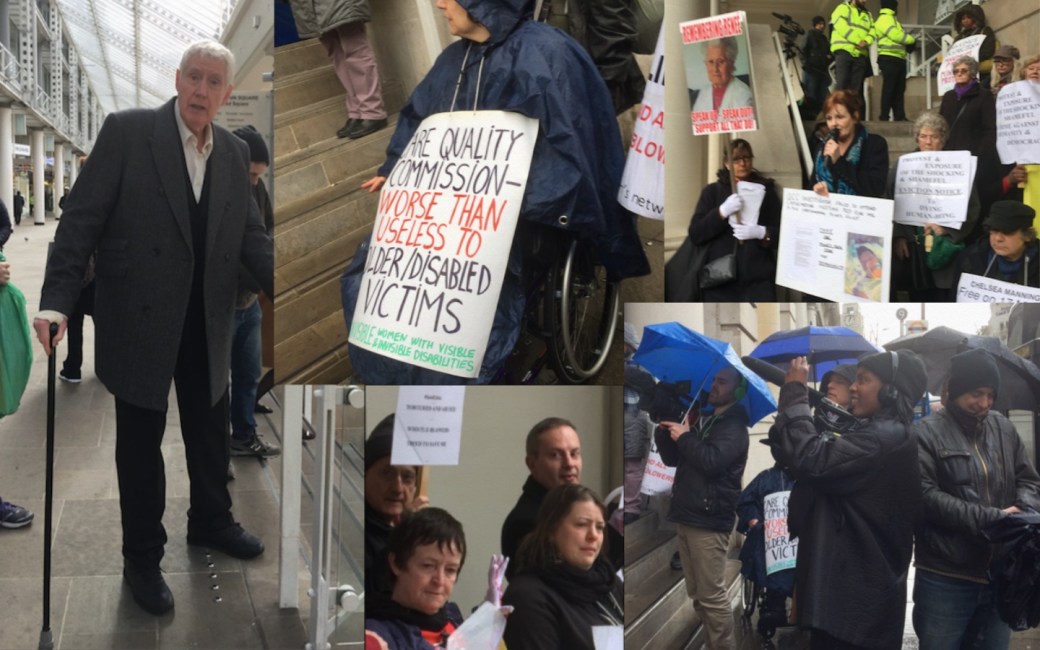
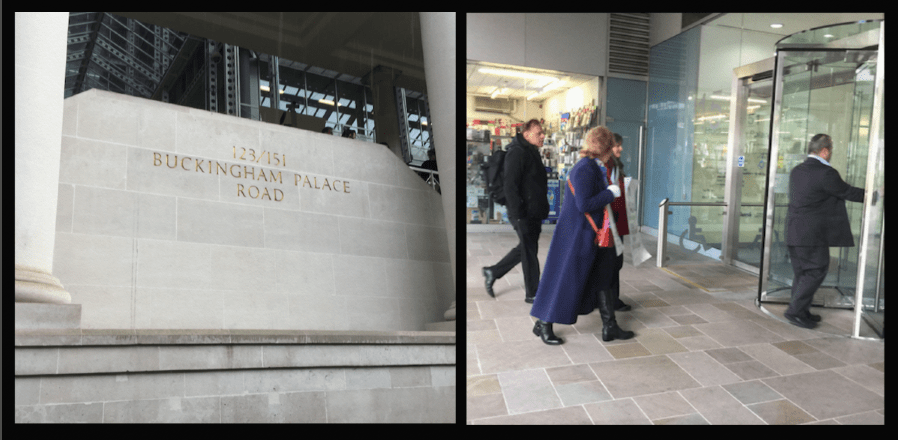
Protest by Compassion in Care and Supporters at CQC headquarters, Buckingham Palace Road 22 March 2017


A copy of a letter to the Prime Minister protesting the Care Quality Commission’s failures, and its CEO David Behan’s knighthood, was handed in to CQC.


The letter:

http://compassionincare.com/node/292


CQC is accused of:

  • Failing the public, vulnerable service users and whistleblowers
  • Failing to hold wrongdoers to account, allowing powerful corporate interests to come before care and failure to ensure safe care and learning from harm
  • Repeatedly breaching whistleblowers’ confidentiality with their employers. Compassion in Care will issue a report about this later this year. 
  • Fielding a sham National Guardian office, that fails whistleblowers


Compassion in Care’s letter requests that discredited, current whistleblowing legislation – PIDA – is scrapped and replaced with Edna’s Law.

http://www.compassionincare.com/node/162

The principles of Edna’s Law are that whistleblowers must be proactively protected by the State, that disclosures must be investigated and that those who cover up and harm whistleblowers must be properly held to account.


paperwork.png

Whistleblowers and families who have suffered loss, cover ups and CQC failure came to tell their stories.

montage.jpeg

Interested passersby:

Passersby.png

Delivering the letter…under escort:

escort.png

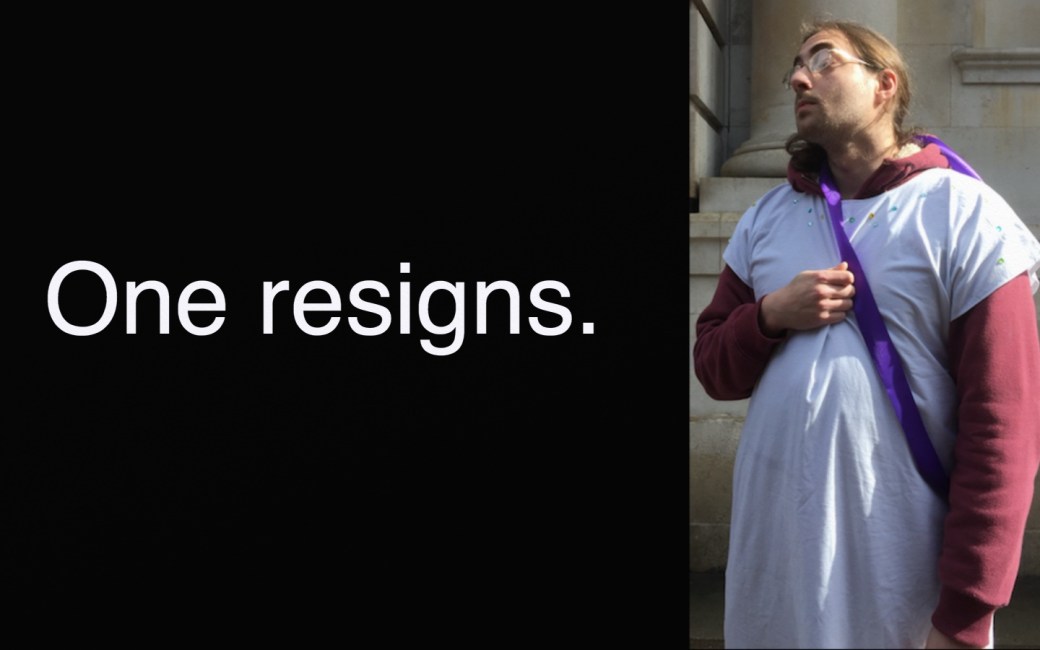
The Queen……..

Not amused

One resigns


UPDATE 16.40, 23 March 2017:

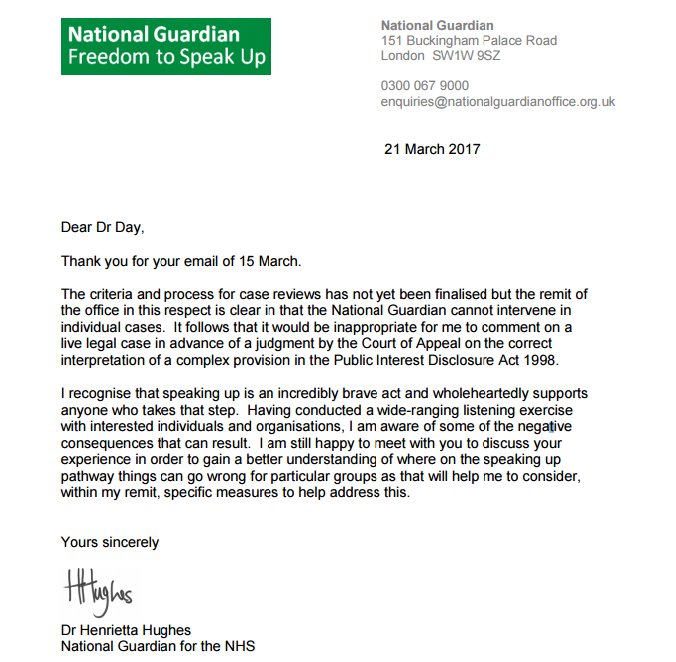
It has now emerged that the National Guardian has also written to Dr Chris Day claiming that she does not intervene in individual cases, even though those his case is clearly crucial to issues of whistleblower protection for all junior doctors.

All 54,000 of them.

What more can one say.

See the Day campaign website:

https://www.crowdjustice.org/case/junior-doctors-round-2/

Chris Day tweets at:@drcmday

The 54,000 doctors campaign tweets at: @54kdoctors

Henrietta Hughes’ letter to Chris Day, which was apparently emailed to him during his Court of Appeal hearing earlier this week:


HH letter to Chris Day 21.03.2017.jpg


RELATED ITEMS

https://minhalexander.com/2017/03/12/national-guardian-behan-replys/

https://minhalexander.com/2017/02/20/national-guardian-letter-from-wonderland/

https://minhalexander.com/2017/03/09/national-guardian-et-al-fantastic-or-airbrushed-fantasy/


25 ‘best’ and 25 ‘worst’ NHS trusts for speaking up. Allegedly.

By Dr Minh Alexander, NHS whistleblower and former consultant psychiatrist


This is a brief report about raising concerns, as reflected by the annual national NHS staff survey.

The 2016 national NHS staff survey results for 240 trusts were published on 7 March this year. 1

I have extracted the results for all NHS trusts on the survey question about ‘I would feel secure raising concerns about unsafe clinical practice’, set against current CQC ratings, and uploaded the relevant database:

2016 national NHS staff survey speaking up and CQC ratings, as of 22 March 2017

Whistleblowers will see some familiar rogues amongst the data.


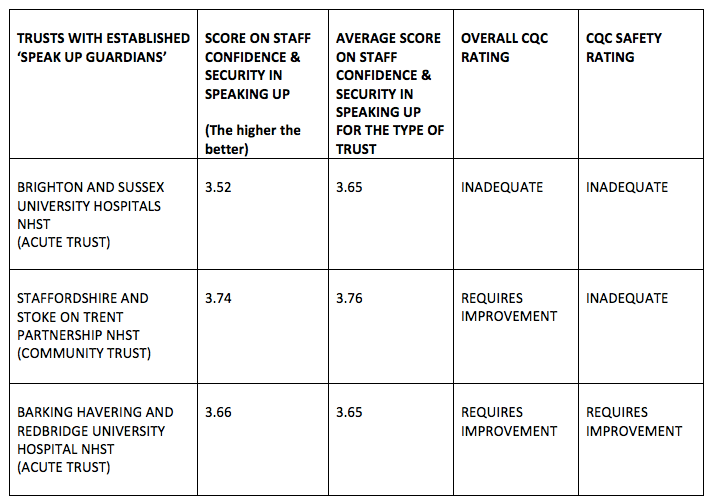
TRUSTS WITH ESTABLISHED SPEAK UP GUARDIANS

Significantly, three trusts that have had prototype Freedom To Speak Up Guardians for several years returned mediocre results on speaking up:

Trusts with established Guardians Staff Survey 2016

This will not be much of a surprise to most whistleblowers. A more detailed discussion of the lack of evidence base for Robert Francis’ Freedom to Speak Up Guardians can be found here:

https://minhalexander.com/2016/09/24/critique-of-francis-model-of-trust-appointed-guardians/

Let’s hope Henrietta Hughes is at least a little chastened by this latest evidence that Speak Up Guardian model doesn’t add much value.


BROAD FINDINGS

Overall, the summary briefing on the 2016 NHS staff survey reported that only 70% of NHS staff feel secure to speak up. 2

Percentages are given for individual trusts but the survey people advise that this information is unweighted and cannot be used to compare trusts.

However, it is very worrying that 30% of the million plus NHS workforce do not feel safe to raise concerns about unsafe care.

In some trusts the proportion of staff who feel safe to report concerns drops to as low as 55% (East of England Ambulance Service).

The percentages for individual NHS bodies can be found here – see question 13:

NHS Staff Survey 2016 unweighted question level data – reporting errors etc

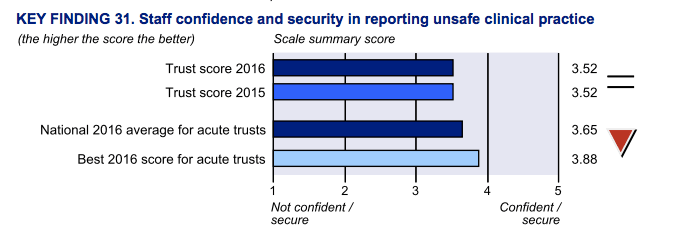
For comparison, trusts are given weighted scores on staff confidence and security in speaking up, the higher the better. This is how the results on this question are displayed in each trust’s survey results:

Brighton and Sussex

The above is the result for the troubled Brighton and Sussex University Hospitals NHS Trust, which is in the bottom 20% of acute trusts on this question

Looking at all 240 NHS trusts, the scores ranged between 3.14 – 3.94, with an average of 3.67.

Fittingly, the trust which has generated the most external whistleblowing disclosures to CQC in recent years, North Cumbria University Hospitals NHST, is fifth from the bottom nationally on its speaking up score.


CQC RATINGS

Doubts exist about both the confidentiality of the NHS staff survey and about whether CQC ratings are accurate. CQC ratings may not correlate with death rates 3, and CQC has recently taken to inexplicably rating trusts that ‘Require Improvement’ on safety as ‘Outstanding’ overall. 4

Without any assumptions about the integrity of either the staff survey data or CQC ratings, the gradient of reported difficulty in speaking up does seem to broadly correspond logically to overall CQC ratings:

OVERALL CQC RATING  

2016 AVERAGE SCORE ON CONFIDENCE AND SECURITY IN SPEAKING


TRUSTS RATED ‘OUTSTANDING’ (n=12) 3.74
TRUSTS RATED ‘GOOD’ BY CQC (n=90) 3.72
TRUSTS RATED ‘REQUIRES IMPROVEMENT’ BY CQC (n=128) 3.64
TRUSTS RATED ‘INADEQUATE’ BY CQC (n=9) 3.51


NB. There was no CQC rating available for one trust (CQC had not yet allocated a rating for the London Ambulance Service).


Trusts’ scores on speaking up also seem to logically correspond with CQC safety ratings:

 CQC SAFETY RATINGS  

2016 AVERAGE SCORE ON CONFIDENCE AND SECURITY IN SPEAKING


Trusts rated ‘Good’

(n=54)

3.72
Trusts rated ‘Requires Improvement’

(n= 166)

3.67
Trusts rated ‘Inadequate’

(n=18)

3.55
No trusts were rated ‘Outstanding’ on safety N/A


NB. There was no CQC rating available for two trusts (the 5 Boroughs Partnership page of the CQC website was not functioning and CQC had not yet allocated a rating for the London Ambulance Service).


However, there are anomalies.


‘WORST’ AND ‘BEST’ TRUSTS

Twenty five trusts with the worst scores on speaking up (range 3.14 – 3.53) included one ‘Outstanding’ trust (West Midlands Ambulance Service) and two ‘Good’ trusts (Alder Hey Children’s NHS Foundation Trust and Yorkshire Ambulance Service).

This is a table of the 25 ‘worst’ scoring trusts on staff confidence about speaking up:

‘Worst’ 25 trusts on Speaking up 2016 NHS staff survey

The 25 best scoring trusts (range 3.82-3.94) included only 6 of the 12 trusts currently rated ‘Outstanding’ by CQC.

Seven of the 25 trusts which had the best scores on speaking up were rated ‘Requires Improvement’ by CQC.

This is a table on the 25 ‘best’ scoring trusts on staff confidence about speaking up:

‘Best’ 25 Trusts on Speaking up 2016 NHS staff survey

The variation in staff survey profile between different types of trusts is well known. Ambulance trust staff report the most difficulty with speaking up:

TYPE OF NHS TRUST 2016 AVERAGE SCORE ON STAFF CONFIDENCE AND SECURITY IN SPEAKING UP


AMBULANCE 3.46
ACUTE 3.65
MENTAL HEALTH AND LEARNING DISABILITY 3.67
COMBINED ACUTE AND COMMUNITY 3.68
COMBINED MENTAL AND LEARNING DISABILITY, AND COMMUNITY 3.71
COMMUNITY 3.76
 

NB These averages here are taken from the published staff survey data. I found some anomalies upon calculating the averages using the original supporting data, which I am querying with the survey authors.


DOCTORS v MANAGERS

Comparing the specific national staff survey results for doctors and general managers suggests that managers are more optimistic about speaking up….or at least report that they are more optimistic.

The average score for medical and dental staff in all trusts compared to the average score for general managers is 3.63 v 3.92.

(There is no separate data for doctors – they are grouped with dentists).

The difference between doctors and managers is found in all the different groups of trusts:

DOCTORS V MANAGERS

There are a range of possible explanations for this difference, but it is worrying when the perceptions of those at the sharp end diverge from those at the blunt end. Such divergence was identified by the Mid Staffs Public Inquiry and it has also been linked to poorer mortality outcomes:

Culture and behaviour NHS Dixon Woods bmjqs-2013-001947.full

Interestingly, the number of responses by managers may be small. There was no data on general management staff and speaking up for 21 trusts. This means either that the number of respondents were below 11, or that no responses at all were submitted by managers. The survey people say they will be publishing some more data about the level of responses by occupational group.

It is also interesting that a recent Royal College of Physicians survey reported that a much lower percentage of College members were confident in speaking up, than the 70% staff found to be confident by the national NHS staff survey.

Royal College of Physicians report, NHS Reality Check:

https://minhalexander.com/wp-content/uploads/2016/09/rcp-speak-up-guardians-march-2017.pdf

Royal College of Physicians summary survey data for the report:

https://minhalexander.com/wp-content/uploads/2016/09/rcp-summary-data-for-nhs-reality-check-16-03-2017.pdf

Only 47% of College members responded affirmatively to this survey question:

“To what extent do you believe doctors in your organisation feel confident in raising concerns and issues? 

  • Very confident
  • Confident
  • Not confident
  • Not confident at all
  • Don’t know”

Only a fifth of the doctors surveyed knew who their trust Freedom To Speak Up Guardian was, and I understand that less than a third of these believed that “the Freedom to Speak Up  Guardian has helped to improve the culture of transparency and raising concerns”.

Royal College of Physicians members represent a fairly distinct sample. The lower confidence about speaking up may relate in part to the special features and experience of this group. But a question also arises about whether the doctors were more comfortable to answer candidly to their Royal College, than to the NHS’ own survey.

But whatever sins the NHS official data is potentially concealing, the current evidence on staff freedom to speak up is pretty bad as it is.


REFERENCES

1 NHS staff survey 2016 results

http://www.nhsstaffsurveys.com/Page/1019/Past-Results/Staff-Survey-2016-Detailed-Spreadsheets/

2 Briefing notes: Issues highlighted by the NHS staff survey in England.7 March 2017

http://www.nhsstaffsurveys.com/Caches/Files/20170306_ST16_National%20Briefing_v6.0.pdf

3 Comparing a recent data analysis by Prof Brian Jarman on acute trust deaths rates against CQC ratings suggests that some trusts with the highest death rates are rated ‘Good’ by CQC, and some of the trusts with the lowest death rates are rated ‘Inadequate’ by CQC.

This is Prof Jarman’s data:

https://minhalexander.com/wp-content/uploads/2017/03/brian-jarman-england-shmis-and-drs-per-bed-tweeted-09-mar-2017.xlsx

These are the trusts in the ‘high’ death rate band and their respective CQC ratings:

High death rate trusts.jpg

4 The Clatterbridge Cancer Centre NHS Foundation Trust and Birmingham Children and Women’s hospital NHS Foundation trusts.


Whistleblower Discrimination: Hunt’s Razzmatazz

By Dr Minh Alexander, NHS whistleblower and former consultant psychiatrist, 20 March 2017

Jeremy Hunt the Health Secretary will be trying to grab some attention at the Learning from Deaths conference tomorrow, by claiming that he is “extending” legal protection for whistleblowers.

See a Department of Health (DH) email about this:

DH email re whistleblower discrimination 17.03.2017

In typical DH style, there is much spin and no detail yet. However, the draft regulations should be unveiled soon, and there will be a brief consultation about the proposed regulations, which will run until 12 May 2017. 

hunt-1


Various issues arise from the DH announcement:

  • The existing legislation, the Public Interest Disclosure Act, does not actually protect. It only allows whistleblowers to sue, usually unsuccessfully due to inequality of arms, for compensation after they have been harmed.

Hunt claims his proposal will:

“Give the applicant a right to complain to an employment tribunal if they have been discriminated against because it appears they have previously blown the whistle.

Set out a timeframe in which a complaint to the tribunal must be lodged.

Set out the remedies which the tribunal may or must award if a complaint is upheld. 

Make provision as to the amount of compensation that can be awarded.”

  • The Health Secretary is two years behind schedule. He promised to have this anti-discrimination legislation in place by the end of the last parliament. 1 In April 2016 he promised again to have the legislation in place by Autumn, but did not deliver. 1b
  • Discrimination cases are hard to win, with Race being the hardest, the latter possibly due to what some have described as a culture of disbelief. 2

Judgments about discrimination cases often boil down to subjective factors. For example:

“A review of Employment Tribunal judgments in race discrimination cases decided at tribunal suggests that the main factors influencing judgments in race cases are the perceived credibility of the parties…”  

http://mbsportal.bl.uk/secure/subjareas/hrmemplyrelat/bis/err%20series/120194review64.pdf

About 3% of all discrimination claims succeed at hearing.

Claimants were most likely to be successful at tribunal in Wages Act cases (14 per cent) and least likely in discrimination cases (three per cent).” 3

Many more claims are settled.

Therefore, the right to sue is not that much of a gift.

Add to this disbelief about whistleblowers’ complaints of victimisation –  even where Employment Tribunals find that whistleblowers are unfairly dismissed, they are sometimes quite reluctant to link this to whistleblowing.

From Public Concern at Work’s figures for 2013/14, only about 3% whistleblowing claims succeeded at hearing. 4

  • By the time whistleblowers find themselves unemployed because they have been sacked, forced to resign or made redundant, they are usually not in very good shape.

Many will also have tried to make a claim to the Employment Tribunal, with all the attendant stresses of an adversarial process, and often much personal expense.

Whistleblowers may end up funding their cases themselves because unions bail, and household insurers find excuses not to pay out for legal services.

Even if whistleblowers ‘win’ an ET claim, legal costs may wipe out most of the compensation.

A broke and exhausted whistleblower will not be best equipped to face yet more stressful, expensive litigation.

  • It is hard to see how the government’s proposals will work, even in the unlikely event that a whistleblower makes a successful claim to the ET for discrimination.

If all the claimant gets is compensation –  and not a job, this does not solve their long term problem of being blacklisted.

Hunt says he will:

Give the applicant a right to bring a claim in the County Court or the High Court for breach of statutory duty in order to, amongst other things, restrain or prevent discriminatory conduct”


  • The right to sue in the County Court or High Court to ‘restrain or prevent discriminatory conduct’ looks like the most interesting part of the proposals, but is again a difficult and stressful thing for a beaten up and broke whistleblower to undertake.

There will also probably be loopholes. Employment Tribunals very occasionally order reinstatement or reengagement of unfairly sacked workers, but employers can opt to resist this and just pay more compensation. There may well be a similar loophole in the government’s proposals for restraining discrimination during recruitment.

And how exactly do you restrain an employer who has already given a job to someone else?

  • The government’s proposals will potentially involve more expense to the public purse from litigation.

The history of public sector whistleblowing is that employers don’t mind shelling out on litigation, because it’s someone else’s money. This includes aggressive appeals when they lose, to wear the whistleblower out.

Public sector employers attract disproportionately more discrimination claims:

The private sector had a lower share of discrimination cases (56 per cent) than their share of employment tribunal cases as a whole (72 per cent), and the public sector a higher share of these cases (30 per cent compared with their 17 per cent share of claims).”

https://www.gov.uk/government/uploads/system/uploads/attachment_data/file/316704/bis-14-708-survey-of-employment-tribunal-applications-2013.pdf

This raises questions about complacence and failure to change practices – which may be enabled by the fact that it is someone else’s money that is wasted.

  • Once a whistleblower is sacked, secondary damage kicks in with de-skilling, and this is another barrier to re-employment.

There should be more focus on preventing serious detriment and sackings, and a leaner means of resolving issues of detriment, rather than just relying on litigation.

A dedicated body with powers to ensure fair play and remedy detriment at an early stage would be much better than yet more reliance on litigation, after things go badly wrong.

Hunt says his proposal will:


provides the Secretary of State with a power, through regulations, to prohibit certain NHS public bodies from discriminating against an applicant because it appears to the NHS employer that the applicant has previously made a protected disclosure under the Employment Rights Act 1996”


  • I am very sceptical of this. Beyond making a good “Heroic Health Secretary” headline, the mind boggles about how this would be administrated.

It will also probably come with qualifications, which will place this facility out of most whistleblowers’ reach. For example, how will ‘certain’ will be defined?

The current reality is that the DH does its best to be as unhelpful and obstructive as it can to whistleblowers who ask the Department for help, and does not lift a finger to stop them being sacked.

The new regulation may lead to a few show cases may be paraded for PR (perhaps in time for the next election), but it is hard to believe there will be a real change of heart, or that the majority whistleblowers will be treated decently by the DH.

If the DH was really serious about protecting whistleblowers and clinical freedom in the NHS, it could reinstate consultants’ right to appeal to the Secretary of State against dismissal (swept away when the new consultant contract was introduced), and extend this right to whistleblowers from all staff groups as well.

But all the evidence is that this is a Health Secretary who is bent on ignoring the NHS frontline’s concerns about safety. 5 6 7

  • If the government wanted to let whistleblowers back into the NHS, they could do it right away without all this legislative rigmarole.

A supported work scheme with paid jobs and test placements, should be possible, and allow whistleblowers to gradually re-integrate and re-skill.

Establishing and properly funding such a scheme would be a better use of public money than allowing avoidable conflict and fuelling more litigation.

Instead, what has been provided is a shoe string initiative that is little more than coaching, with no guaranteed jobs. NHSI’s part of the whistleblower employment support scheme has no budget at all, and has not even been launched yet. We’re all attending a workshop on 24th March which will only consult on how the NHSI scheme will operate.

But the delay and lack of real help is a good way to send a message.

  • Tinkering at the edge of whistleblowing law, and focussing on relatively minor details after the main damage has been done, in no way represents real reform.

The current law, and the government’s latest proposals, have a post detriment focus.

PIDA ignores whistleblowers’ disclosures and only gives whistleblowers the possibility of suing for compensation after detriment.

The law should require employers to proactively protect whistleblowers from the point at which they make a disclosure.

It should also require the proper handling and investigation of disclosures.

There should be sanctions for individuals who suppress disclosures and victimise whistleblowers.

The law should be enforced by a specialist agency with powers, which can both investigate and compel investigations, and order remedy of detriment long before dismissal.

I will update this commentary once the draft regulations are published.

If you are a whistleblower, whether NHS or non-NHS, please consider making a submission to the DH consultation, even if only a brief one.


Times coverage 20 March 2017 of Jeremy Hunt’s public relations exercise on NHS whistleblower blacklisting:

Times Blacklisting article 20.03.2017.png

REFERENCES

1 Jeremy Hunt promises legislation before election to protect NHS whistleblowers. Haroon Siddique, Guardian 11 February 2015

https://www.theguardian.com/society/2015/feb/11/nhs-culture-must-change-to-protect-whistleblowers-official-review

1b Rules planned to prevent ‘blacklisting’ of NHS whistleblowers Shaun Lintern Nursing Times 6 April 2016

https://www.nursingtimes.net/news/workforce/rules-planned-to-prevent-blacklisting-of-whistleblowers/7003821.article

2 Culture of disbelief? Why Race discrimination claims fail in the Employment Tribunal. David Renton. Institute of Race Relations. 2013

http://www.irr.org.uk/news/culture-of-disbelief-why-race-discrimination-claims-fail-in-the-employment-tribunal/

3 2013 survey of Employment Tribunal applications

https://www.gov.uk/government/uploads/system/uploads/attachment_data/file/316704/bis-14-708-survey-of-employment-tribunal-applications-2013.pdf 

4 https://twitter.com/Minh_Alexander/status/693575798494732288

(I’ve asked PCaW several times to re-post the page, but they don’t appear to have done so yet).

5 Consequences, Dr Phil Hammond, Private Eye Issue 1437 February 2017

http://www.drphilhammond.com/blog/2017/02/21/private-eye/private-eye-medicine-balls-1437/

6 NHS facing ‘mission impossible next year’ Nick Triggle BBC 19 March 2017

http://www.bbc.co.uk/news/health-39316963

7 When so many nurses say the NHS is in crisis, Jeremy Hunt must sit up and take notice, Mirror 19 March 2017

http://www.mirror.co.uk/news/politics/many-nurses-say-nhs-crisis-10055262

How many NHS trust governors are disciplined and silenced?

By Dr Minh Alexander NHS whistleblower and former consultant psychiatrist, 17 March 2017


NHS Foundation Trust governors are in the rum position of having great responsibility for holding trust directors to account, with little real power and leverage to do so, and whilst enjoying little protection to speak out freely.

This has not changed despite the Mid Staffs Public Inquiry findings that governors’ disempowered status contributed to the serious patient safety failings, or the recommendations of the Inquiry to strengthen governors’ role. 1

The ongoing difficulties were starkly illustrated by events at Southern Health, where conflict between governors and directors was mismanaged and governors were treated disrespectfully and oppressively by the trust.  2 3 4 5 6 7

One Southern Health governor contacted the police because of concerns about harassment:

http://www.oxfordmail.co.uk/news/14670513.MP_calls_for_scandal_hit_NHS_trust_to_be_dismantled/

There have been other examples of NHS trust governors being sidelined, villified or ostracised, some current.

My own personal experience is of lead governors telling me that they would not attempt to challenge the CQC’s inaction over safety disclosures, as they thought they could make no headway having seen CQC’s poor response to me.

Public trust governors are not ‘workers’ within the meaning of existing whistleblowing legislation, the Public Interest Disclosure Act 8, and do not enjoy even the meagre rights that this legislation confers. (PIDA ‘protection’ essentially amounts only to the right to sue employers, usually unsuccessfully due to inequality of arms, after whistleblowing detriment).

Staff trust governors are at risk of the typical NHS managerial backlash against employees who speak up.

Repeated and ongoing whistleblowing cases show that NHS whistleblower protection remains inadequate. 9

I wrote to the Health Committee via its Chair about the gap in the legislation regarding public governors. 10

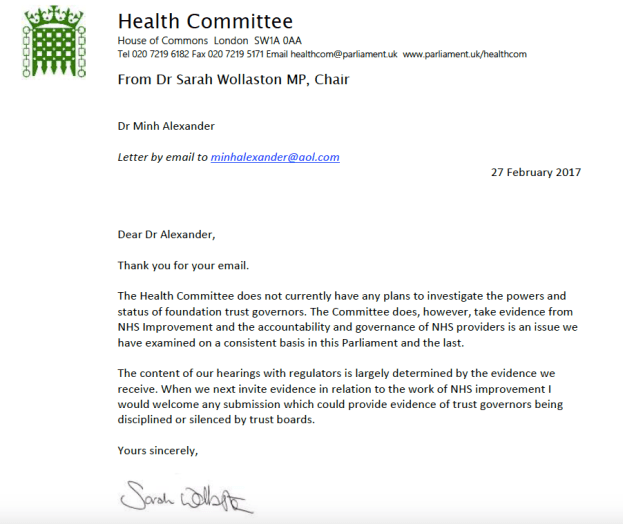
The Committee has noted this correspondence, and also other subsequent evidence, and indicates that it would welcome submissions which provide evidence that NHS trust governors may have been disciplined or silenced:


Sarah Wollaston letter evidence on governors.png


If you have relevant evidence or know anyone who may wish to give evidence, please pass this on. The correspondence address for the Health Committee is:

healthcom@parliament.uk

In addition to the lack of protection for governors, to help them fulfil their role of challenging and holding boards to account, I have also flagged to the Health Committee that NHS commissioning whistleblowers still have no prescribed body under PIDA, to which they can make their disclosures.

NHS England indicated in May 2016 that it might be a prescribed body for CCG whistleblowers by April this year. However, it now appears that there is further delay.

NHS England reports that the Department of Health will decide this summer on whether to make NHS England a prescribed body for CCG whistleblowers, and if it does, this will only come into force by April 2018 at the earliest. 11

Some may think it is convenient that the Department of Health is dragging its feet on protecting commissioning whistleblowers at a time of immense and controversial cuts in the NHS.

Anonymous reports of safety concerns by senior NHS staff abound, and there has even been an overt protest by one CCG, that it was basically told by NHS England to cook its books. 12

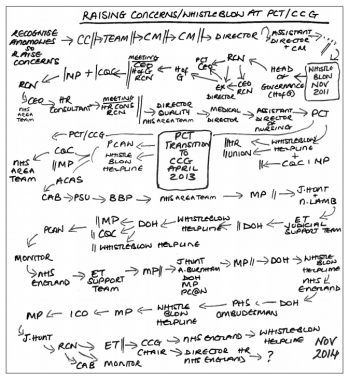
Below is a diagram by a CCG whistleblower who submitted evidence to the Freedom To Speak Up Review (see page 55) showing the ludicrous dance that she was led when trying to raise her concerns:

Bernie Rochford P55.png


Deny, defend and above all delay, still rules.


delay-deny


REFERENCES

1 Report of the Mid Staffordshire NHS Foundation Trust Public Inquiry February 2013

Click to access Volume%202.pdf

“Foundation Trust governors 10.201  

The governors of an FT theoretically play an important role in its oversight. Their power to dismiss the chair and non-executive directors potentially gives them considerable scope to influence the running of the organisation. It is clear from the experience of the Trust’s governors, and from meetings the Inquiry had with governors at a number of other FTs of varying sizes that, in practice, there are numerous challenges facing them:

Weakness of mandate: Apart from any governors nominated by local representative bodies, an FT’s public governors are elected by a membership which is grouped into constituencies in a variety of ways. The membership is by definition a self selecting group and is not necessarily representative of the community from which it is drawn. The precise arrangements vary according to the individual constitutions of FTs as approved by Monitor. While this may be inevitable under this type of structure, and has value in enabling local conditions and needs to be recognised, it is important that governors are accountable not just to the immediate membership but to the public at large. While the requirement that governors’ meetings are held in public goes some way to facilitating this, it is important that regular and constructive contact between governors and the public is maintained. In this way, governors can explain their work to the public and benefit from being open to public views of the service they are receiving.

Potential lack of authority and experience: Governors are a disparate group from a wide variety of backgrounds. While they are a valuable source of information about local views, they are unlikely to be able to assess fully the competence of the board or effectively monitor its performance unless they have adequate support, for which they are currently almost entirely dependent on the board itself. Pursuant to the obligation of FTs to provide appropriate training, steps need to be taken to enhance governors’ independence and ability to bring to light and challenge deficiencies in the services provided by FTs.

Monitor provides a level of guidance and training, and this should be encouraged and developed.

There appears to be a lack of clarity and consistency around what the governors’ role is and how it is to be performed. The Inquiry has encountered a wide range of practice, from a role not far removed from a hospital visitor, to something almost approaching the challenge expected to be undertaken by non-executive directors. Much seems to depend on the leadership given by the organisations’ chairs and chief executives.

Governors need to have their authority reinforced by ready personal access to external assistance and support, such as might be provided by their national association. This suggests that membership of such an association should be a requirement of taking up the post. Governors met during the Inquiry’s healthcare visits were largely complimentary of the internal support they received from their chairs and chief executives but highlighted the need for further external support.

The advisory panel which Monitor will set up under the Health and Social Care Act 2012 as a reference point for governors who fear their trust is in breach of its licence can be developed into a valuable source of support, but its remit appears to be limited to reporting its opinion on whether such breaches have occurred. Therefore, another source of advice is required to address clinical quality issues. Under the current regulatory structure the CQC could and should consider setting up a comparable panel to which governors could gain access.

2 CQC’s damning report: Southern Health ‘still not doing enough’ ITV 15 May 2016

http://www.itv.com/news/meridian/update/2016-05-15/southern-health/

3 Rebel governors at Southern Health stage meeting three days after Chair postpones it.

Daily Echo 17 May 2016

http://www.dailyecho.co.uk/News/14497597.UPDATE__Health_trust_thrown_into_chaos_after_bizarre_split_by_rebel_bosses/

4 Southern Health governors hold ‘cancelled’ meeting as planned. Oxford Mail 17 May 2016

http://www.oxfordmail.co.uk/news/14497971.Rebel_governors_at_Southern_Health_hold__cancelled__meeting_as_planned/

5 Blog by Peter Bell Southern Health governor on the trust’s attempts to discipline him, 12 September 2016

https://www.linkedin.com/pulse/southern-health-governor-investigation-latest-peter-c-bell-acsi-mbcs

6 FOI disclosure 13 July 2016 by Southern Health in response to an query by Peter Bell governor about trust legal spend on blocking governors’ resolutions

Click to access FOI1261%20Internal%20Review%20Response%20letter%20final.pdf

7 Southern Health NHS Foundation Trust governor resigns, BBC 15 July 2016

http://www.bbc.co.uk/news/uk-england-36804214

8 Public Interest Disclosure Act 1998

http://www.legislation.gov.uk/ukpga/1998/23/contents

9 Whistleblowers need more than hand-wringing headlines, Sir Robert. Minh Alexander 10 February 2017

“This is what a current NHS whistleblower has to say:

“I am currently suffering severe detriment after raising concerns. My  family is suffering. I was not protected by the local Guardian in my trust.  I have sought in vain for help from the National Guardian’s office, but feel as if I am being treated as a nuisance. I feel very worried that in reality, no help will come. Robert Francis may think that things have  improved, but I simply cannot agree with him. He needs to listen to what whistleblowers are telling him, if he is to live up to his own standards about senior officials being aware of what’s happening at the frontline”

https://minhalexander.com/2017/02/10/whistleblowers-need-more-than-hand-wringing-headlines-sir-robert/

10 Letter to Dr Sarah Wollaston Health Committee Chair 15 January 2017

HC Wollaston governors 15.01.2017

11 Information from Neil Churchill NHS England Director for Patient Experience, 5 February 2017

12 Northumberland CCG governing body papers 15 February 2017:

SB noted that, at the January 2017 JLEB meeting, there was discussion regarding the continued formal reporting of a £5million deficit when the actual position is £41million. The CCG has repeatedly discussed the actual financial position with NHS England but has been asked to continue to report the deficit as £5million. This is a risk in terms of accurate audit trails as there are no formal minutes of the discussions with NHS England. MR noted that NHS England are fully aware of the current financial position and also that the CCG will have no access to cash as the year end approaches to pay for any overtrading.”

Click to access Gov-Bod-15-Feb-17-Full-Papers.pdf


Just Culture: Sanctions for whistleblower suppression and reprisal

By Dr Minh Alexander, NHS whistleblower and former consultant psychiatrist 15 March 2017

I am in favour of justice being seen to be done, if public servants act dishonestly and endanger the public.

For too long now, there has been impunity for senior officials who cover up failures and risks, and who victimise those who speak out.

The NHS whistleblowing organisation Patients First says that it supports just culture.

I have invited it to fully reflect this in its policy position, by supporting sanctions for whistleblower suppression and reprisal, including criminal sanctions in at least some circumstances.

A formal proposal  is provided below.

RELATED ITEMS:

1. Edna’s Law by Compassion in Care:

http://www.compassionincare.com/node/162

2. Hillsborough Law – a bill on outlawing failures of candour by public servants:

http://www.thehillsboroughlaw.com/

3. The example of Paula Vasco-Knight, an NHS CEO who was found to have bullied whistleblowers but was protected and recycled by NHS regulators

https://minhalexander.com/2017/01/27/cqc-a-chief-inspector-doesnt-call/

PROPOSAL PUT TO PATIENTS FIRST, 15 MARCH 2017

Discussion document: Sanctions for suppression of whistleblowers’ concerns and reprisal against whistleblowers

Introduction

This brief paper has been produced to facilitate discussion within Patients First and consultation with Patients First’s membership about the charity’s policy position on sanctions for whistleblower reprisal.

In writing this paper I focus on practical aspects of deterrence of reprisal, the encouragement of safe speaking up and the communication of healthy norms, which to my mind are the key objectives.

I note the King’s Fund paper of May 2015 on ‘systems leadership’ which featured an implied view that disciplining managers who victimise whistleblowers may not help patients. 1

In this paper, I oppose this view.

Patients First’s constitution states that the charity has two core purposes, one of which is:

 “…to campaign for the advancement of a just culture in the National Health Service (“NHS”) and the healthcare services generally in England, Scotland, Wales and Northern Ireland in order to foster safer patient care.”  1

That being so, the charity should arguably support proportionate and fair sanctions for deliberate wrongdoing, which are an accepted feature of just culture.

Individual accountability

As Aveling et al observed, too much focus on systems can have the effect of undermining appropriate individual accountability in healthcare:

 “Individual agency is both an ethical requirement and a means of modifying systems themselves; never holding individuals to account risks normalisation of failure, fatalism, externalisation of blame and apathy, and may erode collective commitments and values. The ability to impose sanctions for culpable failures is likely to remain an important feature of any well-functioning accountability system, but legitimate and effective exercise of this ability depends on a predictable, fair and effectively operated institutional infrastructure, with proportionate consequences and alignment of the values and processes of different internal and external forums.”2

Indeed, there was a concern arising from the Mid Staffs Public Inquiry that Robert Francis failed to send a message to the most senior actors responsible, and did not deliver justice to those affected by the disaster. 3

As Shojania and Dixon-Woods have argued, there is no reason why attention to systems issues cannot go hand in hand with removing ‘bad apples’: 4

Yet ‘bad apples’—individuals who repeatedly display incompetent or grossly unprofessional behaviours— clearly exist. While they may not account for most patient safety problems, the field has probably reached the point where we can at least name the problem of bad apples without detracting from still crucial efforts to improve the design of organisational systems and human factors”

Nevertheless, Robert Francis recognised from evidence he received during the Mid Staffs Public Inquiry, that suppressing NHS whistleblowers has serious patient safety consequences. So much so that he recommended the behaviour should be criminalised for deterrence and to ensure rigorous protection for whistleblowers. 5 6

Francis’ report of the subsequent Freedom to Speak Up Review two years later was a disappointment. His report was weak on accountability. Francis made excuses for managers who had been guilty of misconduct. He referred to “retribution” which implied motives of revenge as opposed to the accountability that most whistleblowers seek. 7

In total reversal of his original position that sanctions would be a robust deterrent, he claimed that sanctions would actually result in greater cover up. 8

The last point is a substantially flawed argument on a number of grounds. For example, Francis produced no evidence that punishment for deliberate wrongdoing (cover ups in this context) would increase wrongdoing.

Just culture and patient safety

Contrary to Francis’ claims, there is evidence that a just culture which supports workers, prioritises safety, helps workers by remedying systems weaknesses, does not blame workers for errors of good faith that anyone in the same circumstances might make, but does hold people accountable for recklessness, negligence and other deliberate wrongdoing, creates psychological safety and promotes learning and safer practices. 9

Secondly, it is perverse that Francis acknowledged that whistleblower suppression is “serious misconduct” 10, but suggested that sanctions are undesirable. This is especially so when Francis went to the effort of recommending that whistleblowers should be held to account for the far lesser sin of raising concerns in an insufficiently tactful or otherwise inappropriate manner. 11

Serious misconduct is a clearly punishable matter by any standard NHS disciplinary policy.

If having acknowledged acts of whistleblower suppression and reprisal as serious misconduct, the NHS does not apply sanctions, this would cement discrimination against whistleblowers and seriously trivialise acts of suppression and reprisal. It would be the opposite of just culture.

Failure to sanction misconduct against whistleblowers sends a chilling message to other staff. The evidence is that staff do not always report safety concerns if they believe that they will suffer repercussions, or that nothing will be done about their concerns. 12

In other words, it is impunity and lack of sanctions that helps to perpetuate the cycle of cover up and bullying.

NHS organisations that are complacent and dismiss concerns, or seek to villify and scapegoat those who raise concerns have worse mortality outcomes. 13

Sanctions for whistleblower suppression and reprisal are arguably an important part of Safeguarding patients, and promoting staff welfare.

Law reform

The law has a communicative aspect and it functions as an important barometer of social values. If the public good is to be valued over self-interest and cover ups, there is also an argument for communicating distaste for whistleblower reprisal through better legislation. Wisely drafted and used, Law can be a pivotal component of changing culture and behaviour.

Although the criminology evidence base varies depending on context, and some sources conflict, there is overall empirical evidence that sanctions against criminal wrongdoing have a general deterrent effect, especially if punishment is certain, swift and fair. 14 15

In 2014, a statutory regulatory mechanism was introduced in the NHS for removing unfit senior managers: CQC Regulation 5 Fit and Proper Persons (FPPR). Robert Francis suggested in February 2015 that this should be the route for holding those who victimised whistleblowers to account. In November 2016, after delays and repeatedly poor performance by the Care Quality Commission, Francis admitted that FPPR was not working and that managerial regulation should be considered. 16 This implied that he accepted a more effective and enforceable system of accountability and sanctions was needed.

Moreover, under current UK whistleblowing legislation, the onus is on whistleblowers to sue via the Employment Tribunal. This means that many whistleblowers are priced out of justice, or that some risk and lose much or all in their efforts to seek justice.  Only 3% of PIDA claims succeed at hearing 17 and compensation is often wiped out by legal fees. Whistleblowers may be left ruined or facing very uncertain futures. And at the end of it all, unsafe NHS senior managers usually remain free to suppress failings and risks, and endanger patients all over again.

In other models and proposals, the State has a more active role and takes greater responsibility for prosecuting whistleblower reprisal and wrongdoing by individuals. 18

Some of the harassment against whistleblowers meets the existing bar for criminal harassment 19 (and harassment law has been successfully used in at least one case).

Some also feel that suppression of concerns and reprisal should be criminalised per se.

There are also arguments for treating a finding of whistleblower suppression and reprisal as an aggravating factor if it is a feature in other criminal offences.

Without being too prescriptive about the exact form that any new legislation should take, it would be very valuable if whistleblowers are united in agreeing that in at least some instances, there should be criminal sanctions for whistleblower suppression and reprisal.

In conclusion

I suggest that Patients First recognises that sanctions for whistleblower suppression and reprisal are crucial to changing culture, and that the charity explicitly supports the principle of just and proportionate sanctions for those who victimise whistleblowers.

I also invite Patients First to support the broad principle that criminal sanctions are appropriate for whistleblower suppression and reprisal, at least in some circumstances.

Dr Minh Alexander

15 March 2017

REFERENCES

1 The practice of system leadership. King’s Fund May 2015

Page 52One part of the problem is that when things go wrong, people look for a head on the block. And it can be the whistle-blower, not just others, who is looking for a head on the block – that someone, or a certain person, needs to be fired. And that doesn’t really help the patients, you know?”

https://www.kingsfund.org.uk/sites/files/kf/field/field_publication_file/System-leadership-Kings-Fund-May-2015.pdf

1 Patients First constitution 2015

https://minhalexander.com/wp-content/uploads/2016/09/patients-first-constitution.doc

2 What is the role of individual accountability in patient safety? A multi-site ethnographic study. Aveling et al. Sociology of Health & Illness Vol. 38 No. 2 2016 ISSN 0141-9889, pp. 216–232 doi: 10.1111/1467-9566.12370

http://onlinelibrary.wiley.com/store/10.1111/1467-9566.12370/asset/shil12370.pdf?v=1&t=j09nrzgr&s=948ec47cea58c2db188f71e20d58f68c693cfdb2

3 Return to the Killing Fields. Private Eye. 2013

One wonders what version of his report Robert Francis was reading at the press conference on 6 February. He looked like a man held hostage. The interminable delay in publication to allow for rewrites had reportedly been because those he was minded to criticise had launched vigorous legal defences. In the end he opted for a ridiculous “no scapegoats, blame the system” approach. This was endlessly debated after the Bristol Inquiry report in 2001, when a culture of “fair blame” was proposed. Ill thought-out, untested, rushed and brutally-enforced reforms undoubtedly contribute to NHS disasters, but individuals also have to be held accountable for their actions. Patients and staff trust a system that is just. But the judge delivered no justice.”

http://drphilhammond.com/blog/wp-content/uploads/2013/03/Private-Eye-mid-staffs-final.pdf

4 ‘Bad apples’: Time to re-define as a type of systems problem? Shojania and Dixon-Woods

May 2013, Shojania KG, et al. BMJ Qual Saf 2013;22:528–531. doi:10.1136/bmjqs-2013-002138

http://qualitysafety.bmj.com/content/qhc/22/7/528.full.pdf

5 Recommendation 183 of the Report of the Public Inquiry into Mid Staffordshire NHS Foundation Trust

Criminal liability

It should be made a criminal offence for any registered medical practitioner, or nurse, or allied health professional or director of an authorised or registered healthcare organisation:

Knowingly to obstruct another in the performance of these statutory duties;

To provide information to a patient or nearest relative intending to mislead them about such an incident;

Dishonestly to make an untruthful statement to a commissioner or regulator knowing or believing that they are likely to rely on the statement in the performance of their duties.”

https://www.gov.uk/government/uploads/system/uploads/attachment_data/file/279124/0947.pdf

6 Francis calls for new protection for whistleblowers, Shaun Lintern, Nursing Times 11 February 2013

“Speaking to Nursing Times, Mr Francis said: “I have called for a statutory duty of candour that trusts tell the truth to regulators and that there should be criminal sanctions if there’s willful obstruction of anyone performing their duties and informing their trusts about concerns to patients.

“That is about as rigorous protection of whistleblowers as you can imagine, and that’s what I intended,” he said.”

https://www.nursingtimes.net/news/reviews-and-reports/francis-report/francis-calls-for-new-protection-for-whistleblowers/5054780.article

7 Report of Freedom to Speak Up Review February 2015

Page 70 Some whistleblowers may want ‘instant retribution’ but that that was not always within the power of the organisation to deliver.”

http://webarchive.nationalarchives.gov.uk/20150218150343/https://freedomtospeakup.org.uk/wp-content/uploads/2014/07/F2SU_web.pdf

8 Report of Freedom to Speak Up Review February 2015

Page 163 7.5.6 However, there is another side to this which must be considered. Managers are just as vulnerable as other staff to the effects of the culture in which they work, and the pressures which are imposed on them. As stressed by some employers and their representatives a ‘just’ culture is equally as necessary for managers and leaders as it is for staff raising concerns. The consequence of an uneven approach could be a worsening blame culture for staff and a loss of talented managers from the NHS.

http://webarchive.nationalarchives.gov.uk/20150218150343/https://freedomtospeakup.org.uk/wp-content/uploads/2014/07/F2SU_web.pdf

9 A roadmap to Just Culture: Enhancing the safety environment. GAIN working group. September 2004

https://flightsafety.org/files/just_culture.pdf

10 Report of Freedom to Speak Up Review February 2015

Page 165 “Good practice….

…. Discriminating against, or victimising, an NHS worker because they have raised a concern, or turning a blind eye when other officers or employees do so, is regarded as serious misconduct or mismanagement.”

http://webarchive.nationalarchives.gov.uk/20150218150343/https://freedomtospeakup.org.uk/wp-content/uploads/2014/07/F2SU_web.pdf

11 Report of Freedom to Speak Up Review February 2015

Page 162 7.5.1 Everyone should be held accountable for their behaviour and practice when raising, receiving and handling concerns where this is not consistent with the values of a well-led organisation. This applies to those raising concerns as well as the managers and leaders handling concerns.”

Page 142 “Good practice – Training staff in raising and handling concerns

… how to raise concerns with tact to avoid causing offence or provoking defensive behaviour”

 http://webarchive.nationalarchives.gov.uk/20150218150343/https://freedomtospeakup.org.uk/wp-content/uploads/2014/07/F2SU_web.pdf

12 Whistleblowing commission Public Concern at Work 2013

https://www.tuc.org.uk/sites/default/files/Whistleblowing%20Commission%20Report%20Final.pdf

13 Culture and behaviour in the English National Health Service: overview of lessons from a large multimethod study, Dixon-Woods et al, September 2013

http://qualitysafety.bmj.com/content/qhc/early/2013/08/28/bmjqs-2013-001947.full.pdf

14 Criminal Deterrence Research at the Outset of the Twenty-First Century, Nagin 1998,

Crime and Justice, Vol. 23 (1998), pp. 1-42

http://faculty.washington.edu/matsueda/courses/587/readings/Nagin%201998.pdf

15 Deterrence in criminal justice, Evaluating Certainty vs. Severity of Punishment, Valerie Wright 2010, The Sentencing project

http://www.sentencingproject.org/wp-content/uploads/2016/01/Deterrence-in-Criminal-Justice.pdf

16 Robert Francis calls for regulation of senior managers. Health Service Journal Shaun Lintern 9 November 2016

https://www.hsj.co.uk/topics/workforce/exclusive-robert-francis-calls-for-regulation-of-senior-managers/7013089.article

17 Public Concern at Work data 2013/14: Out of 2684 whistleblowing ET claims disposed in 2013/14, 92 claimants were successful at hearing (3%)

18 US Office of Special Counsel: https://osc.gov/

Office of the Whistlebower: https://www.sec.gov/whistleblower/

Compassion in Care, Edna’s Law: http://www.compassionincare.com/node/162

19 Lack of support for whistleblowers is a disgrace. Letter by Prof David Lewis to Guardian, 15 February 2016

“The Guardian has a laudable track record of supporting whistleblowing. However, in commenting on the impact of the Francis report on the culture of speaking up in the NHS (Editorial, 12 February), you demonstrate a rather conservative approach to legislative reform. First, there is no mention of possible criminal sanctions. Citizens who break the Official Secrets Act commit an offence, so why shouldn’t those who victimise people raising concerns in the public interest? TheProtection from Harassment Act can be invoked if the narrow definition of harassment is fulfilled, but, in my opinion, outlawing any form of retaliation against whistleblowers would send out a valuable message about what society expects.

Second, you do not point out that only “workers” are covered by our whistleblowing legislation. However, it is clear that those who are in a position to raise concerns may not have this status – for example, patients and their families. Other countries now recognise the role that the public can play in exposing wrongdoing; in this important respect, the UK no longer provides an international model.
Professor David Lewis
Director, Whistleblowing research unit, Middlesex University”

https://www.theguardian.com/society/2015/feb/15/whistleblowers-should-law-punish-hospital-bosses

©Minh Alexander2017

National Guardian: Behan replies

By Dr Minh Alexander, NHS whistleblower and former consultant psychiatrist, 12 March 2017

Henrietta Hughes the latest National Freedom To Speak Guardian for NHS whistleblowing has been in post for over four months. She has held many roadshows and spoken at several conferences. But she has not yet reviewed any whistleblower cases. She announced at a conference on 8 March 2017 that she will only review twenty cases a year. 1

20 cases

This restriction of capacity will be unfair to whistleblowers, as will her other policy proposals if they are not amended. For example, the National Guardian has proposed that she will not accept cases for review if an employer has not responded to a whistleblower’s concerns. This is quite bizarre because a classic employer tactic is to ignore whistleblowers. It is a governance failing that should add to the case for review by the National Guardian. For a fuller account of the all the problems with the National Guardian’s policy proposals, see:

https://minhalexander.com/2017/02/20/national-guardian-letter-from-wonderland/

Henrietta Hughes’ office is jointly funded to the tune of £1 million by the Care Quality Commission (CQC), NHS Improvement and NHS England. Her office is located within the CQC.

David Behan CQC chief executive is the Accountable Officer for the National Guardian and she has met with him frequently since taking up post, but maintained that this is to report on progress, and not about objective setting. CQC and the National Guardian claim that she is independent. 2 3

I wrote to all three chief executives of the CQC, NHS England and NHS Improvement to raise concerns about the flaws in the National Guardian’s policy proposals, and about the following advice given to a current whistleblower by her office:

“… the National Guardian’s Office is not able to intervene in the personal circumstances of individuals

This is a response from David Behan of 9 March 2017, which is purportedly a joint response from all three chief executives:

https://minhalexander.com/wp-content/uploads/2017/03/joint-response-by-behan-stevens-and-mackey-re-ng-policy-20170309-pocu-1516-0181-dr-minh-alexander-concerns-about-the-national-freedom-to-speak-up-guardians-office-1.pdf

Behan’s letter stresses that Henrietta Hughes will not intervene in individual cases:

“The NGO’s [National Guardian’s office] stance on not intervening in individual cases is in keeping with the outcome of this public consultation”

This is despite the fact that Francis set out a clear intention in his report of the Freedom To Speak Up Review February 2015 that the National Guardian’s core role was to challenge organisations to “look again” at whistleblower cases, where it appeared that concerns had not been well handled, or where staff who raised concerns appeared to suffer detriment. 4

I also question Behan’s claims about the CQC consultation in question. 5

Moreover, Behan’s letter is at variance to Simon Stevens’ past correspondence to Francis, in which Stevens stressed that whistleblowers needed “safe harbour”: 

Simon Stevens safe harbour

https://minhalexander.com/wp-content/uploads/2017/03/nhs-england-submission-to-freedom-to-speak-up-review-22-09-2014-data-letter-from-simon-stevens-1.pdf

The National Guardian cannot provide any semblance of safe harbour if she does not even challenge employers to look again at badly handled cases.

To rule out any misunderstanding, I have asked Behan to specifically clarify whether it is his understanding that the National Guardian will be implementing Francis’ recommendation to challenge employers to look again at individual cases that she has reviewed, which appear to have been badly handled.

https://minhalexander.com/wp-content/uploads/2017/03/cqc-behan-clarification-on-whether-ng-will-challenge-employers-to-look-again-at-cases-12-03-2017.pdf

Don’t hold your breath.

delay-deny

RELATED ITEMS

https://minhalexander.com/2017/03/09/national-guardian-et-al-fantastic-or-airbrushed-fantasy/

https://minhalexander.com/2017/03/07/freedom-to-speak-up-guardian-jailed/

REFERENCES

1 National Guardian et al: “Fantastic”…or airbrushed fantasy? Minh Alexander 7 March 2017

https://minhalexander.com/2017/03/09/national-guardian-et-al-fantastic-or-airbrushed-fantasy/

2 National Guardian independence: The CQC denies some more. Minh Alexander 19 January 2017

https://minhalexander.com/2017/01/19/national-guardian-independence-the-cqc-denies-some-more/

3 Newspeak at the National Guardian’s office. Minh Alexander 8 February 2017

https://minhalexander.com/2017/02/08/newspeak-at-the-national-guardians-office/

4 Robert Francis’ report of the Freedom To Speak Up Review February 2015

Page 19:

He/she [the National Guardian] would not take on the investigation of cases themselves, but would challenge or invite others to look again at cases and would need sufficient authority to ensure that any recommendations made were taken seriously and acted upon.”

Page 169:

“7.6.17 The INO would in essence fulfil a role at a national level similar to the role played by effective Freedom to Speak Up Guardians locally. They would not take on cases themselves, but could challenge or invite others to look into cases which did not appear to have been handled in line with good practice or where it appeared that a person raising a concern had experienced detriment as a result of raising the concern.”

http://webarchive.nationalarchives.gov.uk/20150218150343/https://freedomtospeakup.org.uk/wp-content/uploads/2014/07/F2SU_web.pdf

5 Improvement through openness. CQC consultation report about the role of the National Guardian. May 2016

Click to access 20160526_consultation_response_document_v8_for_publication_01.pdf

National Guardian et al: ‘Fantastic’….or airbrushed fantasy?

By Dr Minh Alexander and Clare Sardari @SardariClare, NHS whistleblowers, 9 March 2017

Summary

Senior NHS silence continues about Paula Vasco-Knight, who bullied whistleblowers, ahead of her sentencing for fraud tomorrow. There is no evidence of learning. The National Freedom To Speak Up Guardian is also proving selectively deaf. Questions by whistleblowers, submitted to her conference yesterday, were deleted.  Amazingly, the National Guardian is splashing cash on glitzy events even though she is not yet open for business, despite distressed whistleblowers pleading at her door. She will also help save ministerial blushes by restricting the number of whistleblower cases that she reviews to just twenty a year.


Tomorrow, Paula Vasco-Knight former NHS CEO will be sentenced at Exeter Crown Court for a fraud. 1

The NHS Protect investigation of this fraud started in March 2014, after a referral by NHS England and South Devon Healthcare NHS Foundation Trust. 2

Before Vasco-Knight was prosecuted for the fraud, an Employment Tribunal found in January 2014 that she had bullied whistleblowers, breached the Code of Conduct for NHS Managers and was not a reliable witness. 3

Despite this, Vasco-Knight was protected and recycled by NHS regulators, until the fraud came into the public domain, in May 2016. 4

There are signs that some NHS bodies are singing from the same hymn sheet regarding her case. The bodies associated with her recycling have all but one missed a deadline on FOI requests about their knowledge of, and response to, the fraud. Several have refused to explain the delay.

CQC, NHS Improvement and NHS England are amongst those feet dragging in this concert of silence. One may be forgiven for wondering if the gaming tables have been opened, with a view to minimising the further embarrassment of tomorrow’s sentencing.

The Department of Health frequently claims that NHS regulators and other oversight bodies are independent. Are they really, or is this simply a convenient political device for deniability? In fact, the Department of Health has the power to orchestrate and intervenes when it pleases.

The professional regulator for nurses, the NMC gave Vasco-Knight a pass when she was referred after the whistleblower reprisal. It provided the CQC with part of the assurance for closing down a Regulation 5 Fit and Proper Person referral. 5 There was no obvious consequence for the NMC resulting from this behaviour.

However, when other NMC misdeeds arose in connection with one of Jeremy Hunt’s political hobbyhorses, he stepped in to order an investigation of the NMC. 6

The National Guardian’s office for NHS whistleblowing is demonstrating that it too is part of the NHS Denial Machine.

The office has resisted meaningful involvement of whistleblowers. It has reluctantly allowed them tokenistic access to its policy making, after protest and only when plans for closed meetings were leaked. 7

Unlike the Chief Investigator of the Healthcare Safety Investigation Branch, Henrietta Hughes is not rocking any boats by challenging her masters. Nor is she seeking statutory independence or powers. 8 She is however taking an excessively long time to open for business. She is still not taking referrals of whistleblower cases, 8 despite requests for help from desperate whistleblowers, and her policy proposals are unfair to whistleblowers. 9

The National Guardian peddles Good News culture 10, compulsory smiling 11 and is reluctant to discuss sanctions for suppression and reprisal against whistleblowers. 8 12

Yesterday, despite not yet being open for business, the National Guardian surreally held an inaugural national conference for Speak Up Guardians, facilitated by Public Concern at Work (PCaW). 13

Few whistleblowers were invited. The event was not advertised on the National Guardian events page 14 as usual. The conference was only discovered by most whistleblowers the day beforehand, because a delegate let it out of the bag.

At the conference, a tiny handful of carefully chosen whistleblowers – some currently working as Speak Up Guardians – were paraded to suit a certain narrative.

Trite statements like “follow your conscience” 15 were made.

It is in fact reckless to encourage staff to whistleblow without ensuring that they are fully informed, taking account of the personalised risk assessment of each case.

Revealingly, questions that were submitted electronically to conference speakers were tightly controlled. Several questions by whistleblowers who had not been invited were airbrushed out.

Delete buttons

One of the authors of this piece submitted these questions:

6 Jailing6 sanctions

but they were deleted, twice.

When the second author submitted the same question about the jailed Speak Up Guardian, but anonymously, it was accepted and trended.

9 Trended imprisonment

But eventually, it too was deleted despite being the second most “liked” question.

The CEO of Public Concern at Work in fact acknowledged that key questions arise from the jailing of the Speak Up Guardian. 16 17 But it is not yet clear if they were asked at yesterday’s conference.

There were other disallowed and deleted questions from whistleblowers and their supporters. This included a question to the Torbay Guardian who was a conference speaker, about the learning at Torbay from the Vasco-Knight scandal.

11 Torbay.jpg

In response to protest about the deletion of this question about Torbay, PCaW explained that delegates’ questions were being given priority.

10 delegates questions taking priority.png

This did not explain why awkward questions by named delegates, such as those about Race, were also deleted.

Also, this tweeted question about Race remained unanswered:

Race question.png

The final published conference questions looked nothing like the real number and type of questions that had been asked (www.sli.do conference code #3093 )

Most tellingly, many of the questions were submitted anonymously, apparently by Speak Up Guardians. For example:

3 Why have we not included WBs5 What can we do to ensure we're taken seriously

There were also questions which exposed the lack of training and preparation for Speak Up Guardians:

7 training.png

Robert Francis attended the conference and reportedly told the assembled Speak Up Guardians:


“You are the pioneers, there’s not another model like it in the world”


(Reported via a tweet by PCaW)

That’s one way to spin and justify his un-evidenced proposals. 18

At a time of underfunding and immense financial pressure for the NHS, when patients are dying in A&E corridors 19 and coroners are issuing warnings on deaths due to bed shortage   20, it is shocking to see money thrown away on a political vanity project and spangly events.

Francis, Hunt and CQC would do well to remember that one of the seven pillars of clinical governance is “resource effectiveness” 21 Eg. Don’t fritter away precious money that could benefit patients, through waste, inefficiency or untested measures.

The conference generated much of the usual NHS self-congratulation, self-promotion and sycophancy. Selfies with the great and the good abounded, “I’m so honoured…” tweets (see twitter hashtag #FTSU), much hot air about “passion” and so on.

All very jolly, and some of it probably well intentioned, but a million miles away from the unpleasant reality of injustice to harmed patients and whistleblowers.

Importantly, Henrietta Hughes gave whistleblowers the finger by announcing at the conference that on a budget of £1 million, she will review only twenty whistleblower cases a year. 22

Whistleblowers expected her office to be a political bottleneck, and have now been proven right.

Twenty cases is a laughably small figure.

Robert Francis’ explicit purpose in recommending the creation of the National Guardian’s office was to ensure that whistleblowers had a place to go, if their employers let them down.

No one knows how many NHS whistleblower cases run into difficulty, because this has never been properly measured. But the data available from PCaW and the CQC suggests there are hundreds of cases a year where health staff are either forced to make external disclosures (as a result of employers’ failures) or where they have experienced reprisal. 23 24

So with an annual caseload of only twenty, it looks like the National Guardian will leave most of the whistleblowers who ask her for help hanging out to dry.

The Freedom To Speak Up project is dreadful waste of opportunity and public money. Worst of all, it leaves patients exposed.

Henrietta Hughes has quipped several times that things are “fantastic”. 8

Fantasy, more like.


RELATED ITEMS

https://minhalexander.com/2017/03/07/freedom-to-speak-up-guardian-jailed/

https://minhalexander.com/2017/01/27/cqc-a-chief-inspector-doesnt-call/

https://minhalexander.com/2017/02/20/national-guardian-letter-from-wonderland/


Some of the selfie-fest

National Guardian conference luvvies 8.03.2017.png


REFERENCES

1 Former NHS trust chief faces jail after she gave £20,000 of taxpayer’s money to her husband, Tom Payne, Daily Mail 27 January 2017

http://www.dailymail.co.uk/news/article-4162558/Former-NHS-trust-chief-faces-jail.html

2 FOI disclosure by NHS Protect 21 February 2017

Click to access nhs-protect-foi-response-re-pvk-2017-02-001-final-response1.pdf

3 Employment Tribunal Judgment, Sardari and Gates v South Devon Healthcare NHS Foundation Trust and Torbay and Southern Devon Health and Care NHS Trust

https://www.dropbox.com/home?preview=Vasco-Knight+Tribunal+judgment+003-1.pdf

4 A Chief Inspector doesn’t call. Minh Alexander 27 January 2017

https://minhalexander.com/2017/01/27/cqc-a-chief-inspector-doesnt-call/

5 FPPR closure letter by Mike Richards CQC Chief Inspector 16 February 2016

https://minhalexander.com/wp-content/uploads/2016/11/cqc-fppr-closure-letter-vasco_knight-re-pvk-16-02-16.pdf

6 Jeremy Hunt orders investigation into nursing regulator over Morecambe Bay scandal, Paul Gallagher, Independent 17 February 2017

https://inews.co.uk/essentials/news/health/jeremy-hunt-nmc-investigation-morecambe-bay-scandal/

7 Employment Scheme (but not as you know it), 19 December 2016

https://minhalexander.com/2016/12/19/new-employment-scheme-but-not-as-you-know-it/

8 Newspeak at the National Guardian’s office. Minh Alexander 8 February 2017

https://minhalexander.com/2017/02/08/newspeak-at-the-national-guardians-office/

9 National Guardian: Letter from Wonderland, Minh Alexander 20 February 2017

https://minhalexander.com/chronological-list-of-posted-articles-correspondence/

10 Good News culture at the National Guardian’s office, 23 December 2016

https://minhalexander.com/2016/12/23/good-news-culture-at-the-national-guardians-office/

11 Hooray Henrietta, Minh Alexander 10 October 2016

https://minhalexander.com/2016/10/10/hooray-henrietta/

12 Blame….or accountability? Minh Alexander 28 February

https://minhalexander.com/2017/02/28/blame-or-accountability/

13 Programme for National Guardian conference 8 March 2017

https://minhalexander.com/wp-content/uploads/2016/09/national-guardian-conference-8-03-2017-final-ftsu-online-programme.pdf

14 National Guardian events information, on the CQC website

http://www.cqc.org.uk/content/national-guardians-office-news-events

15 Tweet by Public Concern at Work 8 March 2017

https://twitter.com/WhistleUK/status/839430519943217153

16 Freedom To Speak Up Guardian jailed, Minh Alexander 7 March 2017

https://minhalexander.com/2017/03/07/freedom-to-speak-up-guardian-jailed/

17 Tweet by CEO of Public Concern at Work 8 March 2017

https://twitter.com/cjameswhistle/status/839424426844250112

18 Critique of Francis’ model of trust appointed Guardians, Minh Alexander June 2015, from evidence submitted to the DH

https://minhalexander.com/chronological-list-of-posted-articles-correspondence/

19 Three patients die at Worcestershire hospital amid NHS winter crisis, Steven Morris, Matthew Weaver and  Haroon Sidddique, Guardian 6 January 2017

https://www.theguardian.com/society/2017/jan/06/three-deaths-worcestershire-royal-hospital-nhs-winter-crisis

20 Stroke patient died after surgery denial ‘over lack of beds’. BBC 1 March 2017

http://www.bbc.co.uk/news/uk-england-nottinghamshire-39113901

21 What is clinical governance? Carl Gray, BMJ 25 June 2005

http://careers.bmj.com/careers/advice/view-article.html?id=937

22 Tweet by Neil Churchill, NHS England Director of Patient Experience, 8 March 2017

https://twitter.com/neilgchurchill/status/839426122618191873

23 The UK whistleblowing report. 2nd edition. July 2015

http://www.pcaw.org.uk/content/5-latest/1-blog/9-new-pcaw-report-and-yougov-survey-into-the-state-of-whistleblowing-in-the-uk/2014%20Whistleblowing%20Report.pdf

Data from PCaW shows that the organisation received a total of 1,876 whistleblowing calls in 2014, 16% (300) of which were from the Health sector.

Whilst not all NHS whistleblowers call PCaW, 8 out of 10 of the individuals who called PCaW reported experiencing reprisal.

Therefore, it likely that many of these individuals fall within the National Guardian’s remit, as per the guidance set out in the Freedom to Speak Up Review report, page 169:

7.6.17 The INO would in essence fulfil a role at a national level similar to the role played by effective Freedom to Speak Up Guardians locally. They would not take on cases themselves, but could challenge or invite others to look into cases which did not appear to have been handled in line with good practice or where it appeared that a person raising a concern had experienced detriment as a result of raising the concern.”

24 The Care Quality Commission receives thousands of disclosures from Health and Social Care whistleblowers every year. Most of these disclosures will represent some sort of governance failing by employers, which made it necessary for staff to whistleblow externally.

CQC has not published whistleblowing data in a consistent format and has given incomplete data in most years. There have been about eight to nine thousand whistleblowing contacts to the CQC by staff of regulated organisations in the last four years.

The CQC indicated that most of the whistleblowing disclosures that it received in 2012/13  came from Social Care (86%).

Assuming the ratio between Health and Social Care whistleblowing contacts does not vary, this gives a rough estimation of well over a thousand whistleblowing contacts from Health workers every year.

Source: CQC annual reports

delay-deny

Freedom to Speak Up Guardian jailed

By Dr Minh Alexander NHS whistleblower and former consultant psychiatrist 7 March 2017

Yesterday, there was much coverage of a bizarre case of fraud by a senior NHS executive that concluded in a two year sentence, handed down by Exeter Crown Court.

Jon Andrewes faked his CV to obtain employment as chair of Royal Cornwall Hospitals NHS Trust, Torbay Care NHS Trust, its successor Torbay and Southern Devon Health and Care NHS Trust and chief executive of St. Margaret’s Hospice in Taunton, Somerset. It was reported that in the course of a decade, Andrewes obtained over £1 million in salary from his fraud. 1 2

What was not reported is that according to publicly available records, Andrewes was also appointed as a non-executive director at Devon Partnership NHS Trust in 2016, 3 4 and crucially, he was that trust’s Freedom to Speak Up Guardian.5

It is unsurprising that the NHS brass have kept quiet about this additional embarrassing fact.

It’s not as if the Freedom To Speak Up Review on NHS whistleblowing was not already discredited.

But what more can you say about the illogic of Robert Francis’ measures, if any old fraudster can be appointed to safeguard transparency, patient safety and whistleblowers’ welfare?

Some have expressed astonishment that such an individual could have walked into senior NHS management.

But I’m not surprised. The NHS has far too many poor and incompetent leaders, who the centre refuses to remove. Paula Vasco-Knight the disgraced former South Devon Healthcare NHS Foundation Chief Executive, was protected by NHS regulators despite findings of bullying against whistleblowers, until a criminal fraud finally caught up with her:

CQC: A Chief Inspector DOESN’T call

Vasco-Knight will be sentenced, also at Exeter Crown Court, on 10 March 2017.

The problem of poor NHS leadership is self perpetuating. Poor leaders often appoint poor leaders.

The regulator the NHS Trust Development Authority and its successor NHS Improvement missed two opportunities to pick up Jon Andrewes’ fraud, when he applied for a Chair and a non-executive director post at two non-Foundation NHS trusts. (NHS TDA and NHS Improvement have had direct responsibility for appointing Chairs and Non Executive directors of non-Foundation trusts) . 6

However, Andrewes was repeatedly appointed by the NHS despite the implausible CV that he fabricated, which reportedly included a claim that he was an executive officer at HMRC in 1969 – when he would have been aged sixteen. 1

NHS scandals and whistleblower suppression will continue for as long as there is pervasive club culture and tolerance of managerial incompetence.

I have written to the Health Committee to submit this further evidence on the failure of the Freedom To Speak Up project. The correspondence is copied below.

UPDATE

This is an FOI disclosure of April 2017 by Devon Partnership NHS Trust about Jon Andrewes’ employment by the trust, including his role as a member of the trust’s Audit Committee and his very ill judged appointment as trust Freedom To Speak Up Guardian:

Click to access devon-partnership-jon-andrewes-foi-response-6-04-2017-325.pdf

LETTER TO HEALTH COMMITTEE

BY EMAIL

Health Committee

7 March 2017

Dear Dr Sarah Wollaston and colleagues,

Further evidence about the flaws of the Freedom To Speak Up Guardian model

I write to briefly submit further evidence as regards a central weakness of the Freedom to Speak Review on NHS whistleblowing.

A widespread criticism of the Freedom to Speak Up Review is that the appointment and line management of Speak Up Guardians by trusts introduces immediate conflicts of interest.

A Speak Up Guardian will only be as effective as the trust that employs them. Poor trusts are more likely to make poor appointments in their own image, or conversely, may bully their Guardians.

In good trusts, Guardians are unnecessary and a waste of public money.

The total cost to the NHS of the Freedom To Speak Up measures, including the cost of appointing Guardians in all trusts, the £1m National Guardian budget and the roadshows, is also considerable.

Yet there is no evidence base for Speak Up Guardians, which the National Guardian herself recently acknowledged.

Rather, there is already evidence that whistleblowers are being failed by the Guardian model. This is a recent report by a current NHS whistleblower:

“I am currently suffering severe detriment after raising concerns. My  family is suffering. I was not protected by the local Guardian in my trust.  I have sought in vain for help from the National Guardian’s office, but feel as if I am being treated as a nuisance. I feel very worried that in reality, no help will come.” 

Whistleblowers need more than hand-wringing headlines, Sir Robert

As a very serious example of an unsuitable Speak Up Guardian appointment, Jon Andrewes – the former Chair of Royal Cornwall Hospitals NHS Trust, Torbay Care NHS Trust, its successor Torbay and Southern Devon Health and Care NHS Trust and also the former non-executive director at Devon Partnership – who was jailed for two years yesterday for fraud and faking a host of qualifications to obtain senior NHS posts, was in fact the Speak Up Guardian for Devon Partnership NHS Trust.

I attach the relevant documents from the Royal Cornwall Hospitals NHS Trust, NHS Improvement and NHS Employers which indicate that Jon Andrewes was a Freedom to Speak Guardian at Devon Partnership Trust.

Questions about NHS TDA and NHS Improvement’s role in making these appointments, particularly as Andrewes’ fake CV reportedly contained obvious anomalies such as claim that he was an executive officer at HRMC at age sixteen.

Questions also arise about the response of the National Guardian’s office.

The National Guardian’s office has been coordinating the network of trust Speak Up Guardians since last year.The National Guardian has a remit for ensuring the integrity of the Speak Up Guardian network.What has been the office’s response to the revelations about Jon Andrewes’ fraud?

I hope that the Committee will consider the substantive law and policy reforms that whistleblowers seek, but which were not delivered by Sir Robert, the Department of Health and the CQC.

This lack of genuine reform is additionally thrown into relief by the fact the National Guardian herself is not seeking the statutory independence and powers that she needs to do her job effectively.

The fact that the NHS repeatedly appointed a fraudster as a senior executive, and also as a Speak Up Guardian, speaks volumes.

The Freedom To Speak Up measures are wholly inadequate in the face of the serious governance challenges.

Yours sincerely,

Dr Minh Alexander

cc

Public Accounts Committee

Public Administration and Constitutional Affairs Committee

Lord Bew Chair Committee on Standards in Public Life

Sir Amyas Morse Auditor General and Comptroller National Audit Office

Law Commissioners

Sir Robert Francis CQC NED and Chair of the Accountability and Liaison Committee for National Guardian’s office

Helen Buckingham NHS Improvement Director of Corporate Affairs and member of Accountability and Liaison Committee for National Guardian’s office

Moira Gibb NHS England Non Executive Director and member of Accountability and Liaison Committee for National Guardian’s office

Keith Conradi Chief Investigator Healthcare Safety Investigation Branch

Dr Henrietta Hughes National Freedom to Speak Up Guardian, CQC

Secretary of State

UPDATE 28 FEBRUARY 2019

The Somerset County Gazette has reported that Jon Andrewes is once more being prosecuted for fraud. This time regarding the hospice at which he was formerly the Chief Executive:

Trial for seven accused of fraud at St Margaret’s Hospice in Taunton

Thanks to @mikesheaff for the spot.

RELATED ITEMS

There is no evidence base for the Freedom To Speak Up project. SSOTP: Robert Francis’ exemplar trust has feet of clay, and Jeremy Hunt’s safety claims are un-evidenced

Jon Andrewes fraud: NHS Improvement responds

Whistleblowers in Their Own Words: What’s wrong with UK whistleblowing law and how it needs to change

The Disinterested National Guardian & Robert Francis’ Unworkable Freedom To Speak Up Project

The toothlessness of the National Guardian’s Office: Why it cannot be a model for protecting whistleblowers

REFERENCES

1 Lying Royal Cornwall Hospital Trust boss who was actually a builder is jailed, L Barton, Cornwall Live, 6 March 2017

http://www.cornwalllive.com/royal-cornwall-hospital-trust-chairman-jailed-after-lying-about-qualifications/story-30183474-detail/story.html

He claimed he had a first-class undergraduate and masters degree at the University of Bristol and a masters in business administration at Edinburgh University, the court heard. He also said he studied for PhDs at Plymouth and Heriot-Watt universities, provided an employment history and said he was a partner at a technology firm.

In addition, he lied about working for the Home Office and said he was employed as an executive officer at HMRC in 1969 – despite the fact he would have been just 16 at the time.

Official records show he was employed as a social worker, probation officer and builder”

2 Walter Mitty former builder is jailed for two years after a ‘staggering series of lies’ saw him use a bogus CV to net £1m from two NHS Chairman posts. Rebecca Taylor, Daily Mail, 6 March 2017

http://www.dailymail.co.uk/news/article-4286080/Walter-Mitty-NHS-chief-63-lied-having-PhD.html

3 NHS Improvement published data – list of appointments to NHS trust Chairs and non executive posts

http://www.ntda.nhs.uk/wp-content/uploads/2016/07/20161028-Stats-for-NHSI-website-Q2-2016_7.pdf

4 Royal Cornwall Hospitals NHS Trust declaration of board members’ interests May 2016, which showed that Jon Andrewes was both Chair of Royal Cornwall Hospitals NHS Trust and a non executive director at Devon Partnership NHS Trust

Click to access App01RegisterofBoardMembersInterests.pdf

5 List of Freedom to Speak Guardians published by NHS Employers

https://minhalexander.com/wp-content/uploads/2016/09/nhs-employers-guardian-table-new-4.xlsx

http://webcache.googleusercontent.com/search?q=cache:NPt7ZwM2j48J:www.nhsemployers.org/~/media/Employers/Documents/Retain%2520and%2520improve/Guardian%2520table%2520NEW.xlsx+&cd=1&hl=en&ct=clnk&gl=uk

Devon Partnership NHS Trust Board papers 9th May 2016

Screen Shot 2017-03-10 at 11.16.02

Click to access BoD_Part_1_9_May_2016.pdf

6 Published information about NHS Improvement’s responsibility for appointing non-Foundation NHS trust chairs and non executive directors

https://improvement.nhs.uk/resources/non-executive-appointments/