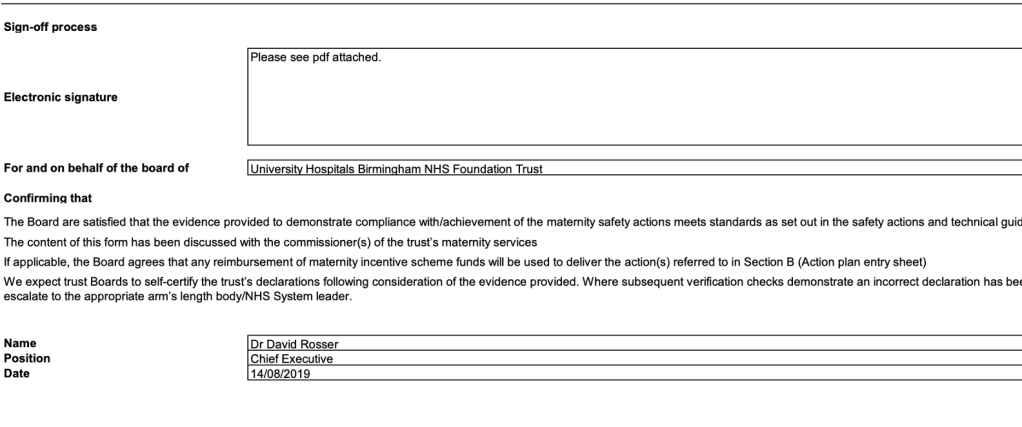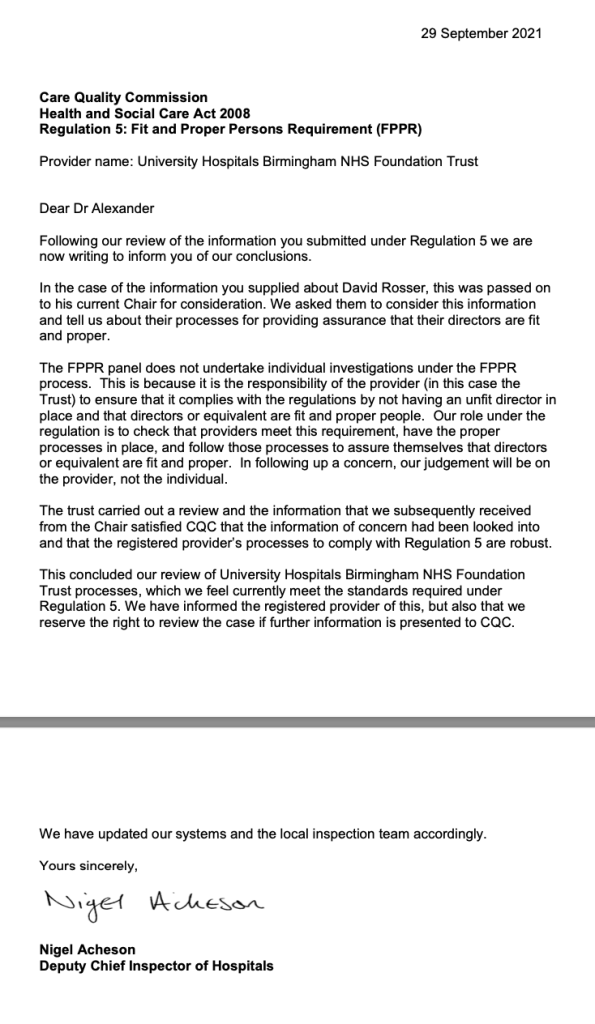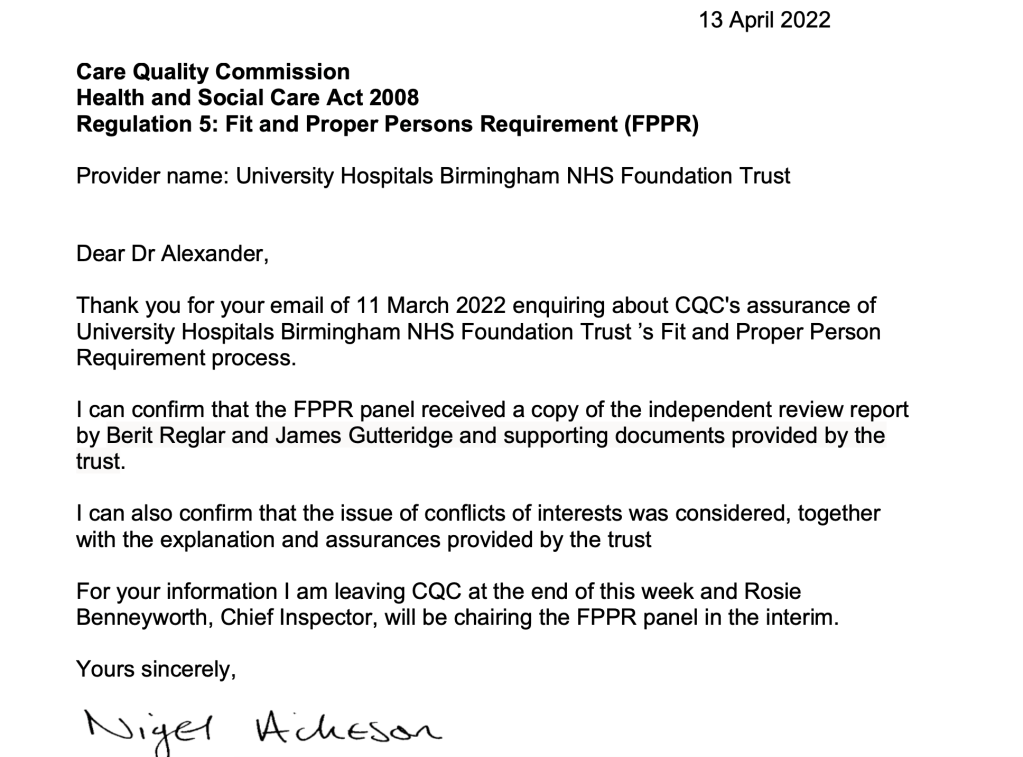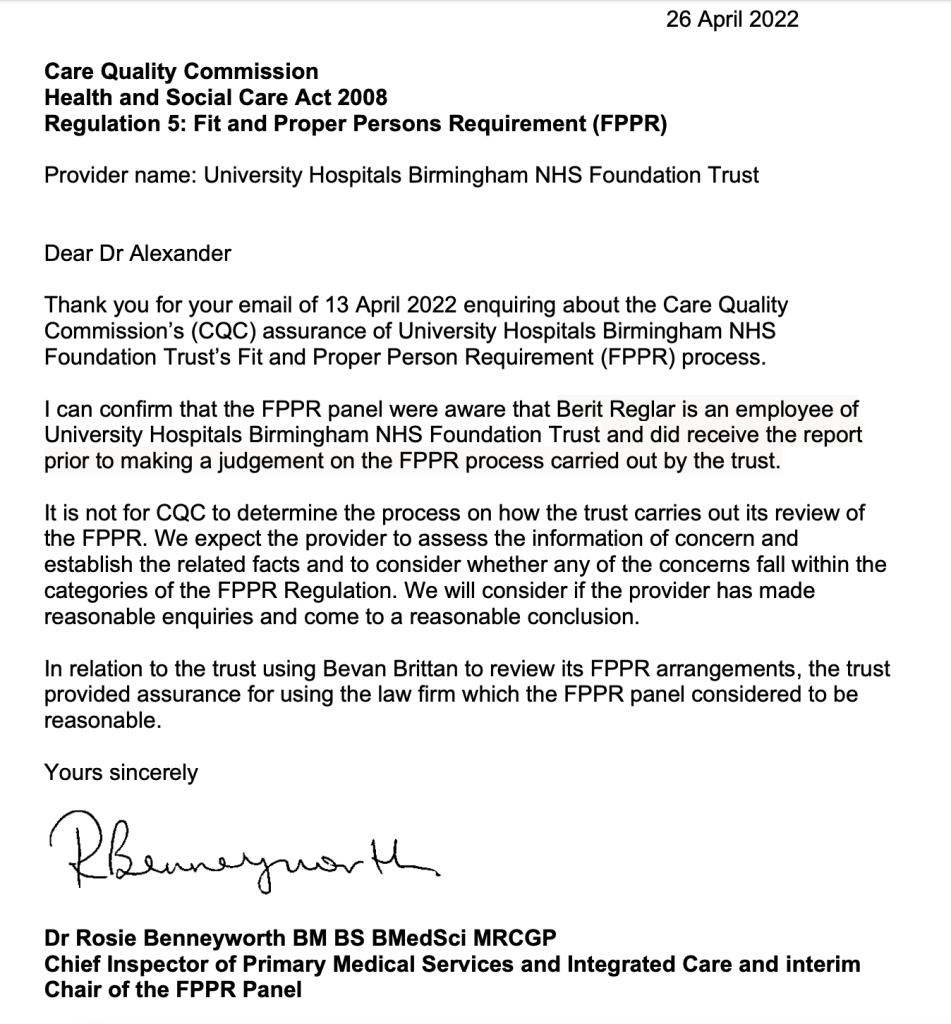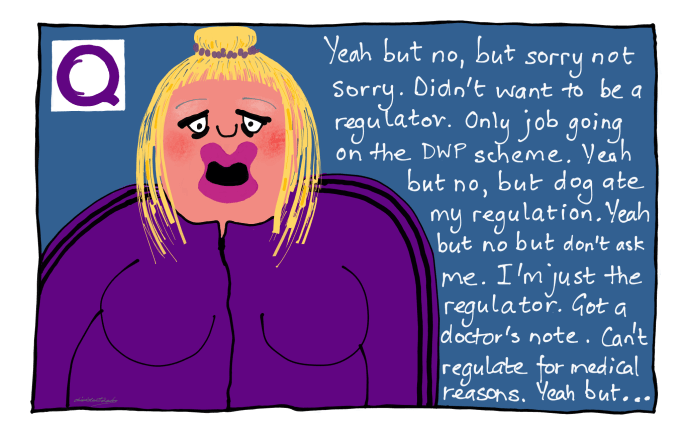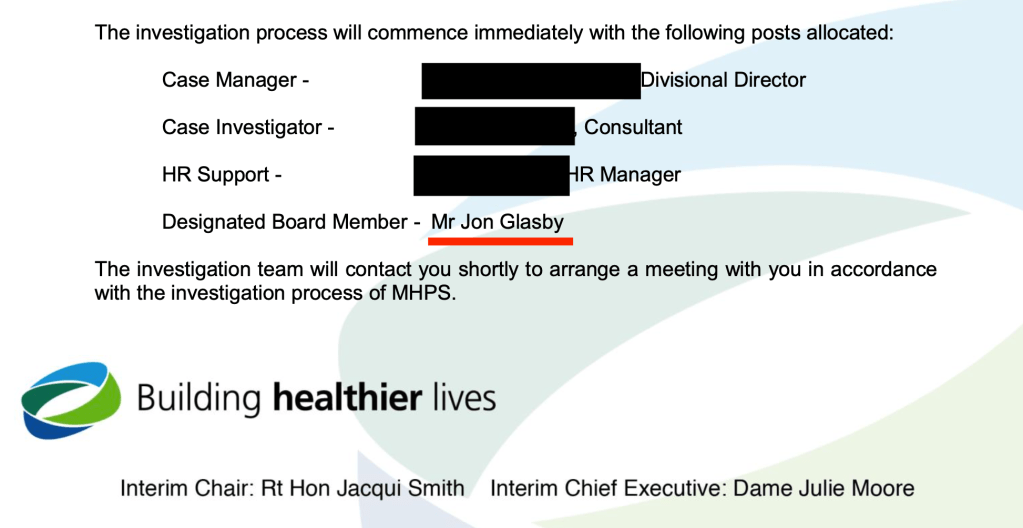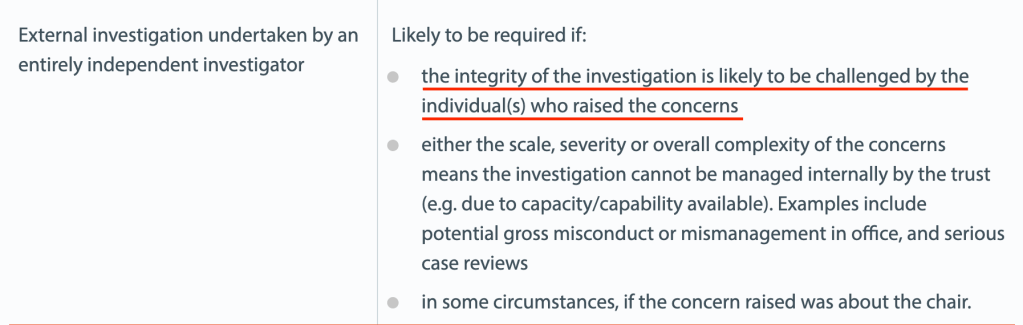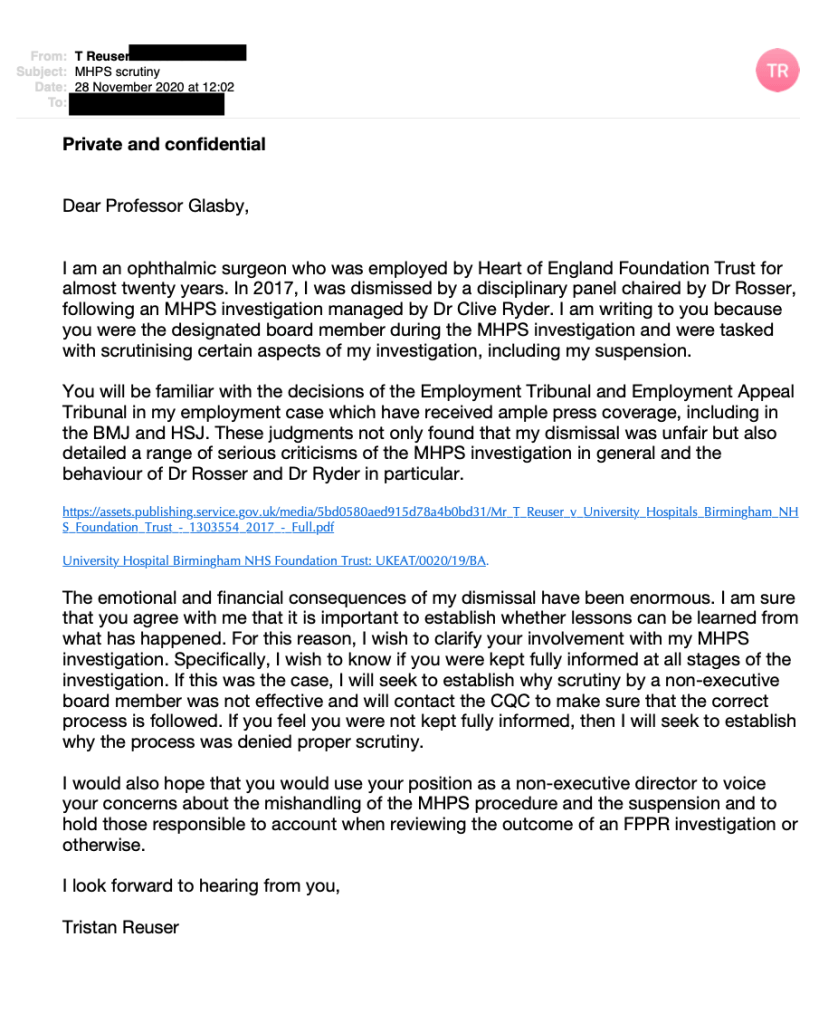
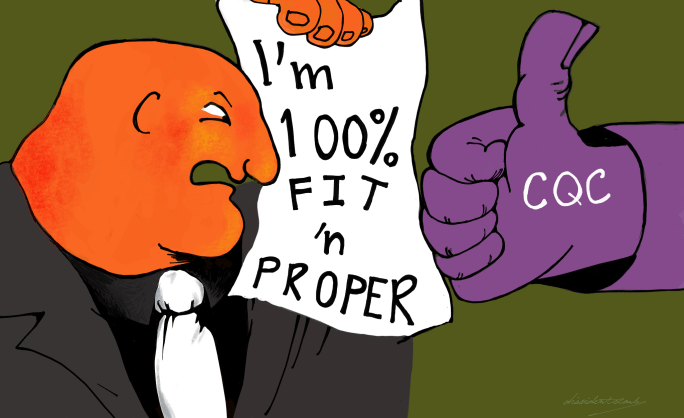
This is a special edition of our Parish newsletter.
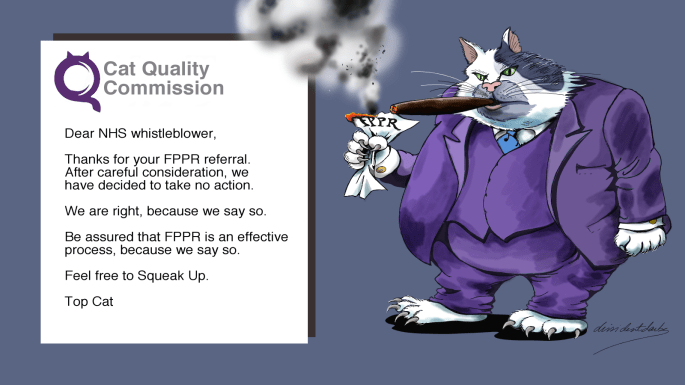
Parishioners raised concerns that some Parish council officers might not have been behaving as they should.
It was rumoured that even when caught out, some of these officers were moved behind the scenes to new jobs, at a little office at the District Council known as the the “Donkey Sanctuary”.
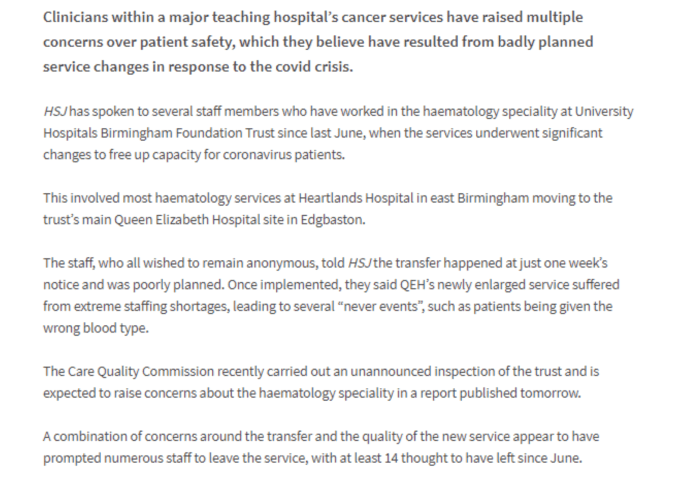
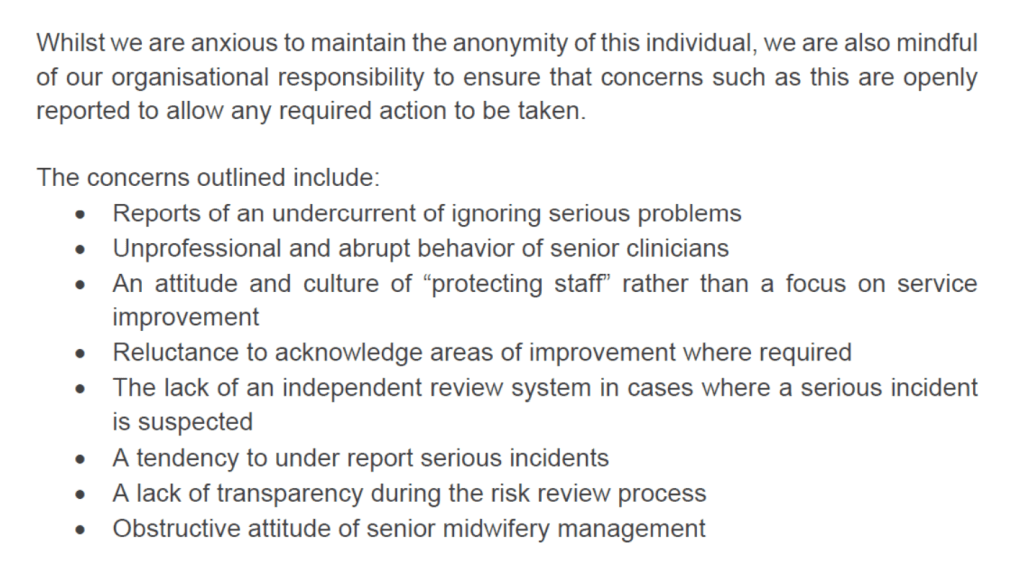
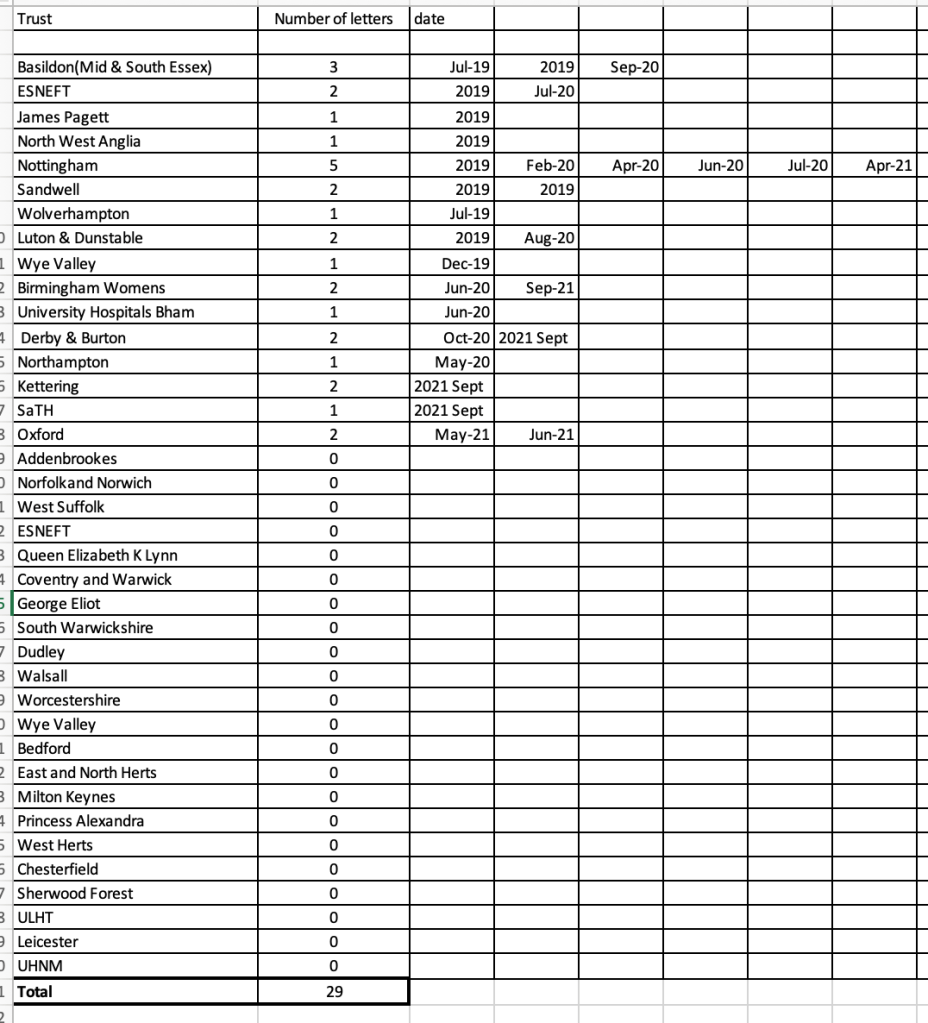
The County Council eventually asked a nice gentleman to write a report in 2018, who suggested a “naughty list” be kept so that no one forgot any misbehaviours:
Unfortunately, it seems the District Council misfiled the report under “hedgerow maintenance schedules” and no action was taken.
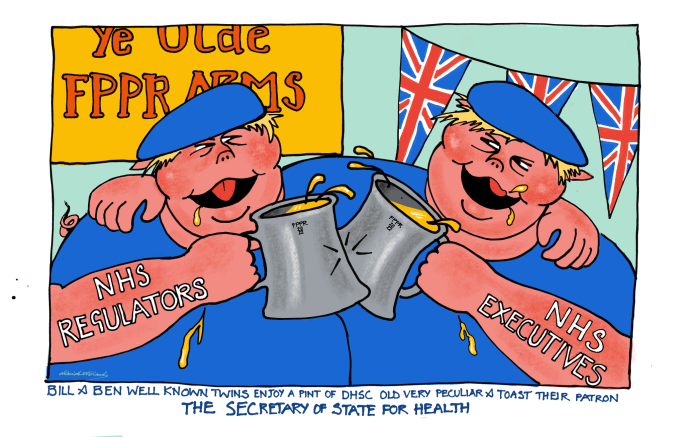
Parishioners recently enquired about progress, and a meeting was held from the phone box by the FPPR Arms.
The WI would like to point out that they take great pride in keeping the phone box spick and span, and could the person who leaves crisp packets please be more considerate.
The District Council said that they had not actually received authorisation yet from the County Council to implement the report recommendations, but it is anticipated that the County Council may give the green light soon. The District Council were ready to make a plan. They did not know if old concerns could be added to the “naughty list”. They did not think they could show the draft template of the “naughty list” to all parishioners.
Mr A. Noyd, retired town clerk, from 12 Skittle Lane said it wasn’t run like that in his day. Not at all.
When Mrs Brown from the chip shop asked them how it was that crimes had taken place, but everyone was innocent, the constables were a little bit stumped.
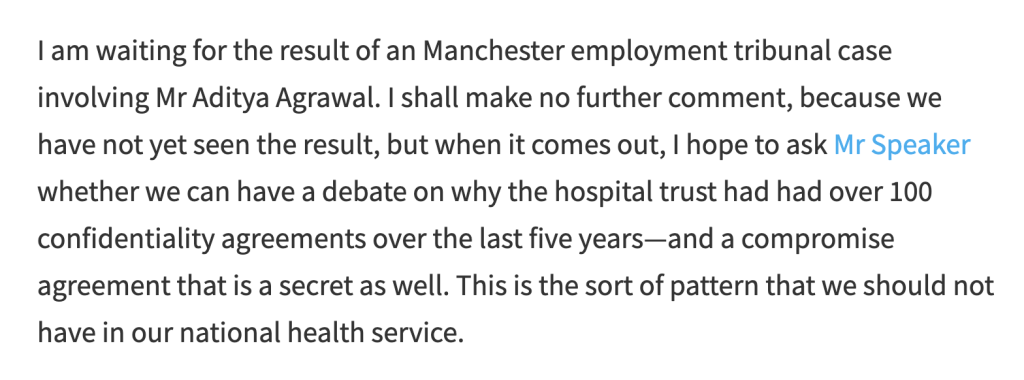
In other news, a parishioner Ms Jane Archibald was promised some follow up action by her former MP at the end of her dreadful legal case. Ms Archibald wrote to remind the MP of their earlier discussions and an offer that he had made to speak to the Health Secretary.
However, her former MP did not seem interested to follow up an irregularity at his local hospital, and his team told her that this was because she had moved out of area.
“From: Dr Neil Hudson MP [REDACTED] Sent: Monday, May 23, 2022 3:49:54 PM To: Jane Archibald [REDACTED] Subject: Re: employment tribunal outcome – Archibald Case Ref: NH52) (Case Ref: NH54)
Dear Miss Archibald,
Thank you for your email. As MPs are only allowed by Parliamentary protocol to assist their own constituents, I suggest you contact the MP for your local area.
speaking to the Westmorland and Cumberland Herald last month, Mr Hudson said of his visit to the sanctuary: “Seeing her work in person really warmed my heart. While she told me some truly harrowing details of the neglect many of her donkeys faced prior to their rescue, it was heartening to know that now with Linda, these gentle animals are receiving such love and good care.”
Let us hope Mr Hudson will make some room in his warm heart for vulnerable patients at his local trust.
The Enquirer tried to reach the top man at the County Council for comment on the “naughty list”, but his staff said he unfortunately had to attend an urgent hospital appointment. We can see why judging from this photo. Get well soon Mr J!
By Dr Minh Alexander retired consultant psychiatrist 31 May 2022
Under FOIA, NHS England/Improvement reluctantly disclosed in April 2022 a suppressed and lack lustre King’s Fund report into poor culture and leadership at the Healthcare Safety Investigation Branch:
There was a reference in the King’s Fund report to HSIB staff dissatisfaction with previous reviews into cultural issues:
“…At the beginning of the work, staff had been clear that they would not trust the report outcomes if they were first shared with the executive team, owing to a perception that the findings of previous reviews had been changed before publication, or not shared at all.”
At the conclusion of the King’s Fund review, the level of staff distrust was such that it was recommended there should be external oversight of follow up actions and clear timescales for action:
“Given the level of mistrust expressed by staff that senior leaders had failed to act on previous review recommendations, it is important that the HSIB executive team, supported by NHS England and NHS Improvement and with oversight from the Department of Health and Social Care, commit to responding to this report with HSIB staff and confirm the timescale for implementation of these recommendations.”
Following the trail, I asked NHSE/I to disclose copies of the earlier reviews cited by the King’s Fund.
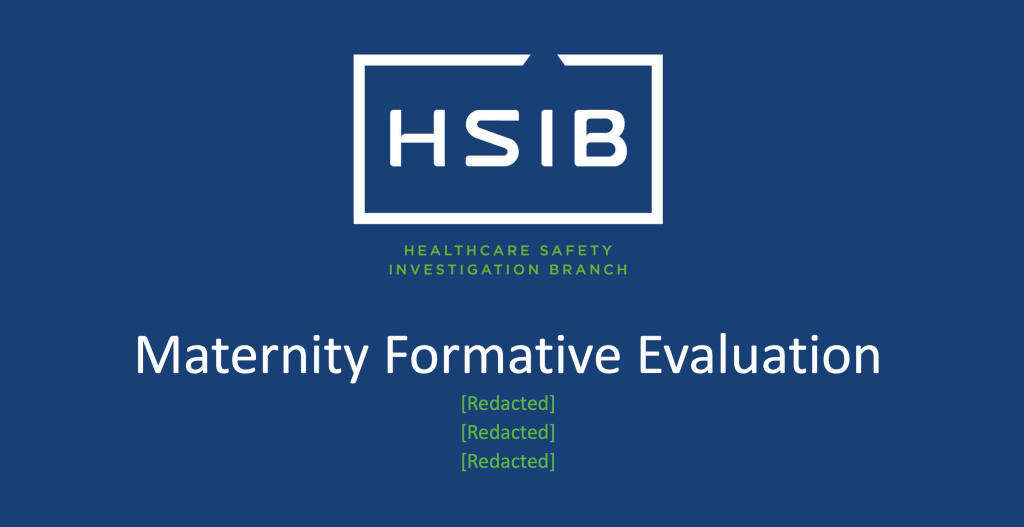
Today NHSE/I disclosed only a single internal review by HSIB senior staff, the Benson review, carried out in 2020, as follows:
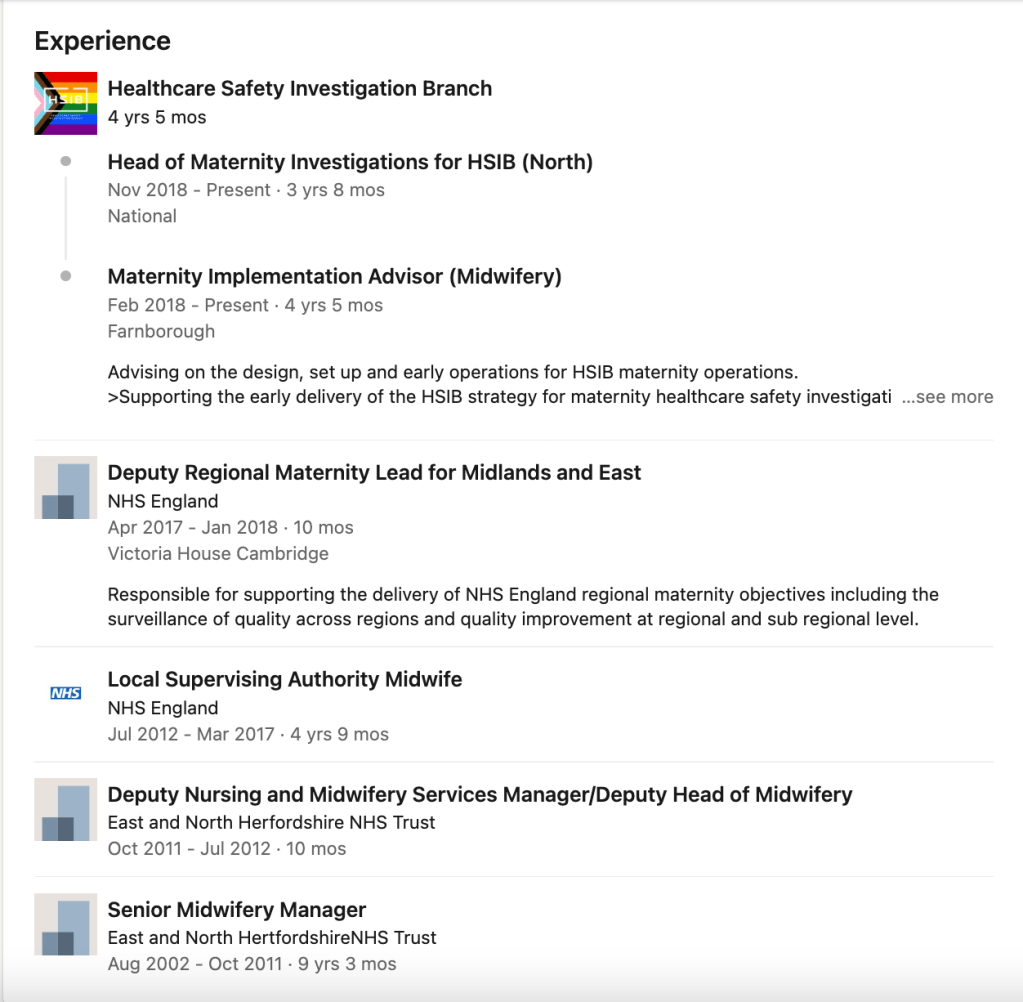
“An internal review of our maternity team was undertaken in 2020. This was led by Dr Nick Woodier, Dr Dawn Benson and David Landreth at HSIB. From this review, a slide deck report was produced and delivered in June 2020.”
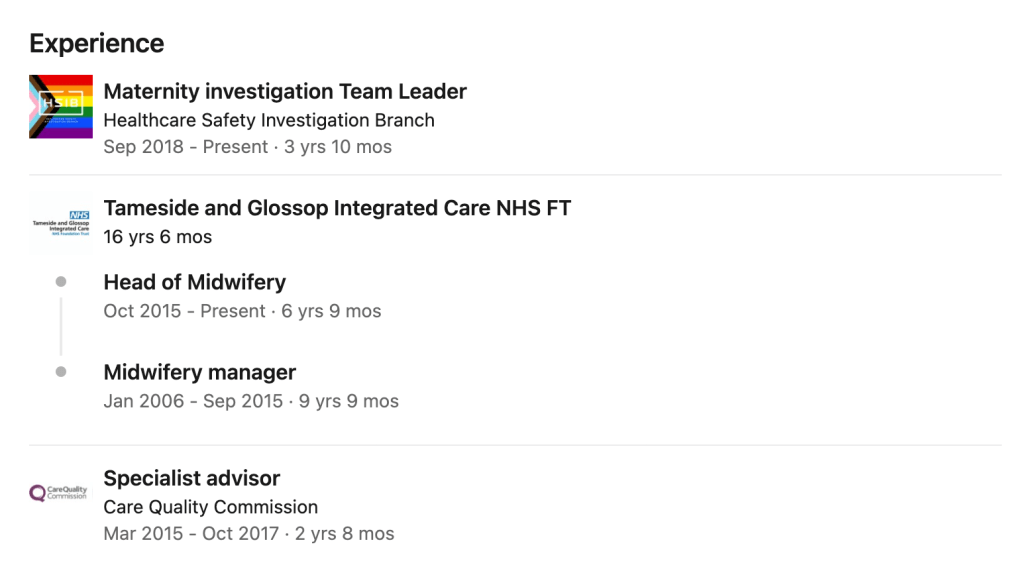
David Landreth is according to his Linkedin entry HSIB Associate Director of Information Management & Technology
“The review…was commissioned by and for the review of the Exec. Team at HSIB. They wanted to understand stakeholder’s opinion of the maternity services. There were responses back from 54 trusts and a total of 247 staff, mainly midwifery but also other clinical and medical leads including ambulance staff. The idea was to use that feedback, in confidence, to understand what themes HSIB should address to improve our practices within the maternity team when undertaking an investigation.”
The context of this is that the maternity investigation section of HSIB was established as an addition in 2018 and is based in the regions.
NHSE/I redacted information from the Benson review report claiming Section 41 FOIA exemption:
“The info was shared in confidence to HSIB by its staff to improve how its maternity functions operates. The information that has been shared is not trivial and has not been published elsewhere. Given the circumstances in which this information was provided, we consider it was imparted in circumstances giving rise to an obligation of confidence.
Furthermore, we consider that disclosing this information would cause detriment to the confiders and there is an expectation that this type of information should not be disclosed under the FOI Act.”
The reflex secrecy by NHSE/I was such that even though the regulator had disclosed the report authors’ names to me, it still redacted their names from the body of the report:
Child psychologists probably call that self-soothing behaviour.
The version of the Benson report disclosed by NHSE/I is similar to the previously disclosed King’s Fund report. It is very light on facts and full of opinions and summary conclusions that are not grounded in data.
It may be that a separate and very different version was produced for senior management consumption, but withheld from the troops.
Nevertheless, there are indications of serious cause for concern.
For a national body which sits in judgment of others, the Benson review made alarming findings of lack of basic structure and standards or common understanding of operating procedure in the maternity section of HSIB.
For example:
“10.3. Define the methodological approach taken to investigate events
Reports demonstrate a fundamental confusion between a method and methodology.
Reports do not clearly define the methodological approach to the investigation, which is strongly rooted in clinically reviewing the event. Rather they list the methods used to collect evidence.
Reports suggest a human factors approach is taken, but that in itself is not a methodology.
There is an opportunity to define the methodology and distinguish between methods and methodological approaches”
“IO 11. Focus on quality
Quality was explored recurrently through the evaluation with questions around quality of reports, analysis and recommendations.
There is a need to balance quality with efficiency, with early learning shared with trusts to help bring about changes.
There is no defined standard of ‘[Redacted]’ resulting in poorly written reports and recommendations that might not offer more than a standard, local, serious incident investigation. ‘[Redacted]’
Quality should include listening and responding appropriately to Trust challenges to findings and factual accuracy.
There is an opportunity for the maternity programme to define standards for quality throughout their investigations, including report writing, report content and recommendation writing.”
“10.2. Design and implement an investigation framework
There is little evidence in either the investigation process or reports, of the appreciation of systems factors which may have contributed to events.
The programme does not have the methodological framework to enable delivery against the directions to ‘identify all contributory factors that led to the outcome’. The investigation process lacks a basic methodological structure which means there is no analytical framework to guide investigations.
Findings are reached by clinicians who, where possible, evaluate what was done against what national and local guidance suggests should have been done. Where there is no such guidance, they review evidence, and influence and shape the recommendations, through their own clinical, and in some cases medico-legal experience. This often leads to reports which suggest responsibility for outcomes lie with the clinical practice of individuals and teams and fail to consider the systems of work which contribute to the outcome.
There is an opportunity to develop and introduce a framework for investigation planning, evidence collection and analysis, which supports investigators to identify all the contributory factors that led to outcomes.”
The Benson review acknowledged that many of the shortcomings arose from the fact that HSIB was forced to expand rapidly when it had to take on national maternity investigations, far outstripping its original capacity.
The review of course did not say so, but the origin of that malaise was political, with Jeremy Hunt’s maternity safety crusader agenda driving the expansion.
“When it comes to maternity safety, we are going to try a completely different approach. From next year, every case of a stillbirth, neonatal death, suspected brain injury or maternal death that is notified to the Royal College of Obstetricians and Gynaecologists’ “Each Baby Counts” programme—that is about 1,000 incidents annually—will be investigated not by the trust at which the incident happened, but independently, with a thorough, learning-focused investigation conducted by the healthcare safety investigation branch. That new body started up this year, drawing on the approach taken to investigations in the airline industry, and it has successfully reduced fatalities with thorough, independent investigations, the lessons of which are rapidly disseminated around the whole system.
The new independent maternity safety investigations will involve families from the outset, and they will have an explicit remit not just to get to the bottom of what happened in an individual instance, but to spread knowledge around the system so that mistakes are not repeated. The first investigations will happen in April next year and they will be rolled out nationally throughout the year, meaning that we will have complied with recommendation 23 of the Kirkup report into Morecambe Bay.”
The Benson review gathered the following concerns about the quality of maternity reports as follows:
Feelings that quality is driven by ensuring that the investigations have input and direction from clinical professionals.
A limited quality assurance review process against standards for reports before they are released. There is evidence of poor formatting, grammar and spelling in reports.
Evidence that the process does not fully take account of factual accuracy challenges with inclusion of changes or clarification to those challenging the report as to why changes have not been made.
Recommendations are generally lower in the hierarchy of effectiveness of recommendations and do not commonly focus on system improvements, rather guidance and policy. Trusts reported concerns that some recommendations were not linked to evidence or causality.
A repeated concern was the delay to receipt of actions from reports. This meant that trusts were not able to put in place early learning to help prevent similar invents and instead had to wait till the final report which may be a year later.
The review team also heard of individual cases that undermined the intention for HSIB to provide no-blame investigations via the way local staff have been interviewed.”
The Benson review listed areas for improvement as follows:
“Improvement Opportunities
IO 1. Define roles so that individuals are responsible for functions within their expertise. IO 2. Design and implement an investigation framework. IO 3. Define the methodological approach taken, and methods to be used to investigate events. IO 4. Empower maternity investigators to lead their investigations. IO 5. Review the expertise of the investigation team and consider introducing investigation scientists. IO 6. Review the process of obtaining clinical opinion in the programme. IO 7. Reassure the workforce. IO 8. Explore leadership development and coaching to foster a culture of support and where staff feel safe to challenge. IO 9. Evaluate and reflect upon the training programme. IO 10. Explore ways the senior team can develop their own understanding of safety/ investigation/ human factors science. IO 11. Focus on quality. IO 12. Taking the opportunity to learn.”
Alongside the operational disruption, the Benson report also noted cultural problems.
NHSE/I has drawn a ludicrous veil over these, as if people cannot deduce what happened from everything else that has come into the public domain since.
Here is a particularly absurd passage, which nevertheless flags bullying and intimidation:
“Culture
The structure, purpose and challenges of the maternity programme have driven a cultural identity which fosters pride in the combined aim to improve maternity services in England. The 14 regional teams provide individual investigators with a secure base from which they derive operational and emotional support and resilience.
Investigators reported:
• The programme structure and a ‘[Redacted]’ attitude cultivates a sense of oppression and control. • Significant numbers (>20) of investigators openly reported either feeling bullied themselves or having knowledge of other people who had been bullied by staff more senior to themselves. • Others (>30) recognised pressure which at times resembled bullying. • They largely attributed this to the pressure being placed upon their direct line managers to, ‘[Redacted]’ of reports. • Many investigators (>30) talked about feeling they could not challenge what was described as ‘Redacted’, which encouraged ‘Redacted’ attitudes towards investigations contrasting with the just culture they had been trained (at Cranfield) to adopt. • Job satisfaction is significantly affected by this and recent messages from the senior team that unless the backlog is cleared by November 2020 ‘[Redacted]’. • HSIB staff from across the whole organisations raised concerns that the ‘’[Redacted]’.
Matters were clearly serious as the review report noted:
“10.7. Reassure the workforce
Investigators feel insecure in their jobs and a significant number report they are considering or actively looking to leave HSIB because they feel their job is not secure.
This is something which has intensified over the period of the evaluation largely because of the pressure to reduce the backlog of reports.
[Redacted]
There is an opportunity to improve the wellbeing of the workforce and retention by offering reassurance about the methods being taken to reduce the backlog of reports.”
It appears that there were difficulties with whistleblowing, but as NHS Improvement have placed a strategic fig leaf over the relevant passage, it is difficult to be sure:
“8. Explore leadership development and coaching to foster a culture of support where staff feel safe to challenge.
• [Redacted]
• [Redacted]
There is an opportunity for improving the culture within the programme and the retention of the workforce. Exploring leadership coaching.”
Freedom To Speak Up at NHS England/ Improvement and whistleblowing by HSIB staff to Speak Up Guardians
NHSE/I have an extraordinary internal whistleblowing policy, where “triage” of whistleblowing matters, that are not immediately resolved by Freedom To Speak Up Guardians, is handled by a steering committee which includes the NHSE/I General Counsel.
Is it me or does that scream “containment”?
NHSE/I has disclosed that there are “55 NHSE / I Freedom to Speak Up Guardians across almost all regions and directorates. These Guardians are made up of staff from various roles and various levels of seniority.”
NHSE/I has also indicated that since HSIB became operational, 15 cases have been opened with Freedom To Speak Up Guardians on HSIB staff.
It would appear that the HSIB executive team were given ample warning in 2020, through the findings of the Benson report, of serious cultural problems in at least some parts of the organisation.
But for whatever reason, HSIB’s leaders failed to effectively address these problems, necessitating the further King’s Fund review in 2021, by which time staff trust had been further eroded.
A sad and telling entry in the review action log of December 2020 is the section that declares action on culture change “complete”:
There are serious questions arising about the consistency and quality of HSIB’s maternity investigations. Have some HSIB maternity investigations failed to identify all contributory factors? It sounds from the disclosed Benson report, for all its avoidance of hard data and detailed facts, that some investigation reports were defective and did not reveal the whole truth.
It is a pity that there is not a legal Duty of Candour for regulators, or that NHSE/I is compelled to own up to any families affected by any of these failures of HSIB maternity investigations. It is too awful to contemplate the abuse of trust. That harmed families put their trust in an independent investigation process which in some cases was not actually sound, and they may not have been told yet that this was so. And all the while, a former Secretary of State posed as a maternity safety champion, whilst strong arming a small safety agency to expand unsafely, for political gain and soundbites. And all the while he failed to implement the MidStaffs core recommendation on ensuring safe staffing for the NHS.
And we have yet to see if there are any other HSIB reviews that NHS Improvement has failed to disclose.
PETITION
Please click and add your signature to this petition to reform UK whistleblowing law – whistleblowers protect us all but weak UK law leaves them wholly exposed, lets abusers off the hook and it is a threat to public safety.
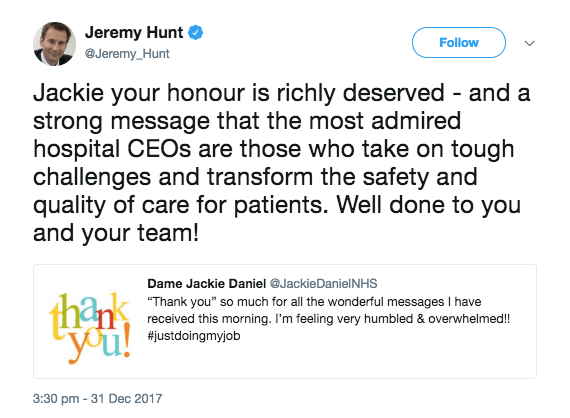
Jeremy Hunt’s patient safety reform/ maternity safety crusader narrative included selling a myth that Morecambe Bay trust had been turned around. It in fact continued to suppress several whistleblowers.
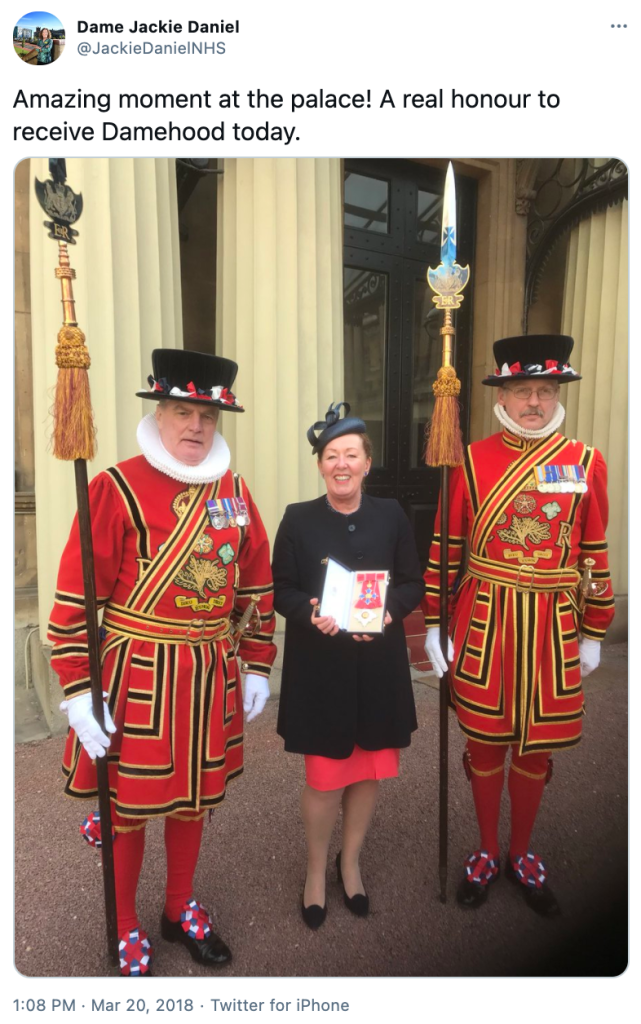
Jackie Daniel former CEO of University Hospitals of Morecambe Bay NHS Foundation Trust receiving a gong
By Dr Minh Alexander retired consultant psychiatrist 31 May 2022
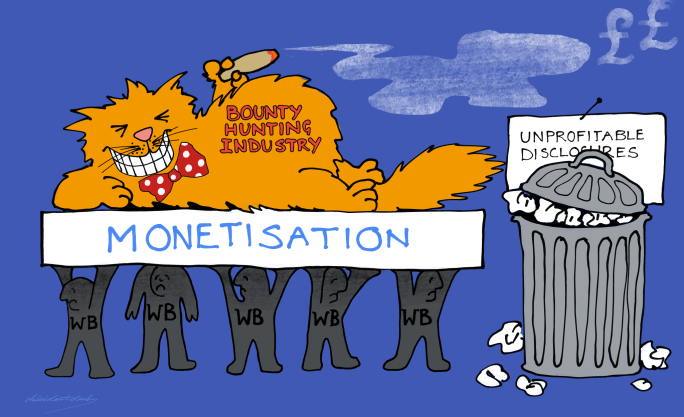
There has been great concern that the controversial Whistleblowing All Party Parliamentary Group (a collection of parliamentarians with no formal status) has been trying to shape UK whistleblowing law in the interests of the US bounty hunting lawyers whose money helped to establish the APPG.
A now defunct Bill introduced by the APPG Chair Mary Robinson Tory MP for Cheadle could be understood as a bounty hunters’ Bill. It contained a number of disturbing features and omissions:
Alarmingly, John Penrose Tory MP for Weston and the Prime Minister’s Anti Corruption Champion expressed public support for the Whistleblowing APPG’s Bill in April. Penrose gave an interview to GB News just before Mary Robinson made a speech about the Bill on 26 April 2022. In this interview, Penrose alluded to insertion of whistleblowing clauses into the Economic Crime Bill as a back up option, if the APPG’s Bill did not pass.
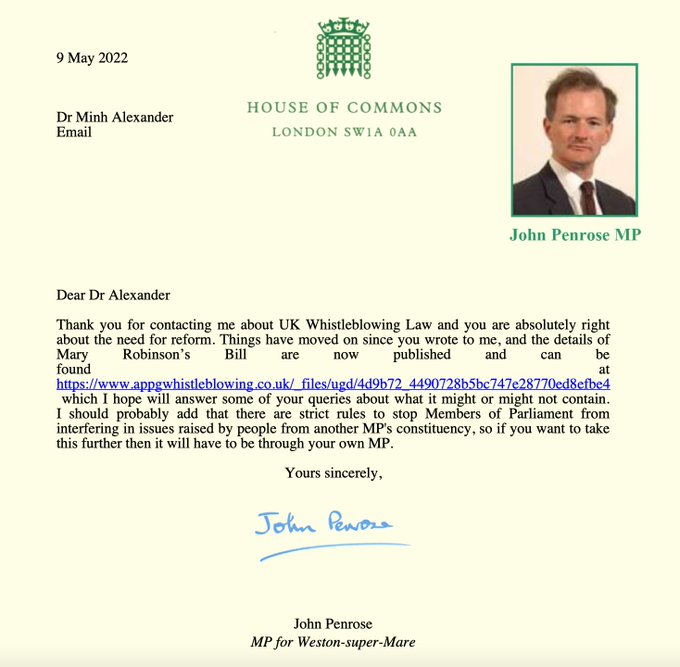
Penrose batted off correspondence from me, on the pretext that I was not a local constituent, even though I had explicitly written to him in his capacity as the national Anti Corruption Champion.
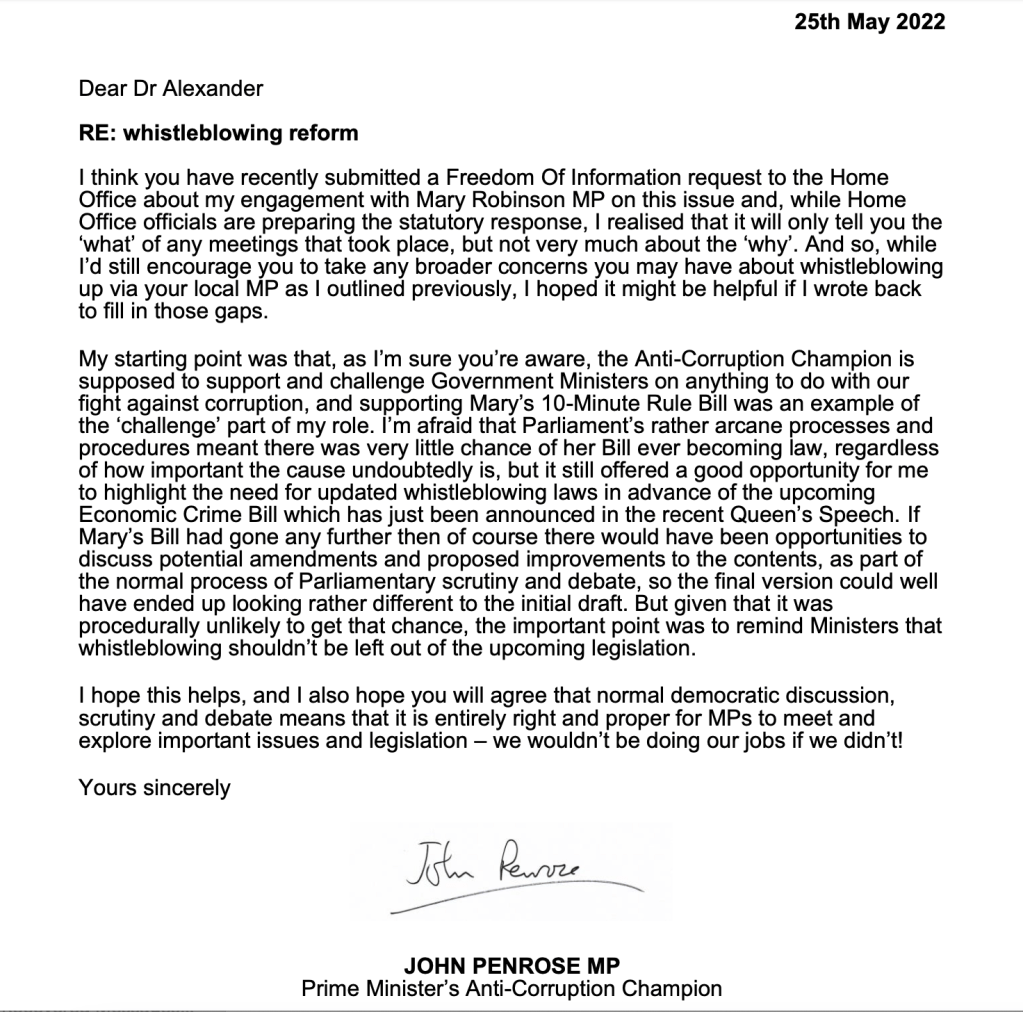
I complained to the Home Office Permanent Secretary about this specious rebuff. Penrose wrote to me again, this time on Home Office stationery and signed in his proper capacity as Anti Corruption Champion. He justified his support for the Whistleblowing APPG Bill as democracy in action. A bit thin really, given that he had just undemocratically tried to ignore dissenting voices.
APPGs are notorious for exerting influence on behalf of private interests, particularly when well funded and amply resourced to drive an aggressive lobbying/ media campaign. The Whistleblowing APPG is notably glossy in its presentation, with very active media liaison and a steady stream of coverage.
Longstanding concerns about hidden interests and unethical conduct by APPGs
“37. Lobbying is an important part of a healthy democracy. It is crucial that the interests of different sectors, organisations, and communities can be brought to the attention of Members and Ministers. All-Party Parliamentary Groups provide a significant benefit to the House by providing a forum where matters of policy can be discussed and a vehicle for making representations to Ministers and the wider House.
38. It should not be the case, however, that those with greater financial means should enjoy a greater advantage in lobbying Members and Ministers, or that those without financial means should be excluded. All-Party Parliamentary Groups must not be a vehicle by which paid external interests can achieve a level of access and influence not available to others. There are few, if any, safeguards in place to ensure that APPGs are genuinely Member-led and are not simply used by external bodies as way to amplify their own message with the added advantage of an informal parliamentary imprimatur. The danger is that an APPG could all too easily become a parliamentary front for an external commercial entity. That would be wholly inappropriate. We therefore believe some limits must now be placed on secretariat services to APPGs.
39. We also advise that Members who set up, chair or play a role in an APPG should be extremely vigilant that the APPG’s agenda, funding and activities do not bring the House into disrepute; are genuinely led by Members rather than any external organisation or individual; and do not provide an inappropriate or unequal degree of influence to any one organisation, individual or set of organisations.”
I had also made a formal request for information about Penrose’s contact with the Whistleblowing APPG and requested disclosure of correspondence between him and the APPG.
This is the resultant FOI response from the Home Office on 30 May 2022:
The Home Office disclosed that there was a meeting between Penrose, the APPG and others on 1 December 2021:
The Home Office also disclosed a friendly email chain between Penrose and Mary Robinson the Whistleblowing APPG Chair, in which he agreed to support her ten minute rule Bill.
Most significantly of all, Penrose forwarded their correspondence to the Home Office on 21 April 2022 with these comments:
“Hi All FYI I have just agreed to be a co-signatory to this 10-minute rule Bill next week, as a way of getting it onto the Government agenda in advance of ECB2. No need for any of you to do anything in particular, but wanted you to know so you aren’t blindsided or surprised!
Best wishes
John Penrose”
So there we have it. The target was indeed the Economic Crime Bill, and the big bucks from bounties in the financial sector.
Bounty hunting is a billion dollar industry in the States, and US lawyers have been trying to break into the UK market for years now.
And all a million miles away from whistleblowers who report poor care and bring in no money at all. A million miles away from public sector Nolan principles of selflessness.
The US style Office of the Whistleblower, if created, will likely be stuffed with cronies, backscratching and promoting private industry interests. It won’t be about justice or real public protection, but milking as much profit as possible.
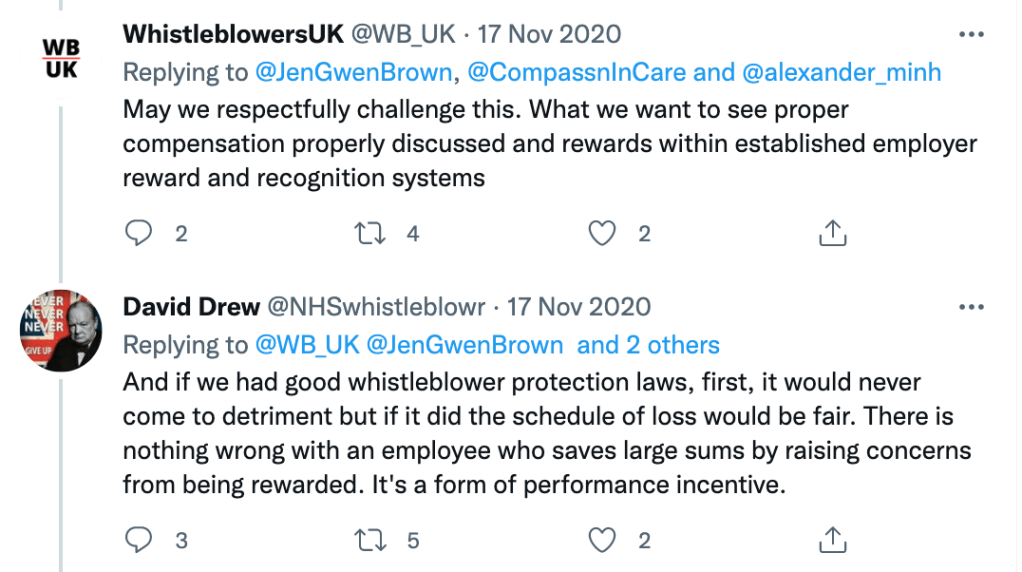
Nolan Principles of selflessness in public life make rewards for whistleblowing anathema in the public sector. In the NHS, workers are contractually obliged to whistleblow through the duties conferred by the NHS constitution, and registered professionals are additionally required by their professional codes of conduct to whistleblow. Any suggestion of rewards for whistleblowing in the NHS are particularly and deeply problematic.
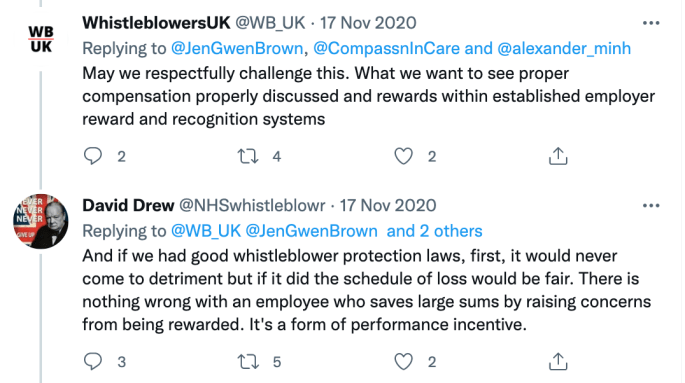
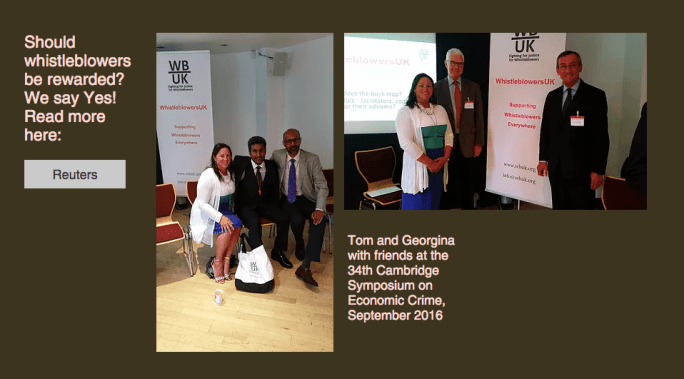
The Whistleblowing APPG’s secretariat, the private organisation WhistleblowersUK and an associate, making clear public statements in support of whistleblower rewardsA post from the WhistleblowersUK website, now deleted, promoting the use of whistleblower rewards
The trust suspended her on trumped up charges. The Employment Tribunal determined that there were no factual grounds for disciplinary action or dismissal, and that those who dismissed Linda Fairhall did not genuinely believe they had a case against her.
“23. In terms of the unfair dismissal claim, the tribunal was not satisfied that the respondent had established that its reason or its principal reason for dismissing the claimant was a reason related to her conduct. Those responsible for the claimant’s dismissal and the dismissal of her appeal did not “genuinely believe” that the claimant had committed any acts of misconduct which are now alleged. There could be no such genuine belief because there were no reasonable grounds for that belief. There could be no reasonable grounds because there had not been a reasonable investigation. The respondent’s decision to dismiss the claimant fell outside the range of reasonable responses open to an employer in all the circumstances of this case. This was an employee of thirty-eight years unblemished service who was suspended from her role in circumstances where that suspension was unjustified and unreasonable. The investigation which followed that suspension was inadequate and unreasonable. The investigation did not produce any qualitative evidence which could have led a reasonable employer to decide to dismiss the claimant in those circumstances, for reasons related to her conduct. The procedure followed by the respondent was unreasonable and unfair. For those reasons the claimant’s complaint of unfair dismissal is well-founded and succeeds.”
Linda Fairhall’s partner died of a heart attack whilst she was unjustly suspended.
She herself was unwell and also a cancer survivor.
She won her Employment Tribunal in January 2020, but appallingly, the trust decided to make her suffer even more by appealing against the finding that her unfair dismissal related to whistleblowing.
What sort of an organisation does that to a bereaved woman, whose partner died whilst it unjustly suspended her? Words are not enough for this additional injury by North Tees.
The Employment Appeal Tribunal noted caustically in its judgment that it was not surprised that the trust had not appealed against a finding of unfair and wrongful dismissal, so “excruciating” were the ET’s detailed findings and laying out of the evidence against the trust.
“In its detailed findings of fact, the Tribunal described in excruciating detail the manifest failings and fundamental unfairness of the respondent in dealing with the claimant’s suspension, the investigation into her conduct, her grievance, her eventual dismissal and the rejection of her appeal.”
Moreover the EAT considered that the ET’s substantive finding of whistleblowing detriment was correct in law. It merely found that the ET could have given fuller reasons for some of its findings of whistleblowing detriment but advised the trust to consider whether it was proportionate to pursue this.
North Tees also persecuted whistleblower Dr Manuf Kassem, who remarkably won an Employment Tribunal in January 2021 for whistleblowing detriment after representing himself.
Mr Kassem raised patient safety concerns and suffered retaliatory disciplinary action. The Employment Tribunal severely criticised the medical director’s detrimental actions against Mr Kassem, which it linked to Mr Kassem’s whistleblowing. Other senior medical staff were also criticised. The ET also determined there was an element of Race discrimination in the trust’s mistreatment of Mr Kassem, and that the trust’s actions amounted to harassment.
As an example of the trust’s egregious mistreatment of Mr Kassem, it launched a fraud investigation into him, but eventually withdrew the allegations. A witness gave this evidence in support of Mr Kassem:
“Mr Tabaqchali concluded his evidence in this respect that he was aware that the claimant “did numerous additional sessions without claiming payments. I therefore think it is a great pity that the directorate has taken this approach rather than thanking him for his hard work and dedication. I would suggest that the directorate overall owe him more pay, not less pay.”
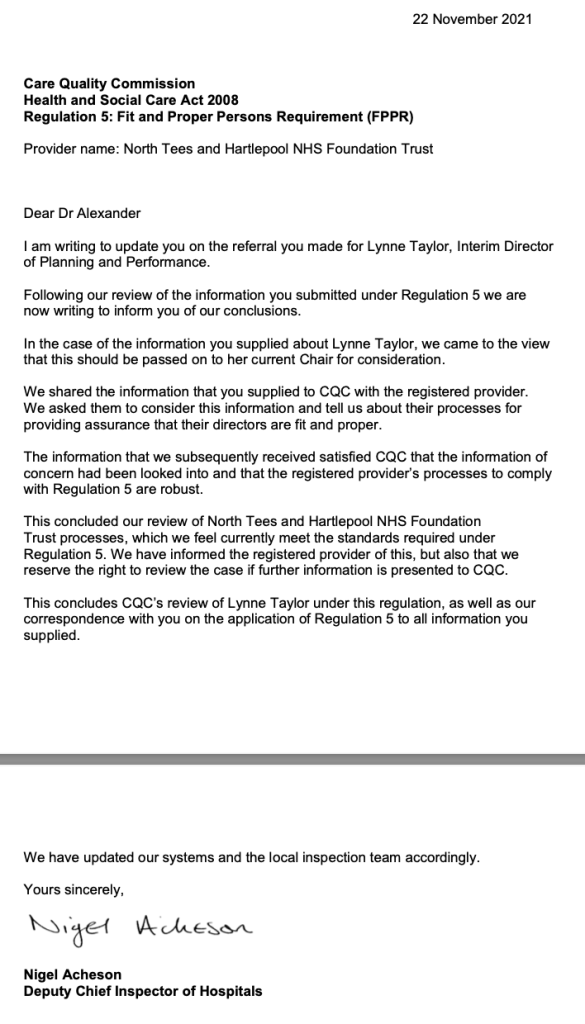
I referred Lynne Taylor, North Tees Director of Planning and Performance, named in the Linda Fairhall ET judgment to the Care Quality Commission under CQC Regulation 5 Fit and Proper Persons, on grounds of whistleblower reprisal.
As usual, CQC shut down the FPPR referral and gave the trust a pass. This was in November 2021, well after the ET judgment was issued in Mr Kassem’s case. At that point, the CQC should have been aware that North Tees was a recidivist whistleblower victimising organisation.
Lynne Taylor retired from the trust with accolades and flowers, a month before I received the CQC FPPR decision, in contrast to the abusive exit meted out to Linda Fairhall:
FOI requests to the trust revealed that the ‘independent’ FPPR process which satisfied the CQC consisted of a panel of three trust directors and two other trust managers reviewing the case.
A pall is cast over this by the trust’s admission under FOI that it was a collective trust board decision to appeal against the ET judgment in Linda Fairhall’s favour.
In other words, a bunch of executives who reportedly did not have the collective common decency to leave a grieving woman alone, and who made her suffer yet another traumatic legal process whilst unwell, were allowed to judge the fitness of a colleague found to have victimised her.
What a perfect picture of rigour and objectivity.
These are the two relevant FOI disclosures from North Tees:
I would have made an FPPR referral last year on North Tees with respect to Mr Kassem’s case but I took a break from campaigning work due to personal commitments.
I have now made a second FPPR referral to CQC on North Tees. I have pointed out to the CQC that North Tees is a recidivist employer, and that the original FPPR process in Linda Fairhall’s case was compromised because it was undertaken by trust directors who were reportedly party to the very poor decision to appeal the ET judgment.
I also recently asked CQC for update FOI information on its regulation of the Fit and Proper Persons provisions.
In response, CQC admitted on 25 May 2022 that since Regulation 5 Fit and Proper Persons came into force in 2014, it has received 147 referrals related to NHS trusts and which included 212 referrals on NHS trust directors.
95 of the 147 referrals on NHS trusts (featuring 108 NHS trust directors) were accepted for consideration by CQC’s FPPR panel, which CQC now admits has never made a single finding of NHS trust non-compliance in the eight years that Regulation 5 has been in force.
CQC has squirmed and tried to soften this stark fact by implying that it would have made findings of non-compliance if some of the individuals had not resigned or been sacked before the completion of its FPPR process.
And as CQC has been so fond of fobbing off whistleblowers with the mantra that it only regulates the soundness of trusts’ FPPR processes and not the fitness of individuals, it is very unconvincing of CQC to claim that its regulation of FPPR ends when suspect directors depart.
These are the relevant passages from CQC’s FOI response of 25 May 2022:
“Since Regulation 5 of the Health and Social Care Act 2008 (Regulated Activities) Regulations 2014 came into force, a total of 147 of the referrals made to the panel have related to NHS trusts. Some trusts have been referred more than once.
In total, these included 212 referrals of NHS trust directors. In some cases, this includes more than one referral of the same person.
Of the 147 total referrals relating to NHS Trusts, 95 were considered by the panel and these related to 108 directors (including some cases where the same director was referred more than once).
There are a number of reasons why a referral may not have been considered by the panel, for example where the person referred was no longer working in a role within the scope of the regulation or the information shared was not a matter that fell within the scope of regulation 5.”
“It is for the provider to discharge its legal duties under the regulation. FPPR referrals can conclude in a number of ways. For example, an FPPR referral may end where the director resigns from their post before the process has concluded or the director is dismissed through the disciplinary process. For this reason, no FPPR referrals relating to NHS trusts have reached an outcome that the provider is non-compliant with the regulation at the conclusion of the panel process.”
CQC has had the muscle all along to remove unfit directors if it wishes to do so. It told whistleblowers this at a meeting in 2014. This was confirmed by recently disclosed internal CQC audit material:
There is more to come about yet another CQC FPPR failure.
PETITION
Accountability is a key plank to preventing future cover ups and whistleblower reprisal.
Please click and add your signature to this petition to reform UK whistleblowing law – whistleblowers protect us all but weak UK law leaves them wholly exposed, lets abusers off the hook and it is a threat to public safety.
Partly because of CQC’s dismal handling of the Fit and Proper Person regulation, and following Jeremy Hunt’s own version of Mid Staffs disaster at Liverpool Community Health NHS Trust, the Department of Health in 2018 commissioned a report into the Fit and Proper Test in the NHS. This was done by barristers Tom Kark and Jane Russell. NHS Improvement was tasked with implementation but has done little since then. A recent meeting took place which revealed that ultimate approval was still awaited from the DHSC.
Dr Jasna Macanovic’s recent NHS whistleblowing case adds to the pile of managerial recycling scandals. John Knighton the medical director found by the ET to be centrally involved in her premeditated unfair dismissal has been protected by the trust and Mark Cubbon the trust CEO who failed to ensure her protection as a whistleblower has been promoted to a senior post at NHS England.
An FPPR referral has now been made regarding the executive failures in her case.
CQC also uses “specialist advisors” in its inspections who are current NHS staff, including managers who review the Well Led domain of inspections.
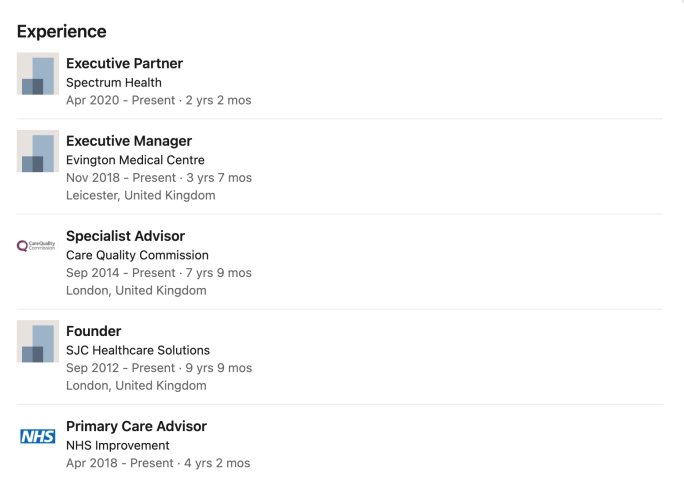
There has been an extraordinary local media report – by Leicestershire Live on 21 May 2022. This was about a former CQC specialist advisor, Shaun Chadwick. Colleagues and ex colleagues have accused Chadwick of abusive comments and social media posts.
Despite Leicestershire Live obtaining apparent evidence of the social media posts, which it has shared, Chadwick has reportedly denied the allegations:
“A manager working for the NHS has been accused of telling a former colleague Karma is a b****’ after she was diagnosed with multiple sclerosis – before calling her a “pathetic woman” and a “fat cow”.
Shaun Chadwick, senior executive partner at Spectrum Health in Oadby, has also been accused of regularly ‘fat shaming’ another former colleague. It has also been alleged he shared confidential questions with practice staff that CQC inspectors planned to ask during a visit – and telling them to be ready with the right answers.
Mr Chadwick has robustly denied the allegations in a statement issued by his current employers Spectrum Health. It says: “We can all confirm that such allegations are grossly inaccurate and insulting.”
Readers can take a look at the Leicestershire Live original article and related images of the social media posts to make up their own minds:
A comment on this article alleged that concerns had been raised with the CCG and NHS England, who failed to act:
“The repeat theme on these posts is that the Leicester/Leicestershire CCG, LMC and NHSE are continually failing in their duty to act despite suggestions of patients and staff raising concerns and it being their position to bring all those responsible to account.”
Chadwick is a GP practice manager.
According to Leicestershire Live, he is also accused of abusing his position as a CQC specialist advisor by sharing questions that CQC inspectors were due to ask with one of his own practices, whilst he was employed as a CQC specialist advisor:
“Mr Chadwick has also been accused of sharing questions that Care Quality Commission inspectors were due to ask staff at one of his practices during a forthcoming inspection, which is a breach of the CQC rules on confidentiality.
He was a specialist advisor for the CQC at the time, while he was also executive manager at nine practices across Leicestershire. But he told LeicestershireLivein 2020 that he was stepping down from his role due to his concerns within the CQC.
The email sharing the questions asks colleagues to treat the documents “in the strictest of confidence” and instructs them not to have them on the day of the inspection. He goes on to tell staff to familiarise themselves with the questions the inspectors will be asking and to approach him if anyone was “unsure of the answers.”
“…A CQC spokesperson said they would not be investigating the allegations because Mr Chadwick is no longer a specialist advisor.
The spokesperson added: “Shaun Chadwick used to work at the CQC as a specialist advisor in primary medical services, however he is no longer employed by the CQC. We are not aware that he sent an email to a GP practice including details about the CQC inspection framework.”
All of the above accusations have also been put to Mr Chadwick, Spectrum Health, NHS England and Leicestershire and Rutland CCG. Mr Chadwick has denied the allegations to LeicestershireLive.
A Spectrum Health spokesman said: “Mr Chadwick denies allegations made and legal proceedings via our solicitor and Leicestershire Police have commenced. Mr Chadwick takes such allegations extremely seriously and therefore ordered an external facilitator to investigate working culture at Spectrum Health.
“We can confirm that such allegations are grossly inaccurate and insulting.”
A joint statement from NHS England and LLR CCGs said: “We cannot comment on ongoing individual cases, but we are aware of concerns which have been raised and we are working to investigate following the appropriate NHS complaint processes.”
I can understand that CQC would not investigate Chadwick as an employee, now that his employment with his CQC has ended.
But surely CQC has grounds to investigate his service as a provider that allegedly abused the inspection process?
How many CQC specialist advisors use their insider inspector knowledge to benefit their own provider services? How does CQC manage the risk of such breaches?
“CQC recognises that in the course of your regular work outside of CQC, you may be asked to speak at conferences or make presentations to various groups. In these presentations you may wish to use your experiences of participating in CQC inspections to illustrate your talk. In such circumstances you must:
• notify the conference organisers that you are not speaking on behalf of CQC
• not imply that you are appearing and/or speaking for or on behalf of CQC;
• anonymise any data from which an individual could be identified; and
• not breach the confidentiality provisions as set out in this Agreement or any relevant CQC policy on confidentiality.
We advise you to seek guidance from CQC if you are unsure about your obligations around this and how they apply to a given set of circumstances. “
Some CQC specialist advisors have been known to sell regulatory compliance services to provider organisations.
The current National Freedom To Speak Up Guardian was a CQC specialist advisor and she also advertised consultancy services including CQC inspection advice:
Introduction: Mary Robinson Tory MP for Cheadle and Chair of the controversial Whistleblowing APPG introduced a new Bill in parliament on 26 April under the ten minute rule. A second reading was oddly scheduled on 6 May 2022 when parliament was prorogued, so the Bill fell. The Bill itself was not published until 3 May 2022, on the APPG’s website. It transpired that the real target might not actually be to pass this legislation but to secure related insertions into the Economic Crime Bill. The Whistleblowing APPG’s campaign to change UK whistleblowing law has caused concerns since its inception in 2018 with funding from US bounty hunting lawyers. The US bounty hunting model benefits only a handful of whistleblowers and is only interested in whistleblowing which recovers very large sums of money. It seems likely that the APPG will continue pushing. We have therefore examined and provided a critique of the recent, fallen Bill in anticipation of future attempts to introduce similar legislation.
A Critique of the Whistleblowing APPG’s April 2022 Whistleblowing Bill
By Minh Alexander NHS whistleblower, Martin Morton Social Care whistleblower, Clare Sardari NHS whistleblower 24 May 2022
Summary: The Whistleblowing APPG’s now fallen draft legislation could be understood as a bounty hunter’s Bill. The Bill is poorly written, mis-numbered and in parts frankly unintelligible. Although the APPG claims its Bill champions whistleblowers, it does not focus much on protection. It does not invest enough in ensuring a safe and appropriate response to whistleblowers’ concerns, nor in criminal sanctions which cover the full range of serious breaches against the public interest. Instead, the Bill focuses on:
Massively widening the definition of ‘whistleblower’, which would increase the bounty hunting market
Building in a gatekeeping mechanism to reject some whistleblowers if necessary – perhaps the less profitable?
Extracting information
Sharing information with foreign regulators
Making referrals to foreign regulators
Making provision for ‘recognition’ of whistleblowers which in other published material has been equated to financial payment
The uncapped financial aspects of redress orders
Making provision for massive financial fines, which at a later point could be made subject to bounties
Points 3 and 4 are particularly relevant to lucrative law suits under US bounty hunting law, which can be filed from overseas. The US bounty hunting business is a billion dollar industry for lawyers.
The APPG Bill borrows heavily from Dr Philippa Whitford MP’s Public Interest Disclosure Protection Bill but tellingly, it dropped the clause which expressly sought to minimise conflict and litigation. The APPG Bill also dropped a clause which prohibited financial rewards for making protected disclosures.
The APPG Bill does not particularise key areas, such as intended standards to be applied by its proposed Office of the Whistleblower. As the Bill places the Office of the Whistleblower firmly under government control, future policy and future whistleblowers will be at the government’s mercy. The poor drafting of the Bill and its failures of particularisation will also provide more employment for lawyers. The Bill does not appear to be so much a real challenge to power, but a knowing handshake. It is in short, a most dubious pig in a poke.
Some summarised comments follow on key areas
Please follow the links for more detailed discussion and references, if required.
The APPG Bill claims to:
“Establish an independent Office of the Whistleblower to protect whistleblowers and whistleblowing and uphold the Public Interest; to create offences relating to the treatment of whistleblowers and the handling of whistleblowing cases; to make provision for that body to set, monitor and enforce standards for the management of whistleblowing cases, to provide disclosure and advice services, to direct whistleblowing investigations, to order redress of detriment suffered by whistleblowers; to repeal the Public Interest Disclosure Act 1998; and for connected purposes.”
Mary Robinson MP and Whistleblowing APPG Chair claimed in her ten minute speech on 26 April 2022:
“The Whistleblowing Bill will set up an independent office of the whistleblower to make whistleblowing work properly and safely for everyone. It will champion whistleblowers and whistleblowing. It will be a central point where the would-be whistleblower could come for information and support. It will have support and advice services for regulators, organisations and the public. It will set standards and report back to the Government. It will ensure that those who inflict or suffer detriment will be properly compensated or properly held to account. It will have real teeth with the ability to issue redress orders, fines and penalties. For the worst offenders, there will be prison sentences.
The Bill will make whistleblowing work by ensuring that concerns are investigated and acted on. It will transform our culture, normalise speaking up and put an end to the discrimination against whistleblowers.”
There is no proactive legal duty to protect or to prevent detriment. The Bill makes no link to Human Rights.
The Whistleblowing APPG’s Bill provides no mechanism by which early protection, early resolution, prevention of escalation and litigation can be achieved. There are no protective provisions such as pre-approval mechanisms before dismissal. There is not even parity with current discrimination law in terms of a proactive public sector duty to promote Equality for whistleblowers.
For comparison, EU law gives whistleblowers access to legal aid.
The APPG Bill gives no clear provision for stays and injunctions against harm.
It does not encourage the use of internal channels, which can be seen as favouring the bounty hunting industry by maximising the number of potential clients who may go straight to lawyers.
The Whistleblowing APPG harvested whistleblower data and feedback, with this note in its report of April 2022:
“All of those interviewed or who participated in the call to evidence were asked what changes they would like to see introduced. We received 100% agreement for the importance of creating a truly independent Office of the Whistleblower”
It is remarkable then that the APPG has put forward its Bill for an Office which is NOT independent but under full government control.
The Whistleblowing APPG has lifted the core passage from Dr Philippa’s Bill to introduce a Whistleblowing Commissioner, but with highly significant changes and omissions which likely signal intent.
Dr Whitford’s Bill provides for a Commission as follows:
“(4) The objectives of the Commission are—
(a) to ensure that concerns raised by whistleblowers are acted upon;
(b) to promote good corporate governance and discourage misconduct and malfeasance;
(c) to protect the public purse and ensure that wrongdoers bear the cost of wrongdoing revealed by whistleblowing;
(d) to promote the normalisation of whistleblowing as part of ethical governance, operating with a presumption in favour of transparency; and
(e) to reduce conflict and litigation relating to whistleblowing.”
The APPG provides for an Office of the Whistleblower as follows:
“(4) The objectives of the Office are—
(a) to encourage and support whistleblowers to refer concerns to the appropriate authorities;
(b) to support an effective and fair whistleblowing process;
(c) to protect the public purse and ensure that wrongdoers bear the cost of wrongdoing revealed by whistleblowing;
(d) to promote good governance through the normalisation of whistleblowing:
(e) to ensure that concerns raised by whistleblowers are acted upon;
(f) to monitor and review the operation of this Act.
That is to say, the Whistleblowing APPG has actively removed the clause:
“to reduce conflict and litigation relating to whistleblowing”
These elements are of course necessary to the income of the bounty hunting industry.
The APPG Bill also gives the Office of the Whistleblower “powers to establish schemes for the recognition of whistleblowers”.
That looks like “rewards” by any other name. Indeed, some members of the Whistleblowing APPG have spoken in favour of whistleblower rewards and incentives.
The APPG Bill plants a dangerous barrier to whistleblowers who seek help from the Office of the Whistleblower by allowing it to reject complaints “determined to be frivolous, malicious or vexatious”. After so many years dispensing with the much abused “good faith” test in the Public Interest Disclosure Act (PIDA), this is a seriously retrograde step.
But the APPG’s proposed barrier could be useful to a bounty hunting organ that wanted to let through lucrative cases whilst blocking those that are unprofitable.
The APPG gives no standards of whistleblowing governance in statute. They are all left to the Office of the Whistleblower to define and by implication therefore at the government’s mercy.
An enquiry to Mary Robinson MP about her vision for the putative regulations to be applied by the Office of the Whistleblower has not been answered.
A particularly important sleight of hand to note is that the Bill seeks to control how whistleblowers’ concerns are investigated – albeit without saying how it will do so – but critically, the Bill omits enforcement of investigation and action upon whistleblower’s concerns.
The Bill borrows from Dr Whitford’s Bill in providing redress orders, but it again makes telling changes focussed on maximising financial payouts.
Dr Whitford’s Bill stated:
“A redress order may order financial redress but must not order financial reward for making a protected disclosure”
The Whistleblowing APPG has changed this to:
“A redress order shall include an order for financial redress where loss or damage has been incurred. No such order shall be subject to any cap.”
The APPG’s Bill proposes massive fines for organisations up to £18 million (or more if the government pleases). This would have a devastating effect on public services if levied against public bodies. Such fines are also self-defeating because it is often under-funding that contributes to public sector service failures, cover ups and whistleblower reprisal.
The proposed massive fines could be made subject to bounties with further legislation at a later date.
The APPG’s Bill restricts new criminal offences to only:
The EU requirements include dissuasive penalties against:
Hindering reporting
Vexatious proceedings against a whistleblower
Breaches of confidentiality of whistleblower identity
Lastly, for some light relief, we gave up at this word hurdle:
“…and, in the absence of evidence establishing the contrary, a relevant person shall be taken to decide on a failure to act when that person does an act inconsistent with doing the failed act or, if that person has done no such inconsistent act, when the period expires within which that person might reasonably have been expected to do the failed act if it were to be done.”
A prize for any soul who can unravel this contorted mystery. (Capped, and non-financial, of course).
Petition
If you would like to see effective reform of UK whistleblowing law that is genuinely in the public interest, and that is not about promoting any private interest and does not risk the good name of whistleblowers by confusing genuine public interest disclosures with bounty hunting or the use of paid criminal informants, please support this petition:
By Dr Minh Alexander, retired consultant psychiatrist 22 May 2022
In March 2021 the Employment Tribunal found in favour of Dr Sonia Mann, a salaried GP working in Bristol, formerly employed by the Helios Medical Centre.
A very rare finding of automatic unfair dismissal due to whistleblowing was made, and also findings of other whistleblowing detriment and breach of contract.
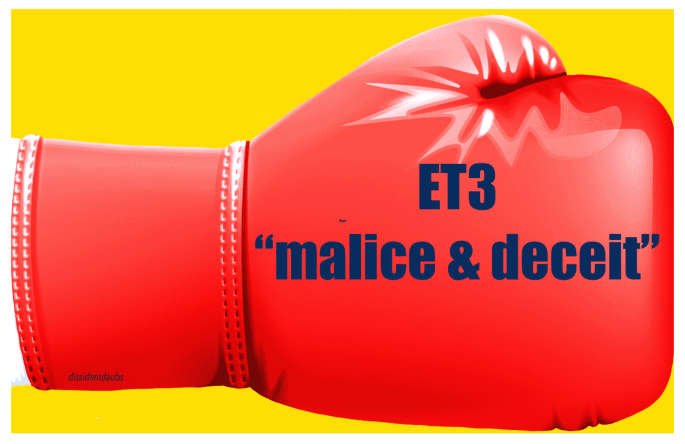
The ET has not finished calculating the compensation owed to Dr Mann. However, she was exceptionally awarded £10,500 aggravated damages earlier this month because the Tribunal found that Dr Mann’s employer seriously abused the ET process, with “malice and deceit” to intimidate Dr Mann and increased her suffering.
The case is a distressing example of the lengths that some employers will go to in order to destroy a whistleblower.
Dr Mann started working for the medical centre in 2015 and the records revealed that she was a valued and well thought of worker, as is often the case with many whistleblowers.
The practice manager wrote on 22 May 2019 only a couple of months before Dr Mann was constructively dismissed
“I know I speak on behalf of Rich and Frank when I say you are a valuable asset to the Helios team and it would be a devastating blow to the practice to lose you.”
A couple of weeks before Dr Mann’s constructive dismissal, Richard Laver managing partner wrote on 6 July 2019:
“Sonia, nobody underestimates how good you have been for Helios during the last 4 years and I do sincerely hope that matters can be resolved on Monday.”
Things only turned sour after there were problems with medical staffing and cover which the medical centre failed to manage safely, despite Dr Mann’s concerns and those of others.
Dr Mann was expected to take on an unsafe workload, which posed a threat to the safety of patients and to her own health. A fellow GP in the same position at the medical centre was also distressed, complained of ill health and was admitted to hospital with sepsis.
During her correspondence about the unsafe medical staffing situation, Dr Mann asked whether the medical centre should inform the CQC that it was struggling to provide a safe service.
“6.159. Dr Mann’s email read, “I understand Dagma is trying to get hold of Frank (I have texted him) and will contact Richard so the CQC can be informed….. “ feel it is unsafe to continue to practice under these circumstances as it poses a high risk of potential harm to patients.” (184)
6.160. Mr Laver preferred to look for other solutions. The CQC need only be informed “if we are unable to provide a service.”
Counter-allegations started to be made against Dr Mann. She was also stripped of some shifts.
There was an extraordinary incident of reported bullying in which Dagma Friis Operations Manager repeatedly called Dr Mann “love” during a difficult meeting and then followed her into the car park, whilst Dr Mann was upset and crying:
“As I fled in tears, she followed me across the car park and shouted at me. Other people in the car park who I recognised were staring at me, I felt humiliated.”
Dr Mann filed a grievance, but her employer failed to respond.
The Employment Tribunal described Dr Mann’s grievance thus:
“5.23. Her short grievance,
· Lack of support by the Partnership in my role as a Salaried GP · Unsafe working within the practice which has been highlighted on several occasions with ineffectual resolution ie lack of adequate action about concerns raised. Risk to patient safety · Poor communication amongst staff members · No response to last email regarding pay appraisal. (182)”
The Tribunal remarked:
“5.37. It was being seen as the problem that so significantly undermined Dr Mann’s confidence. She felt unsupported, belittled and intimidated. Staff felt free to be rude to her, to ignore her clinical concerns and to seek to override her clinical judgment. The partners did not respond to her reports. Mr Laver confirmed to her that Ms Friis had the authority to run the practice which therefore included for staff to undertake clinical triage without medical training or oversight. The difficulties thepractice faced had been very fully documented and the risks to patients and staff highlighted. The serious concerns Dr Mann raised had not been acknowledged but sidelined.
5.38. That had a profound effect on her. She describes it as a toxic environment and that arises out of the management failures including allowing or condoning disrespectful conduct towards Dr Mann while refusing to investigate the concerns she raised. She was anxious and fearful, her sleep badly affected.5.39. She suffered a severe loss of confidence and that has had lasting consequences for her in that her resilience in working within the NHS, a quality essential to her work, has diminished. She continues to suffer anxiety and loss of sleep.”
When Dr Mann tried to pursue the grievance, Dr Mulder the clinical partner reportedly told her she could resign:
“3.176. In her witness statement, Dr Mann says, “Our conversation began with Frank saying “I heard from Dagma that you have resigned”, I said “I think she would like me to but no I have not resigned”. Frank said “There are two ways this can go. If you were to resign, we would not need to go through the grievance meeting, or you could be off sick for 3 months.”
At this point Dr Mann resigned, setting out in writing that she had been forced to do so by her employer’s breach of trust and confidence.
She filed a claim with the Employment Tribunal. The victimisation continued, as the medical centre refused to give her a reference. The Tribunal noted:
“5.78. She continued to look for salaried roles after the dismissal, originally with some confidence and then with increasing dismay as it became clear the extent to which she was at a disadvantage both in relation to salaried roles and locum roles, because of her whistleblowing. The firm offer that she had was withdrawn within a week of the projected start date.
5.79. We are wholly satisfied that that was because the Respondent refused to give a reference – there may also have been adverse comments about her made by telephone, but the refusal to give even a bare reference was enough to cause the withdrawal of the offer. Mr Laver had, in his kindly and regretful acknowledgement of her resignation letter, commented that she had been one of the mainstays of the practice during her four years with them, and that he would give her a good reference if she required one. However, he was not a clinician, and a reference from a medical practitioner was important. Dr Mulder refused any reference. 5.80. Silence about a GP who has been a member of the practice for four years is damming. 5.81. She has had locum positions refused, and then readvertised. 5.82. Her reputation has been damaged within the local community and perhaps more widely. The respondent’s conduct, their misrepresentations and dishonesty have impacted severely on her prospects for work as a GP in Bristol, including in relation to locum work.”
Most shockingly, after Dr Mann filed a claim in the Employment Tribunal for unfair dismissal and other whistleblowing detriment, her employer used the ET response process to produce grounds of resistance (an ET3 form) which amounted to a wholesale character assassination upon Dr Mann of the most extreme nature.
However, this attack was as incompetent as it was vicious. The Employment Tribunal dissected the employer’s flawed claims at length and in detail, dismissing them with condemnation of the motives and unreliability of the witnesses who had contributed to the unpleasant counter-allegations.
These are just a few of the astonishing employer allegations provided by the ET judgment:
“The Claimant had a history of responding in what can be described as a volatile manner to reasonable queries made by the support staff and Respondent 2’s managers.”
“62. The Claimant’s conduct towards (the receptionist) was witnessed by Ms King who wrote a report setting out the Claimant’s unlawful actions of bullying and intimidating a junior member of staff in the work place. 63. Approximately 3 days after the incident of 21 May 2019, the Claimant told Ms King to change her written statement because it would have a negative impact on her upcoming appraisal. The Claimant pressed Ms King until she wrote a fresh statement of events which excluded the fact that the Claimant had shouted at (Mohima) and caused her distress.”
The Tribunal dismissed such unpleasant allegations entirely:
“6.56. The contents of paragraphs 62 and 63 are wholly unreliable”
The Tribunal rejected other unpleasant and groundless insinuations by Dr Mann’s employer:
“Para 95 6.135. At paragraph 95, the Response repeats that the Claimant was removed from the locum rota in anticipation that she would not attend, however “this was entirely based on her history of not attending work at short notice if there was a pending matter to be resolved. 6.136. We have no evidence of any occasion when Dr Mann did not come to work other than on health grounds. She had a good health record until these events. 6.137. There was no evidence put before us that in any way supported this allegation. As already explained, we have no evidence that that was the basis for the decision to cancel the sessions.
6.139. Paragraph 100 asserts that following a fair disciplinary procedure, it is likely that the Claimant would have been dismissed on the grounds of serious misconduct. 6.140. That is not supported by the evidence including the oral evidence. The witnesses identified no serious misconduct and the documentary evidence is that they hoped Dr Mann would come back.”
The Tribunal considered that the allegations made by Dr Mann’s employer were malicious in nature:
“It is the Respondent’s case that the Claimant was aware that her own actions placed junior staff and patients at risk as set out in Ms King’s letter dated 5 July 2019. Consequently at the time she sent her grievance on 12 June 2019, she was aware that any breach of a statutory duty to safeguard patients lay with her and not the Respondents. It is also submitted that the Claimant made disclosures for the purpose of orchestrating events to bring about a false whistleblowing and constructive dismissal tribunal claim. Accordingly her disclosures were not made in good faith or in the public interest.”
6.150. These are amongst the most serious accusations. 6.151. We have not heard evidence that shows that this list of 5 July 2019 was a live issue at the time or that it prompted any action.
6.152. If there is an allegation from a member of staff that a doctor is putting patients at risk, it needs to be taken up not only through internal processes but through the CQC and the GMC. This is presented as an accusation of professional misconduct. 6.153. That was not done. 6.154. From that inaction, it is clear that these matters were not a concern. 6.155. From that, the motive for making the allegations in paragraph 104 has to be questioned. It is difficult to find another explanation than that they were made for malicious purposes to besmirch the claimant and damage her reputation and to mislead the tribunal.”
The Tribunal accepted “beyond doubt” that Dr Mann was a genuine whistleblower:
“6.170. We are satisfied that her disclosures were genuinely made in good faith and in the public interest. It is beyond doubt that she so believed.”
The Tribunal dismissed all of the malicious allegations made by Dr Mann’s employer in its ET3 response:
“6.180. The allegations in the Response that Dr Mann
· Resigned because she refused to follow reasonable management instructions
· Orchestrated events to bring about a false tribunal claim
· Responded in a volatile manner to reasonable queries
· Bullied and intimidated a junior member of staff
· Was aggressive and abusive to a senior receptionist and the reception team
· Caused a senior receptionist to be signed off by her GP due to workrelated stress
· Had a history of failing to attend booked sessions
· Was repeatedly insubordinate
· Conducted herself so aggressively to junior staff that they were absent from work on her shifts · Was guilty of serious misconduct
· Placed junior staff and patients at risk
· Failed to co-operate, preventing her grievance being heard
are unsupported by evidence and untrue.”
Very seriously, the Tribunal determined that the employer had used the ET process to intimidate Dr Mann:
“In the conduct of the defence, the respondent acted in a way that was wholly inappropriate and intimidatory.”
Dr Mann in contrast was accepted by the Tribunal as a clear and credible witness, in contrast to the obvious dissembling by “unreliable” opposing witnesses:
“6.183. In resolving conflicts in this case, we have found Dr Mann herself to be clear and accurate in her evidence. By contrast, we found the Respondent’s witnesses to be unreliable. The Respondent’s witnesses had repeated difficulty in supporting their evidence by reference to the documents, even when referring to the pages they themselves cited in support. That was not the case for the Claimant.”
The Tribunal noted that even in oral evidence, Dr Mulder and Dagma Friis continued to make very serious unsupported claims about Dr Mann:
“6.184. Even in her oral evidence, Ms Friis continued to say that there were times when Dr Mann sat in her room doing nothing. She said there was evidence of that on the computer system. No dates are identified, no records produced and it has never been put to Dr Mann, nor was it put to her in the hearing. 6.185. Dr Mulder in explaining his concerns about Dr Mann spoke again about “hitting” as if that was an actual and current allegation, not a reference to something agreed to have been false months before the Claimant’s resignation. Both say that they were forced to let Mohima go because of Dr Mann’s demands, not because of a serious and false allegation. These are examples of the scope for reputational damage that can be caused by relying on and repeating unchecked allegations and rumour.”
The impact of her employer’s orchestrated untruths against Dr Mann was very serious:
““In December 2019, I received the ET3. I was devastated to read what had been written about me and developed palpitations and anxiety symptoms. My sleep was again disturbed with flashbacks of the traumatic events at Helios. The baseless accusations and allegations, such as being a bully, caused me significant harm as it called into question my professional integrity and my character. There were charts which tried to make it look as if I was not working in line with other GPs, which I knew to be false, there were different versions of what I had worked on on 12 June 2019 and evidence of clear fabrication, for example, the allegations regarding Mohima Hussein and Holly King. I felt betrayed, vulnerable and unprotected by my ex-colleagues being prepared to lie.” (witness statement para 9)”
The ET determined that the employer intimidation, with “malice and deceit”, during the ET process was seriously harmful:
“5.55. It was put to her that the way in which the respondent conducted the litigation had no effect on the way that she suffered. She did not accept that and we do not either. It is inevitable that a response put together with malice and deceit will have an impact and the impact here was profound. This response contained very serious allegations of misconduct and incompetence and even with our findings that they are unfounded, there remains always the risk that people will say, “No smoke without fire”, without exploring any further. She was very aware of the immediate and future damage to her reputation.”
And yet the only ‘crime’ that Dr Mann ever committed was to be a good doctor, and to react as any normal person might, in a highly abnormal and impossible situation. This does not deserve any, let alone an indefinite sentence.
The Tribunal records reveal just how ill the experience made Dr Mann:
“4.15. She found herself lacking confidence and resilience and the ability to tackle the issues that arose at work, fearing a recurrence of the treatment she experienced at Helios when she reported concerns. She was again losing sleep, lying awake with racing thoughts, waking her husband to help her. She found she could not raise even simple issues, asking him to check her emails before sending them.”
It is vital that UK whistleblowing law is reformed so that it recognises conspiracy and orchestrated attacks against whistleblowers (or “mobbing”, which is recognised under some European employment law) as the crimes and assaults that they are.
The medical injuries suffered by many whistleblowers, physical and psychological, are the palpable evidence of these assaults.
What became of the Helios Medical Centre?
It is no more. The ET noted:
“The GP practice at Helios was taken over by Mendip Vale Medical Group in April 2021 and insofar as it continued, closed on 31 March 2022.”
A Dr Frank Alexander Mulder remains on the GMC GP register with no restrictions of his practice. This is a LinkedIn entry for a Dr Frank Mulder, described as formerly of Helios Medical Centre. Commissioning documents reveal that Dr Frank Mulder, by then described as a single handed GP, gave notice of retirement on 22 October 2021:
“Dr Frank Mulder, the single handed GP of Helios Medical Centre formally notified the CCG on 22 October 2021 that he wished to give notice of retirement giving rise to the termination of his contract. In November 2021 the PCCC agreed a managed list dispersal for this patient list.”
There is a Dagma Friis on LinkedIn who is described as an operations manager as Sea Mills Surgery in Bristol. The surgery does not list such a person in its practice team.
I hope Bristol CCG will have the common decency to recognise Dr Mann’s public service and professionalism, and if she remains in the area, to welcome and not to impede her return to work.
Petition
Dr Mann’s ET judgment gives an unusually perceptive and personal account of the devastating effects of serious whistleblower reprisal. There are many more such cases, hidden away from the public eye. Each such case represents a failure to protect the public or sometimes harm that has occurred.
If you wish to protect whistleblowers and to help stop their concerns being covered up, please click on this link and lend your signature to this petition for much better UK whistleblowing law:
Yesterday, the Sunday Times published a useful report of an investigation into very concerning institutional practices by North East Ambulance Service NHS Trust, regarding suppression of information of about care failings in deaths. A jarring note was that the article was used to help revive Jeremy Hunt former Health Secretary’s political fortunes by casting him as the whistleblowers’ friend, who the paper claimed banned NHS gagging. This is untrue. He allowed gagging to continue. Whistleblowers will continue to suffer for as long as politicians play these games and deny them real protection under the law.
I have provided a factual rebuttal of the claim that Hunt banned gags:
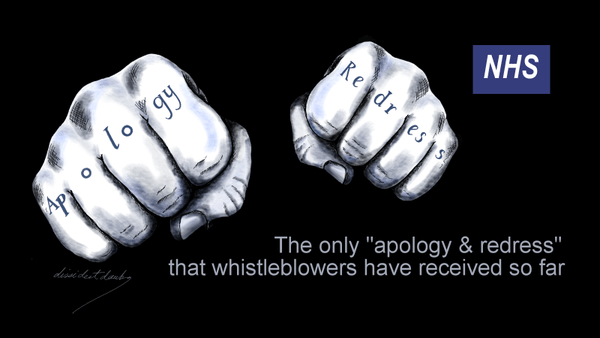
In 2015 the Health Select Committee recommended that the UK government should seek out and provide harmed NHS whistleblowers with an “apology and redress”. Needless to say, this has not been forthcoming. Most importantly, self evidently, neither has there been improved protection for new whistleblowers.
By Dr Minh Alexander, retired consultant psychiatrist, 22 May 2022
Summary: Jeremy Hunt is on the prowl again for the Tory leadership and unsupportable claims are being made on his behalf about his record as Health Secretary. One claim made yesterday is that he banned gagging in the NHS. He did not. Hunt made head line grabbing claims that he did so, whilst allowing gagging to continue. In particular, pernicious super-gags which hide even the existence of settlements were allowed to continue.
Hunt has been dusting off his patient safety crusader cape lately, at the same time as signalling that his Tory leadership ambitions are far from over.
He has published a new book unpleasantly claiming that the NHS is a “rogue system”, a message amplified with the help of the Murdoch press, which has helped to crank up his profile.
No doubt those who travelled on his coat tails are hopeful too.
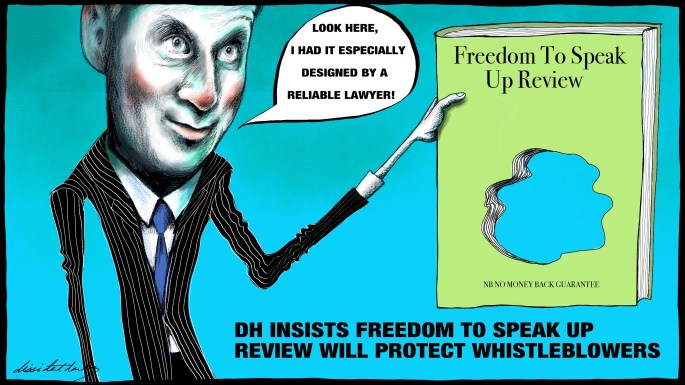
In contrast, NHS whistleblowers remember being led up the garden path with the Freedom To Speak Up Review commissioned by Hunt, which gave them no justice and failed to protect future whistleblowers. They also remember that Hunt did not act on a 2015 Select Committee recommendation to ensure redress and apology for harmed whistleblowers.
In the latest act in Hunt’s come-back cabaret, he has weighed in on allegations that North East Ambulance Service NHS Trust staff were asked to sign settlements seeking to prevent them from making public interest disclosures to a regulator – the Care Quality Commission – and the police.
Importantly, although a very abusive practice, such clauses would not have been legally enforceable.
The Times article which reports on this matter nudges us to remember what a good guy Hunt is, on the basis of an incorrect claim that he “banned” gags in 2014.
A Sunday Times article published late on 21 May 2022 reported that North East Ambulance Service NHS Trust is alleged to have altered documents to cover up care failings. Whistleblowers have raised concerns about managers altering or suppressing statements, and withholding evidence from coroners. It is alleged that families have not been told the whole truth about 90 deaths. Some of the concerns have been corroborated through external audit by a private company, AuditOne, which looked at a sample of 30 cases, with six cases examined in depth.
The sections of the Times article featuring gags and Jeremy Hunt’s star turn was as follows:
“Despite this, the whistleblowers claim they are being driven out of the organisation for raising the problems. This year, in return for taxpayer-funded payments of more than £40,000, two staff members were asked to sign gagging agreements that seek to limit them from making further reports about their concerns to the authorities — including the Care Quality Commission regulator and the police.
Last week the NEAS refused to “confirm or deny” the existence of such non-disclosure agreements (NDAs).Gagging clauses were supposed to have been banned in the NHS by Jeremy Hunt, then the health secretary, in 2014. In The Sunday Times last week, in an extract from his new book, Hunt branded the NHS a “rogue organisation” with an ingrained culture of cover-ups.
Hunt, a Tory MP and chairman of the Commons health select committee, said: “This case is deeply concerning and appears to be another example of the toxic blame culture in the NHS which incentivises cover-ups and means the same mistakes are repeated time and again. These types of gagging clauses have no place in a system where learning from mistakes is a matter of life and death.”
“Earlier this year, bosses at the service asked some members of staff to sign non-disclosure agreements in return for payments of more than £40,000. These agreements would have prevented the staff members from repeating their concerns — even to police — unless there was “a significant change in the nature of the concern”.
Notwithstanding a helpful account of the investigation into the deeply concerning failures by NEAS, Hunt did NOT ban gags in the NHS.
It was a factual inaccuracy by the Sunday Times to claim that he did.
Asked NHS trusts nicely in 2013 to think about what settlements they applied.
Interestingly, he added in this letter that he considered that “many organisations” in the NHS already had an open culture. It seems therefore that Hunt has trouble making up his mind about how roguish the NHS is:
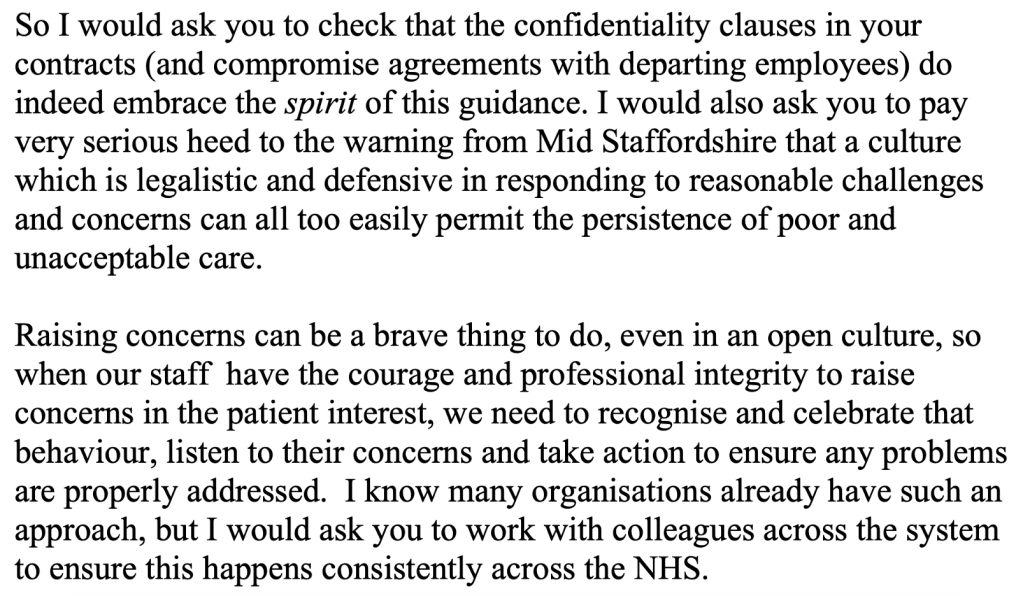
2. In 2013 Hunt’s administration introduced a policy that all settlements should contain a section which explained existing law clearly. That is, no settlement could legally prevent signatories from making public interest disclosures.
This was not in fact even new policy. David Nicholson had already written to NHS trusts in January 2012 to the same effect, requiring them to make it clear in settlement agreements that whistleblowing could not be restricted by any settlement:
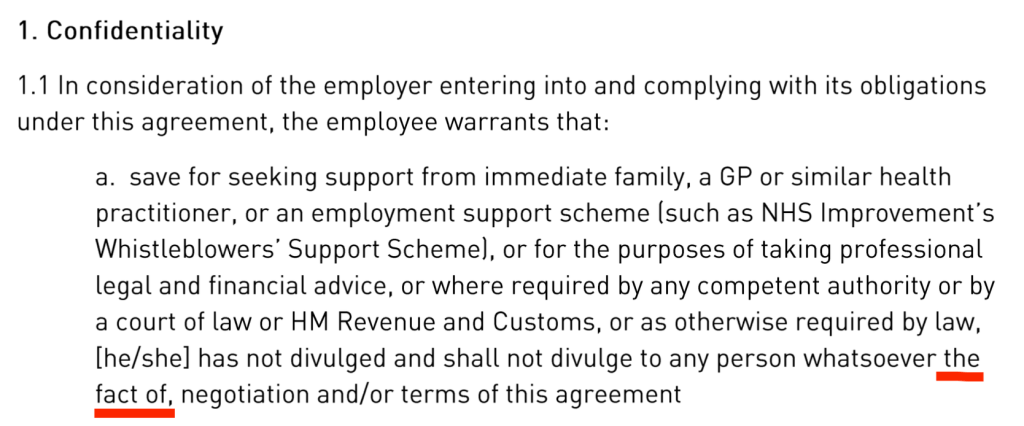
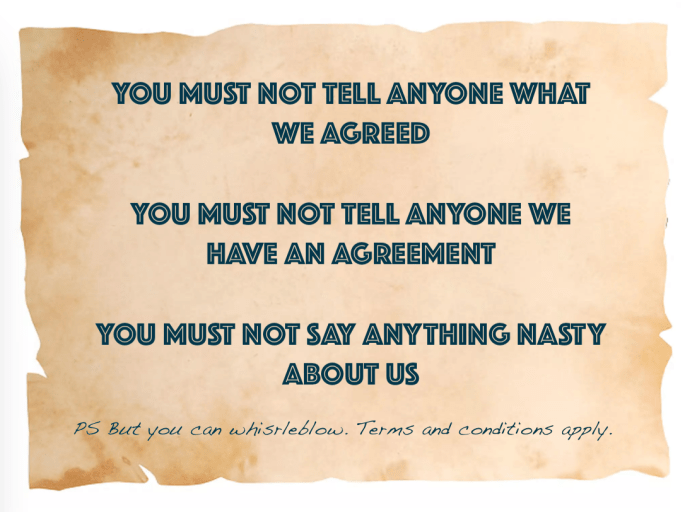
Whilst the wording in NHS settlement agreements told staff they could whistleblow – usually in stilted legalese which many might not fully understand – the confidentiality clauses, non-disparagement clauses and secrecy clauses or super-gags were all allowed to remain and had an intimidating effect.
Hunt allowed NHS trusts to continue freely using gags as follows:
Confidentiality clauses which prevented signatories from disclosing the contents of settlements
Confidentiality clauses which prevented signatories from even disclosing the existence of settlements – eg super-gags. These are especially pernicious as they render whistleblowers invisible. They have no public interest justification whatsoever, and exist merely to facilitate cover ups and reputation management. They were criticised by the Freedom To Speak Up Review in 2015, but HUNT allowed their continuing use.
Non-disparagement clauses which have a similar chilling effect to confidentiality clauses
The Freedom To Speak Up review concluded in 2015 that whilst NHS settlements might not have the effect in law of stopping signatories from making public interest disclosures, the fact that they contain intimidating clauses and cause uncertainty and confusion is often enough to silence staff. The Review was especially critical of super-gags which hid the existence of settlements.
But Hunt still did nothing meaningful to stop the use of gags, not even the use of completely unnecessary super-gags.
This was also despite FOI data that I extracted in 2016 showing widespread use of super-gags by some trusts, including by the trust which sacked a whistleblowing surgeon, leading to a question by Peter Bottomley MP in parliament:
The situation which Hunt allowed to fester continues today.
NHS Employers continues to give national guidance which allows NHS organisations to apply secrecy clauses to prevent signatories from even revealing the existence of settlements.
This is the critical clause in NHS Employers’ current template settlement agreement which prevents signatories from revealing the existence of settlements:
Use of super-gags has continued with the participation of the previous National Freedom to Speak Up Guardian, who jointly reviewed the national guidance with NHS Employers.
I recently asked both NHS Employers CEO Danny Mortimer and the latest National Guardian Jayne Chidgey-Clark if they were still content to allow the super-gagging of NHS staff.
Danny Mortimer did not produce a positive reason for the use of super-gags when invited to do so. Perhaps this is because there is no possible justification. He retired from the field with an indication on 30 March 2022 that the issue would be considered in the next review cycle.
The National Guardian’s Office delayed for weeks then came back with a bizarre non-answer on 10 May 2022 which in no way addressed the issue of super-gags:
“As you may be aware, in December 2018, as part of our review into Royal Cornwall NHS Trust, we made a recommendation that the Office and its partners involved in reviewing settlement agreements in the NHS, including the Department for Health and Social Care and NHS E/I, should complete this review and take all appropriate steps to implement its findings. You can find our case review here. Following this, we developed a factsheet that can be used alongside NHS Employers guidance on the use of settlement agreements and confidentiality clauses. These can be found here and here respectively.
We appreciate you raising this again, and will continue to be alive to this topic.”
None of the references cited in the National Guardian’s response deal with secrecy clauses that prevent signatories from revealing even the existence of settlements.
I imagine the responses from NHS Employers and the National Guardian indicate that the intention is to continue with business as usual, although I have pressed the National Guardian to actually answer the question put to her.
As for Hunt’s little performance via the Sunday Times, whistleblowers suffer enough without politicians capitalising on their misery. Especially those who had the power to change the system years ago but allowed these very abuses to continue. Not to mention those who rebuffed many NHS whistleblowers when in power for six years. Or those who invited cover-ups with a mixture of NHS defunding combined with KissUpKickDown culture.
But brace for more convenient cameos by our Caped Crusader, popping up wherever there is Safety Crime, heroically denouncing the dastardly deeds of the Evil NHS Empire for votes, sorry I mean for truth and honour.
Petition
If you wish to protect whistleblowers and to help stop their concerns being covered up, please click on this link and lend your signature to this petition for much better UK whistleblowing law:
By Dr Minh Alexander retired consultant psychiatrist 20 May 2022
Summary: The Practitioner Performance Advice Service (formerly the National Clinical Assessment Service or NCAS) has a history of enabling NHS employers’ victimisation of medical whistleblowers by rubber stamping unjust suspensions and disciplinary action. PPA issues advice based on what it is told by employers, which is sometimes false. Employers manipulate the process to obtain the advice that they want from PPA, in order to seriously mistreat staff who may be blameless. This poses serious health risks to the mistreated staff and represents a gross waste of precious medical personnel. NHS Resolution has now agreed to consider safeguards against being fed false information by employers, such as requiring a statement of truth from employers.
PPA, formerly NCAS, is an NHS oddity which supervises the operation of the much criticised Maintaining High Professional Standards process in the NHS – a disciplinary process for senior doctors. In recent years NCAS (PPA) has come under the control of NHS Resolution.
Maintaining High Professional Standards (MHPS) 2005
MHPS was seen as an own goal by the BMA which accepted this provision in place of much more rigorous and fair processes for disciplining senior doctors.
The well-known case of Wendy Savage obstetrician, who was successfully defended under the old procedure, would most likely have turned out quite differently if she had been at the mercy of MHPS.
Consultants used to have rights of appeal to the Secretary of State. Nowadays, whistleblowers’ letters just pile up on the floor of the Minister’s office, assuming they are even allowed to get that far. Part of the game is to block contact, to preserve plausible deniability.
For the little that it is worth, this is a link to official NHS guidance for employers on the competencies required of case investigators and case managers:
PPA has no powers, it is merely a consultative service with which employers must liaise in order to trigger suspensions and disciplinary action on grounds of incapability or misconduct.
In the experience of practitioners at the receiving end of this service, employers easily manipulate this arrangement by feeding whatever information is necessary to NCAS to get a desired outcome and a rubber stamp for their actions.
Those who are entirely blameless can be easily suspended and disciplined by abusing the MHPS/PPA mechanism.
And so many NHS whistleblowers have been roughed up by this route.
The unnecessary suspension of doctors is both traumatic for the individuals, constituting serious threat to health, and also a great waste of precious personnel resource for the NHS.
Surgeons in particular are easily de-skilled and it is very wrong that precious, expensively trained medical resource can be so easily flushed down the drain by corrupt managers covering up and protecting their own interests.
After continuing examples of baseless whistleblower exclusions such as those of Mr Tristan Reuser and, Dr Jasna Macanovic, I pressed NHS Resolution, to ensure that PPA implements safeguards against employers’ lies about whistleblowers.
This is a letter of 27 March 2022 to NHS Resolution’s CEO Helen Vernon about the issue:
Today, NHS Resolution has responded in a letter about various matters, with the relevant extract as follows:
“Turning to the first and the query about declarations from managers (including medical managers) who request advice and interventions (including assessments) from Practitioner Performance Advice. You will be aware that we already ask at the point of an initial contact with Advice whether the practitioner is a whistleblower or has made public interest disclosures and are able to offer advice within the context of that. We would anticipate this would be considered routinely throughout the lifetime of a case.
We are currently reviewing our approach to cases which go to the Assessment Consideration Group which determines whether or not a case is suitable for a behavioural or clinical performance assessment or professional support and remediation plan (and is being extended to consider team reviews and assisted mediations). This is equivalent to the type of decision making forum where the GMC have implemented Hooper’s recommendations as part of the fitness to practice referrals. We will be considering with stakeholders (including practitioners) how we can incorporate a statement of truth regarding their referral and whether we need to do something in addition to our current practice to consider whether or not the practitioner has made public interest disclosures. In our referral documentation the practitioner has space to write about the referral from their perspective and this currently provides an opportunity for practitioners to record if they consider themselves to be a whistleblower.” [my emphasis]
So we may in due course see a requirement for medical managers to make a statement of truth when referring doctors to PPA and when seeking PPA’s agreement for exclusions and disciplinary action under MHPS.
This would not stop victimisation but it would add a small safeguard that can be levered if necessary. As was a similar GMC safeguard in the case of Mr Reuser, when a false GMC referral ended in a GMC warning against his former medical director.
I have asked NHS Resolution to:
Advise of the timescale for the above work and to feed back the outcome of its deliberations.
Ask referring medical managers to make a formal declaration about whether the referred doctors are whistleblowers. It is not enough just to ask referred doctors to self-declare. The whole point is that referring organisations must be made to take responsibility and be held accountable for how they treat whistleblowers, in full awareness of a person’s status as a whistleblower.
I have emphasised that insufficient protective action, by not deterring employers’ abuse of process, would mean that NHS Resolution risks contributing to the serious personal injury of blameless whistleblowers. Which would be rich for the agency that oversees the NHS’ compensation of staff for work-related injuries.
Petition
UK whistleblowing law is currently unfit for purpose and allows employers to cover up and persecute whistleblowers with impunity.
If you wish to protect UK whistleblowers and to help stop their concerns being covered up, please click on this link and lend your signature to this petition for much better UK whistleblowing law:
By Dr Minh Alexander retired consultant psychiatrist 16 May 2022
Summary: The NHS trust which employed a bogus doctor Zholia Alemi as a consultant psychiatrist also allowed an unqualified healthcare assistant Samantha Robinson to practice far outside her scope for years as a specialist epilepsy ‘nurse’, running clinics and advising on specialist medication without any input from specialist doctors, sometimes for years. This was despite the situation being known to qualified clinicians and trust managers. When Jane Archibald a specialist nurse joined the trust, she was horrified to discover the situation. Her whistleblowing about this matter and other issues of concern was not met with a safe response by the trust. She experienced reprisal and an Employment Tribunal ultimately found that she had been unfairly constructively dismissed. A poorly executed grievance process was found to be a whistleblowing detriment, with a trust manager falsely claiming to the grievance investigator that the records of the whistleblowing disclosures were not available for inspection. The trust denied that Jane Archibald had made protected disclosures, right up to the last minute until the Tribunal ruled that she had. A disclosure letter that she sent to Stephen Eames the trust Chief Executive asking for his help with the unresolved patient safety concerns and her experience of reprisal was met only with silence. The Care Quality Commission was equally unhelpful and reportedly told her that the issues were an internal matter for the trust. Many issues remain to be resolved.
On 13 May 2022 the Employment Tribunal published a most shocking judgment in the case of Jane Archibald, an unfairly sacked whistleblower. This is the judgment against North Cumbria Integrated Care NHS Foundation Trust, which sacked her:
The Tribunal determined that she had been unfairly constructively dismissed and that the poor handling of a grievance by her constituted a whistleblowing detriment:
“The complaints of protected disclosure detriment in relation to the complaints about the outcome of the grievance and the grievance appeal are well founded.”
Jane Archibald’s whistleblowing concerns and the trust’s poor response
Jane Archibald worked at Cumbria Partnership NHS Foundation Trust, a mixed mental health trust, between 2015 and 2020 as a Senior Nurse Practitioner/Specialist Epilepsy Nurse.
In her time at the trust, she discovered extraordinarily poor clinical practice.
The most striking discovery was that an unqualified healthcare assistant Samantha Robinson had been allowed to work for years without adequate supervision. She ran epilepsy clinics and advised general practitioners on specialist medication. Sometimes the patients were not seen by a specialist doctor, a neurologist, for years.
Epilepsy medication is powerful and sometimes toxic, and it is of great concern that an unqualified person was in a position to make changes to patients’ medication.
Example
This extract from the Employment Tribunal judgment gives the type of disclosure made by Jane Archibald via the trust incident reporting procedure, and the management response to the report:
“Patient attended the Epilepsy Nurse Clinic for review at Hilltop Heights. Noted from the EMIS notes patient had not been reviewed by a Neurologist since attending the Neurology Department, patient transferred in November 2011.
“Only person to have reviewed patient was SR Epilepsy Advisor.
“SR [Samantha Robinson] had made reference to patient’s medication that she would make “no changes to patient’s medications”.
“No evidence of a referral letter on transfer letter in 2011”.
33. Jonathan Kenworthy inserted in the outcome details:
“SIRI investigation has identified the root cause of the incident – many lessons learnt including Sam Robinson no longer employed as Epilepsy Advisor. A lack of supervision and governance was historically cause of the issues. Investigation has resulted in epilepsy safety plan with clear guidance of appropriate service governance that is underwritten by Registered practitioners working with the patient group”.
Robinson was referred to by some as a “neurology specialist” and or “epilepsy nurse”, as noted by the Tribunal, who also noted the trust management’s denial of the extent of the governance failures:
“24. In or around February 2015, soon after the claimant started her role, the claimant had a meeting with Samantha Robinson. Samantha Robinson told her that she had her own clinics. We find that she told the claimant that she prescribed medicines. Fiona Dixon [Senior Network Manager for the Neurology Service] did not think that an investigation found that she had done that; however, the document at page 217 indicates that she made recommendations about medication.
25.The claimant also discovered that Samantha Robinson was described on correspondence as a nurse. An example of this is at page 217. Samantha Robinson was not a registered nurse. There are various references in documents to Samantha Robinson as a “Neurology Specialist” (p.216), and “Epilepsy Nurse” (pp.224, 226).
26. We consider it more likely than not that Samantha Robinson described herself in this way with the knowledge of at least some managers and clinicians. This appears to be supported by the evidence of Fiona Dixon, who describes the concerns the claimant raised about Samantha Robinson being the “product of the historic structure” and why there was no disciplinary action against Samantha Robinson (para 25).”
One of Jane Archibald’s peers had reportedly supervised Samantha Robinson:
“21. It appears that Graham Bickerstaff may, at some time prior to the claimant’s appointment, have had some supervisory responsibility for Samantha Robinson. In her letter to the Chief Executive dated 8 August 2019 (p.559), the claimant wrote that she had been told by Graham Bickerstaff that he used to be her supervisor. The claimant, in submissions, also relied on the document at page 763, on which Graham Bickerstaff is described as Team Leader, of the neuroscience service”.
Very worryingly, Robinson saw many vulnerable patients with a Learning Disability. She also saw patients who were women of child bearing age, with regards to the teratogenic effects of some anti-convulsant medication, especially sodium valproate. The latter can cause devastating harm to developing babies in the womb, resulting in major congenital malformations, developmental delay, intellectual disability, neurological and psychiatric disorders:
When Jane Archibald raised concerns about this surreal situation, she was met with an equally surreal organisational response. According to Archibald, no rigorous investigation was mounted and those responsible for allowing this situation oversaw the organisational response to her concerns.
The Employment Tribunal noted that Fiona Dixon the Senior Network Manager for Neurology suggested in incident forms that Samantha Robinson was removed from her post for malpractice. But the Tribunal found that the reality was that Robinson went off sick and was simply allowed to leave the trust via redundancy. An astonishing failure of Safeguarding:
“28. Samantha Robinson went on sick leave and remained on sick leave until she left the trust. Her employment was terminated by reason of redundancy and no disciplinary action was taken against her. We consider that this is contrary to the impression given on incident forms, which suggest she was removed from post because of concerns about her practice e.g. as referred to in the incident form completed 21 December 2015 on which Fiona Dixon wrote: “The unregistered member of staff was investigated and is no longer with the Trust.”
This saga of Samantha Robinson being allowed to masquerade as an epilepsy specialist is all the more concerning because Cumbria Partnership NHS Trust is where the bogus doctor Zholia Alemi, who posed as a psychiatrist for years. This first came to light through the diligent investigation of a local press reporter.
Jane Archibald also found serious problems with the use of buccal midazolam for epilepsy by nurses, mainly within the Learning Disability section of the trust. This drug is a sedative and can cause respiratory arrest. Archibald found that midazolam was not used within protocol, placing patients at risk, and that some nurses acted outside of their remit.
Reprisal and lack of protection
As a result of raising concerns, Jane Archibald found herself increasingly ostracised.
Managers started focussing on the manner in which she raised concerns, rather than the concerns. They asserted that her communication style was poor, when audit information indicated no such communication problem. It was also despite the fact that Jane Archibald’s record was hitherto unblemished. As the Employment Tribunal noted, although trust managers criticised Archibald’s communication style, they did not actually offer her any help or training with the alleged issue. When her immediate colleagues were hostile or unsupportive, managers suggested that it was her manner of raising concerns that caused problems.
One manager even suggested that the alleged communication problems were due to Jane Archibald’s diagnosis of epilepsy (which had been well controlled):
“135. On 7 June 2019, Fiona Dixon was interviewed in the grievance investigation. The interview included Fiona Dixon saying: “I have no concerns of her clinical knowledge but the impact of not being able to communicate with MDT and patients it then gets fractured, I do feel sorry for her because it is not deliberate, I think it may be linked with her epilepsy but how do you raise that?”
It was a particular disappointment to Jane Archibald that the Tribunal made no finding of discrimination on this point.
There was even a complaint which related to Archibald wearing a cardigan and refusing to take it off because she was cold. Many whistleblowers will relate to this type of ridiculous non-complaint, that arise when employers struggle to find dirt on conscientious, competent employees.
As a well-controlled epilepsy sufferer herself, Archibald’s health began to deteriorate. After eighteen years symptom free, she began experiencing breakthrough symptoms again.
Jane Archibald wrote to the then trust Chief Executive Stephen Eames in August 2019. At that point, Cumbria Partnership was in the process of merging with North Cumbria to create the current North Cumbria Integrated Care NHS Foundation Trust. The merger was completed in October 2019.
In the letter to Eames which I have seen, Archibald very clearly set out the history of her concerns and difficulties at the trust, especially her shock at the trust’s response to the issue of an unqualified healthcare assistant working as a senior specialist nurse.
Archibald reports that she did not even receive the courtesy of a response from Eames. This was cited in Tribunal proceedings and not disputed by the trust.
“147. On 8 August 2019, the claimant wrote to the Chief Executive of the respondent Trust. She wrote that she was writing to highlight concerns which she believed were in the public interest. She wrote about concerns she raised about Samantha Robinson working outside her scope of practice and about lodging other incidents regarding controlled medication, most of which involved Learning Disability Nurses, who she found to be working outside their scope of practice…. The claimant received no response to her letter to the Chief Executive.”
This is not the first time that a concern has arisen regarding Stephen Eames’ interaction with a whistleblower. On this I will provide more at another time.
Stephen Eames
Stephen Eames has held many management posts in the NHS.
This is a most detailed and harrowing account by UNISON of the grievous impact on staffing, beds and services caused by a PFI financial black hole at Mid Yorkshire Hospitals NHS Trust, where Stephen Eames was CEO from 2012 to 2016, and reportedly received a salary of approximately £300K:
Most recently, he has been appointed as Chief Executive of the Integrated Care System in the Humber region.
He was Chief Executive of the Mid Yorkshire Hospitals NHS Trust between 2012 and April 2016 when the trust’s handling of whistleblower cases gave cause for concern.
One of these cases was that of Gillian Wright a manager in the trust Occupational Health Department who raised concerns from 2013-2015 about corrupt practices of nepotism, fraud, breach of the Medicines Act and covert monitoring of her email.
Gillian Wright experienced reprisal after raising concerns and later sued the trust. The Employment Tribunal found that she had been unfairly constructively dismissed and that the trust subjected her to whistleblowing detriment by claiming that she “ might be the problem in her relations with three of her interim managers.”
This obviously has similarities with Jane Archibald’s case.
This is the Employment Tribunal judgment in Gillian Wright’s favour against Mid Yorkshire Hospitals NHS Trust:
I will provide more information about another whistleblowing matter at Mid Yorkshire Hospitals NHS Trust in due course.
Instead, the usual dreadful NHS whistleblower playbook rolled on. Jane Archibald was isolated and vilified. Her grievance about mistreatment was extraordinarily poorly handled and the grievance report joined the chorus about her alleged communication problems, despite Archibald’s previously unblemished record.
Moreover, Jane Archibald was later offered support from a Freedom To Speak Up Guardian who had given evidence against her during the grievance investigation.
The trust’s compromised Freedom To Speak Up process
According to the Employment Tribunal, Linda Turner Quality and Safety Lead gave hearsay evidence against Jane Archibald to the grievance investigation:
“133. Fiona Dixon suggested Martin Daley [the grievance investigator] should speak to Linda Turner. Linda Turner said that she personally had never had an issue with the claimant but a lot of people had told her that they had less than positive experiences of working alongside the claimant. Linda Turner said that a lot of the claimant’s concerns were based on clinical evidence and some of the things she had raised had been brilliant and led to improvements being made. She said the claimant appeared to struggle with email communication and she was aware that other clinicians had been upset by the tone and content of some emails the claimant had sent. She said that the claimant had raised a number of incidents and it was positive that she had picked up on service gaps in development and training. The notes record: “She concluded that Jane has demonstrated some good work and identified issues well but that the main concerns noted come back to communication and people feeling that she doesn’t value them or doesn’t recognize their skills.”
The Tribunal noted that in December 2019 the trust offered Jane Archibald the option of support from Linda Turner in her capacity as Freedom To Speak Up Guardian, but she understandably declined this.
“She was invited to speak to the Freedom to Speak Up Guardian, Linda Turner, but refused to do so.”
The Tribunal concluded that Jackie Molyneux Team Lead for Neurology, who was one of the subjects of the grievance, misled the grievance investigator:
“Martin Daley [the grievance investigator] asked Jacquie Molyneux whether there were copies of the incident forms. Jacquie Molyneux replied “we don’t keep a copy of the incidents”. When asked about this in cross examination, Jacquie Molyneux acknowledged that she could get the incident forms from the computer system. She did not volunteer this information to Martin Daley. No one subsequently corrected the misleading information given by Jacquie Molyneux to Martin Daley, so he did not obtain the relevant incident forms as part of his investigation.”
The trust’s response to Jane Archibald’s grievance about whistleblower reprisal
The grievance investigation into Jane Archibald’s concerns about her experience of whistleblower reprisal was fundamentally flawed because the investigator made no examination of her whistleblowing disclosures, which were mostly in the form of formal incident reports.
There were also other procedural failures in the grievance investigation. The grievance instead focused on her colleagues’ allegations about her manner of communication.
The Employment Tribunal determined that not only was the grievance procedure fundamentally unfair and a whistleblowing detriment, but that the subsequent grievance appeal process was also detrimental:
“The appeal was not a rehearing. We conclude that it was, therefore, tainted by the original flaws in the grievance investigation. We conclude that the claimant was subjected to a detriment by receiving a grievance appeal outcome relying on a flawed grievance process.”
Occupational Health advice to Archibald’s employer was not taken seriously. She went off sick, with stress exacerbating her epilepsy. She eventually resigned, without a job to go to, when it was clear to her that all hope of any fair resolution was gone. The detriment continued when the trust gave her an indefensibly poor reference for a new job with another organisation. This was later criticised by the Tribunal and recognised as a detriment.
Her claims to the Employment Tribunal were partially upheld. Remarkably, the Tribunal accepted that she had suffered whistleblower detriment, a rare finding. It also agreed that she had been unfairly and constructively dismissed.
One of the most egregious aspects of the case is that right up to the end, North Cumbria Integrated Care NHS Foundation Trust refused to accept that Jane Archibald was a whistleblower. Despite her many, serious protected disclosures.
Farcically, the trust argued during Tribunal proceedings that her disclosures were not protected because they were just part of her job:
“219. The respondent also suggested that the claimant was not making protected disclosures because she was raising matters as part of her day to day job.”
The Tribunal gave this short shrift and determined that Jane Archibald had made serious protected disclosures.
“We conclude that it does not matter that it was part of her job to flag up such concerns and complete incident forms where appropriate; the statutory test does not prevent concerns raised as part of a person’s day to day job satisfying the statutory test for protected disclosures.”
“….the incident forms we have seen which all raise legitimate concerns, most of a serious nature.”
Damningly for the trust and reflecting very badly on its persistent denial, the Tribunal accepted all of Archibald’s pleaded disclosures as protected disclosures:
“221. We conclude that all the disclosures relied upon were protected disclosures.”
But the trust has inadvertently impaled itself on a sharpened stake of its own making: it has publicly recognised that Jane Archibald was being a professional and just doing her job in raising concerns.
Small vindication though for all the suffering and lost years.
Regulators and the governance aftermath
Jane Archibald raised concerns with the Care Quality Commission but was told it was an internal matter for the trust.
The correspondence is no longer available as she sent the email from work and she does not have access to it.
The Care Quality Commission and North Cumbria
The Care Quality Commission has a deeply worrying history of helping to minimise patient safety problems at North Cumbria University Hospitals NHS Trust, a predecessor body of North Cumbria Integrated Care NHS Foundation Trust.
A later FOI response from the CQC showed that the CQC reacted reluctantly to numerous North Cumbria whistleblowers’ disclosures, often effectively just putting even the most serious disclosures in a drawer.
Many questions remain from this unedifying tale. The trust can clearly not be trusted to put right the mess of the unqualified healthcare assistant unsafely treating patients for years. Neither can the CQC it seems. Much more rigorous scrutiny is needed. In the first instance, I have asked NHS England/ Improvement to look into the matter and to review Stephen Eames’ role in particular with respect to his current post as Chief Executive of the ICS Humber, Coast and Vale Health and Care Partnership, copied to his Chair Sue Symington.
Elaine Middleton was a senior psychologist. who raised concerns about the trust adopting a cheaper model of staff support for staff coping with traumatic events at work, against NICE guidelines for trauma.
I asked York about its learning from this matter. York Teaching Hospital NHS Foundation Trust CEO’s response of 18 March 2022 was not overly remorseful in tone: “Dear Dr Alexander,
Thank you for your email.
As with any Employment Tribunal outcome we gain learning from the judgement.The learning from the judgement is used to improve our systems and processes. This was the case for the Tribunal you reference below.
The Tribunal clarified for us the need for the Trust to ensure the accuracy of job descriptions and this has now been implemented.
I feel it helpful to clarify that the tribunal confirmed the whistleblowing concern was handled appropriately and there was no connection between that and the dismissal.Kind Regards
Simon Simon Morritt Chief Executive”
I have raised concerns with Sean O’Kelly the new CQC Chief Inspector of Hospitals about the local CQC inspection team’s response to Jane Archibald’s disclosures. I have asked him to ensure that CQC reviews the trust’s compliance with regulations, especially Duty of Candour to all the patients and families affected by the trust’s negligent failure to supervise Samantha Robinson properly.
I have also asked the current trust Chief Executive Lyn Simpson for comments and information. One of the questions I have asked the trust is whether those responsible for supervising and managing Samantha Robinson have been investigated, disciplined or referred to the Nursing and Midwifery Council by the trust. I have also asked the trust for evidence of any trust Safeguarding actions arising from the Samantha Robinson matter. At the time of writing, no comments have been received.
Whilst Jane Archibald was suffering whistleblower reprisal, the National Guardian’s Office was helping to legitimise and publicise the trust’s whistleblowing governance:
This is the trust Freedom To Speak Up Ambassador, who gave hearsay evidence against Jane Archibald, discussing the importance of giving staff confidence to speak up when things go wrong: