Dr Minh Alexander retired consultant psychiatrist 24 April 2023
Background
The HSIB maternity investigation programme was commenced as a political vanity project, against professional advice, under Jeremy Hunt’s tenure as Health Secretary.
Its ambitious brief was to replace local NHS maternity investigations, a huge task.
These are the legal directions for establishment of the programme in 2018, which emphasised unequivocally that HSIB investigations must“identify all contributory factors that led to that outcome”:
HSIB a tiny, centralised specialist investigative agency mushroomed rapidly into a sprawling body with maternity branches based in the regions, that operated on different directions.
Who could have predicted that things would go wrong?
It is thanks to HSIB maternity whistleblowers that the public became aware of serious deficiencies in what should have been a vital safety service.
With great reluctance, NHS England later released some of the relevant reviews about these matters, which it had previously suppressed from public view:
In a later interview he claimed that senior leadership at NHS England did not prioritise patient safety, in a seeming attempt to justify his own position.
Slow and incomplete HSIB maternity investigations, Death of baby Theo Young and Coroner’s serious criticisms of HSIB
In a current Employment Tribunal case against NHS England, the claimant said in oral evidence last week, that she was concerned both that HSIB was not turning investigations around fast enough and that management tried to restrict the scope of her investigations.
This was set against the 2018 HSIB directions which required investigators to identify ALL contributory factors.
A corroborating piece of information about the general concerns about HSIB’s maternity investigations already lies on the public record.
This is the findings from the 2020 inquest of baby Theo Young who died under the care of Surrey and Sussex Healthcare NHS Trust (SASH) in 2018 (not to be confused with the well publicised and also avoidable death of baby Theo Ellis at Frimley).
The Surrey Coroner, Karen Henderson, found that baby Theo died of perinatal hypoxia contributed to by neglect. He was allocated to an inexperienced midwife who did not recognise a pathological CTG reading and did not escalate to a more senior midwife or obstetrician, and he would probably have survived if help had been sought appropriately.
Notably, the coroner was very concerned about the actions of HSIB in this case and issued a Prevention of Future Deaths notice that solely related to the actions of HSIB in forbidding the trust to undertake a local investigation whilst exceeding its own target six month target, and not producing an investigation report until eighteen months later, which was substandard.
The MATTERS OF CONCERN are in relation to the role of the HSIB in their conduct, investigation and conclusion:
1. The HSIB specifically requested the Trust not to undertake their own investigation effectively preventing the recognition of causes of concern and therefore being unable to undertake any immediate and necessary remedial action at the earliest opportunity to prevent future deaths.
2. HSIB indicated to the Trust at the outset that their investigation would take approximately six months which is highly likely to delay the introduction of any immediate necessary measures by the Trust to prevent further deaths.
3. The initial draft report contained factual errors and inaccuracies requiring considerable input by the Trust to resolve. The final report is insufficiently detailed and was completed 18 months after the death, during which time further deaths could have resulted.”
It is quite something that an agency that is supposed to help prevent deaths was found to have obstructed learning and so endangered the public.
The coroner added in her PFD notice that she had other concerns about HSIB which did not fall under PFD remit, but which she would be taking up.
“Other matters were brought to the attention of the court outside of PFD matters which raise considerable concern as to the role and actions of HSIB which I will deal with in a letter to them in due course and will be shared with other relevant bodies.”
Keith Conradi replied on behalf of HSIB to the Coroner’s PFD in what did not appear in my opinion to an especially conciliatory tone and did not demonstrate measurable learning with respect to evidence of improvement.
HSIB made similar comments to the Health Service Journal.
The Department of Health through Nadine Dorries also replied but did not appear to take any effective action to hold HSIB to account.
These are the various organisational responses to the Surrey Coroner’s PFD on baby Theo Young:
I have asked Ted Baker about what evidence HSIB subsequently tracked on the timeliness of its investigations, such as how soon after incidents did interviews with involved staff take place.
I have also asked him about the “other matters” that caused the Coroner considerable concern.
The Employment Tribunal against NHS England continues, with substantial media presence.
The Claimant’s evidence is expected to resume today.
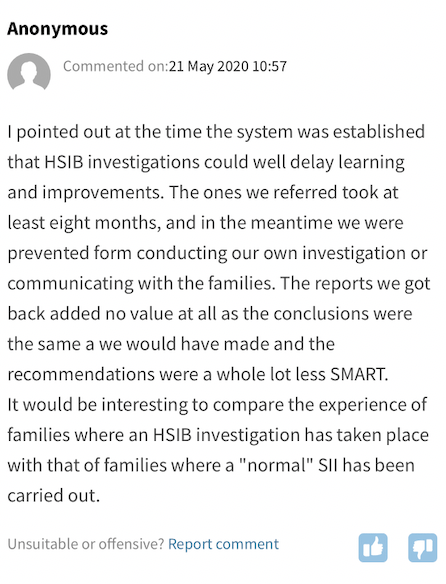
This is a comment left anonymously under the article in HSJ about the Coroner’s criticisms of HSIB in the Theo Young case. It seems that other trusts, unsurprisingly, may have had similar misgivings, lending further credence to the concerns currently being aired in the NHS England ET:
Dr Minh Alexander retired consultant psychiatrist 23 April 2023
Yesterday I reported on an issue that arose from a current Employment Tribunal against NHS England, in the context of the weakness of UK whistleblowing law.
This implied that such a disclosure did not fall under any of the following categories of qualifying disclosure:
“a)that a criminal offence has been committed, is being committed or is likely to be committed,
(b)that a person has failed, is failing or is likely to fail to comply with any legal obligation to which he is subject,
(c)that a miscarriage of justice has occurred, is occurring or is likely to occur,
(d)that the health or safety of any individual has been, is being or is likely to be endangered,
(e)that the environment has been, is being or is likely to be damaged, or
(f)that information tending to show any matter falling within any one of the preceding paragraphs has been, is being or is likely to be deliberately concealed.”
In response to this assertion, I posited how tampering with medical records might fall under the categories of “a breach of a legal obligation”, “endangerment of an individual’s health or safety” or “a crime”.
In this additional post, I now share an additional example of whistleblowing about medical records tampering which was recognised by an NHS England commissioned investigation to be a breach of legal obligations.
The whistleblowing took place at Avon and Wiltshire Mental Health Partnership NHS Trust (AWP) in 2012 and was reported by Community Care and by the BBC:
In February 2012, a group of social workers reported to the Wiltshire Council that they believed that false entries had been made to electronic patient records (RiO) at AWP.
It was alleged that “a number of social workers employed by Wiltshire Council but working in Avon and Wiltshire Mental Health Partnership Trust (AWP) that they had been instructed to falsify or alter service user records and/or that records had been amended by NHS staff without the knowledge of council employed staff.”
The Council investigated and found that nearly thirty social workers based in either the adult community, liaison or later life services of AWP shared these concerns.
The South of England Strategic Health Authority ie. NHS England, commissioned an investigation into the irregularities on the 28 May 2012, under DH guidance (2005) concerning the conduct of independent inquiries into mental health services, replacing paragraphs 33- 36 in HSG(94) 27 (LASSL (94)4).
The investigation terms of reference included a review of any breach of legislative requirements, and impact on safety, care, treatment, welfare, safeguarding, and risk assessment and management of patients.
The investigation team reported that they found a top down senior management culture focussed on meeting financial targets, which in turn middle managers translated into falsification of patient records to meet targets and avoid financial penalties:
“4.2.3 Both NHS and social care staff described working in a bullying and intimidating environment with a relentless focus on achieving targets, avoiding breaches and ‘staying green’ (the scorecard) and threats of fixed penalties being applied to team budgets for breaching targets. We were shown an email from a care team administrator to a social worker that confirmed a £3000 fine would be applied to the team for breaching a referral to assessment target for a single patient. The email went onto confirm that despite the fact that the social worker had recorded multiple telephone contacts with the client, the administrator had added a face to face contact visit to the social workers RiO diary to avoid the breach.”
The investigation concluded that most of the records falsification did not result in direct patient harm but work done to input data and manage performance diverted away from face to face clinical care.
Records also did not always give an accurate clinical contact history.
This is potentially of relevance to clinical risk assessment.
The investigators considered that there was no intention to defraud commissioners, only to survive. But that might not be a persuasive defence in law.
Importantly, the investigators noted that the records falsification at AWP was likely in breach of legal obligations because under the Data Protection Act 1998:
1) False data breached the accuracy principle of data protection
2) Covertly processing fabricated data breached fair processing principles.
AWP had also not taken adequate systemic measures to safeguard against unauthorised and unlawful personal data processing.
“5.5 The organisation is unlikely to be processing information in accordance with the Data Protection Act. Three specific breaches should be considered. Firstly in relation to the recording of data about ‘carers’ without their express knowledge or agreement of the individual concerned which does not satisfy fair processing requirements. Secondly as patient records contain entries and information that is incorrect it is questionable whether the records meet the accuracy principle Thirdly AWP should consider whether it is in breach of the requirement to take appropriate technical and organisational measures against unauthorised or unlawful processing of personal data.”
This is a copy of the investigation report into the records falsification, as disclosed by AWP via the What Do They Know FOI website, to a member of the public who identified themselves as a harmed patient:
So in short, these are more arguments as to why a concern that is raised about tampering with medical records is likely to be a qualifying disclosure under UK whistleblowing law, the Public Interest Disclosure Act (PIDA).
Let us hope that NHS England will in the longer term recognise the importance of protecting disclosures about medical records tampering, and acknowledge (once more) that tampering breaches a number of legal obligations.
Let us also hope that NHS England remembers that its own investigation at Avon and Wiltshire upheld that whistleblowing disclosures about medical records tampering amounted to disclosures about breaches of legal obligations…….which are a category of “qualifying disclosures” under the Public Interest Disclosure Act.
Dr Minh Alexander retired consultant psychiatrist 22 April 2023
UK whistleblowing law is very weak.
It offers no protection.
No one is legally required to proactively protect a whistleblower.
Not employers, not regulators nor other public bodies.
The law only entitles whistleblowers to claim for post hoc compensation after serious harm. Even then the odds of success are very slim and the compensation usually inadequate.
A whistleblower can be blameless, determined to be so, and yet still dragged through several years’ ordeal of disciplinary procedures, dismissal, litigation and end up out of pocket after paying legal fees. I know of such a recent case.
Those representing themselves as litigants in person have even worse outcomes.
A great weakness of UK whistleblowing law is the threshold and number of legal tests that whistleblowers face, which were explicitly set high to appease industry and disadvantaged workers when the law was originally drafted.
For whistleblowers, the law is a fragile chain of flickering fairy lights. Knock out any one of those lights and the case is lost.
A UK whistleblower has to make the right sort of disclosure (qualifying disclosure) and they have to make the disclosure in the right way to the right person or body, in the right circumstances, to qualify for protection (“protected disclosure”).
Lawyers make hay out of endlessly arguing about the niceties, and establishing a professional hegemony from specialist knowledge of ever-evolving case law.
How on earth is a litigant in person supposed to cope in this minefield, from the first critical step of framing their claim? One error and the fairy lights go out.
Take the first hurdle for whistleblowers: what is a qualifying disclosure under the law?
(1) In this Part a “qualifying disclosure” means any disclosure of information which, in the reasonable belief of the worker making the disclosure, tends to show one or more of the following—
(a)that a criminal offence has been committed, is being committed or is likely to be committed,
(b)that a person has failed, is failing or is likely to fail to comply with any legal obligation to which he is subject,
(c)that a miscarriage of justice has occurred, is occurring or is likely to occur,
(d)that the health or safety of any individual has been, is being or is likely to be endangered,
(e)that the environment has been, is being or is likely to be damaged, or
(f)that information tending to show any matter falling within any one of the preceding paragraphs has been, is being or is likely to be deliberately concealed.
(2) For the purposes of subsection (1), it is immaterial whether the relevant failure occurred, occurs or would occur in the United Kingdom or elsewhere, and whether the law applying to it is that of the United Kingdom or of any other country or territory.
(3) A disclosure of information is not a qualifying disclosure if the person making the disclosure commits an offence by making it.
(4) A disclosure of information in respect of which a claim to legal professional privilege (or, in Scotland, to confidentiality as between client and professional legal adviser) could be maintained in legal proceedings is not a qualifying disclosure if it is made by a person to whom the information had been disclosed in the course of obtaining legal advice.
(5) In this Part “the relevant failure”, in relation to a qualifying disclosure, means the matter falling within paragraphs (a) to (f) of subsection (1).”
Case law has evolved such that there are several strands about which whistleblowers are usually grilled by Tribunals and employers’ barristers.
Disclosure of information
The disclosure should contain information of “sufficient factual content and specificity”.
Nature of the worker’s belief
The worker should have a reasonable belief that the information tends to show one of the “relevant failures” and “is made in the public interest”;
Employers’ barristers try to attack via any and all of these angles.
For example, questioning of claimants about whether they made their disclosures with the public interest in mind.
Barristers may posit that this is as narrow as making a disclosure with the employer’s whistleblowing policy in mind, when the law does not even require employers to have a whistleblowing policy.
Another legal tactic is to ask claimants if they ticked a box on the ET application form to consent to their claim being shared with a regulator, on the premise that this demonstrates a public spirit. This question is naturally asked of claimants who do not tick the box.
Employers’ barristers may also question whether claimants’ disclosures fit the defined categories (a) to (f) under Section 43B of PIDA.
Imagine the shock that a lay person, especially those of limited resources and/or who are unrepresented, may experience after raising what most reasonable people would think is a public interest disclosure, only to discover that lawyers have a very particular meaning.
In the NHS, this is compounded by permissively written policies and procedures which on the face of it invite maximum disclosure because the NHS is a safety critical sector.
The national template whistleblowing policy for the NHS:
set by NHS Improvement (now absorbed into NHS England) is applied by many NHS bodies. It states:
“You can raise a concern about risk, malpractice or wrongdoing you think is harming the service we deliver/commission [delete as appropriate]. Just a few examples of this might include (but are by no means restricted to):
· unsafe patient care
· unsafe working conditions
· inadequate induction or training for staff
· lack of, or poor, response to a reported patient safety incident
· suspicions of fraud (which can also be reported to our local counter-fraud team [insert contact details])
· a bullying culture (across a team or organisation rather than individual instances of bullying).”
Crucially, the NHS national whistleblowing policy urges staff to err on the side of caution and to raise concerns even if they are not sure if the concern is proven:
“Remember that if you are a healthcare professional you may have a professional duty to report a concern. If in doubt, please raise it. Don’t wait for proof. We would like you to raise the matter while it is still a concern. It doesn’t matter if you turn out to be mistaken as long as you are genuinely troubled.”
The NHSI 2016 national policy was replaced in 2022 with the NHS England version:
This did not even specify what sort of concerns NHS workers could or should raise. Instead, this replacement policy states in bold letters:
“This policy is for all workers and we want to hear all our workers’ concerns”
All concerns? Remarkable.
But at the very end of the 2022 policy there is an appendix B which states:
“Making a ‘protected disclosure’
A protected disclosure is defined in the Public Interest Disclosure Act 1998. This legislation allows certain categories of worker to lodge a claim for compensation with an employment tribunal if they suffer as a result of speaking up. The legislation is complex and to qualify for protection under it, very specific criteria must be met in relation to who is speaking up, about what and to whom. To help you consider whether you might meet these criteria, please seek independent advice from Protect or a legal representative.”
Why is this caveat in the small print, especially after urging the workforce to spill all?
“Whistleblowing does not apply to personal grievances, including employment issues, which should be dealt with through internal organisational policies. It would generally be applied to:
• Concerns about unsafe patient care;
• Poor clinical practice or other malpractice which may harm patients;
• Failure to safeguard patients;
• Maladministration of medications;
• Untrained staff;
• Unsafe working conditions
• Lack of policies;
• A bullying culture;
• Staff who are unwell or stressed and not seeking help.
These types of concerns are sometimes referred to as ‘Protected Disclosures’ under the Public Interest Disclosure Act 1998.”
This would seem a reasonable list to most health service workers, who can appreciate that these are all matters which could affect the health and safety of patients.
But in the parallel world of litigation, it is far from straightforward, as I will discuss below.
NHS England’s contention that raising a concern about tampering with medical records is not whistleblowing
An ongoing employment tribunal against NHS England (or more specifically, the Healthcare Investigation Branch which is located within NHS England but overseen by NHS England and subject to its HR and governance systems), which I am currently observing, demonstrates how bewildering litigation can be for whistleblowers.
An experienced worker made a disclosure about unauthorised alterations of medical records.
To all healthcare professionals, this is an issue that sets off huge alarm bells on probity, patient safety, culture, safeguarding and a good many other matters.
But NHS England’s barrister questioned whether the matter amounted to a qualifying disclosure under whistleblowing law.
I struggle to see how a concern about tampering with medical records is not a health and safety issue.
Tampering with records may be done to cover up a care failure, which would fall under both the health and safety and concealment provisions of Section 43B PIDA.
It prevents learning from serious incidents, may allow unsafe practitioners to continue harming patients and impacts on trust in healthcare workers, which is an important part of safe care at a public health level.
Tampering with health records impacts on patients’ rights to seek legal redress for care failures and it can potentially obstruct regulatory activities and statutory Health and Safety provisions.
“Risks can relate to a wrongdoing, patient safety or malpractice which the organisation oversees or is responsible or accountable for. In a health setting, these concerns could include, for example:
patient-safety issues
patient-care issues
poor practice
unsafe working conditions
fraud (theft, corruption, bribery or embezzlement)
changing or falsifying information about performance
breaking any legal obligation
abusing authority
deliberately trying to cover up any of the above.”
“maintain securely an accurate, complete and contemporaneous record in respect of each service user, including a record of the care and treatment provided to the service user and of decisions taken in relation to the care and treatment provided;”
That is, maintaining the integrity of contemporaneous care records is a statutory, legal obligation.
Post hoc tampering with health records is likely to represent a failure of this legal obligation, and thus would bring a disclosure about such wrongdoing under the category of a legally “qualifying disclosure”.
For completeness, this is CQC’s guidance to the staff of provider bodies who wish to whistleblow to the CQC. It advises health and care workers that whistleblowing can encompass a wide range of issues: “The concerns don’t have to be restricted to people using the service. Whistleblowing can cover any risk, malpractice or wrongdoing that affects patients, the public, other staff or the provider itself.”
Regardless of whether NHS England prevails in its above legal argument at the ET, it will need to explain to the NHS workforce, patient groups, fellow regulators and parliament, why the most powerful NHS body does not accept that raising a concern about tampering with medical records is whistleblowing.
NB If there are any lawyers reading this blog who think I have got anything wrong or left anything out in this important matter, please do let me know. Best wishes.
Related miscellaneous
NHS England itself has not responded to me yet about its practice of its General Counsel routinely attending operational meetings about the management of internal whistleblowing at NHS England, and whether the affected NHS England whistleblowers will be allowed as a matter of policy to access meeting minutes as personal data. This was first raised in June 2022.
On a similar theme, NHS England through its representatives was supposed to give me electronic access to the case bundle from the above ET, as an observer. I understand that NHSE informed the Tribunal that it did so yesterday morning. However, I received no correspondence from NHSE with the necessary link to give me access, and will take the matter up again with the Tribunal next Monday when the hearing resumes.
It was noteworthy that NHS England’s barrister elected not to question several of the claimant’s senior witnesses, even with a caveat by the barrister that this did not mean that NHSE agreed with their evidence or accepted it.
This further post shares a 2012 investigation report commissioned by South England Strategic Health Authority (the nascent NHS England in other words, which became fully operational on 1 April 2013), on records falsification by a mental health trust, Avon and Wiltshire Partnership (AWP). This investigation concluded that AWP had likely been in breach of legal obligations as a result of falsifying medical records to avoid financial penalties for not meeting performance targets. It follows from this finding that the whistleblowers who made disclosures about the records falsification had by implication raised qualifying disclosures under the Public Interest Disclosures Act.
RELATED ITEMS
We have seen examples of NHS regulators not only failing whistleblowers who approach them as Prescribed Persons under PIDA, but their own regulatory staff who whistleblow.
There has been the case of Mr Shyam Kumar at the Care Quality Commission, where the CQC behaved in the most extraordinary manner. It defamed him, unfairly dismissed him, abused its power as a regulator to (unsuccessfully) seek adverse information about him that could be used in ET proceedings and then maintained a narrative throughout the ET hearing that he was a bully, which was rejected by the ET.
We have also seen a case of race harassment by senior NHS England managers as well as whistleblowing detriment in the case of Ms Cox.
The Tribunal judgment noted that NHS England’s submission in this case focussed on uncoupling detriment from protected acts:
“the respondent’s case focusses on causation and whether the treatment complained of arose from the protected acts or protected disclosures”
This illustrates that where employers think they have lost the battle on disproving protected disclosures, they move on to the next fairy light, which is to disprove a causal link between protected disclosures and detriment.
It is a shabby trick to play on the NHS workforce, to invite whistleblowing disclosures through fine words, and then waste public money on tripping staff up and blocking them with a massive, well-oiled legal machinery and expensive barristers.
What is more, current UK whistleblowing law enables this state of affairs.
Dr Minh Alexander retired consultant psychiatrist 21 April 2023
Care Quality Commission Regulation 12 provides a facility for unsafe provider organisations to be investigated for failures to provide safe care and ultimately to be prosecuted.
Like many others, I fail to see the utility of fining cash strapped public bodies, which only hurts patients as the end users.
However, the regulation exists and CQC is obliged to apply it where appropriate and importantly, to investigate where there is evidence of organisational failure.
University Hospitals Birmingham NHS Foundation Trust staff have been whistleblowing to UHB management and to the CQC about unsafe levels of staffing for a long time.
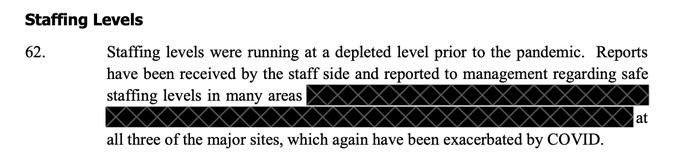
UNISON sent a dossier to CQC in July 2021which revealed that UHB staff across all three sites had been raising concerns with trust managers about “depleted” levels of staffing since before the pandemic.
CQC did not publicly acknowledge the existence of this dossier.
The BBC revealed its existence in recent months as part of the coverage of the UHB scandal.
CQC claimed that it undertook the inspection because:
“We conducted an urgent, unannounced inspection of the full medical care core service due to a number of concerns raised by patients and their families around the care and treatment they had received.”
The reports from this latest CQC inspection was published on 19 April 2023.
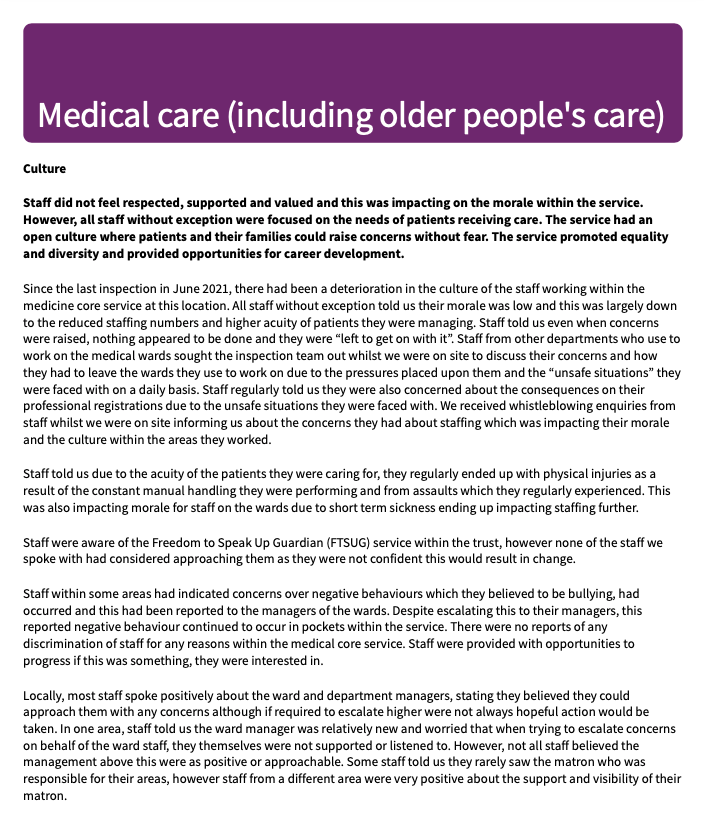
The report from the Good Hope Hospital inspection was damning on management failure to respond to concerns, in that staff had stopped using the internal route for raising concerns because of zero expectation that managers who act upon them:
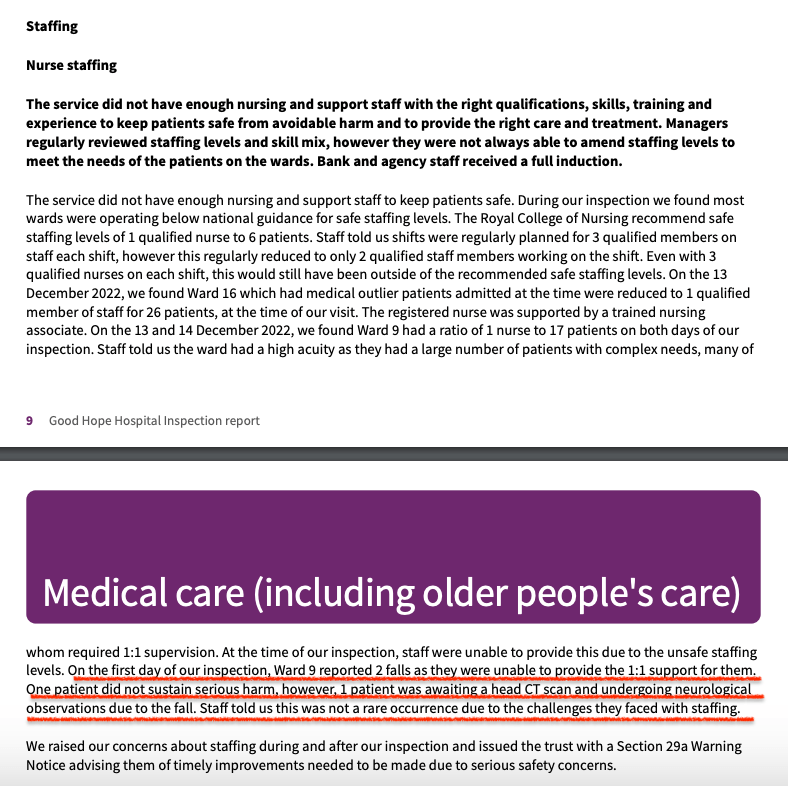
Deeply concerning was a CQC finding of very unsafe levels of staffing.
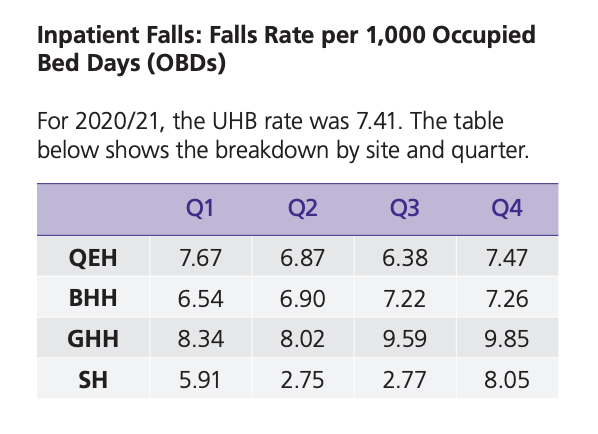
Related to this, patients suffered falls and suffered injuries DURING the CQC inspection:
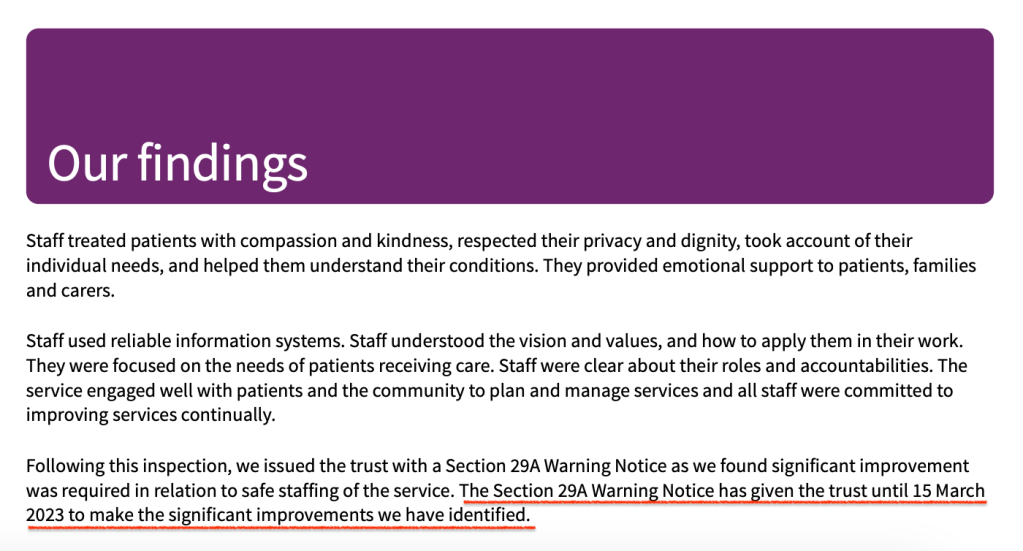
The CQC issued a Section 29A improvement notice with respect to the unsafe levels of staffing:
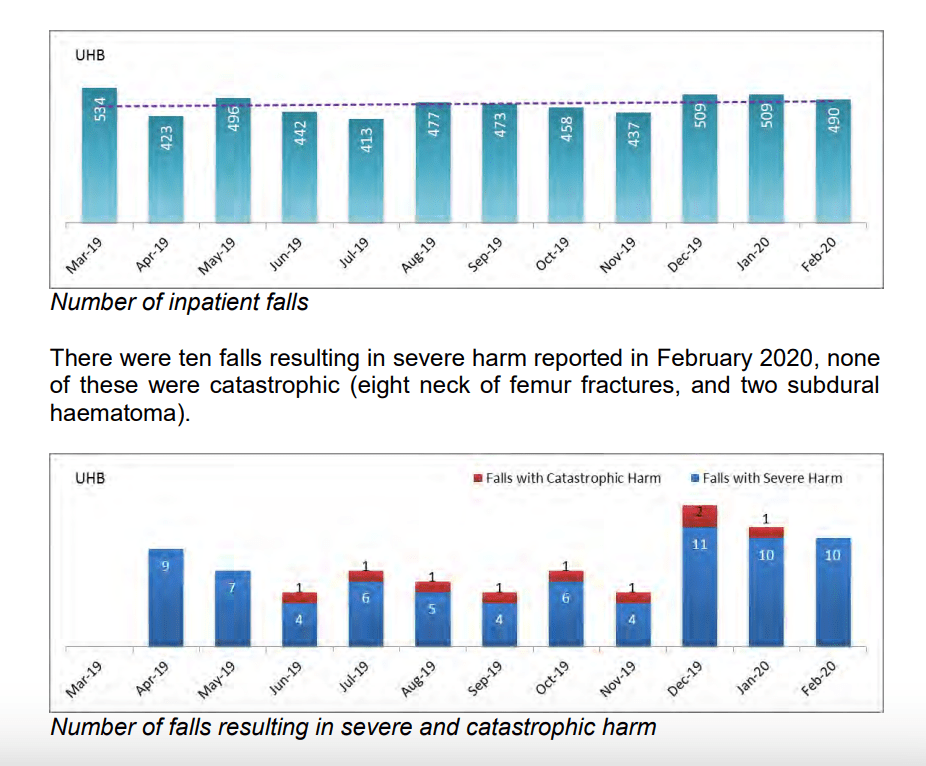
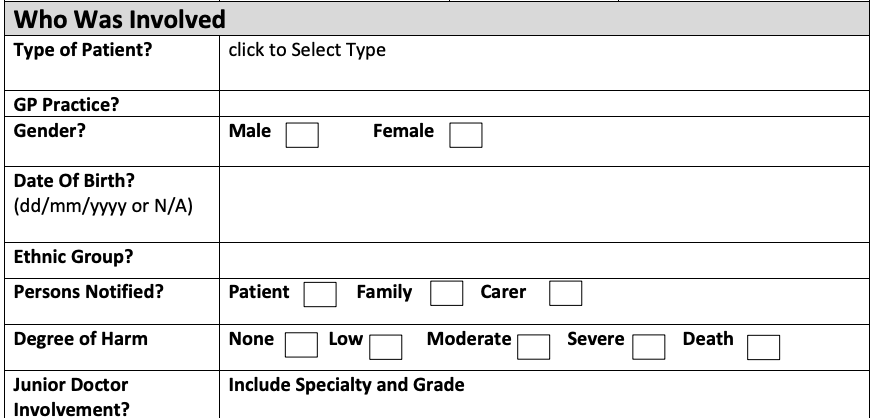
The former NHS England Serious Incident Framework used this categorisation for degrees of harm:
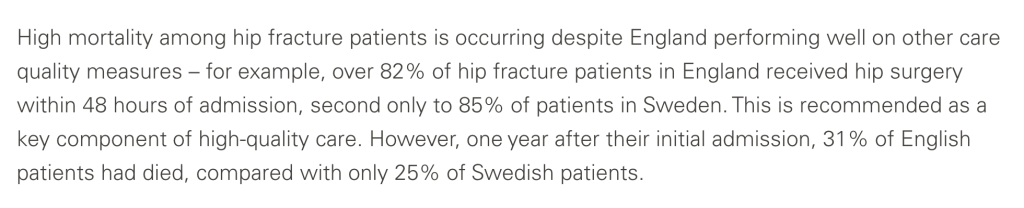
Whilst neck of femur fractures may not result in immediate death, and may therefore sometimes receive a short term categorisation of “severe” rather than “catastrophic” harm, such fractures in older people may trigger a downwards spiral that eventually leads to death:
Given that there have been both longstanding understaffing at UHB AND evidence of regular, serious harm from falls, should the CQC be investigating UHB for Regulation 12 breaches, and not just issuing an improvement notice?
Indeed, the falls related injuries are not the only evidence of possible Regulation 12 breaches at UHB.
With the issue of the CQC warning notice, are we witness more to spectacle, than meaningful regulatory action?
Have harmed UHB patients and their families tried to raise concerns with CQC, but been fobbed off with the classic but misleading CQC refrain “We have no remit to investigate individual complaints”?
Reframing concerns as “complaints” blocks whistleblowers, patients and families, and CQC often does not disclose that it does have a remit to investigate incidents of avoidable harm under Regulation 12.
Dr Minh Alexander retired consultant psychiatrist 17 April 2023
A key matter which triggered BBC Newsnight reportage of the governance failings at University Hospitals Birmingham NHS Foundation Trust was the scandalous whistleblowing case of Tristan Reuser, ophthalmic surgeon.
Mr Reuser was seriously mistreated and unfairly dismissed.
One of the key issues was that he was unfairly suspended based on an unfounded allegation that the ET determined that Clive Ryder Deputy Medical Director and David Rosser Medical Director, later Chief Executive, knew or ought to have known was false.
A related, central issue was that the trust failed to show Tristan Reuser correspondence from an NHS agency called the National Clinical Assessment Service, NCAS (now called Practitioners Performance Advice, PPA), which has a statutory role in advising employers on the suspension of and disciplinary action against doctors.
The withheld correspondence would have revealed that his suspension was triggered on a false premise.
The MHPS rules of procedures require NHS employers to show referred doctors all correspondence relating to their case.
UHB not only failed to show Tristan Reuser the NCAS correspondence that he was entitled to see, but when Tristan Reuser asked for his personal data, UHB failed to disclose the NCAS correspondence.
The resistance to share the NCAS correspondence persisted into Employment Tribunal proceedings when UHB failed to disclose material documents even in the legal disclosure process, incurring the judge’s displeasure and a £20,000 costs award against the trust.
The effect of UHB’s secrecy was that misleading information supplied to NCAS by Clive Ryder UHB deputy medical director, to justify Tristan Reuser’s suspension, was hidden.
How could this have happened in a process that is supposedly safeguarded?
An MHPS “Designated Board Member” was allocated to Tristan Reuser’s case: Jon Glasby, non executive director, who was appointed as the UHB Independent Senior Director under Jacqui Smith’s tenure.
The Designated Board Member’s role in MHPS is to ensure fair play and that the accused doctor is not “incarcerated” by default through an excessively drawn out process.
“The Chairman of the Board must designate a non-executive member “the designated member” to oversee the case and ensure that momentum is maintained.”
“Role of designated Board member
13. Representations may be made to the designated Board member in regard to exclusion, or investigation of a case if these are not provided for by the NHS body’s grievance procedures. The designated Board member must also ensure, among other matters, that time frames for investigation or exclusion are consistent with the principles of Article 6 of the European Convention on Human Rights (which, broadly speaking, sets out the framework of the rights to a fair trial).”
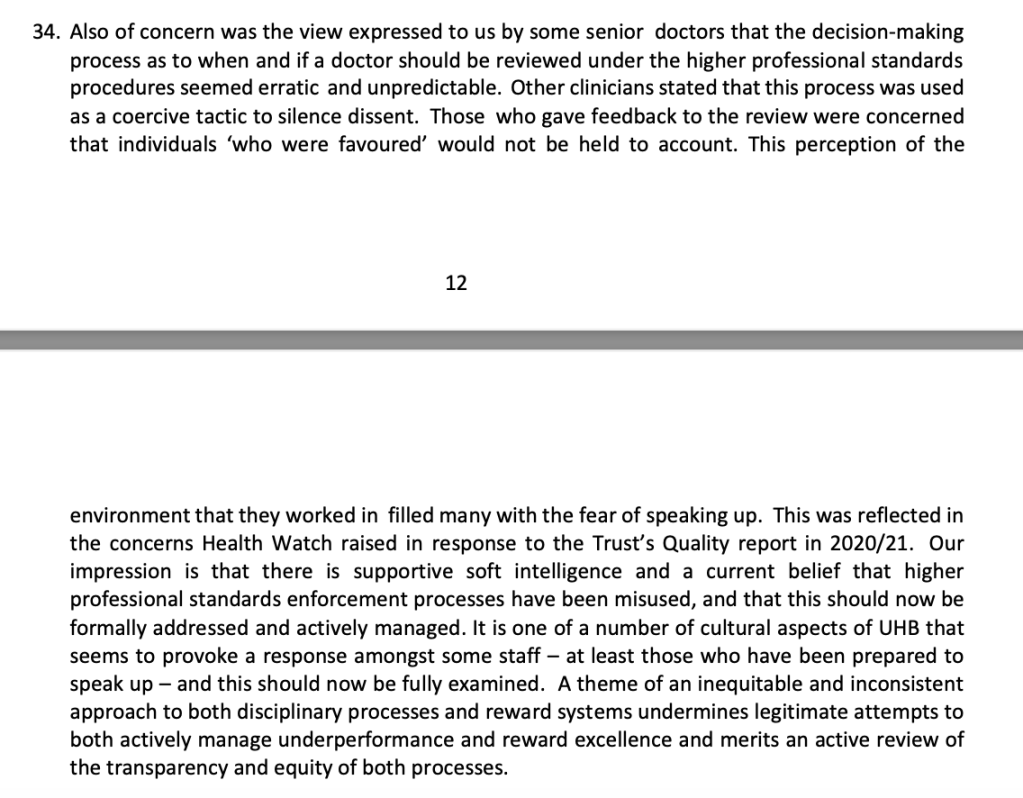
During his phase one investigation at UHB, Mike Bewick was told that the UHB consultant body had raised concerns with the UHB board about cronyism at all levels of medical management.
He was also told of staff perceptions of arbitrary discipline at the trust.
As a former Deputy Medical Director himself, he would surely understand the requirements of MHPS and the significance of any breaches of procedure.
In his report, Bewick stated that he considered that the findings of the Employment Tribunal in Reuser v UHB and the GMC’s warning to David Rosser called into question David Rosser’s fitness for a senior leadership role:
“31. In our opinion, statements made by the GMC and the Employment Tribunal were extremely serious and brought into question DR’s suitability for senior leadership roles.”
It follows that Rosser’s critical actions as a medical director, in suspending and disciplining doctors, should also be reviewed.
As part of Bewick’s investigation, could he not have called up data on UHB’s use of MHPS and adherence to the rules of procedure?
There was anecdote in Bewick’s report about this, but no hard data, making it inconclusive:
Dragging out the review process may benefit the UHB gravy train but not staff and patients.
In the meantime, I have asked the interim UHB Chair to consider some basic, urgent checks.
I have also suggested that when MHPS is applied at UHB, doctors should be clearly informed of their right to access case correspondence.
BY EMAIL
Yve Buckland
Interim Chair
University Hospitals Birmingham NHS Foundation Trust
17 April 2023
Dear Yve,
Failures of MHPS process
I do not know how familiar you are with the NHS conduct/capability process for disciplining doctors, Maintaining High Professional Standards in the Modern NHS (MHPS), but it has rules of procedure with supposed safeguards.
These failed entirely in the case of Tristan Reuser, UHB whistleblower.
One of the MHPS rules is that doctors who are subject to these procedures must be allowed to see all correspondence about their case, to fully enable them to reply to all allegations.
UHB not only failed to ensure this access to case correspondence, but persistently withheld crucial correspondence from Mr Reuser. This withheld correspondence showed that Clive Ryder Deputy Medical Director gave misleading information to an NHS body the National Clinical Assessment Service, as part of the procedure of triggering suspension under MHPS rules. This was later criticised by the Employment Tribunal as “beyond inaccurate”.
Was it really the case that the then deputy medical, the medical director, the director of human resources and the MHPS designated board member who should have ensured fair play (Jon Glasby), all experienced directors, were not aware that Mr Reuser should have been given sight of his MHPS case correspondence?
My concern now is how many other UHB doctors have been disadvantaged in this way?
How many staff are currently being disadvantaged in this way?
This document lists the many alleged failings that may land a doctor in hot water. But it does not say much about the organisation’s responsibilities to treat an accused doctor fairly.
Importantly, I cannot see that the policy says anything about an accused doctor’s rights to see all case correspondence.
The UHB policy cross references the national MHPS framework but gives no link.
It would empower staff if UHB actively gives access to the detailed rules of procedure. MHPS is arguably a contractual matter, and a matter of rights.
The national framework is a lengthy document and the information about the right to see case correspondence is brief and easily missed.
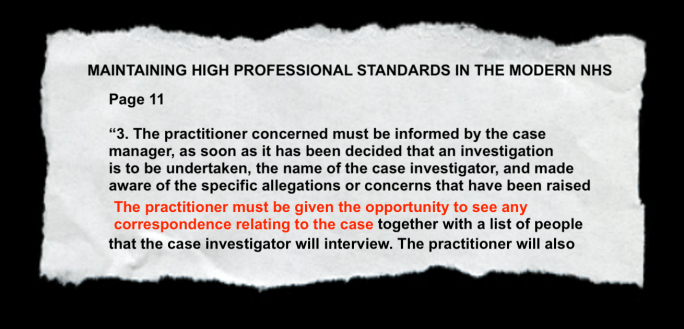
Page 11 of the national MHPS framework:
“3. The practitioner concerned must be informed in writing by the case manager, as soon as it has been decided, that an investigation is to be undertaken, the name of the case investigator and made aware of the specific allegations or concerns that have been raised. The practitioner must be given the opportunity to see any correspondence relating to the case together with a list of the people that the case investigator will interview. The practitioner must also be afforded the opportunity to put their view of events to the case investigator and given the opportunity to be accompanied.”
It would be helpful if the local UHB policy spells out clearly the right of access to case correspondence.
Does UHB need to rapidly audit adherence to basic MHPS standards, based on audit standards co-produced with staffside, to ensure that no further serious harm to individuals is currently unfolding, and that any other serious harm that has taken place besides Reuser v UHB is corrected?
There was a delay in UHB responding, despite my chasing. This was later explained as a switch between email accounts by the interim Chair which led to some email being unnoticed.
In the meantime, David Melbourne the CEO of Birmingham and Solihull ICB emphasised to local councillors at the Joint Health Overview and Scrutiny Committee that the media had got their figures wrong.
This was very distasteful given that the false information had been supplied by UHB.
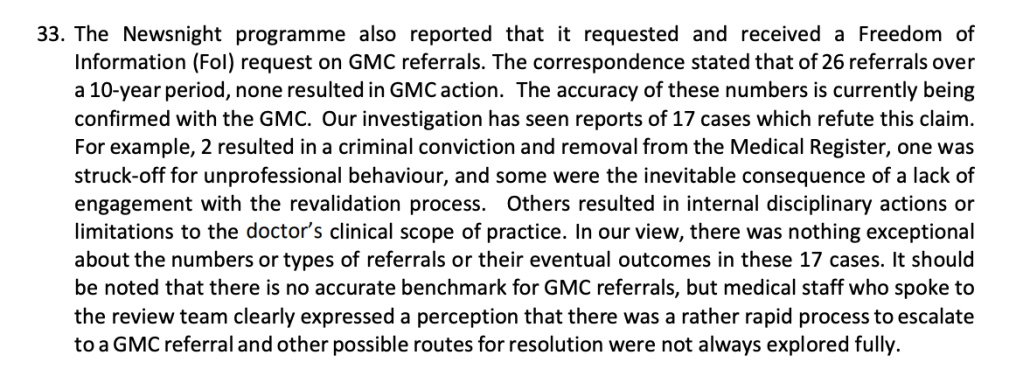
Remarks on page 12 of Bewick’s report dovetail with the tone of Melbourne’s comments to JHOSC:
It is perplexing as to why Bewick focussed on the cases that DID result in GMC action, but omitted to discuss the cases which did NOT result in any GMC action.
One would have thought that all cases would have been counted in any check of accuracy.
And it is the cases that did not result in any GMC action that were of most concern in terms of UHB’s governance.
Yesterday, UHB finally responded through its Chief Legal Officer to my requests for the record to be corrected.
This is the response:
RESPONSE BY DAVID BURBRIDGE 13 APRIL 2023
Dear Dr Alexander
Please find below a response to your email to Dame Yve Buckland, dated 29 March.
For the period 1 April 2012 to 31 March 2022:
– How many doctors the trust referred to the GMC ?
At UHB (prior to and post the merger with Heart of England NHS Foundation Trust (“HEFT”)) there were 22 referrals At HEFT (prior to the merger with UHB) there were 16 (3 of these are dated just after the date of merger 1.4.2018, but are attributed to HEFT – we believe this may be because there was contact before the change of RO)
– How many of these referrals were signed off by the medical director?
At UHB 14/22, the remainder were signed off by Deputy Medical Director or acting Medical Director At HEFT 6/16 were signed off by the Medical Director and the remainder were by Deputy or Associate Medical Directors.
– How many of these referrals resulted in no further action by the GMC?
UHB – 4 were concluded at triage, 7 were investigated and concluded with no action, 11 were subject to advice, warning, undertakings, suspension or erasure HEFT – 3 were concluded at triage, 4 were investigated and concluded with no action, 9 were subject to advice, warning, undertakings, suspension or erasure
– How many doctors died whilst under GMC investigation or monitoring? None
– How many doctors died by suicide whilst under GMC investigation or monitoring? None Regards
David Burbridge Chief Legal Officer
That is to say, there were a total of 38 GMC referrals in the ten year period, 18 of which were either dropped (or “concluded” as UHB put it) at triage or which resulted in no further action by the GMC.
For all the protestations and smoke and mirrors, we still have best part of a score of doctors who were possibly referred to the GMC when this was apparently not essential.
GMC referrals are a serious business. Could alternatives have sufficed? Were any of these doctors referred out of careless misuse of power, or as a punishment or intimidation, to silence them?
Any further reviews of UHB should look carefully at these eighteen GMC referrals.
In the meantime, I have asked UHB to disclose how many of these eighteen GMC referrals which were dropped at triage, or which resulted in no further action by the GMC, were signed off by either David Rosser or Clive Ryder.
This is because both of these senior doctors were criticised by the Employment Tribunal for their actions in the whistleblowing case of surgeon Tristan Reuser, for acts which included supplying inaccurate information to NCAS (now PPA), suspending Mr Reuser on a basis which they knew or ought to have known was unfounded, and misleading the GMC in the course of referring Mr Reuser.
It is also because David Rosser made a GMC referral on a whistleblower, Mr Reuser, which ended in no further action being taken by the GMC.
It is also because of a concern raised by the consultant body about cronyism at all levels of medical management at UHB, and because of a reported staff perception of arbitrary application of discipline.
“It became clear that both Dr Ryder and Dr Rosser knew, or ought to have known, that it was unfounded before the exclusion was even put in place. That only came to light from documents which had not been disclosed but which were obtained by Mr Reuser through a subject access request (SAR).
No action was taken against Mr Negi in relation to what appeared to be a false allegation. This, coupled with my more detailed findings in relation to the exclusion earlier in this judgment, potentially suggests a level of bias and collusion at a senior management level against the claimant. Again, at the very least, it suggests a very serious lack of due care and attention to an important matter.”
“Dr Rosser was not sufficiently independent. There is a strong suspicion of bias given his approval of the exclusion on grounds he ought to have known were false. This appears further confirmed by the omissions and unjustifiably strong language of the GMC referral.”
UHB may object to my enquiry on grounds of personal data and confidentiality.
But the public interest and the seniority of the individuals in question are counter-arguments against such objection.
And for genuine culture change, as opposed to the PR and news management that NHS England and its hangers on will throw at this situation, truth and transparency are a pre-requisite.
Dr Minh Alexander retired consultant psychiatrist 11 April 2023
Mike Bewick’s rapid review of clinical safety at University Hospitals Birmingham NHS Foundation Trust was strangely silent on patient complaints, and so were the related statements by the external reference group and the Chair of Healthwatch Birmingham:
Consequently, I asked Healthwatch Birmingham if it collated and published data on concerns and complaints received from the public about UHB.
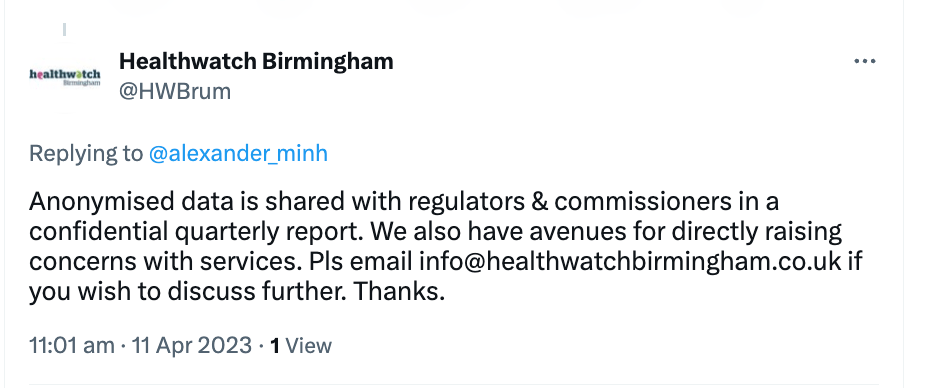
The response was a little reluctant, but Healthwatch Birmingham eventually revealed that it did, and that this data was sent to regulators and commissioners in a confidential, quarterly report.
I have now written to Healthwatch Birmingham’s Chair to ask that the data relating to UHB is transparently published in view of the great public interest.
Frankly, such data should be routinely published in view of Healthwatch’s purported role as champion of the public interest.
LETTER TO RICHARD BURDEN, CHAIR OF HEALTHWATCH BIMRINGHAM
BY EMAIL
Richard Burden
Chair of Healthwatch Birmingham
11 April 2023
Dear Richard,
Public access to complaints and concerns data about UHB that is held by Healthwatch Birmingham
I asked Healthwatch Birmingham via a Twitter conversation if it collated data on concerns and complaints from the public about local NHS services, with particular respect to UHB, for obvious reasons.
HW Birmingham initially directed me to the online feedback page of its website:
When I asked about correspondence received by HW Birmingham from the public regarding complaints and concerns, and whether this generated any summarised data and reports, HW Birmingham replied that correspondence would not be published because it was confidential.
After I pressed the point about summarised data, HW Birmingham indicated that anonymised data about concerns received is sent to regulators and commissioners in quarterly reports, which are confidential.
“Anonymised data is shared with regulators & commissioners in a confidential quarterly report. We also have avenues for directly raising concerns with services. Pls email info@healthwatchbirmingham.co.uk if you wish to discuss further. Thanks.”
I wonder if in view of the clear and current public interest in University Hospitals Birmingham NHS Foundation Trust, and the extraordinary omission of any patient complaints data from Mike Bewick’s phase one rapid review on clinical safety at UHB, whether Healthwatch Birmingham should now publish its anonymised data on all concerns and complaints received about UHB.
I can see no objection on grounds of confidentiality and privacy if the data is anonymised and aggregated.
A series of such data going back over years would be valuable in helping to set the current concerns about UHB’s culture, clinical performance and safety into context.
Furthermore, Healthwatch Birmingham’s dataset can be argued to be a more independent dataset that has not been controlled by the UHB board, and may have added value in this respect.
With best wishes,
Minh
Dr Minh Alexander
Cc
Birmingham and Solihull Joint Health Overview and Scrutiny Committee
The Parliamentary and Health Service Ombudsman triggered the multiagency Emerging Concerns Protocol in August 2022 because of concerns about poor culture, leadership and lack of learning from complaints and incidents at UHB.
PHSO expected to contribute to Bewick’s review but claimed it had been excluded, and this revelation was broadcast by BBC Newsnight. The transcript of Newsnight’s interview with Rob Behrens can found here:
Extraordinarily, Bewick’s rapid review of UHB safety indeed omitted any mention of evidence from PHSO or of the PHSO’s concerns.
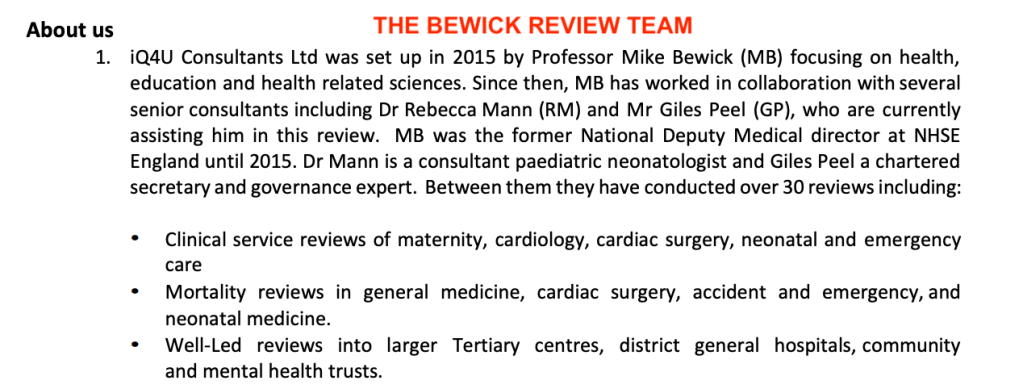
Bewick and his small crew of fellow investigators, a paediatrician and a “chartered secretary and governance expert” also did not mention patient complaints in their report.
Is this because raising the spectre of patient complaints would inevitably remind the public and NHS staff of the missing PHSO data?
How can a report on clinical safety ignore patient complaints about clinical care?
Astonishingly, despite ignoring this core data on patient experience and outcomes, both from trust records and from the PHSO, Bewick and co concluded that UHB was “safe” overall.
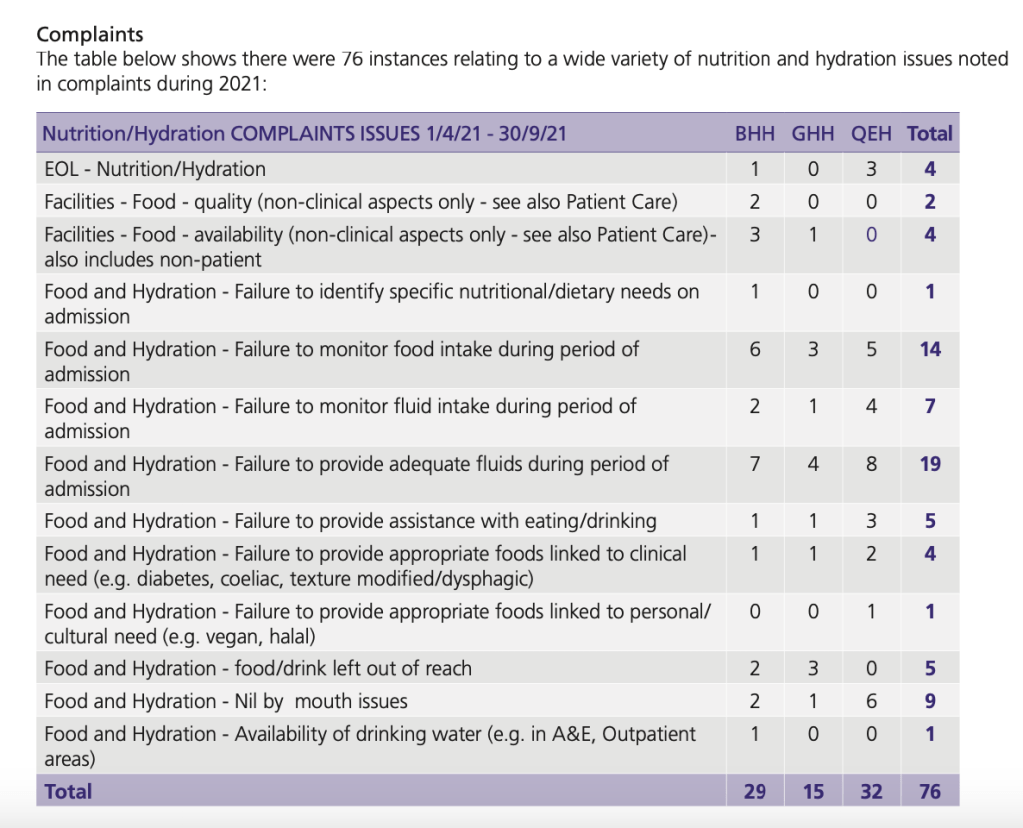
But under the subject of “Improving nutrition and hydration”, the trust did reveal more details of relevant complaints.
As you can see from the above table, these included failures of very basic care such as not monitoring food or fluid intake, not providing assistance with eating and drinking and leaving food and drink out of reach.
The UHB complaints about hydration and nutrition are consistent with this week’s news coverage. UHB families’ and patients’ reported food and drink being left out of reach and patients being left in their own waste:
With those caveats in mind, the data published suggested that complaints about clinical care comprised about half of the complaints.
YEAR
Total number of complaints from patients
% of complaints that related to clinical care
2013/14
956
52.3% (n = 500)
2014/15
1044
51% (n = 533)
2015/16
1075
48.5% (n = 522)
2016/17
949
41.5% (n = 394)
Looking at an overlapping and better-defined dataset from NHS Digital, data on written complaints in the English NHS, shows that complaints about clinical treatment accounted for less than a third of complaints:
YEAR
TOTAL NUMBER OF COMPLAINTS ABOUT CLINICAL TREATMENT
% OF ALL COMPLAINTS THAT WERE ABOUT CLINICAL TREATMENT
2015/16
59,678
32.0%
2016/17
51,145
26.7%
2017/18
48,904
26.2%
2018/19
53,084
27.5%
2019/20
53,018
27.1%
2020/21
40,854
26.9%
A proper interrogation of UHB’s complaints data and an examination of UHB’s response to complaints is needed.
Journalists might be interested to pursue the records relating to this event in 2021/22, as described in the foreword by David Rosser ex UHB CEO, in the trust’s quality account for that financial year:
“A wide range of omissions in care were reviewed in detail during 2021/22 at the Executive Care Omissions Root Cause Analysis (RCA) meetings chaired by the Chief Executive. Cases are selected for review from a range of sources including serious incidents, serious complaints, IT incidents, infection incidents and cross-divisional issues.”
Surely Bewick could hardly have been hampered by poor data systems as UHB’s former CEO and current CMO are ardent fans of digital health and data.
Rosser’s foreword in the 2021/22 proclaimed:
“Data quality and timeliness of data are fundamental aspects of UHB’s management of quality. Data is provided to clinical and managerial teams as close to real-time as possible through various means such as the Trust’s digital Clinical Dashboard. Information is subject to regular review and challenge at specialty, divisional and Trust levels by the Clinical Quality Monitoring Group, Care Quality Group and Board of Directors for example.”
The fact that Bewick was prepared to declare UHB safe without any evident discussion of UHB complaints data suggests two possibilities.
Either he decided it would be unfavourable to examine or report on complaints, or he did not consider patient experience or patient voice important when assessing patient safety.
Either option would suggest he should not be directing the UHB reviews.
And who directed Bewick?
It strikes me that the only NHS England or the Department of Health would have the power to ensure the exclusion of PHSO’s evidence from Bewick’s review.
Such high-level interference only additionally points to the need for a judge led inquiry with powers to compel evidence, as well as to protect witnesses and ungag silenced staff and former staff.
I think we should brace for more misdirection.
UPDATE 12 MAY 2023
I obtained data on the number of concerns raised by the public with Birmingham and Solihull Healthwatch. The data shows marked and continuing escalation beginning in 2021. Healthwatch disclosed under FOIA that it started meeting with the CQC on the basis of this sharp escalation in concerns and that these meetings continue:
I have sent the Healthwatch data to Bewick and suggested that he should examine and report on UHB’s patient complaint data, with both quantitative and qualitative analysis.
RELATED ITEMS
This is a statement of 4 April 2023 by the external reference group on Bewick’s reviews, which criticised some of the gaps in Bewick’s report:
However, this statement also did not mention the PHSO’s exclusion from Bewick’s review or the absence of any reference to patient complaints.
The latter is a little surprising given that Richard Burden former Labour MP is the current Chair of Healthwatch Birmingham and Solihull and a member of this external reference group.
A statement by Burden on 28 March mentioned the PHSO but not Bewick’s omission of patient complaints.
This post shares FOI data which showed that UHB and the ICB colluded to give a false impression that David Rosser had left UHB when he in fact remained an employee of the trust, and was just temporarily parked at the ICB, answering to the ICB’s CEO.
By Dr Minh Alexander retired consultant psychiatrist 6 April 2023
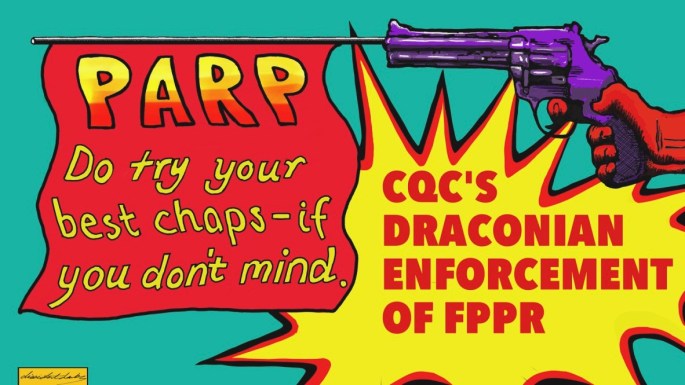
Summary: CQC has once more given scant regard to Employment Tribunal findings of gross whistleblower reprisal in the case of Dr Ambreen Malik and found a provider organisation, Cygnet Health Care, compliant under CQC Regulation 5 Fit and Proper Persons. CQC continues to make claims that it cannot make judgments about the fitness of individuals, and makes unsustainable regulatory judgments about process without taking into account the character of individuals of concern. CQC steadfastly and disingenuously claims that it has no remit to assess the fitness of individuals, despite Regulation 5 requiring that directors are of “good character”. It is also despite the fact that CQC’s own internal guidance states clearly that CQC has powers to take action against providers who have unfit directors, which of course is predicated on CQC making an assessment of individual fitness. CQC also provides almost no details about how it reaches its FPPR decisions, conveniently making them much harder to challenge.
Introduction and background
Two years ago I referred Cygnet directors who had been seriously criticised for harming a whistleblower to the Care Quality Commission under CQC Regulation 5 Fit and Proper Persons (FPPR).
Under this regulation, the CQC has powers to ensure that a provider has satisfactory processes for ensuring that its directors are Fit and Proper Persons.
The CQC has typically manipulated matters to allow board members of regulated bodies to evade accountability for serious wrongdoing.
It has done so by claiming that it has no remit to assess if individual directors are Fit and Proper Persons.
Instead, CQC claims it can only look at processes.
This is of course arrant nonsense. If for example, a regulated organisation appoints a freshly convicted serial killer to its board, even CQC might be forced to admit that based on an assessment of the individual, the provider was in breach of FPPR.
CQC Regulation 5 demands that directors must be of “good character”:
“The requirements referred to in paragraph (2) are that—
the individual is of good character,
the individual has the qualifications, competence, skills and experience which are necessary for the relevant office or position or the work for which they are employed,
the individual is able by reason of their health, after reasonable adjustments are made, of properly performing tasks which are intrinsic to the office or position for which they are appointed or to the work for which they are employed,
the individual has not been responsible for, been privy to, contributed to or facilitated any serious misconduct or mismanagement (whether unlawful or not) in the course of carrying on a regulated activity or providing a service elsewhere which, if provided in England, would be a regulated activity, and
none of the grounds of unfitness specified in Part 1 of Schedule 4 apply to the individual.”
Moreover, CQC’s own internal guidance shows that CQC is perfectly aware that it can use other regulations to force the removal of unsuitable provider directors, should it wish to.
“It is not the responsibility of CQC to ensure fitness although we can take action against the provider if we believe an unfit person to be in a directorship position.”
That is the key issue. Does CQC wish to?
Current media interest in CQC’s handling of FPPR and the UHB scandal
CQC’s disgraceful handling of FPPR is back in the full glare of publicity because the controversial investigator for the UHB scandal Mike Bewick has omitted to examine UHB’s much-criticised FPPR process in his phase one review of UHB.
“There are also several gaps in the report including the lack of recommendation resulting from the conflicting CQC reports. We must be granted access to previous documents such as the Fit and Proper Person Review (FPPR) which have not been shared. Releasing these reports and details of the process and people involved in commissioning and carrying them out is important to help ascertain any conflicts of interest, whether decisions made have contributed to the propagation of UHB’s toxic culture, and whether these amount to a ‘cover up’
Bewick’s omission of FPPR issues from his review relied on a false premise.
Bewick claimed that he did not request a copy of UHB’s still secret FPPR investigation or investigate UHB’s handling of FPPR because it was not within the scope he had been given:
Unsurprisingly, Bewick kicked that can down the road.
In this political backdrop, another astonishing but fully predictable CQC failure on FPPR has concluded in the whistleblowing case of Dr Ambreen Malik at Cygnet Health Care.
CQC’s contention that Cygnet is compliant with FPPR
After I referred the relevant Cygnet directors to CQC under FPPR in the light of the extremely critical judgment against Cygnet for whistleblower reprisal, the CQC delayed and justified the delay because Cygnet had appealed against the ET.
During this time, thousands of Cygnet patients remained potentially exposed.
Only after lengthy legal proceedings concluded did CQC wrap up the FPPR process.
If CQC was concerned about patients, it would have independently reviewed Cygnet’s compliance with Regulation 5 without delay, and taken the approach that it would update any assessment if new information emerged.
In the UHB matter, CQC found UHB compliant with Regulation 5 but added that it would “reserve the right to review the case if further information is presented to the CQC”.
When it suits, in the pursuit of protecting the powerful, the arbitrary CQC will do as it pleases.
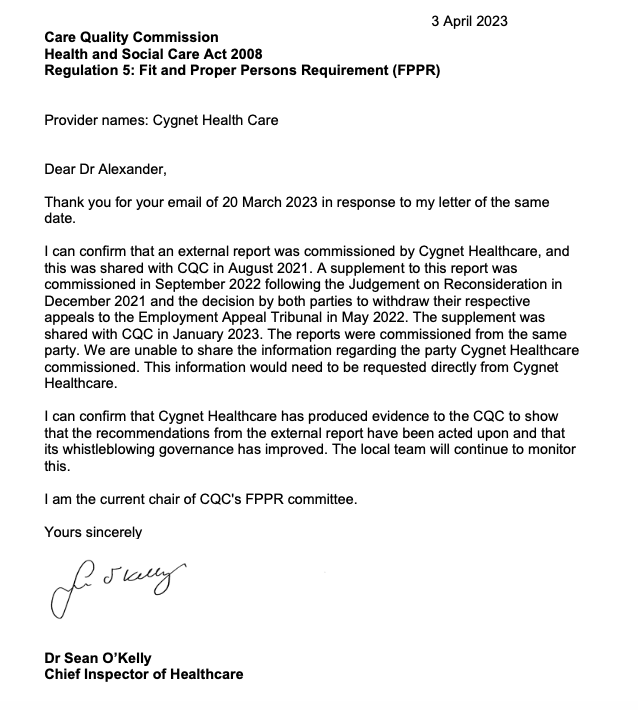
The letter came from CQC’s latest Chief Inspector of Hospitals, Sean O’Kelly, and ended with the signature CQC equivalent of shutting the door in a correspondent’s face:
“This concludes CQC’s review of Cygnet Health Care under this regulation, as well as our correspondence with you on the application of Regulation 5 to all information you supplied.”
For the sake of Dr Malik’s privacy I am not going into details, but the shocking disparity between CQC’s inaction and indifference, and everything that she has suffered is truly unforgivable.
Also, with impeccable timing CQC chose to shut down this Cygnet FPPR in the middle of the five week criminal trial of staff from Whorlton Hall (a Cygnet facility) , regarding abuse against highly vulnerable residents. This abuse was enabled by CQC’s failures to act upon the concerns of its own staff, including CQC whistleblower Barry Stanley Wilkinson.
The nine defendants in the Whorlton Hall abuse trial:
This was met with slightly more information on 3 April 2023, including a disclosure that O’Kelly is the current Chair of CQC’s FPPR committee, which makes the decisions on referrals:
O’Kelly’s role as chair of CQC’s FPPR committee introduces a potential conflict of interest. He may be faced with FPPR referrals which challenge the validity of previous, favourable CQC ratings for which he has ultimate responsibility as Chief Inspector.
Laughably and cynically, CQC suggested that I should contact Cygnet for a copy of the reports upon which CQC’s exoneration of Cygnet was based.
I doubt that Cygnet would be likely to willingly disclose their reports.
And of course, Cygnet Health Care is a private provider and beyond the reach of FOIA, so the reports cannot be obtained by this route either.
CQC’s ridiculous contention that Cygnet is compliant with FPPR because Cygnet’s whistleblowing processes have purportedly improved is predicated on an assumption that individuals change.
Some individuals are not capable of and may not wish to change. No amount of improved processes will protect patients or whistleblowers from such individuals.
That is why less compromised regulators actually ban failed/ rogue directors.
For example, Neil Cruickshank the former senior manager ultimately responsible for the Winterbourne View abuse scandal, who did not listen to whistleblowers’ disclosures, was banned for eight years by the Insolvency Service.
It is a pity that the same cannot be done to CQC, who failed to listen to the Winterbourne View whistleblowers and still fail horribly to listen to or protect whistleblowers by removing abusers.
I also asked NHS England on how it could exert its commissioning leverage to improve whistleblowing governance in the private sector. I have had no response despite numerous chasers.
It is also moot whether processes at Cygnet have genuinely improved. Scandals continue to emerge on a regular basis about Cygnet facilities, and most seriously of all, some of the scandals feature lack of learning and improvement after previous identification of failings.
Are some providers too big, wealthy and powerful to be allowed to fail?
And what of the revolving door between regulators and such powerful providers?
How many senior managers in our regulators have their eyes on the glittering prizes on the other side of the fence, and does that affect how they discharge their regulatory duties?
I have written as planned to asked Cygnet for a copy of their external FPPR reports:
BY EMAIL
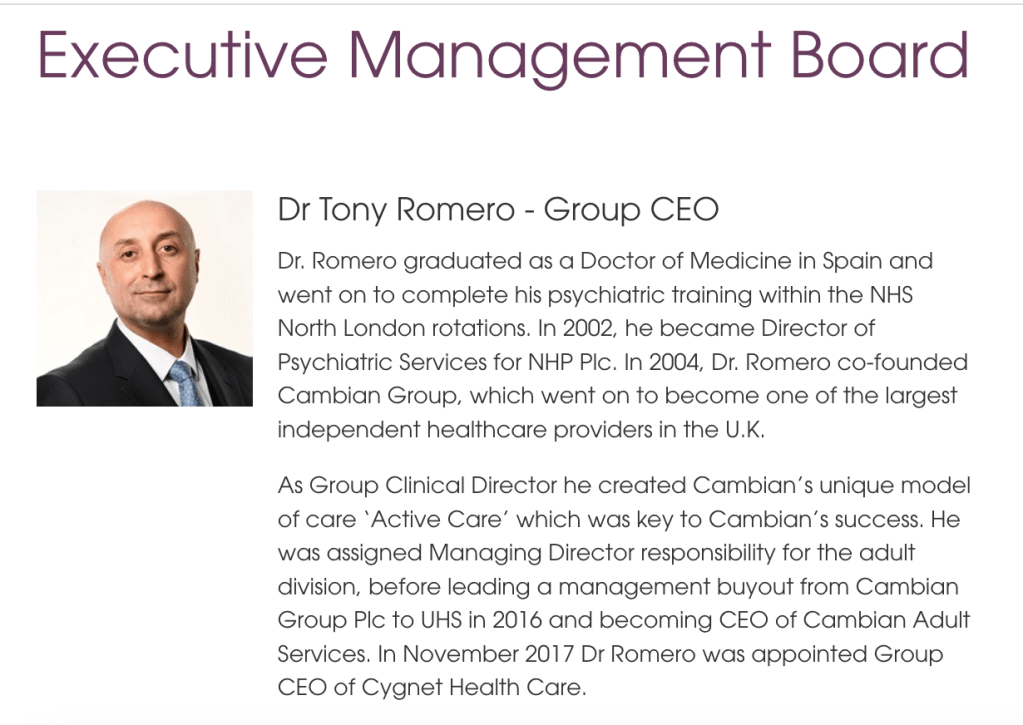
Dr Tony Romero
CEO Cygnet Health Care Ltd
6 April 2023
Dear Dr Romero,
External FPPR reports
The Care Quality Commission has informed me that an Fit and Proper Person referral that I made on Cygnet directors under CQC Regulation 5 in 2021 has concluded, with the regulator concluding that whistleblowing processes at Cygnet have improved to the point where CQC considers that Cygnet is now meeting the requirements of Regulation 5.
I asked the CQC if there had been any transparency about the findings of external reports commissioned by Cygnet which the CQC relied upon to reach its conclusion of improvement.
The CQC did not reply directly to this question but suggested that I contacted Cygnet if I wanted copies of these external reports. They are:
– The external report shared with CQC in August 2021
– A supplement to this report in September 2022, which was shared with CQC in January 2023
In the NHS, the best practice guidance from NHS Providers is that there should be transparency about FPPR investigation findings, at least in summary form.
NHS Providers’ guidance also emphasises that visible rigour is important in contentious cases and where there have been failures of whistleblowing governance.
I would be grateful if Cygnet could accordingly disclose either copies of the external FPPR reports that it commissioned, or at least a summary of the main findings and recommendations.
I copy this to Sean O’Kelly CQC Chief Inspector of Hospitals, Amanda Pritchard CEO of NHS England in view of commissioning issues, and the relevant House of Commons committees.
Many thanks.
With best wishes,
Minh
Dr Minh Alexander
cc Sean O’Kelly CQC Chief Inspector of Hospitals
Amanda Pritchard CEO NHS England
Health and Social Care Committee
Joint Committee on Human Rights
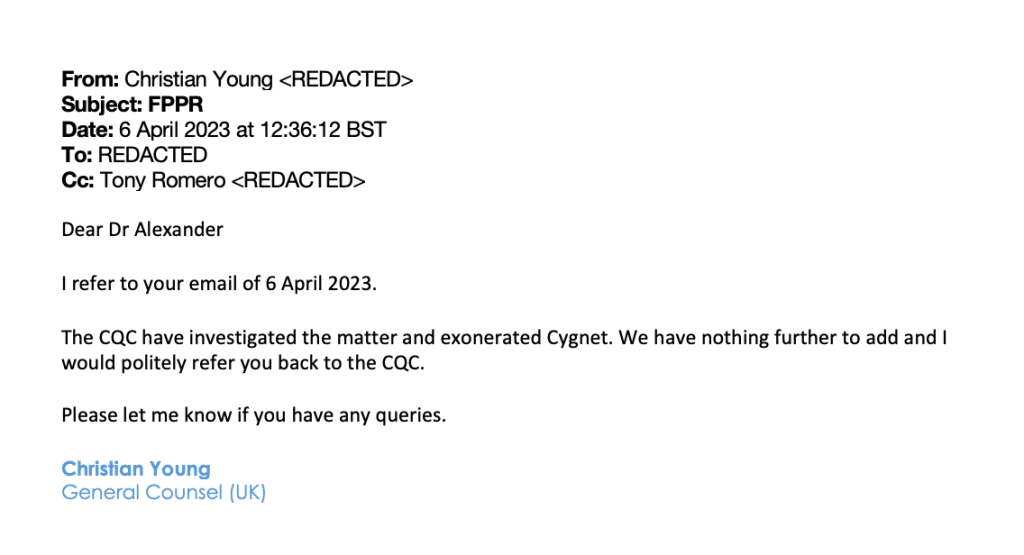
I sent the above request to Cygnet on 6 April 2023 at 11.55 am.
I received the following reply from Cygnet’s General Counsel at 12.36 pm.
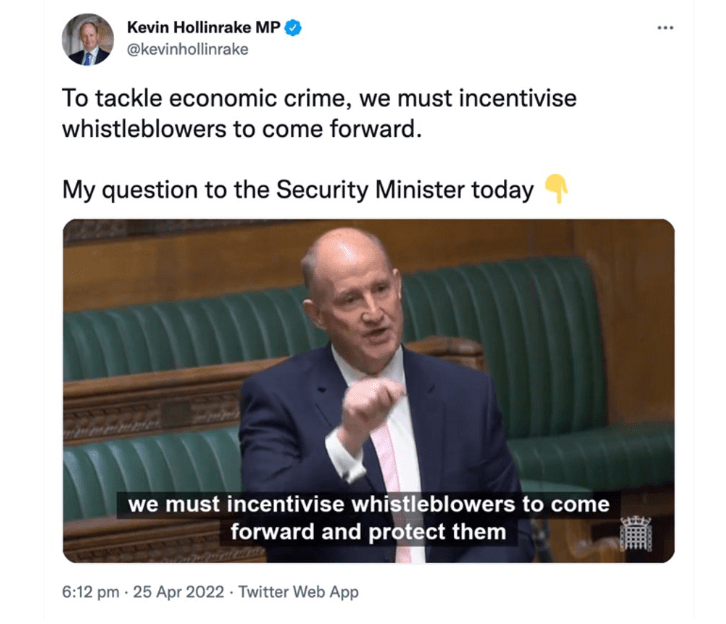
He has openly advocated that UK whistleblowers should be “incentivised”:
Other members of the Whistleblowing APPG have also spoken about whistleblower rewards and the APPG’s secretariat WhistleblowersUK has advocated for whistleblower rewards.
The offer of whistleblower rewards is against most ethical guidance on whistleblowing and against longstanding UK whistleblowing policy.
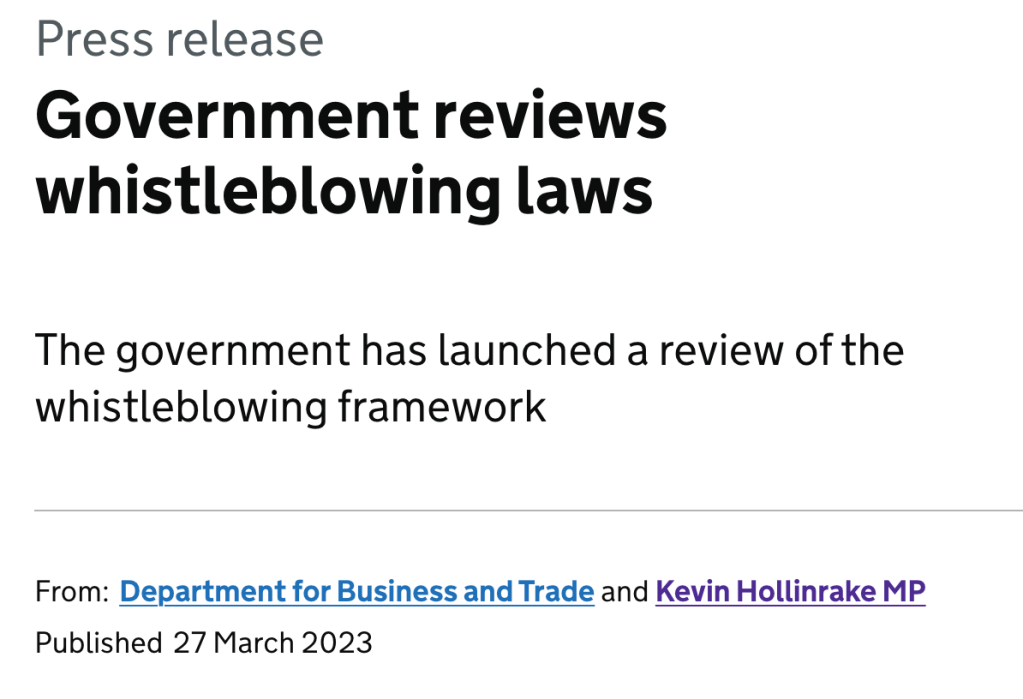
Kevin Hollingrake was appointed to the Department for Business, Energy and Trade as Parliamentary Under Secretary of State between 27 October 2022 and 7 February 2023.
Most recently Hollinrake was appointed Parliamentary Under Secretary of State at the Department for Business and Trade on 7 February 2023.
Will the review be conducted professionally, impartially and follow the evidence base?
Or will it be another Tory charade of thinly disguised cronyism, boot filling and back room deals?
Given all the evidence of government misconduct in recent years, one might reasonably think that the prospect of a bounty model, that siphons obscene amounts of cash into the hands of whistleblowing industry middlemen and bounty hunting lawyers, has just become more likely.
Especially if the increasing excitation of the assorted denizens of the Whistleblowing APPG’s murky waters is anything to go by.
Don’t be optimistic of any genuine governance.
Do expect the parade of dubious celebrities, useful idiots, fake talking heads, planted articles puffing the Office of the Whistleblower and social media sock puppeteers to get worse.
That is of course, only if some further terrible government scandal does not upend all plans by this time next week, and we get another clutch of heartsink ministers.











 Alexander's Excavations