
WhistleblowersUK’s new financial contract with whistleblowers

Dr Minh Alexander NHS whistleblower and retired consultant psychiatrist 2 July 2023

Summary: This is a brief post to share documentation which shows that the private company WhistleblowersUK’s business model continues to be based partly on charging whistleblowers for help, and that it has linked with another company which sells services to barristers.

WhistleblowersUK also asks people for money if they wish to become “associate members”.

A statement of interests to Somerset Council by WhistleblowersUK’s Chair wrongly indicates that WhistleblowersUK is a public authority, and does not disclose that Whistleblowers seeks to influence public opinion and policy.

Background

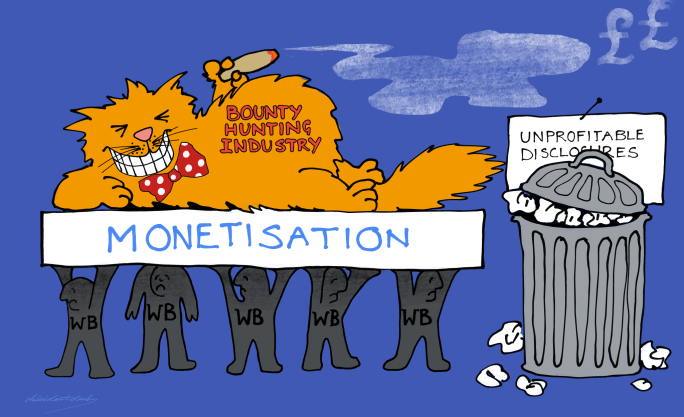
WhistleblowersUK acts as the external secretariat of the Whistleblowing APPG. Leading members of the APPG and WhistleblowersUK seek to introduce a US model of bounty hunting.

WhistleblowersUK recently co-produced a lengthy document singing the praises of whistleblower rewards, with two major US bounty hunting law firms. However, the document omitted to mention serious drawbacks of the US bounty hunting model, such as its exploitative nature and the fact that the majority of whistleblowers are left with nothing, even if they suffer reprisal and loss. The model also siphons money into lawyers’ coffers. Bounty hunting is a billion dollar US industry led by lawyers. Lucrative cases from the financial sector generate huge bounties.

WhistleblowersUK’s document on rewards for informers also claimed that historically, the model worked well in England. Historical studies reveal that the model generated scams and corrupt practices, as has been the case with its modern successor.

I reported here about these issues:

Qui Tam. A tale of malicious informants and corruption in ye Olde England. And its evolution to the modern bounty hunting model

I have since been contacted by someone who approached WhistleblowersUK for help and who obtained the following documents, which they have shared with me:

  1. A revised, updated version of WhistleblowersUK’s “Statement of cooperation”

I have previously published an earlier version of this document.

WhistleblowersUK’s statement of cooperation and agreement

This is the more recent version of the document, which was used as recently as 2022:

NEW WhistleblowersUK statement of cooperation and agreement 2021

Changes include the fact that this appears to be a joint document produced with another private company, the “Barrister Consultancy Services”.

The Barrister Consultancy Services’ logo also appears on this document, and the document reads:

“If appropriate we will introduce you to our trusted partner Barrister Consultancy Services (BCS), who will provide you with legal project management services enabling us to work together on your case from start to finish.” [my emphasis]

The document also indicates that WhistleblowersUK may arrange initial pro bono assistance by barristers that is not legal advice. It appears to imply that BCS may be involved in arranging access to barristers:

“We help you retain full control at all times because you know your case best.

Our specialist panel of barristers usually provide initial pro bono assistance (not legal advice) based on the chronology and supporting information that you supply. All barristers on our panel are regulated by the Bar Standards Board in England & Wales and/or Faculty of Advocates in Scotland, be assured that separate letters of agreement will be sent to you before any official legal advice is provided. You will not incur any legal costs without your agreement. WBUK & BCS does not accept responsibility or liability for any independent legal advice provided.”

The statement of cooperation links to the website of the BCS to a page about the BCS’ privacy policy.

The BCS website suggests that this company primarily provides specialist administrative support to barristers:

“Barristers in the UK often work independently in Chambers and are mostly self-employed. Therefore, they are responsible for managing their own practices and developing their business. However, managing a legal practice can be complex and time-consuming, which is why many barristers and their clerks turn to Barrister Consultancy Services for assistance.”

The “About” page of the BCS states:

“As former Barrister Clerks and Practice Managers, our primary objective is to enhance and refine internal practice management processes and procedures within barrister’s chambers.”

At the bottom of the pages of the BCS website, it is stated:

“Barrister Consultancy Services is the trading name of David Wright a self-employed consultant at DW Business Consultancy, a Company Registered at 23 Franmil Road, Hornchurch, Essex, RM12 4TR No: 10431011”

David Wright’s LinkedIn entry indicates that he has worked as a barrister’s clerk, legal practice manager and director of business at various Chambers.

The Companies House entry for DW Business Consultancy lists Linda Wright as company secretary and David Wright as director.  The nature of the business is stated to be: “70229 – Management consultancy activities other than financial management”.

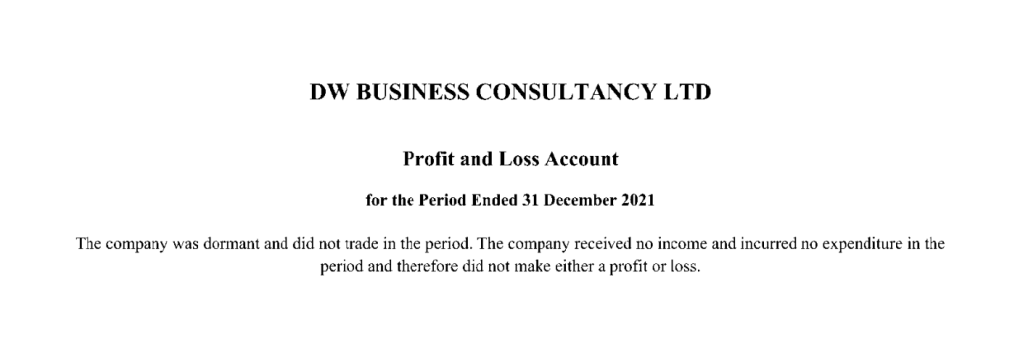
According to Companies House, BCS was incorporated on 17 October 2016, and it last filed accounts last year, with “Accounts for a dormant company made up to 31 December 2021”.

These accounts state that the company was dormant in the reporting period, received no income and incurred no expenditure.

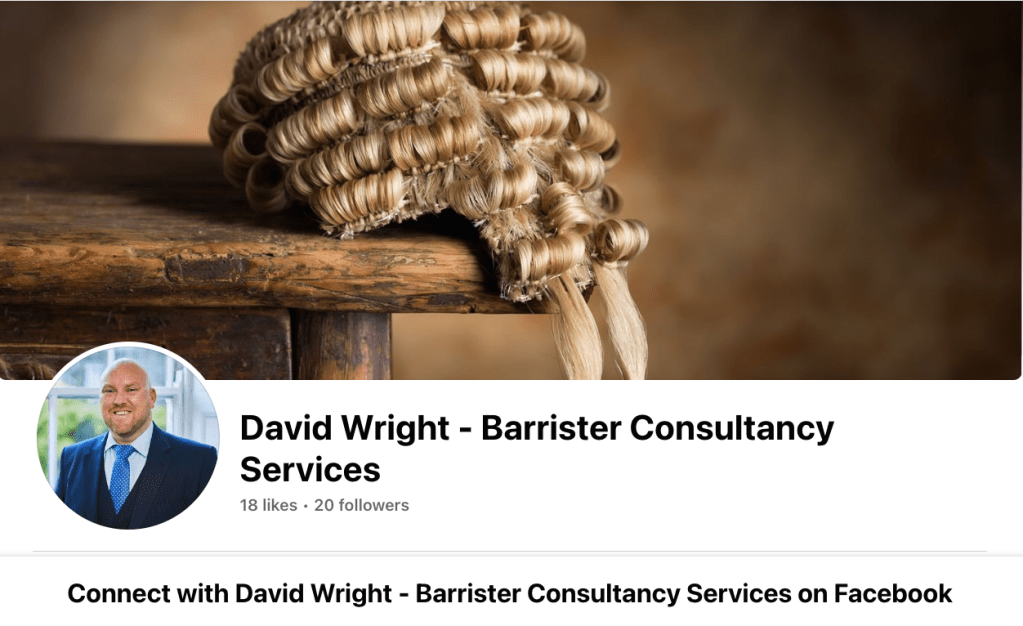
BCS also has a post on Facebook as follows:

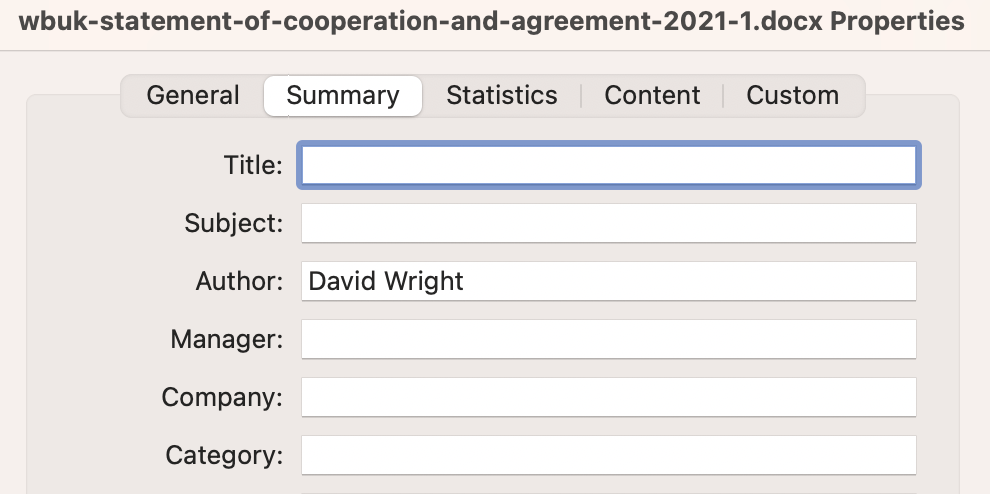
An examination of the metadata of the revised Statement of Cooperation by WhistleblowersUK reveals that it was last edited by David Wright:

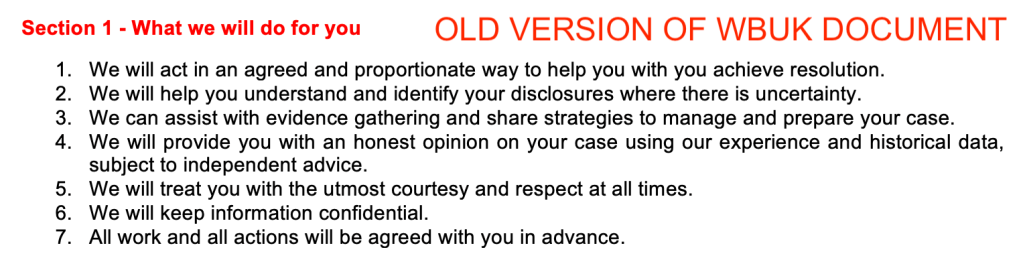
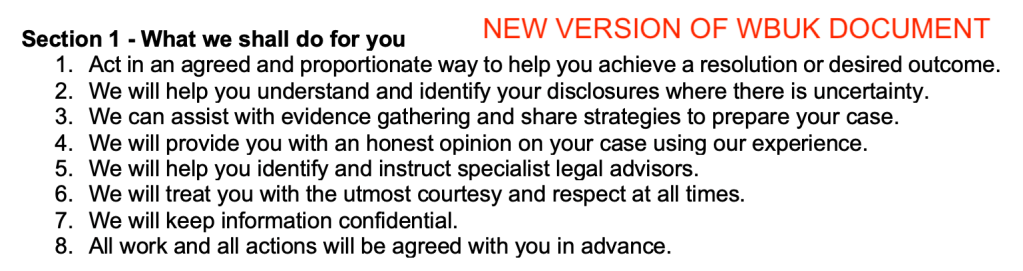
In comparing the new “statement of cooperation” with the previous version that I published, the section “What we will do for you” has been expanded, with insertion of an additional service:

“We will help you identify and instruct specialist legal advisors.”

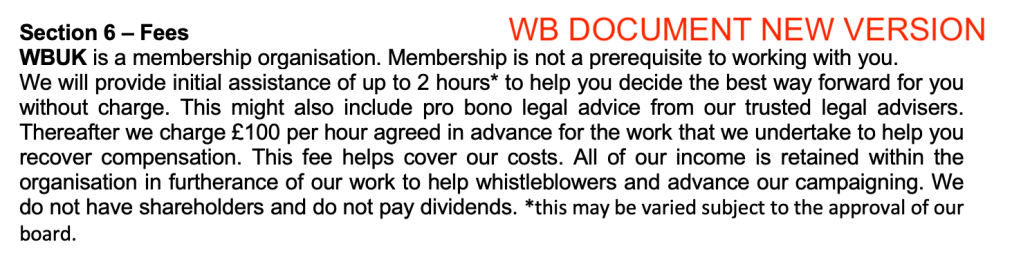
The latest statement of cooperation indicates that WhistleblowersUK still charges whistleblowers £100 per hour for its services, albeit it now states that it will provide initial assistance without charge for up to two hours.

The latest statement of cooperation indicates that WhistleblowersUK also asks for a “percentage” of any financial award that a whistleblower may receive. It differs from the previous version of the document in that where five percent was previously specified, there is now no numerical value given, and no clear limit on what share of financial awards WhistleblowersUK propose to take.

  1. WhistleblowersUK’s application form for associate membership

This is the form: Associate Membership application form

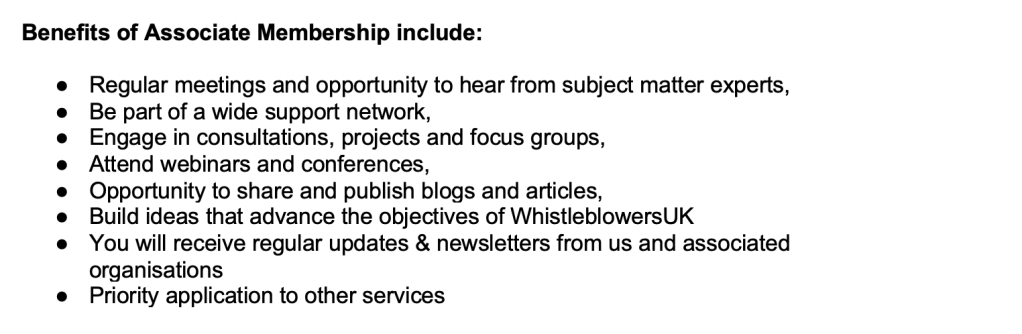
This form states that membership advantages are:

WhistleblowersUK states in the application form that it does not charge fees for membership.

However, it asks any individuals wishing to join as an associate member for a minimum donation of £120 per annum.

There is a section at the end of the document which states:

Financial hardship is not a barrier to becoming an Associate Member. The Directors will consider applications to waive the requirement for a regular donation. Please advise WBUK in Section 2, Question 3 if you wish to apply for a waiver.”

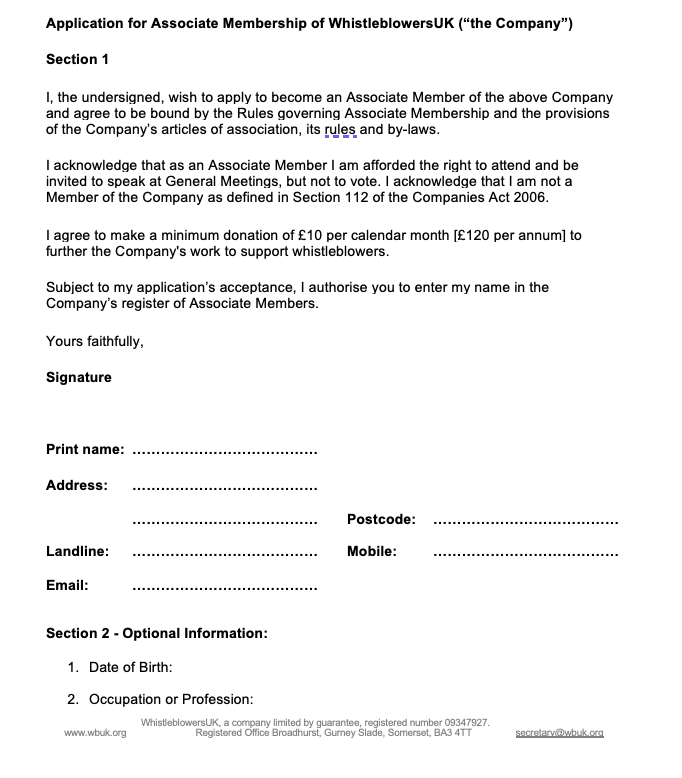
This is the clause in the application form which asks applicants to commit to the payment of £120 and to abide by the company’s by-laws:

I could find no company by-laws on the WhistleblowerUK’s website or recorded in documents filed at Companies House.

But the application form indicates in bold text that WhistleblowersUK’s directors can terminate membership at any time:

Associate Memberships are approved by the directors and can be terminated without notice at any time.”

WhistleblowersUK states that its objectives include expanding its associate membership:

“We Grow our community through our associate membership promoting engagement, collaboration, and sharing of ideas and perspectives among our members.”

The company publicises dates for meetings of associate members, the most recent being 26 June 2023:

However, I could find no record of the current or past number of associate members, or of the level of income generated by associate members’ required donations of a minimum £120 per annum.

By the end of 2022, WhistleblowersUK’s accounts submitted to Companies House showed that the company had a total of £3,905 assets.

I asked WhistleblowersUK through its Chair Tessa Munt former Liberal Democrat MP, now local councillor, if the organisation wished to comment on matters arising from the above two WhistleblowersUK documents, but I have not yet received a reply.

“Tessa Munt

Chair of WhistleblowersUK

29 June 2023

Dear Ms Munt,

I write to ask if WhistleblowersUK would like to comment on and/or elaborate on reports that: 

i) WhistleblowersUK asks whistleblowers for £120 minimum donation per annum to be associate members

ii) WhistleblowersUK offers pro bono assistance from lawyers which is not legal advice, from a panel of specialist barristers

iii) WhistleblowersUK now works in partnership with Barrister Consultancy Services

Many thanks.

Dr Minh Alexander”

Munt is Liberal Democrat councillor for Wells, Somerset.

I note in Munt’s declaration of interests to Somerset Council that she is described as “interim” chair of WhistleblowersUK, and has declared that WhistleblowersUK is a public authority when it is a private company.

I have written today to the CEO of Somerset Council and the Leader of the Council about this factual inaccuracy, and also raised an issue of whether Munt should have declared the fact that Whistleblowers is an organisation which seeks to influence public opinion and policy.

BY EMAIL

Duncan Sharkey

CEO Somerset Council

2 July 2023

Dear Mr Sharkey,

Declaration of Interests by Councillor Tessa Munt: error and omission

I am sure it is a mistake but the council currently publishes inaccurate information about Councillor Munt’s interests.

Ms Munt’s declaration of interests states under Question 9 “Do you hold membership of other Public Authorities?” that she is “director and interim chair” of WhistleblowersUK.

WhistleblowersUK is not a public authority but a private company (09347927) which had £3,905 assets by end 2022, according to documents filed at Companies House. By the end of the previous year, WhistleblowersUK only reportedly had £736 assets.

 WhistleblowersUK is seeking to introduce a controversial and exploitative US model of bounty hunting, which if ever adopted as the UK national model would disadvantage the majority of UK whistleblowers and lead to only a tiny handful receiving vast rewards. The model primarily benefits bounty hunting law firms and is a billion dollar US industry, which has been trying to the break into the UK market for some years now. This model primarily targets the financial sector, where bounties from recovered monies can be huge.

Under question 11 of Ms Munt’s declaration of interests, “11. Do you hold membership of bodies influencing Public Opinion or Policy (including any political party)?”, Miss Munt has only declared membership of the Liberal Democrats. 

I believe she should also arguably declare her leadership position at WhistleblowersUK under this section because this company campaigns for whistleblower financial rewards and law changes which would open the door to such financial rewards.

WhistleblowersUK recently co-authored a document with two major US bounty hunting law firms,  which praised the benefits of financial rewards for whistleblowers.

The company states on its website that it explicitly seeks to influence public opinion and policy. It seeks to introduce an Office Of The Whistleblower, which mirrors the US Securities and Exchange Commission’s Office of the Whistleblower which handles a high profile whistleblower reward programme.

 For example, WhistleblowersUK state on their website:

“We Transform the way everyone thinks about whistleblowing, educate the public, and demonstrate the importance of whistleblowers in a fair and transparent society.

We Campaign for the Office of the Whistleblower now a Bill going through Parliament that will revolutionise the treatment of concerns and the people who raise them.”

Of note, WhistleblowersUK has since 2018 acted as the external secretariat to a Whistleblowing All Party Parliamentary Group, which explicitly campaigns for the law change which would open the door to the US style whistleblowing rewards. When the Whistleblowing APPG was first established in 2018, its declarations showed that it accepted money from Constantine Cannon, a major US bounty hunting law firm. This funding was badged as payment for WhistleblowersUK’s services as external secretariat.

Sir Norman Lamb former Liberal Democrat MP was a member of the Whistleblowing APPG but resigned after the CEO of WhistleblowersUK refused to answer questions about conflicts of interest and finances which I put to the APPG:

Norman Lamb MP has resigned from the Whistleblowing All Party Parliamentary Group

I copy below correspondence to Councillor Munt in her capacity as WhistleblowersUK Chair, seeking greater transparency about WhistleblowersUK’s financial arrangements and the handling of whistleblowers’ highly sensitive personal data. I have received no reply to my letter of 4 May 2023, and I await a reply to my letter of 29 June 2023.

Please confirm receipt of this letter and advise what action Somerset Council will take to ensure that Councillor Munt’s declaration of interests is accurate.

Many thanks.

Yours sincerely,

Dr Minh Alexander

NHS whistleblower and retired consultant psychiatrist

Cc Bill Revans Liberal Democrat councillor North Petherton, Leader of Somerset Council and Lead Member for Governance & Communications


RELATED ITEMS

The Whistleblowing Hunger Games: Why we should reject the Whistleblowing APPG

New research: US bounty hunting model, cronyism and the revolving door between
regulators and bounty hunting law firms

A Tory MP who is a pro bounty, former member of the Whistleblowing APPG
secured a junior ministerial post this year and launched a review of UK
whistleblowing law:

Tory MP Kevin Hollinrake who called for whistleblower “incentives” is now in a
ministerial role, launching a review of UK whistleblowing law

Qui Tam. A tale of malicious informants and corruption in ye Olde England. And its evolution to the modern bounty hunting model

HSIB’s disgrace, official death of the Maternity and Newborn Safety Investigation Authority and the government’s refusal to explain itself

Dr Minh Alexander retired consultant psychiatrist 29 June 2023

Summary: The Department of Health and Social Care has confirmed that its plans to set up a Special Health Authority to investigate maternity failures in the NHS are dead and buried, with no plans to resurrect. This is despite an abortive attempt to recruit a Chair for the Special Health Authority which concluded with fourteen applicants being turned away. It refuses to disclose its justification for transferring the maternity investigation programme to the Care Quality Commission or the legislation drafted for the now binned Maternity and Newborn Safety Investigation Authority.

Background

Jeremy Hunt former Health Secretary’s unwieldy vanity project the national maternity investigation programme was foisted on the Healthcare Safety Investigation Branch against advice.

It unravelled in secrecy as whistleblowers spoke out against poor management and inherent systemic problems, such as designed-in conflicts of interest from seconded staff feeling pressured to keep on good terms with the regional teams they investigated, for the sake of their long term career prospects.

NHS England and its predecessors tried to suppress the scandal but to no avail as an HSIB whistleblower’s Employment Tribunal hearing in April this year revealed crucial evidence and an investigation by Channel 4 (broadcast 15 and 16 May 2023) brought forth yet more whistleblower evidence of defective maternity investigations and cultural failings at HSIB. Importantly, HSIB staff claimed that they had been threatened with job losses if they did not churn out investigations reports quickly enough, which affected quality.

Related to these troubles, several investigations were conducted but suppressed by NHS England. Firstly the Newton report was conducted into a HSIB whistleblower’s concerns of detriment and concluded that there had been poor whistleblowing governance.

A review of culture and leadership was then conducted by the Kings Fund upon the recommendation of the Newton report, which was overseen by NHS England and the Department of Health and Social Care. The Kings Fund produced a curiously fact lite report which nevertheless found leadership failures. It also commented on the harmful effect of uncertainty about the future of the maternity division of HSIB and advised that this be resolved.

The King’s Fund review was informed by an internal review of the maternity division, the Benson report, which revealed serious dysfunction. Dawn Benson the HSIB lead author went on to give evidence at the above HSIB’s whistleblower’s ET hearing and also gave an interview to Channel 4.

Keith Conradi the head of HSIB’s retirement was announced after the King’s Fund’s conclusions were shared with HSIB staff.

On 21 January 2022 the Health Service Journal reported the findings of the leaked King’s Fund report, which was the first time the report’s existence was revealed:

Bullying, sexism and racism ‘prevalent and tolerated’ at national regulator

On 26 January 2022 Sajid Javid made a statement in parliament  announcing that the government would create a short life Special Health Authority to take over the maternity investigation function from HSIB. The idea was to eventually hand maternity investigations back to NHS trusts once an example of good practice had been purportedly modelled:

“Special Health Authority will be established for up to five years from 2022-23 to enable maximum learning to be achieved and to equip NHS Trusts with the expertise, resources, and capacity to take on maternity safety incident investigations in the future.”

The post of Chair for the special health authority was advertised in autumn 2022:

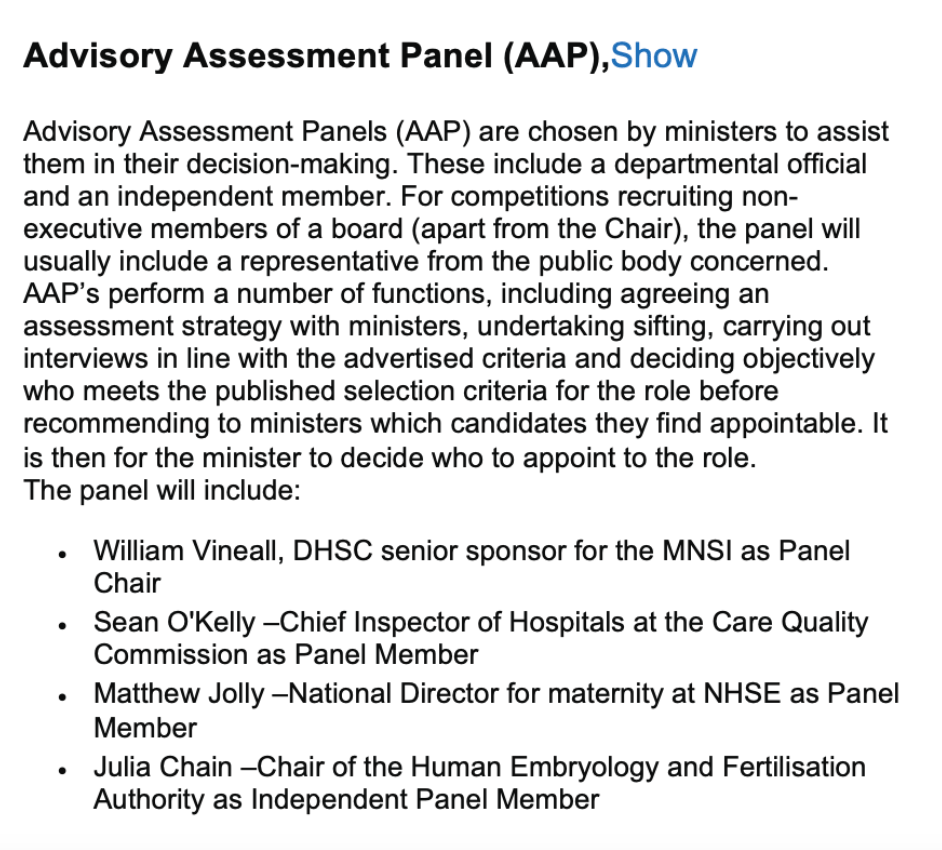
Advert for Chair of Maternity and Newborn Safety Investigation Authority 2 September 2022.

William Vineall and NHS regulators were represented on the advisory panel.

But on 30 March 2023, shortly before the HSIB whistleblower’s ET case was due to be heard, Maria Caulfield Parliamentary Under Secretary for Health and Social Care unexpectedly announced that the maternity investigation section of HSIB would be hosted by the Care Quality Commission:

“On 26 January 2022, Official Report, 25WS, by way of a written ministerial statement, the Department of Health and Social Care announced that a separate Special Health Authority would be established to continue the independent maternity investigation programme, which is currently overseen by the Healthcare Safety Investigation Branch.

The Department is committed to ensuring the continuation of independent, standardised maternity investigations that provide learning to the system and contribute to the Government’s ambition to halve the 2010 rates of stillbirths, neonatal and maternal deaths and brain injuries in babies occurring during or soon after birth by 2025.

Following careful consideration, the Department has determined that the most appropriate and streamlined mechanism for delivering the valued and independent maternity investigations is for the function to be hosted within the Care Quality Commission. The purposes of the maternity investigation programme remain as set out last January: to provide independent, standardised and family-focused investigations of maternity cases for families: to provide learning to the health system via reports at local, regional and national level; analyse data to identify key trends and provide system wide learning; be a system expert in standards for maternity investigations; and collaborate with system partners to escalate safety concerns.

We will now work with the CQC and the HSIB to complete the transition of the maternity investigation programme to the CQC by October 2023.

As announced in the written ministerial statement of 9 February 2023, Official Report, 40WS, the establishment of the new HSSIB will take place in October 2023, to enable all the necessary work to be completed to ensure a smooth transition of these investigation programmes.”

The Department of Health and Social Care’s termination of the Maternity and Newborn Safety Investigation Authority

To confirm whether this was a permanent arrangement and to find out more about the justification for locating maternity investigations within the notoriously politicised and none too competent CQC, I made an FOI request to the Department of Health and Social Care. This is the response:

DHSC FOI response 28 June 2023 Ref 1455271 plans for establishing Maternity and Newborn Safety Investigation Authority and Hosting by CQC

The Department confirmed that it went ahead with its appointment process for a chair to the Special Health Authority, for which it received fourteen applicants:

“DHSC received 14 applications for the post of Chair/Chair designate to the Maternity and Newborn Safety Investigation Special Health Authority (MNSI).”

The government claims no appointment was made because:

“An appointment was not made, as a final decision on the appointment had not been reached before the announcement on the future of the MNSI [Maternity and Newborn Safety Investigation Authority] via a Written Ministerial Statement (WMS) on 30 March 2023.”

Well that’s a good way to do business. Advertise a job and then tell everyone “Hard cheese chaps, the job’s gone”.

The government also confirms that the Special Health Authority was never legally established.

It stands by its claims that the best option is hosting by CQC rather than a standalone Special Health Authority reporting directly to the Department of Health and Social Care:

“….following careful consideration, DHSC has determined that the most appropriate and streamlined mechanism for delivering the valued and independent maternity investigations is for the function to sit within and be hosted by the CQC.”

However, the government refuses to disclose its justification for this opinion on grounds that it might be embarrassed. Sorry, I mean on grounds of Section 35 FOIA formulation of government policy, because the transition period is not yet complete and policy is still being formulated.

The government has no plans to revisit the idea of a Special Health Authority.

This implies that the maternity investigation division will likely be allowed to wither on the vine for some as yet undetermined period until it all reverts to NHS trusts. This will do nothing for the independence of maternity investigations.

The government also refuses to disclose legislation drafted for the Special Health Authority on purported grounds that this is legally privileged.

One is left wondering what sort of governmental hissy fit led to such a major change of direction, and the bizarre Heath Robinson arrangement of the Care Quality but We Don’t Investigate Complaints Commission hosting a specialised incident investigation function.

It is left only to commiserate with the unfortunate maternity investigation staff who have been so badly managed and supported from the outset of a political misadventure.

RELATED ITEMS

Hunt’s chutzpah

Hunt skilfully dined politically off the Midstaffs and Morecambe Bay disasters whilst simultaneously wrecking the NHS, fashioning a narrative of hero crusader against the wicked NHS and recruiting a number of families to insulate himself.

He dined off Midstaffs whilst reneging on core recommendations from the public inquiry such as mandatory safe staffing and real whistleblower protection, which would have helped to prevent further maternity tragedies and any need for his disastrous national maternity investigation gimmick.

Even in 2020, Hunt was still trying to politically capitalise from maternity tragedies:

Jeremy Hunt calls for national inquiry into NHS maternity safety after repeated scandals

His handiwork on the NHS is now all around us as emergency care has collapsed, regularly causing deaths, cancer care is teetering and 7.4 million people await treatment.

And at the UK COVID public inquiry it has just been revealed that Hunt wanted to cut Public Health England’s funding by half:

 Hunt wanted 50% cut to public health, says ex-PHE boss

Public health is one of the most crucial, effective and super-efficient medical specialties with profound effects on improving the health of the populace. Why would anyone except the utterly incompetent or those with malign intentions wish to cut it?

Slow and incomplete maternity investigations: Death of baby Theo Young and Coroner’s serious criticisms of HSIB

HSIB whistleblowers and the Secret King’s Fund Fact Lite report

More secret HSIB reports and failures of HSIB maternity investigations

Finally revealed: The suppressed Susan Newton report on whistleblowing governance at HSIB/ NHS England

HSIB has sent 152 letters of concern to NHS trusts about maternity safety, including 15 letters to one trust

Was the CQC wilfully blind to organisational failures by East Kent Hospitals NHS Foundation Trust on maternity safety?

Calling whistleblowers, patients and families: Language matters. CQC dismisses concerns as “complaints” to give you the bum’s rush, but it has to investigate “incidents” if CQC Regulation 12 is engaged

Why is CQC not investigating UHB under CQC Regulation 12?

NHS England appears to claim that tampering with medical records is not illegal. The legal minefield and what whistleblowing disclosures are legally “protected”?

NHS England appears to claim that tampering with medical records is not illegal (II). Or an apparent failure of organisational memory

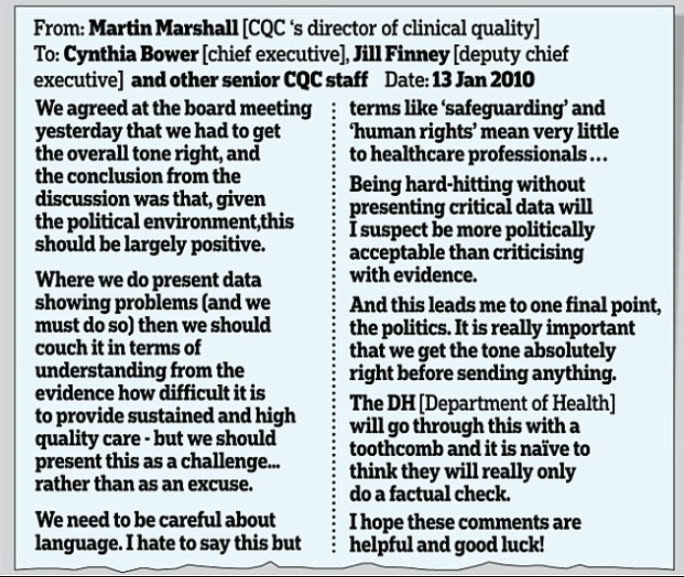
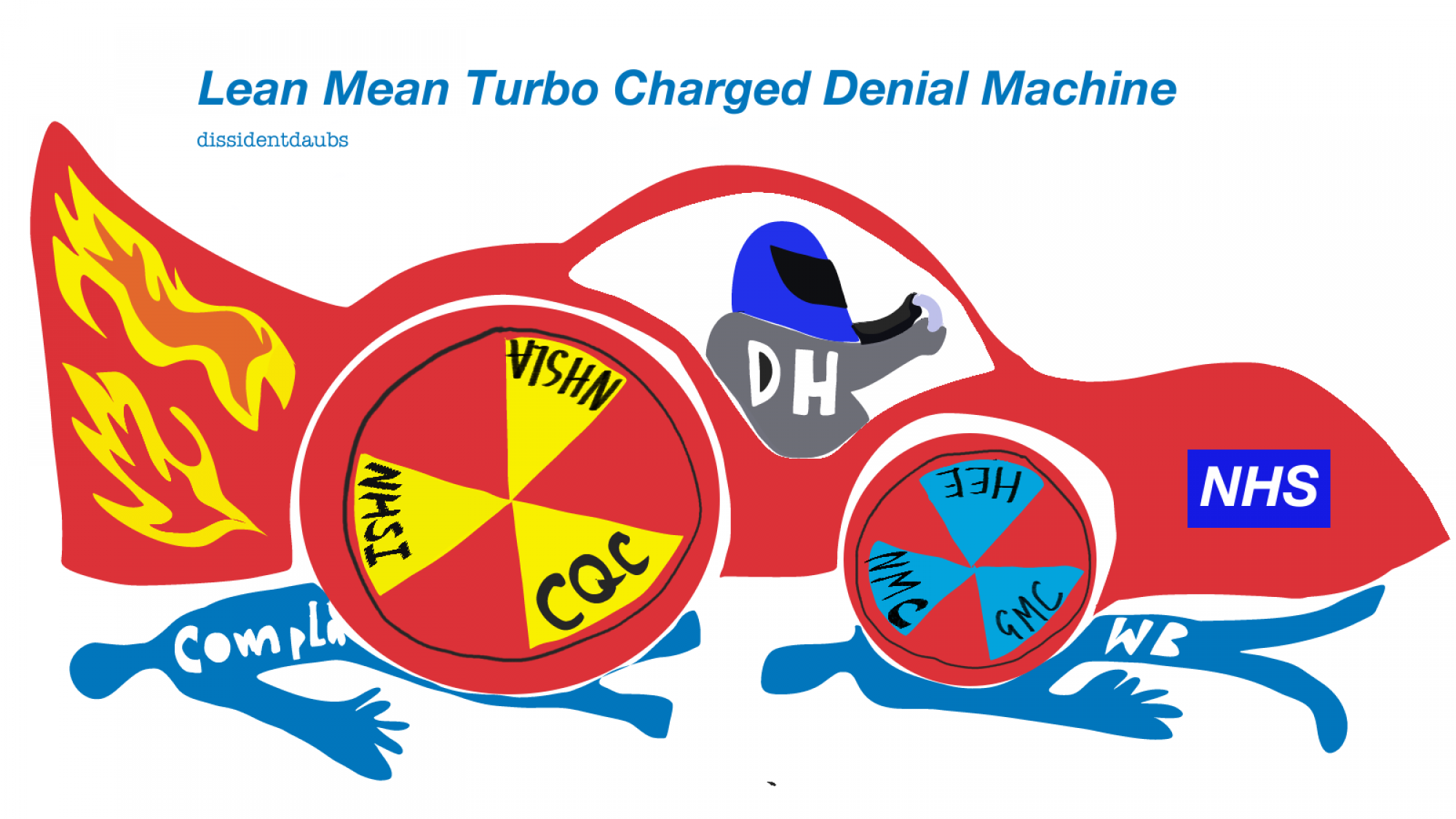
I leave readers who are less familiar with CQC’s ways with this FOI revelation about how CQC senior managers huddled and deliberated on the best way to manipulate public into thinking that they had written a “hard hitting” inspection report, but with as few facts as possible:

Qui Tam. A tale of malicious informants and corruption in ye Olde England. And its evolution to the modern bounty hunting model

Dr Minh Alexander retired consultant psychiatrist 24 June 2023

The private company WhistleblowersUK and its backers are pushing financial rewards for whistleblowing under the guise of ‘restitution’.

The US model of massive bounties for a tiny handful of whistleblowers (hundreds of millions for some individuals) is rapacious and wrong. It has spawned regulatory corruption. It feeds a billion dollar US legal industry that wants to open up the UK market.

The whistleblowing APPG and its external secretariat WhistleblowersUK are becoming more and more explicit in their pursuit of a model of financial rewards (bounties) for whistleblowing in the UK.

For a while, they toned down references to rewards in most of their written material. For example, WhistleblowersUK referred to “compensation” in contexts which made it clear that they were talking about rewards. Equally, although leading members of the APPG called for rewards and financial incentives, documents by the APPG coyly suggested that it was a matter for the government to decide if rewards were appropriate.

But last month, WhistleblowersUK produced this document with two major US bounty hunting law firms, Constantine Cannon and Kohn, Kohn, and Colapinto LLP, singing the praises of financial rewards:

International Whistleblower reward programmes. Is there a place for them in the UK?

Any wisps of veil are gone.This long report claimed to set out the strengths and weaknesses of whistleblowing rewards, but in reality it only knocked down straw men and it ignored elephants.

Importantly, as far as I can see the report does not explain how under the exploitative US bounty hunting model, only a tiny minority of claimants qualify for rewards. It is possible to be a genuine whistleblower and to suffer severe life changing reprisal and detriment but to receive no redress under this scheme.

The report also makes surprising claims, such as an assertion that “qui tam” prosecutions (legal claims in the name of the King, with a share of the proceeds going to the claimant as well as the crown) “worked well for many centuries” in England.

This claim by WhistleblowersUK et al appears to be unsupported. Qui tam suits were very rough justice introduced in the 13th century only because of a lack of governance infrastructure and law enforcement resources. Citizens were effectively deputised.

Historical studies show that the qui tam system of governing was unsurprisingly beset with problems and that informants who personally benefited were despised:

“Early in Henry VII’s reign, it had become apparent that qui tam enforcement of penal statutes had created serious problems….”

False, malicious suits were sometimes pursued for personal gain. Corrupt officials “extorted” fines by imprisoning people until they “confessed” to wrongdoing. Trials without jury were held. Informers sometimes perjured themselves. Suits might be tactically and abusively filed hundreds of miles away from the accused’s home, making it nigh impossible to defend a suit.

A class of “professional informers” called “promoters” arose who made a living out of qui tam suits, and who were despised and distrusted:

“Informers were widely perceived as self-interested at best and malevolent at worst. The charge of self-interest was a natural inference from the bounty provision of a qui tam statute.”

“They were described variously as “varlets, “lewde” and “evil”…”viperous vermin”

“Indeed, informers harassed and impoverished citizens, particularly those in the lower classes, “for malice or private ends, [but] never for love of Justice.”

Some informers settled quietly and unofficially with their marks, in order to pocket more money and deprive the crown of its share, without bringing matters to the court’s attention:

“This collection of payments in return for a promise not to prosecute was, in essence, a form of blackmail or extortion.”

Informers were sometimes jailed for such scams. The worst offenders were occasionally executed.

Where justice is monetised, it is hardly surprising if the perverse incentives lead to corrupt practices. In the same way that the SEC Office of the Whistleblower became corrupted, its ancient predecessors were also sometimes corrupt.

Such was the level of abuse sometimes endured by the populace under qui tam law, that assaults and riots against informers were occasionally recorded in ye in Olde England.

Additional laws were repeatedly passed in attempts to manage the misconduct of informers.

So, hardly a picture of success as claimed by WhistleblowersUK et al.

And it is not reassuring that a claim of success was made.

Nevertheless, WhistleblowersUK, Constantine Cannon, and Kohn, Kohn and Colapinto LLP gamely argue in their report that publicity about large financial rewards increase public awareness of whistleblowers. They leap to a conclusion that this increased awareness must improve public opinion of whistleblowers, without providing the evidence to confirm this theory. (Page 20).

Notoriety for excessive whistleblower rewards, especially in scandals where victims are uncompensated, is of course an alternative explanation.

Yesterday, I observed most of a webinar by WhistleblowersUK and the Whistleblowing APPG  yesterday, bar the first twenty minutes which I had to miss due to a clashing commitment. The speakers were Rory Field barrister with a specialism in organised crime and who has spoken on organised economic crime, standing in for Iain Mitchell barrister, Richard Pike of Constantine Cannon, Susan Kramer former Whistleblowing APPG Chair but still active pro-bounty politician, Folashade Adeyemo Lecturer in Banking and Company Law Reading University and a specialist in Nigerian banking regulations, a whistleblower whose full name I did not catch and Georgina Halford Hall CEO WhistleblowersUK.

The theme of the event was “restitution”.

In reality, this proved to be about financial incentivisation.

Richard Pike of US bounty hunting law firm Constantine Cannon explained the US model of bounty hunting to the audience.

He took a similar approach to that of his colleague Mary Inman in 2018 at the Bylines festival, explaining that the concept came from the “mother country”, England, when ancient custom was to take action in the name of the King, qui tam.

Pike argued that a prime benefit of bounties was to ensure legal representation for whistleblowers, because if lawyers knew that they could get a large pay out, they would be more willing to work contingently (or in plain English, on a no win, no fee basis).

Importantly, Pike did not explain to the audience the vagaries of the bounty system and the minimum financial recovery thresholds that whistleblowers have to fulfil to qualify for a reward, which in reality means that only a tiny minority are rewarded.

This leaves many genuine whistleblowers with no redress. It is possible under the US bounty system to be a bona fide whistleblower who suffers severe reprisal, who loses their livelihood and suffers longterm economic insecurity, but be left with zero redress.

Despite this reality, Pike described the model as “phenomenally successful”. This is possibly more of a comment from the point of view of the bounty hunting industry, and to an extent, the State.

Pike stated that the model is designed to recover money for the State, and indicated that it is therefore a problem when whistleblowers raise concerns about the State itself. His commented that federal whistleblowers might find themselves in prison.

He did not inform the audience of the existence of the the US Office of Special Counsel which looks after federal whistleblowers, who whistleblow about the State. This agency would be of less interest to bounty hunting law firms because it does not financially incentivise whistleblowing and operates a lean public sector model of restitution. It restores whistleblowers to the position that they would have occupied but for the whistleblowing, and no more, and it can ensure non-financial redress.

The whistleblower on the WhistleblowersUK panel suggested that bounties could perhaps be capped.

This reminded me of a past quote from Mary Inman who upon discovering Brits’ “visceral” dislike of the idea of paying whistleblowers, suggested that the bounty model could be made more culturally acceptable by capping rewards:

“she thinks the UK could create a culturally appropriate scheme which caps any rewards.”

And will this proffer of capped rewards survive the implied intention to pursue large and eye-catching bounties, mentioned in the above joint document published only last month by WhistleblowersUK, Constantine Cannon, and Kohn, Kohn and Colapinto LLP?

Alongside Pike, Folashade Adeyemo also spoke about restitution and by this she appeared to mean financial reward. She also used the words “recognition” and “acknowledgment”.

Mostly, Adeyemo’s contribution consisted of different ways of talking about financial transaction. For example:

“Compensation, not payment for informing, but recognising the value of that information”.

There was no clear discussion of non-financial redress.

Susan Kramer former APPG chair, who employs WhistleblowersUK’s CEO as a researcher at the House of Lords spoke on how the APPG and she have garnered interest from members of parliament. She anticipated that the Bill would fall again but made it clear that the campaign would continue.

Of note, Kramer appeared not to be familiar with the details of her own Bill and initially stated that people could have their claims dealt with by either the proposed Office of the Whistleblower, or by the Employment Tribunal if they preferred.

This would actually not be possible under Kramer’s private member’s Bill, which repeals PIDA and provides no alternative path to litigate whistleblowing cases in the Employment Tribunal.

Georgina Halford Hall WhistleblowersUK CEO stepped in to state that the whistleblowing element would be dealt with by the proposed Office of the Whistleblower but other heads of claim such as discrimination would need to be presented to the Employment Tribunal.

An important question from the audience about public sector employees did not receive a satisfactory answer. The panel was asked how their Bill would benefit public sector whistleblowers and if public servants would effectively be paid for information.

Underlying this question is the issue of the Nolan principle of selflessness in UK public life, drawn up after repeated sleaze scandals during the Major premiership.

Either panel members did not appreciate that or did not wish to address it, because the response did not address this principle.

Folashade Adeyemo instead replied:

“Why do we need to incentivise? Valuable information that will save lives, by our very nature as humans, if there’s no incentive, people won’t come forward”

Georgina Halford Hall pushed the boundaries furthest by arguing for the legitimacy of rewarding information from wrongdoers, like convicted fraudster Bradley Birkenfeld who received $104 million in bounties for informing on his co-offenders.

All the talk I heard was about recovering money from frauds and SEC’s 10 to 30% bounties from recovered money.

I heard almost nothing about protecting the public from harmful health and social care, excepting a very few broad comments about saving lives, with no particularisation.

My impression was that the APPG and WhistleblowersUK wish to throw as many nice words as they can at the concept of monetising information and bounty hunting.

As in the words of WhistleblowersUK, Constantine Cannon, and Kohn, Kohn and Colapinto LLP :

“The real sticking point remains the idea of rewarding people for doing the right thing. The UK remains publicly queasy when it hears the word “reward” in the same sentence as “whistleblowing”. However, when we change “reward” to “compensate” or “restitution” attitudes change. No one can dispute the importance of fairness and that whistleblowers should not suffer for doing the right thing.”

So when you hear “restitution”, do not forget that the Whistleblowing APPG, WhistleblowersUK and the substantial corporate power behind them, are talking about financial rewards and the billion dollar bounty hunting industry led by lawyers.

Any financial reward that exceeds fair compensation for loss, and is calculated on a percentage is still bounty, capped or not.

RELATED ITEMS

The Whistleblowing Hunger Games: Why we should reject the Whistleblowing APPG

New research: US bounty hunting model, cronyism and the revolving door between regulators and bounty hunting law firms

UHB, Criminal Cases Review Commission & letter to the Justice Committee

Dr Minh Alexander retired consultant psychiatrist 22 June 2023

The letter below, sent today to the parliamentary Justice Committee, is hopefully self-explanatory.

BY EMAIL

Sir Robert Neill MP and colleagues

Justice Select Committee

22 June 2023

Dear Sir Robert and colleagues,

Processes for reviewing and assuring the fitness of senior officers of the Criminal Cases Review Commission

I write to raise a concern about procedures for reviewing the fitness of senior officers of the Criminal Cases Review Commission (CCRC).

I raised a concern with Helen Pitcher Chair of CCRC about the suitability of the CCRC CEO arising from actions and omissions in her ongoing capacity as a non executive board member of University Hospitals Birmingham NHS Foundation Trust (UHB).

The trust has been undergoing multiple investigations following concerns of poor governance, whistleblower victimisation, a “toxic” culture with reported “cronyism” and patient safety failings.

In particular, I was concerned about the UHB trust board’s actions in ratifying an internal Fit and Proper Person investigation of the former UHB trust Chief Executive. The investigation was launched after he was criticised by the Employment Tribunal for conduct towards a senior medical whistleblower, and related referrals were made to the Care Quality Commission by several external parties, myself included, under CQC Regulation 5 Fit and Proper Persons.

The Employment Tribunal’s criticism included the fact that the former UHB CEO made a misleading referral to the General Medical Council in which he omitted to declare as required, that the whistleblower was a whistleblower. For this he later received a  formal warning from the General Medical Council, as a registered medical practitioner himself.

The subsequent UHB trust internal Fit and Proper Person investigation which reportedly exonerated the trust CEO (it has never been published or even shared with the whistleblower) was undertaken by a subordinate trust manager who was not a board member, assisted by a lawyer from a firm retained by the trust, which had been  paid £497K for other services in the three previous years. It could not be described as an independent investigation and a probity issue arises from the fact that a subordinate employee was put in this position.

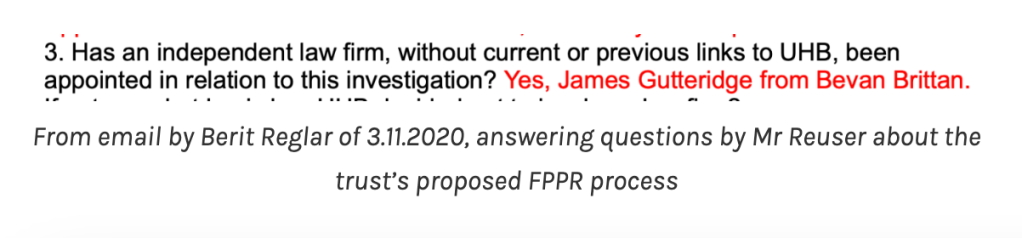
This was compounded by the fact that UHB misled the whistleblower and informed him wrongly in correspondence that the assisting law firm was independent and without current or previous links to the trust.

There were a number of procedural irregularities in the manner in which the whistleblower had been disciplined, suspended and dismissed by the trust, which were criticised by the Employment Tribunal. These breached a principle that NHS doctors should be disciplined with regards to Article 6 rights.

Documents were repeatedly withheld from the whistleblower and from the Employment Tribunal, which had the effect of concealing the fact that he was suspended on a false premise, which the Employment Tribunal determined the former UHB CEO should have known was false. The Employment Tribunal judge indicated in a costs judgment against the trust that he could not rule out “deliberate dishonesty” by the trust and key players, or that there would not be future serious governance failures of this sort.

The CRCC CEO had sight of the trust’s internal Fit and Proper Person Investigation report exonerating the former UHB CEO. She is on record as having reassured the trust governors that the investigation was sound. The minutes state at a UHB Council of Governors’ meeting on 29 July 2021:

“Karen Kneller also wished to provide reassurance to the Governors that the NEDs are particularly enquiring and have examined the situation thoroughly to their satisfaction and all are happy with the review.”

Although I am informed by an individual who actually witnessed the meeting that their recollection is that she stated there was “no smoking gun”.

The former CEO of UHB announced his retirement on the day that the first investigation report on the trust was published, on 28 March 2023.

Helen Pitcher also received information about the understandably serious impact of events on the whistleblower.

The issue I wish to raise with Justice Select Committee is this:

Helen Pitcher initially informed me via her Office on 14 April 2023 that she would consider my concerns and respond within twenty eight days.

On 18 May 2023 Ms Pitcher’s Office informed me that enquiries continued and that there was no date for completion.

On 2 June 2023, after an enquiry, the same message was given again.

There was no date set for review/ update.

I understand that serious matters take time to consider, but I am concerned by this open-ended approach to a serious matter, by an agency that is supposed to be all about fairness and accountability and should be above reproach.

It does not seem to me to be a sufficiently accountable approach.

I ask Justice Committee to note it for any future consideration of the effectiveness of the CCRC and CCRC’s governance.

I should note that parallel to this matter, NHS England’s “Well Led” investigation of UHB is expected to conclude early next month. There is reason to have modest expectations of this given that NHS regulators have repeatedly protected and helped to recycle erring NHS senior managers, which was a trigger for the NHS Kark review on the Fit and Proper Test in the NHS. The report of this review by Tom Kark KC was published over four years ago, but reflecting the recalcitrant nature of NHS senior management culture, its implementation was entrusted to NHS England and it has not yet been implemented.

I copy below the relevant correspondence from the CCRC showing its initial response and later responses with no identified timescale for completion or even review and update.

Yours sincerely,

Dr Minh Alexander

NHS whistleblower and retired consultant psychiatrist

Cc Health and Social Care Committee

From: REDACTED

Subject: FW: Concern about Karen Kneller’s role as Criminal Cases Review Commission CEO

Date: 14 April 2023 at 14:50:04 BST

To: REDACTED

Dear Dr Alexander 

I confirm that your correspondence of 13 April 2023 has been passed to Helen Pitcher.

Ms Pitcher will consider the contents and respond to you within 28 days.

Please could I also ask that you direct any further correspondence on this matter to this address rather than the Commission’s general mailbox.

Yours sincerely

Kind regards,

REDACTED

Executive Assistant to the Chairman  | CCRC

From: REDACTED

Subject: FW: Concern about Karen Kneller’s role as Criminal Cases Review Commission CEO

Date: 18 May 2023 at 15:51:04 BST

To: REDACTED

Dear Dr Alexander

Further to recent correspondence, Ms Pitcher has asked me to confirm that matters remain under consideration and inquiries are underway.

At this stage, we do not have a date for completion, but we will inform you of the outcome in due course.

Yours sincerely,

REDACTED

From: REDACTED

Subject: RE: Concern about Karen Kneller’s role as Criminal Cases Review Commission CEO

Date: 9 June 2023 at 10:49:39 BST

To: REDACTED

Dear Dr Alexander,

Thank you for your recent email.

Our inquiries remain underway. We do not have a specific completion date but will inform you of the outcome as soon as we can.

Yours sincerely,

REDACTED

Executive Assistant to the Chairman  | CCRC

RELATED ITEMS

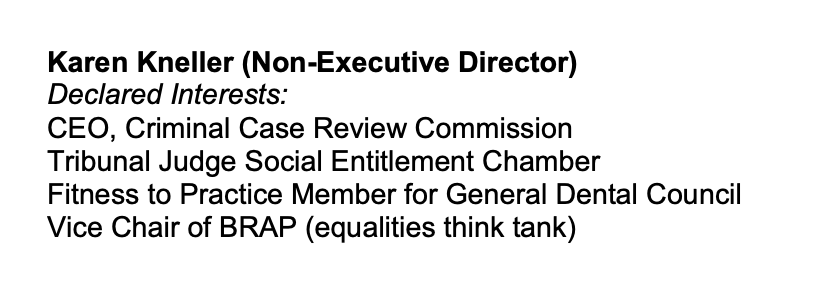
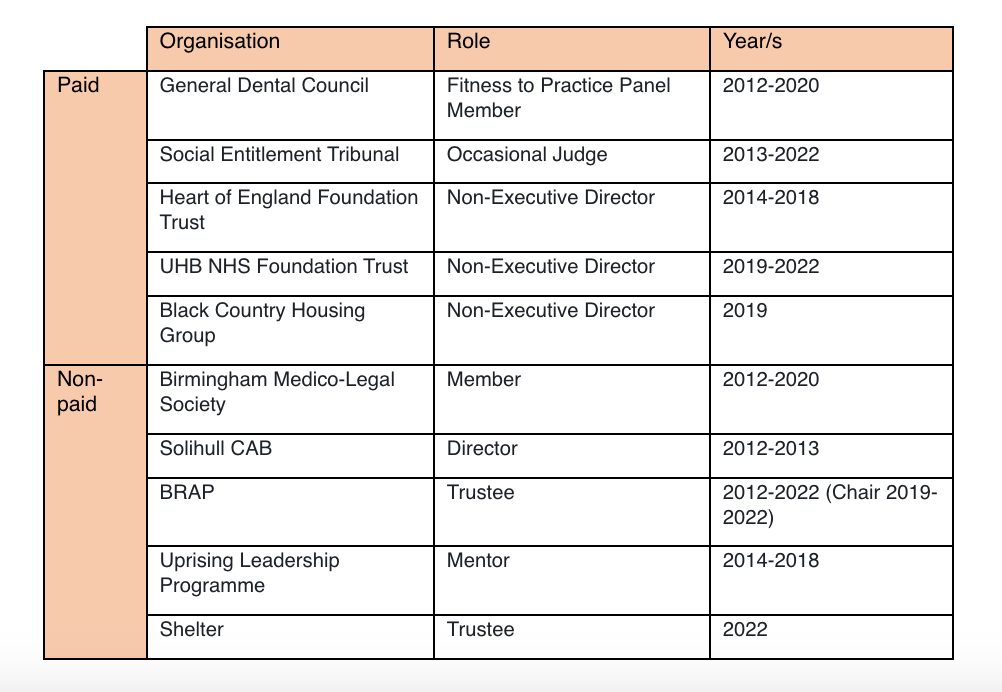
There is a difference in Karen Kneller’s declaration of interests at UHB and her declaration of interests at CCRC, which are more extensive.

This is her declaration of interests at UHB taken from a published trust document of 2020 (the most recent I could find):

Kneller has since resigned as a director of BRAP as of 10 January 2023.

This is Kneller’s declaration of interests at the CCRC, disclosed via FOI on 20 April 2023:

Mr Tristan Reuser’s whistleblowing case: Scandalous employer and regulatory behaviour on FPPR

Secretary of State who commissioned report on recycled NHS managers wonders if bad NHS managers are recycled

Secretary of State who commissioned report on recycled NHS managers wonders if bad NHS managers are recycled

By Dr Minh Alexander retired consultant psychiatrist 21 June 2023

The parliamentary Health and Social Care Committee sat on 20 June 2023 and took evidence from Steve Barclay Secretary of State.

Mr Barclay appeared to start waffling when asked about failure of the Freedom To Speak Up project.

In his verbal perambulations he wondered out loud if bad NHS managers are recycled.

He knows the answer to this, of course, having commissioned the Kark review on this topic in 2018.

But to provide cognitive support, I have reminded him of his previous commission, of two recent unanswered letters on the topic and of a topical example of an NHS exec who resigned after being criticised for poor governance, who then sold governance services to the NHS and is now back in the NHS as a Director of – you guessed it – Governance.

But it is positive that MPs are now starting to speak openly about the failure of the Freedom To Speak Up project.

The danger is that it will be replaced with something equally ineffective that will be again be used for another eight to ten years for PR and to block real change.

Actors new to the whistleblowing landscape, who are not whistleblowers, have recently been clamouring for a central route of NHS disclosure, such as at DHSC or NHS England. I have advised against that notion but it has popped up again through a Committee member. I have warned the Committee against it.

These are the relevant exchanges at Committee on 20 June 2023:

Rachael Maskell MP: If I may Chair. I’d just like to turn to the complaints system. I’m really concerned about the reports coming out of University Hospitals Birmingham. We’ve seen the reports that have come out of a number of mental health trusts. These trusts are clearly not safe for patients as the data is showing, but also not safe for many of the staff who are raising concerns.

After the Robert Francis report we thought that this would come to an end. Duty of Candour very much [inaudible] the front, whistleblowing being accepted as part of the NHS culture, however we haven’t seen the culture move on, and risk still prevails. Even looking at the PHSO insufficiency in being able to have leverage over what’s happening and in their reporting, back of what’s happening at many of these trusts, I’m really concerned that we do not have a robust complaint system.

What steps are you taking to look into that and what measures have you taken to date to move that forward?

Steve Barclay MP and Secretary of State for Health and Social Care: I think it’s a hugely important issue and I think colleagues across the house when I was on the Public Accounts Committee as a member for four years, one of the things I particularly focussed on, which is on record, was gagging of whistleblowers, particularly in the NHS. And how we have more transparency and a culture of learning where things go wrong, you know. In a Department which is allocating over £180 billion and employing as many people as the NHS does, there will be issues that go wrong. The key is how we identify them quickly and how we learn from that.

And so I know the Committee will share my concern when we heard the reports of some of the sexual abuse data that was coming out. And that was something I very urgently met with NHS leaders to discuss to ensure that was being gripped. You allude to the issues of mental health and I hope to have more to say very shortly on that specifically, particularly in the context of the Essex issues. And I know that a number of members of parliament [inaudible] have discussions with them on that, not just in Essex, but there’s been concerns more widely so I think the point you raise is a very valid one. It’s one I take extremely seriously. It’s one that colleagues can see throughout my time as an elected representative I’ve taken very seriously and it is something that I have discussed with Amanda Pritchard the chief executive of the NHS and with senior leaders such as Ruth May the lead nurse, and others, to ensure that we are learning the lessons from these issues and ensuring that where an issue is raised whether that’s by patients, whether it’s by members of staff, whether it’s by others in the community, that we’re addressing it.

Rachael Maskell MP: Just my final question. Because of what has been described as quite a bullying culture in many of these organisations and bullying being very prevalent across the whole economy (27% of workers experience bullying) but when it comes into the Health context it clearly puts the system at risk and patients at risk as well. Not to mention the impact on staff and staff retention.

Will you look at a central place where people can raise concern independently, in order to be able to whistleblow safely and to be able to raise those those concerns so that they are properly investigated? And a top down approach can be put on trusts to deal with these issues, because without it, as hard as the Robert Francis report tried to address these issues, it hasn’t delivered.

Steve Barclay MP and Steve Barclay Secretary of State for Health and Social Care: I’m keen to understand where, if there are areas where the complaints system are not working, why that is and how we learn from it. I think it is an area that has already had lots of focus so one of the issues we’ve got to understand, we have a Patient Safety Commissioner, we have er Guardians, we’ve had a number of other initiatives over many years, in this space. You touched on cases such as Birmingham which still generates significant concern. So for me it’s about understanding why when issues are known about locally, too often they’re not addressed. And how where, we’re learning from that. So that includes things like the trust Board and what visibility, what line of sight does the Board have? What accountability is there for senior managers when wrong doing is established? Are they just rotated  through the system? Or are people held to account? So I think there are a number of issues. It’s an issue sadly that’s been with us for quite a while, because I’ve spent a fair bit of time on it in a previous role. But I share your absolute desire to tackle it. I think you touched on it in the context of the wider duty we have to NHS staff and things like staff absence which is why these things then often manifest themselves in falling retention, because people vote with their feet and leave. It’s a hugely important issue. It’s one that we have a number of people involved in the NHS to tackle.  It is also a role for the Royal Colleges and others in the wider NHS family and I’m extremely keen to work with them on it.

This is my letter to Steve Barclay which includes a formal request for information about the DHSC’s approach to the Kark review on Fit and Proper Persons in the NHS:

“BY EMAIL

Steve Barclay

Secretary of State for Health and Social Care

21 June 2023

Dear Mr Barclay,

Kark review implementation and disbarring unfit NHS senior managers

I watched your oral evidence to Health and Social Care Committee yesterday, and in particular your answers to concerns that the government’s Freedom To Speak Up model has failed to deliver.

Your response on being asked about the failure of the DHSC’s and Robert Francis’ 2015 Freedom To Speak Up project was thus:

“Steve Barclay MP and Steve Barclay Secretary of State for Health and Social Care: I’m keen to understand where, if there are areas where the complaints system are not working, why that is and how we learn from it. I think it is an area that has already had lots of focus so one of the issues we’ve got to understand. We have a Patient Safety Commissioner, we have er Guardians, we’ve had a number of other initiatives over many years, in this space. You touched on cases such as Birmingham which still generates significant concern. So for me it’s about understanding why when issues are known about locally, too often they’re not addressed. And how where, we’re learning from that. So that includes things like the trust Board and what visibility, what line of sight does the Board have? What accountability is there for senior managers when wrong doing is established? Are they just rotated  through the system? Or are people held to account? So I think there are a number of issues. It’s an issue sadly that’s been with us for quite a while, because I’ve spent a fair bit of time on it in a previous role. But I share your absolute desire to tackle it. I think you touched on it in the context of the wider duty we have to NHS staff and things like staff absence which is why these things then often manifest themselves in falling retention, because people vote with their feet and leave. It’s a hugely important issue. It’s one that we have a number of people involved in the NHS to tackle.  It is also a role for the Royal Colleges and others in the wider NHS family and I’m extremely keen to work with them on it.” 

A number of points arise from your comments to Committee:

1.      The Patient Safety Commissioner’s role

The Patient Safety Commissioner’s remit is restricted to medicines and medical devices.

She is not currently listed as a Prescribed Person to whom whistleblowers can make protected disclosures.

But if she is to be a Prescribed Person under UK whistleblowing law, within these narrow confines, I would be grateful if you could confirm that this is so. 

2.      Local NHS Freedom To Speak Up Guardians 

Local FTSU guardians are toothless and importantly, defenceless. They themselves may become victims of abusive NHS organisations which employ them, and that has happened in some cases. Alternatively, some Guardians are appointed because they are willing to abuse whistleblowers. The model is a logically flawed and wasteful. It contributes very little. Testimony from two whistleblowers who have been failed by NHS trust Guardians can be found here:

CQC allows National Guardian to make unsubstantiated claims, and ignores harmful behaviour by Freedom To Speak Up Guardians

3.      Oversight by NHS boards

Oversight by NHS Boards is not the issue. It is abusive NHS Boards that are the issue, whether by actively and directly abusing whistleblowers or knowingly soliciting and/or permitting abuse. 

4.      Accountability for senior management wrongdoing

In your evidence to Committee you wondered out loud about whether there is accountability for erring senior NHS managers, or whether such individuals are recycled.

You personally commissioned the Kark review in 2018 on identifying unfit NHS managers and preventing their recirculation. 

You will recall the immediate catalyst was the debacle in which failed trust managers were protected by NHS regulators after Mid Staffs style failures at Liverpool Community Health NHS Trust.

See Hansard: Capsticks Report and NHS Whistleblowing 13 July 2016

Upon reviewing the Fit and Proper Persons test in the NHS, Mr Kark KC found current systems wanting and made recommendations for improvement. 

However, the implementation of the Kark review recommendations was entrusted to NHS England, an NHS regulator which has been responsible for much of the executive recycling and setting a culture of impunity.

There has been no sign yet of implementation of the Kark review. 

Indeed, NHS England has claimed to me that there is no ministerial support for Tom Kark’s crucial recommendation of a disbarring mechanism for the worst and most unfit NHS managers. 

I have written to you twice about this (7 February and 29 May 2023, forwarded below), asking you to reconsider this reported decision, but I received no reply. 

A current example of NHS executive recycling

But to answer your question on whether erring senior managers are rotated through the system, the answer is ‘yes’. This is a current and topical example:

Darren Grayson resigned from a post as NHS trust CEO in 2015 after an extremely critical CQC report and allegations of management bullying and other governance failures. Mr Grayson went on to sell consultancy services to the NHS through a private company, the Good Governance Institute. This included work for a predecessor body of University Hospitals Sussex NHS Foundation trust, during Marianne Griffiths’ tenure as CEO. Partly on the basis of material produced by the Good Governance Institute, the CQC took the trust out of special measures and rated it “Good” in 2019. Last year Mr Grayson took up a substantive post at this same trust as Director of Governance. Staff whistleblowing to the CQC continued and the police are now making enquiries into concerns about patient deaths 2015-2020 that may amount to gross negligence manslaughter.

The longer the implementation of the Kark review is delayed, the more examples of such recycling will accumulate. 

The Kark review stopped short of recommending managerial regulation, but reserved it as an option for the future. Please note that the delay in regulating NHS managers now spans decades.

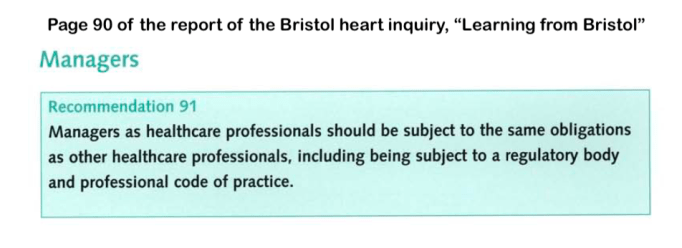
The 2002 Bristol Heart inquiry recommended regulation for NHS managers:

I would be very grateful if under FOIA the DHSC could advise me of the following:

1.      As of now, which of the Kark review recommendations does the DHSC accept and which does the DHSC reject?

2.      Is it correct that there is no ministerial support for Tom Kark’s recommendation of a disbarring mechanism for unfit NHS managers? 

3. Why did the DHSC decide not to pursue a disbarring mechanism? What directions/ instructions has the DHSC given to NHS England on this matter?

4.      What is the DHSC’s timetable, if any, for implementating any of the Kark review recommendations that it has accepted?

Many thanks and best wishes,

Minh

Dr Minh Alexander”

This is my letter to the Health and Social Care Committee to register concern about the proposal for another NHS and government controlled whistleblowing body, and to ask that the Committee instead focuses on implementation of the Kark review.

Letter to Rachael Maskell MP and Health and Social Care Committee 21 June 2023, Kark review and concern about another central NHS whistleblowing body

RELATED ITEMS

NHS musical chairs: Darren Grayson, the Good Governance Institute & University Hospitals Sussex NHS Foundation Trust

Mr Tristan Reuser’s whistleblowing case: Scandalous employer and regulatory behaviour on FPPR

NHS musical chairs: Darren Grayson, the Good Governance Institute & University Hospitals Sussex NHS Foundation Trust

By Dr Minh Alexander retired consultant psychiatrist 13 June 2023

Background

The private company the Good Governance Institute (GGI) sells consultancy services and has many links with the NHS. It lists a large group of current and former NHS managers and NHS regulatory staff amongst what it calls its “people”.

What this designation signifies seems vague.

Jacqui Smith the controversial former Home Secretary, former Chair of University Hospitals Birmingham NHS Foundation Trust (UHB) and current chair of Barts Healthcare NHS Trust and Barking Havering and Redbridge University Hospitals NHS Trust is listed amongst the Institute’s “people”.

Upon a FOI request to Barts, Smith denied that this amounted to any specific role: “Rt Hon Jacqui Smith has no formal board or management title or any ongoing role with GGI” but nonetheless Smith is listed as one of the GGI’s “people”.

Several other UHB managers are listed as GGI “people”.

The GGI carried out a “Well Led” review on UHB in 2019, but more on that another time.

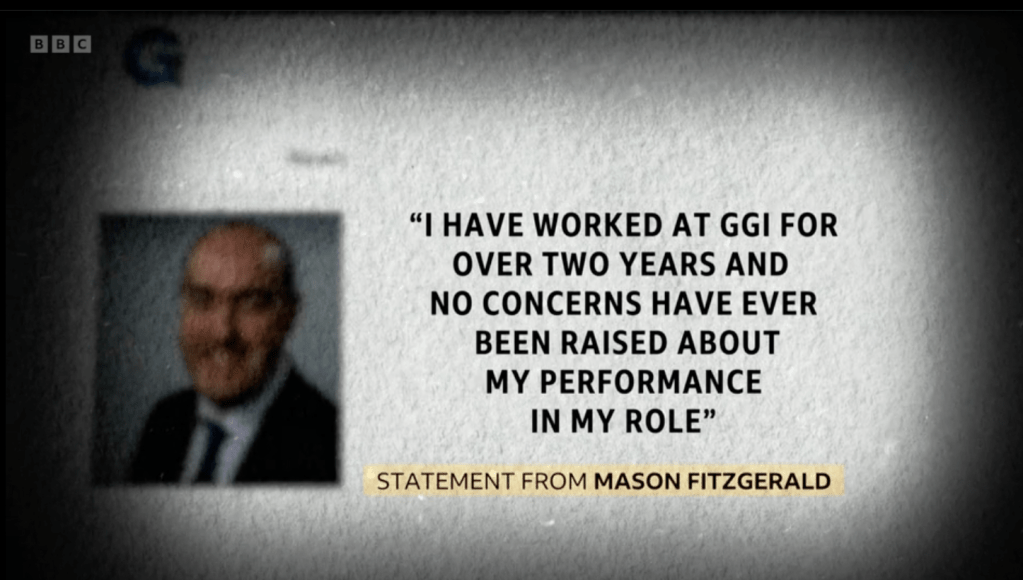
Moreover, the GGI is known for the fact that it hired Mason Fitzgerald former NHS trust director despite his sacking by the NHS after a false claim about his qualifications.

The Good Governance Institute at Sussex

What I cover here is a link between the GGI and University Hospitals Sussex NHS Foundation Trust, where it was revealed at the Employment Tribunal on 5 June 2023 that the police are investigating allegations that may amount to gross negligence manslaughter.

The Guardian reported that Mr Krish Singh, surgeon, one of the Sussex whistleblowers had raised concerns about corporate actions which resulted in deaths:

“Singh claimed the trust had promoted insufficiently competent surgeons and overused insufficiently skilled locums.”

“…he claimed that cost-saving changes at the hospital “were driven through that were grossly unsafe and ultimately drove up complication rates and patient mortality”. 

Another senior trust whistleblower Mr Mansoor Foroughi, surgeon, raised similar concerns.

University Hospitals Sussex NHS Foundation Trust was formed by the 2021 merger of Western Sussex Hospitals NHS Foundation Trust, a regulatory and political favourite run by Marianne Griffiths CEO and George Findlay Medical Director, with the struggling trust Brighton and Sussex University Hospitals NHS Trust.

But the board of Western Sussex took over the running of Brighton and Sussex University Hospitals NHS Trust (BSUH).

From April 2017 onwards Marianne Griffiths became CEO for BSUH as well.

BSUH remained a PR thorn in Griffith’s side for the next two years, with BSUH stuck in special measures until 2019. when it was taken out of special measures by the Care Quality Commission and jumped from a rating of “inadequate” to “good”.

In the CQC’s evidence appendix for the related inspection report, CQC stated that the trust had hired the Good Governance Institute and ensured a “golden thread” of quality throughout its improvement strategy:

“Governance

The chief medical officer explained that when the current executive management team had taken over the management contract for the trust, they felt concerned about the governance and assurance arrangements in place and felt they did not have assurance about the quality of treatment and care being provided for patients. They found examples of good clinical governance and reporting in place at a service level, but this information was not being reported up to the board. The trust had therefore commissioned an external review of the governance arrangements from the Good Governance Institute.

Because of this review, a structure of five divisions was put in place where previously there had been 13 directorates. The divisional structure led by a triumvirate of a clinical director, general manager and head of nursing had provided the building blocks for the revised governance arrangements. The Good Governance Institute provided training in governance for these leaders. the non-executive directors and executive directors described the journey for the triumvirate leaders moving from a concern that more reporting was going to be required of them, to understanding governance and how the data and reporting would enable them to drive quality improvement.

The board invited the Good Governance Institute to carry out a review of the trust’s quality governance structures, which resulted in 31 separate recommendations being made. The trust acted to address these issues and the Good Governance institute carried out a further review reporting on progress against these actions. A focus of this work has been to strengthen quality governance arrangements at divisional level.

The trust had effective structures, systems and processes in place to support the delivery of its strategy including sub-board committees, divisional committees, team meetings and senior managers. Leaders regularly reviewed these structures. The trust reported regularly through its governance arrangements on progress against delivery of its strategy to the board, trust executive committee and to other relevant committees. However, the structure needed more time to become fully embedded.

In interviews with the chair of the Quality Assurance Committee, the chair of audit and the chief medical officer (the executive officer responsible for governance), all non-executive and executive directors were able to describe the governance structure and how it functioned.

The effectiveness of the governance arrangements was observed on inspection at Strategy Deployment Review meetings. Each of the three leaders of each division owned and presented the data for their breakthrough objectives. They had interrogated the data to find root causes where the objectives were behind plan and had devised action plans based on this knowledge to bring the objective back on track.

The Chair of the Audit Committee explained that under the previous administration, assurance was not provided through reporting and they were not getting the information they needed. The new structures provided a joined-up approach that provided assurance on quality and delivery against the Patient First Strategy and breakthrough objectives and delivered quality improvement.

Quality was a ‘golden thread’ running through the trust Patient First Strategy. In all the interviews undertaken on inspection the golden thread of quality was evident in the use of data both quantitative and qualitative and how this was triangulated and reported through the Quality Steering Group to the Quality Assurance Committee and the trust board.

Non-executive and executive directors were clear about their areas of responsibility. Performance against the trust’s patient first strategy, true north and breakthrough objectives was focused and reinforced through the trust’s strategic deployment review approach. There was clear ward to board line of sight through daily performance huddles, weekly driver meetings, Divisional Strategy Deployment Review, executive level Strategy Deployment Review and the board.

The Chair of the Quality Assurance Committee gave an example of challenge and holding the executive directors to account when an action plan did not evidence sufficient learning to drive improvement and required further work to be undertaken.

The quality dashboard was aligned to the quality priorities along with the quality improvement plan with actions being taken and monitored at divisional, corporate and board level through the quality governance system, Quality Assurance Committee and board. The Audit Committee evaluated the effectiveness of the trust’s structures and processes in relation to the management of risk, the management of performance and financial management and the management of quality and quality improvement.”

Well, if your quality dashboard looks good, what could possibly go wrong?

And who led the CQC inspection team that concluded BSUH should be taken out of special measures? The inspection team was led by Cath Campbell now CQC Deputy Director of Operations and a David Melbourne.


Would that be the David Melbourne who was then deputy chief executive of
Deputy Chief Executive of Birmingham Women’s and Children’s NHS Foundation Trust and is now the much-criticised CEO of Birmingham and Solihull ICB, a body that has helped to protect failing UHB executives and to obfuscate the reality at UHB?

Just fourteen months after the remarkable January 2019 CQC inspection report praising Griffiths et al, Health Education England noted horrendous governance and serious patient safety failings at the trust.

Darren Grayson formerly of the Good Governance Institute, now a University Hospitals Sussex NHS Foundation Trust director

I am informed that the Good Governance Institute’s review of BSUH in 2018 was led by Darren Grayson, executive director and partner at the Good Governance Institute 2016-2022.

The Good Governance Institute later celebrated its work at Sussex with a little blog:

Brighton and Sussex University Hospitals NHS Trust – supporting the implementation of a new quality governance structure 13 April 2021.

And then what happened next?

In March 2022 Griffiths appointed Darren Grayson, executive director and partner of the Good Governance Institute, on to the board of the newly formed University Hospitals Sussex NHS Foundation Trust as Chief Governance Officer.

This is Grayson’s LinkedIn entry, which gives some of his CV in terms of past NHS posts prior to becoming an executive partner at the GGI. He was a local NHS executive, previously working as CEO of NHS Brighton and Hove, and then CEO of East Sussex Healthcare NHS Trust.

Notably, Grayson stood down from his post as CEO at East Sussex Healthcare NHS trust in 2015, after a CQC inspection of the trust rated it as “Inadequate” both overall and on the “Well Led” domain.

The CQC found evidence of managerial bullying and other signs of poor culture. For example:

“The themes identified related to the quality of staff engagement, low morale, and a bullying and harassment culture from senior management.”

“The trust board continues to state they recognise that staff engagement is an area of concern but the evidence we found suggests there is a void between the Board perception and the reality of working at the trust. At senior management and executive level the trust managers spoke entirely positively and said the majority of staff were ‘on board’, blaming just a few dissenters for the negative comments that we received.

We found the widespread disconnect between the trust board and its staff persisted. This is reflected in the national NHS Staff survey.

….The trust told us they were disappointed by the results; but we saw no direct programme to address this or to change the position. There remained a poor relationship between the board and some key community stakeholders. We found the board lacked a credible strategy for effective engagement to improve relationships.

….Within the trust, we did not see a cycle of improvement and learning based on the outcome of either risk or incidents.

• Staff remained unconvinced of the benefit of incident reporting, and were therefore not reporting incidents or near misses to the trust. the trust was not able to benefit from any learning from these. this position had not improved.

• The risk register was not capturing risks in a robust way.

• We saw a redesign of the governance structure, but were unable to yet see any significant benefits or improvements from this.”

A special meeting of the local Joint Health Scrutiny and Overview committee reached a unanimous vote of no confidence in him:

No confidence in NHS Trust bosses

The Chair of the Committee commented: “You are the captain of the ship which has hit rocks, and it is starting to sink and I think the biggest morale boost you can give to staff is to say sorry and then offer your resignation.”

Grayson reportedly refused to resign initially but later stepped down:

Controversial NHS boss to stand down – but chairman to remain in position

Local MPs called for Grayson’s resignation.

The unions also called for his resignation and warned against any golden handshake.

“The CEO did not listen to his own staff, public opinion or GMB. Instead he openly criticised and blamed those, including GMB, for challenging him and his management style.”

This is Grayson’s biography from the University Hospitals Sussex NHS Foundation Trust’s website, which adds political detail in terms of his work at the New Labour hub, the No 10 delivery unit which ran 2001-2005.

Importantly, Darren Grayson’s partner is Jenny Procter, another director at University Hospitals Sussex NHS Foundation Trust, as revealed by trust declarations of interest:

According to her LinkedIn entry, Procter has been the trust’s Director of Improvement & Delivery since April 2021, and before that she was Director of Efficiency & Delivery from 2017 to 2021 for both its predecessor trusts.

Matters arising

So, what does it say about Marianne Griffiths’ leadership of University Hospitals Sussex NHS Foundation Trust that she hired someone like Darren Grayson to review trust governance and then later gave him an executive job, after such a disaster at East Sussex Healthcare NHS Trust?

Ironically for Griffiths et al, their enterprise with the Good Governance Institute may well tip the balance in any consideration of corporate failures in the deaths scandal. In the

BSUH quality accounts of 2017/18,  Griffiths claimed:

“At a corporate level, we are working with Good Governance Institute to ensure clear lines of sight from the front line of service delivery through to board level on quality and safety. This means that we can identify – and resolve – issues much earlier, contributing to the improvements in patient care.”

As above, the CQC later reported that the “clear line of sight” by the trust board was in place in its January 2019 inspection report. This appears to be additional evidence supporting staff disclosures to Health Education England that the board, through Griffiths, knew about the deaths, staff concerns and lack of governance in the surgical division.

I am requesting copies of all Good Governance Institute reports undertaken for the trust under FOIA.

I will also ask CQC to confirm that David Melbourne was an employee of the CQC as an inspection chair/ executive reviewer, to disclose whether this continues and to disclose whether any other executives from UHB and Birmingham and Solihull ICB are CQC executive reviewers.

CQC’s unseemly habit of employing part time/ bank staff from regulated bodies, especially at director level, has long been a source of conflicted interests and incestuousness which has undermined the authority and legitimacy of its inspections.

Is there a ‘club culture’ at the heart of the NHS’s quality regulator?

UPDATE 23 SEPTEMBER 2023

The Times has picked up the story about Darren Grayson’s recycling to the Sussex board as Chief Governance Officer:

Surgery deaths continued after repeated warnings by coroners

Importantly, it has now been made public that shockingly, Grayson is the trust’s police liaison for Sussex police with respect to the polic investigation into police deaths.

This is despite the fact that there are questions of conflict of interest from his review of trust services in his previous capacity as a consultant for the so-called Good Governance Institute. The GGI was investigated by BBC Newsnight.

RELATED ITEMS

This is a published CIPFA profile of David Melbourne in question and answer format, from when he was CFO at Birmingham Women and Childrens, in which Melbourne sympathises with the poor and emphasises the importance of staying true to your values.

David Melbourne, Chief Finance Officer

This is Birmingham and Solihull ICB’s biography of Melbourne:

Melbourne took part in a charade in which the ICB and UHB misled the public and partner agencies by claiming that David Rosser the former CEO of UHB stepped down, when he in fact remained employed by UHB:

NHSE, ICB and UHB’s three-ring circus and Rosser’s digital assignment

The neglected Kark review on unfit NHS managers

The Kark review, commissioned by Steve Barclay five years ago made a string of recommendations for preventing the recycling of unfit managers in the NHS. The task of implementation was given to NHS England, which is notorious for running the so-called “donkey sanctuary” for failed senior NHS managers. There has been no sign yet of any implementation, and NHS England claims that Steve Barclay himself dropped Kark’s recommendation for a disbarring mechanism. Correspondence to Mr Barclay about the failure to implement Kark’s recommendations has so far gone unanswered.

I leave readers with this comment below The Brighton Argus report on Grayson’s fall in 2015, by a perspicacious member of the public:

The NHS National Freedom To Speak Up Guardian helped Griffiths and co by disadvantaging trust whistleblowers in 2018, when she delayed a review of whistleblowing governance. This aspect of the saga can be found here:

A Study in Delay: The National Guardian & Brighton and Sussex University Hospitals NHS Trust

A Study in Delay II : The National Guardian, maternity safety & University Hospitals Sussex NHS Foundation Trust

I have asked the CQC to investigate the National Guardian’s Office’s handling of whistleblowing matters at Sussex.

Letter to Ian Trenholm CQC CEO requesting an investigation of the National Guardian’s handling of whistleblowing matters at University Hospitals Sussex NHS Foundation Trust 11 June 2023

A prime example of the fate of whistleblowers at UHB, another NHS trust which favoured the GGI, can be found here:

Mr Tristan Reuser’s whistleblowing case: Scandalous employer and regulatory behaviour on FPPR

The twists and turns at Sussex illustrate very well what an insurmountable and well constructed wall NHS whistleblowers often face.

How credible is UHB’s claim that it purportedly appointed TheValueCircle for their “credibility”, “gravitas” & “value for money”?

Dr Minh Alexander retired consultant psychiatrist 8 June 2023

This is a brief post to share and unpack claims made by University Hospitals Birmingham NHS Foundation Trust, via an FOI disclosure, about its appointment of the private consultancy TheValueCircle to review its “toxic” culture.

So far, other enquiries about TheValueCircle’s past work in the NHS have revealed steep fees, little evident tangible work product and much secrecy by the NHS bodies which purchased the consultancy’s services. Well Led and governance reviews etc undertaken by TheValueCircle are kept under lock and key by NHS execs:

  UHB controls its culture review, NHS executive secrecy and what value from the “TheValueCircle”? 

This does little to foster a culture of transparency and accountability.

Perhaps it is not surprising that the much-criticised board of UHB might opt to hire such services.

UHB has now disclosed information on the panel which hired TheValueCircle and its criteria for selection.

FOI disclosure by UHB on the panel selection process to appoint TheValueCircle

The panel of seven included four UHB directors, including significantly Fiona Alexander the UHB Director of Comms and former editor of the Birmingham Post. Why would you want the chief spin doctor vetting a contractor for a governance exercise, unless perhaps it was more of a PR exercise?

UHB feel no shame it seems in stating that Fiona Alexander’s role is one of reputational management:

So what is she doing inside an exercise that is purportedly supposed to uncover and reveal the embarrassing truth? A silly question, no doubt.

The disclosed selection panel members:

Dame Yve Buckland, Chair of University Hospitals Birmingham NHS FT
Roger Kline, Independent Chair of UHB Culture Review Reference Group
Mehrunnisa Lalani, Non-Executive Director and Chair of People and Culture Committee UHB
Professor Mike Bewick, Patient Safety Review Lead and report author – identified culture themes to be carried through in to culture review
Giles Peel, Patient Safety Reviewer and report contributor – identified culture themes to be carried through in to culture review
Cathi Shovlin, Chief People Officer
Fiona Alexander, Director of Communications

There was no staffside representation on the selection panel, so arguably no one with a real interest and commitment was there to ask penetrating questions.

Mike Bewick who was hired by Birmingham and Solihull Integrated Care Board to oversee all of the UHB reviews, and Giles Peel one of his longstanding business associates and regular report co-authors were on the panel.

Interestingly, Bewick and Peel were appointed to the panel a month after all the others.

They were not paid by UHB so the implication is that the ICB was paying for their input.

The trust denied that NHS England was involved in the selection of panel members and maintained that it was solely directed by the trust chair Yve Buckland who both appointed and sat on the panel.

But the appearance of Bewick and his associate Peel on someone else’s tab suggests there was coordination with other bodies and external influence on this process.

Buckland also hired Roger Kline to act as “independent” chair of the panel.

Kline had prior links with UHB.

In response to a question about panel members’ credentials for the task, UHB answered merely:

“Their credentials are evident from the relevance of their role to the culture review.”

A great start to a review of culture when the accused is so arrogant that it cannot even affect a small show of humility.

As for the criteria by which Buckland’s panel selected the contractor to conduct the culture review, these are the disclosed criteria:

The panel’s disclosed selection criteria for the contractor:

“1. Experience and credibility in undertaking a high quality culture review of this scale and in our current context
2.     Experience in undertaking culture reviews both within the NHS and wider – important that they understand the NHS but also seek added value in what can be gained from wider sectoral experience
3.     Demonstration of understanding of culture, our organisation, our values and the different stakeholder groups
4.     Demonstration of understanding of equality, diversity and inclusion, and their approach to embedding this through culture review
5.     Approach to the culture review – how they will maximise opportunities to hear all voices and how they will approach engagement and trust-building in our current context
6.     The team – their diversity and ability to reflect our staff, and the gravitas with which they can engender trust and credibility
7.     Scale – their ability to undertake the review in all its complexity and in the depth required within the timeframe
8.     Value for money – price, timescale and any additional services they would include”

So how exactly did Kline et al establish that TheValueCircle had “credibility”, “gravitas” and be “value for money” when there is no work product by the company in the public domain and other organisations jealously guard it with such secrecy?

Does the hiring of TheValueCircle whiff a little of a predetermined decision because of a recommendation/ instruction from on high?

Was a selection criteria missed off the disclosed list: “favoured and tipped by other executives”?

Finally, let us remember that TheValueCircle has friends in high places. Andrew Morris a member of the NHS England board acts as a consultant for them.

NHS England refuses to confirm or deny whether it employed sacked former NHS director Mason Fitzgerald, but it did accept “pro bono” research by the Good Governance Institute

Dr Minh Alexander retired consultant psychiatrist 7 June 2023

NHS England has purchased services from a private company, the Good Governance Institute, despite the fact that the Institute hired former NHS director Mason Fitzgerald. Fitzgerald was sacked after false qualification claims, including on his LinkedIn entry:

NHS boss Mason Fitzgerald sacked over false qualification claim

NHS England has failed to respond to concerns since last autumn and initially ignored a complaint about this. It also ignored a related FOI request until it recently received a direction from the ICO to respond.

It now refuses to confirm or deny that it has employed Mason Fitzgerald since his sacking by East London NHS Foundation Trust.

Curiously, NHS England admitted that the Good Governance Institute carried out pro bono research for it this year on “systems”. This sounds as if it could be the work on ICS governance that the GGI and Mason Fitzgerald were possibly involved with, as suggested by GGI material in the public domain.

I have asked for further information  about this pro bono research and for an internal review of NHS England’s refusal to answer on whether it has employed Mason Fitzgerald since his sacking.

I have also pointed out recent evidence that the GGI’s normalisation of his behaviour and his dismissal by the NHS is leading to his re-entry into the NHS.

The FOI response and further correspondence to NHS England is provided below.

From: REDACTED

Subject: Sensitive NHS England’s relationship with the “Good Governance Institute” and possible employment of sacked former NHS director Mason Fitzgerald

Date: 7 June 2023 at 07:14:11 BST

To: REDACTED

Cc: REDACTED

BY EMAIL

Amanda Pritchard 

Chief Executive

NHS England 

7 June 2023

Dear Amanda,

NHS England’s relationship with the “Good Governance Institute” and possible employment of sacked former NHS director Mason Fitzgerald

I have finally received NHS England’s response to my FOI request about whether or not NHS England employed Mason Fitzgerald after he was sacked by East London NHS Foundation Trust (ELFT) in 2021, following concerns about false claims about a legal qualification which appeared in several documents and on his LinkedIn entry.

NHS boss Mason Fitzgerald sacked over false qualification claim

As you may recall, I was concerned that the so called “Good Governance Institute”, a private company with many links to the NHS and which lists many former and current senior NHS managers amongst its “people”, had hired Mr Fitzgerald as a senior consultant despite his sacking by the NHS. It has since promoted him to Director of Consultancy.

I became even more concerned when I saw that Ruth May NHSE England Chief Nursing Officer had engaged the Good Governance Institute late last year. I became even more concerned when I saw material by the GGI which raised questions about whether the GGI was working with NHS England on ICS governance and that Mr Fitzgerald taking part in this work.

Hence I raised concerns with Ruth and then with you about whether NHS England should have links with the GGI and whether NHS England was employing Mr Fitzgerald to work on of all things, ICS governance.

NHS England has stonewalled. The response to my eventual FOI enquiry, made in the absence of any response from you or Ruth, only came after direction by the ICO to NHS England to respond. The FOI reply is forwarded below.

NHS England has now refused to confirm or deny whether it has employed Mason Fitzgerald on grounds that this is non-disclosable personal information. It considers my request for this information “intrusive”.

But it has confirmed that it did indeed purchase services from the GGI AFTER Mr Fitzgerald was sacked by the NHS, including a purchase by Ruth May’s directorate in autumn 2022, by which time Mr Fitzgerald was working for the GGI.

Curiously, NHS England states that it received an offer of pro bono work from the GGI this year: “an offer of pro bono work with a nominal payment of £100”.

This work was vaguely described as: “consultancy services for conducting research with systems to inform the development of set of principles regarding system risk management”

1)         As a fresh FOI request, I would be grateful if NHS England

–           could confirm whether this research by the GGI related to ICS governance

–           could disclose all documents relating to the offer and acceptance of this “pro bono” consultancy work

–           could disclose whether the former CEO of ELFT who is now an NHSE director was involved in setting up this “pro bono” arrangement

–           could disclose what access to NHS systems was given to the GGI in order to undertake this research, including any financial data

–           could disclose the research report(s) produced as a result of this “pro bono” consultancy work

–           With respect to NHSE’s advice that “We are able to generally advise that NHS England scrutinises the suppliers financial standing and capability to deliver the required services and can withhold contracts from organisations where directors have been convicted of fraud or similar offences but that power does not extend to the investigation of employees of the organisation”, please disclose the policy document(s) which sets out what due diligence NHSE should undertake regarding contractors’ governance and the circumstances in which contracts may be refused.

2)         I would also be grateful if NHS England could internally review its assertion that information about whether it employed Mason Fitzgerald is personal data, that is not disclosable.

Mr Fitzgerald was a senior NHS director who was appointed as an NHS trust Chief Executive but did not take up the position at the last minute, causing a scandal and serious reputational harm and disruption to two NHS trusts because of the false claims about his qualifications. 

The reasons for his eventual dismissal by East London NHS Foundation Trust have a serious impact on public trust in the NHS. 

It is of great public interest whether NHS England as the body which oversees the rest of the NHS and is a regulator of NHS trusts and NHS Foundation Trusts, takes issues of probity seriously and does not employ those who have been dismissed following acts of dishonesty. It is a matter of basic Safeguarding that senior individuals whose actions impact on many, many lives should be trustworthy. 

Moreover, it is important that NHS England as the body charged with implementing the Kark review recommendations on preventing unfit NHS managers from recirculating in the NHS is seen to model good practice, to live by the principles set out by the Kark review and not to actively undermine the goals of the Kark review.

NHS England maintains that it cannot investigate contractors’ employees. But the NHS has already investigated and sacked Mr Fitzgerald.

It is therefore essential that NHS England accounts for whether it has employed Mr Fitzgerald following his sacking by East London NHS Foundation Trust, and if it has done so, to explain how it will move on from this.

I should point out that the GGI’s normalisation of Mr Fitzgerald’s behaviour and dismissal is leading to his re-entry to the NHS in other contexts. According to a tweet by the Head of Risk Management of Nottingham University Hospitals, where maternity deaths are currently being investigated by Donna Ockenden, M Fitzgerald was due to speak there last month as a GGI representative, on “risk appetite”.

If NHS England is also seen to normalise the situation, and fails to account in full regarding its relationship with the GGI or to answer questions about whether it has employed Mason Fitzgerald after his sacking, this effect would be greatly amplified.

With best wishes,

Minh

Dr Minh Alexander

Cc Tom Kark KC

     BBC Newsnight

     Health and Social Care Committee

     Steve Barclay Secretary of State

From: REDACTED

Subject: Freedom of Information Request (Our Ref: FOI-2305-1971470) NHSE:0176254

Date: 6 June 2023 at 15:10:01 BST

To: REDACTED

Freedom of Information Request (Our Ref: FOI-2305-1971470)

Dear Minh Alexander,  

Thank you for your Freedom of Information (FOI) request dated 15 March 2023. Please accept our apologies for the delay in responding.

Your request

You requested the following information [numbering inserted by NHS England]:

“As an FOI request, 
 

  1. please disclose if since July 2021 when Mason Fitzgerald was sacked by East London NHS Foundation Trust, NHS England has purchased Mason Fitzgerald’s services in any capacity, whether directly or via another party such as the Good Governance Institute.

 
Please disclose 
 

  1. the number of occasions on which his services were purchased,
  2. the total number of days work purchased,
  3. the type of services purchased and
  4. the total amount spent.
  5. As part of this, please clarify if Mason Fitzgerald did indeed work on ICS governance, and if he did, on which ICS did he work.
  • Please also disclose
  • which NHSE senior managers signed off these expenses, and
  • under which NHSE directorate these expenses fell.
  • Please also disclose the total amount that NHS England has spent on the Good Governance Institute’s services since July 2021, irrespective of which directorate purchased these services.”


Decision

In respect of questions 1 and 2, NHS England is neither confirming nor denying whether the requested information is held.

In respect of question 3, NHS England holds some information in scope of your request and has disclosed all of the information that it holds.

Questions 1 and 2

Please note, from the information that NHS England would routinely hold or collect, we would be unable to breakdown this information as per parts 1(b), 1(c) and 1(e) of your request. Therefore for those parts, we confirm NHS England does not hold the information being requested.

In relation to the other parts under questions 1 and 2, NHS England neither confirms nor denies whether it holds the requested information and considers section 40(5)(b)(i) is engaged.

To determine whether section 40(5) applies, NHS England needs to demonstrate:
 

  1. that confirming or denying whether the requested information is held would constitute the disclosure of a third party’s personal data; and
  2. that providing this confirmation or denial would contravene one of the data protection principles.


Section 3(2) of the Data Protection Act 2018 (DPA) defines personal data as: any information relating to an identified or identifiable living individual.

In response to part a), whether NHS England has contracted or employed services from a specific individual, or did not employ a specific individual, meets the definition of personal data under the DPA. We consider that if we were to either confirm or deny we hold this information, this would in itself disclose personal data.

NHS England are required to be consistent when considering the application of section 40(5) when processing FOI requests. Therefore, it is important to apply this exemption on a consistent basis when considering requests for information under the FOI Act. The application of this exemption should not be taken as an indication as to whether the information is held or not.

In response to part b),NHS England can only confirm whether or not it holds the requested information if to do so would be lawful (i.e. it would meet one of the condition of lawful processing listed in Article 6(1) GDPR), be fair and be transparent.

The most applicable would be Article 6(1)(f) which provides that “processing is necessary for the purposes of the legitimate interests pursued by the controller or by a third party except where such interests are overridden by the interests or fundamental rights and freedoms of the data subject…”

Disclosure under FOI Act is considered to be a disclosure to the world at large, and not just to the individual applicant. Confirming or denying whether this information is held would, in our view, be unfairly disclosing information that is an individual’s personal data. 

Prior to services being contracted, NHS England would scrutinise suppliers’ financial standing and capability to deliver the required services and can withhold contracts from organisations where directors have been convicted of fraud or similar offences. Therefore, we consider there are other ways in which the legitimate aim in question for this FOI can be satisfied and there are less intrusive ways of meeting this legitimate aim. We therefore consider, it would be unfair in this particular instance to disclose an individual’s personal data and we do not have a lawful basis for processing this personal data (i.e. disclosing it under the FOI Act).


Question 3

Since July 2021, NHS England can confirm that it has contracted services from the Good Governance Institute on three occasions:
 

  1. Between July and October 2021, a contract was signed by Health Education England for £47,982 for consultancy services for a review of executive governance to support the Accountable Officer.
  2. Between October and December 2022, NHS England paid £74,650 for consultancy services for an engagement exercise to support the development of the next CNO for England Professional Strategy for nursing and midwifery.
  3. In February 2023, NHS England paid £100 for consultancy services for conducting research with systems to inform the development of set of principles regarding system risk management.


Each of these contracts were contracted through specifying the service required rather than the number of days worked. Therefore, even if a certain individual had worked on behalf of this organisation whilst the contract was in place, NHS England would be unable to breakdown the information we hold as per parts 1(b), 1(c) and 1(e) of your request.

Contract A was arranged when Health Education England (HEE) was a separate organisation to NHS England. In accordance with the former HEE’s Standing Financial Instructions, this was approved by the budget holder, Director of Corporate Accountability and Engagement (the directorate it fell within) and the Director of Finance.

Contract B was approved by NHS England’s Nursing directorate and was approved by the budget holder, finance account manager for the budget it was raised from, and NHS England’s Commercial Panel in accordance with our Standing Financial Instructions.  The Commercial Panel includes representation from the Commercial, Financial and Legal teams.  In addition, due to the value and type (consultancy services) these procurements were referred to, and approved by, the Department of Health and Social Care’s (DHSC) Procurement team.

The procurement was below the PCR (2015) threshold and as such subject to the light touch procurement process. This does not require the use of the Standard Selection Questionnaire (SQ) mandated under PPN 8/16 for above threshold work.

We are able to generally advise that NHS England scrutinises the suppliers financial standing and capability to deliver the required services and can withhold contracts from organisations where directors have been convicted of fraud or similar offences but that power does not extend to the investigation of employees of the organisation.

Contract C was approved by NHS England’s directorate for the Chief Delivery Officer and was approved by the budget holder and constituted an offer of pro bono work with a nominal payment of £100.

The total amount that NHS England has spent on the Good Governance Institute since July 2021 is £122,732 (contracts detailed above).

Copyright

NHS England operates under the terms of the Open Government Licence (OGL). Terms and conditions can be found on the following link:

http://www.england.nhs.uk/terms-and-conditions/

Review Rights

We hope this information is helpful. However, if you are dissatisfied, you have the right to ask for an internal review. This should be requested in writing within two months of the date of this letter. Your correspondence should be labelled “Internal Review” and should outline your concerns and/or the area(s) you would like the review to consider. Internal Review requests should be sent to:

NHS England
PO Box 16738
REDDITCH
B97 9PT

Email: england.contactus@nhs.net

Please quote the reference number FOI-2305-1971470in any future communications.

If you are not content with the outcome of the internal review, you have the right to apply directly to the Information Commissioner for a decision. The Information Commissioner’s Office (ICO) can be contacted at the following weblink:

https://ico.org.uk/global/contact-us/


Please note there is no charge for making an appeal.

Please do not reply to this email. This message has been sent from a central mailbox. To communicate with NHS England regarding Freedom of Information (FOI) requests, enquiries or complaints we ask these are sent directly to NHS England’s customer contact centre. This is to ensure all communications are progressed correctly. Their postal address, telephone number and email details are as follows: PO Box 16738, Redditch, B97 9PT; 0300 3 11 22 33, england.contactus@nhs.net.

Yours sincerely,

Freedom of Information
NHS England

Health Education England’s damning 2020 report on surgical training & safety at Sussex. Another embarrassment for the National Guardian’s Office

By Dr Minh Alexander retired consultant psychiatrist 5 June 2023

Today Croydon Employment Tribunal is scheduled to hear a whistleblowing doctor’s claim against University Hospitals Sussex NHS Foundation Trust. The hearing is set to run until 16 June 2023.

This is a post to share a relevant report from a 2020 Health Education England review of core and higher surgical trainees’ experience at the trust, carried out after trainees raised concerns:

Urgent Concern Review (On-site visit) Core and Higher General Surgery, March 2020

Trainees valued the supervision of some consultants but otherwise raised many safety and governance issues with the HEE reviewers. These included:

  • An “unpleasant”, “toxic” atmosphere
  • Poor behaviour by some consultants
  • “Trainees informed the review team of examples of bullying and undermining by a named consultant, towards both other consultants and trainees.”
  • “The review team heard that some consultants frequently demonstrated undermining behaviour at the morning handover for the upper and lower gastrointestinal (GI) team, for example criticism of the registrars’ management of patients and arguments between themselves.”
  • “Trainees described a recent incident where the named consultant had undermined a consultant colleague in a large meeting by repeatedly accusing them of being incapable of performing a basic surgical procedure.”
  • High complication rates and poor recording of clinical outcomes

  • “The review team heard of a case in which a patient had received surgery on the wrong part of their bowel, resulting in recurrent readmissions.”

  • Trainees expressed concern at the apparent increase in death rates over a period of years, to levels which they felt were unexpected considering the demographics of the local population. Trainees reported they had requested this was investigated by the Chief Medical Officer. When asked, trainees confirmed that the Medical Director and Chief Executive had been made aware of these concerns.” [my emphasis] At the time of the review, the trust Chief Executive was Marianne Griffiths.
  • Lack of leadership in the department
  • “….a lack of ownership of emergency surgery patients.”
  • “The review team heard that some consultants frequently refused to review patients who were not going to theatre that day, resulting in trainees feeling unsupported when asking for senior advice on managing patients. The review team were informed that core trainees were often expected to act at a registrar level in terms of decision- making.”
  • Poor quality clinical work by locum doctors which was not well supervised
  • “Trainees reported a lack of confidence in the supervision provided by some locum consultants and provided examples related to clinical decision-making and dismissal of core trainees’ concerns about an unwell patient.”
  • “The review team were informed there were three gaps (two non-training and one training) on the registrar rota which are currently unfilled. Trainees reported consultants were aware of concerns about the capability of some locum registrars who had covered the rota but had responded that they were required to fill the gaps.”
  • “…..the review team were informed of a review of the last 100 elective colorectal resections performed (taking place between September 2019 and 3 February 2020), which indicated that the anastomotic leak rate was between 10.5-11.5% depending on the definition used to classify as a leak. The review team also noted of the cases reviewed: 14% returned to theatre, 12% experienced wound infections and 15% required readmission. Trainees reported they would not want a family member operated on by some of the consultants in the department.” [my emphasis]
  • “Trainees reported complications were inadequately discussed at morbidity and mortality (M&M) meetings due to the volume of complications.”
  • “The review team heard an example of a serious incident being closed down without sufficient review.”
  • “The review team heard that results of an audit showing that M&M does not meet Royal College of Surgeons guidelines had been shared with the Clinical Lead for General Surgery. Trainees reported they had also raised concern at the Local Faculty Group (LFG) around the accuracy of M&M data and received the response that all departments were struggling with this. The review team were concerned to hear of the lack of systematic governance of M&M data collection. Furthermore, the review team were informed that M&M meetings were not well attended by consultants and until recently minutes of the meetings had not been recorded.”
  • Trainees’ hours were not appropriately controlled and in some cases exception reporting had been discouraged.
  • “The review team heard that trainees regularly worked additional hours. When asked, trainees reported they did not submit exception reports because some consultants had discouraged F1 doctors from doing so. The review team were informed that the Guardian of Safe Working Hours had recognised a drop in exception reporting and approached a higher trainee regarding this. Trainees reported a lack of leadership and responsibility around exception reporting.”

Of great concern, the HEE reviewers were told that trainees were discouraged from raising concerns, including with HEE.

A senior manager was reportedly one of the individuals who had discouraged the raising of concerns:

“The review team were particularly concerned to hear of behaviours apparently intended to discourage trainees from raising concerns. The review team were informed that a consultant had sent an email to trainees ahead of the review, appearing to put pressure on trainees to provide positive feedback. Furthermore, the review team heard that a trainee had been told by a senior manager that those who raised concerns needed to appreciate the consequences of their actions in terms of the impact on service provision.”

The HEE reviewers clearly believed and took what the trainees reported seriously, as reflected in their list of mandatory requirements to the trust.

These included requirements for improved governance and resolution of the cultural issues:

“HEE require the Trust to develop robust clinical governance processes, in line with NHS England and NHS Improvement (NHSE/I) requirements, in relation to patient safety, complication rates and record keeping with regards to patient outcomes.”

“HEE require the Trust to carry out work to improve the culture and reduce the number of bullying and undermining incidents within the general surgical department.”

As part of the action plan on bullying, HEE required: “the Trust to consider an external review of the department from the Royal College of Surgeons.”

I understand that this RCS external review took place only last month, three years on from the original recommendation. I am asking the trust to confirm that this is so, and about progress in general on HEE’s requirements.

The National Guardian and CQC at Sussex

So in summary, HEE found very serious dysfunction in a major trust department, with substantial patient safety implications and reports of actual care failings.

Concerns about the death rates had been raised with Marianne Griffiths.

HEE also found evidence of suppression, including by a senior manager.

And guess who carried out a review of trust whistleblowing governance in July 2019, eight months before the damning findings by HEE in March 2020?

The former NHS National Freedom To Speak Up Guardian, Henrietta Hughes.

Hughes received concerns from trust staff in December 2017, but ignored her own policy and procedure, and astonishingly postponed a review until 2019 to give the trust time to improve.

Her July 2019 review predictably praised the trust leadership for making improvements, and reflected none of the dysfunction found by HEE the following Spring.

CQC would have been informed of the Spring 2020 HEE review findings as part of multi-agency protocols. There is no record of a CQC inspection of trust surgical services in response to the concerns.

An unannounced Care Quality Commission inspection of several trust sites in September/October 2021 took place after staff whistleblew. CQC found care failings and poor whistleblowing governance.

Yet Griffiths and co were still protected and CQC let them keep their “Outstanding” overall rating.

But the CQC continued to hear from trust whistleblowers:

“CQC then received concerns about the UGI surgical service from staff and other stakeholders. We carried out an inspection of the elective UGI surgical service in August 2022 and found serious safety and leadership concerns.”

“We have continued to receive concerns from staff about the safety of the surgical services at the Royal Sussex County Hospital.”

Finally, last month, even the CQC conceded that the trust was failing and downgraded it from “Outstanding” to “Requires Improvement” overall, and “Inadequate” on the Well Led domain.  In its inspection report, CQC noted:

“Some staff feared reprisal for raising concerns and others had simply given up because of ‘concern fatigue.’ This group of staff felt there was little point raising concerns because no action was taken when they did. When we asked staff to describe the culture of the trust, the feedback was mostly negative. Staff also felt the trust was a ‘hierarchical’ organisation which made it hard to get their voice heard.’

CQC also admitted in its briefing, upon release of its report:

“We continue to have repeated contact from staff who tell us feel unable to raise concerns through the trust’s own internal escalation processes.”

How many Sussex staff and patients suffered because Henrietta Hughes gave Marianne Griffiths et al a free pass in 2018?

Or because the CQC failed to act quickly enough on concerns, including those raised by HEE in 2020?

What is Hughes doing as the Patient Safety Commissioner?

And importantly, what do HEE’s findings of serious governance failings and suppression, CQC’s similar findings, and Sussex’s apparent failure to organise a timely external review of surgical services as advised by HEE – despite Griffiths having already been informed of rising death rates – say about Marianne Griffiths’ current investigation of North East Ambulance Service for NHS England?

UPDATE 10 JUNE 2023

Matters took a dramatic turn at the opening of the Sussex whistleblowing ET case on 5 June 2023 when the police asked to sit on evidence, because it was relevant to a criminal investigation of gross negligence manslaughter at Sussex. The trust subsequently asked for an adjournment on grounds of prejudice to their witnesses. But it means that the skeletons in Griffiths’ (and her former medical director now successor CEO) cupboard have tumbled out:

Police investigate dozens of deaths at hospital in Brighton

Alongside this, NHS England continues to resist questions, raised over the last year, regarding the legitimacy of the investigation of NEAS headed by Marianne Griffiths. In its most recent letter, NHSE took the bizarre and desperate step of pretending that it had no jurisdiction over NHS Foundation trust governance, in order to avoid addressing the issue:

Correspondence to Amanda Pritchard regarding Marianne Griffith’s suitability to head the investigation of the deaths scandal at North East Ambulance Service

UPDATE 11 JUNE 2023

I have asked the CQC, which employs the National Guardian, to investigate its handling of the whistleblowing matters at Sussex:

Letter to Ian Trenholm CQC CEO requesting an investigation of the National Guardian’s handling of whistleblowing matters at University Hospitals Sussex NHS Foundation Trust 11 June 2023

A little more on the dramatis personae

Henrietta Hughes got an OBE, and here is Marianne Griffiths congratulating her about it:

Griffiths was made a dame in the 2018 New Year’s honours list, eight months after Hughes gave her the free pass.

George Findlay the former Sussex medical director, promoted to trust CEO, has opined on how much things have improved since the last CQC inspection:

NHS boss sets out how hospital trust has improved after damning report.

Findlay told the media the improvements included:

“Trust-wide focus on making it easier for people to speak up and raise concerns, including stronger support for the Freedom To Speak Up service. Results from the anonymous monthly “Pulse” staff survey show more people now feel confident that the trust would act upon concerns that were raised, up from 49 per cent in September 2022 to 58 per cent in March 2023, closing in on the best-performing trusts nationally.”

Having 42% staff who do not believe concerns will be acted upon is not great cause for celebration. And that is if one accepts that the trust’s report / its pulse surveys are reliable. It is hard to imagine that any patients with botched surgery, leaky bowels, post operative infections and readmissions, or bereaved families, would be uncorking any champagne.

In April 2021, shortly before he was promoted to CEO, Findlay had these commendable aspirations on quality for patients and staff, as expressed in a video posted on Facebook by the trust:

“Welcome to University Hospitals of Sussex. My name is Dr George Findlay. I am Chief Medical Officer and Deputy Chief Executive. We’re absolutely passionate about providing the highest quality care for patients every time and the best environment for our staff to work in. We’re really clear about the continued investment in services and we’ll continue to provide accident and emergency services, maternity services, trauma services and special services in all the locations we currently do. We’re absolutely passionate about research and innovation and working with our partner universities. We’ll make sure that we adopt best practice, our best roles and make the best value of evidence for our patients for the future.”

RELATED ITEMS
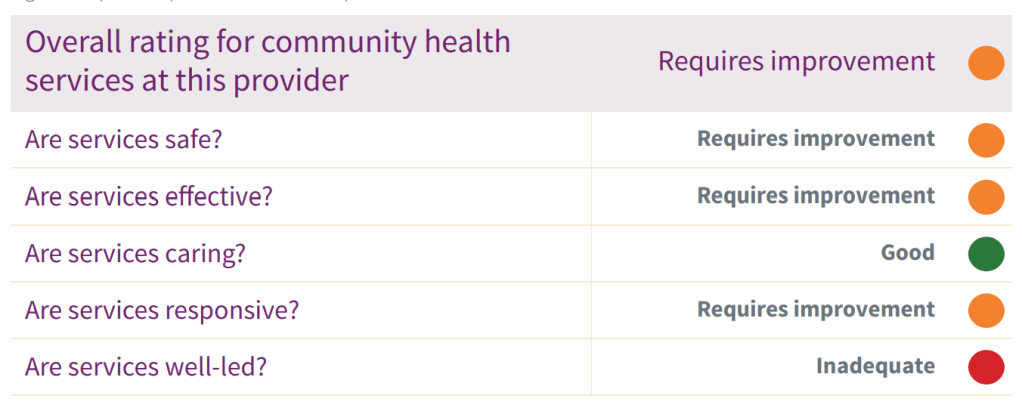
University Hospitals Sussex NHS Foundation Trust resisted FOI requests about their current whistleblowing claims:
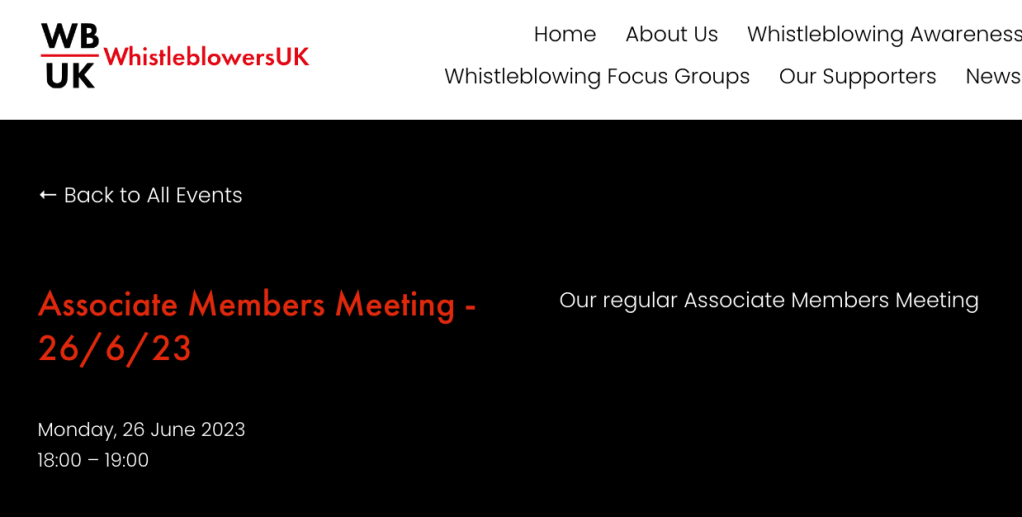
There are currently FOURTEEN Employment Tribunals against Marianne Griffiths’ former NHS trust, University Hospitals Sussex NHSFT. The trust refuses to say how many include whistleblowing claims

Letter to Whistleblowing APPG about WhistleblowerUK’s suggestion that Boris Johnson is a whistleblower, WBUK’s financial transparency & handling of whistleblowers’ personal data

Dr Minh Alexander retired consultant psychiatrist 4 June 2023

WhistleblowersUK the much criticised external secretariat of the also dubious Whistleblowing All Party Parliamentary Group (which has no official standing or powers), has publicly suggested that Boris Johnson might be a whistleblower for stating that he will cooperate with the UK COVID inquiry.

As might be expected, this has provoked strong reactions from genuine whistleblowers.

A hopefully self-explanatory enquiry to the Whistleblowing APPG is shared below.

From: REDACTED

Subject: WhistleblowersUK’s suggestion that Boris Johnson is a whistleblower, financial transparency and handling of whistleblowers’ personal data

Date: 4 June 2023 at 11:04:04 BST

To: REDACTED


BY EMAIL 

All Party Parliamentary Group on Whistleblowing

4 June 2023

Dear Ms Robinson and colleagues,

WhistleblowersUK’s suggestion that Boris Johnson is a whistleblower, financial transparency and handling of whistleblowers’ personal data

I write to raise further serious concerns about your external secretariat, WhistleblowersUK.

On 3 June 2023 WhistleblowersUK tweeted to suggest that Boris Johnson was a whistleblower in respect to his claimed plans to disclose pandemic related documents to the COVID inquiry.

“Is former PM @BorisJohnson #BlowingTheWhistle?”

Mr Johnson is known for the opposite of telling truth. He was fined for a criminal breach of COVID lockdown laws, committed as prime minister. He currently faces further allegations about other breaches of the COVID lockdown.

He has been criticised for abrogation of responsibility during the pandemic. The many COVID policy failures under his premiership, such as the forced discharge of COVID positive patients into care homes, unnecessarily killed and injured thousands. The misconduct in public office that killed so many has been chronicled by Keep Our NHS Public.

Billions that could have been spent on public services, and on protecting the population from the clinical and economic effects of COVID, made their way into private pockets during his tenure.

He brought disgrace many times to his Office as prime minister.

Genuine whistleblowers find it appalling that WhistleblowersUK could suggest that Mr Johnson is any way a “whistleblower”.

It is a fundamental misapplication of the concept to apply it to the individual who was the controlling mind in our country’s tragic COVID misadventures. The many, many families whose lives have been changed forever by COVID losses deserve much better.

Moreover, it is most unfortunate to associate the term “whistleblower” with someone of Mr Johson’s character.

I acknowledge however, that under the US style bounty hunting model of financial rewards/ incentives that key members of the Whistleblowing APPG and WhistleblowersUK have sought to establish, that a criminal ratting out another criminal could be accepted as “whistleblowing” and rewarded. As in the case of Bradley Birkenfeld and other examples. If however, the APPG does not intend to replicate this aspect of the US model, please let me know.

I should add that the Chair of WhistleblowersUK has ignored a letter asking for clarification about WhistleblowersUK’s financial charges to whistleblowers seeking help, and the handling of whistleblowers’ data. Please see the correspondence forwarded below of 4 May 2023.

1.   I would appreciate your comment on the tweet by WhistleblowersUK which equates purported compliance by a controlling mind with a public inquiry into gross failures with mass loss of life, to whistleblowing. Does the Whistleblowing APPG stand by the suggestion that Boris Johnson is a whistleblower?

2.   I wonder also if the APPG would be kind enough to ensure that I receive a response from Tessa Munt on the outstanding questions on transparency about WhistleblowersUK’s financial charges to whistleblowers and WhistleblowersUK’s handling of whistleblowers’ highly sensitive data. 

I previously raised questions of finances and conflict of interest with respect to WhistleblowersUK’s role as APPG secretariat in 2019. But this only led to Sir Norman Lamb’s resignation from the APPG because WhistleblowersUK refused to answer. The other APPG members were happy to continue with WhistleblowersUK as secretariat despite the lack of accountability and transparency. For the newer APPG members, my unanswered questions to the APPG in 2019 are documented here: Norman Lamb MP has resigned from the Whistleblowing All Party Parliamentary Group

A key issue arising from information on WhistleblowersUK’s website is: Does WhistleblowersUK share whistleblowers’ highly sensitive personal data with third parties such as NAVEX Global, and without disclosing that it does so?

Many thanks and best wishes.

Dr Minh Alexander

Cc 

The Earl of Minto, Minister of State, Department for Business and Trade

Baroness Heather Hallet

Dr Philippa Whitford MP

Keep Our NHS Public

Lord Wills Whistleblowing APPG member

Lord Sikka Whistleblowing APPG member

Baroness Neville-Jones Whistleblowing APPG member


From: REDACTED
Date: On Thursday, May 4th, 2023 at 4:08 PM
Subject: Data processing by WhistleblowersUK
To: REDACTED


BY EMAIL & Twitter

Tessa Munt

Chair of WhistleblowersUK

4 May 2023

Dear Ms Munt,

I am directing this to your council email address as I did not wish to sign into your private website, having noted the message displayed about data collected by the LibDems.

The current  “Help me” section of the WhistleblowersUK website tells whistleblowers seeking help that their data is processed under the “WhistleB” process and overseen by WhistleblowersUK’s data controller. Could you kindly advise who is WhistleblowersUK’s data controller and whether any third parties have any role in processing the data of whistleblowers who contact WhistleblowersUK? For example, does WhistleblowersUK use dropboxes or digital platforms by third parties such as Navex Global? Please can WhistleblowersUk provide details of all third party involvement and also make such third party involvement clear on its website so that whistleblowers seeking help are fully informed? Also can WhistleblowersUK explain what the WhistleB process is?

Also, under“Our Purpose”, WhistleblowersUK now states that it provides “affordable” help. Can this be made be more transparent, and any financial charges for services to whistleblowers be explicitly published upfront? Also can any WhistleblowersUK’s requests for a share of financial settlements and awards be made explicit upfront? I ask as a document making indicating such charges and levies has never been published by WhistleblowersUK as far as I am aware.

Many thanks,

Dr Minh Alexander