Steve Trenchard, NHS regulators & FPPR

By Dr Minh Alexander NHS whistleblower and former consultant psychiatrist 26 May 2017

The Department of Health and senior NHS officials often close ranks when things go wrong, and this includes the protection and recycling of NHS managers after wrongdoing.

Following a serious case of sexual harassment and a subsequent cover up by a mental health trust, Derbyshire Healthcare 1, two of the trust’s former directors were recycled.

Mick Martin a former trust NED and acting trust chair was appointed as Executive Director of Operations and Deputy Ombudsman by PHSO, only to later step down after the scandal over his appointment. 2

It transpired that the Ombudsman had been twice warned about Martin’s background, and acknowledged these communications. An investigation concluded that she made a ‘mistake’ in not looking further into the matter. 3

Steve Trenchard the former trust chief executive was also hired again by the NHS as a consultant, five months after resigning from Derbyshire Healthcare, also amidst much scandal. 4

Tracing the events around Steve Trenchard’s recycling reveals, according to FOI disclosures, that the NMC and a CCG lent a hand, and that CQC took little action to enforce FPPR. The details are provided below.


Background

This is the Employment Tribunal judgment which describes the sexual harassment in the case of Marks v Derbyshire Healthcare NHS Foundation Trust, and its cover up by the trust:

Helen Marks ET judgment

Steve Trenchard was the chief executive of Derbyshire Healthcare when a female fellow director – Helen Marks Director of Human Resources –  was sexually harassed and then victimised by Alan Baines the trust’s chair, for rejecting his advances.

The Employment Tribunal upheld all of Marks’ claims of unfair (constructive) dismissal, sex discrimination, harassment and victimisation.

In series of complicated events, Baines subjected Marks to degrading treatment and called her a “whore” and “you stupid woman”.

The Employment Tribunal noted that Marks and Baines formed an inappropriately close personal relationship. The ET also took the view that there was “duplicity” by Marks in that it found that she had used her relationship with Baines to secure favours. For example, agitating for the departure of another director whom she disliked.

However the ET noted that Baines was equally “happy to participate in the behaviour”, and concluded that he was culpable by reason of his position of great power. The ET rejected a suggestion from the trust’s barrister that Marks had led Baines on as regards the possibility of a sexual relationship:

“There is not a shred of evidence that at any stage she had indicated that she would be willing to enter into a sexual relationship with him [Baines]”

The ET concluded that Baines sought a sexual relationship despite Marks giving indications that she did not want this, and that he “engineered” allegations of bullying against her after she repeatedly resisted his sexual advances, with a view to her dismissal.
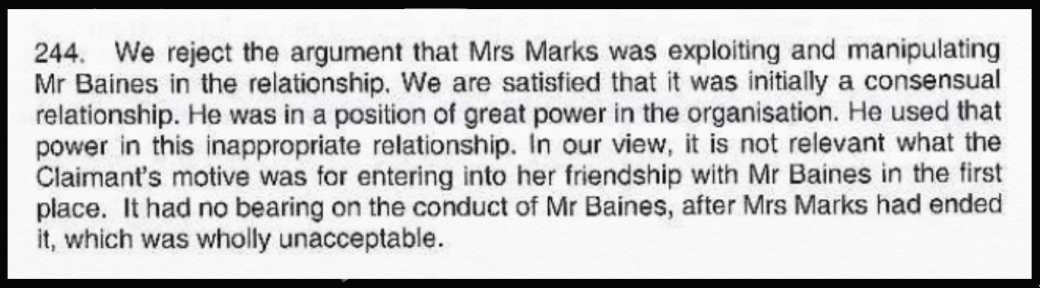
Trenchard Marks relationship with Baines.png

The ET also concluded that the trust treated Marks less favourably by suspending her but not Baines or Trenchard, when all three had been subject to allegations.

The ET also concluded that the trust failed to follow a fair procedure in that it ended Marks’ suspension and halted an investigation into allegations against her, but never explained the reasons for this. Equally, it refused to exonerate her, reneging on an earlier undertaking to apologise for its poor treatment of her.

The trust also failed to investigate her allegations that Baines had sexually harassed her.
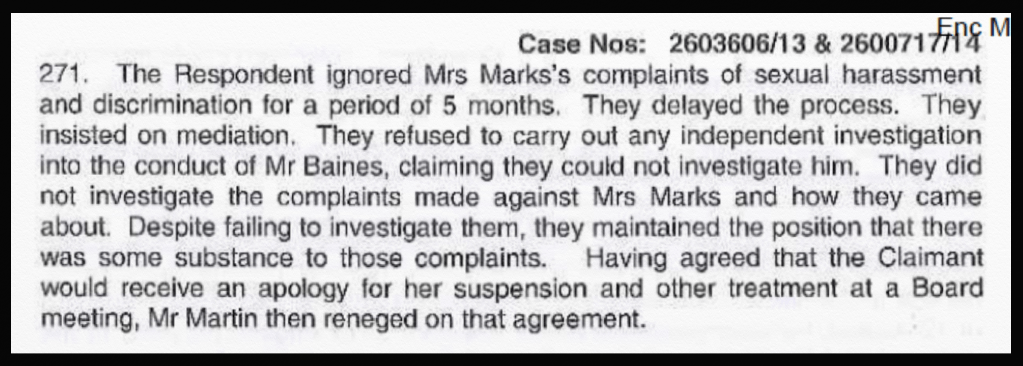
Trenchard no investigation

In addition to upholding Marks’ claim of constructive dismissal, the ET also made other findings of repeated unfairness by the trust.

This included an extraordinary review of Marks’ grievance against Baines, by Lee O’Bryan interim Director of Workforce, which consisted of looking at documents and having a coffee with Trenchard:
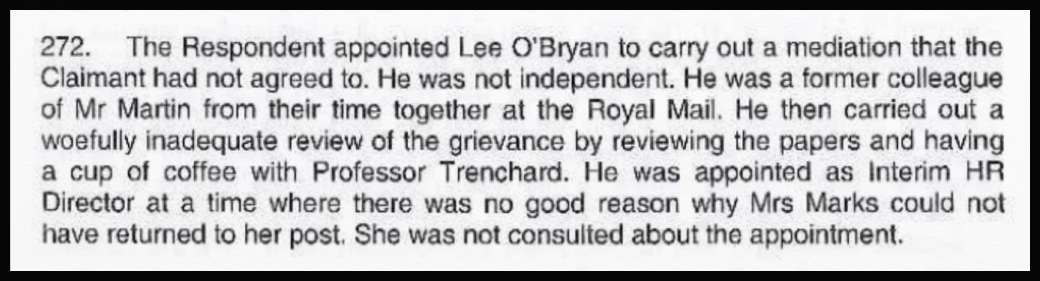
Trenchard Lee OBryan review

O’Bryan concluded based on this ‘review’ that Trenchard was a “credible and sincere person”.

He also concluded that Marks’ suspension was reasonable, that there had been no wrongdoing by Baines and that there was no evidence of sexual harassment.

Of interest is the fact that O’Bryan was until his resignation in October 2015 also a non executive director at Avon and Wiltshire Partnership trust, where he was the lead director for whistleblowing. 5 6

The ET found that Derbyshire Healthcare inflicted detriment on Marks because she was woman.
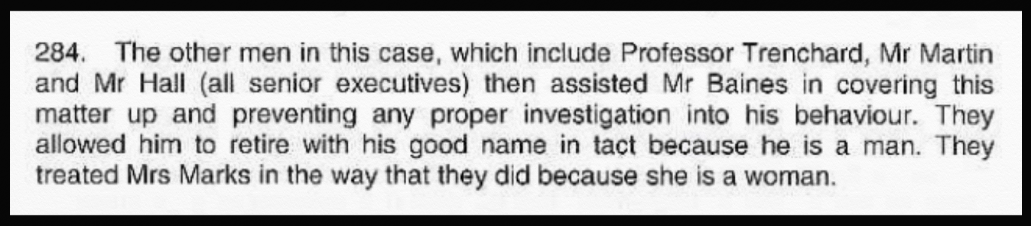
Trenchard covered up


The Employment Tribunal’s findings with respect to Steve Trenchard 

Steve Trenchard is by background a nurse. Prior to his appointment as chief executive of Derbyshire Healthcare, he was the Director of Nursing at the very troubled West London Mental Health NHS Trust.

Trenchard’s LinkedIn account states: I am an accomplished, mature and skilled leader with a track record in people development and service delivery through establishing compassionate, appreciative and performance informed cultures and systems.” 7

The ET concluded that Steve Trenchard accepted Baines’ vexatious allegations against Marks “without question”, even though they tended to be non-specific, contained “sweeping statements” and were at times even “incoherent”.

The ET concluded that Trenchard allowed himself to be used by Baines, and that he decided through an irregular process, that Marks was guilty. This was despite the fact that he had not even spoken to her:

Trenchard Marks guilty

The ET also found that Trenchard willingly participated in Baines’ decision to sack Marks, without due process:

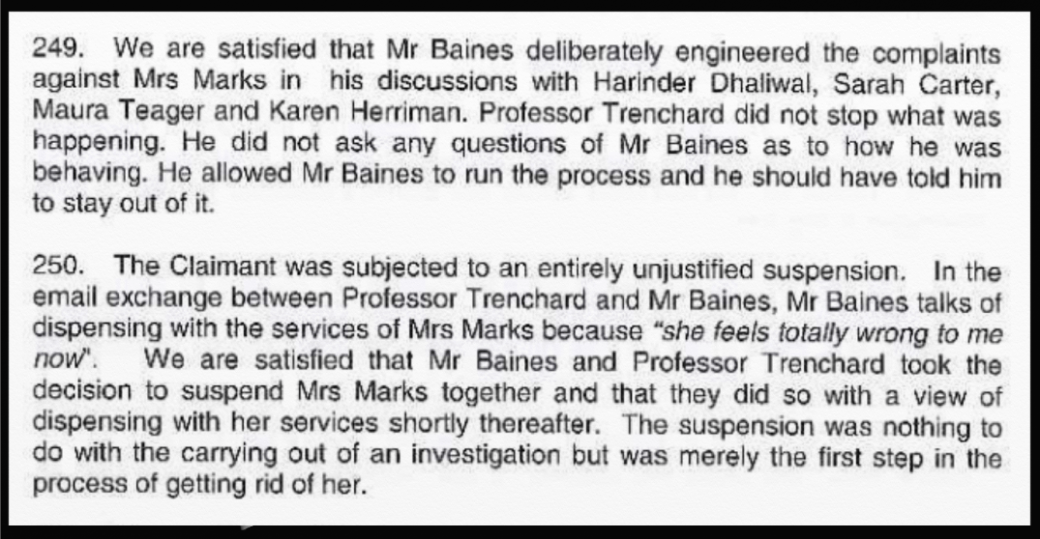
Trenchard complicit

Trenchard getting rid of Marks.png

The ET found unfairness in the manner in which Trenchard suspended Marks and denied her appropriate information about the allegations against her.

The ET found that Trenchard failed to check Baines or properly satisfy himself as to the reasons for Baines actions against Marks, despite the fact that Baines’ allegations against Marks were in the ET’s view obviously “trumped up”:
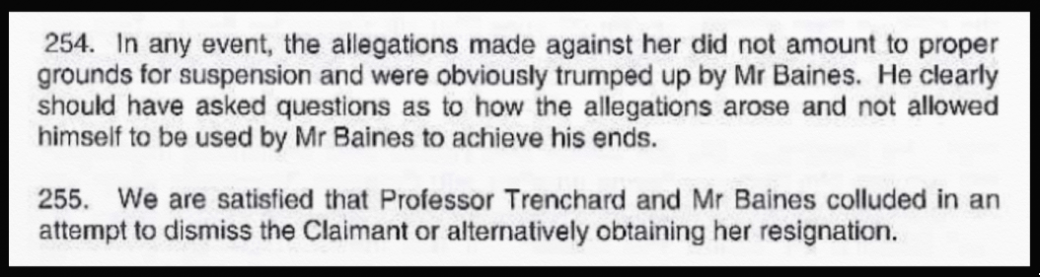
Trenchard colluded

Baines’ behaviour complicated matters further in that he tried to engineer Marks’ departure by settlement, and the ET concluded that this was to prevent his own behaviour coming to light.

Baines urged Trenchard to “bury” the matter:
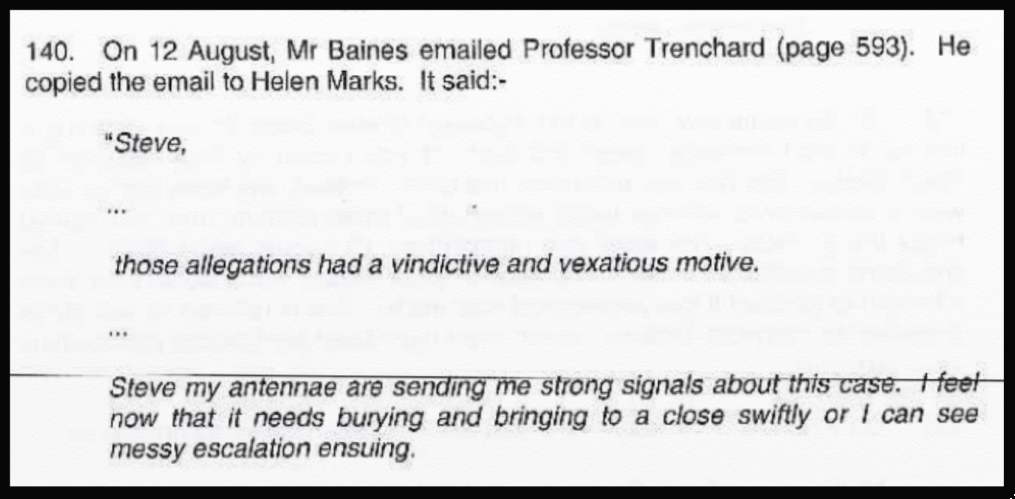
Trenchard bury

However, in September 2013 Marks complained about Baines’ sexual harassment to Monitor’s regional director Adam Cayley and to the trust governors, and she submitted a grievance regarding the sexual harassment by Baines.
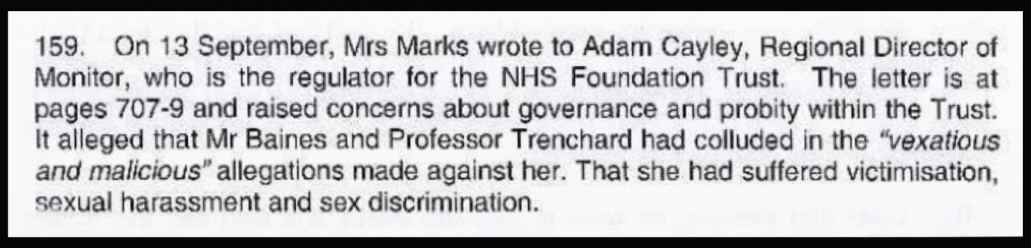
Trenchard Monitor

Importantly, AFTER Trenchard became thus aware of Baines’ real motives in pursuing Marks’ dismissal, Baines was allowed to leave the trust without a stain on his reputation.

The ET noted that Trenchard wrote to trust staff that Baines had decided to retire and had been a great ambassador for the trust.

Mick Martin was reportedly even more effusive:
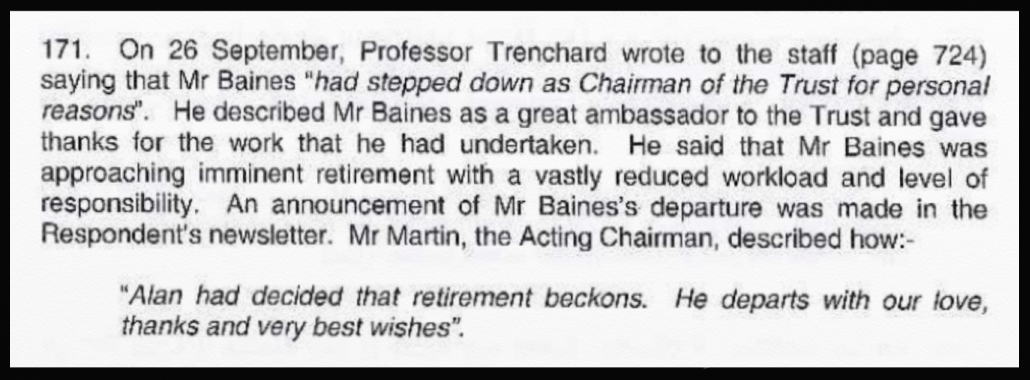
Trenchard wrote to staff.png

The ET concluded that the trust protected Baines:
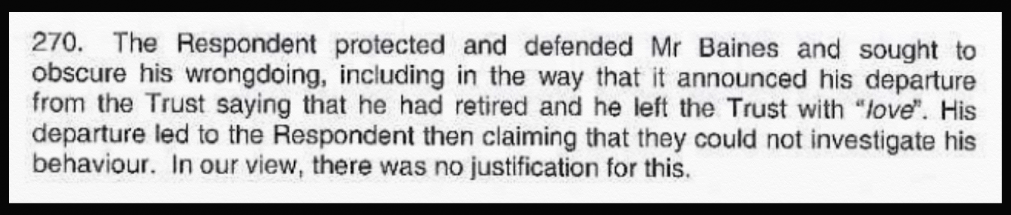
Trenchard Baines protected

In contrast, the trust repeatedly treated Marks in a hostile and unfair manner until she resigned due to loss of trust and confidence, and took legal action, eventually winning her claim to the ET.

Trenchard was suspended by the trust following the ET judgment in June 2015, and resigned in February 2016.


The system response to the Employment Tribunal Judgment, and Steve Trenchard’s appointment by Pennine Care NHS Foundation Trust

Unusually, the scandal arising from the ET judgment was such that Monitor conceded that there would need to be an investigation into the trust.

Two investigations were commissioned by the trust.

One investigation was by Deloittes, which “…assumed that the information provided to us and management’s representations are complete, accurate and reliable”. 8  This was the methodology applied in Deloitte’s much criticised governance review of Royal Wolverhampton and David Loughton. 9

The other investigation was conducted by a panel of three, including Alan Yates, whom Monitor previously installed as improvement director at the still struggling Norfolk and Suffolk NHS Foundation trust. NHS Improvement later appointed Yates as improvement director at Southern Health, and then promoted him to interim chair of Southern Health. Under Yates’ chairmanship, Southern Health recently told the media that it had apologised to a bereaved family, which the family disputed. 10 Yates has today been replaced by new chair. 11

The main report by Yates et al was published in Derbyshire Healthcare’s March 2016 board papers 8, but the Fit and Proper assessment on Trenchard has not been made public.

I found the main Yates report very different in tone to the ET judgment. It refers to the trust being so “overwhelmed” by the situation facing it that it “unconsciously or culturally” deviated from normal procedures:

“The Trust seemed to be overwhelmed by the nature of the challenge and decided perhaps sometimes unconsciously or culturally that its machinery would not work in the circumstances.”

The report also comments on the fact that “suspicion” was caused by the failure to follow accepted procedures, which could be understood to imply that Yates et al did not conclude that there was deliberate obscuration by the trust:

The Trust’s failure to use its standard reporting machinery, approach to risk management and normal approaches to escalation resulted in an approach which was not supported by the whole Board and denied those involved the protection as well as the support good governance offers. It also led to the suspicion that an issue which affected Board members was treated differently to other issues of governance.”

There is less emphasis in the Yates report on weighing the credibility of witnesses and their evidence than in some past FPPR investigation reports.

Derbyshire Healthcare currently refuses to even disclose whether Trenchard was found to be a Fit and Proper Person. 12

However, it seems the above Fit and Proper Person investigation report may have later featured in Trenchard’s subsequent and controversial appointment as a consultant at Pennine Care.

The appointment at Pennine Care was not a board position and not subject to FPPR, but the trust has indicated that a report about Trenchard’s fitness was considered as part of Pennine’s appointment process.

Pennine Care was reluctant to be fully transparent about the details of Trenchard’s appointment, but provided the following information:

  • Trenchard’s post at Pennine Care was not externally advertised:

Professor Trenchard’s consultancy services were commissioned in line with Trust processes for engaging external consultants.  It did not require external advertisement.”

  • Trenchard was interviewed by Pennine Care’s chief executive Michael McCourt and Medical Director Henry Ticehurst


  • Trenchard had been referred to the NMC which was reportedly satisfied of Trenchard’s good character and integrity:

The matter had also been referred to the Nursing and Midwifery Council (NMC).  The Trust reviewed the details of the NMC investigation which found there was no case to answer and noted there was no ‘evidence such that could be said to bring into question Professor Trenchard’s good character or alternatively his integrity or honesty.’ 


  • Pennine Care also indicated that a Derbyshire CCG provided Trenchard with a verbal reference, given to Pennine Care’s CEO, but that there was no further record of this.

South Derbyshire CCG advised me that it did not provide the reference.

North Derbyshire was evasive and claimed it did not hold a record about a reference, but did at least clarify that no reference was provided by its most senior officials. 

  • Pennine Care stated that it reviewed a report which concluded that Trenchard was a fit and proper person: 

Additional assurance was sought from reviewing an independent report, which found him to be fit and proper and no evidence of misconduct or wrongdoing.”

Of note, Pennine Care misled me by initially claiming that there were no communications with regulators about Trenchard to disclose.

Several exchanges later, the trust coughed up a letter from CQC, which revealed that CQC took no further action after examining FPPR issues at Derbyshire Healthcare.

This was despite the fact that CQC concluded from an inspection in January 2016 that Derbyshire Healthcare’s FPPR paperwork was not in order, and whilst Trenchard had been suspended by that point, there was no documented rationale as to why other managers named in the Marks ET judgment had been allowed to continue in their roles. CQC noted that no investigations had been mounted into the other managers named in the ET judgment.13

This is the information and CQC correspondence disclosed by Pennine Care:

Pennine Care Trenchard FOI 1 March 2017

Pennine Care Trenchard FOI – CQC letter to Pennine Care

Pennine Care Letter to CQC re Trenchard FOI 2017-0416

It is also worth noting that Trenchard had previously been a CQC insider, acting as an inspection chair for CQC. For example at Cambridgeshire and Peterborough NHS Foundation Trust:
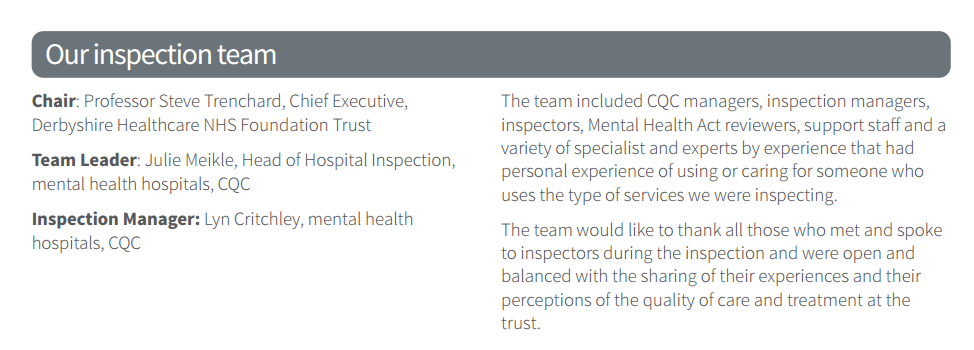
Trenchard CQC inspection team.png


CPFT CQC inspection report 2015 AAAE1951


But as Trenchard has reportedly been found Fit and Proper, and the NMC has apparently vouched for his integrity, no doubts in that direction are likely to be countenanced.


REFERENCES

1 Helen Marks awarded £832,711by Employment Tribunal, BBC 16 February 2016

http://www.bbc.co.uk/news/uk-england-derbyshire-35581737

2 NHS watchdog faces new blow as deputy stands down

http://www.independent.co.uk/news/uk/politics/nhs-complaints-watchdog-deputy-quits-over-sexual-harassment-cover-up-a6970301.html

3 Report of investigation into the PHSO’s appointment of Mick Martin, by Sir Alex Allen, 13 September 2016


PHSO Helen Marks Report_of_a_review_into_issues_concerning_the_PHSO_0

4 Disgraced NHS boss lands a job – at the trust next door. Jennifer Williams. Manchester Evening News. 13 February 2017

http://www.manchestereveningnews.co.uk/news/greater-manchester-news/disgraced-nhs-boss-lands-new-12599826

5 Three AWP mental health chiefs resign. Eve Buckland, Swindon Advertiser, 28 October 2015

http://www.swindonadvertiser.co.uk/news/13902377.Three_AWP_mental_health_chiefs_resign/

6 Lee O’Bryan’s LinkedIn data:
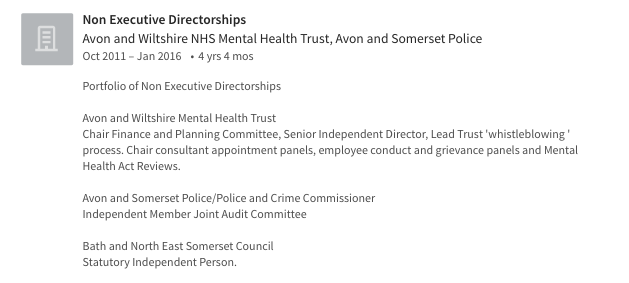
Trenchard OBryan LinkedIn

https://www.linkedin.com/in/lee-o-bryan-a69ab533/?ppe=1

7 Steve Trenchard’s LinkedIn data:
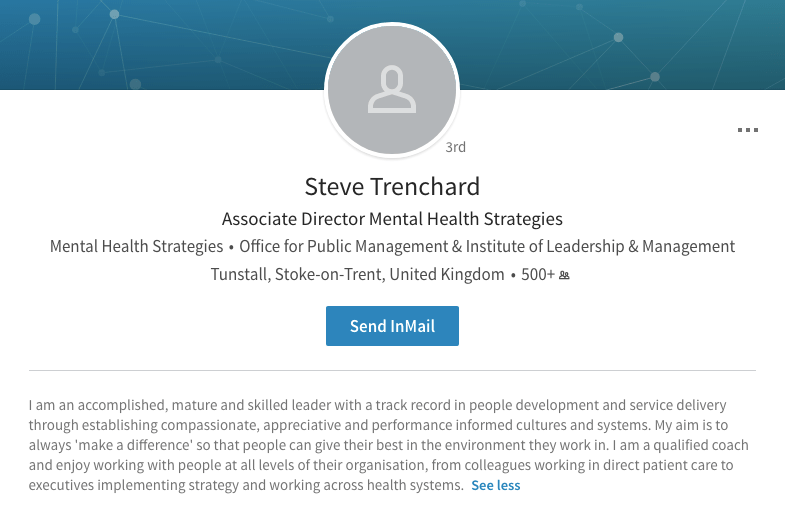
Trenchard LinkedIn

https://www.linkedin.com/in/steve-trenchard-52354544/?ppe=1

8 The report of the Deloitte governance review on Derbyshire Healthcare, and the Yates investigation on Derbyshire Healthcare, were published in the trust’s board papers of 30 March 2016:

Derbyshire Healthcare Agenda Pack Public Board 30 MAR 2016 Update2

9 Report of Deloitte governance review on the Royal Wolverhampton NHS Trust

RWT_Governance Review_Deloitte_29112016 (1)

10 A missing ‘apology’ in five parts. Sara Ryan, 11 May 2017

https://mydaftlife.com/2017/05/11/a-missing-apology-in-four-parts/

11 http://www.southernhealth.nhs.uk/news/new-chair-announcement/

12 FOI disclosure 24 May 2017 by Derbyshire Healthcare NHS Foundation Trust, ref. 4147_001

Derbushire Healthcare FOI response 4147_001

13 CQC inspection report February 2016 on Derbyshire Healthcare NHS Foundation Trust

CQC Inspection report on Derbyshire Healthcare February 2016 AAAF1142

 

FPPR: CQC has lost all moral authority, but what will the National Guardian do?

By Dr Minh Alexander NHS whistleblower and former consultant psychiatrist 23 May 2017

It was as expected, but still shocking.

The CQC has finally produced its responses to Regulation 5 Fit and Proper Person (FPPR) referrals that were made over a year ago, on two NHS directors found to have mistreated whistleblowers.

The referred directors were David Loughton CEO of the Royal Wolverhampton NHS trust – who needs little introduction amongst whistleblowers 1 2 3 4 – and Adrienne Murphy Director of Human Resources at Cornwall Partnership NHS Foundation Trust, and former Director of Workforce at South Devon.

Loughton was referred for a longstanding pattern of behaviour towards whistleblowers, and related Verita findings from an investigation of Loughton’s trust, in which Loughton’s conduct was specifically criticised. 5

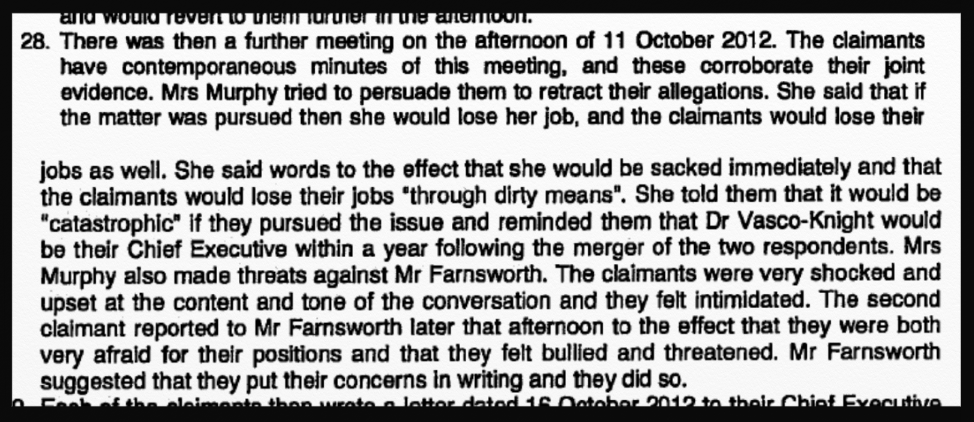
Murphy was referred after she was recycled by the NHS, despite being criticised by an Employment Tribunal (ET) for bullying whistleblowers. 6

Murphy’s attempt to silence whistleblowers is described by the South Devon ET Judgment7:

Adrienne Murphy ET.png

The ET concluded that Murphy had subjected the whistleblowers to detriment, and that this detriment was due to the fact that they had blown the whistle.

However, the CQC has now cemented its appalling record on FPPR through disingenuous claims that the demands of FPPR have been satisfied in both Loughton and Murphy’s cases:

CQC 20170522 Minh Alexander FPPR (3)

CQC 20161114 FPPR closure letter to referrer no breach Cornwall Partnership ….pdf Muprhy

The NHS establishment’s protection of David Loughton has been quite extraordinary. It is exemplified by the Deloitte report commissioned by NHS Improvement, it seems, to clean up the embarrassment caused by Verita’s frankness. Deloitte did not even manage a slap on the wrist for Loughton – just a mild suggestion that he should ‘reflect’ on his ‘style’:

“However, there is undoubtedly scope for the CEO to give further reflection to the impact his personal style can occasionally have on those around him.”8

In its above FPPR closure letter about about Loughton, the CQC clings to this Deloitte report. A question arises about whether CQC delayed in its response to the FPPR referral on Loughton in order to benefit from Deloitte’s very convenient findings.

CQC’s FPPR closure letter about Murphy reveals that the CQC relied on the trust’s own investigations.

This is not only laughable, but inconsistent. The CQC has in the past rejected another trust’s internal FPPR review and demanded external, independent review – but perhaps because they knew that particular case was weak and would be damaging to whistleblowers.

In contrast in the Murphy case, it is hard not to conclude that the CQC resisted sunlight because they knew they were dealing with a genuine, proven case of whistleblower reprisal.

And wouldn’t you know it, but the CQC ‘forgot’ to send me both the outcomes to the Loughton and Murphy FPPRs – the former concluded in February this year, and the latter in November last year. They have only responded now because of a complaint about the delay.

That makes it a total of THREE times on which the CQC has skulked about in the shadows and ‘forgotten’ to send me FPPR outcomes.  Last year, CQC ‘forgot’ to declare that Mike Richards Chief Inspector of Hospitals had closed an FPPR referral on Paula Vasco-Knight – shortly before she had to be sacked by the NHS due to charges of fraud. 9

And it is said sometimes that three makes a pattern.

Unfortunately, I do not expect any better from the CQC. It is a laughing stock and a failure on all fronts.

What now remains to be seen is how the National Guardian responds to this continuing failure on FPPR.

When I last spoke to her, she seemed reluctant to confront the ugly side of whistleblowing failures, and preferred to speak instead of ‘improvement culture’ and ‘support’ for organisations to do better. 10

Nevertheless, she recently published written answers to questions raised at a national conference for Speak Up Guardians on 8 March 2017, in which she finally acknowledged indelicate terms such as ‘serious misconduct’:

20170428_ngo_conference_responses_to_submitted_questions

In response to questions about how she would handle serious misconduct by those who mistreat whistleblowers, she gave this assurance:

Where evidence of serious misconduct is identified, for example through the case review process, this information will be shared with regulators who are able to take appropriate actions as a result.”

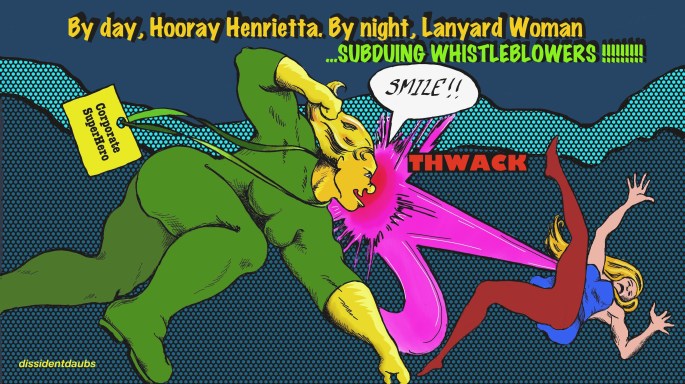
Given the now all too familiar and well known regulatory failures to hold abusers to account, I wrote to Henrietta Hughes to ask what provision she has made for instances in which regulators defy her, and resist appropriate action.

It is part of the National Guardian’s job description to hold the whole system to account including implausibly, the central bodies that fund her office, employ her and line manage her.

I don’t expect to be reassured, but whatever the answer, it will be interesting.

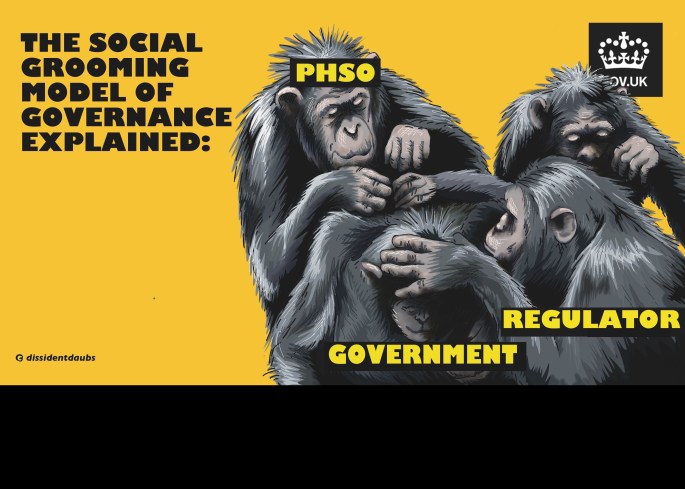
In truth, the National Guardian’s office is simply a government device for delaying what needs to be done. Current UK whistleblowing structures and law are designed to be ineffective and need to be replaced, but this is fiercely resisted.

I leave you with two quotes from whistleblowers who have suffered under Loughton and Murphy’s management:

Prof David Ferry, Royal Wolverhampton whistleblower, to BBC File on Four, broadcast 7 February 2017:

“Things were deteriorating, and after a particularly difficult day in the department, there was a lot of upset and that night, when I went to my car, there was a sticker on my car that said ‘Death to the bastard Geordie whistle-blower.’” 11

It should be noted that CQC have ridden to Loughton’s rescue before, by falsely claiming in a CQC inspection report that controversial oncology treatment provided by Loughton’s trust was standard when it was not. When David Ferry challenged CQC’s inspection report, Mike Richards claimed that CQC had merely made a typographical error. 11

Clare Sardari South Devon whistleblower , who along with Penny Gates raised the alarm about Paula Vasco-Knight’s nepotism. This is Clare Sardari’s response to the CQC FPPR closure letter:

So, the ET Judge and panel got it all wrong and Adrienne Murphy is as pure as driven snow! And, of course, CQC are happy with that – all done and dusted. We have one totally Fit and Proper HR and Org Development Director who is now off scot-free.”

“ She had Penny’s and my life in her hands and she literally stuck the dagger in our back”

Clare Sardari tweets at @SardariClare

But then, according to the CQC, ruining perfectly innocent people’s lives, placing patients in harm’s way and wasting public resources through totally unnecessary litigation and discarding expensively trained staff is NOT serious misconduct.

I wonder what is.


RELATED ITEMS

https://minhalexander.com/2017/01/27/cqc-a-chief-inspector-doesnt-call/

https://minhalexander.com/2017/03/15/just-culture-sanctions-for-whistleblower-suppression-and-reprisal/


REFERENCES

1 Raj Mattu and the death of whistleblowing. Dr Phil Hammond, Private Eye issue 1364 May 2014

http://www.drphilhammond.com/blog/2014/05/07/private-eye/medicine-balls-private-eye-issue-1364-2/

2 Branded a rapist for daring to be a whistleblower: How brave cardiologist sacked for exposing needless deaths was smeared as sex attacker by bosses. Rebecca Hardy Daily Mail 11 February 2016

http://www.dailymail.co.uk/news/article-3443311/Branded-rapist-daring-NHS-whistleblower-brave-surgeon-sacked-exposing-needless-deaths-smeared-sex-attacker-bosses.html

3 Probe launched into NHS chief who blew £6m to get rid of whistleblowers as minister pledges to protect workers who speak out, Paul Bentley and Daniel Martin Daily Mail, 8 March 2014

http://www.dailymail.co.uk/news/article-2576096/Probe-launched-NHS-chief-blew-6m-rid-whistleblowers-minister-pledges-protect-workers-speak-out.html

4 Wolverhampton’s New Cross Hospital Cancer scandal: Cleared after four year fight! Victory for NHS whistleblower, Express and Star 18 January 2016

https://www.expressandstar.com/news/2016/01/18/cleared-after-four-year-fight-victory-for-nhs-whistle-blower/

5 Verita report Royal Wolverhampton Trust -FINAL-21-Jan-16

6 Senior hospital manager resigns following ex-Plymouth health chief ‘nepotism’ storm. Plymouth Herald. 22 August 2014.

http://www.plymouthherald.co.uk/senior-hospital-manager-resigns-following-ex/story-22803404-detail/story.html

7 ET Judgment Sardari and Gates v South Devon Healthcare NHS Foundation Trust and Torbay and Southern Devon Health and Care NHS Trust

https://www.dropbox.com/home?preview=Vasco-Knight+Tribunal+judgment+003-1.pdf

8 Deloitte report of review on leadership and governance at Royal Wolverhampton NHS Trust, 9 November 2016

RWT_Governance Review_Deloitte_29112016 (1)

9  CQC: A Chief Inspector doesn’t call, Minh Alexander 27 January 2017

https://minhalexander.com/2017/01/27/cqc-a-chief-inspector-doesnt-call/

10 Agreed records of meetings with National Guardian 23 January 2017 and 2 February 2017

https://minhalexander.com/wp-content/uploads/2017/02/hh-meeting-records-23-01-2017-and-2-02-2017.pdf

11 Transcript of BBC File on Four broadcast on whistleblowing, 7 February 2017

https://minhalexander.com/wp-content/uploads/2017/02/file-on-four-nhs-wb-transcript-07_02_17_fo4_speakingup.pdf


National Guardian complaints: Keeping it in the family


By Dr Minh Alexander NHS whistleblower and former consultant psychiatrist 19 May 2017

Rules and standards are the heart of civilisation and public service.

They are the means by which fair play can be assured.

In public life, healthy complaints processes are an important part of upholding rules and standards.

The NHS is rotten at dealing with complaints, and has especially designed dead ends and endless Mobius loops to frustrate and deter complainants.

Even the body that is supposed to provide ultimate oversight of NHS complaints, the Parliamentary and Health Service Ombudsman, has been repeatedly mired in scandal and is seen by many as a purpose built obstacle. 1

Bill Kirkup concluded from his investigation into the maternity safety failures at Morecambe Bay that governance by central NHS bodies was ‘circular’, with these bodies wrongly passing flawed and unjustified assurance amongst themselves. 2

It is no surprise then that the National Guardian’s office, a public relations vestige flapping on CQC’s bum, has no published complaints policy.

It is also no surprise that there are no coherent and fit for purpose arrangements for investigating complaints about the National Guardian’s office.

CQC claims that the National Guardian’s office is operationally independent and free to hold bodies such as CQC, NHS England and NHS Improvement to account for their failures of whistleblowing governance. 3 3b

This is brought into severe doubt by the fact that:

  1. These bodies fund the National Guardian
  2. The National Guardian is employed by CQC and reports to David Behan, CQC’s chief executive, meeting with him frequently 4 5

Adding to the impression that the National Guardian is in reality beholden to its funders, the CQC informed me in January that complaints about the National Guardian’s office will be adjudicated by the National Guardian’s Accountability and Liaison Committee – which comprises board members from CQC, NHS England and NHS Improvement:

Complaints about the NGO are handled under their own governance structure with the NGO Accountability and Liaison Board (ALB) acting as an independent reviewer of complaints made against the NGO.” 6

I have now written to Rob Behrens the new Parliamentary and Health Services Ombudsman to question why the National Guardian office has complaints arrangements that could potentially subvert its core purpose, and await his response. 7

In the meantime, a current whistleblower who has made a complaint about the National Guardian has received a letter from the National Guardian’s office of 18 May 2017 which states:

Your complaint about Dr Henrietta Hughes will be dealt with under the National Guardian Office complaints procedure. This will involve Tom Grimes and the complaints team at NHS Improvement looking into your complaint and coordinating a response will be sent to Sir Robert to agree as the current Chair of the accountability and liaison board.” 

In addition, this whistleblower was provided with a distinctly thin document, that purports to be the National Guardian’s complaints policy:

20170518 NGO Complaints Policy V3

This document extraordinarily says nothing about the National Guardian’s complaint procedure, and does not provide even the most basic information. For example, who will investigate, who will adjudicate, what is the standard for response times, how adherence to the policy will be audited or how complainants’ experience will be tracked.

The Public Interest Disclosure Act is even wrongly referred to as the “Public Information Disclosure Act”.

In short, one could be forgiven for suspecting that this document was hurriedly knocked up in response to the complaint.

And irregularly, the document does not appear on the CQC website.

Importantly, what the document exposes is that those running the National Guardian’s office are by no measure experts in governance.

Which is a great pity given that this office is supposed to police a critical matter of governance – the honesty and probity of the NHS in handling criticism and concerns.

But then, if the intention is that the office should not be effective, that suits government just fine.


RELATED ITEMS

https://minhalexander.com/2017/05/18/national-guardian-reprieves-nhs-employers-but-condemns-whistleblowers-and-patients/

https://minhalexander.com/2017/05/06/cqc-and-national-guardian-defend-fortress-dh/


REFERENCES

1 Patients Association. The ‘People’s Ombudsman and how it failed us. November 2014

PHSO-The-Peoples-Ombudsman-How-it-Failed-us-FINAL4

2 The report of the Morecambe Bay Investigation by Dr Bill Kirkup March 2015

Morecambe Bay investigation report 47487_MBI_Accessible_v0.1

3 CQC Board paper July 2015

The FTSU review states that the National Guardian must be independent of both providers and national bodies so it is able to review their practices and make recommendations without fear of interference.”

https://minhalexander.com/wp-content/uploads/2017/05/cqc-board-paper-on-ng-july-2015-cm071506_item_6_freedom_to_speak_up_national_guardian.pdf

3b National Guardian Independence: The CQC denies some more. Minh Alexander 19 January 2017

https://minhalexander.com/2017/01/19/national-guardian-independence-the-cqc-denies-some-more/

4  CQC Position Specification for the National Guardian September 2015

“The National Guardian will be an appointment by the Chief Executive of CQC on behalf of the Board. The appointee will be managed by the Chief Executive…”

https://minhalexander.com/wp-content/uploads/2016/10/cqc-national-guardian-specification-final-760085.pdf

5 Agreed records of meetings with the National Guardian on 23 January 2017 and 2 February 2017

https://minhalexander.com/wp-content/uploads/2017/02/hh-meeting-records-23-01-2017-and-2-02-2017.pdf

6 Email 24 January 2017 from Caroline Dale, Deputy National Complaints Manager – Corporate Complaints Team, Governance and Legal Services Directorate, CQC

7 Letter 8 May 2017 to Rob Behrens Parliamentary and Health Services Ombudsman

Letter to Rob Behrens PHSO 8 May 2017

National Guardian reprieves NHS employers, but condemns whistleblowers and patients

 By Dr Minh Alexander NHS whistleblower and former consultant psychiatrist, 18 May 2017

The ebb and flow of whistleblowing politics is such that when governments are forced to concede a little in the glare of scandal, they soon dig escape tunnels.

One such attempted Great Escape by the Department of Health et al – based on misinformation and invention – was recently thwarted. 1

But as soon as that tunnel was filled in, more appeared. I will focus on one in particular:

Very seriously, it emerged via a CQC disclosure of personal data to a whistleblower that the National Guardian’s office is claiming that it cannot review cases if they are ‘live’.

https://minhalexander.com/2017/05/09/whistleblowers-wanted-dead-or-not-live/

This is contrary to common sense, evidence and good practice principles of early intervention, which were accepted by Robert Francis in his report of the Freedom to Speak Up Review:

42 It was clear in so many of the cases we heard about that if they had been handled well from the outset, a great deal of pain and expense could have been avoided. The more issues can be ‘nipped in the bud’, the greater the likelihood that there will be a successful outcome for everyone involved. A common factor in many of the cases we heard about was the length of time they took to resolve, if indeed they were ever resolved. Some had gone on so long it was impossible or impracticable to get the full picture. The impact of this on both individuals and organisations was immense.” 2

On 8 May 2017 I asked the National Guardian for clarification as follows:

Should I understand from this that your office intends to wait until say, employers’ disciplinary processes against whistleblowers have concluded and have potentially resulted in disciplinary action and dismissal, before the office will consider reviewing the whistleblower cases in question?” 

The reply that arrived yesterday is affirmative, albeit short on definition:

“…during the 12-month trial of our case review process we will initially select cases for review where there are no outstanding decisions to be made”

This is disastrous for distraught whistleblowers whose careers, livelihoods and long term financial security are hanging by a thread.

“Go away and come back once you’ve been disciplined/ referred to your professional regulator/ sacked” is a dysfunctional and wasteful system response.

In separate correspondence on 18 April 2017 I asked the National Guardian what she would do for whistleblowers who have been sacked whilst waiting for her office to open to referrals. Russell Parkinson her Head of Office replied:

Where a case review finds evidence that a whistleblower has been dismissed inappropriately, we will make recommendations that action is taken, as appropriate.  This may include recommending that the employer reinstates the worker concerned”

Preventing dismissal is much easier than sorting things out once the employment relationship is severed.

Not least because early intervention would help reduce the de-skilling that later contributes to whistleblowers’ unemployability.

Once a whistleblower is sacked, there is no guarantee that either the National Guardian will recommend reinstatement (assuming she even accepts the case, which remains a significant uncertainty) or that an employer will acquiesce.

The National Guardian has the option of asking system regulators to take action against trusts that defy her.

The odd show case will probably be paraded to win ministers some favourable headlines. Realistically though, history shows that regulators have largely protected those who mistreat whistleblowers. So it is doubtful they will help much to ensure that whistleblowers are reinstated.

Crucially, what happens to patients whilst the National Guardian twiddles her thumbs waiting for protracted employment processes to conclude?

Robert Francis made it clear in his report of the Freedom To Speak Up Review that he expected that harm and risk to patients which results from poor whistleblowing governance should be always be addressed. 3

Does Henrietta Hughes really think that it is appropriate not to step in when a whistleblower tells her that an employer has ignored or minimised patient safety concerns, just because the employment process has not concluded?

And employers may deliberately draw matters out for years – running investigations of investigations of investigations –  to wear whistleblowers down and to engineer a breakdown of relationships (a lawful basis for dismissal).

And what if the National Guardian also counts employment tribunal processes and referrals to professional regulators amongst the matters that must be resolved before she will consider reviewing a case?

In short, it is unacceptable to delay in responding to whistleblowers’ reports that employers are mistreating them or putting patients at risk.

In classic Whitehall-ese, the National Guardian holds out a possibility that her processes may change at some point:

As the trial period progresses, we will review this approach and explore whether we can effectively open up the parameters within which we will be able to accept cases for review.” 

In due course. At the appropriate juncture. In the fullness of time.

This mess only emphasises that an entirely different sort of body is needed, which has powers to investigate and remedy, and is designed to be proactive. It would need of course to operate under fully reformed whistleblowing law.

I have asked for clarification of which processes must be exhausted before the National Guardian will consider reviewing whistleblower cases.

Letter to Henrieatta Hughes live cases 18.05.2017


NEXT IN THE ESCAPE TUNNEL SAGA:

Employer impunity for ignoring whistleblowers’ concerns


RELATED ITEMS: https://minhalexander.com/2017/03/26/at-the-nhs-improvement-soup-kitchen/


REFERENCES:

1 CQC and National Guardian defend Fortress DH. Minh Alexander, 6 May 2017

https://minhalexander.com/2017/05/06/cqc-and-national-guardian-defend-fortress-dh/

2 Report of the Freedom To Speak Up Review by Robert Francis, 11 February 2017

http://webarchive.nationalarchives.gov.uk/20150218150343/https://freedomtospeakup.org.uk/wp-content/uploads/2014/07/F2SU_web.pdf

3 Report of the Freedom To Speak Up Review by Robert Francis, 11 February 2017

http://webarchive.nationalarchives.gov.uk/20150218150343/https://freedomtospeakup.org.uk/wp-content/uploads/2014/07/F2SU_web.pdf

Page 196

“I believe that the widespread introduction of Freedom to Speak Up Guardians, with a national point of reference created through the new post of the Independent National Officer, is a key component in keeping watch over the way concerns are handled, providing support to those who need it, and ensuring the patient safety issue is always addressed.


Speak Up Guardians: A Whiter Shade Of (Corporate) Pale

By Dr Minh Alexander NHS whistleblower and former consultant psychiatrist 16 May 2017

This is an early, quick and dirty look at the emerging characteristics of so-called ‘Freedom To Speak Up Guardians’ –  roles that are not evidence based but provide a sop to calls for real reform of whistleblowing governance.

There is no good, complete evidence yet. The National Guardian reassuringly told the press in January 2017 that 201 trusts had appointed a Speak Up Guardian. 1

The reality is that the Speak Up Guardian landscape is akin to the Wild West. Only it is less organised.

Jeremy Hunt has endlessly cited the Freedom To Speak Up Review to prop up implausible claims that he is building the safest, most transparent health service in the world. In truth, the government hasn’t bothered much with the Review’s centre piece – the creation of Speak Up Guardians. Most likely as it was never considered a serious venture to begin with, serving only a decorative function.

Francis’ proposal for Speak Up Guardians was short on detail.

Then the government made the situation worse by allowing trusts to do whatever they wanted: installing whatever arrangements they liked, or delaying until guidance was available:


“In addition, if Trusts feel confident to appoint their Guardian without this guidance, they should not wait for the guidance to be published.” 2


The guidance came late – in September 2016 3 – given the glacial rate at which the CQC approaches its duties.

Inevitably in the absence of evidence base and guidance, all sorts of weird and wonderful permutations sprang up, which will make meaningful evaluation a nightmare.

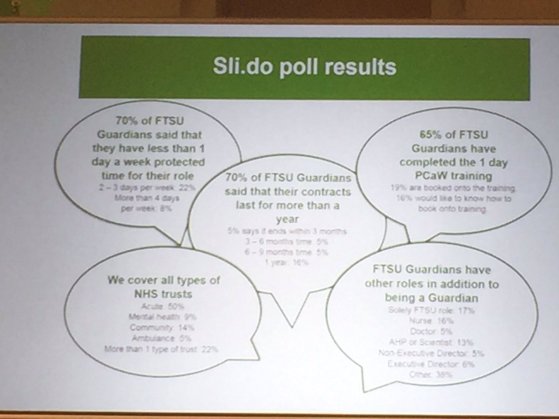
Some trusts appointed networks of Guardians and champions. Some held elections. Professional backgrounds and seniority vary considerably. Many trusts have published little detail on how their Guardians work or what capacity in terms of WTE has been installed. A pre-conference poll by the National Guardian suggested that the majority of Guardians are part time – 70% indicated that they had less than one day of protected time. 4

An unenthusiastic tone is reflected in a number of trust board papers:


“Freedom to Speak Up Guardian Raj Bhamm, Head of Workforce Strategy, has been appointed to this role for a 3 year period. This is a CQC requirement.”

http://www.royalsurrey.nhs.uk/wp-content/uploads/2015/09/170126-final-part-1.pdf

One can understand why some trusts may be reluctant to expend time and money on this imposed project, when the NHS is under such immense strain.

A wander through the gallery of Speak Up Guardians throws up interesting individual examples, if the paper trail is to be believed:

  1. A Speak Up Guardian who was formerly the Head of Legal Services at Mid Staffs.5


  1. A Speak Up Guardian who is also listed as Head of Comms.6


  1. A Speak Up Guardian who came from John Lewis.7


  1. A Speak Up Guardian who used to be the Chief Executive of the Foundation Trust Network 8


  1. A Speak Up Guardian who used to a Director of Comms 9


I wrote to Robert Francis about general concerns and gave the example of the former Mid Staffs Head of Legal Services. His response acknowledged that implementation has been variable and resulted in a lack of uniformity.  10

NHS Employers started publishing an interactive map showing all the trusts that had reportedly appointed Guardians:

http://www.nhsemployers.org/your-workforce/retain-and-improve/raising-concerns-at-work-and-whistleblowing/freedom-to-speak-up-guardian-hub/guardian-map

The most recent version of this map, dated 31 March 2017, accounted for only 209 trusts.

Of the trusts that did not feature on the NHS Employers map, eight have not clearly appointed a Speak Up Guardian yet, based on published papers:

Buckinghamshire Healthcare NHS Trust
Hertfordshire Partnership NHS Foundation Trust
Kingston Hospital NHS Foundation Trust
Pennine Acute Hospitals NHS Trust
North West Anglia NHS Foundation Trust

(previously Peterborough and Stamford NHS Foundation Trust and Hinchingbrooke Healthcare NHS Trust, which merged on 1 April 2017)

Princess Alexandra Hospital NHS Trust
Queen Victoria Hospital NHS Trust
Royal United Hospitals Bath NHS Foundation Trust

I must question the reliability of the data reported to NHS Employers by some trusts. It looks in some instances that trusts may have just given NHS Employers names of contacts who were not actually Freedom to Speak Up Guardians, usually senior managers. In some of these cases, a check of trust records shows that Freedom To Speak Up Guardians had not even been appointed.

A related question arises about whether the National Guardian’s above figure of 201 trusts with Guardians included duff data, given by trusts who just wanted the centre off their backs. I suspect it did.

Corporate Speak Up Guardians

There are also worries about the corporate nature of some Guardian appointments.

A trawl of all the Speak Up Guardians flagged on the most recent version of NHS Employers’ Guardian map and trusts’ papers revealed that 66 trust directors and 30 associate directors had apparently been appointed as Speak Up Guardians in 88 trusts.

Two directors were each Guardians for two trusts, and three trusts had more than one director acting as Guardians.

This is the supporting data:

https://minhalexander.com/wp-content/uploads/2016/09/freedom-to-speak-up-guardians-who-are-directors-14-05-2017.xlsx

Cross checking with other sources such as board papers confirmed only some of these apparent appointees as Guardians – only 28 out of the 66 directors and only 16 out of 30 associate directors were clearly Speak Up Guardians.

Of course, some of the unconfirmed cases may be Guardians. And many of those directors who were not confirmed as Guardians are nevertheless those who are in control of the appointment and operation of Guardians.

However, conservatively there are so far at least 44 confirmed ‘corporate’ Speak Up Guardians, in 37 trusts:

This is a list of those 37 trusts:

Freedom to Speak Up Guardians who are directors 14.05.2017

The 44 corporate Speak Up Guardians broke down as follows:

Type of Trust Director Number
Chief executive 1
Non-executive director 14
Medical director 4 (3 medical directors, 1 associate medical director)
Director of nursing 4 (2 directors of nursing, 2 associate directors of nursing)
Director of human resources 3 (1 director of HR, 2 associate directors of HR)
Directors of corporate affairs 3 (2 directors of corporate Affairs, 1 associate director of corporate affairs)
Directors of governance (and similar)  10 (2 directors of governance, 8 associate directors of governance)
Other types of directors 5 (4 directors, 1associate director)
Total 44

It is a concern that there are so many corporate appointments, as questions arise about values, perspective and patient-centredness.

As Mid Staffs showed, unchecked managerialism can be deadly to patients. 

freedom-to-speak-up-get-sacked-guardian

Few BME Speak Up Guardians

As well as an unhealthy dose of corporate salts, the Guardians also look rather white so far.

I have so far come across only 15 Guardians who are from visible ethnic minorities.

This is despite a higher proportion of BME individuals in the NHS workforce than in the general population.

At last count:

17% of the whole NHS workforce were non-white

 38% of NHS doctors and dentists were non-white. 11

I took a closer look at the available data on Speak Up Guardians in trusts that serve 38 of the most ethnically diverse districts (based on the 2011 census 12).

These districts ranged from Newham (29% white) to Coventry (73.8% white). 13

Of course, the percentage of BME staff in NHS services in these districts is higher than the average across the whole NHS. For example, the proportion of BME staff in the London NHS workforce is 44%, according to NHS England. 14

I found that in the 48 trusts serving these districts, there were 12 non-white Speak Up Guardians and 49 white Speak Up Guardians. 15

Even accounting for incomplete data, this suggests that power appoints in its own image.

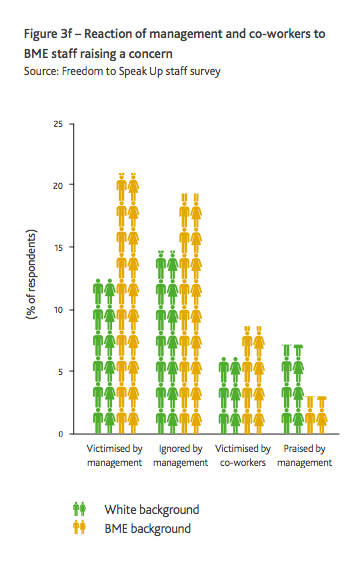
This is not very good news for just culture, or for BME whistleblowers, who the Freedom to Speak Up Review acknowledged were much more likely to be ignored and to suffer reprisal. 16

Francis BME page 66

But then, it’s not as if anyone really cared enough to administrate the establishment of Speak Up Guardians in a coherent and efficient manner.

No one tends to the window dressing once it’s been hung out.

As one trust illustrates, the focus is now on serious stuff….. such as ensuring a supply of green lanyards:

“Freedom to Speak Up (FTSU) – The ‘Freedom to Speak Up’ review, published in February 2015, highlighted how important it is for every part of the NHS to develop a culture in which all staff are positively encouraged to raise issues about safety, quality and effectiveness of patient care and supported when they do so. It was a requirement for all NHS Trusts to appoint Guardians to work with trust leadership teams to implement this agenda. The National Guardian for FTSU has now been appointed, Dr Henrietta Hughes. She held the first National Guardians conference in March 2017. NCH&C have increased the number of FTSU champions and held its third steering group meeting. Actions developing from the group include; a role description for the advocates; implementation of the national reporting dataset; inclusion on datix for staff to raise concerns directly to the Trust Guardians; FTSU green lanyards for champions; development of a FTSU logo for NCH&C; communication plan to cascade information; implementation of dedicated phone line for reporting concerns.”

Norfolk Community Health and Care NHS Trust Board paper 26 April 2017


UPDATE 8 June 2017

Curiously, three weeks after I wrote about these issues of poor quality data on Speak Guardians, their questionable diversity and the large number of corporate appointments, one of the main published data sources has disappeared. It is NHS Employers’ interactive Speak Up Guardian map, which gave details of Speak Up Guardians appointed so far by trusts. A ‘page not found’ message is obtained when the relevant link is clicked. I have asked NHS Employers why the map has been erased and whether there are plans to replace it.

Screen Shot 2017-06-08 at 10.37.51.png


RELATED ITEMS

https://minhalexander.com/2017/03/07/freedom-to-speak-up-guardian-jailed/

https://minhalexander.com/2017/03/22/25-best-and-25-worst-nhs-trusts-for-speaking-up-allegedly/

https://minhalexander.com/2016/09/24/critique-of-francis-model-of-trust-appointed-guardians/


REFRENCES

1 Learning Not Blaming, Department of Health July 2015

https://www.gov.uk/government/uploads/system/uploads/attachment_data/file/445640/Learning_not_blaming_acc.pdf

2 More than 30 trusts do not have whistleblower guardian. Health Service Journal, 12 January 2017

https://minhalexander.com/wp-content/uploads/2016/09/more-than-30-trusts-still-do-not-have-whistleblower-guardian.pdf

3 CQC guidance on job description for Speak Up Guardians

https://minhalexander.com/wp-content/uploads/2016/09/example_job_description_freedom_to_speak_up_guardian_september_2016.pdf

4 Speak Up Guardian polll tweeted 8 March 2017

5 Rebecca Southall, former Head of Legal Services at Mid Staffs, currently Director of Corporate Affairs at University Hospitals of Coventry and Warwickshire NHS Trust is listed as the Speak Up Guardian for UHCW and also for Coventry Warwickshire Partnership NHS Trust

http://www.uhcw.nhs.uk/clientfiles/File/Trust%20Board%20Public%2030_03_17.pdf

https://www.linkedin.com/in/rebecca-southall-06416641/

http://www.nhsemployers.org/your-workforce/retain-and-improve/raising-concerns-at-work-and-whistleblowing/freedom-to-speak-up-guardian-hub/guardian-map

6 Sarah Newby Head of Comms and Fundraising at Luton and Dunstable NHS Trust is also Speak Up Guardian according to NHS Employers’ data

https://www.ldh.nhs.uk/contact-us/media-enquiries/

http://www.nhsemployers.org/your-workforce/retain-and-improve/raising-concerns-at-work-and-whistleblowing/freedom-to-speak-up-guardian-hub/guardian-map

7 Caroline Owens is listed as the Speak Up Guardian for the very troubled Brighton and Sussex University Hospitals NHS Trust. Her LinkedIn data and other sources indicate that her background is in corporate affairs at John Lewis.

http://www.brightonandhovenews.org/2017/03/30/whistleblowing-champion-urges-hospital-chiefs-to-support-staff-who-speak-out/

https://www.linkedin.com/in/carolineowens/?ppe=1

8 Sue Slipman, an non executive director at Kings College Hospital NHS Foundation Trust, and who was previously CEO of the Foundation Trust Network, is listed by NHS Employers as King’s Speak Up Guardian

https://www.kch.nhs.uk/about/organisation/directors/nonexecutive-directors

http://www.nhsemployers.org/your-workforce/retain-and-improve/raising-concerns-at-work-and-whistleblowing/freedom-to-speak-up-guardian-hub/guardian-map

9 Venessa James is a non executive director for South West Ambulance Service NHS trust, is named as the Speak Up Guardian for the trust by NHS Employers. Her LinkedIn data indicates that she was previously the Director of Comms at NHS Devon PCT.

https://www.linkedin.com/in/venessa-james-67b62391/?ppe=1

http://www.nhsemployers.org/your-workforce/retain-and-improve/raising-concerns-at-work-and-whistleblowing/freedom-to-speak-up-guardian-hub/guardian-map

10 Correspondence with Robert Francis about Speak Up Guardian appointments

Correspondence with Robert Francis about Speak Up Guardians May 2017

11 NHS Employers ethnicity stats for the NHS May 2017

http://www.nhsemployers.org/~/media/Employers/Publications/Ethnicity%20in%20the%20NHS.pdf

http://www.nhsemployers.org/case-studies-and-resources/2017/05/diversity-in-the-nhs-infographic

12 2011 Census: table of ethnicity by district

https://minhalexander.com/wp-content/uploads/2016/09/2011-census-ethnicity-by-district.xls

13 List of the 38 most ethnically diverse districts based on 2011 census

https://minhalexander.com/wp-content/uploads/2016/09/38-most-ethnically-diverse-districts-source-2011-census.xlsx

14 WRES 2016 Data analysis report for trusts, NHS England April 2017 Page 101:

In London the proportion of the NHS trust workforce from BME backgrounds is 44%.”

https://www.england.nhs.uk/wp-content/uploads/2017/03/workforce-race-equality-standard-data-report-2016.pdf

15 https://minhalexander.com/wp-content/uploads/2016/09/trusts-serving-the-most-ethnically-diverse-districts-16-05-20171.xlsx

16 Freedom to Speak Up Review by Robert Francis 11 February 2015

http://webarchive.nationalarchives.gov.uk/20150218150343/https://freedomtospeakup.org.uk/wp-content/uploads/2014/07/F2SU_web.pdf

Whistleblowers Wanted: Dead, or not Live

By Dr Minh Alexander, NHS whistleblower and former consultant psychiatrist, 10 May 2017

Officialdom’s absurdities in keeping whistleblowers at bay are endless.

The latest question about the National Freedom To Speak Up Guardian arises from personal data disclosed to an NHS whistleblower, under the Data Protection Act.

This disclosure included internal correspondence by the National Guardian’s team which indicated that ‘live’ whistleblower cases may not be accepted for review.

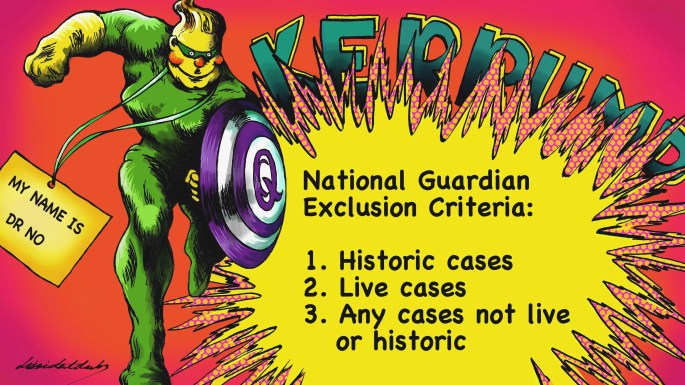
That is pretty ludicrous, especially bearing in mind that so-called ‘historic’ cases have already been barred. 1

Live cases

You will also see from this disclosure that the Department of Health and the National Guardian conferred about the response to the whistleblower.

There has already been plenty of other marble-rolling by the National Guardian’s office, CQC and the Department of Health. For example, they all made an unfounded claim that the National Guardian has no remit to intervene at all in individual cases, which has now been withdrawn. 2

I have asked the National Guardian to clarify how she defines ‘live’ cases.

Does she intend to wait until whistleblowers are neck deep in detriment, having been maliciously disciplined, vexatiously referred to professional regulators or pushed out onto the dole?

Once whistleblowers have been sacked, what exactly could she do to fulfil her remit – as set out in the Freedom To Speak Up Review – to ensure that the NHS provides “…redress to any patients or staff harmed…” 3 by poor whistleblowing governance?

Perhaps a referral passing the sacked whistleblower to the ineffective NHS whistleblower employment support scheme, that is explicitly designed not to provide jobs?

Why is the National Guardian’s office making up silly rules as it goes along?

The Freedom To Speak Review clearly acknowledged that early intervention – and resolution –  was important in preventing serious harm to whistleblowers. 4

Insistence that cases can only be accepted once they are no longer ‘live’ is a noxious recipe.

But no doubt it would be music to the Department of Health’s ears.

Whistleblowers wanted: Dead, or not Live.


RELATED ITEMS

https://minhalexander.com/2017/05/06/cqc-and-national-guardian-defend-fortress-dh/

https://minhalexander.com/2017/03/26/at-the-nhs-improvement-soup-kitchen/


REFERENCES

1 Robert Francis shut many so-called ‘historic’ whistleblowers out of justice through his report of the Freedom To Speak Up report:

The INO should not be tasked with reviewing, let alone investigating, historic cases.”

The INO should not be expected to review historic issues.”

“Finally I recognise that some of those who have contributed so constructively to the Review will feel that their own personal issues have not been addressed. This was perhaps inevitable given my remit, but I have to observe that in some of their cases the contention has endured over such a long time, and the issues have become so complex, that the most rigorous inquiry devoted to each such case would not have been able to resolve matters for those involved. For this reason I doubt that any form of public inquiry of the sort demanded by some would do more than raise expectations only for them to be dashed. I hope, however, that all who have contributed to this Review by Chapter 10 – Conclusion 197 taking the difficult step of sharing with me their sometimes harrowing experiences will receive some consolation from the knowledge that they have informed the lessons identified in the report and made a significant contribution to ensuring that others will avoid suffering the same consequences in future.”

http://webarchive.nationalarchives.gov.uk/20150218150343/https://freedomtospeakup.org.uk/wp-content/uploads/2014/07/F2SU_web.pdf

The National Guardian has now defined ‘historic’ as employment in the NHS over two years from the point of referral to her office:

“…the NGO will review cases referred to it by NHS workers who have been employed in the NHS for a period of up to two years prior to the point they are referred to the NGO for review.”

https://minhalexander.com/wp-content/uploads/2016/09/national-guardian-20170428_ngo_case_review_process_0.pdf

2 CQC and National Guardian defend fortress DH. Minh Alexander 6 May 2017

https://minhalexander.com/2017/05/06/cqc-and-national-guardian-defend-fortress-dh/

3 Page 168 Freedom To Speak Up Report 11 February 2015

http://webarchive.nationalarchives.gov.uk/20150218150343/https://freedomtospeakup.org.uk/wp-content/uploads/2014/07/F2SU_web.pdf

4 Freedom to Speak Up Review report 11 February 2015

Page 41

Through the NHS Constitution it is made clear that workers are expected to exercise their right to raise concerns as early as possible.”

Page 119

“The lesson I drew from the evidence was that it is vital that cases are handled well and quickly. The more issues can be ‘nipped in the bud’ by establishing facts early on, with a degree of independence if necessary, and by communicating better at all stages, using mediation if needed, the greater the likelihood that there will be a successful outcome.”


CQC and National Guardian defend Fortress DH

By Dr Minh Alexander, NHS whistleblower and former consultant psychiatrist, 6 May 2017

When governments are forced to respond to whistleblower scandals, they tend to do so grudgingly and minimally, whilst making all sorts of inflated propaganda claims.

A case in point is the office of the National Freedom To Speak Up Guardian, a public relations contrivance by the Department of Health.

Shockingly, the National Guardian’s office, its part funder and employer the Care Quality Commission and the Department of Health, have tried to curtail even the little influence it was originally given.

Crucially, the National Guardian’s office started wrongly telling whistleblowers in extremis that it had no remit at all to intervene in individual whistleblowers’ cases.

The National Guardian’s office maintained this position despite being challenged, and then the CQC and DH joined in with this lamentable chorus.

In fact, it was the clear intention of the Freedom To Speak Up Review that:

  • The National Guardian’s office was to provide a place where whistleblowers could go if they were let down by their employers
  • The National Guardian’s core function was to challenge others to look again at badly handled whistleblower cases and to correct poor practice:

“7.6.17 The INO would in essence fulfil a role at a national level similar to the role played by effective Freedom to Speak Up Guardians locally. They would not take on cases themselves, but could challenge or invite others to look into cases which did not appear to have been handled in line with good practice or where it appeared that a person raising a concern had experienced detriment as a result of raising the concern.” Page 169 Report of the Freedom to Speak Up Review 1

Robert Francis also made it clear that where necessary, the National Guardian should request a direction from the relevant regulator to force employers to correct malpractice.2

In swerving these commitments, David Behan a former DH Director General and the recently ennobled chief executive of the CQC, went so far as to claim that a public consultation by CQC had decided that the National Guardian should not intervene in individual cases:

https://minhalexander.com/2017/03/12/national-guardian-behan-replys/

This was a baseless claim. Contributors to the public consultation in question had suggested that there should be better protection of individual whistleblowers.

Behan was challenged on 12 March 2017. 3

However he dallied in responding, despite being reminded.

I wrote to the Secretary of State on 11 April 2017 providing evidence that Behan’s extraordinary claims about the public consultation were unfounded, and that the DH had been in error to peddle his claims:

https://minhalexander.com/wp-content/uploads/2017/04/dh-jeremy-hunt-ng-help-for-individual-whistleblowers-11-04-2017.pdf

On 21 April 2017 Behan finally responded, conceding that the original Freedom To Speak Up recommendation – that the National Guardian should challenge others to look again at mishandled individual cases – would be implemented after all:

https://minhalexander.com/wp-content/uploads/2017/02/behan-20170420-pocu-1516-0181-dr-minh-alexander-national-freedom-to-speak-up-guardians-remit.pdf

HOWEVER, working on the ‘WhackAMole’ model of official resistance to genuine whistleblower protection, the National Guardian has now popped up with her finalised case review process and this remains very flawed. 4

In particular, it still contains the truly ridiculous stipulation that she will not review whistleblower cases unless employers have responded to whistleblowers’ concerns:

3.1.2 The evidence required to assess referrals

Paragraph 76 of the executive summary states that the purpose of a case review should be to ‘review the handling of concerns where there is reason to believe that there has been failure to follow good practice …’ Therefore cases should only be considered for possible review where there is clear evidence received in the referral that the NHS body has already responded to a concern and has failed to do so appropriately. Where the referral contains little or no such information the case should not be considered for possible case review.

 It is expected that the information provided in some referrals will be insufficient to allow the Case Review Manager to decide whether the case meets the criteria advised by the AG. In such cases the NGO should not undertake the gathering of information in the nature of a review to determine whether that referral meets the criteria for case review. They may instead inform the referrer of the need to provide more information.” 4

As ignoring whistleblowers is one of the most common employer ruses, such an arrangement would give solace to the worst NHS employers.

The retention of this exclusion criterion seems unlikely to be a simple mistake, as both Behan and the National Guardian were both made aware of this employer-friendly loophole during the recent consultation on the National Guardian’s process. 5

Nevertheless, I have written again to Behan to clarify whether it is his intention that there should be impunity for employers who ignore whistleblowers, and if not, what action he, Stevens and Mackey as the chief executives of the National Guardian’s funding organisations will take to resolve this mess:

https://minhalexander.com/wp-content/uploads/2016/09/letter-to-behan-re-ng-employers-ignoring-whistleblowers-5-05-2017.pdf

In this latest letter to Behan, I have also asked him to remove a misleading claim in the National Guardian’s case review process guidance that all the twenty ‘Francis principles’ from the Freedom To Speak Up were evidence based. The establishment of flawed Speak Up Guardians was most definitely NOT evidence based. Even the National Guardian herself acknowledged this. 6

Indeed, the ‘model’ trust upon which Francis relied to justify his recommendation for Speak Up Guardians has not proved so angelic after all.

It has been found to have ignored staff’s serious patient safety concerns 7 8, attracting a related CQC warning and rating of ‘Inadequate’ on the ‘Well Led’ domain 9 and it has failed to meet its legal obligations under the Freedom of Information Act as regards these governance failures. It arbitrarily withheld data on staff whistleblowing disclosures to the trust’s ‘Cultural Ambassador’ from a critical period in 2014/2015, and it failed to issue any valid grounds for doing so. A complaint has been made to the ICO.

So much then for Francis’ illusory exemplar of transparency and accountability.

If doctors dished out untested treatments, and made unsubstantiated claims about them as the government has done, they’d be struck off.

Related items about the lack of evidence base for Francis’ Speak Up Guardians:

A) Critique of Francis’ model of trust appointed Guardians, from evidence June 2015 submitted to the Department of Health consultation on implementation of the Freedom To Speak Up Review

https://minhalexander.com/2016/09/24/critique-of-francis-model-of-trust-appointed-guardians/

B) 25 best and 25 worst NHS trusts for speaking up. Allegedly. 22 March 2017

https://minhalexander.com/2017/03/22/25-best-and-25-worst-nhs-trusts-for-speaking-up-allegedly/

REFERENCES

1 Report by Robert Francis of the Freedom To Speak Up Review, 11 February 2015

http://webarchive.nationalarchives.gov.uk/20150218150343/http://freedomtospeakup.org.uk/the-report/

2 Report by Robert Francis of the Freedom To Speak Up Review, 11 February 2015

“Principle 15 External Review

There should be an Independent National Officer [National Guardian] resourced jointly by national systems regulators and oversight bodies and authorised by them to carry out the functions described in this report, namely…advise NHS organisations to take appropriate action where they have failed to follow good practice, or advise the relevant systems regulator to make a direction to that effect”

http://webarchive.nationalarchives.gov.uk/20150218150343/http://freedomtospeakup.org.uk/the-report/

3 Letter to David Behan 12 March 2017

https://minhalexander.com/wp-content/uploads/2017/03/cqc-behan-clarification-on-whether-ng-will-challenge-employers-to-look-again-at-cases-12-03-2017.pdf

4 National Guardian’s case review process for NHS trusts and foundation trusts. CQC 28 April 2017

https://minhalexander.com/wp-content/uploads/2016/09/national-guardian-20170428_ngo_case_review_process_0.pdf

5 National Guardian: Letter from Wonderland. Minh Alexander, 20 February 2017

https://minhalexander.com/2017/02/20/national-guardian-letter-from-wonderland/

6 Agreed record of a meeting with the National Guardian on 2 February 2017

MA You know there’s no evidence for any of this (the SUGs)?

HH That’s the challenge, building an evidence base”

https://minhalexander.com/wp-content/uploads/2017/02/hh-meeting-records-23-01-2017-and-2-02-2017.pdf

7 Leaked NHS report reveals dying patients left alone and in pain. Staff at breaking point. Stoke Sentinel 2 April 2015

http://www.stokesentinel.co.uk/exclusive-leaked-nhs-report-reveals-dying/story-26274491-detail/story.html

8 Leaked NHS dossier: Nurses log concerns over care. 2 April 2015

http://www.stokesentinel.co.uk/nhs/story-26274522-detail/story.html

9 Country’s biggest Health and Social Care Trust ‘requires improvement’. National Health Executive magazine. 13 May 2016

http://www.nationalhealthexecutive.com/Health-Care-News/countrys-biggest-health-and-social-care-trust-rated-requires-improvement

4 years of CQC mental health whistleblowing data

Governments intermittently make glib promises to lift neglected and under-funded mental health services out of second class status, but usually only disappoint in the end.

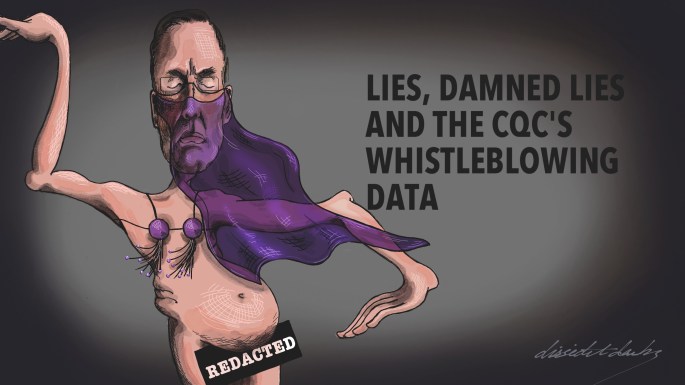
The health regulator the Care Quality Commission (CQC) is regarded as an unhelpful if not hostile force by the majority of whistleblowers, with concerns from whistleblowers about CQC politicisation, confidentiality, employer bias, active protection of abusers, wilful blindness and failures to respond appropriately to disclosures.

Despite a major investigation of West London Mental Health Trust in 2009 1 triggered by CQC’s predecessor the HealthCare Commission, which generated common sense recommendations for addressing safety problems in struggling mental health services, the CQC has not distinguished itself in championing the needs of mental health patients.

Headlines have continued about familiar, recurrent failures.

At Southern Health NHS Foundation Trust, CQC failed to detect or report gross failures in the handling of hundreds of deaths. 2 The Mazars deaths review on Southern Health NHS Foundation Trust found that CQC did not even have the right number of deaths of detained patients. Mazars also questioned the reliability of CQC’s intelligent monitoring data .

CQC has been insufficiently critical of excessive mental health bed closures even though a recommendation from the West London investigation was that adequate beds were needed for safety. When asked about CQC’s approach to regulating safe numbers of mental health beds, CQC’s deputy Chief Inspector said that CQC preferred to only regulate the effects of bed shortage. Not exactly proactive then. 3

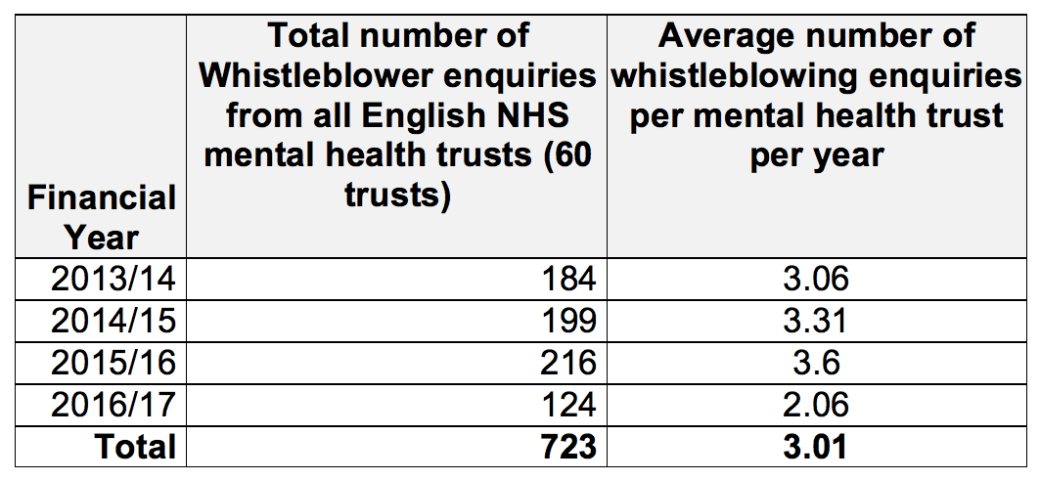
I have kindly been sent FOI data on whistleblowing by mental health trust staff to the CQC, which shows over 700 whistleblower ‘enquiries’ over a four year period, 1 April 2013 to 1 March 2017:

CQC FOI disclosure 8 March 2017

The whistleblowing enquiries to CQC are likely to have been made by trust staff who could not progress their concerns within their own organisations, or for some other reason did not wish to make an internal disclosure.

Extrapolating from CQC’s data gives an overall average of 3 whistleblowing enquiries per mental health trust each year.

Screen Shot 2017-04-23 at 13.45.29.png

Curiously, there has been a sharp dip in the number of enquiries in the last financial year. CQC have denied any change in their recording method.  IF that is so, a number of other possible factors could be responsible for the drop. However, it seems unlikely that staff have stopped disclosing because things are going well.


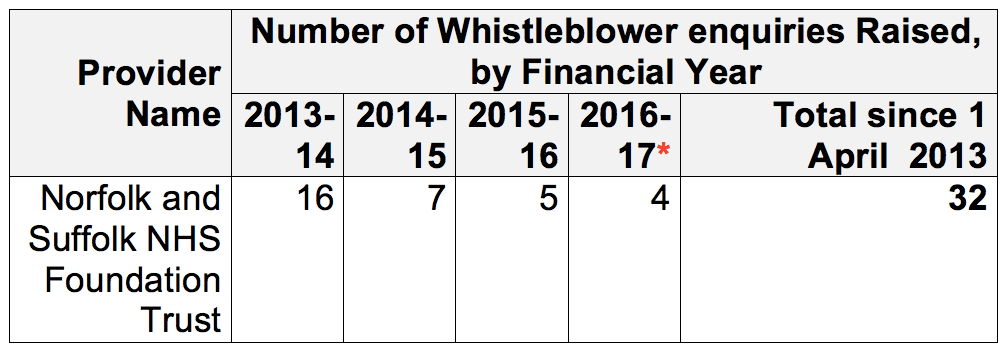
The mental health trust that has had the highest recorded number of whistleblowing enquiries to the CQC in the last four years is Norfolk and Suffolk NHS Foundation Trust, which CQC recently and controversially took out of special measures despite continuing concerns about safety and deaths, and continuing bed cuts.

Screen Shot 2017-04-24 at 11.18.11.png

See the Norfolk and Suffolk Crisis campaign website for full details:

http://norfolksuffolkmentalhealthcrisis.org.uk/

HOWEVER, on this occasion the CQC has given an especially elaborate disclaimer about what its data actually means:

We should advise you that the number of ‘whistleblowing’ enquiries recorded against each provider will not necessarily be representative of the actual number of whistleblowing concerns reported to us.

This is because an enquiry recorded as ‘whistleblowing’ may contain:

  • A single concern from one whistleblower
  • Multiple concerns from one whistleblower
  • Multiple concerns from multiple whistleblower’s that are linked to a similar issues
  • Multiple concerns from staff who have been invited to contact CQC with feedback ahead of an inspection where one enquiry is recorded as whistleblowing
  • Positive and negative intelligence about a location and provider
  • Information wrongly categorised as whistleblowing”


CQC’s claim that “whistleblowing enquiries” may contain positive feedback is implausible, or at best unrepresentative of the great majority of contacts, based on various disclosures that I have seen regarding specific trusts.

For example, in the same above FOI disclosure, specific whistleblowing data was given on two trusts with recent whistleblowing governance issues – North Essex Partnership NHS Foundation Trust and Berkshire Healthcare NHS Foundation Trust. No positive feedback is evident. Instead, there are concerns about safety, patients at risk of self harm, poor service, falsified documents poor incident recording, bullying, staffing, poor service, bed cuts, safeguarding, racism, and poor management of change:

CQC FOI DISCLOSURE NORTH ESSEX AND BERKSHIRE IAT 1617 0775

As for CQC’s obfuscation on the precise numbers of whistleblowers and concerns, the regulator should be recording whistleblowing data in a way that shines light on what is happening, not doing the dance of the seven veils.

Regarding the extraordinary comment by CQC that it might be incorrectly classifying some events as ‘whistleblowing’ when they are not, what can one say? An organisation that costs as much as two mental health trusts ought not to record data that is so inaccurate that it cannot be relied upon.

However, CQC’s purpose in contriving such looseness and ambiguity may be revealed by CQC’s assertion that its whistleblowing data “should not be used as an indicator of Trust performance”.

The Department of Health would surely be proud of such pliable, elastic data that could be made to mean whatever you want it to.

And despite a recent CQC attempt to spin that it is now more responsive to whistleblower disclosures  4 – following criticism at the end of last year 5 – please note that none of the 2016/17 disclosures for North Essex and Berkshire Healthcare resulted in inspections being brought forward.

But then, it’s all in the fancy footwork,  how you do your sums and how much or how little you reveal.


UPDATE 25 APRIL 2017

If CQC carries on recoding whistleblowing data on the above basis, it will fall foul of new legal requirements for bodies that are ‘Prescribed Persons’ under the Public Interest Disclosure Act to publish the numbers of whistleblowing disclosures received and responses to the disclosures. These new legal requirements came into force at the beginning of this month. I have now written to the National Guardian about her employer’s shortcomings, copied to the relevant parliamentary committees.

Letter to Henrietta Hughes re CQC WB data 25.04.2017


RELATED ITEMS

https://minhalexander.com/2016/12/05/whistleblowers-unheard-by-cqc/

https://minhalexander.com/2016/12/15/covering-up-the-cover-ups-cqcs-revisionism/

https://minhalexander.com/2016/11/18/the-ever-anomalous-cqc-another-soft-shoe-shuffle-around-inconvenient-data/

https://minhalexander.com/2016/09/25/cqc-deaths-review-all-fur-coat/


REFERENCES

1 Report of Investigation into West London Mental Health Trust by the Healthcare Commission. CQC 2009

WLMHT HCC Investigation_into_West_London_Mental_Health_NHS_Trust_FINAL_200907171608

2 Mazars report of Independent review of deaths of people with a Learning Disability or Mental Health problem in contact with Southern Health NHS Foundation Trust April 2011 to March 2015, December 2015

https://www.england.nhs.uk/south/wp-content/uploads/sites/6/2015/12/mazars-rep.pdf

3 Email from Paul Lelliott 19 December 2014:

I think therefore that the correct approach for the CQC to take is not to try to count bed numbers but to assess services for the ‘symptoms and signs’ of pressure on bed availability eg. problems with admitting a person who needs to be in hospital for their own wellbeing, people being admitted to a ward distant from their home, people being moved from ward to ward during an admission episode, people being discharged before they are ready etc.”

4 CQC Board Paper Feb 2017 CM021705_Item5_Q3performanceReport

CQC Health Service Journal April 2017 Insp brought forward after WB

5 Whistleblowers unheard by CQC. Alexander, Linton, Sardari and a fourth NHS whistleblower December 2016

https://minhalexander.com/2016/12/05/whistleblowers-unheard-by-cqc/


Health Education England hasn’t done its whistleblowing homework

By Dr Minh Alexander NHS whistleblower and former consultant psychiatrist, 21 April 2017

The Freedom To Speak Up Review 1 was an expensive exercise in government spin and stalling.

It gave the appearance that something was being done by the government, when in reality all that happened was that tokenistic, ineffective measures were – in theory – adopted and the Department of Health press office acquired another willing helper – the National Guardian’s office. 2

After the initial buzz of the launch in February 2015, and the cameras departed, many of the NHS bodies that were assigned homework in terms of specific Freedom To Speak Up action plans did not implement the tasks, took an excessively long time and or did a shoddy job. 3

Importantly, over two years on from Francis’ recommendations for establishment of an office to scrutinise cases, over a year since the National Guardian’s office was established and over seven months after the latest National Guardian took up post, not a single NHS whistleblower case has been reviewed.

Health Education England (HEE) was also one of the bodies given homework as a result of the Freedom To Speak Up Review, but has now admitted that it has not attended to a key task: ensuring that local Speak Up Guardians are properly trained.

Of course, Health Education England notoriously retaliated against Dr Chris Day, junior doctor whistleblower by removing his National Training Number, thus scuttling his specialist training. The government, including the Health Secretary, then closed ranks and claimed a loophole in coverage of whistleblowing law for junior doctors. (I say ‘coverage’ as opposed to ‘protection’, as current whistleblowing law is weak and does not protect). After the resulting scandal, the government and HEE came up with a sticking plaster solution which allowed junior doctors the dubious privilege of suing HEE in the High Court, at prohibitive expense. 4

The government’s position has been challenged. Judgment is awaited from a recent hearing at the Royal Courts of Justice on Chris Day’s case.

The details of this extraordinary saga can be found here:

https://www.crowdjustice.org/case/junior-doctors-round-2/

Given this shabby background, it is unsurprising that HEE has not been diligent in helping to improve NHS whistleblowing governance.

The government assured us in July 2015 that HEE would produce guidance on the training needed for the local Speak Up Guardian role:

“Health Education England should produce guidance on what training will be needed for the Freedom to Speak Up Guardian role, along with a curriculum that NHS organisations can use to ensure that the training they are providing on raising concerns is of a sufficiently high standard” 

“HEE will develop and publish guidance on training for this role working with the CQC and the Independent National Officer [National Guardian]. We would expect HEE to take into account the work the INO will undertake around recruitment for this role.” 5

HEE has now disclosed via FOI that it has done no work at all on this matter and that there has been no liaison with the National Freedom To Speak Up Guardian:

“HEE has not yet conducted any work with the National Guardian or their office…”

HEE does not even give assurance that the work will definitely be done – it only says that the work may be done:

“…this may change…”

This is HEE’s FOI disclosure:

https://minhalexander.com/wp-content/uploads/2016/09/hee-foi-disclosure-3-april-2017.pdf

So by HEE’s latest admission, the government’s promises that Speak Up Guardians – who are a central plank of Robert Francis’ recommendations – should have kitemarked training have come to naught.

Why hasn’t the National Guardian ensured that the action plan was implemented?

How confident can we be that the numerous Guardian training events held so far by the National Guardian are of adequate quality?

Whistleblowers have asked to observe these training sessions for Guardians, but have been refused.

Nevertheless, the National Guardian who by her own admission is keen on Good News stories, spins copiously about how well the Speak Guardian network is progressing. 6 This is despite the evidence so far that Speak Up Guardians add little value. 7

Additionally, HEE discloses that it still has no Speak Up Guardian of its own, although it says it plans to recruit one.

HEE also previously disclosed in February 2016 that it had no external whistleblowing policy:

https://minhalexander.com/wp-content/uploads/2016/09/hee-foi-disclosure-25-feb-2016.pdf

It disclosed to another party in January 2016 that it did not hold any central data about whistleblowing disclosures by trainees.

Despite its woeful behaviour and omissions, and lack of evidence, HEE claimed in its above February 2016 disclosure:

“HEE supports trainees raising concerns and encourages them to do so. While we cannot discuss individual cases, at a local level, HEE has supported trainees report concerns to their employer, the GMC, Care Quality Commission and other relevant regulatory bodies. We believe that trainees can be the eyes and ears of patient safety.”

HEE in fact became a Prescribed Person under the Public Interest Disclosure Act (PIDA) in February 2016, and has a duty to receive and record whistleblowing disclosures by NHS staff in regards to:

“…matters relating to the education and training for health care workers and ensuring sufficient skilled and trained health care workers are available for the delivery of services” 8

It now has an external whistleblowing policy 9 and also claims that it has kept a central record of whistleblowing incidents:

“HEE became a prescribed Person in February 2016…HEE has kept a central record since becoming a Prescribed Body”

So currently, we have a situation in which a PIDA prescribed body that is responsible for handling disclosures about other organisations and helping to ensure best practice, can also be sued in the High Court for causing direct whistleblower detriment to those who disclose to it.

‘Dysfunctional’ does not even start to describe this tangled oversight arrangement.

But then, tangle is exactly what you get when governments practise to deceive.

RELATED ITEMS

https://minhalexander.com/2017/03/26/at-the-nhs-improvement-soup-kitchen/

https://minhalexander.com/2017/03/12/national-guardian-behan-replys/

UPDATE 1 NOVEMBER 2018

It was widely reported that HEE removed Chris Day’s training number, including in an article of 2 October 2018 by The Guardian, which coincided with the commencement of an Employment Tribunal hearing of a claim against HEE:

“A number of counter-allegations were made against him, and his HEE training number was deleted, effectively forcing him out of his career.”

https://www.theguardian.com/society/2018/oct/02/nhs-whistleblowing-protection-tribunal-junior-doctors

Further facts have emerged since the conclusion of a Employment Tribunal hearing which indicate that Dr Day resigned his training number.

A statement agreed between parties was published by HEE on 15 October 2018:

https://www.hee.nhs.uk/news-blogs-events/news/health-education-england-responds-outcome-dr-chris-day-case


REFERENCES

1 Report by Robert Francis of the Freedom To Speak Up Review, February 2015

http://webarchive.nationalarchives.gov.uk/20150218150343/http://freedomtospeakup.org.uk/the-report/

2 As an example of the National Guardian’s office being on message, it recently reproduced verbatim a Department of Health press release claiming:

Since the tragic events of Mid Staffs we have made considerable progress to making the NHS the safest healthcare system in the world including appointing a National Guardian and making sure every NHS organisation has a Freedom to Speak Up Guardian.”

http://www.cqc.org.uk/content/national-guardians-office-news-events

3 Examples of half hearted implementation of the Freedom To Speak Up Review and foot dragging include:

  • Government failure to designate a number of bodies as Prescribed Persons as recommended by Francis
  • Government failure to given NHS commissioning whistleblowers a Prescribed Person
  • Under-funding and very serious delay on the NHS whistleblower employment support scheme
  • Failure by the Care Quality Commission to inspect providers’ compromise agreements, despite claims that it would so

4 Health Education England published information August 2016:

https://hee.nhs.uk/printpdf/news-events/news/hee-extends-whistleblowing-protection-doctors-training

5 Learning, Not Blaming. Government action plan from the Freedom To Speak Up review, July 2015

https://www.gov.uk/government/uploads/system/uploads/attachment_data/file/445640/Learning_not_blaming_acc.pdf

6 This is some of the National Guardian office’s public relations output:

National Guardian newsletters

https://minhalexander.com/2017/04/19/national-guardian-newsletters-the-unexpurgated-version/

National Guardian promotional video, which Speak Up Guardians are being encouraged to disseminate:

https://drive.google.com/file/d/0B6YC8LPXL9HsR29IaHgxUTBjR1E/view

We would encourage all Guardians to use the video in their engagement activities, such as when speaking at team meetings or inductions, or as a tool to engage their Board or other staff groups.”

100 Day report by the National Guardian

http://www.cqc.org.uk/sites/default/files/20170110-national-guardians-office-first-100-days-report.pdf

Transcript of conference speech by the National Guardian

https://minhalexander.com/wp-content/uploads/2017/02/e28098the-role-of-the-national-guardian_-dr-henrietta-hughes.pdf

7 Critique of Francis’ model of trust appointed Guardians. Excerpt from evidence to the Department of Health, Minh Alexander 4 June 2015

https://minhalexander.com/2016/09/24/critique-of-francis-model-of-trust-appointed-guardians/

8 List of PIDA Prescribed Persons

https://www.gov.uk/government/publications/blowing-the-whistle-list-of-prescribed-people-and-bodies–2/whistleblowing-list-of-prescribed-people-and-bodies

9 Health Education England external whistleblowing policy

https://minhalexander.com/wp-content/uploads/2016/09/hee-ext-whistleblowing-policy.pdf

National Guardian Newsletters – the unexpurgated version

In February 2017 Dr Henrietta Hughes the National Freedom To Speak Up Guardian agreed to publish her newsletters, which had commenced in December 2016 but had not been published:

Newspeak at the National Guardian’s office

Newsletters for December 2016, February 2017 and March 2017 were subsequently published.

However, two of these (December 2016 and February 2017 issues) have subsequently been removed from the CQC website.

I will inform the National Guardian about this and post the full collection of National Guardian newsletters here until such time as a full record is restored on the CQC website.

Dr Minh Alexander 19 April 2017


NATIONAL GUARDIAN NEWSLETTERS THAT HAVE BEEN RELEASED TO DATE:


National Guardian newsletter December 2016:

201612_ngo-newsletter_december2016

National Guardian newsletter February 2017

201702_ngo-newsletter_february2017

National Guardian newsletter March 2017

201703_ngo-newsletter_march2017

National Guardian newsletter May 2017

20170518_ngo-newsletter_may2017

National Guardian newsletter July 2017

20170720_ngo-newsletter_july2017


NATIONAL GUARDIAN SURVEY OF LOCAL SPEAK UP GUARDIANS 15 SEPTEMBER 2017

20170915_freedom_to_speak_up_guardian_survey2017


NATIONAL GUARDIAN SPEAK UP DATA, BASED ON RETURNS BY NHS TRUSTS

National Guardian Speak Up data Quarter 1, 2017/18

National Guardian Speak Up data Quarter 2, 2017/18

National Guardian Speak Up data Quarter 3, 2017/18