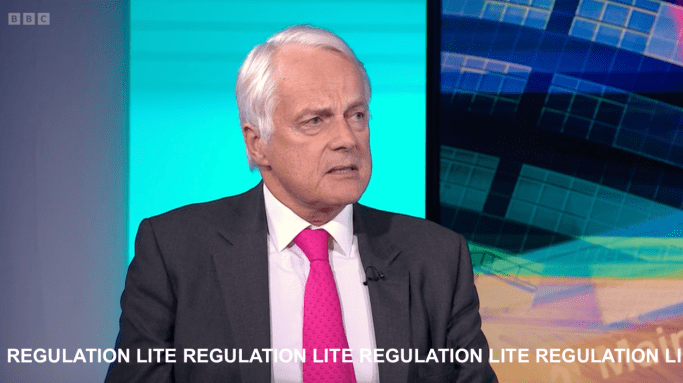
Lucy Letby murders: Robert Francis’ and Bill Kirkup’s messaging supports government’s choice of a non-statutory inquiry

Dr Minh Alexander retired consultant psychiatrist 20 August 2023

The government has announced a non statutory inquiry into the Letby affair. Two of its regulars, Francis and Kirkup, have provided supportive messaging.

Robert Francis’ rise and failure to protect NHS whistleblowers

Robert Francis is a medical negligence lawyer who did well after chairing the public inquiry into the Mid Staffs hospital disaster.

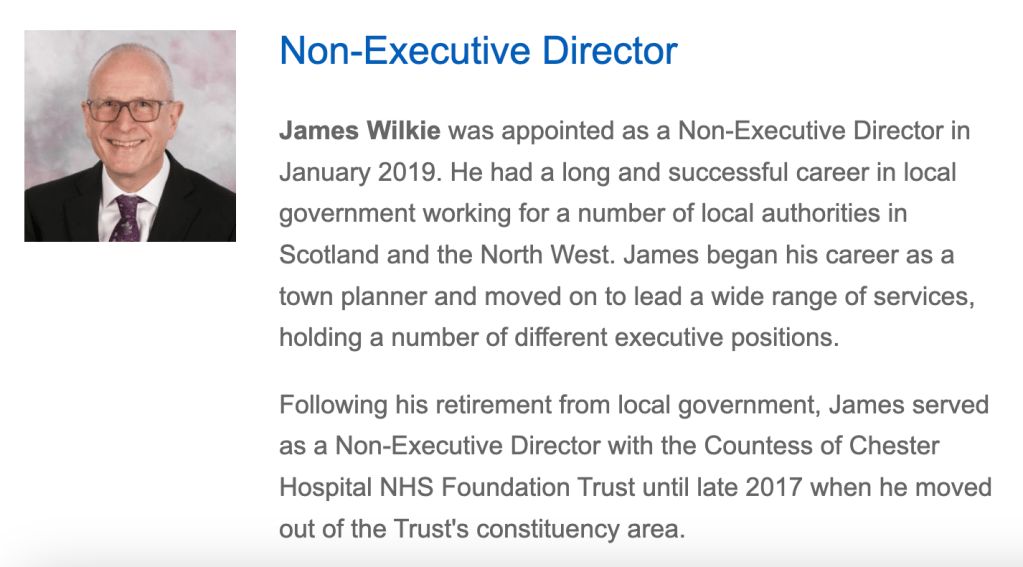
In 2014 he was knighted and got a job as a Care Quality Commission non executive director.

In his poshed-up, high profile new persona, he was also asked in 2014 to conduct the Freedom To Speak Up review into NHS whistleblowing failures.

Francis proved himself to be a loyal servant of power.

He acknowledged the weakness of UK whistleblowing law which had failed UK whistleblowers and the public so badly since 1999 but refused to recommend law reform, on the grounds that it would take too long.

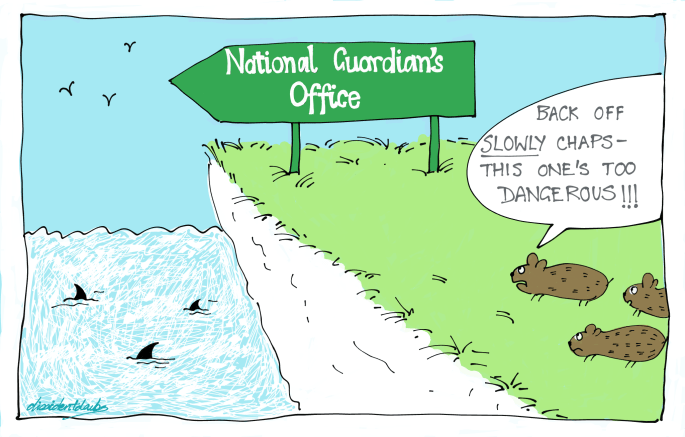
He claimed that a non evidence-based model of toothless local Guardians backed up by a toothless National Guardian would change culture more quickly.

When his wobbly model later did not meet expectations, Francis changed tack and argued instead that culture change required time.

That would be the precious time in which vital reform of UK whistleblowing law could have taken place, but did not, because of Francis’ inadequate recommendations.

Importantly, Francis also dropped his own recommendation from the Mid Staffs public inquiry to criminalise whistleblower reprisal.

In Francis’ report of the Freedom To Speak Up review, he did not even acknowledge that he had ever made such a recommendation. Rather, he appeared faintly derisive of contributors who asked for criminal sanctions. In his Freedom To Speak Up review he wrote:

“A small number even wanted to see criminal and custodial sentences.”

Another betrayal of the public interest is that Robert Francis expressly left the investigation of whistleblowers’ concerns entirely in the hands of NHS employers.

He made it clear that neither local Freedom to Speak Up Guardians nor the National Guardian could have any role in investigating whistleblowers’ concerns.

This is one of the most indefensible and dangerous outcomes of Francis’ Freedom To Speak Up review.

Francis covered his governance shame with the skimpiest fig leaf by adding that NHS employers could call in independent, external investigators sometimes, if they wanted to. Even then, he stressed that whistleblowers should not be entitled to such independent investigation in all cases.

Investigations controlled and paid for by employers are de facto tainted and cannot be claimed to be reliably independent.

It is of course reasonable in some circumstances for incidents to be locally investigated in the first instance. But the most serious incidents should always be fully independently externally investigated.

For example, in NHS mental health services, homicides by patients should always trigger an externally commissioned, external independent investigation under HSG (94) 27.

In the Letby case, the Countess of Chester Hospital NHS Foundation Trust wasted critically valuable time by bizarrely commissioning a review by the Royal College of Paediatricians which did not involve case note review of the affected babies who had collapsed and died.

This inexplicable omission helped the trust to suppress the scandal for a little longer, but at the cost of leaving Letby at large.

This is an example par excellence of why it was so dangerous that Francis left employers in sole control of investigating the most serious whistleblower disclosures.

When it became clear that Francis’ already weak and flawed Freedom To Speak Up model was being further diluted by both the regulators tasked with implementing it, and by the second National Guardian appointed, Henrietta Hughes, I raised concerns directly with Francis.

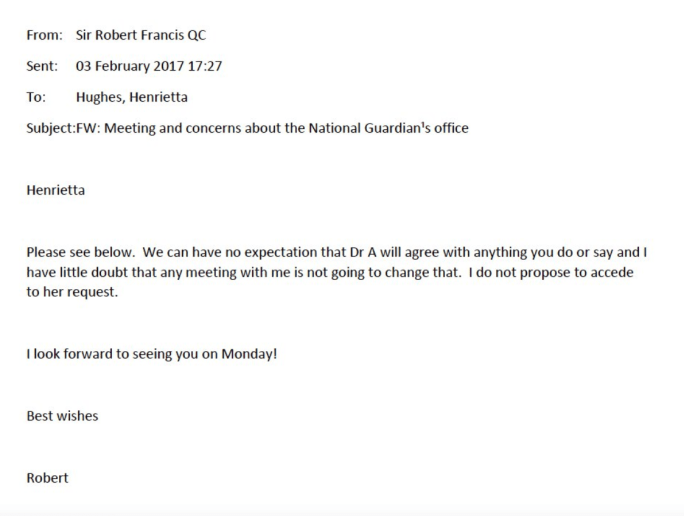
He showed his true self by sending my correspondence straight to Hughes without my knowledge or consent, and wrote to her that he would not meet with me because he did not think he could change my mind. In other words, Francis did the exact opposite of what one should do when faced with any sort of whistleblowing concern. He was hostile and dismissive, he refused to look into the matter and he showed little regard for any normal standards of confidentiality, sharing concerns with a party about whom concerns had been raised. I discovered Francis’ errant correspondence by subject access request. Years later, I mentioned to him that I knew. He did not acknowledge the matter nor did he apologise.

Never mind the decorative gong and the Department of Health’s carefully constructed branding. That is a true measure of the man.

The Daily Telegraph interview with Francis on Letby

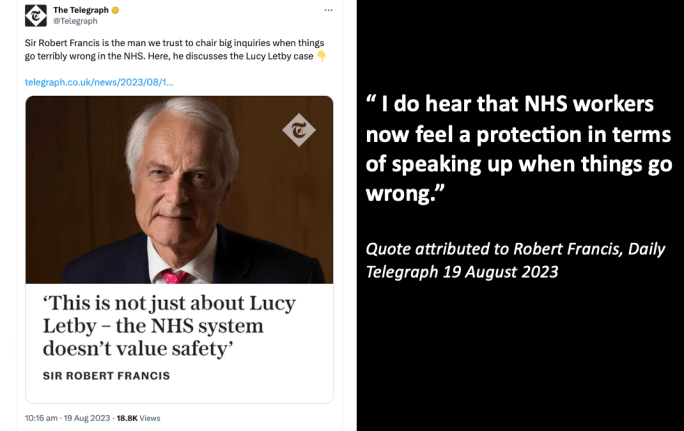
On 19 August 2023 the Telegraph published a lamentable and most embarrassing article on Francis and his comments about the Letby killings.

The article opened with adulation more suited to a matinée idol:

“Sir Robert is the kind of patrician grey-haired chap who gives the establishment a good name. A barrister, King’s Counsel and President of the Patients Association, he’s the man we trust to chair big enquiries when things go terribly wrong in the NHS. The lessons for the NHS that came out of his epic five-year inquiry into high numbers of deaths in elderly patients at Stafford hospital enshrined a “duty of candour” in the NHS. His lessons on accountability and culture are taught to all medical students. If ever there was a moment for his cool, experienced head, this is it.”

This is a word picture of the public relations shield that the Department of Health has been wielding to legitimise many things since 2013.

In case the above bludgeon was too subtle, the rest of the article is scattered with more Francis-worship:

“These insights are hard-won; not just from his decades as a leading medical negligence barrister, but from his epoch-defining inquiry and report of mid Staffordshire NHS Foundation Trust”.

“He made such a name for himself as a champion of patients’ safety with the report, that afterwards he became President of the Patients Association, Chair of Healthwatch England and also chaired an NHS review into protecting whistleblowers called the Freedom to Speak Up review”.

That last claim about “protecting” whistleblowers moves things into the realm of fiction.

Please see this 2018 summary for some of the evidence about Francis’ disastrous Freedom To Speak Up model:

A Serious Health Warning about the Freedom To Speak Up Project: What all NHS staff should know before they whistleblow

There has been only more evidence of its failure since then.

Shamelessly, in his interview with the Telegraph Francis reportedly stated:

“ I do hear that NHS workers now feel a protection in terms of speaking up when things go wrong.”

The article added “We saw this in the Letby case, when the neonatal consultants did raise the alarm.”

Breathtaking arrogance here from the Torygraph in the face of the horrific threats and smears that the consultant paediatricians subsequently faced, when they persisted with their concerns about Letby.

The fact that Francis’ shameful Freedom To Speak Up project took up only fourteen words of the Telegraph article says much about the fact that it is now widely recognised to be a failure.

If we listen carefully, can we hear any vicarious messages from Whitehall, transmitted through its representative on Earth?

How about this passage from the Telegraph piece:

“There needs to be a proper independent and transparent review of everything that happened, as swiftly as possible, but I would say not a public inquiry. We don’t need five years of looking at this to come to some conclusions about putting patient safety at the forefront.”

And what fine, ready-made, “patrician” pillar of the establishment might be called upon to conduct this?

And how about this little reported line from Francis?

“Fundamentally, many of the problems in the NHS are down to bad management. I don’t think there is anywhere in the private sector that would behave this badly”.

It is abundantly clear to many that the NHS is a full of dedicated frontline lions led mostly by self-serving senior management donkeys, with a number of clearly political appointments in recent years.

But to claim that the private sector is a paragon after all the terrible, terrible private sector care scandals due to profit mongering?

But we are after all talking about the Torygraph, and we are well into the Tories’ end game for the NHS.

Is Francis’ choice of media outlet significant?

Will we see the “patrician” in the House of Lords at some point?

Lastly, I leave the reader with this little gem. Francis wanted to be an actor, according to a tête-à-tête with the PHSO in 2017:

“…I rather wanted to be an actor….”

The “patrician” got his primary law degree at a provincial university, Exeter.

He has to date chaired the following inquiries:

Report of the independent inquiry into the care and treatment of Michael Stone
South East Coast SHA 2006

Independent inquiry into the care and treatment of Peter Bryan and Richard
Loudwell NHS London 2009

The first (non-statutory) inquiry into Mid Staffs Volume 1 DH 2010 and Volume 2

Midstaffs Public Inquiry DH 2013

Freedom To Speak Up Review DH 2015

Bill Kirkup hums a similar tune

Bill Kirkup is another government go-to guy. Some families seem satisfied with his investigations, some decidedly not.

In particular, the parents of Elizabeth Dixon were deeply concerned that allegedly, Kirkup did not conduct an appropriate investigation and that not all relevant evidence was weighed. Kirkup’s investigation into baby Lizzie’s death certainly seemed to have inexplicable gaps, in that criticism was focussed on frontline clinicians, but very little was discussed about corporate controlling minds.

But then examining the favoured management of Frimley Health NHS Foundation Trust, a much used icon in former Secretary of State Jeremy Hunt’s PR campaigns, would have trodden on powerful toes.

In various media interviews, Kirkup played down the need for a public inquiry into the Letby killings, stating that there could instead be “public involvement”.

In my view, Kirkup also appeared to subtly deflect blame by suggesting that the paediatricians at Chester could have been more top of their clinical outcomes.

There is of course always room for improvement. However, as the doctors were reportedly raising concerns about Letby with trust executives from August 2015 onwards (two months after the first known killing by Letby), I find it hard to believe that the doctors were not acutely aware and anxious about outcomes on their unit at least from that point onwards.

The far greater issue was the reflexive reputation management by trust directors and their active suppression of the doctors’ concerns. That had nothing to do with outcome data.

These are Kirkup’s relevant comments, transcribed from a Channel 4 interview on 18 August 2023:

Guru-Murthy:  Dr Bill Kirkup has led a number of independent reviews into NHS failings. Most recently the baby death scandal at East Kent hospitals. I spoke to him earlier today and asked for his reaction to the ordering of an inquiry.

Kirkup: I think it’s absolutely essential. These are just awful events. We have to learn from them. We have to get better at detecting these kind of things much more quickly. I mean prevention would be ideal of course if we could do that, but at the very least we have to get better at spotting them rapidly. The first way to do that is to monitor outcomes as they happen and we could have picked this up much, much sooner than we did.


Guru-Murthy: Doctors did that but in their own, internal way I suppose, when they tried to raise the alarm.

Kirkup: They did, they had a feeling that er there was something wrong here because of the frequency these things were happening at and they were right. But it’s hard to persuade other people unless you have concrete evidence to base it on. If they had been able to say, look this is a proper analysis week by week of these events as they happened and this is so far off the scale we have to have a serious problem here. We have to put the resources into finding out what we [inaudible] now then we have to start thinking the unthinkable.


Guru-Murthy: Are you shocked by the reaction of the hospital management?

Kirkup: It’s so disappointing that clinicians were raising concerns. They were saying that we think there’s something wrong here and they do not appear to have been taken seriously by those running the unit. That’s very, very disappointing.


Guru-Murthy: Do you think there’s a more fundamental problem there about the relationship between doctors and management? I mean there seems to be a fundamental lack of trust in this case.

Kirkup: Yes, I think that can be the case in some places. Hopefully not the majority but I think in some cases it is. I think when very drastic events like these happen that can put the system under such strain that those gaps turn into gaping chasms.

Guru-Murthy: As somebody who’s done an inquiry and came up with recommendations, you’ve just cited one thing that could make this much easier to detect, which hasn’t yet been done. So how do you do an inquiry that will be listened to and acted upon?

Kirkup: Yeah, you have to persuade people that these are serious problems and that they can get better if we do it, and we have. It’s just that it took a little while to get going after the independent investigation into East Kent. But the initial reaction was disappointing and I said so at the time. But since then, we have begun to make real progress. We’re introducing a system that does monitor outcomes, what the results of care are, on a case by case basis. If we’d had that in the Countess of Chester Hospital I’ve got no doubt that we could have picked up that this way, way off the scale, much, much sooner that happened.

Guru-Murthy: Given that this will have ramifications for many patients in the NHS and parents who are in neonatal units, do you think an inquiry like this should be held in public?

Kirkup: I think that there should be public involvement in the investigation. At the moment I would call it an investigation rather than an inquiry, but that does depend on what the final format of the thing is. There are ways to do that, without again necessarily pushing everybody into a position where they have to be legally represented. We did that in the Morecambe Bay investigation for example. We had  representatives of families attended all the meetings that we had and attended all the, or at least they had the ability to attend all the interviews that we did. That’s all a way of discharging that obligation and to be transparent, and to have the families concerned assured that these things are being [inaudible] properly, without pushing for this to go down a very legal route that does complicate the issues enormously.

A BBC article of 19 August 2023 reported that Kirkup claimed that people would reliably cooperate with a non-statutory inquiry that had no power to compel evidence:

“Dr Bill Kirkup, who has led non-statutory reviews for other maternity units, said non-compliance had not been a problem in his experience and people were “ready and willing to cooperate”.

This is very interesting as in Kirkup’s report of his (non statutory) investigation about the death of baby Lizzie Dixon, he wrote:
“The most troubling aspect of compiling this report has been the clear evidence that some individuals have been persistently dishonest, both by omission and by commission, and that this extended to formal statements to police and regulatory bodies.”

And Kirkup complained that some individuals would not cooperate with his investigation into the Dixon death:

“It is, however, greatly regrettable that some of those who were contacted refused to take part in interviews” [my emphasis]

Kirkup underlined the importance of failure to cooperate:

“Cooperating with an investigation into a public service is not optional for those involved, and professionally registered doctors and nurses are under a duty to do so. Dereliction of this duty, without even the offer of an excuse, is seriously detrimental to the conduct of investigations, and contrary to the requirement for candour and transparency. The professional regulatory bodies must consider whether those who elected to withhold cooperation were in breach of their professional responsibilities.”

Perhaps great men, once loftily elevated by the Department of Health, feel less obligation to fact check even their own pronouncements.

But that quality may in fact recommend one to power.

I have written to Kirkup about the apparent discordance between his report on failure of witness cooperation during the Dixon death investigation and his current, reported claim that he has experienced no difficulties with witness compliance during non statutory inquiries. The letter is copied to the relevant BBC and Channel 4 journalists and editors:

Letter to Bill Kirkup 21 August about witness cooperation with non statutory inquiries and failure of witness cooperation in Kirkup’s investigation of Elizabeth Dixon’s death under care of Frimley Health NHS Foundation Trust

I have also pointed out that the non statutory inquiry into Essex mental health deaths failed due to uncooperative witnesses and had to be converted to a statutory public inquiry:

Department of Health announcement 28 June 2023 of a statutory public inquiry into Essex mental health deaths

UPDATE

The families of Letby’s victims are pressing for a full public inquiry and for the Duty of Candour arrangements to be replaced by mandatory reporting. Their lawyers have made a statement on their behalf:

Samantha Dixon MP City of Chester issued this statement in favour of public inquiry on 18 August 2023, after the verdict

UPDATE 23 AUGUST 2023

The Telegraph reported yesterday that the PM was wavering on the government’s initial decision to call a non statutory inquiry, as trenchant calls for a statutory public inquiry have accumulated:

The “patrician” also seemed to sway with public opinion:

“Sir Robert Francis KC, who chaired the inquiry into serious care failings at Mid Staffordshire NHS Foundation Trust, said that the families of Letby’s victims should decide on whether the inquiry into her crimes should be statutory”

Pity he did not seem to consider the families’ wishes when he initially recommended a non statutory inquiry.

UPDATE 24 AUGUST 2023

Bill Kirkup acknowledged that key witnesses did not cooperate in his investigation of baby Lizzie Dixon’s death, but he maintained it did not affect his investigation. He stated that only three witnesses had ever refused him, out of hundreds of interviewees. Kirkup did not reply when asked about evidence that four NHS directors did not appear to have cooperated with his investigation into serious failings Liverpool Community Health NHS Trust (LCH). A letter deposited in parliament from Steve Barclay to NHS regulators in 2018 gave further evidence of the failure of witness cooperation at LCH. I have asked William Vineall Department of Health for definitive confirmation, as it begs the question of why would government pursue a non statutory inquiry when it has evidence of serious past failures of witness cooperation? The further details are provided in this post of 23 August 2023:

Lucy Letby murders: “Ready and willing” Follow up on Bill Kirkup’s comments to the BBC about his experience of witness cooperation with non statutory inquiries

RELATED ITEMS

Despite Francis’ best attempts to disavow his former recommendation on criminal liability for NHS managers who suppress and victimise whistleblowers and who cover up, there are now understandable calls for consideration of corporate manslaughter with regard to the gross mismanagement that allowed Letby to continue killing and abusing babies.

This is the Crown Prosecution Services’ guidance on the offence of Corporate Manslaughter, which relates to serious failures by a body corporate, through its senior staff:

CPS legal guidance corporate manslaughter

The guidance states:

“The offence applies only to certain organisations, as defined by the Act. They include private bodies such as limited companies and partnerships. Public bodies such as local authorities and NHS Trusts can also be held liable, on the grounds that they are bodies incorporated by statute (see section 25 and para 15 of the explanatory notes). Specified government departments and police forces can also be held liable. Individuals cannot be prosecuted for the offence, whether as an accessory or otherwise.”

This is the CPS guidance on Gross Negligence Manslaughter, which is committed by individuals:

CPS legal guidance Gross Negligence Manslaughter

In a healthcare context, the CPS guidance states: “Death following medical treatment or care; the offence can be committed by any healthcare professional, including but not exclusively doctors, nurses, pharmacists, and ambulance personnel”

The CPS guidance also indicates that individuals can also be prosecuted for negligence in the workplace: “Deaths in the workplace the offence can be committed by anyone who is connected in some way to a workplace of any nature.”

There is also of course the offence of Misconduct in Public Office.

Statement by the Letby victims’ families

The victims’ families have been given anonymity by the Court, and there seems to have been limited coverage of their views. This is a transcription of a statement by the families, read out by a family liaison officer at Cheshire Constabulary after the verdict:

“Words cannot effectively explain how we are feeling at this moment in time.  We are quite simply stunned. To lose a baby is a heart breaking experience that no parent should ever have to go through. But to lose a baby or have a baby harmed in these particular circumstances is unimaginable. Over the past seven to eight years, we’ve had to go through a long, tortuous and emotional journey. From losing our precious newborns and grieving their loss, seeing our children who survived, some of whom are still suffering today. To be told years later that their death or collapse might be suspicious. Nothing can prepare you for that news. Today, justice has been served and a nurse who should have been caring for our babies has been found guilty of harming them. But this justice will not take away from the extreme hurt, anger and distress that we’ve all had to experience. Some families have not received the verdict they expected and therefore it is a bittersweet result. We are heartbroken, devastated, angry and feel numb. We may never truly know why this happened. Words cannot express our gratitude to the jury who have had to sit through 145 days of gruelling evidence which led to today’s verdict. We recognise that this has not been an easy task for them. And we will forever be grateful for their patience and their resilience throughout this incredibly difficult process. The police investigation began in 2017 and we’ve been supported from the very beginning by a team of very experienced and dedicated family liaison officers. We want to thank these officers for everything that they’ve done for us. Medical experts, consultants, doctors and nursing staff have all given evidence at court, which at times has been extremely harrowing and distressing for us to listen to. However, we recognise the determination and commitment that each witness has shown in ensuring that the truth was told. We acknowledge that the evidence given by each of them has been key in securing today’s verdict. Finally, we would like to acknowledge and thank the investigation team and more recently, the prosecution team who have led the trial to a successful conclusion. The search for the truth has remained at the forefront of everyone’s mind and we will forever be grateful for this. We would now ask for time and peace to process what has happened as we come to terms with today’s verdict.”

The police liaison officers paid tribute to the affected families and also to Court staff for facilitating proceedings: “On behalf of our team of dedicated liaison officers I would like to thank all our families for the immense fortitude and extreme resilience that they have shown over the years. They have acted with dignity and reservedness during a very long trial, hearing the most horrendous evidence. We are all extremely humbled by them.”

Lack of learning from the 1994 Beverly Allitt inquiry

The inquiry into Allitt’s killings on a children’s ward criticised failures to be alert to abuse and to piece clues together in a methodical way. It also criticised managers who did not take concerns seriously. The Letby case represents a failure by the NHS as an organisation to learn from Allitt and other similar cases, and to protect the public from avoidable risk. Notes from the Allitt inquiry can be found here.

Robert Francis’ claim that nowhere in the private sector do managers behave as badly as they do in the NHS

This claim is a pile of steaming proverbial and a great, great insult to all victims of bad care by private healthcare providers and their notorious cover ups.

The profit motive drives a lot of bad care in the private sector, and the managers there can be as cut-throat as any you might find in the NHS.

There is a long trail of injured and dead patients, and seriously harmed whistleblowers to prove it.

Here are a few of many related items:

Winterbourne View Serious Case Review report 2012

Pinned down, force-fed and drugged into ‘zombie-like’ state: ‘Systemic abuse’ at children’s hospitals revealed

Mapped: All the mental health hospitals rated inadequate

St. Andrews Healthcare, Whistleblowing, Safeguarding and Public Protection

The spreading CQC Whorlton Hall scandal – emerging allegations at ‘Outstanding’ Newbus Grange. Another CQC deception?

Employment Tribunal describes a Cygnet medical director’s email to the GMC about a whistleblower as “venomous and dishonest”. Dr Ambreen Malik wins her whistleblowing case.

Cygnet Health Care has Fit and Proper leaders according to the CQC, despite gross whistleblower reprisal

Lucy Letby murders: Learning from the 1994 Clothier inquiry into the Beverly Allitt killings at Grantham and Kesteven General Hospital

Dr Minh Alexander retired consultant psychiatrist 18 August 2023

There are troubling similarities between the system responses to concerns raised about about Allitt and Letby, with the difference being much greater delay in Letby’s case.

I have looked at the original 1994 Allitt inquiry report. It only seems to be available in hard copy, so I have made notes for sharing with anyone who might find the information useful.

Notes on Independent inquiry relating to deaths and injuries on the children’s ward at Grantham and Kesteven General Hospital during the period February to April 1991

This is a contemporaneous, short summary of the Allitt Inquiry’s criticisms of the NHS:

Chances to stop killer nurse were missed: Allitt report highlights understaffing 

Insulin poisoning was a common feature of the two cases, and was an important clue to foul play.

Allitt’s killings occurred over a two month span. NHS staff were criticised by the inquiry for not acting quickly enough after the possibility of insulin poisoning first arose, with an ensuing interval of eighteen days before the policed were notified.

In Letby’s case, the first insulin poisoning occurred in August 2015 and then again in April 2016. She was not removed from clinical duties until after June 2016, and the police were not asked to investigate until March 2017, announced in May 2017.

Very sadly for the families affected at the Countess of Chester Hospital, the jury was unable to reach a verdict in six charges of attempted murder against Lucy Letby relating to four babies.

But following the verdict of seven murders and six attempted murders by Letby, the Health Service Journal and other media have today revealed that doctors who raised concerns about Letby were castigated and threatened with referral to the General Medical Council if they persisted in raising concerns.

“The sources claimed the consultants were told there would be consequences if they refused, as it could leave them open to a GMC referral.”

The doctors were in fact forced to write an apology to Letby for raising their concerns.

The doctors were also apparently undermined by their own Royal College. According to the Health Service Journal, there was an unpublished addendum to the 2016 Royal College invited review report of neonatal care at the trust which suggested that the doctors’ concerns were based on questionable grounds:

“An unpublished addendum to the RCPCH report, seen by HSJ, said specific concerns about Letby had been raised by the neonatal lead and consultants, but described them as “subjective” and based on “simple correlation” and “gut feeling”.”

This echoes events in the Allitt case when a consultant who suggested that video monitoring was needed after unexplained child deaths and collapses, was dismissed as having “fanciful ideas” and being “a bit unpredictable”.

Susan Gilby, who was appointed as a new medical director in August 2018 and became acting Chief Executive in September 2018, reportedly supported the paediatric consultants and helped raise the alarm about Letby. However, she also found herself in hot water. She later filed an Employment Tribunal claim against the trust, alleging bullying by the trust Chair.

The government has announced a non-statutory inquiry into the Letby killings.

The announcement included this significant information:

Following on from the work already underway by NHS England, it will help us identify where and how patient safety standards failed to be met and ensure mothers and their partners rightly have faith in our healthcare system.” [my highlight]

It is quite possible, if not likely, that there will be many questions and superficial handwringing but little real learning.

It is not reassuring that NHS England and the government have rejected Tom Kark KC’s 2019 recommendation to introduce a disbarring mechanism to remove unfit senior managers from the NHS.

Neither is it reassuring that there seems to be a highly irregular government review of UK whistleblowing law in progress.

The 1991 Beverly Allitt killings accuse the NHS, from across the decades, of a failure to learn.

There are too many similarities between Allitt and Letby for comfort.

The Guardian asked for my opinion and I have highlighted senior NHS managers’ lack of competence in dealing with bad news and the literally fatal weakness of UK whistleblowing law.

My condolences to all affected by the actions of Allitt and Letby, and those who failed to protect the public when it was in their power to do so.

RELATED ITEMS

Robert Francis and Bill Kirkup have predictably been helping to tune the pulpits, in an attempt to convince the public that a non statutory inquiry into Letby’s killings will suffice:

Lucy Letby murders: Robert Francis’ and Bill Kirkup’s messaging supports government’s choice of a non-statutory inquiry

Importantly Bill Kirkup claimed to the BBC that there is no problem with cooperation with non statutory inquiries which cannot compel evidence. This is very curious as he previously made a great song and dance about individuals who refused to cooperate with his investigation into the deaths of baby Elizabeth (Lizzie) Dixon under the care of Frimley Health NHS Foundation Trust. I asked Kirkup about this anomaly.

Bill Kirkup replied on 21 August 2023. He acknowledged that key witnesses did not cooperate in his investigation of baby Lizzie Dixon’s death, but he maintained it did not affect his investigation. He stated that only three witnesses had ever refused him, out of hundreds of interviewees. Kirkup did not reply when he was also asked about evidence that four NHS directors did not appear to have cooperated with his investigation into serious failings Liverpool Community Health NHS Trust (LCH). A letter deposited in parliament from Steve Barclay to NHS regulators in 2018 gave further evidence of the failure of witness cooperation at LCH. I have asked William Vineall Department of Health for definitive confirmation, as it begs the question of why would government pursue a non statutory inquiry when it has evidence of serious past failures of witness cooperation? The further details are provided in this post of 23 August 2023:

Lucy Letby murders: “Ready and willing” Follow up on Bill Kirkup’s comments to the BBC about his experience of witness cooperation with non statutory inquiries

A review of the Fit and Proper Test in the NHS by Tom Kark KC and Jane Russell (barrister) for the Secretary of State) published February 2019

Department of Health and Social Care confirms Secretary of State has binned Kark’s mechanism to disbar unfit NHS managers, and reveals this was NHS England’s suggestion

An organisation with a memory, Report of an expert group on learning from adverse events in the NHS chaired by the Chief Medical Officer, DH 2000

Replacing the Public Interest Disclosure Act (PIDA)

NHS England appears to refuse a review of whether the NHS should hire the Good Governance Institute any more

Dr Minh Alexander retired consultant psychiatrist 16 August 2023

There has been concern about a private company which sells consultancy services to the NHS, the so-called “Good Governance Institute”, and which has employed a former NHS trust director who was sacked following a false claim about his qualifications.

The company has recently been investigated by BBC Newsnight:

Investigating the ‘institute’ making millions from the NHS

Reports by the Good Governance Institute are also of interest at University Hospitals Sussex NHS Foundation Trust, where there is a police investigation into deaths and where a former Good Governance Institute Executive Director and Partner later became the Trust’s Chief Governance Officer.

After BBC Newsnight’s investigation into the Good Governance Institute, I asked Amanda Pritchard CEO of NHS England if the regulator would review whether the NHS should ever use this company again.

NHS England has today issued a response on behalf of Amanda Pritchard today, indicating that it has nothing to add to previous replies. (NHS England had previously merely said that it had checked current contracts and confirmed there it had no contracts with the Good Governance Institute).

So would that be a ‘no’ then?

Do NHS regulatory or ex regulatory staff have connections with the Good Governance Institute?

For example, Bob Alexander and Stephen Moir, formerly of NHS TDA and NHS England, are listed on the company’s website amongst its “people”:

The exchange of correspondence with NHS England is provided below:

From: CASEWORK (NHS ENGLAND – X24) <REDACTED>

To: Minh Alexander <REDACTED>

Sent: Wednesday, 16 August 2023 at 11:03:38 BST

Subject: NHS England Case Reference 2306-1985921 – GE. NHSE:0834279

Dear Dr Minh Alexander,

Thank you for your further email, I am sorry for the delay in responding.
 

Ms Pritchard is aware of your email but we are not adding anything further to the responses already provided in respect of this matter.
 

Regards
Kimberley


Case Officer
Customer Contact Centre


NHS England
PO Box 16738

Redditch
B97 9PT
Tel: 0300 123 4484   Please quote your case reference number, calls may be recorded for training and monitoring
Email: REDACTED
Web: www.england.nhs.uk

BY EMAIL

Amanda Pritchard
CEO NHS England


20 July 2023

Dear Amanda,

BBC Newsnight investigation into the Good Governance Institute

In the most recent exchange of correspondence, NHS England informed me that it had checked its current contracts and none were with the Good Governance Institute (GGI). 

This followed NHSE’s hiring of the GGI last autumn via the Chief Nurse’s directorate, AFTER the GGI employed the sacked former NHS trust director Mason Fitzgerald. The GGI still employs Mason Fitzgerald.

Last night BBC Newsnight broadcast an investigation into this private company which raises serious questions (starts at 20.45).

Companies House advised the BBC that no company should include the sensitive word “institute” in its name without permission from the Secretary of State, and that to do so is an offence. According to the BBC, Companies House has written to the GGI to ask it to stop using its current name.

There were also other matters of concern.


Will NHS England take the additional step of reviewing whether this company should ever be used again by the NHS?

As a wider point, Rachael Maskell MP questioned the usefulness and value for money in outsourcing governance reviews in this manner.

Prof Andrew Sturdy from Bristol University School of Business pointed to the “demand inflation” that is driven by the self-interest of private consultants looking for repeat business, when they transact with the NHS.

Many thanks and best wishes,

Minh

Dr Minh Alexander

Cc Health and Social Care Committee

     BBC Newsnight

 RELATED ITEMS

BBC Newsnight investigates the Good Governance Institute

NHS musical chairs: Darren Grayson, the Good Governance Institute & University Hospitals Sussex NHS Foundation Trust

Health Education England’s damning 2020 report on surgical training & safety at Sussex. Another embarrassment for the National Guardian’s Office

A Study in Delay II : The National Guardian, maternity safety & University Hospitals Sussex NHS Foundation Trust

A Study in Delay: The National Guardian & Brighton and Sussex University Hospitals NHS Trust

Kark, Fit and Proper Persons, NHS England, Mason Fitzgerald and the Good Governance Institute

What’s going on at University Hospitals Sussex NHS Foundation Trust? George Findlay CEO and former medical director has withheld a review report on clinical services, co-authored by an external consultant who is now the trust’s Chief Governance Officer

Dr Minh Alexander retired consultant psychiatrist

University Hospitals Sussex NHS Foundation, the subject of a police investigation, is resisting an FOI request.

The wheels came off the trust’s publicity machine earlier this year when the CQC finally conceded that there was poor trust leadership and downgraded it sharply from ‘Outstanding’ to ‘Requires Improvement’ overall, with a rating of ‘Inadequate’ on leadership:

Sussex hospital trust downgraded as staff blow whistle

But even before that, the CQC had registered failures of leadership and very poor whistleblowing governance.

Whistleblower controversies have dogged the trust, as have allegations of spin and suppression by its senior management team, who were for a while protected favourites of Jeremy Hunt.

As the forcefield of protection has weakened, serious failings have become evident.

One matter of concern is how exactly a predecessor body was lifted out of special measures in 2019, and there have been questions about the quality of the information which informed this regulatory decision.

Accordingly, I asked the trust for all reports undertaken by the controversial Good Governance Institute for the trust, some of which informed this regulatory decision.

This is especially as one of the GGI consultants, Darren Grayson, was later appointed as the trust’s Chief Governance Officer in March 2022.

Darren Grayson was a GGI Executive Director and Partner in the period in which the trust purchased many services from the GGI, having previously resigned as CEO of a neighbouring NHS trust in 2015. The resignation followed a very critical Care Quality Commission report which concluded there was bullying by management. The unions and MPs demanded new leadership.

University Hospitals Sussex NHS Foundation Trust has responded oddly to my FOI request for the GGI reports. At first it resisted disclosure of all the requested GGI reports. The trust also claimed it could not disclose the cost of its contracts with the GGI on grounds of commercial interest, which is nonsense because as a public body it is expected to be proactively transparent about spending and to publish details of spending over £25K.

For unexplained reasons, the trust has now had a change of heart and disclosed some of the GGI reports but not a review of a clinical service, and two other reports on governance.

I cannot find any given trust grounds for withholding the latter two governance reports.

Moreover, the conduct of a clinical service review by the GGI is unusual. I am not aware that the GGI normally reviews clinical services. Indeed, most NHS trusts call in the Royal Colleges for reviews of clinical services so that they can be informed by appropriate clinical expertise.

The trust contends that disclosure of the clinical service review report is “likely” to lead to “sensationalised” reporting. The trust is so reluctant to disclose this particular report that it has claimed that if it has to disclose this report, it might not carry out invited reviews again:

“Disclosure at this stage would likely to prejudice the Trust’s ability to carry out its public affairs effectively…This would likely undermine its [the trust’s] willingness to invite external organisations to conduct service reviews in the future.”

The so far disclosed GGI reports are as follows:

Rapid review of clinical governance in divisions, by Good Governance Institute at BSUH September 2017

Options for board secretary, report by Good Governance Institute at Western Sussex and BSUH April 2018

Quality Governance Review at BSUH by Good Governance Review November 2017

A Quality Governance Structure for the merged Trust: high level design principles and associated recommendations, by the Good Governance Institute at University Hospital Sussex NHS Foundation Trust November 2020   

I leave it with the reader to decide if these reports represent public money well spent. They are generally upbeat in tone.

The fact that serial reports were carried out – there were a total of seven GGI reports at Sussex – brings to mind observations by Professor Sturdy, University Bristol, to BBC Newsnight about demand inflation by external consultants, who want repeat business.

This is the trust’s first FOI response letter of 12 July 2023.

This is the trust’s second FOI response letter of 10 August 2023.

The trust also decided that it would disclose spending on the GGI after all. It amounts to £410,419.99 in the period November 2017 to November 2020.

I believe that the 2018 clinical service review that is still being withheld is of significant public interest, and forms part of the audit trail on corporate failures. It was co-authored by Darren Grayson, now the trust’s Chief Governance Officer.

The trust has stated that Dr George Findlay the trust’s former medical director, now CEO, is the trust’s qualified person under FOIA who has agreed with the decision not to disclose. As the qualified person he is ultimately responsible for the decision to withhold this important report.

I have challenged the trust’s claimed grounds for withholding the report of the clinical service review in the following, hopefully self-explanatory correspondence to its Chair.

BY EMAIL

Alan McCarthy

Chair University Hospitals Sussex NHS Foundation Trust

13 August 2023

Dear Mr McCarthy,

Decision by George Findlay to withhold a 2018 GGI report on a Rapid Review of Digestive Diseases Clinical Directorate.

I write to request an internal review of a decision by Dr Findlay trust CEO and former trust medical director to withhold information under FOIA which I consider should be disclosed in the public interest.

Please see the attached FOI correspondence from the trust on these matters.

Firstly, I am concerned irregularity in the trust’s FOI process.

The trust withheld several GGI reports from me which it later disclosed.

The trust also initially claimed quite inappropriately that it could not disclose the cost of each piece of work that it contracted from the GGI on grounds of commercial interest, when in fact that exemption did not apply, and in any case the trust should be proactively publishing all items of spending above £25K.

The trust has now disclosed four of seven of the reports that the GGI has produced. The seven GGI reports were as follows:

But the trust has not released the two reports on:

– “Supporting the Implementation of Quality Management Structure” 2018

– “Senior Project Manager Covid-19” 2020.

I could not find any grounds given in the trust’s FOI response letter for not disclosing these two reports.

I request that the trust either discloses the reports or provides valid legal exemptions for withholding them. I also ask if Darren Grayson was a GGI consultant for either of these exercises and whether the “Supporting the Implementation of Quality Management Structure” report made any recommendations for the creation of a Chief Governance Officer post or similar.

Of special concern, the trust declined to disclose the 2018 Brighton and Sussex University Hospitals NHS Trust Rapid Review of Digestive Diseases Clinical Directorate.

The trust has claimed FOIA Section 36 exemption, prejudice to the conduct of public affairs against disclosure of this report.

I copy below in the appendix the lengthy justification that the trust has provided for claiming this exemption.

The trust has disclosed that the ultimate decision maker in withholding the rapid review report on the Digestive Diseases Clinical Directorate is Dr George Findlay trust medical director:

“This decision is supported by the Trust’s Qualified Person, Dr George Findlay (Chief Executive Officer), who is of the opinion that the disclosure of this information would likely inhibit the free and frank provision of advice and/or free and frank exchange of views for the purposes of deliberation [section 36(2)(b)(i) and (ii)], and that disclosure would otherwise likely prejudice the effective conduct of public affairs [section 36(2)(c)].”

The GGI has redacted the names of all GGI report authors, claiming FOIA S40 personal data and S43 Commercial interest exemptions.

“Although disclosure in this case would serve a legitimate interest relevant to the general principles of transparency and accountability, it is our view that these individuals would not have a reasonable expectation that their personal information would be disclosed into the public domain in this way. On this basis we do not consider disclosure necessary nor do we consider there to be sufficient legitimate interest which outweighs the rights of the data subjects in this case. The redacted information is therefore considered exempt under section 40(2) [personal information] exemption of the Act. The engagement of s.40(2) in this case is considered absolute and is not subject to further public interest considerations.

Since our initial response on 12 July 2023, the Trust further considered the public interest test associated with section 43(2) [commercial interests] exemption as it relates to the disclosure of these reports and concluded that disclosure outweighed withholding this information. No information has been redacted under section 43(2) exemption within these reports.”

My challenge to the trust’s decision to withhold the report of the 2018 rapid review of the Digestive Diseases Clinical Directorate is as follows:

I reject the trust’s claim that the need to protect internal decision making and deliberations outweighs the public interest need to disclose.

Indeed, I consider that this argument suggests a lack of insight by senior trust management and a failure to create a genuinely safe space in which concerns can be openly acknowledged.

Trust staff have clearly felt unable to raise concerns without reprisal as evidenced by recurrent Care Quality Commission inspection findings, Health Education England inspection findings, disclosures by staff to the media and the ongoing legal claims against the trust for whistleblower detriment.

I believe the withheld rapid review report on the Digestive Diseases Clinical Directorate is in fact part of the evidence trail on corporate failures to protect patient safety and ensure proper processing of staff concerns.

Contrary to the trust’s claims, all trust staff who have continued to feel suppressed and silenced by trust management since 2018 would surely welcome publication of this report.

This is especially so as corporate failure is a theme that has specifically been raised by trust whistleblowers and their concerns have triggered a police investigation into deaths where the allegations may amount to gross negligence manslaughter.

I consider the report’s contents to be of very serious public interest and that it is indefensible and unsustainable that the trust claims publication would inhibit full and frank internal discussion.

There is currently no evidence of full and frank internal discussion and safe exchanges between frontline staff and senior management at the trust, and it is a flawed argument to claim that more suppression will improve the culture.

The trust speciously contends that because the GGI’s 2018 report was produced on the basis of an invited review, and it was not a regulatory report, this lowers the expectations of public disclosure:

Since this was an invited review and not a regulatory investigation, the willingness of staff to continue to participate and cooperate in this process is essential. Full disclosure would be likely to discourage the staff that participated in the review and those in the wider department, from continuing to assist the Trust. This would likely hinder the Trust’s ability to develop its corporate improvement plan and implement the changes that are required. Disclosure at this stage would be premature and therefore likely to prejudice the outcome of the review process.”

I reject this argument because the report was purchased with £16,248.60 of public money, and there should be accountability and transparency about what was purchased. I also reject the trust’s claim of a lesser duty to disclose because it was only an invited review. This is not least because it has been widely acknowledged that there has been a general failure of NHS accountability in not publishing invited reviews, which has impeded system learning, facilitated cover ups and represents an abuse of the public purse. BBC Panorama exposed the fact that at least 111 invited reviews had been suppressed and it led to questions in parliament and demands for new procedures to require publication.

The trust’s claim that it would be dissuaded from commissioning future invited reviews if it is forced to disclose the 2018 GGI rapid review of the Digestive Diseases Clinical Directorate only reinforces the impression that the NHS has a tendency to consider invited reviews, paid for from the public purse, as private property:

“Disclosure at this stage would likely to prejudice the Trust’s ability to carry out its public affairs effectively…This would likely undermine its [the trust’s] willingness to invite external organisations to conduct service reviews in the future.”

The trust states that it would prefer to update the public with a report about improvement through upcoming board meetings. I reject this as a reason for not disclosing the GGI report. The public has a right to see the details of the original baseline against which all claims of improvement will be made. Without the baseline information, the public would not be truly free to make up their own minds about what improvement has been made. The trust is a public body with duties of accountability. Its board meetings must be genuinely accountable and disclose all relevant information, so that the public can ask fully informed questions. The board should not cherry pick or filter information to give a favourable impression. Reputation management is not a valid FOIA exemption.

Moreover, five years have passed since the rapid review of the Digestive Diseases Clinical Directorate. Expectations of improvement are greater given the time elapsed, and there is a greater burden on the trust to demonstrate clearly the level of improvement. The trust’s arguments that it needs time to make improvements are unreasonable given that five years have elapsed.

The trust has taken me to an ICO ruling which concluded that as only two months had elapsed after an invited review, an NHS trust should be given time to compose itself and respond before disclosing the contents of the review.

However, at Sussex, if after five years the trust has not put sufficient blue water between its practice now compared to its practice in 2018, the argument for disclosure is even greater because of questions about failure of improvement. If the trust has duly improved, there should be no good reason to suppress the 2018 report.

Moreover, as the trust made claims of substantial improvement and dismissed or minimised many staff concerns about clinical safety, it is of concern that the trust now relies on this argument to justify withholding the rapid review report:

Although we appreciate that considerable time has passed since the review, some of the more complex issues involved remain live. The information that staff provided remains relevant to the status of the service at this time and issues are ongoing for the staff involved.” [my emphasis]

The trust cannot have it both ways.

I reject the trust’s claim that the rapid review report on the Digestive Diseases Clinical Directorate cannot be disclosed because disclosure would affect public confidence as follows:

“Disclosure at this time would also likely negatively impact the relationship the Trust has with staff involved in this process, thereby hindering its ability to implement the changes that are required. This would in turn compromise the Trust’s ability to assure the public that it is taking the necessary action to improve patient care.”

I contend that this is a specious and speculative argument which is not about the public interest but about reputation management. This same argument is not applied when there are adverse regulatory findings. Instead, it usually acknowledged that there must first be accountability and transparency about difficulties, before those difficulties can be addressed. The argument presented by the trust raises a question about whether the trust is clutching at straws to protect senior reputations, and to retrospectively defend information that was given to regulators in 2018 to justify lifting the trust out of special measures. When perhaps there was cause to doubt the optimism expressed in the other GGI reports that have so far been disclosed.

I also note that the trust willingly placed adverse information in the public domain about the performance of the Digestive Diseases Clinical Directorate in 2016. This is an extract from a 2016 published trust board paper:

Current Position

The operational standard is that 92% of patients who have not yet started treatment should be waiting no more than 18-weeks.

At BSUH, we are currently reporting 73% of patients waiting no more than 18-weeks. The backlog is now reducing with a total of 8,954 patients waiting over 18- weeks as of the 10 May. The deterioration in Digestive Diseases (Surgery and Medicine) has slowed down however they are unable to clear the current backlog with the current demand and capacity. Comprehensive plans are being developed to address the deterioration within Paediatrics especially ENT. Pain management continues to deteriorate and will require additional capacity in both admitted and non-admitted performance.

There are 100-patients that have waited over 52-weeks for treatment at the end of April. Of the 100-patients, 89 are within Digestive Diseases. 64- patients are awaiting surgery and the remaining 25-patients are awaiting investigations and follow-up appointments. The remaining 11-patients are across a range of specialties, but are all dated. The forecast is that only 18- patients will require dating in DD by July 2016.

There are now circa 5,000 patients transitioning through the NULL cohort of the Patients with Unknown Status (PUS). It will reduce further as systems and processes are improved and until such time is being routinely validated. The trust has commissioned an external IT specialist to review the current ‘business rules’ that generate our PTLs to ensure that we are reporting correctly and have sight of all patients.

Following the extensive validation of April month end, the external validation team focussed on validating the ‘planned outpatients’ who have had no target date assigned. This work was completed as the team finished. Work continues to validate the ‘to be checked’, ‘planned’ and ‘non-RTT’ cohorts of patients and ensure that we have full visibility of them, we are certain of the appropriateness of reporting and we have sufficient capacity to treat.”

It is inconsistent of the trust to have openly revealed these significant performance problems in the past, but to now claim that it cannot reveal adverse material in the 2018 GGI rapid review about the same clinical directorate.

The trust itself has created concern by claiming in its FOI response:

“Full disclosure would likely lead to greater speculation, external comment, media attention and/or pressure from other interested parties adding prejudice to the review process. Disclosure and subsequent use of this information by others without understanding the context in which it was written, is likely to lead to sensationalised or misunderstood reporting about the service in question.”

It is surely for the trust to provide context in the process of disclosure and to explain where it is appropriate and justifiable, what the disclosed data means.

Moreover, there is as yet no indication that the 2018 GGI Rapid Review of the Digestive Diseases Clinical Directorate was undertaken by anyone with relevant clinical expertise.

It is surprising that the trust did not ask the relevant Royal College to conduct an expert review of a clinical service and instead asked the GGI, an organisation which focuses on administrative matters. When medical Royal Colleges conduct invited reviews, these usually follow a very formal, standardised format and strict quality criteria, for important reasons of clinical quality, consistency and professional accountability to the public.

The trust disclosed in its previous response to me (attached) that Darren Grayson the trust’s current Chief Governance Officer was one of the GGI consultants who took part in the 2018 GGI’s Rapid Review of the Digestive Diseases Clinical Directorate.

I also understand that Mr Grayson is now acting as the senior trust liaison point for the police investigation into deaths at the trust.

In this context, I believe it is all the more important that the 2018 Rapid Review of the Digestive Diseases is disclosed so that there is transparency about any possible conflicts of interest in Mr Grayson directing the flow of evidence to the police.

Also, as you may be aware, BBC Newsnight recently investigated the Good Governance Institute and reported that the GGI has been calling itself an “Institute” without the express permission of the Secretary of State. Companies House advised Newsnight that this is an offence, and reportedly asked the GGI to stop calling itself an institute. There were also other concerns about the governance of the GGI.

In the light of this, it is additionally important that the trust discloses the GGI’s Rapid Review of the Digestive Diseases and demonstrates whether or not this review was conducted by appropriately qualified personnel, and to an acceptable standard. It would be a serious matter if a review of a clinical service and its safety was not conducted by anyone with the relevant clinical expertise and credentials.

I further note that the trust has spent a total of £410,419.99 on the Good Governance Institute’s services, in a period when Mr Grayson its current Chief Governance Office was a GGI director. According to Mr Grayson’s LinkedIn entry, he was a GGI Executive Director and Partner for the period September 2016 to March 2022.

The trust has taken me to an ICO ruling in favour of an NHS trust which pleaded against disclosure on grounds that staff might face hostility from the public if reviews of clinical services were disclosed. I ask the trust to consider the weight of ill health and unresolved grief on bereaved relatives who suffer from a lack of answers and gaslighting by NHS organisations who fail to be accountable and to take responsibility for failings.

Serious concerns were raised by the local Senior Coroner over several years about the trust’s patient safety record, with recurrent reports to Prevent Future Deaths sent to the Secretary of State and NHS regulators. It was also the current Coroner who triggered the ongoing police investigation by referring cases of concern. I ask you to acknowledge the serious suffering that is inflicted on surviving relatives, and the very great impact on their own health, when the truth is locked up and has to be dragged out. The NHS exists to serve, and not to be served.

Please therefore disclose the report of the 2018 GGI Rapid Review of the Digestive Diseases, with any relevant and proportionate redactions to protect individual staff privacy but without obscuring evidence of serious safety failings and any direct, indirect or implied evidence of corporate failures then or since. In particular, please also disclose:

  • The trust’s terms of reference for this 2018 GGI rapid review
  • The qualifications, professional credentials and seniority of all the GGI consultants who carried out the 2018 GGI Rapid Review of the Digestive Diseases and indicate whether they held any clinical qualifications or had relevant clinical experience.

Lastly, I believe there is a potential conflict of in that the trust’s “qualified person” under FOIA is Dr Findlay, who as the former medical director was directly involved in events regarding surgical safety, surgical competence and the employment case handling of medical whistleblowers at the trust.

I ask you to factor this into the trust’s further deliberations.

Lastly, I would like to ask some fresh questions as follows:

  1. Has the trust disclosed the 2018 GGI rapid review report of the Digestive Disease Clinical Directorate to the Care Quality Commission, and if so, when was the report shared with the CQC?
  • If the trust presented any findings or summaries of the 2018 GGI Rapid Review of Digestive Disease Clinical Directorate at its board meetings, please provide copies of any relevant documents or excerpts from board minutes. (The published trust board papers on the trust’s website only extend back to 2021). Please also provide any updates that the trust has provided, through its trust board meetings, on improvement work flowing from the 2018 review of the Digestive Diseases Clinical Directorate. The ICO rulings to which the trust has directed me noted that other NHS organisations demonstrated good practice by issuing summaries in circumstances where they decided not to disclosure full reports.
  • Has the report of the 2018 GGI Rapid Review report on the Digestive Diseases Clinical Directorate in fact already been disclosed to any external processes such as Employment Tribunal proceedings or other litigation?

Many thanks and best wishes,

Dr Minh Alexander

Cc

Caroline Lucas MP Brighton, Pavilion

BBC Newsnight

The Guardian

Dr Chaand Nagpaul

Dr Phillip Banfield BMA Chair

APPENDIX

Grounds given by the trust for not disclosing the 2018 report of the GGI’s Rapid Review of Digestive Diseases Clinical Directorate

Brighton and Sussex University Hospitals NHS Trust Rapid Review of Digestive Diseases Clinical Directorate [Report] – January 2018

In December 2017, GGI was commissioned by Brighton and Sussex University Hospitals NHS Trust to conduct a rapid review of the Digestive Diseases Clinical Directorate; GGI’s review report is dated January 2018. This final report relevant to your request is being withheld in full on the basis that it falls within section 36(2) of the FOI Act [prejudice to the effective conduct of public affairs] and that the public interest in maintaining the exemption outweighs the public interest in disclosure. This decision is supported by the Trust’s Qualified Person, Dr George Findlay (Chief Executive Officer), who is of the opinion that the disclosure of this information would likely inhibit the free and frank provision of advice and/or free and frank exchange of views for the purposes of deliberation [section 36(2)(b)(i) and (ii)], and that disclosure would otherwise likely prejudice the effective conduct of public affairs [section 36(2)(c)].

Section 36 of the FOIA provides that, “Information to which this section applies is exempt information if, in the reasonable opinion of a qualified person, disclosure of the information under this Act – (2)(b) would, or would be likely to, inhibit –

i. the free and frank provision of advice, or
ii. the free and frank exchange of views for the purposes of deliberation,

or (2)(c) would otherwise prejudice, or would be likely otherwise to prejudice, the effective conduct of public affairs.”

The rationale for the application of section 36(2)(b) is as follows:

The Trust must be able to hold free and frank discussions about its services and about confidential and sensitive matters, without concern that the detail of those discussions or that advice will be prematurely disclosed. The fundamental purpose of undertaking an invited service review is to facilitate the free and frank exchange of views for the purposes of deliberation, which enables the Trust to shape and implement proposals in order to improve its services. The review report by the GGI contains analysis which reflects candid discussions between staff within the Trust and the reviewers. To be effective, invited service reviews rely on a relationship of trust and confidence between the Trust and the staff concerned. Disclosure of this report would, therefore, likely undermine this trust and inhibit the free flow of views and information that would consequently have a detrimental impact on service development and improvement.

During the review, staff were interviewed and opinions shared which forms a substantial amount of information contained in the report. This information was exchanged with the clear expectation that these discussions would remain confidential. Due to the small number of staff involved, staff could be identified by their views which would then be known by other staff, making working relationships more strained and complicated. Disclosure in this case could well exacerbate some of the problems that led to the review being commissioned in the first place. For these reasons we believe that disclosure poses a significant risk of having a chilling effect on the willingness of staff that participated in the review and the wider team from continuing to assist the Trust, and from participating in future discussions relevant to the issues involved.

The Trust must be allowed the safe space to conduct rigorous and candid reviews of its services, seek advice and deliberate openly and honestly about how to move forward without the risk of premature disclosure. There must be a safe space in circumstances such as this, which staff feel able to raise concerns and discuss issues which could benefit their work. While staff have an understanding of the FOIA, there is still an expectation that this type of free and frank discussion will remain confidential. If the information contained in the report was disclosed, staff may be reluctant to participate so freely, frankly and honestly. All levels of staff in the Directorate concerned and staff more generally, are likely to be affected by disclosure in this case which would likely have a significant chilling effect on the willingness of staff to participate in such reviews in the future. Although specific, personal identifying information can be redacted from the report under section 40(2) exemption [personal information], due to the small number of staff involved in the review the general themes and views outlined in the report could still be attributed to these staff. If staff were less willing to participate in reviews of this nature on the basis that their personal views might become known to their colleagues or the general public, this would likely undermine the ability of the Trust to effectively review its performance and implement changes to improve its services.

The rationale for the application of section 36(2)(c) is as follows:

Further to the views outlined above, the Trust’s Qualified Person is also of the opinion that disclosure of the report would otherwise prejudice the effective conduct of public affairs. The Trust is in the process of resolving some of the issues raised in the report and a safe space is necessary in which to do this. Disclosure of the report would likely prejudice the ability of the Trust to discuss and debate internally the issues it faces, the recommendations put forward and the options available to it. Although we appreciate that considerable time has passed since the review, some of the more complex issues involved remain live. The information that staff provided remains relevant to the status of the service at this time and issues are ongoing for the staff involved. Since this was an invited review and not a regulatory investigation, the willingness of staff to continue to participate and cooperate in this process is essential. Full disclosure would be likely to discourage the staff that participated in the review and those in the wider department, from continuing to assist the Trust. This would likely hinder the Trust’s ability to develop its corporate improvement plan and implement the changes that are required. Disclosure at this stage would be premature and therefore likely to prejudice the outcome of the review process.

The issues involved in the review include sensitive matters and disclosure could cause those involved distress and upset. The Trust relies on its relationship with its staff to enable free and frank communication, and has a duty to safeguard and promote positive relationships between the staff involved in such reviews and across the wider Trust. Full disclosure would likely lead to greater speculation, external comment, media attention and/or pressure from other interested parties adding prejudice to the review process. Disclosure and subsequent use of this information by others without understanding the context in which it was written, is likely to lead to sensationalised or misunderstood reporting about the service in question, which may undermine public confidence in the service and the staff that support it. The Trust requires a safe space to develop and promote its corporate improvement plan which will address the issues raised without getting unduly side-tracked with public enquiries and media attention. Disclosure at this stage would likely to prejudice the Trust’s ability to carry out its public affairs effectively and implement the necessary actions that are required to improve patient care. This would likely undermine its willingness to invite external organisations to conduct service reviews in the future.

The Public Interest Test: Section 36 is a prejudice based and qualified exemption so the Trust must apply a ‘public interest test’ and a ‘prejudice test’ to decide whether, in the circumstances of the case, the public interest in maintaining the exemption outweighs the public interest in disclosing the information.

The Trust recognises the public interest in accountability and transparency in respect of the decisions and actions it takes. Disclosure may further public understanding and public debate surrounding the issues identified by the review, what has been recommended and why, and the improvements that are required. The Trust fully appreciates the public interest in the spending of public funds and ensuring the best use of public resources. Additionally, we acknowledge the public interest in bringing to light information affecting public health and safety.

There is clearly strong public interest in ensuring the quality and safety of the Trust’s services, in demonstrating our accountability for these services and how well they are performing. We also understand how issues around quality and safety might impact on an individual basis and on the public more generally. However, this public interest is met in a variety of ways, such as through a range of internal and external quality assessment and assurance processes and CQC inspections which are formally reported. Whilst invited service review reports may also serve this purpose, it is our view that the forthcoming report that will outline the Trust’s corporate improvement plan which will address some of the issues raised by this review and will be made available via the Trust Board, is the more appropriate means by which to communicate this information to the public in these circumstances. Invited service reviews protect patient safety by supporting staff to speak up safely, which leads to robust conclusions and recommendations that are then followed up by the Trust to ensure important issues and concerns are accepted and being addressed.

It is our view that to be effective, invited service reviews rely on a relationship of trust and confidence amongst those staff involved. The Trust considers that there is a strong public

interest in respecting the confidences of those that participated in the review process and in preserving and promoting candour, reflection and freedom to speak up amongst staff. Although full disclosure of the report would provide transparency and further insight regarding the purpose of the review, we do not believe this outweighs the negative impact disclosure would likely have on future invited reviews and the willingness of staff to participate in them. Diminished cooperation by staff in this context would undermine the ability of the Trust to effectively review its performance and implement changes that would benefit patients and staff, which is firmly in the public interest. There is a public interest in safeguarding and promoting the relationships between all parties involved in these reviews, and ensuring that they remain willing to share free and frank views in the future, to help guarantee that such reviews remain fit for purpose and learning for the Trust is encouraged. It would not be in the wider interests of the public to prejudice this function.

Considering the timing of the request and the circumstances at this time, we believe the consequences of disclosure would add additional challenges for the Trust and this would not be in the public interest. Deliberations and planning which address the recommendations made in the review report remains ongoing. In order to decide on the steps and resolutions required to address the recommendations made, the Trust requires the safe space to obtain and consider free and frank internal advice and deliberate openly, candidly and honestly about how to move forward. This process needs to be rigorous so as to promote patient safety, the effective delivery of services, and to improve relationships between staff members. Disclosure of the information contained in the report at this time would be likely to prejudice this process. Those staff involved would be likely hindered or discouraged from discussing and considering the issues so openly and frankly, which would be further prejudiced by likely public enquiries and media attention. Disclosure at this time would also likely negatively impact the relationship the Trust has with staff involved in this process, thereby hindering its ability to implement the changes that are required. This would in turn compromise the Trust’s ability to assure the public that it is taking the necessary action to improve patient care. We believe such consequences would be challenging for the Trust and this would not be in the wider interests of the public. Rather it is in the best interests of the public to allow the Trust the safe space it requires to considers it options and implement the right solutions in order to address the issues identified. We believe there is compelling public interest in preserving the integrity of reviews of this nature and in giving the Trust the best opportunity to overcome the challenges it faces so that it may provide the highest quality of clinical care for its patients.

Taking into account all of these considerations, it is the view of the Trust that the public interest is best served by withholding the information contained in the report under section 36(2)(b) and (c) for the reasons explained above.

The Information Commissioner’s Office (ICO) has a duty to investigate complaints where it is

believed that an authority has failed to respond correctly to a request for information. Previous investigations and subsequent decisions by the ICO have established that it is both reasonable and in the wider public interests for NHS organisations to withhold reports which detail the findings and outcomes of Invited Service Reviews under section 36(2)(b) of the FOIA. We have considered a number of these decisions and believe the application of section 36(2) exemption is appropriate in these circumstances and this view is supported by ICO Decision Notices, reference FS50839428 and FS50730159. We have provided links to these decision notices for your information below.

Microsoft Word – FS50839428 Decision Notice for website (ico.org.uk)

Freedom of Information Act 2000 (Section 50) (ico.org.uk)

RELATED ITEMS

NHS musical chairs: Darren Grayson, the Good Governance Institute & University Hospitals Sussex NHS Foundation Trust

Health Education England’s damning 2020 report on surgical training & safety at Sussex. Another embarrassment for the National Guardian’s Office

A Study in Delay II : The National Guardian, maternity safety & University Hospitals Sussex NHS Foundation Trust

A Study in Delay: The National Guardian & Brighton and Sussex University Hospitals NHS Trust

Kark, Fit and Proper Persons, NHS England, Mason Fitzgerald and the Good Governance Institute

This is an article summarising BBC Panorama’s 2021 investigation about suppressed invited reviews in the NHS:

BBC 2021: Unpublished hospital patient safety reports exposed

The government’s outsourced and so far inaccessible review of UK whistleblowing law: The Players

Dr Minh Alexander NHS whistleblower and retired consultant psychiatrist 10 August 2023

Kevin Hollinrake MP junior minister and former vice chair of the controversial, pro bounty Whistleblowing APPG, announced a government review of UK whistleblowing law on 27 March 2023. The government gave written assurance that it would seek help from whistleblowers.

Since that announcement, the Department of Business and Trade inexplicably provided no means for whistleblowers to contribute evidence.

The Department ignored requests for clarification of how it was conducting the review and whether and how whistleblowers could contribute evidence.

Concern has been increasing as the clock runs down on the end date for the review, which the government has so far only specified as “autumn”.

Moreover, the government has resisted an FOI request for information about the conduct of its review. It has claimed that FOIA S43 “commercial interest” exemption and S27 “international relations” exemption may apply. The Department has delayed a response for another month in order to purportedly deliberate on these putative exemptions. This delay has the effect of hiding for longer whether the government has already met with and accepted evidence from Hollinrake’s former associates, the Whistleblowing APPG and WhistleblowersUK, a private company and the APPG’s much criticised external secretariat.

I have asked the Department to expedite disclosure of any data that is NOT subject to these purported deliberations about commercial interest and international relations.

Of great concern, it has also been revealed that the government has outsourced its review of UK whistleblowing law to Grant Thornton, management accounts, who have been repeatedly fined by the Financial Reporting Council for breaches of audit standards. Grant Thornton also had prior links with the Whistleblowing APPG, WhistleblowersUK and the powerful US bounty industry, which funded the establishment of the Whistleblowing APPG and will benefit from the APPG’s legislative proposals. These are summaries about this issue:

Has the UK government put a review of UK whistleblowing law in the hands of management accountants Grant Thornton?

Department for Business and Trade confirms it has hired private contractor Grant Thornton to undertake a review of UK whistleblowing law

Despite the undemocratic manoeuvre by the government in not allowing open access to its review, and not revealing who has been give access so far, there is nevertheless disturbing evidence the government has been favouring a few parties whilst keeping the majority in the dark.

Whistleblowing APPG

I wrote to Mary Robinson Chair of the Whistleblowing APPG about the fact that her APPG’s external secretariat, WhistleblowersUK appears to be implying that it has access to the government’s whistleblowing law review process.

Related to this, I asked her if the Whistleblowing APPG held information on how evidence could be submitted to the government’s review.


BY EMAIL 

Mary Robinson MP and Chair of Whistleblowing APPG 

31 July 2023

Dear Ms Robinson,

Transparency about access to the government’s review of the whistleblowing legal framework

1) I write to ask for the APPG’s assistance.

Your secretariat the company WhistleblowersUK has indicated that it will be submitting evidence to the government’s review of the whistleblowing legal framework, and that other parties who wish their evidence to be presented to the government should send their evidence to WhistleblowersUK in order to access the government’s review.

If the APPG has an arrangement with the government to submit evidence to the review, can the APPG kindly share details of how evidence can be submitted to the review by any member of the public.

I ask as there is currently no transparency about how the review is being conducted.

Many people will wish to submit evidence privately and independently of the APPG and WhistleblowersUK.

I hope that the APPG will facilitate access by all, and therefore openly disclose key issues such as who is the relevant contact at the Department of Business and Trade for the review, and their contact details, including their direct email address for submitting evidence.

Many thanks,

Dr Minh Alexander

I have received no reply to date.

I have now asked Mary Robinson for a copy of submissions by the Whistleblowing APPG to the Department of Business and Trade.

Parrhesia Inc

Parrhesia Inc a recently formed organisation, which has been granted charitable status, had been part of Hollinrake’s/ the Department of Business and Trade’s circle.

Parrhesia Inc, charity number 1193561, was registered with the charity commission on 16 February 2021. According to the Charity Commission, Parrhesia has policies on the following areas:

  • Complaints handling
  • Conflicting interests
  • Paying staff
  • Risk management
  • Safeguarding vulnerable beneficiaries
  • Volunteer management

According to the Charity Commission, this is Parrhesia’s governing document, which includes “impartial research and rigorous factual analysis” (apologies for the capitals, which is how the document is drafted):

Charitable objects

  • THE PROMOTION AND ADVANCEMENT OF EDUCATION BY RESEARCH INTO THE PRACTICE OF WHISTLEBLOWING AND PROTECTION OF WHISTLEBLOWERS AND EDUCATING THE PUBLIC THEREIN BY ALL OR ANY OF THE FOLLOWING MEANS: (A) THE PROMOTION AND ADVANCEMENT OF RESEARCH INTO (AND THE PUBLICATION OF THE USEFUL RESULTS THEREOF) OF THE PRACTICE OF WHISTLEBLOWING AND PROTECTION OF WHISTLEBLOWERS; (B) THE PUBLICATION AND DISTRIBUTION OF JOURNALS, BOOKS, MAGAZINES, PAMPHLETS AND OTHER LITERARY WORKS TO DISSEMINATE INFORMATION AND PROMOTE DISCUSSION ON TOPICS CONNECTED WITH THE OBJECTS; (C) THE EDUCATION OF THE PUBLIC REGARDING THE PRACTICE OF WHISTLEBLOWING AND PROTECTION OF WHISTLEBLOWERS; AND (D) TO PROMOTE AND ADVANCE PUBLIC UNDERSTANDING AND INFORM PUBLIC DEBATE IN THOSE FIELDS WHETHER IN THE UK OR ABROAD AND IN PARTICULAR BY MAKING AVAILABLE TO THE PUBLIC, THROUGH A PROCESS OF OBJECTIVE, IMPARTIAL RESEARCH AND RIGOROUS FACTUAL ANALYSIS, FULL, ACCURATE AND RELEVANT INFORMATION TO ASSIST SUCH PUBLIC UNDERSTANDING AND TO INFORM AND IMPROVE THE QUALITY OF PUBLIC DEBATE. 2) TO PROMOTE THE HUMAN RIGHTS (AS SET OUT IN THE UNIVERSAL DECLARATION OF HUMAN RIGHTS, SUBSEQUENT UNITED NATIONS CONVENTIONS AND DECLARATIONS, AND THE EUROPEAN CONVENTION ON HUMAN RIGHTS) OF WHISTLEBLOWERS IN THE UNITED KINGDOM BY ALL OR ANY OF THE FOLLOWING MEANS: (A) PROVISION OF TECHNICAL ADVICE TO GOVERNMENT AND OTHERS ON WHISTLEBLOWERS’ HUMAN RIGHTS ISSUES; (B) CONTRIBUTION TO THE SOUND ADMINISTRATION OF THE LAW RELATING TO WHISTLEBLOWERS’ HUMAN RIGHTS; (C) COMMENTING ON PROPOSED LEGISLATION RELATING TO OR IMPACTING WHISTLEBLOWERS’ HUMAN RIGHTS; (D) RAISING AWARENESS OF WHISTLEBLOWERS’ HUMAN RIGHTS ISSUES; (E) PROMOTING PUBLIC SUPPORT FOR WHISTLEBLOWERS’ HUMAN RIGHTS ISSUES; (F) PROMOTING RESPECT FOR WHISTLEBLOWERS’ HUMAN RIGHTS AMONG INDIVIDUALS AND CORPORATIONS; (G) INTERNATIONAL ADVOCACY OF WHISTLEBLOWERS’ HUMAN RIGHTS. (3) NOTHING IN THIS CONSTITUTION SHALL AUTHORISE AN APPLICATION OF THE PROPERTY OF THE CLO FOR THE PURPOSES WHICH ARE NOT CHARITABLE IN ACCORDANCE WITH SECTION 7 OF THE CHARITIES AND TRUSTEE INVESTMENT (SCOTLAND) ACT 2005 AND SECTION 2 OF THE CHARITIES ACT (NORTHERN IRELAND) 2008. NOTHING IN THIS CONSTITUTION SHALL AUTHORISE AN APPLICATION OF THE PROPERTY OF THE CLO FOR THE PURPOSES WHICH ARE NOT CHARITABLE IN ACCORDANCE WITH SECTION 7 OF THE CHARITIES AND TRUSTEE INVESTMENT (SCOTLAND) ACT 2005 AND SECTION 2 OF THE CHARITIES ACT (NORTHERN IRELAND) 2008

On its website, Parrhesia states that it wishes to be thought leaders on whistleblowing:

“Aim 3 – to be, and to be seen to be, the voice of authority and influence, the thought leaders, at the policy table”   

Parrhesia declares that it does not raise funds from the public and indicates that it pursues academic, evidence-based activities to help shape UK whistleblowing policy.

Significantly, Parrhesia’s annual report for the period ending 31 March 2022  states that it supports the Whistleblowing APPG and WhistleblowersUK’s legislative agenda:

“We believe that the establishment of an independent statutory authority is urgently required to create a safe environment in which wrongdoing may be disclosed and to ensure that the rights of whistleblowers are protected, respected fulfilled. We have publicly supported the APPG on Whistleblowing, and their Secretariat (Whistleblowers UK) at the launch of a Bill proposing the establishment of the Independent Office of the Whistleblower. We have purposely included support for such an authority in our discussions with Ministers.” [my emphasis]

On 1 August 2023 I asked Parrhesia’s CEO Ian Foxley for a copy of the organisation’s submission to the government’s current review of UK whistleblowing law.

He declined to share the relevant information.

This was unexpected because Parrhesia had previously published some of its advice to ministers.

At his invitation, I additionally asked:

1. What position has Parrhesia taken on financial rewards/ incentives for whistleblowers?

2. How did you/ Parrhesia come to be in contact with the Department of Business and Trade? (I am interested in the Department’s process).

Ian Foxley has replied on these two points in correspondence which he asked me not to publish.

But there is some information in the public domain about Parrhesia’s past stance on financial rewards, and it appears rather contradictory.

The above 2022 statement of support for the Whistleblowing APPG and WhistleblowersUK’s Bill, as recorded in Parrhesia’s annual report, could be seen as de facto supportive of opening the legislative door to bounty hunting in the UK and to more profit for US bounty hunting law firms.

But this statement of support in the annual report seems at odds with a published joint position statement by Foxley and the CEO of Protect on 9 May 2022. This rejected the Whistleblowing APPG and WhistleblowersUK’s Bill and legislative bid to entirely replace current law and replace it with their model of an Office of the Whistleblower.

Foxley’s joint submission with Protect, on behalf of Parrhesia, stated:

“We believe that fundamentally any OWB should supplement rather than replace existing arrangements.”

“Those proposing to introduce an Office of the Whistleblower (OWB) often make comparisons with the US whistleblowing bodies, including the OWB within the Securities and Exchange Commission (SEC) but this only deals with whistleblowing about financial matters…”

“…we do not wish to see the current tribunal structure replaced with a rewards or ‘bounty’ based programme issued by a central regulator or body.”

I have asked Parrhesia’s CEO to let me share some minimal facts about the organisation’s role and current position which I feel is of public interest.

Protect

Protect says it has not yet made a submission to the whistleblowing law review, but it appeared to have had some level of contact before others were given access:

From the above the reader may come to the conclusion that the government does not want contributions from grassroots whistleblowers, especially those who are opposed to the proposed Office of the Whistleblower.

I have directly asked Sara Wallin, the civil servant who is a point of contact for whistleblowing law review, how I and other whistleblowers might be able to contribute evidence.

She has so far not answered on this point.

As above, the Department of Business and Trade is also kicking an FOI request which seeks greater transparency about its review process and involved parties, into the long grass.

As a test, I also asked Grant Thornton how I or other whistleblowers could submit evidence to Grant Thornton. So far, this has been met with silence. (And I do not recommend that whistleblowers submit sensitive personal data to Grant Thornton in any case).

So, we wait to see who else will be allowed through the Departmental sluice gates, or alternatively, whose evidence will be flung in the shredder.

UPDATE

Ian Foxley has responded to decline my open sharing of information about Parrhesia’s role and current position.

RELATED ITEMS

Byline Times published an article on 8 August 2023 about criticism of Ian Foxley for the way in which he handled a concern about Martin Bright a Parrhesia trustee, and issues arising from the scandal about Nick Cohen a former Guardian journalist:

Founder of Whistle-Blowing Charity Responds to Complainant by ‘Passing on’ Her Name and Suggesting She Calls Friend of Alleged Abuser

“Klingler wrote to Foxley and Parrhesia: “I was looking back through the most vocal supporters of Nick Cohen and was shocked that a trustee of a whistleblowing charity was publicly defending an [alleged] sexual harasser…I don’t know either of the men in question and haven’t met his [alleged] victims, but as a woman who encourages women to come to your charity for support with whistleblowing claims; I have to question how that conflict works within your organisation.”

In correspondence seen by Byline Times, Ian Foxley initially replied with information about having a daughter, adding he supported his trustee – and crucially, saying Bright “would be pleased to speak directly with you”.

Klingler alleged: “I gave him a second chance: I went back to him and said: “That actually raises more questions than it answers.” The fact that Ian gave him my information when someone could retaliate against me in the media about it…he just brushed it off.”

UPDATE 12 AUGUST 2023

An organisation which is listed on Parrhesia Inc’s website as a “partner” of Parrhesia, Civil Society, has published an article on how Parrhesia will be reviewing its complaint policy in the light of the above incident. The article lacks searching questions. Was this crisis management assistance for Parrhesia? I have still not seen any meaningful, unqualified apology by Parrhesia to Jamie Klingler.

The Whistleblowing Hunger Games: Why we should reject the Whistleblowing APPG

New research: US bounty hunting model, cronyism and the revolving door between regulators and bounty hunting law firms

WhistleblowersUK’s new financial contract with whistleblowers

Prime Minister’s Anti Corruption Champion backs creation of flawed Whistleblowing Regulator controlled by the government

Whistleblowing v Bounty hunting. A new whistleblowing APPG with sponsorship from bounty hunters

Qui Tam. A tale of malicious informants and corruption in ye Olde England. And its evolution to the modern bounty hunting model

Tory MP Kevin Hollinrake who called for whistleblower “incentives” is now in a ministerial role, launching a review of UK whistleblowing law

A current Parrhesia trustee was reportedly in attendance with WhistleblowersUK at an annual symposium on economic crime in 2015:

Kevin Hollinrake is still listed as a member of Parrhesia’s policy advisory group, although this may be out of date given his ministerial role:

Department for Business and Trade confirms it has hired private contractor Grant Thornton to undertake a review of UK whistleblowing law

Dr Minh Alexander NHS whistleblower and retired consultant psychiatrist, 4 August 2023

I posted earlier this week a disturbing report that the government had hired Grant Thornton management accountants to review UK whistleblowing law.

At that point, Grant Thornton would not confirm or deny that this was the case.

Grant Thornton have a history of being repeatedly fined for breaching audit standards.

The UK Financial Reporting Council lists some of its sanctions against Grant Thornton.
 
The decision notices and related documents about some of the breaches for which the FRC has fined Grant Thornton can be found through these links:
 
05 November 2021 Sports Direct International plc
 
10 August 2021 Interserve plc
 
29 July 2021 Patisserie Holdings plc
 
26 March 2020 Conviviality Retail plc
 
05 November 2019 A publicly listed company
 
09 July 2018 Nichols plc and the University of Salford

29 March 2017 AssetCo plc

Grant Thornton sell whistleblowing compliance services and arguably have a conflict of interest in also reviewing UK whistleblowing law.

The company also had a prior association with the controversial Whistleblowing APPG and its disturbing secretariat, the private company Whistleblowers UK.

Both leading members of the Whistleblowing APPG and WhistleblowersUK have advocated for financial incentivisation of whistleblowing. They have campaigned for an Office of the Whistleblower mirroring the US Office of the Whistleblower rewards programme operated by the US Securities and Exchange Commission. Latterly, WhistleblowersUK explicitly advocated for whistleblower rewards in a joint paper with US bounty hunting law firms:

Qui Tam. A tale of malicious informants and corruption in ye Olde England. And its evolution to the modern bounty hunting model

The main beneficiaries of the US bounty hunting model are lawyers and other middle men. The system may reward criminals who inform on other criminals. The majority of genuine whistleblowers get nothing. The model can be described as an exploitative, regulatory equivalent of the Hunger Games.

Grant Thornton and WhistleblowersUK co-hosted an event about the future of whistleblowing just four days before the government announced its review of UK whistleblowing law on 27 March 2023. At this event, rewards for whistleblowers were discussed.

Kevin Hollinrake the junior minister who launched the review of UK whistleblowing law is a pro bounty, former member of the Whistleblowing APPG.

The government said it would seek evidence from whistleblowers as part of its review, but it has not publicly provided any means of submitting evidence, despite making contact with some interested parties.

Is there a foregone conclusion at the back of the government’s review?

More details of these matters can be found here:

Has the UK government put a review of UK whistleblowing law in the hands of management accountants Grant Thornton?

Confirmation of Grant Thornton’s appointment

An NHS whistleblower Clare Sardari @SardariClare contacted Sara Wallin the civil servant who was reportedly the contact for the whistleblowing law review, to ask for confirmation of Grant Thornton’s appointment and how the review would be conducted.

This was the surprisingly swift reply, which confirmed that Grant Thornton have been hired:


“From: REDACTED 
Date: Fri, 4 Aug 2023 at 11:16
Subject: RE: Whistleblowing Law Review
To: REDACTED

Dear Ms Sardari,

Thank you for your email.

The Department for Business and Trade announced a review of the whistleblowing framework earlier this year (March 2023) and published the Terms of Reference, which set out that the aims of the review are to examine the effectiveness of the whistleblowing framework in meeting its original objectives. 

We have been making preparation for the review to consist of a research project which will provide an up-to-date evidence base to inform government about policy choices. As you are aware, we have recently appointed Grant Thornton UK LLP to conduct the Research Study to Understand the Effectiveness of the Whistleblowing Framework in Great Britain.

The research study will include a review of recent academic and relevant literature, examine and analyse data related to employment tribunals and whistleblowing reporting by prescribed bodies, and undertake several interviews and focus groups with various stakeholder groups to gather and hear a broad range of perspectives, views and experiences surrounding whistleblowing. The research will produce an evidence-based set of observations and themes related to the objectives of the existing legislation. These will be put to government to consider when assessing the effectiveness of the existing whistleblowing framework in meeting its intended objectives. Grant Thornton UK LLP will not be making policy proposals for the whistleblowing framework but may synthesise the evidence related to potential areas for reform.  

As part of the research, Grant Thornton will be engaging directly with key individuals, bodies and organisations with insight and experience of whistleblowing.

I hope this is helpful.

Best wishes,

Sara”

[Sara Wallin, Department of Business and Trade]

Moreover, I have received correspondence which variously states that some parties had already reportedly met with the Department, had been informed of Grant Thornton’s appointment to lead the law review, and have made arrangements for contact with Grant Thornton.

I will report more on this later.

I would encourage all whistleblowers who are opposed to the US bounty hunting industry’s, the Whistleblowing APPG’s and WhistleblowersUK’s attempts to import an iniquitous and failed bounty model to the UK to write to the Department for Business and Trade to voice objections.

The direct email address for Sara Wallin is: sara.wallin@beis.gov.uk

Her team are contactable on: whistleblowing.framework.review@beis.gov.uk

RELATED ITEMS

The longest established UK whistleblowing organisation, Protect, told me that they were not aware of Grant Thornton’s appointment.

But then, they are not wholehearted supporters of bounties, and do not agree with the Whistleblowing APPG’s and WhistleblowersUK’s attempts to deputise ALL citizens as “whistleblowers” who can earn money as informants, as opposed to genuine whistleblowers who have taken the serious risk of raising concerns related to their employment.

Protect’s reply:

Let us hope the government is not cherry picking who gets to submit evidence.

This is a follow up post of 10 August 2023 on these matters:

The government’s outsourced and so far inaccessible review of UK whistleblowing law: The Players

RELATED ITEMS

The Whistleblowing Hunger Games: Why we should reject the Whistleblowing APPG

New research: US bounty hunting model, cronyism and the revolving door between regulators and bounty hunting law firms

Whistleblowing v Bounty hunting. A new whistleblowing APPG with sponsorship from bounty hunters

WhistleblowersUK’s new financial contract with whistleblowers

Qui Tam. A tale of malicious informants and corruption in ye Olde England. And its evolution to the modern bounty hunting model

Tory MP Kevin Hollinrake who called for whistleblower “incentives” is now in a ministerial role, launching a review of UK whistleblowing law

A tweet by the Minister when he was on the back benches:

Has the UK government put a review of UK whistleblowing law in the hands of management accountants Grant Thornton?

Dr Minh Alexander NHS whistleblower and retired consultant psychiatrist 1 August 2023

On 27 March 2023 the UK government announced a review of UK whistleblowing law.

It indicated that the junior minister responsible for this project was Kevin Hollinrake MP, who had not long been appointed:

Tory MP Kevin Hollinrake who called for whistleblower “incentives” is now in a ministerial role, launching a review of UK whistleblowing law

Hollinrake was formerly a member of the pro bounty Whistleblowing APPG which was set up with money from US bounting hunting law firm, Constantine Cannon.

The government stated in its announcement that it would seek evidence from a range of parties, including whistleblowers:

“The review will seek views and evidence from whistleblowers, key charities, employers and regulators.”

However, there has been no transparency about how this will be achieved and no means of contributing evidence have been made public.

I have written both to the Department of Business and Trade and to the Cabinet Office to seek clarification, but have received no answers.

I have now been informed that the government in fact hired the management accountants  Grant Thornton to undertake the review on its behalf.

That a matter of UK law of great public interest should be placed in private hands is surprising and of concern.

According to its UK website, Grant Thornton sells whistleblowing compliance services.

“Our whistle-blower reporting program is an independent, investigative ethics service operated by our multi-disciplinary team of forensic accounting and investigative professionals. Our security consultants have experience dealing with personal and corporate safety, and security concerns that may be identified by callers.”

Should a company which profits from the whistleblowing industry really be conducting a review of UK whistleblowing law?

Moreover, in common with other similar large corporations, Grant Thornton has been repeatedly fined both here and abroad for breaches of audit standards.

The UK Financial Reporting Council lists some of its sanctions against Grant Thornton.
 
The decision notices and related documents about some of the breaches for which the FRC has fined Grant Thornton can be found through these links:
 
05 November 2021 Sports Direct International plc
 
10 August 2021 Interserve plc
 
29 July 2021 Patisserie Holdings plc
 
26 March 2020 Conviviality Retail plc
 
05 November 2019 A publicly listed company
 
09 July 2018 Nichols plc and the University of Salford
 
29 March 2017 AssetCo plc

Also of concern, the Whistleblowing APPG’s controversial secretariat, the the private company WhistleblowersUK,, has suggested publicly that it has access to the government’s review process:

This raises a question of whether the government’s review is being conducted fairly and inclusively.

It is especially a concern given that WhistleblowersUK are pro bounty. The company recently made this very clear:

Qui Tam. A tale of malicious informants and corruption in ye Olde England. And its evolution to the modern bounty hunting model

Moreover, WhistleblowersUK and Grant Thornton hosted an event “The Future of Whistleblowing”, just four days BEFORE the government’s announced its review of UK whistleblowing law.

The event was co-sponsored by Kohn Kohn & Colapinto, a huge and powerful US law firm which has made a fortune out of the US bounty hunting arrangements. A partner, Stephen Kohn, spoke at the Whistleblowing APPG’s event.

Grant Thornton published a blog from this event,  which featured this passage on whistleblower rewards (bounties):

There have been other events, showing links between Grant Thornton and the Whistleblowing APPG.

NAVEX Global, another corporation linked with the Whistleblowing APPG and WhistleblowersUK, promoted this event attended by Whistleblowing APPG members and Grant Thornton  on the Whistleblowing APPG’s pro bounty Bill:

I asked Grant Thornton for information on the timetable for the whistleblowing law review and how evidence is being collected and marshalled for the review.

I received a reply from Steve Donaghy, Director of Forensic, Grant Thornton who gave no information about Grant Thornton’s role but directed me to the Department of Business and Trade.

Donaghy has however, supplied a contact email address for the relevant team at the Department of Business and Trade:

whistleblowing.framework.review@beis.gov.uk 

Moreover, I understand from another source that a point of contact at the Department of Business and Trade for the whistleblowing law review is

Sara Wallin.

Her direct email address: sara.wallin@beis.gov.uk

Her LinkedIn profile states that she is/was a Departmental Assistant Director.

I suggest that any parties who oppose the US bounty hunting model, which the Whistleblowing APPG and its associates are pursuing, let the government know of their views via the above email addresses.

The Department will be asked for more information about its review and how Grant Thornton were hired.

UPDATE

These are follow up posts on these matters:

Department for Business and Trade confirms it has hired private contractor Grant Thornton to undertake a review of UK whistleblowing law

The government’s outsourced and so far inaccessible review of UK whistleblowing law: The Players

RELATED ITEMS

A prominent member of the Whistleblowing APPG who daily rails on social media at financial corruption and inequity, Prem Sikka (The Lord Sikka) has been vociferous in criticising Grant Thornton:

WhistleblowersUK has also made critical comments about Grant Thornton, accusing them of colluding in “criminal activity”:

I have written to Prem Sikka about Grant Thornton’s role in the whistleblowing law review, and I have also written to Andrew Verity at the BBC, who attended one of the APPG’s events.

The Whistleblowing Hunger Games: Why we should reject the Whistleblowing APPG

New research: US bounty hunting model, cronyism and the revolving door between regulators and bounty hunting law firms

Whistleblowing v Bounty hunting. A new whistleblowing APPG with sponsorship from bounty hunters

Qui Tam. A tale of malicious informants and corruption in ye Olde England. And its evolution to the modern bounty hunting model

WhistleblowersUK’s new financial contract with whistleblowers

Tory MP Kevin Hollinrake who called for whistleblower “incentives” is now in a ministerial role, launching a review of UK whistleblowing law

Post Office Ltd Horizon prosecutions, harmed Asian postmasters and the public sector duty to promote Equality

Dr Minh Alexander retired consultant psychiatrist 27 July 2023

Questions have been raised about whether Post Office Ltd treated ethnic minority postmasters less favourably in its discredited Horizon prosecutions. There was also a question of harsher sentences for such postmasters.

The Communications Workers Union published this challenge last year:

Post Office Horizon scandal – was racism an issue?

At that point, the Post Office refused to provide a full list of the individuals convicted for Horizon issues.

“Eastern Eye’s request for a list of the 738 postmasters who were convicted between 2000 and 2015, in order to investigate the matter further, was rejected by The Post Office for, in their words, ‘data protection reasons’.

El Shaikh @ElCShaikh a campaigner who has supported her local postmaster and the harmed postmasters generally, recently unearthed evidence of Post Office Ltd (POL) using outdated and offensive racial terms such as “negroid” to describe the individuals whom it had prosecuted.

FOI request Post Office Investigations Compliance 2008-2011

FOI disclosure 19 May 2023 by Post Office ltd – FOI2023/00205    

POL disclosed internal guidance on prosecutions which required the collection of “identification codes” based on race:

These loosely map onto the identity codes used by the police for rapid visual assessment by officers, in the field.

“The 6+1 codes are essential for rapid identification and also speedy transmission of information by communication systems.”

For example, this is information on IC codes from a Metropolitan Police Authority internal guidance document from March 2007:

However, the police are also required to use self-defined ethnicity codes, including where a suspect’s self-assessment differs from an officer’s visual assessment:

“The Home Office requires Section 95 Criminal Justice Act 1991 (a statutory framework providing data about Black and Minority Ethnic people and the criminal justice system) information to be provided in both SDE and visual assessment formats.”

Self-defined ethnicity does not relate to visible appearance but to a person’s self-image in relation to his or her own cultural origins. Where it is to be used, a police officer must record the SDE category chosen by the person encountered, even if the category chosen is clearly at odds with the officer’s visual assessment.”

Related to the gathering of ethnicity data, the public sector duty to promote Equality, applies both to public bodies and bodies which exercise public functions.

As a wholly publicly owned company discharging a function such as prosecution, it would be reasonable to expect that Post Office Ltd should adhere to the legal public sector Equality Duty and to “Eliminate unlawful discrimination, harassment and victimisation and other conduct prohibited by the Act.”

POL’s exercise of prosecutorial functions, which has included joint working and sharing intelligence with public bodies, would seem to fall under the definition of a public function as advised by technical guidance given by the Equality and Human Rights Commission:

A.1

As the law presently stands, a private body might be held to be exercising a public function and thus subject to the general equality duty if, in respect of that function, some or all of the following factors are present:

it is publicly funded, or has significant reliance on public funding

it is exercising powers of a public nature directly assigned to it by statute

it is taking the place of central or local government

it is providing a public service

it is acting in the public interest

its structures and work are closely linked with that of the delegating or contracting-out State body

there is a close relationship between the private body and any public authority

it is supervised by a State regulatory body, or

it is exercising coercive powers devolved from the State.[1]

The public sector Equality Duty requires the collection of evidence, to demonstrate an organisation’s level of Equality practice and to monitor progress.

“5.15 In order to give proper consideration to the aims set out in the general duty, a relevant body will need to have sufficient evidence of the impact its policies and practices are having, or are likely to have, on people with different protected characteristics. Such information is referred to in this guidance as equality evidence.

“5.1 If a body subject to the duty does not have sufficient evidence to make an informed decision about the impact of their functions for some protected characteristics, the authority should consider gathering more evidence.

The Post Office’s publicity material suggested that the company was not routinely collecting Equality data on postmasters, with this explanation:

“We don’t collect data on the ethnicity make-up of our Postmasters. The main reason for this is that there are a number of different ways of becoming a Postmaster. You can be an independent Postmaster who runs your own Post Office. But we also have Post Offices operated by our Strategic Partners, for example WH Smith, Tesco, Co-op and Spar. They employ staff to run Post Offices. Some Post Offices are also run by registered companies or as partnerships trading as a business.”

However, the POL blog does reveal:

“There are over 7,000 independent Postmasters and around 1,300 completed the survey. Almost one in three (29%) described their ethnic group as Indian, 6% described it as Pakistani, 1% Bangladeshi, 8% any other Asian background and 1% a mixed White and Asian background. Whilst these stats cannot be deemed statistically representative of the whole independent Postmaster population, it nevertheless gives an insight into why it’s so important that Post Office celebrates and champions South Asian Heritage Month”

Moreover, an FOI request on 30 May 2022 by Gurpreet Kaur via the What Do They Know website revealed that in 476 cases of postmasters “convicted potentially using evidence from the Horizon system”, ethnicity was not recorded in 160 cases. Where ethnicity was recorded (in 316 cases), there were 123 postmasters were from Black, Asian or Minority Ethnic backgrounds. Or in other words, about 39% of the convicted postmasters were of Asian or other minority background, assuming missing ethnicity data for 160 cases was similar to the sample of 316 cases for which ethnicity was available.

I asked POL for more information about ethnicity data and possible equality impact assessments that might have been carried out on the Horizon prosecutions.

This is POL’s response:

FOI response 21 July 2023 Post Office Ltd’s Race Equality duty in the application of its prosecutorial powers Ref FOI2023/00292

The company indicated that it had not carried out any Equality impact assessment on Horizon prosecutions.

“Post Office can also confirm that, in response to Q4, it has not carried out any Equality Impact Assessments of convicted postmasters nor has it analysed the ethnicity data of those prosecuted.”

In the case of postmistress Seema Misra who was wrongly sent to prison whilst pregnant, leaving a ten year old son at home, the Post Office has not carried out any specific review:

“With regards to Q5, Post Office has not carried out any specific review of this case in respect of bias and/or race impact. Sentencing is of course solely a matter for the Courts.”

The imprisonment of Seema Misra raised not just Race Equality issues but also issues of Sex Equality. At the time of her imprisonment, female offenders and their families were recognised to have special needs and serious vulnerabilities. The 2007 Corston report had recommended that women should not be imprisoned except for risk of violence and that no woman with children should be sent to prison without a full social circumstances report:

“Custodial sentences for women must be reserved for serious and violent offenders who pose a threat to the public….Women must never be sent to prison for their own good, to teach them a lesson, for their own safety or to access services such as detoxification.”

“Defendants who are primary carers of young children should be remanded in custody only after consideration of a probation report on the probable impact on the children.”

The government’s response to the Corston report indicated that it intended to honour this recommendation:

“The Government has recently published a Review by Lord Carter of Coles, ‘Securing the Future: Proposals for the Sustainable and Efficient Use of Custody in England and Wales’. As a result of that Review, Ministers will consider the Government’s response to the broad thrust of Lord Carter’s recommendations in relation to the issue of women offenders. The intention is to ensure that, in making any changes in response to Lord Carter’s recommendations, the approach is appropriate for women and complements the commitments in this Response to the Corston Report.”

Post Office lawyer bragged how team ‘destroyed attack on the Horizon system’ and put woman in prison
 
“The Post Office’s former senior criminal lawyer, Jarnail Singh, described his team’s success as destroying the defence’s arguments against the Post Office Horizon accounting software.”

“In the email, which was copied to several executives, Singh wrote:

“After a lengthy trial at Guildford Crown Court [Seema Misra] was found guilty of theft. This case turned from a relatively straightforward general deficiency case to an unprecedented attack on the Horizon system. We were beset with unparallel [sic] request for disclosure requests by the defence. Through the hard work of everyone, counsel Warwick Tatford, investigation officer Jon Longman and through the considerable expertise of Gareth Jenkins of Fujitsu, we were able to destroy to the criminal standard of proof (beyond reasonable doubt) every single suggestion made by the defence. …”
 
Gareth Jenkins, who was praised in the email, is currently under investigation by the Metropolitan Police for potential perjury in the trials of subpostmasters where he gave evidence.”

It is also surprising to hear that POL believed they were not required to routinely record protected characteristics. The police and CPS have been collecting information about offender characteristics for many years.

The CPS introduced a Single Equality Scheme in 2006 which included the CPS’ Race Equality Scheme 2005-2008. This identified the following as CPS functions of relevance to Race Equality:

“The following key priorities were raised following the earlier consultation which took place as part of the development of the Race Equality Scheme 2005-08 and are included in this Scheme:

o Effective handling of racist crime, to include the elimination of inappropriate down grading of charges and increase successful outcomes

o Effective handling of religious crime, to include the elimination of inappropriate down grading of charges and increase successful outcomes

o Monitoring of terrorism related cases
oAssuring communities of the independence of the CPS in the context of Statutory Charging

o Charging of ethnic minority offenders
o Community Advocacy”

[my emphasis]

Despite omitting to even collect proper data on the protected characteristics of the people whom it prosecuted, and its refusal to conduct a retrospective equality impact assessment, Post Office Ltd claimed that it did not tolerate racism:

“We would like to make you aware that Post Office has instigated an investigation into the document in media reports you refer to. Post Office does not tolerate racism in any form and an update on the investigation can be found on our website here:

https://corporate.postoffice.co.uk/en/media-centre/#/news/update-on-post-offices-investigation-into-historical-document-containing-racist-and-offensive-language-468592

POL emphasised how much resource it was investing in responding to the charge of racism:

“Post Office has begun a search of all known active and historical documents to ensure there are no other documents that may contain racist or offensive language.”

“Post Office has appointedJeremy Scott-Joynt,a barrister from Outer Temple Chambers, as an external legal advisor to review all evidence, contribute to the direction of the investigation and assist in drafting the Final Investigation Report.”

It is a pity the same energy cannot be directed at a proper review of whether Post Office Ltd discriminated against BME postmasters in its Horizon prosecutions.

In keeping with a theme of reputation management, POL was keen to distance itself from its past leadership:

“Since the 2019 change of leadership, Post Office has been clear that it will never again carry out its own prosecutions.”

I have asked POL to provide the early CPS guidance which it claims did not require it, as a prosecutor, to keep records on the protected characteristics of people who it prosecuted.

I have also asked the Post Office if it ever established formal data collection on the protected characteristics of those whom it prosecuted.

It seems a very serious matter that a prosecutor appears unable to account for whether it treated ethnic minorities fairly, when there is evidence that the organisation has used racist terminology.

The more so in a matter of such grievous and widespread miscarriage of justice.

RELATED ITEMS

Post Office Horizon scandal: How Dido Harding helped to recycle Paula Vennells, FPPR and a suggestion for the BEIS Minister

A response from the General Medical Council shows that it is failing to properly hold abusive medical managers to account

Dr Minh Alexander retired consultant psychiatrist 26 July 2023

Summary: After a delay and only as a result of intervention from the ICO, the GMC has disclosed information on its processes which shows that it is not centrally collating data to track variations between employers who refer doctors to the GMC. It has not followed up many cases where employer referrals have not even led to an investigation by the GMC, by feeding back to the relevant employers. This is despite a claim that it is GMC procedure to do so. GMC’s policy does not cover feedback to employers after cases which are investigated but result in no further action, which seems an omission. Although the GMC advises that it works with employers to reduce the level of unnecessary referrals, it does not keep a record of whether referrals are necessary. The GMC declines to tighten its rules to deter medical managers from making vexatious referrals. The GMC has also finally broken its silence about referrals by University Hospitals Birmingham NHS Foundation Trust. According to the GMC, even “corrected” data by the trust contained inaccuracies, but a broad picture of a high proportion of referrals leading to no investigation or to no further action by the GMC is confirmed. It is hard to see how GMC is safeguarding whistleblowers effectively given the above omissions.

The General Medical Council is the professional regulator for doctors and is funded by compulsory fees paid by doctors.

It has lost the confidence of many doctors after years of poor decisions, including the harmful handling of cases and related suicides of referred doctors, inconsistent approaches and perceived unfairness towards of ethnic minorities, caprice in both excessive harshness and leniency, failure to protect the public from doctors such as Ian Paterson the jailed breast surgeon whilst allowing employers to harm whistleblowers and latterly, and latterly failure to take action in cases of vaccine disinformation by a few individuals.

At the recent annual BMA conference, a motion of no confidence in the GMC passed. This included a call for senior officers of the GMC and Medical Practitioners Tribunal Service  to be dismissed.BMA declares it has no confidence in the GMC 4 July 2023

The GMC’s handling of whistleblowing cases was reviewed in 2015 by former Court of Appeal judge Tony Hooper,  with recommendations adopted to safeguard whistleblowers.

Arising from this, the GMC reviewed the fitness of David Rosser medical director at University Hospitals Birmingham NHS Foundation Trust who had referred Mr Tristan Reuser a whistleblower but falsely declared that the referred doctor had NOT made public interest disclosures.   

Last year, UHB supplied flawed data about its GMC referrals. It was asked to correct these when it became clear from published MPTS data that the UHB FOI data was flawed. UHB did not correct the data until 13 April 2023:

RESPONSE BY DAVID BURBRIDGE, UHB CHIEF LEGAL OFFICER, 13 APRIL 2023

Dear Dr Alexander

Please find below a response to your email to Dame Yve Buckland, dated 29 March.

For the period 1 April 2012 to 31 March 2022:

– How many doctors the trust referred to the GMC ?

At UHB (prior to and post the merger with Heart of England NHS Foundation Trust (“HEFT”)) there were 22 referrals

At HEFT (prior to the merger with UHB) there were 16 (3 of these are dated just after the date of merger 1.4.2018, but are attributed to HEFT – we believe this may be because there was contact before the change of RO)

– How many of these referrals were signed off by the medical director?

At UHB 14/22, the remainder were signed off by Deputy Medical Director or acting Medical Director 

At HEFT 6/16 were signed off by the Medical Director and the remainder were by Deputy or Associate Medical Directors. 

– How many of these referrals resulted in no further action by the GMC?

UHB – 4 were concluded at triage, 7 were investigated and concluded with no action, 11 were subject to advice, warning, undertakings, suspension or erasure HEFT – 3 were concluded at triage, 4 were investigated and concluded with no action,  9 were subject to advice, warning, undertakings, suspension or erasure

– How many doctors died whilst under GMC investigation or monitoring?
None

– How many doctors died by suicide whilst under GMC investigation or monitoring?
None
Regards

David Burbridge
Chief Legal Officer


In the months between, the trust and ICB had the gall to spin the supply of false data by UHB as misreporting by BBC Newsnight, who merely reported what the trust had claimed.

On 1 May 2023 I asked the GMC to verify the “corrected” UHB data. I also asked the GMC to demonstrate that it had systems to hold rogue employers who make vexatious referrals to account.

The GMC resisted this FOI despite reminders. I therefore referred this failure to the ICO who ordered the GMC to provide a response.

This is the GMC’s reluctant reply, which came from the Fitness to Practice Policy Enquiries Team:

GMC FOI reply 25 July 2023 After the Hooper report and UHB 24072023

It is a detailed reply, with some claims of good practice, but it is evasive and obfuscatory on important points.

Data about UHB’s referrals to the GMC

The GMC’s response provides the following data on GMC referrals by UHB:

“With respect to the data that UBH provided, the data on the total number of referrals is correct, however there is an inaccuracy in the data on cases which concluded at triage / concluded with no actions:

“UHB reported that of the 22 referrals, four were concluded at triage, seven were investigated and concluded with no action, 11 were subject to advice, warning, undertakings, suspension or erasure.
 
In fact, of the 22 referrals from UHB the outcomes were that three were concluded at triage, eight were investigated and concluded with no action and 11 were subject to advice, warning, undertakings, suspension or erasure.
 
Turning to Heart of England NHS Foundation Trust (HEFT), the data you were provided with states that six of 16 referrals were signed off by the Medical Director and the remainder were by Deputy or Associate Medical Directors. Our data indicates that the number of referrals by the Medical Director was five.
 
Finally, one of the nine referrals which was said to have ended by way of advice, warning, undertakings, suspension or erasure actually ended by means of being referred to the doctor’s Responsible Officer.
 
Further information on outcomes
 
Of the 11 investigations stemming from UHB referrals which were subject to advice, warning, undertakings, suspension or erasure, two were closed with advice. The number for HEFT is also two.”

GMC’s tracking of the quality of employers’ referrals

The GMC has advised that since May 2022, it has operated a policy of feeding back to employers where referrals do not result in a GMC investigation, but has only provided feedback on three occasions:

“The feedback loop between our Case Examiners and the Employer Liaison Service (ELS) was implemented in May 2022 in response to the following recommendation in Fair to Refer?

Where a referral is received from an employer/provider which does not result in the GMC opening an investigation, the ELA [Employment Liaison Adviser] and RO [Responsible Officer] should have a discussion to identify learning in relation to the original referral. If a referral comes in that either doesn’t involve an ELA, or does involve an ELA but doesn’t get past our initial triage stage, the ELA team scrutinise this to understand what learning can be taken from the referral. For those referrals that get to a CE decision, if the CE [Case Examiner] identifies learning for the referring organisation about the referral, then that is shared back via the ELA.

Providing feedback is at the discretion of the CEs to do so when appropriate. As of May 2023, there had been three cases where it was appropriate to utilise this feedback loop.”

Triage / RO feedback loop:

we have also implemented a further feedback loop between the team that initially assess concerns (triage) and our ELS to support further discussion between the ELS and ROs on cases that have been considered and closed by us at triage where there are opportunities to feedback on aspects of the referral that would be useful learning for ROs and their organisations.”

The GMC receives hundreds of referrals from employers each year.

GMC has indicated in its FOI response that 85% of these referrals from employers pass the threshold for investigation:

“85% of the referrals we received from ROs [Responsible Officers] in 2022 met our test for an investigation.”

It seems anomalous that the GMC has given feedback to employers on only three occasions since May 2022.

It is also a concern that GMC appears not to be concerned about the levels of referrals from employers which are investigated but result in no further action by the GMC.

The GMC claimed in its FOI response that it is working to reduce the level of unnecessary referrals:

“We’re supporting the work of our partners to standardise local investigation processes and how these might address disproportionality at the early stages of a concern being raised, to avoid unnecessary GMC referrals.”

However, GMC does NOT collate data about whether referrals that it receives are necessary:

“In respect of your question as to if referrals which ended in advice were necessary, we don’t hold data on whether referrals were necessary…”

This seems half-hearted.

Although the GMC monitors the performance of individual employers through its attached Employment Liaison Advisers, it has not provided any evidence that it systematically uses the information to track differences between organisations and to thus identify outliers.

In response to a question on whether the GMC has plans to track differences between employers’ referral patterns, the GMC strangely referred me to the following document:

GMC Equality, diversity and inclusion Targets, progress and priorities for 2023

The document is about GMC performance targets on tracking how doctors with protected characteristics and related factors are treated, and not differences between employers.

So, whilst superficially adopting the recommendations of the Hooper review, the GMC still protects the powerful through wilful blindness and failure to actively check for signs of abuse. It does not seek to actively identify outliers and seems not to collate nor extract data that would enable comparisons and the identification of outliers. Leaving abusers unpunished is not effective safeguarding of whistleblowers.

And yet GMC received this advice from Hooper in 2015:

“24. The effect of the reprisals on individuals at work and at home is likely to be devastating. Doctors who have devoted their lives to the care of others face the prospect of their careers being brought to an end. One of the consequences may be that the doctor against whom the retaliatory measures are being taken becomes clinically depressed. His or her depression may then be used as justification for further action against the doctor. 

25. It is self-evident that the fear of suffering reprisals acts as a powerful disincentive to raising concerns, as does also a belief that the concern will be ignored. The attainment of the objective of patient safety therefore requires that the risk of reprisals is reduced or eliminated, and that concerns are not ignored.”

GMC resisted a suggestion to amend Good Medical Practice for medical managers, to make it a proscribed practice for doctors in leadership positions to carelessly or knowingly make unsubstantiated or false GMC referrals or PPA referrals on doctors whom they manage. GMC claimed that its existing general guidance on conduct is sufficient. Many harmed whistleblowers would likely disagree, based on years of GMC inaction over abusive medical managers.

A telling detail from the GMC’s FOI response is that GMC says it deploys a special protection for referred whistleblowers. It checks whether the referrer’s claims can be corroborated before launching an investigation:

“In the cases where a doctor has raised concerns in the public interest, we seek independent corroboration of the concerns raised by the employer before deciding whether to open an investigation. If a full investigation is needed, we ensure the investigation focuses on independent corroboration of concerns raised by the employer.”

Should the GMC not be doing this for ALL doctors who are referred?

After all, the trauma and serious harmful health effects of a GMC referral and investigation are well known.

In all, the GMC appears to remain establishment-centric. Its bias is towards power. It has implied that it routinely opens investigations without corroboration of employers’ concerns. It appears to have not followed up on many cases where employers’ referrals have not led to a GMC investigation. It avoids data analysis and collation that might reveal rogue employers, and it will not tighten the rules for medical managers to deter vexatious referrals.

None of this should be surprising. The government and NHS England have delayed and watered down the Kark review on Fit and Proper Persons in the NHS, and a recent government release about the East Kent maternity scandal noted that NHS England will only remove erring NHS executives under “extreme” circumstances:

“NHSE has powers regarding the replacement of trust leadership which it uses in extreme and exceptional circumstances, and applies fairly, reasonably and proportionally, and with the interests of those served by the trust in mind.”

I have asked GMC for some further details and clarifications regarding the responses it gave which were vague or evasive.

I have also asked for a list of NHS trusts which since May 2022 have made referrals which did not result in GMC investigation, and the numbers of such referrals made by each of the trusts in question.

RELATED ITEMS

Department of Health and Social Care confirms Secretary of State has binned Kark’s mechanism to disbar unfit NHS managers, and reveals this was NHS England’s suggestion

Sorry is the hardest word: CQC, Paula Vasco-Knight and Regulation 5 Fit and Proper Persons

Mr Tristan Reuser’s whistleblowing case: Scandalous employer and regulatory behaviour on FPPR

After Reuser v UHB and Macanovic v Portsmouth: New rules to deter malicious referrals of whistleblowers to the Practitioner Performance Advice service

Mr Tristan Reuser surgeon & GMC. Update on GMC, whistleblowing and implementation of the Hooper recommendations

Waste Industry: The NHS disciplinary process & Dr John Bestley

What’s the point of CQC’s Emerging Concerns Protocol? CQC never once triggered it at UHB nor held a regulatory risk summit in the four years up to 31 March 2022

PHSO alleges it has been excluded from NHSE/ICB’s reviews on UHB & ICB’s factual inaccuracy to the Joint Health Overview and Scrutiny Committee

Can Healthwatch Birmingham please let us see its complaints & concerns data on UHB?

Bewick’s lack of data on suspended and disciplined UHB doctors, despite complaints of medical management cronyism

Bewick, the ICB, misinformation by UHB about GMC referrals and a late correction

NHSE, ICB and UHB’s three-ring circus and Rosser’s digital assignment

What the UHB Freedom To Speak Up Guardian told the BBC

Why is CQC not investigating UHB under CQC Regulation 12?


NHS Resolution resists full disclosure about NHS staff’s personal injury claims since the start of the pandemic

Dr Minh Alexander retired consultant psychiatrist 24 July 2023

This is a post to share correspondence to the Information Commissioner about a stubborn failure by NHS Resolution to fully disclose data on personal injury claims by NHS staff during the years since the pandemic started.

NHS Resolution has been handling personal injury claims by NHS workers affected by long COVID, but claimed it could not provide data about this, because it had no specific code for long COVID.

When asked to disclose data on all claims spanning the pandemic years, under all existing codes, NHS Resolution bizarrely cherry picked and supplied data relating to only a few injury codes.

It has prevaricated and delayed in supplying the withheld information, which includes claims which fall under codes such as “breathing difficulties”, sensory loss and “brain damage”.

I have referred the matter to the ICO.

The correspondence is below. The headline figures quoted from NHSR in the appendix relates to the period 2018/19 onwards. (Pre-pandemic years were included in the request for comparison).

BY EMAIL

Information Commissioner

24 July 2023

Dear ICO,

Failure by NHS Resolution to provide information about NHS staff personal injury claims during the pandemic

I have been trying to seek out information about how long COVID has affected the NHS workforce.

This is information of substantial public interest for a number of reasons. 

Firstly, the government and NHS oversight bodies have indicated that they have not been collating data on the scale of harm to NHS staff from long COVID, which seems a negligent omission.

The infection of NHS staff and resulting significant disability is a reflection on infection control processes, and the government should be recording all relevant information in order to learn from the harm and to mitigate risks.

The scale of harm is a basic starting point in evaluating matters.

The BMA has from a survey of members identified over 600 doctors suffering from the continuing effects of COVID-19 infection. As of November 2022 there were 132,900 doctors in an NHS worforce of 1.26 million (10.5%). So it is likely that there are thousands of NHS workers who have been affected by long COVID. This is also suggested if the sampling data from the ONS coronavirus infection survey is scaled up. For example, as of September 2022, ONS estimated that 3.76% healthcare workers were affected by long COVID.

Moreover, NHS staff who have suffered occupational harm from COVID infections deserve to know the full facts about the scale of harm, and any related patterns in disease. Relevant to this is a coroner’s ruling that the deaths of two NHS nurses were “industrial disease”.

NHS Resolution has been paying compensation to some COVID injured NHS staff who have made claims for personal injury.

However, NHSR informed me that it had assigned no specific COVID to such cases:

Unfortunately, we do not have a code that would allow us to readily extract claims where the injury is due to long COVID.”

NHSR claimed that it was in consequence unable to search for data relating to these cases.

I therefore approached the matter from a different angle, and asked NHS Resolution on 6 March 2023 to provide me with data on all personal injury claims by NHS staff under all existing injury codes for a period spanning the COVID pandemic and the two years prior to the pandemic for comparison.

Inexplicably, NHS Resolution provided me with data on only some of the personal injury claims by NHS staff in the period in question.

NHSR limited its response to a small selection of its injury codes, and failed to disclose data relating to claims under the rest of the injury codes.

It offered no valid legal grounds for exemption of disclosure under FOIA with respect to the information that it had withheld.

When I challenged this, including with information from past FOI disclosures by NHS Resolution which showed that it held data relevant to the omitted injury codes, NHSR apologised on 10 May 2023, claimed that it was seeking advice from “subject matter experts” and indicated that it would provide me with a substantive response within two weeks.

Since then, NHSR has repeatedly failed to provide the missing data and despite further unreliable promises to do so:

NHSR email 30 May 2023: 

“We hope to provide you a substantive response within 2 weeks”

NHSR email 19 June 2023:

“We hope to be able to provide you with a response by the end of next week”

I should point out that all this is very uncharacteristic behaviour by NHS Resolution, which is usually punctilious in responding to FOI requests.

I do not think it is reasonable wait any further, especially as all coded information is electronically accessible and there should be no reason why NHS Resolution could not have provided the requested information, in full, much sooner.

I would be grateful for the ICO’s help in accessing the missing data.

In the appendix below, I set out the injury codes for which NHSR has provided personal injury claims data, and the remaining injury codes for which NHSR has still provided no claims data.

The correspondence with NHSR, including the original FOI request on is forwarded below.

Many thanks and best wishes,

Dr Minh Alexander

Cc Helen Vernon CEO NHS Resolution

Baroness Heather Hallett UK COVID inquiry

APPENDIX

NHS Resolution has provided data on personal injury claims made NHS staff which fall under the following codes:

Orthopaedic Injuries 2,403 
Psychiatric Damage 372 
Facial Injuries 199 
Head Injuries 185 
Injuries to Internal Organs 96 
Burns 51 
Damage 50 
Sickness/Disease 45 
Injuries affecting the senses 33 
Other 24 
Fatality 15 
Scarring (Except Facial) 12 
Unknown 
Damage to Hair 

NHS Resolution has failed to provide data on personal injury claims by NHS staff which fall under the following codes:

Total Loss of Both Legs

Achilles Tendon Amputation

Amputation of Both Arms 

Amputation of Both Feet 

Amputation of one Arm 

Amputation of One Foot Ankle

Arms

Asbestosis

Asthma

Back

Bladder

Blindness in one eye Bowels

Brachial Plexus Injury 

Brain Damage 

Breathing Difficulties 

Bronchitis

Building

Carpal Tunnel Syndrome Cervical

Cervical Spondylosis

Chest

Clostridium Difficile

Clothing

Colles Fracture

Crush

Damage to Teeth

Deafness

Digestive System

Dislocation

Elbow

Epicondylitis

Epilepsy

Eye Injury (not affecting sight) 

Facial Disfigurements

Foot

Fracture

Fracture of Cheekbones 

Fracture of Jaw

Fracture of Nose

Fracture to Finger(s)

Frozen Shoulder

Hand

Hernia

Hip Replacement

Impotence

Infertility

Injuries Involving Paralysis 

Kidneys

Knee

Leg

Legionaires

Loss of Both Hands

Loss of Eye

Loss of Finger

Loss of Function in Both Hands 

Loss of Function in One Hand 

Loss of hearing in 1 ear

Loss of One Hand

Loss of One Leg

Loss of Sexual Function 

Lumbar

Lung Cancer

Lung Disease

Mesothelioma

Minor Eye Injury

Minor Head Injury

MRSA

MSSA

Multiple Loss of Fingers

Neck

Needle Stick Injury 

Other Property

Paraplegia

Partial Hearing Loss

Partial Loss

Pelvis and Hips

PTSD

Quadriplegia

Reproductive System: F Reproductive System: M 

S.Aureus (PVL)

Salmonella

Scarring

Secondary Victim

Shortening of Leg

Shoulder

Sight

Skull Fracture

Smell

Soft Tissue

Soft Tissue Injury

Spleen

Sterility

Stress

Swine Flu

Taste

Tennis Elbow Syndrome 

Tenosynovitis

Thoracic

Tinnitus

Toe

Total Blindness

Total Deafness

Total Loss

Trauma

Twisting Injury

Upper Limb Disorders

Vehicle (inc Bike)

Vibration White Finger

Wrist

NHS leavers during the pandemic and number of staff infected with COVID