WRES, CQC and more NHS hot air on Race


By Dr Minh Alexander NHS whistleblower and former consultant psychiatrist, 28 November 2017


Simon Stevens made an eye-catching promise at a Workforce Race Equality Standard (WRES) conference on 31 October 2017 that one third of NHS England’s own Speak Up Guardians would be BME staff. A throwaway soundbite perhaps, but potentially a very significant precedent in that Stevens appeared to be promoting the concept of BME quotas in recruitment.
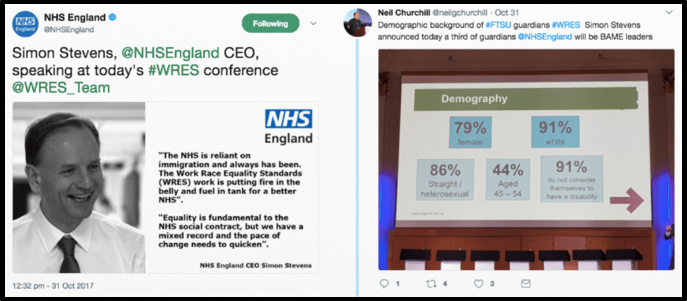
Simon Stevens


His promise followed acknowledgment by the National Freedom To Speak Up Guardian that BME staff were under-represented amongst Freedom To Speak Up Guardians.


I asked for NHS England’s intended methodology in achieving Stevens’ target of one third BME Speak Up Guardians. In response, there was an indication that NHS England was developing its process, but no details on how the quota would be achieved:


Simon Stevens recently announced that a third of freedom to speak up guardians in NHS England will be from black and minority ethnic (BME) backgrounds and colleagues are finalising the processes for this to happen.”

From a response by the WRES Team 9 November 2017


A direct request to Simon Stevens to release national NHS Race data that is languishing under NHS England’s control, which would incur negligible cost, has been met so far with ambiguity and no clear agreement to release.

Adding to this mix, CQC revealed via a recent FOI disclosure that it is effectively looking the other way by not recording the ethnicity of provider staff who are consulted during inspections.

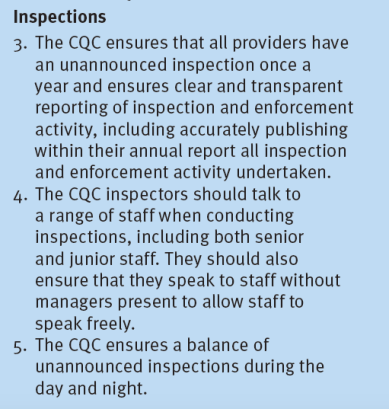
This is despite CQC having made a great display of enforcing WRES, through inspection:
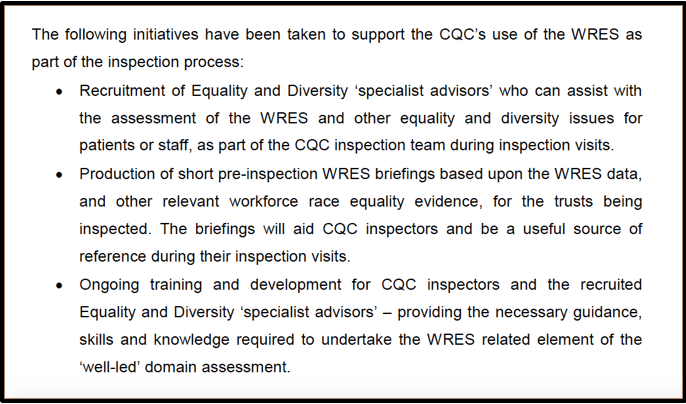
Screen Shot 2017-11-28 at 13.05.13

https://www.england.nhs.uk/publication/workforce-race-equality-standard-technical-guidance-2017/

http://www.cqc.org.uk/news/stories/cqc-support-nhs-tackling-race-inequality-across-workforce

Enquiries to NHS England about whether its WRES team had actually kitemarked CQC’s inspection methodology on WRES have not so far borne fruit.

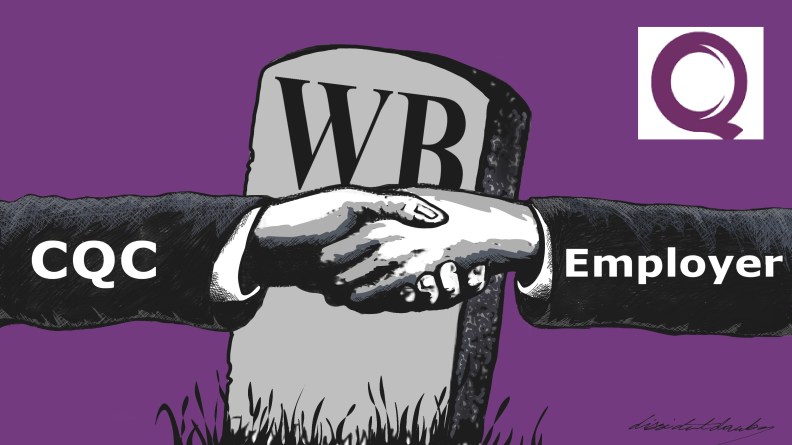
This silence is amplified by ongoing scandal about CQC’s failures at Southport and Ormskirk Hospital NHS Trust, where it failed to listen properly to the concerns of BME staff and seriously botched yet another FPPR process.

In a clear demonstration of the level of workforce mistrust engendered by such regulatory behaviour, not one of the BME doctors who raised concerns in 2015 about Southport and Ormskirk Hospital NHS Trust came forward to speak to the National Guardian’s office when it recently reviewed these matters.

The correspondence with NHS England about these CQC omissions, and supporting references, are provided below.

Millions have been spent on the NHS Race industry, with much glossy publicity and high profile events. But how much do frontline BME staff truly benefit from this largesse?

The unedifying fall of NHS England’s former poster girl for Race, Paula Vasco-Knight, equally raises questions about the conduct of the NHS Race programme.

It is not PR overdrive and endless ‘monitoring’ that are required, (albeit it is important to note that crucial issues such as Race ET claims against the NHS and NHS pay inequality are still not tracked).

It is greater accountability and effective enforcement of robust standards that are required.


UPDATE 29 NOVEMBER 2017:

One day after the above post, the NHS England WRES team has decided that despite inviting me to its event on 30 November 2017, it will not cover my travel expenses as an unwaged whistleblower. Draw your own conclusions…
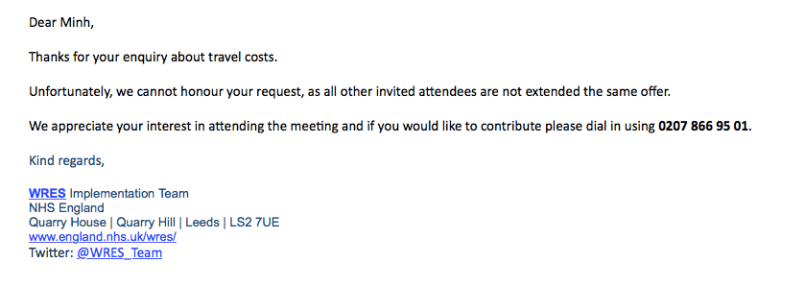
Screen Shot 2017-11-29 at 17.58.54

UPDATE 2 DECEMBER 2017

I attended the WRES event on 30 November 2017, paying out of my own pocket to travel to London. I was approached by a member of the WRES team at the event, who repeated the statements about WRES not being able to pay me. I have now asked Simon Stevens NHS England CEO for reimbursement of my £35.20 travel expenses:

Simon Stevens Christmas card


RELATED ITEMS

Will Simon Stevens uncork ALL the NHS Race data?

https://minhalexander.com/2017/10/11/will-simon-stevens-uncork-all-the-nhs-race-data/

Postscripts on Paula: NHS England’s apologia and regulatory reticence

https://minhalexander.com/2017/10/10/postscripts-on-paula-nhs-englands-apologia-regulatory-reticence/

CQC has lost all moral authority, but what will the National Guardian do?

https://minhalexander.com/2017/05/23/fppr-cqc-has-lost-all-moral-authority-but-what-will-the-national-guardian-do/


CORRESPONDENCE WITH NHS ENGLAND ABOUT CQC & RACE

BY EMAIL

Yvonne Coghill

Director of WRES Programme

NHS England

28 November 2017


Hi Yvonne,

Academic and Data meeting 30 November 2017, and CQC inspection methodology on NHS Workforce Race Equality Standard

Thanks for the meeting agenda.

Is it possible to have confirmation of whether there is a written agreement between NHS England and CQC on inspection methodology as applied to WRES, under the Well-Led domain? As you know, I first asked for this on 30 October and again on 26 November but I have received no response.

As you may recall, I asked for this information following an FOI disclosure of 5 July 2017 by CQC that stated:

“The inspection team spoke with 219 members of staff during the inspection; we do not record their colour or ethnicity, as this does not form part of our methodology for inspection. This information is therefore not held.

https://www.whatdotheyknow.com/request/equality_and_diversity_inspectio#incoming-1001621

This seems a crucial omission.

In 2015 CQC failed BME staff who reported concerns about Southport and Ormskirk Hospital NHS Trust. CQC gave undue weight to management assurances, and to a management commissioned FPPR report which concluded that there were no serious failings. 1 However, shortly afterwards the trust Chief Executive and other trust directors were suspended. 2

A recent review by the National Guardian has revealed that CQC accepted the FPPR report, despite the fact that FPPR investigators failed to speak to the BME staff who raised concerns at Southport and Ormskirk. 3

That not a single BME doctor, who had previously raised concerns at Southport and Ormskirk, was prepared to speak to staff from the National Guardian’s office during the recent case review emphasises how damaging it is to culture when oversight bodies behave tokenistically and breach staff trust:

“Although we had hoped to speak to some of the BME doctors who had previously raised concerns none of them attended the forums or approached us in person.”

CQC and NHS England have variously issued public statements about how CQC is supporting WRES through its inspection of the Well Led domain, and CQC has appointed a few Race and Diversity specialist advisors.

However, if there is no agreed inspection methodology and or CQC’s methodology is ineffective, this is an additional weakness in failures of WRES enforcement.

Whistleblowers have seen a parallel pattern in that CQC claims a commitment to supporting good practice but resists transparent and effective inspection methodology. For example, CQC has repeatedly resisted examination of NHS providers’ compromise agreements and use of gags despite being advised to do so by the Freedom to Speak Up Review. 4

Of relevance to the main theme of the event this Thursday, I suggest that an important part of any future metrics is the measurement of WRES enforcement activity.

A pre-requisite of measurement is clear standards. I would be grateful for a response to my enquiry of 30 October as soon as possible. It looks to me as if CQC inspection methodology on Race inequality is likely to be ineffectual and discriminatory at least by omission, and if so will need substantial improvement. If it is possible to have sight of the relevant documents, this will enable a more informed discussion at our forthcoming meeting.

Best wishes,

Minh

Dr Minh Alexander

NHS whistleblower and former consultant psychiatrist


Cc David Isaac Chair EHRC

Philip Dunne Minister of State for Health

Simon Stevens NHS England Chief Executive

Peter Wyman CQC Chair

Dr Henrietta Hughes National Freedom To Speak Up Guardian, CQC

Paul Corrigan CQC NED and Board lead on WRES

Sir Robert Francis CQC NED and Chair of National Guardian’s  Accountability and              Liaison meeting

Marie Gabriel Chair WRESAG

Prof Mala Rao Vice Chair WRESAG

Victor Adebowale NHS England NED

Other delegates 30 November 2017

REFERENCES

1 CQC inspection report on Southport and Ormskirk NHS Trust 13 May 2015:

“As a result of the allegations the CQC initiated a regulatory challenge relating to Fit and Proper Person Regulation. In response the Trust commissioned an independent, external investigation the final report of which has ben received by the Trust Board. The investigation found no evidence or grounds for the allegations. The CQC has reviewed the report viewing it as thorough”.

 https://minhalexander.com/wp-content/uploads/2017/11/cqc-southport-and-ormskirk-inspection-report-aaab8967.pdf

2 By August 2015, it was announced that the Southport and Ormskirk chief executive and other directors had been suspended:

http://www.liverpoolecho.co.uk/news/liverpool-news/southport-ormskirk-hospital-chiefs-suspended-9788193

3 National Guardian case review on Southport and Ormskirk November 2017

“In response to workers’ repeated concerns about the alleged discriminatory behaviour of one of the trust’s directors the trust commissioned an external Fit and Proper Person (FPP) review in 2015 to determine whether the director’s competence and character met those standards. However, evidence cited in the trust’s cultural review highlighted that the FPP investigation did not interview any of the staff who had spoken up about the director in question. This was despite the fact that, for a director to be a fit and proper person under the regulations, one of the requirements their employer must show is that they have ‘not been responsible for … any serious misconduct or mismanagement’ – the very type of misconduct that staff who spoke up were alleging. National Guardian’s Office 22 Southport and Ormskirk Hospital NHS Trust – A case review Upon completion the FPP review ‘found no evidence of discrimination or racial discrimination’ against the director in question.”

https://minhalexander.com/wp-content/uploads/2017/11/national-guardian-case-review-20171115_ngo_southportormskirk.pdf

4 NHS Gagging. How CQC sits on its hands.

https://minhalexander.com/2016/09/23/nhs-gagging-how-cqc-sits-on-its-hands-2/


From: “WRES, England (NHS ENGLAND)” <england.wres@nhs.net>

Subject: RE: IMPORTANT – Workforce Race Equality Standard (WRES) – Academic and Data meeting

Date: 27 November 2017 at 17:37:28 GMT

To: “COGHILL, Yvonne (NHS ENGLAND)” ********************************************************************************************************************************************************************************************************************************************************************************************************************************************************************************************************************************************************************************************************************************************************************************************************************************************************************************************************************************


Dear Colleague,

You will be aware that the WRES was implemented in the NHS in 2015, we are now in the next phase of the programme, supporting organisations to improve race equality and to become truly inclusive.

https://www.england.nhs.uk/about/equality/equality-hub/equality-standard/

We would now like to reflect on research that has been done around the subject of health and race and decide what more/else needs to be done and believe you would be instrumental in helping us to shape our thinking. Professor Mala Rao, Imperial College London, has agreed to chair a workshop where we will look at the data and work to date and decide what more needs to be done, including the possibility of establishing a race observatory.

We will be holding  the workshop at Friends House, 173 – 177 Euston Road, London, NW1 2BJ on November 30th 2017 and would be delighted if you are able to attend or nominate a colleague who would be better suited to attend.

We will forward the agenda in due course and sincerely hope you can attend and help contribute to this really important discussion about health and race in the NHS.

Please accept invite to confirm your attendance and forward all dietary requirements to sniles@nhs.net ASAP.

You can stay up to date with WRES by following us on Twitter: @WRES_team.

Yours sincerely,

Yvonne Coghill, OBE

Director

Workforce Race Equality Standard (WRES) Implementation


WRES Implementation Team

NHS England

Quarry House | Quarry Hill | Leeds | LS2 7UE

www.england.nhs.uk/wres/

Twitter: @WRES_Team


********************************************************************************************************************


This message may contain confidential information. If you are not the intended recipient please inform the

sender that you have received the message in error before deleting it.

Please do not disclose, copy or distribute information in this e-mail or take any action in relation to its contents. To do so is strictly prohibited and may be unlawful. Thank you for your co-operation.


NHSmail is the secure email and directory service available for all NHS staff in England and Scotland. NHSmail is approved for exchanging patient data and other sensitive information with NHSmail and other accredited email services.


For more information and to find out how you can switch, https://portal.nhs.net/help/joiningnhsmail
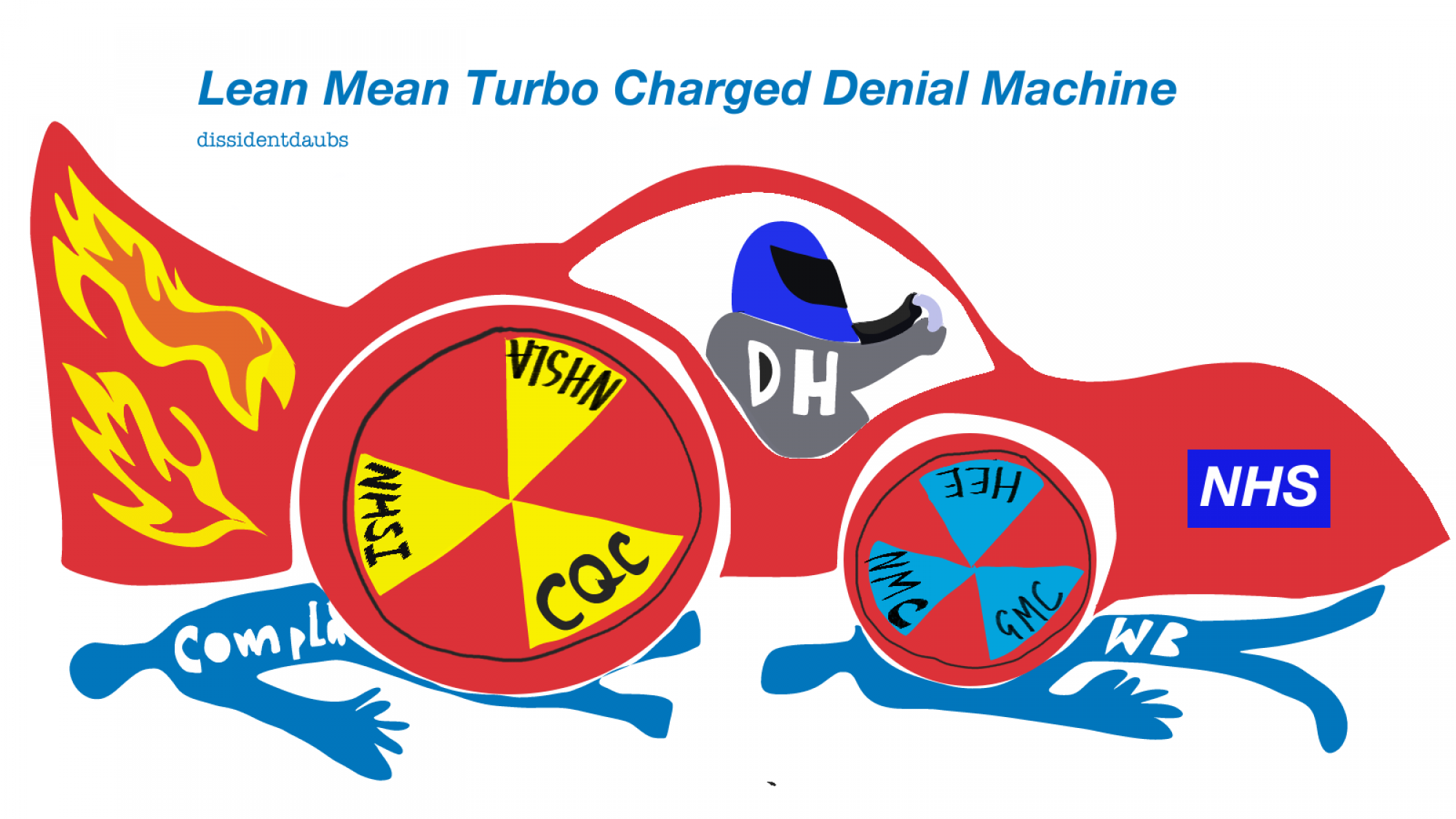
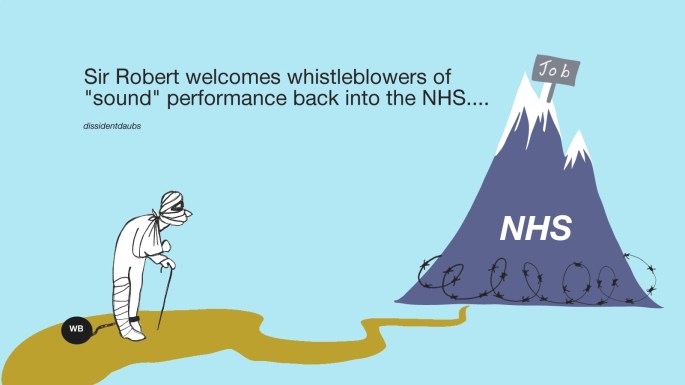
 

The long shadows cast by whistleblowing

By Dr Minh Alexander NHS whistleblower and former consultant psychiatrist, 22 November 2017


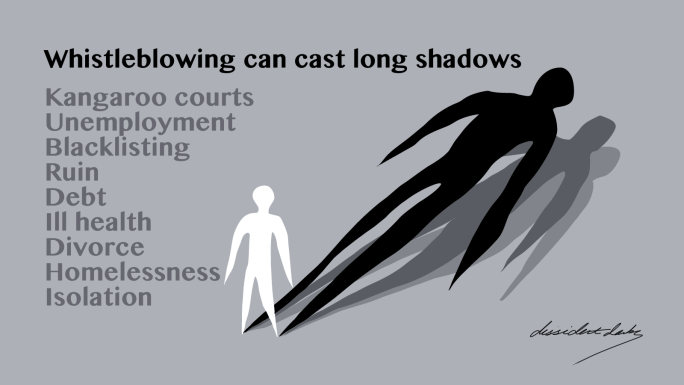
The violence done to whistleblowers is savage. Whilst it is not in most cases physically administered violence, serious mental and physical illness sometimes occurs in the context of damage to social networks, and has included marital breakdowns. Only those who have experienced it or are close to a whistleblower, can truly understand how serious this damage can be. 1 2

The huge pressure that is brought to bear on whistleblowers in serious cases frequently includes sustained coercion in the form of false allegations. Sometimes these are of a criminal nature as experienced by NHS whistleblower Dr Raj Mattu. 3 The intense stress of living under such threats for years at a time, combined with the uncertainty of not knowing what further falsehoods will be levied, takes a serious toll.

The right to a fair trial is recognised to be a fundamental human right. Being plunged into Kafkaesque misrule by a powerful, multi-billion pound employer aided and abetted by other bodies that should help but instead choose to collude, can be a very frightening experience.

Mattu was at one point seriously ill in hospital, with an autoimmune illness that can be sensitive to stress, when he received news that he had been sacked by University Hospitals of Coventry and Warwickshire NHS Trust.4

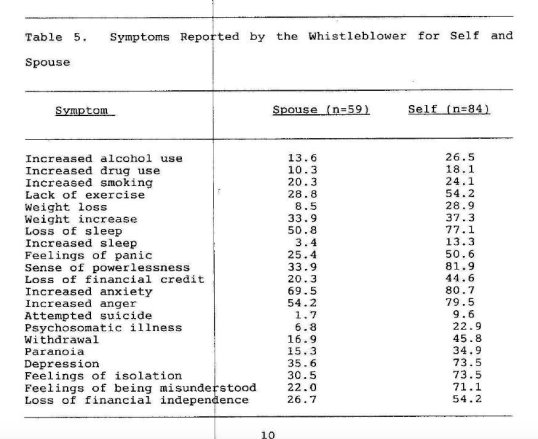
Some early work by Soeken ad Soeken, albeit rough and limited by sampling issues, nevertheless puts a human face on whistleblowing:

Soeken and Soeken copy

Soeken and Soeken 1987 PhD thesis


The long-suffering NHS frontline is pushed and pulled in all directions with sometimes conflicting diktats from above. These often issue from those who command little moral authority because they do not live the values they preach.

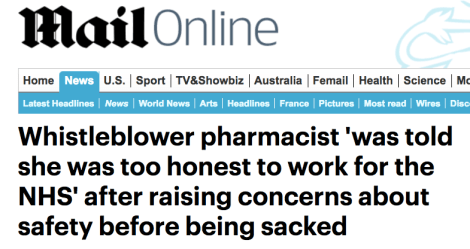
A glaring contradiction is the requirement to report harm and risk under the professional Duty of Candour 5, sitting alongside flashing neon signals that simultaneously say “Shut up and go away”.


Screen Shot 2017-11-22 at 13.55.51


http://www.dailymail.co.uk/news/article-3522138/Whistleblower-pharmacist-told-honest-work-NHS.html


Many are quick to tell frontline staff that they must speak up, but are much less quick to defend them when they do.

The parliamentary Health Committee thundered in January 2015:

“….this committee is clear that professionals have a duty to put patients first and to come forward with their concerns”

Health Committee report on Complaints and Raising Concerns, January 2015 6


But in the same report, the committee did not go far enough in ensuring whistleblowers would be protected.

The committee made a broad recommendation for “apology and practical redress” for harmed whistleblowers, which was welcome. However, it did not prescribe any hard hitting system changes such as law reform or a public inquiry.

Instead, the committee deferred to Robert Francis, acting for the Department of Health, who was yet to publish his report of the Freedom To Speak Up Review. 7

Despite the Freedom To Speak Up Review subsequently proving to be ineffectual and a great disappointment, the Committee has done little to challenge the lack of progress or to even find out if harmed whistleblowers have received the ‘apology and practical redress’ that it asked the Department of Health to provide.

The Committee has so far refused to hold a follow up hearing on NHS whistleblowing.

The Committee is hoisted by its own petard, having ventured this opinion in its 2015 report:

“The treatment of those whistleblowers has not only caused them direct harm but has also undermined the willingness of others to come forward and this has ongoing implications for patient safety. 6

Until the system takes more responsibility and provides real protection, and not just lip service, the great and the good cannot complain if staff do not always report.

Flagrant abuses of the NHS disciplinary process continue, with unjustified suspensions and harsh, arbitrary discipline wielded by some NHS employers not just against whistleblowers but in cases of error and other matters. 8

To demand that staff must always whistleblow in the face of such hypocrisy and crushingly unjust culture is not only unrealistic but wrong. When people approach me for help pre-disclosure, I provide only information and help people to assess risk either way. I leave it to individuals to make the judgment call for themselves: to disclose or not, and to disclose anonymously or on named basis.

It is not safe to apply a blanket approach when each case may be very different. There is not only whistleblowers and the public interest to consider, but families as well, who may be profoundly affected by any decision.

As I write I think about a whistleblower who is very well known to me. They have exhausted every avenue in raising their concerns, but have been badly failed by all, including the Secretary of State for Health. The whistleblower’s reward for dedication and professionalism, and years of being put through the grinder? Uncontrolled high blood pressure and renal failure, which will now require a kidney transplant.

And have this whistleblower’s safety concerns ever been properly resolved? No.

So, don’t tell me what staff should do. Tell me what politicians and other senior figures will do to protect whistleblowers and the public interest.


RELATED ITEMS

Waste Industry: The NHS disciplinary process & Dr John Bestley

https://minhalexander.com/2017/10/21/waste-industry-the-nhs-disciplinary-process-dr-john-bestley/

Post-scripts on Paula: NHS England’s apologia & regulatory reticence

https://minhalexander.com/2017/10/10/postscripts-on-paula-nhs-englands-apologia-regulatory-reticence/

Sir Robert Francis & Reform of whistleblowing law

https://minhalexander.com/2017/11/17/sir-robert-francis-and-reform-of-whistleblowing-law/


REFERENCES

1 What happens to whistleblowers and why. Dr Jean Lennane

Social Medicine.  Volume 6, Number 4, May 2012

https://minhalexander.com/wp-content/uploads/2017/11/jean-lennane-what-happens-to-whistleblowers-and-why.pdf

2 Whistleblowing. A Health Issue. Dr Jean Lennane. BMJ, 11 September 1993, Vol.307, P.667-70

https://minhalexander.com/wp-content/uploads/2017/11/jean-lennane-whistleblowing-a-health-issue.pdf

3 Raj Mattu and the death of whistleblowing. Dr Phil Hammond. Private Eye Issue 1364, May 2014

http://www.drphilhammond.com/blog/2014/05/07/private-eye/medicine-balls-private-eye-issue-1364-2/

4 Vindicated: NHS whistleblower backed by the Mail receives £1.2 million payout after NHS spent £10m trying to crush him after he exposed shocking failings in care, Daniel Martin, Daily Mail 2 February 2016

http://www.dailymail.co.uk/news/article-3432523/NHS-whistleblower-receives-1-2-million-payout-12-year-witch-hunt-doctor-highlighted-fears-patient-safety.html

5 Joint statement by Chief Executives of General Medical Council, Nursing and Midwifery Council, General Pharmaceutical Council, General Optical Council, Pharmaceutical Society NI and General Osteopathic Council on the Duty of Candour

https://www.pharmacyregulation.org/sites/default/files/joint_statement_on_the_professional_duty_of_candour.pdf

GMC guidance on Duty of Candour

https://www.gmc-uk.org/guidance/ethical_guidance/27233.asp

NMC guidance on Duty of Candour

https://www.nmc.org.uk/standards/guidance/the-professional-duty-of-candour/

6 Health Committee report, Complaints and Raising Concerns, 21 January 2015

The committee made only two recommendtions in relation to NHS whistleblowing governance:

Treatment of staff raising concerns

  1. The failure to deal appropriately with the consequences of cases where staff have sought protection as whistleblowers has caused people to suffer detriment, such as losing their job and in some cases being unable to find similar employment. This has undermined trust in the system’s ability to treat whistleblowers with fairness. This lack of confidence about the consequences of raising concerns has implications for patient safety. (Paragraph 114)
  2. We expect the NHS to respond in a timely, honest and open manner to patients, and we must expect the same for staff. We recommend that there should be a programme to identify whistleblowers who have suffered serious harm and whose actions are proven to have been vindicated, and provide them with an apology and practical redress. (Paragraph 115)

https://publications.parliament.uk/pa/cm201415/cmselect/cmhealth/350/350.pdf

7 Robert Francis’ report of the Freedom To Speak Up Review 15 February 2015

http://webarchive.nationalarchives.gov.uk/20150218150953/https://freedomtospeakup.org.uk/wp-content/uploads/2014/07/F2SU_web.pdf

8 Waste Industry: The NHS disciplinary process & Dr John Bestley

https://minhalexander.com/2017/10/21/waste-industry-the-nhs-disciplinary-process-dr-john-bestley/


Sir Robert Francis and Reform of Whistleblowing Law

Please sign and share:

Petition to replace weak UK whistleblowing law to protect whistleblowers and the public


By Dr Minh Alexander NHS whistleblower and former consultant psychiatrist, 17 November 2017

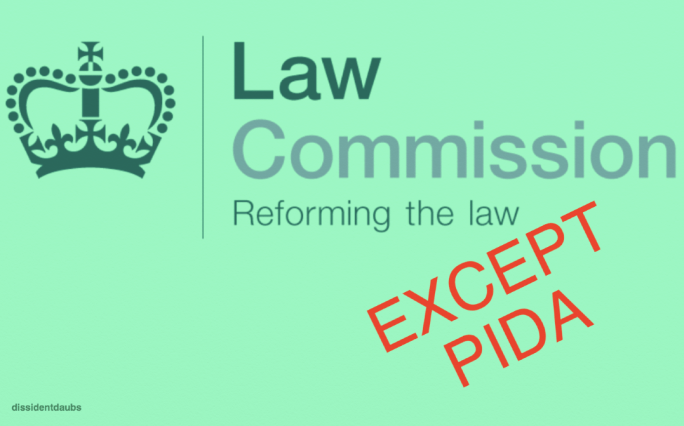
Everybody knows that UK whistleblowing law, the Public Interest Disclosure Act (PIDA), is not fit for purpose. 1

Robert Francis admitted in his report of the Freedom to Speak Up Review that PIDA fails to protect whistleblowers:

the existing legislation is weak. 2

But he held back from recommending substantive reform.

He made a timid recommendation to outlaw blacklisting of sacked NHS whistleblowers. 3

The government accepted it. It was good PR and posed little threat. 4

Starving, unemployed whistleblowers cannot afford to litigate effectively, and in any case, such litigation will likely have little prospect of success in many cases. 4  And what use is such legislation to clinicians who have been rendered unemployable from de-skilling, illness or loss of licence from not being able to practice and revalidate?

Instead of major challenges to power, Sir Robert banged the DH’s drum on culture change.  Warm and fuzzy culture change, with minimal accountability for power abusers, as subsequently demonstrated by CQC’s persistent refusal to hold any NHS directors who have harmed whistleblowers to account under FPPR. 5

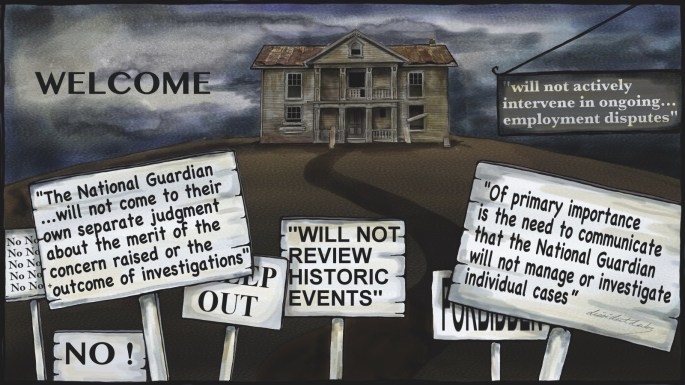
The National Guardian has similarly been holding DH’s line and has declined to seek law reform on the basis that she considers culture change to be more important:

I do understand the views of campaigners who say that the current legislation requires reform. However, we are not currently seeking to campaign for changes to the law. Instead, we will be working collaboratively with a wide range of bodies to deliver a reformed NHS culture where freedom to speak up is ingrained and becomes ‘business as usual’ 16 February 2017 6

This ignores the principle that good law has a communicative function and drives culture change.

For example, drink driving is now socially unacceptable, with this change having been driven by statute.

Despite previously eschewing the need to reform PIDA, Francis stated at a recent financial sector conference that the law needed “looking at”. He seemed a little discombobulated when he was consequently asked by an NHS whistleblower to clarify if he believed UK whistleblowing law needed reform.

In response, he initially produced some NHS bullying statistics that were a little tangential to the point in question.

And then he replied that there should be review of how the NHS applies the Law. Phew. DH goal protected. Whistleblowers nil.

Here is a transcript and recordings of the relevant conference proceedings:

Francis culture and conduct comments 7.11.2017 transcript


Implausibly, Francis suggested that lawyers acting for the NHS should have regard to values and not just the letter of the law.

Tell that to the family of John Moore Robinson, who died through failings at Mid Staffs that were obscured with the help of a lawyer who was ultimately found to have acted professionally by her regulatory body. 7

Francis’ continued intellectual gymnastics around PIDA are not supportable.

He had made a number of critical comments about the legislation at the conference, before the above final exchange about reform of PIDA. These makes it clear to any reasonable person that Francis must surely know PIDA needs to be replaced.

 I have written to ask if he will act upon his criticisms of PIDA:

Correspondence with Francis about Law reform November 2017

One small consolation from the conference is that in an unguarded moment, Francis indicated that he intended that the NHS should run a ‘re-employment scheme for sacked whistleblowers. That is, not the watered down ‘employment support’ scheme that NHS England and NHS Improvement have tried to sell. 8 And he commented that it is not working very well. A little truth goes a long way sometimes. Thank you Sir Robert.


UPDATE 26 NOVEMBER 2017:

On 22 November 2017 Sir Robert kindly replied, but sadly maintained his position on not supporting reform of UK whistleblowing law:

Robert Francis Law Reform correspondence November 2017


RELATED ITEMS:

What could a new whistleblowing law look like? A discussion document

What could a new whistleblowing law look like? A discussion document

Letter to the Health Service Journal’s Patient Safety Correspondent

Letter to the Health Service Journal’s Patient Safety Correspondent

Postscripts on Paula: NHS England’s apologia and regulatory reticence

Postscripts on Paula. NHS England’s apologia & regulatory reticence

Jeremy Hunt’s Secret Whistleblower (Non Employment) Scheme

Jeremy Hunt’s Secret Whistleblower (Non-Employment) Scheme


REFERENCES

1 Protecting whistleblowers in the UK: A new blue print. Blue Print for Free Speech 2016

https://blueprintforfreespeech.net/wp-content/uploads/2016/05/Report-Protecting-Whistleblowers-In-The-UK.pdf

2 Robert Francis’ Report of the Freedom to Speak Up Review 11 February 2015

“9.5 Contributors who mentioned the existing legal protection were generally in agreement that it does not work well. It is complex and the concept of a protected disclosure is not easily understood. This can act as a barrier to those who try but fail to understand what protection they have if they choose to raise a concern.”

“9.17 Although the existing legislation is weak, I have not recommended a wholesale review of the 1996 Act for two reasons. First, I do not think legislative change can be implemented quickly enough to make a difference to those working in the NHS today. What is needed is a change in the culture and mindset of the NHS so that concerns are welcomed and handled correctly. If this can be achieved, fewer staff will need recourse to the law. Second, this Review is concerned only with the position of disclosures made within one part of the public sector, the NHS. The Act covers all forms of employment whether in the public or private sectors. There may well be different considerations in other fields.”

http://webarchive.nationalarchives.gov.uk/20150218150953/https://freedomtospeakup.org.uk/wp-content/uploads/2014/07/F2SU_web.pdf


3 Robert Francis’ Report of the Freedom to Speak Up Review 11 February 2015

“However I am particularly concerned by one aspect of the legislation, which is that it does nothing to protect people who are seeking employment from discrimination on the grounds that they are known to be a whistleblower. This is an important omission which should be reviewed, at least in respect of the NHS. I invite the Government to review the legislation to extend protection to include discrimination by employers in the NHS, if not more widely, either under the Employment Rights Act 1996 or under the Equality Act 2010.

http://webarchive.nationalarchives.gov.uk/20150218150953/https://freedomtospeakup.org.uk/wp-content/uploads/2014/07/F2SU_web.pdf

4 Whistleblower Discrimination: Hunt’s razzamatazz

https://minhalexander.com/2017/03/20/whistleblower-discrimination-hunts-razzmatazz/

5 A Chief Inspector doesn’t call

https://minhalexander.com/2017/01/27/cqc-a-chief-inspector-doesnt-call/

CQC has lost all moral authority, but will the National Guardian do?

https://minhalexander.com/2017/05/23/fppr-cqc-has-lost-all-moral-authority-but-what-will-the-national-guardian-do/

Postscripts on Paula: NHS England’s apologia and regulatory reticence

https://minhalexander.com/2017/10/10/postscripts-on-paula-nhs-englands-apologia-regulatory-reticence/

6 Letter from Henrietta Hughes National Freedom to Speak Up Guardian 16 February 2017

7 A law unto themselves. Dr Phil Hammond. Private Eye 1341, 2013

http://www.drphilhammond.com/blog/2013/06/04/private-eye/private-eye-issue-1341/

8 Jeremy Hunt’s Secret Whistleblower (Non-Employment) Scheme

https://minhalexander.com/2017/10/14/jeremy-hunts-secret-whistleblower-non-employment-scheme/


CARRY ON SMILING: National Guardian Turns Helen Rochester Away

By Dr Minh Alexander, NHS whistleblower and former consultant psychiatrist, 24 October 2017

The National Freedom To Speak Up Guardian for NHS whistleblowing finally started establishing her advisory group in this last two months, but without proper advertisement.

This was despite her promise over a year ago that this advisory group would be pivotal in determining her case review process:

“She said the cases the office would look at would be decided by a “stakeholder advisory group”, which would include people with experience of whistleblowing.” 1

Clearly, as her case review process had already been finalised and launched in June 2017 and case reviews had already started in July 2017 , the advisory group was in reality little more than an afterthought.

Some whistleblowers who had previous contact with her office received individual invitations to apply for places on the advisory group, and some information appeared on her small section of the CQC website.

But it was not a truly open process with equal access for all. The whiff of a tokenism once more wafted down the corridors of 151 Buckingham Palace Rd.

Despite the National Guardian having informed me that numbers would be kept to a manageable level to make the group workable, everybody who applied has to my knowledge been accepted. And based on information from the National Guardian’s office, there were over twenty applications.

All manner of applications were received, from terse, one paragraph, take-it-or-leave-it-I’m-a-staunch-critic jobs to lengthy essays.

But eventually, there was one very significant application that was turned down.

Helen Rochester, a veteran whistleblower twice seriously harmed by the National Guardian’s employer and paymaster the CQC, was firmly barred by Henrietta Hughes.

Helen Rochester did not know about the advisory group, but recently wrote to the National Guardian to suggest that whistleblowers should be hired as a specialist type of Expert by Experience.

I suggested to the National Guardian that she allow Rochester to join her advisory group, and pointed out that the access to the group had not been properly advertised.

If anyone has vital, highly relevant insight into how thoroughly messed up the system is, and is ideal to speak on the advisory group, it is Rochester.

But the answer was No, based on the bureaucratic excuse that the deadline had passed, and the refusal has been rigidly maintained:

https://minhalexander.com/wp-content/uploads/2016/09/national-guardians-office-correspondence-with-helen-rochester.pdf

Obviously, this cannot have anything to do with the fact that Rochester made an Employment Tribunal claim against the CQC for complicity in whistleblower reprisal:

https://minhalexander.com/2017/09/09/helen-rochester-v-cqc-act-ii-wherein-a-whistleblower-sueth-a-prescribed-person/

https://minhalexander.com/2017/06/22/cqc-involved-in-a-whistleblowers-referral-to-the-disclosure-barring-service/

The National Guardian’s inflexible decision to leave Rochester in the cold is another big  nail in the coffin of her office’s credibility.

Henrietta Hughes had already seriously failed Rochester and all other whistleblowers by ducking a clear answer about whether she would ensure that the CQC would audit its practice on whistleblower confidentiality.

https://minhalexander.com/2017/09/03/national-guardian-expects/

Standing up to the CQC would have required the courage of a true whistleblower.

It is most unseemly that Hughes excludes Rochester when she should be going out of her way to embrace her, and thereby send a very clear message to the CQC that whistleblower reprisal by the most senior officials is particularly unacceptable.

Hughes has so far told us, via the ever-willing Health Service Journal that she ‘whistleblew’ about an individual’s parking practices. I can’t say I was tremendously moved by her account or that it was clear to me that it was actually whistleblowing in the accepted sense, as opposed to performance management duties expected of any manager.

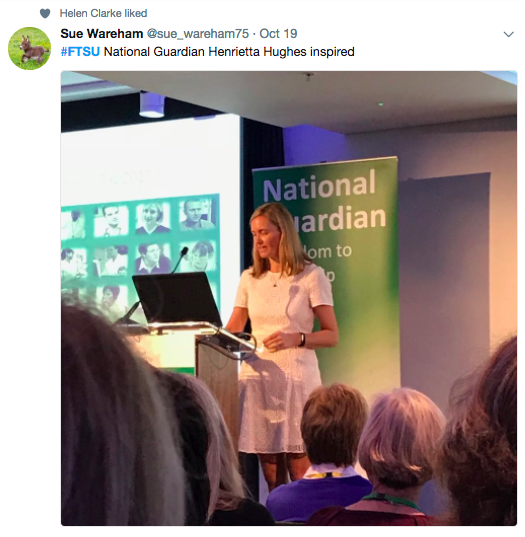
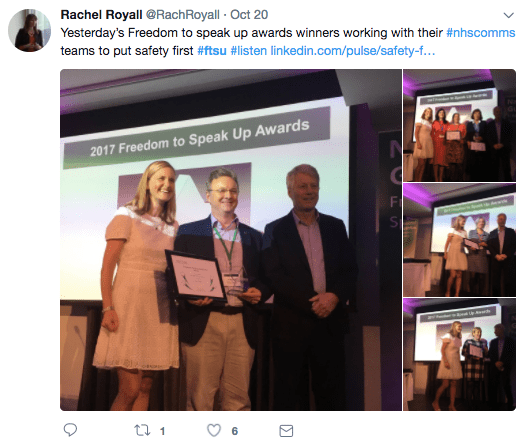
No amount of cult of personality and spin – see the twitter hashtag #FTSU for the breathless tweets from the latest National Guardian conference on 19 October 2017 for examples – will compensate for lack of substance.

Screen Shot 2017-10-24 at 10.45.19.png

This was perhaps the most telling tweet from the National Guardian’s recent conference:

Screen Shot 2017-10-24 at 10.44.18

Hughes has now issued documents on the operation of her advisory group which in my view smack of secrecy and control:

https://minhalexander.com/wp-content/uploads/2017/09/national-guardian-advisory-group-20170922-values-and-expectations-agreement.docx

https://minhalexander.com/wp-content/uploads/2017/09/national-guardian-advisory-group-20170922-draft-terms-of-reference-received-23-oct-2017.docx

There is great emphasis on ‘confidentiality’ under the guise of sensitivity. But as far as I am concerned, the advisory committee is a place of business with public accountability, not a support group. I reject any attempts to veil its proceedings under a cloud of faux paternalism.

I will also be seeking clarification about an impertinence by the National Guardian’s office through a demand that advisory group members:

“…act as champions for a positive Freedom To Speak Up culture in the NHS” 

It is crass of well-fed bureaucrats to ask this of frontline whistleblowers who have bled, starved and walked over coals to protect patients.

It would be even worse if this is a demand that harmed whistleblowers must specifically endorse Robert Francis’ and the National Guardian’s particular vision of ‘positive’ culture.

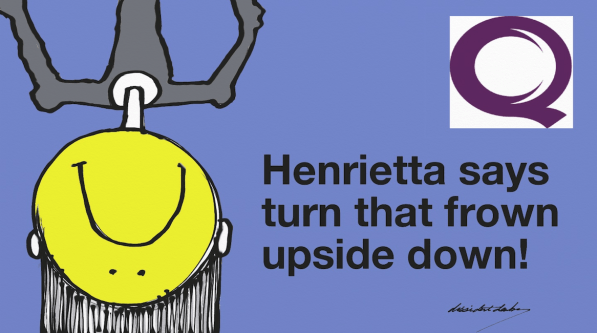
The National Guardian gave an interview to the Times a year ago, claiming that poor NHS culture could be sorted out ‘just like that’ if doctors and nurses were less grumpy. This resulted in derisive press headlines such as: ‘Turn that frown upside down! Grumpy doctors and nurses are told to ‘cheer’ up to improve level of care and end a culture of bullying in the NHS’.

I also remind readers of the National Guardian’s Brave New World edict in her previous life as an NHS England Medical Director:

While researching I came across the 10:5 rule – when someone comes within 10 feet – smile, within 5 feet – say hello.

“I have started SHINE and the 10:5 rule within my team in London and shared it across the Directorate.” 

S – smile

H- hello

I – eye contact

N- name

E- enthusiasm/ Empathy”

http://www.nhsmanagers.net/guest-editorials/shine/


Good manners and genuine respect are of course essential but such intrusive managerial demands are unacceptable, and impinge on the dignity of others.

Perhaps the National Guardian forgets that whistleblowers are now beyond such NHS managerial impositions, having been relieved of the employment relationship.

The National Guardian also seeks via her optimistically labelled document ‘Values and Expectations Agreement’ for her advisory group to banish ‘negative criticism’.

However, her ‘Agreement’ has not in fact been agreed by anyone.

I invite the National Guardian to stop all false positivity, patronising tone control and any censorship through misconceived application of confidentiality.

The advisory group has its first meeting on 3 November 2017. Based on the National Guardian’s office’s behaviour to date, the exercise will most likely be a shabby waste of whistleblowers’ time and energy.

But I intend to raise the issue of Helen Rochester’s exclusion at the meeting.


Screen Shot 2017-10-24 at 10.56.43


RELATED ITEMS

Letter to the Health Service Journal’s Patient Safety Correspondent

Letter to the Health Service Journal’s Patient Safety Correspondent

Letter to the Public Accounts Committee

Click to access letter-to-public-accounts-committee-11-sep-2017-re-review-of-whistleblowing.pdf

NEWSFLASH: CQC denies denial

NEWSFLASH: CQC denies denial


REFERENCES

1 Whistleblower Guardian will not be an investigation body, Will Hazel, HSJ 12 October 2016

https://www.hsj.co.uk/topics/workforce/whistleblower-guardian-will-not-be-an-investigation-body/7011388.article


Who speaks for the dead? Ivy Atkin and the unaccountable CQC

By Dr Minh Alexander NHS whistleblower and former consultant psychiatrist, 22 October 2017

The CQC has behaved arbitrarily and evasively in the matter of serious elder abuse at Autumn Grange care home and the horrific death of Ivy Atkin, weighing just 3 St 13lb,  by criminal negligence.

Its chief executive David Behan promised that a belated CQC internal review into these matters would be published but inexplicably, CQC later pulled up the drawbridge.

When CQC was asked to produce the document, it claimed it could not do so because it did not wish to breach its inspectors’ privacy, despite the grave public interest.

I made a formal complaint about CQC’s behaviour on 5 October 2017:

https://minhalexander.com/2017/10/05/ivy-atkins-death-more-cqc-evasion/

The CQC responded on 19 October 2017 and deemed my complaint invalid. However, it paradoxically stated that I was entitled to escalate my non-complaint to the PHSO.

CQC refused my non-complaint on grounds that I was not directly affected by the original events:

CQC refusal to accept complaint on Ivy Atkin and internal review publication 20171019 Dr Minh Alexander NCT 372

In fact, the relevant regulations state that a complaint may be made on behalf of someone who has died.

Indeed, CQC’s sub-committee Healthwatch England previously waxed lyrical on the importance of addressing concerns raised by third parties.

Awkwardly for CQC, Robert Francis is on the record as having clearly concurred with this position.

Moreover, my complaint centrally concerns CQC’s governance, not the original events.

I have written to Peter Wyman CQC chair to question CQC’s refusal to accept my complaint. Don’t hold your breath.

The letter is provided below.


RELATED ITEMS

(1) This week, unsurprisingly, Private Eye ran a full page feature on the “pisspoor” CQC’s adventures:

CQC Private Eye Special Issue 1455 20 Oct 2017

Screen Shot 2017-10-22 at 07.52.09


(2) CQC an ongoing concern – a report by the campaigning charity Compassion In Care

http://www.compassionincare.com/node/229


(3) Care home deaths and more broken CQC promises

https://minhalexander.com/2016/10/08/care-home-deaths-and-more-broken-cqc-promised/


Letter 20 October 2017 to Peter Wyman about CQC’s refusal of the complaint about its handling of Ivy Atkin’s death:

BY EMAIL

Peter Wyman

Chair Care Quality Commission

20 October 2017


Dear Mr Wyman,

CQC’s refusal to accept a complaint about its governance following Ivy Atkin’s death

Your complaints team has informed me that CQC refuses to accept my complaint. This is on the basis that CQC contends I was not directly affected by the events.

However, CQC seems to contradict itself in respect of the legitimacy of my complaint by suggesting that I may proceed to the next stage of the complaints process by contacting the PHSO.

I consider that CQC’s position is flawed on the following grounds:

  1. I believe CQC is wrong to argue that I have not been directly affected by the events of which I have complained.

The events about which I am complaining of are not the original events surrounding Ivy Atkin’s death, but CQC ‘s poor governance and subsequent secrecy about the death, which is a serious matter of public interest that affects all.

The events of which I complain are specifically:

  • That CQC did not see fit to conduct an internal review until four years after Ivy Atkin’s death


  • The response of your Head of Inspection when I made an inquiry about CQC’s handling of Ivy Atkin’s case. In his letter of 2 March 2016 he appeared dismissive of the need for internal review and claimed, despite the lack of an internal review, that CQC’s processes were “better than ever before”.


  • That the CQC’s failed to disclose and publish the full internal review on Ivy Atkin’s death, despite the fact that your chief executive gave your Board written assurance on 16 November 2016 that the review would be published. I consider CQC’s grounds for refusing to disclose and publish inadequate.


  • That CQC continues to fail to account for why Ivy Atkin was not taken to hospital when she was found perilously ill. She was instead merely transferred to another care home where she died. CQC did not answer a direct question about this, and there is nothing in the material later published by either CQC or the local authority which answers this fundamental question.


  1. In my view CQC is applying double standards.

Healthwatch England, which is constituted as part of CQC, not long ago criticised NHS bodies for taking a “defensive and obstructive” approach 1 in that they erected artificial barriers to third party complaints.

Healthwatch England made its criticisms based on the following data, which it obtained by FOI:

https://minhalexander.com/wp-content/uploads/2016/09/healthwatch-2014-hospital_complaints_foi_results17122014-11.xls

 Healthwatch England’s then CEO Anna Bradley made these criticisms of the institutional defensiveness that Healthwatch England had uncovered:

“For me this is symptomatic of a much bigger problem around complaints handling in the NHS and social care services.

The fact that doctors and nurses would rather tell one of these “citizen whistleblowers” they can’t complain because they don’t tick the right box or have the permission to make a complaint is just wrong.

If a passer-by reports an abandoned bag in an airport, the staff don’t say: “I’m sorry sir, but do you have the permission of the bag owner.” Rather they are thanked for their vigilance.

If the policy makers and politicians are serious about driving culture change in the NHS then more needs to be done to wipe out this ‘compute says no’ attitude and encourage staff to welcome feedback – positive and negative.” 1

She also commented that the NHS’ refusal of third party complaints, which comprised about a fifth of all cases, is a misapplication of the rules:

 “Hospital patients often feel incredibly vulnerable and too scared to complain when they receive poor care. And yet widespread misapplication of the rules is preventing concerned citizens standing up on their behalf.” 1

 A CQC non-executive director, Sir Robert Francis commented thus in response to Healthwatch’s findings:

 “…it is vital that healthcare providers listen and act on concerns from whatever source they come. Unless they do so they are unlikely to be fulfilling their commitment to be open and transparent learning organisations focussed on meeting the needs of their patients.” 1

  1. The Local Authority Social Services and National Health Service Complaints (England) Regulations 2009 state that a complaint may be made on behalf of someone who has died. 2


The CQC has expressed itself fulsomely about the obligations of regulated bodies:

“Complaints handling is an excellent proxy for an open, transparent and learning culture that we would expect to see in well-led organisations.” 3

I believe that if CQC refuses to account properly for its poor governance in Ivy Atkin’s case, this is both an injustice to the deceased and to the public.

CQC claimed in December 2014 that it would hold itself to the standards that it expects of others with respect to complaints handling:

“As we hold providers to a higher standard, we know we need to deliver that same standard ourselves. We are working to make it easier for people to share their experiences with us, to use that information effectively in our regulation, and to report back to people on what action we have taken.”

 Please reconsider CQC’s decision to dismiss my complaint.


Yours sincerely,

Dr Minh Alexander


Sir Robert Jay Queen’s Bench Division, High Court

Ms Stephanie Haskey Ass Coroner Nottinghamshire

Ms Mairin Casey Coroner Nottinghamshire

Judge Mark Lucraft Chief Coroner

Elizabeth Denham UK Information Commissioner

Lord Bew CSPL

Sir Amyas Morse NAO

Public Administration and Constitutional Affairs Committee

Public Accounts Committee

Health Committee

Philip Dunne MP Minister of State for Health

Dr Philippa Whitford MP

Norman Lamb MP

Jon Ashworth MP Shadow Secretary of State for Health

Barbara Keeley MP Shadow Minister for Mental Health and Social Care

Professor Rob Behrens PHSO

Sir Paul Jenkins, Matrix Chambers

Sir Robert Francis QC CQC NED

Prof Louis Appleby CQC NED

Paul Corrigan CQC NED

Paul Rew CQC NED

Jora Gill CQC NED

Ted Baker CQC Chief Inspector of Hospitals

Andrea Sutcliffe CQC Chief Inspector of Adult Social Care

Steve Field CQC Chief Inspector of General Practice

Mike Mire CQC NED and Chair of CQC Regulatory Governance Committee

Malte Gerhold CQC Executive Director of Strategy and Intelligence

Jane Mordue CQC NED and Chair Healthwatch England


delay-deny


REFERENCES

1 Healthwatch England statements 5 December 2014

https://minhalexander.com/wp-content/uploads/2016/09/healthwatch-england-statements-x-2-on-citizen-whistleblowers-5-12-20142.pdf

2 The Local Authority Social Services and National Health Service Complaints (England) Regulations 2009

“ Persons who may make complaints

5.—(1) A complaint may be made by— 

(a)a person who receives or has received services from a responsible body; or

(b)a person who is affected, or likely to be affected, by the action, omission or decision of the responsible body which is the subject of the complaint.

(2) A complaint may be made by a person (in this regulation referred to as a representative) acting on behalf of a person mentioned in paragraph (1) who— 

(a)has died;

(b)is a child;

(c)is unable to make the complaint themselves because of—

(i)physical incapacity; or

(ii)lack of capacity within the meaning of the Mental Capacity Act 2005(1); or

(d)has requested the representative to act on their behalf.

(3) Where a representative makes a complaint on behalf of a child, the responsible body to which the complaint is made— 

(a)must not consider the complaint unless it is satisfied that there are reasonable grounds for the complaint being made by a representative instead of the child; and

(b)if it is not so satisfied, must notify the representative in writing, and state the reason for its decision.

(4) This paragraph applies where— 

(a)a representative makes a complaint on behalf of—

(i)a child; or

(ii)a person who lacks capacity within the meaning of the Mental Capacity Act 2005; and

(b)the responsible body to which the complaint is made is satisfied that the representative is not conducting the complaint in the best interests of the person on whose behalf the complaint is made.

(5) Where paragraph (4) applies— 

(a)the complaint must not be considered or further considered under these Regulations; and

(b)the responsible body must notify the representative in writing, and state the reason for its decision.

(6) In these Regulations any reference to a complainant includes a reference to a representative.”

http://www.legislation.gov.uk/uksi/2009/309/regulation/5/made


3 Complaints Matter. CQC December 2014

http://www.cqc.org.uk/sites/default/files/20141208_complaints_matter_report.pdf


Waste Industry: The NHS disciplinary process & Dr John Bestley

By Dr Minh Alexander NHS whistleblower and consultant psychiatrist, 21 October 2017


The NHS is infamous for unjust culture and unfair workforce practices.

This is a full update paper on these matters:

Waste Industry – The NHS disciplinary process and Dr John Bestley published 21 October 2017

“Summary

I report on longstanding policy failures and provide updated summary statistics on NHS dismissals.

I illustrate the issues through the specific case of Dr John Bestley, former Consultant Psychiatrist and clinical director at the troubled Humber NHS Foundation Trust, who an Employment Tribunal determined was unfairly dismissed for gross misconduct.

Dr Bestley displeased his employer, who did not consider him to be ‘corporate’ enough. He later became caught up in a maelstrom that is familiar to too many. Allegations were made against him, and for far too long remained un-particularised. He was suspended without adequate evidence of review and his suspension continued long after there ceased to be grounds for suspension. He was subjected to a lengthy flawed investigation and then to a heavy handed disciplinary process. Ultimately, at age 52 he was dismissed, which an Employment Tribunal later determined was unwarranted and unfair.

Furthermore, Dr Bestley’s illness of Bipolar Disorder was considerably worsened by the experience, such that he was no longer able to practice. Neither was he eligible for early access to his NHS pension on ill health grounds on account of having been dismissed. His employer, a specialist mental health trust, ought to have been aware of the likely impact on his health.

I do not write this to defend Dr Bestley, who indeed accepts that his behaviour fell short at times. And whilst the Employment Tribunal determined that his dismissal was unfair, it did observe that there had been a history of concerns and that a lesser sanction would have been justified. The key issue is that the system response to Dr Bestley was seriously disproportionate. Dr Bestley has been brave enough to contact me and share his story despite the fact it is not comfortable for him to do so, in order that some light can be shone on this aspect of NHS dysfunction.

This dysfunction in his case led to serious waste in terms of scarce time, distress to all concerned, hundreds of thousands of pounds being wasted, and the loss of an experienced and expensively trained doctor from the NHS when there had been no concern found about his clinical performance.

The National Clinical Assessment Service (NCAS) is the body that is supposed to oversee suspension processes and advise trusts on best practice. However, the correspondence from NCAS in Dr Bestley’s case shows a typical lack of challenge to the trust. Dr Bestley was simply reduced by NCAS to “Dr 11009”, as it acquiesced to the trust’s actions.

Based on the example of Dr Bestley’s case and others of which I am aware, the National Clinical Assessment Service should in my view stop passively approving unjust suspensions, and provide much more robust challenge to employers.

Moreover, Dr Bestley tried to ensure that lessons were learnt from his case, but the responses from the trust, the General Medical Council and the health watchdog NHS Improvement were all wanting.

NHS Improvement relied on his former employer’s assurances that it had learned lessons. Laughably NHS Improvement claimed that the trust, rated ‘Inadequate’ on safety by the Care Quality Commission and mired in a number of recent scandals, was a learning organisation generally.

The Care Quality Commission acknowledged in a 2016 inspection report that the trust had suspended a large number of staff since 2014, but claimed that the Trust followed its procedures correctly. It did not acknowledge that an Employment Tribunal had determined that the trust had unfairly dismissed a senior doctor.

Stories such as this illustrate the need for reform of NHS disciplinary process, better central tracking of NHS staff suspensions and Employment Tribunal outcomes, and accountability for how public money is spent.

It is a serious failure that fourteen years after the National Audit Office’s 2003 report on NHS mismanagement of staff suspensions, little has been done to properly implement NAO’s recommendations.

The NHS needs to recognise that suspensions are a damaging Human Resources emergency, that their expeditious resolution must be prioritised to limit the serious harm done to employees. This is the more so where employees have pre-existing disabilities or vulnerabilities that are likely to increase the harm inflicted.

NHS Pension policy also needs to be adjusted so that employees who are found to have been unfairly dismissed should have pension rights such as access to early ill health retirement restored. It is unjust if the NHS not only inflicts avoidable, serious injury on its staff through poor human resources practice, but also deprives them of the pension they would have been entitled to had they not been wrongfully dismissed.

Regulators such as NHS Improvement and the Care Quality Commission should also take injustices against the workforce much more seriously when assessing NHS bodies’ governance, instead of closing ranks and or obfuscating as they did in Dr Bestley’s case.”

This is the Employment Tribunal judgment in Dr Bestley’s favour, which found that Humber NHS Foundation Trust dismissed him unfairly, suspended him for far too long and thereby caused serious injury to his health:

Employment Tribunal judgment Bestley v Humber NHS Foundation Trust


This is the 2003 National Audit Office report on the mismanagement of suspension in the NHS:

https://www.nao.org.uk/report/the-management-of-suspensions-of-clinical-staff-in-nhs-hospital-and-ambulance-trusts-in-england/

NAO found that doctors were suspended for an average of 47 weeks. NAO also concluded:

“A number of exclusions occur as a result of a breakdown in team working or personality clashes where there appears to be no risk to patients. Where there have been patient safety incidents, trusts have sometimes excluded clinicians despite evidence of systemic failures rather than individual shortcomings.” 

NAO’s recommendations have never been implemented properly or at all.

In particular the NAO advised the Department of Health to:

“Extend its monitoring to all long term exclusions of clinical staff, not just formal suspensions of doctors”

and to

“Require Strategic Health Authorities to scrutinise the length and costs of exclusions as part of their performance management work”

These tasks remain studiously neglected.

I have challenged CQC about its reporting of suspension practice at Humber NHSFT.

Letter to Ted Baker CQC 20 October 2017

I will submit the full report to Public Accounts Committee as further evidence of insufficient learning by the NHS and specifically as additional evidence in support of a cross-sector review of whistleblowing.


UPDATE 9 JANUARY 2018

This was the response from Ted Baker CQC Chief Inspector of Hospitals on 1 November 2017:

“Dear Dr Alexander,

On behalf of Professor Ted Baker, Chief Inspector for Hospitals at the Care Quality Commission (CQC), thank you for your email of 20 October 2017.
CQC will keep the suggestions you make under consideration. We do not intend to engage in further correspondence with you on this matter.

Yours sincerely,

Matt Docherty

Correspondence Secretary, Governance & Private Office, Care Quality Commission”

NCAS was responsible for scrutinising the use of suspension in Dr Bestley’s case.

Although, the Employment Tribunal determined that he was unfairly kept suspended for too long with grievous damage to his health, and the trust had to pay him almost £300K compensation, NCAS says it did its job:

PAC NCAS correspondence misuse of suspension Jan 2018


Screen Shot 2017-10-21 at 15.19.15

At the DH launch of the disappointing Freedom To Speak Up Review 11 Feb 2015


RELATED ITEMS

The dismissal of over ten thousand NHS staff via Some Other Substantial Reason

https://minhalexander.com/2019/02/17/the-dismissal-of-over-ten-thousand-nhs-staff-via-some-other-substantial-reason/

Whatever happened to Jeremy Hunt’s Just Culture Task Force?

https://minhalexander.com/2017/08/30/whatever-happened-to-jeremy-hunts-just-culture-task-force/

The NHS in the Employment Tribunal: A five month sample

https://minhalexander.com/2017/07/06/the-nhs-in-the-employment-tribunal-a-five-month-sample/

National Clinical Assessment Disservice

https://minhalexander.com/2017/01/06/national-clinical-assessment-disservice/

NHS Gagging: How CQC sits on its hands

https://minhalexander.com/2016/09/23/nhs-gagging-how-cqc-sits-on-its-hands-2/


Jeremy Hunt’s Secret Whistleblower (Non-Employment) Scheme

Dr Minh Alexander, NHS whistleblower and former consultant 14 October 2017

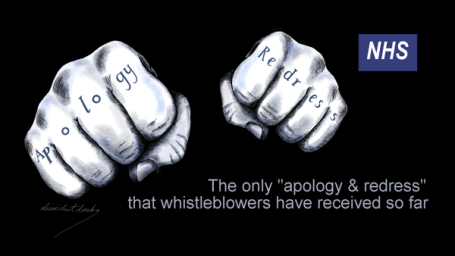
On 21 January 2015 the parliamentary Health Committee advised Jeremy Hunt to ensure that harmed NHS whistleblowers should receive an ‘apology and practical redress’. 1

On 11 February 2015 Robert Francis recommended in his report of the Freedom To Speak Up Review that as a minimum, sacked and exiled NHS whistleblowers should be urgently provided with support to return to NHS employment, including trial employment. 2


“7.3.8 Beyond that, I believe that there is an urgent need for an employment support scheme for NHS staff and former staff who are having difficulty finding employment in the NHS who can demonstrate that this is related to having made protected disclosures and that there are no outstanding issues of justifiable and significant concern relating to their performance. This should be devised and run jointly by NHS England, the NHS Trust Development Authority and Monitor. As a minimum, it should provide:

• remedial training or work experience for registered healthcare professionals who have been away from the workplace for long periods of time

• advice and assistance in relation to applications for appropriate employment in the NHS

• the development of a ‘pool’ of NHS employers prepared to offer trial employment to persons being supported through the scheme

• guidance to employers to encourage them to consider a history of having raised concerns as a positive characteristic in a potential employee.” 2


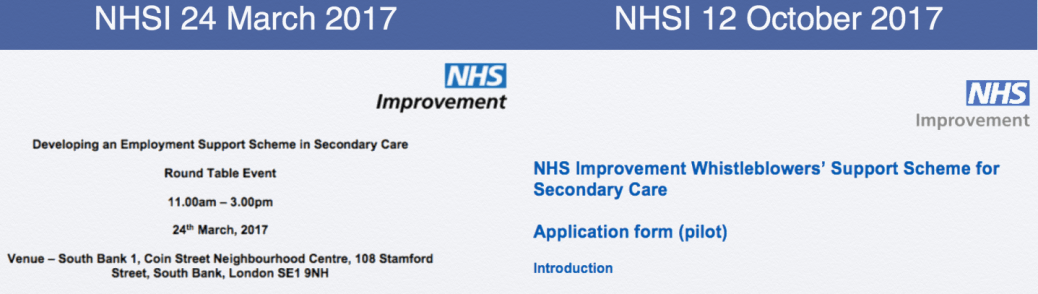
Over two years later, the Department of Health and its organs are still leading harmed whistleblowers a not so merry dance, making whistleblowers jump through bureaucratic hoops for the privilege of little more than employment coaching services, with profits going to an outsourced supplier. 3 4 5

There is no trial employment on offer, despite the DH’s attempts to spin otherwise through willing helpers. 6

Screen Shot 2017-10-14 at 10.10.18

Yet it has emerged that behind the scenes, NHS Improvement made a special arrangement months ago to help secure a sacked NHS whistleblower a job, no red tape involved whatsoever.

Jim Mackey has been asked to account for this blatant inconsistency and to ensure that other whistleblowers receive equal access:

Letter to Jim Mackey re-employment 8 October 2017

In the meantime, NHS England’s pilot Employment Support Scheme, which attracted only eight applicants, is coming up for evaluation.

A request led to this update from NHS England on 8 September, about a proposed evaluation by Liverpool John Moores University:

NHS England High Level Plan

NHS England WBSS briefing for workshop attendees

NHS England did not give full details of the proposed evaluation methodology, I therefore asked Liverpool John Moores University for more information.

Correspondence with Liverpool John Moore University

Limited detail was provided, but this draft list of proposed interview questions was shared:
interview questions-1

I asked for all of my request to be processed. The university then closed its doors:

Liverpool John Moore’s University FOIResponse17_179

Screen Shot 2017-10-14 at 09.02.01

It did not make any specific technical case for secrecy but simply claimed that disclosure would prejudice the outcome of the evaluation.

NHS England purports to promote co-production:

1.3 Co-production: What this looks like for people   

  • People with lived experience have an equal status with practitioners to influence key decisions.” 7

It specifically promised on 8 September to involve whistleblowers in designing its evaluation:

The evaluation will engage directly with stakeholders to explore both the process of developing the pilot and the utility of the support to clients. Because of the involvement of stakeholders it is particularly important that they feel valued as partners. The evaluation will therefore be done with participants (not imposed ‘on’ them) ensuring they have a say in determining the aims and objectives of the pilot and its evaluation.”

It is important that whistleblowers can see exactly what the university proposes to do, including its ethical controls, as this is sensitive work. There were already concerns arising from a presentation by the lead researcher at an event by NHS Improvement on 22 September. This is because there was an implication that whistleblowers’ personal data might be sought from confidential coaching services purchased for whistleblowers, and it had to be clarified by whistleblowers and the service supplier that such data was off limits.

I have therefore asked NHS England to keep its word and to intervene:

REQUEST 14 OCTOBER 2017 TO NEIL CHURCHILL

It would be ironic if research aimed at delivering Mr Hunt’s Plans to end cover up culture in the NHS 8 is beyond scrutiny.

Almost as ironic as this recent refusal by Jim Mackey to provide much of the data sought by an FOI request about NHS Improvement’s scheme, and his decision to withhold an NCAS paper relating to the scheme.

FOI_Employment_Support_Scheme_development

Laughably, both NHS Improvement and NHS England have also surreptitiously tweaked the names of their programmes from ‘Whistleblower Employment Support Service’ to just ‘Whistleblower Support Service’:

Screen Shot 2017-10-14 at 00.43.10


That’s a big clue.

It is irresponsible of the DH et al to mistreat whistleblowers who have been through so much, many of whom still bear the serious health consequences of their ordeals.

As Health Committee acknowledged, this spectacle of un-rectified injustice damages patient safety culture: 


“114. The failure to deal appropriately with the consequences of cases where staff have sought protection as whistleblowers has caused people to suffer detriment, such as losing their job and in some cases being unable to find similar employment. This has undermined trust in the system’s ability to treat whistleblowers with fairness. This lack of confidence about the consequences of raising concerns has implications for patient safety”

 Health Committee, Complaints and Raising Concerns, 21 January 2015


But perhaps that’s the idea.

apology-redress


RELATED ITEMS

At the NHS Improvement Soup Kitchen

https://minhalexander.com/2017/03/26/at-the-nhs-improvement-soup-kitchen/


REFERENCES

1 Complaints and Raising Concerns. Health Committee 21 January 2015

https://publications.parliament.uk/pa/cm201415/cmselect/cmhealth/350/350.pdf

2 Report of the Freedom to Speak Up Review

http://webarchive.nationalarchives.gov.uk/20150218150953/https://freedomtospeakup.org.uk/wp-content/uploads/2014/07/F2SU_web.pdf

3 At the NHS Improvement Soup Kitchen

https://minhalexander.com/2017/03/26/at-the-nhs-improvement-soup-kitchen/

4 NHS failing whistleblowers with return-to-work plan, Kat Lay, The Times, 21 August 2017

https://minhalexander.com/wp-content/uploads/2016/09/nhs-e28098failing-whistleblowers_-with-return-to-work-plan-times-21-aug-2017.pdf

5 NHS Improvement whistleblowers’ support scheme launch September 2017

https://improvement.nhs.uk/events/whistleblowers-support-scheme-launch/

6 NHS trusts to offer whistleblowers trial employment, Shaun Lintern, Health Service Journal 26 September 2017

https://www.hsj.co.uk/workforce/nhs-trusts-to-offer-whistleblowers-trial-employment/7020644.article

7 Co-production. NHS England June 2017

https://www.england.nhs.uk/wp-content/uploads/2017/06/516_Co-production-for-personal-health-budgets-and-Integrated-Personal-Commissioning_S7.pdf

8 Plans to end the cover up culture in the NHS, Department of Health 9 March 2016

https://www.gov.uk/government/news/plans-to-end-the-cover-up-culture-in-the-nhs


Will Simon Stevens uncork ALL the NHS Race data?

The poor, discriminatory treatment of BME staff in the NHS has been a long recognised stain upon the NHS’ reputation.

A landmark event in NHS Race history was Joe Collier and his colleagues’ whistleblowing about a racist computer programme at St Georges which weeded out foreign medical student applicants.

Screen Shot 2017-10-11 at 07.37.58

The classic book Racism in Medicine: An Agenda for Change,  Naaz Coker et al 2001, is a very good, gripping read and still highly relevant.

NHS England commendably launched the Workforce Race Equality Standard programme (WRES) but its implementation has been a disappointment to many, with no focus on enforcement and a number of significant omissions in the parameters measured.

Whistleblowing and NHS racism are interlinked. Research done on behalf of the Speak Up Review showed that BME whistleblowers are more likely to be ignored and victimised.

I have asked Simon Stevens to prioritise the proper measurement of BME staff’s experience of whistleblowing through the NHS staff survey.

I have also asked him to uncork data that already exists at trust level on Race differentials for all domains of the national NHS staff survey.

I have been advised by the Picker Institute which administrates the survey for NHS England that the cost of analysing this trust level Race data is reportedly very modest:

“£1200-£1600 (excl. VAT)”

I find it perplexing that such analyses have not already been requested and published.

The letter to Simon Stevens, with supporting references, background correspondence and data,  is provided below.

Dr Minh Alexander

NHS whistleblower and former consultant psychiatrist

11 October 2017


LETTER TO SIMON STEVENS

BY EMAIL

Simon Stevens

Chief Executive

NHS England


11 October 2017

Dear Mr Stevens,


Re: NHS Englands approach to Race Equality & Race analysis of NHS Staff Survey Data

I write about the rigour of NHS England’s approach and to make a request about better use of national staff survey data.

As you may be aware from correspondence to the NHS England WRES team into which I have copied you, I have concerns that the WRES programme is at this late juncture not measuring important matters such as Race Employment Claims against the NHS. Neither is it measuring Race pay inequality.

Since WRES was established, challenges to how WRES is administrated have sometimes been ignored, resisted or deflected to varying degrees. It has been indicated and or implied more than once that after any year’s WRES programme has been approved by you, no deviation is possible, whether or not this is correct. It may be that the recent shake up in WRES personnel will speed progress up.

But to give a recent example of inflexible system response:

Gross bias and Race discrimination was evident from analysis of NHS Employers’ data on the appointment of Speak Up Guardians earlier this year 1 and confirmed by the National Guardian’s office subsequent analysis of its data. 2 I asked that further measures be taken, including addition of whistleblowing questions to the WRES metrics of the annual staff survey. I was told that WRES will not even consider possible changes until April 2018 at the earliest – see correspondence below. 3
This lack of urgency is a concern given the findings by Middlesex University, published in the Speak Up Review report, that BME whistleblowers are much more likely to be ignored and to suffer considerably more detriment. 4

After the last response from NHS England 3, I established for myself that the current generic whistleblowing questions in the NHS staff survey are not good at distinguishing between White and BME staff groups 5, despite the known differences in how these groups are treated. It may be that they rely too much on expectation and not on actual experience.

I do think NHS England should prioritise the better measurement of whistleblowing experience of staff in the national survey, and also include effective whistleblowing questions in the WRES metrics as soon as possible.

Most importantly, I have established that Race data is held at trust level for all questions in the national NHS staff survey and not just whistleblowing questions, and that it would reportedly cost £1200 – £1600 plus VAT to analyse the 2016 national data by white v BME scores. 6

Given this seemingly modest cost, I am surprised that this data has not already been requested and published by NHS England. This is especially as I understand the budget of millions allocated to WRES to date has not been fully spent.

Such an analysis would clearly help shine a powerful light on the shameful and still unmitigated Race inequality in the NHS. 7

I would be very grateful to know if you would authorise:

  • Urgent action on ensuring that Race differences in whistleblowing are measured as part of the WRES programme


  • The above Race analysis of all 2016 NHS staff survey data at trust level, similar analysis of all future annual NHS staff surveys, and the publication of such analyses.


Many thanks.

Yours sincerely,

Dr Minh Alexander


Cc

Philip Dunne Minister of State for Health

Yvonne Coghill Director of WRES Programme

Professor David Lewis Professor of Employment Law Middlesex University

Lord Adebowale NHS England NED

Prof Mala Rao NHS England WRESAG

Marie Gabriel NHS England WRESAG

Dr Henrietta Hughes National Freedom To Speak Up Guardian

Dame Moira Gibb NHS England NED and member of National Guardian’s Accountability & Liaison Committee


REFERENCES

1 https://minhalexander.com/2017/05/16/speak-up-guardians-a-whiter-shade-of-corporate-pale/

2http://www.cqc.org.uk/sites/default/files/20170915_Freedom_to_Speak_Up_Guardian_Survey_2017.pdf

3 Correspondence about Race discrimination in the appointment of Speak Up Guardians & tracking whistleblowing Race metrics:

From: “COGHILL, Yvonne (NHS ENGLAND)” <**************>

Subject: RE: Concerns about Freedom to Speak Up Guardian appointments – Race

Date: 1 October 2017 at 18:18:38 BST

To: Minh Alexander <********************>

Cc: “CE, England (NHS ENGLAND)” <****************>, mala rao <***************************>, Victor Adebowale <*****************>, *******************>, Marie Gabriel <**********************>, “NAQVI, Habib (NHS ENGLAND)” <*********************>, “WILHELM, Reg (NHS ENGLAND)” <************************>

Dear Minh,

Thank you for you e mail.

We are in the process of arranging a meeting with the National Guardian and will let you know when it will be. I will of course need to inform Dr Hughes of your request to have the meeting minuted.

With regards to the inclusion of new metrics in the WRES, we are in the process of evaluating phase 1 of the initiative and will not prior to the outcomes and recommendations of the evaluation be considering the inclusion of additional metrics in the WRES. We are hoping the evaluation to be completed by the end of April 2018.

In addition,  you will be aware that Professor Dr Mala Rao is arranging a meeting to which you and other clinicians/academics will be invited, the purpose of the meeting is  to discuss the WRES, research and together decide what more needs to be done in this arena.

On a final note, NHS England, the WRES team and SAG are fully committed to helping to make demonstrable, sustainable  change within the system for BME staff and will continue to work towards that aim.

Kind Regards

Yvonne

Yvonne Coghill OBE

Director -WRES Implementation

NHS England

Skipton House

London SE1 6LJ

From: Minh Alexander [********************]

Sent: 29 September 2017 11:30

To: COGHILL, Yvonne (NHS ENGLAND)

Cc: CE, England (NHS ENGLAND); mala rao; Victor Adebowale; Hughes, Henrietta; Marie Gabriel

Subject: Concerns about Freedom to Speak Up Guardian appointments – Race

BY EMAIL

Yvonne Coghill

Director of WRES Programme

NHS England

29 September 2017

Dear Yvonne,

Re: Bias and Race Discrimination in the appointment of Freedom to Speak Up Guardians

Further to my letter of 19 September to the Minister of State for Health below, the Minister has informed me the WRES team will be meeting with the National Guardian’s office to

“…consider the identification of interventions that may help to improve the diversity of Freedom to Speak Up Guardians”

I wonder if it would be possible to share the minute of this meeting and any associated action plan with whistleblowers.

Also, please can you advise if NHS England is willing to include whistleblowing measures in the WRES metrics of the annual NHS staff survey, as per my request of 19 September?

Many thanks.

Yours sincerely,

Minh

Dr Minh Alexander

Cc Simon Stevens Chief Executive NHS England

     Lord Adebowale NHS England NED

     Prof Mala Rao NHS England WRESAG

     Marie Gabriel NHS England WRESAG

     Dr Henrietta Hughes National Freedom To Speak Up Guardian

From: Minh Alexander <minhalexander@aol.com>

Subject: Concerns about Freedom to Speak Up Guardian appointments – Race

Date: 19 September 2017 at 07:52:26 BST

To: philip.dunne.mp@parliament.uk

Cc: ****************, edward Jones <*****************>, Contactus England <*******************>, CE England <******************>, kate Moore <*********************>, Robert Francis, “Hughes, Henrietta” <*****************>, Dave Lewis <******************>, Yvonne Coghill <****************>, mala rao <**********************>

BY EMAIL

Rt Hon Philip Dunne

Minister of State

Department of Health

19 September 2017

Dear Mr Dunne,

Concerns about Freedom to Speak Up Guardian appointments – Race

I see that the National Guardian’s survey of Speak Up Guardians, released yesterday, has confirmed a low percentage (8.5%) of Speak Up Guardians from visible ethnic minorities. This is in accordance with my findings when I reviewed NHS Employer’s data and other sources earlier this year – see attached and previous correspondence below with Sir Robert.

This is a gross under-representation of BME staff in the NHS (at last count there were 17% non-white NHS staff and 38% non-white NHS doctors and dentists).

It is very disappointing given that research on behalf of the Freedom To Speak Up Review showed that BME whistleblowers are known to suffer greater reprisal.

This failure to appoint enough BME SpeakUp Guardians is another demonstration of the laissez-faire attitude towards and poor administration of the Freedom To Speak Up Project.

Sir Robert Francis stated in his report of the Freedom to Speak Up Review:

“I do not think it necessary to set out specific additional actions related to the raising of concerns by BME staff”

Given the latest demonstration of system bias in the form of gross under-representation of BME amongst Speak Up Guardians, I wonder if the Department of Health could review this policy and reconsider whether more specific action is needed beyond encouragement.

For example, addition of specific Speaking Up measures to the WRES metrics in the annual NHS Staff Survey.

I additionally copy this to Prof David Lewis, Middlesex University and to the NHS WRES team.

Yours sincerely,

Dr Minh Alexander

cc

Secretary of State for Health

Dame Moira Gibb NHS England NED and member of National Guardian’s Accountability and Liaison Board

Kate Moore, NHS Improvement General Counsel and member of National Guardian’s Accountability and Liaison Board

Sir Robert Francis, CQC NED and member of National Guardian’s Accountability and Liaison Board

Dr Henrietta Hughes National Freedom to Speak Up Guardian

Prof David Lewis, Professor of Employment Law, Middlesex University

Simon Stevens CEO NHS England

Yvonne Cognill, WRES Programme Director, NHS England

Prof Mala Rao, WRES Advisory Group and lead for WRES medical programme

https://minhalexander.com/wp-content/uploads/2017/04/20170915_freedom_to_speak_up_guardian_survey2017.pdf

4 Page 66 of the report of the Freedom to Speak Up Review:

Francis BME page 66

http://webarchive.nationalarchives.gov.uk/20150218150953/https://freedomtospeakup.org.uk/wp-content/uploads/2014/07/F2SU_web.pdf

5 https://minhalexander.com/wp-content/uploads/2016/09/race-breakdown-of-q13-whistleblowing-nhs-staff-survey-2015-20161.pdf

6 Correspondence with the Picker Institute about NHS staff survey data:

From: Rory Corbett <***********************************>

Subject: RE: Race breakdown for question 13

Date: 10 October 2017 at 11:28:10 BST

To: Minh Alexander <**************************************>

Cc: nhsstaffsurvey <nhsstaffsurvey@surveycoordination.com>

 Hi Minh,

For those analyses it would cost approximately:

1)    £500-£700 (excl. VAT)

2)    £1200-£1600 (excl. VAT)

The exact cost will depend on exactly what is required for each question – are you after ‘top box’ data (e.g. for q13a –  the % responding ‘yes’) or data for each individual response option (e.g. for q13a – the % responding ‘yes’, the % responding ‘no’, the % responding ‘don’t know’)?

I’d also need to run this request past NHS England for approval – but I would expect there wouldn’t be a problem as no case level data is being shared.

Regards,

Rory

Rory Corbett

Senior Research Associate

Survey Coordination Centre

Picker Institute Europe

Buxton Court

3 West Way

Oxford OX2 0JB

Web:   www.nhsstaffsurveys.com

           www.nhssurveys.org

           www.picker.org

From: Minh Alexander [*******************]

Sent: 04 October 2017 16:16

To: Rory Corbett <******************>

Subject: Race breakdown for question 13

Again, very helpful Rory, thank you.

Is it possible to say roughly how much ‘BME v White’ analyses of

1) Question 13, at trust level

2) All Questions, at trust level

for the 2016 data would cost, respectively?

BW

Minh

Minh Alexander

From: Rory Corbett <*******************>

Subject: RE: Race breakdown for question 13

Date: 4 October 2017 at 16:11:16 BST

To: Minh Alexander <*************************>

Hi Minh,

We haven’t broken down the data at trust level by white/BME for all questions – but this would be possible with the data we hold.

We do conduct additional analysis on the staff survey data for individuals & organisations but we do have to charge for our staff time in such cases.

Regards,

Rory

Rory Corbett

Senior Research Associate

Survey Coordination Centre

Picker Institute Europe

Buxton Court

3 West Way

Oxford OX2 0JB

Web:   www.nhsstaffsurveys.com

           www.nhssurveys.org

           www.picker.org

Charity registered in England and Wales: 1081688

Charity registered in Scotland: SC045048

From: Minh Alexander [*********************]

Sent: 03 October 2017 22:19

To: Rory Corbett <*******************>

Subject: Race breakdown for question 13

Hi,

Thanks. That’s very helpful.

May I check one more thing – do you hold the trust level data, even if you don’t publish it?

Thanks,

Minh

Minh Alexander

From: Rory Corbett <**************************>

Subject: RE: Race breakdown for question 13

Date: 2 October 2017 at 15:12:15 BST

To: Minh Alexander <***************************>

Cc: nhsstaffsurvey <nhsstaffsurvey@surveycoordination.com>

Hi Minh,

If you look at this spreadsheet you will find the 2016 results for q13 for both white staff and BME staff – this is located on row 391 and 392.

The same data is available in this spreadsheet for 2015 on row 370 and 371.

Please note this is the score for staff from all organisations (including CCGs, CSUs and other small organisations that conduct the survey voluntarily).

We don’t publish this data at trust level unfortunately.

Regards,

Rory

Rory Corbett

Senior Research Associate

Survey Coordination Centre

Picker Institute Europe

Buxton Court

3 West Way

Oxford OX2 0JB

Web:   www.nhsstaffsurveys.com

           www.nhssurveys.org

           www.picker.org

Charity registered in England and Wales: 1081688

Charity registered in Scotland: SC045048

This email and any attachments to it may be confidential and are intended solely for the use of the individual to whom it is addressed. 
Any views or opinions expressed are solely those of the author and do not necessarily represent those of Picker Institute Europe.
If you are not the intended recipient of this email, you must neither take any action based upon its contents, nor copy or show it to anyone.

From: Minh Alexander [******************]

Sent: 01 October 2017 21:37

To: nhsstaffsurvey <nhsstaffsurvey@surveycoordination.com>

Subject: Race breakdown for question 13

Dear Sir,

Race breakdown for question 13

Can you advise me if you can provide a national overview as regards the scores for white v BME staff on the following 2016 and 2015 NHS staff survey questions?

Question 13

a)    If you were concerned about unsafe clinical practice, would you know how to report it?

b)     b) I would feel secure raising concerns about unsafe clinical practice.

c)     I am confident that my organisation would address my concern.

Also, do you hold trust level data on white vs BME for these questions, for 2015 and 2016?

Thanks,

Dr Minh Alexander

Picker Institute Europe is a charity registered in England and Wales, registered number 1081688 and in Scotland, registered number SC045048.
Registered Company number 3908160. Registered office: Picker Institute Europe, Buxton Court, 3 West Way, Oxford OX2 0JB.
This email and any attachments to it may be confidential and are intended solely for the use of the individual to whom it is addressed.
Any views or opinions expressed are solely those of the author and do not necessarily represent those of Picker Institute Europe.
If you are not the intended recipient of this email, you must neither take any action based upon its contents, nor copy or show it to anyone.


Postscripts on Paula. NHS England’s apologia & regulatory reticence

Please sign and share:

Petition to replace weak UK whistleblowing law to protect whistleblowers and the public


By Dr Minh Alexander and Clare Sardari, NHS whistleblowers, 10 October 2017

The Vasco-Knight affair is emblematic of a self serving managerialism that has crept into the NHS in latter years:  Those with sharp elbows climbing over other people’s rights, corporate back slapping, gala events to puff up egos, endless hot air and empty lip service to service by those who primarily help themselves.

Paula Vasco-Knight was a much feted NHS chief executive before her final fall due to the emergence of a criminal fraud. She was a BME poster girl for NHS England’s rhetoric about Equality. 1


One of Vasco-Knight’s colleagues at NHS England was Steve Field, who became CQC’s  Chief Inspector of General Practice in 2013:

Screen Shot 2017-10-10 at 00.19.02


She was awarded a honorary doctorate by Exeter University 2 and took dubiously to calling herself ‘Doctor’. She was also favoured with a CBE.


CBE


NHS England Chair’s comments about Vasco-Knight’s CBE:

Professor Sir Malcolm Grant, Chair of NHS England, said: “We are very proud of Dr Vasco-Knight for her achievement. She has done a fantastic job at NHS England representing the needs of all staff and promoting the call for diversity to be further up the NHS agenda across the UK. This honour is testament to the 25 years of hard work Dr Vasco-Knight has given to the NHS and is continuing to give.

Healthwatch Devon on PVK’s CBE Dec 2013


The great and the good were reluctant to believe ill of her even after an Employment Tribunal criticised Vasco-Knight and South Devon her former trust for victimising whistleblowers.

Some were solicitous about the length of her suspension in February 2014 after the ET, which was relatively brief compared to those typically imposed on whistleblowers:

Screen Shot 2017-10-10 at 02.39.26

Vasco-Knight resigned in May 2014 as South Devon’s chief executive. But she was quickly recycled on the locum circuit, where she was still handsomely paid by the NHS. 3 Monitor accepted her into its interim pool. 4 4b When Vasco-Knight returned to a Board position at St Georges, there were raised eyebrows but some were quick to opine that she deserved a second chance. 5

The CQC determined that a history of whistleblower reprisal was not a sufficiently serious obstacle to her recycling. The CQC’s then chief inspector Mike Richards personally shut down an FPPR referral and this allowed Vasco-Knight to be promoted to acting Chief Executive at Georges:


https://minhalexander.com/2017/01/27/cqc-a-chief-inspector-doesnt-call/


It was only the news of her misappropriation of NHS funds that finally led to her sacking by the NHS.

It is ironic that Vasco-Knight’s end was brought about by a paltry £11K swindle. Her nepotism and persecution of whistleblowers had previously cost the NHS hundreds of thousands, but was just shrugged off by the powers that be.

Exeter University’s bosses tried their best to ignore a complaint about her honorary doctorate on the basis of her victimisation of whistleblowers and conviction for fraud. 6

Screen Shot 2017-10-10 at 01.31.05.png

The university still did not respond to a reminder after she was sentenced. 7

But further enquiries now reveal that Vasco-Knight was stripped of the degree in April in this year, after her sentencing for fraud.

Screen Shot 2017-10-09 at 16.47.25


NHS Protect had advised that its fraud investigation commenced in March 2014 and was triggered by a joint referral from Vasco-Knight’s former trust and NHS England:

Screen Shot 2017-10-09 at 22.48.25From FOI response by NHS Protect 21 February 2017


Enquiries to NHS England about its role in the fiasco by Clare Sardari @SardariClare , one of the South Devon whistleblowers, were met with predictable circumlocution.

Initially, Simon Stevens’ office claimed that NHS England had been innocent of Vasco-Knight’s fraud until informed about it in April 2016 by NHS Protect:

“Paula Vasco-Knight worked for NHS England on a part-time basis up to January 2014. On 28 April 2016, we were informed by NHS Protect that a member of our staff was being charged with fraud, together with Paula Vasco-Knight and her husband. I informed NHS Improvement the following day as I was aware that Paula Vasco-Knight had recently been appointed to an interim role at Georges Foundation NHS Trust.

As far as I can establish, NHS England was not aware that Paula Vasco-Knight was under investigation prior to 28 April 2016. I understand that she was referred to NHS Protect by South Devon Healthcare NHS Trust, and I can’t find any record of NHS England being involved in the referral. I can confirm that we haven’t disclosed an further material on this matter to NHS Improvement (i.e. in addition to the notification I shared with them in April last year).”

When this was queried with opposing facts, Simon Stevens’ office revised its account:

Dear Clare

I can now confirm that NHS England did indeed make a formal referral to NHS Protect in April 2014. I was not aware of this when I wrote to you on 11 July.

Referrals to NHS Protect are confidential and it would not be appropriate for us to inform other bodies when such referrals are made. This is for two reasons: first, there has to be a presumption of innocence while investigations are taking place and second, NHS Protect’s investigations could be undermined if the individual being referred should become aware of the referral.

As I previously explained, I did alert NHS Improvement at the point I became aware that Paula Vasco-Knight was to be charged with fraud.

Yours sincerely 

Tom

Tom Easterling

Director of the Chair and Chief Executive’s Office

NHS England

Health and high quality care for all, now and for future generations”

When it was pointed out that NHS England’s date did not tally with the information from NHS Protect, Simon Stevens’ office again revised its position. It specifically admitted that it did not warn NHS Improvement about Vasco-Knight’s fraud:

“Dear Clare

Thank you for your email. To respond to your questions:

  1. I am told that an informal referral was initially made to NHS Protect by South Devon Healthcare NHS Foundation Trust and this was then followed by a formal referral by South Devon Healthcare NHS Foundation Trust and NHS England in April 2014.
  2. No disclosure was made to NHS Improvement so there is no further correspondence to share.
  3. As I previously explained, referrals to NHS Protect are confidential and it would not have been appropriate for us to inform other bodies that we had made a referral to NHS Protect.  It is the responsibility of employers to assure themselves that potential employees are fit and proper persons.

Yours sincerely

Tom

Tom Easterling

Director of the Chair and Chief Executive’s Office

NHS England

Health and high quality care for all, now and for future generations”

This is the full correspondence with NHS England:

NHS England correspondence

 CQC was evasive about when it learned of Vasco-Knight’s fraud, but disclosed that there was also an internal meeting of senior CQC managers on 28 April 2016 about Vasco-Knight’s fraud:

“We do not hold a record of the exact date when CQC first became aware of the fraud allegations.

 We can however confirm that a meeting took place on 28 April 2016 between David Behan, Chief Executive of CQC, Professor Sir Mike Richards, Chief Inspector of Hospitals, Ellen Armistead, Deputy Chief Inspector of Hospitals and Rebecca Lloyd-Jones, Director of Legal Services and Information Rights, where the fraud allegations were discussed.” 

20170324 Final Response FOIA CQC IAT 1617 0746


This is a redacted email chain between Jim Mackey, Mike Richards and others in early May 2016 when Vasco-Knight’s fraud hit the headlines:

Screen Shot 2017-10-09 at 15.39.58

20160518 Email from NHS Improvement to CQC WITH SCANNED REDACTIONS

20160517 Email correspondence St George’s Fit and Proper Person Test CQC IAT 1617 0746 WITH SCANNED REDACTIONS


NHSI has also revealed that irregularly, an un-minuted meeting took place between Mike Richards and NHSI’s Head of Private Office about Vasco-Knight and FPPR on 26 May 2016. 8

But the full details of what passed between the regulators and NHS England are not available as both CQC and NHSI have drawn a veil over it all on grounds that it might prejudice the conduct of public affairs. That usually just means that important people do not wish to be embarrassed:

“Section 36(2)(b)(ii) free and frank exchange of views 

The correspondence in question represents senior executives exchanging views about the investigations against Paula Vasco-Knight and the fit and proper person test. The correspondence was intended to prompt discussion and learning from the case of Ms Vasco-Knight, and how this situation could be avoided in the future. Sharing information between bodies ensures that we are able to respond to situations effectively and efficiently. In order to carry out their functions, the officials of NHS Improvement, NHS England and the CQC must be able to exchange information freely, without concern that the detail of that information exchange will be disclosed inappropriately. If the information were published, it would be likely to restrict the organisations’ willingness to share and discuss information, due to the possibility that this information may be made public. That would have an adverse impact on the ability of NHS Improvement, NHS England and the CQC to liaise effectively on leadership and operational issues at NHS trusts and foundation trusts and would inhibit the free flow of information.”

 NHS Improvement 19 July 2017 

NHSI FOI response to Clare Sardari 19 July 017

 Mr Behan has reviewed the information and expressed the opinion that disclosure of the information would inhibit the free and frank exchange of views for the purposes of deliberation; would be likely to prejudice the effective conduct of public affairs, and that the public interest to be served by withholding the information outweighs the public interest that would be served by disclosure

 CQC 24 March 2017

 “No other person’s opinion can be substituted for that of the qualified person but, where we receive a request for internal review, a non-executive member of our board is asked to perform the review and consider whether the opinion of the qualified person is a reasonable one, and whether the public interest in withholding the information outweighs the public interest in disclosure. In this case, Mr Paul Corrigan performed this review. Mr Corrigan’s decision is that the exemption was correctly applied, therefore we will not release the content of the email.

 CQC 13 July 2017

Intriguingly, NHSI also considered that full disclosure of all relevant correspondence might damage its relationships with NHS England and CQC:

“This exemption is engaged as disclosure of correspondence on how to prevent similar conduct in the NHS as that in the Vasco-Knight case may damage the relationship of trust and confidence between NHS Improvement and other national bodies involved, as well as inhibit the free flow of information.” 8

One wonders if recriminations lurk in the undisclosed correspondence.

But whatever words were exchanged, it seems clear that NHS England simply stood by and kept shtum when Vasco-Knight was recycled to board positions at St Georges, despite knowing that there were serious questions about whether she was a Fit and Proper Person.

So much for Safeguarding principles.

NHS England defends keeping its hands in pockets on grounds that Vasco-Knight was innocent until proven guilty.

No such latitude was given to the whistleblowers who were persecuted on her watch.

NHS whistleblowers are still suspended at the drop of a hat and shown the door quicker than you can say ‘interim executive pool’.

CQC’s and NHSI’s approach to assuring that NHS executives are Fit and Proper Persons looks unchanged. A few deck chairs have been re-arranged but the process continues to rely on self assessment by regulated bodies:

“NHSI have no direct involvement in the completion of the fit and proper person test for executive staff by NHS Trusts. Owing to the confidential nature of the content within the FPPT, we rely on a self-assessment by the NHS Trusts that this process has been completed. NHS Trusts are asked to complete a template notifying NHSI of the outcome of the selection process and within this template includes a box for the trust to confirm the FPPT has been completed.” 8

Indeed, when NHS England was asked if it would do things differently in future it retorted:

It is the responsibility of employers to assure themselves that potential employees are fit and proper persons.”

NHS England email 9 August 2017

So despite the recent jailing of Jon Andrewes trust chair who falsified a CV 9, and Paula Knight’s conviction for fraud after ineffective vetting by St Georges with collusion from the CQC, we are simply back at square one.

Any old patter may pass.


Comments by Vasco-Knight in a blog she wrote for the NHS Leadership Academy after receiving her honorary doctorate from Exeter University in 2013:

The most important thing you can bring to work with you is your common humanity – your kindness and compassion. Think of your patients or your customers or your colleagues as if they might be members of your own family. What would you want for them and how would you wish them to be treated?

I live these values in my everyday life and so far they have served me well.

Vasco-Knight NHS Leadership Academy blog 2013


Mike Richards claimed at the outset of implementing Regulation 5 in 2014 that it would be too difficult to remove too many managers.  To our knowledge, CQC has not triggered the removal any NHS managers under FPPR yet.

Shortages of management staff are of course a challenge, but tolerating a solid contingent of poor quality appointments seems unlikely to make the NHS attractive to better managers.

And as for Clare Sardari, a robustly and repeatedly vindicated whistleblower, the NHS still not made any meaningful amends.


Screen Shot 2017-10-09 at 23.39.31


Screen Shot 2017-10-10 at 02.47.43

Screen Shot 2017-10-10 at 02.29.55


UPDATE 19 DECEMBER 2018

The PHSO has partially upheld a complaint about CQC’s handling of the Vasco-Knight FPPR.

CQC is defiant.

PHSO has also pulled some punches.

This is a summary of the PHSO report, and unresolved governance and policy issues:

Sorry is the hardest word: CQC, Paula Vasco-Knight and Regulation 5 Fit and Proper Persons


Please sign and share:

Petition to replace weak UK whistleblowing law to protect whistleblowers and the public


RELATED ITEMS

Open letter by Clare Sardari to St George’s governors

clare-sardari-open-letter-st-georges

NHS Gagging: How CQC sits on its hands

https://minhalexander.com/2016/09/23/nhs-gagging-how-cqc-sits-on-its-hands-2/

Engineered failure to investigate whistleblowers’ concerns

https://minhalexander.com/2017/04/08/engineered-failure-to-investigate-nhs-whistleblowers-concerns/


REFERENCES

1 Paula Vasco-Knight was appointed as NHS England’s National Lead for Equality in 2013, under David Nicholson’s reign

Screen Shot 2017-10-10 at 00.21.43

https://www.england.nhs.uk/2013/11/equality-toolkit/

https://www.england.nhs.uk/wp-content/uploads/2014/01/edc-meet-min-jan14.pdf

Vasco-Knight NHS Leadership Academy blog 2013

3 Management consultant’s £1,000 a day slap in face for Lancashire NHS Staff Peter Magill, Lancashire Telegraph, 5 August 2015

http://www.lancashiretelegraph.co.uk/news/13573334.Management_consultant___s___1_000_a_day____slap_in_face____for_Lancashire_NHS_staff/

https://twitter.com/IanLex2/status/741201394355560448

4 FOI disclosure by St Georges 24 March 2016

  • Mrs Vasco-Knight was interviewed for the post of Interim COO on 28th September 2105.
  • The interview included questions about the reason for Mrs VascoKnight leaving South Devon Healthcare Trust.
  • References were taken up from Hunter Healthcare on appointment
  • Verbal approval to the interim appointment had been given by Monitor and Mrs Vasco-Knight was confirmed to be on the Monitor interims approved list
  • When concerns were raised by staff and governors, the trust obtained a copy of the ET findings and took advice from Capsticks Solicitors.
  • A member of the executive team interviewed Mrs Vasco-Knight.
  • Further references were taken from Monitor, which had provided support for the Monitor FPPT process.

The findings were considered by Christopher Smallwood, Chairman on 27th October 2016.

St Georges FOI response FPPR assessment of Ms VascoKnight 24.03.2017

4b FOI disclosure by Monitor 23 December 2015

Ms Vasco-Knight submitted her application for the Monitor interim pool on 16 April 2015. Monitor subsequently undertook its validation process to obtain references and verified case studies, and accepted and confirmed Ms Vasco-Knight’s membership, over the course of May 2015.

Monitor VascoKnight FPP FOI response 23.12.2015

5

Vasco-Knight HSJ Editor &amp; MBI recyle

6 Letter to Chancellor Exeter University 27 Feb 2017

7 Letter to Exeter University 10 Mar 2017

8 NHS Improvement FOI response 19 July 2017

NHSI FOI response to Clare Sardari 19 July 017

9 http://www.bbc.co.uk/news/uk-england-39183882

http://www.somersetcountygazette.co.uk/news/15137343.Builder_who_conned_his_way_into_top_NHS_jobs_jailed/


Ivy Atkin’s death & more CQC evasion

By Dr Minh Alexander NHS whistleblower and former consultant psychiatrist, 5 October 2017

Summary

The CQC catastrophically failed Ivy Atkin and other vulnerable residents at Autumn Grange care home in Nottingham, where patients were horrendously neglected and suffered unexplained injuries.

Ivy Atkin died on 22 November 2012 as a result of severe neglect. Inexplicably, it seems that on the final inspection of Autumn Grange when CQC inspectors found her gravely ill, she was not taken to hospital. Instead, she was transferred to another care home where she died after three weeks.

CQC did not carry out any internal review of its failures for four years, and it has still not properly accounted for its omissions in the Autumn Grange affair.

It has not answered a question about why Ivy Atkin was not taken to hospital.

The local authority has published only an executive summary of the Serious Case Review into Autumn Grange.

Remarkably, despite the fact that David Behan gave an undertaking last year that an internal review of the matter would be published, CQC has had a change of heart and is now trying to conceal the full contents of this document.

I have made a formal complaint about this extraordinary secrecy and arbitrariness.

Moreover, as CQC has now admitted under FOIA that it has asked for some of its responses to coroners’ Section 28 reports not to be published, I have asked CQC if it asked for its response on Ivy Atkin’s death to be withheld.

I hope Sir Robert Francis is re-thinking his comments to me of 19 January 2017:

“Of course nothing is perfect and the organisation recognises this:…under the leadership of David Behan, it is constantly – and openly –  striving to improve the way it regulates the sector”


Complaint to CQC Chair cc CQC Board, Philip Dunne Minister of State for Health and others:

BY EMAIL

Peter Wyman

Care Quality Commission Chair

5 October 2017


Dear Mr Wyman,

CQC’s handling of Ivy Atkin’s death, matters at Autumn Grange and issues of transparency and accountability

I write to raise a complaint about CQC’s handling of its failures concerning Ivy Atkin’s death and the related matters at Autumn Grange.

This is separate to a request for general internal review of CQC’s response to FOIA request IAT 1718 0390 which I will address under separate cover.

Ivy Atkin died a horrific death on 22 November 2012, weighing only 3st 13lb, having lost half her body weight over 48 days stay at Autumn Grange care home. Her body mass index was 10.7, which is at the outermost limit of survival. She was found close to death at Autumn Grange. She had pneumonia and an infected grade 4 pressure ulcer, contaminated with faeces. Her bed was soaked with urine. 1

When Ivy Atkin was discovered in extremis by CQC inspectors and the police she was reportedly not taken to hospital, but transferred to another care home where she later died three weeks later. 2

Other residents at the home were also found in a most neglected state:

“…mattresses were sodden with urine, there was no hot water or incontinence pads and residents were wearing each other’s clothing and even underwear” 1 

A spokesperson for the CQC reportedly stated:

 “The level of care at Autumn Grange was unacceptable and our inspectors were truly shocked by what they found.” 1

Private Eye reported in February 2016:


“Ivy who had dementia, wasn’t the only resident suffering gross neglect. After an anonymous carer blew the whistle, at least two residents were found to have pressure sores which were not treated properly; others were found lying in their own urine or waste; another had long, filthy nails digging into the skin, and yet another was found dehydrated with cracked and bleeding lips. Others had “unexplained injuries and bruising”, including head wounds, bruised and swollen hands and cuts to the knees and eyes of people who were immobile. Painting a horrific picture of staff “care”, one resident complained to inspectors about noisy nights. “Depends on which gang is on. They shout at the barmy ones,” he said. There was no hot water to wash those who were in a filthy state, and call bells were either not working or deactivated.” 2


The care home owner was subsequently convicted of manslaughter for the criminal negligence that resulted in Ivy Atkin’s death. 1 3 It was reported that expert evidence drew a causal link between the poor care and Ms Atkin’s physical decline and death. 1

Yet CQC had determined that Autumn Grange was largely compliant in the weeks prior to her death in 2012:


Screen Shot 2017-10-05 at 12.33.52

http://www.cqc.org.uk/sites/default/files/old_reports/1-101618554_sherwood_rise_limited_1-126202251_autumn_grange_residential_home_20121102.pdf


In February 2016 the CQC told Private Eye “..if there are further lessons to learn as a result we will ensure we do so”.

In relation to this, I asked David Behan on 18 February 2016 if CQC had conducted any internal review of its regulatory failure:

Dear Mr Behan,

Re Autumn Grange, the death of Ivy Atkin and CQC’s role

I see that the latest Private Eye reports concerns that CQC did not detect (or act upon) very serious failings at Autumn Grange care home, and concerns that the death of Ivy Atkin, 86 in 2012 was related to this.

I copy below the salient extracts from the Private Eye article. 

As the CQC has undertaken an internal review into why it gave Homerton maternity services a “good” rating in 2014, when this followed by at least Rive subsequent maternal deaths and findings of service failings at inspection a year later, may I ask if CQC has undertaken a similar internal review of the matters at Autumn Grange?

If such an internal review has been undertaken, please could a copy of this be made available and published.

Whilst I understand that a serious case review regarding Autumn Grange is now underway, may I also ask if there has been any previous examination of why Ivy Atkin was reportedly not admitted to hospital in October 2012 when she was found to be in such serious medical condition, but reportedly only transferred to another care home where she died three weeks later, despite CQC and all agencies presumably being aware of the serious medical condition in which she had been found?

Yours sincerely,

Dr Minh Alexander

I received an unfortunate response to this enquiry from the CQC Head of Inspection for the Central Region. He told me that although CQC had not undertaken an internal review, it was his view that CQC regulatory processes were “better than ever before”. 4

The CQC Head of Inspection did not address my question about why Ivy Atkin was not taken to hospital despite CQC inspectors finding her in extremis.

The executive summary of a Serious Case Review report produced for Nottingham City Council later stated that CQC accepted their inspection in September 2012 should have been more rigorous”. 5

But it was only after damning coroner’s findings on Ivy Atkin’s death and a related Section 28 Report on Action to Prevent Future Deaths issued on 25 October 2016 that CQC gave any public indication of internal review regarding Autumn Grange. 6


The coroner’s Section 28 report of 25 October 2016 on Ivy Atkin’s death, sent to CQC as a named respondent:

https://www.judiciary.gov.uk/wp-content/uploads/2016/12/Atkin-2016-0379.pdf

CQC’s did not respond to the coroner within the statutory deadline and its response was not published by the Chief Coroner until August 2017, after I queried its absence:

https://www.judiciary.gov.uk/wp-content/uploads/2016/10/2016-0379-Response-by-Care-Quality-Commission.pdf


CQC informs me that the internal review took place in August 2016.

However when I recently asked for a copy of the internal review, CQC resisted disclosure on grounds that it would infringe CQC staff privacy:


We consider CQC’s full Internal Review into this matter to be exempt from disclosure as the reports contains personal information and identifies individual inspectors and disclosure could severely impact their privacy if they were identified. This exemption is explained in full in the ‘Exemptions on disclosure’ section below.

 From a CQC response received 4 October 2017


This is an extraordinary FOIA exemption to rely upon in a case of unlawful killing where the regulator has admitted that its actions were wanting.

CQC’s attempt to protect itself in this manner also seems all the more questionable given that David Behan CQC CEO previously assured the CQC Board on 16 November 2016 that this internal review would be published:


We expect to publish our internal review into our regulation of Autumn Grange Residential Home alongside the summary of the Council’s Safeguarding Adults Review.”

https://minhalexander.com/wp-content/uploads/2017/09/david-behan-report-to-cqc-board-16-nov-2016-cm111604_item4_chiefexecutivereport.pdf


CQC has gone to trouble of producing a manicured summary of its withheld internal review on Autumn Grange, which emphasises that the coroner was satisfied by CQC’s assurances that things had ‘moved on’:

https://minhalexander.com/wp-content/uploads/2016/09/cqc-internal-review-summary-20170902-autumn-grange.pdf

There is ample evidence that things have not ‘moved on’ and that CQC continues to fail very vulnerable care home residents. 7 8 9

CQC’s failure to act on the appalling, similar death of Barbara Cooke in 2014 despite receiving a coroner’s Section 28 report is a case in point. 10 I should point out that there is still no published CQC response to the Section 28 report issued on 12 September 2014 about Barbara Cooke’s death.

It is inappropriate of CQC to suggest that the public should settle for a summary of its withheld internal review report on Autumn Grange.

Given that CQC has now just been exposed for covering up the likely rape of a highly vulnerable man in another care home 11, I think this filtering of information by CQC is especially unwelcome and that the negligent, horrific death of a vulnerable person requires full transparency.

CQC conceded only four weeks ago that external review was required in the case of the above covered up rape. It is simply not credible for CQC to assert that a filtered version of an internal review is adequate accountability for Ivy Atkin’s terrible death.

Under even the much criticised old CQC regime, Cynthia Bower and Jo Williams arranged an internal review of CQC’s notorious failures at Winterbourne View that was published. 12 And nobody died in that episode.

CQC’s summary of its internal review on Autumn Grange raises more questions than it answers.

Unsurprisingly, CQC admits fleetingly in its summary of the internal review that it failed to listen to whistleblowers:


The review identified a number of areas where improvements were required. There was too much focus on the evidence collected the day of the inspection in September 2012 rather than ensuring that our methods for assessing the provider’s regulatory risk was based on all the information available including past regulatory history, whistleblowing and safeguarding referrals and concerns from other agencies. The review also identified that record keeping, storage of information and inspection planning was poor.

 Undated CQC summary of its internal review on Autumn Grange and Ivy Atkin’s death


I believe it is incumbent on CQC to explain in greater detail exactly what whistleblower intelligence it received about Autumn Grange prior to Ivy Atkin’s death and why it failed to act upon this intelligence.

This is because these matters remain relevant and CQC continues to fail whistleblowers by not listening to them or even being complicit in reprisal against them. 13

A recent FOI disclosure by CQC relating to HC-One, one of the largest care providers, suggests that CQC still gives insufficient weight to whistleblower intelligence. 14

I think given the gravity of the matters in question CQC should publish its internal review on Autumn Grange in its entirety, and provide the public some assurance regarding the competence of inspection staff involved and whether they remain employed by CQC.

If CQC is not willing to provide such assurance, I feel the very least that CQC should do is disclose and publish the internal review with redaction of individual CQC staff details.

I should point out of course that the CQC may not rely on a privacy exemption under the FOIA where information is already in the public domain.

Your inspector for Autumn Grange is already named on the public record and reported to have stated that she found “chaos and screaming” upon the final Autumn Grange inspection, but that she maintained that “A home can go downhill quickly”. 15

It was also reported:

“Under questioning from Nottinghamshire Assistant Coroner Stephanie Haskey, Mrs W said she had not “missed anything” in an earlier inspection in September.”


To summarise, I am concerned that:

  • CQC did not see fit to undertake an internal review until four years after Ivy Atkins death.


  • CQCs Head of Inspection appeared in his letter to me of 2 March 2016 to be dismissive of the need for internal review and despite the absence of review, claimed that things were better.


  • CQC has refused to disclose a copy of its internal review and it has not published its internal review despite this being originally promised by David Behan.


  • CQC has given inadequate and frankly spurious reasons for not making the full contents of its internal review public. CQC has failed to act appropriately on the most serious public interest issues possible.


  • CQC has still not addressed my original question of why Ivy Atkin was not taken to hospital when CQC inspectors found her gravely ill.


Moreover, now that CQC has admitted that it has asked that some of its responses to Section 28 reports should not be published by the Chief Coroner, I would be grateful if CQC would clarify whether it initially asked for its response to the Section 28 report on Ivy Atkin’s death not to be published by the Chief Coroner.

In short, CQC cannot have the moral authority to demand transparency of regulated bodies if it is not willing to model the same behaviour and values.

Yours sincerely,

Dr Minh Alexander

Cc

Sir Robert Jay Queen’s Bench Division, High Court

Ms Stephanie Haskey Ass Coroner Nottinghamshire

Ms Mairin Casey Coroner Nottinghamshire

Judge Mark Lucraft Chief Coroner

Elizabeth Denham UK Information Commissioner

Lord Bew CSPL

Sir Amyas Morse NAO

Public Administration and Constitutional Affairs Committee

Public Accounts Committee

Health Committee

Philip Dunne MP Minister of State for Health

Dr Philippa Whitford MP

Norman Lamb MP

Jon Ashworth MP Shadow Secretary of State for Health

Barbara Keeley MP Shadow Minister for Mental Health and Social Care

Sir Paul Jenkins, Matrix Chambers

Sir Robert Francis QC CQC NED

Prof Louis Appleby CQC NED

Paul Corrigan CQC NED

Paul Rew CQC NED

Jora Gill CQC NED

Ted Baker CQC Chief Inspector of Hospitals

Andrea Sutcliffe CQC Chief Inspector of Adult Social Care

Steve Field CQC Chief Inspector of General Practice

Mike Mire CQC NED and Chair of CQC Regulatory Governance Committee

Malte Gerhold CQC Executive Director of Strategy and Intelligence

Jane Mordue CQC NED and Chair Healthwatch England


RELATED ITEMS

CQC’s “better than ever”…or didn’t you know?

https://minhalexander.com/2016/10/14/cqcs-better-than-ever-or-didnt-you-know/

CQC an ongoing concern

http://www.compassionincare.com/node/229

Care home deaths and more broken CQC promises

https://minhalexander.com/2016/10/08/care-home-deaths-and-more-broken-cqc-promised/


REFERENCES

1 http://www.nottinghampost.com/news/nottingham-news/ivy-atkin-death-care-home-138551

2 Autumn’s Fall. Private Eye February 2016, Issue 1412

3  http://www.bbc.co.uk/news/uk-england-nottinghamshire-35499865

4 https://minhalexander.com/wp-content/uploads/2016/10/cqc-no-internal-review-of-autumn-grange-death.pdf

5 https://minhalexander.com/wp-content/uploads/2016/09/safeguarding-adults-review-executive-summary-autumn-grange.pdf

6 CQC Chief Executive report to the CQC Board 16 November 2016

https://minhalexander.com/wp-content/uploads/2017/09/david-behan-report-to-cqc-board-16-nov-2016-cm111604_item4_chiefexecutivereport.pdf

7 Elderly people put at risk as watchdog fails to act on warnings of fatally negligent care homes, Melanie Newman and Oliver Wright, Independent 2 September 2015

http://www.independent.co.uk/life-style/health-and-families/health-news/elderly-people-put-at-risk-as-watchdog-fails-to-act-on-warnings-of-fatally-negligent-care-homes-10483573.html

8 Public Accounts Committee, report of Inquiry on CQC, 11 December 2015 https://publications.parliament.uk/pa/cm201516/cmselect/cmpubacc/501/501.pdf

9 Care home deaths and more broken CQC promises, Minh Alexander 8 October 2016

https://minhalexander.com/2016/10/08/care-home-deaths-and-more-broken-cqc-promised/

CQC an ongoing concern, Compassion in Care December 2015

http://www.compassionincare.com/node/229

10 Death of Isle of Wight care home resident at centre of national investigation

https://onthewight.com/death-of-isle-of-wight-care-home-resident-at-centre-of-national-investigation/

Section 28 report on Barbara Cooke (for which there is still no published CQC response)

https://www.judiciary.gov.uk/publications/barbara-cooke/

11 Three Times articles published on 27 July 2017, related to CQC cover up of a suspected rape and other incidents at care homes run by Hill Green Care

https://minhalexander.com/wp-content/uploads/2017/09/cqc-covered-up-suspected-rape-in-care-home.pdf

https://minhalexander.com/wp-content/uploads/2017/09/leading-article-silent-witness.pdf

https://minhalexander.com/wp-content/uploads/2017/09/cqc-is-no-stranger-to-claims-of-cover-up.pdf

12 CQC internal management review of the Winterbourne View affair 2011

https://minhalexander.com/wp-content/uploads/2016/09/cqc-internal-management-review-on-winterbourne-view-20120730_wv_imr_final_report.pdf

13 CQC breach of whistleblower confidentiality and complicity in reprisal

https://minhalexander.com/2017/06/22/cqc-involved-in-a-whistleblowers-referral-to-the-disclosure-barring-service/

Letter to Public Accounts Committee 11 September 2017

https://minhalexander.com/wp-content/uploads/2017/09/letter-to-public-accounts-committee-11-sep-2017-re-review-of-whistleblowing.pdf

CQC denies denial

https://minhalexander.com/2017/09/16/newsflash-cqc-denies-denial/

14 The FOI data on HC-One disclosed by CQC, regarding information of concern received by CQC on all HC-One providers:

https://minhalexander.com/wp-content/uploads/2016/09/cqc-foi-hc-one-info-of-concern-20160728-what-do-they-know-jan13-to-jun16-ir7993-v3-cqc-iat-1617-0235.xlsx

Screen Shot 2017-10-05 at 22.54.21

Source: FOI disclosure CQC IAT 1617 0235 via the ‘What Do They Know’ site

https://www.whatdotheyknow.com/request/hc_one_care_home_operator#incoming-848034


Five out of the top eight HC-One care homes with the highest number of whistleblowing contacts recorded by CQC, between Jan 2013 to June 2016, are currently rated ‘Good’ overall by CQC:

Screen Shot 2017-10-05 at 23.08.10

Source: FOI disclosure CQC IAT 1617 0235 via the ‘What Do They Know’ site

https://www.whatdotheyknow.com/request/hc_one_care_home_operator#incoming-848034 and published CQC inspection reports as of 17 September 2017

15 http://www.bbc.co.uk/news/uk-england-nottinghamshire-37621522