Is CQC’s handling of Regulation 5 “Fit and Proper”?

By Dr Minh Alexander NHS whistleblower and former consultant psychiatrist 21 November 2016

CQC has today admitted that St George’s trust’s approach to Regulation 5 Fit and Proper Persons (FPPR) is “ineffective”. CQC advises that it has issued the trust with a warning, for which a reply is required by 30 November. However, questions remain about CQC’s handling of FPPR at St George’s and why CQC shut down an FPPR process on Paula Vasco Knight.

CQC’s handling of Regulation 5 has been discredited to the extent that Robert Francis has now publicly admitted that FPPR is not working, and he has opened the door to possible managerial regulation. [1]

The CQC has delayed inordinately in responding to a referral on Paula Vasco-Knight, made under Regulation 5 Fit and Proper Persons, on 12 October 2015.

The referral related to her recycling to a board position, as chief operating officer at St. Georges, after her previous fall from grace due to a whistleblower scandal at South Devon Healthcare NHS Foundation Trust. [2] [3]

Behind the scenes, the CQC in fact quietly shut down the FPPR process in February this year. Mike Richards CQC Chief Inspector wrote to St George’s on 16 February to advise that the CQC had concluded that the trust’s FPPR process had been “thorough”. This letter only came to light in April through a disclosure by St. George’s itself. Mike Richards wrote:

richards

The full letter is here:  cqc-fppr-closure-letter-vasco_knight-re-pvk-16-02-16

After being cleared thus by Mike Richards, Paula Vasco-Knight was promoted to chief executive, only to be removed within two weeks in relation to financial allegations. [4] St. Georges initially announced that she had been ‘suspended’ but later admitted that it had terminated her agency contract on the same day. Paula Vasco-Knight and two co-accused are scheduled for a two week trial in the Crown Court in January. [5]

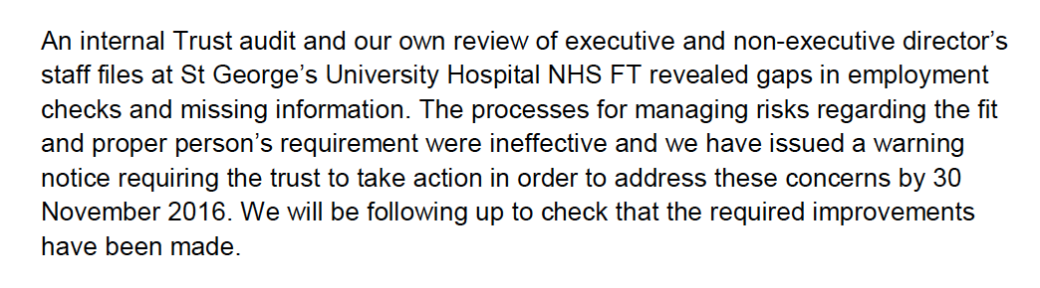
Despite reminders, the CQC has taken until now to respond to the original, outstanding FPPR referral. It had this to say today:

audit

The full letter is here: fppr-outcome-letter-cqc-21-november-2016

This raises questions about why Mike Richards concluded in February that St. George’s FPPR process was sound, and why the failings that are now acknowledged were not previously identified. Did the CQC previously only rely on what it was told by the trust? Have other FPPR referrals been mishandled by CQC due to lack of thorough checking? Why has CQC reduced FPPR to a bureaucratic exercise about compliance with process, and less about whether the right judgment was made?

The recycling of senior managers who have harmed whistleblowers sends the worst possible message to the NHS workforce, and gives licence to would-be abusers.

A letter about these issues by Clare Sardari South Devon whistleblower to St George’s governors can be found here:

Click to access clare-sardari-open-letter-st-georges.pdf

Clare Sardari tweets at @SardariClare

A complaint has now been made to the CQC about the handling of the matter, including the failure by CQC to disclose in February that it had closed down the FPPR process.

Given CQC’s comment in its latest letter that Paula Vasco-Knight was not directly employed by St. Georges but via an agency, CQC has also been asked to clarify whether it will apply FPPR equally to interim directors who are not directly employed by trusts.


RELATED ITEMS

CQC’s Fit and Proper Parade

This summarises the history of the controversy surrounding CQC’s prosecution of FPPR and provides relevant documents and correspondence.

CQC’s Fit and Proper Parade

Silent Knight

Clare Sardari’s correspondence with Robert Francis.

Silent Knight


REFERENCES

[1] Robert Francis calls for regulation of senior managers. Health Service Journal Shaun Lintern 9 November 2016

https://www.hsj.co.uk/topics/workforce/exclusive-robert-francis-calls-for-regulation-of-senior-managers/7013089.article

[2] Ex Torbay Hospital worker awarded £230,000 compensation after ‘nepotism’ row, HE Paul Greaves, Herald Express 19 July 2015

http://www.torquayheraldexpress.co.uk/ex-torbay-hospital-worker-awarded-230-000/story-27443632-detail/story.html

[3] Devon Health boss Dr Paula Vasco-Knight resigns, BBC 30 May 2014

http://www.bbc.co.uk/news/uk-england-devon-27636112

[4] Health boss Paula Vasco-Knight suspended over finance claims, BBC 4 May 2016

http://www.bbc.co.uk/news/uk-england-devon-36204798

[5] Former South Devon NHS boss denies £20K fraud

http://www.bbc.co.uk/news/uk-england-devon-36622340

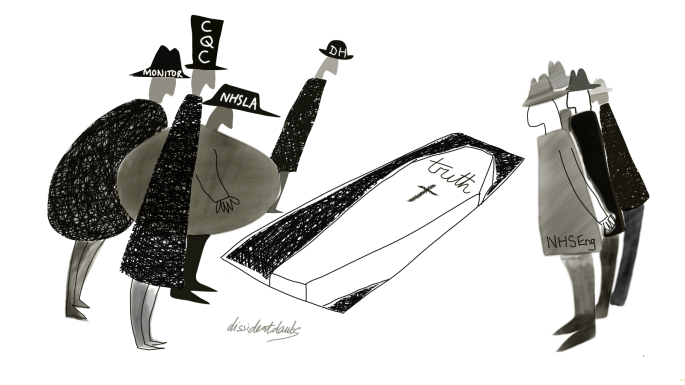
DH, Robert Francis’ National Guardian and the dark art of delay

By Dr Minh Alexander NHS whistleblower and former consultant psychiatrist 21 November 2016

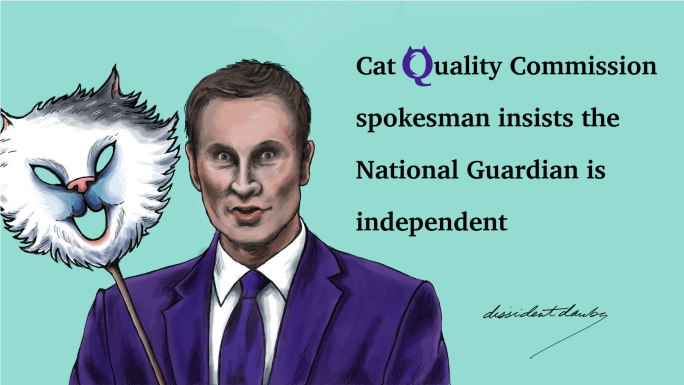
The powerless National Guardian’s office for NHS whistleblowing is Robert Francis’ brainchild. It is an expensive but rickety exercise in PR. It is not evidence based and is built on unstable sands of useless whistleblower legislation, un-remedied rotten culture and brazen impunity for those who have orchestrated cover ups and reprisal but who still prosper and roam free. In an important parliamentary debate in July about NHS failure and continuing whistleblower suppression, Ben Gummer Under-secretary of State for Health held that the government had taken adequate action by creating the National Guardian’s office. I subsequently asked Mr Gummer how the DH would track and evaluate the effectiveness of the office. Four months on, the DH reply so far amounts to “We will have meetings with the CQC”. A lack of evaluation would help the government to continue its can-kicking on whistleblowing reform.

An important parliamentary debate took place in July, which revealed that the NHS continues to make exactly the same errors that led to the Mid Staffs disaster.

The debate revolved around events at the very troubled Liverpool Community Health NHS Trust (LCH), which in its haste to please regulators and achieve Foundation status had made impossibly harsh, unsafe cuts. The trust suppressed staff concerns and it neglected clinical quality and safety. Regulators were slow to respond to the failings. Even after all the serious failings had been fully revealed, regulators behaved in an underhanded way to help recycle senior trust managers, even to the extent of misleading local MP Rosie Cooper:

https://hansard.parliament.uk/commons/2016-07-13/debates/16071339000002/CapsticksReportAndNHSWhistleblowing

capsticks-report-on-lch

For all the hot air and political capital that Jeremy Hunt has made out of MidStaffs, LCH is an important example and proof of the fact that the NHS and senior officials have not genuinely learnt the lessons of Mid Staffs.

Ben Gummer Under-secretary of State for Health attended the LCH debate and pointed to the establishment of a National Guardian for NHS whistleblowing as evidence of government action.

After the debate I asked Mr Gummer how the DH planned to evaluate and track the effectiveness National Guardian’s office.

I would be grateful if the DH would share its plans for evaluating and tracking the effectiveness of the National Guardian model…”

letter-to-ben-gummer-re-ng-15-july-2016

You might think this was a fair question. The DH has now had 21 months to think about it. It is also a crucial question as the role is not supported by any evidence base.

However, four months after the question was asked, the best that the DH can do is:

Response from Department of Health 18 November 2016

Dear Dr Alexander, 


Thank you for your email of 15 July to Ben Gummer about the National Guardian.  I have been asked to reply and apologise for the lengthy delay. 

The National Guardian will lead and support a network of individuals within NHS trusts appointed as freedom to speak up (FTSU) guardians. 

The FTSU guardians will provide support and be a point of contact for those who wish to raise concerns locally.  The National Guardian will share good practice, report on national or common themes, and identify any barriers that are preventing the NHS from having a safe and open culture. The National Guardian is independent and will speak freely and honestly about where changes are needed among NHS Trusts and Foundation Trusts.

The Department of Health holds monthly assurance meetings with Care Quality Commission (CQC) Directors and quarterly accountability meetings with the Chief Executive and Chair.  The Department is finalising the Framework Agreement with the CQC, which will cover reporting and accountability arrangements with the National Guardian. 

I hope this reply is helpful.


Yours sincerely, 


James Shewbridge 


Ministerial Correspondence and Public Enquiries
Department of Health”

A question arises about whether this sketchy DH response is symptomatic of a lack of seriousness about whistleblowing governance. Why bother expending much effort on something that was never really intended to work?

I will continue to press for details.

letter-to-jeremy-hunt-re-ng-evaluation-21-november-2016

The right thing to do is to scrap the National Guardian and to protect staff with genuine reforms. However, the DH will inevitably continue playing for time and take as many years as it can to say that it is “too soon to tell if the National Guardian works”. A lack of measurement and evaluation will help the DH prolong the delay.


delay-deny


RELATED ITEMS

Hooray Henrietta

A snippet on the exploits of the latest National Guardian, her introduction of compulsory smiling for staff and views on cheerfulness, oxytocin and Love actually.

Hooray Henrietta


Clubadoodle-doo

On the lack of independence of the National Guardian’s office.

Clubadoodle-doo


No one believes Jeremy Hunt on patient safety and whistleblowers, not even his own appointees

A critique of the National Guardian’s office and report on the debacle of the previous National Guardian’s resignation two months after her appointment.

No one believes Jeremy Hunt on patient safety or whistleblowers – not even his own appointees. Unmasking the faux National Guardian Office.


The ever-anomalous CQC. Another soft-shoe shuffle around inconvenient data.

By Dr Minh Alexander NHS whistleblower and former consultant psychiatrist 18 November 2016

Summary

There is currently an unprecedented level of grave concern about the state of mental health services, which has today prompted nine past Health Secretaries to attack the government’s failures on mental health. The CQC annual community mental health survey – which measures what patients say about mental health services – was published earlier this week and presents further anomalies. It raises more questions about the validity and consistency of the CQC’s inspection ratings. The survey response rate is persistently low and the survey does not seem to distinguish well between trusts. Nor do CQC’s inspection ratings correspond reliably with survey results. Notwithstanding, the survey results support the concerns and questions by campaigners about why a particularly troubled trust, Norfolk and Suffolk NHS Foundation, has been released from special measures.


Background

Today, The Times has reported:

Every health secretary from the past 20 years has condemned the “enduring injustice” faced by patients with mental illnesses and accused the government of failing to honour pledges to help them. 

In an unprecedented intervention, the nine previous holders of the post say they are “alarmed and dismayed” that little has changed since the promise last year that the NHS would treat mental health on a par with physical problems. The last two chief executives of the health service join them in warning that “warm words” were yet to be backed by action to alleviate the suffering of families nationwide.” 

https://minhalexander.com/wp-content/uploads/2016/11/times-nine-health-secretaries-attack-government-for-failing-mentally-ill.pdf

The CQC oversees a national community mental health survey every year, in which adult patients receiving specialist mental health care in the community are sent a questionnaire about their experience of care. [1]

Mental health trusts are expected to arrange the sampling, either through “approved contractors or in house”, which introduces potential variation and bias. Data has been excluded from the survey, both this year and in the past, due to sampling deemed as flawed.

It is a costly exercise as 850 questionnaires are sent out by each trust, and two subsequent rounds of reminders, to non-responders are also sent.

However, the typical response rate is low and falls short of a target response rate of 40%. This year the overall response rate was just 28%. The range was 18.1% to 33.9%.

The response rate has not varied greatly over the years, raising questions about whether effective action has been taken to elucidate why the rate is low, or to address this.

YEAR CQC Community Mental Health Survey – rate of response
2014 29%
2015 29%
2016 28%

Source: annual community mental health survey reports

It would be useful to know if the most ill, most vulnerable or most dissatisfied patients are not responding to the survey. The CQC admits that it cannot answer this question and it implausibly claims that there is no way to find out:

However, whether we do have non-response bias is difficult to assess, as we do not have any way of knowing how those people who did not respond would have answered.”

One hopes the survey in its current form and current execution is not hiding the full extent of problems.

Things are bad enough as it is. The annual surveys have repeatedly revealed serious problems with mental health care, as might be expected from chronic underfunding and the second class status of mental health services. A persistently serious finding is how dissatisfied patients are with crisis care. Crisis resolution and home treatment teams have been used less as a positive, safely resourced, genuine attempt to provide less restrictive care, but more as a means of gatekeeping dwindling beds, sometimes inappropriately so and with fatal results. [2]

The survey questions are scored out of ten (0 being worst and 10 being best). Survey questions grouped into ten groups, and each group is given its own overall rating of “better”, “about the same” or “worse” than other trusts based on the scores.

CQC insists that the statistical process means that these ratings are robust and accurate:

The technique used to analyse these results allows us to identify which trusts we can confidently say performed ‘better’, ‘worse’ or ‘about the same’ when compared with other trusts.”[3]

Famous last words? It is clear from a bird’s eye view that the great majority of mental health trusts have ratings of “about the same”. This suggests that the survey and or CQC’s rating system may be rather blunt instruments, and are not very good at distinguishing between trusts:

https://minhalexander.com/wp-content/uploads/2016/11/cqc-ratings-community-mental-health-survey-scores-2015-161.xlsx

There are also conflicts with CQC’s inspection ratings. Northumberland Tyne and Wear NHS Foundation Trust (NTW) was recently pronounced “Outstanding” by CQC after an inspection led by Paul Lelliott CQC deputy chief inspector. [4] However, the community mental health survey data reportedly places it as “about the same” as other trusts, across all groups of questions. East London NHS Foundation trust (ELFT) was similarly declared “Outstanding’ [5], but is rated “about the same” as other trusts in nine out of ten of the groups of questions.

There are two noticeable exceptions in this sea of “about the sameness”. These are likely to be significant outliers particularly given the survey’s seeming tendency to lump trusts together. The two exceptions are:

2gether NHS Foundation Trust

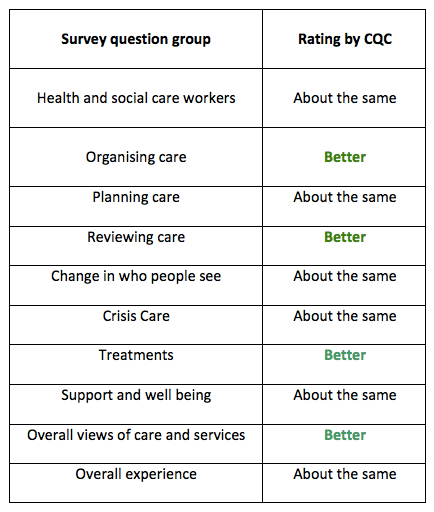
According to patients, notwithstanding the questions over the accuracy and representativeness of the survey data, and validity of CQC’s ratings, this is the best mental health trust. It scored “better” on four out of 10 groups of questions. See Table 1.

Table 1. 2gether NHS Foundation Trust Community mental health survey 2016. Summarised results:

2gether-summarised-community-mental-health-survey-2016

There are also other indications of above average performance by 2gether. For example, on the national staff survey. 2gether’s staff survey results are above average in almost all domains, more so than NTW:

https://minhalexander.com/wp-content/uploads/2016/11/2gether-and-ntw-summarised-staff-survey-results-juxtaposed.docx

However, the CQC has deemed that 2gether is not as good at NTW and ELFT – it was rated only ‘Good”, and not ‘Outstanding’. [6]

Norfolk and Suffolk NHS Foundation Trust

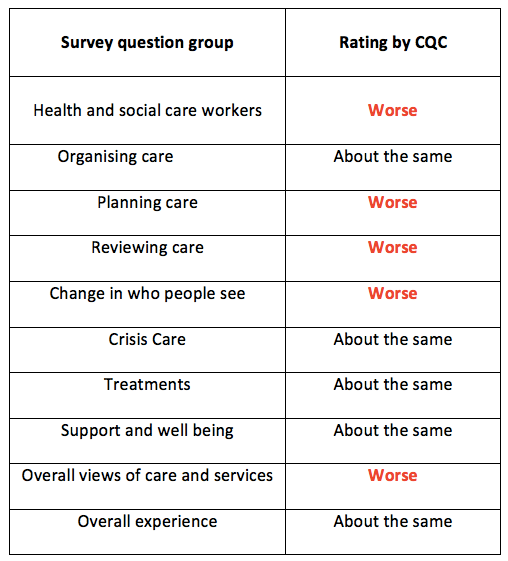
Patients have given this very troubled trust the thumbs down and it was rated “worse” than other trusts in five out of ten groups of questions. See Table 2.

Table 2. Norfolk and Suffolk NHS Foundation Trust Community mental health survey 2016. Summarised results:

nsft-summarised-results-community-mental-survey-2016

Norfolk and Suffolk suffered dangerous cuts in staffing several years ago, with a round of much publicised and controversial redundancies. It suffered disproportionately harsher cuts than acute services in the same area. The CQC admitted in February 2015 that NSFT was ‘Inadequate’ and unsafe, and the trust was placed in special measures. Curiously, the CQC inspection report of February 2015 did not give any data on trust deaths. In fact, the only mention of deaths was this misleading statement:

“Every six months the Ministry of Justice publishes a summary of Schedule 5 recommendations (previously rule 43) which had been made by coroners with the intention of learning lessons from the cause of death and preventing further deaths. In the latest report covering the period from October 2012 to March 2013 there were no concerns regarding the trust raised by the coroner”[7]

CQC omitted to mention that there had been several coroners’ warnings after March 2013. [8]

NSFT deaths have been mounting and most recently the trust management has been accused of hiding risks to patients by failing to provide details of unexpected deaths in the trust annual report. [9]

CQC recently uprated NSFT from ‘Inadequate’ to ‘Requires Improvement’, after an inspection chaired by Paul Lelliott CQC Deputy Chief Inspector. [10] Very controversially, NSFT was also released from special measures. [11] Local campaigners hope to mount a legal challenge to the trust’s release from special measures, subject to raising sufficient funds for a judicial review.

The uprating of NSFT and its release from special measures was announced shortly before Alan Yates the improvement director previously installed at NSFT [12] – by Monitor – was recycled and appointed as interim chair at another huge embarrassment to the Minister, Southern Health NHS Foundation Trust. [13]

CQC et al may live to regret putting a PR sticking plaster on the severe safety problems at NSFT.

At a rate of almost four unexpected deaths a week according to campaigners, there is only so much one can do to hide the bodies.

“Is NSFT the mental health Mid Staffs?

….Since April 2012, at least 572 NSFT patients have died unexpectedly; the number has increased every year. Based upon the first five months of 2016-17, more than 200 NSFT patients will die unexpected deaths this year, which will take the total since April 2012 above 750. NSFT claims to take the deaths of those who rely on its services seriously, but then removes their number from the trust’s document of historical record. This is shameful.” [14]


RELATED ITEMS

CQC Deaths Review: All fur coat

This is an analysis which shows that CQC inspection reports on mental health trusts have given inconsistent, incomplete and sometimes misleading safety and deaths data.

CQC Deaths Review: All fur coat….

Letter 9 September 2016 to David Behan CQC chief executive about CQC under-reporting of coroners’ warnings about mental health deaths

Letter 9 September 2016 to David Behan CQC Chief Executive on CQC under-reporting of coroners’ mental health deaths warnings

Letter 15 October 2016 to parliament: Indefensible CQC

This reports on CQC failures to safely inspect care homes or respond appropriately to coroners’ warnings and care home deaths, and to adeuqately use its investigatory powers.

Letter: Unheeded deaths warnings. Neglect. A care home owner with criminal convictions. Indefensible CQC.

REFERENCES

[1] CQC statistical release on the community mental health survey 2016

http://www.cqc.org.uk/sites/default/files/20161115_cmh16_statistical_release.pdf

CQC technical document on the community mental health survey 2016

http://www.cqc.org.uk/sites/default/files/20161115_CMH16_technical_document.pdf

CQC quality and methodology report on community mental health survey 2016

http://www.cqc.org.uk/sites/default/files/20161115_CMH16_quality_methodology.pdf

[2] Safety of patients under the care of crisis resolution home treatment services in England: a retrospective analysis of suicide trends from 2003 to 2011

http://thelancet.com/journals/lanpsy/article/PIIS2215-0366(14)70250-0/fulltext

[3] CQC statement 15 November 2016

http://www.cqc.org.uk/content/community-mental-health-survey-2016

[4] CQC inspection report 1 September 2016 on Northumberland Tyne and Wear NHS Foundation Trust

http://www.cqc.org.uk/sites/default/files/new_reports/AAAF6056.pdf

[5] CQC inspection report 1 September on East London NHS Foundation Trust

http://www.cqc.org.uk/sites/default/files/new_reports/AAAF6519.pdf

[6] CQC inspection report 27 January 2016 on 2gether NHS Foundation Trust

http://www.cqc.org.uk/sites/default/files/new_reports/AAAE5937.pdf

[7] CQC inspection report on Norfolk and Suffolk NHS Foundation Trust February 2015

http://www.cqc.org.uk/sites/default/files/new_reports/AAAA3470.pdf

[8] Concerns raised over deaths at Norfolk and Suffolk mental health service, Tom Bristow, Eastern Daily Press 29 July 2016

http://www.edp24.co.uk/news/health/concerns_raised_over_deaths_at_norfolk_and_suffolk_mental_health_service_1_4637578

[9] Protest at Norfolk and Suffolk mental health trust AGM over unexpected patient deaths data.

http://www.eadt.co.uk/news/protest_at_norfolk_and_suffolk_mental_health_trust_agm_over_unexpected_patient_deaths_data_1_4744124

[10] CQC inspection report on Norfolk and Suffolk NHS Foundation Trust 14 October 2016

http://www.cqc.org.uk/sites/default/files/new_reports/AAAF8329.pdf

[11] Norfolk and Suffolk NHS Foundation Trust out of special measures, BBC 14 October 2016

http://www.bbc.co.uk/news/uk-england-norfolk-37656958

[12] Monitor employs Improvement Director for ‘Inadequate’ Norfolk and Suffolk NHS Foundation Trust, Gemma Mitchell, East Anglian Daily Times 24 February 2015

http://www.eadt.co.uk/news/monitor_employs_improvement_director_for_inadequate_norfolk_and_suffolk_nhs_foundation_trust_1_3969591

[13] Regulator imposes new chair at Southern Health, Joe Gammie Health Service Journal 3 November 2016

https://www.hsj.co.uk/hsj-local/providers/southern-health-nhs-foundation-trust/regulator-imposes-new-chair-at-southern-health/7013038.article

[14] Deaths Crisis: NSFT AGM Protest. Is NSFT the Mental Health Mid Staffs? Campaign blog:

http://norfolksuffolkmentalhealthcrisis.org.uk/deaths-crisis-nsft-agm-protest-is-nsft-the-mental-health-mid-staffs/

Morecambe: All that glisters…

By Dr Minh Alexander NHS whistleblower and former consultant psychiatrist 15 November 2016


University Hospitals of Morecambe Bay NHS Foundation Trust has a history of cover up, whistleblower reprisal and failure to learn from serious patient harm. [1] Recently, the trust has been celebrated as an example of turnaround and NHS reform under Jeremy Hunt’s stewardship. Morecambe received much praise for its recent revelation – made to professional and system regulators – that it previously entered into a questionable settlement with a senior midwife. This included an undertaking not to investigate her:

“Following discussions between the employee and the trust, the employee has opted to take early redundancy and as a result the employer has agreed not to commence an internal investigation into the employee’s performance as maternity risk manager.” [2]

The Trust was subsequently asked if it had reached any other similar settlements. Today, it has provided only a partial answer:

“All agreements dating back to 2011 have been examined and the Trust can confirm that there are no other agreements in existence with similar undertakings not to investigate a member of staff.”

The full FOI disclose by Morecambe can be found here:

foi-response-6065-morecambe-non-investigation-clauses

Clearly, the Trust’s response does not fully answer the question. Neither did the trust disclose all relevant documents as requested.

Is it possible that there have been other settlements by the Trust, prior to 2011, that also promised not to investigate other staff?

Perhaps the CQC should break its habit of impressive inaction on NHS compromise agreements and look into this.

Assuming the DH takes its heavy foot off the brakes, that is.

But as we know, spinaround is so much easier than turnaround.


RELATED ITEMS


  1. ‘Final overarching summary report’ by Morecambe Bay 1 November 2016, from its recent internal review of of the events leading to the Morecambe Bay Investigation

https://minhalexander.com/wp-content/uploads/2016/11/foi-ref-6065-morecambe-summary-report-redacted-v1-0.pdf

  1. Morecambe and wise counsel 17 October 2016

A less rosy look at Morecambe, from whistleblowers’ perspective

https://minhalexander.com/2016/10/17/morecambe-and-wise-counsel/

  1. NHS Gagging. How CQC sits on its hands 23 September 2016

An analysis, with other audit trail, that shows that the CQC has been bending over backwards not to review any NHS providers’ compromise agreements, despite claiming that it would.

https://minhalexander.com/2016/09/23/nhs-gagging-how-cqc-sits-on-its-hands-2/

REFERENCES

[1] The report of the Morecambe Bay Investigation. An independent investigation into the management, delivery and outcomes of care provided by the maternity and neonatal services at the University Hospitals of Morecambe Bay NHS Foundation Trust from January 2004 to June 2013. Published March 2015.

https://www.gov.uk/government/uploads/system/uploads/attachment_data/file/408480/47487_MBI_Accessible_v0.1.pdf

[2] ‘Irregular’ pay off deal revealed at scandal hit trust. Shaun Lintern Health Service Journal 12 October 2016

https://www.hsj.co.uk/topics/workforce/exclusive-irregular-payoff-deal-revealed-at-scandal-hit-trust/7011428.article#.V_4pn-eSr-c.twitter


Coroners’ warnings: terminal inexactitude and CQC opacity

By Dr Minh Alexander NHS whistleblower and former consultant psychiatrist 11 November 2016


Summary

The Care Quality Commission’s purported transformation is a central plank in Jeremy Hunt’s claims of NHS reform and focus on patient safety. However CQC has not been revealing the full extent of unmet need and harm. [1] [2] Of great importance, CQC failed to reveal hundreds of deaths that had not been investigated by Southern Health Foundation Trust. [3] There have also been repetitions of Winterbourne View type failures [4] [5], despite new CQC leadership being installed in 2012. Two days ago, another Panorama undercover investigation into care failings emerged. [6] The CQC has also previously failed to report and act on coroners’ warnings about deaths [7], with little sign of improvement based upon a recent check. [8] The CQC has also given conflicting dates for when its memorandum of understanding with coroners was established. This has clouded issues of accountability. An analysis of coroners’ data shows that CQC has been sent 206 coroners’ Reports to Prevent Future Deaths (PFDs) since July 2013. Almost three quarters of the PFDs sent to CQC featured NHS organisations. However, there was published evidence of a CQC response in only nine (4.3%) of the 206 cases. Even when PFDs were directly addressed to CQC as a named respondent, only a fifth were apparently answered by CQC. The PFD reports reveal many serious risks to service users. Some shocking case examples are provided. It is troubling that CQC has not demonstrated a consistent response to the PFDs, or evidence of analysis of such serious matters. It is also evident that CQC inspection reports do not consistently and fully reflect coroners’ warnings. Greater transparency is needed about how CQC has used – or not used – vital intelligence from coroners.


Background

Coroners’ PFD reports (formerly known as Rule 43 reports) are warnings about risks to life, which are only exceptionally issued. The risks usually relate to the deaths reviewed by coroners, but other risks that are incidentally discovered are also reported. PFDs represent a small proportion of the many thousands of cases in which inquests are opened every year:

Table 1. Number all of coroners’ inquests opened in recent years:

YEAR NUMBER OF INQUESTS OPENED IN ENGLAND AND WALES
2013 29,942
2014 25,899
2015 32,857

Source: Coroners’ statistics 2013, 2014, 2015 [9]


Only some of the PFDs are sent to the CQC, reflecting considerable concern by coroners. An effective regulator would reasonably be expected to investigate further.

In a report published in February 2015, CQC stated that it had reached a memorandum of understanding (MoU) with coroners in 2014, and that it had started receiving PFDs on deaths in any health and care settings, which it was passing to inspectors. [10]

In September 2015 after CQC was criticised for failing to respond to coroners’ warnings about care home deaths, the CQC changed its story and claimed that it only had a “proposed and drafted” MoU with coroners. [11]

When questioned this September about gross under-reporting of mental health PFDs [12], CQC claimed that its MoU with coroners had not covered the period 2014/15. [13]

When questioned last month by Disability News about the evidence of continuing failures to respond to coroners’ warnings about care home deaths, CQC maintained its claim that the MoU was not established until November 2015. [14]

Questions arise about why CQC has given conflicting accounts. Notwithstanding, PFD data is openly available to the public and CQC could easily have availed itself of coroners’ warnings about regulated bodies. [15]


Analysis and case examples

Review of published coroners’ PFD reports shows that 206 PFDs have been sent to the CQC about regulated bodies since July 2013. NHS organisations featured in 152 (73.4%) of the PFDS.

The PFDs related to 76 NHS providers, 46 social care providers – all private – and 11 private healthcare providers.

18.9% (39) of the PFDs were directly addressed to CQC and not just copied.

7.2% (15) of the PFDs were sent to CQC board members (13 to David Behan CQC chief executive, one to David Prior CQC Chair and one to Mike Richards, CQC Chief Inspector of Hospitals).

Table 2. Since July 2013, the providers that were most often reported to CQC by coroners were as follows:
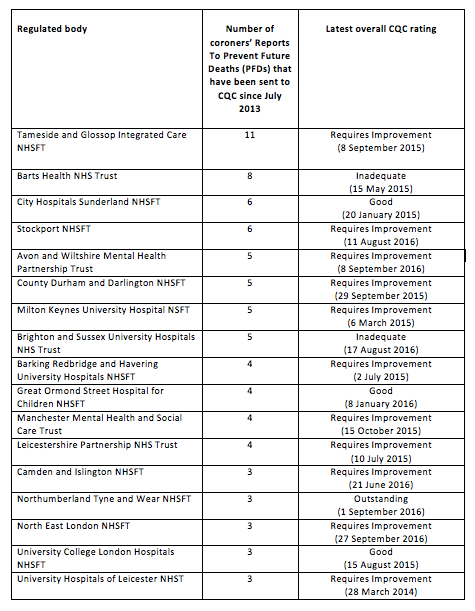
table-providers-most-often-reported-to-cqc-by-coroners

CQC’s most recent inspection reports on 12 of the above 17 NHS trusts did not mention coroners’ PFDs, despite CQC being sent PFDs about these trusts prior to the issue of CQC’s inspection reports. Deaths were not mentioned at all in CQC’s reports about City Hospitals Sunderland NHS Foundation Trust and Leicestershire Partnership Trust. CQC’s report on troubled Brighton and Sussex University Hospitals NHS Trust noted the rate of some deaths in the local population but was silent on deaths of trust patients, besides commending end of life arrangements. CQC rated University College London Hospitals NHS Foundation Trust as ‘good’, without providing any data on deaths of trust patients and without mentioning that it had been subject to PFDs. Where CQC mentioned PFD reports, it stated that PFDs had been “submitted” or reported by trusts, which implies that CQC perhaps relies on trusts to tell it about PFDs. [16]


The full data on the coroners’ PFDs that have been sent to CQC since July 2013 can be found here:

cqc-pfds-since-july-2013-as-of-9-11-2016

Some individual failings by staff featured in the 206 PFDs sent to CQC but more often, coroners have described systems failings. Risk factors such as absence or inadequacy of policies and procedures, inadequate staff training, numbers and supervision, design flaws in premises and equipment, shortage of equipment, poor investigations and cover ups were described by the PFDs. Failures by providers to learn from repeated serious incidents and prior coroners’ findings were noted:

“This is a repetition of similar circumstances in a number of previous Inquests and I think the Trust needs to be assessed independently.” [17]

There were serious signs of service strain in the PFDs sent to CQC. For example after one death, it was revealed that the practice in one area was not to conduct Mental Health Act assessments when a need was identified, but to defer assessments until beds were available. In effect, serious risk and unmet need had been normalised. [18]

In total, there is only a published CQC response to nine (4.3%) of the 206 coroners’ warnings sent to CQC. There is no published evidence of a CQC response to 31 (79%) of the 39 PFDs that were directly addressed to CQC.

The PFDS that were apparently unanswered by CQC included grave cases. I give below four examples:

  1. Death of Jack Molyneux following care by Brighton and Sussex University Hospitals NHS Trust

https://www.judiciary.gov.uk/publications/jack-molyneux/

Mr Molyneux had Alzheimer’s dementia and needed all care, but did not receive it from the trust. The coroner reported that when he was discharged from hospital to a care home, the care home “immediately raised a Safeguarding concern on grounds of neglect”.

The coroner wrote in his report of 29 April 2016, copied to Jeremy Hunt, Simon Stevens and CQC:

“I believe this to be one of the most disturbing cases of sub-optimal care that I have come across recently, and I am not at all satisfied that this inquest will result in any effective action being taken which is why I am concerned to follow up this matter and to ensure that all those who should know about this situation are informed”

 The subsequent CQC inspection report of 17 August 2016 failed to reveal that coroners’ PFDs had been issued, and did not give any data on the deaths of trust patients. On Safeguarding, CQC only noted that the trust had not met its own target for training:

“The trust had a safeguarding vulnerable adults and children policy, and guidelines were readily available to staff on the intranet and staff were able to access this quickly. However, safeguarding training for all staff groups was lower than the Trusts target.”


  1. Death of Patricia Cleghorn under the care of Birmingham and Solihull Mental Health Trust

https://www.judiciary.gov.uk/publications/patricia-cleghorn/

The Nursing Times recently reported on Mrs Patricia Cleghorn’s death shortly after being given a small dose (5mg) of diazepam, a sedative, by an unsupervised healthcare assistant. [19] She was under the care of the trust’s Home Treatment Team. This was because a need for hospital admission had been identified, but no mental health beds were available. The coroner concluded that she died of an intentional overdose and observed in his report of 25 July 2016:

“She was allowed to self-medicate drugs including amitriptyline and morphine, despite repeatedly stating she would take her life through an overdose”

This coroner’s PFD was addressed to the trust, the Department of Health, NHS England and CQC. These bodies were expected to respond to the coroner by 20 September 2016. There is no published response yet by any of these bodies.


  1. Death of Mohammed Chaudhury following care by King’s College Hospital NHS Foundation Trust

https://www.judiciary.gov.uk/publications/mohammed-chaudhury/

Mr Chaudhury required hospital care after a road traffic collision, initially in intensive care. He later developed several infected pressure sores whilst on a step down ward at King’s College Hospital. The coroner concluded that this was because he was not nursed on an air mattress and there had been insufficient staff to turn him as needed. He was transferred to a nursing home with “five pressure sores between grades 2 and 4, which were septic”. The coroner remarked that the pressure sores were “unusual in extent and severity” and concluded that they may have been a cause of death.

The coroners’s report of 20 August 2013 was addressed to Tim Smart then chief executive of King’s and Mike Richards CQC Chief Inspector. It was also copied to Jeremy Hunt. The deadline for responses was 1 October 2013. There is no published response from the trust, the CQC or the Department of Health.


  1. Death of Neil Carter under the care of Priory Roehampton

https://www.judiciary.gov.uk/publications/neil-carter/

Mr Carter was an inpatient at the Priory Roehampton, a private mental health hospital, when he took his own life. The coroner’s report of 5 March 2014 was addressed to the Priory Group and CQC. The coroner noted:

“There were gross failures in his care, notably the failure to perform basic observations followed by falsification of the record”

Despite this report of serious care failure and cover up, there is no published response by the CQC.

CQC’s inspection report of September 2014, from an inspection on 20 August 2014, made no reference to the coroner’s findings. Its inspection report did not mention deaths at all.

In short, many questions arise about the extent to which the CQC is acting upon and revealing evidence about serious risk to patients. I will submit the above data to parliament.

I invited the CQC’s comment three days ago, via its press office, on why there are apparently only a handful of CQC responses to coroners’ warnings and to explain its so far conflicting dates for its MoU with coroners.

I have not yet received a substantive response from the CQC at the time of writing, but will update this report if a response is provided.


REFERENCES

[1] How safe are NHS patients in private hospitals. Prof Colin Leys and Prof Brian Toft, Centre for Health and the Public Interest December 2015

https://chpi.org.uk/wp-content/uploads/2015/12/CHPI-PatientSafety-Dec15.pdf

[2] CQC Deaths Review: All Fur Coat. Minh Alexander

https://minhalexander.com/2016/09/25/cqc-deaths-review-all-fur-coat/

[3] Mazars report of Independent review of deaths with a Learning Disability or Mental Health problems in contact with Southern Health NHS Foundation Trust from April 2011 to March 2015

https://www.england.nhs.uk/south/wp-content/uploads/sites/6/2015/12/mazars-rep.pdf

[4] Orchid View Inquest: Home riddled by ‘institutional abuse’, BBC 18 October 2013

http://www.bbc.co.uk/news/uk-england-sussex-24579496

[5] Staff sackings and suspensions over poor elderly care. Alison Holt, BBC 30 April 2014

http://www.bbc.co.uk/news/uk-england-sussex-24579496

Old Deanery whistleblowing proves system does not work, says campaigner

http://www.gazette-news.co.uk/news/local/braintree/11183546.Old_Deanery_whistleblowing_proves_system_does_not_work__says_campaigner/

[6] Care Home closed after BBC investigation, Natasha Swift, St. Austell Voice 9 November 2016

http://www.staustellvoice.co.uk/news/73/article/5971/

[7] Elderly people put at risk as watchdog fails to act on warnings of ‘fatally negligent’ care homes

http://www.independent.co.uk/life-style/health-and-families/health-news/elderly-people-put-at-risk-as-watchdog-fails-to-act-on-warnings-of-fatally-negligent-care-homes-10483573.html

[8] Care home deaths and more broken CQC promises

https://minhalexander.com/2016/10/08/care-home-deaths-and-more-broken-cqc-promised/

[9] Coroners’ statistics for England and Wales 2013,2014,2015

https://www.gov.uk/government/uploads/system/uploads/attachment_data/file/311465/coroners-bulletin-2013.pdf

https://www.gov.uk/government/uploads/system/uploads/attachment_data/file/427720/coroners-statistics-2014.pdf

https://www.gov.uk/government/uploads/system/uploads/attachment_data/file/525916/coroners-statistics-annual-2015-england-and-wales.pdf

[10] CQC Mental Health Act monitoring report 2013/14 and associated press release 5 February 2015

http://www.cqc.org.uk/content/new-report-published-looking-use-mental-health-act-201314

[11] CQC press release 3 September 2015

http://www.cqc.org.uk/content/cqc-response-story-independent

[12] Letter to David Behan CQC chief executive 9 September 2016

https://minhalexander.com/2016/09/25/letter-9-september-2016-to-david-behan-cqc-chief-executive-on-cqc-under-reporting-of-coroners-mental-health-deaths-warnings/

[13] Letter from Paul Lelliott CQC Deputy Chief Inspector 26 October 2016
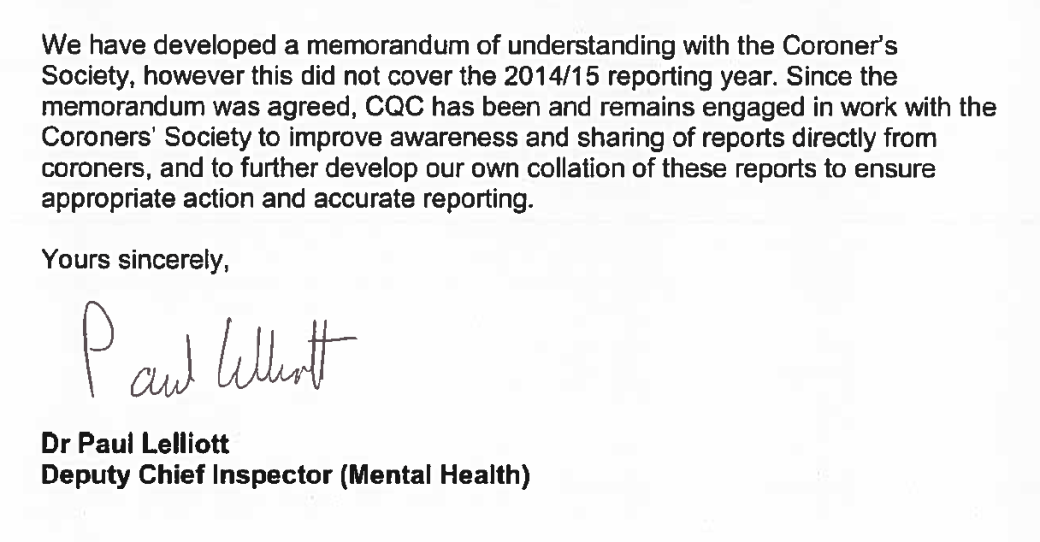
paul-lelliott-letter

[14] Care watchdog ‘fails to follow up on coroners’ warnings. John Pring. Disability News, 27 October 2016

http://www.disabilitynewsservice.com/care-watchdog-fails-to-follow-up-on-coroners-death-warnings/

Statement by Andrea Sutcliffe CQC Chief Inspector 27 October 2010:

We have previously acknowledged that our handling of reports from Coroners has not been sufficiently effective which is why we carried out an internal review in 2014, introduced new procedures in 2015 and established a formal agreement with the Coroner’s Society in November 2015.” 

[15] Chief Coroner’s published data on Reports to Prevent Future Deaths

https://www.judiciary.gov.uk/related-offices-and-bodies/office-chief-coroner/pfd-reports/

[16] Summary table of information about PFDs in CQC reports on the providers that were most often reported to CQC by coroners:

summary-table-of-information-about-pfds-in-cqc-reports-on-the-trusts-that-were-most-often-reported-to-cqc-by-coroners

[17] Report to Prevent Future Deaths. Kathleen Dixon:

https://www.judiciary.gov.uk/publications/kathleen-rosemary-dixon/

[18] Report to Prevent Future Deaths. Rohan Fitzsimons.

https://www.judiciary.gov.uk/publications/rohan-fitzsimons/

[19] Trust admits neglect after patient died when unsupervised HCA administered drug, Rebecca Thomas Nursing Times 3 November 2016

https://www.nursingtimes.net/news/reviews-and-reports/patient-died-after-unsupervised-hca-gave-drug-says-trust/7013019.article
 

Does PHSO go easier on the big boys?

By Minh Alexander NHS whistleblower and former consultant psychiatrist 4 November 2016

The Parliamentary and Health Service Ombudsman’s (PHSO) role in protecting NHS organisations from proper accountability has been questioned by many.

In its recent report “Learning from mistakes”, the PHSO seems avoidant of acknowledging NHS cover ups, or their political roots. In the case of three year old Sam Morrish’s death, PHSO’s tortuous language and logic draws an implausible distinction between “total unwillingness” by organisations to accept they are wrong, and cover up.

PHSO’s report focuses on lack of investigatory competence by NHS organisations, rather than obstinate, repeated failures of enforcement of good investigation practice by the DH and its arms length bodies.

Does the PHSO treat NHS overlords more lightly than the rank and file of NHS bodies?

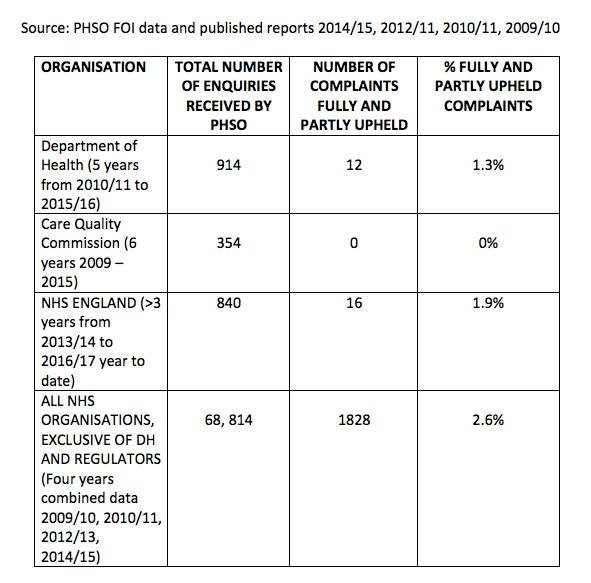
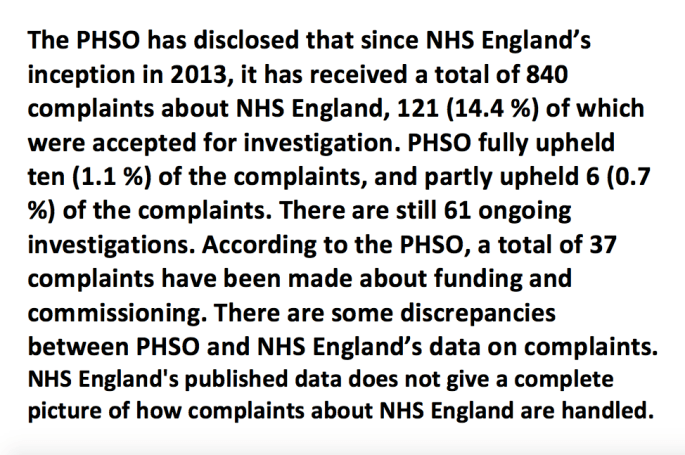
FOI data shows a low uphold rate (upheld and partly upheld complaints) of 1.3%, 1.9% and zero for complaints against the DH, NHS England and CQC, respectively.  [1] [2] [3]

There is not a complete dataset published by PHSO to precisely calculate how these rates compare to the overall average for all NHS bodies. The data that exists raises the possibility that PHSO may be less likely to uphold complaints against the DH and its arms length bodies than other NHS bodies. In rough terms the 4 years of PHSO published data on its handling of complaints about all NHS bodies [4], bar DH and regulators, yield an overall uphold rate of 2.6%.

      RATE OF COMPLAINTS UPHELD BY PHSO:

phso-upheld-rates-dh-nhse-cqc

I have submitted this data to parliament as part of evidence to Public Administration and Constitutional Affairs Committee’s follow up inquiry on PHSO’s report “Learning from Mistakes”, which can be summarised thus:

“BY EMAIL

Public Administration and Constitutional Affairs Committee 

4 November 2016

Dear Mr Jenkin and colleagues,

Submission to PACAC inquiry on PHSO and NHS investigations

Please find attached my submission to PACAC’s follow up inquiry on PHSO’s report about NHS investigations, “Learning from Mistakes”.

I lay out evidence to argue that PHSO needs to acknowledge and grasp more firmly the fact that cover ups whether by omission or commission, and not just lack of investigatory competence, are a major factor in failures of NHS learning. 

I ask PACAC to support substantive reform of whistleblower protection, and also the Hillsborough Law (Public Authorities Accountability Bill) which seeks criminal penalties for cover ups by public servants.

I suggest that the PHSO is avoidant of the fact that NHS cover ups come from the top. I also add some data which, although incomplete, raises questions about whether the PHSO is more lenient in its handling of complaints about the Department of Health and its arms length bodies – pages 4 and 5.

I have also submitted this evidence via the PACAC web portal.

Yours sincerely,

Dr Minh Alexander

cc Meg Hillier Chair of Public Accounts Committee

     Sarah Wollaston Chair of Health Committee”

RELATED ITEMS

DH complaints handling

Do “Complaints Matter” to CQC?

FOI disclosure 26 October 2016 by PHSO on complaints made about NHS England

PHSO FOI disclosure 21 September 2015 on handling of complaints: PHSO has the CQC’s back

REFERENCES

[1] PHSO FOI disclosure: complaints about DH 2010/11 to 2015/16

https://minhalexander.com/wp-content/uploads/2016/11/foi-disclosure-by-the-phso-about-complaints-against-dh-1-november-2016.pdf

[2] PHSO FOI disclosure: complaints about NHS England 2013/14 to 2016/17 year to date

https://minhalexander.com/wp-content/uploads/2016/10/phso-foi-disclosure-complaints-about-nhs-england.pdf

[3] PHSO FOI disclosure: complaints about CQC 2009-2015

https://minhalexander.com/wp-content/uploads/2016/09/phso-foi-response-re-complaints-about-cqc-21-september-2015.pdf

[4] PHSO data on all NHS complaints 2014/15

http://www.ombudsman.org.uk/reports-and-consultations/reports/health/complaints-about-health-organisations-for-the-year-2014-15

PHSO data on all NHS complaints 2012/13

http://www.ombudsman.org.uk/reports-and-consultations/reports/health/nhs-complaints-handled-by-the-ombudsman-service-in-2012-13

PHSO data on all NHS complaints 2011/12

http://www.ombudsman.org.uk/listening-and-learning-2012/overview/complaints-about-the-nhs-in-2011-12

PHSO data on all NHS complaints 2010/11

http://www.ombudsman.org.uk/__data/assets/pdf_file/0019/12286/Listening-and-Learning-Screen.pdf

DH complaints handling

By Dr Minh Alexander NHS whistleblower and former consultant psychiatrist and Maha Yassaie NHS whistleblower and former chief pharmacist, 2 November 2016


The Department of Health (DH) has been telling everyone for years what good complaints handling looks like. The Mid Staffs Public Inquiry reinforced the importance of good complaints governance to patient safety and crucially, the need for organisations to learn from complaints and to transparently disseminate the learning. The DH accepted this. [1] However, there is little evidence that the DH has applied these complaints handling standards to itself. The DH has admitted via FOI that it has not categorised or analysed complaints, and has not measured complainants’ experience. The DH seems to have paid little attention to the narrative of complaints (Recommendation 40 Mid Staffs Public Inquiry). FOI data from the Parliamentary and Health Service Ombudsman (PHSO) shows that an increasing number of complaints against the DH have been investigated, but few are upheld. The lack of good role modelling and accountability by the DH is damaging to culture, and surely sends a message to the rest of the NHS that rhetoric about good complaints handling is more display than action.

In its first response to the Mid Staffs Public Inquiry report, the DH stated:

“2.53 The system must learn and improve from general feedback and from any complaints and concerns raised by patients, service users, families and carers. Complaints can be an early symptom of a problem within an organisation.” [1]

In its subsequent report Hard Truths, the DH drew up a long shopping list of things that NHS boards should do when handling complaints. This placed an emphasis on understanding and analysing the content of complaints:

“We want Boards to see regular data about complaints which means the ‘narrative and not just the numbers’, so they can identify themes and recurring problems, and take action.”[2]

 The DH has also signed up to the PHSO’s good practice principles for complaints handling, which included tracking complainants’ experience for specific outcomes:

“…they [complainants] feel confident in the system, that it worked for them and would for others too, and that they would feel willing and able to voice their concerns again”. [3]

 However, the DH’s occasional reports about its complaints performance since 2010 are dry affairs, all about numbers and whether response times are compliant. [4] Neither does there appear to be a full set published – no such reports are evident after 2013, despite the public show of intensified interest in complaints from 2013 onwards. The numbers given also seem rather low – no more than 32 complaints a year. Of note, these DH reports have disclosed only what the DH calls “formal” complaints. This may obscure a proportion of the complaints that have been made. The reports contain nothing about the nature of the complaints nor the experience of the people who made them.

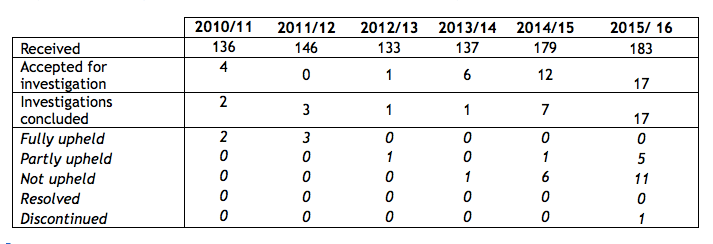
However, there seem to be quite a few unhappy people who went on to complain to the PHSO about the DH. FOI data from PHSO reveals that it received a total of 914 enquiries about the DH from 2010/11 onwards, of which, only five (0.5%) complaints were upheld and seven (0.7%) complaints were partly upheld. [5]

  phso-dh

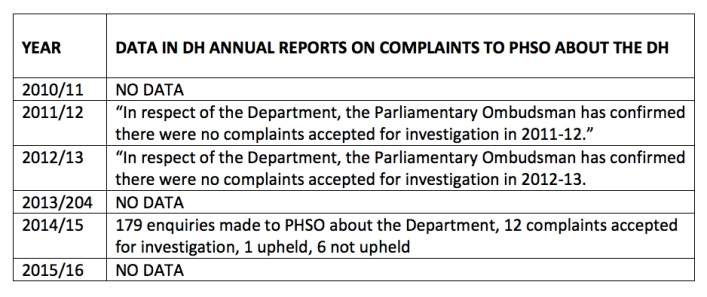
The DH itself has been coy about these complaints to the PHSO. The DH has reported very little complaints data in its annual reports, giving full figures on PHSO complaints for only one year and no data at all in some years:

annual-reports-dh

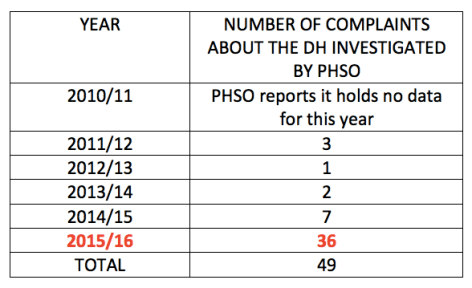
Interestingly, PHSO’s data on the number of complaints about the DH that were investigated shows a significant rise in 2015/16:

phso-dh-numbers

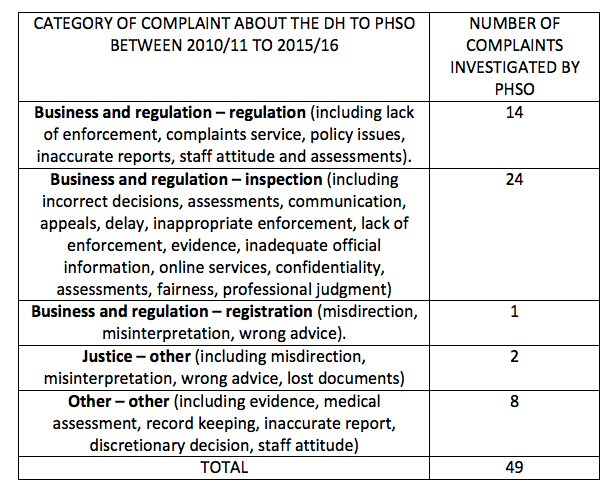
The DH’s annual reports give absolutely nothing away about why people have complained to PHSO. PHSO’s data shows that the majority of the complaints investigated related to ‘regulation’ or ‘inspection’:

dh-nature

There appears to be no learning by the DH from complaints. An enquiry about the DH’s complaints governance resulted in a woefully threadbare reply. [6] The DH admitted in this response that:

  • The DH has not categorised complaints
  • The DH has not undertaken any central analysis of the complaints that it has received since 2010
  • The DH has not evaluated the experience of complainants and has not surveyed complainants to this end.


One of the authors of this article, Maha Yassaie, was advised to complain to the PHSO about the DH. This was because the DH mishandled her whistleblowing case and subsequently refused to account. The potted background is thus:

 Maha Yassaie raised concerns about patient safety, the improper handling of controlled drugs and issues of probity. She subsequently experienced serious detriment, including counter-allegations and an investigation in which the trust’s appointed investigator was later discovered to have coached the witnesses against her. [7] She made a claim to the Employment Tribunal (ET) against her former employer, which was eventually settled at a very high sum of £375K. In the process, she received a letter of apology from the DH on behalf of the NHS. However, she has since been blacklisted [8] and was also put through a gruelling Fitness To Practice process on the basis of her former employer’s original allegations. [9] Despite the DH’s prior acknowledgment that she was unfairly treated, the DH – and specifically Jeremy Hunt – were impervious to her appeals for protection from this further detriment. [10] The DH has also since claimed that it does not hold some of the key documents containing her personal data, even though it was previously the source of disclosed documents for her ET case. The DH has also refused to help correct misleading records that contribute to her blacklisting. Due to these difficulties of progressing various issues with the DH, Maha Yassaie was advised to complain to the PHSO about the DH.

What do readers think of Maha’s chances if she complains, as advised?

Over two years ago, the DH told NHS boards:

“We want to see Trust Chief Executives and Boards taking personal responsibility for complaints handling.” [2]

 So, is Mr Hunt ultimately responsible for the DH’s lack lustre complaints performance? Mr Hunt has made much capital of Mid Staffs, but he does not seem to have paid much heed to Recommendation 40 of the Mid Staffs public inquiry:

“It is important that greater attention is paid to the narrative contained in, for instance, complaints data, as well as to the numbers.”


delay-deny


RELATED ITEMS

Do “Complaints Matter” to CQC?

PHSO FOI disclosure 21 September 2015 on handling of complaints: PHSO has the CQC’s back

FOI disclosure 26 October 2016 by PHSO on complaints made about NHS England

REFERENCES

[1] Patients First and Foremost. Initial government response to the Mid Staffs Public Inquiry. DH March 2013

Complaints, their source, their handling and their outcome provide an insight into the effectiveness of an organisation’s ability to uphold both the fundamental standards and the culture of caring. They are a source of information that has hitherto been undervalued as a source of accountability and a basis for improvement. Learning from complaints must be effectively identified, disseminated and implemented, and it must be made known to the complainant and the public, subject to suitable anonymisation.”

 [2] Hard Truths. The Journey to Putting Patients First. DH January 2014

https://www.gov.uk/government/uploads/system/uploads/attachment_data/file/270368/34658_Cm_8777_Vol_1_accessible.pdf

[3] My expectations for raising concerns and complaints. PHSO November 2014

http://www.ombudsman.org.uk/__data/assets/pdf_file/0007/28816/Vision_report.pdf

[4] DH complaints performance reports

https://www.gov.uk/government/uploads/system/uploads/attachment_data/file/213648/Complaints-performance-January-2013.pdf

https://www.gov.uk/government/uploads/system/uploads/attachment_data/file/252709/Complaintsperformancewebpagefornewsite_June_13.pdf

[5] FOI disclosure 1 November 2016 by PHSO on complaints to PHSO about the DH

foi-disclosure-by-the-phso-about-complaints-against-dh-1-november-2016

foi-disclosure-by-phso-1-nov-2016-data-on-dh-complaints-investigated-fdn-271744

[6] FOI disclosure 31 October 2016 by DH on its complaints governance

dh-foi-disclosure-31-october-2016-complaints-governance-foi-1053421-reply

[7] Whistleblower told she was ‘too honest’ to work for the health service, Lyndsey Telford et al, Telegraph 3 April 2016

http://www.telegraph.co.uk/news/2016/04/03/nhs-whistle-blower-told-she-was-too-honest-to-work-for-the-healt/

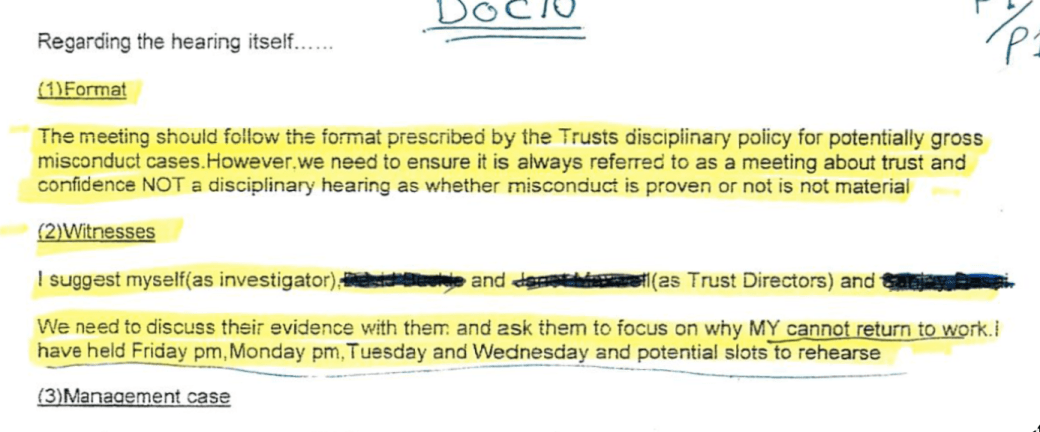
This is the relevant correspondence by the trust’s appointed investigator from Capsticks. In this correspondence it was proposed that witnesses should focus on why Maha Yassaie “cannot return to work” and speak always of “trust and confidence”. This correspondence also refers to arranging meetings in which the witnesses could “rehearse” their evidence:


cheatle

[8] Whistleblowers being ‘blacklisted by NHS’ as staff records state they were dismissed despite even after being cleared after tribunal, Camilla Turner 20 August 2016

http://www.telegraph.co.uk/news/2016/08/20/whistleblowers-being-blacklisted-by-nhs-as-staff-records-state-t/

[9] Press statement by Maha Yassaie 15 October 2016

http://mahayassaie.weebly.com/

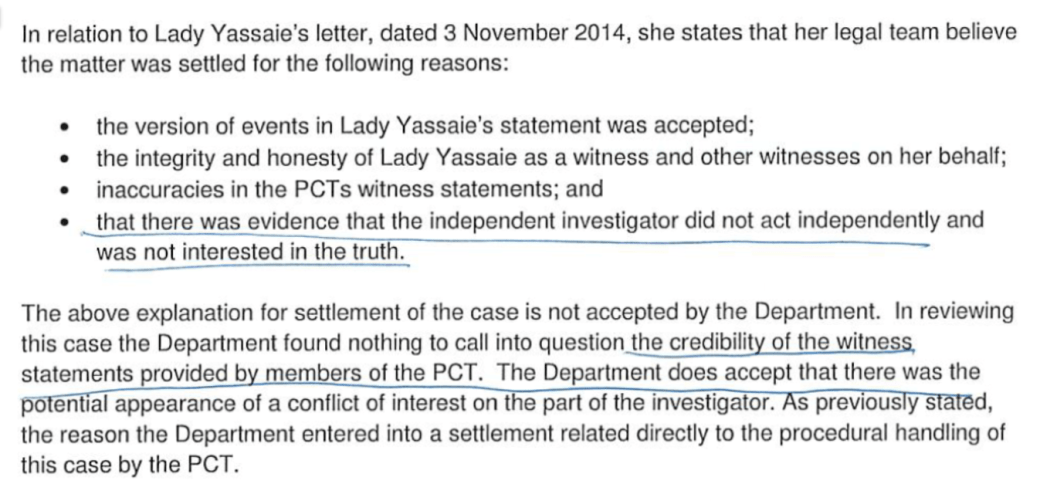
[10] From a letter by the DH of 18 February 2015 to the General Pharmaceutical Council, refuting that witness evidence against Maha Yassaie was ever found to be unreliable:

dh-maha-witness

This is despite the fact that the DH had been in possession of a statement which noted that some of the witness evidence against Maha Yassaie had been excluded due to a problems with a witness:

unreliable-witness

Jeremy Hunt wrote a letter on 16 December 2015 denying that the DH had got it wrong about Maha Yassaie. It ended with a note that he remained committed to creating a culture in which NHS staff would feel able to speak up, which was not much comfort to Maha Yassaie as she contemplated the Fitness to Practice hearing ahead of  her:

hunt-maha


Letter to parliament: CQC’s inconsistent regulation of restraint in mental health


The Department of Health often launches snazzy initiatives – bestrewn with ‘champions’ and ‘guardians’-  in response to failings being exposed. But when the cameras move on, little improves because root causes are not tackled. Excessive use of restraint by highly stressed mental health services is one of a long line of issues that has had the DH treatment, complete with champions . However, cuts to mental health services have continued and recorded incidents of restraint in mental health trusts have in fact increased from over 39,883 incidents in 2011/12 to over 66,681 incidents in 2015/16. The NHS has contended that this is due to better recording, but there are still gaps in the data provided by trusts via FOI and when trusts’ records are inspected. The increase in recorded episodes of restraint has been revealed by FOI data and not by the CQC, which has again not been fully accountable to the public. CQC’s reports do not give a full picture. Evidence about this has been submitted to parliament as follows:


BY EMAIL

To Health Committee 31 October 2016

Dear Dr Wollaston and colleagues,

Inconsistency in CQC’s regulation of the use of restraint in mental health services

I write to submit additional evidence for the forthcoming CQC accountability hearing of what I perceive to be arbitrariness by the CQC. The recent rating of Northumberland Tyne and Wear NHS Foundation Trust (NTW) as ‘Outstanding’ is an example of CQC ratings not following the evidence. In my view, the CQC contributes to Department of Health’s denial about NHS under-funding and crisis.

NTW has for years had by far the highest number of violent incidents out of all English NHS trusts. This raises serious questions about quality of de-escalation practice and whether there are preventative, positive therapeutic interventions to avoid and manage conflict. High rates of violence can reflect strain on services and on staff, and the increasing acuity and over occupancy of psychiatric beds.

NTW has the highest numbers of physical restraints and specifically, prone (face down) restraints. According to FOI data obtained by Norman Lamb’s office [1] NTW had 7855 episodes of restraint in 2014/15. In 2908 of these episodes, the patient was in the prone position, which is recognised as posing a high risk to patients. The average numbers of restraints and prone restraints in English mental health trusts during 2014/15 from the same FOI data, were 1374 and 320 respectively. In the same period, eighteen other mental health trusts had fewer than 100 episodes of prone restraint. Trusts with a higher number of bed days than NTW had fewer episodes of restraint and prone restraint. Nottinghamshire Healthcare NHS Foundation Trust, a similarly large trust with many Forensic beds – including high secure beds at Rampton – and a higher number of bed days, reported no episodes of prone restraint at all. Even allowing for possible under-recording by other trusts and differences in trust profile and specialism, NTW’s outlier status on this important parameter of both safety and governance seems clear.

NTW’s use of prone restraint was cause of much concern when MIND released its 2013 report on variable use of restraint amongst mental health trusts in 2011/12. [2] NTW’s use of restraint has increased since then and since the Department of Health’s 2014 launch of policy to drive down the use of restrictive interventions and dangerous prone restraint. [3] Based on a six month sample preceding the last CQC NTW inspection, NTW’s episodes of prone restraint have more than tripled since 2011/12. There are also other reasons to question CQC’s rating of ‘Outstanding’. I have summarised the issues here:

https://minhalexander.com/2016/10/29/northumberland-tyne-and-weary-another-ministerial-photo-opp-courtesy-of-cqc/

The ‘Outstanding’ rating at Northumberland Tyne and Wear is thrown into relief by the CQC’s criticism of other trusts’ restraint practices. CQC, and specifically Paul Lelliott CQC Deputy Chief Inspector, substantially criticised West London Mental Health Trust and rated it as ‘Requires Improvement’:

We were concerned at the apparent overuse of physical restraint, and the failure to keep proper records. Staff must use restraint only as a last resort, and minimise the use of restraint in the prone (face-down) position.”[4]

However, pre-inspection data obtained by CQC showed that West London Mental Health NHS Trust (WLMHT) had about a tenth of both restraint episodes and prone restraint episodes compared to NTW. This is a significant difference because WLMHT’s number of bed days approaches that of NTW’s.

Also of note, 6 weeks after CQC’s recent ‘Outstanding’ rating on NTW despite high levels of restraint and prone restraint, the CQC rated The Spinney hospital ‘Outstanding’ on 19 October, citing low use of restraint as part of CQC’s reasons for this rating. [5]

In contrast to CQC’s criticism of WLMHT and other trusts, CQC’s report of the recent NTW inspection [6] – led by Paul Lelliott – noted NTW’s high use of restraint but did not acknowledge the steep increase in restraint. CQC’s report was silent as to the efficacy of any measures by NTW to address its high restraint use. CQC only reported that the trust had a strategy on reducing restrictive interventions, but gave no judgment of its quality or its implementation, beyond noting that staff training was provided. CQC made no requirements of NTW on its overuse of restraint and prone restraint other than a recommendation that the trust should review its use of mechanical restraints. The CQC noted use of emergency response belts and handcuffs in children’s services, but no specific figures were given on frequency of use. The tone of the NTW inspection report contrasts with CQC’s stern instructions to other trusts. For example, this rebuke to North East London NHS Foundation Trust (NELFT), issued only 26 days after CQC’s favourable report on NTW:

The trust had not implemented a reduction strategy to reduce the use of restraint and prone restraint….The trust must ensure there is a reduction strategy implemented to reduce the use of restraint and prone restraint.”[7]

In 2014/15 NELFT reported only 9% of the restraints and 12% of the prone restraints that NTW reported. Similarly, CQC’s pre-inspection data for NELFT revealed only 15% of the restraints and prone restraints that the pre-inspection data for NTW revealed.

The various data above, derived from 2014/15 FOI figures and collated pre-inspection data supplied in CQC inspection reports on mental health trusts are uploaded here:

https://minhalexander.com/wp-content/uploads/2016/10/hc-cqc-and-prone-restraint-30-10-2016.xlsx

CQC has acknowledged in principle that Safeguarding service users from abuse is core to maintaining fundamental standards of care, and that preventing unwarranted and avoidable use of force is an integral part of this. [8]

It is a Safeguarding issue if the regulator is arbitrarily down playing serious risks to patients, and it is inimical to a just culture if the regulator does not maintain consistency and fairness in how it treats regulated bodies. It begs a question of whether the regulator serves a useful purpose for the public.

Joint guidance by CQC and NHS Confederation indicated that CQC would include specific review of providers’ restraint practice in its new style inspections as part of the government’s drive to reduce restrictive measures and prone restraint. [9] However, CQC’s reporting on the use of restraint and prone restraint is inconsistent and incomplete. Review of new style CQC inspection reports on mental health trusts shows that:

  • The CQC does not always report on restraint practices by mental health trusts, even though this is a pivotal parameter in assessing the quality of care and the protection of vulnerable patients’ rights and safety.
  • In its inspection process, the CQC samples variable intervals for data on restraint activity by trusts. It mostly reports on short periods of six months and does not often give specific information on longer trends.
  • The CQC does not consistently report the numbers of restraint and prone restraint episodes. The CQC does not give data in terms of numbers of restraint episodes per 1000 bed days etc., when this information would allow the public to make more sense of the numbers, and to more easily compare trusts.
  • The CQC only occasionally comments on the accuracy of trusts’ restraint data and only occasionally gives information to confirm that it has checked accuracy.
  • The CQC does not consistently indicate whether trusts’ restraint activity has improved or whether trusts have effective governance in place to track and reduce the number of restraints.

Please see the uploaded data above, for the basis of this summary of CQC’s reporting on restraint.

This all makes it hard to get a complete national picture, to track progress and to compare trusts. This is not the first time that CQC’s incomplete and opaque safety reporting has been evident. [10] [11] Campaigners and bereaved families have had to obtain mental health restraint data by FOI, which rather says it all about CQC’s handling of safety data and accountability to the public.

Yours sincerely,

Dr Minh Alexander

cc Public Accounts Committee

Public Administration and Constitutional Affairs Committee


delay-deny


REFERENCES

[1] FOI data obtained by Norman Lamb’s office, published by MIND

http://www.mind.org.uk/news-campaigns/news/use-of-physical-restraint-still-widespread/#.WBdEpuGLSgR

[2] Mental health crisis care: physical restraint in crisis. MIND June 2013

https://www.mind.org.uk/media/197120/physical_restraint_final_web_version.pdf

Northumberland Tyne and Wear NHSFT’s restraint data for 2011/12

https://www.mind.org.uk/media/311348/Northumberland-Tyne-and-Wear.pdf

[3] Positive and proactive care: reducing the need for restrictive interventions. Department of Health April 2014

https://www.gov.uk/government/uploads/system/uploads/attachment_data/file/300293/JRA_DoH_Guidance_on_RP_web_accessible.pdf

[4] Comments by Paul Lelliott CQC Deputy Chief Inspector in a CQC press statement about care failings at West London Mental Health.

“Chief Inspector rates service at West London Mental Health Trust as Requires Improvement” CQC 16 September 2015

http://www.cqc.org.uk/content/chief-inspector-hospitals-rates-services-west-london-mental-health-nhs-trust-requires

[5] CQC inspection report on The Spinney, 19 October 2016

http://www.cqc.org.uk/sites/default/files/new_reports/AAAF8831.pdf

[6] CQC inspection report on Northumberland Tyne and Wear 1 September 2016

http://www.cqc.org.uk/sites/default/files/new_reports/AAAF6056.pdf

[7] CQC inspection report on North East London NHS Foundation Trust 27 September 2016

http://www.cqc.org.uk/sites/default/files/new_reports/AAAF3168.pdf

[8] CQC statement of its role and responsibilities in Safeguarding June 2015

https://www.cqc.org.uk/sites/default/files/20150710_CQC_New_Safeguarding_Statement.pdf

[9] Joint NHS Confederation and CQC guidance September 2014 on implementing Positive and Proactive Care: Reducing the need for restrictive intervention

http://www.nhsconfed.org/-/media/Confederation/Files/Publications/Documents/Positive-and-proactive-care.pdf

[10] How safe are NHS patients in private hospitals? Prof Colin Leys and Prof Brian Toft November 2015

https://chpi.org.uk/wp-content/uploads/2015/12/CHPI-PatientSafety-Dec15.pdf

[11] CQC Deaths Review: All fur coat. Minh Alexander 13 August 2016

https://minhalexander.com/2016/09/25/cqc-deaths-review-all-fur-coat/


Northumberland Tyne and Weary. Another ministerial photo opp, courtesy of CQC

By Dr Minh Alexander NHS whistleblower and former consultant psychiatrist, 29 October 2016

The politicised Care Quality Commission (CQC) continues to astound us with its arbitrary ways. Jeremy Hunt cashed in on a public relations opportunity after the CQC rated Northumberland Tyne and Wear Trust “Outstanding”. However, serious questions arise about the validity of CQC’s rating in terms of patient experience data, the number of complaints upheld by PHSO, the highest rate of violent incidents nationally and a significant increase in use of dangerous face down restraint. A backdrop of whistleblower reprisal and other staff mistreatment adds to the doubts. CQC’s claims lack credibility in the face of obvious, severe de-funding and downgrading of mental health services. However, they do serve Mr Hunt well.

CQC’s recent ‘Outstanding’ rating on Northumberland Tyne and Wear was a first for a mental health trust. [1] The inspection had been chaired by no less that Paul Lelliott [2], CQC Deputy Chief Inspector of Hospitals, and the rating came at a handy time for Jeremy Hunt.

The government’s studied neglect of mental health services had brought years of awkward headlines, intensified recently by the scandal of hundreds of un-investigated deaths at Southern Health trust. [3] Opposition politicians have exposed continuing cuts to mental health [4], despite government spin to the contrary. Suicides have continued rising and deaths continue to be criticised by coroners. Bed shortages remain visibly acute.

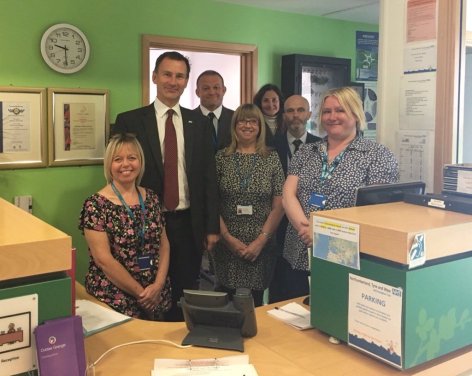
So sure enough, after CQC hung out the good news bunting at Northumberland, the Minister popped up for a photo opp:

hunt

But did long troubled Northumberland really merit a rating of ‘Outstanding’? Where the slippery CQC is concerned, it’s always wise to check the small print.

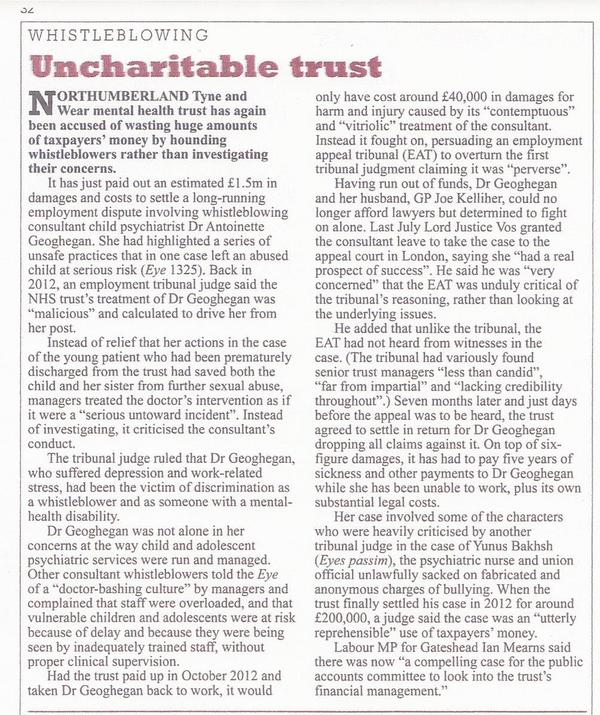
Whistleblowers are conscious of the treatment of psychiatrist Dr Antoinette Geoghegan, who suffered a terrible ordeal at the hands of the trust after she whistleblew on unsafe practices. [5] After she won at the Employment Tribunal, Northumberland appealed and subjected her to yet more years of gruelling litigation. She eventually won at the Court of Appeal last year, at great personal cost.

There have also been other staff who have been mistreated by the Trust and who had Employment Tribunal findings in their favour, over matters such as disability discrimination and detriment for trade union activity. [6]

A glance at the most recent staff survey (2015) [7] shows above average scores on staff engagement, and favourable scores on bullying indices, but not the best.

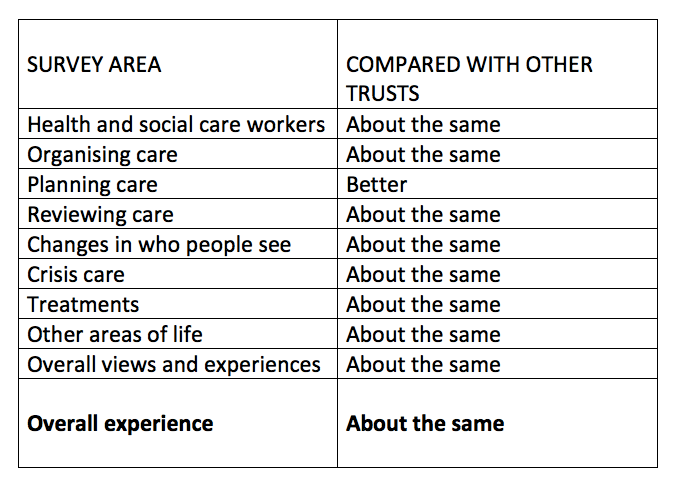
A check of Northumberland’s performance on the latest patient survey (2015) – with a questionnaire response rate of only 27% – does not look at all ‘Outstanding”. See Table 1.

Table 1. CQC patient survey 1 October 2015, based on responses by 227 people (after questionnaires had been sent to 850 people):

ntw-patient-survey-2015Source: http://www.cqc.org.uk/provider/RX4/survey/6

A grading of “About the same” as other trusts is not saying much when CQC has now admitted that almost two thirds of mental health trusts, after years of cuts, ‘Require Improvement’.

A peek at patient feedback on NHS choices [8] shows 22 entries that are mostly negative with either one or no star ratings, dating back to 2012. The average rating is 1.3 stars. In the year before CQC last inspected, there were seven critical comments: “rude and abrupt…poor service…poor administration and lack of communication…no access to ANY NHS services…disappointing in a time of need…why bother….unfit for purpose, lacking care and compassion…”.

A peek at Patient Opinion [9] doesn’t look  clearly ‘Outstanding’ either:

ntw-patient-opinion-rating-as-of-28-10-2016

Some of the comments, from both patients and families, are very distressed. For example, two months ago:

“I’ve been left to feel like my life is worth nothing and left me feeling just to give up and not try anymore. They’ve taken every ounce of fight out of me I give up trying they make it too hard, grind you down. I now feel am worth nothing they’ve ground me down to the point that I give up don’t know who to ask for help anymore life seems pointless cause the staff at the cmht just don’t care whether patient are alive or dead.”

And 15 months ago:

“My sister is a patient in St Georges and i can’t believe what i see every day i visit. Today was the last straw. My sister has not had her clothes changed in a week or washed, i was told if she did’nt want to do these things that was ok by them….parients  like my sister are left to fend for themselves whatever their mental capacity. An extremely worried sister.”

There are also some very good comments, but the number of criticisms does not support an impression of a consistently sound and adequately resourced service.

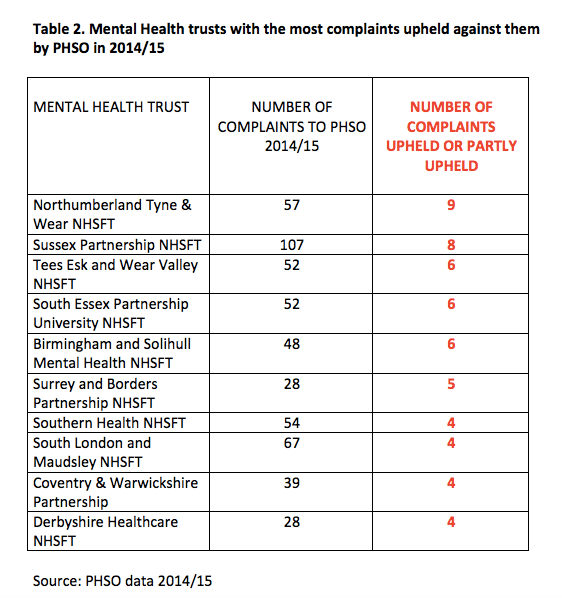
A flick through the PHSO’s data reveals that Northumberland was the mental health trust with the most complaints upheld against it in 2014/15 – see Table 2. Well, that’s sort of ‘Outstanding’….

table-2-mh-trusts-with-highest-numbers-of-complaints-upheld-by-phso

Northumberland has also tended to top the violence charts. NHS Protect data shows that Northumberland has led the field nationally on reported assaults, by some, for three years. [10]

Table 3. Reported assaults at Northumberland Tyne and Wear NHS Foundation Trust

table-3-ntw-reported-assaults-by-year

Table 4. NHS trusts with the highest numbers of reported assaults in 2014/15

table-4-trusts-with-most-reported-assaults-201415

In terms of the rate of violence, as defined by assaults per 1000 staff, Northumberland was the clear leader at a whopping 600 assaults per 1000 staff in 2014/15.

Not least of all, an investigation by the charity MIND in 2013 resulted in a scandal because Northumberland and Southern Health together accounted for about half of all face down restraint incidents in mental health trusts in 2011/12 – with 923 and 810 incidents respectively. [11] Face down restraint is much more dangerous for patients. The variations between trusts could not be accounted for by differences in trust size and population alone.

The MIND data on Northumberland’s restraint incidents in 2011/12 can be found here:

mind-restraint-data-northumberland-tyne-and-wear

In response, the government tightened up guidance. Face down restraint was thereafter supposed to be kept to an absolute minimum, and used for the shortest time possible.  [12]

There has been little progress though, as confirmed by recent FOI data. [13]

At Northumberland, the rate of face down restraints appears to have increased since the MIND report in 2013. As CQC’s latest report admits, between just 1 November 2015 and 30 April 2016

There were 1,481 incidents of prone [face down] restraint which accounted for 37% of the restraint incidents…” [2]

Pro rata, this equates to 2962 incidents of face down restraint a year – over three times the Northumberland rate in 2011/12. It is very clearly not the minimal use required by NICE.

Excessive use of restraint can be a sign that mental health services are over stretched, and that staff are under strain and not adequately supported.

So how on earth did CQC translate all this into an ‘Outstanding’ rating?

Logic and evidence don’t seem to have much to do with it. What then, are the explanations that are left?

I think Mr Hunt could probably answer that one.

God help our poor NHS, patients and staff.


RELATED ITEMS:

CQC deaths review: All fur coat 25 September 2016

In CQC’s hands, reporting of unmet need and harm, including deaths, is akin to a game of Find The Lady. This summarises the pattern of patchy reporting that hides as much as it reveals.

CQC Deaths Review: All fur coat….

Letter to parliament: CQC’s inconsistent regulation of restraint in mental health 31 October 2016

An analysis of CQC’s reporting of restraint practices in its inspection reports on mental health trusts set against FOI data from mental health trusts about their use of restraint. This showed incomplete reporting and questionable inconsistency in CQC’s approach.

Letter to parliament: CQC’s inconsistent regulation of restraint in mental health


REFERENCES

[1] First mental health trusts rated outstanding. Joe Gammie, Health Service Journal 1 September 2016

https://www.hsj.co.uk/sectors/mental-health/first-mental-health-trusts-rated-outstanding-by-cqc/7010237.article

[2] CQC inspection report on Northumberland Tyne and Wear 1 September 2016

http://www.cqc.org.uk/sites/default/files/new_reports/AAAF6056.pdf

[3] Mazars report of an independent review of people with a learning disability or mental health problem in contact with Southern Health NHS Foundation Trust April 2011 to March 2015

https://www.england.nhs.uk/south/wp-content/uploads/sites/6/2015/12/mazars-rep.pdf

[4] Jeremy Hunt breaks his pledge to raise spending on mental health, Jason Beattie Mirror 22 September 2016

http://www.mirror.co.uk/news/uk-news/jeremy-hunt-breaks-pledge-raise-8889117

[5] Private Eye March 2015, on Antoinette Geoghegan’s ordeal & eventual vindication by the Court of Appeal.

antoinette-geoghan-private-eye-march-2015


[6] MP will raise nurse Yunus Bakhsh’s plight in parliament, The Journal 25 June 2013

http://www.thejournal.co.uk/news/north-east-news/mp-raise-nurse-yunus-bakhshs-4427398

http://www.ajustnhs.com/case-histories-of-victimised-nhs-staff/#mccoy

[7] Northumberland Tyne and Wear NHS Foundation Trust, NHS Staff Survey 2015

http://www.nhsstaffsurveys.com/Caches/Files/NHS_staff_survey_2015_RX4_full.pdf

[8] NHS Choices – patient feedback on Northumberland Tyne and Wear NHSFT

http://www.nhs.uk/Services/Trusts/ReviewsAndRatings/DefaultView.aspx?id=2470

[9] Patient Opinion – patient feedback on Northumberland Tyne and Wear NHSFT

https://www.patientopinion.org.uk/services/rx4

[10] NHS Protect data on reported assaults

http://www.nhsbsa.nhs.uk/Documents/SecurityManagement/Reported_Physical_Assaults_2014-15_-_FINAL_Published_Figures(1).pdf

http://www.nhsbsa.nhs.uk/Documents/SecurityManagement/Reported_Physical_Assaults_2013-14.pdf

http://www.nhscounterfraud.nhs.uk/2012-13%20Reported%20physical%20assaults%20on%20NHS%20staff%20NO%20PCT%20&%20SHA%20v2%20PCC.pdf

[11] Mental Health Crisis Care, physical restraint in crisis, MIND June 2013

https://www.mind.org.uk/media/197120/physical_restraint_final_web_version.pdf

‘Excessive’ use of face down restraint in mental health hospitals, Mark Easton BBC, 18 June 2013

http://www.bbc.co.uk/news/uk-22955917

[12] Violence and aggression. Short term management in mental health, health and community settings. NICE guideline NG10 May 2015

https://www.nice.org.uk/guidance/NG10/chapter/1-recommendations

[13] Surge in number of mental health patients being physically restrained criticised by former Health Minister, Rob Merrick, Independent 21 September 2016

http://www.independent.co.uk/life-style/health-and-families/health-news/mental-health-patients-physically-restrained-norman-lamb-criticised-former-health-minister-a7321136.html


FOI disclosure 26 October 2016 by PHSO on complaints made about NHS England

Dr Minh Alexander NHS whistleblower and former consultant psychiatrist

The Parliamentary and Health Service Ombudsman (PHSO) has disclosed that since NHS England’s inception in 2013, it has received a total of 840 complaints about NHS England, 121 (14.4 %) of which were accepted for investigation. PHSO fully upheld ten (1.1 %) of the complaints, and partly upheld six (0.7 %) of the complaints. There are still 61 ongoing investigations. According to the PHSO, a total of 37 complaints have been made about funding and commissioning . There are some discrepancies between PHSO’s and NHS England’s data on complaints. NHS England’s published data does not give a complete picture of how complaints about NHS England are handled.

The full FOI disclosure by the PHSO, which includes a description of the types of complaints made, can be found here:

phso-foi-disclosure-complaints-about-nhs-england

It is not possible tell what proportion of complaints about NHS England progress to the PHSO stage, because NHS England’s corporate publications give only total numbers of all complaints made to NHS England. The numbers of complaints about NHS England itself are not separately provided. [1] Neither does NHS England give clear data on the number of complaints that it upholds. Only some selected, anecdotal examples are given of lessons purportedly learnt. For the sake of transparency and accountability, these are gaps that should be remedied.

There is no complete, published tally of complaints made to NHS England to date, and changes in categorisation mean that data from 2015/16 onwards cannot be compared with earlier data. However, in the first two years after NHS England was established, it received a total of 21,887 complaints.

NHS England’s intermittent reports about the performance of its customer contact services, including complaints handling, have shown that the percentage of customers who are satisfied by the outcome of their contacts with NHS England has run between 40 to 60%.

NHS England started giving figures for complaints that progressed to the PHSO stage in its annual report for 2015/2016. [2] However, NHS England’s figures do not match the PHSO’s figures for the same period.

NHS England has reported that in 2015/16, five complaints were fully upheld by PHSO, ten complaints were partly upheld and eleven complaints were not upheld:

nhse-20152016-data-on-phso

Source: NHS England annual report 2015/16

In contrast, PHSO has informed me that in 2015/16, four complaints were fully upheld, one complaint was partly upheld and twenty two complaints were not upheld.

I have brought the discrepancy between NHS England’s and PHSO’s data to the PHSO’s attention and requested clarification.


Questions arise about whether such a low rate of upheld complaints represents fair treatment of complainants by the PHSO, notwithstanding accuracy of the data that has been provided.


RELATED ITEMS

PHSO has the CQC’s back

An FOI in 2015 showed that PHSO had not upheld any complaints against the Care Quality Commission.

https://minhalexander.com/2016/09/30/phso-foi-disclosure-21-september-2015-on-handling-of-complaints-phso-has-the-cqcs-back/

Do ‘Complaints Matter’ to CQC?

Analysis of data from CQC’s annual reports has shown that CQC does not hold itself to the same standards that it expects of the organisations that it regulates, in terms of the handling complaints against itself.

https://minhalexander.com/2016/10/02/do-complaints-matter-to-cqc/


REFERENCES

[1] NHS England annual reports, annual customer contact and complaints report 2014/2015, and quarterly customer contact reports

https://www.england.nhs.uk/wp-content/uploads/2015/01/NHS-England-Customer-Contact-Annual-Report_v1-10.pdf

[2] NHS England annual report 2015/2016

https://www.england.nhs.uk/wp-content/uploads/2016/07/nhse-annual-rep-201516.pdf