
Northumberland Tyne and Weary. Another ministerial photo opp, courtesy of CQC

By Dr Minh Alexander NHS whistleblower and former consultant psychiatrist, 29 October 2016

The politicised Care Quality Commission (CQC) continues to astound us with its arbitrary ways. Jeremy Hunt cashed in on a public relations opportunity after the CQC rated Northumberland Tyne and Wear Trust “Outstanding”. However, serious questions arise about the validity of CQC’s rating in terms of patient experience data, the number of complaints upheld by PHSO, the highest rate of violent incidents nationally and a significant increase in use of dangerous face down restraint. A backdrop of whistleblower reprisal and other staff mistreatment adds to the doubts. CQC’s claims lack credibility in the face of obvious, severe de-funding and downgrading of mental health services. However, they do serve Mr Hunt well.

CQC’s recent ‘Outstanding’ rating on Northumberland Tyne and Wear was a first for a mental health trust. [1] The inspection had been chaired by no less that Paul Lelliott [2], CQC Deputy Chief Inspector of Hospitals, and the rating came at a handy time for Jeremy Hunt.

The government’s studied neglect of mental health services had brought years of awkward headlines, intensified recently by the scandal of hundreds of un-investigated deaths at Southern Health trust. [3] Opposition politicians have exposed continuing cuts to mental health [4], despite government spin to the contrary. Suicides have continued rising and deaths continue to be criticised by coroners. Bed shortages remain visibly acute.

So sure enough, after CQC hung out the good news bunting at Northumberland, the Minister popped up for a photo opp:
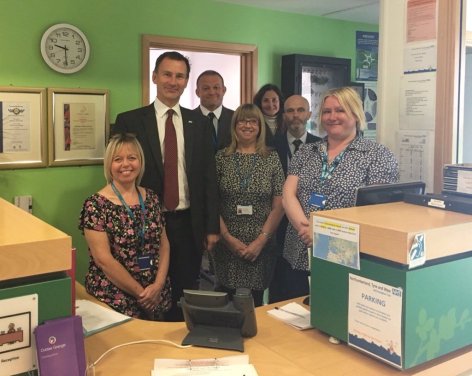
hunt

But did long troubled Northumberland really merit a rating of ‘Outstanding’? Where the slippery CQC is concerned, it’s always wise to check the small print.

Whistleblowers are conscious of the treatment of psychiatrist Dr Antoinette Geoghegan, who suffered a terrible ordeal at the hands of the trust after she whistleblew on unsafe practices. [5] After she won at the Employment Tribunal, Northumberland appealed and subjected her to yet more years of gruelling litigation. She eventually won at the Court of Appeal last year, at great personal cost.

There have also been other staff who have been mistreated by the Trust and who had Employment Tribunal findings in their favour, over matters such as disability discrimination and detriment for trade union activity. [6]

A glance at the most recent staff survey (2015) [7] shows above average scores on staff engagement, and favourable scores on bullying indices, but not the best.

A check of Northumberland’s performance on the latest patient survey (2015) – with a questionnaire response rate of only 27% – does not look at all ‘Outstanding”. See Table 1.

Table 1. CQC patient survey 1 October 2015, based on responses by 227 people (after questionnaires had been sent to 850 people):
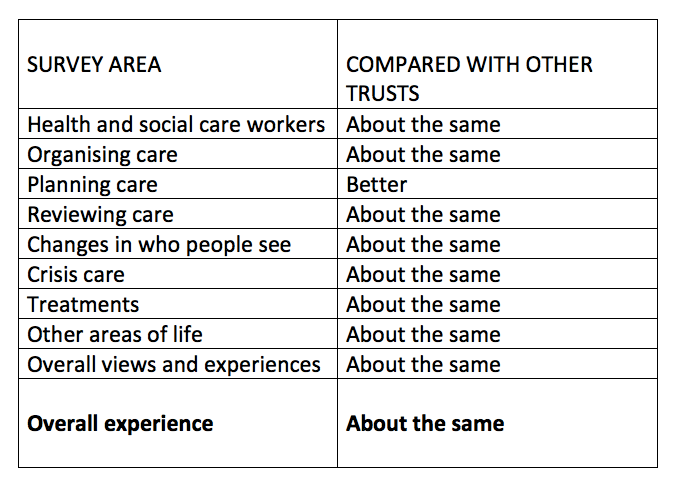
ntw-patient-survey-2015Source: http://www.cqc.org.uk/provider/RX4/survey/6

A grading of “About the same” as other trusts is not saying much when CQC has now admitted that almost two thirds of mental health trusts, after years of cuts, ‘Require Improvement’.

A peek at patient feedback on NHS choices [8] shows 22 entries that are mostly negative with either one or no star ratings, dating back to 2012. The average rating is 1.3 stars. In the year before CQC last inspected, there were seven critical comments: “rude and abrupt…poor service…poor administration and lack of communication…no access to ANY NHS services…disappointing in a time of need…why bother….unfit for purpose, lacking care and compassion…”.

A peek at Patient Opinion [9] doesn’t look  clearly ‘Outstanding’ either:

ntw-patient-opinion-rating-as-of-28-10-2016

Some of the comments, from both patients and families, are very distressed. For example, two months ago:

“I’ve been left to feel like my life is worth nothing and left me feeling just to give up and not try anymore. They’ve taken every ounce of fight out of me I give up trying they make it too hard, grind you down. I now feel am worth nothing they’ve ground me down to the point that I give up don’t know who to ask for help anymore life seems pointless cause the staff at the cmht just don’t care whether patient are alive or dead.”

And 15 months ago:

“My sister is a patient in St Georges and i can’t believe what i see every day i visit. Today was the last straw. My sister has not had her clothes changed in a week or washed, i was told if she did’nt want to do these things that was ok by them….parients  like my sister are left to fend for themselves whatever their mental capacity. An extremely worried sister.”

There are also some very good comments, but the number of criticisms does not support an impression of a consistently sound and adequately resourced service.

A flick through the PHSO’s data reveals that Northumberland was the mental health trust with the most complaints upheld against it in 2014/15 – see Table 2. Well, that’s sort of ‘Outstanding’….
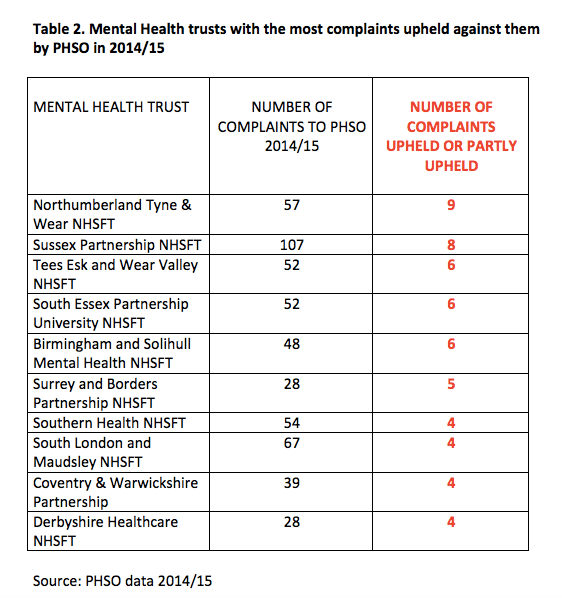
table-2-mh-trusts-with-highest-numbers-of-complaints-upheld-by-phso

Northumberland has also tended to top the violence charts. NHS Protect data shows that Northumberland has led the field nationally on reported assaults, by some, for three years. [10]

Table 3. Reported assaults at Northumberland Tyne and Wear NHS Foundation Trust

table-3-ntw-reported-assaults-by-year

Table 4. NHS trusts with the highest numbers of reported assaults in 2014/15

table-4-trusts-with-most-reported-assaults-201415

In terms of the rate of violence, as defined by assaults per 1000 staff, Northumberland was the clear leader at a whopping 600 assaults per 1000 staff in 2014/15.

Not least of all, an investigation by the charity MIND in 2013 resulted in a scandal because Northumberland and Southern Health together accounted for about half of all face down restraint incidents in mental health trusts in 2011/12 – with 923 and 810 incidents respectively. [11] Face down restraint is much more dangerous for patients. The variations between trusts could not be accounted for by differences in trust size and population alone.

The MIND data on Northumberland’s restraint incidents in 2011/12 can be found here:

mind-restraint-data-northumberland-tyne-and-wear

In response, the government tightened up guidance. Face down restraint was thereafter supposed to be kept to an absolute minimum, and used for the shortest time possible.  [12]

There has been little progress though, as confirmed by recent FOI data. [13]

At Northumberland, the rate of face down restraints appears to have increased since the MIND report in 2013. As CQC’s latest report admits, between just 1 November 2015 and 30 April 2016

There were 1,481 incidents of prone [face down] restraint which accounted for 37% of the restraint incidents…” [2]

Pro rata, this equates to 2962 incidents of face down restraint a year – over three times the Northumberland rate in 2011/12. It is very clearly not the minimal use required by NICE.

Excessive use of restraint can be a sign that mental health services are over stretched, and that staff are under strain and not adequately supported.

So how on earth did CQC translate all this into an ‘Outstanding’ rating?

Logic and evidence don’t seem to have much to do with it. What then, are the explanations that are left?

I think Mr Hunt could probably answer that one.

God help our poor NHS, patients and staff.


RELATED ITEMS:

CQC deaths review: All fur coat 25 September 2016

In CQC’s hands, reporting of unmet need and harm, including deaths, is akin to a game of Find The Lady. This summarises the pattern of patchy reporting that hides as much as it reveals.

CQC Deaths Review: All fur coat….

Letter to parliament: CQC’s inconsistent regulation of restraint in mental health 31 October 2016

An analysis of CQC’s reporting of restraint practices in its inspection reports on mental health trusts set against FOI data from mental health trusts about their use of restraint. This showed incomplete reporting and questionable inconsistency in CQC’s approach.

Letter to parliament: CQC’s inconsistent regulation of restraint in mental health


REFERENCES

[1] First mental health trusts rated outstanding. Joe Gammie, Health Service Journal 1 September 2016

https://www.hsj.co.uk/sectors/mental-health/first-mental-health-trusts-rated-outstanding-by-cqc/7010237.article

[2] CQC inspection report on Northumberland Tyne and Wear 1 September 2016

http://www.cqc.org.uk/sites/default/files/new_reports/AAAF6056.pdf

[3] Mazars report of an independent review of people with a learning disability or mental health problem in contact with Southern Health NHS Foundation Trust April 2011 to March 2015

https://www.england.nhs.uk/south/wp-content/uploads/sites/6/2015/12/mazars-rep.pdf

[4] Jeremy Hunt breaks his pledge to raise spending on mental health, Jason Beattie Mirror 22 September 2016

http://www.mirror.co.uk/news/uk-news/jeremy-hunt-breaks-pledge-raise-8889117

[5] Private Eye March 2015, on Antoinette Geoghegan’s ordeal & eventual vindication by the Court of Appeal.
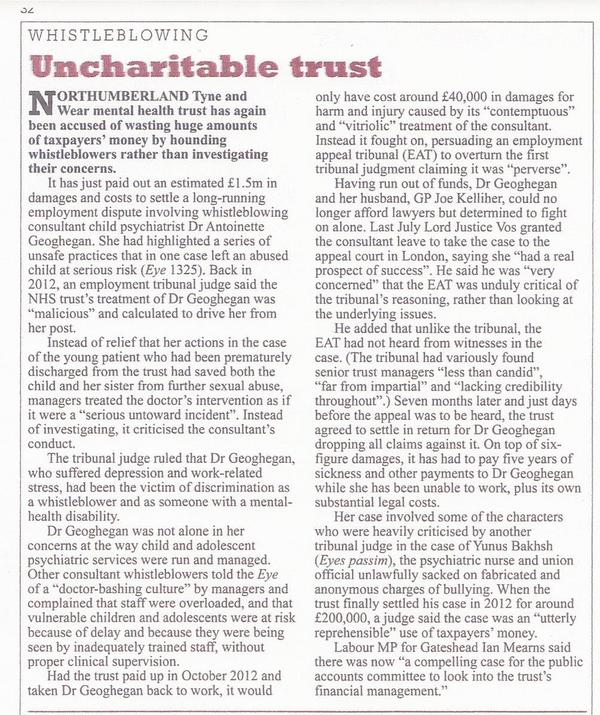
antoinette-geoghan-private-eye-march-2015


[6] MP will raise nurse Yunus Bakhsh’s plight in parliament, The Journal 25 June 2013

http://www.thejournal.co.uk/news/north-east-news/mp-raise-nurse-yunus-bakhshs-4427398

http://www.ajustnhs.com/case-histories-of-victimised-nhs-staff/#mccoy

[7] Northumberland Tyne and Wear NHS Foundation Trust, NHS Staff Survey 2015

http://www.nhsstaffsurveys.com/Caches/Files/NHS_staff_survey_2015_RX4_full.pdf

[8] NHS Choices – patient feedback on Northumberland Tyne and Wear NHSFT

http://www.nhs.uk/Services/Trusts/ReviewsAndRatings/DefaultView.aspx?id=2470

[9] Patient Opinion – patient feedback on Northumberland Tyne and Wear NHSFT

https://www.patientopinion.org.uk/services/rx4

[10] NHS Protect data on reported assaults

http://www.nhsbsa.nhs.uk/Documents/SecurityManagement/Reported_Physical_Assaults_2014-15_-_FINAL_Published_Figures(1).pdf

http://www.nhsbsa.nhs.uk/Documents/SecurityManagement/Reported_Physical_Assaults_2013-14.pdf

http://www.nhscounterfraud.nhs.uk/2012-13%20Reported%20physical%20assaults%20on%20NHS%20staff%20NO%20PCT%20&%20SHA%20v2%20PCC.pdf

[11] Mental Health Crisis Care, physical restraint in crisis, MIND June 2013

https://www.mind.org.uk/media/197120/physical_restraint_final_web_version.pdf

‘Excessive’ use of face down restraint in mental health hospitals, Mark Easton BBC, 18 June 2013

http://www.bbc.co.uk/news/uk-22955917

[12] Violence and aggression. Short term management in mental health, health and community settings. NICE guideline NG10 May 2015

https://www.nice.org.uk/guidance/NG10/chapter/1-recommendations

[13] Surge in number of mental health patients being physically restrained criticised by former Health Minister, Rob Merrick, Independent 21 September 2016
http://www.independent.co.uk/life-style/health-and-families/health-news/mental-health-patients-physically-restrained-norman-lamb-criticised-former-health-minister-a7321136.html


FOI disclosure 26 October 2016 by PHSO on complaints made about NHS England

Dr Minh Alexander NHS whistleblower and former consultant psychiatrist

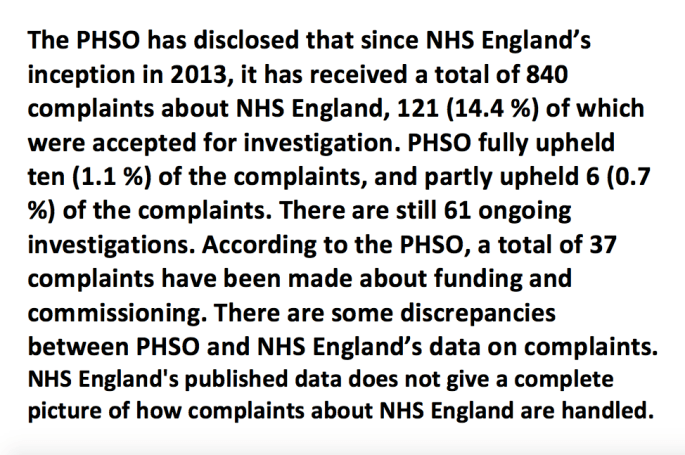
The Parliamentary and Health Service Ombudsman (PHSO) has disclosed that since NHS England’s inception in 2013, it has received a total of 840 complaints about NHS England, 121 (14.4 %) of which were accepted for investigation. PHSO fully upheld ten (1.1 %) of the complaints, and partly upheld six (0.7 %) of the complaints. There are still 61 ongoing investigations. According to the PHSO, a total of 37 complaints have been made about funding and commissioning . There are some discrepancies between PHSO’s and NHS England’s data on complaints. NHS England’s published data does not give a complete picture of how complaints about NHS England are handled.

The full FOI disclosure by the PHSO, which includes a description of the types of complaints made, can be found here:

phso-foi-disclosure-complaints-about-nhs-england

It is not possible tell what proportion of complaints about NHS England progress to the PHSO stage, because NHS England’s corporate publications give only total numbers of all complaints made to NHS England. The numbers of complaints about NHS England itself are not separately provided. [1] Neither does NHS England give clear data on the number of complaints that it upholds. Only some selected, anecdotal examples are given of lessons purportedly learnt. For the sake of transparency and accountability, these are gaps that should be remedied.

There is no complete, published tally of complaints made to NHS England to date, and changes in categorisation mean that data from 2015/16 onwards cannot be compared with earlier data. However, in the first two years after NHS England was established, it received a total of 21,887 complaints.

NHS England’s intermittent reports about the performance of its customer contact services, including complaints handling, have shown that the percentage of customers who are satisfied by the outcome of their contacts with NHS England has run between 40 to 60%.

NHS England started giving figures for complaints that progressed to the PHSO stage in its annual report for 2015/2016. [2] However, NHS England’s figures do not match the PHSO’s figures for the same period.

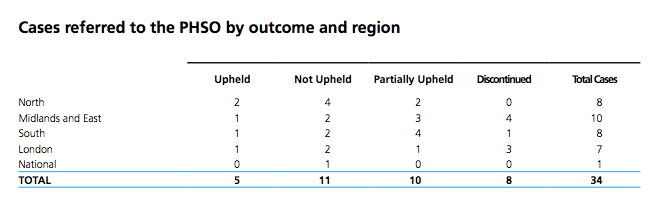
NHS England has reported that in 2015/16, five complaints were fully upheld by PHSO, ten complaints were partly upheld and eleven complaints were not upheld:

nhse-20152016-data-on-phso

Source: NHS England annual report 2015/16

In contrast, PHSO has informed me that in 2015/16, four complaints were fully upheld, one complaint was partly upheld and twenty two complaints were not upheld.

I have brought the discrepancy between NHS England’s and PHSO’s data to the PHSO’s attention and requested clarification.


Questions arise about whether such a low rate of upheld complaints represents fair treatment of complainants by the PHSO, notwithstanding accuracy of the data that has been provided.


RELATED ITEMS

PHSO has the CQC’s back

An FOI in 2015 showed that PHSO had not upheld any complaints against the Care Quality Commission.

https://minhalexander.com/2016/09/30/phso-foi-disclosure-21-september-2015-on-handling-of-complaints-phso-has-the-cqcs-back/

Do ‘Complaints Matter’ to CQC?

Analysis of data from CQC’s annual reports has shown that CQC does not hold itself to the same standards that it expects of the organisations that it regulates, in terms of the handling complaints against itself.

https://minhalexander.com/2016/10/02/do-complaints-matter-to-cqc/


REFERENCES

[1] NHS England annual reports, annual customer contact and complaints report 2014/2015, and quarterly customer contact reports

https://www.england.nhs.uk/wp-content/uploads/2015/01/NHS-England-Customer-Contact-Annual-Report_v1-10.pdf

[2] NHS England annual report 2015/2016

https://www.england.nhs.uk/wp-content/uploads/2016/07/nhse-annual-rep-201516.pdf


Jus’ like that, says Henrietta

Memorandum of Non-Understanding from the Ministry of Love


Whistleblowers have serious misgivings about Robert Francis’ and the Department of Health’s Freedom to Speak Up Review on NHS whistleblowing. In short, its main use is for government spin. The central plank of the Freedom to Speak Up Review is the creation of a National Guardian for whistleblowing. This office has been entrusted to the Care Quality Commission. The project has been characterised by CQC gamesiness, delay, incompetence and the hasty resignation of the first appointee. [1] CQC refuses to acknowledge its mishandling of the office or shortcomings by the latest appointee.

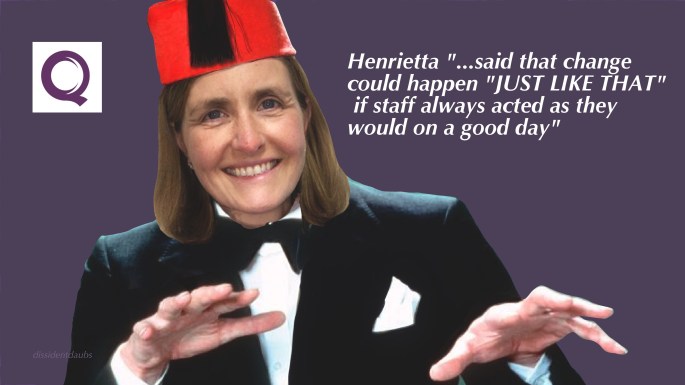
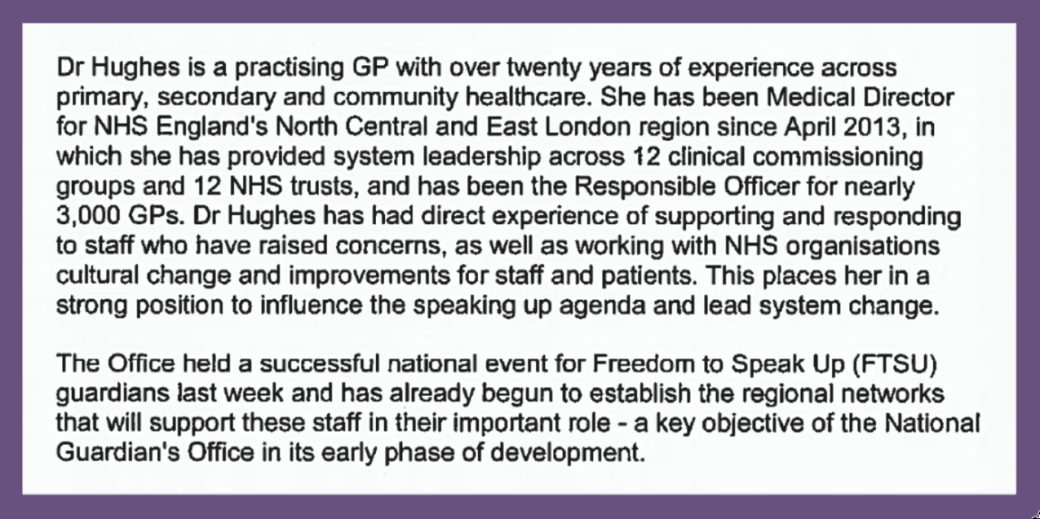
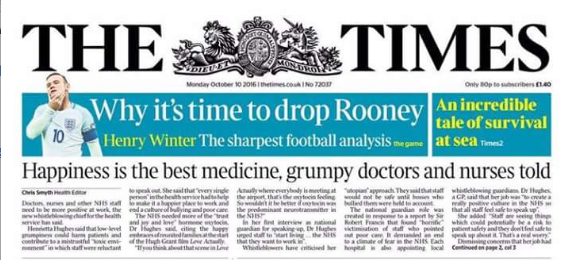
Henrietta Hughes the replacement National Guardian provoked disbelief and ridicule when she started her job earlier this month. In an interview with the Times, she suggested that NHS whistleblowing would be sorted “just like that” if staff cheered up. [2] Thus, she trivialised the deep establishment corruption and related suffering faced by whistleblowers, and she unfairly blamed frontline staff for deterring whistleblowing. Her gaffs were widely reported. Embarrassing details included her reference to the movie “Love Actually” and her suggestion that oxytocin should be the “predominant neurotransmitter” for NHS staff.

A salvage operation was attempted shortly after, when Henrietta gave an interview to the Health Service Journal. [3] The resulting article did not feature any of her views on smiling, Love Actually or oxytocin. Instead, it was reported that she had whistleblown twice in her career, but with scant details and context provided.

The first occasion related to a member of staff who had health problems and was receiving treatment that had resulted in them losing “insight into their own clinical abilities”.

“It was a very sad situation, but that member of staff was then supported with occupational health and time off, and it was the right thing to do,” Dr Hughes said.

The second incident involved an administrator who was using a health emergency badge for parking her car and later attempted to pass herself off as a nurse when she received a parking ticket.”

Whistleblowers are curious to know more, given that her comments to the Times are not compelling evidence of much insight or lived experience of whistleblowing.

The Health Service Journal reported – that as originally envisaged by Robert Francis and the Department of Health – Henrietta is not going to investigate cases or make judgments about the behaviour of local employers. She will only stand on the sidelines and offer non-binding recommendations, in so far as they can be formulated without any investigation.

Her predecessor had the grace to admit she was unhappy that ‘historic’ cases had been excluded from her remit. In contrast, Henrietta reportedly views such cases as burdensome to her ‘small’ (but as yet undisclosed) budget. This conveniently echoes the line that Francis took when he argued that past cases were too difficult to be worth looking at.

I collated the expressions of concern about Henrietta’s musings on cheerfulness and her finger wagging at an already demoralised NHS workforce, and sent them to Peter Wyman CQC chair, the day after the Times coverage.

A letter to the ever-listening Cat Quality Commission

In response, there is not one scintilla of regret from Mr Wyman about the dismay caused by Henrietta’s remarks. [4] Nope. The Party stands firm behind Citizen Hughes. By implication, it disdains proles who question her authority.

From letter by Peter Wyman 19 October 2016:

hh-wyman


Neither does Mr Wyman share any of my concerns about CQC’s handling of the National Guardian’s office and selection process. There was also other mischief in his missive, but I’ll deal with that another time.

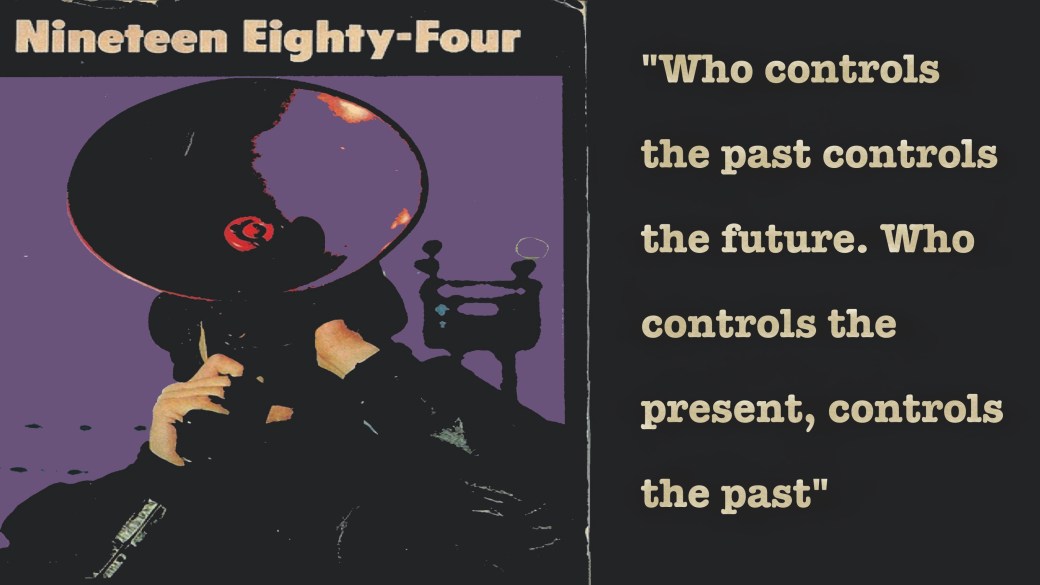
It’s good to know the Ministry of Love is so receptive to feedback. It is perfectly equipped to deal with whistleblowers and to deliver Big Brother’s vision of a “single version of the truth”. [5]

1984-who-controls-the-past


RELATED ITEMS

Hooray Henrietta

Clubadoodle-doo

No one believes Jeremy Hunt on patient safety or whistleblowers – not even his own appointees. Unmasking the faux National Guardian Office.


REFERENCES

[5] Patients First and Foremost. Department of Health March 2013

https://www.gov.uk/government/uploads/system/uploads/attachment_data/file/170701/Patients_First_and_Foremost.pdf

[1] Jeremy Hunt humiliated as whistleblowing Tsar quits before she started, Andrew Gregory, Mirror 8 March 2016

http://www.mirror.co.uk/news/uk-news/jeremy-hunt-humiliated-nhs-whistleblower-7513425

[2] Happiness is the best medicine, grumpy doctors and nurses told. Chris Smyth, The Times, 10 October 2016

http://www.thetimes.co.uk/article/happiness-is-the-best-medicine-grumpy-doctors-and-nurses-told-7032fd6rr

front-page

[3] Whistleblower guardian ‘will not be an investigation body’. Will Hazel, Health Service Journal, 12 October 2016

https://www.hsj.co.uk/topics/workforce/whistleblower-guardian-will-not-be-an-investigation-body/7011388.article?blocktitle=More-for-you&contentID=19936

[4] Letter from Peter Wyman CQC Chair 19 October 2016

peter-wyman-letter-hh-19-october-2016


Fit and Proper Mess

By Dr Minh Alexander NHS whistleblower and former consultant psychiatrist 19 October 2016


The Care Quality Commission, in association with other NHS regulators, has bent over backwards not to remove any NHS directors under Regulation 5, Fit and Proper Persons (FPPR).[1] Not a single director has been removed so far. CQC’s wilful blindness to cases of proven misconduct has been both condemned and ridiculed. The evidence of CQC’s failures keeps mounting as those whom it has protected inevitably get into more hot water.Legislative reform is needed for real accountability.

See here for a summary of CQC’s previous mishandling of FPPR and related obfuscations and distortions:

https://minhalexander.com/2016/09/24/cqcs-fit-and-proper-parade/

In December 2014 several whistleblowers, me included, took part in a telephone meeting with CQC’s Chief Inspector of Hospitals Professor Mike Richards and his entourage. This was to discuss how CQC would apply FPPR. During the meeting, Mike Richards claimed that removing too many NHS managers would not pass in the “Court of Public Opinion”. Discouragingly, he also said that reprisal against whistleblowers – which Robert Francis identified was a form of serious misconduct – would only be actionable under FPPR if it was of a sufficient degree.

Judging from CQC’s subsequent refusal to take action on several cases of proven managerial misconduct against whistleblowers, the acts of falsifying charges, bullying and harassment, unfair dismissals and cover ups cannot be sufficiently serious matters for the Professor.

CQC came a cropper after it surreptitiously shut down an FPPR referral on Paula Vasco-Knight, a former NHS chief executive about whom whistleblowers raised concerns of nepotism. Her conduct and that of her fellow managers in suppressing this matter was criticised by an Employment Tribunal. [2] Not long after CQC shut down the FPPR referral, “Fiasco-Knight” was dropped by her latest trust due to financial allegations. [3] A two week criminal trial is scheduled at Exeter Crown Court in January 2017. [4] After this latest scandal, CQC was forced to announce that it would review its handling of FPPR [5]. Five months on, there is still no evidence that it has done so. I am still waiting for CQC’s substantive responses to FPPR referrals, one of which is referral on Vasco-Knight, made a year ago.

In respect of David Loughton the NHS chief who was criticised over the case of NHS whistleblower Raj Mattu [6] and then again in the case of Sandra Haynes-Kirkbright [7], there is still no evidence that CQC has acted on FPPR referrals. Embarrassingly for CQC, David Loughton reported that Mike Richards had given permission for his trust to tell its staff to only “answer the question and then shut up, don’t elaborate” when dealing with inspectors.[8] CQC denied this, but doubts linger. This is partly because CQC has tolerated other questionable practices by trusts, such as allowing trust managers to instruct staff to report back on conversations with inspectors.

The latest in the long line of CQC FPPR scandals is that Phil Morley the controversial former Chief Executive at Hull, who moved to Princess Alexandra Hospital, is in the headlines again. This is due to findings of poor care and leadership at Princess Alexandra Hospital, now rated ‘Inadequate’. [9]

The local press in Hull reported extensively on Mr Morley’s tenure up north. For example:

“Hospital staff were called “incompetent, underperforming, useless and dopey”, pushed and prodded, had pens thrown at them, a damning report into bullying revealed”[10]

SENIOR hospital staff were allowed to run riot with NHS credit cards without proper checks on their spending, a new report has revealed.Auditors KPMG were called in after managers spent £740,000 on their NHS credit cards in a single year.The Mail has already revealed former chief executive Phil Morley spent £50,000 on his NHS credit card, racking up bills at fine dining restaurants and luxury hotels during his time in charge of Hull and East Yorkshire Hospitals NHS Trust” [11]

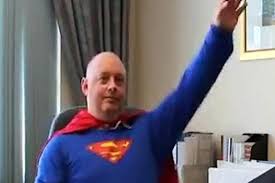
Morley’s super powers of persuasion were not infinite. He made a complaint of harassment against the local press, but it was not upheld by IPSOS. [12]

morley-superman

Very seriously, a Hull whistleblower suffered significant detriment under Morley’s reign, and eventually received compensation from the trust. [13]

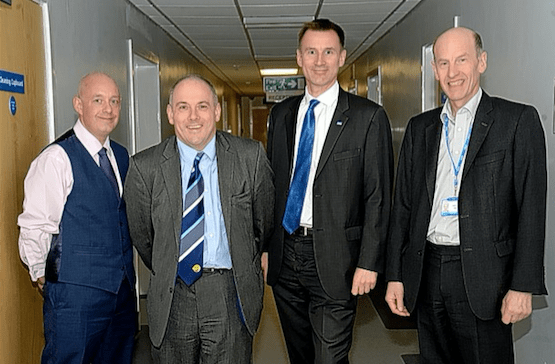
Local Hull MP Diana Johnson complained about the NHS’ ineffectual Fit and Proper Person governance, which allowed Morley to be recycled to Princess Alexandra. [14] She got short shrift. [15] Here is a photo of Jeremy Hunt literally standing by his man at Princess Alexandra hospital:

morley

In its latest inspection report, the CQC admits that Princess Alexandra trust’s performance has deteriorated under Mr Morley’s stewardship, and that there is apparent disconnect between the trust board leadership level and the ward level”. Well what do the CQC and Hunt expect if they recycle leaders with a reputation for poor behaviour against staff? [16]

The NHS has been told countless times that recycling managers who have failed is part of the problem. However, we hear excuses that a culture of fear would result if erring managers are sacked, and the shortage of managers is given as a reason for not sacking people. But does it ever occur to the NHS establishment that good managers are put off from working in the NHS because they don’t want to work with duffers? Julie Moore, a successful NHS Chief Executive in Birmingham spoke up about the fact that the NHS is damaged by managers who are “grossly incompetent” and who focus on self preservation:

“I have actually met one who said: ‘I have made a career out of never making a decision’… We’ve created a culture of people who are terrified of making decisions because you can’t be held to account for making no decision, but you can if you make a decision. We’ve got the leadership model wrong.” [17]

However, there is much resistance to removing erring managers. Robert Francis was at some point prevailed upon to change his position from ‘sack ‘em’ to ‘hug a hoodie’. See the history of his flip flops here:

https://minhalexander.com/2016/09/26/sir-roberts-flip-flops/

Earlier this month when speaking at the launch of a report by the National Confidential Inquiry into Suicide and Homicide, Francis was reported to have said “Retribution encourages concealment of mistakes in services, focus should be on learning and putting mistakes right”.

Last week, Jeremy Hunt made off-colour comments about a “witch hunt” at Southern Health, implying negative and improper motives by bereaved families seeking justice and a safer service. [18]

This week, John Manzoni the Chief Executive of the civil service and Cabinet Secretary ran an article for the civil service “Whistleblower Awareness Week”. [16] It was yet more waffle about culture change and of course, it emphasised that this will take more time. Never mind that government deliberately delays whenever it comes to whistleblowing. And never mind the fact that Manzoni had to admit to Public Accounts Committee in December 2015 that the government task and finish group on whistleblowing reform – set up in response to PAC’s recommendations of 1 August 2014 [19] – had only met once. [20]


delay-deny


When it comes to the most serious matters, societies do not generally say “let’s encourage everyone to do better”. No one argues that it is wrong to penalise murder, because it might drive it underground or create undue fear. And there are clear examples of law changing culture, such as the change in attitudes to drink driving after it was outlawed.

Genuine whistleblowing is a matter of public good and the victimisation of whistleblowers should be seen as an offence of serious dishonesty against the public good.

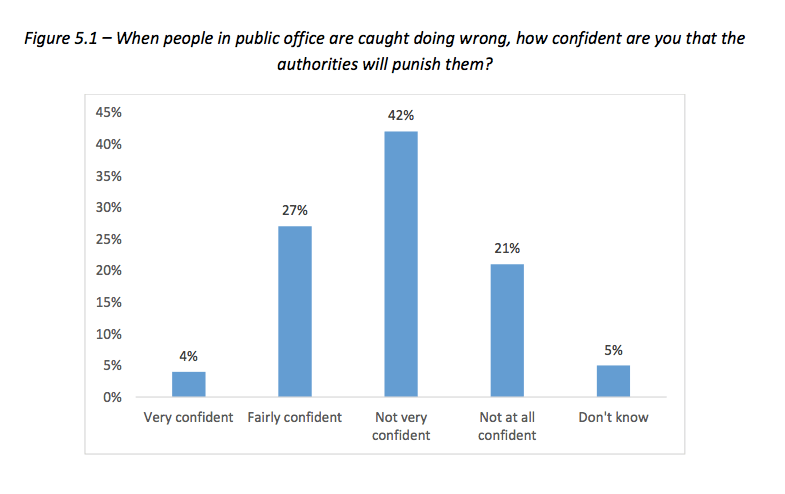
Public confidence in public sector accountability is low, and it is clear that reform is sorely needed. [21] [22] 

cspl-wrongdoing

Source: Committee on Standards in Public Life


The vindication of Hillsborough campaigners after many years of establishment mistreatment is a step in the right direction. The recently launched ‘Hillsborough Law’ – Public Authorities Accountability Bill – needs the public’s support. It is well worth keeping an eye on the campaign:  http://www.thehillsboroughlaw.com/

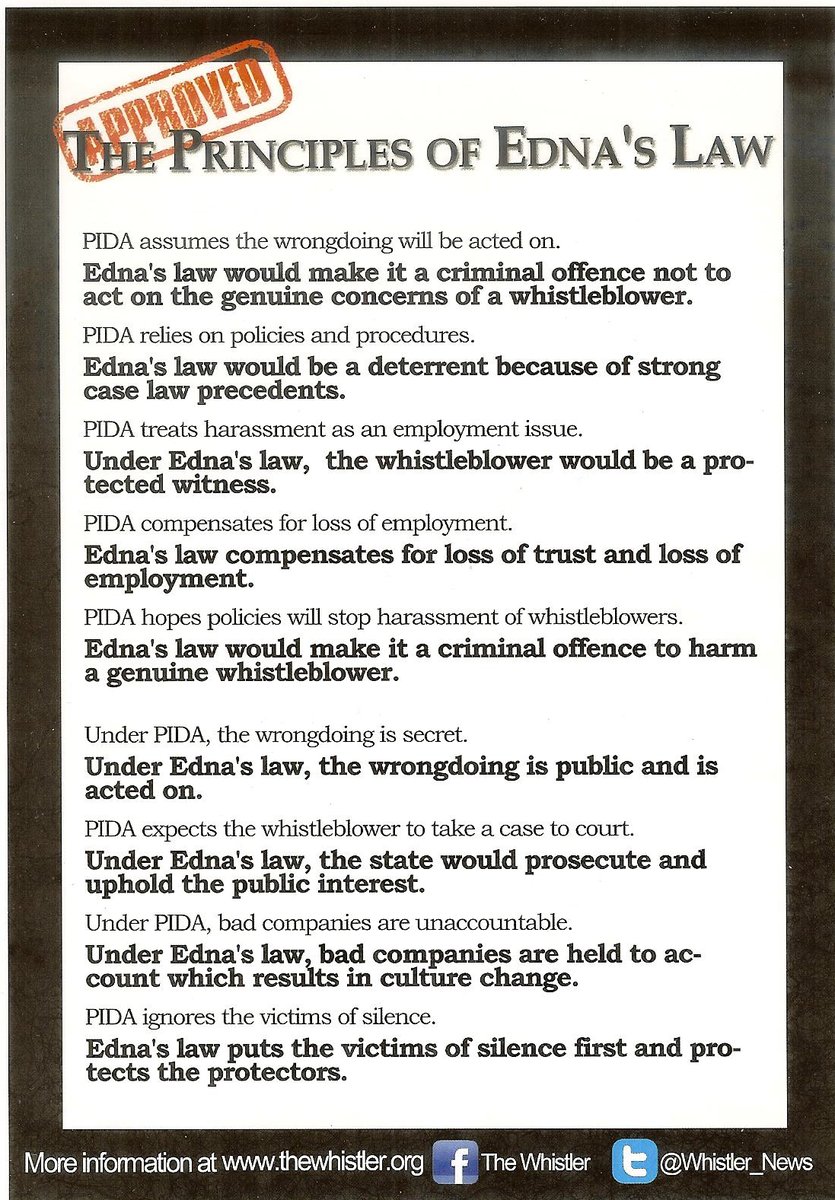
Also see the campaigning charity Compassion In Care’s proposal, Edna’s Law on whistleblowing, which focuses on two essential issues – accountability and righting wrongs:  http://www.compassionincare.com/


ednas


REFERENCES

[1] CQC Regulation 5, Fit and Proper Persons

http://www.cqc.org.uk/sites/default/files/20141120_doc_fppf_final_nhs_provider_guidance_v1-0.pdf

https://www.cqc.org.uk/content/regulation-5-fit-and-proper-persons-directors#full-regulation

[2] Devon health boss Dr Paula Vasco-Knight resigns. BBC 30 May 2014

http://www.bbc.co.uk/news/uk-england-devon-27636112

[3] Health boss Paula Vasco-Knight suspended over finance claims, 4 May 2016

http://www.bbc.co.uk/news/uk-england-devon-36204798

[4] NHS chief denies siphoning £20K of public money into her husband’s company, Ted Davenport, Liverpool Echo 26 June 2016

http://www.liverpoolecho.co.uk/news/liverpool-news/nhs-chief-denies-siphoning-20k-11527462

[5] CQC to review whether Fit and Proper Person rule ‘needs to change’, Will Hazel, Health Service Journal 24 May 2016

https://www.hsj.co.uk/topics/policy-and-regulation/cqc-to-review-whether-fit-and-proper-person-rule-needs-to-change/7005046.article

[6] Probe launched into NHS chief who blew £6m to get rid of whistleblowers as minister pledges to protect workers who speak out. Paul Bentley and Daniel Martin, Daily Mail 8 March 2014

http://www.dailymail.co.uk/news/article-2576096/Probe-launched-NHS-chief-blew-6m-rid-whistleblowers-minister-pledges-protect-workers-speak-out.html

[7] Verita investigation report January 2016 on David Loughton, Sandra Haynes –Kirkbright and the Royal Wolverhampton trust

verita-loughton-rwt-verita-report

Now sack £200,000 NHS boss who hounded whistleblower’. Paul Bentley, Daily Mail, 13 May 2016

http://www.dailymail.co.uk/news/article-3587897/Now-sack-200-000-boss-hounded-NHS-whistleblower-Calls-come-damning-report-treatment-whistleblower-accused-hospital-fixing-death-rates.html

[8] ‘Shut up and never explain’: What NHS boss told staff to do if inspectors called.

Paul Bentley, Daily Mail, 14 May 2016

http://www.dailymail.co.uk/news/article-3590018/Shut-never-explain-NHS-boss-told-staff.html

[9] Trust in special measures after safety and leadership failings. James Illman, Health Service Journal 19 October 2016

https://www.hsj.co.uk/hsj-local/providers/the-princess-alexandra-hospital-nhs-trust/trust-in-special-measures-after-safety-and-leadership-failings/7011586.article?utm_source=t.co&utm_medium=Social&utm_campaign=newsfeed

[10] Hull NHS bosses threw pens at ‘incompetent, underperforming, useless’ hospital staff, Alexandra Wood, Yorkshire Post 7 October 2014

http://www.yorkshirepost.co.uk/news/health/hull-nhs-bosses-threw-pens-at-incompetent-underperforming-useless-hospital-staff-1-6880292

[11] Senior NHS staff in Hull ran up £740,000 in credit card bill ‘without proper checks’, Allison Coggan Hull Daily Mail, 18 December 2014

http://www.hulldailymail.co.uk/senior-nhs-staff-hull-ran-740-000-credit-card/story-25733939-detail/story.html

[12] IPSOS ruling 00180-15 Morley v Hull Daily Mail, issued 26 June 2015

https://www.ipso.co.uk/rulings-and-resolution-statements/ruling/?id=00180-15

[13] NHS whistleblower Pauline Lewin awarded £250K after accusing ex-Hull chief Phil Morley of bullying, Hull Daily Mail, 1 August 2016

https://www.ipso.co.uk/rulings-and-resolution-statements/ruling/?id=00180-15

[14] Letter by Diana Johnson to Jeremy Hunt about Phil Morley

diana-johnson-letter-to-hunt-morley-16-july-2015-1

[15] Health Secretary: NHS boss Phil Morley’s appointment ‘fit and proper’, Laura Hughes, Hull Daily Mail, 25 July 2015

http://www.hulldailymail.co.uk/health-secretary-deems-nhs-boss-phil-morley-fit/story-27478960-detail/story.html

[16] CQC inspection report on Princess Alexandra Hospital NHS Trust, 19 October 2016

https://www.cqc.org.uk/sites/default/files/new_reports/AAAF6797.pdf

[17] NHS troubleshooter calls for leaders to be sacked. Will Helpern. Politics Home. 9 April 2016

https://www.politicshome.com/news/uk/health-and-care/nhs/news/73632/nhs-troubleshooter-calls-leaders-be-sacked

[18] Jeremy ‘witch Hunt’ and the mother blame. Sara Ryan 15 October 2016

https://mydaftlife.com/category/laughing-boy-tales/sloven-health/

[16] Be confident to speak up – encouraging a positive culture in the Civil Service. John Manzoni, 17 October 2016

https://civilservice.blog.gov.uk/2016/10/17/be-confident-to-speak-up-encouraging-a-positive-whistleblowing-culture-in-the-civil-service/

[19] Public Accounts Committee inquiry report. 1 August 2014.

http://www.publications.parliament.uk/pa/cm201415/cmselect/cmpubacc/593/593.pdf

[20] John Manzoni. Oral evidence to Public Accounts Committee. 7 December 2015

http://data.parliament.uk/writtenevidence/committeeevidence.svc/evidencedocument/public-accounts-committee/whistleblowing-recall/oral/25706.pdf

[21] On the Politics of Lying. Nick Turnbull and Dave Richards, LSE 10 June 2016

on-the-politics-of-lying

[22] Survey of public attitudes towards conduct in public life, 2014. Prepared for the Committee on Standards in Public Life.

https://www.gov.uk/government/uploads/system/uploads/attachment_data/file/415746/Survey_of_public_attitudes_towards_conduct_in_public_life_2014_final_19_march.pdf


Morecambe and wise counsel

By Dr Minh Alexander NHS whistleblower and former consultant psychiatrist 17 October 2016

Jeremy Hunt’s camp has repeatedly and shamelessly exploited the maternity safety scandal at Morecambe Bay trust to shore up the Health Secretary’s claims to be a patient champion. It’s all tosh of course, as a true patient champion would not be swinging a wrecking ball at the NHS.

Last week, another “New! Shiny! Improved!” Morecambe Bay story did the rounds.

It related to an important issue of how some NHS organisations pay off and silence those implicated in wrongdoing. The Health Service Journal reported that Morecambe Bay trust reached a settlement with one of the midwives in the maternity scandal, which stipulated that she would not be investigated:

“Following discussions between the employee and the trust, the employee has opted to take early redundancy and as a result the employer has agreed not to commence an internal investigation into the employee’s performance as maternity risk manager.” [1 ]

The trust itself had revealed this settlement, four years after it had been agreed. Some rushed to claim that the disclosure meant that NHS culture was changing, and by implication, that our glorious Health Secretary Hunt had delivered promised change culture. Compliments were also heaped on Morecambe Bay’s new regime.

Whistleblowers have a different perspective. Russell Dunkeld ( @RussellDunkeld ) an NHS whistleblower and a former Morecambe Bay trust nurse had continuing difficulties with the trust, which were recently covered by the Lancaster Guardian. [2]

russell-dunkeld-photo

Since Morecambe Bay’s current chief executive Jackie Daniel took up her post in August 2012, the CQC has reported via its ‘intelligent monitoring’ updates, of October 2013, March 2014, July 2014 and December 2014, that there were repeated external ‘whistleblowing alerts’ by trust staff.

In 2014 two whistleblowers raised concerns about the safety of breast cancer screening services, leading to a Public Health England external review. [3] There was controversy about the treatment of the whistleblowers. The Mirror noted:

Public Health England were approached by the whistleblowers after the trust – which is in special measures – initially refused to investigate. The whistleblowers found themselves suspended and barred from working in breast screening when they complained 12 months ago.” [4]

There has also been correspondence to Jeremy Hunt about the trust’s behaviour. One of the letters to Jeremy Hunt was by local councillor Azhar Ali:

I am writing to express my deep concerns regarding the manner in which a whistleblowing incident within the breast cancer screening unit at the University Hospitals of Morecambe Bay is being addressed…I am aware that one of the clinicians who raised concerns have nearly left the Trust due to the upheaval…Could I urge you to establish an independent team to ensure that the whistleblowers’ concerns are fully taken into account…”

councillor-azhar-ali-letter-to-hunt

Last year, there were concerns about the deaths of women who died after being given the all clear on cancer. But New! Shiny! Improved! Morecambe Bay trust refused to fully disclose the outcomes for all patients affected by screening errors. [5]

Most recently, I asked the trust about its spending on Capsticks LLP’s legal and related services in whistleblowing cases. The trust resisted the FOI request but on appeal to a trust governor, a full disclosure was made.

Morecambe Bay trust FOI disclosure 24 June 2016:  

morecambe-foi-response-5775-24-06-2016

On Jackie Daniel’s watch, £92,519 had been spent on Capsticks’ services in the case of the breast screening whistleblowers. Capsticks have been instructed by NHS bodies in a number of other whistleblowing cases. Two examples are:

Maha Yassaie, former Berkshire West Chief Pharmacist, described by a Capsticks investigator as ‘too honest’ for the NHS. [6] The Telegraph has reported on how the same Capsticks investigator tried to coach witnesses during the investigation. [7]

Hayley Dare, Consultant Psychologist. [8] Dr Dare’s statement for the Employment Tribunal can be found here:

Click to access home

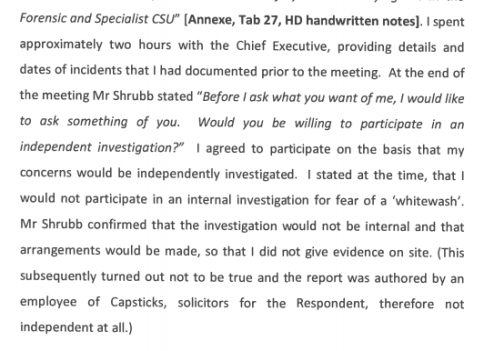
The statement shows that Dr Dare was offered an independent investigation into her concerns by her former chief executive Steve Shrubb, but it turned out that the trust’s own solicitors Capsticks were appointed:

hayley-dare-capsticks-investigator

When there is legal spend by trusts in whistleblower cases, this implies that a failure of governance is likely and that an employer may have tried to turn whistleblowing matters into an employment dispute. This is a classic strategy for neutralising whistleblowers. [9] As successive whistleblowing cases have also shown, trusts often call the lawyers in at an early stage to help plan whistleblowers’ exits, long before any formal litigation.

You’ll forgive me if I don’t join the rush to proclaim that Morecambe Bay has transformed. Nor will I agree that the recent disclosure of the non-investigation clause augurs cultural change across the NHS. If Hunt was serious about eradicating inappropriate settlement agreements in the NHS, he would have taken real steps to deter them. Instead, he just indulged in some empty political theatre, and he allows the CQC to shirk its responsibilities on inspecting NHS gags. [10]

One has to wonder how much of the continuing hype about Morecambe Bay is just more stage managed Hunt-ery. As a piece by Conservative Home noted, Hunt has set out to re-brand his party’s image on the NHS:

“Labour has enjoyed a poll lead over the Conservatives on health for time out of mind.  Hunt’s task is to stop it getting larger and to start leading a counter-attack.”  [11]

hunt-bed-pan 

The illustration to the piece, bedpan and all, is a fitting metaphor for Hunt’s real intentions.


RELATED ITEMS

No one believes Jeremy Hunt on patient safety or whistleblowers, not even his own appointees

A comment on the Health Secretary’s propensity to govern by spin and a chronicle of the National  Freedom to Speak Up Guardian debacle.

https://minhalexander.com/2016/09/24/no-one-believes-jeremy-hunt-on-patient-safety-or-whistleblowers-not-even-his-own-appointees-unmasking-the-faux-national-guardian-office/

Suppressed Homerton maternity whistleblowers, FOI disclosure of the London clinical senate on four maternal deaths and the latest National Guardian for whistleblowing

Updated notes and documents about this whistleblowing scandal, where a cluster of maternal deaths occurred after whistleblowers were ignored, including by CQC.

https://minhalexander.com/2016/09/28/homerton-maternity-whistleblowers-foi-disclosure-of-the-london-clinical-senate-report-on-four-maternal-deaths-and-the-national-guardian/

Hooray Henrietta

An update about the latest National Guardian for whistleblowing, and the embarrassment caused to the Health Secretary by comments in her first press interview.

https://minhalexander.com/2016/10/10/hooray-henrietta/

Silent Knight

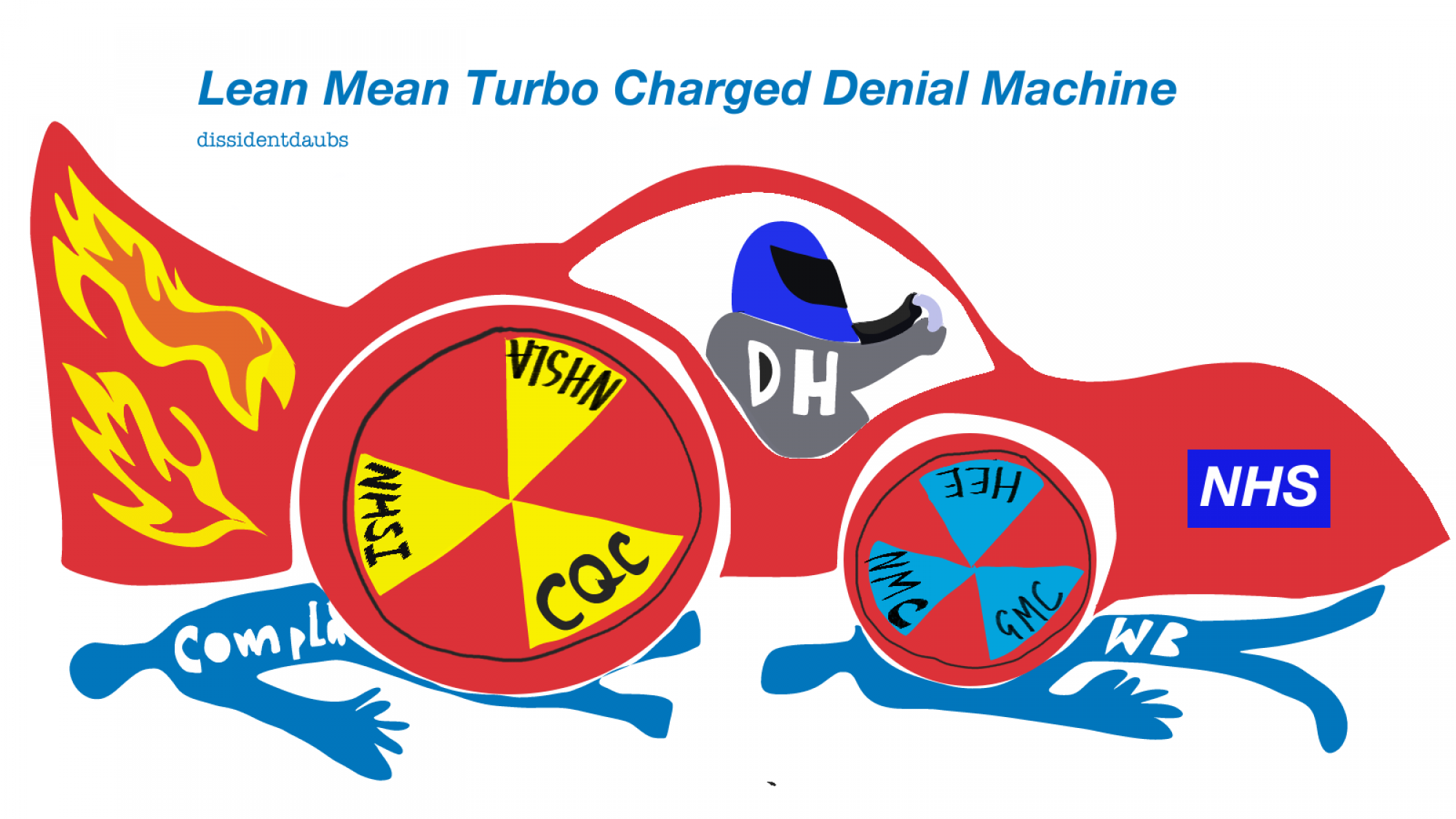
St. Robert of Richmond House. The NHS denial machine. How the Department of Health and the Care Quality Commission built a brand.

https://minhalexander.com/2016/10/12/silent-knight/


REFERENCES

[1] Irregular ‘payoff’ deal at scandal hit trust. Shaun Lintern, Health Service Journal 12 October

https://www.hsj.co.uk/topics/workforce/exclusive-irregular-payoff-deal-revealed-at-scandal-hit-trust/7011428.article

[2] Former nurse blasts Morecambe Bay health trust’s whistleblowing policy, Nick Lakin, Lancaster Guardian 22 July 2016

http://www.lancasterguardian.co.uk/news/former-nurse-blasts-morecambe-bay-health-trust-s-whistleblowing-policy-1-8026260

[3] The Public Health England report of its review of breast screening at Morecambe Bay:

https://www.gov.uk/government/uploads/system/uploads/attachment_data/file/430352/Final_External_Review_final_version.pdf

[4] Morecambe Bay NHS Trust: Two women died after bungling screening tests missed 24 cancers, Martyn Halle and Rachel Mc Dermott, Mirror 4 June 2015

http://www.mirror.co.uk/news/uk-news/morecambe-bay-nhs-trust-two-5820431

[5] Cancer diagnosis shock at Barrow hospital’s trust, North West Evening Mail, 13 July 2015

http://www.nwemail.co.uk/detailedstory?p_p_id=DetailedStory_WAR_portalsuite&p_p_lifecycle=1&p_p_state=exclusive&p_p_mode=view&p_p_col_id=column-1&p_p_col_count=3&_DetailedStory_WAR_portalsuite_javax.portlet.action=doclickcount&_DetailedStory_WAR_portalsuite_uuid=1dc5743f-29d8-48ec-8324-8a23e4077bb9&_DetailedStory_WAR_portalsuite_start=1&_DetailedStory_WAR_portalsuite_category=%2FNEWS%2FBarrow&_DetailedStory_WAR_portalsuite_pubDate=2015-07-13T11%3A08%3A00Z

[6] NHS whistleblower told she was ‘too honest’ to work for the NHS. Lyndsey Telford et al, Telegraph 3 April 2016

http://www.telegraph.co.uk/news/2016/04/03/nhs-whistle-blower-told-she-was-too-honest-to-work-for-the-healt/?utm_source=dlvr.it&utm_medium=twitter

[7] NHS whistleblower investigator in Freedom to Speak Up role, Lyndsey Telford and Claire Newell, Telegraph 4 April 2016

http://www.telegraph.co.uk/news/2016/04/04/nhs-whistle-blower-investigator-in-freedom-to-speak-up-role/

[8] NHS mental health trust admits whistleblower who spoke out about bullying acted in good faith. Paul Gallagher, Independent 7 November 2015

http://www.independent.co.uk/life-style/health-and-families/health-news/nhs-mental-health-trust-admits-whistleblower-who-spoke-out-about-bullying-acted-in-good-faith-a6725786.html

[9] 21 Ways to Skin a Whistleblower. Andrew Bousefield and Dr Phil Hammond, 2011 http://medicalharm.org/uncategorized/the-full-21-ways-to-skin-a-whistleblower/

[10] NHS gagging. How CQC sits on its hands. Minh Alexander 23 September 2016
https://minhalexander.com/2016/09/23/nhs-gagging-how-cqc-sits-on-its-hands-2/

[11] Jeremy Hunt, quiet reformer. Conservative Home. Paul Goodman, 13 November 2014

http://www.conservativehome.com/thetorydiary/2014/11/jeremy-hunt-quiet-reformer.html

Letter: Unheeded deaths warnings. Neglect. A care home owner with criminal convictions. Indefensible CQC.

Letter to House of Commons Health Committee 15 October 2016


BY EMAIL

To Health Committee, 15 October 2016


Dear Dr Wollaston and colleagues,

Unheeded deaths warnings. Neglect and a care home owner with criminal convictions. Indefensible CQC.

I write to submit additional evidence for the next CQC accountability hearing.

The CQC remains insufficiently accountable, insufficiently sighted on critical risks and sentinel events, and unfit to safeguard vulnerable service users. It needs to be replaced

Introduction

Almost a year ago, Public Accounts Committee found that the CQC was still an ineffective regulator, that it had not adhered reliably to its own policy on safeguarding, that it did not handle data well or provide the public with adequate data about regulated services, and that it did not listen enough to service users and whistleblowers. Regarding CQC accountability, the committee found that despite previous criticism in 2012, the CQC’s framework for monitoring its own performance was still inadequate:

“….the Commission does not yet have the quantified performance measures, linked to explicit targets, that are needed to show whether it is satisfactorily performing its statutory duties…only 6 out of the 37 performance measures included in it have specific, quantified, targets”[1]

Also a year ago, The Bureau of Investigative Journalism and the Independent revealed that the CQC had not inspected 9 out of 23 care homes where coroners’ warning reports had been issued about deaths.[2] David Behan acknowledged that these failures were ‘indefensible’ and promised to make improvements, including analysis of coroners’ intelligence.


New analysis on coroners’ warnings about care homes

I have updated the work, and cross-checked coroners’ Reports to Prevent Future Deaths (PFDs) against CQC inspection records. There was no published evidence that CQC had inspected 18 out of 66 homes despite coroners’ warnings. Where CQC had inspected, its response was slow and erratic. I have summarised my findings in a paper that I have published here, with supporting data:

https://minhalexander.com/2016/10/08/care-home-deaths-and-more-broken-cqc-promised/

It shows that the CQC was sent 31 of the 66 care home PFDs, 11 of which were directly addressed to CQC as a named respondent. There was no published CQC response to 9 of the PFDs. In one of two cases where CQC was specifically criticised by the coroner, there was no published response by CQC. I have been unable to find any published analysis by CQC of coroners’ intelligence.


Ivy Atkin, Autumn Grange and CQC’s lack of learning

CQC’s ongoing failures have again been highlighted by the profoundly shocking death of 86 year old Ivy Atkin who died weighing 3 st 13 lb, only twenty days after CQC issued a favourable report on her care home, Autumn Grange.

CQC inspection report on Autumn Grange care home 2 November 2012:

autumn-grange

Click to access 1-101618554_sherwood_rise_limited_1-126202251_autumn_grange_residential_home_20121102.pdf

This inspection report was published on the same day that CQC carried out an unannounced re-inspection of Autumn Grange as a result of a member of staff blowing the whistle only three days after starting work at the care home. In addition to the horrific neglect of Ivy Atkins, other residents at Autumn Grange also suffered severely and were found to have unexplained injuries. ITV news reported that other staff also came forward and alleged mistreatment, including assault. A ‘culture of neglect’ was described, thus raising a question of whether the dysfunction had been present for some time:

http://www.itv.com/news/update/2013-08-14/whistleblower-says-she-tried-to-stop-care-home-abuse/

The coroner has now concluded that Ivy Atkin was unlawfully killed, and that CQC failed to inspect the care home effectively. [3]

The care home owner was jailed in February for corporate manslaughter. During the course of the recent inquest, the coroner expressed concern that he had three criminal convictions: 

“A coroner has questioned how a care home boss was able to run the business where pensioner Ivy Atkin lived before she died – even though he had three criminal convictions…

…The inquest heard on Thursday that home director Yousaf Khan was convicted of criminal damage in 1989, a public order offence for punching and kicking a person in a restaurant in 1998 and drink-driving in 2000.” [4]


Despite obvious and serious questions about CQC’s handling of the issues relating to Autumn Grange, the CQC told me that it had not undertaken any internal review of its actions, and implied that there was no need to do so because its processes are “better than ever”. This correspondence with CQC is attached. [5] The inspector responsible for the inspection 7 weeks before Ivy Atkin’s death maintained at the inquest that she had not “missed anything” and that care homes can go “downhill quickly”. In a discussion yesterday about Ivy Atkin’s death, a CQC Non Executive Director responded thus to a campaigner’s concerns that CQC is reactive and not sufficiently proactive: “Er, this was 4 years ago”.

ks

I find this attitude by CQC deeply shocking, set against the cruel death that befell Ivy Atkin. There is much rhetoric from the Secretary of State that the CQC is a new organisation under his stewardship. However, even the previous CQC regime undertook an internal review after abuse at Winterbourne View was exposed. The severity of the failings at Autumn Grange was much greater than at Winterbourne View, yet the current CQC regime has not seen fit to properly hold itself to account.

The history of serial failure by the CQC to safely regulate care homes and provide the public with accurate information – highlighted 22 times by Private Eye since 2010 – is summarised in this comprehensive report by the campaigning charity Compassion In Care: http://www.compassionincare.com/node/229


CQC value for money

The Mazars report on Southern Health NHS Foundation has raised serious doubts about the accuracy of CQC’s so-called ‘intelligent monitoring’, which is a cornerstone of CQC’s purported ‘transformation’. Moreover, a £273,908 CQC inspection [6] of Southern Health in 2014 did not report on the hundreds of uninvestigated unexpected deaths, later identified by Mazars’ investigation.

After seven years of failure by CQC and frequent refusal to investigate key matters (CQC disclosed by FOI that it had undertaken only 6 Section 48 investigations since inception [7]) I contend that the CQC’s approach does not work, is not safe and is poor value for money.

The hundreds of millions spent every year on CQC – on a ‘transformation’ that is not actually evident – would surely be better spent on leaner, focused, and professionalised investigation services, such as that which revealed the grave care failings at Mid Staffordshire:

https://minhalexander.com/wp-content/uploads/2016/10/hcc-investigation_into_mid_staffordshire_nhs_foundation_trust.pdf

I note that the Healthcare Safety Investigation Branch (HSIB) has now been created to carry out healthcare investigations, but its currently slender funding results in inadequate capacity. It has an intended rate of only 30 investigations a year, and the Department of Health advised that this capacity may even reduce. [8]

CQC’s latest National Guardian for whistleblowing has extolled the virtues of cheerfulness: https://minhalexander.com/2016/10/10/hooray-henrietta/


front-page


However, CQC unfortunately gives the health and care workforce little cause to smile.

Yours sincerely,

Dr Minh Alexander


cc  Public Accounts Committee

Public Administration and Constitutional Affairs Committee

Keith Conradi Chief Investigator, HSIB


REFERENCES

[1] Public Accounts Committee. CQC inquiry. December 2015

http://www.publications.parliament.uk/pa/cm201516/cmselect/cmpubacc/501/501.pdf

[2] Elderly people put at risk as watchdog fails to act on warnings of ‘fatally negligent’ care homes. Melanie Newman and Oliver Wright, The Independent, 2 September 2015

http://www.independent.co.uk/life-style/health-and-families/health-news/elderly-people-put-at-risk-as-watchdog-fails-to-act-on-warnings-of-fatally-negligent-care-homes-10483573.html

[3] Ivy Atkin death: ‘Unlawful killing’ over care resident death, BBC 13 October 2016  http://www.bbc.co.uk/news/uk-england-nottinghamshire-37649387

[4] Owner of the care home where Ivy Atkin stayed before her death had three criminal convictions, Jemma Page, Nottingham Post, 14 October 2016

http://www.nottinghampost.com/owner-of-care-home-where-ivy-atkin-stayed-had-three-criminal-convictions/story-29806771-detail/story.html

[5] Correspondence February and March 2016 with CQC, about whether it had undertaken an internal review on its inspection activities at Autumn Grange

https://minhalexander.com/wp-content/uploads/2016/10/cqc-no-internal-review-of-autumn-grange-death.pdf

[6] FOI disclosure about the cost and details of a CQC inspection on Southern Health:

https://minhalexander.com/wp-content/uploads/2016/10/cqc-foi-disclosure-on-cost-of-the-southern-health-inspection-oct-2014.pdf

[7] FOI disclosure by CQC about the number of Section 48 inspections undertaken since CQC’s inception:

https://minhalexander.com/2016/09/27/cqc-foi-disclosure-15-january-2016-about-section-48-investigations-conducted-since-inception-in-2009/

[8] FOI disclosure by the Department of Health about HSIB:

https://minhalexander.com/wp-content/uploads/2016/10/ipsis-hsib-dh-disclosure-budget-capacity-3-02-2016.pdf


CQC’s “better than ever”…or didn’t you know?


By Dr Minh Alexander, NHS whistleblower and former consultant psychiatrist 14 October 2016

The much criticised Care Quality Commission has tried hard to re-brand itself but the changes are superficial, and the values at its heart remain highly questionable. The CQC remains a defensive organisation, full of self-justification. CQC’s attitude towards its part in the profoundly shocking care home death of Ivy Atkin is a case in point.

Ivy Atkin an 86 year old retired dressmaker suffered a barbaric death on 22 November 2012 after gross neglect at Autumn Grange care home in Nottingham. Her case has been extensively reported. In summary:

High Court judge Robert Jay said that when Mrs Atkin was found, she was skeletal, severely dehydrated, lying on a bed soaked in urine and had a large open, pressure sore at the base of her back which was contaminated with faeces.”[1]

Although discovered in extremis, Mrs Atkin was reportedly not admitted to hospital, but was moved to another care home where she died shortly after, weighing 3 st 13 lb.

Other residents also suffered severely. Some had unexplained injuries.

The care home director was jailed for corporate manslaughter in February this year.[1]

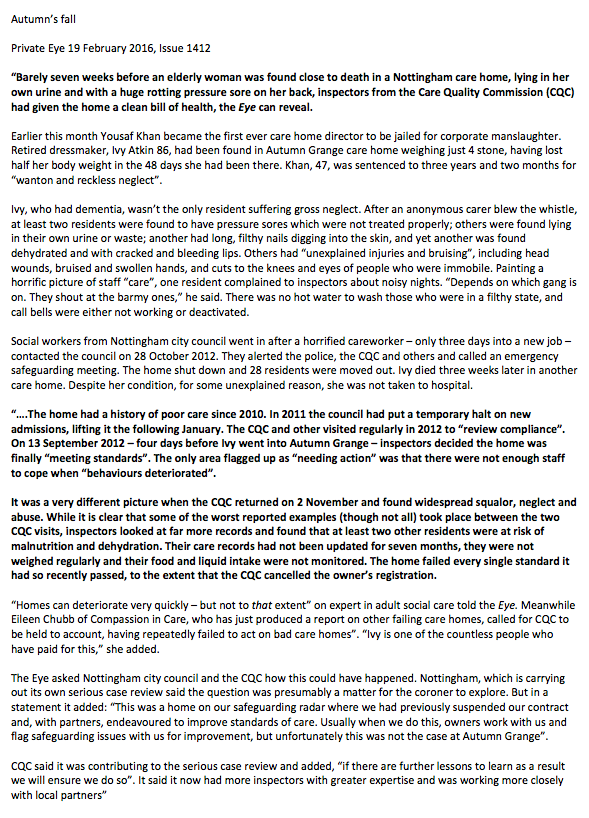
Private Eye covered the scandal, and noted that Autumn Grange had been given a clean bill of health before the abuse was uncovered. [2]

autumn-grange

Link to the CQC inspection report issued 20 days before Ivy Atkin’s death:

Click to access 1-101618554_sherwood_rise_limited_1-126202251_autumn_grange_residential_home_20121102.pdf

An inquest has now found that Ivy Atkin was unlawfully killed:

Health inspectors were criticised by the Nottinghamshire Assistant Coroner for “missing opportunities” to uncover conditions at the home.”

[The coroner reportedly also] “…said in the light of concerns raised about conditions at the home, the inspection “should have been more rigorous” and inspectors failed to “be proactive”. [3]

According to the BBC, Lesley White the CQC inspector who inspected Autumn Grange weeks before Ivy Atkin’s death told the inquest: “…she had not “missed anything” in an inspection in September and that a home could go “downhill quickly”.”

The BBC had not yet received the CQC’s response to the inquest’s conclusion.

In February this year after the above corporate manslaughter conviction,  I asked if CQC had conducted an internal review into its inspection activities at Autumn Grange.

The CQC replied that it was contributing to the local authority’s serious case review, but had not undertaken any internal review of its inspection activities at Autumn Grange. The CQC made no comment on why Mrs Atkin had not been taken to hospital, and added:

The way CQC inspected services in 2012 is very different to how inspections are now carried out….Our approach to monitoring and inspecting adult social

care allows us to get under the skin of services better than ever before. We have more inspectors with greater expertise and we are working more closely with our local partners to respond to concerns.” [4]

 This morning, in response to a campaigner voicing concerns that the CQC is reactive and not sufficiently proactive in its inspection approach, a CQC Non Executive Director delightfully tweeted: “Er, this was four years ago”

That’s alright then.

PS It’s anybody’s guess how many complaints have been made about this CQC NED’s social media behaviour. I gather the CQC refuse to divulge the number. Toodle-oo.

ks


UPDATE 13 NOVEMBER 2016

CQC Board papers for the CQC Board meeting of 16 November 2016 show that CQC has now been issued with a coroner’s warning report regarding Autumn Grange. CQC has also now undertaken an internal review of its handling of Autumn Grange, which is yet to be published:

Click to access CM111604_Item4_ChiefExecutiveReport.pdf


RELATED ITEMS

Care home deaths and more broken CQC promises.

A review of 66 coroners Reports to Prevent Future Deaths against CQC inspection reports. This has revealed that despite criticism a year previously, CQC’s response to coroners’ warnings about care home deaths remained variable and slow, and that there were no published responses to most of the coroners’ reports that had been addressed directly to CQC as a named respondent.

Care home deaths and more broken CQC promises

CQC deaths review: all fur coat

A review of all current CQC inspection reports on mental health trusts revealed that CQC presented deaths data in an inconsistent, incomplete manner and sometimes did not even refer to deaths or report coroners’ warning reports fully or at all.

CQC Deaths Review: All fur coat….

REFERENCES

[1] Ivy Atkin death: Care home director jailed for gross negligence, Rachel Gorman, Nottingham Post 5 February 2016

http://www.nottinghampost.com/ivy-atkin-death-care-home-director-jailed-gross/story-28677735-detail/story.html

[2] Private Eye:

cqc-pe-ivy-atkins-18-02-2016

[3] Ivy Atkin death: ‘Unlawful killing’ over care resident death, BBC 13 October 2016 http://www.bbc.co.uk/news/uk-england-nottinghamshire-37649387

[4] Correspondence with CQC February and March 2016 about whether it undertook an internal review of its inspection activities at Autumn Grange care home

cqc-no-internal-review-of-autumn-grange-death

Silent Knight

By Dr Minh Alexander NHS whistleblower and former consultant psychiatrist, 12 October 2016

How many distressed whistleblowers hear back from St. Robert of Richmond House? The answer is that we don’t know, but here is a tale of apparent silence.

Whilst wrecking the NHS with dangerous cuts, Jeremy Hunt likes to spin about the infallibility of those whom he has used to build his false narrative of tough regulation, prioritisation of patient safety and hard-nosed efficiency. After a conflict between GPs and Steve Field CQC Chief Inspector, who had made some generalised comments about GPs “failing as a profession”, Jeremy Hunt effectively pronounced that Field was un-touchable:

A former GP and President of the Royal College, his credibility is beyond question, and we absolutely back his independent judgements as Chief Inspector.”

http://www.pulsetoday.co.uk/your-practice/regulation/cqc/professor-steve-field-says-gps-have-failed-as-a-profession/20030685.fullarticle

So much for just culture.

Similarly, Sir Robert Francis’ name has been used by the government and by Jeremy Hunt as a powerful PR weapon. It has been incessantly built up as a cipher for patient safety, a trusted brand logo. Where you need to brush a little gloss on a project, manage a scandal or sell another Department of Health or Care Quality Commission good news story, just pop in those magic words: “Sir Robert Francis said…..”.

When Hunt and the CQC were in choppy water because the previous National Guardian Eileen Sills resigned within two months of appointment – after a head-hunting exercise that cost the public £61,300 [1] and after she dropped clangers which showed that she was ill-informed about whistleblowing – who was wheeled in? Sir Robert. Sir Robert was unfurled and run up the CQC flagpole:

Sir Robert Francis QC, CQC board member and author of the ‘Freedom to Speak Up’ review, said: 

“The Office of the National Guardian is a key part of the promotion of the freedom to speak up in the NHS. I remain personally committed to help see a new National Guardian appointed as soon as possible and to oversee the continuing development of the infrastructure required to support the new appointee. I am confident that the team at CQC is working hard to ensure that the new Guardian has the support in place to enable this vital work to be done.”” [2]

Never mind of course, that Sir Robert had a hand in this failed appointment.

francis-cqc-logo

Sir Robert gets invited to all the right parties, and continues to say all the right things. At the recent launch of the annual report of the National Confidential Inquiry into Suicide and Homicide by People with Mental Illness, attendants reported that he made these laudable comments:

“You would think that patient safety would be a priority in all health services, this isn’t the case… We need to go further in creating safe spaces where staff can discuss and learn from error….if you don’t care for staff, they don’t care for patients” etc….

Sir Robert also struck out for the little guy – or in this case, gals – when in February 2014 he publicly criticised the conduct of Paula Vasco-Knight’s trust – South Devon Healthcare NHS Foundation Trust – towards two whistleblowers, Clare Sardari and Penny Gates:

“It is important that no tolerance is afforded to oppressive managerial behaviour of the sort identified only last week by an employment tribunal in the South West, which victimises staff who raise honestly held concerns. 

“Every such case is hugely damaging to the confidence of other staff who are contemplating raising concerns. It is clear that there is much to do in this area.” [3]

But what happened when one of the whistleblowers – Clare Sardari – wrote him a distressed letter in August 2015? This was at a time when she was significantly depressed and had required professional care, and had not long lost her mum. Clare Sardari never heard from Sir Robert.

Her letter informed Sir Robert that due to the vagaries of the Employment Tribunal system and her employer’s actions, she had ended up in very difficult financial circumstances despite winning her case:

“…I was given only a very short time to make a decision, and on the advice of my legal team… I accepted the settlement offer of £233,000. This figure did not take into account any future loss of earnings or future pension loss. I have legal costs of over £100,000, will have to pay 40% in tax and have built up significant debts in the two and a half years I have been unemployed. What I will be left with is a very small amount and at 58 years of age, having tried my hardest over the past 3 years to find a job, blacklisted by local NHS Trusts, I have no future!”

The letter also recounted how her employers agreed to make a formal apology, but did not in the end do so. Her letter ended on a highly personal note:

I need a job as my financial situation is dire. I need a job because my self esteem is at rock bottom. I need justice but am unlikely to get it. I need your support and your help, if there is anything you can do.”

But there was only silence.

It’s possible Clare Sardari’s letter was lost in the post and never arrived, or that Sir Robert replied but his response did not arrive. Perhaps he can tell us. Robert Francis told us in 2014 that he has heard from many whistleblowers, and also from staff too frightened to speak out:

“Sir Robert said that since publishing his findings 16 months ago into the unnecessary deaths of hundreds of patients at Mid Staffs, many staff had contacted him saying they were still too scared to speak out.” [4]

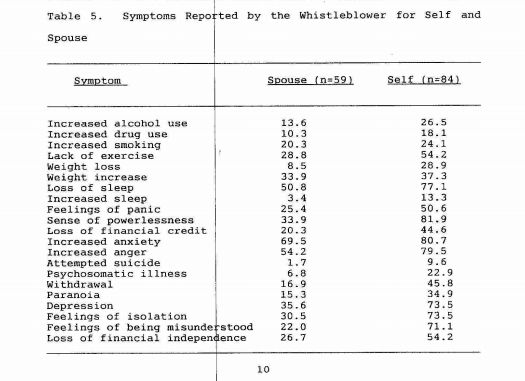
I would like to think that Mr Hunt’s totem of moral authority does not ignore people who are in a state of obvious distress. It is well known that the whistleblower’s journey often includes serious ill health, mental and physical. [5] Soeken and Soeken reported this years ago:

soeken-soeken-psych-symptoms-1987

These were early, rough results from an investigation beset with the usual problems of sampling in whistleblowing, but nevertheless, they provide a picture of significant suffering.

Being cold shouldered and finding doors repeatedly closed in your face – or never opened – is part and parcel of the isolation and despair that many whistleblowers experience.

And as Sir Robert has observed, “…if you don’t care for staff, they don’t care for patients”.

Clare Sardari tweets at @SardariClare


RELATED ITEMS

1) Sir Robert’s Flip Flops

An account of Robert Francis’ u-turns on his original recommendation from the MidStaffs public inquiry to criminalise whistleblower reprisal.

Sir Robert’s Flip Flops

2) Open letter by Clare Sardari to the governors of St. Georges, where Paula Vasco-Knight her former Chief Executive was recycled into a board position and then promoted to Chief Executive, only to fall from grace again after allegations of a financial nature.

clare-sardari-open-letter-st-georges

3) CQC’s Fit and Proper Parade

A summary about the Care Quality Commission’s failure and obfuscations on holding any unfit NHS directors to account under Regulation 5 Fit and Proper Person, with details about CQC’s highly questionable behaviour in response to an FPPR referral on Paula Vasco-Knight, Clare Sardari’s former Chief Executive.

CQC’s Fit and Proper Parade


REFERENCES

[1] NHS bosses blew £61,000 on whistleblowing tsar who QUIT before starting job

http://www.mirror.co.uk/news/uk-news/nhs-bosses-blew-61000-whistleblowing-7650064

[2] National Guardian update. CQC press release 5 April 2016

http://www.cqc.org.uk/content/national-guardian-update

[3] Francis criticises Vasco-Knight trust, Judith Welikala, Health Service Journal, 7 February 2014 https://www.hsj.co.uk/sectors/acute-care/francis-criticises-vasco-knight-trust/5067807.article

[4] NHS is still gripped by a culture of fear: Inquiry into whistleblowing set up by barrister who investigated Mid Staffs, Sophie Borland Daily Mail, 25 June 2014

http://www.dailymail.co.uk/news/article-2668566/NHS-gripped-culture-fear-Inquiry-whistleblowing-set-barrister-investigated-Mid-Staffs.html

[5] “Whistleblowing”: a health issue. Dr Jean Lennane, BMJ Volume 307, 11 September 1993, p.667-670 whistleblowing-a-health-issue-dr-jean-lennane

A letter to the ever-listening Cat Quality Commission

Letter  11 October 2016 to Peter Wyman CQC Chair, about ongoing issues with the National Freedom to Speak Up Guardian

I have written to Mr Wyman to bring to his attention to adverse reactions by whistleblowers, NHS staff and the public to comments made by Henrietta Hughes, the replacement National Guardian, in her first interview with the press.

The full letter with all attached comments is uploaded here:

cqc-wyman-letter-re-hh-ng-wb


delay-deny


THE MAIN CONTENT OF THE LETTER IS AS FOLLOWS:

To Peter Wyman, Chair of Care Quality Commission, 11 October 2016

Dear Mr Wyman,

CQC’s handling of the National Freedom to Speak Up Guardian’s office

When you appeared before the Health Committee at your pre-appointment hearing on 1 December 2015 for the CQC Chair, you commented thus about NHS whistleblowing: “I need to understand properly whether there really is a problem and, if there is a problem, what else we can do beyond the things I know the CQC is doing to make it easy.”

I hope by now that you are familiar with the contents of the Freedom to Speak Up Review report February 2015 and Health Committee’s findings of January 2015 that the treatment of whistleblowers is a stain upon the NHS’ reputation, and that you agree there “really is a problem” with NHS whistleblowing governance.

The CQC promised in December 2014 “We will hold health and social care services to a high standard of listening and acting on people’s concerns. We are committed to apply the same standards to ourselves”. To that end, I write to pass on a collation of some adverse reactions from whistleblowers, NHS staff and the public to the new National Guardian’s comments in an interview with the press, revealed yesterday.

https://minhalexander.com/wp-content/uploads/2016/10/happiness-is-the-best-medicine-henrietta-hughes.pdf

The responses are listed below. You will note that the general gist of many of the comments can be summarised, as per one doctor’s comment, as a perception that NHS staff have been told: “…put up, shut up and smile”. This is obviously an unfortunate outcome when the stated aim is to encourage staff disclosure. You will also note that senior NHS whistleblowers Dr Heather Wood and Amanda Pollard, who uncovered the Mid Staffs care failings and or gave evidence to the Mid Staffs public inquiry are amongst those who have expressed concerns. Dr Kim Holt who worked for CQC on whistleblowing has now also expressed concerns.

The National Guardian office has been deeply troubled since the outset of its short life. The first National Guardian resigned earlier this year, within two months of appointment and after wrongly advising that her office was not a legally “prescribed body” under the Public Interest Disclosure Act. I believe further serious questions now arise about CQC’s selection process and its exclusion of whistleblowers from this process.

The CQC’s position specification for the National Guardian post required that the candidate must have:

Ability to work collaboratively with individuals from Board level to the frontline …Ability to present complex issues clearly and with sensitivity to individuals, groups and the media….Excellent communication skills, both written and oral…. Ability to inspire trust and confidence of a wide range of stakeholders”

https://minhalexander.com/wp-content/uploads/2016/09/cqc-national-guardian-specification-v2-29-april-2016-final-799675.pdf

The effective handling of whistleblowing is a critical issue, especially when the NHS is in turmoil and NHS staff need genuine freedom to speak up. It is still not clear exactly what the National Guardian’s remit will be. I hope that for the sake of patients, the current serious situation is properly and actively resolved.

I previously received a letter from CQC that was critical of the fact that I had copied some of my correspondence to select committee members. I do not agree that it is for CQC to determine my communication with parliament. Accordingly, I copy this correspondence to parliament because of the public interest nature of the issues involved.

Yours sincerely,

Dr Minh Alexander

NHS whistleblower and former consultant psychiatrist

cc Health Committee, Public Accountants Committee, Public Administration and

Constitutional Affairs Committee

Chris Wormald Permanent Secretary DH

Sir Jeremy Heywood, Head of the Civil Service


COMMENTS

My own comments about the National Guardian’s office and the present incumbent’s recent comments can be found here:

Other comments are as follows:

Amanda Pollard CQC whistleblower and former CQC inspector:

“When I attended release of Mid Staffs Public Inquiry report, I genuinely wouldn’t have imagined so little progress made by 2017”


Hooray Henrietta

A special bulletin from the Ministry of Love. 

It seems our replacement National Guardian for whistleblowing is a fan of peace and love, apparently by diktat if necessary. She’s even given an interview to the Times about her thoughts on how NHS staff must be cheerful, so that no one feels intimidated from speaking up.[1]

front-page

The NHS needed more of the “trust and joy and love” hormone oxytocin, Dr Hughes said, citing the happy embraces of reunited families at the start of the Hugh Grant film Love Actually….If you think about that scene in Love Actually where everybody is meeting at the airport, that’s the oxytocin feeling. So wouldn’t it be better if oxytocin was the predominant neurotransmitter in the NHS?…In her first interview as national guardian for speaking-up, Dr Hughes urged staff to “start living . . . the NHS that they want to work in…Dismissing concerns that her job had few formal powers, she said that change could happen “just like that” if staff always acted as they would on a good day”

Darn, why didn’t any of us think of that? Forget all those silly old professors who’ve been researching whistleblowing for years. Forget their daft evidence-based recommendations. Who needs dull stuff like Law reform and proper infrastructure for safeguarding whistleblowers [2] when you can have happy, happy, happy, happy talk. So, well done Sir Robert, Patients Association and CQC for another credible and serious appointment. [3]

Henrietta’s so big on happy, shiny people that according to a blog, she introduced a RULE about smiling for her staff: [4]

At the Olympics as I handed over my ticket and walked into the venue I noticed a small sign on the back of the booth – SHINE.  I saw the first 3 words but by then I had moved past so did some research and made a guess as to what the N and E meant:

S – smile

H- hello

I – eye contact

N- name

E- enthusiasm/ Empathy

While researching I came across the 10:5 rule – when someone comes within 10 feet – smile, within 5 feet – say hello.”

NHS managerial grotesquery, you may think.

Moreover, is it right and proportionate to disparage “grumpy” staff, without mentioning the KissUpKickDown senior management? Or the intolerable stresses to which the NHS frontline has been subjected? No, forget the lowest paid NHS staff being forced to rely on food bank handouts [5] whilst senior managers have repeatedly awarded themselves fat pay rises. Forget the anxiety of working in seriously under-staffed departments or the stress and exhaustion of servicing on call rotas with yawning gaps. Forget the institutional dishonesty that forces unhappy staff to become complicit in cover ups, or to risk all by dissenting. [6] Forget the message of intimidation inherent in seeing senior managers walk away unscathed after indulging in whistleblower reprisal. [7] [8] Just let those whining staff eat food bank cake.

morley

Phil Morley, Robert Halfon MP, Jeremy Hunt Health Secretary and Douglas Smallwood Trust Chair, at Princess Alexandra Hospital Essex

diana-johnson-letter-to-hunt-morley-16-july-2015-1

The twitchy and highly controlling NHS establishment classically brands staff dissent as “disruptive” and “unmanageable”. Bogus disciplinaries are often concocted against truth tellers. If these don’t succeed, employers can still cry breakdown of relationships – which is a legal basis for dismissal no matter whose fault it is. [9] Compulsory smiling is surely part of the dysfunctional, choking miasma.

And is Henrietta in a position to share a valid evaluation of her “10 foot” smile rule, and whether it had a measurable effect on whistleblowing governance?

Or were her staff just grinning and bearing with the intrusive management….because they didn’t feel able to object?

On top of a non evidence-based Guardian model courtesy of Sir Robert [10], will there now be policy by caprice and movie references?

I would actually like to hear from Henrietta. Even at this very late stage no one knows what exactly she is going to do for desperate and distressed whistleblowers. I’m still waiting for an answer to questions that were first put to Sir Robert in May, which have been put to Henrietta twice since. [11] [12]

Whilst we’re all waiting for serious answers as opposed to CQC set pieces, here’s what Mr Orwell said about the Ministry of Love:

“The Ministtry of Love was the really frightening one. There were no windows in it at all. Winston had never been inside the Ministry of Love, nor within half a kilometer of it. It was a place impossible to enter except on official business, and then only by penetrating through a maze of barbed-wire entanglements, steel doors, and hidden machine-gun nests. Even the streets leading up to its outer barries were roamed by gorilla-faced guards in black uniforms, armed with jointed truncheons.”

Smile for the CCTV camera.

Related items

Clubadoodle-doo. An update on continuing lack of clarity about the National Guardian’s remit.

Clubadoodle-doo

No one believes Jeremy Hunt on patient safety and whistleblowers, not even his own appointees. A summary about the development of the National Guardian office and information from a meeting with Eileen Sills the former National Guardian, who resigned.

No one believes Jeremy Hunt on patient safety or whistleblowers – not even his own appointees. Unmasking the faux National Guardian Office.

Update 11 October 2016

Letter to Peter Wyman CQC Chair, bringing to his attention the strong, negative responses to Henrietta Hughes’ comments that staff must be more cheerful.

A letter to the ever-listening Cat Quality Commission


REFERENCES

[1] Happiness is the best medicine, grumpy doctors and nurses told Chris Smyth, Times, 10 October 2016 happiness-is-the-best-medicine-henrietta-hughes

[2] Sir Robert’s Flip Flops. Minh Alexander, 26 September 2016
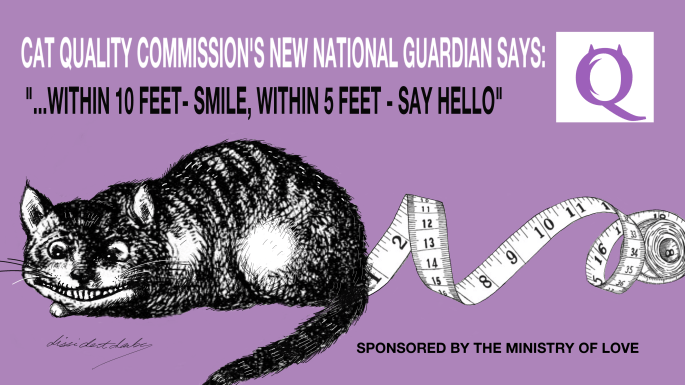
Sir Robert’s Flip Flops

New National Guardian appointed to the lead the NHS in speaking up freely and safely. CQC press release about Henrietta Hughes’ appointment. 7 July 2016

[3] New National Guardian appointed to the lead the NHS in speaking up freely and safely. CQC press release about Henrietta Hughes’ appointment. 7 July 2016

http://www.cqc.org.uk/content/new-national-guardian-appointed-lead-nhs-speaking-freely-and-safely

[4] SHINE. Henrietta Hughes guest blog for NHS Mangers Network

http://www.nhsmanagers.net/guest-editorials/shine/

UPDATE 16 NOVEMBER 2018. THE GUEST BLOG APPEARS TO HAVE REMOVED FROM THE WEB. THIS IS A COPY OF THE ORIGINAL CONTENTS:

Guest Editorial SHINE 28 Jul

SHINE Henrietta Hughes NHS England

It’s the first anniversary of the 2012 Olympic Games – what is the legacy for the NHS?

Analysis

Cast your mind back to the warmth and friendliness of the volunteers at the London 2012 Olympic and Paralympic Games. Despite the crowds and the need to get all the visitors into the venues swiftly the volunteers were always smiling and friendly and made us feel really welcome.  The  friendliness continued outside the Olympic Park with commuters uncharacteristically chatting on the tubes and trains.  The NHS starred in the opening ceremony in such a moving way, in stark contrast to the daily stories we now read of widespread poor patient experience.

I wondered how we could harness the amazing warmth of the volunteers to improve not only the patient experience but also the staff experience within the NHS. At the Olympics as I handed over my ticket and walked into the venue I noticed a small sign on the back of the booth – SHINE.  I saw the first 3 words but by then I had moved past so did some research and made a guess as to what the N and E meant:

S – smile

H- hello

I – eye contact

N- name

E- enthusiasm/ Empathy

While researching I came across the 10:5 rule – when someone comes within 10 feet – smile, within 5 feet – say hello.

The 10:5 rule is widely employed by sales teams, at Universal Studios and the Georgia World Congress Center as well as several healthcare providers in the USA. At the Medical University of South Carolina (MUSC) Medical Center this is written into the job description of all staff. Individually employees, as well as applicants, must pledge to practice standards of behaviour for the benefit of colleagues and the betterment of the MUSC Medical Center.  A patient described a journey from the front door at MUSC to the time she was seen by the doctor.  By then she had received so many smiles and acknowledgements she described herself as grinning from ear to ear. The staff describe being happy and welcomed from day one.

I have started SHINE and the 10:5 rule within my team in London and shared it across the Directorate.  It has helped to create a kind and welcoming atmosphere across a large open plan office and to build relationships across different directorates. I would love to see this expanded across the NHS.  It is free, warm and friendly. Make this part of the training of GP receptionists and clinic staff and patients would feel better straight away. It needs to be role modeled by senior management, when you are walking the wards or around your own work environment you will be more approachable to patients, relatives and your junior staff.  As a GP I have always greeted patients by name from the waiting room rather than the impersonal dot matrix display.  A warm smile and greeting helps to evaporate the tension if I have started to run late and builds a great start to the consultation.

So let’s build on the inspiration of the Olympic and Paralympic games by helping staff to SHINE and making the NHS an inviting and friendly environment for both patients and staff. Smiling has been variously credited with improving mood, relieving stress and boosting the immune system, lowering blood pressure, releasing endorphins, improving attractiveness and making you look younger.  Whilst I cannot guarantee that you will look younger and more attractive smiling is contagious – I certainly get a lot of smiles around the office.

[5] Nurses turning to food banks and asking for debt advice because of NHS cuts.

Jane Kirby, Mikey Smith, Mirror 2 September 2015

http://www.mirror.co.uk/news/uk-news/nurses-turning-food-banks-asking-6367795

[6] Hot air about Just Culture, Richard von Aberndorff and Minh Alexander

https://minhalexander.com/2016/09/24/hot-air-about-just-culture/

[7] Health Secretary. NHS boss Phil Morley’s appointment ‘Fit and Proper’

http://www.hulldailymail.co.uk/health-secretary-deems-nhs-boss-phil-morley-fit/story-27478960-detail/story.html

[8] CQC’s Fit and Proper Parade. Minh Alexander, 29 July 2016

https://minhalexander.com/2016/09/24/cqcs-fit-and-proper-parade/

[9] Important new guidance from the courts for employers on managing whistleblowing claims. Capsticks LLP

[10] Critique of Francis’ model of trust-appointed Guardians. Minh Alexander 4 June 2015

https://minhalexander.com/2016/09/24/critique-of-francis-model-of-trust-appointed-guardians/

[11] Letter to Robert Francis 1 May 2016

https://minhalexander.com/wp-content/uploads/2016/10/letter-to-robert-francis-1-may-2016.pdf

[12] Clubadoodle-doo, 4 October 2016 Minh Alexander

https://minhalexander.com/2016/10/04/clubadoodle-doo/