Morecambe and wise counsel

By Dr Minh Alexander NHS whistleblower and former consultant psychiatrist 17 October 2016

Jeremy Hunt’s camp has repeatedly and shamelessly exploited the maternity safety scandal at Morecambe Bay trust to shore up the Health Secretary’s claims to be a patient champion. It’s all tosh of course, as a true patient champion would not be swinging a wrecking ball at the NHS.

Last week, another “New! Shiny! Improved!” Morecambe Bay story did the rounds.

It related to an important issue of how some NHS organisations pay off and silence those implicated in wrongdoing. The Health Service Journal reported that Morecambe Bay trust reached a settlement with one of the midwives in the maternity scandal, which stipulated that she would not be investigated:

“Following discussions between the employee and the trust, the employee has opted to take early redundancy and as a result the employer has agreed not to commence an internal investigation into the employee’s performance as maternity risk manager.” [1 ]

The trust itself had revealed this settlement, four years after it had been agreed. Some rushed to claim that the disclosure meant that NHS culture was changing, and by implication, that our glorious Health Secretary Hunt had delivered promised change culture. Compliments were also heaped on Morecambe Bay’s new regime.

Whistleblowers have a different perspective. Russell Dunkeld ( @RussellDunkeld ) an NHS whistleblower and a former Morecambe Bay trust nurse had continuing difficulties with the trust, which were recently covered by the Lancaster Guardian. [2]

russell-dunkeld-photo

Since Morecambe Bay’s current chief executive Jackie Daniel took up her post in August 2012, the CQC has reported via its ‘intelligent monitoring’ updates, of October 2013, March 2014, July 2014 and December 2014, that there were repeated external ‘whistleblowing alerts’ by trust staff.

In 2014 two whistleblowers raised concerns about the safety of breast cancer screening services, leading to a Public Health England external review. [3] There was controversy about the treatment of the whistleblowers. The Mirror noted:

Public Health England were approached by the whistleblowers after the trust – which is in special measures – initially refused to investigate. The whistleblowers found themselves suspended and barred from working in breast screening when they complained 12 months ago.” [4]

There has also been correspondence to Jeremy Hunt about the trust’s behaviour. One of the letters to Jeremy Hunt was by local councillor Azhar Ali:

I am writing to express my deep concerns regarding the manner in which a whistleblowing incident within the breast cancer screening unit at the University Hospitals of Morecambe Bay is being addressed…I am aware that one of the clinicians who raised concerns have nearly left the Trust due to the upheaval…Could I urge you to establish an independent team to ensure that the whistleblowers’ concerns are fully taken into account…”

councillor-azhar-ali-letter-to-hunt

Last year, there were concerns about the deaths of women who died after being given the all clear on cancer. But New! Shiny! Improved! Morecambe Bay trust refused to fully disclose the outcomes for all patients affected by screening errors. [5]

Most recently, I asked the trust about its spending on Capsticks LLP’s legal and related services in whistleblowing cases. The trust resisted the FOI request but on appeal to a trust governor, a full disclosure was made.

Morecambe Bay trust FOI disclosure 24 June 2016:  

morecambe-foi-response-5775-24-06-2016

On Jackie Daniel’s watch, £92,519 had been spent on Capsticks’ services in the case of the breast screening whistleblowers. Capsticks have been instructed by NHS bodies in a number of other whistleblowing cases. Two examples are:

Maha Yassaie, former Berkshire West Chief Pharmacist, described by a Capsticks investigator as ‘too honest’ for the NHS. [6] The Telegraph has reported on how the same Capsticks investigator tried to coach witnesses during the investigation. [7]

Hayley Dare, Consultant Psychologist. [8] Dr Dare’s statement for the Employment Tribunal can be found here:

Click to access home

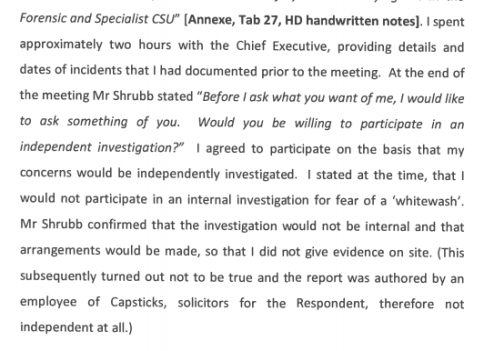
The statement shows that Dr Dare was offered an independent investigation into her concerns by her former chief executive Steve Shrubb, but it turned out that the trust’s own solicitors Capsticks were appointed:

hayley-dare-capsticks-investigator

When there is legal spend by trusts in whistleblower cases, this implies that a failure of governance is likely and that an employer may have tried to turn whistleblowing matters into an employment dispute. This is a classic strategy for neutralising whistleblowers. [9] As successive whistleblowing cases have also shown, trusts often call the lawyers in at an early stage to help plan whistleblowers’ exits, long before any formal litigation.

You’ll forgive me if I don’t join the rush to proclaim that Morecambe Bay has transformed. Nor will I agree that the recent disclosure of the non-investigation clause augurs cultural change across the NHS. If Hunt was serious about eradicating inappropriate settlement agreements in the NHS, he would have taken real steps to deter them. Instead, he just indulged in some empty political theatre, and he allows the CQC to shirk its responsibilities on inspecting NHS gags. [10]

One has to wonder how much of the continuing hype about Morecambe Bay is just more stage managed Hunt-ery. As a piece by Conservative Home noted, Hunt has set out to re-brand his party’s image on the NHS:

“Labour has enjoyed a poll lead over the Conservatives on health for time out of mind.  Hunt’s task is to stop it getting larger and to start leading a counter-attack.”  [11]

hunt-bed-pan 

The illustration to the piece, bedpan and all, is a fitting metaphor for Hunt’s real intentions.


RELATED ITEMS

No one believes Jeremy Hunt on patient safety or whistleblowers, not even his own appointees

A comment on the Health Secretary’s propensity to govern by spin and a chronicle of the National  Freedom to Speak Up Guardian debacle.

https://minhalexander.com/2016/09/24/no-one-believes-jeremy-hunt-on-patient-safety-or-whistleblowers-not-even-his-own-appointees-unmasking-the-faux-national-guardian-office/

Suppressed Homerton maternity whistleblowers, FOI disclosure of the London clinical senate on four maternal deaths and the latest National Guardian for whistleblowing

Updated notes and documents about this whistleblowing scandal, where a cluster of maternal deaths occurred after whistleblowers were ignored, including by CQC.

https://minhalexander.com/2016/09/28/homerton-maternity-whistleblowers-foi-disclosure-of-the-london-clinical-senate-report-on-four-maternal-deaths-and-the-national-guardian/

Hooray Henrietta

An update about the latest National Guardian for whistleblowing, and the embarrassment caused to the Health Secretary by comments in her first press interview.

https://minhalexander.com/2016/10/10/hooray-henrietta/

Silent Knight

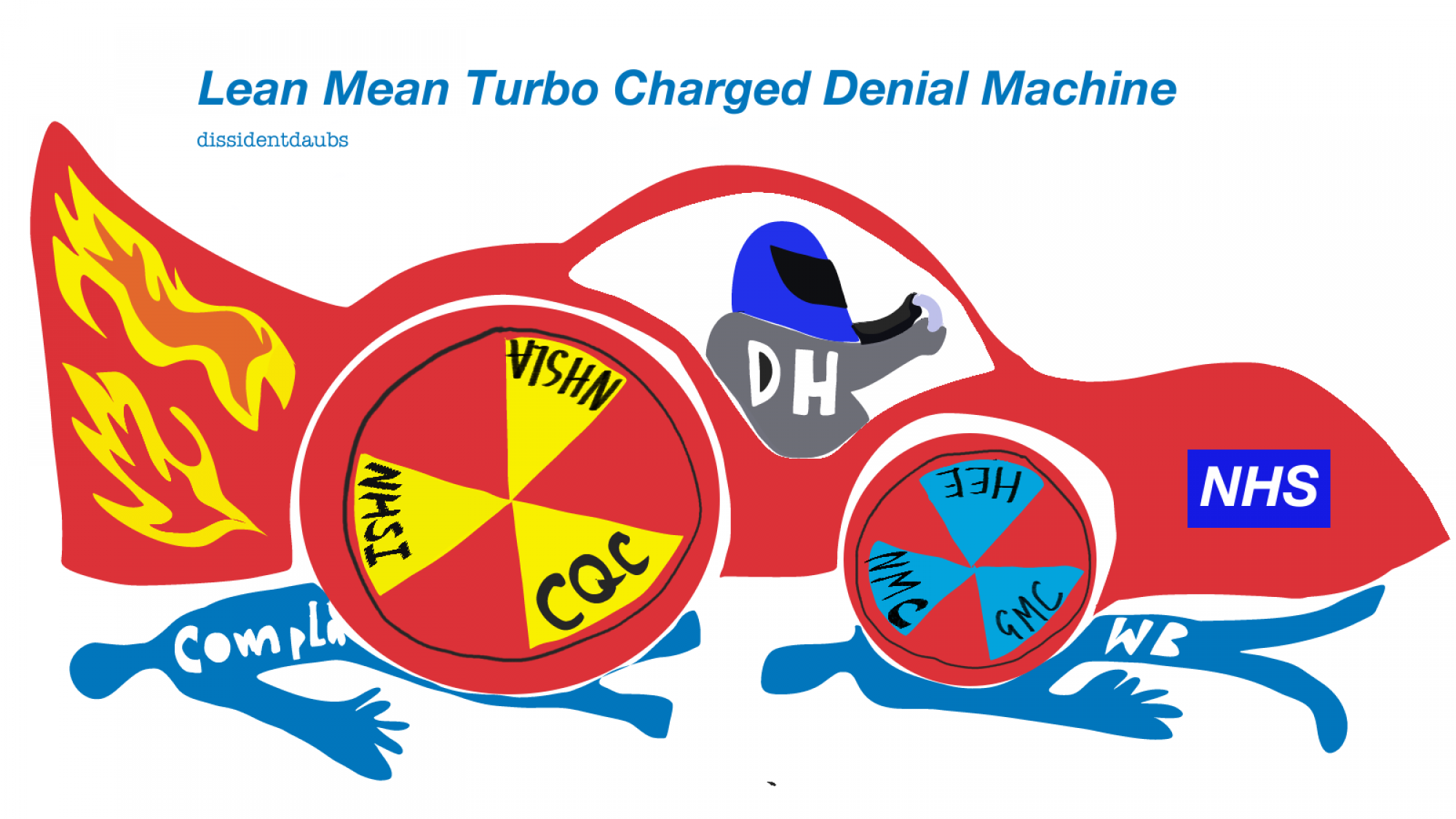
St. Robert of Richmond House. The NHS denial machine. How the Department of Health and the Care Quality Commission built a brand.

https://minhalexander.com/2016/10/12/silent-knight/


REFERENCES

[1] Irregular ‘payoff’ deal at scandal hit trust. Shaun Lintern, Health Service Journal 12 October

https://www.hsj.co.uk/topics/workforce/exclusive-irregular-payoff-deal-revealed-at-scandal-hit-trust/7011428.article

[2] Former nurse blasts Morecambe Bay health trust’s whistleblowing policy, Nick Lakin, Lancaster Guardian 22 July 2016

http://www.lancasterguardian.co.uk/news/former-nurse-blasts-morecambe-bay-health-trust-s-whistleblowing-policy-1-8026260

[3] The Public Health England report of its review of breast screening at Morecambe Bay:

https://www.gov.uk/government/uploads/system/uploads/attachment_data/file/430352/Final_External_Review_final_version.pdf

[4] Morecambe Bay NHS Trust: Two women died after bungling screening tests missed 24 cancers, Martyn Halle and Rachel Mc Dermott, Mirror 4 June 2015

http://www.mirror.co.uk/news/uk-news/morecambe-bay-nhs-trust-two-5820431

[5] Cancer diagnosis shock at Barrow hospital’s trust, North West Evening Mail, 13 July 2015

http://www.nwemail.co.uk/detailedstory?p_p_id=DetailedStory_WAR_portalsuite&p_p_lifecycle=1&p_p_state=exclusive&p_p_mode=view&p_p_col_id=column-1&p_p_col_count=3&_DetailedStory_WAR_portalsuite_javax.portlet.action=doclickcount&_DetailedStory_WAR_portalsuite_uuid=1dc5743f-29d8-48ec-8324-8a23e4077bb9&_DetailedStory_WAR_portalsuite_start=1&_DetailedStory_WAR_portalsuite_category=%2FNEWS%2FBarrow&_DetailedStory_WAR_portalsuite_pubDate=2015-07-13T11%3A08%3A00Z

[6] NHS whistleblower told she was ‘too honest’ to work for the NHS. Lyndsey Telford et al, Telegraph 3 April 2016

http://www.telegraph.co.uk/news/2016/04/03/nhs-whistle-blower-told-she-was-too-honest-to-work-for-the-healt/?utm_source=dlvr.it&utm_medium=twitter

[7] NHS whistleblower investigator in Freedom to Speak Up role, Lyndsey Telford and Claire Newell, Telegraph 4 April 2016

http://www.telegraph.co.uk/news/2016/04/04/nhs-whistle-blower-investigator-in-freedom-to-speak-up-role/

[8] NHS mental health trust admits whistleblower who spoke out about bullying acted in good faith. Paul Gallagher, Independent 7 November 2015

http://www.independent.co.uk/life-style/health-and-families/health-news/nhs-mental-health-trust-admits-whistleblower-who-spoke-out-about-bullying-acted-in-good-faith-a6725786.html

[9] 21 Ways to Skin a Whistleblower. Andrew Bousefield and Dr Phil Hammond, 2011 http://medicalharm.org/uncategorized/the-full-21-ways-to-skin-a-whistleblower/

[10] NHS gagging. How CQC sits on its hands. Minh Alexander 23 September 2016

https://minhalexander.com/2016/09/23/nhs-gagging-how-cqc-sits-on-its-hands-2/

[11] Jeremy Hunt, quiet reformer. Conservative Home. Paul Goodman, 13 November 2014

http://www.conservativehome.com/thetorydiary/2014/11/jeremy-hunt-quiet-reformer.html

Letter: Unheeded deaths warnings. Neglect. A care home owner with criminal convictions. Indefensible CQC.

Letter to House of Commons Health Committee 15 October 2016


BY EMAIL

To Health Committee, 15 October 2016


Dear Dr Wollaston and colleagues,

Unheeded deaths warnings. Neglect and a care home owner with criminal convictions. Indefensible CQC.

I write to submit additional evidence for the next CQC accountability hearing.

The CQC remains insufficiently accountable, insufficiently sighted on critical risks and sentinel events, and unfit to safeguard vulnerable service users. It needs to be replaced

Introduction

Almost a year ago, Public Accounts Committee found that the CQC was still an ineffective regulator, that it had not adhered reliably to its own policy on safeguarding, that it did not handle data well or provide the public with adequate data about regulated services, and that it did not listen enough to service users and whistleblowers. Regarding CQC accountability, the committee found that despite previous criticism in 2012, the CQC’s framework for monitoring its own performance was still inadequate:

“….the Commission does not yet have the quantified performance measures, linked to explicit targets, that are needed to show whether it is satisfactorily performing its statutory duties…only 6 out of the 37 performance measures included in it have specific, quantified, targets”[1]

Also a year ago, The Bureau of Investigative Journalism and the Independent revealed that the CQC had not inspected 9 out of 23 care homes where coroners’ warning reports had been issued about deaths.[2] David Behan acknowledged that these failures were ‘indefensible’ and promised to make improvements, including analysis of coroners’ intelligence.


New analysis on coroners’ warnings about care homes

I have updated the work, and cross-checked coroners’ Reports to Prevent Future Deaths (PFDs) against CQC inspection records. There was no published evidence that CQC had inspected 18 out of 66 homes despite coroners’ warnings. Where CQC had inspected, its response was slow and erratic. I have summarised my findings in a paper that I have published here, with supporting data:

https://minhalexander.com/2016/10/08/care-home-deaths-and-more-broken-cqc-promised/

It shows that the CQC was sent 31 of the 66 care home PFDs, 11 of which were directly addressed to CQC as a named respondent. There was no published CQC response to 9 of the PFDs. In one of two cases where CQC was specifically criticised by the coroner, there was no published response by CQC. I have been unable to find any published analysis by CQC of coroners’ intelligence.


Ivy Atkin, Autumn Grange and CQC’s lack of learning

CQC’s ongoing failures have again been highlighted by the profoundly shocking death of 86 year old Ivy Atkin who died weighing 3 st 13 lb, only twenty days after CQC issued a favourable report on her care home, Autumn Grange.

CQC inspection report on Autumn Grange care home 2 November 2012:

autumn-grange

Click to access 1-101618554_sherwood_rise_limited_1-126202251_autumn_grange_residential_home_20121102.pdf

This inspection report was published on the same day that CQC carried out an unannounced re-inspection of Autumn Grange as a result of a member of staff blowing the whistle only three days after starting work at the care home. In addition to the horrific neglect of Ivy Atkins, other residents at Autumn Grange also suffered severely and were found to have unexplained injuries. ITV news reported that other staff also came forward and alleged mistreatment, including assault. A ‘culture of neglect’ was described, thus raising a question of whether the dysfunction had been present for some time:

http://www.itv.com/news/update/2013-08-14/whistleblower-says-she-tried-to-stop-care-home-abuse/

The coroner has now concluded that Ivy Atkin was unlawfully killed, and that CQC failed to inspect the care home effectively. [3]

The care home owner was jailed in February for corporate manslaughter. During the course of the recent inquest, the coroner expressed concern that he had three criminal convictions: 

“A coroner has questioned how a care home boss was able to run the business where pensioner Ivy Atkin lived before she died – even though he had three criminal convictions…

…The inquest heard on Thursday that home director Yousaf Khan was convicted of criminal damage in 1989, a public order offence for punching and kicking a person in a restaurant in 1998 and drink-driving in 2000.” [4]


Despite obvious and serious questions about CQC’s handling of the issues relating to Autumn Grange, the CQC told me that it had not undertaken any internal review of its actions, and implied that there was no need to do so because its processes are “better than ever”. This correspondence with CQC is attached. [5] The inspector responsible for the inspection 7 weeks before Ivy Atkin’s death maintained at the inquest that she had not “missed anything” and that care homes can go “downhill quickly”. In a discussion yesterday about Ivy Atkin’s death, a CQC Non Executive Director responded thus to a campaigner’s concerns that CQC is reactive and not sufficiently proactive: “Er, this was 4 years ago”.

ks

I find this attitude by CQC deeply shocking, set against the cruel death that befell Ivy Atkin. There is much rhetoric from the Secretary of State that the CQC is a new organisation under his stewardship. However, even the previous CQC regime undertook an internal review after abuse at Winterbourne View was exposed. The severity of the failings at Autumn Grange was much greater than at Winterbourne View, yet the current CQC regime has not seen fit to properly hold itself to account.

The history of serial failure by the CQC to safely regulate care homes and provide the public with accurate information – highlighted 22 times by Private Eye since 2010 – is summarised in this comprehensive report by the campaigning charity Compassion In Care: http://www.compassionincare.com/node/229


CQC value for money

The Mazars report on Southern Health NHS Foundation has raised serious doubts about the accuracy of CQC’s so-called ‘intelligent monitoring’, which is a cornerstone of CQC’s purported ‘transformation’. Moreover, a £273,908 CQC inspection [6] of Southern Health in 2014 did not report on the hundreds of uninvestigated unexpected deaths, later identified by Mazars’ investigation.

After seven years of failure by CQC and frequent refusal to investigate key matters (CQC disclosed by FOI that it had undertaken only 6 Section 48 investigations since inception [7]) I contend that the CQC’s approach does not work, is not safe and is poor value for money.

The hundreds of millions spent every year on CQC – on a ‘transformation’ that is not actually evident – would surely be better spent on leaner, focused, and professionalised investigation services, such as that which revealed the grave care failings at Mid Staffordshire:

https://minhalexander.com/wp-content/uploads/2016/10/hcc-investigation_into_mid_staffordshire_nhs_foundation_trust.pdf

I note that the Healthcare Safety Investigation Branch (HSIB) has now been created to carry out healthcare investigations, but its currently slender funding results in inadequate capacity. It has an intended rate of only 30 investigations a year, and the Department of Health advised that this capacity may even reduce. [8]

CQC’s latest National Guardian for whistleblowing has extolled the virtues of cheerfulness: https://minhalexander.com/2016/10/10/hooray-henrietta/


front-page


However, CQC unfortunately gives the health and care workforce little cause to smile.

Yours sincerely,

Dr Minh Alexander


cc  Public Accounts Committee

Public Administration and Constitutional Affairs Committee

Keith Conradi Chief Investigator, HSIB


REFERENCES

[1] Public Accounts Committee. CQC inquiry. December 2015

http://www.publications.parliament.uk/pa/cm201516/cmselect/cmpubacc/501/501.pdf

[2] Elderly people put at risk as watchdog fails to act on warnings of ‘fatally negligent’ care homes. Melanie Newman and Oliver Wright, The Independent, 2 September 2015

http://www.independent.co.uk/life-style/health-and-families/health-news/elderly-people-put-at-risk-as-watchdog-fails-to-act-on-warnings-of-fatally-negligent-care-homes-10483573.html

[3] Ivy Atkin death: ‘Unlawful killing’ over care resident death, BBC 13 October 2016  http://www.bbc.co.uk/news/uk-england-nottinghamshire-37649387

[4] Owner of the care home where Ivy Atkin stayed before her death had three criminal convictions, Jemma Page, Nottingham Post, 14 October 2016

http://www.nottinghampost.com/owner-of-care-home-where-ivy-atkin-stayed-had-three-criminal-convictions/story-29806771-detail/story.html

[5] Correspondence February and March 2016 with CQC, about whether it had undertaken an internal review on its inspection activities at Autumn Grange

https://minhalexander.com/wp-content/uploads/2016/10/cqc-no-internal-review-of-autumn-grange-death.pdf

[6] FOI disclosure about the cost and details of a CQC inspection on Southern Health:

https://minhalexander.com/wp-content/uploads/2016/10/cqc-foi-disclosure-on-cost-of-the-southern-health-inspection-oct-2014.pdf

[7] FOI disclosure by CQC about the number of Section 48 inspections undertaken since CQC’s inception:

https://minhalexander.com/2016/09/27/cqc-foi-disclosure-15-january-2016-about-section-48-investigations-conducted-since-inception-in-2009/

[8] FOI disclosure by the Department of Health about HSIB:

https://minhalexander.com/wp-content/uploads/2016/10/ipsis-hsib-dh-disclosure-budget-capacity-3-02-2016.pdf


CQC’s “better than ever”…or didn’t you know?


By Dr Minh Alexander, NHS whistleblower and former consultant psychiatrist 14 October 2016

The much criticised Care Quality Commission has tried hard to re-brand itself but the changes are superficial, and the values at its heart remain highly questionable. The CQC remains a defensive organisation, full of self-justification. CQC’s attitude towards its part in the profoundly shocking care home death of Ivy Atkin is a case in point.

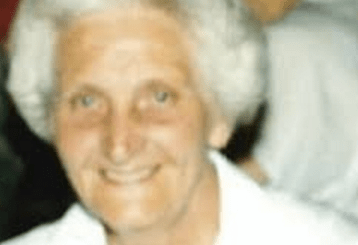
Ivy Atkin an 86 year old retired dressmaker suffered a barbaric death on 22 November 2012 after gross neglect at Autumn Grange care home in Nottingham. Her case has been extensively reported. In summary:

High Court judge Robert Jay said that when Mrs Atkin was found, she was skeletal, severely dehydrated, lying on a bed soaked in urine and had a large open, pressure sore at the base of her back which was contaminated with faeces.”[1]

Although discovered in extremis, Mrs Atkin was reportedly not admitted to hospital, but was moved to another care home where she died shortly after, weighing 3 st 13 lb.

Other residents also suffered severely. Some had unexplained injuries.

The care home director was jailed for corporate manslaughter in February this year.[1]

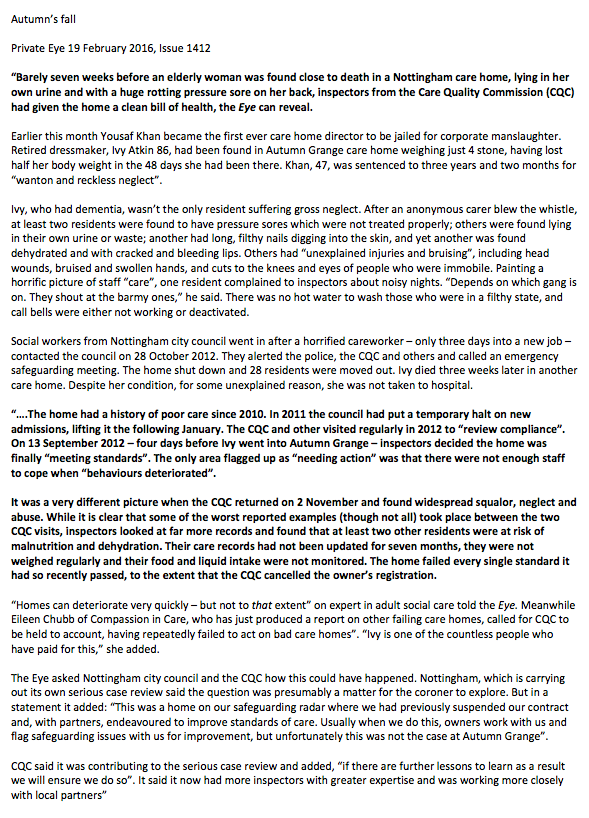
Private Eye covered the scandal, and noted that Autumn Grange had been given a clean bill of health before the abuse was uncovered. [2]

autumn-grange

Link to the CQC inspection report issued 20 days before Ivy Atkin’s death:

Click to access 1-101618554_sherwood_rise_limited_1-126202251_autumn_grange_residential_home_20121102.pdf

An inquest has now found that Ivy Atkin was unlawfully killed:

Health inspectors were criticised by the Nottinghamshire Assistant Coroner for “missing opportunities” to uncover conditions at the home.”

[The coroner reportedly also] “…said in the light of concerns raised about conditions at the home, the inspection “should have been more rigorous” and inspectors failed to “be proactive”. [3]

According to the BBC, Lesley White the CQC inspector who inspected Autumn Grange weeks before Ivy Atkin’s death told the inquest: “…she had not “missed anything” in an inspection in September and that a home could go “downhill quickly”.”

The BBC had not yet received the CQC’s response to the inquest’s conclusion.

In February this year after the above corporate manslaughter conviction,  I asked if CQC had conducted an internal review into its inspection activities at Autumn Grange.

The CQC replied that it was contributing to the local authority’s serious case review, but had not undertaken any internal review of its inspection activities at Autumn Grange. The CQC made no comment on why Mrs Atkin had not been taken to hospital, and added:

The way CQC inspected services in 2012 is very different to how inspections are now carried out….Our approach to monitoring and inspecting adult social

care allows us to get under the skin of services better than ever before. We have more inspectors with greater expertise and we are working more closely with our local partners to respond to concerns.” [4]

 This morning, in response to a campaigner voicing concerns that the CQC is reactive and not sufficiently proactive in its inspection approach, a CQC Non Executive Director delightfully tweeted: “Er, this was four years ago”

That’s alright then.

PS It’s anybody’s guess how many complaints have been made about this CQC NED’s social media behaviour. I gather the CQC refuse to divulge the number. Toodle-oo.

ks


UPDATE 13 NOVEMBER 2016

CQC Board papers for the CQC Board meeting of 16 November 2016 show that CQC has now been issued with a coroner’s warning report regarding Autumn Grange. CQC has also now undertaken an internal review of its handling of Autumn Grange, which is yet to be published:

Click to access CM111604_Item4_ChiefExecutiveReport.pdf


RELATED ITEMS

Care home deaths and more broken CQC promises.

A review of 66 coroners Reports to Prevent Future Deaths against CQC inspection reports. This has revealed that despite criticism a year previously, CQC’s response to coroners’ warnings about care home deaths remained variable and slow, and that there were no published responses to most of the coroners’ reports that had been addressed directly to CQC as a named respondent.

Care home deaths and more broken CQC promises

CQC deaths review: all fur coat

A review of all current CQC inspection reports on mental health trusts revealed that CQC presented deaths data in an inconsistent, incomplete manner and sometimes did not even refer to deaths or report coroners’ warning reports fully or at all.

CQC Deaths Review: All fur coat….

REFERENCES

[1] Ivy Atkin death: Care home director jailed for gross negligence, Rachel Gorman, Nottingham Post 5 February 2016

http://www.nottinghampost.com/ivy-atkin-death-care-home-director-jailed-gross/story-28677735-detail/story.html

[2] Private Eye:

cqc-pe-ivy-atkins-18-02-2016

[3] Ivy Atkin death: ‘Unlawful killing’ over care resident death, BBC 13 October 2016 http://www.bbc.co.uk/news/uk-england-nottinghamshire-37649387

[4] Correspondence with CQC February and March 2016 about whether it undertook an internal review of its inspection activities at Autumn Grange care home

cqc-no-internal-review-of-autumn-grange-death

Silent Knight

By Dr Minh Alexander NHS whistleblower and former consultant psychiatrist, 12 October 2016

How many distressed whistleblowers hear back from St. Robert of Richmond House? The answer is that we don’t know, but here is a tale of apparent silence.

Whilst wrecking the NHS with dangerous cuts, Jeremy Hunt likes to spin about the infallibility of those whom he has used to build his false narrative of tough regulation, prioritisation of patient safety and hard-nosed efficiency. After a conflict between GPs and Steve Field CQC Chief Inspector, who had made some generalised comments about GPs “failing as a profession”, Jeremy Hunt effectively pronounced that Field was un-touchable:

A former GP and President of the Royal College, his credibility is beyond question, and we absolutely back his independent judgements as Chief Inspector.”

http://www.pulsetoday.co.uk/your-practice/regulation/cqc/professor-steve-field-says-gps-have-failed-as-a-profession/20030685.fullarticle

So much for just culture.

Similarly, Sir Robert Francis’ name has been used by the government and by Jeremy Hunt as a powerful PR weapon. It has been incessantly built up as a cipher for patient safety, a trusted brand logo. Where you need to brush a little gloss on a project, manage a scandal or sell another Department of Health or Care Quality Commission good news story, just pop in those magic words: “Sir Robert Francis said…..”.

When Hunt and the CQC were in choppy water because the previous National Guardian Eileen Sills resigned within two months of appointment – after a head-hunting exercise that cost the public £61,300 [1] and after she dropped clangers which showed that she was ill-informed about whistleblowing – who was wheeled in? Sir Robert. Sir Robert was unfurled and run up the CQC flagpole:

Sir Robert Francis QC, CQC board member and author of the ‘Freedom to Speak Up’ review, said: 

“The Office of the National Guardian is a key part of the promotion of the freedom to speak up in the NHS. I remain personally committed to help see a new National Guardian appointed as soon as possible and to oversee the continuing development of the infrastructure required to support the new appointee. I am confident that the team at CQC is working hard to ensure that the new Guardian has the support in place to enable this vital work to be done.”” [2]

Never mind of course, that Sir Robert had a hand in this failed appointment.

francis-cqc-logo

Sir Robert gets invited to all the right parties, and continues to say all the right things. At the recent launch of the annual report of the National Confidential Inquiry into Suicide and Homicide by People with Mental Illness, attendants reported that he made these laudable comments:

“You would think that patient safety would be a priority in all health services, this isn’t the case… We need to go further in creating safe spaces where staff can discuss and learn from error….if you don’t care for staff, they don’t care for patients” etc….

Sir Robert also struck out for the little guy – or in this case, gals – when in February 2014 he publicly criticised the conduct of Paula Vasco-Knight’s trust – South Devon Healthcare NHS Foundation Trust – towards two whistleblowers, Clare Sardari and Penny Gates:

“It is important that no tolerance is afforded to oppressive managerial behaviour of the sort identified only last week by an employment tribunal in the South West, which victimises staff who raise honestly held concerns. 

“Every such case is hugely damaging to the confidence of other staff who are contemplating raising concerns. It is clear that there is much to do in this area.” [3]

But what happened when one of the whistleblowers – Clare Sardari – wrote him a distressed letter in August 2015? This was at a time when she was significantly depressed and had required professional care, and had not long lost her mum. Clare Sardari never heard from Sir Robert.

Her letter informed Sir Robert that due to the vagaries of the Employment Tribunal system and her employer’s actions, she had ended up in very difficult financial circumstances despite winning her case:

“…I was given only a very short time to make a decision, and on the advice of my legal team… I accepted the settlement offer of £233,000. This figure did not take into account any future loss of earnings or future pension loss. I have legal costs of over £100,000, will have to pay 40% in tax and have built up significant debts in the two and a half years I have been unemployed. What I will be left with is a very small amount and at 58 years of age, having tried my hardest over the past 3 years to find a job, blacklisted by local NHS Trusts, I have no future!”

The letter also recounted how her employers agreed to make a formal apology, but did not in the end do so. Her letter ended on a highly personal note:

I need a job as my financial situation is dire. I need a job because my self esteem is at rock bottom. I need justice but am unlikely to get it. I need your support and your help, if there is anything you can do.”

But there was only silence.

It’s possible Clare Sardari’s letter was lost in the post and never arrived, or that Sir Robert replied but his response did not arrive. Perhaps he can tell us. Robert Francis told us in 2014 that he has heard from many whistleblowers, and also from staff too frightened to speak out:

“Sir Robert said that since publishing his findings 16 months ago into the unnecessary deaths of hundreds of patients at Mid Staffs, many staff had contacted him saying they were still too scared to speak out.” [4]

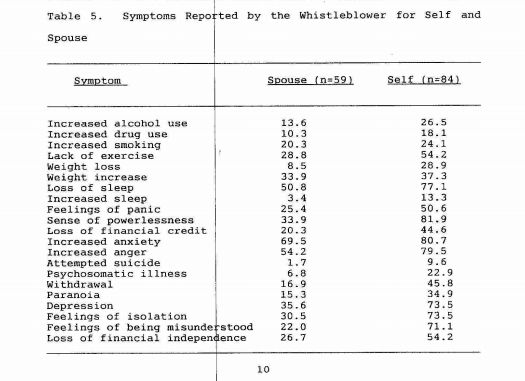
I would like to think that Mr Hunt’s totem of moral authority does not ignore people who are in a state of obvious distress. It is well known that the whistleblower’s journey often includes serious ill health, mental and physical. [5] Soeken and Soeken reported this years ago:

soeken-soeken-psych-symptoms-1987

These were early, rough results from an investigation beset with the usual problems of sampling in whistleblowing, but nevertheless, they provide a picture of significant suffering.

Being cold shouldered and finding doors repeatedly closed in your face – or never opened – is part and parcel of the isolation and despair that many whistleblowers experience.

And as Sir Robert has observed, “…if you don’t care for staff, they don’t care for patients”.

Clare Sardari tweets at @SardariClare


RELATED ITEMS

1) Sir Robert’s Flip Flops

An account of Robert Francis’ u-turns on his original recommendation from the MidStaffs public inquiry to criminalise whistleblower reprisal.

Sir Robert’s Flip Flops

2) Open letter by Clare Sardari to the governors of St. Georges, where Paula Vasco-Knight her former Chief Executive was recycled into a board position and then promoted to Chief Executive, only to fall from grace again after allegations of a financial nature.

clare-sardari-open-letter-st-georges

3) CQC’s Fit and Proper Parade

A summary about the Care Quality Commission’s failure and obfuscations on holding any unfit NHS directors to account under Regulation 5 Fit and Proper Person, with details about CQC’s highly questionable behaviour in response to an FPPR referral on Paula Vasco-Knight, Clare Sardari’s former Chief Executive.

CQC’s Fit and Proper Parade


REFERENCES

[1] NHS bosses blew £61,000 on whistleblowing tsar who QUIT before starting job

http://www.mirror.co.uk/news/uk-news/nhs-bosses-blew-61000-whistleblowing-7650064

[2] National Guardian update. CQC press release 5 April 2016

http://www.cqc.org.uk/content/national-guardian-update

[3] Francis criticises Vasco-Knight trust, Judith Welikala, Health Service Journal, 7 February 2014 https://www.hsj.co.uk/sectors/acute-care/francis-criticises-vasco-knight-trust/5067807.article

[4] NHS is still gripped by a culture of fear: Inquiry into whistleblowing set up by barrister who investigated Mid Staffs, Sophie Borland Daily Mail, 25 June 2014

http://www.dailymail.co.uk/news/article-2668566/NHS-gripped-culture-fear-Inquiry-whistleblowing-set-barrister-investigated-Mid-Staffs.html

[5] “Whistleblowing”: a health issue. Dr Jean Lennane, BMJ Volume 307, 11 September 1993, p.667-670 whistleblowing-a-health-issue-dr-jean-lennane

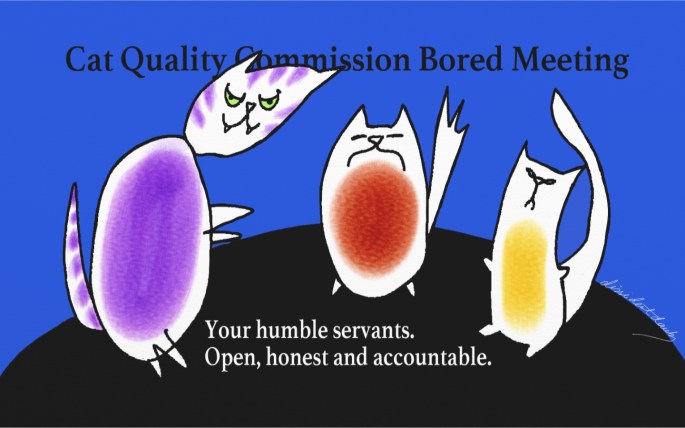
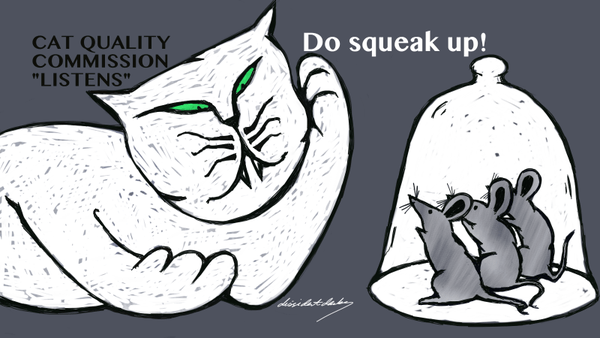
A letter to the ever-listening Cat Quality Commission

Letter  11 October 2016 to Peter Wyman CQC Chair, about ongoing issues with the National Freedom to Speak Up Guardian

I have written to Mr Wyman to bring to his attention to adverse reactions by whistleblowers, NHS staff and the public to comments made by Henrietta Hughes, the replacement National Guardian, in her first interview with the press.

The full letter with all attached comments is uploaded here:

cqc-wyman-letter-re-hh-ng-wb


delay-deny


THE MAIN CONTENT OF THE LETTER IS AS FOLLOWS:

To Peter Wyman, Chair of Care Quality Commission, 11 October 2016

Dear Mr Wyman,

CQC’s handling of the National Freedom to Speak Up Guardian’s office

When you appeared before the Health Committee at your pre-appointment hearing on 1 December 2015 for the CQC Chair, you commented thus about NHS whistleblowing: “I need to understand properly whether there really is a problem and, if there is a problem, what else we can do beyond the things I know the CQC is doing to make it easy.”

I hope by now that you are familiar with the contents of the Freedom to Speak Up Review report February 2015 and Health Committee’s findings of January 2015 that the treatment of whistleblowers is a stain upon the NHS’ reputation, and that you agree there “really is a problem” with NHS whistleblowing governance.

The CQC promised in December 2014 “We will hold health and social care services to a high standard of listening and acting on people’s concerns. We are committed to apply the same standards to ourselves”. To that end, I write to pass on a collation of some adverse reactions from whistleblowers, NHS staff and the public to the new National Guardian’s comments in an interview with the press, revealed yesterday.

https://minhalexander.com/wp-content/uploads/2016/10/happiness-is-the-best-medicine-henrietta-hughes.pdf

The responses are listed below. You will note that the general gist of many of the comments can be summarised, as per one doctor’s comment, as a perception that NHS staff have been told: “…put up, shut up and smile”. This is obviously an unfortunate outcome when the stated aim is to encourage staff disclosure. You will also note that senior NHS whistleblowers Dr Heather Wood and Amanda Pollard, who uncovered the Mid Staffs care failings and or gave evidence to the Mid Staffs public inquiry are amongst those who have expressed concerns. Dr Kim Holt who worked for CQC on whistleblowing has now also expressed concerns.

The National Guardian office has been deeply troubled since the outset of its short life. The first National Guardian resigned earlier this year, within two months of appointment and after wrongly advising that her office was not a legally “prescribed body” under the Public Interest Disclosure Act. I believe further serious questions now arise about CQC’s selection process and its exclusion of whistleblowers from this process.

The CQC’s position specification for the National Guardian post required that the candidate must have:

Ability to work collaboratively with individuals from Board level to the frontline …Ability to present complex issues clearly and with sensitivity to individuals, groups and the media….Excellent communication skills, both written and oral…. Ability to inspire trust and confidence of a wide range of stakeholders”

https://minhalexander.com/wp-content/uploads/2016/09/cqc-national-guardian-specification-v2-29-april-2016-final-799675.pdf

The effective handling of whistleblowing is a critical issue, especially when the NHS is in turmoil and NHS staff need genuine freedom to speak up. It is still not clear exactly what the National Guardian’s remit will be. I hope that for the sake of patients, the current serious situation is properly and actively resolved.

I previously received a letter from CQC that was critical of the fact that I had copied some of my correspondence to select committee members. I do not agree that it is for CQC to determine my communication with parliament. Accordingly, I copy this correspondence to parliament because of the public interest nature of the issues involved.

Yours sincerely,

Dr Minh Alexander

NHS whistleblower and former consultant psychiatrist

cc Health Committee, Public Accountants Committee, Public Administration and

Constitutional Affairs Committee

Chris Wormald Permanent Secretary DH

Sir Jeremy Heywood, Head of the Civil Service


COMMENTS

My own comments about the National Guardian’s office and the present incumbent’s recent comments can be found here:

Other comments are as follows:

Amanda Pollard CQC whistleblower and former CQC inspector:

“When I attended release of Mid Staffs Public Inquiry report, I genuinely wouldn’t have imagined so little progress made by 2017”


Hooray Henrietta

A special bulletin from the Ministry of Love. 

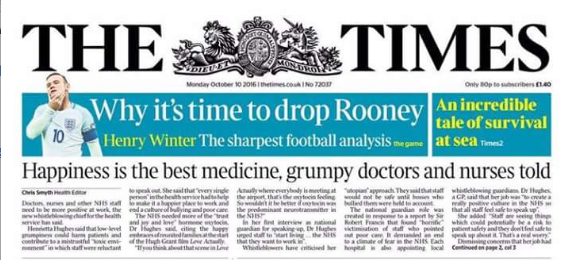
It seems our replacement National Guardian for whistleblowing is a fan of peace and love, apparently by diktat if necessary. She’s even given an interview to the Times about her thoughts on how NHS staff must be cheerful, so that no one feels intimidated from speaking up.[1]

front-page

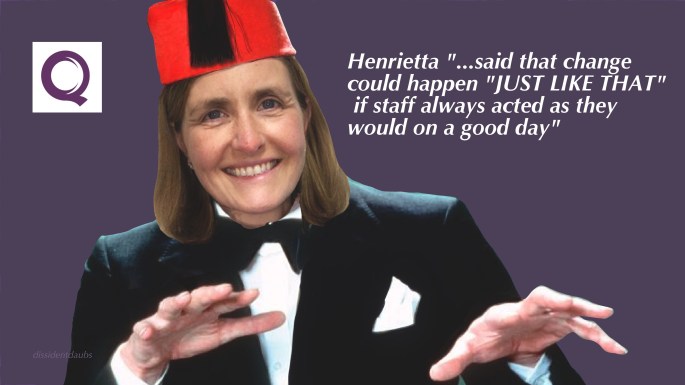
The NHS needed more of the “trust and joy and love” hormone oxytocin, Dr Hughes said, citing the happy embraces of reunited families at the start of the Hugh Grant film Love Actually….If you think about that scene in Love Actually where everybody is meeting at the airport, that’s the oxytocin feeling. So wouldn’t it be better if oxytocin was the predominant neurotransmitter in the NHS?…In her first interview as national guardian for speaking-up, Dr Hughes urged staff to “start living . . . the NHS that they want to work in…Dismissing concerns that her job had few formal powers, she said that change could happen “just like that” if staff always acted as they would on a good day”

Darn, why didn’t any of us think of that? Forget all those silly old professors who’ve been researching whistleblowing for years. Forget their daft evidence-based recommendations. Who needs dull stuff like Law reform and proper infrastructure for safeguarding whistleblowers [2] when you can have happy, happy, happy, happy talk. So, well done Sir Robert, Patients Association and CQC for another credible and serious appointment. [3]

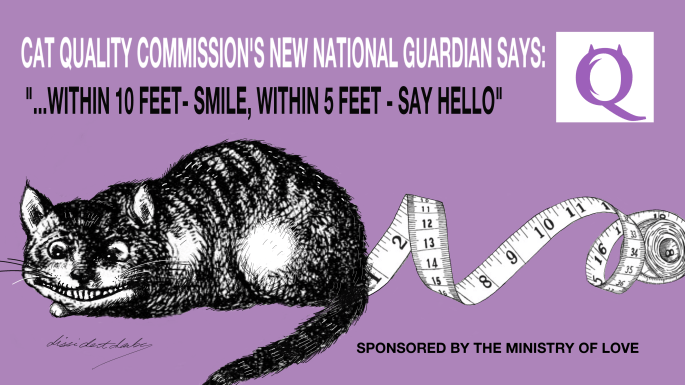
Henrietta’s so big on happy, shiny people that according to a blog, she introduced a RULE about smiling for her staff: [4]

At the Olympics as I handed over my ticket and walked into the venue I noticed a small sign on the back of the booth – SHINE.  I saw the first 3 words but by then I had moved past so did some research and made a guess as to what the N and E meant:

S – smile

H- hello

I – eye contact

N- name

E- enthusiasm/ Empathy

While researching I came across the 10:5 rule – when someone comes within 10 feet – smile, within 5 feet – say hello.”

NHS managerial grotesquery, you may think.

Moreover, is it right and proportionate to disparage “grumpy” staff, without mentioning the KissUpKickDown senior management? Or the intolerable stresses to which the NHS frontline has been subjected? No, forget the lowest paid NHS staff being forced to rely on food bank handouts [5] whilst senior managers have repeatedly awarded themselves fat pay rises. Forget the anxiety of working in seriously under-staffed departments or the stress and exhaustion of servicing on call rotas with yawning gaps. Forget the institutional dishonesty that forces unhappy staff to become complicit in cover ups, or to risk all by dissenting. [6] Forget the message of intimidation inherent in seeing senior managers walk away unscathed after indulging in whistleblower reprisal. [7] [8] Just let those whining staff eat food bank cake.

morley

Phil Morley, Robert Halfon MP, Jeremy Hunt Health Secretary and Douglas Smallwood Trust Chair, at Princess Alexandra Hospital Essex

diana-johnson-letter-to-hunt-morley-16-july-2015-1

The twitchy and highly controlling NHS establishment classically brands staff dissent as “disruptive” and “unmanageable”. Bogus disciplinaries are often concocted against truth tellers. If these don’t succeed, employers can still cry breakdown of relationships – which is a legal basis for dismissal no matter whose fault it is. [9] Compulsory smiling is surely part of the dysfunctional, choking miasma.

And is Henrietta in a position to share a valid evaluation of her “10 foot” smile rule, and whether it had a measurable effect on whistleblowing governance?

Or were her staff just grinning and bearing with the intrusive management….because they didn’t feel able to object?

On top of a non evidence-based Guardian model courtesy of Sir Robert [10], will there now be policy by caprice and movie references?

I would actually like to hear from Henrietta. Even at this very late stage no one knows what exactly she is going to do for desperate and distressed whistleblowers. I’m still waiting for an answer to questions that were first put to Sir Robert in May, which have been put to Henrietta twice since. [11] [12]

Whilst we’re all waiting for serious answers as opposed to CQC set pieces, here’s what Mr Orwell said about the Ministry of Love:

“The Ministtry of Love was the really frightening one. There were no windows in it at all. Winston had never been inside the Ministry of Love, nor within half a kilometer of it. It was a place impossible to enter except on official business, and then only by penetrating through a maze of barbed-wire entanglements, steel doors, and hidden machine-gun nests. Even the streets leading up to its outer barries were roamed by gorilla-faced guards in black uniforms, armed with jointed truncheons.”

Smile for the CCTV camera.

Related items

Clubadoodle-doo. An update on continuing lack of clarity about the National Guardian’s remit.

Clubadoodle-doo

No one believes Jeremy Hunt on patient safety and whistleblowers, not even his own appointees. A summary about the development of the National Guardian office and information from a meeting with Eileen Sills the former National Guardian, who resigned.

No one believes Jeremy Hunt on patient safety or whistleblowers – not even his own appointees. Unmasking the faux National Guardian Office.

Update 11 October 2016

Letter to Peter Wyman CQC Chair, bringing to his attention the strong, negative responses to Henrietta Hughes’ comments that staff must be more cheerful.

A letter to the ever-listening Cat Quality Commission


REFERENCES

[1] Happiness is the best medicine, grumpy doctors and nurses told Chris Smyth, Times, 10 October 2016 happiness-is-the-best-medicine-henrietta-hughes

[2] Sir Robert’s Flip Flops. Minh Alexander, 26 September 2016

Sir Robert’s Flip Flops

New National Guardian appointed to the lead the NHS in speaking up freely and safely. CQC press release about Henrietta Hughes’ appointment. 7 July 2016

[3] New National Guardian appointed to the lead the NHS in speaking up freely and safely. CQC press release about Henrietta Hughes’ appointment. 7 July 2016

http://www.cqc.org.uk/content/new-national-guardian-appointed-lead-nhs-speaking-freely-and-safely

[4] SHINE. Henrietta Hughes guest blog for NHS Mangers Network

http://www.nhsmanagers.net/guest-editorials/shine/

UPDATE 16 NOVEMBER 2018. THE GUEST BLOG APPEARS TO HAVE REMOVED FROM THE WEB. THIS IS A COPY OF THE ORIGINAL CONTENTS:

Guest Editorial SHINE 28 Jul

SHINE Henrietta Hughes NHS England

It’s the first anniversary of the 2012 Olympic Games – what is the legacy for the NHS?

Analysis

Cast your mind back to the warmth and friendliness of the volunteers at the London 2012 Olympic and Paralympic Games. Despite the crowds and the need to get all the visitors into the venues swiftly the volunteers were always smiling and friendly and made us feel really welcome.  The  friendliness continued outside the Olympic Park with commuters uncharacteristically chatting on the tubes and trains.  The NHS starred in the opening ceremony in such a moving way, in stark contrast to the daily stories we now read of widespread poor patient experience.

I wondered how we could harness the amazing warmth of the volunteers to improve not only the patient experience but also the staff experience within the NHS. At the Olympics as I handed over my ticket and walked into the venue I noticed a small sign on the back of the booth – SHINE.  I saw the first 3 words but by then I had moved past so did some research and made a guess as to what the N and E meant:

S – smile

H- hello

I – eye contact

N- name

E- enthusiasm/ Empathy

While researching I came across the 10:5 rule – when someone comes within 10 feet – smile, within 5 feet – say hello.

The 10:5 rule is widely employed by sales teams, at Universal Studios and the Georgia World Congress Center as well as several healthcare providers in the USA. At the Medical University of South Carolina (MUSC) Medical Center this is written into the job description of all staff. Individually employees, as well as applicants, must pledge to practice standards of behaviour for the benefit of colleagues and the betterment of the MUSC Medical Center.  A patient described a journey from the front door at MUSC to the time she was seen by the doctor.  By then she had received so many smiles and acknowledgements she described herself as grinning from ear to ear. The staff describe being happy and welcomed from day one.

I have started SHINE and the 10:5 rule within my team in London and shared it across the Directorate.  It has helped to create a kind and welcoming atmosphere across a large open plan office and to build relationships across different directorates. I would love to see this expanded across the NHS.  It is free, warm and friendly. Make this part of the training of GP receptionists and clinic staff and patients would feel better straight away. It needs to be role modeled by senior management, when you are walking the wards or around your own work environment you will be more approachable to patients, relatives and your junior staff.  As a GP I have always greeted patients by name from the waiting room rather than the impersonal dot matrix display.  A warm smile and greeting helps to evaporate the tension if I have started to run late and builds a great start to the consultation.

So let’s build on the inspiration of the Olympic and Paralympic games by helping staff to SHINE and making the NHS an inviting and friendly environment for both patients and staff. Smiling has been variously credited with improving mood, relieving stress and boosting the immune system, lowering blood pressure, releasing endorphins, improving attractiveness and making you look younger.  Whilst I cannot guarantee that you will look younger and more attractive smiling is contagious – I certainly get a lot of smiles around the office.

[5] Nurses turning to food banks and asking for debt advice because of NHS cuts.

Jane Kirby, Mikey Smith, Mirror 2 September 2015

http://www.mirror.co.uk/news/uk-news/nurses-turning-food-banks-asking-6367795

[6] Hot air about Just Culture, Richard von Aberndorff and Minh Alexander

https://minhalexander.com/2016/09/24/hot-air-about-just-culture/

[7] Health Secretary. NHS boss Phil Morley’s appointment ‘Fit and Proper’

http://www.hulldailymail.co.uk/health-secretary-deems-nhs-boss-phil-morley-fit/story-27478960-detail/story.html

[8] CQC’s Fit and Proper Parade. Minh Alexander, 29 July 2016

https://minhalexander.com/2016/09/24/cqcs-fit-and-proper-parade/

[9] Important new guidance from the courts for employers on managing whistleblowing claims. Capsticks LLP

[10] Critique of Francis’ model of trust-appointed Guardians. Minh Alexander 4 June 2015

https://minhalexander.com/2016/09/24/critique-of-francis-model-of-trust-appointed-guardians/

[11] Letter to Robert Francis 1 May 2016

https://minhalexander.com/wp-content/uploads/2016/10/letter-to-robert-francis-1-may-2016.pdf

[12] Clubadoodle-doo, 4 October 2016 Minh Alexander

https://minhalexander.com/2016/10/04/clubadoodle-doo/

Care home deaths and more broken CQC promises

By Dr Minh Alexander, NHS whistleblower and former consultant psychiatrist 8 October 2016


Summary

CQC continues to fail to protect vulnerable people. As an example of this, and despite revelations of failings a year ago, there is still no evidence that CQC responds in a consistent way to coroners’ warnings about care homes failures. CQC has been sent about half (31 of 66) of the coroners’ warnings issued about care home deaths since July 2013. There have sometimes been lengthy gaps between coroners’ warnings and subsequent inspections by CQC. In 18 (27%) of the 66 cases, there is no evidence yet that a coroner’s warning has triggered a CQC inspection. CQC inspection reports rarely refer to deaths or to coroners’ warnings. There are only two published CQC responses to coroners’ warning reports. There is no published response by CQC to a criticism that it failed to inspect medicines management prior to the death of a patient who was given the wrong medication. There is also no published CQC response to two coroners’ warnings which concluded that there was neglect, and which noted an allegation of physical harm by care home staff. A year ago, after CQC’s poor response to coroners’ warnings about care homes was criticised, David Behan promised that CQC would improve and undertake analyses of coroners’ data. There is still no published evidence that analyses have been undertaken.

Introduction

Social care is in even worse trouble than the NHS, with dire under-funding [1], under staffing, exploitation of staff who are sometimes not even paid the legal minimum wage [2] [3] and general pressures that increase the risk of error and abuse.

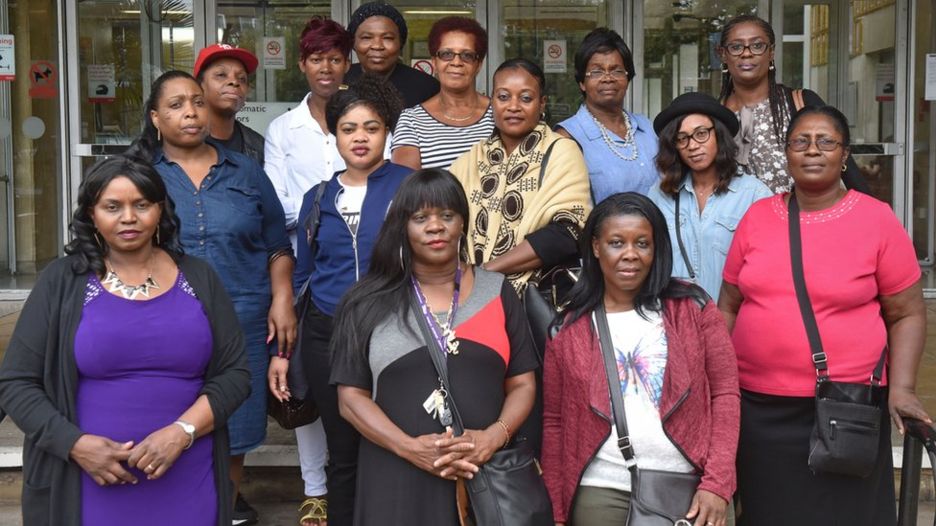
Care workers paid less than minimum wage who are taking legal action:
black

http://www.bbc.co.uk/news/uk-37350750

However, the CQC has been repeatedly and copiously criticised for failures to detect and respond to poor care, and failures to listen to care home whistleblowers. [4] [5] Over the last year, there have been five Private Eye articles exposing the CQC’s poor regulation of the sector, including repeated failures to be fully transparent about poor care homes’ histories, despite this being pointed out since 2010. In total, Private Eye has featured 22 articles about CQC’s care home failures and obfuscation since 2010. The sorry history can be found summarised in the report “CQC an ongoing concern” by the campaigning charity Compassion in Care, which has collaborated with many of the Private Eye investigations: http://www.compassionincare.com/node/229

The CQC has also been criticised for its closeness to the care home industry. Questions raised about CQC’s objectivity, which CQC’s Chief Inspector has dismissed:

I am a firm believer in the value of constructive engagement between the regulator and providers and have welcomed the contribution provider representatives have made to the development of our new regulatory regime. I speak regularly at conferences organised for providers so that I can explain clearly my expectations of them and hear about their issues. [7]

Despite the Secretary of State’s claims to be reforming services with “intelligent transparency”, the CQC is not sufficiently transparent or accountable to the public about the most crucial issues. Other analyses have shown that CQC does not present deaths and other safety data in a complete or consistent manner in its inspection reports. [8] [9]

A year ago, the Bureau of Investigative Journalism and the Independent exposed failure by the CQC to respond to serious coroners’ warnings about care homes. [10] This investigation identified 23 coroners’ warnings about care homes since July 2013. It reported that in over half of these cases, the coroners’ reports had failed to trigger an inspection by CQC.

This was of particular concern because the CQC had previously claimed that it agreed a memorandum of understanding with coroners in 2014:

“Coroners Society: In 2014 we developed a memorandum of understanding with the Coroners Society. We now receive information from individual coroners’ reports about any deaths in health and care settings and how these could be prevented in future. This information is provided to our inspection teams who use the details of the report in their work with individual providers.” [11]

Indeed, it is extraordinary that CQC only reached this joint working arrangement with coroners five years after its inception, and despite scandals such as the Harold Shipman killings.

David Behan CQC Chief Executive responded thus to the 2015 TBIJ and Independent investigation: “I am not going to defend the indefensible. We have got more to do.”

In a related CQC press release, David Behan promised that CQC would improve its response to coroners’ warnings and ensure any concerns raised are effectively logged, analysed, managed and reviewed[12]

Results of new analysis

I have carried out an updated search of published coroners’ Reports to Prevent Future Deaths on care homes (PFDs) and I have cross checked these with CQC inspection reports of the care homes in question, to look for evidence of improvement. The relevant data is uploaded here: care-home-rule-43s-8-10-2016

PFD reports (formerly known as Rule 43 reports) are issued when coroners identify risks that may cause future deaths. [13] Most often, PFDs relate to factors that have contributed to the deaths reviewed, but incidental risks that are discovered may also be reported. PFDs are sent to the relevant organisations with responsibility for addressing the risks identified by the coroner, with a requirement for response within a defined timescale. PFDs have been published since July 2013. The Chief Coroner advises that most PFDs, and responses by organisations that are sent PFDs, are published.

The Chief Coroner has published 71 PFD reports since July 2013 that his office has categorised as ‘care home deaths’. Five of these reports related to domiciliary and transport services rather than care homes, and were excluded from this analysis, leaving 66 PFDs about care home cases. The care homes were not identified in two of the 66 cases, so they could not be cross-referenced with the relevant CQC care home inspection reports. Links to all 66 coroners’ PFD reports are provided below.

The 66 care home PFD reports were distributed in time as follows:


YEAR


Number of coroners’ PFDs issued about care home deaths


2013, from July onwards

11

2014

24

2015

14

2016 year to date

17

NB. 2016 figures may not be complete, as there is a lag between the issue and publication of PFDs.

In the 66 care home PFDs, coroners warned about poor staffing levels and training, poor management of falls and risk assessment, failures to safely manage urgent medical needs, poor medicines management, inappropriate placements in homes that could not meet the most complex needs, inadequate arrangements regarding resuscitation and end of life care, failures of Safeguarding and lack of incident investigation. In two cases, coroners explicitly criticised the CQC for not recognising a serious burns risk prior to a death, and for failing to inspect medicines management prior to a related death “purportedly because they [CQC] did not have anyone available to inspect and review the drugs administration system at the time”.

There was no evidence that 18 (27%) care homes have been inspected by CQC after coroner’s PFDs were issued. The time elapsed since the issue of PFDs ranged between 3 and 32 months, with an average interval of approximately 15 months. In ten of these 19 cases, a year or more had passed since a PFD was issued without evidence of subsequent inspection. Obviously, some CQC inspections may have been conducted but not yet reported, but the length of the gaps still suggests that there have been excessive delays in some of the cases. One of the 18 care homes is no longer operating, but even so, there is no evidence that CQC inspected it in the 22 months in which it continued operating after the coroners’ PFD was issued.

CQC had inspected 46 care homes after PFDs were issued. The interval between the PFDs and subsequent CQC inspections ranged between 2 days to 27 months, with an average interval of approximately 7 months. In eleven cases, a year or more passed after PFDs, without evidence of a subsequent inspection.

Since CQC acknowledged the failings highlighted a year ago by the TBIJ and Independent, a further 18 care home PFD reports have been issued by coroners. Eleven of the 18 homes were subsequently inspected, with an average gap of approximately 4 months between the PFDs and the subsequent inspections. There is no evidence that six of the 18 care homes have yet been inspected, with an average of approximately 5 months gap since the PFDs were issued. This suggests that CQC may have been responding more quickly to PFDs that were issued over the last year, but it has inexplicably still not clearly responded to older PFDs.

To check whether CQC had already responded to deaths prior to the issue of coroners’ PFD reports, the dates of all inspections after the deaths were examined. These showed similar variation and delays.

57 of the 66 homes had been inspected after the deaths, with the interval between death and subsequent inspection ranging between 0  to 37 months, with an average interval of approximately 7 months. In eleven cases, it took a year or more after a death before the care home was inspected.

There was no evidence that 6 homes have been inspected after the deaths, with a range of 10 to 41 months since the deaths, and an average interval of 17 months.

The majority of the CQC reports from inspections undertaken after the deaths, and after issue of PFDs, did not specifically mention the deaths or the coroners’ PFDs. [14]

Overall, the results raise questions about whether the CQC is reliably detecting sentinel events – or worse, detecting them but not responding and reporting appropriately.

What about the 31 PFD reports sent to CQC, and the people who suffered?

About half of all care home PFDs – 31 of 66 – had been sent to the CQC. Of these, 11 had been directly addressed to the CQC as a named respondent, as opposed to just being copied to CQC for information. See Table 1  for details of the 31 PFDs sent to CQC: care-home-rule-43s-table-1

Even when PFDs were sent to CQC the response, in terms of evidence of subsequent inspections, was still erratic and slow. See Table 2 for details: care-home-rule-43s-table-2

In the 31 cases of which CQC was notified of concerns via coroners’ PFDs, there is still no evidence that 7 of the care homes have yet been inspected. The time elapsed without inspection ranged between 3 and 29 months, with an average of approximately 12 months.

23 of the 31 care homes had been inspected, with the interval between PFDs and subsequent inspections ranging between 2 days and 27 months, with an average interval of approximately 7 months.

In only two of the 31 cases notified to CQC by coroners was there a published response by CQC. Both cases related to the physical safety of care home premises:

Death of Marjorie Keogh

https://www.judiciary.gov.uk/wp-content/uploads/2014/02/2013-0325-Response-by-Care-Quality-Commission.pdf

Death of Walter Powley

https://www.judiciary.gov.uk/wp-content/uploads/2014/05/2013-0251-Response-by-Care-Quality-Commission.pdf

Both of these CQC responses acknowledged the importance of the intelligence provided by coroners and accordingly, emphasised that the information would be cascaded to CQC staff.

However, there was a published CQC response to only one out of the 11 PFDs that were directly addressed to CQC.

There was no published response to a PFD addressed to David Behan himself in the case of Gwendoline Clarke, who sustained multiple injuries and who had made an allegation that a member of staff had hurt her.

There was no published CQC response to the PFDS about Dorothy Clarkson and Barbara Cooke, which explicitly found neglect (choking and two grade 4 pressure sores respectively) and had been addressed directly to CQC.

There was no published CQC response to the case of Derrick Rivers, in which the coroner had addressed his PFD to David Behan. This was despite findings by the coroner of unsafe medicines management and failure by the CQC to review the care home’s medication arrangements prior to the death.

There was no published CQC response to the PFD about Mary Waldron, directly addressed to CQC, in which the coroner expressed concern about failure to recognise and appropriately manage a patient with deteriorating physical health. This was despite the fact that the coroner noted that the care home had reported inaccurately to the CQC and the coroner wanted to know what investigation the CQC would undertake.

In the case of Walter Powley who suffered severe burns after falling against a radiator, the coroner was concerned that CQC had missed the fact that radiators were run at temperatures well in excess of HSE guidance, and that they were not covered. Of concern, the first recorded CQC inspection was conducted 12 months after the coroner’s PFD report, even though the PFD had been addressed to David Behan himself.

There was no published CQC response to a PFD about Stanley Ward that was addressed to CQC. This raised concerns about insufficient guidance to staff about how to manage falls and injuries where older people are on anti-coagulants, that increase the risk of intracranial bleeding. This issue featured in several other care home PFDs, which CQC would have picked up if it had systematically tracked PFD intelligence.

However, the CQC has not yet published any evidence that it has analysed the copious evidence that it has received from coroners.

One has to ask quite how much repeated failure is tolerable, from a body that must surely hold itself to the highest standards if it expects to judge others.

I am sending this additional evidence to parliament for the next CQC accountability hearing. I hope the Health Committee will wonder how many times do the same ‘mistakes’ need to be made before one asks if they are deliberate?

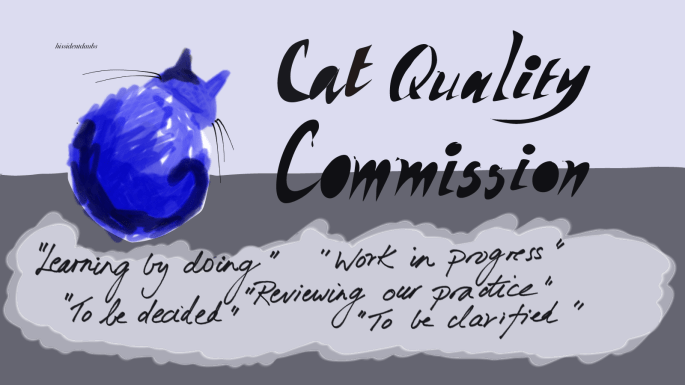
CQC has cost the taxpayer well over a billion pounds in just its running costs, let alone the cost of its failures. Isn’t that rather a lot of money just for political window dressing and a load of old ‘’learning by doing” rope?

In its seventh year of failure, shouldn’t CQC be blushing whenever it wheels out its habitual “work in progress” refrain?

CQC operational expenditure

Source: CQC annual reports

Financial year

CQC operational expenditure

2009/2010

£189, 941,000

2010/2011

£139,089,000

2011/2012

£149,440,000

2012/2013

£163,665,000

2013/2014

£171,052,000
2014/2015

£221,706,000

2015/2016

£248,045,000

All years

£1, 282,938,000

Related items:

Do “Complaints Matter” to CQC?

https://minhalexander.com/2016/10/02/do-complaints-matter-to-cqc/

CQC Deaths Review: All fur coat

https://minhalexander.com/2016/09/25/cqc-deaths-review-all-fur-coat/

REFERENCES

[1] Social Care for Older People, Home Truths, Kings Fund, 15 September 2016

http://www.kingsfund.org.uk/sites/files/kf/field/field_publication_file/Social_care_older_people_Kings_Fund_Sep_2016.pdf

[2] Tens of thousands of care workers ‘still paid below minimum wage despite new regulations’ Jamie Merrill, Independent, 23 March 2016

http://www.independent.co.uk/news/uk/home-news/tens-of-thousands-of-care-workers-still-paid-below-minimum-wage-despite-new-regulations-a6946596.html

[3] Care workers sue council contractor in minimum wages battle, Zoe Conway, BBC, 14 September 2016 http://www.bbc.co.uk/news/uk-37350750

[4] Orchid View, Serious Case Review, West Sussex Adult Safeguarding Board June 2014

http://www.hampshiresab.org.uk/wp-content/uploads/June-2014-Orchid-View-Serious-Case-Review-Report.pdf

[5] Staff sackings and suspensions over poor elderly care. Alison Holt BBC Panorama, 30 April 2014 http://www.bbc.co.uk/news/uk-27128011

[7] Care Home Open Day, Blog by Andrea Sutcliffe CQC Chief Inspector 22 June 2015, http://www.cqc.org.uk/content/care-home-open-day-0

[8] How safe are NHS patients in NHS hospitals? Prof Colin Leys and Prof Brian Toft, Centre for Health and the Public Interest, December 2015

https://chpi.org.uk/wp-content/uploads/2015/12/CHPI-PatientSafety-Dec15.pdf

[9] CQC deaths review: all fur coat, Minh Alexander 13 August 2016

https://minhalexander.com/2016/09/25/cqc-deaths-review-all-fur-coat/

[10] Elderly people put at risk as watchdog fails to act on warnings of ‘fatally negligent’ care homes, Melanie Newman and Oliver Wright, Independent 2 September 2015

http://www.independent.co.uk/life-style/health-and-families/health-news/elderly-people-put-at-risk-as-watchdog-fails-to-act-on-warnings-of-fatally-negligent-care-homes-10483573.html

[11] CQC Annual Mental Health Act monitoring report 2013/2014

http://www.cqc.org.uk/sites/default/files/monitoring_the_mha_2013-14_report_web_0303.pdf.pdf

[12] CQC press release 3 September 2015, ‘CQC response to the story in the Independent

http://www.cqc.org.uk/content/cqc-response-story-independent

[13] Chief Coroner’s guidance on Reports to Prevent Future Deaths

https://www.judiciary.gov.uk/wp-content/uploads/2013/09/guidance-no-5-reports-to-prevent-future-deaths.pdf

[14] CQC inspection reports were key word searched.

Links to the 66 coroners’ Reports to Prevention Future Deaths on care homes since July 2013:

Betty ADDISON https://www.judiciary.gov.uk/publications/betty-addison/

Keith BARTON https://www.judiciary.gov.uk/publications/barton-2013-0330/

Malcolm BENNETT https://www.judiciary.gov.uk/publications/malcolm-bennett/

Stanley BERE https://www.judiciary.gov.uk/publications/stanley-bere/

John BIRD https://www.judiciary.gov.uk/publications/john-bird/

Eliza BOWEN https://www.judiciary.gov.uk/publications/eliza-bowen/

Ross BOYD https://www.judiciary.gov.uk/publications/ross-boyd/

Phyllis BROOMHEAD https://www.judiciary.gov.uk/publications/phyllis-broomhead/

George BROWN https://www.judiciary.gov.uk/publications/brown-2013-0230/

Edna BULMER https://www.judiciary.gov.uk/publications/edna-bulmer/

Michaela CHRISTOFOROU https://www.judiciary.gov.uk/publications/michaela-christoforou/

Gwendoline CLARKE https://www.judiciary.gov.uk/publications/gwendoline-clarke/

Dorothy CLARKSON https://www.judiciary.gov.uk/publications/dorothy-clarkson/

Violet CLOUDSDALE https://www.judiciary.gov.uk/publications/violet-cloudsdale/

Margaret CONNOR https://www.judiciary.gov.uk/publications/margaret-connor/

Barbara COOKE https://www.judiciary.gov.uk/publications/barbara-cooke/

Freda CORDY https://www.judiciary.gov.uk/publications/freda-cordy/

Norman DORN https://www.judiciary.gov.uk/publications/norman-dorn/

Thomas FARRELL https://www.judiciary.gov.uk/publications/thomas-farrell/

Margaret FLEMING https://www.judiciary.gov.uk/publications/margaret-flemming/

Beryl FRENCH https://www.judiciary.gov.uk/publications/beryl-french/

Jean GILLESPIE https://www.judiciary.gov.uk/publications/jean-gillespie/

Joseph GODFREY https://www.judiciary.gov.uk/publications/joseph-godfrey/

Harold GOULDING https://www.judiciary.gov.uk/publications/harold-goulding/

Douglas GREY https://www.judiciary.gov.uk/publications/douglas-grey/

George HULME https://www.judiciary.gov.uk/publications/george-hulme/

Lillian HURSELL https://www.judiciary.gov.uk/publications/george-hulme/

Joan JONES https://www.judiciary.gov.uk/publications/jones-2013-0234/

Janine KAISER https://www.judiciary.gov.uk/publications/janine-kaiser/

Marjorie KEOGH https://www.judiciary.gov.uk/publications/keogh-2013-0325/

Charles LAWRENCE https://www.judiciary.gov.uk/publications/charles-lawrence/

Doreen MATTINSON https://www.judiciary.gov.uk/publications/doreen-mattinson/

Dorothy MC DERMOTT https://www.judiciary.gov.uk/publications/dorothy-mcdermott/

Margaret METCALFE https://www.judiciary.gov.uk/publications/margaret-metcalfe/

Gaenor MOORE https://www.judiciary.gov.uk/publications/margaret-metcalfe/

John MORRIS https://www.judiciary.gov.uk/publications/morris-2013-0295/

Wilhelmina NEWTON https://www.judiciary.gov.uk/publications/wilhelmina-isobel-newton/

Peter NOTT https://www.judiciary.gov.uk/publications/peter-norman-nott/

Peter PATTINSON https://www.judiciary.gov.uk/publications/peter-pattinson/

Marjorie PHILLIPS https://www.judiciary.gov.uk/publications/marjorie-phillips/

Alois PISKA https://www.judiciary.gov.uk/publications/alois-piska/

Noreen PORTER https://www.judiciary.gov.uk/publications/alois-piska/

Walter POWLEY https://www.judiciary.gov.uk/publications/walter-gordon-powley

Marie QUINN https://www.judiciary.gov.uk/publications/marie-quinn/

Elsie RAPER https://www.judiciary.gov.uk/publications/elsie-raper/

Derrick RIVERS https://www.judiciary.gov.uk/publications/derrick-rivers/

James ROBERTSON https://www.judiciary.gov.uk/publications/james-robertson/

Lillian ROBINSON https://www.judiciary.gov.uk/publications/lillian-robinson/

Margaret ROGERSON https://www.judiciary.gov.uk/publications/margaret-rogerson/

Christopher ROYAL https://www.judiciary.gov.uk/publications/christopher-royal/

Maria SILKIN https://www.judiciary.gov.uk/publications/maria-silkin/

Gladys SMITH https://www.judiciary.gov.uk/publications/gladys-smith/

Vincent SMITH https://www.judiciary.gov.uk/publications/vincent-smith/

Edna SMITHER https://www.judiciary.gov.uk/publications/edna-smither/

Vera STEEL https://www.judiciary.gov.uk/publications/vera-lillian-steel/

James STEWART https://www.judiciary.gov.uk/publications/james-stewart/

Doris TAYLOR https://www.judiciary.gov.uk/publications/doris-taylor/

Pamela THURSTON https://www.judiciary.gov.uk/publications/pamela-thurston/

William TOLEN https://www.judiciary.gov.uk/publications/william-tolen/

John TUGWELL https://www.judiciary.gov.uk/publications/tugwell-2013-0319/

Mary WALDRON https://www.judiciary.gov.uk/publications/mary-waldron/

Stanley WARD https://www.judiciary.gov.uk/publications/stanley-ward/

Walter WILLOWS https://www.judiciary.gov.uk/publications/walter-willows/

Olive WILMOTT https://www.judiciary.gov.uk/publications/clive-wilmott/

Marjorie WOOD https://www.judiciary.gov.uk/publications/marjorie-wood/
Clubadoodle-doo

By Dr Minh Alexander, NHS whistleblower and former consultant psychiatrist 4 October 2016

The National Guardian for NHS whistleblowing is Robert Francis’ much-derided brainchild. It has no powers and is not evidence-based. It is a replacement for his earlier recommendations that there should be hard legislative reform to properly outlaw whistleblowing reprisal. [1] Twenty months after Francis proposed that a National Guardian should be established, the office is not yet open for business and we don’t even know what it will do.

Nevertheless, the National Guardian idea was useful to Jeremy Hunt as a publicity tool, bar the small fact that the first National Guardian resigned, just two months after being appointed.

The National Guardian’s office will stir back into life shortly as the replacement National Guardian Henrietta Hughes takes up her post at the CQC.

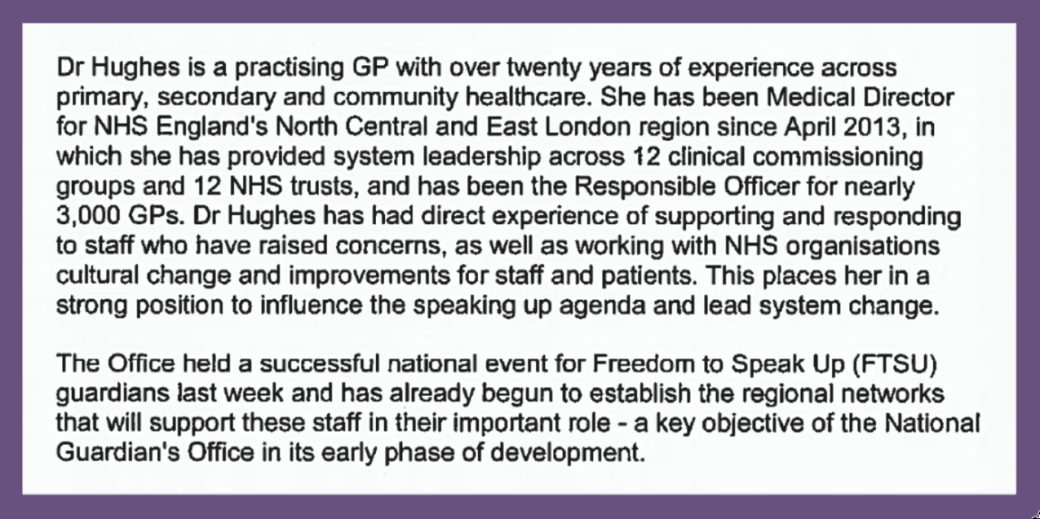
She was described in parliament as a ‘practising GP’ by Ben Gummer, in response to the excellent Philippa Whitford noting concerns that Hughes was an NHS England senior manager.

hansard-13-july-2016

Hilariously, when NHS England was asked to disclose how many days a week Dr Hughes worked for it as a Medical Director, it apparently sought to protect Mr Gummer by refusing-to-disclose-this-information-on-grounds-of-privacy:

“…NHS England are withholding details in respect of exact hours worked by Dr Hughes under Section 40(2) of the FOI Act which provides for the protection of personal information”

It has been unclear what credentials either the current National Guardian or her predecessor hold in the field of whistleblowing. Skills, knowledge and experience in whistleblowing were not even on CQC’s list of requisites for candidates.[2]

We now have Henrietta Hughes, a former NHS England senior manager, reporting directly to David Behan, CQC Chief Executive and a former Director General of the Department of Health. What could possibly go wrong with such an arrangement for scrutinising frontline whistleblowing, about things for which NHS England, NHS regulators and the Department of Health are ultimately responsible?

Disappointingly, 20 months after Mr Hunt drenched parliament with his tearful lament about the findings of Francis’ Freedom to Speak Up Review on the treatment of NHS whistleblowers, there is still no clarity about what the National Guardian will do. The office has still not announced that it is open for business as regards whistleblowers who have been unable to make progress with their employers. There isn’t even any certainty that the National Guardian will accept complaints from whistleblowers.

The CQC went through the motions of a faux consultation exercise last year about the National Guardian’s office, after it had already finalised the job description and advertised the post. Of course, the CQC ignored the concerns of whistleblowers who contributed to the ‘consultation’.  Things then fell apart after the CQC had the gall to appoint a current NHS trust director to the post – despite the glaring conflicts of interest – who was only seconded to the CQC for two days a week. This arrangement quickly crashed and burned. [3] Mr Hunt declined to comment. There were calls for the next appointee to come from outside the NHS.

The job was re-advertised with some significant omissions from CQC’s position specification. I asked Robert Francis, as the designated NED for the project, about an apparent retreat by CQC [4] from ludicrous restrictions that it had attempted to place on the remit of the previous National Guardian, but I never heard from him. When I later put the same questions to Henrietta Hughes upon her appointment, she replied – guess what – there will be yet more gassing about it all:

“Over the coming months the precise scope and design will be defined. I will be seeking views from a wide range of individuals and organisations both from within the NHS and externally to ensure that best practice can be shared.”

This looks like more classic NHS buck-passing and procrastination. Frankly, anyone who accepts the job of the National Guardian is either unlikely to understand just how emasculated the office is – or worse, unlikely to care.

But let’s face it, would the Minister really want anybody from outside the club, with clear credentials, who would do a half-decent job of NHS whistleblowing reform? I’d be delighted if Dr Hughes proves me wrong, but….

No, it’s still Stalin, not Gandhi, whatever Mr Hunt says.

Another helping of gulag with lashings of whistleblower show trials, Minister?


Items to cross reference

https://minhalexander.com/2016/09/24/no-one-believes-jeremy-hunt-on-patient-safety-or-whistleblowers-not-even-his-own-appointees-unmasking-the-faux-national-guardian-office/

Background on the National Guardian’s office and information from a meeting with the previous National Guardian.


Letter to Henrietta Hughes 5 October 2016

From: Minh Alexander <minhalexander@aol.com>

Subject: Role and powers of the National Guardian for Freedom to Speak up

Date: 5 October 2016 at 12:07:08 BST

To: National Guardian <national.guardian@nationalguardianoffice.org.uk>, Hughes Henrietta henrietta.hughes@nhs.net

To Dr Henrietta Hughes, CQC National Guardian for Freedom to Speak Up, 5 October 2016

Dear Dr Hughes,

Role and powers of the National Guardian for Freedom to Speak Up

Thanks for your email.

I wasn’t clear exactly when you were to start your post as National Guardian, besides that it would be this month. On the assumption that you may now be in post, may I ask if there is a clear timetable yet for resolving the lack of clarity about what the National Guardian’s remit will comprise? (Please see my letter to you below, of 7 July 2016).

With best wishes,

Dr Minh Alexander


References

[1] https://minhalexander.com/2016/09/26/sir-roberts-flip-flops/

Minh Alexander 26 September 2016

[2] CQC position specification for the National Guardian

cqc-national-guardian-specification-final-760085

[3] Jeremy Hunt humiliated as NHS whistleblower Tsar quits before she started, Andrew Gregory, Mirror 8 March 2016

http://www.mirror.co.uk/news/uk-news/jeremy-hunt-humiliated-nhs-whistleblower-7513425

[4] Letter to Robert Francis 1 May 2016

letter-to-robert-francis-1-may-2016


Do “Complaints Matter” to CQC?

By Dr Minh Alexander, NHS whistleblower and former consultant psychiatrist 2 October 2016

NHS managers “look up, not out”, so said a major report that was suppressed by the Department of Health. [1] On that theme, the Care Quality Commission has a political function: to flatter politicians and help manage potential embarrassment. It has made arbitrary and inconsistent decisions, which has brought it into conflict with providers, complainants and whistleblowers. CQC has said all the right things about the importance of good complaints handling and transparency, but a review of CQC’s annual reports shows that the CQC has provided little information about why people complain about CQC and what CQC has learnt from the complaints.The data that CQC has released about complaints is not presented in a consistent format and mostly lacks detail. There is limited evidence to demonstrate that CQC has made changes in response to complaints and that it does not repeat mistakes. 

The health watchdog the Care Quality Commission was created to replace its more effective predecessors, who had embarrassed the government. Notably, CQC’s immediate predecessor the Healthcare Commission (HCC) had uncovered the grave care failings Mid Staffs, and strategic failures which had contributed to the scandal. The excellent HCC investigation report by Dr Heather Wood et al can be found here: hcc-investigation_into_mid_staffordshire_nhs_foundation_trust

CQC disbanded the central investigation team it inherited from the HCC, which had been so effective. [2] Notoriously, CQC also gagged Dr Heather Wood  [3] – this became the subject of much criticism in the public inquiry into Mid Staffs. One interpretation of these events is that the CQC did not wish to be fully “sighted” on politically embarrassing provider failures.

CQC under-uses and frequently minimises its investigatory powers. It has sometimes made misleading claims that it cannot investigate at all. However, it has powers to investigate under Section 48 of the Health and Social Care Act 2008 [4] and it has powers to investigate in relation to patients subject to the Mental Health Act. Whistleblowers and complainants often feel fobbed off when the CQC refuses to do anything at all, except to note their concerns.

There have also been controversies where providers have felt unfairly treated by the CQC, in terms of oppressive inspection approach, increases in CQC’s fees, unfair ratings and excessive factual inaccuracies in CQC reports. [5] [6] Most recently, there was an outcry and many questions when Dr David Zigmond’s practice was shut down. [7] This happened after Dr Zigmond published a book the previous year entitled “If you want good personal healthcare – see a vet”. He wondered whether this “had been a black mark against him”. In 2014, before the publication of Dr Zigmond’s critique of the direction of health services, the CQC had rated his practice fully compliant and noted very positive feedback from patients: “People we spoke with were very happy with the treatment they received at the surgery”.

 So how does CQC perform when people complain about it? CQC previously stated that it intended to model best practice on complaints handling:

“We intend to become a role model in the way we ourselves handle and resolve complaints about CQC and concerns raised by our own people.” [8]

However, a look at the six annual reports published so far by the CQC since its inception raises questions about whether CQC is a good role model. Data in these reports is presented with CQC’s trademark inconsistency, which obscures as much as it reveals. [9] [10] According to the six annual reports, 2644 complaints have been made about CQC between 1 April 2009 to 31 March 2016, and 434 (16%) of these complaints proceeded to Stage 2 of CQC’s procedure. Half of CQC’s annual reports were totally silent on the numbers of complaints upheld at Stage 1 and Stage 2. See table 1 below.

cqc-complaints-1

Almost no evidence was provided about the experience of complainants or how satisfied they were with CQC’s complaint handling. This seems a significant omission as CQC has placed an emphasis on the experience of people who complain about regulated bodies:

“ From now on, we will ask providers to share with us any survey they have carried out of people who have complained to them in the last 12 months.”[11]

Has CQC failed to practice what it preaches by not carrying surveys of its own? Or has it surveyed its own complainants, but failed to transparently share the results?

In some years CQC gave a rough indication of the nature of complaints, but in two of the years, no information was provided at all. The most detailed report about complaints was provided by the CQC annual report of 2012/2013, but this was an exception. See Table 2 below.

cqc-complaints-2

No systematic reports have been provided by CQC on how it has learnt from complaints, made changes or stopped making the same mistakes. Perhaps the most interesting data, analysis of the nature of complaints that were upheld and CQC’s responses to these upheld complaints, is not provided apart from a few selected anecdotes.

CQC’s thematic review report “Complaints Matter” [9] noted that in October 2014, CQC introduced a mandatory ‘key line of enquiry’ in its inspections on how well providers are handling complaints.

CQC also stated in this review report: “We now have a clear vision of ‘what good looks like [on complaints handling]”. CQC added that evidence of good complaints handling would result in complainants being ready to complain again if needed, that complainants would feel fairly treated, that complainants would encourage others to complain if needed and that complainants can see how their complaints have helped to improve services.

So where is the equivalent evidence on CQC’s own complaints handling? Is it too awkward to publish because it might show that the CQC – and its masters – have little intention of changing how CQC does business?

CQC said in 2014 that it would rate providers’ complaints governance as follows:

  • Outstanding – there is active review of complaints and how they are managed and responded to, and improvements are made as a result across the services.
  • Good – it is easy for people to complain or raise a concern and they are treated compassionately when they do so.
  • Requires improvement – people do not find it easy to complain or raise concerns, or are worried about raising concerns or complaining. When they do, a slow or unsatisfactory response is received.
  • Inadequate – there is a defensive attitude to complaints and a lack of transparency in how they are handled. People’s concerns and complaints do not lead to improvements in the quality of care.


So, where would you place the CQC on this scale?


Items to cross-reference

PHSO has the CQC’s back

Between April 2009 and September 2015, the PHSO received 354 complaints about CQC, not one of which had yet been upheld as of September 2015. See here for more:

PHSO FOI disclosure 21 September 2015 on handling of complaints: PHSO has the CQC’s back

Letter to Health Committee 3 October 2016 about CQC’s handling of complaints

letter-to-house-of-commons-health-committee-3


References

[1] Achieving the vision of excellence in quality, Recommendations for the English NHS system of quality improvement, Institute of Health Improvement, January 2008

ihi-report-achieving-the-vision-of-excellence-in-quality-2

[2] Stafford hospital investigator berates CQC regulator, John Carvel, Guardian, 1 May 2012 https://www.theguardian.com/society/2012/may/01/stafford-hospital-investigator-berates-cqc-regulator

[3] Health watchdog put 20 gagging orders on staff, Patrick Sawer and Laura Donnelly, Telegraph 30 June 2013 http://www.telegraph.co.uk/news/health/heal-our-hospitals/10150664/Health-watchdog-put-20-gagging-orders-on-staff.html

[4] CQC FOI disclosure of 15 January 2016 about six Section 48 investigations conducted since inception https://minhalexander.com/2016/09/27/cqc-foi-disclosure-15-january-2016-about-section-48-investigations-conducted-since-inception-in-2009/

[5] Public Accounts Committee inquiries on CQC 2012 and 2015

Click to access 1779.pdf

Click to access 501.pdf

[6] Practices to pay almost £2,000 more in CQC fees from April, Jaimie Kaffash, Pulse 30 March 2017 http://www.pulsetoday.co.uk/your-practice/regulation/cqc/practices-to-pay-almost-2000-more-in-cqc-fees-from-april/20031484.fullarticle

[7] The ousted doctor: “My patients’ souls matter the most”, Angela Neustatter, Guardian 18 September 2016 https://www.theguardian.com/society/2016/sep/18/the-ousted-doctor-my-patients-souls-matter-most

[8] CQC annual report 2013/2014 https://www.cqc.org.uk/sites/default/files/20140708-cqc-annual-report-web-final.pdf

[9] How safe are NHS patients in private hospitals? Prof Colin Leys and Prof Brian Toft, Centre for Health and the Public Interest, November 2015 https://chpi.org.uk/wp-content/uploads/2015/12/CHPI-PatientSafety-Dec15.pdf

[10] CQC deaths review: All fur coat. Minh Alexander 13 August 2016 https://minhalexander.com/2016/09/25/cqc-deaths-review-all-fur-coat/

[11] Complaints Matter. CQC thematic review December 2014 http://www.cqc.org.uk/sites/default/files/20141208_complaints_matter_report.pdf


Jim Reaper and gags up north

Jim Reaper’s been skipping across the north lands, hand in hand  with his chum the hugely popular Secretary of State for Ill Health.

Reports from an NHS Disinvestment board meeting on 29 September 2016 suggest that Jim is perhaps sensitive about gags at his former trust:


a-ben


So here’s the full FOI disclosure of 15 February 2016 about secrecy and non-disparagement clauses at ‘Outstanding’ Northumbria, so you can make up your own mind: northumbria-compromise-agreements-foi-disclosure-15-02-2016

As you can see, 45 members of staff were silenced with secrecy clauses that stopped them from even disclosing the existence of the compromise agreements that they had signed:

Here’s what Sir Peter Bottomley said in parliament on 18 May 2016 about such secrecy clauses in NHS compromise agreements:

I am waiting for the result of an Manchester employment tribunal case involving Mr Aditya Agrawal. I shall make no further comment, because we have not yet seen the result, but when it comes out, I hope to ask Mr Speaker whether we can have a debate on why the hospital trust had had over 100 confidentiality agreements over the last five years—and a compromise agreement that is a secret as well. This is the sort of pattern that we should not have in our national health service.”

https://www.theyworkforyou.com/debates/?id=2016-05-18a.6.0&s=speaker%3A10057#g71.0

Here’s what Sir Robert Francis said in the report of the Freedom To Speak Up Review on 11 February 2015 about secrecy clauses:

“… I have seen some [compromise agreements] which seem unnecessarily draconian or restrictive, for example, banning signatories from disclosing the existence of a settlement agreement.”

Click to access F2SU_web.pdf

By the way, despite CQC’s spinning ways, a glance at PHSO data showed that Northumbria is not compellingly ‘Outanding’ in terms of complaints: phso-foi-disclosure-complaints-against-northumbria-fdn259244-your-information-request

Northumbria’s rate of enquiries to PHSO that were accepted per 100,000 clinical incidents in 2014/2015 was 6.96. The range for acute trusts was 1.32 to 17.

But mum’s the word. Shhhhhh.


Items to cross-reference

NHS Gagging. How CQC sits on its hands: despite misleading claims by CQC, review of almost 200 current CQC inspection reports reveals no evidence that CQC has inspected trusts’ compromise agreements.

https://minhalexander.com/2016/09/23/nhs-gagging-how-cqc-sits-on-its-hands-2/

Letter to House of Commons Health Committee 23 September 2016 about CQC’s failure to deter the inappropriate use of compromise agreements in the NHS:

https://minhalexander.com/2016/09/23/letter-to-health-committee-23-september-2016/