If I was Secretary of State

By Dr Minh Alexander, NHS whistleblower and former consultant psychiatrist 23 February 2017

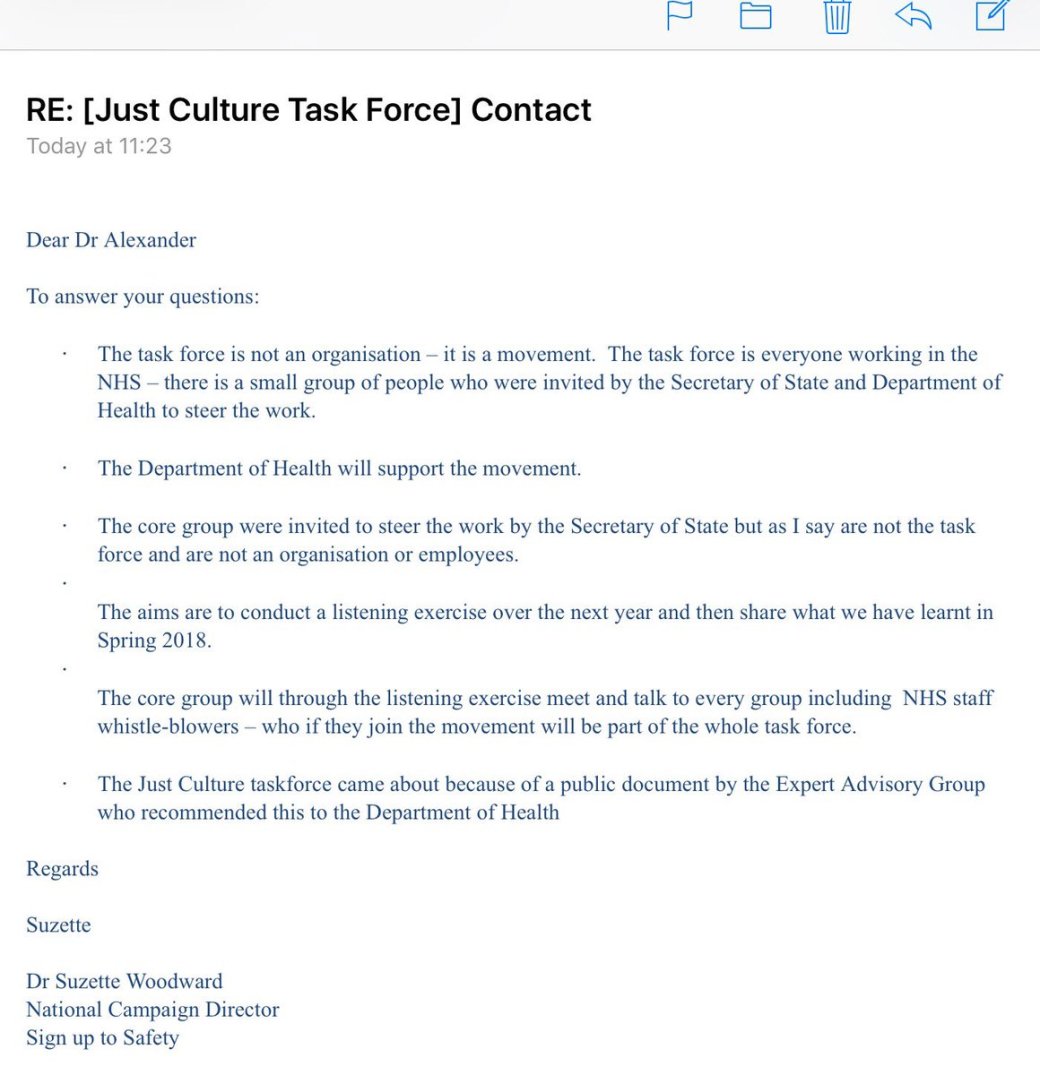
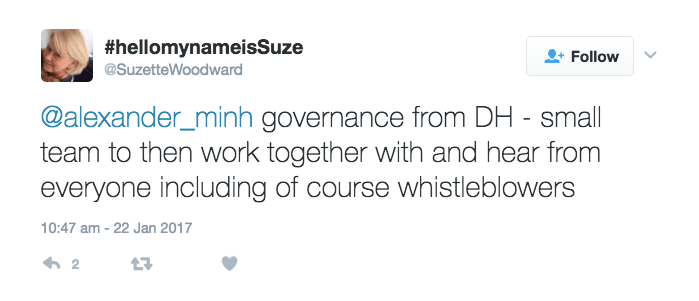
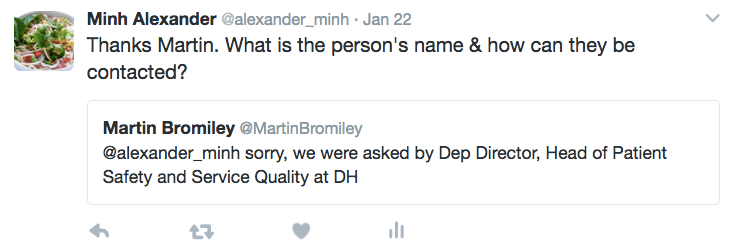
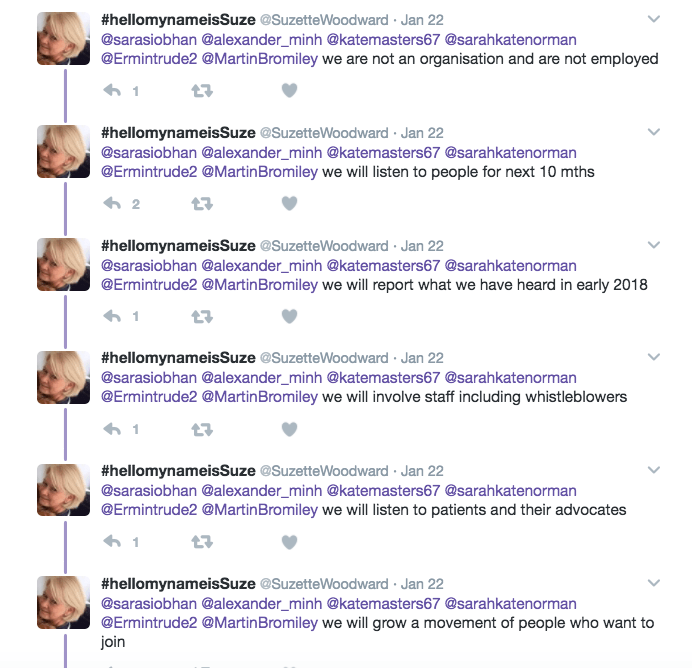
On the campaign trail, one ends up in interesting social media conversations. Such a conversation led to me being asked what I would do to prevent suppression of whistleblowers’ concerns if I was the Secretary of State for the Department of Health.

There were about 600 submissions to Robert Francis’ Freedom to Speak Up Review, most of which were from whistleblowers. Review officials acknowledged that most of the whistleblowers who contributed reported negative experiences of speaking up.

But there was not a word in Francis’ Review report about the nature or gravity of whistleblowers’ disclosures.

Moreover, Francis recommended that there should not be a public inquiry into NHS whistleblowing, and so it is unlikely that the buried, serious patient safety issues will see the light of day.

After the review, Francis confirmed that most of the submitted material was destroyed:

Click to access robert-francis-email-f2su-data-3-03-2016.pdf

It was a huge missed opportunity.

But turning to the future, this is what I would do about NHS whistleblowing if I was the Secretary of State:


BY EMAIL

Open letter to James Titcombe

NHS Just Culture Taskforce core member


23 February 2017

Dear James,

What I would do if I was Secretary of State

I write further to our twitter discussion yesterday about culture in the NHS and failures to protect whistleblowers, which culminated in you asking what I would do if I was Secretary of State.

Summary

The Secretary already knows what he should do. Things can not and will not change until there is political will to genuinely improve transparency, as opposed to spinning an appearance of improved transparency. To protect whistleblowers – and therefore patients – the Secretary of State should:

  • Model good behaviour by listening to the workforce and to whistleblowers in particular
  • Implement whistleblowing law reform
  • Ensure accountability for whistleblower suppression and reprisal (this should include a public inquiry into past abuses and unmitigated patient safety risks)
  • Stop the improper protection of those who victimise whistleblowers
  • Enforce the investigation of whistleblowers’ concerns and provide a mechanism for appeal against unsatisfactory local investigations by employers
  • Support the establishment of a properly resourced, independent body for whistleblowers which has powers to investigate and remedy poor whistleblowing governance and enforce whistleblowing law
  • Make NHS disciplinary processes fairer to employees
  • Take genuine action to stop the inappropriate use of gags in NHS settlement agreements and provide a general waiver for past gags
  • Stop NHS bodies wasting vast sums on litigating against and silencing whistleblowers
  • Ensure that whistleblower perspectives are considered in national projects on transparency and culture change.


Introduction

As I pointed out, the roots of NHS whistleblower suppression and reprisal are ultimately political and reflect the immature governance of the NHS. This skews priorities and fiercely protects the reputations of politicians and senior officials. This top down culture of ‘compliance and fear’ was described by two major reports by the Institute of Health Improvement and Joint Commission International in 2008, which were suppressed for two years by the Department of Health (DH) until released via Freedom of Information. 1  2 Whilst there are pockets which are less toxic, culture has not improved overall and in some ways is worse due to accelerated denial about the managed decline of the NHS.

Typically, governments the world over take a crisis management and public relations approach to whistleblowing, with superficial, ineffective responses to scandals that serve only to buy time and not to genuinely address issues. The Freedom to Speak Up Review is such an example. 3 Far from protecting whistleblowers’ rights, the current government is driving the balance towards greater punishment of whistleblowers and the press who support them and report their concerns. 4  Authoritarianism is increasing in government, not decreasing.

The Secretary of State and Department of Health are often the last port of call for NHS whistleblowers who have been unable to progress concerns with employers, regulators and other oversight bodies. However, their common response to whistleblowers is to avoid meaningful contact and to claim that they cannot get involved in employment disputes, even where patient safety issues are reported. 5 This practice continues.

What should the Secretary of State do?

The Secretary of State, who has been in post five years, is aware of the things that would help to protect whistleblowers. He has received numerous representations from whistleblowers and their supporters about the interventions needed to deter and prevent whistleblower suppression and reprisal. The issue is that he has not acted upon them. Whistleblowing failures continue.

Nevertheless it may be useful to list some of the main things he could do:

Model listening behaviour – the Secretary of State should in general treat the workforce with consideration and respect, and listen to its concerns. Specifically, he should stop rebuffing whistleblowers, and he should stop DH officials rebuffing whistleblowers, who approach him for help because the rest of the system has let them down. 6

In the extraordinary and long running whistleblower case of Dr Raj Mattu, there was no shortage of political support, questions in the House, appeals and petitions to governments. Despite this, seven successive Secretaries of State did not stop the serious injustice. 7

These are the seven Secretaries of State over the period in which Dr Raj Mattu has experienced serious reprisal and detriment:

Raj Mattu seven secretaries of State.png

Whistleblower approaches to the DH almost always represents serious governance failure by the wider NHS. Instead of washing his hands of cases, the Secretary of State and his department should hold the bodies responsible to account, facilitate the resolution of concerns, and acknowledge that whistleblower detriment is not merely an “employment matter”, but an indicator of failed governance and risk to patients.

Full Law reform – PIDA, the existing whistleblowing law, 8 came into force 18 years ago and is acknowledged to be weak by experts. Robert Francis acknowledged it was weak. 9 But there is no current political will to allow reform. The Law Commission confirmed on 15 February 2017 that it has no plans to review PIDA.

Politicians and senior civil servants often claim that PIDA provides protection for whistleblowers. This is a misrepresentation. PIDA only provides the possibility of compensation after victimisation, and compensation is usually inadequate set against the real losses.


BLUEPRINT FOR FREE SPEECH ANALYSIS OF PIDA, MAY 2016:

“However, PIDA’s widely publicised failings have begun to tarnish the law’s reputation. The dangers faced by whistleblowers – from firing and harassment, to bullying and boycotting – can plainly be traced to major flaws and gaps in the law itself.

An analysis shows that when compared against a list of international standards, PIDA contains only 37 percent of these standards for whistleblower protection legislation.” 10


PIDA does not provide anyone with powers to proactively protect whistleblowers or to remedy detriment. There is no evidence even that PIDA deters reprisal.

Public organisations with deep pockets are untroubled by PIDA, and prepared to spend large amounts of money to out gun whistleblowers in Court.

Whistleblowers rarely succeed with litigation – many cases are settled out of court, and the statistics available suggest that only 3% of claims actually succeed at hearing. 11 Employers are also prepared to pay compensation for unfair dismissals, as the price for ridding themselves of whistleblowers and managing reputation.

Importantly, PIDA does not compel anyone to investigate or act upon whistleblowers’ concerns. Patient safety concerns raised by NHS whistleblowers in the most serious cases largely get buried.

PIDA also does not hold individuals to account for whistleblower suppression or reprisal, only organisations. Managers guilty of endangering the public suffer no personal consequences.

If the Secretary of State is serious about protecting whistleblowers and ensuring that their patient safety concerns are acted upon, he should take steps to trigger and support reform of the law.

Independent body for whistleblowers – The Secretary of State should support the establishment of a properly resourced, fully independent body for whistleblowers that answers to parliament and not to a government department, with proper powers to investigate or compel other bodies to investigate, remedy poor whistleblowing governance and generally enforce compliance with whistleblowing law.

There are precedents. For example, the USA Office of Special Counsel, which protects federal whistleblowers. 12

At present, there is no single UK body with responsibility for whistleblowers. Under PIDA, there are only numerous disparate bodies (“prescribed persons”) to whom whistleblowers can make disclosures. However, these bodies have no defined responsibilities under PIDA. They often have little expertise on whistleblowing. They do little to protect whistleblowers. 13

Accountability

There is currently almost no accountability for whistleblower suppression and reprisal in the NHS. There can be no psychological safety for staff in raising concerns nor hope of a genuinely just culture, until this blatant impunity is rectified.

Currently, the sight of gibbeted whistleblowers contrasting with protected persecutors has a chilling effect, reflected in poor NHS staff survey measures of confidence in speaking up and in concerns being acted upon.  In 2015, about one third of NHS staff did not feel secure to raise concerns and about half of staff did not think their concerns would be acted upon. 14

In the lastest survey of staff at the regulator, the CQC (which should be an exemplar) only 43% of staff felt safe to challenge the way things are done at CQC. 15


cqc-staff-survey-2016-safe


The Secretary of State is arbitrary and inconsistent in his responses to NHS wrongdoing. He has ordered a very welcome investigation into the disreputable practices by the NMC. 16

However, he has not responded to equally egregious examples of whistleblower persecution, other than when the Daily Mail campaigned on one particular example. 17

He has the power to order a public inquiry into all the gross abuses and malfeasance in many NHS whistleblower cases, and the recycling of erring managers with complicity or active facilitation by regulators, but he has resisted doing so.

He should order a public inquiry and he should ensure that the culture of impunity ceases, to send a message to the workforce that there is order, fairness and a safe environment in which to speak up.

A public inquiry would also bring to light the thousands of patient safety concerns that have been suppressed by the NHS, and allow hopefully for serious unresolved issues to be addressed.

The Secretary of State should also ensure that employers and regulators stop protecting those who victimise whistleblowers, and that such behaviour is heavily sanctioned, proportionate to the serious harm and risk that it causes.

Managerial regulation – As part of increasing accountability, the Secretary of State should introduce managerial regulation for all grades of managers. It is wrong to allow power without sufficient accountability, especially when the toothlessness of and failure to enforce the NHS Manager’s Code of Conduct has been a feature of so many NHS failures. 18

Make NHS disciplinary processes fairer to staff – Current NHS disciplinary processes are easily abused and enable managers to conduct kangaroo courts to get rid of unwanted staff, including whistleblowers. Independent, lawyer chaired panels should be reinstated to hear the final stages of disciplinary proceedings, not just for consultants but for other staff as well. 19

Stop the inappropriate use of gags in NHS settlement agreements and provide a general waiver for past gags – The Midstaffs Public Inquiry criticised the NHS’ use of gags and their deleterious effect on patient safety. 20 The Secretary of State and senior officials did not respond effectively to this, and provided no real deterrent or enforcement of good practice. 21

Since 2013, NHS settlement agreements have been modified to make them strictly speaking legal, but they still frequently contain intimidating clauses which have the effect of silencing staff.

The Secretary of State should set out clear, adequate standards by which organisations’ performance can be measured, and enforce good practice. He should ban the use of ‘super-gags’ – clauses that make even the existence of settlement agreements secret. Such clauses have been used to make whistleblowers invisible, to cover up the fact that they have been paid off and hide the underlying managerial wrongdoing.

Currently, the DH has refused to ban such super-gags.

Also, the CQC has variously attempted to wrongly claim that gags have been banned from the NHS 22, it has ignored specific concerns raised by whistleblowers about organisations’ use of gags and it has failed to regulate the use of gags (despite claiming that it would). 21

The Secretary should send a clear message by ensuring better regulatory practice, and by providing a general waiver for past gags, the details of which will need to be agreed. Thousands of people have been ‘pardoned’ for offences of same sex relations. The NHS can surely give similar justice to staff who have been wrongly gagged.

There is also a practical aspect to providing a waiver of past gags. Some gagged whistleblowers cannot currently access, or fully access, the NHS whistleblower employment support scheme because they are subject to such restrictively drafted settlement agreements.

If the Secretary of State does not act on this, some exiled whistleblowers will remain frozen out of the NHS with no hope of return.

Preventing inappropriate expenditure on litigation and silencing whistleblowers – The Secretary of State should stop the misuse of public funds by NHS bodies in suppressing public interest disclosures.

Tighter controls and more rigorous challenge by regulators and oversight bodies is needed.

Whistleblower settlements are still being rubber stamped by the Treasury and NHS regulators. 23

NHS organisations should not be able to waste money on employing law firms to devise exit strategies and corrupt investigations against whistleblowers, litigation or paying off whistleblowers without consequences.

Regulators and oversight bodies should take proactive measures against organisations who waste public money in this way, instead of nodding it by.

Any such improper expenditure should trigger an examination of organisations’ whistleblowing governance and any necessary protection of the whistleblowers affected.

Ensure whistleblower perspectives and engagement in any national projects on transparency and culture change – Whistleblowing is currently not considered at all or only tokenistically in projects that purport to improve transparency and culture. For example, the Secretary of State’s initiation of the Just Culture Taskforce did not include staffside representatives or whistleblowers from the outset. 24

The Healthcare Safety Investigation Branch has also equivocated and resisted transparency about ‘co-production’ of its protocols. It is in particular resistive to questions about whether it will involve whistleblowers in developing its protocols.

This sort of behaviour by NHS bodies reveals that despite lip service, there are still negative attitudes to whistleblowing as a problem rather than a resource. The Secretary of State should model better whistleblower engagement and require others to do so also.

In conclusion, I hope this helps to illustrate why the view that failure of whistleblower protection is primarily a political issue, is based on evidence and analysis, and not merely ‘conspiracy theory’ or the product of unthinking negativity.

A classic technique of governments is to divide and split, and some individuals who have a more positive experience may naturally arrive at a more positive outlook based on their personal experiences. However, it is important to look at the whole picture, and to be mindful of issues of equity.

Not only whistleblowers, but also many patient complainants and bereaved families continue to be very badly treated by the NHS, and it is the totality of experience that needs to be consistently and fairly improved.

My thanks to you for asking a very helpful question.

With best wishes,

Dr Minh Alexander

cc Secretary of State

Chris Wormald Permanent Secretary DH

Lord Bew, Committee on Standards in Public Life

Keith Conradi Chief Inspector Healthcare Safety Investigation Branch (HSIB)

Jane Rintoul Deputy Director DH, patient experience, HSIB contact

Dr Henrietta Hughes National Freedom to Speak Up Guardian, CQC

Tim Jones DH, NHS Just Culture Taskforce Secretariat

Paul Stonebrook, DH, NHS Just Culture Taskforce Secretariat

Suzette Woodward, NHSLA, NHS Just Culture Taskforce core member

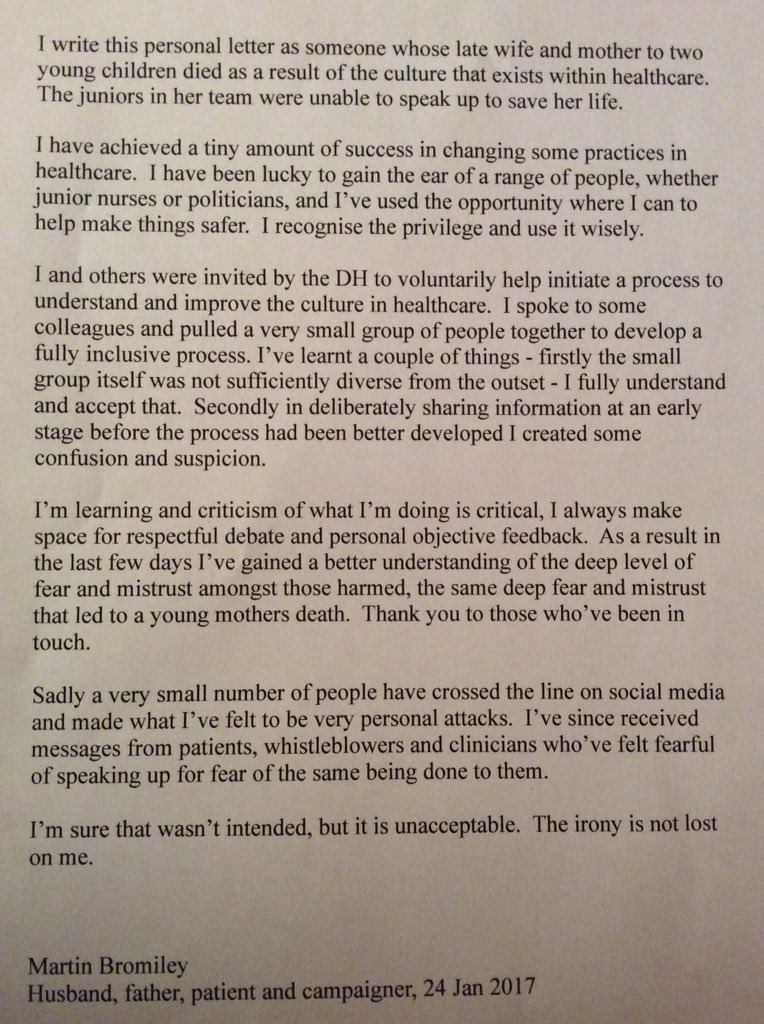
Martin Bromiley, NHS Just Culture Taskforce core member

Scott Morrish, NHS Just Culture Taskforce core member

Steven Shorrock, NHS Just Culture Taskforce core member

Peter Walsh CEO AvMA

Deborah Coles, Director INQUEST

Katherine Murphy CEO Patients Association

Jane Mordue Chair Healthwatch England

CLARIFICATION 23.02.2017: A recent Just Culture Taskforce website gave details as above of Taskforce core members. Steven Shorrock has clarified that he has nothing to do with the Just Culture Taskforce “at present and nothing planned. Happy to offer experience from aviation but very different context”.


titcombe-conspiracy-theory


RELATED ITEMS

  1. Transcript of BBC File on Four broadcast 7 February 2017, on continuing NHS whistleblowing failures

Click to access file-on-four-nhs-wb-transcript-07_02_17_fo4_speakingup.pdf

2. https://minhalexander.com/2017/02/20/national-guardian-letter-from-wonderland/

3. https://minhalexander.com/2016/09/24/letter-to-jeremy-hunt-16-october-2015-about-his-role-regarding-homerton-maternity-whistleblowers/

4. https://minhalexander.com/2016/09/26/safety-campaigners-letter-10-february-2016-to-the-times-about-government-inaction-on-nhs-whistleblowing-and-measures-required/


REFERENCES

1 Achieving the Vision of Excellence in Quality. Recommendations for the English system of quality improvement. Institute of Health Improvement. 2008

https://www.dropbox.com/s/xpd95hwd3jmbw2s/IHI%20report%20achieving%20the%20vision%20of%20excellence%20in%20quality.pdf?dl=0

2 Quality Oversight in England – Findings, Observations and Recommendations for a New Model. Joint Commission International 2008

https://www.dropbox.com/home?preview=JCI+report+Quality+oversight+in+England.pdf

3 Report by Robert Francis of the Freedom to Speak Up Review 11 February 2015

http://webarchive.nationalarchives.gov.uk/20150218150343/https://freedomtospeakup.org.uk/wp-content/uploads/2014/07/F2SU_web.pdf

4 Law Commission consultation paper – Protection of Official Data, February 2017

http://www.lawcom.gov.uk/wp-content/uploads/2017/02/cp230_protection_of_official_data.pdf

5 Ignored: Whistleblower’s claim of nurse who ‘killed slowly’, Sunday Times 14 December 2014

https://sharmilachowdhury.com/2014/12/14/ignoredwhistleblowers-claim-of-nurse-who-killed-slowly/

https://twitter.com/Unity_portal/status/531370139762298881

DH employment issue.png

6 Bid to block whistleblower’s access to Ministers, Civil Service World, 14 May 2014

http://www.civilserviceworld.com/articles/news/bid-block-whistleblower%E2%80%99s-access-ministers

7 Raj Mattu and the death of whistleblowing, Dr Phil Hammond, Private Eye issue 1364

http://www.drphilhammond.com/blog/2014/05/07/private-eye/medicine-balls-private-eye-issue-1364-2/

8 Public Interest Disclosure Act 1998

http://www.legislation.gov.uk/ukpga/1998/23

9 Page 192 of the report of the Freedom to Speak Up Review:

the existing legislation [PIDA] is weak”

10 Protecting whistleblowers in the UK: a new blueprint, Blueprint for free speech, May 2016

https://blueprintforfreespeech.net/wp-content/uploads/2016/05/Report-Protecting-Whistleblowers-In-The-UK.pdf

11 Public Concern at Work data 2013-2014: Out of 2684 whistleblowing ET claims disposed in 2013/14, 92 claimants were successful at hearing

12 USA Office of Special Counsel https://osc.gov/

13 The role of prescribed persons. National Audit Office. February 2015

https://www.nao.org.uk/wp-content/uploads/2015/02/The-role-of-prescribed-persons.pdf

14 Briefing note: issues highlighted by the 2015 NHS national staff survey, February 2015

http://www.nhsstaffsurveys.com/Caches/Files/20160322_NHS%20Staff%20Survey%202015%20National%20Briefing_V2.pdf

“Findings on staff satisfaction regarding unsafe clinical practice are similar, with 68% of staff feeling secure in raising any concerns they may have regarding clinical practice. Fifty six percent of staff had confidence that their organisation would address their concerns if they were raised.”

15 CQC staff survey 2016, January 2017

http://www.cqc.org.uk/sites/default/files/20170127_cqc-staff-survey-2016.pdf

16 Jeremy Hunt orders investigation into nursing regulator over Morecambe Bay scandal, Paul Gallagher, i-news 17 February 207

https://inews.co.uk/essentials/news/health/jeremy-hunt-nmc-investigation-morecambe-bay-scandal/

17 Hospital told to stop threatening whistleblower as Hunt steps in: Health Secretary demands an investigation into claims would be sacked, Paul Bentley and Sophie Borland, Daily Mail, 3 March 2014

http://www.dailymail.co.uk/news/article-2572556/Hospital-told-stop-threatening-whistleblower-Hunt-steps-Health-Secretary-demands-investigation-claims-sacked.html

18 https://www.gov.uk/government/uploads/system/uploads/attachment_data/file/279121/0898_iii.pdf

Comments in the Mid Staffs Public Inquiry, volume 3, about the NHS Managers’ Code of Conduct

The Code of Conduct for NHS Managers

22.133 The Code of Conduct for NHS Managers states:

I will respect and treat with dignity and fairness the public, patients, relatives, carers, NHS staff and partners in other agencies … I will also seek to ensure that … patients are involved in and informed about their own care, their experience is valued and they are involved in decisions.

22.134 This statement suffers similar defects to the NHS Constitution: it is not specific about the need for candour in the sense of volunteering information. The Code does not apparently apply directly to FT employees.144 It is also unclear to some whether, or to what extent, they are covered by this Code: Mr Knowles for one thought it did not apply to him.145 However, it was incorporated into Ms Levy’s contract of employment, although her understanding was that she was obliged to act in the best interests of her client.146 Both accepted they would have regard to the Code in advising their clients.”

19 John Hendy QC Employers’ discipline of doctors in the NHS, from “A Savage Inquiry Re-visited” 2007

https://minhalexander.com/wp-content/uploads/2016/09/john-hendy-qc-on-doctors.pdf

20 Report of the Mid Staffs Public Inquiry Volume 2

“Non-disparagement” and “gagging” clauses

11.229 Some witnesses to the Inquiry who were former employees of the CQC required a direction to give evidence because of their fears about the effect of a clause in compromise agreements relating to the terms of their departure. Ms Bower told the Inquiry she had been advised that such terms were entirely standard. The Inquiry obtained copies of the CQC’s standard clause as inserted in Dr Heather Wood’s agreement:

That Dr Wood will not at any time hereafter make or repeat any statement which disparages or is intended to disparage the goodwill or reputation of the CQC, or any specified person and the CQC will use reasonable endeavours to ensure that no senior manager, tier 3 or above, with whom Dr Wood had direct dealings with her employment with the CQC, nor any specified person involved in the correspondence process surrounding the termination of Dr Wood’s employment will make or repeat any statement which disparage or are intended to disparage the goodwill or reputation of Dr Wood.

11.230 Standing on its own, the clause would prevent any criticism or public comment on matters of public concern being made by Dr Wood of the actions of the CQC while she was an employee there, or even after she had left, if these would have an adverse effect on the CQC’s reputation.”

21 NHS Gagging: How CQC sits on its hands. Minh Alexander, 22 September 2016

https://minhalexander.com/2016/09/23/nhs-gagging-how-cqc-sits-on-its-hands-2/

22 The CQC denies. Minh Alexander, 8 January 2017

https://minhalexander.com/2017/01/08/the-cqc-denies/

23 NHS Employers. Guidance on severance payments, December 2013

http://www.nhsemployers.org/~/media/Employers/Publications/severance-payment-guidance.pdf

24 Call for Just Culture Taskforce core members to step down, Minh Alexander 25 January 2017

https://minhalexander.com/2017/01/25/call-for-just-culture-taskforce-core-members-to-step-down/
 

National Guardian: Letter from Wonderland

By Dr Minh Alexander NHS whistleblower and former consultant psychiatrist 20 February 2017


The much derided National Guardian’s office for NHS whistleblowing is doing its best to dilute what little responsibility it was given by Robert Francis, the Department of Health and CQC.

It is hilariously trying to turn individual reviews of badly handled whistleblower cases into a blame-free zone, awash with shiny, permitted words like “improvement”, and not vulgar concepts such as serious managerial misconduct and cover up.

The National Guardian’s responsibilities to whistleblowers are less willingly embraced than support and help for the organisations that persecute them.

Loopholes abound in the National Guardian’s proposed protocols, and potentially allow whistleblower cases to be rejected for review with little explanation.

I have written to the CEOs of the three bodies which jointly fund the National Guardian’s office – a cool million –  to set out the injustices and waste that will result if the National Guardian’s unfair proposed protocols are allowed.

The correspondence is provided below:


BY EMAIL

20 February 2017

To David Behan CEO CQC

Simon Stevens CEO NHS England

Jim Mackey CEO NHS Improvement


Dear Mr Behan, Mr Stevens and Mr Mackey,

Concerns about the National Freedom to Speak Up Guardian’s office

I write to raise a concern about the direction of the National Freedom to Speak Up Guardian’s office, which your three organisations jointly fund to the tune of £1m.

Sir Robert Francis’ central purpose in recommending the creation of the National Guardian’s office was to provide external review of individual whistleblower cases, where whistleblowers’ concerns appeared not to have been properly addressed or where  whistleblowers appeared to have been mistreated. 1

Sir Robert made it clear that the purpose of case review by the National Guardian’s office was to, if appropriate, challenge others to ‘look again’ at individual whistleblower cases which had not been well handled:

The INO [National Guardian] would be authorised by these bodies to review the handling of concerns raised by NHS workers where there is reason to believe that there has been failure to follow good practice, particularly failing to address dangers to patient safety or causing injustice to staff”

“He/she would not take on the investigation of cases themselves, but would challenge or invite others to look again at cases”

However, of great concern, the case review manager at the National Guardian’s Office recently told a current whistleblower that the National Guardian’s Office is not able to intervene in the personal circumstances of individuals” (2 February 2017)

This was an extraordinary claim, given the above recommendations by Sir Robert, the DH’s acceptance of these recommendations 2 and CQC’s published information 3 – all of which make it clear that the role of the National Guardian is to intervene in individual cases by reviewing them and possibly recommending more appropriate actions by employers.

Moreover, the National Guardian has now issued draft proposals for how whistleblower case reviews will be conducted, which are neither fair nor fit for purpose:

Click to access 20170213_ngo-case_review_process_proposal_draft.pdf

The draft proposals contain no specific procedural details for establishing whether good practice has been followed in individual cases.

There are no clear rules by which individual whistleblowers can measure whether they have been treated fairly by the National Guardian and by which the National Guardian can be held to account.

There is no defined process or specific criteria by which the National Guardian will reach a conclusion that she should challenge others to “look again” at an individual case.

Instead, the draft proposals only contain a vague outline of how the National Guardian will assess employers’ general processes.

The National Guardian’s proposed assessment processes are so vaguely described that they could be interpreted in wide manner, allowing inconsistency and unfairness.

The tests described could easily be passed by any employer that produces documents that appear superficially sound.

Overall, the biases in the process set out by the National Guardian effectively favour employers and not whistleblowers.

Whistleblowers must jump hurdles that are unfairly high, whilst employers are not seriously held to account by the processes described.

I am concerned that the National Guardian’s office seems to be emerging as a bureaucratic body that applies an incorrect interpretation of its role, will not compassionately meet the needs of whistleblowers in dire straits, will not provide safe harbour and will most likely give erring employers a soft ride if they tick the right corporate boxes.

If the National Guardian’s Office persists in telling whistleblowers that it cannot intervene in their individual cases, and if it only superficially asks whether abusive employers tick corporate boxes, this will represent a gross waste of public money and a serious failure of the duty of care to patients and to whistleblowers.

I ask you as the responsible funding bodies to review the situation, to effectively monitor the performance of the National Guardian’s office, and to demonstrate that you have done so.

I provide details below of the concerns about the National Guardian’s case review proposals.

I will not labour the points about controversies that remain from the Freedom To Speak Up Review, but I briefly note for the record that I do not agree with the failure to create an independent body with proper powers, failure to properly reform inadequate, failed whistleblowing law or to provide effective sanctions to deter reprisal, or the exclusion of ‘historic’ cases from further examination.

I copy this to the National Guardian’s office as my response to the National Guardian’s draft proposals.

Yours sincerely,

Dr Minh Alexander


cc

Health Committee

Public Accounts Committee

Public Administration and Constitutional Affairs Committee

Helen Buckingham Director of Corporate Affairs NHSI, member of National Guardian’s Accountability and Liaison Committee

Moira Gibb NED NHS England, member of National Guardian’s Accountability and Liaison Committee

Sir Robert Francis CQC NED, Chair of National Guardian’s Accountability and Liaison Committee

Dr Henrietta Hughes National Freedom to Speak Up Guardian, CQC


CONCERNS ABOUT NATIONAL GUARDIAN’S DRAFT PROPOSALS FOR WHISTLEBLOWER CASE REVIEWS


ASSESSMENT OF AND CONCLUSIONS ABOUT INDIVIDUAL WHISTLEBLOWER CASES

Sir Robert Francis recommended that the National Guardian should review individual cases, but without investigating them. There are serious questions about the validity of this concept. However, even within this narrow remit, the very least that the National Guardian should set out is how she will approach assessment of good practice in the individual whistleblower cases being reviewed.

For example, these are the type of questions that the NGO must answer and which are currently absent from the proposed protocol, but must specifically feature in the National Guardian’s protocol for individual case reviews:

  • Was the whistleblower’s concern(s) and the organisation’s response documented and investigated by the organisation in accordance with its whistleblowing policy?
  • Was the investigation into the whistleblower’s concern(s) sufficiently independent?

(Taking into account Robert Francis’ recommendations from the Mid Staffs Public Inquiry that allegations of a Serious Untoward Incident or concerns about senior managers should trigger an external investigation)

  • Was the investigation into the whistleblower’s concern(s) conducted in a fair, thorough and expeditious manner?

Typically, when employers seek to cover up, terms of reference are inadequate, unsuitable, inexperienced investigators may be allocated, relevant enquiries are not made, and delay is used punitively to wear the whistleblower down. The National Guardian must examine such factors if she is to come to a fair conclusion about whether good practice has been followed.

  • Was the whistleblower supported, protected and kept well informed during the investigation, and allowed to comment on the conduct of the investigation?

Employers who seek to cover up will not properly involve whistleblowers in investigations, restrict their access to information, may fail to protect their confidentiality or actively fan co-worker hostility against them and fail to allow them fair opportunities to influence the conduct of the investigation. The National Guardian must weigh such factors if she is to come to a fair conclusion about whether good practice has been followed.

  • Did the employer’s investigation come to a reasonable conclusion based on the evidence it reviewed, or is there evidence of perversity?
  • Did the employer’s investigation report fairly reflect the evidence gathered by the investigation?
  • Has the organisation acted upon the findings and recommendations of the investigation?
  • Has the whistleblower suffered, or appear to have suffered, any detriment after raising concerns, including but not limited to:

-bullying and harassment

-ostracisation and isolation

-discrimination and less favourable treatment than peers

-unfair excess workload or unfair removal of responsibility

-withholding of managerial support

-lack of normal career progression

-denial of rights and benefits

-unfair performance appraisal

-counter allegations, being subject to disciplinary process, suspension

-dismissal either on grounds of misconduct, competency, SOSR, or redundancy

referral to professional regulator


  • Has the whistleblower suffered, or appeared to have suffered, a personal injury, after raising concerns?
  • Has the employer failed to address and remedy the detriment?
  • Is the board itself implicated in reprisal against the whistleblower?
  • The template given for the National Guardian’s case review reports is superficial and lacks key features.

The template must require that case review reports explicitly provide:

  • A clear conclusion by the National Guardian on whether:

– It appears that a whistleblower’s concern(s) have not been handled in line with good practice

– It appears that a whistleblower has suffered detriment after raising a concern(s)

  • A clear statement on whether or not the National Guardian recommends that the whistleblower’s case is looked at again, with specific reasons.
  • A clear statement on whether or not the National Guardian considers that any BME whistleblower has been treated less favourably than actual or hypothetical comparators
  • Where the National Guardian concludes that the board of an organisation is actively responsible for or has been complicit in reprisal against a whistleblower:

-The National Guardian must recommend further EXTERNAL investigation of the whistleblower case.

-The National Guardian must inform system regulators of this finding.

-The National Guardian must also indicate whether or not a regulatory challenge under CQC Regulation 5 Fit and Proper Persons is recommended.

MISCELLANEOUS OTHER ISSUES

  • Compromise agreements

The National Guardian proposes:

“Evidence relating to confidentiality clauses in settlement agreements indicates that they have only been drafted in the public interest”

This requires more specific definition. The National Guardian should set out what she considers to be a settlement agreement that has only been drafted in the public interest.

  • Accountability for reprisal against whistleblowers
  1. The National Guardian proposes:

“Evidence that trusts have appropriately responded to any incidents where workers are victimised, or otherwise unreasonably treated for raising concerns, including making protected disclosures” 

The National Guardian’s protocol must include review of evidence that organisations have met their whistleblowing policy commitments to discipline individuals found guilty of reprisal against a whistleblower.

  1. The National Guardian proposes:

“The purpose of a case review should not be to apportion blame where it identifies that support for staff or a response to a concern was insufficient, but instead to identify how NHS trusts can make improvements to their systems, policies and procedures as well as to commend areas of good practice.” 

I see this as an unfair and insupportable statement which has the effect of protecting those guilty of serious misconduct in the form of whistleblower suppression and reprisal.

It is wrong and not credible to start from a position that no one will be blamed. That would lead to unjust culture.

The National Guardian must acknowledge the possibility that case reviews may reveal or confirm serious wrongdoing, and her protocols must include proportionate, potential responses to such serious misconduct.

The National Guardian’s protocol must set out the range of actions that may need to be taken where there is evidence suggestive of serious misconduct – for example, referrals to system or professional regulators, recommendation of a regulatory challenge under CQC Regulation 5 Fit and Proper Persons or a referral to NHS Protect.

  • The purpose of a case review

The National Guardian’s proposes that the purpose of case reviews should be:

“to identify the greatest possible learning…. to support NHS trusts to identify how they can improve their own processes and support for staff when raising concerns by reviewing how NHS trusts responded to such concerns”

This again places focus on general organisational processes, when an important part of the stated purpose of case reviews is to help prevent and address injustice to individual whistleblowers.

Freedom to Speak Up Review page 19: “The INO [National Guardian] would be authorised by these bodies to review the handling of concerns raised by NHS workers where there is reason to believe that there has been failure to follow good practice, particularly failing to address dangers to patient safety or causing injustice to staff

This must be equally reflected in and added to the National Guardian’s protocol.

  • Case Review Criteria

The National Guardian proposes:

“A set of criteria will be required to determine which of the cases referred to the NGO are potentially suitable for formal review. Where a case passes this threshold the NGO will then exercise its discretion whether or not to review it.  

At its meeting on 12.12.16 the Accountability and Liaison Board of the National Guardian’s Office advised that an Advisory Group for the NGO would be able to provide ideas and suggestions for what these criteria should be and meetings scoping the potential membership of a future Advisory Group took place on 20 January for this purpose.

WHO 

  • The referral should be from either:

o a current NHS worker or workers who have raised a concern; or 

o by those working for the NHS in the previous 12 months; or 

o a Freedom to Speak Up Guardian; or 

o a body responsible for delivering or monitoring NHS services 

[NB: ‘Worker’ is defined by s.43K Employment Rights Act 1996 – i.e. in its widest sense, to include agency staff, in order to support whistle blowers; the overriding considerations are the safety of patients and supporting all classes of NHS ‘workers’.]

WHAT 

  • The available information shows that the NHS provider in question failed to respond appropriately to a serious concern, or concerns relating to the safety of patients and/or NHS workers 
  • In respect of any matter that is not otherwise the subject of either a criminal investigation or an investigation by NHS Protect 
  • Where it is practicable for the NGO to review the case in question”


  1. The time restriction of 12 months is not reasonable. Detriment can occur long after employment ceases, and may not always be immediately evident to the whistleblower. The period should be two years at the very least, but preferably longer.
  2. The National Guardian’s specification “the NHS provider in question failed to respond appropriately to a serious concernis too vague and open to abuse and inconsistent interpretation. 

Instead of “serious concern”, the National Guardian should state here “a qualifying disclosure under the Public Interest Disclosure Act” and list the categories of qualifying disclosures identified under the Act.

3. The National Guardian’s specification “Where it is practicable for the NGO to review the case in question” is again too vague and potentially allows arbitrary decisions and unfairness.

The National Guardian

– must set out examples of ‘impracticability’

– must indicate that review will be practicable in the majority of cases and only exceptionally will cases be excluded on grounds of impracticability.

4.The National Guardian’s specification: “Where a case passes this threshold the NGO will then exercise its discretion whether or not to review it” – this is again far too vague to be fair or to support accountability by the National Guardian.

The National Guardian must clearly and specifically set out how her “discretion” will be exercised, and demonstrate that the principles she will apply when exercising such discretion are fair, proportionate and reasonable.

The National Guardian’s protocol must require clear documentation, in each whistleblower case that meets its basic inclusion criteria and threshold, of the National Guardian’s reasons for deciding to review or not to review the case.

The National Guardian’s protocol must also require regular Diversity and Equality audit of whistleblowers’ cases accepted or rejected for review.

In particular, the National Guardian’s office as a matter of policy should demonstrate that it is not discriminating against BME whistleblowers either at the level of accepting cases for review, or its resultant decisions to challenge others to look again at cases, or not.

5. The National Guardian proposes:

Paragraph 76 of the executive summary states that the purpose of a case review should be to ‘review the handling of concerns where there is reason to believe that there has been failure to follow good practice …’  

Therefore cases should only be considered for possible review where there is clear evidence received in the referral that the NHS provider has already responded to a concern and has failed to do so appropriately. Where the referral contains little or no such information the case should not be considered for possible case review.” 

This is an unfair threshold, because one of the most common institutional responses to whistleblowers, as noted by parliament 4, is silence. Whistleblowers may simply be ignored by employers.

Such institutional silence and passive aggressiveness is clearly and widely accepted as a form of whistleblowing governance failure.

It is inconceivable that the National Guardian propose to reject referrals if an employer has not responded, when this is in fact a core failure.

The National Guardian must withdraw this inappropriate and unfair hurdle.

  1. The National Guardian proposes:

It is expected that the information provided in some referrals will be insufficient to allow the Case Review Manager to decide whether the case meets the criteria advised by the AG. In such cases the NGO should not undertake the gathering of information in the nature of a review to determine whether that referral meets the criteria for case review. They may instead inform the referrer of the need to provide more information.”

Whistleblowers will usually be in a highly distressed state, or even unwell, and may be less able to clearly articulate the details of their cases.

The National Guardian’s office should not merely confine itself to “informing the referrer of the need to provide more information”.

The National Guardian’s protocol should require the National Guardian to actively provide support to whistleblowers who may need help to clarify their referral, and to advise the whistleblower what further information is needed.

  • Corroboration

The National Guardian suggests:

When gathering information the NGO should ensure that, wherever possible, the information is corroborated, i.e. it will be necessary to find more than one piece of information to support the assertion of an existence of a fact.  

Without corroboration it will not be reasonable to assert in a final report that a fact, or a particular set of facts is true and therefore capable of supporting a conclusion and any recommendations.”

This is potentially unfair to whistleblowers if the reliability of facts is to be determined only by the number of sources.

Whistleblowers are often deliberately isolated by employers, who intimidate and drive supporters away and may even pressure other employees to falsify denials or make false allegations against whistleblowers. The fact that two or more people may make a false allegation against a whistleblower does not necessarily make it true.

The National Guardian’s protocol must be amended to reflect the fact that a number of factors will be weighed when determining facts, and that the number of sources is only one factor.


  • Draft reports

The National Guardian proposes:

Once a draft report has completed the quality assurance process it should be shared with the NHS provider without delay to permit any necessary actions to be taken promptly. It should also be published and share with key stakeholders” 

The indication here is that the National Guardian will share draft case review reports with employers, but not with whistleblowers, who must wait until the case review reports are published.

This introduces procedural unfairness in that employers will have a greater opportunity to influence the process.

The National Guardian’s protocol must include the sharing of the draft report with the whistleblower as well as the employer.

RELATED ITEMS

  1. https://minhalexander.com/2017/02/08/newspeak-at-the-national-guardians-office/

2. https://minhalexander.com/2017/01/19/national-guardian-independence-the-cqc-denies-some-more/


REFERENCES


1 Report of the Freedom to Speak Up Review by Robert Francis, 11 February 2015

http://webarchive.nationalarchives.gov.uk/20150218150343/https://freedomtospeakup.org.uk/wp-content/uploads/2014/07/F2SU_web.pdf

“The only route available to an individual who feels he has been subject to detriment for making protected disclosure is to take a case to an Employment Tribunal. However, most do not want to take legal action: all they want is to be assured that patients are safe and to get on with their jobs. 

76 Rather than establish yet another new body, which would require legislation as well as new funding, I propose that an Independent National Officer (INO) should be jointly established and resourced by the CQC, Monitor, the NHS TDA and NHS England, to operate under the combined aegis of these bodies. The INO would be authorised by these bodies to: 

  • review the handling of concerns raised by NHS workers where there is reason to believe that there has been failure to follow good practice, particularly failing to address dangers to patient safety or causing injustice to staff  
  • where this has occurred, to advise the relevant NHS organisation to take appropriate and proportionate action, or to recommend to the relevant systems regulator or oversight body that it make a direction requiring such action” 


2 Learning not blaming, Department of Health July 2015

Principle 15 of the Freedom to Speak Up report sets out how the Independent National Officer will provide an independent role to review the handling of concerns raised by NHS workers and/or the treatment of the person or people who speak up where there is cause for concern. The person undertaking this role will…advise NHS organisations to take appropriate action where they have failed to follow good practice, or advise the relevant system regulator to make a direction to that effect” 

https://www.gov.uk/government/uploads/system/uploads/attachment_data/file/445640/Learning_not_blaming_acc.pdf


3 Improvement through openness. CQC May 2016

Click to access 20160526_consultation_response_document_v8_for_publication_01.pdf

It is positive that the majority of respondents agreed with the role of the National Guardian in reviewing how individual cases have been handled.

The National Guardian’s Office is establishing a framework over the coming months, to set out a review process and criteria for case review, and we will be working collaboratively to develop them. The purpose of the review process will be to identify ways in which greater protection and support can be provided for people who speak up, with recommendations to local trusts as well as to Government and regulators to make necessary changes and take action where required”

4 Whistleblowing. Public Accounts Committee, 1 August 2014

Click to access 593.pdf

Whistleblowers need more than hand-wringing headlines, Sir Robert

By Dr Minh Alexander NHS whistleblower and former consultant psychiatrist 10 F.ebruary 2017


Precisely two years ago Robert Francis let patients and whistleblowers down with his very flawed report of the Freedom to Speak Up Review on NHS whistleblowing.

His report was helpful to politicians and senior NHS officials in many ways.

Shockingly, he was totally silent about the nature and gravity of the many concerns that had been buried by the NHS.

It is true he had no remit to make determinations about these disclosures, but there was no reason why he could not describe what whistleblowers had reported.

Instead, he did exactly what the rest of the system does to whistleblowers, sidelining their concerns and focussing on the employment aspects.

Francis not only ignored the disclosures of the whistleblowers who submitted evidence to his review, he helped ensure that they would not see the light of day.

He blocked off any inquiry into ‘historic cases’, and implausibly claimed that it was all too long ago for reliable examination (even though some were recent cases) . 1 Hillsborough and other inquiries into historic matters suggest that Francis was wrong.

Francis back pedalled on effective sanctions and deterrence of whistleblower suppression. 2

He left control of cases in employers’ hands, and staff at the mercy of further abuses. 3

In his report of the Mid Staffs public inquiry, Francis previously criticised the failure of the self assessment model, that formed the basis of past regulation:

9.359 The assessment process also suffered a number of defects. Principal among them was the reliance on self-assessment and declaration as the basis of regulation. Of necessity, only a small proportion of such assessments could be checked or audited directly by a national regulator. The system relied on the ability and honesty of the regulated organisations to undertake their assessments accurately while observing the spirit of the standards, as well as the letter. Of course if such virtues could genuinely and universally be relied upon there would have been no need for regulation at all.” 4

 But he argued the opposite when it came to whistleblowers:

“74 I considered whether there is a case for establishing an independent body with powers to review staff concerns. I concluded that it would be wrong to take responsibility for dealing with concerns away from trusts, and would be more likely to lead to delays and additional layers of bureaucracy.”

By arguing thus, Francis left whistleblowers without appeal and at risk.

Francis avoided much needed substantive law reform. 5 He suggested that culture change and law were unrelated, when the truth is that good law changes culture. He argued that culture change would be quicker than changing law, yet in a recent interview with the BBC he excused the lack of progress on whistleblowing by arguing that culture change takes a long time.

“Progress in changing culture is always slower than one would like. It’s not like turning a light on or a light off” 6

 Francis proposed a totally unevidenced model of a National Guardian without powers, complemented by a network of local Guardians employed by the bodies they were supposed to hold account. 7 8 9

He offended whistleblowers with remarks that amounted to victim blaming – for example, suggesting that whistleblowers brought reprisal upon themselves for lack of tact.  10 He emphasised this with a recommendation that staff should be trained to be tactful when raising concerns. 11

He also wrote about damaged, “mistrustful” and “fixated” whistleblowers. 12

Francis appeared even to hint in the direction of dismissal under SOSR 13, break down of relationships. He suggested that “fixated” whistleblowers might require “strong encouragement to move on”. 12

At the same time as casting blame on whistleblowers, Francis made excuses for managers’ serious misconduct in victimising whistleblowers. 14

In contrast, he explicitly suggested that whistleblowers should be punished if they did not raise concerns nicely. 15

Although the government hyped the Freedom to Speak Up Review as ‘independent’, Francis openly stated during the Review that he wouldn’t make any recommendations that wouldn’t be accepted. I heard him say that.

Effectively, it made the Review a very expensive pantomime.

Now that things are going belly up in an under-funded NHS, Francis has tried to wash his hands publicly of failed policies.

He has given an interview to the Health Service Journal criticising the under-funding of the NHS and various continuing failures of governance: breaches of the duty of candour, unsafe staffing, the persisting regulatory gap on investigating individual cases, senior officials’ obsession with good new stories, senior management that is divorced from frontline realities, lack of means to hold individual managers to account, the fact that HCAs remain unregistered and…..wait for it….persisting problems with staff feeling unable to speak up. 16 17

But he conceded very little policy ground in the interview. I read it as just more apparent promises full of lawyerly loopholes. Indeed, there is nothing new of substance.

On whistleblowing, Francis could not resist a side swipe at whistleblowers who have “exiled themselves”.

Personally, I don’t know any whistleblowers who have willingly walked into the wilderness and happily embraced loss of career and livelihood.

Although Francis is now publicly handwringing, in private, he still seems defiant about what he did to whistleblowers.

I recently invited Francis to discuss the effectiveness of his recommendations on whistleblowing.

He declined to talk to me, and suggested that it was all now a matter for the National Guardian, even though he retains influence over the National Guardian’s office as chair of its Accountability committee. In the process of refusing to discuss the lack of progress, he dismissed additional concerns about the CQC that were raised by a recent major report, by the Centre for Welfare Reform. He characterised criticism of the CQC as picking holes.

The correspondence with Francis can be found here:

Click to access correspondence-with-robert-francis-january.pdf

It’s not as if Francis doesn’t know about CQC’s failures. Whistleblowers continue to write to him about their unsuccessful attempts to get help from bodies like the CQC. I have also been regularly sending him detailed evidence of CQC’s failures.

Yet in his interview with the Health Service Journal, Francis still clung onto the assertion that the CQC adds value and “backbone”:

Sir Robert, who is a non-executive director at the Care Quality Commission, added that the CQC “provides some backbone where there wasn’t before”, which may lead to the system being more aware of chief executives saying they cannot manage.”

I don’t know what Francis is seeking to do at present. But I don’t see that he is any more ready to listen to whistleblowers than he was two years ago.

The Department of Health beatified him for his services, and made him into the saintly brand he is today, to sell reassurance to the public.

But the Department left him to answer alone to the BBC for the failures of the Freedom To Speak Up Review, which was hardly an endorsement.

Until and unless Francis retracts his ineffective recommendations and puts right his omissions on NHS whistleblowing governance, I won’t be helping to polish the halo.

But far from acknowledging that he failed whistleblowers, Francis recently tried to claim to the BBC that there had been progress. 6

“….I do think progress has been made. Firstly there’s been a widespread recognition that things should change. I believe that the principles that I set out have been widely accepted. So I think there’s progress being made. But have we got to the end of the road? No, of course we haven’t…..I would like to think that the alertness for warning signs of serious systemic failure are more easily recognised now than they used to be. So I would like to think that sort of failure [another Mid Staffs arising from concerns being ignored] is less likely but I couldn’t possibly rule it out

It is actions that count, and so far I see no real action by Francis.

In his interview with the Health Service Journal, Francis now repeats his criticism of senior officials for not listening to the NHS frontline. Perhaps he should finally listen properly to whistleblowers. This is what a current NHS whistleblower has to say:

“I am currently suffering severe detriment after raising concerns. My  family is suffering. I was not protected by the local Guardian in my trust.  I have sought in vain for help from the National Guardian’s office, but feel as if I am being treated as a nuisance. I feel very worried that in reality, no help will come. Robert Francis may think that things have  improved, but I simply cannot agree with him. He needs to listen to what whistleblowers are telling him, if he is to live up to his own standards about senior officials being aware of what’s happening at the frontline”

RELATED ITEMS

  1. https://minhalexander.com/2016/09/26/sir-roberts-flip-flops/


2. https://minhalexander.com/2016/10/12/silent-knight/


3. Private Eye 2013, Return to the killing fields

Click to access Private-Eye-mid-staffs-final.pdf


From Return to the Killing Fields. Private Eye 2013

“Knighthood for a whitewash?  

One wonders what version of his report Robert Francis was reading at the press conference on 6 February. He looked like a man held hostage. The interminable delay in publication to allow for rewrites had reportedly been because those he was minded to criticise had launched vigorous legal defences. In the end he opted for a ridiculous “no scapegoats, blame the system” approach. This was endlessly debated after the Bristol Inquiry report in 2001, when a culture of “fair blame” was proposed. Ill thought-out, untested, rushed and brutally-enforced reforms undoubtedly contribute to NHS disasters, but individuals also have to be held accountable for their actions. Patients and staff trust a system that is just. But the judge delivered no justice.”


REFERENCES

1 Page 196 of the Freedom to Speak Up Review report by Robert Francis, 11 February 2015

10.7 Finally I recognise that some of those who have contributed so constructively to the Review will feel that their own personal issues have not been addressed. This was perhaps inevitable given my remit, but I have to observe that in some of their cases the contention has endured over such a long time, and the issues have become so complex, that the most rigorous inquiry devoted to each such case would not have been able to resolve matters for those involved. For this reason I doubt that any form of public inquiry of the sort demanded by some would do more than raise expectations only for them to be dashed. I hope, however, that all who have contributed to this Review by taking the difficult step of sharing with me their sometimes harrowing experiences will receive some consolation from the knowledge that they have informed the lessons identified in the report and made a significant contribution to ensuring that others will avoid suffering the same consequences in future.”

Click to access F2SU_web.pdf

2 Sir Robert’s Flip Flops. Minh Alexander 26 September 2016

https://minhalexander.com/2016/09/26/sir-roberts-flip-flops/

3 Page 19 of the Freedom to Speak Up Review report by Robert Francis, 11 February 2015

“74 I considered whether there is a case for establishing an independent body with powers to review staff concerns. I concluded that it would be wrong to take responsibility for dealing with concerns away from trusts, and would be more likely to lead to delays and additional layers of bureaucracy.”

4 Volume 2 Report of the Mid Staffs Public Inquiry

“9.359 The assessment process also suffered a number of defects. Principal among them was the reliance on self-assessment and declaration as the basis of regulation. Of necessity, only a small proportion of such assessments could be checked or audited directly by a national regulator. The system relied on the ability and honesty of the regulated organisations to undertake their assessments accurately while observing the spirit of the standards, as well as the letter. Of course if such virtues could genuinely and universally be relied upon there would have been no need for regulation at all. Safeguards are needed because experience shows that not all organisations are competently or honestly led and not all deliver a proper standard of service. The more centrally controlled a public service is, the more those safeguards can arguably be provided by a publicly accountable performance management system. The more autonomy the front-line providers are allowed from such a system, the greater the need for a regulator to detect non-compliance with standards and to take appropriate enforcement action.”

Click to access Volume%202.pdf

5 Page 192 of the Freedom to Speak Up Review report by Robert Francis, 11 February 2015

“9.17 Although the existing legislation is weak, I have not recommended a wholesale review of the 1996 Act for two reasons. First, I do not think legislative change can be implemented quickly enough to make a difference to those working in the NHS today. What is needed is a change in the culture and mindset of the NHS so that concerns are welcomed and handled correctly. If this can be achieved, fewer staff will need recourse to the law. Second, this Review is concerned only with the position of disclosures made within one part of the public sector, the NHS. The Act covers all forms of employment whether in the public or private sectors. There may well be different considerations in other fields.”  

6 BBC File on Four broadcast: NHS whistleblowing, 7 February 2016

http://www.bbc.co.uk/programmes/b08crzrc

7 No one believes Jeremy Hunt on patient safety or whistleblowers, not even his own appointee, 11 March 2016

https://minhalexander.com/2016/09/24/no-one-believes-jeremy-hunt-on-patient-safety-or-whistleblowers-not-even-his-own-appointees-unmasking-the-faux-national-guardian-office/

8 Critique of Francis’ model of trust appointed Guardians, 4 June 2015

https://minhalexander.com/2016/09/24/no-one-believes-jeremy-hunt-on-patient-safety-or-whistleblowers-not-even-his-own-appointees-unmasking-the-faux-national-guardian-office/

9 Newspeak at the National Guardian’s Office, Minh Alexander 8 February 2016

https://minhalexander.com/2016/09/24/critique-of-francis-model-of-trust-appointed-guardians/

10 Page 153 of the Freedom to Speak Up Review report by Robert Francis, 11 February 2015

“7.3.7 There are undoubtedly some individuals who will raise concerns in a less than tactful way or who lack self-awareness and can be difficult or even disruptive work colleagues.”

11 Page 142 of the Freedom to Speak Up Review report by Robert Francis, 11 February 2015

“[Staff should have training on] how to raise concerns with tact to avoid causing offence or provoking defensive behaviour”

12 Page 75 of the Freedom to Speak Up Review report by Robert Francis, 11 February 2015

3.5.34 There can come a point in some cases where the individual becomes ‘fixated’ on what has happened to them and may need personal support to move on emotionally. In such a situation there may need to be stronger action to encourage them to move on when all concerns have been investigated and exhausted to prevent both psychological damage to the individual and demoralisation of the wider team.”

13 What are ‘Some Other Substantial Reason’ dismissals

http://www.personneltoday.com/hr/what-are-some-other-substantial-reason-dismissals-sosr/

14 Page 162 of the Freedom to Speak Up Review report by Robert Francis, 11 February 2015

“7.5.5 A number of the contributors suggested that if people were seen to be held to account this would send a powerful and positive message to other staff.”

7.5.6 However, there is another side to this which must be considered. Managers are just as vulnerable as other staff to the effects of the culture in which they work, and the pressures which are imposed on them. As stressed by some employers and their representatives a ‘just’ culture is equally as necessary for managers and leaders as it is for staff raising concerns. The consequence of an uneven approach could be a worsening blame culture for staff and a loss of talented managers from the NHS.”

15 Page 18 of the Freedom to Speak Up Review report by Robert Francis, 11 February 2015

“There should be personal accountability for…acting with disrespect or other unreasonable behaviour when raising or responding to concerns”

16 Francis outlines unfinished business four years after inquiry. Shaun Lintern Health Service Journal, 9 February 2017

“Whistleblowing

“I do fear that there is still a culture which does not welcome concerns being raised by staff. I think you see that through things like the staff survey, staff do not feel they are listened to.

“The reason I wanted to normalise the raising of concerns was to stop this becoming about a diaspora of people who either have been exiled or exiled themselves from the system. We should concentrate on making it easy for the vast majority – that is my priority. But we mustn’t forget injustices. We are only going to get this right if people’s everyday concerns can be freely raised.

https://www.hsj.co.uk/home/patient-safety/francis-outlines-unfinished-business-four-years-after-inquiry/7015510.article?utm_source=t.co&utm_medium=Social&utm_campaign=newsfeed

17 Francis: Top Down pressure on NHS chiefs ‘depressingly familiar’. Shaun Lintern 9 February 2017

Sir Robert said he was still worried about staff feeling they were not being listened to, “and I include in that the ever increasing number of chief executives who say they can’t manage and the pressures coming down from the top sound anecdotally depressingly familiar.”

He said there was still an emphasis on “good news stories”, which grew “the higher up the national tree you go” – echoing concerns he raised around Mid Staffs that national leaders only wanted to tell positive stories about the service and were ignoring concerns when they were raised.” 

https://www.hsj.co.uk/topics/quality-and-performance/francis-top-down-pressure-on-nhs-chiefs-depressingly-familiar/7015509.article?utm_source=t.co&utm_medium=Social&utm_campaign=newsfeed


Newspeak at the National Guardian’s office

By Dr Minh Alexander, NHS whistleblower and former consultant psychiatrist, 8 February 2017

 Governments do not like giving away power. They do not willingly support or protect whistleblowers, who challenge established power structures when they speak up. Whistleblowers are less concerned with fitting in, and more about the public interest. This makes them politically untidy.

Not many politicians genuinely support whistleblowers. A brave few do. A larger number pay lip service,  sometimes whilst being complicit with reprisal and suppression behind closed doors.

Classically, governments buy time on whistleblowing by re-inventing the wheel ineffectively. Every few years there is a new initiative that Whitehall says must be given time to bed in, whilst knowing full well that it won’t work, because it is designed not to work.

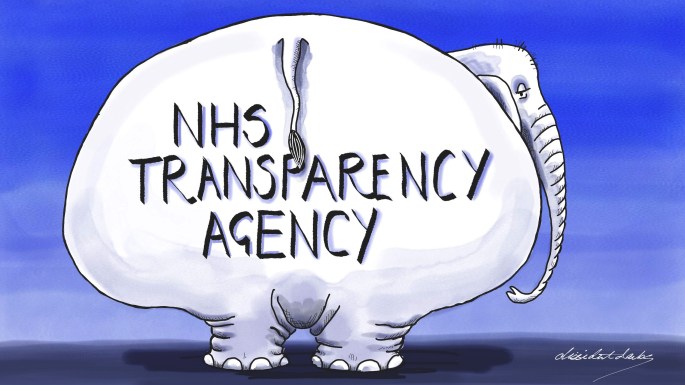
The latest white elephant is the National Freedom to Speak Up Guardian’s office for whistleblowing in the NHS. 1

This much criticised contrivance, courtesy of the Department of Health, Robert Francis and the Care Quality Commission, will do none of the things that will help whistleblowers and patients. It has no powers, won’t investigate, make binding determinations about cases or provide appeal against unfair local decisions by employers. 2

In fact, everything of importance has been left in the control of employers – the very bodies that Francis admitted were incompetent or corrupt, or both. The excuse for this being that it is undesirable to prevent employers from taking responsibility for whistleblowing governance. 3

Instead, the National Guardian will only “review” – whatever that means – and make suggestions. 4

Francis did not explain what he meant by “review” when he put forward this proposal. It would have been difficult to do so without effectively admitting that the idea was a non starter.

When the National Guardian will review cases is anyone’s guess. The office has been blighted by a resignation and delays, and has still not yet accepted any cases. 5

There has also been little appetite shown for genuinely involving whistleblowers. A recent consultation by the National Guardian’s office was only opened up to whistleblowers after protest. 6 7

From two recent meetings, by telephone on 23 January and in person on 2 February, with the latest National Guardian Dr Henrietta Hughes (HH), some issues emerge:

  • HH, who took up post at the start of October 2016, said she received no handover and could not account for why work scheduled by her predecessor Eileen Sills had not been carried out

This is at odds to CQC’s previous rush to claim that the disruption caused by Eileen Sills’ departure last March was under control, with CQC set up staff staying on longer and Robert Francis’ steady hand on the tiller. 8 But we know about the CQC’s relationship with the truth, so no biggie.

  • HH has a budget of £1m, with equal contributions from CQC, NHS England and NHS Improvement. Her team comprises two national engagement managers, a comms manager, a strategy manager, a case review manager and a senior administrator. She may recruit more staff but that is not certain yet.

(Whisteblowers have since identified HH’s case review manager as a former CQC lead inspector).

  • HH will link with an Accountability and Liaison Committee, chaired by Francis. The other two committee members are Helen Buckingham NHS Improvement Director of Corporate Affairs 9 and Moira Gibb NHS England NED 10 . The Committee has met once and meets again in March. The memorandum of understanding which governs the arrangement has been circulated but not yet signed off by the three funding bodies.
  • HH will set up a Stakeholder Advisory Group that she will chair. There are no details yet.
  • HH has little lined up in terms of outcome measures. There is heavy reliance on the national staff survey.
  • Otherwise, HH proposed to rely on data gathered by local Guardians, but without checking its quality and reliability, or in some matters, even being aware what questions the local Guardians are asking.
  • HH said she is commissioning descriptive research on the way in which trusts have established their local Guardians and their different approaches. There is nothing definite planned about evaluating effectiveness.
  • HH resisted any direct acknowledgement of gross CQC failure on whistleblowing. She meets frequently with David Behan CQC Chief Executive to report on progress. But she said that she “feels independent”.
  • HH is not seeking statutory independence and powers, and will not follow the example of Conradi, Chief Inspector of HSIB who is in the process of doing so.12
  • Neither is HH supporting substantive reform of whistleblowing law, even though everyone who knows anything about whistleblowing knows this is vital.
  • HH said that the CQC is “looking again” at how it approaches trusts’ whistleblowing governance under its Well Led domain.
  • HH would not agree that CQC should inspect compromise agreements, although Francis has already said they should and CQC have accepted, in theory, that this is part of their responsibilities.
  • HH is unlikely to call a spade a spade or to call out wrongdoers. She sticks to Francis’ lately adopted position that punishing wrongdoers will increase cover ups. She implies that frank criticism perpetuates “negative culture”, and prefers to speak of helping people to improve.

It is hard to conceive how this is an appropriate approach to serious managerial misconduct, and sometimes criminal behaviours, which are found in the worst whistleblower cases.

  • HH refuses to say yet how her office will review cases. She says it depends on the outcome of current consultation. But she says it will not involve interviewing witnesses or using any established investigative process, and will not be comprehensive.
  • HH was reluctant to admit any failure by local Guardians. She initially said that no problems had been reported. She then acknowledged receiving a third party report of concerns about a local Guardian. In fact, there are other concerns, which have been reported to her personally.
  • Nevertheless, Hughes acknowledges that there is no evidence base for the local Guardians.
  • HH does not know how much it is costing the NHS to employ these un-evidenced local Guardians.
  • Hughes maintained that the local Guardians, who are not themselves trained for their roles, will help CQC inspectors to become more competent about whistleblowing.
  • HH admitted that super-gags (clauses in compromise agreements which prevent signatories from disclosing even their existence) are “insidious” but she stopped short of agreeing that they should be banned.
  • HH said there will be work on re-drafting a best practice template on NHS compromise agreements, and that NHS Improvement is interested in this.
  • HH volunteered that it might be possible for existing compromise agreements to be changed by “mutual consent”. She was less committal about the idea of a government waiver.
  • HH agreed to publish the newsletter that her office has been circulating to local Guardians, after initially demurring that there was insufficient space on her corner of the CQC website.
  • HH agreed in principle to publish material that trusts have been sending in for sharing, once she gets her own website, possibly some time this year.

Two years on from the publication of the Freedom To Speak Up Review, it is dispiriting that we are so little further forward. Whistleblowers knew that Robert Francis’ proposals were never going to work. But the execution of even his flawed recommendations is poor and slow. We do not have a strong and expert office. We have inexpert local Guardians led by someone with a managerial focus, who avoids criticising her chief paymaster, CQC.  Henrietta Hughes is also on record expressing an unrealistic belief that change could happen if only staff were more pleasant to each other. 13

In short, all we have gained is pointless and wasteful bureaucracy.

Current whistleblowers in dire straits are presently being turned away, officiously, whilst the National Guardian’s office takes its time choosing which boxes it will tick.  There has been a lack of warmth and humanity so far in the office’s approach, and worrying attempts to claim a remit that is even narrower than Francis’ very limited prescription.

As things stand, abusive NHS bosses need not lose sleep. Ministers can assume it is business as usual.

The Department of Health was not available for interview when asked by the BBC File on Four team to comment on continuing failures of NHS whistleblowing governance. Perhaps this is the strongest admission of all that Francis’ review has failed.

But it may be useful to remind the Secretary of State about this little sting in Francis’ Freedom to Speak Up report:

“Recommendation 2 The Secretary of State for Health should review at least annually the progress made in the implementation of these Principles and Actions and the performance of the NHS in handling concerns and the treatment of those who raise them, and to report to Parliament”

We’re all ears, Minister.


These are the agreed records of the two recent meetings with Henrietta Hughes, with some related correspondence:

hh-meeting-records-23-01-2017-and-2-02-2017


RELATED ITEMS

  1. BBC File on Four broadcast, 7 February 2017, on lack of progress on NHS whistleblowing:

http://www.bbc.co.uk/programmes/b08crzrc

Transcript of the broadcast:

Click to access file-on-four-nhs-wb-transcript-07_02_17_fo4_speakingup.pdf

2. https://minhalexander.com/2016/10/10/hooray-henrietta/

3. https://minhalexander.com/2017/01/19/national-guardian-independence-the-cqc-denies-some-more/

4. See Edna’s Law for transferring the burden of litigation from whistleblowers to the State, ensuring accountability by individuals as opposed to organisations and ensuring that the focus remains on whistleblowers’ disclosures:

https://www.change.org/p/protect-the-protectors-with-edna-s-law-need-one-law-for-all-whistleblowers

REFERENCES

1 Information published by the CQC about the National Freedom to Speak Up Guardian

http://www.cqc.org.uk/content/national-guardians-office

2 CQC Position Specification for the National Freedom To Speak Up Guardian

https://minhalexander.com/wp-content/uploads/2016/10/cqc-national-guardian-specification-final-760085.pdf

3 Report by Robert Francis of the Freedom to Speak Up Review, 11 February 2015

74 I considered whether there is a case for establishing an independent body with powers to review staff concerns. I concluded that it would be wrong to take responsibility for dealing with concerns away from trusts, and would be more likely to lead to delays and additional layers of bureaucracy.”

 http://webarchive.nationalarchives.gov.uk/20150218150343/https://freedomtospeakup.org.uk/wp-content/uploads/2014/07/F2SU_web.pdf

4 Report by Robert Francis of the Freedom to Speak Up Review, 11 February 2015

7.6.12 The INO should be authorised by these bodies to use his/her discretion to:

  • review the handling of concerns raised by NHS workers where there is cause for concern in order to identify failures to follow good practice, in particular failing to address dangers to patient safety and to the integrity of the NHS, or causing injustice to staff”

http://webarchive.nationalarchives.gov.uk/20150218150343/https://freedomtospeakup.org.uk/wp-content/uploads/2014/07/F2SU_web.pdf 

5 NHS whistleblowing tsar hasn’t investigated a SINGLE case and won’t review any patient neglect claims until 2017, Andrew Gregory, Mirror 13 December 2016

http://www.mirror.co.uk/lifestyle/health/nhs-whistleblowing-tsar-hasnt-investigated-9452059

6 New Employment Scheme (but not as you know it), Minh Alexander 19 December 2016

https://minhalexander.com/2016/12/19/new-employment-scheme-but-not-as-you-know-it/

7 Good News at the National Guardian’s office? Richard von Abendorff, 23 December 2016

https://minhalexander.com/2016/12/23/good-news-culture-at-the-national-guardians-office/

8 CQC statement 4 March 2016 on Eileen Sills’ resignation:

David Behan, Chief Executive of CQC, said: “I was disappointed to receive Dame Eileen’s resignation but I respect her honesty in making this difficult decision. A new appointment process will begin immediately. The work of setting up the office of the National Guardian will continue as planned, with a focus on supporting and working with freedom to speak up guardians in NHS trusts and NHS foundation trusts.”

Sir Robert Francis QC said: “The office of the National Guardian is a vital element in the drive to change the culture of the NHS to one which welcomes and supports staff who raise concerns. Separately from my role as a CQC Board member I am happy to offer non-executive support for the Office as it continues its work until a Guardian is appointed.”

http://www.cqc.org.uk/content/cqc-statement-resignation-dame-eileen-sills-national-guardian

9 NHS Improvement information about Helen Buckingham NHS Improvement Director of Corporate Affairs

https://www.gov.uk/government/people/helen-buckingham

10 NHS England information about Moira Gibb NHS England Non Executive Director

https://www.england.nhs.uk/about/whos-who/

12 NHS has nothing to fear from new investigation body, says Chief. Health Service Journal 5 January 2017

The head of the NHS’s new patient safety watchdog has said it needs statutory independence and extra powers to demand that NHS organisations respond to its warnings.”

https://www.hsj.co.uk/topics/policy-and-regulation/nhs-has-nothing-to-fear-from-new-investigation-body-says-chief/7014490.article

13 Happiness is the best medicine, grumpy doctors and nurses told Chris Smyth, Times, 10 October 2016

Dismissing concerns that her job had few formal powers, she said that change could happen “just like that” if staff always acted as they would on a good day. “If you bring a positive attitude to work with you then you start seeing all those benefits of working well as a team,”

https://minhalexander.com/wp-content/uploads/2016/10/happiness-is-the-best-medicine-henrietta-hughes.pdf

CQC: A Chief Inspector DOESN’T call

By Dr Minh Alexander NHS whistleblower and former consultant psychiatrist, 27 January 2017

Very serious questions remain about the CQC’s protection of senior NHS managers who have been found guilty of serious misconduct and breaches of the NHS Managers’ Code of Conduct 1. For example, by suppressing and victimising whistleblowers.

Yesterday, a two week fraud trial of a former NHS CEO Paula Vasco-Knight came to a dramatic halt as she pleaded guilty. 2

A complaint was made to CQC in October 2015 about her suitability to hold senior office at St Georges, due to a past finding of whistleblower reprisal by an Employment Tribunal. 3 Mike Richards, CQC’s Chief Inspector of Hospitals personally handled the matter, but found no fault in her appointment.

Today, CQC announced that Mike Richards will be retiring in the summer. 4 5

There is recognition that the CQC’s handling of a regulation that was introduced in November 2014 – Regulation 5 Fit and Proper Persons (FPPR) 6 – has been unsatisfactory. 7

In November 2016 even Robert Francis, who had abandoned his original recommendation for criminal sanctions for whistleblower reprisal 8 and who previously eschewed managerial regulation in favour of a trial of FPPR, admitted that FPPR was not working. In consequence he called for managerial regulation 9

Paula Vasco Knight stepped down as an NHS CEO in 2014 10 four months after a critical Employment Tribunal judgment. The judgment raised questions about her reliability as a witness and concluded that her trust had victimised whistleblowers. 11 However, Vasco-Knight was later recycled by Monitor, employed by St. Georges in 2015 and then rubber stamped as “Fit and Proper” by CQC.3

Mike Richards himself wrote to St Georges on 16 February 2016 to shut down the FPPR process that had been initiated by the above referral in October 2015. 12

Regrettably, Richards did not inform me as the referrer that he had done so. I only found out through a disclosure by St. Georges on 25 April 2016.

Vasco-Knight had in the meantime been promoted by St. Georges from Chief Operating Officer to Chief Executive. 13

In May 2016 she was sacked and subject to criminal charges 3, thus exposing CQC’s poor judgment and flawed process.

Subsequently, CQC promised in May 2016 to review its FPPR practice. 7 We have yet to hear about the progress of this review. Dismally, Mike Richards noted in a recent interview that the internal CQC review was only launched in November 2016, would take ‘months’ and had no identified end date. 14

To go back to the beginning, on 17 December 2014 I took part in a teleconference with Mike Richards CQC Chief Inspector about how CQC was going to approach FPPR. At this meeting, CQC advised that it had no direct powers to remove NHS trust directors who were not Fit and Proper Persons. However, Mike Richards made it clear that CQC could bring other powers into play, to place pressure on trusts to remove unfit directors. He made it clear that he was confident that he could ensure the removal of unfit directors.

He also indicated that he would be chairing CQC’s FPPR panel, which would decide on how referrals would be handled.

Two years later, in early December 2016, Mike Richards gave an interview to the Health Service Journal in which he complained that CQC had been unfairly criticised over FPPR. 14 One wonders if he had in mind the comments by Robert Francis, his colleague and fellow CQC board member. As part of his defence against the criticism, Richards maintained that CQC could only assess trusts’ FPPR process, but could not judge the fitness of directors or remove unfit directors. Strikingly, he did not repeat the comments he made in December 2014 that he was confident that CQC could use indirect powers to force trusts to remove directors, although he acknowledged that these existed.

The Department of Health disagreed with Mike Richard’s assertion that CQC could not assess if directors were fit:

The CQC has the powers to assess whether both executive and non-executive directors are fit to carry out their role and whether providers have put in place adequate and appropriate processes to ensure this is the case.” 

The DH also considered that CQC had sufficient powers to enforce any breaches of FPPR:

“…the DH agreed with the CQC that the FPP regulations “do not give CQC the power to remove a director, but CQC could place conditions on a provider limiting what services it can deliver until such time that a breach of the fit and proper person regulation was corrected”. 14

In the case of Paula Vasco-Knight, fresh questions now arise about CQC’s FPPR process. It has become evident that an investigation into the fraud allegations against her was underway well before Mike Richards shut down the FPPR process in February 2016.16 17

This begs an important question of what CQC knew at the time that it closed the FPPR process. Did CQC know about the fraud allegations but fail to respond appropriately to them? Or if CQC did not know, why was there a failure of intelligence and information sharing between NHS bodies?

CQC’s chief officers need to investigate, clearly account and fill in the gaps as regards to CQC’s poor performance in the Vasco-Knight case, as well as others.

So far, there seems little hope of that. I made a complaint about the way that CQC and Mike Richards handled the Vasco-Knight FPPR process. The CQC’s complaint ‘investigation’ is so far a shambles.

CQC has resisted clarity about whether there are potential conflicts in the line management of its complaint investigation. I asked CQC if Rebecca Lloyd Jones CQC’s Director of Governance and Legal Services had any part in the handling of the Vasco-Knight FPPR. This was because I understood that CQC’s complaints department sat within Lloyd-Jones’ directorate and that Lloyd-Jones had assisted Mike Richards with FPPR cases. There has so far been silence from CQC on this point.

I also expressed concern that the Chairman’s office was not dealing with my complaint, given that it relates in part to a board member. Again, no response from CQC.

Bizarrely, CQC has not interviewed me as part of its investigation and refuses to show me a draft copy of its complaints investigation report. CQC in fact proposed to present me with a completed investigation report as a fait accompli and only spoke to me when I suggested this. The CQC senior complaints officer said to me (verbatim):

“I don’t see the point of sending out a draft report”

He remained immoveable when I pointed out that PHSO sets the standards for public sector complaints handling, and routinely shares draft reports with complainants as a matter of fairness. His manager has reportedly also declined my request to see and comment on the draft investigation report before CQC’s investigation concludes. Strangely though, they have indicated that I might get a copy via the Subject Access Request route. 18

In short, the CQC is a hit and run operation, which does not stop to give its details or submit to meaningful scrutiny when it has erred. It is a poor role model, and the NHS denial machine speeds on.

How does CQC’s behaviour impact on the whistleblowers who have been seriously harmed by the NHS? Clare Sardari, who won her whistleblower detriment claim against Paula Vasco-Knight and South Devon has this to say:

“Yesterday, after 4 long years, I feel totally vindicated regarding the concerns I raised about Paula Vasco Knight in 2012.  But now, questions must be answered regarding the effectiveness of the current FPPR process which the CQC have responsibility for administering.  I do not want anyone else to go through an experience like mine and believe that a thorough review needs to occur in order to ensure that those who commit these types of offences whilst in public office are not re-cycled back into the system but are properly held to account for their actions. There are many other whistleblowers who are currently in situations similar to mine, and these need to be addressed now.” 


RELATED ITEMS

Is CQC’s handling of Regulation 5 “Fit and Proper”?

The CQC Denies…


delay-deny


 REFERENCES

1 Code of Conduct for NHS Managers, Department of Health 2002

http://www.nhsemployers.org/~/media/Employers/Documents/Recruit/Code_of_conduct_for_NHS_managers_2002.pdf

2 Former NHS trust chief faces jail after she gave £20,000 of taxpayer’s money to her husband’s company, Tom Payne Daily Mail 26 January 2017

http://www.dailymail.co.uk/news/article-4162558/Former-NHS-trust-chief-faces-jail.html

3 CQC’s Fit and Proper Parade, Minh Alexander 29 July 2016

https://minhalexander.com/2016/09/24/cqcs-fit-and-proper-parade/

4 Sir Mike Richards announced retirement, Rebecca Thomas Health Service Journal 27 January 2017

https://www.hsj.co.uk/topics/policy-and-regulation/sir-mike-richards-announces-retirement/7015171.article

5 CQC press release 27 January 2017

http://www.cqc.org.uk/content/professor-sir-mike-richards-announces-retirement

6 CQC published guidance on Regulation 5 Fit and Proper Persons November 2014

http://www.cqc.org.uk/sites/default/files/20141120_doc_fppf_final_nhs_provider_guidance_v1-0.pdf

7 CQC to review whether fit and proper person rule ‘needs to change’, Will Hazel, Health Service Journal, 24 may 2016

https://www.hsj.co.uk/topics/policy-and-regulation/cqc-to-review-whether-fit-and-proper-person-rule-needs-to-change/7005046.article

8 Sir Robert’s Flip Flops, Minh Alexander 26 September 2016

https://minhalexander.com/2016/09/26/sir-roberts-flip-flops/

9 Robert Francis calls for regulation of senior managers, Shaun Lintern Health Service Journal, 9 November 2016

https://www.hsj.co.uk/topics/workforce/exclusive-robert-francis-calls-for-regulation-of-senior-managers/7013089.article

10 Devon Health Boss Dr Paula Vasco-Knight resigns, BBC 30 May 2014

http://www.bbc.co.uk/news/uk-england-devon-27636112

11 Employment Tribunal judgment Sardari and Gates v South Devon Healthcare NHS Foundation Trust and Torbay and Southern Devon Health & Care NHS Trust

https://www.dropbox.com/home?preview=Vasco-Knight+Tribunal+judgment+003-1.pdf

12 FPPR closure letter by Mike Richards to St. Georges 16 February 2016

https://minhalexander.com/wp-content/uploads/2016/11/cqc-fppr-closure-letter-vasco_knight-re-pvk-16-02-16.pdf

13 Chief of scandal hit teaching hospital steps down, Crispin Dowler, Shaun Lintern Health Service Journal 22 April 2016

https://www.hsj.co.uk/sectors/acute-care/chief-of-scandal-hit-teaching-hospital-steps-down/7004243.article

In Mr Scott’s place, Paula Vasco-Knight has been appointed acting chief executive at the beleaguered trust. Ms Vasco-Knight, who has been working as interim chief operating officer at St George’s, last held a chief executive role at South Devon Healthcare FT. She resigned from that role in 2014 after being accused of nepotism in the employment tribunal of two whistleblowers”

14 CQC cannot force removal of unfit trust directors. Sharon Brennan Health Service Journal

https://www.hsj.co.uk/topics/policy-and-regulation/richards-cqc-cannot-force-removal-of-unfit-trust-directors/7013700.article

16 Former trust chief faces jail after pleading guilty to fraud. Ben Clover Health Service Journal 26 January 2017

“In November 2013, Mr Vasco-Knight submitted an invoice to the NHS for £11,072, from the bursary funds, to produce a 200 page leadership improvement document Transform.

Ms Vasco-Knight then authorised the trust to pay her husband’s company.

Prosecutor Gareth Evans said Ms Vasco-Knight was legally bound to declare her interest in her husband’s company as part of the NHS’s standing financial instructions, but failed to do so.

Mr Evans said the document was never submitted to the NHS, with the couple showing investigators a “complete sham” as evidence in 2014.”

17 Shock guilty plea in Torbay hospital boss Vasco-Knight fraud trial, Herald Express, 26 January 2017

http://www.torquayheraldexpress.co.uk/shock-guilty-plea-in-torbay-hospital-boss-vasco-knight-fraud-trial/story-30089251-detail/story.html

“The trial heard prosecution evidence that the work he was paid to do – known as the Transform document – was not completed. In 2015 the couple gave investigators a document which they allegedly claimed was the finished work.

But the prosecution said it was a ‘sham’, containing other people’s work cut and pasted from the internet, empty pages, and was only produced after investigation started.”

18 Correspondence about CQC’s handling of a complaint about its handling of the Vasco-Knight FPPR.

https://minhalexander.com/wp-content/uploads/2016/09/cqc-pvk-fppr-complaint-correspondence.pdf


Call for Just Culture Taskforce core members to step down

As part of the establishment of the Healthcare Safety Investigation Branch, there was a proposal by the related Expert Advisory Group that there should be a national Taskforce on Just Culture:

Click to access hsibreport.pdf

It has become evident since the weekend that Jeremy Hunt has launched the Just Culture Taskforce by asking a small inner circle to kick off the process. The group say they will bring different thinking to transform NHS safety culture.

just-culture-twitter-profile

However, there has been no public consultation – or evidence of other due process – regarding the establishment of the Taskforce. I have called on the core group members of the Taskforce to support Just Culture by stepping down, and asking the Department of Health to start again from scratch, with proper public consultation.

The open letter calling for this was sent today and is provided below.

Dr Minh Alexander

NHS whistleblower and former consultant psychiatrist

LETTER

BY EMAIL via NHS Litigation Authority

Open letter to Martin Bromiley and other members of the Taskforce core group  24 January 2017

Dear Martin,

NHS Just Culture Taskforce

 I write as a member and a critical friend of the Just Culture Taskforce ‘movement’, having applied to join and having been accepted by Suzette Woodward of NHSLA.

I am writing to respond to your tweeted open letter. 1

It is very welcome that you now acknowledge there have been errors regarding the lack of diversity of the Taskforce. Indeed, your work on learning from errors and Human Factors is widely valued.

As the Just Culture Taskforce is a government instigated and publicly financed project, it is appropriate to re-visit Lord Keith’s comments on the importance of people being allowed to criticise the government:

“It is of the highest public importance that a democratically elected government body, or indeed any government body, should be open to uninhibited public criticism” 2

Many were mystified when the Just Culture Taskforce launched last weekend, with a twitter account and unofficial looking WordPress website. 3 The website gave very little information about the origins and nature of the project. The website stated that the Taskforce was ‘not an organisation’ but a ‘movement’. This was repeated in tweets and correspondence by Suzette Woodward. 4

After I asked questions by twitter and email 5 about the context of this initiative, you advised that:

  • The Department of Health was financing the Taskforce. This was also confirmed by Suzette Woodward, who added that the governance of the Taskforce lies with the DH 6, and that the DH would “support” the movement.4
  • You advised me that you and James Titcombe had been asked to initiate the process. You later added that you had been approached by a DH Deputy Director. Suzette Woodward added that the invitation in fact also came from Jeremy Hunt.

I asked you for the name of the DH contact. 7 I received no reply but I now gather that the two DH senior officials are members of the core group: Tim Jones Head of Patient Safety and Service Quality (formerly the DH Head of News) 8  and Paul Stonebrook DH Senior Policy Adviser. 9

As you may be aware, I have since formally asked the DH for information about terms of reference, how the Just Culture Taskforce was established, whether it is subject to DH Equality and Diversity policy, any identified outcome measures and arrangements for future transparency, as regards whether the proceedings of the Taskforce will be subject to Freedom of Information provisions. It would have been better of course if it had not been necessary to resort to FOI, or to have to do so again in future.

To my surprise, the Just Culture TaskForce’s website was subsequently arbitrarily edited, with substantial deletions. This is despite the fact that it is customary for official records to be transparent, and added to, not removed. Membership details of the core group have now been removed. To my great concern, I see that even the original NHSLA contact email address and contact portal have been removed.

Regarding your comment “..in deliberately sharing information at an early stage before the process had been better developed I created some confusion and suspicion”1, I do not think it was sharing of information that caused concern. It was that a group of individuals had been assembled to take this project forward without any evidence of due process, and without any public consultation. It was clear that important decisions had already been made about this project – such as adoption of a reportedly unconventional leadership model – without the involvement of all concerned. There was in fact a lack of information about many things. When I later requested information as a member of the ‘movement’10, I was told that it could not yet be provided. 11

I have flagged to you that I think the way in which the Taskforce was established so far is an example of club culture, even if the club lacks insight into this. You thanked me for doing so politely, but you disagreed.

In your open letter, you characterise the many objections raised so far about the Taskforce as “fear and mistrust”. 1 Rather,  I think it would be fairest to see them as evidence based arguments against the manner in which this project has been handled.

In all, I think the project has been poorly handled by the Department of Health. There is no evidence of staffside or whistleblower involvement from the outset. This is an extraordinary omission at a time when there are serious morale issues in the NHS. From the staff survey, we know that almost half of NHS staff do not feel confident that concerns would be properly addressed by their organisation. 12  Any effective project on Just Culture must involve staff and those with lived experience of suppression from the outset.

I am sure you entered into this project in good faith. I hope you can see now why the handling of this project has been inimical to Just Culture.

Whilst you, Suzette Woodward and the Taskforce website originally indicated that there would be a different leadership model, what is now clear is that there is a “core group” which has power, and is distinct to a “wider taskforce” (Suzette Woodward’s phrase) which anyone can join. 13 It does not matter that, as Suzette Woodward has maintained, you are not employees. 4 As members of the core group, you are all in a privileged position of influence and greater access to information about a nationally important project.

Accordingly, I call on all members of the current Taskforce core group to support Just Culture by stepping down and asking the DH to start again from scratch.

What is needed first is a process of totally open public consultation on what a Just Culture Taskforce should look like, how it should be established and how it should be governed. This is a highly sensitive, publicly funded government project, with ongoing contribution by senior DH officials. Thus, there needs to be clarity, real inclusiveness, fairness, structure and formality as to how its business is done.

With best wishes,

Minh

Dr Minh Alexander

cc Jeremy Hunt

Keith Conradi Chief Investigator Healthcare Safety Investigation Branch

All other members of the Just Culture Taskforce core group

AvMA

INQUEST

Katherine Murphy CEO Patients Association

RELATED ITEMS

https://minhalexander.com/2016/09/24/hot-air-about-just-culture/

https://www.opendemocracy.net/ournhs/minh-alexander/is-there-club-culture-at-heart-of-nhss-quality-regulator

REFERENCES

1 Open letter tweeted by Martin Bromiley 24 January 2017

martin-bromiley-open-letter-24-january-2017

2 Derbyshire County Council v. Times Newspaper Ltd. [1992] 1 Q.B. 770 at 809 and the leading opinion in the House of Lords in the same case, at [1993] A.C.534, Lord Keith of Kinkel at page 547E

3 Just Culture Taskforce twitter account: @JustcultureTF

Just Culture taskforce WordPress website: https://justculturetaskforce.com/

4 Tweeted copy of an email from Suzette Woodward, NHS Litigation Authority 22 January 2017:

tweeted-copy-of-email-by-suzette-woodward

Similar email from Suzette Woodward, NHS Litigation Authority 22 January 2017:

“Dear Dr Alexander

Thank you for your email.  I have just sent you an email answering your questions.  I have repeated them below:

The task force is not an organisation – it is a movement.  The task force is everyone working in the NHS – there is a small group of people who were invited by the Secretary of State and Department of Health to steer the work.

The Department of Health will support the movement 

The core group were invited to steer the work by the Secretary of State but as I say are not the task force and are not an organisation or employees. 

The aims are to conduct a listening exercise over the next year and then share what we have learnt in Spring 2018.

The core group will through the listening exercise meet and talk to every group including  NHS staff whistle-blowers – who if they join the movement will be part of the whole task force.

The Just Culture taskforce came about because of a public document by the Expert Advisory Group who recommended this to the Department of Health

To assure the patient groups and others on this email list – we will be engaging with you all in this process – it is very early days and we will inform you as we progress.

Kind regards

Suzette

Dr Suzette Woodward

National Campaign Director

Sign up to Safety”

5 Email to all members of the Just Culture Taskforce 22 January 2017

“To all members of the Just Culture Task force for the NHS in England 22 January 2017

 Dear All,

Can I ask how this task force is financed, whether its accounts will be published and which NHS body is overseeing or has stewardship of this project?

Could you also let me know how the members of the taskforce were appointed, and by whom, and what the selection criteria were?

Do you have terms of reference and any timetable for your work? If so, could these be shared?

Also, I don’t see (to my knowledge) that there are any NHS staff whistleblowers in this group. This seems an extremely serious omission. Please could you explain why this is so, and if you agree that it was an omission, whether you will now put that right? If so, how?

I have to say that a Just Culture taskforce that is assembled without public consultation is something of a contradiction in terms.

Yours sincerely,

Dr Minh Alexander 

cc Katherine Murphy CEO Patients Association

    AvMA

    INQUEST”


6 Tweet 22 January 2017 by Suzette Woodward NHS Litigation Authority

suzette-woodward-dh-governance

7 Tweeted question about the name of the Department of Health contact:

q-about-dh-contact

8 Tim Jones

http://www.prweek.com/article/1175503/department-health-defends-london-pr-spend

https://www.linkedin.com/in/tim-jones-987a1b134

9 Paul Stonebrook

https://www.linkedin.com/in/paul-stonebrook-bb1ab9104

10 Email 22 January 2017 to Suzette Woodward NHS Litigation Authority

“To Suzette Woodward, National Campaign Director, Sign Up to Safety 22 January 2017

Hi Suzette,

Thanks for your email – or the screenshot of your email (below). I’m not sure what happened as I gather some cc’d people received a copy of your reply, but my copy never arrived.

Notwithstanding, I gather from your tweets that anyone can join your movement.

I’d like to join your movement, thank you.

What happens now and who’s making the decisions about how I can contribute?

Who’s doing the organising/ admin, that I can link with?

Best wishes,

Minh

cc All other Task force members

    AvMA

    INQUEST

    Katherine Murphy CEO Patients Association”

11 Email 22 January 2017 from Suzette Woodward NHS Litigation Authority

“Dear Minh

Thank you.  That’s great.

We are building up the list of interested people and would be really keen to involve you.

At the moment because we have literally just started we are still working through the details as I think you have probably seen on twitter today 

We will be in touch soon.

Kind regards

Suzette

Dr Suzette Woodward

National Campaign Director, Sign up to Safety

Twitter: @suzettewoodward”

12 Annual NHS staff survey 2015

“Fifty six percent of staff had confidence that their organisation would address their concerns if they were raised.”

http://www.nhsstaffsurveys.com/Caches/Files/20160322_NHS%20Staff%20Survey%202015%20National%20Briefing_V2.pdf

13 Tweets on 22 January 2017 by Suzette Woodward, NHS Litigation Authority

suzette-woodward-wider-taskforce

suzette-woodward-tweets

Ticket to ride

By Dr Minh Alexander NHS whistleblower and former consultant psychiatrist 19 January 2017


Alyson O’Connell is an NHS whistleblower, nurse and cancer patient with experience to offer.

She also needs just £26 to pay for a coach ticket from Wales to London.

She is attending the National Freedom to Speak Up Guardian’s consultation event on Friday 20th January, to contribute to discussions on how an advisory group should be established.

She is paying out of her own pocket to make this long journey by coach, in mid winter.

That’s commitment.

O’Connell was initially told by the National Guardian’s office that the event was only about the English NHS, and she was deterred from taking part.

She pointed out that Robert Francis had accepted her evidence for the Freedom To Speak Up Review, that NHS England had recently involved her in the development of its whistleblower employment support scheme, and that her contribution would be relevant.

A place was then offered…but she was told she would have to pay her own travel expenses.

She asked the National Guardian’s office to reconsider, and advised that she needed the princely sum of £26 to cover her coach fare, but the National Guardian’s office has not so far acquiesced.

This is the email correspondence:  emails

O’Connell was dismissed by the NHS seven years ago after whistleblowing about patient safety risks:

http://www.walesonline.co.uk/news/wales-news/nhs-whistleblower-urges-concerned-staff-1908602

She survived for a while on agency work, but says her former employer refused to let her work shifts for them.

She has been unemployed for five years whilst battling pancreatic cancer.

There have been periods of severe financial hardship, and she and her husband still live with uncertainty about whether they can meet their mortgage payments.

O’Connell says that unlike the National Guardian office, NHS England was more generous when she contributed to the development of its employment support scheme:

“NHS England booked and paid for all my rail travel and overnight accommodation with breakfast included. All I had to do was collect the rail tickets.”

 So, is it wise of the National Guardian’s office to insist that ‘rules is rules’?

Many whistleblowers cannot make the National Guardian’s event due to the short notice given. The National Guardian’s travel expense budget is unlikely to be creaking.

£26 is not even a hiccup in the CQC’s £200m plus budget.

£26 for a long distance coach journey is not luxury.

In contrast, CQC officers are used to commodious conditions and they are not strangers to nice hotels on the public tab. [1] [2] [3] [4]

screen-shot-2017-01-19-at-21-12-54

Will the great public service that O’Connell performed in speaking up, at immense personal cost, be at least recognised by the very small token of reimbursing her tiny coach fare?

It’s not the money – although it’s an expense that O’Connell doesn’t need – it’s about respect and valuing people.


UPDATE 21 JANUARY 2017

Alyson O’Connell spent over eight hours travelling from Wales to contribute to Henrietta Hughes’ consultation event on 20th January, which was a scant two hour slot.

Seven of those hours travelling were spent on a coach. Not comfortable for anyone, but worse for someone in fragile health.

She reports that Henrietta Hughes has decided not to contribute a token of £26 for the coach fare.

“She said that she wished that the NGO could pay my expenses but as Wales not included it wasn’t possible and was very apologetic.”

It is a great pity that the National Guardian is not showing more flexibility. Her role is complex and requires a great deal of insight, skill and judgment.

It is unlikely to work if it does not include some wisdom about when “rules is NOT rules”.


REFERENCES

[1] NHS watchdog staff put up in luxury hotels, stately homes and country houses. Laura Donnelly Telegraph 16 November 2015

http://www.telegraph.co.uk/news/health/news/11999102/NHS-watchdog-staff-put-up-in-luxury-hotels-stately-homes-and-country-houses.html

[2] NHS watchdog’s £81K hotel bill for a single inspection: Freedom law reveals officials’ extravagance. Sophie Borland 16 November 2015

http://www.dailymail.co.uk/health/article-3320939/Health-watchdog-blew-8-7-million-luxury-hotels-dinners-travel-expenses-hospital-care-home-inspectors-year.html

[3] CQC health watchdog racked up £123,000 hotel bill whilst inspecting NHS organisations in Suffolk, Essex and Norfolk. Andrew Hirst. East Anglian Daily Times, 8 February 2016.

http://www.eadt.co.uk/news/cqc_health_watchdog_racked_up_123_000_hotel_bill_while_inspecting_nhs_organisations_in_suffolk_essex_and_norfolk_1_4409417

[4] NHS watchdog spent over £5 million on hotels and accommodation last year. Keir Mudie. Mirror 7 May 2016

http://www.mirror.co.uk/news/uk-news/nhs-watchdog-spent-over-5million-7920207

National Guardian independence: the CQC denies some more….

By Dr Minh Alexander, NHS whistleblower and former consultant psychiatrist 19 January 2017


Governments have a habit of establishing satellite bodies that they pretend are independent, for public relations purposes, and for deniability and outsourcing of accountability for controversial decisions.

The fragmentation of the NHS in recent years often allows the government to claim that it has no operational responsibility or cannot answer questions because it holds no information.

CQC the health watchdog has been criticised as a government device for denial. The latest criticism comes from the Centre for Welfare Reform, whose Director commented:

“The illusion that it [CQC] is performing a useful function is critical to Government policy. As severe cuts and rising cost savage an already inadequate social care system, it may be that the Government will not want to address these problems. For the CQC adds a patina of respectability to its failed policies”

http://www.centreforwelfarereform.org/news/why-cqc-failre-correctly/00316.html

A similar masquerade seems to be unfolding with regard to the National Freedom to Speak Up Guardian’s office. Its independence has been much questioned because the Department of Health located the office within CQC. CQC, along with NHS England and NHS Improvement also fund the office.

The accountability arrangements for the National Guardian are not entirely clear, yet there has been repeated insistence by Robert Francis, the Department of Health and CQC that the office is operationally independent.

However, CQC has also repeatedly made comments which indicate that it will have some oversight of the National Guardian’s office. A CQC Board paper stated:

“The Commission consists of the Board (including committees), Chief Executive and employees. Whatever the manner of appointment, the Board will require some oversight of the National Guardian role, given its own accountability for CQC to Ministers and Parliament.  

There needs to be a formal arrangement with Monitor, TDA and NHSE that governs their responsibilities in terms of funding, and expectations in terms of input into the delivery of the role.” 1

A CQC consultation document stated:

We propose that the relationship between the National Guardian and appointing arm’s length bodies (Monitor, TDA and NHS England) would be governed through memorandums of understanding (MoU), an annual steering group, and an annual report from the National Guardian presented to each arm’s length body’s Board” 

They remain accountable to the Chief Executive of CQC for the overall delivery of their role and functions, just like the Chief Inspectors.2

In May 2016, CQC’s response to the consultation about the National Guardian’s office stated:

The National Guardian’s Office will be hosted by the CQC, reporting to the CQC’s Chief Executive as its Accounting Officer.” 3

 (This report was issued as if the decisions therein came from the National Guardian’s office, but the office was in fact vacant at this point and being steered by Robert Francis CQC NED).

Moreover, the latest National Guardian has also just issued a report, about her first 100 days in office, which stated:

“The National Guardian meets with the main sponsor boards once a year; more frequent meetings with Sir David Behan as the lead Accountability Officer (AO) for the National Guardian’s Office. The National Guardian provides an annual report to the Board of each of the sponsor boards.” 4

Curiously, at a CQC Board meeting on 18 January 2017, David Behan CQC’s Chief Executive cheerfully denied any oversight at all of the National Guardian’s activities, save for accounting for how the National Guardian’s budget is spent, in his role as Accounting Officer.

Accounting Officers of course do not simply scrutinise the use of funds, but must link this to performance measures, to make judgments about value for money.5

Behan also contradicted past CQC statements by stating that his relationship with the National Guardian would NOT be the same as his relationship with CQC Chief Inspectors.

For those who are not aware, Behan was also the appointing officer both for the first National Guardian Eileen Sills, and her replacement, Henrietta Hughes. The CQC has also stated that the appointment will be reviewed periodically, possibly every three years.

The National Guardian appointment will be reviewed periodically (eg every three years).” 2  

It would be unrealistic to pretend that this could not be a potential compromise to the office’s independence, if this review is conducted by the DH or its allegedly arms lengths bodies.

The transcript of the relevant comments by Behan at yesterdays Board meeting is given below.

It would be a rum do if the National Guardian, who is responsible for leading improvement in culture, is not truly accountable to anyone.

Notwithstanding the additional muddle caused by Behan’s denial, there is perhaps an argument that the National Guardian should answer only to parliament.

The National Guardian’s recent report states that she will provide “updates to the Health Select Committee” but no details are given about how this will be achieved and whether hearings will be held. 4

There have been calls for her to seek statutory independence, as Keith Conradi, HSIB Chief Investigator has done. 6 Whether she does so will surely be a test of her mettle.


TRANSCRIPT OF A DISCUSSION ABOUT THE INDEPENDENCE OF THE NATIONAL FREEDOM TO SPEAK UP GUARDIAN AT CQC BOARD 18 DECEMBER 2017

Member of the public at 26.18: “Is there any clarification around the 20th ….it seems there’s a group of whistleblowers only being allowed to go in the afternoon, but the meeting is in the morning, so not really quite clear how that’s working. Does anybody have any ideas?”

David Behan at 26.43: “That’s not something that this Board is overseeing. The National Guardian…..”

Member of the public: “I thought she was reporting to you though?”

David Behan:No, she has an operational independence. I need to account for the money. We host the function but Henrietta has the role and she discharges that function on behalf of CQC and NHSI and NHS England.”

Member of the public: “But doesn’t she report back to you?”

David Behan: “No. She doesn’t report to me, no. She’s not accountable to me.”

Member of the Public: “Who’s she accountable to then?”

David Behan:It’s a role which is established… I occupy the role of Accounting Officer so that if the Public Accounts Committee wants to know what the money is being spent on, they would expect me to explain what she’s doing and what the money is. But in the same way that I’m the Accounting Officer for this organisation but I am managerially accountable for Mike, Andrea, Steve etc…I do not enjoy, or she does not enjoy that relationship as Mike, Andrea and Steve will tell you…”

David Behan: “So it’s completely independent of the…you ask Henrietta – it’s a completely independent office of the National Guardian”


THE FOOTAGE OF THE CQC BOARD MEETING ON 18 JANUARY 2017 CAN BE VIEWED HERE:

http://www.cqc.org.uk/content/care-quality-commission-board-meeting-18-january-2017


RELATED ITEMS

https://minhalexander.com/2017/01/17/smile-shine-sag/

https://minhalexander.com/2016/10/10/hooray-henrietta/

https://minhalexander.com/2016/09/24/no-one-believes-jeremy-hunt-on-patient-safety-or-whistleblowers-not-even-his-own-appointees-unmasking-the-faux-national-guardian-office/


REFERENCES

1 CQC Public Board Paper 29 July 2015, by Charles Rendell / Sarah Bickerstaffe, Sponsor: Eileen Milner, CQC Executive Director of Customer & Corporate Services

http://webarchive.nationalarchives.gov.uk/20160420154801/http://www.cqc.org.uk/content/care-quality-commission-board-meeting-29-july-2015

2 A National Guardian for the NHS – have your say. CQC consultation document September 2015

https://www.cqc.org.uk/sites/default/files/20150916_national_guardian_consultation_final.pdf

3 The National Guardian for the NHS – Improvement through openness. CQC May 2016

https://www.cqc.org.uk/sites/default/files/20160526_consultation_response_document_v8_for_publication_01.pdf

4 Dr Henrietta Hughes. First 100 Days Report. 12 January 2017

https://minhalexander.com/wp-content/uploads/2016/09/dr-henrietta-hughes-first-100-days-report-final.pdf

5 Accountability to Parliament for taxpayers’ money. National Audit Office, February 2016

https://www.nao.org.uk/wp-content/uploads/2016/02/Accountability-for-Taxpayers-money-summary.pdf

6 NHS has nothing to fear from new investigation body says chief. Shaun Lintern HSJ 5 January 2017

“The head of the NHS’s new patient safety watchdog has said it needs statutory independence and extra powers to demand that NHS organisations respond to its warnings.”

https://www.hsj.co.uk/topics/policy-and-regulation/nhs-has-nothing-to-fear-from-new-investigation-body-says-chief/7014490.article


SMILE, SHINE & SAG

Dr Minh Alexander, NHS whistleblower and former consultant psychiatrist 17 January 2017


The saga of Robert Francis’ much derided National Guardian for NHS whistleblowing rumbles on.

After rowing back on an important consultation that initially excluded most whistleblowers, the National Guardian has now provided a segregated consultation process with most of the whistleblowers physically corralled in a different session.

I have made a written submission and raised questions as copied below, which I will be sending to the Great and the Good who are sheltering in the safe harbour of the other, largely whistleblower-free session.

Additional background information about the National Guardian’ office can be found here:

https://minhalexander.com/2016/10/10/hooray-henrietta/

https://minhalexander.com/2016/10/04/clubadoodle-doo/


CORRESPONDENCE AND SUBMISSION TO NATIONAL FREEDOM TO SPEAK UP GUARDIAN:


Dr Henrietta Hughes

National Freedom to Speak Up Review

Care Quality Commission

17 January 2017


Dear Dr Hughes,

Establishment of a ‘stakeholder advisory group’ (SAG)

I write to apologise that I may not be able to attend your consultation event on 20th  January about establishment of a ‘stakeholder advisory group’. My husband was admitted to hospital as an emergency and is still not well enough for me to travel to London.  Things may not have improved sufficiently by the 20th. Therefore, I write instead to make an initial written submission to the consultation – copied below. Depending on further information received and whether you give access by agreeing to stream the whole event, I may make an additional submission.

Yours sincerely,

Dr Minh Alexander

cc Sir Robert Francis

Katherine Murphy CEO Patients Association


SUBMISSION

Introduction

In February 2015 Sir Robert Francis proposed that the National Guardian should ‘review’ whistleblower cases against good practice principles and make recommendations, but should not investigate the cases, make determinations or provide an appeal against employers’ actions. 1 It is exceedingly difficult to understand what this means or to envisage how it will work. Nevertheless, it has been accepted by the Department of Health and the CQC, and you confirmed these arrangements in an interview with the Health Service Journal.2

The Health Service Journal also reported that you said a ‘stakeholder advisory group’ would be established, which would include whistleblowers, and that this group would decide the cases that you would ‘review’.2a

A communication from your office subsequently indicated that your current consultation is intended to “identify the key roles and responsibilities of the stakeholder advisory group and potential membership”. 3

The materials you have issued for the event on 20 January now say that you propose:

“Co-production group to provide advice and guidance on establishing selection criteria [of cases to be reviewed]”

and that

“NGO selects cases to review on the basis of suggested criteria” 4 


Definition of ‘review’

I think this is a pivotal matter. In order for your consultation to be meaningful, it should be clear how you propose to ‘review’ cases, and how this will differ from investigation.

What will be your ‘review’ methodology?

What sources of evidence will you draw upon when ‘reviewing’ cases?

How will you deal with disputed facts?

For example, if a whistleblower provides evidence of poor practice, but an employer denies this, how will you deal with this and what finding or recommendation will you make, if any?

If you do not investigate and test evidence, how will you be able to make valid, effective recommendations that address root causes?

As per my email to you of 15th January, I would be grateful to know what substance there is to a written report by David Drew that a way “around” your lack of investigatory powers has been found. 5 If correct, there should be transparency about this so that all whistleblowers who need your help can potentially benefit.

It would also be useful if there is clarity on whether your office is now in fact taking referrals, based on David Drew’s report that he and you are liaising about a current case.

There are other whistleblowers with current cases who would like to seek your help.


Criteria for cases to be reviewed by the National Guardian

I think the National Guardian should review:

  • All whistleblower cases referred by local Guardians because they have not been able to resolve them locally with employers.
  • All cases of self referrals by whistleblowers who have been unable to resolve issues with their local Guardian.

If the National Guardian’s office does not have the resources to do this, it should seek more resources.


Establishment of the Stakeholder Advisory Group (SAG)

I suggest:

  1. At least half of the members of the SAG should be whistleblowers who have been clearly established as having made public interest disclosures in good faith, either by Employment Tribunal, independent investigation or some other equivalent.
  1. The Chair of SAG should be a whistleblower.
  1. Members of SAG who are not whistleblowers should nevertheless have clear credentials and expertise in whistleblowing, and should be independent of the NHS. Representatives of bodies which receive funding or have contracts with the DH or other NHS organisations should not sit on SAG.
  1. SAG should have good access to data, sufficient for it to function effectively and not just be a rubber stamp for the National Guardian’s office. The datasets to which SAG has access should be clearly defined and agreed in advance with all stakeholders.
  1. For example, SAG should have access to all analysed data held by the National Guardian on the numbers of whistleblowing disclosures, nature of whistleblowing disclosures, action taken in response to disclosures and originating organisations. The National Guardian’s office should ensure that such data is actively tracked and regularly updated, and that SAG has access to information that is up to date and relevant.
  1. SAG should have access to analysed data on intelligence supplied to the National Guardian by local Guardians about the degree to which local employers are following good practice, activity data by local Guardians, and the numbers and nature of referrals that local Guardians are making to the National Guardian because of failures by local employers. The National Guardian should also collate and share information with SAG about whether local Guardians themselves are being well treated.
  1. SAG should have access to financial data about the National Guardian’s office, how resource is allocated within the National Guardian’s budget and any details of unmet need arising from budget constraints.
  1. SAG should have access to ‘user’ satisfaction data, about how all whistleblowers who approach the National Guardian’s office experience their contact with the office. This information should be produced by the National Guardian at least annually and shared with SAG.
  1. SAG should have access to audit data on whether the National Guardian is meeting performance standards and adhering to its operational policies.
  1. SAG should have access to Equality and Diversity performance data relating to the National Guardian’s office. This is especially important given the established, disproportionate detriment experienced by BME whistleblowers. Replication of bias and discrimination is a risk given that Robert Francis has advised that the office should have ‘wide discretion’, which could have the unintended consequence of  inconsistency and arbitrariness:

The office should be more nimble and less bound by legalistic process than a statutory body, with wide discretion to decide whether it is appropriate to get involved in a particular case.”1

  1. SAG should be able to act upon appeals from individual whistleblowers and to challenge the National Guardian’s decisions with respect to individual cases.
  1. SAG should be able to review information on the rate and pattern of acceptance cases for review by the National Guardian, and to give an opinion on whether the National Guardian is making valid and fair decisions.
  1. SAG should meet frequently enough to be effective. In the first year, SAG should meet at least every two months.
  1. There should be an operational protocol on how SAG functions and interacts with the National Guardian’s office, and this should be devised with whistleblower involvement and it should be published.
  1. All SAG meeting records and papers should be published, save for any identifying, confidential information about individual cases.
  1. SAG should report periodically on its work, no less than annually.
  1. As part of its regular reporting, SAG should include feedback from SAG members about how well they believe the model is working and what improvements may be needed.


REFERENCES

1 Report of the Freedom to Speak Up Review by Robert Francis, February 2015

I want to emphasise that I am not proposing an office to take over the investigation of concerns.” 

“It is not my intention that the INO should have binding powers. I do not see this role as strictly comparable to that of an Ombudsman.”

“It [National Guardian’s office] is not, however, a means of appeal for the results of an investigation that an individual disagrees with.”

http://webarchive.nationalarchives.gov.uk/20150218150343/https://freedomtospeakup.org.uk/wp-content/uploads/2014/07/F2SU_web.pdf

2 Whistleblower guardian will not be an ‘investigation body’. Will Hazel Health Service Journal, 12 October 2016

https://www.hsj.co.uk/topics/workforce/whistleblower-guardian-will-not-be-an-investigation-body/7011388.article

2a She said the cases the office would look at would be decided by a “stakeholder advisory group”, which would include people with experience of whistleblowing.”

3 New Employment Scheme (but not as you know it). Minh Alexander, 19 December 2016

https://minhalexander.com/2016/12/19/new-employment-scheme-but-not-as-you-know-it/

4 Paper on case reviews, issued to whistleblowers by National Guardian’s office 13 January 2017

https://minhalexander.com/wp-content/uploads/2016/09/20170113-paper-2-case-review-slides.pptx

5 Email 15 January 2017 to Henrietta Hughes National Freedom to Speak Up Guardian

BY EMAIL

Dr Henrietta Hughes

National Freedom to Speak Up Guardian

Care Quality Commission

15 January 2017


Dear Dr Hughes,

Possible investigation of cases by the National Guardian’s office

Yesterday I received written indication from David Drew, whom you have invited to the morning session of your consultation event on 20 January, that you may be effectively investigating whistleblower cases now. He reported:

“We have got around the inability for NG [National Guardian] to investigate and are pleased with the NG response in line with Principle 15 so far.” [1]

If this is correct, is it possible to share how your lack of investigatory powers has been circumvented, so that other whistleblowers may also potentially benefit from this?

Many thanks,

Dr Minh Alexander

cc Sir Robert Francis


[1] Principle 15 of Freedom to Speak Up Review, 11 February 2015

“Principle 15 – External review

There should be an Independent National Officer resourced jointly by national systems regulators and oversight bodies and authorised by them to carry out the functions described in this report, namely:

  • review the handling of concerns raised by NHS workers, and/or the treatment of the person or people who spoke up where there is cause for believing that this has not been in accordance with good practice
  • advise NHS organisations to take appropriate action where they have failed to follow good practice, or advise the relevant systems regulator to make a direction to that effect
  • act as a support for Freedom to Speak Up Guardians
  • provide national leadership on issues relating to raising concerns by NHS workers
  • offer guidance on good practice about handling concerns
  • publish reports on the activities of this office.”


Lights! Camera! Inaction?


Request for streaming of an important National Guardian consultation on 20 January

The current National Freedom To Speak Up Guardian made plans to hold an important consultation event on 20 January without advertising it or inviting the majority of whistleblowers.

https://minhalexander.com/2016/12/19/new-employment-scheme-but-not-as-you-know-it/

Whistleblowers asked for the event to be live streamed.

This is what has happened so far:


DATE


5 January 2016 National Guardian asked to live stream her consultation event 20 Jan, so that whistleblowers could follow proceedings
10 January 2016 National Guardian reminded of the request for live streaming
11 January 2016 National Guardian’s office said that streaming would not be possible on 20 January but was a good idea in principle, and future events could be streamed

The National Guardian also agreed to hold a second session on 20 January for whistleblowers who had not previously been invited.

11 January 2016 National Guardian asked if whistleblowers could arrange their own streaming and filming at 20 January event
12 January 2016 National Guardian reminded of whistleblowers’ request to arrange streaming and filming themselves
13 January 2016 National Guardian’s office advises that whistleblowers can film the National Guardian’s presentation, but would only be able to film other delegates with their consent
13 January 2016 All known delegates for session 1, 20 January (the original event organised by the National Guardian before whistleblowers asked her to consult them as well) asked if they object to streaming and filming.

Today’s letter asking all known delegates invited to the first session on 20 January if they object to streaming or filming is copied below.

I will update this article regarding the responses received.


LETTER TO DELEGATES OF SESSION 1, 20th JANUARY 2017 , TO ASK ABOUT STREAMING AND FILMING


 To (by bcc) :

Jerina Brown, Corporate Secretary CQC

Heather Bruce University Hospitals of Morecambe Bay NHSFT

Cassandra Cameron NHS Provide

Claire Campbell George Eliot Hospital NHST

Georgina Charlton Guy’s & St Thomas’ NHSFT

Chris Chrysochou Salford Royal NHSFT

Neil Churchill NHS England

Keith Conradi HSIB

Mary Cridge CQC

Helene Donnelly Cultural Ambassador Stoke On Trent & Staffordshire on Trent

David Drew

Ginny Edwards West Hertfordshire Hospitals NHST

Kate Erskine Imperial College Healthcare NHST

Judith Graham Rotherham Doncaster and South Humber NHSFT

Tom Grimes NHS Improvement

Chris Ham King’s Fund

Cathy James Public Concern at Work

Paula Johnson South Staffordshire and Shropshire NHSFT

Narinder Kapur Psychologist

Roger Kline NHS England

Sharon Landrum

Chris McGhee Liverpool Women’s Hospital NHSFT

Neelam Mehay Speak Up Guardian West Midlands

Danny Mortimer NHS Employers

Katherine Murphy Patients Association

Newcastle Speak Up Guardian

Sonia Pearcey Gloucestershire Care Services NHST

Susan Robinson Healthwatch England

Nick Ross

Anne Sharp CEO ACAS

Lisa Smith York Teaching Hospitals NHSFT

Wayne Walker Torbay and South Devon NHST

Elaine Williams Berkshire Healthcare NHSFT


13 January 2016


Dear All,


Streaming and filming of National Guardian event on 20th January 

I gather that you have been invited to attend an important consultation event on the morning of 20 January by the National Freedom To Speak Guardian, on how a ‘stakeholder advisory group’ will be established. Dr Hughes has indicated that this group will choose the whistleblowing cases that are reviewed by her office.

The majority of whistleblowers have not been invited to this event, and are keen to follow the proceedings.

Since the above event was first organised, Dr Hughes has set up a duplicate event for the majority of whistleblowers which will take place on the afternoon of 20 January. However, we will not have access to what is said in the morning session, where decision makers will be present.

Therefore, we have asked if the events on 20 January can be streamed. Dr Hughes has indicated that streaming will not be available on this occasion, but has agreed that it is a good idea in principle and could be arranged for future events

.Whistleblowers have subsequently asked if they may stream the events themselves (ie via Periscope or Face Time) or film. Dr Hughes has agreed that her presentation may be filmed, but other delegates would need to agree to be filmed.

To that end, I would be most grateful if you could all let me know if you have any objection to streaming and filming by whistleblowers as above. (One of the whistleblowers attending the morning session has suggested that they could stream the event, if this is agreed).


Many thanks,

Yours sincerely,


Dr Minh Alexander

NHS whistleblower and former consultant psychiatrist

cc

Dr Henrietta Hughes, National Freedom to Speak Up Guardian, Care Quality         Commission

Lorraine Turnell National Engagement Manager, National Guardian’s office

Sir Robert Francis


RELATED ITEMS

https://minhalexander.com/2016/09/24/no-one-believes-jeremy-hunt-on-patient-safety-or-whistleblowers-not-even-his-own-appointees-unmasking-the-faux-national-guardian-office/

https://minhalexander.com/2016/10/10/hooray-henrietta/