Speak Up Guardians: A Whiter Shade Of (Corporate) Pale

By Dr Minh Alexander NHS whistleblower and former consultant psychiatrist 16 May 2017

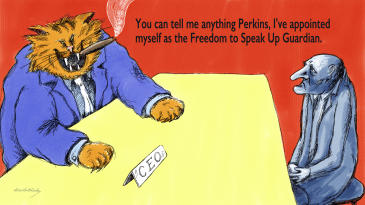
This is an early, quick and dirty look at the emerging characteristics of so-called ‘Freedom To Speak Up Guardians’ –  roles that are not evidence based but provide a sop to calls for real reform of whistleblowing governance.

There is no good, complete evidence yet. The National Guardian reassuringly told the press in January 2017 that 201 trusts had appointed a Speak Up Guardian. 1

The reality is that the Speak Up Guardian landscape is akin to the Wild West. Only it is less organised.

Jeremy Hunt has endlessly cited the Freedom To Speak Up Review to prop up implausible claims that he is building the safest, most transparent health service in the world. In truth, the government hasn’t bothered much with the Review’s centre piece – the creation of Speak Up Guardians. Most likely as it was never considered a serious venture to begin with, serving only a decorative function.

Francis’ proposal for Speak Up Guardians was short on detail.

Then the government made the situation worse by allowing trusts to do whatever they wanted: installing whatever arrangements they liked, or delaying until guidance was available:


“In addition, if Trusts feel confident to appoint their Guardian without this guidance, they should not wait for the guidance to be published.” 2


The guidance came late – in September 2016 3 – given the glacial rate at which the CQC approaches its duties.

Inevitably in the absence of evidence base and guidance, all sorts of weird and wonderful permutations sprang up, which will make meaningful evaluation a nightmare.

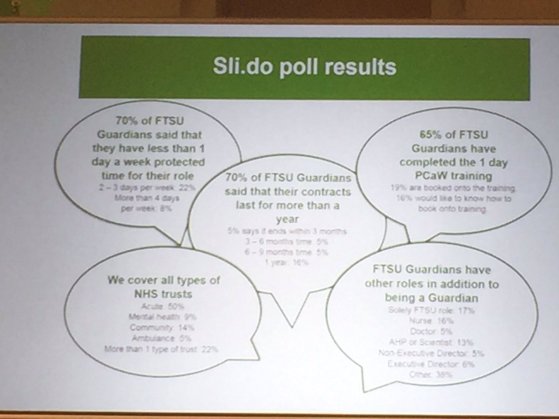
Some trusts appointed networks of Guardians and champions. Some held elections. Professional backgrounds and seniority vary considerably. Many trusts have published little detail on how their Guardians work or what capacity in terms of WTE has been installed. A pre-conference poll by the National Guardian suggested that the majority of Guardians are part time – 70% indicated that they had less than one day of protected time. 4

An unenthusiastic tone is reflected in a number of trust board papers:


“Freedom to Speak Up Guardian Raj Bhamm, Head of Workforce Strategy, has been appointed to this role for a 3 year period. This is a CQC requirement.”

http://www.royalsurrey.nhs.uk/wp-content/uploads/2015/09/170126-final-part-1.pdf

One can understand why some trusts may be reluctant to expend time and money on this imposed project, when the NHS is under such immense strain.

A wander through the gallery of Speak Up Guardians throws up interesting individual examples, if the paper trail is to be believed:

  1. A Speak Up Guardian who was formerly the Head of Legal Services at Mid Staffs.5


  1. A Speak Up Guardian who is also listed as Head of Comms.6


  1. A Speak Up Guardian who came from John Lewis.7


  1. A Speak Up Guardian who used to be the Chief Executive of the Foundation Trust Network 8


  1. A Speak Up Guardian who used to a Director of Comms 9


I wrote to Robert Francis about general concerns and gave the example of the former Mid Staffs Head of Legal Services. His response acknowledged that implementation has been variable and resulted in a lack of uniformity.  10

NHS Employers started publishing an interactive map showing all the trusts that had reportedly appointed Guardians:

http://www.nhsemployers.org/your-workforce/retain-and-improve/raising-concerns-at-work-and-whistleblowing/freedom-to-speak-up-guardian-hub/guardian-map

The most recent version of this map, dated 31 March 2017, accounted for only 209 trusts.

Of the trusts that did not feature on the NHS Employers map, eight have not clearly appointed a Speak Up Guardian yet, based on published papers:

Buckinghamshire Healthcare NHS Trust
Hertfordshire Partnership NHS Foundation Trust
Kingston Hospital NHS Foundation Trust
Pennine Acute Hospitals NHS Trust
North West Anglia NHS Foundation Trust

(previously Peterborough and Stamford NHS Foundation Trust and Hinchingbrooke Healthcare NHS Trust, which merged on 1 April 2017)

Princess Alexandra Hospital NHS Trust
Queen Victoria Hospital NHS Trust
Royal United Hospitals Bath NHS Foundation Trust

I must question the reliability of the data reported to NHS Employers by some trusts. It looks in some instances that trusts may have just given NHS Employers names of contacts who were not actually Freedom to Speak Up Guardians, usually senior managers. In some of these cases, a check of trust records shows that Freedom To Speak Up Guardians had not even been appointed.

A related question arises about whether the National Guardian’s above figure of 201 trusts with Guardians included duff data, given by trusts who just wanted the centre off their backs. I suspect it did.

Corporate Speak Up Guardians

There are also worries about the corporate nature of some Guardian appointments.

A trawl of all the Speak Up Guardians flagged on the most recent version of NHS Employers’ Guardian map and trusts’ papers revealed that 66 trust directors and 30 associate directors had apparently been appointed as Speak Up Guardians in 88 trusts.

Two directors were each Guardians for two trusts, and three trusts had more than one director acting as Guardians.

This is the supporting data:

https://minhalexander.com/wp-content/uploads/2016/09/freedom-to-speak-up-guardians-who-are-directors-14-05-2017.xlsx

Cross checking with other sources such as board papers confirmed only some of these apparent appointees as Guardians – only 28 out of the 66 directors and only 16 out of 30 associate directors were clearly Speak Up Guardians.

Of course, some of the unconfirmed cases may be Guardians. And many of those directors who were not confirmed as Guardians are nevertheless those who are in control of the appointment and operation of Guardians.

However, conservatively there are so far at least 44 confirmed ‘corporate’ Speak Up Guardians, in 37 trusts:

This is a list of those 37 trusts:

Freedom to Speak Up Guardians who are directors 14.05.2017

The 44 corporate Speak Up Guardians broke down as follows:

Type of Trust Director Number
Chief executive 1
Non-executive director 14
Medical director 4 (3 medical directors, 1 associate medical director)
Director of nursing 4 (2 directors of nursing, 2 associate directors of nursing)
Director of human resources 3 (1 director of HR, 2 associate directors of HR)
Directors of corporate affairs 3 (2 directors of corporate Affairs, 1 associate director of corporate affairs)
Directors of governance (and similar)  10 (2 directors of governance, 8 associate directors of governance)
Other types of directors 5 (4 directors, 1associate director)
Total 44

It is a concern that there are so many corporate appointments, as questions arise about values, perspective and patient-centredness.

As Mid Staffs showed, unchecked managerialism can be deadly to patients. 

freedom-to-speak-up-get-sacked-guardian

Few BME Speak Up Guardians

As well as an unhealthy dose of corporate salts, the Guardians also look rather white so far.

I have so far come across only 15 Guardians who are from visible ethnic minorities.

This is despite a higher proportion of BME individuals in the NHS workforce than in the general population.

At last count:

17% of the whole NHS workforce were non-white

 38% of NHS doctors and dentists were non-white. 11

I took a closer look at the available data on Speak Up Guardians in trusts that serve 38 of the most ethnically diverse districts (based on the 2011 census 12).

These districts ranged from Newham (29% white) to Coventry (73.8% white). 13

Of course, the percentage of BME staff in NHS services in these districts is higher than the average across the whole NHS. For example, the proportion of BME staff in the London NHS workforce is 44%, according to NHS England. 14

I found that in the 48 trusts serving these districts, there were 12 non-white Speak Up Guardians and 49 white Speak Up Guardians. 15

Even accounting for incomplete data, this suggests that power appoints in its own image.

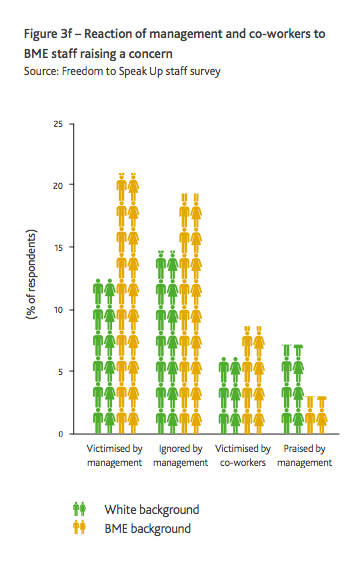
This is not very good news for just culture, or for BME whistleblowers, who the Freedom to Speak Up Review acknowledged were much more likely to be ignored and to suffer reprisal. 16

Francis BME page 66

But then, it’s not as if anyone really cared enough to administrate the establishment of Speak Up Guardians in a coherent and efficient manner.

No one tends to the window dressing once it’s been hung out.

As one trust illustrates, the focus is now on serious stuff….. such as ensuring a supply of green lanyards:

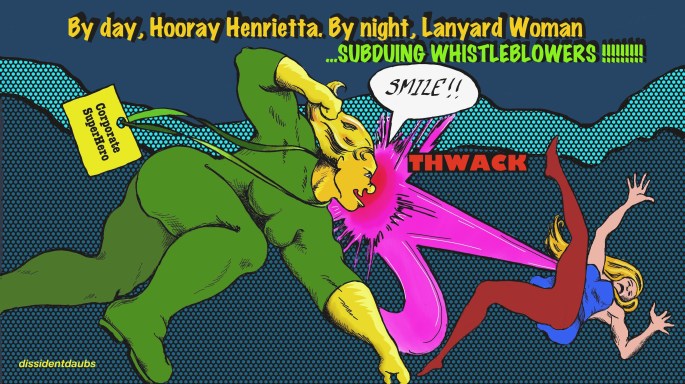
“Freedom to Speak Up (FTSU) – The ‘Freedom to Speak Up’ review, published in February 2015, highlighted how important it is for every part of the NHS to develop a culture in which all staff are positively encouraged to raise issues about safety, quality and effectiveness of patient care and supported when they do so. It was a requirement for all NHS Trusts to appoint Guardians to work with trust leadership teams to implement this agenda. The National Guardian for FTSU has now been appointed, Dr Henrietta Hughes. She held the first National Guardians conference in March 2017. NCH&C have increased the number of FTSU champions and held its third steering group meeting. Actions developing from the group include; a role description for the advocates; implementation of the national reporting dataset; inclusion on datix for staff to raise concerns directly to the Trust Guardians; FTSU green lanyards for champions; development of a FTSU logo for NCH&C; communication plan to cascade information; implementation of dedicated phone line for reporting concerns.”

Norfolk Community Health and Care NHS Trust Board paper 26 April 2017


UPDATE 8 June 2017

Curiously, three weeks after I wrote about these issues of poor quality data on Speak Guardians, their questionable diversity and the large number of corporate appointments, one of the main published data sources has disappeared. It is NHS Employers’ interactive Speak Up Guardian map, which gave details of Speak Up Guardians appointed so far by trusts. A ‘page not found’ message is obtained when the relevant link is clicked. I have asked NHS Employers why the map has been erased and whether there are plans to replace it.

Screen Shot 2017-06-08 at 10.37.51.png


RELATED ITEMS

https://minhalexander.com/2017/03/07/freedom-to-speak-up-guardian-jailed/

https://minhalexander.com/2017/03/22/25-best-and-25-worst-nhs-trusts-for-speaking-up-allegedly/

https://minhalexander.com/2016/09/24/critique-of-francis-model-of-trust-appointed-guardians/


REFRENCES

1 Learning Not Blaming, Department of Health July 2015

https://www.gov.uk/government/uploads/system/uploads/attachment_data/file/445640/Learning_not_blaming_acc.pdf

2 More than 30 trusts do not have whistleblower guardian. Health Service Journal, 12 January 2017

https://minhalexander.com/wp-content/uploads/2016/09/more-than-30-trusts-still-do-not-have-whistleblower-guardian.pdf

3 CQC guidance on job description for Speak Up Guardians

https://minhalexander.com/wp-content/uploads/2016/09/example_job_description_freedom_to_speak_up_guardian_september_2016.pdf

4 Speak Up Guardian polll tweeted 8 March 2017

5 Rebecca Southall, former Head of Legal Services at Mid Staffs, currently Director of Corporate Affairs at University Hospitals of Coventry and Warwickshire NHS Trust is listed as the Speak Up Guardian for UHCW and also for Coventry Warwickshire Partnership NHS Trust

http://www.uhcw.nhs.uk/clientfiles/File/Trust%20Board%20Public%2030_03_17.pdf

https://www.linkedin.com/in/rebecca-southall-06416641/

http://www.nhsemployers.org/your-workforce/retain-and-improve/raising-concerns-at-work-and-whistleblowing/freedom-to-speak-up-guardian-hub/guardian-map

6 Sarah Newby Head of Comms and Fundraising at Luton and Dunstable NHS Trust is also Speak Up Guardian according to NHS Employers’ data

https://www.ldh.nhs.uk/contact-us/media-enquiries/

http://www.nhsemployers.org/your-workforce/retain-and-improve/raising-concerns-at-work-and-whistleblowing/freedom-to-speak-up-guardian-hub/guardian-map

7 Caroline Owens is listed as the Speak Up Guardian for the very troubled Brighton and Sussex University Hospitals NHS Trust. Her LinkedIn data and other sources indicate that her background is in corporate affairs at John Lewis.

http://www.brightonandhovenews.org/2017/03/30/whistleblowing-champion-urges-hospital-chiefs-to-support-staff-who-speak-out/

https://www.linkedin.com/in/carolineowens/?ppe=1

8 Sue Slipman, an non executive director at Kings College Hospital NHS Foundation Trust, and who was previously CEO of the Foundation Trust Network, is listed by NHS Employers as King’s Speak Up Guardian

https://www.kch.nhs.uk/about/organisation/directors/nonexecutive-directors

http://www.nhsemployers.org/your-workforce/retain-and-improve/raising-concerns-at-work-and-whistleblowing/freedom-to-speak-up-guardian-hub/guardian-map

9 Venessa James is a non executive director for South West Ambulance Service NHS trust, is named as the Speak Up Guardian for the trust by NHS Employers. Her LinkedIn data indicates that she was previously the Director of Comms at NHS Devon PCT.

https://www.linkedin.com/in/venessa-james-67b62391/?ppe=1

http://www.nhsemployers.org/your-workforce/retain-and-improve/raising-concerns-at-work-and-whistleblowing/freedom-to-speak-up-guardian-hub/guardian-map

10 Correspondence with Robert Francis about Speak Up Guardian appointments

Correspondence with Robert Francis about Speak Up Guardians May 2017

11 NHS Employers ethnicity stats for the NHS May 2017

http://www.nhsemployers.org/~/media/Employers/Publications/Ethnicity%20in%20the%20NHS.pdf

http://www.nhsemployers.org/case-studies-and-resources/2017/05/diversity-in-the-nhs-infographic

12 2011 Census: table of ethnicity by district

https://minhalexander.com/wp-content/uploads/2016/09/2011-census-ethnicity-by-district.xls

13 List of the 38 most ethnically diverse districts based on 2011 census

https://minhalexander.com/wp-content/uploads/2016/09/38-most-ethnically-diverse-districts-source-2011-census.xlsx

14 WRES 2016 Data analysis report for trusts, NHS England April 2017 Page 101:

In London the proportion of the NHS trust workforce from BME backgrounds is 44%.”

https://www.england.nhs.uk/wp-content/uploads/2017/03/workforce-race-equality-standard-data-report-2016.pdf

15 https://minhalexander.com/wp-content/uploads/2016/09/trusts-serving-the-most-ethnically-diverse-districts-16-05-20171.xlsx

16 Freedom to Speak Up Review by Robert Francis 11 February 2015

http://webarchive.nationalarchives.gov.uk/20150218150343/https://freedomtospeakup.org.uk/wp-content/uploads/2014/07/F2SU_web.pdf

Whistleblowers Wanted: Dead, or not Live

By Dr Minh Alexander, NHS whistleblower and former consultant psychiatrist, 10 May 2017

Officialdom’s absurdities in keeping whistleblowers at bay are endless.

The latest question about the National Freedom To Speak Up Guardian arises from personal data disclosed to an NHS whistleblower, under the Data Protection Act.

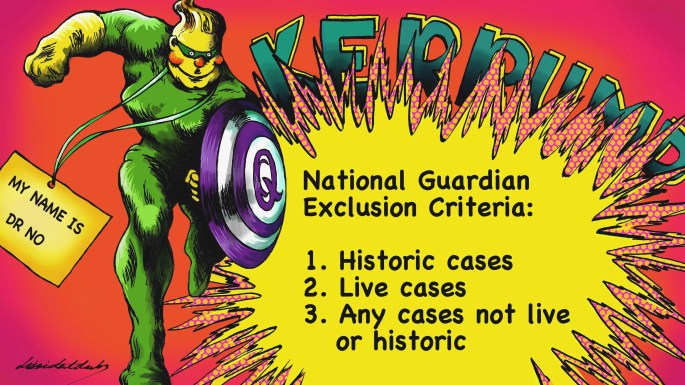
This disclosure included internal correspondence by the National Guardian’s team which indicated that ‘live’ whistleblower cases may not be accepted for review.

That is pretty ludicrous, especially bearing in mind that so-called ‘historic’ cases have already been barred. 1

Live cases

You will also see from this disclosure that the Department of Health and the National Guardian conferred about the response to the whistleblower.

There has already been plenty of other marble-rolling by the National Guardian’s office, CQC and the Department of Health. For example, they all made an unfounded claim that the National Guardian has no remit to intervene at all in individual cases, which has now been withdrawn. 2

I have asked the National Guardian to clarify how she defines ‘live’ cases.

Does she intend to wait until whistleblowers are neck deep in detriment, having been maliciously disciplined, vexatiously referred to professional regulators or pushed out onto the dole?

Once whistleblowers have been sacked, what exactly could she do to fulfil her remit – as set out in the Freedom To Speak Up Review – to ensure that the NHS provides “…redress to any patients or staff harmed…” 3 by poor whistleblowing governance?

Perhaps a referral passing the sacked whistleblower to the ineffective NHS whistleblower employment support scheme, that is explicitly designed not to provide jobs?

Why is the National Guardian’s office making up silly rules as it goes along?

The Freedom To Speak Review clearly acknowledged that early intervention – and resolution –  was important in preventing serious harm to whistleblowers. 4

Insistence that cases can only be accepted once they are no longer ‘live’ is a noxious recipe.

But no doubt it would be music to the Department of Health’s ears.

Whistleblowers wanted: Dead, or not Live.


RELATED ITEMS

https://minhalexander.com/2017/05/06/cqc-and-national-guardian-defend-fortress-dh/

https://minhalexander.com/2017/03/26/at-the-nhs-improvement-soup-kitchen/


REFERENCES

1 Robert Francis shut many so-called ‘historic’ whistleblowers out of justice through his report of the Freedom To Speak Up report:

The INO should not be tasked with reviewing, let alone investigating, historic cases.”

The INO should not be expected to review historic issues.”

“Finally I recognise that some of those who have contributed so constructively to the Review will feel that their own personal issues have not been addressed. This was perhaps inevitable given my remit, but I have to observe that in some of their cases the contention has endured over such a long time, and the issues have become so complex, that the most rigorous inquiry devoted to each such case would not have been able to resolve matters for those involved. For this reason I doubt that any form of public inquiry of the sort demanded by some would do more than raise expectations only for them to be dashed. I hope, however, that all who have contributed to this Review by Chapter 10 – Conclusion 197 taking the difficult step of sharing with me their sometimes harrowing experiences will receive some consolation from the knowledge that they have informed the lessons identified in the report and made a significant contribution to ensuring that others will avoid suffering the same consequences in future.”

http://webarchive.nationalarchives.gov.uk/20150218150343/https://freedomtospeakup.org.uk/wp-content/uploads/2014/07/F2SU_web.pdf

The National Guardian has now defined ‘historic’ as employment in the NHS over two years from the point of referral to her office:

“…the NGO will review cases referred to it by NHS workers who have been employed in the NHS for a period of up to two years prior to the point they are referred to the NGO for review.”

https://minhalexander.com/wp-content/uploads/2016/09/national-guardian-20170428_ngo_case_review_process_0.pdf

2 CQC and National Guardian defend fortress DH. Minh Alexander 6 May 2017

https://minhalexander.com/2017/05/06/cqc-and-national-guardian-defend-fortress-dh/

3 Page 168 Freedom To Speak Up Report 11 February 2015

http://webarchive.nationalarchives.gov.uk/20150218150343/https://freedomtospeakup.org.uk/wp-content/uploads/2014/07/F2SU_web.pdf

4 Freedom to Speak Up Review report 11 February 2015

Page 41

Through the NHS Constitution it is made clear that workers are expected to exercise their right to raise concerns as early as possible.”

Page 119

“The lesson I drew from the evidence was that it is vital that cases are handled well and quickly. The more issues can be ‘nipped in the bud’ by establishing facts early on, with a degree of independence if necessary, and by communicating better at all stages, using mediation if needed, the greater the likelihood that there will be a successful outcome.”


CQC and National Guardian defend Fortress DH

By Dr Minh Alexander, NHS whistleblower and former consultant psychiatrist, 6 May 2017

When governments are forced to respond to whistleblower scandals, they tend to do so grudgingly and minimally, whilst making all sorts of inflated propaganda claims.

A case in point is the office of the National Freedom To Speak Up Guardian, a public relations contrivance by the Department of Health.

Shockingly, the National Guardian’s office, its part funder and employer the Care Quality Commission and the Department of Health, have tried to curtail even the little influence it was originally given.

Crucially, the National Guardian’s office started wrongly telling whistleblowers in extremis that it had no remit at all to intervene in individual whistleblowers’ cases.

The National Guardian’s office maintained this position despite being challenged, and then the CQC and DH joined in with this lamentable chorus.

In fact, it was the clear intention of the Freedom To Speak Up Review that:

  • The National Guardian’s office was to provide a place where whistleblowers could go if they were let down by their employers
  • The National Guardian’s core function was to challenge others to look again at badly handled whistleblower cases and to correct poor practice:

“7.6.17 The INO would in essence fulfil a role at a national level similar to the role played by effective Freedom to Speak Up Guardians locally. They would not take on cases themselves, but could challenge or invite others to look into cases which did not appear to have been handled in line with good practice or where it appeared that a person raising a concern had experienced detriment as a result of raising the concern.” Page 169 Report of the Freedom to Speak Up Review 1

Robert Francis also made it clear that where necessary, the National Guardian should request a direction from the relevant regulator to force employers to correct malpractice.2

In swerving these commitments, David Behan a former DH Director General and the recently ennobled chief executive of the CQC, went so far as to claim that a public consultation by CQC had decided that the National Guardian should not intervene in individual cases:

https://minhalexander.com/2017/03/12/national-guardian-behan-replys/

This was a baseless claim. Contributors to the public consultation in question had suggested that there should be better protection of individual whistleblowers.

Behan was challenged on 12 March 2017. 3

However he dallied in responding, despite being reminded.

I wrote to the Secretary of State on 11 April 2017 providing evidence that Behan’s extraordinary claims about the public consultation were unfounded, and that the DH had been in error to peddle his claims:

https://minhalexander.com/wp-content/uploads/2017/04/dh-jeremy-hunt-ng-help-for-individual-whistleblowers-11-04-2017.pdf

On 21 April 2017 Behan finally responded, conceding that the original Freedom To Speak Up recommendation – that the National Guardian should challenge others to look again at mishandled individual cases – would be implemented after all:

https://minhalexander.com/wp-content/uploads/2017/02/behan-20170420-pocu-1516-0181-dr-minh-alexander-national-freedom-to-speak-up-guardians-remit.pdf

HOWEVER, working on the ‘WhackAMole’ model of official resistance to genuine whistleblower protection, the National Guardian has now popped up with her finalised case review process and this remains very flawed. 4

In particular, it still contains the truly ridiculous stipulation that she will not review whistleblower cases unless employers have responded to whistleblowers’ concerns:

3.1.2 The evidence required to assess referrals

Paragraph 76 of the executive summary states that the purpose of a case review should be to ‘review the handling of concerns where there is reason to believe that there has been failure to follow good practice …’ Therefore cases should only be considered for possible review where there is clear evidence received in the referral that the NHS body has already responded to a concern and has failed to do so appropriately. Where the referral contains little or no such information the case should not be considered for possible case review.

 It is expected that the information provided in some referrals will be insufficient to allow the Case Review Manager to decide whether the case meets the criteria advised by the AG. In such cases the NGO should not undertake the gathering of information in the nature of a review to determine whether that referral meets the criteria for case review. They may instead inform the referrer of the need to provide more information.” 4

As ignoring whistleblowers is one of the most common employer ruses, such an arrangement would give solace to the worst NHS employers.

The retention of this exclusion criterion seems unlikely to be a simple mistake, as both Behan and the National Guardian were both made aware of this employer-friendly loophole during the recent consultation on the National Guardian’s process. 5

Nevertheless, I have written again to Behan to clarify whether it is his intention that there should be impunity for employers who ignore whistleblowers, and if not, what action he, Stevens and Mackey as the chief executives of the National Guardian’s funding organisations will take to resolve this mess:

https://minhalexander.com/wp-content/uploads/2016/09/letter-to-behan-re-ng-employers-ignoring-whistleblowers-5-05-2017.pdf

In this latest letter to Behan, I have also asked him to remove a misleading claim in the National Guardian’s case review process guidance that all the twenty ‘Francis principles’ from the Freedom To Speak Up were evidence based. The establishment of flawed Speak Up Guardians was most definitely NOT evidence based. Even the National Guardian herself acknowledged this. 6

Indeed, the ‘model’ trust upon which Francis relied to justify his recommendation for Speak Up Guardians has not proved so angelic after all.

It has been found to have ignored staff’s serious patient safety concerns 7 8, attracting a related CQC warning and rating of ‘Inadequate’ on the ‘Well Led’ domain 9 and it has failed to meet its legal obligations under the Freedom of Information Act as regards these governance failures. It arbitrarily withheld data on staff whistleblowing disclosures to the trust’s ‘Cultural Ambassador’ from a critical period in 2014/2015, and it failed to issue any valid grounds for doing so. A complaint has been made to the ICO.

So much then for Francis’ illusory exemplar of transparency and accountability.

If doctors dished out untested treatments, and made unsubstantiated claims about them as the government has done, they’d be struck off.

Related items about the lack of evidence base for Francis’ Speak Up Guardians:

A) Critique of Francis’ model of trust appointed Guardians, from evidence June 2015 submitted to the Department of Health consultation on implementation of the Freedom To Speak Up Review

https://minhalexander.com/2016/09/24/critique-of-francis-model-of-trust-appointed-guardians/

B) 25 best and 25 worst NHS trusts for speaking up. Allegedly. 22 March 2017

https://minhalexander.com/2017/03/22/25-best-and-25-worst-nhs-trusts-for-speaking-up-allegedly/

REFERENCES

1 Report by Robert Francis of the Freedom To Speak Up Review, 11 February 2015

http://webarchive.nationalarchives.gov.uk/20150218150343/http://freedomtospeakup.org.uk/the-report/

2 Report by Robert Francis of the Freedom To Speak Up Review, 11 February 2015

“Principle 15 External Review

There should be an Independent National Officer [National Guardian] resourced jointly by national systems regulators and oversight bodies and authorised by them to carry out the functions described in this report, namely…advise NHS organisations to take appropriate action where they have failed to follow good practice, or advise the relevant systems regulator to make a direction to that effect”

http://webarchive.nationalarchives.gov.uk/20150218150343/http://freedomtospeakup.org.uk/the-report/

3 Letter to David Behan 12 March 2017

https://minhalexander.com/wp-content/uploads/2017/03/cqc-behan-clarification-on-whether-ng-will-challenge-employers-to-look-again-at-cases-12-03-2017.pdf

4 National Guardian’s case review process for NHS trusts and foundation trusts. CQC 28 April 2017

https://minhalexander.com/wp-content/uploads/2016/09/national-guardian-20170428_ngo_case_review_process_0.pdf

5 National Guardian: Letter from Wonderland. Minh Alexander, 20 February 2017

https://minhalexander.com/2017/02/20/national-guardian-letter-from-wonderland/

6 Agreed record of a meeting with the National Guardian on 2 February 2017

MA You know there’s no evidence for any of this (the SUGs)?

HH That’s the challenge, building an evidence base”

https://minhalexander.com/wp-content/uploads/2017/02/hh-meeting-records-23-01-2017-and-2-02-2017.pdf

7 Leaked NHS report reveals dying patients left alone and in pain. Staff at breaking point. Stoke Sentinel 2 April 2015

http://www.stokesentinel.co.uk/exclusive-leaked-nhs-report-reveals-dying/story-26274491-detail/story.html

8 Leaked NHS dossier: Nurses log concerns over care. 2 April 2015

http://www.stokesentinel.co.uk/nhs/story-26274522-detail/story.html

9 Country’s biggest Health and Social Care Trust ‘requires improvement’. National Health Executive magazine. 13 May 2016

http://www.nationalhealthexecutive.com/Health-Care-News/countrys-biggest-health-and-social-care-trust-rated-requires-improvement

4 years of CQC mental health whistleblowing data

Governments intermittently make glib promises to lift neglected and under-funded mental health services out of second class status, but usually only disappoint in the end.

The health regulator the Care Quality Commission (CQC) is regarded as an unhelpful if not hostile force by the majority of whistleblowers, with concerns from whistleblowers about CQC politicisation, confidentiality, employer bias, active protection of abusers, wilful blindness and failures to respond appropriately to disclosures.

Despite a major investigation of West London Mental Health Trust in 2009 1 triggered by CQC’s predecessor the HealthCare Commission, which generated common sense recommendations for addressing safety problems in struggling mental health services, the CQC has not distinguished itself in championing the needs of mental health patients.

Headlines have continued about familiar, recurrent failures.

At Southern Health NHS Foundation Trust, CQC failed to detect or report gross failures in the handling of hundreds of deaths. 2 The Mazars deaths review on Southern Health NHS Foundation Trust found that CQC did not even have the right number of deaths of detained patients. Mazars also questioned the reliability of CQC’s intelligent monitoring data .

CQC has been insufficiently critical of excessive mental health bed closures even though a recommendation from the West London investigation was that adequate beds were needed for safety. When asked about CQC’s approach to regulating safe numbers of mental health beds, CQC’s deputy Chief Inspector said that CQC preferred to only regulate the effects of bed shortage. Not exactly proactive then. 3

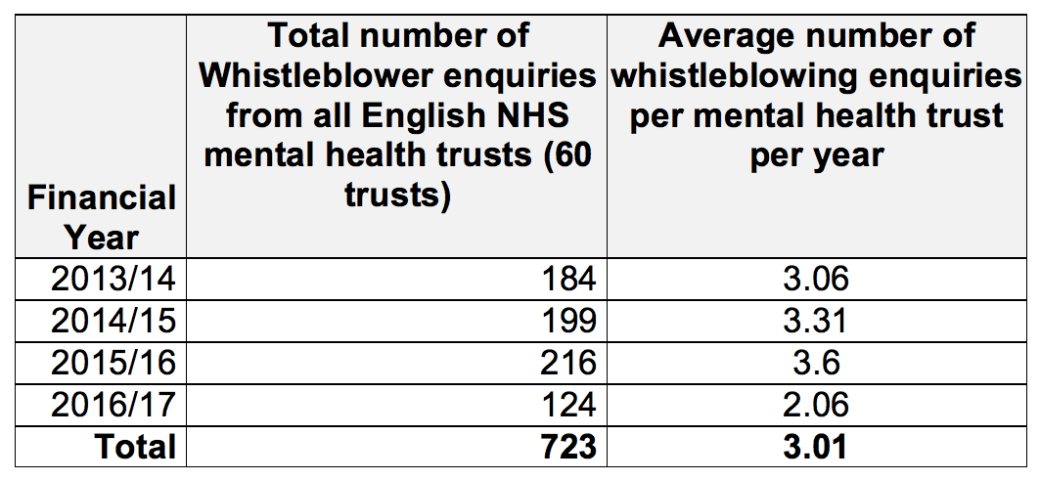
I have kindly been sent FOI data on whistleblowing by mental health trust staff to the CQC, which shows over 700 whistleblower ‘enquiries’ over a four year period, 1 April 2013 to 1 March 2017:

CQC FOI disclosure 8 March 2017

The whistleblowing enquiries to CQC are likely to have been made by trust staff who could not progress their concerns within their own organisations, or for some other reason did not wish to make an internal disclosure.

Extrapolating from CQC’s data gives an overall average of 3 whistleblowing enquiries per mental health trust each year.

Screen Shot 2017-04-23 at 13.45.29.png

Curiously, there has been a sharp dip in the number of enquiries in the last financial year. CQC have denied any change in their recording method.  IF that is so, a number of other possible factors could be responsible for the drop. However, it seems unlikely that staff have stopped disclosing because things are going well.


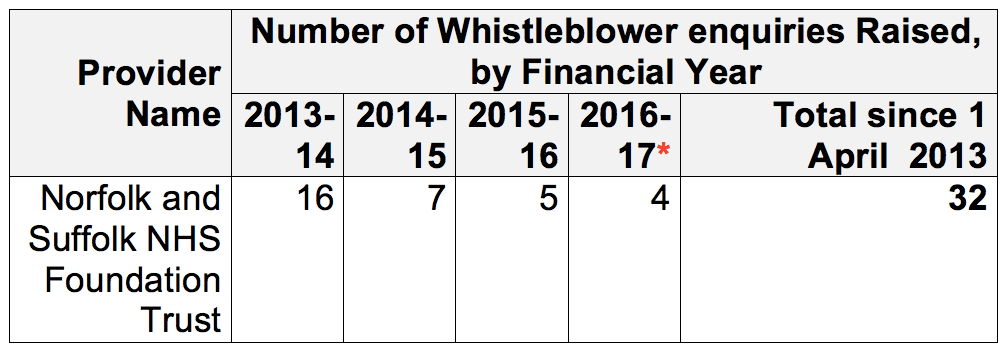
The mental health trust that has had the highest recorded number of whistleblowing enquiries to the CQC in the last four years is Norfolk and Suffolk NHS Foundation Trust, which CQC recently and controversially took out of special measures despite continuing concerns about safety and deaths, and continuing bed cuts.

Screen Shot 2017-04-24 at 11.18.11.png

See the Norfolk and Suffolk Crisis campaign website for full details:

http://norfolksuffolkmentalhealthcrisis.org.uk/

HOWEVER, on this occasion the CQC has given an especially elaborate disclaimer about what its data actually means:

We should advise you that the number of ‘whistleblowing’ enquiries recorded against each provider will not necessarily be representative of the actual number of whistleblowing concerns reported to us.

This is because an enquiry recorded as ‘whistleblowing’ may contain:

  • A single concern from one whistleblower
  • Multiple concerns from one whistleblower
  • Multiple concerns from multiple whistleblower’s that are linked to a similar issues
  • Multiple concerns from staff who have been invited to contact CQC with feedback ahead of an inspection where one enquiry is recorded as whistleblowing
  • Positive and negative intelligence about a location and provider
  • Information wrongly categorised as whistleblowing”


CQC’s claim that “whistleblowing enquiries” may contain positive feedback is implausible, or at best unrepresentative of the great majority of contacts, based on various disclosures that I have seen regarding specific trusts.

For example, in the same above FOI disclosure, specific whistleblowing data was given on two trusts with recent whistleblowing governance issues – North Essex Partnership NHS Foundation Trust and Berkshire Healthcare NHS Foundation Trust. No positive feedback is evident. Instead, there are concerns about safety, patients at risk of self harm, poor service, falsified documents poor incident recording, bullying, staffing, poor service, bed cuts, safeguarding, racism, and poor management of change:

CQC FOI DISCLOSURE NORTH ESSEX AND BERKSHIRE IAT 1617 0775

As for CQC’s obfuscation on the precise numbers of whistleblowers and concerns, the regulator should be recording whistleblowing data in a way that shines light on what is happening, not doing the dance of the seven veils.

Regarding the extraordinary comment by CQC that it might be incorrectly classifying some events as ‘whistleblowing’ when they are not, what can one say? An organisation that costs as much as two mental health trusts ought not to record data that is so inaccurate that it cannot be relied upon.

However, CQC’s purpose in contriving such looseness and ambiguity may be revealed by CQC’s assertion that its whistleblowing data “should not be used as an indicator of Trust performance”.

The Department of Health would surely be proud of such pliable, elastic data that could be made to mean whatever you want it to.

And despite a recent CQC attempt to spin that it is now more responsive to whistleblower disclosures  4 – following criticism at the end of last year 5 – please note that none of the 2016/17 disclosures for North Essex and Berkshire Healthcare resulted in inspections being brought forward.

But then, it’s all in the fancy footwork,  how you do your sums and how much or how little you reveal.


UPDATE 25 APRIL 2017

If CQC carries on recoding whistleblowing data on the above basis, it will fall foul of new legal requirements for bodies that are ‘Prescribed Persons’ under the Public Interest Disclosure Act to publish the numbers of whistleblowing disclosures received and responses to the disclosures. These new legal requirements came into force at the beginning of this month. I have now written to the National Guardian about her employer’s shortcomings, copied to the relevant parliamentary committees.

Letter to Henrietta Hughes re CQC WB data 25.04.2017


RELATED ITEMS

https://minhalexander.com/2016/12/05/whistleblowers-unheard-by-cqc/

https://minhalexander.com/2016/12/15/covering-up-the-cover-ups-cqcs-revisionism/

https://minhalexander.com/2016/11/18/the-ever-anomalous-cqc-another-soft-shoe-shuffle-around-inconvenient-data/

https://minhalexander.com/2016/09/25/cqc-deaths-review-all-fur-coat/


REFERENCES

1 Report of Investigation into West London Mental Health Trust by the Healthcare Commission. CQC 2009

WLMHT HCC Investigation_into_West_London_Mental_Health_NHS_Trust_FINAL_200907171608

2 Mazars report of Independent review of deaths of people with a Learning Disability or Mental Health problem in contact with Southern Health NHS Foundation Trust April 2011 to March 2015, December 2015

https://www.england.nhs.uk/south/wp-content/uploads/sites/6/2015/12/mazars-rep.pdf

3 Email from Paul Lelliott 19 December 2014:

I think therefore that the correct approach for the CQC to take is not to try to count bed numbers but to assess services for the ‘symptoms and signs’ of pressure on bed availability eg. problems with admitting a person who needs to be in hospital for their own wellbeing, people being admitted to a ward distant from their home, people being moved from ward to ward during an admission episode, people being discharged before they are ready etc.”

4 CQC Board Paper Feb 2017 CM021705_Item5_Q3performanceReport

CQC Health Service Journal April 2017 Insp brought forward after WB

5 Whistleblowers unheard by CQC. Alexander, Linton, Sardari and a fourth NHS whistleblower December 2016

https://minhalexander.com/2016/12/05/whistleblowers-unheard-by-cqc/


Health Education England hasn’t done its whistleblowing homework

By Dr Minh Alexander NHS whistleblower and former consultant psychiatrist, 21 April 2017

The Freedom To Speak Up Review 1 was an expensive exercise in government spin and stalling.

It gave the appearance that something was being done by the government, when in reality all that happened was that tokenistic, ineffective measures were – in theory – adopted and the Department of Health press office acquired another willing helper – the National Guardian’s office. 2

After the initial buzz of the launch in February 2015, and the cameras departed, many of the NHS bodies that were assigned homework in terms of specific Freedom To Speak Up action plans did not implement the tasks, took an excessively long time and or did a shoddy job. 3

Importantly, over two years on from Francis’ recommendations for establishment of an office to scrutinise cases, over a year since the National Guardian’s office was established and over seven months after the latest National Guardian took up post, not a single NHS whistleblower case has been reviewed.

Health Education England (HEE) was also one of the bodies given homework as a result of the Freedom To Speak Up Review, but has now admitted that it has not attended to a key task: ensuring that local Speak Up Guardians are properly trained.

Of course, Health Education England notoriously retaliated against Dr Chris Day, junior doctor whistleblower by removing his National Training Number, thus scuttling his specialist training. The government, including the Health Secretary, then closed ranks and claimed a loophole in coverage of whistleblowing law for junior doctors. (I say ‘coverage’ as opposed to ‘protection’, as current whistleblowing law is weak and does not protect). After the resulting scandal, the government and HEE came up with a sticking plaster solution which allowed junior doctors the dubious privilege of suing HEE in the High Court, at prohibitive expense. 4

The government’s position has been challenged. Judgment is awaited from a recent hearing at the Royal Courts of Justice on Chris Day’s case.

The details of this extraordinary saga can be found here:

https://www.crowdjustice.org/case/junior-doctors-round-2/

Given this shabby background, it is unsurprising that HEE has not been diligent in helping to improve NHS whistleblowing governance.

The government assured us in July 2015 that HEE would produce guidance on the training needed for the local Speak Up Guardian role:

“Health Education England should produce guidance on what training will be needed for the Freedom to Speak Up Guardian role, along with a curriculum that NHS organisations can use to ensure that the training they are providing on raising concerns is of a sufficiently high standard” 

“HEE will develop and publish guidance on training for this role working with the CQC and the Independent National Officer [National Guardian]. We would expect HEE to take into account the work the INO will undertake around recruitment for this role.” 5

HEE has now disclosed via FOI that it has done no work at all on this matter and that there has been no liaison with the National Freedom To Speak Up Guardian:

“HEE has not yet conducted any work with the National Guardian or their office…”

HEE does not even give assurance that the work will definitely be done – it only says that the work may be done:

“…this may change…”

This is HEE’s FOI disclosure:

https://minhalexander.com/wp-content/uploads/2016/09/hee-foi-disclosure-3-april-2017.pdf

So by HEE’s latest admission, the government’s promises that Speak Up Guardians – who are a central plank of Robert Francis’ recommendations – should have kitemarked training have come to naught.

Why hasn’t the National Guardian ensured that the action plan was implemented?

How confident can we be that the numerous Guardian training events held so far by the National Guardian are of adequate quality?

Whistleblowers have asked to observe these training sessions for Guardians, but have been refused.

Nevertheless, the National Guardian who by her own admission is keen on Good News stories, spins copiously about how well the Speak Guardian network is progressing. 6 This is despite the evidence so far that Speak Up Guardians add little value. 7

Additionally, HEE discloses that it still has no Speak Up Guardian of its own, although it says it plans to recruit one.

HEE also previously disclosed in February 2016 that it had no external whistleblowing policy:

https://minhalexander.com/wp-content/uploads/2016/09/hee-foi-disclosure-25-feb-2016.pdf

It disclosed to another party in January 2016 that it did not hold any central data about whistleblowing disclosures by trainees.

Despite its woeful behaviour and omissions, and lack of evidence, HEE claimed in its above February 2016 disclosure:

“HEE supports trainees raising concerns and encourages them to do so. While we cannot discuss individual cases, at a local level, HEE has supported trainees report concerns to their employer, the GMC, Care Quality Commission and other relevant regulatory bodies. We believe that trainees can be the eyes and ears of patient safety.”

HEE in fact became a Prescribed Person under the Public Interest Disclosure Act (PIDA) in February 2016, and has a duty to receive and record whistleblowing disclosures by NHS staff in regards to:

“…matters relating to the education and training for health care workers and ensuring sufficient skilled and trained health care workers are available for the delivery of services” 8

It now has an external whistleblowing policy 9 and also claims that it has kept a central record of whistleblowing incidents:

“HEE became a prescribed Person in February 2016…HEE has kept a central record since becoming a Prescribed Body”

So currently, we have a situation in which a PIDA prescribed body that is responsible for handling disclosures about other organisations and helping to ensure best practice, can also be sued in the High Court for causing direct whistleblower detriment to those who disclose to it.

‘Dysfunctional’ does not even start to describe this tangled oversight arrangement.

But then, tangle is exactly what you get when governments practise to deceive.

RELATED ITEMS

https://minhalexander.com/2017/03/26/at-the-nhs-improvement-soup-kitchen/

https://minhalexander.com/2017/03/12/national-guardian-behan-replys/

UPDATE 1 NOVEMBER 2018

It was widely reported that HEE removed Chris Day’s training number, including in an article of 2 October 2018 by The Guardian, which coincided with the commencement of an Employment Tribunal hearing of a claim against HEE:

“A number of counter-allegations were made against him, and his HEE training number was deleted, effectively forcing him out of his career.”

https://www.theguardian.com/society/2018/oct/02/nhs-whistleblowing-protection-tribunal-junior-doctors

Further facts have emerged since the conclusion of a Employment Tribunal hearing which indicate that Dr Day resigned his training number.

A statement agreed between parties was published by HEE on 15 October 2018:

https://www.hee.nhs.uk/news-blogs-events/news/health-education-england-responds-outcome-dr-chris-day-case


REFERENCES

1 Report by Robert Francis of the Freedom To Speak Up Review, February 2015

http://webarchive.nationalarchives.gov.uk/20150218150343/http://freedomtospeakup.org.uk/the-report/

2 As an example of the National Guardian’s office being on message, it recently reproduced verbatim a Department of Health press release claiming:

Since the tragic events of Mid Staffs we have made considerable progress to making the NHS the safest healthcare system in the world including appointing a National Guardian and making sure every NHS organisation has a Freedom to Speak Up Guardian.”

http://www.cqc.org.uk/content/national-guardians-office-news-events

3 Examples of half hearted implementation of the Freedom To Speak Up Review and foot dragging include:

  • Government failure to designate a number of bodies as Prescribed Persons as recommended by Francis
  • Government failure to given NHS commissioning whistleblowers a Prescribed Person
  • Under-funding and very serious delay on the NHS whistleblower employment support scheme
  • Failure by the Care Quality Commission to inspect providers’ compromise agreements, despite claims that it would so

4 Health Education England published information August 2016:

https://hee.nhs.uk/printpdf/news-events/news/hee-extends-whistleblowing-protection-doctors-training

5 Learning, Not Blaming. Government action plan from the Freedom To Speak Up review, July 2015

https://www.gov.uk/government/uploads/system/uploads/attachment_data/file/445640/Learning_not_blaming_acc.pdf

6 This is some of the National Guardian office’s public relations output:

National Guardian newsletters

https://minhalexander.com/2017/04/19/national-guardian-newsletters-the-unexpurgated-version/

National Guardian promotional video, which Speak Up Guardians are being encouraged to disseminate:

https://drive.google.com/file/d/0B6YC8LPXL9HsR29IaHgxUTBjR1E/view

We would encourage all Guardians to use the video in their engagement activities, such as when speaking at team meetings or inductions, or as a tool to engage their Board or other staff groups.”

100 Day report by the National Guardian

http://www.cqc.org.uk/sites/default/files/20170110-national-guardians-office-first-100-days-report.pdf

Transcript of conference speech by the National Guardian

https://minhalexander.com/wp-content/uploads/2017/02/e28098the-role-of-the-national-guardian_-dr-henrietta-hughes.pdf

7 Critique of Francis’ model of trust appointed Guardians. Excerpt from evidence to the Department of Health, Minh Alexander 4 June 2015

https://minhalexander.com/2016/09/24/critique-of-francis-model-of-trust-appointed-guardians/

8 List of PIDA Prescribed Persons

https://www.gov.uk/government/publications/blowing-the-whistle-list-of-prescribed-people-and-bodies–2/whistleblowing-list-of-prescribed-people-and-bodies

9 Health Education England external whistleblowing policy

https://minhalexander.com/wp-content/uploads/2016/09/hee-ext-whistleblowing-policy.pdf

National Guardian Newsletters – the unexpurgated version

In February 2017 Dr Henrietta Hughes the National Freedom To Speak Up Guardian agreed to publish her newsletters, which had commenced in December 2016 but had not been published:

Newspeak at the National Guardian’s office

Newsletters for December 2016, February 2017 and March 2017 were subsequently published.

However, two of these (December 2016 and February 2017 issues) have subsequently been removed from the CQC website.

I will inform the National Guardian about this and post the full collection of National Guardian newsletters here until such time as a full record is restored on the CQC website.

Dr Minh Alexander 19 April 2017


NATIONAL GUARDIAN NEWSLETTERS THAT HAVE BEEN RELEASED TO DATE:


National Guardian newsletter December 2016:

201612_ngo-newsletter_december2016

National Guardian newsletter February 2017

201702_ngo-newsletter_february2017

National Guardian newsletter March 2017

201703_ngo-newsletter_march2017

National Guardian newsletter May 2017

20170518_ngo-newsletter_may2017

National Guardian newsletter July 2017

20170720_ngo-newsletter_july2017


NATIONAL GUARDIAN SURVEY OF LOCAL SPEAK UP GUARDIANS 15 SEPTEMBER 2017

20170915_freedom_to_speak_up_guardian_survey2017


NATIONAL GUARDIAN SPEAK UP DATA, BASED ON RETURNS BY NHS TRUSTS

National Guardian Speak Up data Quarter 1, 2017/18

National Guardian Speak Up data Quarter 2, 2017/18

National Guardian Speak Up data Quarter 3, 2017/18

NHS Bodies: 5 years of ICO decisions

By Dr Minh Alexander NHS whistleblower and former consultant psychiatrist 18 April 2017 

Summary: This piece reports on patterns in five years’ data of upheld complaints about NHS responses to FOI requests. The picture is one of a multi-billion corporation throwing its weight about and sometimes defying even the ICO. There have been over 500 ICO decision notices about NHS bodies, and almost 200 upheld complaints. Two NHS bodies emerge as behaving especially badly: NHS England and the Department of Health. There are signs suggestive of politicisation by public servants whose duty it is to be neutral, and various games are evident. At the Department of Health, repeated spurious claims have been made that disclosure of information would prejudice the effective conduct of public affairs or infringe on ministerial prerogative, which have been rejected by the ICO. The Department has absurdly even refused to provide data on grounds of national security, also rejected.

The Freedom of Information Act (FOIA) is one of the most useful and powerful tools for holding power to account.

The establishment resents this and some have tried unsuccessfully so far, to weaken and dismantle FOI provisions. 1

Those who resist transparency typically complain that FOI is a costly disruption to the smooth running of government.

The reality is that the government and its satellites spend much more on public relations than on responding to FOI requests.  2 Clearly then, the FOIA is an important protection against government spin, and supportive of democratic values and the public interest.

If governments were more open and routinely published more information, there would not be such a demand for information via the FOIA.

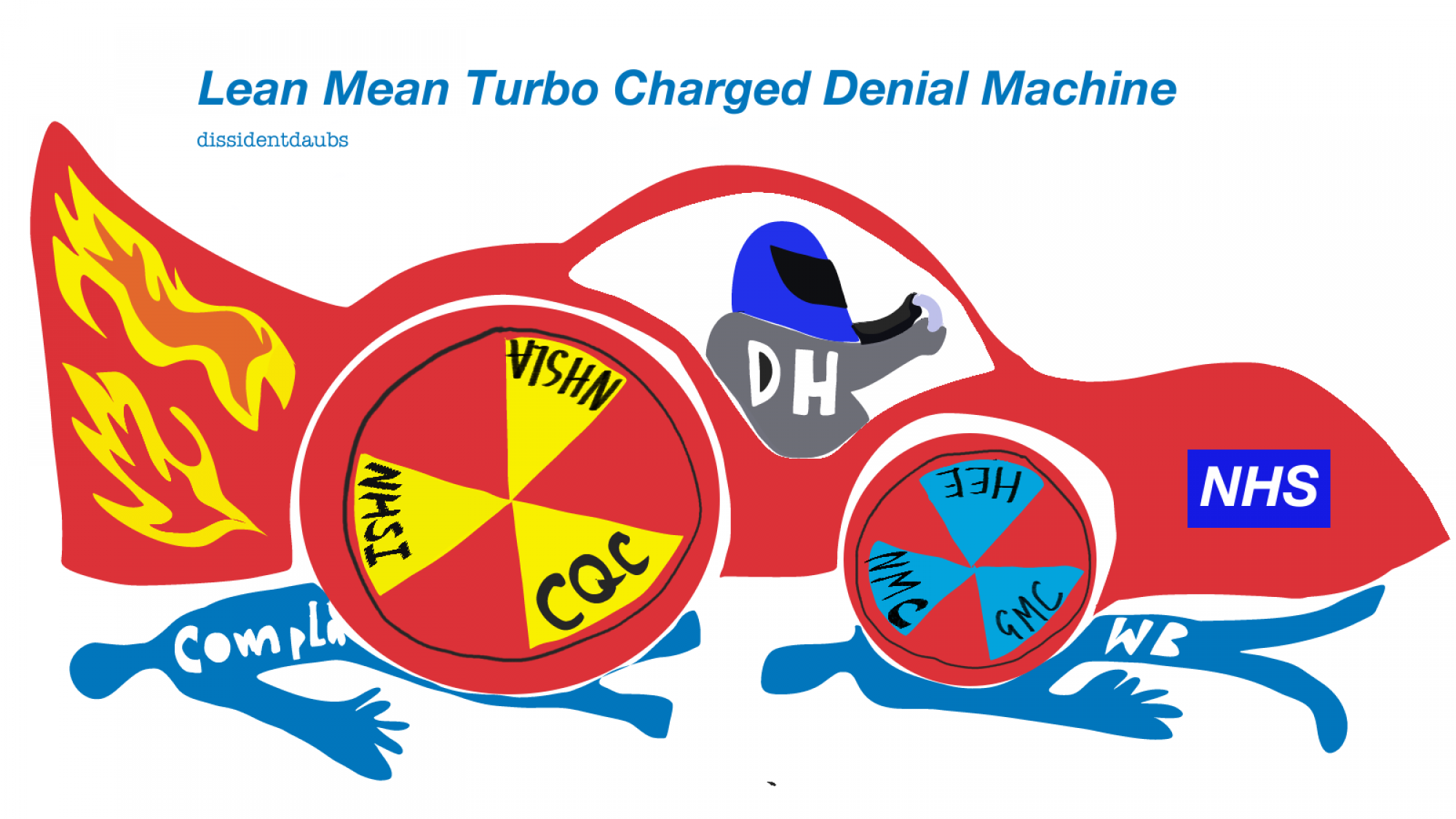
The NHS has been described as a ‘denial machine’, and its relationship with the Freedom of Information provisions has not always been straightforward. 3

Based on the Information Commissioner’s recent annual reports, about 10-12% of complaints to the ICO relate to the Health sector. 4

In 2012, an ICO audit of 15 NHS hospitals and trusts, focussing on protection of personal data under the Data Protection Act, concluded that: “…27% fell within the limited assurance range”. 5

I looked at five years’ published data on decisions by the Information Commissioner’s Office about NHS bodies, including the Department of Health. The extracted data about NHS bodies is available here:

ICO NHS decisions 1 April 2012 to 31 March 2017

In the five year period 1 April 2012 to 31 March 2017 (roughly corresponding with the interval in which Jeremy Hunt has been Secretary of State for Health), according to decision notices published by the ICO, there were a total of 533 complaints to the ICO about NHS bodies, of which 198 were upheld.

The Department of Health and NHS England together accounted for about a fifth of all the NHS complaints (n = 108), and a quarter of the upheld complaints (n = 50).

These complaints will represent only a proportion of the concerns about NHS bodies’ response to FOI data requests. This is because not all requesters complain formally to ICO, and decision notices are only issued in a proportion of complaints. In the last two years for which there is published data, the ICO issued about one decision notice for every five complaints received.
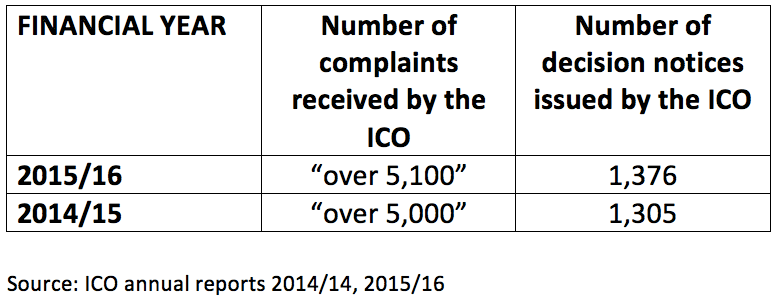
Screen Shot 2017-04-19 at 12.16.30

Attrition can be expected, as in any process that is under-pinned by complicated law, there is inequality of arms. NHS bodies can hoodwink, outgun and intimidate complainants by abusing a bottomless public purse.


Grounds upon which the ICO upheld complaints

All the ICO decisions in the five year period related to complaints about NHS bodies’ responses to FOI requests. In a handful of cases, there was an indirect relationship to the Data Protection Act because complainants had wrongly requested personal data via FOI, instead of the DPA.

In some cases, the breaches identified by the ICO were relatively minor or were limited failures set against largely appropriate disclosure. However, some breaches related to substantive failure to disclose all or most of the legitimately requested data.

The most frequent featured grounds for the ICO upholding complaints was ‘Section 10’ – delay in meeting the statutory deadline of 20 working days in responding to FOI requests. Section 10 featured in over half (111) ICO decisions.

Repeatedly misapplied grounds for not disclosing – either because they were not at all engaged or because they were over-ridden by the public interest – included:

Section 43 – commercial interests 6 (28 cases)

Section 41 – information given in confidence 7 (16 cases)

Section 36 – prejudice to the effective conduct of public affairs 8 (11 cases)

Section 40 – protection of personal data 9 (8 cases)


Action ordered by ICO

 Public authorities are required to comply with ICO orders within 35 calendar days, or risk High Court action:

Failure to comply may result in the Commissioner making written certification of this fact to the High Court pursuant to section 54 of the FOIA and may be dealt with as a contempt of court.”

The ICO required no further action by NHS bodies in 34.3% (68 of 198) cases of upheld complaints. Often, this was because data had been provided by the time of the ICO decision, or because of technical errors which did not affect the substantive outcome of the case.

In 27.2% (54 out of 198) cases of upheld complaints, the ICO ordered NHS bodies that had failed to respond, or withheld data on incorrect grounds, to either provide the requested data or to issue valid grounds for refusal.

In 36.8% (73 out of 198) cases of upheld complaints the ICO actively ordered NHS bodies to release specific information that had been wrongly withheld.

In one case, the ICO ordered an NHS body to specify what data was covered by the exemptions upon which it was relying.

In four cases the ICO ordered NHS bodies to provide assistance to complainants to clarify and refine their requests.

The possibility of deliberate brinkmanship is raised by the fact that in 19.2% (38 of 198) upheld complaints, NHS bodies ‘voluntarily’ provided responses after a complaint had been made to the ICO.

Three Department of Health and six NHS England cases were included in these 38 cases.
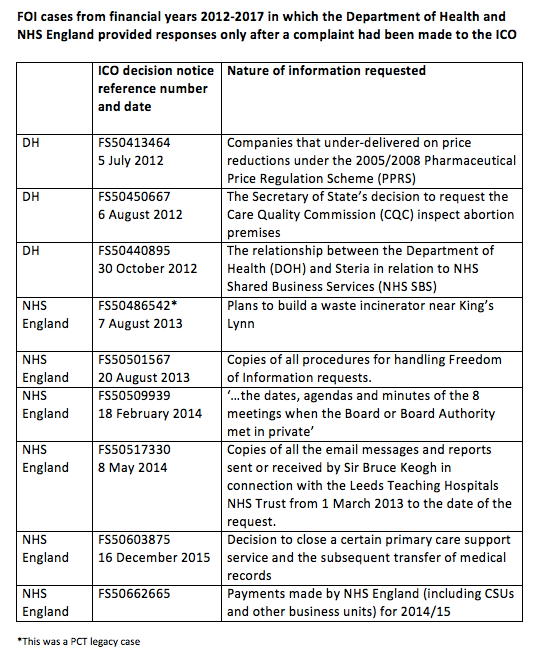
INSERT 2


FOI requests deemed ‘vexatious’

Under Section 14 FOIA 10, public authorities can declare requests ‘vexatious’.

Some resort to the tactic of threatening to declare requests vexatious if you insist once too often on the facts, as opposed to meekly accepting the spin.

The NHS was found by the ICO to have inappropriately declared FOI requests ‘vexatious’ on eleven occasions.

Of some concern the Care Quality Commission – which is supposed to lead by example – tried to evade transparency about its chief officers’ activity regarding the Winterbourne View scandal. 11

Also, the Department of Health was found to have incorrectly classified as ‘vexatious’ a request about the activities of its Private Finance Unit. 12
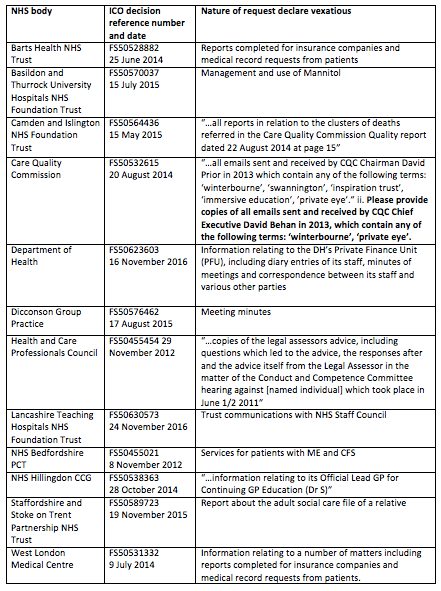
INSERT 3

Variation over time

There has not been great variation over time, save for the last financial year, which saw an upward swing in both the numbers of total complaints and upheld complaints, and the proportion of upheld complaints:
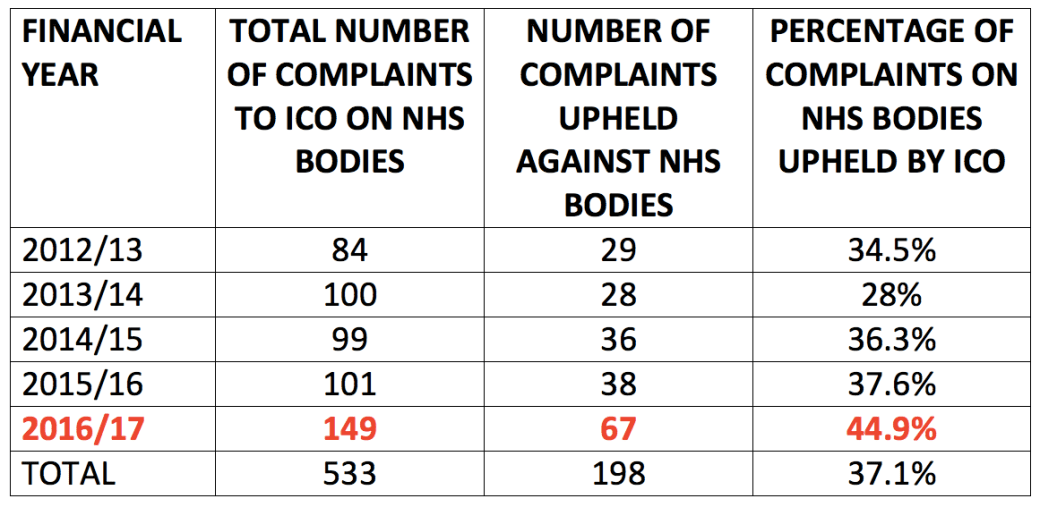
INSERT 4

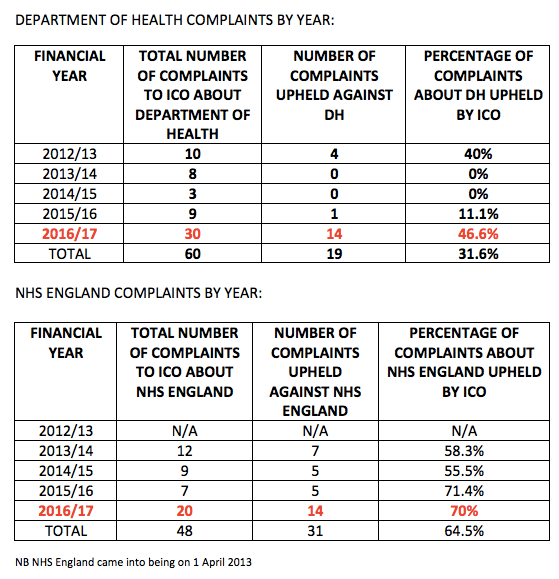
In this last turbulent year which saw the junior doctors’ contract dispute, the Department of Health and NHS England together accounted for one third (50 of 149) of all complaints against the NHS and 42% (28 of 67) of all upheld complaints against the NHS.

Similarly, examination of complaints against the Department of Health and against NHS England over the last 5 years shows spikes in 2016/17. 13


Type of NHS bodies complained against

The complaints to the ICO related to 95 NHS bodies, which break down as follows:
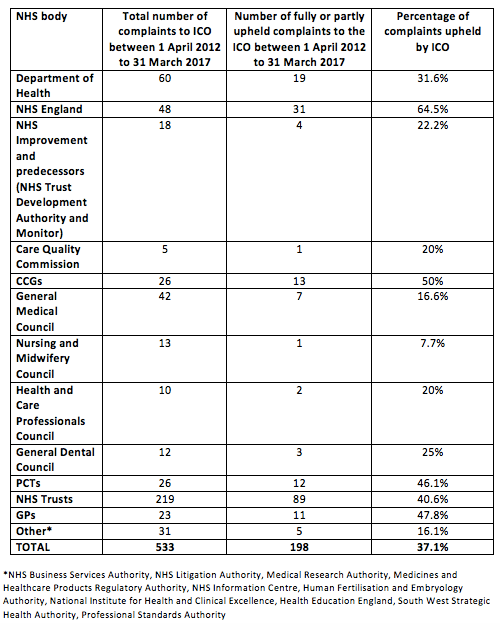
INSERT 5

Health and Safety Executive (HSE) and PHSO

For completeness, although the HSE and PHSO are not strictly speaking part of the NHS, they are – in theory – an important part of NHS oversight, and they are supposed to support transparency.

However, they too have been the subject of unfavourable ICO decisions.
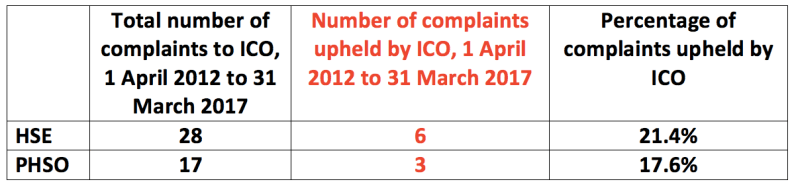
INSERT 6

None of the upheld complaints about the PHSO and HSE related to the Health Service.

However, five of the complaints about the PHSO that were not upheld by the ICO related to medical advisors, who are used on an anonymous basis by the PHSO. 14

Of course, in the tangled regulatory undergrowth, the PHSO has a reciprocal remit to investigate complaints about the ICO.

In 2014 PHSO disclosed via FOI that it had fully or partly upheld a total of 9 out of 739 complaints received about ICO, in the 9 years between 1 April 20015 and 31 March 2014.

That’s a one a year – or 1.2%.
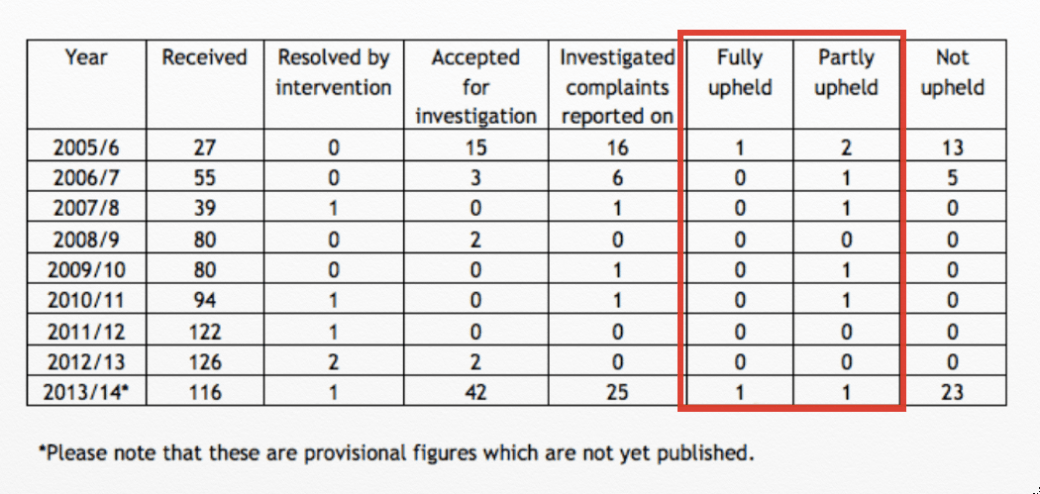
Complaints about ICO upheld by PHSO

PHSO FOI disclosure 29 May 2014, Ref. FDN-190468:

https://www.whatdotheyknow.com/request/has_the_phso_ever_upheld_a_compl


In 2015/16, the PHSO investigated eleven of 120 complaints received about the ICO, and upheld or partly upheld two of these complaints. 15

The circularity and inherent conflicts in the system raise questions about objectivity.


Repeat offenders

The ICO received between one and 32 upheld complaints on each of the 95 NHS bodies that were subject to complaints, with an average number of 2 upheld complaints per body.

These are the NHS bodies which attracted the highest number of upheld complaints to ICO:
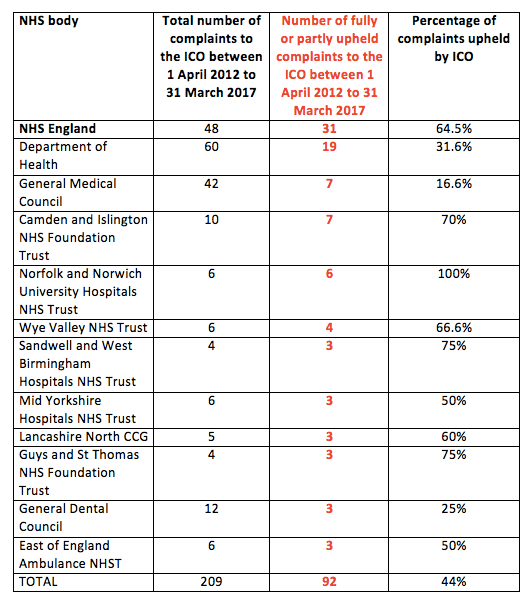
INSERT 7

In other words, 11.6% (11) of the 95 bodies accounted for 39.2% (209 0f 533) of all complaints, and 46% (92 of 198) of all upheld complaints.

This group of 11 repeat offenders had a higher ICO uphold rate than average: sub-group average 44.3% vs the overall average of 37.1%.

Despite being in existence for only four of the five years, NHS England attracted the second highest number of total complaints (48), and the highest number of upheld complaints (31).

Even allowing for two legacy PCT cases that are included in these 31 upheld complaints , NHS England remains top of the league.


NHS England: the silent treatment

 An examination of the 31 upheld complaints against NHS England reveals a tendency to ignore FOI requests (11 cases) or stall with assurances and apologies for delay, but without any response materialising (six cases) or to be tardy (five cases).

Extraordinarily, in five cases where NHS had failed to respond at all or to respond substantively, the failure continued even after ICO intervention.

This bloody mindedness may be explained by the politically sensitive nature of the information requested in several of these cases:
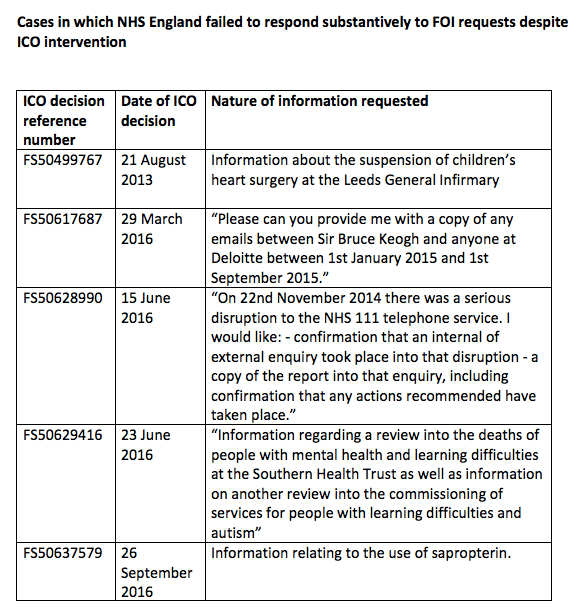
INSERT 8


Department of Health: State Secrets

 Examination of the 19 upheld complaints against the Department of Health shows some examples of exemption carpet bombing, and a rather absurd readiness to claim State Secrets.

In one case (Ref. FS50406024) 16 the Department claimed the following exemptions under the FOIA:

Section 21– Information reasonably accessible to the applicant by other means 17

Section 23 – Security bodies 18

Section 24 – Safeguarding national security 19

Section 27 – International relations 20

Section 35(1)(a) and (d) – Government policy – formulation and development of government policy, operation of ministerial private office 21

Section36 – Prejudice to the effective conduct of public affairs 8

Section 38 – Health and Safety of any individual 22

Section 40(2) – Personal data of others 9

Section 41 – Information provided in confidence 7

Section 44 – Disclosure of the information is prohibited under any enactment 23

So what prompted this barrage of resistance? Answer: “a request for ministerial diaries”.

The ICO to its credit swept aside most of the Department of Health’s exemptions:

The Commissioner’s decision is that the DoH has correctly applied section 23 and section 40(2) where relied upon to make the relevant redactions. However the Commissioner considers that the DoH incorrectly applied the other exemptions.”

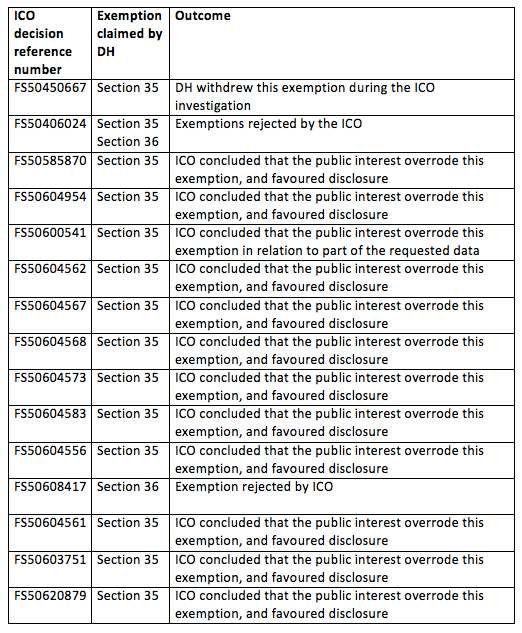
In fact, the ICO rejected the Department of Health’s claims of ministerial privileges and prejudice to the conduct of public affairs on 13 occasions in the five years in question:
INSERT 9

An interesting detail revealed by ICO decision notices against the Department of Health is that Ministers are rather wont to hold meetings without minutes:

  • There were no minutes of five meetings between Jeremy Hunt and Boots Alliance, Royal College of Surgeons, Price Waterhouse Coopers, Academy of Medical Royal Colleges, “a group of health organisations” (cases FS50604562, FS50604567, FS50604573, FS50604583, FS50604561)
  • There were also no minutes of two meetings between the Parliamentary Under Secretary of State at the Department of Health and the General Medical Council, the Royal College of Surgeons (cases FS50604568, FS50604556).

One could be forgiving for wondering if this practice is to avoid being held to account under FOI.


Closing ranks on the hottest potatoes?

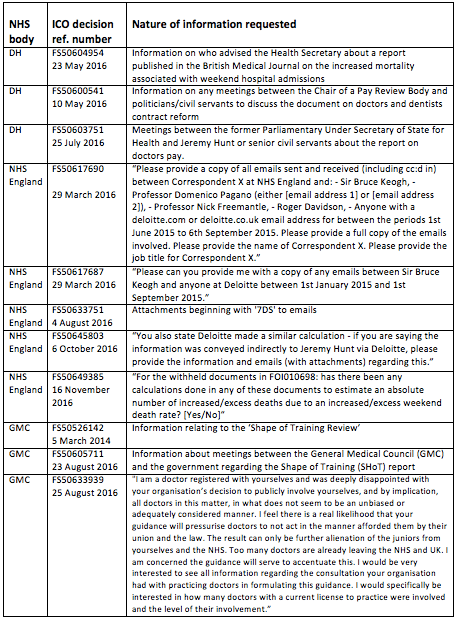
Amongst the complaints against the NHS that were upheld by the ICO, there were 11 cases in which information had been requested about junior doctors’ training and their industrial dispute and related issues of weekend deaths, but resisted by the Department of Health, NHS England and the GMC:
INSERT 10

So, in conclusion, do we believe Mr Jeremy Hunt when he claims that he is building the safest and most transparent health service in the world?
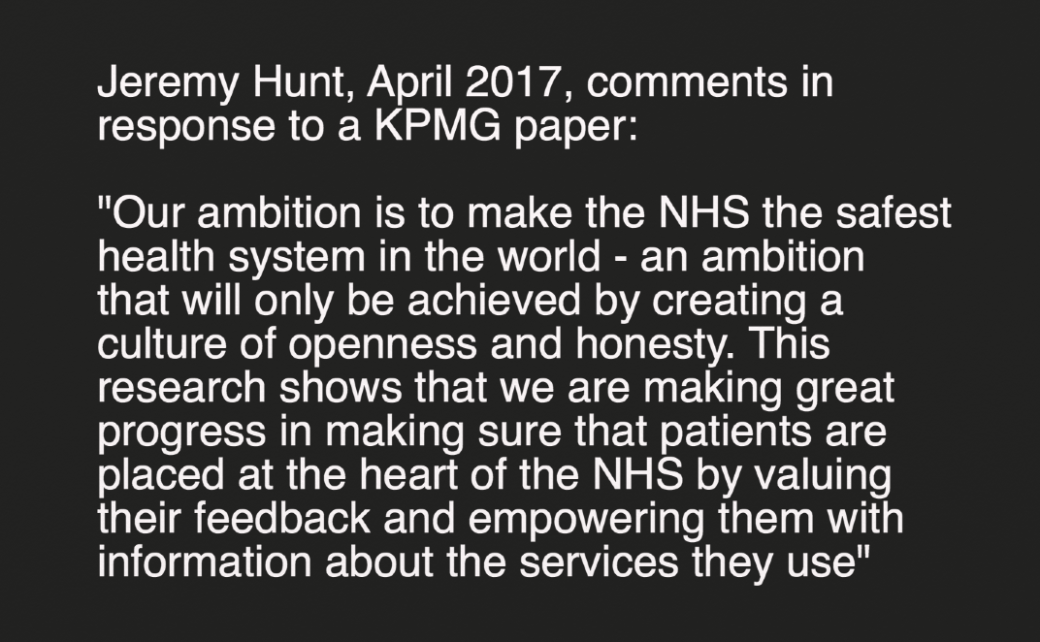
Hunt KPMG comments


REFERENCES
1
In 2015, the government set up the Commission on Freedom of Information
REFERENCES

https://www.gov.uk/government/publications/independent-commission-on-freedom-of-information-report

This is a submission by the National Union of Journalists:

https://minhalexander.com/wp-content/uploads/2017/04/nuj-foi-submission-2015.pdf

The union also opposes introducing charges for the supply of information, expanding the basis for refusing requests, strengthening powers to deny access to certain types of information and any potential redundancies among those who are currently employed to respond to requests for information. Furthermore, we are concerned about the composition of the existing Commission because it excludes working journalists and civil society representatives. This implies the FOI requester’s perspective has not been considered within the deliberations so far. “

2 FOI costs, sure – but nowhere near as much as PR, FOI Man (Paul Gibbons) 9 October 2015

https://www.foiman.com/archives/2072

3 Labour’s denial machine over hospital death rates, Steven Swinford, Laura Donnelly, Patrick Sawer, Telegraph 14 July 2013

http://www.telegraph.co.uk/news/health/heal-our-hospitals/10178552/Labours-denial-machine-over-hospital-death-rates.html

4 ICO annual reports 2014/15, 2015/16

https://ico.org.uk/about-the-ico/our-information/annual-reports/

5 ICO Audit outcomes analysis, NHS, 2012

https://minhalexander.com/wp-content/uploads/2016/09/ico-outcomes-report-nhs-2012.pdf

6 Section 43 exemption: Commercial interests:

https://ico.org.uk/media/for-organisations/documents/1178/awareness_guidance_5_v3_07_03_08.pdf

7 Section 41 exemption: Information provided in confidence

https://ico.org.uk/media/for-organisations/documents/1432163/information-provided-in-confidence-section-41.pdf

8 Section 36 exemption: Prejudice to effective conduct of public affairs

https://ico.org.uk/media/for-organisations/documents/1175/section_36_prejudice_to_effective_conduct_of_public_affairs.pdf

9 Section 40 exemption: Personal information

https://ico.org.uk/media/for-organisations/documents/1213/personal-information-section-40-and-regulation-13-foia-and-eir-guidance.pdf

10 Section 14 exemption: Vexatious requests

https://ico.org.uk/media/for-organisations/documents/1198/dealing-with-vexatious-requests.pdf

11 ICO decision against a claim by CQC that an FOI request about various matters, including Winterbourne View, was ‘vexatious’

https://ico.org.uk/media/action-weve-taken/decision-notices/2014/1021508/fs_50532615.pdf

12 ICO decision against a Department of Health claim that an FOI request about the activities of its Private Finance Unit was ‘vexatious’

https://ico.org.uk/media/action-weve-taken/decision-notices/2016/1625413/fs_50623603.pdf

13 Upwards swings in 2016/17 in the number of complaints about DH’s and NHS England’s responses to FOI requests:
INSERT 11

NB NHS England came into being on 1 April 2013

14 ICO decisions about FOI requests to the PHSO about its medical advisors

https://ico.org.uk/media/action-weve-taken/decision-notices/2014/946440/fs_50512530.pd

https://ico.org.uk/media/action-weve-taken/decision-notices/2015/1043305/fs_50553963.pdf

https://ico.org.uk/media/action-weve-taken/decision-notices/2015/1432039/fs_50566223.pdf

https://ico.org.uk/media/action-weve-taken/decision-notices/2015/1560287/fs_50576766.pdf

https://ico.org.uk/media/action-weve-taken/decision-notices/2017/1625855/fs50643432.pdf

15 PHSO report: Complaints about UK governments and agencies, and some UK public organisations 2015/16

https://www.ombudsman.org.uk/sites/default/files/Complaints_about_parliamentary_departments_2015-16.pdf

16 ICO decision notice in the case where the Department of Health claimed 11 different categories of exemptions, of which only two were upheld by the ICO:

https://ico.org.uk/media/action-weve-taken/decision-notices/2013/812324/fs_50406024.pdf

17 Section 21 exemption – Information reasonably available to applicant by other means

https://ico.org.uk/media/for-organisations/documents/1203/information-reasonably-accessible-to-the-applicant-by-other-means-sec21.pdf

18 Section 23 exemption– Security bodies

https://ico.org.uk/media/for-organisations/documents/1182/security_bodies_section_23_foi.pdf

19 Section 24 exemption– Safeguarding national security

https://ico.org.uk/media/for-organisations/documents/1174/safeguarding_national_security_section_24_foi.pdf

20 Section 27 exemption – International relations

https://ico.org.uk/media/for-organisations/documents/1184/awareness_guidance_14_-_international_relations.pdf

21 Section 35 exemption – Government policy

https://ico.org.uk/media/for-organisations/documents/1200/government-policy-foi-section-35-guidance.pdf

22 Section 38 exemption– Health and Safety of any individual

https://ico.org.uk/media/for-organisations/documents/1624339/health-and-safety-section-38-foia.pdf

23 Section 44 exemption– Prohibitions on disclosure

https://ico.org.uk/media/for-organisations/documents/1186/section-44-prohibitions-on-disclosure.pdf



Jon Andrewes fraud: NHS Improvement responds

Dr Minh Alexander NHS whistleblower and former consultant psychiatrist 11 April 2017

Jon Andrewes the Chair of an NHS trust was jailed last month for a bizarre fraud, in which he secured senior NHS jobs, after faking his CV. 1

Very embarrassingly, he fooled NHS regulators – NHS Improvement and its predecessor the NHS Trust Development Authority – who were directly responsible for two of his board level appointments to three NHS trusts. 2

Grotesquely, Andrewes was even for a period the Freedom To Speak Up Guardian for Devon Partnership NHS Trust,  with responsibility for receiving sensitive information about wrongdoing and failures.

Additionally, Andrewes was a member of Devon Partnership’s Audit Committee, which has a special responsibility for corporate governance and ensuring the proper handling of concerns about wrongdoing.

Devon Partnership has stated that in appointing Andrewes to its audit committee: “The Trust would have been appraised of his [Jon Andrewes’] relevant skills, experience etc via the appointment process led by NHS Trust Development Authority.3

NHS Improvement was asked via an FOI request to account for its part in the Andrewes fiasco. This is NHSI’s response:

Click to access nhs-improvement-foi-response-re-jon-andrewes-11-04-2017.pdf

Extraordinarily, NHSI claims that it (or more accurately, its predecessor) did not check Jon Andrewes’ qualifications when it appointed him as a Non Executive Director at Devon Partnership because the Fit and Proper Persons Regulation 4 had not come into force.

NHS Improvement did not carry out a check of the qualifications Mr Andrewes claimed to hold in his application for the role of non-executive at Devon Partnership NHS Trust. At that point in time, the Health and Social Care Act 2008 (Regulated Activities) Regulations 2014 (“the fit and proper person regulations”) had not come into force, and the additional checks we now carry out were not undertaken.”

This is a baffling claim as one would have expected that common sense and good practice would have prevailed long before the 2014 Fit and Proper Regulations were a twinkle in the Department of Health’s eye.

NHSI also insists:

“As you see, he was well known to the NHS with a strong performance history.” 

This is open to question not least as NHSI also reveals that it relied upon assurance evidence from Andrewes himself:

Appraisals provided from previous non-executive roles including his self-assessment and appraisal documentation as Acting Chair of Torbay & Southern Devon Health and Care NHS Trust for the period 2013-14”

 “Written confirmation from Mr Andrewes that he is a “fit and proper person” 

The truth is, the whole affair reeks of club culture and of beliefs that people above a certain level of seniority in the NHS are beyond question.

Jeremy Hunt himself set an appalling example of this sort of behaviour when he previously made a claim that a CQC Chief Inspector was “beyond question”. 5

These are the attitudes that contribute to managerial impunity for suppression of and reprisal against NHS whistleblowers.

Nevertheless, NHSI indicates that it is “currently considering its approach” to checking candidates’ qualifications.

Worryingly, NHSI discloses that it was aware of intelligence about Andrewes’ suspected fraud for three months before it informed the two trusts for which he was respectively Chair and Non-Executive Director.

NHSI says it was informed by the Department of Health Anti-Fraud Unit on 14 July 2016 that there were concerns about the validity of Andrewes’ qualifications and purported career history.

NHSI says it did not inform Royal Cornwall Hospitals NHS Trust and Devon Partnership NHS Trust (nor Torbay and South Devon NHS Foundation Trust for that matter) until October 2016.

Interestingly, NHSI’s account of events does not tally with Devon Partnership NHS Trust’s account.

Devon Partnership Trust has stated that it was not informed of concerns about Jon Andrewe’s fraudulent CV until “15 December 2016” and that it was not informed by NHSI, but “via the NHS Fraud team”. 2

Further clarifications will need to be sought to explain this variance in ‘facts’ between the Devon Partnership and NHSI.

Lastly, NHSI has refused to disclose correspondence between itself and the Department of Health about Andrewes, claiming a Section 31 exemption:

Section 31(1)(a), (b) and (c) of the FOI Act provides information is exempt from disclosure if its disclosure would, or would be likely to, prejudice the prevention or detection of crime, the apprehension or prosecution of offenders or the administration of justice.” 

NHSI maintains that the public interest does not override this consideration.

How convenient.


RELATED ITEMS

CQC: A Chief Inspector DOESN’T call

Regulation 5, Fit and Proper Persons: Dissecting CQC’s Dissembling

The unfair sacking of Andrew Smith, NHS whistleblower and trade union representative. A heady cocktail of tainted ingredients. Or how CQC, NHS Improvement & Mid Essex Hospital Services NHS Trust worked together on FPPR.

Just Culture: Sanctions for whistleblower suppression and reprisal


REFERENCES

1 Lying Royal Cornwall Hospital Trust boss who was actually a builder is jailed, L Barton, Cornwall Live, 6 March 2017

http://www.cornwalllive.com/royal-cornwall-hospital-trust-chairman-jailed-after-lying-about-qualifications/story-30183474-detail/story.html

 “He claimed he had a first-class undergraduate and masters degree at the University of Bristol and a masters in business administration at Edinburgh University, the court heard. He also said he studied for PhDs at Plymouth and Heriot-Watt universities, provided an employment history and said he was a partner at a technology firm.

In addition, he lied about working for the Home Office and said he was employed as an executive officer at HMRC in 1969 – despite the fact he would have been just 16 at the time.

Official records show he was employed as a social worker, probation officer and builder”

2 Jon Andrewes was appointed to Devon Partnership NHS Trust by the NHS Trust Development Authority as a Non Executive Director, and appointed to Royal Cornwall Hospitals NHS Trust as Chair by NHS Improvement.

3 FOI disclosure by Devon Partnership NHS Trust 6 April 2017

https://minhalexander.com/wp-content/uploads/2017/03/devon-partnership-jon-andrewes-foi-response-6-04-2017-325.pdf

4 Health and Social Care Act 2008 (Regulated Activities) Regulations 2014

http://www.legislation.gov.uk/ukdsi/2014/9780111117613/regulation/5

Fit and proper persons: directors

5.—(1) This regulation applies where a service provider is a health service body.

(2) Unless the individual satisfies all the requirements set out in paragraph (3), the service provider must not appoint or have in place an individual—

(a)as a director of the service provider, or

(b)performing the functions of, or functions equivalent or similar to the functions of, such a director.

(3) The requirements referred to in paragraph (2) are that—

(a)the individual is of good character,

(b)the individual has the qualifications, competence, skills and experience which are necessary for the relevant office or position or the work for which they are employed,

(c)the individual is able by reason of their health, after reasonable adjustments are made, of properly performing tasks which are intrinsic to the office or position for which they are appointed or to the work for which they are employed,

(d)the individual has not been responsible for, been privy to, contributed to or facilitated any serious misconduct or mismanagement (whether unlawful or not) in the course of carrying on a regulated activity or providing a service elsewhere which, if provided in England, would be a regulated activity, and

(e)none of the grounds of unfitness specified in Part 1 of Schedule 4 apply to the individual.

(4) In assessing an individual’s character for the purposes of paragraph (3)(a), the matters considered must include those listed in Part 2 of Schedule 4.

(5) The following information must be available to be supplied to the Commission in relation to each individual who holds an office or position referred to in paragraph (2)(a) or (b)—

(a)the information specified in Schedule 3, and

(b)such other information as is required to be kept by the service provider under any enactment which is relevant to that individual.

(6) Where an individual who holds an office or position referred to in paragraph (2)(a) or (b) no longer meets the requirements in paragraph (3), the service provider must—

(a)take such action as is necessary and proportionate to ensure that the office or position in question is held by an individual who meets such requirements, and

(b)if the individual is a health care professional, social worker or other professional registered with a health care or social care regulator, inform the regulator in question.

5 Hunt praises ‘courageous’ Professor Field after GPC calls for resignation, Alex Matthews-King, Pulse 18 December 2015

http://www.pulsetoday.co.uk/your-practice/regulation/hunt-praises-courageous-professor-field-after-gpc-calls-for-resignation/20030755.article

‘A former GP and president of the royal college, his credibility is beyond question, and we absolutely back his independent judgements as chief inspector.’


Engineered failure to investigate NHS whistleblowers’ concerns

By Dr Minh Alexander NHS whistleblower and former consultant psychiatrist 8 April 2017

There is a big hole at the heart of NHS whistleblowing governance that is most likely there by design.

In reality, it’s nobody’s job to investigate whistleblowers’ concerns.

Of course, employers are supposed to.

But no one makes them do so.

Current UK whistleblowing law, the Public Interest Disclosure Act (PIDA) 1 , does not compel them to do so.

Instead, PIDA is focused on employment disputes. 2 This only serves to support poor employers’ main tactic of hiding whistleblowers’ concerns by focussing on – and sometimes manufacturing – employment disputes.

NHS regulators pay lip service to the need for investigation of concerns, but very often look the other way when whistleblowers report failures by their employers. 3

For good measure, the NHS regulator the Care Quality Commission also repeatedly maintains that it has no remit to investigate individual whistleblowers’ concerns. 4

When the government was embarrassed into ‘doing something’ about recurrent NHS whistleblower scandals, it came up with local Freedom to Speak Up Guardians and the National Freedom to Speak Guardian. Unsurprisingly, they too were specifically designed not to investigate whistleblowers’ concerns. 5

Sir Robert Francis, through his report of the Freedom to Speak Up Review, left investigation firmly in the hands of employers. 6

This was with a fig leaf proviso that employers could arrange external investigation where appropriate. 7 But investigations commissioned by and paid for by employers are hardly guaranteed to be independent.

There have been too many examples of such ‘independent’ investigations that proved to be little more than public relations exercises.


Spiv .png


As a typical example, NHS whistleblower Hayley Dare reported that she was offered an ‘independent’ investigation by her former chief executive, but discovered that the investigator was in fact her employer’s solicitors’ hireling.

NHS whistleblower Hayley Dare’s statement to the Employment Tribunal:

https://www.dropbox.com/home?preview=Hayley+Dare+Witness-Statement.pdf

Hayley Dare Capsticks investigator

So, was this edifice of non-investigation arrived at by pure accident and incompetence?

That is most unlikely. Those clever folks at Whitehall know that investigation of whistleblowers’ concerns – about matters for which the government is ultimately responsible – is crucial to the public interest and to protecting whistleblowers.

Power protects itself. It follows then that if the status quo is to be maintained, investigation of concerns must be resisted and potential political embarrassment contained.

Genuine reform requires an enforceable legal duty upon employers to properly investigate whistleblowers’ disclosures.

Will the much criticised National Guardian help ensure that concerns are investigated? Unlikely. Her current position is that her office will not seek law reform 8 and her office has quickly become part of the problem.

Will the just-launched Healthcare Safety Investigation Branch (HSIB) fully discharge its remit to ensure good investigative practice in the NHS 9 10 11, including of whistleblowers’ concerns?

After all, the Department of Health promised us:

The Service [HSIB] will have the capacity to investigate only a small proportion of the many safety incidents that occur each year, and therefore a key part of its role will be to champion the need for good quality local investigations and lead on approaches that will enhance the capabilities of providers to conduct their own investigations. 9

I’ve seen little sign so far of serious interest and expertise at HSIB regarding whistleblowing. HSIB resisted meaningful engagement on whistleblowing and a meeting was only offered after lengthy correspondence.

I have put it to HSIB that it should closely examine failures to investigate whistleblowers’ concerns, and that it needs to openly consult with whistleblowers to tap into an important part of the NHS organisational memory on cover ups.

However, at the time of writing, there is no confirmation from HSIB that it will do so.

Also, HSIB indicated that it would publish its protocols for “dealing with whistleblowers” and repeatedly refused to share this material prior to publication. However, when HSIB became operational on 1 April and published its materials, I could find no specific documents on whistleblowing.

HSIB has also not yet responded to repeated questions about how it will discharge its Prescribed Person functions under the Public Interest Disclosure Act. HSIB has not even acknowledged its status as a Prescribed Person, which it must certainly have given that it is currently constituted as part of NHS Improvement, a Prescribed Person.

This is the relevant correspondence, which includes agreed records of a telephone meeting with the head of the HSIB intelligence unit about these matters on 24 March 2017.

Click to access hsib-correspondence-on-whistleblowing-records-of-meetimg-24-03-2017.pdf

HSIB’s hesitance to embrace whistleblowers is perhaps not surprising given that it seems to be under the DH thumb: a DH Deputy Director is currently seconded to HSIB as HSIB’s Director of Corporate Affairs.

Despite this DH embedment, HSIB claims:

HSIB independence website 7.04.2017

Do note that HSIB seems to be whittling down its already restricted quota of 30 investigations a year. The official, public HSIB wording is up to 30 healthcare safety incidents in England each year”. The conversation with HSIB on 24 March reveals that the intention is to carry out 25 investigations.

Until the gaping investigative breach – that literally swallows whistleblowers whole – is closed by effective law and a willing enforcement structure, expect more whistleblowing failures.


RELATED ITEMS

(1) Edna’s Law, proposed by the campaigning charity Compassion in Care, seeks to enforce investigation of whistleblowers’ concerns:

http://www.compassionincare.com/node/162

(2) https://minhalexander.com/2017/03/03/white-elephants/

(3) https://minhalexander.com/2017/03/12/national-guardian-behan-replys/


REFERENCES

1 Public Interest Disclosure Act 1998

http://www.legislation.gov.uk/ukpga/1998/23/contents

2 The Public Interest Disclosure Act does not protect whistleblowers and only gives them the right to sue for compensation after they have been harmed. It does not include any requirement upon employers to investigate concerns.

3 Whistleblowers unheard by the CQC. Alexander, Linton, Sardari and a fourth NHS whistleblower, December 2016 https://minhalexander.com/2016/12/05/whistleblowers-unheard-by-cqc/

4 Complaints matter, CQC report December 2014

https://minhalexander.com/wp-content/uploads/2016/09/cqc-20141208_complaints_matter_report.pdf

“People [whistleblowers] with historic cases also contact CQC in the hope that we can help resolve their concerns or hold a provider to account for its actions. While each case provides learning for us about the problems that can occur, and how we need to mould our new methods of inspection to detect similar problems and take effective action, we do not have the remit to resolve an individual case. As with complaints, we believe there is a regulatory gap in this area and we welcome the Freedom to Speak Up review, including its focus on historic cases.”

5 Robert Francis’ report of the Freedom to Speak Up Review February 2015

Click to access F2SU_web.pdf

Page 19:

78 The INO [National Guardian] will have discretion to consider how an existing case is being or has been handled, and to advise an organisation on any actions they should take to deal with the issues raised. The officer would need to operate in a timely, non-bureaucratic way. He/she would not take on the investigation of cases themselves, but would challenge or invite others to look again at cases and would need sufficient authority to ensure that any recommendations made were taken seriously and acted upon.”

Page 169:

“7.6.13 I want to emphasise that I am not proposing an office to take over the investigation of concerns. As I have already said, this needs to remain the responsibility of the local organisations.”

“7.6.17 The INO would in essence fulfil a role at a national level similar to the role played by effective Freedom to Speak Up Guardians locally. They would not take on cases themselves, but could challenge or invite others to look into cases which did not appear to have been handled in line with good practice or where it appeared that a person raising a concern had experienced detriment as a result of raising the concern.”

6 Robert Francis’ report of the Freedom to Speak Up Review February 2015

Click to access F2SU_web.pdf

Page 167:

7.6.2 There was considerable discussion in the written contributions about the potential role of an independent body to manage disclosures by whistleblowers. Some contributors were supportive of this option, others were unsure but thought it at least worthy of consideration. Most of the reasons given in support of this idea were related to mistrust of managers and internal processes which led to concerns that treatment of whistleblowers would be biased and prejudicial. “ Trusts cannot be left to mark their own homework.” 7.6.3 We were also told about the risks associated with establishing such a body. In particular, removing responsibility for dealing with the concern from local level to a more remote organisation could create delays, affect local ownership of issues, and require the establishment of potentially bureaucratic systems to allow the external organisation to investigate concerns. Equally importantly, there would be a real risk that serious patient safety issues may not be addressed sufficiently quickly locally, if someone reported them to an external body for investigation rather to their own organisation

7.6.3 We were also told about the risks associated with establishing such a body. In particular, removing responsibility for dealing with the concern from local level to a more remote organisation could create delays, affect local ownership of issues, and require the establishment of potentially bureaucratic systems to allow the external organisation to investigate concerns. Equally importantly, there would be a real risk that serious patient safety issues may not be addressed sufficiently quickly locally, if someone reported them to an external body for investigation rather to their own organisation.

7.6.4 These risks seem to me to be powerful arguments. It is certainly not my intention to propose anything which could in fact make the practical handling of patient safety concerns more complex rather than less so. I am therefore not minded to propose establishment of an external body to consider and investigate concerns. Primary responsibility for investigating concerns should remain with the local organisation taking into account the good practice set out in 6.4.”

7 Robert Francis’ report of the Freedom to Speak Up Review February 2015

Click to access F2SU_web.pdf

Page 25:

Principle 8

Investigations: When a formal concern has been raised, there should be prompt, swift, proportionate, fair and blame-free investigations to establish the facts. 

Action 8.1: All NHS organisations should devise and implement systems which enable such investigations to be undertaken, where appropriate by external investigators, and have regard to the good practice suggested in this report.”

8 Letter from Henrietta Hughes National Freedom to Speak Up Guardian 16 February 2017

9 Learning not Blaming. Department of Health, July 2015

https://www.gov.uk/government/uploads/system/uploads/attachment_data/file/445640/Learning_not_blaming_acc.pdf

10 The National Health Service Trust Development Authority (Healthcare Safety Investigation Branch) Directions 2016

https://www.gov.uk/government/uploads/system/uploads/attachment_data/file/514217/HSIB_directions.pdf

11 Healthcare Safety Investigation Branch, website: http://www.hsib.org.uk/

“We investigate up to 30 health safety incidents each year in order to provide meaningful safety recommendations. We share what we learn across the whole of the healthcare system for the benefit of everyone who is cared for by it and works in it.

In this way, we can raise standards, improve patient safety and support learning across the healthcare system in England.

In essence we are here to:

  • conduct thorough, independent, impartial and timely investigations into clinical incidents
  • engage patients and relatives, NHS staff, and medical organisations in the investigation process
  • treat the patients and relatives of incidents sympathetically and help them understand ‘what happened?’ and what’s being done to prevent similar events in the future
  • produce clearly written, thorough and concise reports with well-founded analysis and conclusions that explain the circumstances and causes of clinical incidents without attributing blame
  • make safety recommendations to improve patient safety
  • improve patient safety by sharing the lessons learned from investigations as widely as possible
  • raise the standard of local investigations of healthcare safety incidents by establishing common standards and skills development

In the future, we will act as global ambassadors for safety investigations.”


At the NHS Improvement Soup Kitchen

By Dr Minh Alexander NHS whistleblower and consultant psychiatrist 26 March 2017

NHS Improvement held a workshop on the design of its whistleblower employment support scheme for trust whistleblowers, on 24 March 2017. It was co-facilitated by two members of of Patients First, with Chatham House rules agreed.

In brief, there is little sign of serious help on the horizon. In fact, we were told that the service may be diluted if there are many applicants and or if the scheme is expanded to re-deployment of whistleblowers still employed by the NHS, on the same budget.

The NHS whistleblower employment support scheme is another unlovely love child of Robert Francis’ assignation with the Department of Health, under the blanket of the Freedom to Speak Up Review.

Note that it is not a re-employment scheme, but only an employment support scheme.

The scheme does not provide jobs, but support to find jobs. 1

The scheme is not designed to deliver robust justice to badly harmed whistleblowers.

With due respect to individuals on the regulatory shop floor doing their best with a flawed remit and scant resources, the scheme is just more ministerial PR tinsel.

Over a year ago exiled whistleblowers traipsed to a similar workshop hosted by NHS England, which has responsibility for primary care whistleblowers.

After this, the NHS England board assigned a budget of only £250K and NHS England slowly rolled out a small pilot.

No formal report has been published about NHS England’s pilot, but at the workshop on Friday we were informed that there had been only eight applicants, as a number of whistleblowers who expressed interest decided not to apply. The scheme coordinator thought this was because the scheme did not do what whistleblowers wanted.

Will NHS England take this on board and change its scheme, so that it provides what whistleblowers want (ie. Jobs)? No, was the answer.

But nevertheless, NHS England will purchase formal, external evaluation of the scheme. And in response to questioning, we were assured that whistleblowers will be involved in designing this through an open process, and that the evaluation will include the experience of whistleblowers who decided not to apply.

It became evident that NHS England has a “decision template” for the panels that judge whistleblower applications, but it does not have a written protocol setting out how the panels should weigh evidence or make decisions.

At the NHS England workshop last year, it was put to NHS England that the burden of proof should rest with the NHS to prove that whistleblowers are not fit, as opposed to whistleblowers having to prove that they are fit. This is on the basis that the government has accepted that the body of whistleblowers consists of individuals who have been unfairly pushed out, through no fault of their own.

This suggested burden of proof has not so far been reflected in NHS England’s documents. However an NHS England manager and panellist, who presented at the workshop assured, us that this is broadly the approach that has been taken in practice, and that the presumption has been in whistleblowers’ favour. All eight applicants were accepted for the scheme.

We were advised that better guidance for panels will now be drafted and include specific criteria to be taken into account when any past allegations against whistleblowers are evaluated. For example, whether the chronology of events suggest that allegations against whistleblowers were reprisal for raising concerns, and whether whistleblowers’ performance was maliciously and implausibly downgraded by employers in response to whistleblowing.

NHS Improvement has been dawdling at the back of the whistleblower employment class, allegedly because of its internal reorganisation. It promised to start it scheme sometime last year. It did not do so and was decidedly tetchy when asked for information about progress, treating requests as FOIs and ducking out of answering on silly technical exemptions.

NHS Improvement was asked at the workshop about its progress on establishment of a proposed pool of employers willing to employ whistleblowers. We learnt that a discussion was recently held with some 15-20 or possibly more trust employers, but that things are at an early stage.

NHS Improvement now clarifies that it has not yet set a budget for the scheme. But after questions, both NHS Improvement and NHS England disclosed on 24 March that they have set a ceiling of £10K expenditure per whistleblower case. It was said that the support provided may vary according to individual need and preference, but could include liaison with prospective employers, mediation with a past employer for a reference, coaching and help with interview and job application skills, training or other help to find alternative employment outside of the NHS. The scheme will not be fully operational immediately but will start with only a pilot of a limited number of whistleblowers (the currently proposed number is ten whistleblowers).

It is of course worth pointing out that a flat rate of £10K per person is not a personalised approach. One official acknowledged to me that this amount would in no way suffice to re-skill say, a surgeon.

Most worryingly, we were told that there might be dilution of this service depending on

  • The number of applicants – we were asked to mull over whether a better service should be given to a smaller number of whistleblowers, or whether the service should be spread out amongst a larger number of people.
  • Shockingly, it was also casually mentioned that the budget for helping exiled whistleblowers might be spread thinner if there was a decision to add a redeployment service for whistleblowers who are still in employment. The best bit was….this redeployment service might be needed especially as there are multiple reports that the trust Speak Up Guardians are not proving sufficiently effective in preventing harm to whistleblowers.

How dysfunctional can you get? The government committed millions of precious public money to a flawed National Guardian office and non-evidence based local Guardian model, and when these are failing as expected, it is the most severely harmed, exiled whistleblowers who are expected to pick up the tab for this inexcusable waste and inefficiency.

It is totally unacceptable to put whistleblowers in the position of choosing whether they want their gruel thin…or extra thin.

There are also other important issues which are far from resolved, such as the disadvantage to gagged whistleblowers who cannot defend themselves properly for the purposes of accessing the scheme. Also, a question was raised about issues of due diligence in not exposing whistleblowers who have been harmed to more abusive employers, given the propensity of some NHS organisations to merely say the right things to gain regulatory favour. Of relevance to this, it recently emerged that a senior manager who had been a Freedom to Speak Up Guardian was recently jailed.

Both NHS England’s existing application form and NHS Improvement’s draft protocol contain an objectionable passage which precludes discussion of how the NHS treated the whistleblower2. This is very clearly unworkable if the whistleblower needs to present evidence about false allegations that they have suffered if these present a continuing barrier to employment.

In all, there was serious concern and anger expressed by whistleblowers who attended the workshop. Some comments are not reportable. Some commented to me that they didn’t know what planet NHS Improvement and NHS England were on. One person injected a note of reality and urgency at the workshop by reminding officials that they were worried about feeding their children that night.

As far as I could see, there was a unanimous show of hands by whistleblowers in the audience in favour of a needs led approach ie. a scheme that is properly resourced to provide all of the whistleblowers who need help all of the help that each person needs.

The NHS has a moral duty to fix what it broke. It also needs to send an unequivocal message that it will no longer cause, aid and abet or walk past serious harm to whistleblowers.

I have suggested that if the government is serious, it should disband the ineffective trust Guardian network and use the money saved to help fund a real employment scheme.

The scheme should include paid jobs and highly supported, graduated and safe re-entry for whistleblowers. It could be done if the government really wanted to.

As was pointed out at the workshop, the NHS demonstrates that it is quite capable of shifting itself when it recycles seriously erring managers at the drop of a hat.

We need serious, responsible policy not ‘cruel gruel’ or disingenuous barrow boy schemes from the Department of Health.

But then again, how would anyone feel about working again for an abusive employer who has still not delivered a fully operational re-employment support scheme two years after it was first promised? There are official and there are unofficial messages.


NEXT STEPS

NHS Improvement is looking for expressions of interest in terms of

  • Trust whistleblowers who want to apply to its pilot scheme
  • Whistleblowers who are willing to help review and develop documents
  • Whistleblowers who might be willing to sit on application panels (these will be comprised of a manager, a whistleblower and a professional of matched professional background to the applicant).

NHS Improvement has also agreed to consider opening a specific website page about the scheme, so that documents and developments can be shared, and to enable more open consultation than has taken place so far – the process to date has relied upon access via a small number of whistleblowing organisations which are not representative of the full body of whistleblowers.

You may also wish to comment on the working draft of the NHS protocol that has been shared via the workshop (the document is marked ‘confidential’ but its publication has been agreed):

DRAFT NHS IMPROVEMENT PROTOCOL WHISTLEBLOWER EMPLOYMENT SUPPORT SCHEME Received 23 March 2017

The NHS Improvement lead manager for this project, who has recently taken over from Tom Grimes, is Maria Robson, NHS Improvement Head of Trust Resourcing enquiries@improvement.nhs.uk

For completeness, this is the agenda for the workshop on 24 March 2017:

NHS IMPROVEMENT EMPLOYMENT SUPPORT SCHEME WORKSHOP AGENDA


UPDATE 23 SEPTEMBER 2017

Brief report from NHS Improvement_s secondary care whistleblower employment support scheme launch 22 September 2017


UPDATE 8 OCTOBER 2017

Things have been rather stirred up by a revelation that NHS Improvement surreptitiously helped to secure NHS re-employment for a sacked NHS whistleblower without any of the vetting that NHSI has claimed is required, and whilst telling the majority of other whistleblowers that the employment support scheme on offer consists merely of preparation for return to work.

Mr Mackey NHSI Chief Executive has been asked about this special treatment and whether NHSI will provide similar help to other whistleblowers:

Letter to Jim Mackey re-employment 8 October 2017


RELATED ITEMS

https://minhalexander.com/2017/03/20/whistleblower-discrimination-hunts-razzmatazz/

https://minhalexander.com/2017/03/07/freedom-to-speak-up-guardian-jailed/

https://minhalexander.com/2017/03/12/national-guardian-behan-replys/


REFERENCES

1 Page 153 Robert Francis’ report of the Freedom to Speak Up Review February 2015

“7.3.8 Beyond that, I believe that there is an urgent need for an employment support scheme for NHS staff and former staff who are having difficulty finding employment in the NHS who can demonstrate that this is related to having made protected disclosures and that there are no outstanding issues of justifiable and significant concern relating to their performance. This should be devised and run jointly by NHS England, the NHS Trust Development Authority and Monitor. As a minimum, it should provide:

  • remedial training or work experience for registered healthcare professionals who have been away from the workplace for long periods of time
  • advice and assistance in relation to applications for appropriate employment in the NHS
  • the development of a ‘pool’ of NHS employers prepared to offer trial employment to persons being supported through the scheme
  • guidance to employers to encourage them to consider a history of having raised concerns as a positive characteristic in a potential employee. 7.3.9 All NHS organisations should support such a scheme. Doing so would send a clear signal to their staff, and to staff across the NHS that they are willing to value people who are brave enough to raise concerns. Organisations that do should be given appropriate recognition (see 7.8).”

Click to access F2SU_web.pdf

2 This is the passage included in both NHS England’s application form (page 4 of 27) – handed out at the workshop on 24 March – and in NHS Improvement’s draft protocol:

NHS Improvement draft protocol:

In providing evidence of eligibility to the Employment Support Scheme, it is important to highlight that the application is an opportunity to demonstrate suitability and eligibility to apply for the scheme and to focus on employment aims and support needed to return to employment. It should not be used to raise specific whistleblowing concerns or re-iterate whistleblowing experiences.  How the whistleblowing case was handled or the management actions that were taken as a result of any employment disputes will not be reviewed as part of the process to join the scheme.”

NHS England whistleblower employment support scheme application form (highlighted in bold on the form):

In providing evidence of eligibility to the Employment Support Scheme, it is important to highlight that the application is an opportunity to demonstrate your suitability and eligibility to apply for the scheme and to focus on your employment aims and support you need to return to employment. It should not be used to raise your specific whistleblowing concerns or re-iterate your whistleblowing experiences.  How your whistleblowing case was handled or the management actions that were taken as a result of any employment disputes will not be reviewed as part of the process to join the scheme.”