By Dr Minh Alexander retired consultant psychiatrist 25 July 2026
Summary: This post briefly reports on accumulating evidence which discredits Marianne Griffiths’ unsatisfactory review for NHS England on North East Ambulance Service’s fiddling of deaths reporting to coroners. The government relies on Griffiths’ report to deny bereaved families and whistleblowers a public inquiry, but it is steadily losing the moral high ground.
The inquest
The extraordinary inquest on Andrew Watson’s death, seven years ago, aged just 32, opened in June and resumed this week, with a conclusion that ambulance delay contributed to Andrew’s avoidable death from a throat abscess. The coroner determined that Andrew would probably have survived if ambulances had been more available.
This is the response by Andrew’s family.
The case is particularly significant for several reasons.
Andrew’s case should have been included in NHS England’s review of the North East Ambulance Service (NEAS) deaths ‘cover up’, controversially led by Marianne Griffiths a former NHS trust CEO.
A suppressed report, available to Griffiths, identified that ambulance delay contributed to Andrew’s death and that NEAS wrongly classified his death as a “low harm” incident, which brought it below the threshold for disclosing the harm to Andrew’s family under the legal Duty of Candour. The report also noted failure to disclose relevant information and reports to the coroner.
Despite this, Griffiths inexplicably excluded Andrew’s case from her review of NEAS.
NHS England has been asked to account for this exclusion, but there is no substantive response yet.
Because the trust downgraded the level of harm suffered by Andrew, and withheld the true circumstances of his death from the senior coroner, an inquest in 2020 made a finding of death due to natural causes.
Andrew’s family were unaware that he had suffered significant, avoidable harm until Paul Calvert NEAS whistleblower revealed the manipulation of coronial process and journalists informed the family about the contents of the suppressed report.
After Andrew’s family discovered that there had been ambulance delay and care failings, they pressed for the current inquest.
This second inquest has now heard that two paramedics and a trust manager were pressured to downgrade the harm that Andrew suffered. The former NEAS Head of Quality and Safety was accused of leaning on staff to ensure that harm was downgraded.
In returning his verdict yesterday, the coroner for Durham and Darlington pointedly noted evidence that the trust had gerrymandered evidence, retrospectively trimming the reported level of harm to fit the excessive ambulance response time.
He commended the integrity of paramedic staff who objected to the manipulation of evidence and noted that they did not agree to the downgrading of harm.
The coroner also indicated that he had given latitude within the inquest for the examination of NEAS’ handling of the death and its poor governance because this had an effect on the coronial process, and because a public inquiry had not been established which could examine these issues. He considered these were matters of public interest.
He intends to issue a Prevention of Future Deaths report regarding ambulance escalation process.
These are some of the media reports which covered the inquest:
The coroner’s comments and conclusions about NEAS’ cover up and manipulation of evidence with the effect of avoiding coronial scrutiny have significant implications for the Griffiths review, NHS England and the government.
The system response
Griffiths examined only four cases when NEAS whistleblowers had flagged at least ninety. Did she exclude Andrew Watson’s case because NHS England knew his case would reveal strong evidence of deliberate cover up?
Griffiths ended up claiming ridiculously that she could not make a finding of deliberate cover up by NEAS because, in terms, she wasn’t there.
At the top of this creaky edifice, the government has refused bereaved families and whistleblowers a public inquiry based on the claim that the Griffiths review was sufficient. It very clearly was not, now emphatically driven home by the Watson inquest.
Further demonstrating persisting poor culture, NEAS issued a disingenuous public statement in response to the inquest outcome.
It was issued by Karen O’Brien the Director of People and Development, also Deputy Chief Executive.
The statement claimed that relevant issues had been extensively reported by the Griffiths review in 2023.
This was misleading given that Griffiths did not even examine Andrew Watson’s case, and did not concede any deliberate cover up by NEAS.
This is O’Brien’s statement on behalf of the trust:
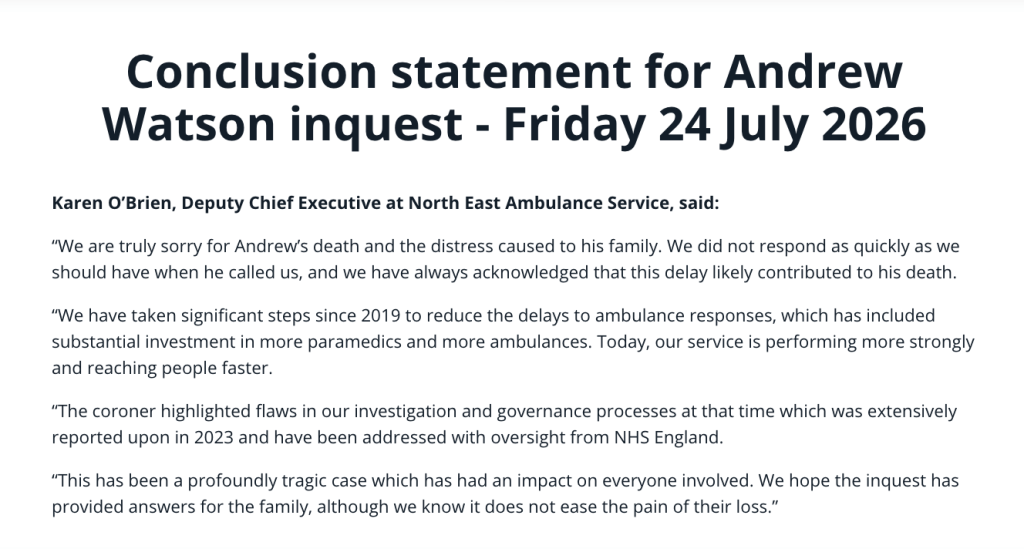
The trust’s statement is in part a facile good news message. It fails to apologise for the deliberate cover up. It only apologises for the ambulance delay, and even then gracelessly claims that it has “always” acknowledged the delay.
In a dismal sort of circularity, it is relevant to remember that Griffiths claimed in her 2023 review report that everything was better at NEAS because it was under a new management team.
However, it seems from the disrespectful and less than truthful NEAS response to the inquest outcome, that some things are unchanged at the trust.
Even at this late hour, NEAS seems incapable of candour.
RELATED ITEMS
1.Fitness to practice proceedings continue against two senior NEAS nurse managers who are accused of bullying and withholding information from the coroner.
Distressingly for the affected bereaved families, a hearing was part heard earlier this year and will resume next year:
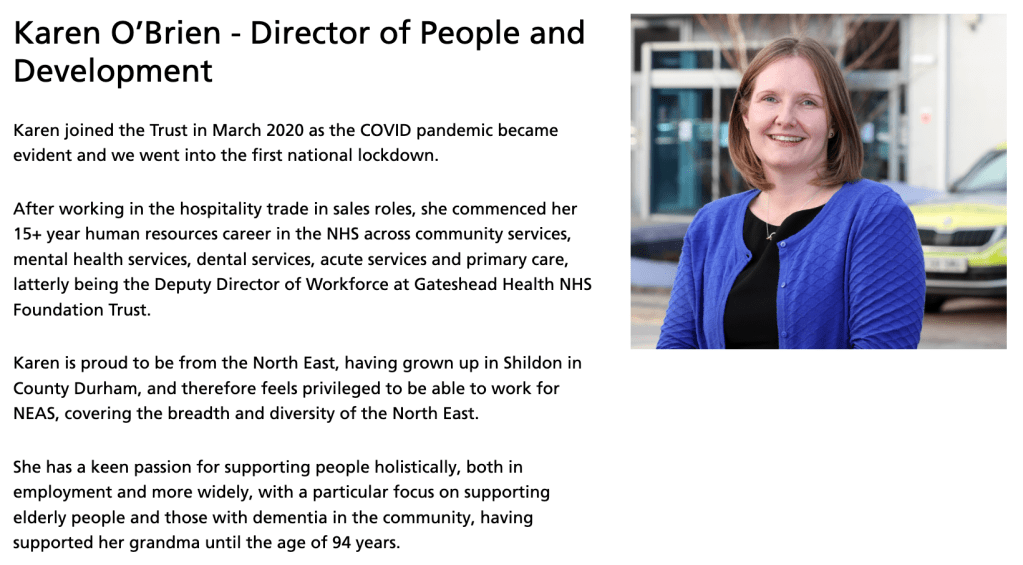
2. Karen O’Brien the NEAS Director of People and Development has been in post at NEAS since 2020.
She oversaw the trust’s attempt to unlawfully gag the coronial cover up whistleblowers with settlement agreements which restricted their ability to pursue public interest disclosures. One signed and one refused.
Griffiths later downplayed this serious breach, portraying it as a matter of poor governance instead of illegality.
As head of human resources, O’Brien obviously also had a large share of the responsibility for NEAS whistleblowing governance, which has been criticised.
Of note, O’Brien chairs the North East and Cumbria HR Directors Network.
She also describes her leadership style as “Authentic, humble, brave, tenacious and grounded in listening.”
No doubt NEAS whistleblowers are glad to hear that.
This is the trust biography for O’Brien: