Dr Minh Alexander retired consultant psychiatrist 26 November 2025
Introduction
This is a brief report on the continuing failure of the wasteful Freedom To Speak Up model, which is being retained by the NHS despite abolition of the National Freedom To Speak Up Guardian’s Office.
An external review of failings in breast cancer care, the “Aubrey Report”, has this week been published by County Durham and Darlington NHS Foundation Trust (CDDFT).
The Aubrey report was commissioned following advice received from the Royal College of Surgeons, related to its invited service review in January 2025.
| About the author of the Aubrey Report Mary Aubrey the author is described in the report as Director and Specialist Expert Advisor in Governance. Her LinkedIn entry describes her as a part time NHS director “Providing specialist advice and support on progressing the NHS Trust to moving to excellence and exiting RSP 4 in 2026”. She is also listed on the website of the private company Quality Governance Solutions 15267661 where she is described as a CQC associate. A search shows that she has acted for CQC as an executive reviewer in past CQC inspections. For example, during the 2019 inspection of Royal Berkshire NHS Foundation Trust. |
Care Failings
The Aubrey report found multiple failings spread over a long period of time, which resulted in poor care, summarised as follows:
“Patient harm due to outdated clinical practices and unnecessary procedures:
Patients experienced avoidable harm, including delayed diagnoses, unnecessary mastectomies and axillary clearance, and benign procedures that were not clinically indicated. These failures resulted in significant physical, emotional and psychological consequences for patients and staff”
“A lack of documented breast reconstruction planning in at least six cases highlights missed opportunities for shared decision making. Additionally, technical errors, including incorrect skin marking leading to repeat surgery, underscore preventable harm and resource inefficiencies.”
A local media report gives a devastating report of one patient who was left bed bound after sepsis:
Woman bedbound after CDDFT breast cancer service experience
“This has been totally devastating. It has ruined my life, without a doubt,” says Moira, who is in her 60s….I never thought this would be the case at this age. I have had a very busy life and career, but now I am dependent on the care of others.”
“She says she is completely bedbound unless hoisted into a chair by her carers.”
The patient describes a traumatic encounter with a surgeon:
“This surgeon was in his suit and put surgical gloves on – and without warning from him, and without any kind of anaesthetic, cut open my wound.”
“He began taking out handfuls of blood clots from my breast and putting them into a surgical bowl.
“While it wasn’t painful, it was uncomfortable and felt very concerning. Blood was pooling underneath me and down my left-hand side, which the nurses cleaned after the surgeon left the room.
“From the faces of the nurses who were present, I could tell this wasn’t normal.
“I didn’t know what to do, as I wanted my breast to get better, but the faces of the nurses told me everything I needed to know. They didn’t say anything about what he had done.
Related governance failings including whistleblowing failures
The Aubrey report also noted a failure of the legal, organisational duty of candour:
“Despite clear evidence of harm, including unnecessary axillary clearance, mastectomies, excessive surgery due to poor diagnostics, and benign procedures that were not clinically indicated, the Executive Medical Director and former Executive Director of Nursing delayed the initiation of Duty 12 of 232 of Candour. Action was only taken in February 2025, a nine-month gap that represented a significant breach of statutory obligations.”
According to his LinkedIn entry, the Executive Medical Director was in post from 2017 up to November 2025. The former Executive Director of Nursing according to his LinkedIn entry was in post 2015 to December 2024 and is now a NED at York and Scarborough Teaching Hospitals NHS Foundation Trust.
Mary Aubrey concluded that there were repeated missed opportunities to identify and correct the patient harm, with multiple red flags and warnings from different sources, including from senior personnel, which the trust board failed to act upon.
For example:
“Despite multiple early warnings from 2012 to 2025 including internal audits, external reviews, national surveys, and benchmarking data, effective action was not taken until 2025. This prolonged delay reflects deep-rooted leadership and governance failures, where Executive Directors, Care Group Triumvirate and Specialty leaders repeatedly failed to intervene, challenge poor practice, or implement improvement recommendations.”
“Concerns raised in 2017. 2018, 2019, 2021, 2023, and 2024 were either ignored or subject to delayed action, despite clear red flags. Service and Care Group leaders did not act on, or escalate warnings from colleagues across pathology, radiology, booking, MDT coordination, medical records, operational management and clinical nursing.”
These listed whistleblowing episodes all fall firmly within the period when the NHS Freedom To Speak Up arrangements should have been embedded. They were introduced in 2015 and it is reasonable to expect that by 2017, all trusts should have had compliant structures and informed boards. It was certainly what the central propaganda claimed. But there may have been issues of capacity, as a CQC report of 2019 stated:
“On our last inspection we raised concerns about the capacity of the Freedom to Speak Up Guardian (FTSUG). While two champions had been recruited and working hours increased there was still work to do to increase capacity and raise the profile of the role within the trust.”
Aubrey noted dysfunctional culture within trust breast surgery services with issues of bedside manner, rudeness within teams, insularity and resistance to feedback and change.
For example: “Cultural and behavioural issues, including poor communication, lack of psychological safety, and unprofessional conduct from some consultants, contributed to staff distress, high turnover, and reluctance to raise concerns.”
The RCS invited review noted problems with multidisciplinary decision making, challenge and leadership.
Moreover, Trust staff showed fear during Aubrey’s investigation and asked for anonymity.
Their fears proved justified when Trust executives tried to identify them. Aubrey wrote:
“Staff repeatedly expressed to the Reviewer their desire to remain anonymous, particularly where roles were unique and individuals could be easily identified. Attempts by some Executive Directors to identify contributors not only breached this understanding but also reflected a leadership approach perceived to prioritise control over accountability. This incident highlights broader cultural challenges within the Trust, where psychological safety appears compromised and staff remain apprehensive about potential retaliation or scrutiny when raising concerns.”
It is a measure of dysfunction that trust executives felt free to attempt to identify staff in plain view of an external investigator.
Clearly, whether or not the trust Freedom To Speak Up Guardian service was adequately resourced, it had no chance if the trust executives had no respect for staff confidentiality.
Unsurprisingly, the Aubrey report concludes that whistleblowing governance at the trust was flawed. There is possibly an implication that Freedom To Speak Up procedures – “formal mechanisms” – failed:
“As outlined above, staff reported feeling discouraged by managers from whistleblowing due to apprehension about retaliation, including warnings from managers that speaking up could adversely affect their careers. This culture of deterrence contributed to the persistence of harmful practices and undermined efforts to strengthen safety, transparency, and accountability within the service. Concerns were not escalated and the Trust Board did not have effective systems to detect and address suppression of concerns within the areas affected. While the Trust’s staff survey scores for ‘Raising Concerns’ are in line with national averages, qualitative feedback from interviews and helpline data suggests that formal mechanisms were not always experienced as psychologically safe or effective by staff” [my emphasis]
There was specific criticism of Non-Executive directors who should challenge, and who often hold “champion” roles for FTSU arrangements:
“The cultural factors outlined above combined with staff apprehension around whistleblowing and limited scrutiny from Non-Executive Directors, including the former Trust Chairs during their tenure. and assurance committees created conditions in which unsafe practices were able to persist unchallenged and without accountability.”
It is almost always the case that such summarised details do not convey the depth of suffering of individuals and their families who are at the butt end of such failures of whistleblowing governance. To be at the mercy of trust executives whose goal is “control”, above all else, can be a life-changing nightmare that may extend for years.
In short, Aubrey’s report sets out a fairly typical and familiar anatomy of an NHS scandal.
CQC failings
And of course, no NHS scandal is complete without a Care Quality Commission whitewash. The CQC currently rates CDDFT as “Good” overall and “Good” on the “Well Led” domain despite the poor leadership and its whistleblower hunting tendencies.
This “Good” rating is from 2019. One would have hoped that with all the concerns about the breast service and poor trust governance that the trust should have been inspected more recently.
But was CQC even aware of the breast service failings? The trust’s breast service lost training status as early as 2012 and the Aubrey report rightly concludes that the loss of training status was a red flag:
“The Breast Surgery Services was flagged for failing to meet the standards required for safe and effective medical education, and for not providing a supportive training environment which are both essential for surgical trainees. This led to the withdrawal of training accreditation in 2012. The loss of surgical trainees was a direct result of GMC action and serves as a fundamental indicator of breakdowns in supervision and clinical governance.”
“The loss of trainee status in the Breast Surgery Services represents a significant red flag for the organisation”
But as far as I can see, CQC did not specifically inspect the breast service in 2019. Or if it did, it raised no specific concerns.
Moreover, the CQC inspection report of 2019 claimed generally “It was easy for people to give feedback and raise concerns about care received. The service treated concerns and complaints seriously, investigated them and shared lessons learned with all staff.”
General ineffectiveness of the Freedom To Speak Up model and questions about the Fit and Proper Person Framework
In conclusion, this affair only reinforces concerns that the government’s Freedom To Speak Up project has been a wasteful, deflective propaganda exercise that has done very little to help NHS patients and staff.
At least the lead propagandist’s Office, the National Guardian’s Office has been disbanded. But the decision to continue wasting scarce public funds by continuing with a local model of Freedom To Speak Up Guardians is a classic but disappointing NHS fudge.
There has been little transparency about how the latter will work, only a few cryptic comments in a NGO’s newsletter and a brief NHSE update about how some central functions will transfer to NHS England. I have asked NHS England via FOI for more precise details.
I have also written to Jim Mackey NHSE CEO to ask if and how the findings of the Aubrey report will be used by NHS England with respect to new NHS Fit and Proper Person arrangements following the Kark review. This is with respect to general findings of executive failure to act upon red flags and safety indicators, the failure of organisational duty of candour and the reported attempts by trust executives to breach anonymity of staff reporting concerns to an investigator. It is unclear to me if the FPP framework and related database/ disbarring mechanism have been finalised six years after completion of the Kark Review on Fit and Proper Persons in the NHS, but I have asked NHSE for a completion date if not.
UPDATE 6 JANUARY 2026
I have published FOI responses from the Care Quality Commission
PERSONAL UPDATE
My wonderful husband Ian has died. I am not back at work at full strength and cannot respond to requests as much as usual, but will aim to post from time to time. All my very best.
RELATED ITEMS
- CDDFT has as per NHS standard operating policy, announced a cultural reset. The trust also reports early progress in rectifying the safety issues.
CDDFT response to the Aubrey report
2. Robert Francis continues to express ineffectual dismay about how NHS managers still respond shockingly to NHS whistleblowers. Eye-roll.
3.Fundamental failure of the NHS Freedom To Speak Up Project: Dr Rajai Al- Jehani unfairly sacked by Royal Free NHS Foundation Trust for whistleblowing on breaches of Human Tissue law, with suppression of linked investigations by University College London
4. Think whistleblowing in the NHS is confidential? Think again
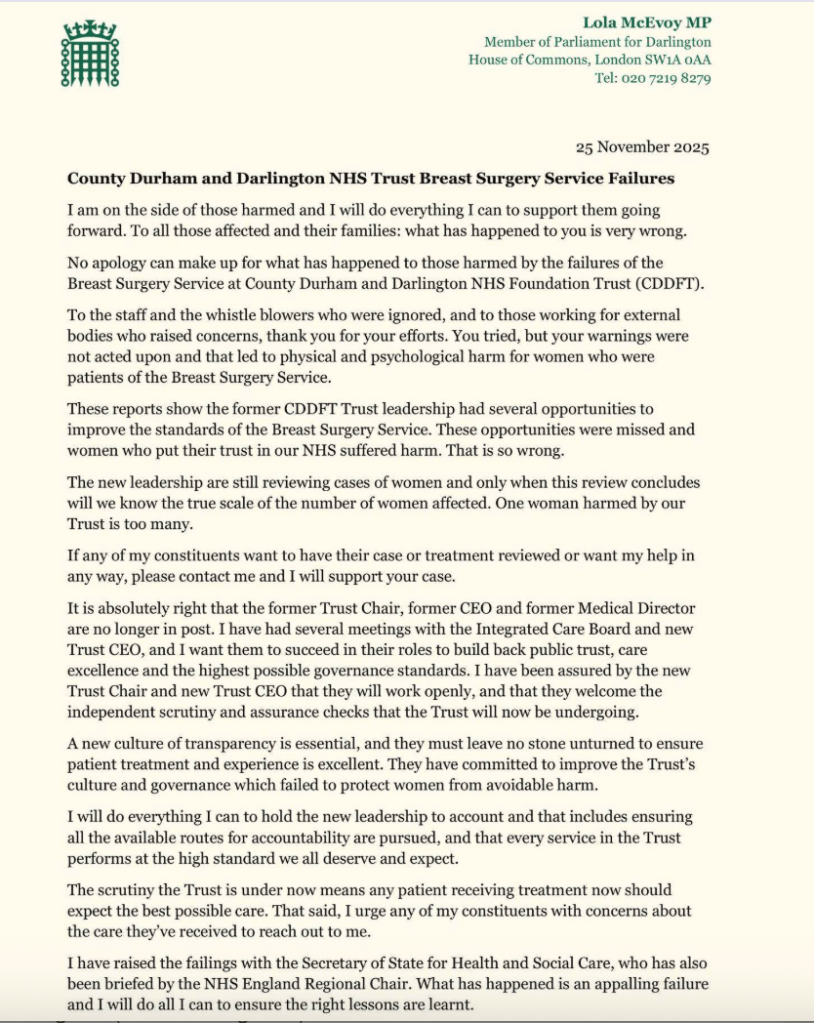
The local MP Lola Mc Evoy has published this statement on the matter, which acknowledges that staff whistleblowers were ignored:

 Alexander's Excavations
Dear Minh,
I’m so sorry to hear about Ian’s death. I followed the link to X, and from what you wrote there, Ian sounds like he was a very fine human being.
Please look after yourself,
Caroline
LikeLike
Thank you Caroline. He was. 🙂
LikeLike
My condolences. Your work is exceptional and peerless.
Jamal Siddqi Consultant OMFS MSE, Essex under gmc investigation 6+ years etc etc
LikeLike
Thank you Jamal. That is kind. I hope things get better for you too.
LikeLike