Dr Minh Alexander retired consultant psychiatrist 11 September 2023
Who wrote the Whistleblowing APPG’s pro bounty Bill?
An individual who had dealings with WhistleblowersUK sent me photos of May 2022 Signal messages which appeared to be from Georgina Halford-Hall the CEO of WhistleblowersUK.
WhistleblowersUK is a private company with links to powerful US bounty hunting law firms. This is a link to WhistleblowersUK’s company accounts. WhistleblowersUK is the secretariat of the All Party Parliamentary Group (APPG) on whistleblowing.
In the Signal messages, shared below, Halford-Hall appeared to document in detail how much time she was spending on the person’s case, as though it was a business service for which payment would be claimed (see photos 3 and 4).
The parties eventually agreed in these messages that payment for help would be deferred and eventually made in the form of a percentage of any financial award (see photo 2).
This is consistent with WhistleblowersUK documents which ask whistleblowers for money and a percentage of any settlements and awards.
Importantly, in the course of the exchanges, Halford-Hall appeared to compose a draft press statement to accompany this case, which claimed that WhistleblowersUK had written the pro bounty Bill which the Whistleblowing APPG and former APPG members have been repeatedly presenting to parliament:
“The Whistleblowing Bill written by WhistleblowersUK is working its way through parliament…..” (see photo 5)
If true, does this support concerns that the Whistleblowing APPG is a vehicle for private interests?
WhistleblowersUK is now openly and explicitly working with US bounty hunting firms to advocate for monetisation of UK whistleblowing through financial rewards system.
The US bounty system is ruthless, exploitative and abandons the majority of whistleblowers.
But it generates huge profits for lawyers, and US bounty hunting law firms have been trying to introduce bounty hunting law to the UK for years.
The US lawyers certainly funded the establishment of the Whistleblowing APPG, with Constantine Cannon LLP donating money which paid for WhistleblowersUK’s services as an external secretariat, and links continue to be evident. For example, a partner of Kohn, Kohn and Colapinto spoke at an APPG event earlier this year.
Moreover, in the Signal messages, Halford-Hall appeared to offer to “coordinate political help” (see photo 6).
Would it be right that services, for which WhistleblowersUK seeks to be paid, are entangled with our democratic processes?
There are strict rules which prevent members of parliament from representing anyone who is not a constituent. Does the Whistleblowing APPG in any way breach this principle, through its relationship with WhistleblowersUK, and any brokering of political influence by WhistleblowersUK?
WhistleblowersUK previously publicly stated on 22 July 2023 that whistleblowers who wanted their evidence to be presented to the government should submit via WhistleblowersUK, implying a special relationship:
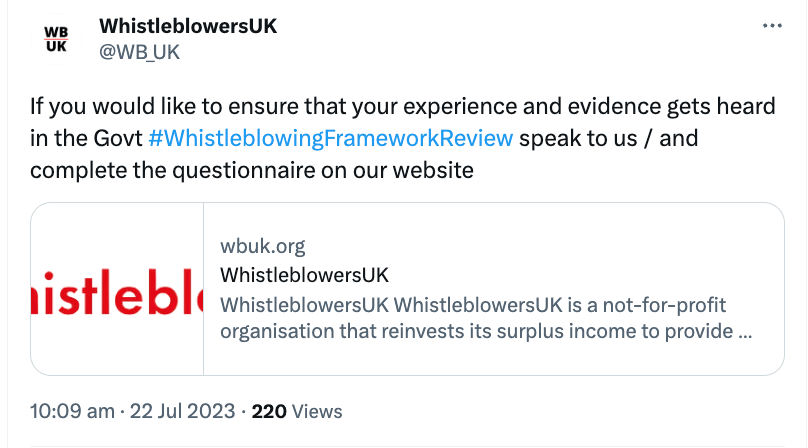
I asked the Whistleblowing APPG Chair Mary Robinson about this and she denied that WhistleblowersUK had any special, formal role:
“Neither the APPG or WhistleblowersUK have any formal role in the collection of submissions or the terms and would submit their own evidence as they see fit to assist and inform the review.” From email 11 August 2023
I sent the photos of the May 2022 Signal messages on 4 September 2023 to Mary Robinson MP Chair of the Whistleblowing APPG copied to Baroness Susan Kramer, a former APPG member who employs Halford-Hall as a parliamentary researcher, to ask for confirmation and comment.
Neither have responded despite a reminder.
In the absence of a response, I am making key photos public and leave it with others to form an opinion:
PHOTO 1
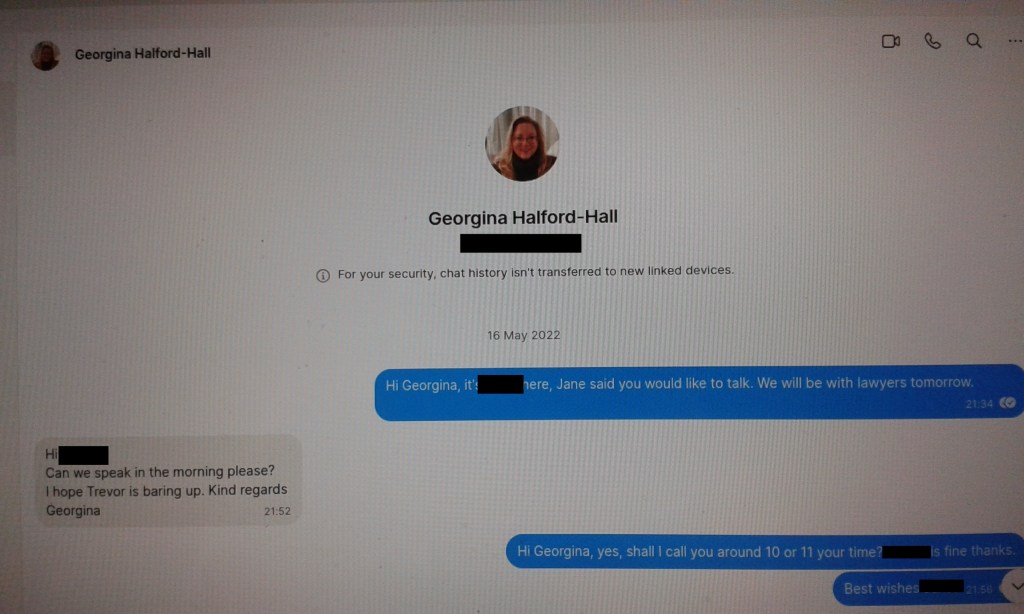
PHOTO 2
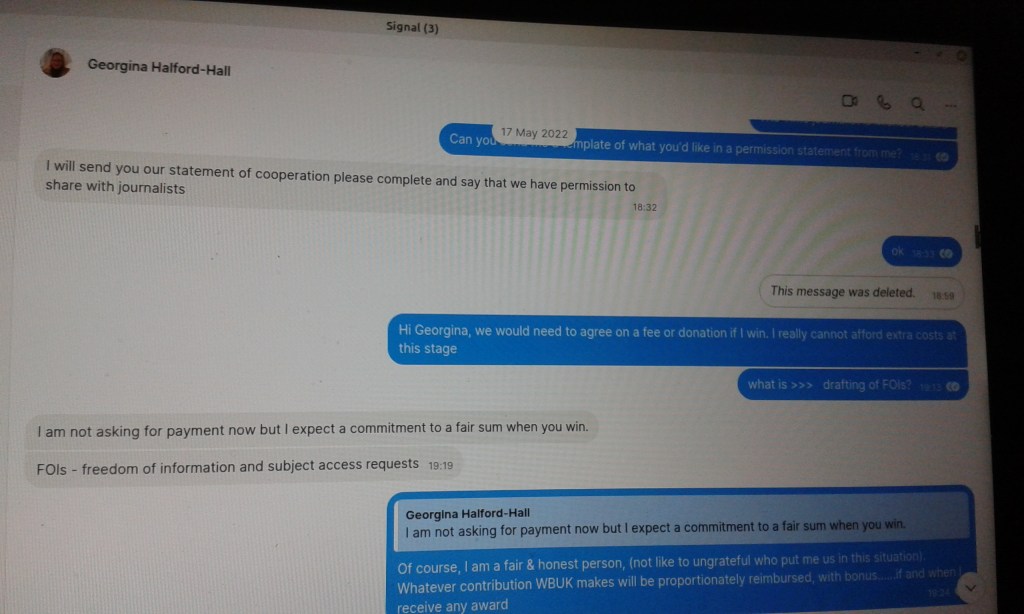
PHOTO 3

PHOTO 4
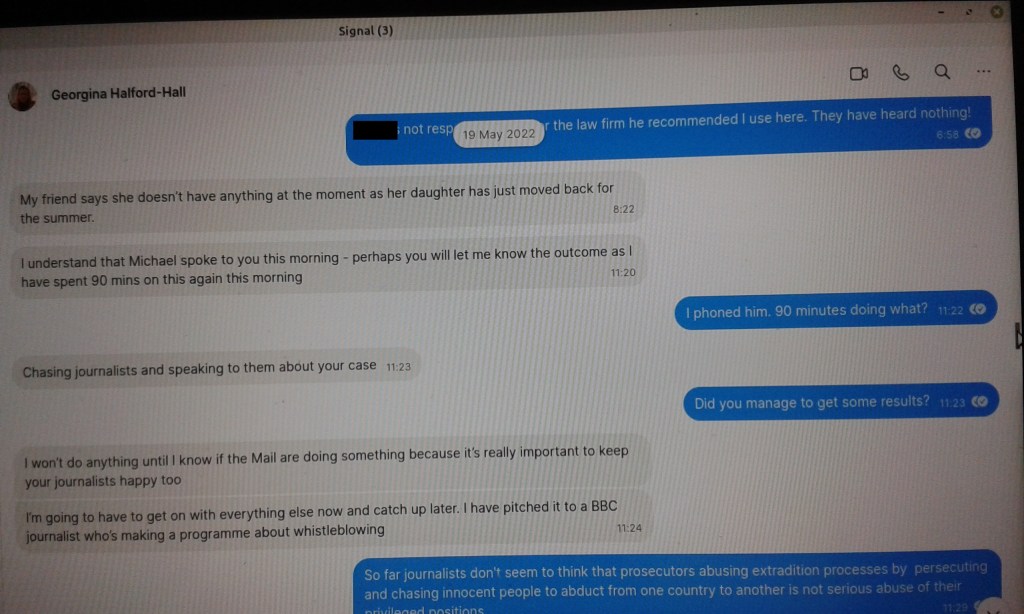
PHOTO 5

PHOTO 6

Who controls the APPG?
When WhistleblowersUK refused to answer questions about finances and conflicts of interest that I put in 2019, it was not WhistleblowersUK who were sacked as secretariat, but Norman Lamb MP who resigned in protest at the failure to answer.
Preferential government treatment of WhistleblowersUK and others
Kevin Hollinrake a pro bounty former member of the Whistleblowing APPG, launched a secretive and dubious review of UK whistleblowing law in March this year in his new capacity as a junior minister of the Department of Business and Trade.
WhistleblowersUK are now revealed as one of the parties who have been treated preferentially by Hollinrake’s department. WhistleblowersUK had a meeting with the Department of Business and Trade BEFORE official evidence gathering had begun.
Because of months of government silence following the March 2023 announcement of Hollinrake’s review, and government failure to provide a means for whistleblowers to contribute, despite an announced intention to do so, whistleblowers started asking questions. These revealed that the government had outrageously outsourced the law review to a company, Grant Thornton. Not only this, Grant Thornton had prior contacts with the Whistleblowing APPG, WhistleblowersUK and US bounty hunting law firms.
The government also delayed a response to an FOI request about its review process, that was made two months ago, claiming that it needed time to consider possible exemptions to disclosure.
It has now responded (FOI2023/03987) revealing that the usual suspects were treated preferentially and met with the Department for Business and Trade (DBT) in the Spring, soon after the law review had been announced.
WhistleblowersUK, Protect and Parrhesia all had meetings with DBT about the law review.
WhistleblowersUK met with DBT officials on 6 April 2023, only ten days after Hollinrake announced the government’s law review.
Protect and Parrhesia met with DBT officials later on 4 May 2023.
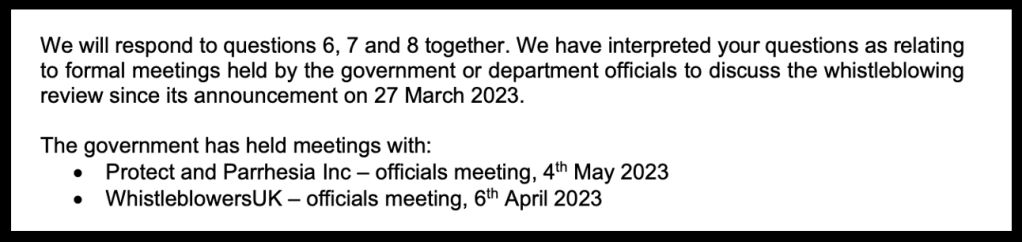
Did these meetings in any way pre-determine the conduct of the government’s review, especially the first and very early meeting with WhistleblowersUK?
The Department also met with representatives from various institutions: TUC, Law Society and several Prescribed Persons.
Grant Thornton’s contract for the review
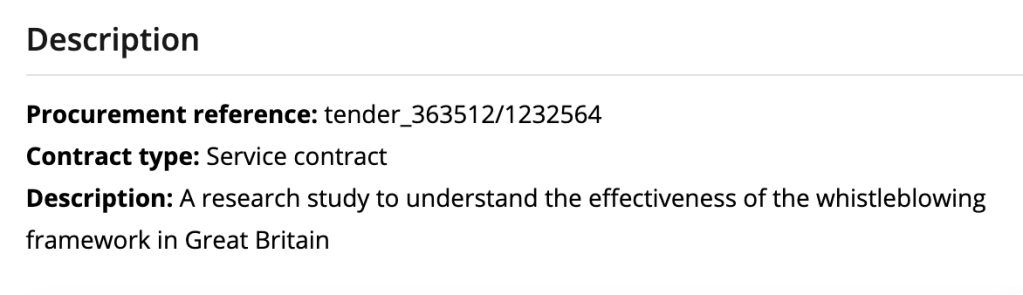
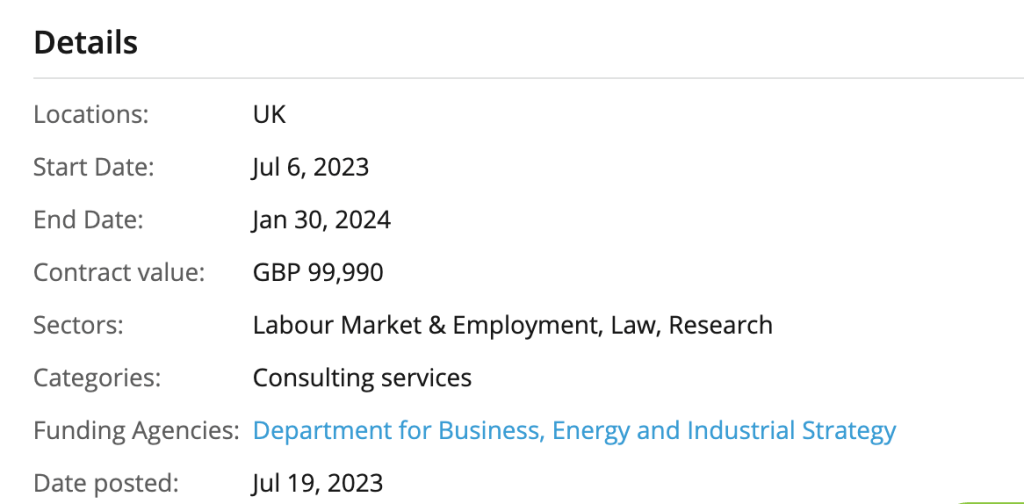
Published material indicates that the closing date for the bid was 19 May 2023:
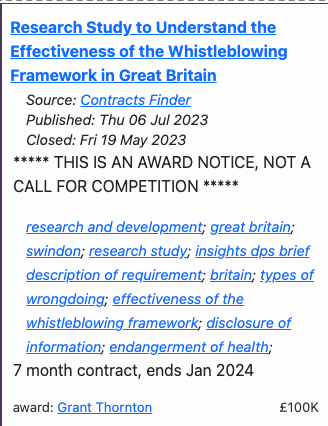
Astonishingly, there has been no formal announcement of the decision to hire Grant Thornton for this very important exercise.
When I asked Protect if they knew, they replied that they did not know and in the words of their CEO: “We had not heard any announcement about the appointment of a consultant to conduct the review and had hoped to meet with them first.”
The government recently indicated to me that the review process is not open.
It told me that I MIGHT be invited to contribute. Three days later I received an invitation from Grant Thornton, but that was not the point.
The government has disclosed via the above FOI response FOI2023/03987 that Grant Thornton will stop taking evidence in December 2023.
On 4 September 2023 I asked Grant Thornton for a copy of the questionnaire they said they would use to gather evidence. In response, Grant Thornton stated that their questionnaire had not been finalised:
From: Ali Crotch-Harvey <REDACTED>
Subject: RE: Invite to participate in the research study into the effectiveness of the whistleblowing protections in Great Britain
Date: 4 September 2023 at 10:16:03 BST
To: REDACTED
Hi
Of course.
We are just finalising testing the questionnaire through our internal quality controls to ensure it works, that we are happy with the wording of questions and its security, given the nature of what we are asking whistleblowers to share with us. We are aiming for this to be the case by the end of the week, so I will send you the invite link then.
In the meantime, let me know if you have any further questions or thoughts.
Kind regards
Ali
I have again asked for the questionnaire and await a response.
If Grant Thornton will stop taking evidence by December 2023, that does not leave much time for whistleblowers to be informed of the process and to contribute evidence.
How sound will this law review be, given that it is being conducted on a relatively limited budget, without proper publicisation and without being open to all whistleblowers?
Grant Thornton’s governance has been criticised by regulators and the company has been repeatedly sanctioned. There is also a question of conflict of interest arising from the fact that Grant Thornton sells whistleblowing compliance services.
The review is appears to be dominated by those with an institutional and/or market perspective from the whistleblowing compliance industry and by the bounty hunters.
Will the public interest be foremost?
Will evidence from whistleblowers whom the government would rather not hear be discarded?
Whistleblowers from non-financial sectors will be disadvantaged if the bounty hunters prevail in replacing current UK whistleblowing law with a model that is designed for and focussed on lucrative bounties from the financial sector. Will non-financial whistleblowers’ voices be muted? Is that what we really need after endless health and care scandals, such as the Letby killings at the Countess of Chester Hospital?
If free range whistleblowers, who have eschewed membership of the government’s favoured organisations, wish to submit evidence, I advise that you send it direct to the Secretary of State.
Her email address is: badenoch@trade.gov.uk
Hollinrake is the responsible minister. If you wish to copy him into your correspondence, his email address is: hollinrake@trade.gov.uk
RELATED ITEMS
The individual who sent me the Signal messages which were reportedly from Georgina Halford-Hall also shared a copy of WhistleblowersUK’s associate membership application form.
WhistleblowersUK’s website, on the “What We Do” page, states that the company advances dialogue through its community of associate members:
The company’s coffers may also benefit, as according to WhistleblowersUK’s associate membership application form, such membership costs a minimum of £120 per annum. Applicants are asked to agree to pay “donations”:
“I agree to make a minimum donation of £10 per calendar month [£120 per annum] to further the Company’s work to support whistleblowers.”
At the end of the document it is stated that people who cannot afford this can apply to WhistleblowersUK’s directors for a waiver.
Associate membership entitles individuals to be non-voting participants at WhistleblowersUK’s general meetings:
“I acknowledge that as an Associate Member I am afforded the right to attend and be invited to speak at General Meetings, but not to vote. I acknowledge that I am not a Member of the Company as defined in Section 112 of the Companies Act 2006.”
Associate membership of WhistleblowersUK also purportedly entitles individuals to a range of other benefits, including “Priority application to other services”, whatever that is.
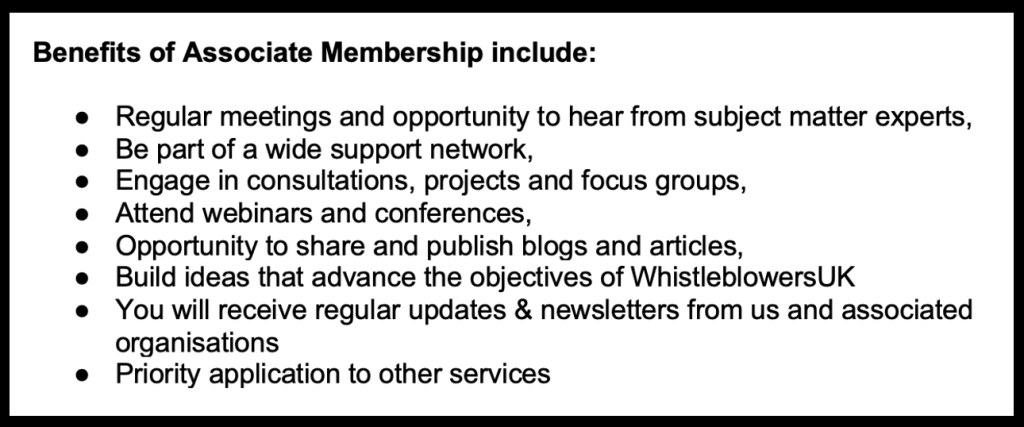
Let us hope it does not relate to benefits in terms of access to power and “political help”.
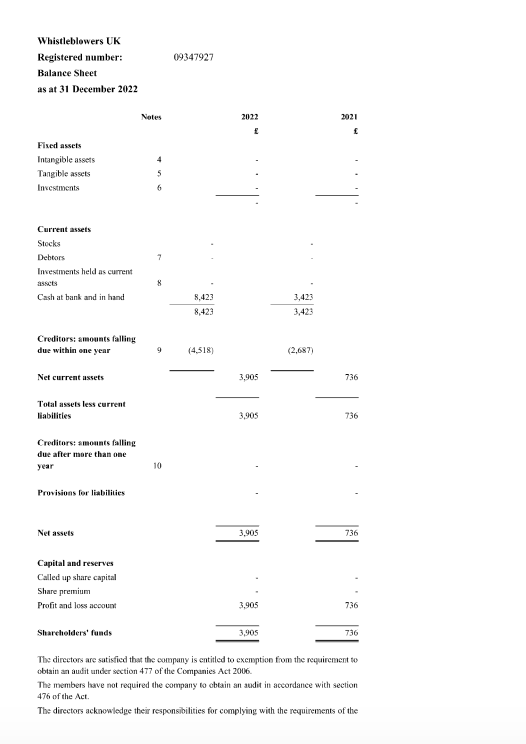
As of December 2022, WhistleblowersUK reported that it had a little under £4K in assets:
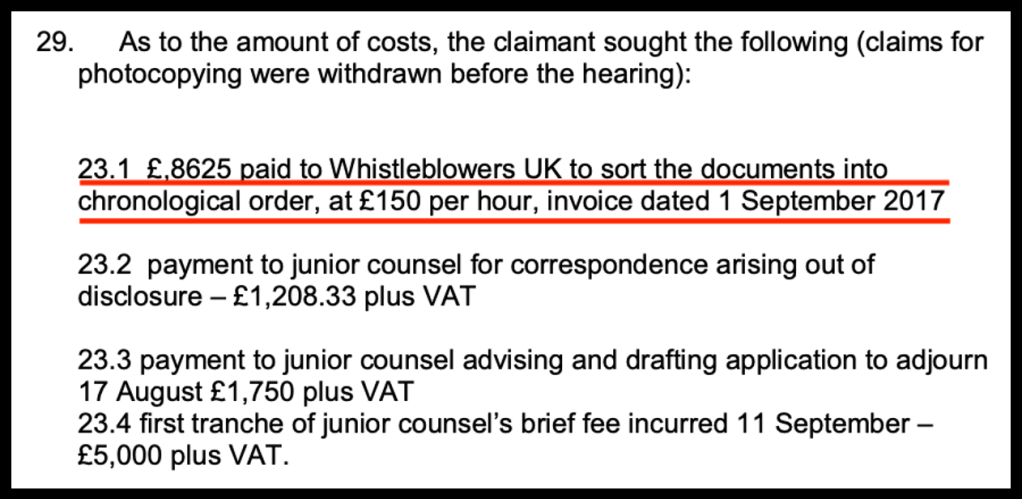
An invoice by WhistleblowersUK was submitted to the Employment Tribunal in a financial whistleblower’s case (Banerjee Case number 2200415/2017) which consisted of charging £150 per hour for arranging the whistleblower’s documents in date order, with a total bill of £8625.
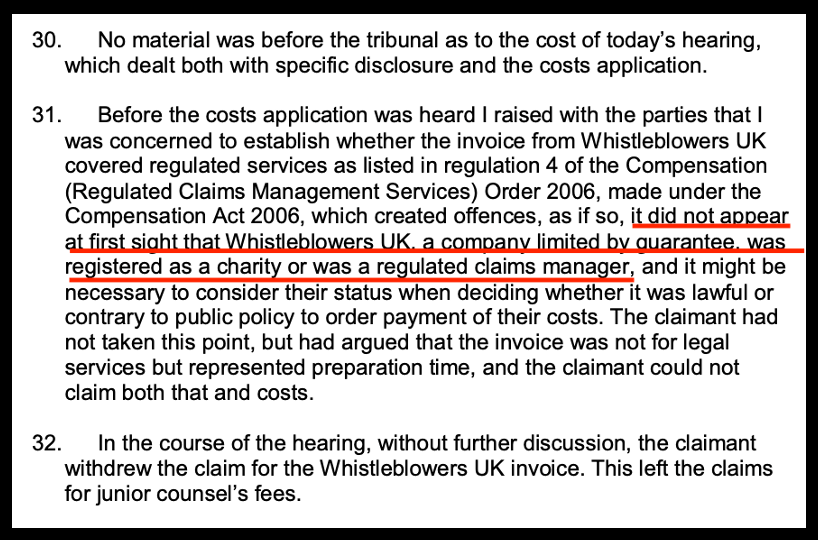
The judge questioned the claim on the grounds that WhistleblowersUK is not legally recognised as a regulated claims manager, and the invoice was withdrawn by the claimant:

 Alexander's Excavations
Thanks for ongoing exposee into NHS problems.
This is why solicitors who work on a no win no fee basis get their client payment only days before getting to court. NHS resolution just trying to save legal fees.
Keep up the good work
Regards John O’Brien
LikeLike
I’m not that well read in the US bounty-hunter whistleblower system – and drawbacks – but fundamentally, anything that puts legal clout behind whistleblowers – in the same way that no win no fee has in medical negligence – has got to have benefits for patient safety and compliance with regulation & required process?? Not that no win no fee is perfect by any stretch – risking cherry-picking of claims.
Without that – the balance of power is hugely disproportionate and intimidating??
Anything involving the private sector will inevitably involve monetisation – but then if that drives holding the authorities to account – & exposing their dangerous, complacent & corrupt practices – acting as deterrent – that has to be good.
If they don’t like it – they should regulate themselves & do their duty.
However, as I say – I’m not well read in this and may very well have the wring end of the stick??
LikeLike
NO organisation should ever be allowed to regulate itself. Leads to cover ups and corruption. Especially in the NHS
LikeLiked by 1 person
Hello, thanks for taking the time. The US model in fact disempowers the majority of whistleblowers because it operates as a lottery. Only a tiny number get a financial award. See here if interested for the stats: https://minhalexander.com/2023/05/09/the-whistleblowing-hunger-games-why-we-should-reject-the-whistleblowing-appg/. The system is designed to recover money for the government from financial scams. It is not interested in other harm to the public, such as failures of health and care, as it is about property and not persons. I asked the US government if had recovered any money from substandard care, but there had been no attempted suits of this sort, underlining the disinterest in harm to the person. WhistleblowersUK and the Whistleblowing APPG wish to repeal existing UK whistleblowing law and replace it wholly with their pro bounty law. This will make life even more difficult for whistleblowers who aren’t raising concerns about financial scandals, but about poor health and social care. Such whistleblowers will be of little interest to a bounty hunting system, and if all other whistleblowing law is scrapped as WBUK & the APPG propose, they will have no other avenues. Existing UK whistleblowing (PIDA) is very weak and needs to be replaced with something much more effective, but it should be something that is genuinely in the public interest. One notable feature of PIDA, despite this law’s weakness, is that it requires whistleblowers to make disclosures in the public interest. It disallows claims based on self interest. This is one of the reasons I imagine why bounty hunters may wish to scrap it, as their model is fundamentally based on self interest and financial incentivisation.
LikeLiked by 1 person
Far too many bounty hunters in the legal profession in the UK right now. No win No fee is a scam.
Because you have to convince the solicitor you have a case before he/she takes it on. so he can assure himself he will get his cut.
LikeLiked by 1 person