Letter to Director of National Clinical Assessment Service (NCAS) 22 September 2016

From: Minh Alexander <minhalexander@aol.com>

Subject: National Clinical Assessment Service (NCAS) , NHS whistleblowers & BME staff

Date: 22 September 2016 at 14:16:04 BST

To: Vicky Voller <vicky.voller@ncas.nhs.uk>

Cc: helen.vernon@nhsla.com, Sir Anthony Hooper <AnthonyHooper@matrixlaw.co.uk>, rfrancis@serjeantsinn.com, mb-sofs@dh.gsi.gov.uk, Edward Jones <edward.jones@dh.gsi.gov.uk>, sheyda.m.azar@parliament.uk, Health Committee <healthcom@parliament.uk>, sarah.wollaston.mp@parliament.uk, philippa.whitford.mp@parliament.uk, paula.sherriff.mp@parliament.uk, julie.cooper.mp@parliament.uk, james.davies.mp@parliament.uk, andrea.jenkyns.mp@parliament.uk, andrew.percy.mp@parliament.uk, maggie.throup.mp@parliament.uk, bradshawb@parliament.uk, media@equalityhumanrights.com, “CE England (NHS ENGLAND)” <england.ce@nhs.net>, england.contactus@nhs.net, contactholmember@parliament.uk, bottomleyp@parliament.uk, ***** ***** <********************>, *** ***** <*******************>, ***** ********** <****************************>, admin@bapio.co.uk, bida@btconnect.com

To Ms Vicky Voller, Director of National Clinical Assessment Service, 22 September 2016

Dear Vicky,

NCAS’ approach to whistleblowers and BME staff

I wrote to you a year ago – see the correspondence below which summed up a meeting that I and other whistleblowers had with you and colleagues on 22 September 2015.

You kindly indicated that NCAS would contact us again and involve whistleblowers in its training activities, but I have not heard from NCAS.

I continue to hear from medical whistleblowers who report being intimidated with disciplinary action, and actual and implied threats that fault will be found with their performance, following raising concerns.

I would be grateful if you could let me know whether NCAS will involve whistleblowers in its training programme as you suggested previously.

I would also be grateful to hear if NCAS has completed the work that it said would be undertaken to routinely identify whistleblower cases, in order to ensure that whistleblowers do not suffer detriment. If so, I would be grateful if the details could be shared, and to see any new NCAS written protocol/ guidance on how whistleblower cases should be managed. I note from NCAS’ FOI response that it is in discussion with the Department of Health about work to ensure fair and consistent process, so that referred doctors (including whistleblowers) do not suffer inequality and detriment. It would be very helpful to hear more about this as well.

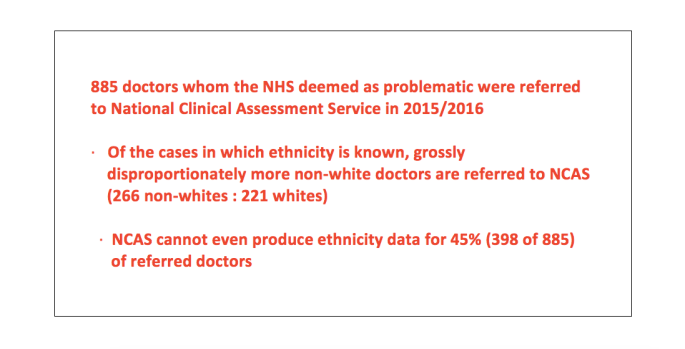
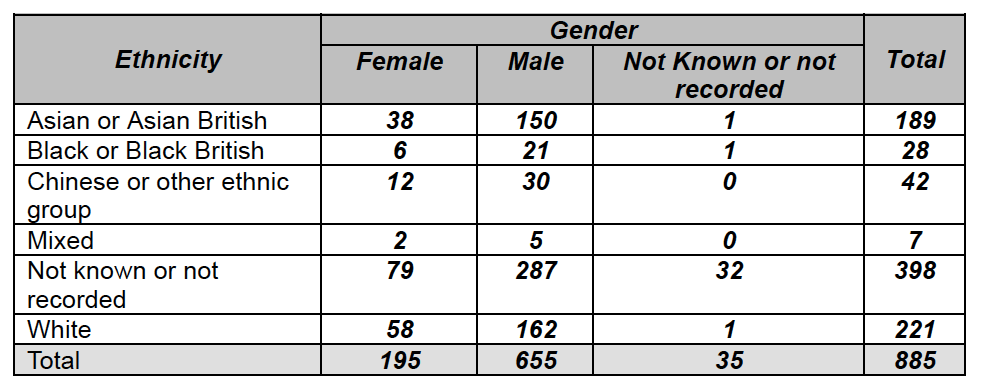
I need to raise an additional issue, about NCAS’ Equality and Diversity practice. I see from FOI data (attached) that NCAS’ data on referred doctors’ ethnicity is seriously incomplete – NCAS is unable to give the ethnicity of almost half the doctors who are referred. This must surely make it impossible for NCAS to fulfil its legal duty to monitor whether it is treating BME doctors equally and fairly. This is a major concern given that the data that is available shows grossly more non-white doctors are referred to NCAS. Please see the summary table below that I have prepared from the data that NCAS has provided. I am particularly concerned that NCAS informs me that it has no improvement/ action plan for ensuring a better level of ethnicity recording.

DEMOGRAPHICS OF DOCTORS REFERRED TO NCAS IN FINANCIAL YEAR

2015/2016

Source: NCAS 20 September 2016

White doctors Non-White doctors Doctors whose ethnicity was not known or recorded
Female 58 58 79
Male 162 206 287
Gender not known or recorded 1 2 32
Total 221 (25%) 266 (30%) 398 (45%)

Therefore:

  • Of the cases in which ethnicity is known, grossly disproportionately more non-white doctors are referred to NCAS (266 non-whites : 221 whites)
  • NCAS cannot produce ethnicity data for 45% (398 of 885) of referred doctors

As I think has been pointed out previously, and as evidenced by the Freedom to Speak Up Review, BME doctors are more likely to be mistreated if they whistleblow.

Moreover, I am concerned that NCAS appears to concede by omission, in its FOI response, that it has not undertaken any review of its Diversity and Equality practice in the last two years.

I would therefore also be grateful to know if NCAS will re-visit these issues, and formally review the way in which it treats BME doctors and their experience of NCAS’ process, and ensure a much better level of ethnicity recording from now on.

With best wishes,

Minh

Dr Minh Alexander

cc Helen Vernon Chief Executive NHSLA

Rt Hon Sir Anthony Hooper

Sir Robert Francis QC

Secretary of State for Health

Shadow Secretary of State for Health

House of Commons Health Committee

Equality and Human Rights Commission

Simon Stevens Chief executive NHS England

Lord Adebowale NED NHS England

Lord Prior Minister of NHS Productivity

Sir Peter Bottomley

Dr Kevin Beatt

Dr Raj Mattu

Dr Peter Wilmshurst

BAPIO

BIDA

FOI DISCLOSURE BY NHSLA ON BEHALF OF NCAS, 21 SEPTEMBER 2016


From: FOI foi@nhsla.com

Subject: Freedom of Information Request – F/2761

Date: 21 September 2016 at 17:19

To: Minh Alexander minhalexander@aol.com

Dear Dr Alexander

I write in relation to your email of 24 August 2016 in which you have requested information from the National Clinical Assessment Service (NCAS). Your request has been considered under the Freedom of Information Act 2000. Please find below the response to your request.

NCAS’ handling of Equality and Diversity matters

Please advise for financial year 2015/2016:

  • How many doctors were referred to NCAS?

In the financial year 2015/16, NCAS received 885 requests for advice in relation to

individual doctors.

2) What is the gender and ethnicity breakdown of these referred doctors?

The following utilises the datasets against which NCAS records ethnicity information

in relation to individual doctors:

3) In 2015/2016 how many doctors underwent Full NCAS performance assessment,

Assessment of behavioural concerns and Assessment of health?

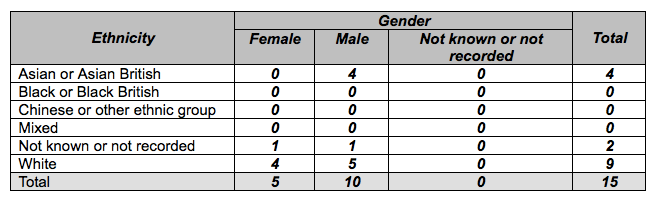
NCAS completed 15 full performance assessment reports in the financial year

2015/16. NCAS completed 3 assessments of behavioural concerns reports in the financial year 2015/16. NCAS did not undertake any standalone occupational health assessments in the financial year 2015/16.

4) What is the gender and ethnicity breakdown of these doctors who in 2015/2016

underwent Full NCAS performance assessment, Assessment of behavioural concerns

and assessment of health?

Drawing from the data collected at the point of referral i.e. at the time NCAS is first

contacted, the gender and ethnicity breakdown of doctors who underwent

assessment in the financial year 2015/2016 was as follows:
a-nhsa-1

Full performance assessments

a-nhsa-2

Assessment of behavioural concerns

a-nhsa-3

Occupational health assessment only

NCAS did not undertake any assessment of occupational health only assessments in the financial year 2016/16.

5) In the last 2 years, has NCAS undertaken any review of its Equality and Diversity practice in relation to referred doctors, and has NCAS reviewed BME doctors’ experience of NCAS’ processes?

NCAS recognises the importance of observing the equality and diversity issueswhich may impact on our handling of cases. All staff within NCAS are required to undertake mandatory equality and diversity training. This has been supplemented by a programme for advisers and other senior NCAS staff on the Language of Cultural Diversity held in June 2016 and focused on the impact of culture on communication. In addition, we are considering how we can ensure there is a rolling programme of diversity skills development and awareness for staff.

As part of our Case Investigator national educational programme we are currentlyrevising some of the material which will include ensuring there is clear guidance on the raising of concerns under whistleblowing procedures. We have been in discussion with the Department of Health in regard to the development of a more consistent approach procedurally to performance management to work towards reducing any potential for inequality and also any detriment experienced by whistleblowers.

Other than the routine data collected for practitioners (highlighted in 2 and 4 above)the specific experience of BME doctors has not been reviewed. However, NCAS is  being proactive in keeping up to date with research and good practice regarding potential sources of bias (including unconscious bias) and will include training in thisarea for assessors.

If so, please disclose the relevant reports from these reviews.

N/A

6) Does NCAS have a standard for the completeness of its data on the ethnicity of doctors who are referred? (For example, such as a minimum percentage of cases whereethnicity is not recorded or recorded as “unknown”).

Whilst there is not a specific percentage threshold for recording ethnicity, as part of our routine casework processes for each case we request information about the ethnicity of individual doctors about whom the employer or contracting body is seeking our advice. This information will be recorded if it is held by the employing or contracting body and they are able to supply it to NCAS.

7) If NCAS has an action plan/ improvement plan for ensuring a good level of recording of doctors’ ethnicity, please disclose this.

There is no action plan/improvement plan currently in place. Our response to question six above provides information about how NCAS collects data regarding ethnicity of individual doctors about whom the employer or contracting body is seeking our advice.

This concludes the response to your request. If you are not satisfied with the service that you have received in response to your information request, it is open to you to make a complaint and request a formal review of our decisions. If you choose to do this, you should write to Tinku Mitra, Head of Governance for the NHS LA, within 28 days of your receipt of this reply. Reviews of decisions made in relation to information requests are carried out by a person who was not involved in the

original decision-making about the request. If you are not content with the outcome of your complaint, you may apply directly to the Information Commissioner for a review of the decision by her. Generally, the Information Commissioner will not make a decision unless you have exhausted the local complaints procedure. The address of the Information Commissioner’s Office is:

Wycliffe House, Water Lane, Wilmslow, Cheshire SK9 5AF.

Kind regards,

Joe Stock | Information Access Manager | Corporate Governance Team

NHS Litigation Authority (NHS LA
Letter to Health Committee 23 September 2016


From: Minh Alexander <minhalexander@aol.com>

Subject: Settlement agreements and use of “super-gags” by NHS bodies

Date: 23 September 2016 at 11:46:24 BST

To: Health Committee <healthcom@parliament.uk>, sarah.wollaston.mp@parliament.uk, philippa.whitford.mp@parliament.uk, maggie.throup.mp@parliament.uk, andrew.percy.mp@parliament.uk, james.davies.mp@parliament.uk, andrea.jenkyns.mp@parliament.uk, paula.sherriff.mp@parliament.uk, bradshawb@parliament.uk, julie.cooper.mp@parliament.uk, emma.reynolds.mp@parliament.uk, pubaccom@parliament.uk, meghilliermp@parliament.uk, pacac@parliament.uk, Bernard Jenkin <bernard.jenkin.mp@parliament.uk>, amyas.morse@nao.gsi.gov.uk, mb-sofs@dh.gsi.gov.uk, Edward Jones <edward.jones@dh.gsi.gov.uk>, sheyda.m.azar@parliament.uk, bottomleyp@parliament.uk


To House of Commons Health Committee, 23 September 2016


Dear Dr Wollaston and colleagues,


Settlement agreements and use of “super-gags” by NHS bodies


I wrote to you in February to ask whether firmer action should be taken to deter the inappropriate and excessive use of confidentiality clauses in NHS settlement agreements, which is still obviously prevalent.


I now inform you that there is no evidence that CQC inspects NHS bodies’ use of settlement agreements despite its various claims that it does so, when “necessary” or if warned.


My findings are summarised in a paper which I have published here:


https://minhalexander.com/2016/09/23/nhs-gagging-how-cqc-sits-on-its-hands-2/


I have already informed Public Accounts Committee of my findings, with respect to PAC’s previous recommendations on tracking public sector settlement agreements, upon which the NHS has clearly not properly acted.


I would be grateful to hear from Health Committee on how it is minded to respond to this additional evidence of NHS inaction on transparency and whistleblower protection.


Many thanks.


Yours sincerely,


Dr Minh Alexander


cc Chairs of PAC and PACAC

Sir Amyas Morse Comptroller and Auditor General NAO

Secretary of State for Health

Shadow Secretary of State for Health

Sir Peter Bottomley MP


From: Minh Alexander <minhalexander@aol.com>

Subject: Settlement agreements and “super-gags” by NHS bodies

Date: 15 February 2016 at 12:21:50 GMT

To: Health Committee <healthcom@parliament.uk>, sarah.wollaston.mp@parliament.ukphilippa.whitford.mp@parliament.ukmaggie.throup.mp@parliament.ukandrew.percy.mp@parliament.ukjames.davies.mp@parliament.ukandrea.jenkyns.mp@parliament.ukpaula.sherriff.mp@parliament.ukbradshawb@parliament.ukjulie.cooper.mp@parliament.ukemma.reynolds.mp@parliament.uk

Cc: pubaccom@parliament.ukmeghilliermp@parliament.ukrichardbaconmp@parliament.ukharriett.baldwin.mp@parliament.ukdeidre.brock.mp@parliament.ukkevin.foster.mp@parliament.ukstewart.jackson.mp@parliament.uknigel.mills.mp@parliament.ukcaroline.flint.mp@parliament.ukchris.evans.mp@parliament.ukbridget.phillipson.mp@parliament.ukdavid.mowat.mp@parliament.ukstephen.phillips.mp@parliament.ukpughj@parliament.ukkarin.smyth.mp@parliament.ukannemarie.trevelyan.mp@parliament.uk, Bernard Jenkin <bernard.jenkin.mp@parliament.uk>, pacac@parliament.ukronnie.cowan.mp@parliament.ukoliver.dowden.mp@parliament.ukpaulflynnmp@talk21.comcheryl.gillan.mp@parliament.ukhoeyk@parliament.ukhopkinsk@parliament.ukjonesdi@parliament.ukgerald.jones.mp@parliament.uktom.tugendhat.mp@parliament.ukmail@islandmp.orgAnthonyHooper@matrixlaw.co.ukrfrancis@serjeantsinn.com


To Health Committee 15 February 2016


Dear Dr Wollaston and fellow committee members


Settlement agreements and “super-gags” by NHS bodies


The NHS’ use of settlements has been criticised to various degrees, for inappropriate secrecy and possible concealment of governance failures.It is generally accepted, including by Sir Robert Francis, that even where settlement agreements are strictly speaking legal (and contain clarification that a worker’s rights to make public interest disclosures are unfettered), they can still be constructed in such draconian terms and language that they still serve to intimidate and effectively silence staff. In particular, Sir Robert criticised the use of “super-gags”, which prevent parties from even disclosing the existence of agreements:


“…I have seen some which seem unnecessarily draconian or restrictive, for example, banning signatories from disclosing the existence of a settlement agreement.”


“…The excessive use of confidentiality clauses of any type in settlement agreements is a hindrance to transparency”


“…It is also clear that there is an atmosphere of fear and confusion surrounding the obligations of confidentiality in such agreements so as to make them a deterrent against public interest disclosures even where they do not have that effect in law.”


Such were the extent of Sir Robert’s concerns about current handling of NHS settlements that he suggested that the National Guardian should perhaps have responsibility for reviewing proposed settlements that require Treasury approval:


“NHS TDA and Monitor should consider whether their role of reviewing such agreements should be delegated to the Independent National Officer” 


I can see no public interest argument for any use of “super-gags”. However, they appear to have been used extensively in the NHS. Of significance, the former trusts of the new CQC Chair and the new CEO of NHS Improvement have both confirmed substantial use of such confidentiality clauses: 22 and 45 “super-gags” respectively, in the last 5 years. I attach the relevant FOI disclosures by these trusts.


I wonder if more robust, enforceable requirements need to be issued to make it clear that the NHS (and indeed other public bodies) should not use intimidating albeit legal settlement agreements, and in particular that all use of “super-gags” should cease.


Yours sincerely,

Dr Minh Alexander


cc Rt Hon Sir Anthony Hooper

Sir Robert Francis

Public Administration and Constitutional Affairs Committee

Public Accounts Committee

Dame Eileen Sills


NHS Gagging. How CQC sits on its hands

By Dr Minh Alexander NHS whistleblower and former consultant psychiatrist 22 September 2016

At a time when there are harsh cuts that affect patient safety, NHS staff need more than ever to be able to speak up without fear of reprisal, the health watchdog Care Quality Commission (CQC) is not doing enough to prevent cover-upsThis is partly due to failure to deter the inappropriate use of compromise agreements by regulated bodies. The CQC has claimed that it would inspect providers’ use of compromise agreements if “necessary”, but a review of almost 200 current CQC inspection reports on NHS trusts reveals no evidence whatsoever that it has done so.

Compromise (settlement) agreements are legal contracts that NHS organisations use to define how staff employment is terminated. Some of these agreements are benign, but some are used to cover up failure. Employers may seek to improperly gag themselves and departing employees who have under-performed or have been party to wrong-doing. Alternatively, employers may also use compromise agreements to silence whistleblowers. Gags can take the form of confidentiality clauses that make the existence or contents of agreements secret, or non-disparagement clauses that prevent the signatories from criticising each other.

There has been longstanding concern about the inappropriate use of compromise agreements in the public sector, including the NHS. Public Accounts Committee has made recommendations on improving practice but the government has watered them down. [1] [2] [3] [4] [5] [6]

Infamously, it was revealed that CQC gagged its own staff. [7] [8] [9]. The journalist Andrew Bousefield wrote: “A highly placed source in the CQC told Medical Harm he “had never before or since seen the number of people signing gagging orders” as they left the organisation.” This included a non-disparagement clause in the case of Dr Heather Wood, respected lead investigator of the team that uncovered failures at Mid Staffs. CQC later dismantled the investigation team. [10]

The non-disparagement clause in Dr Heather Wood’s case was quoted verbatim in the Mid Staffs Public Inquiry report [11]. Robert Francis criticised the CQC thus:

“…the agreement had a “chilling effect” inimical to the public interest and inconsistent with the role of the CQC as a regulator in a sector in which the public have a distinct right to know about concerns affecting their health and well-being”

Compromise agreements that seek to prevent signatories from making disclosures in the public interest (whistleblowing) are in fact illegal. Since 2013 when Robert Francis recommended that gagging in the NHS should be abolished [12], the NHS has worked around this problem of illegality by simply sticking an additional clause into compromise agreements – that still contain gags – which basically says “…but you can still whistleblow”. This just creates confusion and anxiety for staff who are subject to intimidating compromise agreements with gags. How would a lay person with no legal expertise know exactly what they could safely disclose ‘in the public interest’ without breaching such an agreement? Such matters are often subject to legal argument and ultimately require determination by a Tribunal. So how could the ordinary person in the street feel sure about what they can say and whether they will be legally protected if they do?

Press headlines in 2013 reported that Jeremy Hunt had banned gags in the NHS, but this was not so. He simply wrote an ineffectual letter to trusts asking them to do better. [13] The gagging continued and in 2014 the journalist Andrew Bousefield submitted evidence to the Freedom to Speak Up Review on NHS whistleblowing, which included:“64 blacked out compromise agreements in which the gagging clause is easily visible.” [14]

In his report of the Freedom to Speak Up Review, Robert Francis commented on how even legal compromise agreements can be intimidating if they are written in legalistic language and contain “draconian” and “restrictive” clauses that require secrecy of one sort or another. He described a “chilling” effect and concluded that some of the clauses he examined during the review were excessively restrictive. He singled out the use of gags that make the existence of compromise agreements secret (‘super-gags’) as particularly harsh. [15] Indeed, there are whistleblowers who were subject to technically legal compromise agreements but decided not to risk submitting evidence to the Freedom to Speak Up Review, because their agreements contained gags. Arising from his findings, Robert Francis recommended:


  • NHS Chief Executives should take personal responsibility for checking that all compromise agreements are not unduly restrictive


  • The CQC should review trusts’ compromise agreements as part of their inspection process when assessing whether trusts were “well-led”


Through various exchanges of correspondence, I asked CQC how it was implementing the latter. Worryingly, CQC replied that it had no specific, structured methodology for checking compromise agreements and that it did not intend to check such compromise agreements routinely. It also claimed that it would check where “necessary”, but did not explain how it would determine necessity. [16] Most recently David Behan, CQC Chief Executive, claimed in a letter of 16 September 2016, which I have seen, that if compromise agreements are raised with CQC as an issue, CQC inspectors would “pursue this as part of the inspection”. [17]

To assess how often the CQC deemed it “necessary” to review trusts’ compromise agreements, all the current new style inspection reports were searched for evidence that the CQC had checked and reported on trusts’ use of compromise agreements. Of 199 inspection reports, there was no evidence that CQC had scrutinised any compromise agreements for inappropriate application or clauses. And yet most of these inspection reports – 163 (82%) – were issued after Robert Francis recommended that CQC should review trusts’ compromise agreements. [17] This is astonishing, especially given that ongoing Freedom of Information work shows that the use of secrecy and non-disparagement clauses remains widespread in the NHS. Trusts have quite often told me that they use gags as “standard”, which suggests that the recommendations of Public Accounts Committee and the Freedom To Speak Up Review have been ignored. I have informed Public Accounts Committee of this lack of evidence that CQC checks compromise agreements. [18]

The above finding from CQC’s inspection reports means that there was no evidence that CQC checked the use of compromise agreements even in trusts with well-known whistleblower issues, recent whistleblowing alerts on CQC’s system of “intelligent monitoring” and or high levels of bullying and other poor scores on the NHS staff survey.

At Mersey Care NHS Foundation trust, which has received negative publicity through coroners’ inquests and has revealed the highest number of compromise agreements so far (443 over 5 years, all with super-gags), the CQC inspection report said nothing at all about compromise agreements. [19] [20] Mr Behan’s recent claim that if warned, CQC would pursue compromise agreements as part of inspections also does not seem to hold water. At Sheffield Teaching Hospitals NHS Foundation trust where there have been over seven whistleblowers and 22 external whistleblowing disclosures to CQC in 3 years, [21] CQC was warned by whistleblowers that there had been 228 compromise agreements over 5 years. However, CQC’s recent inspection report was silent about these 228 compromise agreements. [22]

At trusts recently found to be ‘Inadequate’, CQC did not seem to think it was necessary to check for inappropriate gagging.

There was no mention of compromise agreements in CQC’s latest inspection report on the London Ambulance Service (bullying and poor staff survey, staff fear of raising issues in case of “repercussions”, and whistleblower cases). [23] [24] [25] Similarly, there was no mention of compromise agreements in the latest CQC inspection report issued only last month, about Colchester (bullying and poor staff survey results, whistleblower cases, whistleblowing alerts on CQC’s intelligent monitoring). [26] [27] [28]

At a time when the NHS is in so much turmoil, it is of great concern that the lead regulator is not making any visible effort to protect staff’s freedom to speak up by challenging trusts about their use of gags. Also of concern, the Department of Health sees no need for change. When the Department is questioned about the lack of effective reform since Jeremy Hunt’s promises in 2013 to reduce the use of NHS gags, it just insists that trusts have been given sufficient guidance on ensuring that their compromise agreements are legal. Lord Prior recently wrote in the Health Service journal that the government is intent on driving NHS improvement through Mr Hunt’s famous ‘intelligent transparency’, but this is frankly just hot air.

Almost exactly four years ago the Serious Case Review on institutional abuse at Winterbourne View concluded that the CQC failed whistleblowers and was incapable of detecting serious care failings. [29] The fact that the CQC still resists examining key information which could reveal whether whistleblowers have been gagged raises a question of whether NHS silence is strategic and engineered.


References

[1] Confidentiality Clauses and Special Severance Payments. House of Commons Public Accounts Committee. Thirty-sixth Report of Session 2013–14, 24 January 2014

http://www.publications.parliament.uk/pa/cm201314/cmselect/cmpubacc/477/477.pdf

[2] Treasury Minutes. Government responses on the Thirty Fifth to

the Forty Fifth Reports from the Committee of Public Accounts: Session 2013-14. April 2014.

https://www.gov.uk/government/uploads/system/uploads/attachment_data/file/302527/39796_Cm_8847_Print_Ready.pdf

[2] Briefing for Stephen Barclay MP, Public Accounts Committee

Gagging clauses in the NHS, Public Concern at Work, 12 December 2011

[3] £14m bill for gagging axed officials. Steven Swinford, Telegraph 3 April 2014

http://www.telegraph.co.uk/news/9967901/14m-bill-for-gagging-axed-public-officials.html

[4] Councils use gagging orders in most staff settlements, finds investigation. Guardian 3 April 2016

https://www.theguardian.com/uk-news/2016/apr/03/councils-gagging-orders-most-staff-settlements-bbc-radio-5-live-investigates

[5] Whistleblowing and gagging clauses. House of Commons briefing paper, Number CBP 7442, 4 January 2016

[6] Shoot the Messenger. Dr Phil Hammond and Andrew Bousefield, Private Eye 2011

http://drphilhammond.com/blog/wp-content/uploads/2011/11/Shoot_the_Mesenger_FINAL.pdf

[7] Cynthia: Goodbye Then. Andrew Bousefield , Medical Harm 19 March 2012

http://medicalharm.org/uncategorized/cynthia-goodbye-then/

[8] Health regulator ‘gagged own staff against speaking of failures’. Rebecca Smith, Telegraph, 30 March 2012

http://www.telegraph.co.uk/news/health/news/9170951/Health-regulator-gagged-own-staff-against-speaking-of-failures.html

[9] Care Quality Commission puts gagging orders on six employees

Rajeev Syal, Guardian 24 January 2012

https://www.theguardian.com/society/2012/jan/24/care-quality-commission-gagging-orders

[10] Stafford Hospital Investigator berates CQC regulator John Carvel Guardian, 1 May 2012

https://www.theguardian.com/society/2012/may/01/stafford-hospital-investigator-berates-cqc-regulator

[11] Report of the Public Inquiry into Mid Staffordshire NHS Foundation Trust:

“Non-disparagement” and “gagging” clauses

11.229 Some witnesses to the Inquiry who were former employees of the CQC required a direction to give evidence because of their fears about the effect of a clause in compromise agreements relating to the terms of their departure. Ms Bower told the Inquiry she had been advised that such terms were entirely standard. The Inquiry obtained copies of the CQC’s standard clause as inserted in Dr Heather Wood’s agreement:

That Dr Wood will not at any time hereafter make or repeat any statement which disparages or is intended to disparage the goodwill or reputation of the CQC, or any specified person and the CQC will use reasonable endeavours to ensure that no senior manager, tier 3 or above, with whom Dr Wood had direct dealings with her employment with the CQC, nor any specified person involved in the correspondence process surrounding the termination of Dr Wood’s employment will make or repeat any statement which disparage or are intended to disparage the goodwill or reputation of Dr Wood.” 

http://webarchive.nationalarchives.gov.uk/20150407084003/http://www.midstaffspublicinquiry.com/sites/default/files/report/Volume%202.pdf

[12] Robert Francis recommendation 179 of the Mid Staffs Public Inquiry report:

“179 Restrictive contractual clauses  

“Gagging clauses” or non disparagement clauses should be prohibited in the policies and contracts of all healthcare organisations, regulators and commissioners; insofar as they seek, or appear, to limit bona fide disclosure in relation to public interest issues of patient safety and care.”

[13] Letter by Jeremy Hunt to NHS trusts March 2013

https://www.gov.uk/government/uploads/system/uploads/attachment_data/file/217036/open-culture-letter.pdf

[14] Submission by Andrew Bousefield to Freedom to Speak Up Review 10 September 2014

http://twitdoc.com/view.asp?id=298255&sid=6E4V&ext=PDF&lcl=Andrew-Bousfield-First-Statement-for-Francis-1-.pdf&usr=alexander_minh

[15] Report of the Freedom to Speak Up Review. February 2015.

http://webarchive.nationalarchives.gov.uk/20150218150343/https:/freedomtospeakup.org.uk/wp-content/uploads/2014/07/F2SU_Executive-summary.pdf

[16] Letter from Rebecca Lloyd-Jones CQC Director of Legal Services 2 August 2016

https://twitter.com/alexander_minh/status/760502740720226305

[17] Letter from David Behan Chief Executive of the Care Quality Commission to Jade Taylor 16 September 2016

[18] All latest CQC reports of inspections conducted under the new inspection regime were reviewed, and searched for the following key words:


Gag (gags, gagging)

Compromise

Settlement

Agreement

Clause

Non-disparagement

Confidentiality


On this basis, no discussion of compromise (settlement) agreements was found in any of the CQC inspection reports searched.

The relevant data is uploaded here:

https://www.dropbox.com/home?preview=OPEN+DEMOCRACY+CQC+INSP+REPORTS+%26+COMPROMISE+AGREEMENTS.xlsx

[19] Letter to Public Accounts Committee 2 September 2016

http://twitdoc.com/view.asp?id=298261&sid=6E51&ext=PDF&lcl=Letter-to-Public-Accounts-Committee-2-September-2016-re-lack-of-evidence-that-CQC-reviews-compromise-agreements.pdf&usr=alexander_minh

[20] Freedom of information disclosure by Mersey Care NHS Foundation Trust 27 July 2016

Click to access mersey-care-received-28-07-2016.pdf

[21] CQC inspection report on Mersey Care NHS Foundation Trust 14 October 2015

https://www.cqc.org.uk/sites/default/files/new_reports/AAAD5292.pdf

[22] Freedom of Information disclosures about Sheffield Teaching Hospitals NHS Foundation Trust

https://twitter.com/alexander_minh/status/740857992212566016

https://twitter.com/alexander_minh/status/762521001016131584

[23] CQC inspection report on Sheffield Teaching Hospitals NHS Foundation Trust 9 June 2016

http://www.cqc.org.uk/sites/default/files/new_reports/AAAE8129.pdf

[24] CQC inspection report on London Ambulance Service NHS Trust 27 November 2015

http://www.cqc.org.uk/sites/default/files/new_reports/AAAD5290.pdf

[25] Revealed: The hidden crisis in Britain’s ambulance services. Mary Wakefield. The Spectator, 30 August 2014

http://www.spectator.co.uk/2014/08/londons-999-emergency/

[26] The London Ambulance Service Bullying and Harassment Review: Summary & Action Plan, July 2015

http://twitdoc.com/view.asp?id=298260&sid=6E50&ext=PDF&lcl=LAS-Bullying-and-harassment-review-action-plan.pdf&usr=alexander_minh

[27] CQC inspection report on Colchester Hospital University NHS Foundation Trust 15 July 2016

http://www.cqc.org.uk/sites/default/files/new_reports/AAAF6388.pdf

[28] Colchester Hospital University NHS Foundation Trust

http://www.nhsstaffsurveys.com/Caches/Files/NHS_staff_survey_2015_RDE_full.pdf

[29] Whistleblowers Still Coming Forward At Colchester Hospital. Heart 5 November 2014

http://www.heart.co.uk/essex/news/local/whistleblowers-come-forward-colchester-hospital/#Jf23cXbKl1DzfVOW.97

[30] South Gloucestershire Safeguarding Adults Board Winterbourne View Hospital A Serious Case Review By Margaret Flynn, 4 September 2012

Click to access report.pdf