
Letter by whistleblowers 26 November 2015: CQC a fraying rope

To Mike Mire CQC Chair, 26 November 2015

Dear Mr Mire,

CQC’s approach to whistleblowers and whistleblowing

We write to raise concern about these issues. Public Accounts Committee, at its recent hearing with the CQC and Dame Una O’Brien on 28 October, noted the CQC’s continuing ineffectiveness. [1] Specifically, we believe that the CQC has failed and continues to fail whistleblowers. We have the following unresolved concerns about the CQC’s discharge of its responsibilities for ensuring good whistleblowing governance:

1) The CQC’s poor treatment of its own staff who whistleblow and its role modelling of good practice as an employer.

2) The CQC has done little or nothing to challenge the gagging of whistleblowers by the organisations that it regulates.

3) The CQC is not sufficiently transparent about whistleblowing issues.

4) The CQC is failing to act appropriately upon whistleblowers’ disclosures.

5) The CQC still has no structured inspection methodology for assessing regulated organisations’ whistleblowing governance.

6) The CQC has not made serious efforts to engage with whistleblowers.

7) The CQC has shown little will to address serious misconduct by senior managers who engage in reprisal

8) The CQC has advised whistleblowers that they can complain to PHSO about CQC’s response, but in six years PHSO has not upheld a single complaint about the CQC

9) Whistleblowers continue to be sacked or forced to move on, and this is supporting evidence of insufficient support for whistleblowers and insufficient deterrence of reprisal.

We provide the basis for our concerns in the appendix below. We ask you to ensure that the CQC rapidly improves its whistleblowing governance and that the shortcomings that we have described are rectified. In particular, we ask that the CQC’s handling of FPPR is appropriately scrutinised and corrected. To borrow from the CQC’s Board, we believe that the CQC’s poor whistleblowing governance is a “fraying rope” which poses a risk to patient safety. We look forward to hearing whether you will be able to help resolve our concerns.

Yours sincerely,

Minh Alexander

Kevin Beatt

Fiona Bell

Sharmila Chowdhury

Eileen Chubb

David Drew

Narinder Kapur

Gary Walker

Maha Yassaie

cc Health Committee

Public Accounts Committee

Secretary of State for Health

Shadow Secretary of State for Health

APPENDIX: The basis for our concerns:

1.  The CQC’s treatment of its own staff who whistleblow and the CQC’s role modelling of good practice as an employer. The CQC has a history of gagging [2] and treating its own whistleblower staff poorly. It has also still not apologised to several of its own whistleblowers. Additionally, a CQC member of staff recently made a serious external disclosure.[3] This suggests that CQC is still not properly handling concerns raised by its own staff. This does not set a good example to the organisations that the CQC regulates.

2. The CQC has done little or nothing to challenge the gagging of whistleblowers by the organisations that it regulates. The CQC’s inspection reports do not explicitly deal with this key issue of whistleblowing governance. Despite the CQC acknowledging that confidentiality clauses can be seen as gagging clauses [2], the CQC seems to have turned a blind eye to the widespread and continuing use of such clauses by regulated organisations. This allows employers to continue forcing whistleblowers into silence.

3. The CQC is not sufficiently transparent about whistleblowing issues. Despite Public Account Committee’s recommendations that public bodies make proactive and transparent use of whistleblowing data [4], the CQC has failed to analyse and publish meaningful whistleblowing activity data. This is despite the fact that the CQC holds an unparalleled national database on health and social care whistleblowing, which could clearly be powerfully used to drive learning and care quality. It is a hugely wasteful, major governance failure that the CQC has not made better use of this data. The CQC has also declined to make a definite commitment to publishing such whistleblowing data in the future [5], even though the government says that it plans to make it compulsory from April 2016 for prescribed bodies such as the CQC to publishing whistleblowing data. [6]We are also concerned that the CQC has refused to publish the outcome of an external review of its whistleblowing governance, which was conducted at a cost of £150,000 to the public purse. The cost of this exercise was revealed only through an FOI request. [7]

4. CQC’s failure to act appropriately upon whistleblowers’ disclosures. The CQC has repeatedly failed to give due weight to whistleblowers’ concerns, and has repeatedly failed to investigate their concerns either singly or as part of wider thematic review, despite the fact that the CQC acknowledges it has powers of thematic review. In the few instances where the CQC has undertaken thematic reviews, it has not been adequately supportive of whistleblowers. [8] The CQC has also far too readily accepted “independent” investigations that regulated organisations arrange to manage concerns raised by whistleblowers. These investigations are not truly independent, and there is evidence in some cases that employers have unhealthy if not clearly corrupt control of such investigations. The CQC must surely be aware of the shortcomings of such investigations, but it still permits and in some cases, encourages their use. In essence, the CQC divests itself of responsibility, does not take whistleblower intelligence seriously, and allows regulated organisations to waste public money on superficial and sometimes false assurance.

5. The CQC still has no structured inspection methodology for assessing regulatedorganisations’ whistleblowing governance. [9] We have written to the CQC about this issue. [9]Sir Robert Francis concluded the CQC was not making sufficient use of its powers to protect whistleblowers, and that it could do more. He recommended that regulatory action should be taken where organisations have poor whistleblowing practice. [10] However, it is hard to see how this will be achieved until the CQC sets clear, auditable inspection standards and measures its adherence to such standards. The CQC does notseem to have adopted Sir Robert Francis’ recommendations in any measurableway and appears to be carrying on regardless.

6. The CQC has not made serious efforts to engage with whistleblowers. It has only held two whistleblower listening events in two years. This is despite the CQC’s promise to keep whistleblowers regularly involved and informed. The CQC’s approach has been tokenistic, and it continues to postpone discussion of the real issues that concern whistleblowers. Also, the CQC stated last year that it was reviewing its customer care, including its approach to whistleblowers, but it has not yet taken an evidence-based approach and measured whistleblowers’ experience of the CQC. One important consequence of the CQC’s failure to measure whistleblowers’ experience is that it is failing its duty of Equality. The CQC has no data to evidence that it is treating protected groups as well as others, and CQC has admitted that it is not collecting data on the ethnicity of whistleblowers. This is despite the fact that the Freedom To Speak Up Review demonstrated that BME whistleblowers have a worse experience of whistleblowing. The CQC also set criteria for a recent CQC whistleblowing post which disadvantaged whistleblowers, and meant that many whistleblowers would not be eligible to apply even though they were the individuals with the very knowledge and expertise that were relevant to this post. [11]

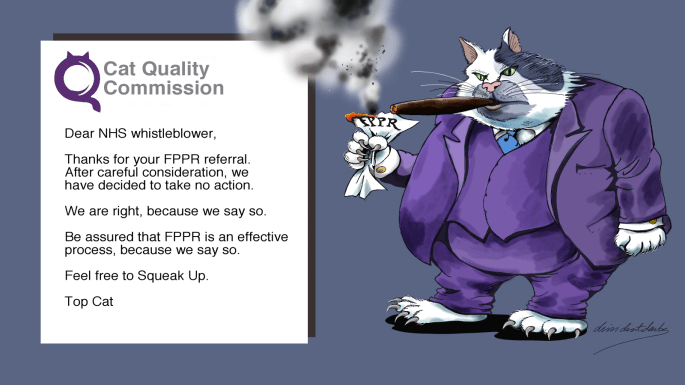
7. CQC has shown little will to address serious misconduct by senior managers who engage in reprisal against whistleblowers. Not one director who has been referred under Regulation 5 Fit & Proper Person (FPPR) has so far been removed from office as a result of the CQC’s actions. [12] [13] Whistleblowers have in fact noted a tendency by the CQC to spare such managers. Professor Sir Mike Richards, who chairs the CQC’s FPPR panel, has stated that only certain levels of reprisal would be considered for regulatory action, although there is no clarity and transparency about the determining levels of reprisal. Professor Mike Richards has also stated to whistleblowers that it will not be possible to remove too many managers for reasons of public opinion. In our view, the CQC’s application of FPPR has been arbitrary and its position contradictory. The CQC claims that it is up to Trusts to make determinations of fitness, but the CQC itself has declared a number of FPPR referrals to be meritless and has not even passed these referrals to the relevant Trust Boards. This brings to mind recent comments by Professor Mark Baker of NICE: “I think the reason they don’t want it is if you don’t like the answer to the question, you don’t ask the question” [14] It seems logical to ask if the CQC is not allowing FPPR questions to be raised with Trusts, because it wishes to avoid the answers. This is particularly disappointing to whistleblowers as FPPR is currently the sole mechanism for holding managing victimising whistleblowers to account. This is because in his report of the Freedom To Speak Up Review report, Sir Robert Francis eschewed managerial regulation in favour of a trial of FPPR. It seems logical to ask if the CQC is not allowing FPPR questions to be raised with Trusts, because it wishes to avoid the answers. This is particularly disappointing to whistleblowers as FPPR is currently the sole mechanism for holding managing victimising whistleblowers to account. This is because in his report of the Freedom To Speak Up Review report, Sir Robert Francis eschewed managerial regulation in favour of a trial of FPPR. We do not believe that the CQC have shown robust will to deter whistleblower reprisal. Another government agency has overseen the successful barring of a company director responsible for whistleblower suppression at Winterbourne view [15], but the CQC have failed to remove other directors for even worse reprisal using FPPR. Mr Behan and Professor Mike Richards recently claimed that although no director has yet been removed under FPPR, they believed that FPPR is now having a “deterrent” effect. [13] Their view was not supported by the recent appointment by St. George’s hospital of a high profile director, who was previously found by an Employment Tribunal to have victimised whistleblowers. [16] Sir Robert Francis referred to this specific case as an example of “oppressive” employer behaviour that should not be tolerated. [17] Yet it seems to us that the CQC has tolerated many such instances of oppressive behaviour. The resulting injustice to whistleblowers and impunity for “oppressive” managers is, as Health Committee has noted, a serious patient safety issue. [18] In the case of Hayley Dare whistleblower, her former employer West London Mental Health NHS Trust has now finally admitted in EAT proceedings and after prosecuting a ferocious campaign against her, that she raised concerns in good faith. [19] Yet such is the licence afforded to employers that we have no expectation that the Trust board will be held to account for unlawful reprisal, sacking a whistleblower or for gross waste of public funds.

8. The CQC has advised whistleblowers that they can complain to PHSO if they are unhappy with its response, but this is likely to be an ineffective means of appeal.However, it is clear from the statistics that a complaint to PHSO is unlikely to beupheld. Based on FOI disclosure by PHSO, of 354 complaints to PHSO about the CQC since the CQC’s inception in 2009, none have yet been upheld. [20] An appeal to PHSO is likely to be just another journey between pillar to post for whistleblowers. So in short, whistleblowers are obstructed by the CQC’s failures to discharge its responsibilities, and in effect have nowhere else to go.

9. Whistleblowers continue to be sacked or forced to move on, and this is supporting evidence of insufficient support for whistleblowers and insufficient deterrence of reprisal. In the continuing case of whistleblower Dr Kevin Beatt illustrates the fact that even when whistleblowers are fully vindicated by Employment Tribunals, employers may still subject them to further harrowing appeals. The Employment Tribunal found that Dr Kevin Beatt was a genuine whistleblower, that he was blameless and that he suffered serious detriment which included being vexatiously referred by his employer to the GMC. However, Dr Beatt’s former employer has appealed against the ET judgment despite the recommendations of Sir Robert Francis’ whistleblowing review and his advice that employers should reflect on current legal action [21], and despite Mr Hunt’s promises to protect whistleblowers. Furthermore, the CQC arbitrarily rejected Dr Beatt’s FPPR referralabout the actions of his employer. It is clear to us that poor employers continue to victimise whistleblowers because there is a palpable lack of deterrence, and they have no fear of consequences.

References

[1] Public Accounts Committee, oral evidence on the CQC 28.10.2015

Click to access 23822.pdf

[2] Health watchdog put 20 gagging orders on staff, Patrick Sawer and Laura Donnelly, Telegraph 30 June 2013

http://www.telegraph.co.uk/news/health/heal-our-hospitals/10150664/Health-watchdog-put-20-gaggingorders-on-staff.html

[3] DH audit of the CQC’s procurement process in response to a CQC whistleblower’s disclosures to DH

https://www.gov.uk/government/publications/review-of-2-cqc-procurements-made-in-2013

[4] House of Commons Public Accounts Committee, Whistleblowing, Ninth report of session 2014-2015, 1.08.2014

Click to access 593.pdf

[5] Correspondence about the CQC’s analysis and publication of its whistleblowing data

[6] Correspondence from Sir Jeremy Heywood, Cabinet Secretary 20.10.2015

[7] Correspondence about the publication of a review of the CQC’s performance as a prescribed body under the Public Interest Disclosure Act

[8] Joint review by the CQC and Monitor into whistleblowing concerns at the Christie NHS Foundation Trust

Click to access Christie_Review.pdf

[9] Letter to Mr David Behan, CQC Chief Executive 19.10.2015

CQC Inspectors in the dark

[10] Report of Freedom to Speak Up Review by Sir Robert Francis QC, 11.02.2015

[11] Correspondence to Mr David Behan about National Guardian Set Up Manager post 10.10.2015 and 22.10.2015

CQC’s processes leaves exiled whistleblowers in the cold

CQC slams door on whistleblowers

[12] More than 60 managers have faced Fit and Proper complaints, Shaun Lintern, Health Service Journal 29.06.2015

http://www.hsj.co.uk/news/more-than-60-managers-have-faced-fit-and-proper-complaints/5087202.article

[13] Chief inspector: Fit and proper regulation having ‘deterrent effect’, Will Hazel, Health Service Journal, 24.09.2015

http://www.hsj.co.uk/news/chief-inspector-fit-and-proper-regulation-having-deterrenteffect/5090599.article

[14] NHS leaders ‘didn’t like answer’ they got on staffing levels, Shaun Lintern, Nursing Times 7.07.2015

http://www.nursingtimes.net/home/specialisms/leadership/nhs-leaders-didnt-like-answer-getting-onstaffing-levels/5087589.article?referrer=RSS

[15] Nursing home director disqualified for failing to act on whistleblower concerns

https://www.gov.uk/government/news/nursing-home-director-disqualified-for-failing-to-act-onwhistleblower-concerns

[16] Ex-South Devon Chief joins London trust, Sophie Barnes, Health Service Journal, 12.10.2015 http://m.hsj.co.uk/5091013.article

[17] Francis criticises Vasco-Knight trust, Judith Welikala, Health Service Journal, 7.02.2014 http://www.hsj.co.uk/news/acute-care/francis-criticises-vasco-knight-trust/5067807.article

[18] House of Commons Health Committee, Complaints and Raising Concerns, Fourth report of session 2014-2015, 21.01.2015

[19] NHS Mental Health Trust accepts whistleblower who spoke out about bullying acted in good faith, Paul Gallagher, Independent on Sunday 8.11.2015

http://www.independent.co.uk/life-style/health-and-families/health-news/nhs-mental-health-trust-admitswhistleblower-who-spoke-out-about-bullying-acted-in-good-faith-a6725786.html

[20] FOI disclosure 21.09.2015 by PHSO on the handling of complaints about the CQC.

http://twitdoc.com/4S1Y

[21] NHS to get whistleblower guardians, Hugh Pym, BBC 11.02.2015
http://www.bbc.co.uk/news/health-31362196

CQC Deaths Review: All fur coat….

By Dr Minh Alexander, NHS whistlerblower and former consultant psychiatrist, first published 13 August 2016

After the abject failures by CQC, DH and other oversight bodies were revealed by the Mazars [1] report on failure to investigate hundreds of unexpected patient deaths by Southern Health, Jeremy Hunt predictably asked CQC to review the way the NHS handles deaths. [2]

What better way of keeping it in the family, whilst fobbing off the public with some superficially reassuring headlines.

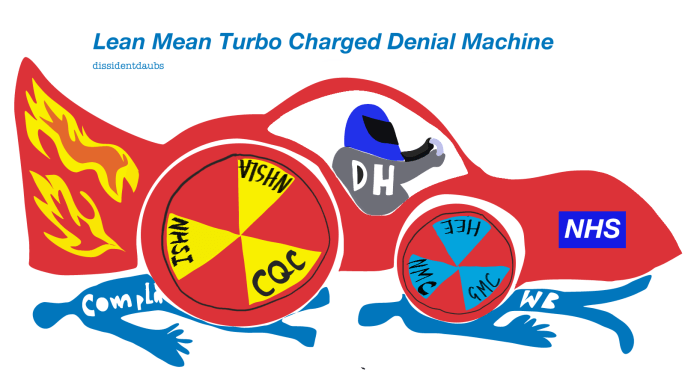
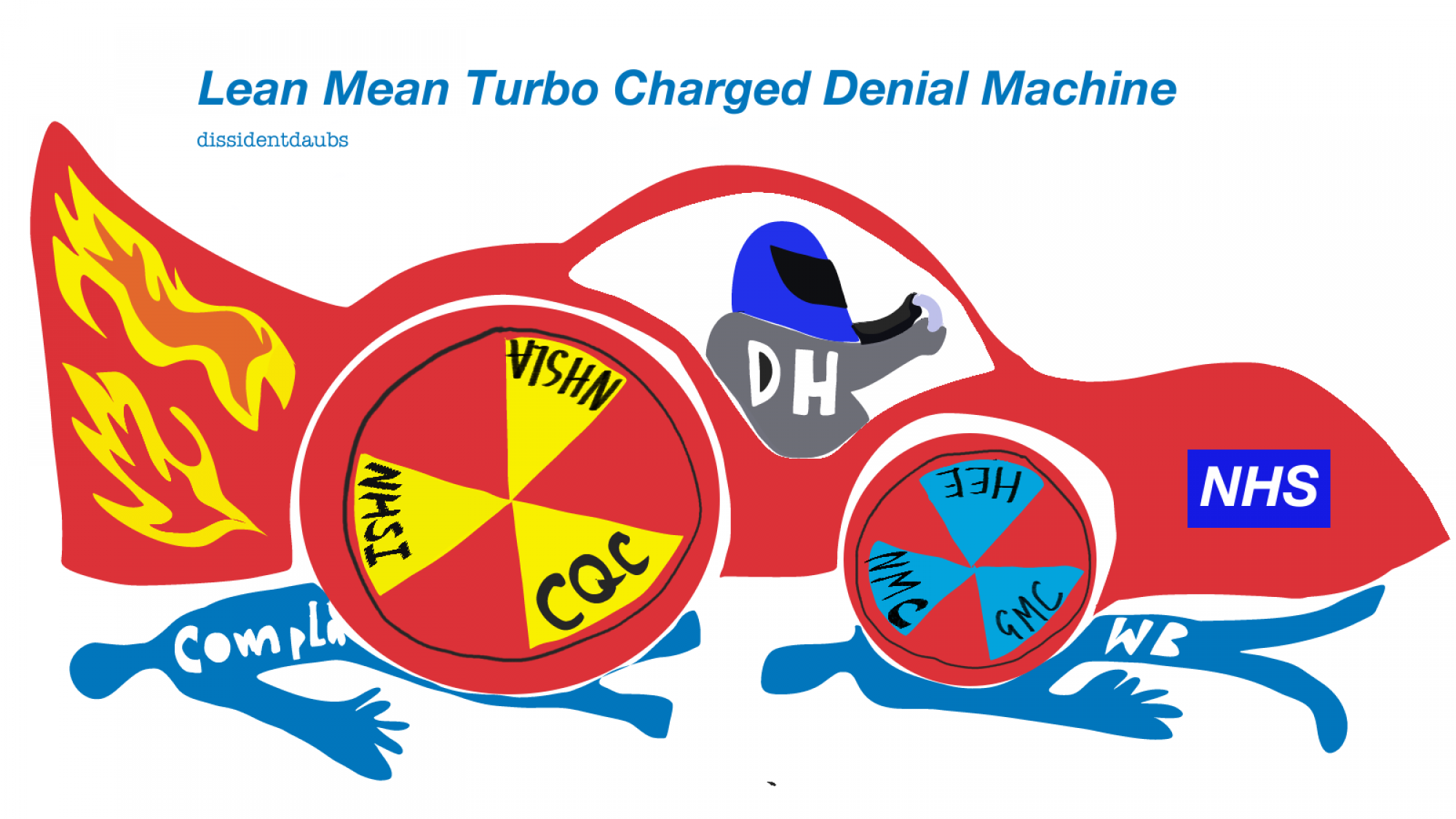
Never mind that CQC has long been implicated as an essential part of what Professor Brian Jarman called the NHS Denial Machine. [3]

CQC itself is only reviewing what trusts do. Purportedly, there is other work by the DH that “may” result in changes to regulatory process. There is passing reference to this in CQC’s review blurb, but I am not aware that any details of this work have been published. [4]

After I posted criticism of CQC and the limited remit of the deaths review in the twitter hashtag #CQCDeathsReview, I was approached via twitter by a CQC official who assured me that the enforcement of good practice would be reviewed as well. This person invited my contribution and offered me a meeting with the deaths review team. When I asked for more information, a telephone call was offered. When I asked for written information and the actual terms of reference of any review of regulatory performance, the communication petered out. This is unfortunate as the deadline for submission of evidence is this Sunday, 14 August.

No doubt it was a well-meaning approach, by someone who had not yet discovered that the CQC has developed a habit of writing frosty letters to me via its Director of Legal Services.

However, there is a startling contrast between the frenetic publicisation of CQC’s review of trusts’ performance in handling deaths, compared to the opacity and silence over the purported (and more important) review of oversight processes. The message is one of double standards: “No stakeholder scrutiny please, we’re too important”.

This unwillingness by the DH, and its arm lengths bodies such as CQC, to properly account for their failures to protect patients is typical of a longstanding pattern of behaviour. Major reports which criticised the DH’s role in creating a culture of fear and compliance, instead of a genuine focus on quality and patient safety, were suppressed by the DH in 2008 and only released in 2010 by FOI. [5] [6] [7]

It is most unlikely that the whole truth will be allowed to emerge about the NHS’ continued mishandling and subterfuges about patient deaths.

A review of CQC inspection reports on English mental health trusts raises serious questions of systematic evasiveness by CQC about patient deaths. [8]

Only one of the new-look CQC inspection reports published so far on mental health trusts gave the numbers of deaths of patients under the Mental Health Act. The rest of the reports carefully side-stepped this critical data, even in instances where CQC admitted that some trusts were noted to be at elevated risk of deaths and or suicides under the Mental Health Act. At Mersey Care, a CQC report of October 2015 claimed that although the trust had an elevated risk in terms of the number of suicides under the Mental Health Act, the figures were not given because the numbers of deaths were low and could lead to identification. [9] Yet there are plenty of occasions when CQC reports have referred to very small numbers of other types of incidents, for example: a serious injury sustained by a detained Southern Health patient after climbing onto a roof that was too easily accessed. Perhaps the real issue is government reluctance to reveal the scale of Article 2 Right to Life legal claims to which it is potentially exposed, with liability being most obvious in the deaths of patients detained by the State.

The Mazars report did not spare CQC’s blushes on Mental Health Act deaths. Mazars’ investigation found that Southern Health reported 27 deaths of patients under the Mental Health Act to CQC. However, CQC managed to mislay 9 of these, and told Mazars that there had only been 18 deaths of Southern Health patients under the Mental Health Act.

There is generally arbitrary variation of the way in which deaths data was presented from one CQC report to another. The time periods sampled varied for no given reason. CQC showed Goldfish grade organisational memory in that the time periods sampled were short (mostly around a year or so, distributed variably in time prior to the inspection visits), and there was very little evidence of benchmarking against past deaths. Consequently, there was almost no longitudinal perspective on the degree to which organisations were repeating the same failings. CQC sometimes gave a breakdown of the types of deaths, but sometimes not. Suicide is sometimes not mentioned at all, which is rather surreal when a regulator is reporting on mental health service safety.

The July 2015 CQC inspection report on Kent and Medway, from an inspection chaired by no less than Paul Lelliot CQC’s Deputy Chief Inspector and CQC lead for mental health, did not mention deaths at all. [10] This is rather extraordinary as Kent and Medway has received at least 13 coroner’s warning Reports to Prevent Future Deaths, including 4 reports in 2014.

Similarly, the numbers of deaths were not reported at all by the CQC inspection report on Nottinghamshire Healthcare, of July 2014. [11] Instead, there was only a brief claim that the number of Nottinghamshire Healthcare’s deaths was in the expected range. Paul Lelliot also chaired this inspection.

At the very troubled and “Inadequate” Norfolk and Suffolk, which has seen very harsh staffing cuts in recent years, CQC’s latest inspection report of February 2015 [12] also contrived not to give the numbers of any deaths whatsoever, despite the fact that the local media has been filled with frequent reports of campaigners’ concerns about increased numbers of deaths and trust inquests. In this context, a question arises of whether this failure by CQC to report the number of Norfolk and Suffolk deaths was a politicised decision.

There were other CQC reports that did not give the numbers of deaths, and some that gave conflicting numbers of deaths, with no attempt by CQC to reconcile the conflicts.

Importantly, CQC only described reported deaths. There was no evidence that CQC checked on whether reporting was accurate and reliable. In some trusts, CQC stated that no deaths had been reported at all, but gave no indication that inspectors had dug deeper to verify the number of deaths. I have told CQC many times that not all deaths and serious incidents are reported. Mazars also gave ample evidence that not all deaths are reported: there were a total of 10,306 deaths at Southern Health between 2011 to 2015, but only 195 were reported as serious incidents requiring investigation (SIRIs). Some of the trusts with zero reported deaths were rated “Good” by CQC. CQC did not describe any attempts to cross check directly with coroners. There is evidence that CQC relied on some trusts to tell them how many coroners’ warning reports had been received: The trust told us about four subsequent coroners’ rulings (regulation 28 rulings)”. In this particular instance, this information was incorrect and there had been two additional coroners’ warning reports.

Bizarrely, the November 2015 CQC inspection report on Lancashire Care NHS Foundation restricted itself to looking at Coroners’ warning reports from only 6 months in 2013:

Every six months, the Ministry of Justice publishes a summary of recommendations that had been made by coroners with the intention of learning lessons from the cause of death to help prevent deaths. There were no concerns raised regarding the trust in the most recent report (April 2013 – September 2013).” [13]

In fact, Lancashire Care had 5 coroners’ warning Reports to Prevent Future Deaths from December 2013 up to the time of CQC’s report. A very serious question arises about why CQC chose to ignore this evidence and to exclude it from its inspection report.

CQC performed the same worrying manoeuvre in its February 2015 inspection report of the extremely troubled Norfolk and Suffolk. The CQC report claimed that

“In the latest report covering the period from October 2012 to March 2013 there were no concerns regarding the trust raised by the coroner.”

Firstly, this was wrong as there was a coroner’s warning report issued on

28 March 2013 on the death of a patient detained under the Mental Health Act. Moreover, there were another 6 coroners’ warning reports after that, up to the time of CQC’s inspection report. In total, Norfolk and Suffolk have had at least 22 coroner’s warning reports, which is one of the highest if not the highest numbers of coroners’ warning reports nationally.

The same dodgy dance steps were followed at Avon and Wiltshire Partnership, when the CQC July 2015 inspection report claimed:

“In the latest report covering the period from October 2012 to March 2013 one concern regarding the trust was raised relating to the death of a patient at Fromeside” [14]

In fact, from September 2013 to the time of CQC’s inspection report, there were at least 8 further coroners’ warning reports. Avon and Wiltshire Partnership has had at least 17 coroners’ warning reports in total, and some have described the most serious failures of care. These included the highly publicised case of a 2014 suicide-infanticide in which the trust was criticised by the coroner in October 2015 for not making adequate contingency plans for a very high risk pregnancy, in a patient with known psychotic illness. [15] [16]

At Greater Manchester West, CQC’s inspection report of June 2016 [17] mentioned only one coroner’s warning report in January 2016, when in fact between September 2013 and December 2015, there were 8 other warning reports issued.

At Devon Partnership, CQC’s inspection report of January 2016 [18] did not mention coroners’ warning reports at all, despite the fact that the trust has had at least 19 warning reports, with 4 issued between July 2014 and October 2015.

CQC’s January 2016 inspection report of SLAM [19] was equally silent on coroners’ warning reports, when there had been a total of at least 19 warning reports, with 8 issued between August 2013 and July 2015.

At troubled Sussex Partnership, CQC’s inspection report of May 2015 [20] also did not mention coroners’ warning reports at all, despite the fact that there had been a total of 11 reports up to the time of CQC’s inspection report, with 8 reports issued between August 2013 and April 2015. This inspection was chaired by Paul Lelliot.

There were other examples of CQC selective omission of coroner’s warning reports from inspection reports.

The only CQC report that gave detailed data on deaths and their handling was the post Mazars inspection report on Southern Health. The superficial Pre-Mazars inspection report on Southern Health of February 2015 mentioned ‘death(s)’ only six times. [21] The post-Mazars inspection report of April 2016 mentioned ‘death(s)’ 94 times. [22] Ironically, CQC states in this latest report that the trust should “give a more transparent breakdown of deaths” in its annual report. It is a pity that CQC does not devote the same thoroughness to trusts where there has been less publicity about deaths, and does not follow its own advice about transparency regarding the pattern of deaths.

The overall superficiality, passivity, frank inaccuracy and lack of standardisation by CQC means that the deaths data presented by CQC reports is not robust, is sometimes seriously misleading, and that it is difficult to track the performance of individual trusts or to compare trusts. Politically however, the moveable measurement goal posts keep CQC’s options open, and make it easier to stretch a rating to fit when required. Jeremy Hunt’s vision of a “single version of the truth” by an authoritative and trusted regulator is yet more tarnished tinsel.

They really should all toddle off to M&S for some items of intimate apparel.

References

[1] Mazars December 2015 report on Independent review of deaths of people with a Learning Disability or Mental Health problem in contact with Southern Health NHS Foundation Trust April 2011 to March 2015

https://www.england.nhs.uk/south/wp-content/uploads/sites/6/2015/12/mazars-rep.pdf

[2] Written statement by Jeremy Hunt Secretary of State 17 December 2015 on Southern Health

https://www.parliament.uk/business/publications/written-questions-answers-statements/written-statement/Commons/2015-12-17/HCWS421/

[3] Labour’s ‘denial machine’ over hospital death rates. Telegraph 14 July 2013

http://www.telegraph.co.uk/news/health/heal-our-hospitals/10178552/Labours-denial-machine-over-hospital-death-rates.html

[4] CQC scoping paper for deaths review http://www.cqc.org.uk/sites/default/files/20160624%20Investigating_deaths_across_mental_health_acute_and_community_setting_Scoping_Paper.pdf

[5] When managers rule, patients may suffer and they’re the ones that matter. Prof Brian Jarman BMJ Editorial 19 December 2012 BMJ 2012;345:e8239

http://www.ajustnhs.com/wp-content/uploads/2012/06/Brian-Jarman-BMJ-Dec-2012.pdf

[6] Institute of Health Improvement 2008 report, Achieving the Vision of Excellence in Quality: Recommendations for the English NHS System of Quality Improvement

https://www.dropbox.com/home?preview=IHI+report+achieving+the+vision+of+excellence+in+quality+(2).pdf

[7] Joint Commission International 2008 report, Quality Oversight in England – Findings, Observations and Recommendations for a New Model

https://www.dropbox.com/s/dpnhg605fhrsq52/JCI%20report%20Quality%20oversight%20in%20England.pdf?dl=0

[8] The main data collated on data about deaths in CQC mental health trust inspection reports can be found uploaded here:

https://www.dropbox.com/home?preview=CQC+data+on+deaths+in+inspection+reports+.xlsx

[9] http://www.cqc.org.uk/sites/default/files/new_reports/AAAD5292.pdf

[10] https://www.cqc.org.uk/sites/default/files/new_reports/AAAC9675.pdf

[11] http://www.cqc.org.uk/sites/default/files/new_reports/AAAA1862.pdf

[12] http://www.cqc.org.uk/sites/default/files/new_reports/AAAA3470.pdf

[13] http://www.cqc.org.uk/sites/default/files/new_reports/AAAD1977.pdf

[14] http://www.cqc.org.uk/sites/default/files/new_reports/AAAC0116.pdf

[15] Bristol mother Charlotte Bevan and missing baby CCTV issued. BBC 3 December 2014 http://www.bbc.co.uk/news/uk-england-bristol-30316699

[16] Coroner’s Report to Prevent Future Death in the case of Charlotte Bevan, 27 October 2015 https://www.judiciary.gov.uk/publications/charlotte-bevan/

[17] http://www.cqc.org.uk/sites/default/files/new_reports/AAAF1696.pdf

[18] http://www.cqc.org.uk/sites/default/files/new_reports/AAAD7774.pdf

[19] http://www.cqc.org.uk/sites/default/files/new_reports/AAAE6494.pdf

[20] https://www.cqc.org.uk/sites/default/files/new_reports/AAAC1746.pdf

[21] http://www.cqc.org.uk/sites/default/files/new_reports/AAAB9266.pdf

[22] http://www.cqc.org.uk/sites/default/files/new_reports/AAAF4191.pdf


Letter 9 September 2016 to David Behan CQC Chief Executive on CQC under-reporting of coroners’ mental health deaths warnings

From: Minh Alexander <minhalexander@aol.com>

Subject: CQC’s reporting of coroners’ Reports to Prevent Future Deaths

Date: 9 September 2016 at 09:01:46 BST

To: “Behan, David” <David.Behan@cqc.org.uk>, Health Committee <healthcom@parliament.uk>, sarah.wollaston.mp@parliament.uk, philippa.whitford.mp@parliament.uk, paula.sherriff.mp@parliament.uk, julie.cooper.mp@parliament.uk, james.davies.mp@parliament.uk, andrea.jenkyns.mp@parliament.uk, andrew.percy.mp@parliament.uk, maggie.throup.mp@parliament.uk, bradshawb@parliament.uk, meghilliermp@parliament.uk, Bernard Jenkin <bernard.jenkin.mp@parliament.uk>, deborahcoles@inquest.org.uk, HSIB <info@hsib.org.uk>, admin@avma.org.uk

BY EMAIL ONLY

To David Behan Chief Executive Care Quality Commission, 9 September 2016

Dear Mr Behan,

CQC’s reporting of coroners’ Reports to Prevent Future Deaths

I write to inform you of an irregularity regarding information about coroners’ Reports to Prevention Future Deaths.

In CQC’s annual Mental Health Act monitoring report for the period 2014/2015, it is reported that:

“Between December 2014 and June 2015, we received three ‘Prevention of future death reports’ concerning patients who were receiving mental health services at the time of their death; one report related to a detained patient.” (Page 27)

I have found by searching information uploaded by the Chief Coroners’ office, that there were at least 92 Reports to Prevent Future Deaths on mental health service patients in the period 2014/2015.

Additionally, six of the 92 reports related to detained patients.

Five of the 92 reports, which related to informal patients, appeared to have been copied to CQC by coroners. One of the five was sent to you personally. I provide links below to all five original reports.

I would be grateful to understand why CQC did not include all relevant data in its 2014/2015 report, particularly as it advised in its 2013/2014 report that:

“Coroners Society: In 2014 we developed a memorandum of understanding with the Coroners Society. We now receive information from individual coroners’ reports about any deaths in health and care settings and how these could be prevented in future.” (Page 33)

Yours sincerely,

Dr Minh Alexander

cc Health Committee

Chairs of Public Accounts and Public Administration and Constitutional Affairs

Committee

AvMA

INQUEST

Keith Conradi Chief Investigator HSIB


Five coroners’ Reports to Prevent Future Deaths that were apparently copied to CQC by coroners in 2014/2015:

https://www.judiciary.gov.uk/publications/james-boylan/

https://www.judiciary.gov.uk/wp-content/uploads/2014/07/Atasoy-2014-0166.pdf

https://www.judiciary.gov.uk/wp-content/uploads/2015/01/Brown-2014-0289.pdf

https://www.judiciary.gov.uk/publications/simon-costin/

https://www.judiciary.gov.uk/publications/lucy-moffatt/

Club Culture at the heart of CQC

First published 9 September 2016

MINH ALEXANDER First published 9 September 2016

A look at the Care Quality Commission’s choice of inspection chairs and overall processes reveals a predominantly white, male, corporate culture that risks letting down patients and staff.

Jeremy Hunt declared three years ago that the beleaguered  NHS quality regulator, the Care Quality Commission (CQC),  should become an authoritative source of a “single version of the truth. The CQC accordingly trumpeted a makeover of its inspection regime, with a purportedly more professional and expert approach.

However, CQC has continued to be criticised by parliament, complainants and whistleblowers for lack of attention to detail, failure to listen properly to concerns, inaccurate inspection reports and poor data quality.

The independent Mazars report on scandal-hit Southern Health questioned the CQC’s new regime – so-called ‘intelligent monitoring’, saying “The national data the CQC uses for its intelligent monitoring may not be accurate.. As Southern Health hits the news again this week, following the revelation that its under-fire ex-Chief Executive has been shifted to a junior post but on the same £240,000 a year salary, it’s timely to ask more questions about whether the CQC sometimes obscures more than it reveals – and why.

A look at who chairs Care Quality Commission (CQC) inspections, and how they are run, raises questions about objectivity, expertise, diversity and club culture.

The CQC asked the Manchester Business School, together with the Kings Fund, to evaluate its new inspection regime. The Manchester evaluation painted a chaotic picture of programme that – whilst an improvement on past CQC methods – was still over-ambitious and inadequately organised, with patchy standards, insufficiently prepared and under-trained inspection staff, and a lack of clarity over roles.

The overly-complicated inspection regime also creates difficulties with recruiting staff, with inspection teams sometimes forming at the last minute, lacking key staff, and not analyzing the large volume of data gathered properly. The authors expressed suspicion that some of the data is in fact never used. Inconsistencies and variation between CQC inspection teams were noted:

In practice, from our observations and interviews we found that teams sometimes made up rules for themselves…”

A key concern is how the inspections are chaired – and by whom.

The CQC promised in 2013 that “Each inspection panel is chaired [by] an external expert.

And the Manchester evaluation states that each inspection was originally intended to be chaired by a medical professional, who should typically be a “senior doctor”, and led by a CQC compliance manager.

But in fact almost two thirds of CQC inspection chairs are current NHS trusts directors. Approximately half of inspections (48%) were chaired by senior doctors – and of nearly half of these were chaired by doctors who hold corporate roles as medical directors of trusts, regulators, NHS England and other bodies.

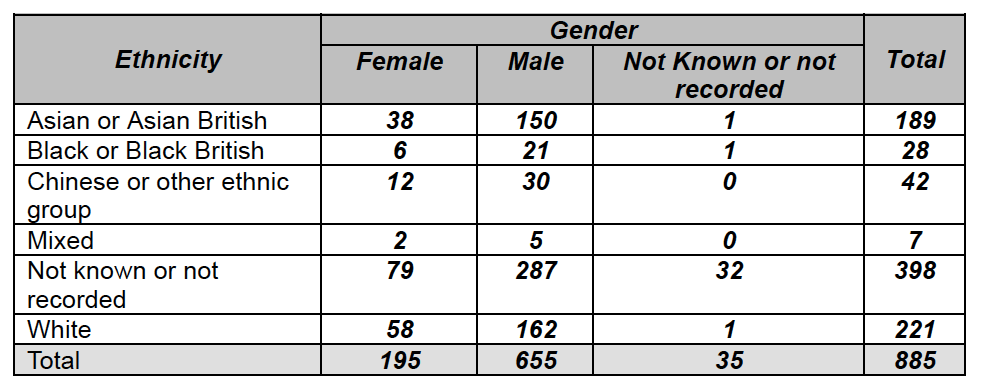
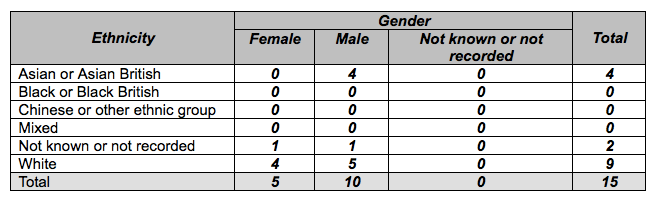
Furthermore, very few inspection chairs (less than 4%) are from visible ethnic minorities and there are about twice as many male chairs as female ones.

The Manchester Business School report described worrying informality in the recruitment process for external inspectors and chairs:

“To recruit external inspectors or inspection chairs, senior CQC staff had used professional contacts and formal and informal networks (such as royal college affiliations) predominantly, rather than the open recruitment advertising process. One interviewee claimed that ‘my recruitment process was Mike Richards badgering me until I said yes’ (Doctor, CQC inspection team).”

Current CQC inspection reports on English NHS trusts reveal that 14 of 199 full-scale (‘comprehensive’) CQC inspections were not chaired at all. It was unclear why this was, but perhaps the recruitment problems described above played a part.

Inspection chairs were drawn from current senior trust staff, managers from other NHS regulators and NHS England, the chief executives of the Academy of Royal Medical Colleges, the Faculty of Medical Leadership and Management and the NHS Confederation, former senior NHS managers, and one former and one current director from private sector providers – the former Chief Medical Officer of the Priory Group and the Chief Executive of Swanton Care Ltd, respectively.

The overall impression from CQC’s choice of inspection chairs is of a predominantly white, male, corporate culture that is perhaps too comfortable with itself, with insufficient boundaries between the regulated and the regulator.

Is some of CQC’s deafness to the concerns of patients, families and frontline staff (particularly ethnic minority staff) due to this skew towards privilege and corporate culture?

At Southport and Ormskirk last year CQC ultimately chose to believe a trust-commissioned report over the concerns of a large number of Black and Minority Ethnic (BME) staff.   The CQC inspection was led by three white men, including its chair. [10] Numerous BME staff raised concerns of less favourable treatment.The CQC noted that BME staff “felt highly disengaged from the executive. Concerns were expressed regarding limitation of opportunities for promotion and development, bullying and harassment and a punitive approach to medical re-validation and the application of professional standards to BME staff…Thirty members of the consultant staff also indicated in writing the presence of a culture of bullying and harassment.” However, CQC eventually concluded that the external investigation arranged by the trust was “thorough and comprehensive” and accepted its conclusion that there were “no evidence or grounds for the allegations”.

The poor diversity of CQC inspection chairs is of particular concern set against all that is widely accepted about the importance of inclusive and just culture to good quality healthcare.

The clubbiness of the chairs is also a concern given the lack of clarity in whether chairs can substantially intervene in the report writing or not (in theory, they do not, but in practice, the Manchester report suggests they do.

There is potential for objectivity to be compromised due to the predominance of current trust directors amongst inspection chairs. There is no obvious indication that this is the case when the ratings from inspections chaired by trust staff are compared with the overall pattern of ratings. In fact, CQC’s Chief Inspector and deputy inspectors seem slightly more disposed to rate trusts favourably, with only 2% of trusts reviewed by NHS trust staff rated as outstanding compared to 16% of CQC chief chaired reports, and 8.7% of trust staff chaired inspections rating the trust as ‘inadequate’ compared to none of the CQC chief chaired inspections.

Without controlling for other factors over a longer period, it is hard to be certain of how employing current NHS directors as inspection chairs affects the outcomes of inspections.

Indeed, questions also arise about the value added by inspection chairs relative to cost, if there is duplication of roles and some inspections can be conducted without them. Some in fact question CQC’s ratings model in general.

As for the appointment of a chair from the private sector to inspect NHS trusts, is it right for competitors of NHS services to be given access to large amounts of detailed intelligence about NHS providers or to be in a position to influence ratings on NHS providers?

Another matter that arose was that a CQC inspection chair is who has chaired 3 inspections is, according to information held at Companies House and onLinkedIn – a director of a private company that offers services helping to prepare organisations for CQC inspections.

Will the CQC listen to any criticism? Our NHS quality regulator has long been politicised. A leaked 2010 email by one of its directors said: Being hard hitting without presenting critical data will I suspect be more politically acceptable than criticising with evidence”.  Or is the CQC happy to continue its approach, current choice of chairs, and its role as part of an NHS “denial machine” ?

No one believes Jeremy Hunt on patient safety or whistleblowers – not even his own appointees. Unmasking the faux National Guardian Office.

MINH ALEXANDER First published 11 March 2016

A rash of rebukes, resignations and reports pour cold water on Jeremy Hunt’s continued claim to be the whistleblowers’ friend.

This week, Lord Darzi’s long-awaited report into patient safety in England’s health service, reported that as few as 5% of patient safety incidents are reported, often because of staff fearfulness.

And today an influential committee of MPs reproaches the government for its continuing failure to take whistleblowing seriously. A new report by the Public Accounts Committee says MPs are “disappointed by the lack of urgency” the government has shown around whistleblowing, and also “concerned” at the narrow scope.

All this is a further embarrassment to Jeremy Hunt who this week hung out more patient safety tinsel, announcing a raft of initiatives to “end the cover-up culture” and ensure an NHS that has “safe space” for staff and “learns from mistakes”. But behind the soundbites, where’s the detail? I phoned the Department of Health, but they were unable (or unwilling) to put much flesh on the bones.

The rebranded Healthcare Safety Investigation Branch (HSIB) will carry out “no blame” investigations, we’re told – and much fuss is made of legal “safe space” for staff within these. Some have questioned how this will be achieved without primary legislation. The Department of Health insists that it can be achieved, but has no draft directions to share. HSIB will only undertake 30 investigations a year when there are some 10,000 serious incidents, including over 300 Never Events.

The DH admits that there will be no “safe space” provision for thousands of NHS investigations that will take place outside of HSIB’s domain. Neither will HSIB report to parliament. Instead it will be a branch of NHS Improvement, possibly perpetuating conflicts of interest in NHS incident handling thatparliament criticised a year ago.

There’s a catchy new “Learning from Mistakes League”. It places the NHS Improvement CEO’s old trust at the top. However this trust (Northumbria) super-gagged 45 staff, a practice criticised by Robert Francis as “draconian” and unhelpful.

But there’s no sign of Hunt learning from his own serious mistakes in relation to how he protects – or doesn’t protect – whistleblowers.

In the Commons this week, Hunt agreed merely to “reflect” on a further call, from a Health Committee member, for review of past whistleblower cases.

And last week – in a highly embarrassing move for Hunt – Dame Eileen Sills resigned as the first “National Freedom to Speak Up” Guardian, before she’d even started the job. The creation of her post was a centrepiece of Hunt’s promises on protecting both patients and whistleblowers, post-mid-Staffs.

Her resignation came ten days after she said defiantly “I won’t be dropping any balls”.

She was responding to criticism that the Guardian post was only two days a week, and established on top of her full time £174,000 commitment as Chief Nurse at Guy’s.

But by 4th March she was gone, citing unmanageable workload.

Eileen Sills was purportedly appointed to lead improvement in NHS whistleblowing governance at national level, and to support a network of local whistleblowing Guardians employed by NHS bodies.

But from the start, the majority of whistleblowers and campaigners predicted problems with the National Guardian’s office, pointing out that what is needed is a truly independent body that reports directly to parliament, which has powers to investigate and remedy poor whistleblowing governance, and is properly resourced.

Instead, we got a part-time office implemented by the government’s regulator, the Care Quality Commission (CQC). The CQC’s specification for the postfocused heavily on what the National Guardian would not do:

  • no remit for hundreds of “historical” cases
  • no investigation of the disclosures made by staff
  • no assessment of the soundness of local investigations by employers
  • no investigation of cases
  • no provision of appeal against local decisions by employers
  • no statutory powers

All of which – along with the part-time nature – rendered the office merely decorative.  Even Eileen Sills herself expressed disquiet to me that “historical” cases were excluded from her remit.

CQC launched a “consultation” about the office after the job had already been advertised. In response to criticism of this pre-determination, CQC claimed that there was still flexibility. This did not seem evident to Eileen Sills, who wrote to me that there was no possibility of deviation from CQC’s advertised specification for her post.

In the wake of Eileen Sill’s abrupt departure, and associated disruption, questions arise about why the great and the good appointed an NHS insider whose own trust has been slow and reluctant to answer questions about past whistleblowing governance. Its response to an enquiry about use of compromise agreements and associated gagging clauses is overdue.

Eileen Sills recently oversaw completion of important national whistleblowing guidance but – to the concern of whistleblowers themselves – they had minimal involvement in the process. Sills chose not to appoint whistleblowers who were put forward by NHS arms length bodies for interim posts in her team. Instead, she made somewhat “corporate” appointments from the DH and other central bodies. Her office has been reluctant to disclose the total number of whistleblowers who were turned down.

The erstwhile National Guardian, whilst still in post, suggested I meet with her – though it was difficult to agree a clear agenda. After the meeting, her interim deputy (who appeared at our meeting without prior discussion) seemed reluctant to agree a record of the discussion, reminding me of surreal past experiences of NHS Human Resources. I was bemused when in our meeting Eileen Sills commented that she was being careful with her answers, because I would “tweet” whatever she said. So much for the National Guardian’s remit for improving transparency.

Nevertheless a record of the meeting was eventually broadly agreed. It notes that Eileen Sills did not yet know how many local Guardians were in place, that she thought it was “too early” to tell if the Public Interest Disclosure Act (in force since 1999) was a success, and that she did not want to say whether harmed whistleblowers should be released from gags for the purposes of defending themselves when applying to the planned NHS re-employment scheme, but agreed to “explore” this. She refused to comment on whether NHS bodies should be barred from gagging staff about whistleblower reprisal.

And it’s even unclear whether staff who make disclosures to the National Guardian can claim legal protection under the Public Interest Disclosure Act (meagre though this is). The interim deputy asserted the National Guardian isnot a Prescribed Person under the Act, to whom staff can make “protected disclosures”.

This is despite the fact that the office is located within CQC, which is a Prescribed Person. Eileen Sills agreed with her deputy. If they are right, staff would have weaker grounds to claim against employers for reprisal resulting from disclosures to the National Guardian. I have asked CQC to clarify this important point, and to issue guidance to NHS staff on their rights when disclosing to the National Guardian.  It would be a further weakness of the office if staff who inform the National Guardian of concerns are in fact more exposed. Who would wish to embed such a fault into core governance?

In all, there is little evidence of learning from the mistakes highlighted by the National Guardian’s resignation before her post even formally started.

There is no announcement that Francis’ whistleblowing Guardian model will now be reviewed, nor that near unanimity amongst whistleblowers on the need for a truly independent body will be heeded. Neither is there any announced plan to involve whistleblowers in the appointment of another National Guardian. Instead, the CQC assures us that it is full steam ahead for more of the same.

Whistleblowers and patients need a serious venture, not window dressing and part-time figureheads.

Look out for plenty more dropped balls.


Correspondence with Eileen Sills’ Office: Minutes of meeting 23 February 2016

BY EMAIL

To Dame Eileen Sills Chief Nurse Guy’s and St. Thomas’ NHS Foundation Trust

24 February 2016

Dear Eileen,

Re our meeting 23 February 2016

As indicated, I write with my summary of the factual content of our meeting, and would be glad if you could provide your comments about accuracy.

In brief, further to your invitation to meet and to suggest agenda items, and the prior agreement between us of some specific agenda items, we met for a little over an hour. David Bell your interim deputy was present when I arrived and remained with us for nearly all of the meeting. May I ask that if we have further meetings, that advance notice is given of any other individuals whom you invite to join us, and for this to be discussed with me.

At our meeting, you indicated that you could not discuss one of the agreed agenda items, an issue of ambiguously written NHS settlement agreements which may actually or in effect prevent whistleblowers from speaking out about experiences of whistleblower reprisal, and whether the NHS should clarify that concerns about whistleblower reprisal should be approached as a form of protected disclosure, which cannot be gagged. As I have put to you before, the current arrangements allow poor governance and related risks to patient safety to be hidden.

Regarding another agreed agenda item, the issue of lifting gags to assist whistleblowers who are applying to the re-employment scheme, you indicated that whilst it was not possible to give a substantive answer, you would explore this. We also discussed a range of other issues.

The broad flow and salient content of our discussion, based on notes which I made throughout the meeting are set out below.

I look forward to hearing from you.

Yours sincerely,

Minh

Dr Minh Alexander

Key to the below:

ES Eileen Sills

MA Minh Alexander

DB David Bell

NG National Guardian


  1. ES gave information about developments:

i. ES started work on NG office 4 January 2016

ii. ES has appointed an interim team

iii. David Bell (DB) started last week, acting as ES’ interim deputy. Comes from Commissioning Support Unit South East, relevant experience from contributing to the set up of NHSI; HR background

iv. The other two interim appointments to the NG office:

a) Russell Parkinson from DH; is DH lead for global patient safety summit; will lead work on connecting with local guardian

b) Will Flowers, appointment not yet confirmed; if appointed will lead on communications. … will be proactive in our communications, tell everybody what the role of the office is, the benefits of the office

v. The set up team appointed by CQC finish in March

2. ES: Substantive team posts will be advertised in April, one of the functions of substantive appointees will be leading “casework”

3. MA: How does “casework” differs from “case management” (which both the Freedom to Speak Up Review & CQC say is not part of NG remit)?

4. ES: Not sure why you’re asking about terms.

4. ES: We will take referrals from individuals who feel they have been disadvantaged. No referrals will be accepted until post-October. Threshold to be agreed. Those individuals will be give a case to review. At the moment can’t say more. All of this subject to finalisation. I’m not going to be rail roaded into something and fall foul.

5. MA: I’d like to start with my key question to you – re approaching concerns about whistleblower reprisal as form of protected disclosure, not allowing them to be gagged etc…

6. ES: I’m on learning curve, can’t comment. Would be wrong of me to do so.

7. MA: Disappointed as it was agreed before the meeting that we would discuss this issue (ref email). Hope you can see why I might be disappointed – specifically agreed agenda item not discussed; also meeting with you agreed, but arrive to find David involved with no explanation.

8. ES: [Asked to meet you because]…you’re very active in the whistleblowing community. You have a lot to say. If I try to respond [to your email]…we’re trying to build confidence. I want to put the record straight on some of the stuff on twitter.

9. MA to DB: Have you seen the [pre-meeting} emails?

10. DB: Yes, [but in respect of the question about whether ES would express a view about whether concerns about WB reprisal constitute protected disclosures], NG office is not a prescribed body.

11. MA: A different issue.

12. ES: if NG office finds a whistleblower has not been fairly treated, will make that public. [At what point do we take referrals?] Do we take referrals when cases are concluded? [Or at an earlier point].

13. MA: Other specific issue from my email – gagged whistleblowers and how this relates to entry to the re-employment scheme – WBs need to be able to defend themselves, disclose experiences of poor HR governance. They may be or may feel gagged by non-disparagement clauses. Would you support gags being lifted to allow WBs the best chance of entry to re-employment scheme?

14. ES: I haven’t seen anything yet from Neil Churchill about the employment scheme. NHS England [in charge of that].

15. MA: Your role is also to oversee and possibly criticise how central NHS bodies, eg. NHS England, handle whistleblowing?

16. ES: I don’t want to criticise. We [trying to do this] constructively.

17. ES: Other people have said they want to be able to talk about their story [as part of well being and being able to re-integrate into work].

18. MA: That’s a separate issue. I am asking about lifting gags and whistleblowers being able to enter the re-employment scheme, not what happens after.

19. ES: What do you mean about gags, example?

20. MA Gags prevalent. Super-gags still used. Both Peter Wyman & Jim Mackeys have used super-gags. [45 and 22 respectively in 5 years]. Can send the data.

21. ES: I don’t want the data.

22. ES: Nothing suspicious in relation to me.

23. ES: [continuing on lifting gags for the purpose of the re-employment scheme] I can’t give you a view legally. I don’t see how, if someone has signed a legal agreement…

24. MA: Not asking for a legal view. Asking if you agree it should be done, assuming it can be done.

25. ES: I can explore that. [We should] give individuals every opportunity….[I’m being careful about what I say] …whatever I say to you will get tweeted.

26. MA: Neil Churchill has said to me he thinks it should be doable [lifting gags].

27. ES: Until I’ve had a conversation with Neil, I will reserve judgment.

28. MA: Struck by the fact that NG office will have “wide discretion” as to which cases it will pick up. How will you ensure this does not result in unfairness & that Equality requirements are met?

29. ES: Will need to be professional and open. …[criteria will be set & made public] Intend to have very robust governance framework. Involve Experts by Experience, establish Advisory Board, applications will be invited. Live by May.

30. MA: Can I return to the issue of whether NG office is a prescribed body under PIDA. If NG office is a subsection of CQC, and CQC is a prescribed body, why would NG office not also function as a prescribed body?

31. ES: NG office is not a subsection of CQC. NG is hosted by CQC. Some core functions shared with CQC, with SLAs for example on HR & procurement. But operationally independent.

32. MA: But CQC provides funding?

33. ES: Other ALBs provide funding too.

34. MA: David Behan is accountable officer?

35. ES: Some one’s got to be.

36. MA: David Behan is your line manager?

37. ES: He doesn’t really line manage me. I’m accountable to him [for how the NG office is established].

38. MA: If NG office is not a prescribed body, who do people whistleblow to if they are concerned about the NG office itself?

39. ES: Can raise with NG Advisory Board.

40. MA: That’s internal…what about beyond that?

41. ES: To be clarified.

42. MA: A question that others have asked is whether NG office accept a case if the whistleblower loses confidence in local Guardian. Will NG always pick up such cases

43. ES: Yes, but not necessarily investigate them.

44. MA: What will you do for people who are unhappy with their local Guardian?

45. ES: We haven’t finalised that either. But might include signposting to other organisations. Or I might liaise with trust Chief Executive or other organisations.

46. ES: Guidance on local Guardian posts goes to Chief Executives this Friday.

47. MA: Do you know how many local Guardians have been appointed?

48. ES: Don’t know how many local Guardians appointed so far. We want them in post by September.

49. MA: What if posts that have already been created don’t comply with your criteria?

50. ES: We’re going to ask them to review. We’re asking trusts about [existing] local Guardians.

51. MA: Can your guidance to Chief Executives about local guardian posts be shared?

52. ES: Publishing next Monday.

53. MA: Can the information you get back from trusts about current local Guardians be shared?

54. ES: Only asking trusts for names of Guardians.

55. MA: Not asking about grade & hours?

56. ES: Local guardians will be sent bespoke questionnaire.

57. MA: Can the questionnaire be shared?

58. ES: Not yet ready. Work on it starts in March when Russell starts. Publish in April. We’re not prescribing banding at all. We’re asking for demographics. Will be evaluating demographics.

59. MA: What do you mean by demographics?

60. ES: The post they’ve come from, banding, ethnicity etc.. The demographics linked to success (for example as indicated by staff survey) will be evaluated.

61.MA: Will questionnaire results be shared?

62. ES: Some of It will be personal.

63.MA: But at least some elements are appropriate to share, and can be shared if anonymised?

64.MA: What do you think of PIDA?

65. ES: Put in place to protect people who raise concerns, that’s got to be a good thing. It’s too early to make a judgment that it works [PIDA]. Don’t know how many successful cases there are – we don’t see them. They’ve whistleblown and it’s worked. Works in some teams. Can challenge each other.

66. MA: Do you think there should be more research on whistleblowing?

67. ES: Wide… what do you mean?

68. MA: For example, you just said we don’t know how many cases are positive. Has NG office got a research budget?

69. ES: No research budget.

70. MA: [Re ES’ comments about positive cases] Although you could say that contributors to Freedom To Speak Up were self-selected, it showed mostly negative experiences. 2014 staff survey showed about a quarter of staff not secure to raise concerns, so there is a problem. Are you aware only 3% of ET claims [under PIDA] succeed at hearing?

71. ES: At one end you’ve got protected disclosures and whistleblowing, then you’ve got a person on the ward informally raising a concern.

72. MA: What do you mean by whistleblowing

73. ES: I hope that’s not a trick question.

74. MA: Someone on the ward informally raising a concern is technically whistleblowing if it is a qualifying disclosure within PIDA [but acknowledged the practical challenge posed by range between simple raising of concern and situations that have dragged on and escalated]

75. ES: I would slightly disagree. It’s about changing culture…..

76. MA: Your CQC blog set out your plans.

77. ES: I haven’t done a blog.

78. MA: CQC press material attributed to you.

79. ES appeared unsure which reference was being cited. MA: [Reading from a copy of the press release] ….by one year, I will have started to work towards developing a set of common standards for handling staff concerns and to showcase examples of good practice.” http://www.cqc.org.uk/content/dame-eileen-sills-sets-out-her-priorities-her-first-months-national-guardian

80. ES: Standards to be in place at one year:

i. Local Guardian standard for trusts (Acute, MH, Ambulance

ii. Ways of Working for NG

iii. Training standard for local guardians

iv. Workforce awareness standard on raising concerns

v. Show casing examples of good practice. Some teams are great at this.

Transparency.

81. MA: [Ref transparency] Can you chase your FOI department?

82. ES: That’s a conflict of interest. Not proper [to respond]. But I have [chased]…

83. MA: I think the conflict of interest is inherent in the dual role.

84. ES: Other people have said that. [Disagree] …I won’t be dropping any balls

85. ES, at least x2 during the meeting: You absolutely have to trust me.

86. MA x 2: I don’t have to trust you at all.

87. ES: I work as a clinician one day week [understand the concerns of staff].

88. MA: [What I’m about to say doesn’t relate to you personally]… very often those responsible for whistleblower reprisal are the most senior clinicians.

89. ES x 2 during the meeting: First time it’s ever been done [and associated comments that it needs a chance]

90. MA: Not the first time. USA model of OSC has powers but still hasn’t done a good job. History is that this sort of body goes stale. [DB noted point about USA model]. I am a sceptic about NG office.

91. ES: So long as can say have acted fairly , openly & independently….

92. MA: Design of NG office is itself unfair. You won’t be investigating whistleblowers’ concerns. Cannot handle cases effectively or judge proportionality without this. All reasonable people see that vindication is an integral issue, including parliament, which linked apology & redress to vindication.

93. ES: Will highlight any problems with the office in due course.

94. MA: Was glad to see you requested review at 6 months.

95. ES: Might be a different office in 2 years.

96. MA: But lives will be ending in that time. I’m in touch with whistleblowers who are suicidal.

97. ES: We’d expect people to contact us for advice.

98. MA: Your office won’t be able to do a jot for these people [ref remit]

99. ES: That’s one aspect I’m not happy with, historic cases not included.

100. MA: Good to know that.

101. ES: [Would you be interested]….in attending further events….

102. MA: Expert by Experience stuff?

103. ES: Yes

104. MA: Little confidence in the way the NG guardian office established but it’s what we have, in principle happy to work constructively on helping it work as best it can. So provisionally “yes”, but depends how things pan out.


Letter to Jeremy Hunt 16 October 2015 about his role regarding Homerton maternity whistleblowers

BY EMAIL ONLY

To Rt Hon Jeremy Hunt Secretary of State for Health, 16 October 2015

Dear Mr Hunt,

Re: Maternal deaths and the safety of Homerton maternity services

I understand that anonymous Black midwife whistleblowers, who call themselves the “Unhappy Midwives”, contacted you personally in July 2013.

As you should be aware, the Unhappy Midwives first made disclosures to both Homerton University Hospital NHS Foundation Trust and to CQC in 2012, about poor care and Race discrimination that impacted on patient care and safety. They did not feel their disclosures were appropriately acted upon by either the Trust or by CQC. A series of at least 5 maternal deaths then followed, starting in July 2013.

The Unhappy Midwives made exhaustive attempts to warn all those in positions of responsibility about the fact that their safety concerns were unresolved, and about their concern that both internal Trust investigations and a review by the Clinical Commissioning Group (CCG) were seriously flawed. For their pains, the Unhappy Midwives were branded “vexatious” and “vindictive” by two successive Trust CEOs, and threatened with various forms of punitive action.

I understand that the Unhappy Midwives wrote to you personally in July 2013 after the first Homerton maternal death. I believe they warned you in some detail of their concerns about:

  • Risks to patients’ safety
  • Race discrimination affecting both staff and patients
  • Serious reprisal against a named Black whistleblower in Homerton maternity services.
  • Homerton’s apparent failure to disclose a particular midwife’s poor safety record, of baby deaths, to a subsequent employer.

However, the Unhappy Midwives’ correspondence was passed to your officials, who I believe fobbed them off and eventually directed them back to the very bodies about which they were concerned. I also believe that there was no help from you personally or from DH officials for the named whistleblower, despite a request from the Unhappy Midwives that you urgently help this person.

Moreover, the Unhappy Midwives explicitly warned DH officials of serious flaws in the CCG’s review of Homerton maternity services, and also their concern that the Trust was intimidating staff to prevent them from giving truthful evidence to the CCG review. However, I now see that DH officials are citing the CCG review report as assurance data. DH officials are also wrongly claiming that this review did not in any way substantiate the Unhappy Midwives’ concerns, when a cursory examination would show that it very clearly did. Most importantly the CCG review validated the Unhappy Midwives’ concerns that the Trust was not learning enough from serious patient harm, and was not making links between serious incidents.

As I think you know, at least four more Homerton mothers died after you and DH were informed of serious flaws in the governance of the Trust and CCG.

Maternal deaths are normally rare events. The clustering of deaths at Homerton prompted yet another review last year. The London Clinical Senate carried out this review, but the Senate report appears to have been withheld by the Trust and CCG. The Trust CEO suggested in a recent internal email that the Trust would most likely continue withholding the Senate report. This clearly flies in the face of Dr Bill Kirkup’s recommendation 25 that NHS bodies should not be allowed to withhold the findings of external reviews.

I should note that in addition to maternal deaths, the Trust has now disclosed under FOI that there have been 20 intrapartum deaths, stillbirths and neonatal deaths since 2012. There have also been 2 Never Events, and a total of 79 serious incidents since 2012. There is also concern that other harm has occurred due to staff with unsafe practice moving to other organisations.

Despite the concerns about how the Trust has treated whistleblowers and handled safety in maternity services, I see that you continue to publicly praise the Trust CEO for value-based leadership and for listening to staff.

A question arises about failure by you, DH and arms length bodies to sufficiently protect mothers and babies, despite the repeated warnings.

Accordingly, I would like to understand how you and the Department of Health have handled this matter.

There is a particular need for transparency because of the concerns of Race discrimination, the harm to BME patients and the evidence from the Freedom to Speak Up Review that BME whistleblowers are more likely to be ignored and victimised. I ask you to note that in a very high diversity area, the “Snowy Peaks” [1] of the Homerton Trust board are wholly white.

Please disclose:

1) All communications between Homerton University Hospital NHS Foundation Trust and you, and DH, from July 2013 onwards, regarding the safety of Homerton maternity services, including the handling of any whistleblowers’ concerns.

2) All communications between City and Hackney CCG and you, and DH, from July 2013 onwards, regarding the safety of Homerton maternity services, including the handling of any whistleblowers’ concerns.

3) All communications between Care Quality Commission and you, and DH, from July 2013 onwards, regarding the safety of Homerton maternity services, including the handling of any whistleblowers’ concerns.

3) All communications between NHS England and you, and DH, from July 2013 onwards, regarding the safety of Homerton maternity services, including the handling of any whistleblowers’ concerns.

Please include letters and emails, and appended documents.

It seems to me that the culture of “circular assurance” described by Dr Bill Kirkup still flourishes, in that the DH and its arms length bodies are far more inclined to listen to each other and NHS organisations, than to listen to dissenting voices.

I would like to remind you of the calls over the years for safe harbour and a truly independent body for whistleblowers, including a recent call by Simon Stevens on behalf of NHS England. I believe the Homerton saga is another tragic, wasteful story that plainly illustrates why such a body is needed.

Yours sincerely,

Dr Minh Alexander

[1] The “Snowy White Peaks” of the NHS: a survey of the discrimination in governance and leadership and the potential impact on patient care in London and England, Roger Kline, Middlesex University 2014

cc Rt Hon Dame Margaret Hodge MP Barking

Diane Abbott MP Hackney North and Stoke Newington

Meg Hillier MP Hackney South and Shoreditch

Shadow Secretary of State for Health

Health Committee

Public Administration and Constitutional Affairs Committee

Public Accounts Committee

Sir Peter Bottomley MP

Rt Hon Sir Anthony Hooper

Sir Robert Francis QC

EHRC

Professor Sir Bill Kirkup

National Maternity Review


RELATED ITEM

An update on the Homerton maternity whistleblowers 28 September 2016

A copy of the London Clinical Senate report on four maternal deaths is provided.

https://minhalexander.com/2016/09/28/homerton-maternity-whistleblowers-foi-disclosure-of-the-london-clinical-senate-report-on-four-maternal-deaths-and-the-national-guardian/


Critique of Francis’ model of trust-appointed Guardians

From submission to Department of Health consultation on the implementation of the Freedom to Speak Up Review, by Minh Alexander former consultant psychiatrist, 4 June 2015

Francis greatly emphasised the example of the Cultural Ambassador at Staffordshire and Stoke on Trent Partnership Trust (SSOTP) as supporting evidence for his proposal to introduce whisteblowing guardians nationally. He featured the SSOTP model in the Freedom to Speak Up report. At the launch of his report Francis told whistleblowers that the present incumbent had proven that such a post could work.

Few facts had been offered about the provenance or efficacy of the model, other than that a low staff uptake had prompted this arrangement, and that uptake subsequently increased “dramatically”. No other parameters were explored in Francis’ report. Details of staff contacts with the Ambassador have now been requested from the Trust and are awaited.

The Ambassador post was established two years ago in April 2013. The Trust has confirmed to me that no evaluation of this new role has yet been carried out. [1]

The Trust signals an intention for evaluative research to be carried out, but no decision has been made yet on how this will be done.

What then are the other sources of information that might shed light on the effectiveness of the model?

Local press reported that recent, significant external whistleblowing disclosures were made about the Trust. It is alleged that staff reported externally because of issues of organisational culture and because little was done to rectify safety issues despite managers being made aware of the problems. [2,3,4] If so, this raises a question of what is contributed by a Guardian-type role where there are particularly serious and knotty problems that an organisation might find threatening. For example, some of these external disclosures ultimately led to regulatory action on staffing levels, which may in turn present other challenges for a Trust seeking Foundation status.

Notwithstanding, it is recognised that external whistleblowing is often an indication of an internal blockage of some sort. The Trust’s response to press coverage of leaks was to emphasise to its staff that internal reporting was encouraged, but there was no clear acknowledgment of failure to engage with staff. [5]

Some external disclosures by SSOTP staff have been made to CQC. A full list of disclosures has been requested under FOI arrangements and is awaited. Meanwhile, remarks in a CQC inspection report of 19 March 2015 may reflect tensions inherently thrown up by an Ambassador role:

“Action the provider MUST or SHOULD take to improve

  • Review the internal communication arrangements for the Ambassador for Change to ensure transparent lines of communication and staff feel reassured that the role is organisation wide, not part of the management process

It would be understandable that any Ambassador role, irrespective of the person in post, may be viewed hesitantly if staff are wary of management commitment to transparency.

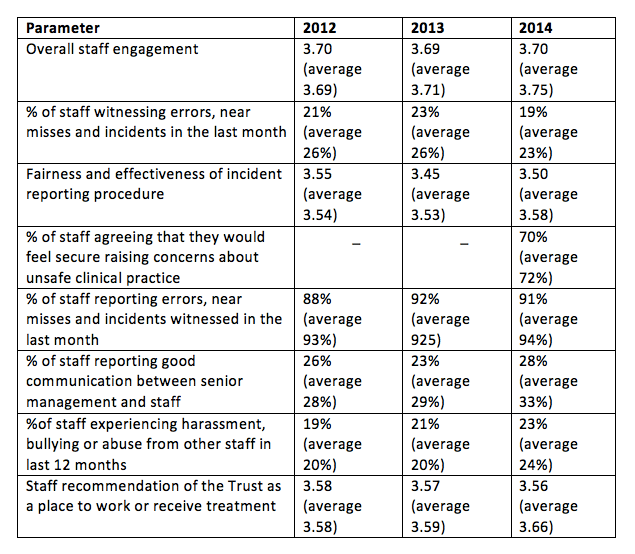
NHS Staff Surveys for SSOTP in the last 3 years, against national averages for comparator trusts, do not show major changes over the period in which an Ambassador post was established:

a-critique

These figures give only a rough indication of some of the issues, and may be affected by factors other than the work of an Ambassador. Broadly though, they are not by any means proof that an Ambassador model clearly generates improvement around issues of raising concerns. Confidence in the fairness of incident procedures remained slightly below average. When a measure about staff’s sense of security in reporting concerns was added in 2014, this was slightly below average too.

Whistleblowers, who have seen all that the most corrupt employers can do to manipulate and pervert processes, do not have any expectations that closed organisations will be transformed by Trust-appointed whistleblowing Guardians. In such trusts, Guardians will at best be ignored, and ineffectual as a result of impassable systemic issues. More likely, the worst organisations will appoint in their own image. The role could be used to help conceal continuing whistleblower reprisal whilst falsely white washing organisational reputations. The analogy of prefects from Tom Brown’s school days comes to mind.

There is another indication that Francis’ whistleblowing Guardian experiment will fail. There is already evidence that some organisations are ignoring Francis’ recommendations that:

(i) Whistleblowng Guardians posts should be dedicated roles

(ii) The Whistleblowing Guardian role should not be on top of someone’s existing duties

(iii) Whistleblowing Guardians are ideally in a professional role, to gain the trust and confidence of colleagues.

Of concern, these are examples of whistleblowing Guardians that have been quickly appointed by NHS organisations whilst the DH consultation has been taking place:

“Formally appointing the Executive Director of Nursing, Quality and Governance as the Trust’s Freedom to Speak Up Guardian” 

“…also appoint: Assistant Director, Corporate Governance as the ‘Freedom to Speak Up’ Guardian” 

“The identification of one official Freedom to Speak Up Guardian, to concentrate on the assurance side, proposed to be the Director of Quality and Assurance”

“The Head of Governance, who is identified as our designated officer in the Raising Concerns Policy, to also take on the role of ‘Freedom to speak up Guardian”

“…Director of Communications and Business Services… has also been appointed by the Audit and Governance committee as the “Freedom to Speak Up Guardian”

These appointments are clearly at odds with the Freedom to Speak Up review’s intentions. Arguably, they show corporate bias, little prioritisation of whistleblowing governance, and failure to appreciate (or care about) the nuances of staff advocacy. It is questionable that Trusts were told that they could move ahead with making arrangements before the Department of Health Speak Up consultation had taken place. However, their actions are part of the evidence that the Trust-appointed Guardian model lacks sufficient robustness and credibility.

A whistleblower contributor to the Francis review, who has worked in a established Guardian type role for some time, has very clearly advised that such a role can make a contribution but:

“… is in no way  a panacea for remedy to prevent further scandals within the NHS.

And the whistleblower remains of the opinion that:

“In order to change the culture a proper whistleblowing inquiry is necessary”

This person remains conscious of the marked imbalance of power, disadvantage and stress that staff face when raising concerns. In common with the majority of whistleblowers, this person emphasises that until root causes are genuinely addressed, the overall dysfunction will continue.

Robert Francis stipulated that Trust-appointed Guardians must command the confidence of Chief Executives. Where the Chief Executive is corrupt, this is clearly nonsense, as the Guardian would have to act corruptly too, in order to command the Chief Executive’s confidence. This contortion of logic lies at the heart of Robert Francis’ fatally flawed proposal.

It is also important to note that the more robustly those in current Guardian-type posts advocate for patients, the more likely it is that they will experience retaliatory mistreatment. This has reportedly sometimes been very serious.

In summary, Trust appointed whistleblowing Guardians are the lynchpin around which Francis’ proposals are built. Given the lack of evidence that such posts can be relied on as the key intervention to prevent whistleblower reprisal or to reduce fear, and evidence that organisations are already making inappropriate appointments, the Freedom to Speak Up review falls.

[1] Correspondence with Stuart Poynor SSOTP Chief Executive, 1 June 2015

[2] Leaked NHS dossier: nurses log concerns over care. D Blackhurst, Staffordshire Sentinel, 2 April  2015

http://www.stokesentinel.co.uk/nhs/story-26274522-detail/story.html

[3] Leaked NHS report reveals dying patients left alone and in pain, staff at breaking point, Staffordshire Sentinel, 2 April 2015

[4] NHS ordered to appoint more district nurses in North Staffordshire, Staffordshire Sentinel, 9 May 2015

http://www.stokesentinel.co.uk/exclusive-leaked-nhs-report-reveals-dying/story-26274491-detail/story.html

[5] Health staff told ‘don’t speak to press’ after regional daily expose. David Sharman, Staffordshire Sentinel, 5 May 2015

http://www.holdthefrontpage.co.uk/2015/news/health-staff-warned-not-to-leak-to-daily-after-damning-dossier-splash/

CQC’s Fit and Proper Parade

By Dr Minh Alexander, NHS whistleblower and former consultant psychiatrist, first published 29 July 2016

In the six years of its much-criticised life, CQC has been part of the NHS denial machine. Its decisions have been exposed as overtly politicised on some occasions [1], and suspected as such on others. Its ratings are questioned for their methodology, and because people think they can be arbitrary, and either unfairly severe or unduly lenient. CQC has sometimes failed to detect – or report – gross safety failings such as those at Southern Health NHS Foundation Trust. [2]

In November 2014 the CQC assumed a legal duty under Regulation 5 Fit and Proper Persons (FPPR) to assure that trusts appointed Fit and Proper directors and that existing directors continued to be Fit and Proper Persons. Under FPPR, directors who have been guilty of – or privy to – serious misconduct and mismanagement, may be removed. [3]

In December 2014 other NHS whistleblowers and I took part in a teleconference with Mike Richards CQC Chief Inspector – who was going to chair CQC’s FPPR panel – and his entourage to find out how CQC intended to run FPPR. This was not encouraging as the Chief Inspector made comments such as CQC action would depend on the “level” of whistleblower reprisal. Before a single shot had been fired, he asserted that it would not pass in the “Court of Public Opinion” if too many managers were removed under FPPR.

The Chief Inspector subsequently demonstrated impressive reluctance to remove seriously erring NHS managers. To my knowledge and others’, not a single director has been removed under FPPR. CQC has in a handful of cases triggered investigations – but allowed trusts to commission and direct these investigations. At Southport and Ormskirk where at BME doctors complained of unfairness and mistreatment, and 30 consultants had written to complain of a bullying culture, CQC rubber-stamped such an FPPR investigation as sound. [4] This was followed only three months later by suspension of the CEO and 3 other managers. CQC also rejected an FPPR referral on Southern Health NHS Foundation Trust, only for this to be seriously questioned by the revelations of the Mazars report that hundreds of unexpected trust deaths had not been investigated. [5] [6] The outcome of a re-referral is awaited, whilst more revelations came today from the BBC about millions paid by the trust to the Chief Executive’s former associates. [7]

An FOI request in May 2015 confirmed that CQC had received referrals on 65 NHS managers, including 14 individuals reported to have suppressed whistleblowers, but it did not take action to remove any of these 65 managers. [8] [9] [10]

An update FOI request was made in May this year, but CQC has refused to provide this data on grounds of cost, even though it had already announced plans to review its use of FPPR. When asked, CQC failed to say what data it would be prepared to provide within the cost limits.

Also interesting is the fact that trusts may appeal against CQC’s decisions on FPPR, but in response to an enquiry, CQC’s Chief Executive David Behan stated that referrers may not. [11] However, I am told that in at least one case, CQC has undertaken a review in response to a referrer’s objections. So much then for equitable and consistent decision -making.

CQC’s performance on FPPR has not gone unnoticed. Health Committee has noted the concerns reported to it for the next accountability hearing with CQC. After the recycling of Paula Vasco-Knight at St. George’s, with Monitor’s involvement by allowing her into their interim pool, CQC was caught very, very short when she was suspended over financial allegations. Soon after that CQC admitted that there were legitimate concerns over its handling of FPPR, and that questions had been asked about why CQC was only tick boxing trusts’ FPPR process, when it should also have been looking at the soundness of FPPR decisions. CQC announced that it would review itself with regard to FPPR. [12] This will most likely take the path of past CQC internal reviews. For example, that relating to CQC’s poor response to Homerton maternity risks and whistleblowers’ warnings, which implausibly found no serious error. [13]

The recent parliamentary debate on the Liverpool Community Health NHS Trust scandal exposed the active complicity of regulators in recycling some poor NHS managers, even to the extent of misleading an MP about what they had done. [14]

It is worth taking the microscope to CQC’s lamentable role in the Vasco-Knight business. Paula Vasco-Knight was Chief Executive of a trust, South Devon Healthcare NHS Foundation Trust, which was severely criticised for harming two whistleblowers who raised concerns about nepotism by Paula Vasco-Knight. She resigned from that trust in 2014 after a damning Employment Tribunal judgment against the trust [15] [16] [17] but within months she had been recycled by the NHS. Controversially, she worked on an interim basis for another trust at a cost to the public purse £248K. [18] By September 2015, she was hired as interim Chief Operating Officer by St. George’s University Hospitals NHS Foundation Trust. The trust informed me that in appointing her, references were taken from Monitor, which had provided support for the Monitor FPPT process”. Monitor informed me: “The business referees put forward, from whom references had been sought and obtained, all held senior roles in the NHS trusts that Paula Vasco-Knight had recently worked for, including East Lancashire Hospitals NHS Trust”.


In October 2015 I made an FPPR referral on Paula Vasco-Knight to CQC, and received a curt acknowledgement which effectively said “Don’t call us, we’ll call you”. [19] But months passed and there was no call. I made an enquiry at the end of February 2016 about progress, which was acknowledged by CQC, but no still substantive response followed. In the meantime, on 25 April, St. Georges disclosed a letter from Mike Richards to the trust dated 16 February 2016, closing down the FPPR process on Paula Vasco-Knight. [20] As you can imagine, I was very concerned that CQC appeared to have avoided giving me a straight answer about what it had done, during which time St. George’s announced on 22 April that Ms Vasco-Knight had been promoted to interim Chief Executive. Clare Sardari, one of the South Devon whistleblowers wrote an open letter on 26 April to St. George’s governors, protesting the appointment of Paula Vasco-Knight to Chief Executive. [21]

The house of cards soon tumbled when on 3 May St. George’s announced that it had suspended her “…the acting chief executive of St George’s was suspended from her role on Friday because of serious allegations being made against her relating to a previous employment. Suspension is required in such circumstances but it is a neutral act….The allegations are financial in nature and relate to her work at a previous employer”. [22] On 20 May the Health Service Journal reported that CQC had indicated that it was looking into whether St George’s had carried out its duty under the fit and proper person regulations” (CQC email 19 May). [23] 

I was therefore somewhat perplexed when St. Georges advised on 27 July that it had in fact terminated Paula Vasco-Knight’s agency contract on the day it suspended her – or it seems in plain English, sacked her. [24] Why then did St Georges continue to refer only to suspending her? On 5 May the trust reportedly stated: “As a result of serious allegations being made against her, Dr Paula Vasco-Knight has been suspended from her role as acting chief executive at St Georges University Hospitals NHS Foundation Trust”. [25] Why did CQC say it was looking into her appointment, in terms of compliance with FPPR, when it has in the past insisted that it can only apply FPPR to current directors? (I had specifically asked CQC in 2015 if it would run a disclosure and barring scheme for ex NHS directors who might return to the NHS, but CQC indicated that it had no intention or remit to do so).

So, did CQC claim on 19 May that it was conducting a review of FPPR in relation Paula Vasco-Knight’s appointment on 20 May, over 2 weeks after her contract with St George’s had been terminated, simply to spin an impression that CQC was doing “something”?

And why does CQC say one thing about the limit of its jurisdiction on FPPR, but then do the opposite?

The whiff of arbitrariness has not been dispelled, and is a most unfortunate quality in a regulator.

I hope Health Committee looks very closely at all this, and insists on more robust governance than the usual CQC “lessons NOT learned” internal review. Patients’ lives depend on competent, honest NHS management and regulation.

[1] Labour’s cover up on failing hospitals: Ministers tried to silence watchdog on eve of general election. Sophie Borland, Daily Mail, 3 October 2013

[2] https://twitter.com/alexander_minh/status/753197235333132288

[3] CQC guidance for providers on Regulation 5: Fit and Proper Person and Regulation 20: Duty of Candour, November 2014

http://www.cqc.org.uk/sites/default/files/20141120_doc_fppf_final_nhs_provider_guidance_v1-0.pdf

[4] CQC inspection report on Southport and Ormskirk NHS Trust, 13 May 2015

[5] Independent review of deaths of people with a Learning Disability or

Mental Health problem in contact with Southern Health NHS Foundation

Trust April 2011 to March 2015, by Mazars December 2015

[6] https://twitter.com/sarasiobhan/status/612177823705513984

[7] Southern Health NHS Trust ‘paid millions’ to Katrina Percy’s associates, by Michael Buchanan, BBC 29 July 2016

[8] CQC response 9 June 2015 to FOI about FPPR referrals

http://twitdoc.com/view.asp?id=289176&sid=674O&ext=PDF&lcl=CQC-Response-FPPR-FOI-CQC-IAT-1516-0112.pdf&usr=alexander_minh

[9] Further CQC response 29 June 2015 to FOI about FPPR referrals

http://twitdoc.com/view.asp?id=289177&sid=674P&ext=PDF&lcl=CQC-Further-response-to-FOI-FPPR-CQC-IAT-1516-0112.pdf&usr=alexander_minh

[10] More than 60 managers have faced Fit and Proper complaints, Shaun Lintern Health Service Journal 29 June 2015

[11] Letter from David Behan 19 August 2015

http://twitdoc.com/view.asp?id=289178&sid=674Q&ext=PDF&lcl=CQC-Behan-no-appeal-against-FPPR-19-08-2015.pdf&usr=alexander_minh

[11] CQC to review whether fit and proper person rule “need to change”. Will Hazel, Health Service Journal, 24 May 2016

[12] CQC internal review report on CQC’s handling of patient safety risks in Homerton maternity services, 15 March 2016

http://twitdoc.com/view.asp?id=289194&sid=6756&ext=PDF&lcl=CQC-Homerton-review-CM031605-Item-5A-RGC-Report-to-March-Board-FINAL-Appendix-1.pdf&usr=alexander_minh

[14] Hansard record of parliamentary debate on the Liverpool Community Health NHS Trust scandal, a Capsticks report and NHS whistleblowing 13 July 2016

https://hansard.parliament.uk/commons/2016-07-13/debates/16071339000002/CapsticksReportAndNHSWhistleblowing

[15] Nurse turned Chief Executive resigns in wake of employment tribunal. Sarah Calkin, Nursing Times, 30 May 2014

[16] Ex Torbay hospital worker awarded £230,000 compensation over ‘nepotism’ row, Herald Express 19 July 2015

http://www.torquayheraldexpress.co.uk/ex-torbay-hospital-worker-awarded-230-000/story-27443632-detail/story.html

[17] Employment Tribunal Judgment Penny Gates and Clare Sardari v South Devon Healthcare NHS Foundation Trust and Torbay and Southern Devon Health and Care NHS Trust

https://www.dropbox.com/s/6ou0rl5i45xbd60/VascoKnight%20Tribunal%20judgment%20003-1.pdf?dl=0

[18] FOI disclosure 10 June 2016 by East Lancashire Hospitals NHS Trust

https://twitter.com/IanLex2/status/741201394355560448

[19] Email from CQC 27 October 2015

http://twitdoc.com/view.asp?id=289187&sid=674Z&ext=PDF&lcl=CQC-email-on-Vasco-Knight-FPPR-27-10-2015.pdf&usr=alexander_minh

[20] FPPR closure letter on Paula Vasco-Knight, from Mike Richards CQC Chief Inspector to St George’s

http://twitdoc.com/view.asp?id=267431&sid=5QCN&ext=PDF&lcl=Vasco-Knight-FPPR-closure-Letter-from-CQC-re-PVK-16-02-16.pdf&usr=alexander_minh

[21] Open letter 26 April 2016 by Clare Sardari South Devon whistleblower to St. George’s

https://twitter.com/sharmilaxx/status/731500214515847168

[22] Teaching trust loses second chief executive in two weeks. Shaun Lintern Health Service Journal 3 May 2016

[23] CQC looking into Vasco-Knight appointment. Will Hazel, Health Service Journal 20 May 2016

[24] FOI disclosure by St George’s 27 July 2016

http://twitdoc.com/view.asp?id=289190&sid=6752&ext=DOC&lcl=FOI-PVK-1617-200.doc&usr=alexander_minh

[25] Former Torbay Hospital Chief under financial investigation. HE Tina Crowson, Herald Express 5 May 2016

Hot air about Just Culture

By Richard von Abendorff Patient Safety Campaigner and Dr Minh Alexander NHS whistleblower and former consultant psychiatrist, originally published 1 September 2016

‘Just culture’ is a term for principles of respectful governance, with fair and proportionate accountability and a focus on learning. Politicians and senior NHS officials say they want just culture [1] but so far, it has been elusive in the NHS. Why so?

The literature often focuses on how just culture should apply to the NHS frontline and provider organisations, and less so on commissioners, watchdogs and politicians. [2] This distracts from the root causes of unjust culture.

In his statement of 6 February 2013 about the MidStaffs Public Inquiry, Robert Francis noted failure at all levels of the NHS:

“Regrettably there was a failure of the NHS system at every level to detect and take the action patients and the public were entitled to expect.” [3]

The Public Administration Select Committee noted last year that culture comes from the top:

“Throughout the past five years, the recurring theme of our findings and recommendations reflects the importance of effective leadership in creating effective organisations. Our work has shown that it is the positive or negative attitudes and behaviour in the people and the culture of an organisation which determines success or failure..….the same issues will keep arising until there is a comprehensive determination to address the attitudes and behaviour of all the most senior Ministers and officials.” [4]

The deficit of just culture in the NHS can be traced to the top. Numerous NHS inquiries into healthcare failures have shown the contribution of poor leadership by politicians and senior officials in creating a culture of fear and reputation management, and wilful blindness to harm and risk to patients.

The Department of Health suppressed 3 major reports on NHS culture and quality improvement in 2008, which were critical of the Department’s leadership of the NHS. [5] [6] [7] They were not released until 2010, and only via a Freedom of Information request. It appears that the Department of Health did not wish to reveal findings that:

  • The NHS had a culture of “fear and compliance” and “shame and blame”
  • Managers in the NHS “look up, not out” (that is, NHS managers manage to please those above in the hierarchy, as opposed to prioritising the interests of patients and families)
  • Patients and families were not central to those at the top of the NHS, and were little mentioned – “We were struck by the virtual absence of the mention of patients and families”
  • That there was “an absence of an improvement imperative within the Department of Health and the NHS”

At the Midstaffs Public Inquiry, evidence was given by several senior officials about negative political interference in the NHS, and a driving imperative not to “embarrass the Minister”. [8]

In another matter, a leaked email by a civil servant revealed collusive practices to prevent a whistleblower, Raj Mattu, from gaining access to a Minister. [9] Similar ruses to ensure political deniability are common and continue. NHS whistleblowers often appeal to the Secretary of State and Department of Health as a final port of call when they have exhausted attempts to raise safety concerns with regulators. However, the typical response of the Department of Health is to dismissively claim that it does not get involved in ‘employment issues’ and to refer anxious and frustrated whistleblowers back to the regulators who have failed them.

Similar stonewalling is experienced by NHS complainants, despite official lip service to the immense value of feedback provided by complainants. Years of repeated reports about failure of NHS complaints governance have not resulted in improvement, and the number of complaints has actually increased. [10] Families find out time and again that loved ones died or suffered preventable harm because the NHS failed to properly learn from previous incidents or to mitigate known risks, and sometimes families do not get answers at all.

Complainants and whistleblowers alike are often badly mistreated if they raise concerns about NHS failure. [11] Politicians have decades of evidence of such malpractice, but it has never been effectively discouraged. The truth is that the NHS is not allowed to learn, because of the political pressure to suppress matters that may embarrass Ministers, and to avoid exposure of the fact that the NHS has long been under-funded. Indeed, there is evidence that wide-spread gagging of NHS staff continues despite headlines in 2013 that Jeremy Hunt supposedly banned gags. He did not. He simply asked NHS trusts to do better, but omitted to ensure effective oversight. [12]

Just culture requires that politicians and senior officials should also be held accountable for care failures that arise from poor stewardship of the NHS, and systemic failings. Staff struggling in a seriously underfunded, understaffed service that is in perpetual crisis can be expected to make mistakes. Politicians and senior officials who produce policy that makes unrealistic and unachievable demands, and creates oppressive and exploitative working conditions for NHS staff are guilty of disrespect. Such tensions have been highlighted by the junior doctors contract row. However, as Lucian Leape et al have noted, this form of disrespect is often normalised in health services. [13][14] When disrespect is evident, or justice is not seen to be done, this will naturally intimidate staff and deter them from speaking up.

Severe NHS cuts of all forms continue despite the obvious safety concerns of the workforce. Senior establishment figures in the Health community are united in voicing increasingly urgent concerns about NHS under-funding. [15] [16] Yet key recommendations of the MidStaffs Public Inquiry are being jettisoned one by one. Jeremy Hunt has made much of ‘intelligent transparency’ and has said that he wanted the CQC to be ‘chief whistleblower’. However, CQC’s inspection reports present safety data in an inconsistent and incomplete way, which makes it hard to track the effects of government policy on patient safety. [17] [18] CQC has also been criticised for failing to regulate the Duty of Candour properly. [19] Moreover, CQC has failed woefully on implementing Regulation 5 Fit and Proper Persons. [20] [21] Not one manager whose fitness to lead has been seriously called into question has been removed by CQC. NHS England asked NICE to stop its safe staffing work, and NHS Improvement has been criticised for dismantling NICE’s previous work on safe staffing. [22] [23] NHS Improvement has castigated trusts for spending on staffing, even where trusts were responding to CQC requirements to increase staffing levels to safeguard patient care. [24] Waiting time standards have also effectively been cast off. [25] [26] [27] Most recently, the leak of a DH risk assessment raised questions of whether the Secretary of State had unsafely ploughed on with the 7 day NHS initiative, despite even the concerns of his own officials. [28] Since the leak, the DH has not produced evidence that it has any means of mitigating the risks identified by civil servants. The Chair of Health Committee entered the fray with strongly worded criticism:

“Cannot keep piling ever greater responsibilities onto an overstretched service without realistic resource and workforce to cope”.

Expect problems when thin evidence is used to bolster an under resourced political objective instead of policy following the evidence.” [29]

In just culture, accountability is acknowledged as an important part of creating psychological safety, and recklessness is considered a matter for sanction. The following are listed by Stedman as blameworthy acts that merit sanction:

  • Reckless behaviour
  • Disruptive behaviour
  • Working significantly outside your capability
  • Disrespectful behaviour
  • Knowingly violating standards
  • Failure to learn over time
  • Failure to work as a team
  • Covering up [30]

How then do the Secretary of State, the Department of Health and the Department of Health’s arms length bodies measure up against this sort of ruler? We contend that they do not measure up at all well, based on the evidence.

After the publication of the MidStaffs Public Inquiry, Jeremy Hunt wrote to NHS providers to say that he wanted lasting change to create a more open, compassionate and safer NHS, and not just “short term noise”. [31] But it seems from the escalating stream of news about NHS staff shortages, increasing rationing, service closures and repetition of the same clinical failures that although Mr Hunt loudly banged the patient safety drum, patients have in reality not been protected.

Professor Brian Jarman rightly described the NHS as a denial machine. [32] It remains so. Until there is mature political leadership of the NHS, based on evidence, diligent governance and just culture as opposed to hot air about just culture, this will continue.

References

[1] From a blame culture to a learning culture. Speech by Jeremy Hunt, 10 March 2016

https://www.gov.uk/government/speeches/from-a-blame-culture-to-a-learning-culture

[2] The NHS must move from ‘no blame’ to a ‘just culture’. James Titcombe Health Service Journal 8 August 2016

https://www.hsj.co.uk/sectors/acute-care/the-nhs-must-move-from-no-blame-to-a-just-culture/7009823.article

[3] Statement by Robert Francis about the Mid Staffordshire Public Inquiry 6 February 2013

[4] Our work in the 2010-2015 parliament. Seventh report of session 2014-2015. Public Accounts Committee, 28 March 2015

http://www.publications.parliament.uk/pa/cm201415/cmselect/cmpubadm/1152/1152.pdf

[5] When managers rule Patients may suffer, and they’re the ones who matter. Prof Brian Jarman BMJ 19 December 2012 BMJ 2012;345:e8239

https://twitter.com/Jarmann/status/551119690530324481

[6] Achieving the Vision of Excellence in Quality. Recommendations for the English system of quality improvement. Institute of Health Improvement. 2008

https://www.dropbox.com/s/xpd95hwd3jmbw2s/IHI%20report%20achieving%20the%20vision%20of%20excellence%20in%20quality.pdf?dl=0

[7] Quality Oversight in England – Findings, Observations and Recommendations for a New Model. Joint Commission International 2008

https://www.dropbox.com/home?preview=JCI+report+Quality+oversight+in+England.pdf

[8] Report of the Mid Staffordshire NHS Foundation Trust Public Inquiry, February 2013

[9] Bid to block whistleblower’s access to ministers. Civil Service World 14 May 2014

http://www.civilserviceworld.com/articles/news/bid-block-whistleblower%E2%80%99s-access-ministers

[10] Data on Written Complaints in the NHS 2014-15. HSCIC 26 August 2015.

[11] Complaints and Raising Concerns. Health Committee. Fourth report of session 2014-2015. 21 January 2015.

http://www.publications.parliament.uk/pa/cm201415/cmselect/cmhealth/350/350.pdf

[12] Letter by Jeremy Hunt to NHS trusts about ensuring open culture 2013

https://www.gov.uk/government/uploads/system/uploads/attachment_data/file/217036/open-culture-letter.pdf

[13] Perspective: a culture of respect, part 1: the nature and causes of disrespectful behavior by physicians. Lucian Leape at al Academic Medicine Vol.87, No 7/ July 2012

[14] Perspective: A Culture of Respect, Part 2: Creating a Culture of Respect Lucian Leape et al Academic Medicine, Vol. 87, No. 7 / July 2012

[15] Deficits in the NHS 2016. Kings Fund July 2016

Click to access Deficits_in_the_NHS_Kings_Fund_July_2016_1.pdf

[16] Feeling the crunch. NHS finances to 2020. Nuffield Trust August 2016

Click to access feeling_the_crunch_nhs_finances_to_2020_web_correction.pdf

[17] How safe are NHS patients in private Hosptals. Leys & Toft Centre for Health and the Public interest December 2015

https://chpi.org.uk/wp-content/uploads/2015/12/CHPI-PatientSafety-Dec15.pdf

[18] CQC Deaths Review. All Fur Coat. Minh Alexander 13 August 2016

https://twitter.com/alexander_minh/status/764499517953740800

[19] Regulating the duty of candour A report by Action against Medical Accidents on CQC inspection reports and regulation of the duty of candour Hannah Blythe August 2016

https://www.avma.org.uk/?download_protected_attachment=Regulating-the-duty-of-candour.pdf

[20] CQC’s Fit and Proper Parade. Minh Alexander 29 July 2016

https://twitter.com/alexander_minh/status/759104742815633408

[21] CQC to review whether fit and proper person rule needs to change. Will Hazel Health Service Journal 24 May 2016

[22] NHS England asks NICE to suspend safe staffing programme. NICE statement 4 June 2015

https://www.nice.org.uk/news/article/nhs-england-asks-nice-to-suspend-safe-staffing-programme

[23] NHS Improvement accused of ‘dismantling’ NICE safe staffing work. Shaun Lintern Health Service Journal 14 June 2016

[24] Third of ‘excess pay growth’ trusts were told by CQC to improve staffing.

Sharon Brennan Health Service Journal. 12 August 2016.

[25] Hospitals given green light to miss waiting time targets, Nick Triggle BBC 21 July 2016

http://www.bbc.co.uk/news/health-36854557

[26] NHS Indicators, July 2016. House of Commons briefing paper, Number 7281 6 July 2016

[27] Feeling the wait. Patients Association Annual Report on Elective Surgery Waiting times. August 2016

http://www.patients-association.org.uk/wp-content/uploads/2016/08/Waiting-Times-Report-2016-Feeling-the-wait-The-Patients-Association.pdf

[28] Secret documents reveal official concerns over ‘seven-day NHS’ plans.

Denis Campbell. Guardian 22 August 2016

https://www.theguardian.com/society/2016/aug/22/secret-documents-reveal-official-concerns-over-seven-day-nhs-plans

[29] Tweets 23 August 2016 by Dr Sarah Wollaston MP and Chair of House of Commons Health Committee

[30] Blameworthy acts in a blame free safety culture. Roger Stedman November 2012

http://rogerstedman.com/wp/blameworthy-acts-in-a-blame-free-safety-culture/

[31] Letter to trusts by Jeremy Hunt about Mid Staffordshire Public Inquiry 2013.

https://www.gov.uk/government/uploads/system/uploads/attachment_data/file/217034/jeremy-hunt-mid-staffs-public-inquiry-letter.pdf

[32] Labour’s ‘denial machine’ over hospital death rates. Telegraph 14 July 2013

http://www.telegraph.co.uk/news/health/heal-our-hospitals/10178552/Labours-denial-machine-over-hospital-death-rates.html


Letter to Director of National Clinical Assessment Service (NCAS) 22 September 2016

From: Minh Alexander <minhalexander@aol.com>

Subject: National Clinical Assessment Service (NCAS) , NHS whistleblowers & BME staff

Date: 22 September 2016 at 14:16:04 BST

To: Vicky Voller <vicky.voller@ncas.nhs.uk>

Cc: helen.vernon@nhsla.com, Sir Anthony Hooper <AnthonyHooper@matrixlaw.co.uk>, rfrancis@serjeantsinn.com, mb-sofs@dh.gsi.gov.uk, Edward Jones <edward.jones@dh.gsi.gov.uk>, sheyda.m.azar@parliament.uk, Health Committee <healthcom@parliament.uk>, sarah.wollaston.mp@parliament.uk, philippa.whitford.mp@parliament.uk, paula.sherriff.mp@parliament.uk, julie.cooper.mp@parliament.uk, james.davies.mp@parliament.uk, andrea.jenkyns.mp@parliament.uk, andrew.percy.mp@parliament.uk, maggie.throup.mp@parliament.uk, bradshawb@parliament.uk, media@equalityhumanrights.com, “CE England (NHS ENGLAND)” <england.ce@nhs.net>, england.contactus@nhs.net, contactholmember@parliament.uk, bottomleyp@parliament.uk, ***** ***** <********************>, *** ***** <*******************>, ***** ********** <****************************>, admin@bapio.co.uk, bida@btconnect.com

To Ms Vicky Voller, Director of National Clinical Assessment Service, 22 September 2016

Dear Vicky,

NCAS’ approach to whistleblowers and BME staff

I wrote to you a year ago – see the correspondence below which summed up a meeting that I and other whistleblowers had with you and colleagues on 22 September 2015.

You kindly indicated that NCAS would contact us again and involve whistleblowers in its training activities, but I have not heard from NCAS.

I continue to hear from medical whistleblowers who report being intimidated with disciplinary action, and actual and implied threats that fault will be found with their performance, following raising concerns.

I would be grateful if you could let me know whether NCAS will involve whistleblowers in its training programme as you suggested previously.

I would also be grateful to hear if NCAS has completed the work that it said would be undertaken to routinely identify whistleblower cases, in order to ensure that whistleblowers do not suffer detriment. If so, I would be grateful if the details could be shared, and to see any new NCAS written protocol/ guidance on how whistleblower cases should be managed. I note from NCAS’ FOI response that it is in discussion with the Department of Health about work to ensure fair and consistent process, so that referred doctors (including whistleblowers) do not suffer inequality and detriment. It would be very helpful to hear more about this as well.

I need to raise an additional issue, about NCAS’ Equality and Diversity practice. I see from FOI data (attached) that NCAS’ data on referred doctors’ ethnicity is seriously incomplete – NCAS is unable to give the ethnicity of almost half the doctors who are referred. This must surely make it impossible for NCAS to fulfil its legal duty to monitor whether it is treating BME doctors equally and fairly. This is a major concern given that the data that is available shows grossly more non-white doctors are referred to NCAS. Please see the summary table below that I have prepared from the data that NCAS has provided. I am particularly concerned that NCAS informs me that it has no improvement/ action plan for ensuring a better level of ethnicity recording.

DEMOGRAPHICS OF DOCTORS REFERRED TO NCAS IN FINANCIAL YEAR

2015/2016

Source: NCAS 20 September 2016

White doctors Non-White doctors Doctors whose ethnicity was not known or recorded
Female 58 58 79
Male 162 206 287
Gender not known or recorded 1 2 32
Total 221 (25%) 266 (30%) 398 (45%)

Therefore:

  • Of the cases in which ethnicity is known, grossly disproportionately more non-white doctors are referred to NCAS (266 non-whites : 221 whites)
  • NCAS cannot produce ethnicity data for 45% (398 of 885) of referred doctors

As I think has been pointed out previously, and as evidenced by the Freedom to Speak Up Review, BME doctors are more likely to be mistreated if they whistleblow.

Moreover, I am concerned that NCAS appears to concede by omission, in its FOI response, that it has not undertaken any review of its Diversity and Equality practice in the last two years.

I would therefore also be grateful to know if NCAS will re-visit these issues, and formally review the way in which it treats BME doctors and their experience of NCAS’ process, and ensure a much better level of ethnicity recording from now on.

With best wishes,

Minh

Dr Minh Alexander

cc Helen Vernon Chief Executive NHSLA

Rt Hon Sir Anthony Hooper

Sir Robert Francis QC

Secretary of State for Health

Shadow Secretary of State for Health

House of Commons Health Committee

Equality and Human Rights Commission

Simon Stevens Chief executive NHS England

Lord Adebowale NED NHS England

Lord Prior Minister of NHS Productivity

Sir Peter Bottomley

Dr Kevin Beatt

Dr Raj Mattu

Dr Peter Wilmshurst

BAPIO

BIDA

FOI DISCLOSURE BY NHSLA ON BEHALF OF NCAS, 21 SEPTEMBER 2016


From: FOI foi@nhsla.com

Subject: Freedom of Information Request – F/2761

Date: 21 September 2016 at 17:19

To: Minh Alexander minhalexander@aol.com

Dear Dr Alexander

I write in relation to your email of 24 August 2016 in which you have requested information from the National Clinical Assessment Service (NCAS). Your request has been considered under the Freedom of Information Act 2000. Please find below the response to your request.

NCAS’ handling of Equality and Diversity matters

Please advise for financial year 2015/2016:

  • How many doctors were referred to NCAS?

In the financial year 2015/16, NCAS received 885 requests for advice in relation to

individual doctors.

2) What is the gender and ethnicity breakdown of these referred doctors?

The following utilises the datasets against which NCAS records ethnicity information

in relation to individual doctors:

3) In 2015/2016 how many doctors underwent Full NCAS performance assessment,

Assessment of behavioural concerns and Assessment of health?

NCAS completed 15 full performance assessment reports in the financial year

2015/16. NCAS completed 3 assessments of behavioural concerns reports in the financial year 2015/16. NCAS did not undertake any standalone occupational health assessments in the financial year 2015/16.

4) What is the gender and ethnicity breakdown of these doctors who in 2015/2016

underwent Full NCAS performance assessment, Assessment of behavioural concerns

and assessment of health?

Drawing from the data collected at the point of referral i.e. at the time NCAS is first

contacted, the gender and ethnicity breakdown of doctors who underwent

assessment in the financial year 2015/2016 was as follows:

a-nhsa-1

Full performance assessments

a-nhsa-2

Assessment of behavioural concerns

a-nhsa-3

Occupational health assessment only

NCAS did not undertake any assessment of occupational health only assessments in the financial year 2016/16.

5) In the last 2 years, has NCAS undertaken any review of its Equality and Diversity practice in relation to referred doctors, and has NCAS reviewed BME doctors’ experience of NCAS’ processes?

NCAS recognises the importance of observing the equality and diversity issueswhich may impact on our handling of cases. All staff within NCAS are required to undertake mandatory equality and diversity training. This has been supplemented by a programme for advisers and other senior NCAS staff on the Language of Cultural Diversity held in June 2016 and focused on the impact of culture on communication. In addition, we are considering how we can ensure there is a rolling programme of diversity skills development and awareness for staff.

As part of our Case Investigator national educational programme we are currentlyrevising some of the material which will include ensuring there is clear guidance on the raising of concerns under whistleblowing procedures. We have been in discussion with the Department of Health in regard to the development of a more consistent approach procedurally to performance management to work towards reducing any potential for inequality and also any detriment experienced by whistleblowers.

Other than the routine data collected for practitioners (highlighted in 2 and 4 above)the specific experience of BME doctors has not been reviewed. However, NCAS is  being proactive in keeping up to date with research and good practice regarding potential sources of bias (including unconscious bias) and will include training in thisarea for assessors.

If so, please disclose the relevant reports from these reviews.

N/A

6) Does NCAS have a standard for the completeness of its data on the ethnicity of doctors who are referred? (For example, such as a minimum percentage of cases whereethnicity is not recorded or recorded as “unknown”).

Whilst there is not a specific percentage threshold for recording ethnicity, as part of our routine casework processes for each case we request information about the ethnicity of individual doctors about whom the employer or contracting body is seeking our advice. This information will be recorded if it is held by the employing or contracting body and they are able to supply it to NCAS.

7) If NCAS has an action plan/ improvement plan for ensuring a good level of recording of doctors’ ethnicity, please disclose this.

There is no action plan/improvement plan currently in place. Our response to question six above provides information about how NCAS collects data regarding ethnicity of individual doctors about whom the employer or contracting body is seeking our advice.

This concludes the response to your request. If you are not satisfied with the service that you have received in response to your information request, it is open to you to make a complaint and request a formal review of our decisions. If you choose to do this, you should write to Tinku Mitra, Head of Governance for the NHS LA, within 28 days of your receipt of this reply. Reviews of decisions made in relation to information requests are carried out by a person who was not involved in the

original decision-making about the request. If you are not content with the outcome of your complaint, you may apply directly to the Information Commissioner for a review of the decision by her. Generally, the Information Commissioner will not make a decision unless you have exhausted the local complaints procedure. The address of the Information Commissioner’s Office is:

Wycliffe House, Water Lane, Wilmslow, Cheshire SK9 5AF.

Kind regards,

Joe Stock | Information Access Manager | Corporate Governance Team

NHS Litigation Authority (NHS LA