
By Dr Minh Alexander retired consultant psychiatrist 31 January 2026
Summary
I briefly report on the case of Dr Tim Noble who has been sacked by Doncaster and Bassetlaw Teaching Hospitals NHS Foundation Trust under a classic route of broken down relationships, sometimes applied to whistleblowers when no wrongdoing can be proven or manufactured. Shortly after Dr Noble’s dismissal, the trust published external reviews by the private company TheValueCircle on culture and leadership which concede shortcomings in whistleblowing practice but make ineffective recommendations with respect to this. These review reports also omit important governance failings, including the trust’s use of medical disciplinary procedures which is highly germane in Dr Noble’s case, where an excessively prolonged suspension was used and much criticised. The leadership review omitted other data which is unflattering to the trust and which suggests carelessness and/or cover ups, and the culture review instead emphasised that staff were proud of the trust’s services.
Dr Noble’s case
There has been a high profile dispute at Doncaster and Bassetlaw Teaching Hospitals NHS Foundation Trust in which the medical director Tim Noble, a respiratory physician, was subjected to prolonged suspension of over a year.
Dr Noble has been backed by the British Medical Association which has maintained that he was persecuted for raising concerns in the public interest, chiefly about bullying and harassment at the trust.
He was finally sacked this month on claimed grounds that relationships had broken down irretrievably
In other words, the route of dismissal known technically as “Some Other Substantial Reason” or SOSR, applied when there is no misconduct or incapability issue.
The NHS has abused this means of dismissal in some whistleblower cases and also more generally. Some idea of the NHS usage of this category of dismissal can be found here.
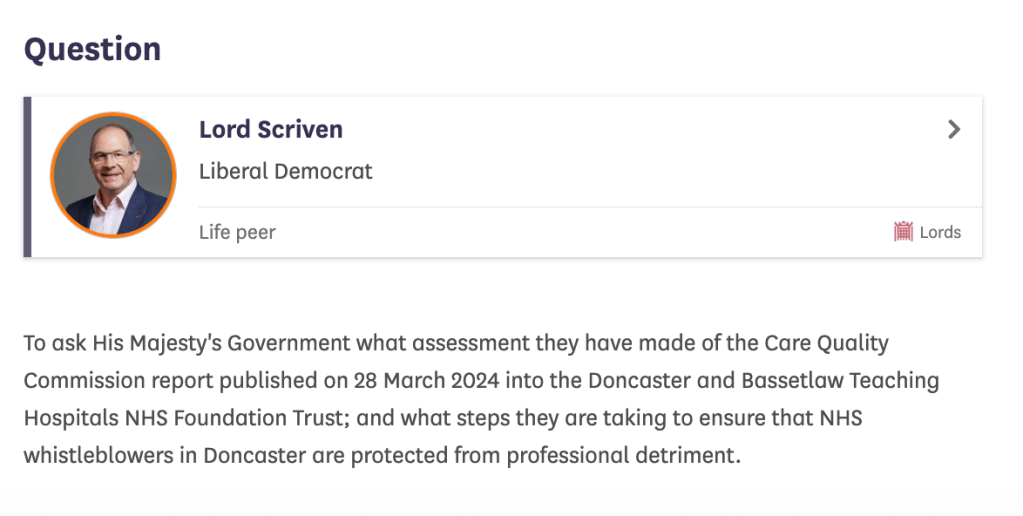
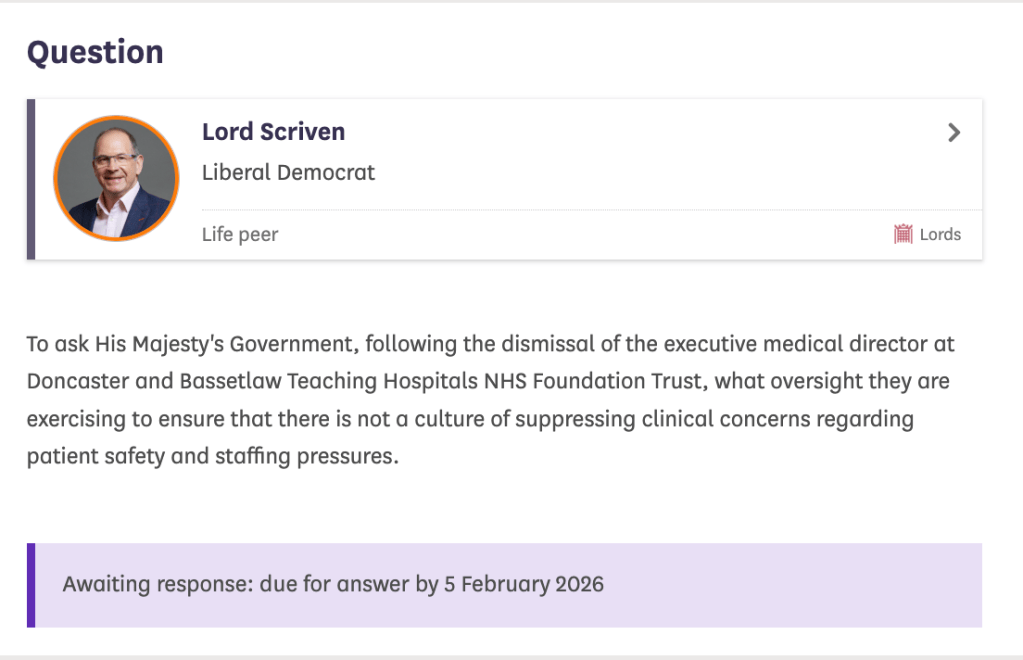
Since Dr Noble’s dismissal, a question has been tabled in parliament by Lord Scriven about whistleblower detriment at the trust:
Background regulatory findings
The regulator the Care Quality Commission noted in an inspection report of 28 March 2024 that there were issues with trust leadership and staff confidence in raising concerns:
“Not all staff felt leaders were visible. Staff in areas where there were greater pressures, due to challenges recruiting staff, financial restraints, and patient demand, felt less supported by the senior leadership.”
“However, during our discussions with staff groups not everyone felt respected supported and valued. We had received several whistleblowing concerns where employees felt a lack of respect, listening and ‘compassionate leadership’ from the trust. Staff in areas where there were greater pressures, due to challenges recruiting staff, financial restraints, and patient demand, felt less supported and listened to by the senior leadership.”
CQC criticised incomplete recording of staff concerns and noted staff concerns about the safety of the internal whistleblowing process:
“However, as the trust’s process encouraged staff to approach the FTSU [Freedom To Speak Up] partners rather than the guardian in the first instance, the report did not include the details of concerns raised directly to the partners. The trust did not have a process to capture these concerns centrally. This meant the Board were not fully sighted on the numbers of concerns raised by staff through the trust’s FTSU process. Following the inspection, the trust informed us they were undertaking further work to triangulate themes from concerns raised through different routes.
During the inspection most staff said they were aware of how to contact FTSU. However, we received several enquiries from staff who shared their negative opinion of speaking up, as such there was further work needed to ensure all staff felt safe to speak up.”
Two just published external reviews
This week, Doncaster and Bassetlaw published two external reviews, respectively on culture and leadership.
Report of the external review of culture at Doncaster and Bassetlaw
This review of culture was conducted by the private company TheValueCircle LLP, which previously reviewed University Hospitals Birmingham.
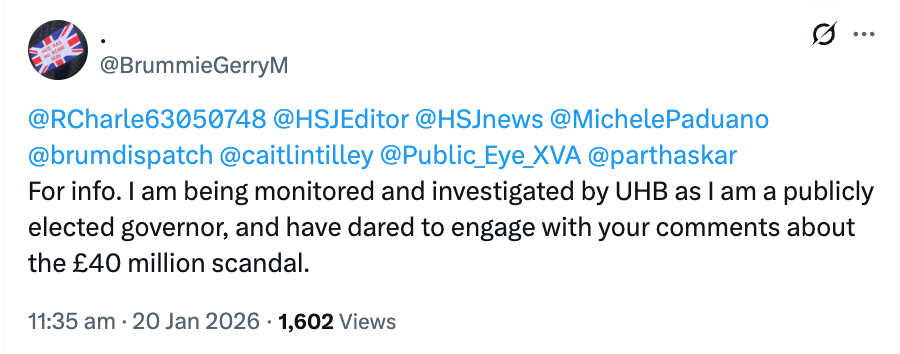
UHB remains as dogged by cultural problems as ever. One of UHB’s governors has recently revealed that he is being investigated by UHB for publicly engaging with discussion on a recent scandal about use of funds for recruiting overseas doctors:
The more recent culture review at Doncaster and Bassetlaw was reportedly based on twenty confidential interviews of senior staff (“Chair, CEO, Executive and Non-Executive members of the Board, and wider system partners”), surveys, walkabouts engaging 150 plus staff and listening groups with 67 staff.
The trust noted that about 10% of staff participated.
The authors say that their report was commissioned by the trust. The trust’s website states: “We commissioned the independent review to provide another safe and confidential place for colleagues to share their experiences openly”, and adds that the reviews were commissioned in “mid-2025”.
In the context of major allegations and disputes, NHS England usually has a hand in these matters, albeit this is not yet admitted in the current situation.
The report’s executive summary emphasised staff’s pride in care provided by the trust, acknowledged a “top down” dynamic, some disconnect between staff and senior management and noted improvements were needed. But I found the language somewhat euphemistic and the summary did not fully reflect the negative findings listed in the body of the report. These in fact showed:
* 27% staff did not feel respected by their immediate manager/local leader
* 46% staff did not feel respected by the trust as their employer
* 26% staff did not feel their work was valued by their immediate manager/ local leader
* 45% staff did not feel their work was valued by the trust
* 28% staff did not feel the trust was an employer which cared about their well being
* 47% staff did not feel their immediate manager/ local leader cared about their well being
Lending support to Dr Noble’s reported concerns,
* 49% staff had felt bullied or harassed in the workplace
Staff indicated that 62% of the bullying and harassment came from managers, whether from “senior management in the trust”, “senior managers in your own teams” and/or “immediate line manager/local leader”.
And very seriously,
* 54% staff did not feel confident that the trust would listen and consider their feedback
The review authors reported there were mixed views about internal whistleblowing process: “Some staff felt confident if they needed to use the FTSU route, that their concerns would be taken seriously and considered in an appropriately confidential manner. However, others felt a similar feeling to raising concerns of any kind to the Trust and doubted the process’ effectiveness. A small number of staff and some staff representatives expressed concerns regarding the perceived confidentiality of the FTSU process.”
Interestingly, reviewers noted “We were made aware that the Trust Executive team have commissioned a peer review of FTSU.”
In my view, the reviewers made largely anodyne recommendations. On whistleblowing governance they recommended:
“6.7 The review team recommends that the Trust ensures the FTSU process meets its intended purpose, assessing the effectiveness of that process, ensuring feedback is given to those raising concerns and the importance of confidentiality is understood by all.”
This is hardly going to change any abusive practices.
Nor will it assuage staff fears, when the workforce have just witnessed one of the most senior trust officers being bundled out of the door under SOSR, after a prolonged suspension.
It is necessary to acknowledge serious issues before there can be real change.
It is also disingenuous to pretend that the NHS whistleblowing system, fatally flawed by conflict of interest and power imbalance, can be fixed by recommending that senior managers voluntarily behave better.
Report of the external Well Led review
The Well Led review was also undertaken by TheValueCircle. It relied on some of the same evidence used in the culture review, as well as observation of meetings and also document review.
There were a slew of observations about trust process with some criticisms about failures to follow up and mitigate corporate risks, consistency in ensuring stated trust values, issues about communication and non executive challenge. Below average staff engagement was noted. Concerns from governors about access to some board sub-committee meetings and whether governors were heard was also raised.
Although governors’ concerns were mentioned, I found no mention of the major rupture behind the suspension of an executive director, and yet the mission includes “To identify the dynamics of the board”. Instead, the reviewers appeared to erase the fact that there had been a rupture and reported as if a member of the board was not currently suspended. They referred only to “respectful” and well chaired ongoing meetings.
Similar comments were made about whistleblowing governance as in the culture review, with the added detail that the trust had worked with the General Medical Council on whistleblowing matters, implying that at least some doctors were fearful:
“We acknowledge that the Trust has worked with the General Medical Council to strengthen perceptions of psychological safety in speaking up and to improve medical colleagues’ confidence in the process. However, listening groups identified that some colleagues still lacked confidence. In addition, some staff reported they were unsure how to access the FTSU service.”
Of note, despite the controversial and excessively long suspension of the medical director, I could find no comment by the reviewers about the trust’s application of formal NHS medical disciplinary process under MHPS (Maintaining High Professional Standards).
This seems to be a serious omission in the trust’s favour and potentially a point of criticism about impartiality of the review, or at best, its effectiveness.
The only reference that I found in the Well Led review report on trust disciplinary process was the inclusion of the policy “ORP/EMP 2– Disciplinary Procedure” in the list of documents reviewed.
Neither was disciplinary culture discussed in TheValueCircle’s culture review report, as far as I could see.
These seem to be inexplicable omissions given the high level of bullying and harassment flagged by staff.
Especially as staff reported that 62% of the bullying and harassment came from managers.
Neither could I find discussion of compliance with CQC Regulation 5 Fit and Proper Persons in the Well Led review report. This may be a limitation of the NHS England template for these types of reviews.
On general search, I also found past CQC fines against the trust for breach of candour and several serious and relevant coroners’ findings in 2025, that were not reflected in TheValueCircle’s well led review report. I list these at the end of this post. I would have hoped that these should have been considered under the banner “Is there a culture of high quality, sustainable care?”
In conclusion
We appear to have a classic NHS whistleblowing case of very harsh discipline following reported public interest disclosures and then dismissal on shaky grounds on breakdown of relationships. The latter is usually a last resort when employers are unable to make misconduct or incapability grounds stick. All accompanied by somewhat lacking employer-commissioned reviews which offer partial fig leaves by omission, throw up some vapour trails yet have not answered all the crucial questions.
None of which serves patients’ interests, and likely only leaves remaining staff in anxiety and doubt.
As well as the wasteful dismissal of an expensively trained and developed senior doctor who was not accused of misconduct or incapability, the prolonged suspension of Dr Noble was especially objectionable. Such torturous suspensions are wasteful and almost never justified. They are punitive and very harmful to individuals and their families. They were supposed to be actively tracked and phased out long ago after NAO recommendations in 2003, but harsh discipline and suppression in the NHS is too politically useful and so was retained.
Tim Noble may obviously lodge an Employment Tribunal claim against the trust in respect of his treatment, in which case more details will emerge about the nature of the governance concerns.
RELATED ITEMS
1) It is relevant to note that the CQC issued two fixed penalty notices against Doncaster and Bassetlaw in recent years for failing to comply with the legal Duty of Candour:
“In 2021 CQC completed an investigation of a serious incident at the trust. The fixed penalty notices relate to an incident in July 2018 where a patient, who cannot be named for legal reasons, died after complications during childbirth. These two breaches of duty of candour regulations were:
Failing to notify the family as soon reasonably possible that an incident had occurred
The trust did not provide the family with an account of the incident or offer an appropriate apology to them in a timely manner.”
There have been other cases in which harmed families have complained of a lack of appropriate apology by the trust.
These governance failings reflect on trust leadership.
2) Doncaster and Bassetlaw has also been issued several coroners’ Prevention of Future Deaths reports last year as follows, some of which raise issues about organisational learning and thus leadership.
John Bell Prevention of Future Deaths report 4/08/2025
Marina Raisbeck Prevention of Future Deaths report 18/02/2025
Walter Horton Prevention of Future Deaths Report 10/09/2025
Emily Hewerdine Prevention of Future Deaths Report 18/08/2025
Khadija Kerri Prevention of Future Deaths report 25/02/2025
In the case of John Bell, the coroner was concerned that no Datix incident report was filed and that six months after his untoward death, no investigation had taken place.
In the case of Marina Raisbeck, the coroner was concerned that the factors which contributed to her death had not been addressed, fifteen months after her death.
Distressingly, in the case of Walter Horton, the coroner concluded that staff did not understand cleanliness or aseptic technique.
In the death of Emily Hewerdine from neglect, the coroner noted fifteen months after her death that the system failings had not been rectified.
In the death of Khadija Kerri, radiological evidence of cervical and rib fractures were not passed on initially and clinical action was not taken to immobilise the fractures for 3 days. Eight months after the patient’s death, the coroner noted that there was no policy on disseminating addendum report findings.
It would seem to me that such governance failings should have been reflected in a report on whether the trust was well led.
NHS England’s expectations for Well Led reviews require:
“Senior leaders can evidence that there are appropriate and effective mechanisms for turning concerns/ incidents into improvement actions based on inquiry about the root causes of what has happened, where constructive challenge is welcome at all levels of the organisation, including the board.”
3) In December 2025 a PHSO investigation concluded that a patient died of sepsis at the trust after a basic failure to administer antibiotics despite requests from the family, community staff and paramedics:
Disabled father died from sepsis after pleas ‘dismissed’ by hospital staff
4) It is worth reminding ourselves that the lamentable architect of the NHS Freedom To Speak Up model, Robert Francis, claimed expansively over ten years ago in his 2015 Freedom to Speak Up report:
“The climate that can be generated by these measures will be one in which injustice to whistleblowers should become very rare indeed, but is redressed when it does occur.”
Neither of the risible claims in this statement is true.
I have spent the last ten years tracking and documenting the failures of Francis’ patently ineffective but government-pleasing policy.
It is clear that there continue to be no end of casualties. Redress for NHS whistleblowers is very patchy and usually only partial and inadequate when achieved. And redress very rarely comes in the form of resolution of the original whistleblowing concerns, which is so important to the majority of whistleblowers. In the NHS this is vital to public safety, which still limps in last.
Realistically, I usually have to advise whistleblowers to prepare themselves for loss, and to make choices about the level and type of losses.
The least risky whistleblowing strategy is NOT to follow the internal policy but to disclose to the media, either anonymously or with guarantee of anonymity. But it is best to take advice and each must make a personal decision.
And until UK policy and law are properly reformed, the situation will sadly not change.
5) At University Hospitals Birmingham, which also commissioned reviews from TheValueCircle after scandal, another whistleblower was severely victimised and the CQC failed to hold trust directors to account under the Fit and Proper Person provisions:
Mr Tristan Reuser’s whistleblowing case: Scandalous employer and regulatory behaviour on FPPR

 Alexander's Excavations
I hope Dr Noble is now gainfully and happily employed, preferably in private practice, where his integrity and expertise are appreciated and suitably rewarded.
I hope Karma soon catches up with the lamentable non-descripts responsible for this pathetic farce.
LikeLike