Dr Minh Alexander retired consultant psychiatrist 30 September 2023
Robert Francis’s and the government’s Freedom To Speak Up project, launched in 2015, is an exercise in endless failure.
Eight years on, the unabated NHS whistleblowing scandals make it clear that very little has changed. There is in fact evidence that some Freedom To Speak Up Guardians and certainly the National Guardian’s Office are part of the problem.
The Freedom To Speak Up model was launched on flim flam and on unevaluated work at an NHS trust where district nurses were forced to whistleblow to the media and to the Care Quality Commission, because managers had not acted on hundreds of incidents reports about short staffing. There was nothing about the latter in Robert Francis’ Freedom To Speak Up review report.
The National Freedom To Speak Up Guardian’s Office was set up originally primarily, we were told, to help whistleblowers whose cases had not been handled well by NHS employers.
| The Freedom To Speak Up review report stated: “There should be an Independent National Officer resourced jointly by national systems regulators and oversight bodies and authorised by them to carry out the functions described in this report, namely: • review the handling of concerns raised by NHS workers, and/or the treatment of the person or people who spoke up where there is cause for believing that this has not been in accordance with good practice” “7.6.12 The INO [National Guardian] should be authorised by these bodies to use his/her discretion to: • review the handling of concerns raised by NHS workers where there is cause for concern in order to identify failures to follow good practice, in particular failing to address dangers to patient safety and to the integrity of the NHS, or causing injustice to staff • to advise the relevant NHS organisation, where any failure to follow good practice has been found, to take appropriate and proportionate action, or to recommend to the relevant systems regulator or oversight body that it make a direction requiring such action. This may include: – addressing any remaining risk to the safety of patients or staff – offering redress to any patients or staff harmed by any failure to address the safety risk – correction of any failure to investigate the concerns adequately” [my emphasis] |
The National Guardian’s primary purpose was thus to independently review whistleblower cases and facilitate redress and learning for patients and whistleblowers harmed by cover ups.
But its mission became perverted into one of propaganda and the case reviews became a minimal afterthought.
Since the Office’s inception in 2016, only a ridiculously small handful (ten) of case reviews have been conducted.
Southport and Orsmkirk Hospital NHS Trust 2017
Northern Lincolnshire and Goole NHS Foundation Trust 2018
Derbyshire Community Health Services NHS Trust 2018
Nottinghamshire Healthcare NHS Foundation Trust 2018
Brighton and Sussex University Hospitals NHS Trust 2019
North West Ambulance Service NHS Trust 2019
Royal Cornwall Hospitals NHS Trust 2020
Whittington Health NHS Trust 2020
Blackpool Teaching Hospitals NHS Foundation Trust 2021
Speak Up Review of Ambulance Trusts in England 2023
The reviews themselves have also been perverted into bland general reviews of governance, with the National Guardian refusing to intervene in individual whistleblower cases or acknowledge specific harm to patients, despite this being one of the original purposes of the Office.
Whistleblowers have felt let down because they have been unable to access a case review, or they have been through a case review process which has done nothing for them personally.
The National Guardian’s Office is now even changing its terminology from case review to “Speak Up review”. It would be unfortunate if anyone gets any strange ideas that this is about actually helping whistleblowers in distress and trouble.
Successive National Guardians have so far managed to spend over £7 million of public money.
| YEAR | National Guardian’s Office expenditure |
| 2016/17 | £196,750.55 |
| 2017/18 | £294,910.19 |
| 2018/19 | £1,108,140.74 |
| 2019/20 | £1,349,843.77 |
| 2020/21 | £1,279,559.67 |
| 2021/22 | £1,350,682.11 |
| 2022/23 | £1,445,893.02 |
| TOTAL | £7,025,780.05 |
Roughly translated, that means each of the ten National Guardian case reviews to date has cost about £700,000.
There is not even a pending case review announced presently, as there used to be.
Is the intention to stop the case reviews altogether, to focus on the hard work of propagandising?
As part of the Office’s unaccountability, its annual report is full of froth and gives almost no real accountability data about what the Office does.
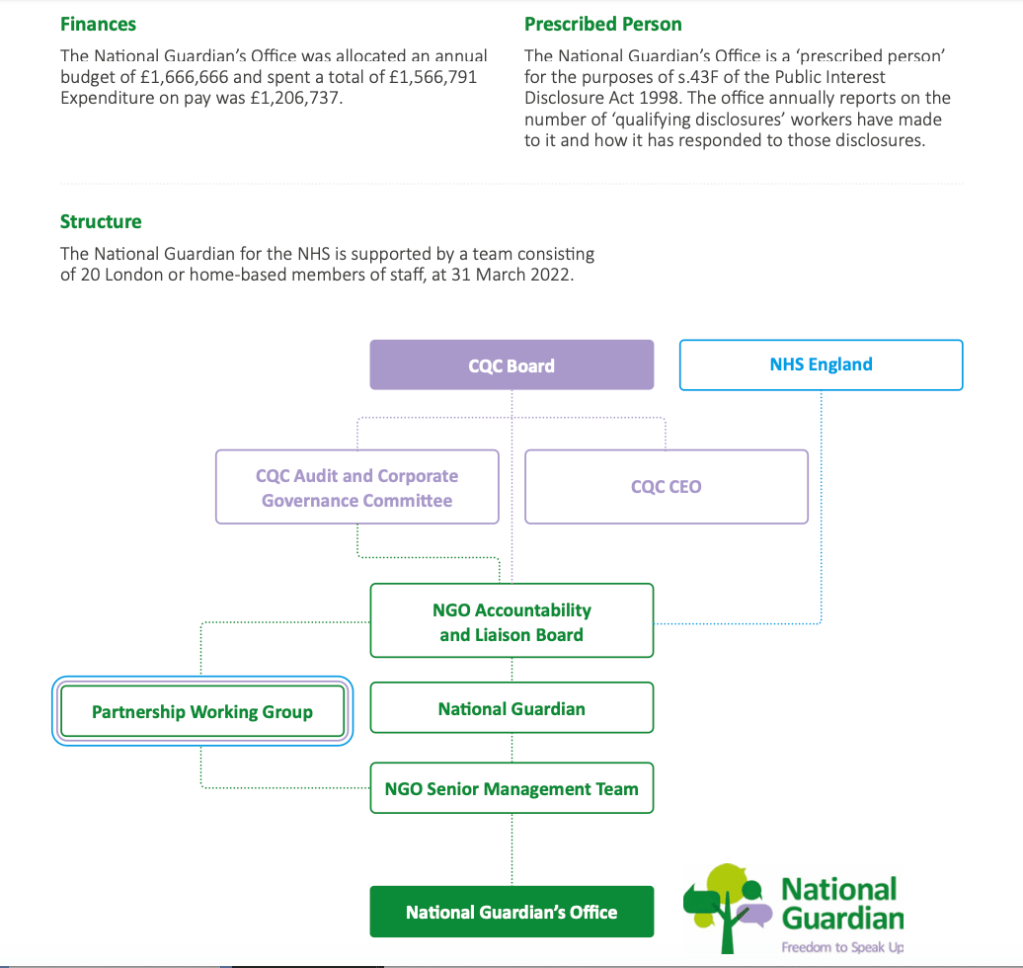
The most recently published National Guardian’s annual report (2021/22) gives a single page at the very end of the most minimal details about the Office’s governance and finance:
I asked for more details about the National Guardian’s finances and also about a recently expanded Accountability and Liaison Board.
The New National Guardian’s Accountability and Liaison Board
This Board purportedly oversees the work of the Office. It used to consist of two to three representatives from the regulators who funded the National Guardian’s Office, the Care Quality Commission and NHS England/Improvement.
There are now six members.
Most importantly, responsibility has been outsourced with the hiring of a private contractor to act as Chair.
This individual is Suzanne Mc Carthy, a former civil servant who undertook long-term secondments to run arms length bodies such as the Human Fertilisation and Embryology Authority (HFEA), where she was CEO between 1996 to 2000.
| Human Fertilisation and Embryology Authority Scandal Notably, a scandal arose over the HFEA in 2002 after mixed race babies were born to a white couple who had received fertility treatment at Leeds Teaching Hospital NHS Trust, revealing a mix up in sperm samples. Professor Brian Toft’s 2004 report into the related governance failures concluded that there was a culture of secrecy at the responsible regulator, HFEA, with insufficient information sharing: “Over time the ‘culture of confidentiality’ generated by the provisions of the HFE Act appears to have become internalised within the HFEA to such an extent that it has become transformed into a ‘culture of secrecy’ where, more recently, even their own personnel may not be informed when an adverse event has taken place without prior approval from senior managers.” His report noted that McCarthy and her former Chair declined to give evidence in person: “Witnesses 15. Of the witnesses invited to give evidence to the Review Panel only two replied that they were ‘not minded to attend ’1 in person. These were Dame Ruth Deech (Chairman of the HFEA 1994-2002) and Ms Suzanne McCarthy (Chief Executive of the HFEA 1996-2000). They both referred the panel to the written information available from the HFEA and offered to consider whether they could give a written reply to any questions that the panel thought only they could answer. However the panel concluded that under the circumstances such an approach was not feasible.” The Toft review criticised the inefficacy and superficiality of the HFEA’s inspection process: “…, there can be no confidence that all centres have been or are at the time of this review being inspected to a consistent standard as required by the HFE Act and COP.” Toft was critical of HFEA’s culture and capture as a regulator, and its failure to use enforcement powers where it found failure. “Moreover, as licence committees have to be unanimous in their decisions relating to the grant of licences, lay Members of the Authority must have consistently agreed with clinical Members not to apply the sanctions that were available to them.” There was also no clear system for reporting adverse events at HFEA: “Similarly, when the Review Panel asked the HFEA Executive in 2002 for details of any adverse events that had occurred over the lifetime of the HFEA, other than those that are the subject of this review, the HFEA replied that they had experienced difficulties in locating adverse events that had been reported..” HFEA did not seem to investigate thoroughly or proactively: “7.27 An interim regulatory manager, who has been employed by the HFEA for several years, however informed the Review Panel that typically it was the staff at the centre where an adverse event had taken place that would carry out the investigation and they would then report their findings back to the HFEA. The inspector co-ordinator associated with a centre that had experienced an adverse event would only carry out an examination of the circumstances surrounding that incident at the next inspection, which could be many months later.” Importantly, although there were no earlier cases similar to the index cases, Toft found that HFEA knew about earlier incidents of the wrong embryos being used because of failures to follow protocol: “There were however seven adverse events where patients had received the wrong embryos due to errors in the identification of embryos or patients. In two of those cases the error had been caused through staff not following the written protocol that had been provided. It is of interest to note that in one of the other five adverse events the licence committee varied that centre’s licence to include the condition that, ‘…a fail-safe protocol should be devised for identifying patients prior to embryo transfer. The protocol must be submitted to the HFEA for approval.’ This does not seem a propitious background for someone who is to oversee the work of a national whistleblowing agency. |
But McCarthy seems a safe enough pair of establishment hands, and her appointment provides the government an element of deniability for the embarrassment that is the Freedom To Speak Up project.
This facility will cost the public £8,000 for 24 days work a year, according to the latest FOI data from the National Guardian.
Implausibly, the National Guardian’s Office has claimed that the person spec for the ALB Chair is the same as her job description. I have written to Chidgey-Clark to question this unusual assertion and to repeat my request for the job description, as well as to ask some more detailed questions about her Office’s spending pattern.
The other significant change to the National Guardian’s Accountability and Liaison Board is that a representative from the Department of Health has appeared. This is Adam Mc Mordie Deputy Director Quality, Patient Safety and Maternity, Department of Health and Social Care.
General spending by the National Guardian
Until now, there has been near blackout on how the National Guardian’s Office spends its money.
I obtained data in 2019 on the National Guardian’s distasteful spending on HSJ awards and placing paid for-content in the Health Service Journal.
I have now obtained more comprehensive breakdown of spending by the Office since inception:
FOI disclosure Ref IAT 2324 0616 National Guardian accounts 29 September 2023
The spending increases year on year, but the number of whistleblower case reviews has not.
According to the 2021/22 annual report there are now about twenty staff at the National Guardian’s Office. What do they do, if not the core job they were originally supposed to do???
Brainstorming sessions on new ways to turn away whistleblowers?
Seminars on how to make desperate whistleblowers cry?
Since financial year 2017/19, the National Guardian has bought publicity by sponsoring a naff Health Service Journal speak up award, spending a total of £100,800:
| YEAR | Spending on HSJ Awards Sponsorship |
| 2017/18 and 2018/19 | £39,600.00 |
| 2019/20 | £19,800.00 |
| 2020/21 | – |
| 2021/20 | £19,800.00 |
| 2022/23 | £21,600.00 |
| TOTAL | £100,800.00 |
The Office has additionally spent at least a total of £74,101.20 on public engagement and public relations, with a very sharp spike since Chidgey-Clark became the National Guardian.
Chidgey-Clark, the self-described firewalk instructor and reiki practitioner, spent a cool £50,161.20 on PR in 2022/23.
I say “at least” £74,101.20 has been spent on PR because the National Guardian did not include in its disclosure its spending on placing paid-for content in HSJ prior to 2020/21, which we know took place. It is not clear if such expenditure after 2020/21 is included in the disclosed public relations spend.
| Year | Spending on public engagement and public relations |
| 2020/21 | £9,750.00 (public engagement) £6,918.00 (public relations) |
| 2021/22 | £7,272.00 (public relations) |
| 2022/23 | £50,161.20 (public relations) |
| TOTAL | £74,101.20 |
Interestingly, Chidgey-Clark also spent £36,480.00 on a “staff recruitment advert” in 2022/23.
What was that?
Not an excessive head-hunting fee for Suzanne Mc Carthy?
And after the embarrassment about the waste and excessive head hunting costs for the Eileen Sills the first National Guardian and bolter?
The National Guardian has also forked out a bundle on glitzy conferences:
| Year | Expenditure on conferences |
| 2016/17 | £10,771.20 |
| 2017/18 | £ 86,888.40 |
| 2018/19 | £ 76,589.10 |
| 2019/20 | £ 2,367.30 |
| 2020/21 | – |
| 2021/22 | £ 22,612.80 |
| 2022/23 | £ 56,414.40 |
| TOTAL | £255,643.20 |
I asked the National Guardian what proportion of its budget is dedicated to whistleblower case reviews.
The answer?
“We do not hold this information, as we don’t track costs against specific activities of the office in a way which would enable us to identify the specifics of your question.
However, since the NGO’s inception, the office has had one FTE member of staff devoted to the case review and Speak Up review programme. The NGO works in a matrix management way, therefore colleagues from the office would have contributed to parts of both case reviews and Speak Up reviews as required.”
How princely. A whole member of staff dedicated to whistleblowers’ cases despite the Office’s busy schedule of spinning and glad-handing. How generous.
Don’t worry about the sounds of collapse all around.
Do try the fattened Galician dormice stuffed with larks’ tongues and salted with whistleblowers’ tears.

RELATED ITEMS
Further correspondence to Jayne Chidgey Clark cc Suzanne Mc Carthy and the DHSC
BY EMAIL
Jayne Chidgey-Clark
National Freedom to Speak Up Guardian
30 September 2023
Dear Jayne,
FOI request National Guardian’s finances and expanded Accountability and Liaison Board
Thank you for your Office’s response to my enquiry – attached and below.
I am rather confused by the assertion that the new ALB Chair’s person spec is the same as her job description.
I have not come across this before and assume this is a mistake.
Please could I have the job description which sets out the ALB Chair’s duties as opposed to the Person Spec which sets out her required qualities and experience.
May I ask some fresh questions:
1) Why did a staff recruitment advert by the NGO in 2022/23 cost £36,480.00?
Where was the advert placed?
What position did the advert relate to?
Was a head hunting firm engaged to handle this particular recruitment, and if so, which firm?
2) Besides “filming for Guardian training modules and costs for survey work”, what other items accounted for public relations expenditure? Please give a breakdown including details of any contractors hired.
Please also give details of contractors hired to undertake the above mentioned filming.
Why was there a steep increase in public relations expenditure in 2022/23 to £50,161.20? Please break down the PR spending in 2022/23 in particular.
3) Please disclose the annual amounts paid to the Health Service Journal for placing paid-for (“sponsored”) articles in the journal since the Office’s inception.
I am aware that such articles have been placed in the past.
For example, were these articles by you, placed in the Health Service Journal on the basis of a payment to the Journal?
“A call to action: Supporting leaders at all levels to embrace freedom to speak up” 17 May 2022
“We all have a duty to speak up for safety, civility and inclusion” 10 October 2022
If the National Guardian’s Office paid to place these articles in the Health Service Journal, was this cost included in the FOI disclosure to me of 29 September 2023, and if so, under what category of expenditure were they badged?
4) Can the spending on “training” be particularised?
What was the training? What did it comprise? To whom was the training delivered? Where are the activity data relating to this training expenditure and can they please be disclosed?
5) Has the National Guardian’s Office made plans to continue a programme of whistleblower case reviews? If so, please disclose what the plans are.
Please disclose whether there have been any reviews of what constitutes an acceptable work rate in terms of the number of whistleblower case reviews conducted.
I ask as I am very concerned that there have been only ten case reviews since the Office’s inception, after spending of £7,025,780.05, even [sic – insert ‘though’] the primary original purpose of the Independent National Officer (the original designation of the National Guardian’s Office) was to afford wronged NHS whistleblowers the facility of independent review and someone who might point out that there should be redress for them and any patients harmed as a result of poor whistleblowing governance.
Page 168 in particular:
All of that seems to have been quite “forgotten”, to put it kindly.
If there are plans to discontinue whistleblower case reviews, please disclose what they are.
Many thanks.
Minh
Dr Minh Alexander
Cc
Suzanne McCarthy Chair of National Guardian’s Accountability and Liaison Board
Adam Mc Mordie, Deputy Director Quality, Patient Safety and Maternity, Department of Health and Social Care, member of National Guardian’s Accountability and Liaison Board
The Disinterested National Guardian & Robert Francis’ Unworkable Freedom To Speak Up Project


After the death of sister in 2013 I am still going after NHS now after a pause . Lies and more lies told by NHS ,CQC, Nurising Home funded by Hampshire County Council. The people involved in care have no interest in vulnerable patients but themselves. This will rebound on them in the future.
LikeLiked by 1 person
Thank you, Dr A, for a sobering report.
If only as many resources were given to addressing the concerns of whistle-blowers as are given to the creation, promotion and celebration of the offices charged with the task of addressing those concerns, how much happier we all would be!
LikeLike
Dear Dr. Alexander,
Do you provide any training or seminars in holding politicians and health care providers accountable through making their operations, conduct and decision making publicly transparent?
I love the work you do and the citizen advocacy service board, advocates and friends that I collaborate with, I believe, might be greatly interested to know if you provide the above services.
Kind regards,
James B. Rostas
Independent Citizen and Community Advocate
A freely given service
LikeLike
That’s very kind James. No, I don’t do training. I would just say that like with many things, practice helps. A guiding principle is to look for hard facts and gaps in facts, and to cross check things. Experience will give people a better idea of how to weigh evidence and know how and where to investigate. Familiarising yourself with policies helps. It may seem dull, but you have to speak the system’s language and understand its ways, to ask it questions. Hope that helps. All best, Minh.
LikeLike
I must say, personally, I was hoping to learn more from you formally, as I am sure my colleagues would have as well. Thank you Dr. Alexander for sharing those wise, road tested methods, to hold those we rely on in positions of incredible power accountable for their actions/and or lack of them. I will be applying those principles to the best of my ability, living and breathing them in the work I do everyday. I will continue encouraging my colleagues, here in Australia, to subscribe to your “Excavations.” too. Go well, Minh.
James 🙂
LikeLike