Dr Minh Alexander retired consultant psychiatrist 15 September 2015
Labour were responsible for installing Cynthia Bower, the former Chief Executive of the West Midlands Strategic Health Authority, which failed to prevent the disaster at Mid Staffs, as Care Quality Commission Chief Executive in 2009. She went on to fail and resigned.
Some of the CQC’s failures were eventually acknowledged in a 2012 report by the Department of Health on CQC’s performance and capability.
Labour appointed Bower as CQC CEO in 2009 in spite of Alan Johnson, Labour Health Secretary, telling parliament in 2007 after an earlier NHS disaster that incompetent NHS managers should be removed.
The CQC was a weaker version of the regulator that it replaced, the Healthcare Commission, which had embarrassed the Labour administration by exposing failings at Mid Staffs and elsewhere.
The CQC further weakened itself and disbanded its central investigation team, leading to the compromised, cosy relationships between local CQC inspection teams and providers, that have often featured in subsequent, serious failings. Indeed, the CQC rated the Countess of Chester Hospital NHS Foundation Trust favourably whilst the trust was ignoring whistleblowers who tried to raise concerns about Letby’s killings. The CQC claimed at that point: “There was a very positive culture throughout the trust. Staff felt well supported, able to raise concerns and develop professionally”
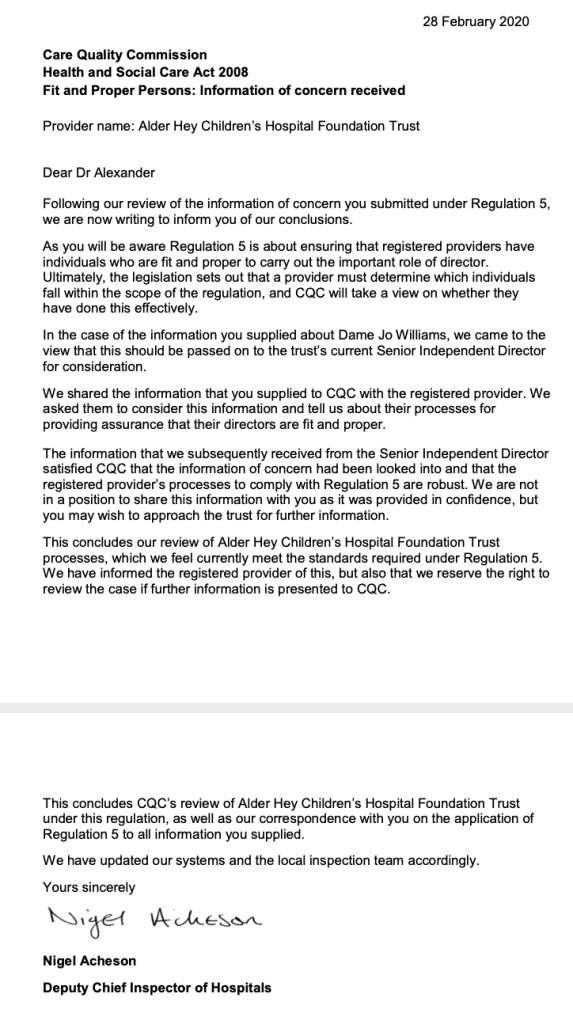
Indeed, CQC and the NHS jointly acted to recycle Jo Williams, the CQC Chair installed by Labour in 2009. This recycling was despite the fact that she had been criticised for harming CQC whistleblowers.
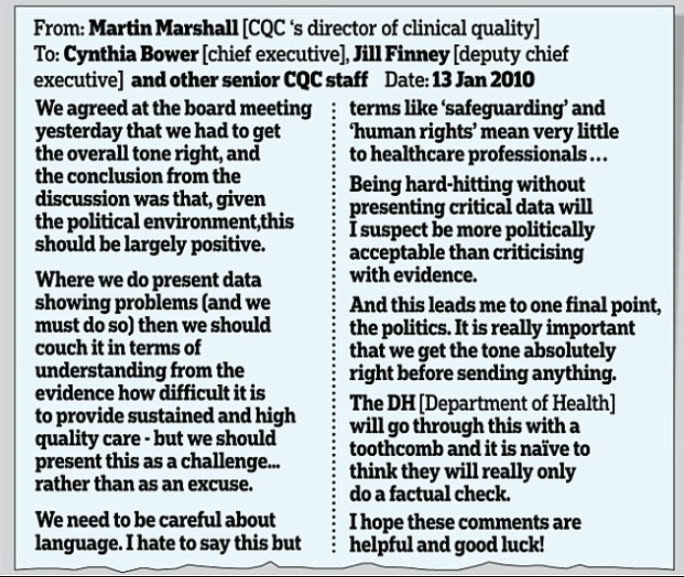
The CQC was shown to be politically subservient in internal correspondence which showed its senior leaders discussing how to appear tough, without actually sharing key details of service failure with the public.
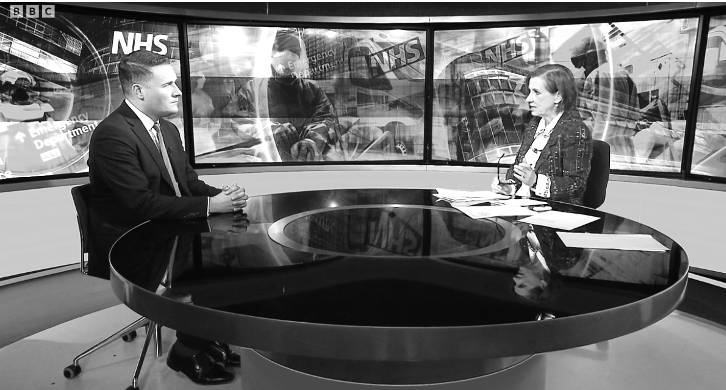
Post Letby Wes Streeting, Labour Shadow Health Secretary, has intervened in the current debate about NHS management failure by promising to regulate NHS managers.
He has not clearly defined what he means by regulation, and in fact spoke on BBC Newsnight on 13 September 2023 about implementing existing recommendations.
There is currently no recommendation on the table for full managerial regulation that would bring NHS managers to the same level of accreditation and accountability as doctors, nurses and other registered healthcare professionals.
The Kark review recommended only a disbarment mechanism, with a view to full regulation in the future if this proved insufficient:
“On the evidence currently available to us, we have not at this stage recommended that the HDSC [Health Directors’ Standards Council] becomes a full ‘regulator of directors’, accrediting training, registering and regulating directors, and operating a form of revalidation process. But we do recommend that the design of the HDSC allows for a more extensive remit should that prove necessary.” [my emphasis]
Moreover, there is no proposal on the table to regulate ALL NHS managers. Only directors are covered by the Kark proposals, with the risk that more abuses will be simply commissioned further down the chain of command. Many whistleblower cases show that abuses start at middle management level. Should such power abusers be allowed to progress in their careers without any controls? As things stand, partaking in abuse often results in reward and promotion. I have only today received an anguished message from a victim about such a promotion.
| UPDATE 16 SEPTEMBER 2023 I have drawn Wes Streeting’s attention to an example of serious abuse by an NHS middle manager against a whistleblower which the Employment Tribunal considered was a whistleblowing detriment and which led the whistleblower’s constructive, unfair dismissal. The case is that of Jane Archibald, North Cumbria whistleblower, in whose case managers colluded to prevent a grievance investigator’s access to Datix incident forms. The grievance investigator was wrongly told by Jackie Molyneux, a middle manager that copies were not kept of the incident forms (when the data is in fact routinely stored electronically), and this fiction was maintained by others. Molyneux also made a number of other untruthful and/ or exaggerated negative claims about Jane Archibald, which are clearly recorded in the Employment Tribunal judgment. I have asked Wes Streeting if he wishes to deter these behaviours by regulating ALL NHS managers. |
Streeting has not so far answered my question to him about whether he will commit in principle to regulation for managers that is as rigorous as regulation for clinicians.
These are Streeting’s comments on BBC Newsnight on 13 September 2023:
17.14
Kirsty Wark: I’m joined now by the Shadow Health Secretary Wes Streeting, thank you very much for joining us, Wes Streeting. First of all, amongst the series of films that we’ve made over the last eighteen months, we’ve demonstrated a failure of NHS England to hold management to account for their failings. We just heard that line there, managers have no one to answer to. Why has it taken till the Lucy Letby conviction for politicians across the board to really focus on the problems of management?
Wes Streeting: Good question because there’s been a series of reviews. We’ve had Sir Robert Francis with his review, we’ve had the Kark review, we’ve had the Messenger review.
Kirsty Wark: You backed Sir Robert Francis didn’t you, on the Fit and Proper Person to be…
Wes Streeting: Of course we’ll back the recommendations but not all of the recommendations in all of those reviews have been followed. And in particular when it comes to the regulation of senior managers in the NHS, the government hasn’t gone as far as they really ought to. And one of the things I’ve said to the Health Secretary Steve Barclay because on patient safety issues, and particularly in the light of the most grotesque tragedy of what happened in the case of Lucy Letby and her heinous, undescribable crimes, don’t want to use this as a political football. I have said to the Health Secretary if he goes ahead with the recommendations of the Kark review, and the full implementation of all the other recommendations that have been made, he will have our whole hearted and full throated support.
If the government doesn’t act before the general election, if there’s a Labour government after the general election, we will act because one of the things that I find infuriating is this merry go round of failure and incompetence, which has led to the most appalling crimes going undiscovered. And that can’t be allowed to continue.
Kirsty Wark: So if those recommendations are published in full you’ll go along with that as far as the Conservatives are concerned. If a Labour government gets in, how quickly will you institute every single recommendation?
Wes Streeting: Well I think this has got to be a first order priority which is why….
Kirsty Wark: Immediately?
Wes Streeting: ….which is why I’ve given the government our support. To say if you bring forward the measures before an election, we’ll work with you. Because one thing I will say Kirsty, recommendations and regulation is one thing, the caveat I would add is that in relation to regulation of senior managers and the disbarring of senior managers, in the cases of professional negligence and misconduct which I think is essential, that is part of the answer.
There is a deeper challenge on culture. And that’s a much harder nut to crack. And it’s partly about penalties but it’s also about inculcating good culture through training, support and making this agenda a priority.
Kirsty Wark: Let’s just look at [inaudible] very quickly. As you say the regulation is there to be enacted in full. If you win the election and come in, will you enact that immediately and I really do mean within the first six months.
Wes Streeting: I’d hope so. Got to negotiate on the legislation programme but that would be my undertaking, because I think this is such a crucial priority. And actually Kirsty it’s one of the reasons why we started now to consult with NHS leaders and the wider workforce about getting the regulation right. Because I want to be ready to hit the ground running.
Kirsty Wark: One of the problems with this is that whistleblowers, people don’t feel safe still to come forward. There isn’t an atmosphere and there aren’t rules where people can speak out. Will you make sure that policy is cast iron?
Wes Streeting: Yes and in fact one of the things we are asking hard questions on is why is that the Duty of Candour which has already been established isn’t working. And this is why I come back to this point about culture, because as it stands there’s meant to be a Duty of Candour, one of the reactions…
Kirsty Wark: The programme on Monday night made it clear…
Wes Streeting: And by the way, I take my hat off to Newsnight’s investigative journalism. Thank goodness you have shone the light that you have, but this is why I have come back to this point about culture. When I spoke to someone senior in the NHS just last week about the Letby case and the merry go round of senior managers,I was told, but look, we’ve got the Fit and Proper Person’s test, and we now got a standardised form for references. My…This is why culture is crucial because my challenge back was “You think the answer is a form, I’m telling you the problem is culture, where poor performance is tolerated, where safety isn’t a genuine priority.
The Health Service Journal has meanwhile published on 12 September 2023 a letter by Streeting to NHS Confederation and NHS Providers, broaching the matter of managerial regulation:
Wes Streeting letter to NHS Confederation chief Matthew Taylor and NHS Providers chief Sir Julian Hartley
Dear Mr Taylor and Mr Hartley
I am writing following the murders of at least seven babies by Lucy Letby, and the failings in the management at the Countess of Chester Hospital uncovered by the subsequent trial.
These were acts of unspeakable evil which are impossible to fathom. However, it appears certain that the lives of newborn babies could have been saved, had hospital leaders acted when concerns were first raised by staff working on the ward. Instead, the brave doctors who sounded the alarm were met with hard-headed, stubborn refusal.
This is not the first time whistle-blowers in the NHS have been ignored at a cost to patient safety. Yet, despite the case for regulation being made pointedly and repeatedly in the past decade, little action has been taken. That is not good enough. The system must change.
I am writing to give the health service notice now that Labour is committing to act, and to state my intention that we work collaboratively towards delivering a regulatory framework that strengthens the accountability of managers and enhances patient safety.
I want to see supportive regulation that promotes excellent leadership and protects patients when things go wrong. Good management is vital for staff wellbeing, clinical outcomes, efficient services and, most of all, patient safety. Strong professional standards and training for managers can help to foster first-rate leadership throughout the health service. Likewise, I am clear that those found guilty of serious misconduct should be disbarred from the NHS.
I recognise the shortcomings of clinical regulation. It can be bureaucratic and misguided, and does not always lead to the best outcome, but this cannot be an excuse for inaction. We will learn from systems that are already in place, listening to experts and harnessing the learnings of multiple national reviews into the accountability of NHS managers.
I am keen to receive representations from NHS Confederation and NHS Providers so that I can take into account the views of your members and senior leaders in the NHS, alongside patient representatives, on four aspects:
- How we subject managers to regulation and measure competency
- How a professional register might work and how we avoid unnecessary bureaucracy, minimise overlap and streamline existing regulation
- How we ensure whistle-blowers are listened to and empower staff to raise concerns.
- How we deliver the best training to develop and support managers and how we adopt and spread good practice
We must get this right, for the sake of both patients and staff. We owe it to the victims of Lucy Letby and to the whistleblowers whose warnings were ignored.
I look forward to hearing from you.
Between now and final implementation of any controls on serious NHS leadership failures, there will no doubt be further lobbying and attempts to neuter any managerial regulation.
Those who are intimately acquainted with NHS leadership failures need to push back equally hard against the specious anti regulation arguments that are flying about.
PETITION FOR REGULATION OF NHS MANAGERS
This is a Westminster petition calling for regulation of NHS managers:
https://petition.parliament.uk/petitions/642631
If the petition reaches 100,000 signatures, the government will consider a related debate in parliament.
RELATED ITEMS
Robert Francis appeared on BBC Newsnight on 11 September 2023 and supported NHS England’s claims that full regulation is not needed for NHS managers:
Francis suggested on Newsnight that NHS employers are unaware of errant managers’ histories. By doing so, he drew a veil over what is an organised system of mutual protection and recycling, which has NHS regulators at its heart. The system even has a nickname, “The Donkey Sanctuary”.
The case of Paula Vasco-Knight exemplifies the collusion running throughout the system:
Postscripts on Paula. NHS England’s apologia & regulatory reticence
Historically, Medway NHS Foundation was one of fourteen “Keogh” trusts found to have high mortality:
2013 Report out today will highlight major failings across 14 NHS hospital trusts
Letby murders: McLellan’s arse, NHS Stalinism and reported NHS management recycling at Devon ICB
Lucy Letby murders: Former Countess of Chester Non Executive Director James Wilkie

 Alexander's Excavations