Dr Minh Alexander retired consultant psychiatrist 12 September 2023
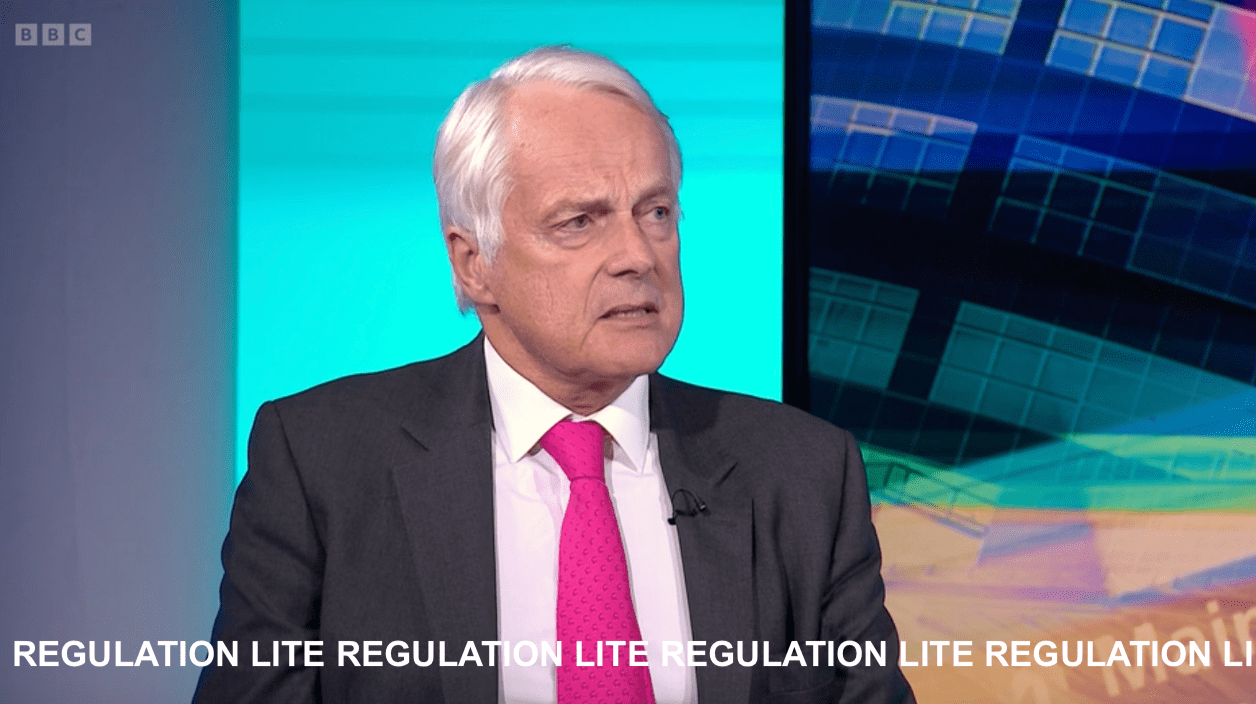
Last night on BBC Newsnight, accountability for the persecution of NHS whistleblowers was re-visited and Robert Francis was interviewed.
The broadcast viewed the issues through the prism of a yet-to-be-tested case of allegations against The Christie NHS Foundation Trust by Rebecca Wight, a nurse who reports that she experienced reprisal after raising concerns about another nurse’s practice. The concerns included an allegation of records alteration after a patient death.
The Christie accepted that concerns were legitimately raised but denied that there was patient harm or improper records alteration. The NMC is investigating. Newsnight reported that Wight has filed a claim of wrongful dismissal to the Employment Tribunal.
Ahead of the Newsnight broadcast, The Christie took the step of issuing an internal statement to its staff, denying the veracity of Wight’s allegations.
Newsnight interviewed Francis about the need for NHS managerial regulation in the context of the Wight case and other matters, such as the scandal at University Hospitals Birmingham NHS Foundation Trust and the Letby killings at the Countess of Chester Hospital.
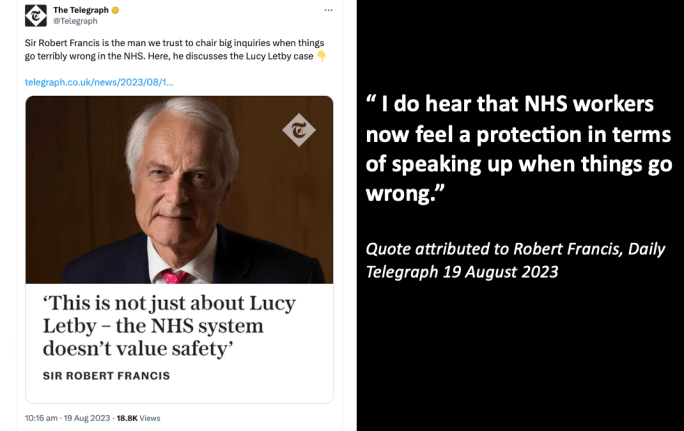
Francis recently supported the government’s initial stance of resisting a public inquiry into the Letby killings. He gave an interview to the Telegraph which resulted in a comically adulatory article about The Patrician:
When the government shifted its position about a public inquiry, in response to public disgust and outcry, Francis also shifted his position.
Following this, the government indicated that it would revisit a mechanism for disbarring unfit NHS managers, which it originally discounted at NHS England’s suggestion.
More recently, NHS England’s CEO buckled and indicated both that NHS England would reconsider disbarment AND regulation of NHS managers, albeit a light version such as that which applies to teachers and bankers.
Francis now hums a similar tune and told BBC Newsnight that he thinks it is time for NHS managers to be regulated. However, he said that there is no need for strict equivalence to a body such as the General Medical Council. Francis espoused only a reactive system which will respond to complaints. This is the case for teachers.
Although Francis spuriously claimed that such a reactive system would level the playing field for clinicians, his suggestion means that non clinical NHS managers would not be held to the same level of proactive professional standards, skills, aptitudes and continuing professional development that clinicians are expected to meet.
This effectively ignores past reviews of NHS management capability, which have criticised the poor training of NHS managers.
All whilst the government and General Medical Council dream up ever more absurd ways in which to control doctors. For example, a newly introduced, mandatory requirement for “kindness”. I have written to the GMC’s medical director about this and have not yet received a response.
For completeness, I provide Francis’ evidence to parliament of 14 March 2019 which is a response to the Kark review on the Fit and Proper Person Test in the NHS.
At that point, Francis agreed with Kark’s proposal of a disbarring mechanism and he suggested that the disbarring function could be given to the Health and Care Professions Council. The HCPC is the most incompetent professional regulator that I have ever come across. It does not even collate basic data about referrals by referring employer.
A transcript of Francis’ comments about managerial regulation to BBC Newsnight is provided below:
18.07
Robert Francis: Well on the point of confidentiality, I appreciate that there is always a need for some degree of confidentiality. But too often in my view, and I can’t comment on this individual case, but too often it’s used as an excuse not to give explanations either to the members of staff or indeed to patients about what has happened to them. And I think that needs to be revisited.
Victoria Derbyshire: Time and again when someone raises a concern, whether it’s Rebecca Wight an experienced nurse, whether it’s senior consultants in the Letby case, who had to apologise to Lucy Letby for raising concerns. Or the statistical data at Stafford Hospital showing deaths were higher than they should have been, managers attacked the messenger, the data. Rather than focussing immediately on patient safety. It’s still happening. Why do you think that is?
Robert Francis: I think that there is a, an absence unfortunately in the National Health Service of a proper system of investigating things that might have gone wrong. And I don’t think…you shouldn’t have to wait until you prove that something’s gone wrong before it can be looked into. And I think that needs to be done by qualified and trained people who can undertake an objective inquiry, one that’s independent. And one that produces an authoritative result. At the moment I’m afraid, most investigations, if there’s one at all, are undertaken sometimes by Human Resources officers who frankly they don’t have the expertise, or by people who have a preconceived agenda. So I think there needs to be a serious look at how we look at concerns that are raised, whether it be by staff or patients or indeed into serious incidents which are known to have happened.
Victoria Derbyshire: In our film the question was about why doctors and nurses can be struck off yet not hospital managers. Do you think that should change?
Robert Francis: I think the time has come for that to be considered very seriously. I recommended the Fit and Proper Person Test, which is not very surprisingly a requirement that managers are Fit and Proper People to do the job. It seems to me that if they don’t treat whistleblowers correctly that raises an issue about whether they’re Fit and Proper People. But that hasn’t worked and I think the time has come where there should be a level playing field between managers and healthcare professionals in relation to regulation. And I don’t think that means a new sort of manager’s General Medical Council. What is needed is a register of people who are managers and a Tribunal of some sort which can listen to complaints about them and investigate them properly. At the moment, when a manager’s done something bad, at one trust goes to another, the new employer has very little means of finding out what happened before. And the only way of dealing with that is to have a system of disciplinary investigation, similar to doctors and nurses. And until that happens, I’m afraid that there won’t be what the outside world would think of as accountability.
RELATED ITEMS
For those who are old enough to remember, Robert Francis once recommended criminal sanctions against NHS managers who suppressed and mistreated whistleblowers:
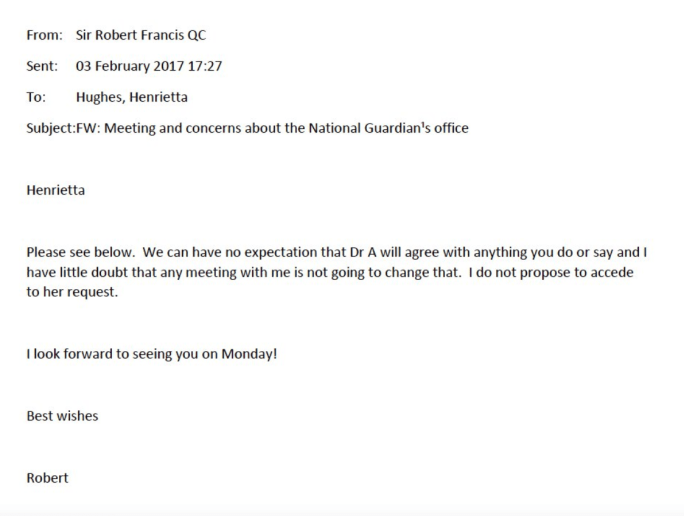
Also, Francis knows full well that UK whistleblowing law is hopelessly weak, but he declined to recommend law reform when he had the chance to do so in 2015. He instead gave us the useless and non evidence based Freedom To Speak Up model, and he refused to listen to concerns that the model was being further diluted by the second National Guardian and her funders, CQC and NHSE/I:
Francis’ comment to BBC Newsnight that new employers do not know what NHS managers did wrong in previous posts draws a veil over endemic collusion amongst the manager classes who protect each other. Quid pro quos are commonplace, and NHS regulators are at the heart of a system of organised recycling of erring NHS managers.
The case of Paula Vasco-Knight former NHS CEO and convicted fraudster is an excellent example of what happens:
Postscripts on Paula. NHS England’s apologia & regulatory reticence
Letby murders: McLellan’s arse, NHS Stalinism and reported NHS management recycling at Devon ICB
Lucy Letby murders: Former Countess of Chester Non Executive Director James Wilkie

 Alexander's Excavations
Robert Francis is a man of straw and blows with the wind. Despite his hitting the nail on the head in in Mid Staffs reporting – and plainly aware of the issues facing complainants and whistlenblowers – when given the opportunity to make real change on the board of the CQC & Chair of Healthwatch – he squandered it and did absolutely nothing useful. Failing to engage with complainant families & whistleblowers and humming the house music. A regulator – who doesn’t regulate is of no use Robert Francis. Who says one thing in one role and says nothing in another – is a hypocrite Robert Francis. Now back out of office, he wants to make utterings once more. Waste of space.
LikeLike
My thoughts, such as they are, may not be kind enough for this blog. I imagine you offer some form of kindness re-education so I shall edge forward gently.
My impression is that Sir Robert Francis presents with a stereotypic photograph of how a kindly, caring, senior expert on NHS bureaucracy should look like. This reassures the public and journalists who can jot down and absorb his wise words.
Sir Robert also manages to adjust his views to accompany changing times thus ensuring a smooth, non-alarming focus for the comfort of NHS bureaucrats and politicians.
He seems perfect for his role and performs well.
That leaves patients and whistleblowers without much in the way of representation – but I don’t think we need to concern ourselves with them – few others do.
Of course, I could be wrong so I shall stare at a photo of Sir Robert trusting that I can be inspired to be non-inquiring, non-judgmental but very, very kind.
LikeLiked by 1 person