
Dr Minh Alexander retired consultant psychiatrist 24 June 2023
The private company WhistleblowersUK and its backers are pushing financial rewards for whistleblowing under the guise of ‘restitution’.
The US model of massive bounties for a tiny handful of whistleblowers (hundreds of millions for some individuals) is rapacious and wrong. It has spawned regulatory corruption. It feeds a billion dollar US legal industry that wants to open up the UK market.
The whistleblowing APPG and its external secretariat WhistleblowersUK are becoming more and more explicit in their pursuit of a model of financial rewards (bounties) for whistleblowing in the UK.
For a while, they toned down references to rewards in most of their written material. For example, WhistleblowersUK referred to “compensation” in contexts which made it clear that they were talking about rewards. Equally, although leading members of the APPG called for rewards and financial incentives, documents by the APPG coyly suggested that it was a matter for the government to decide if rewards were appropriate.
But last month, WhistleblowersUK produced this document with two major US bounty hunting law firms, Constantine Cannon and Kohn, Kohn, and Colapinto LLP, singing the praises of financial rewards:
International Whistleblower reward programmes. Is there a place for them in the UK?
Any wisps of veil are gone.This long report claimed to set out the strengths and weaknesses of whistleblowing rewards, but in reality it only knocked down straw men and it ignored elephants.
Importantly, as far as I can see the report does not explain how under the exploitative US bounty hunting model, only a tiny minority of claimants qualify for rewards. It is possible to be a genuine whistleblower and to suffer severe life changing reprisal and detriment but to receive no redress under this scheme.
The report also makes surprising claims, such as an assertion that “qui tam” prosecutions (legal claims in the name of the King, with a share of the proceeds going to the claimant as well as the crown) “worked well for many centuries” in England.
This claim by WhistleblowersUK et al appears to be unsupported. Qui tam suits were very rough justice introduced in the 13th century only because of a lack of governance infrastructure and law enforcement resources. Citizens were effectively deputised.
“Early in Henry VII’s reign, it had become apparent that qui tam enforcement of penal statutes had created serious problems….”
False, malicious suits were sometimes pursued for personal gain. Corrupt officials “extorted” fines by imprisoning people until they “confessed” to wrongdoing. Trials without jury were held. Informers sometimes perjured themselves. Suits might be tactically and abusively filed hundreds of miles away from the accused’s home, making it nigh impossible to defend a suit.
A class of “professional informers” called “promoters” arose who made a living out of qui tam suits, and who were despised and distrusted:
“Informers were widely perceived as self-interested at best and malevolent at worst. The charge of self-interest was a natural inference from the bounty provision of a qui tam statute.”
“They were described variously as “varlets, “lewde” and “evil”…”viperous vermin”
“Indeed, informers harassed and impoverished citizens, particularly those in the lower classes, “for malice or private ends, [but] never for love of Justice.”
Some informers settled quietly and unofficially with their marks, in order to pocket more money and deprive the crown of its share, without bringing matters to the court’s attention:
“This collection of payments in return for a promise not to prosecute was, in essence, a form of blackmail or extortion.”
Informers were sometimes jailed for such scams. The worst offenders were occasionally executed.
Where justice is monetised, it is hardly surprising if the perverse incentives lead to corrupt practices. In the same way that the SEC Office of the Whistleblower became corrupted, its ancient predecessors were also sometimes corrupt.
Such was the level of abuse sometimes endured by the populace under qui tam law, that assaults and riots against informers were occasionally recorded in ye in Olde England.
Additional laws were repeatedly passed in attempts to manage the misconduct of informers.
So, hardly a picture of success as claimed by WhistleblowersUK et al.
And it is not reassuring that a claim of success was made.
Nevertheless, WhistleblowersUK, Constantine Cannon, and Kohn, Kohn and Colapinto LLP gamely argue in their report that publicity about large financial rewards increase public awareness of whistleblowers. They leap to a conclusion that this increased awareness must improve public opinion of whistleblowers, without providing the evidence to confirm this theory. (Page 20).
Notoriety for excessive whistleblower rewards, especially in scandals where victims are uncompensated, is of course an alternative explanation.
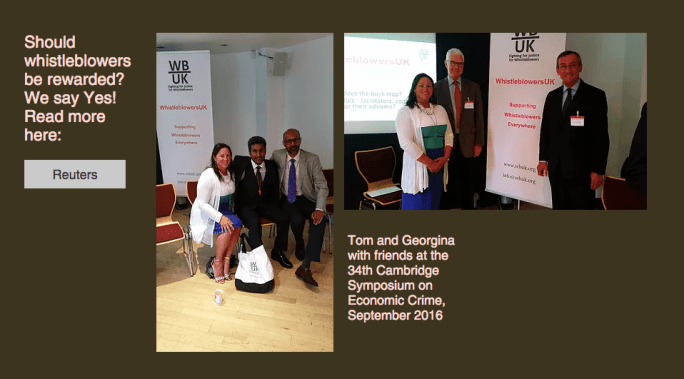
Yesterday, I observed most of a webinar by WhistleblowersUK and the Whistleblowing APPG yesterday, bar the first twenty minutes which I had to miss due to a clashing commitment. The speakers were Rory Field barrister with a specialism in organised crime and who has spoken on organised economic crime, standing in for Iain Mitchell barrister, Richard Pike of Constantine Cannon, Susan Kramer former Whistleblowing APPG Chair but still active pro-bounty politician, Folashade Adeyemo Lecturer in Banking and Company Law Reading University and a specialist in Nigerian banking regulations, a whistleblower whose full name I did not catch and Georgina Halford Hall CEO WhistleblowersUK.
The theme of the event was “restitution”.
In reality, this proved to be about financial incentivisation.
Richard Pike of US bounty hunting law firm Constantine Cannon explained the US model of bounty hunting to the audience.
He took a similar approach to that of his colleague Mary Inman in 2018 at the Bylines festival, explaining that the concept came from the “mother country”, England, when ancient custom was to take action in the name of the King, qui tam.
Pike argued that a prime benefit of bounties was to ensure legal representation for whistleblowers, because if lawyers knew that they could get a large pay out, they would be more willing to work contingently (or in plain English, on a no win, no fee basis).
Importantly, Pike did not explain to the audience the vagaries of the bounty system and the minimum financial recovery thresholds that whistleblowers have to fulfil to qualify for a reward, which in reality means that only a tiny minority are rewarded.
This leaves many genuine whistleblowers with no redress. It is possible under the US bounty system to be a bona fide whistleblower who suffers severe reprisal, who loses their livelihood and suffers longterm economic insecurity, but be left with zero redress.
Despite this reality, Pike described the model as “phenomenally successful”. This is possibly more of a comment from the point of view of the bounty hunting industry, and to an extent, the State.
Pike stated that the model is designed to recover money for the State, and indicated that it is therefore a problem when whistleblowers raise concerns about the State itself. His commented that federal whistleblowers might find themselves in prison.
He did not inform the audience of the existence of the the US Office of Special Counsel which looks after federal whistleblowers, who whistleblow about the State. This agency would be of less interest to bounty hunting law firms because it does not financially incentivise whistleblowing and operates a lean public sector model of restitution. It restores whistleblowers to the position that they would have occupied but for the whistleblowing, and no more, and it can ensure non-financial redress.
The whistleblower on the WhistleblowersUK panel suggested that bounties could perhaps be capped.
This reminded me of a past quote from Mary Inman who upon discovering Brits’ “visceral” dislike of the idea of paying whistleblowers, suggested that the bounty model could be made more culturally acceptable by capping rewards:
“she thinks the UK could create a culturally appropriate scheme which caps any rewards.”
And will this proffer of capped rewards survive the implied intention to pursue large and eye-catching bounties, mentioned in the above joint document published only last month by WhistleblowersUK, Constantine Cannon, and Kohn, Kohn and Colapinto LLP?
Alongside Pike, Folashade Adeyemo also spoke about restitution and by this she appeared to mean financial reward. She also used the words “recognition” and “acknowledgment”.
Mostly, Adeyemo’s contribution consisted of different ways of talking about financial transaction. For example:
“Compensation, not payment for informing, but recognising the value of that information”.
There was no clear discussion of non-financial redress.
Susan Kramer former APPG chair, who employs WhistleblowersUK’s CEO as a researcher at the House of Lords spoke on how the APPG and she have garnered interest from members of parliament. She anticipated that the Bill would fall again but made it clear that the campaign would continue.
Of note, Kramer appeared not to be familiar with the details of her own Bill and initially stated that people could have their claims dealt with by either the proposed Office of the Whistleblower, or by the Employment Tribunal if they preferred.
This would actually not be possible under Kramer’s private member’s Bill, which repeals PIDA and provides no alternative path to litigate whistleblowing cases in the Employment Tribunal.
Georgina Halford Hall WhistleblowersUK CEO stepped in to state that the whistleblowing element would be dealt with by the proposed Office of the Whistleblower but other heads of claim such as discrimination would need to be presented to the Employment Tribunal.
An important question from the audience about public sector employees did not receive a satisfactory answer. The panel was asked how their Bill would benefit public sector whistleblowers and if public servants would effectively be paid for information.
Underlying this question is the issue of the Nolan principle of selflessness in UK public life, drawn up after repeated sleaze scandals during the Major premiership.
Either panel members did not appreciate that or did not wish to address it, because the response did not address this principle.
Folashade Adeyemo instead replied:
“Why do we need to incentivise? Valuable information that will save lives, by our very nature as humans, if there’s no incentive, people won’t come forward”
Georgina Halford Hall pushed the boundaries furthest by arguing for the legitimacy of rewarding information from wrongdoers, like convicted fraudster Bradley Birkenfeld who received $104 million in bounties for informing on his co-offenders.
All the talk I heard was about recovering money from frauds and SEC’s 10 to 30% bounties from recovered money.
I heard almost nothing about protecting the public from harmful health and social care, excepting a very few broad comments about saving lives, with no particularisation.
My impression was that the APPG and WhistleblowersUK wish to throw as many nice words as they can at the concept of monetising information and bounty hunting.
As in the words of WhistleblowersUK, Constantine Cannon, and Kohn, Kohn and Colapinto LLP :
“The real sticking point remains the idea of rewarding people for doing the right thing. The UK remains publicly queasy when it hears the word “reward” in the same sentence as “whistleblowing”. However, when we change “reward” to “compensate” or “restitution” attitudes change. No one can dispute the importance of fairness and that whistleblowers should not suffer for doing the right thing.”
So when you hear “restitution”, do not forget that the Whistleblowing APPG, WhistleblowersUK and the substantial corporate power behind them, are talking about financial rewards and the billion dollar bounty hunting industry led by lawyers.
Any financial reward that exceeds fair compensation for loss, and is calculated on a percentage is still bounty, capped or not.
RELATED ITEMS
The Whistleblowing Hunger Games: Why we should reject the Whistleblowing APPG

 Alexander's Excavations
Great article Minh. Very high quality as usual. Keep it up! Thank you for your efforts which I’m sure all WBs will appreciate.
David
Sent from my iPhone
LikeLike
I received help from Constantine Cannon to make a claim under US law about tax malpractice by my then UK employer who exported to the US, which resulted in me receiving a financial reward as a whistleblower under the US scheme.
However, when I wanted help from WBUK with an NHS whistleblowing matter, in a previous capacity as a low paid employee, they were not interested and in my opinion treated me badly.
I do not believe they really want to help whistleblowers, protect the public or see justice done, so much as to seek out cases that might pay a large bounty.
They will also most likely ignore low paid workers, including even serious cases, if they are not lucrative.
I warn all those genuinely interested in the public interest not to be taken in by their PR.
LikeLike
Another excellent post Dr. Alexander.
Thank you for drawing attention concerning the significant risks that predatory legal firms pose to undermining the “love of justice” that, I believe, motivates most Whistleblowers. Monetising justice in the interest of fat cat lawyers – bounty hunters – above the public interest is to me totally repugnant. Especially, in relation to matters of public safety, health and justice.
James B. Rostas
Independent Citizen Advocate
Queensland Australia.
LikeLike