Dr Minh Alexander retired consultant psychiatrist 1 June 2023
This is a brief post to share information about a disturbing failure by the Care Quality Commission to prosecute a private provider for egregious care failures. These failures led to an exquisitely vulnerable patient’s death, in a governance context of a regulatory revolving door.
Sally Lewis had a learning disability and lived in sheltered accommodation run by the company Dimensions UK.
Sally Lewis died avoidably from constipation on 27 October 2017, a known risk in her case, because of a failure to follow a care plan to monitor her bowel function and to administer vital laxative medication. It was a very painful death, with sections of her bowel found to be necrotic (dead) at post mortem.
There were many opportunities to stop this deterioration, as her family repeatedly raised concerns with staff about a deterioration in Sally’s overall wellbeing and distension of her abdomen, but this did not prompt appropriate action.
The details of Sally’s inquest this week and reactions to it can be found via tweets by her family, a supporting inquest blog, an INQUEST briefing and media accounts such as this: Inquest finds neglect contributed to constipation death.
I concentrate here on serious questions arising from CQC’s conduct.
CQC inspection background
Sally Lewis died at a Dimensions UK facility called The Dock.
A 2014 CQC inspection report gives the usual cursory, superficial account of the care one expects from CQC social care reports.
Laughably, as evidence of user choice, the CQC report produces the example:
“We heard a person being offered choice at mealtime. One staff said: “Would you like cheese or ham?””
As evidence of respect, CQC quoted what staff claimed they did:
“Staff told us how they demonstrated respect for people they were caring for. Staff said: “I knock on the doors”
CQC connection at Dimensions UK
Unattractive aspects of the CQC in recent years include the way in which some of its most senior officers have walked through the revolving door to highly lucrative jobs in the private sector, and links between the regulator and the regulated.
Months after retiring from CQC, David Behan CQC’s former CEO took up a job at the care home giant HCOne, and started arguing in parliament that people should pay a tax for their future care home care:
Workers ‘should be forced to have pay docked to pay for care in old age’ November 2018
Even more outrageously, he was appointed by Dido Harding onto NHS England’s board despite his position on HCOne’s board, which one would have imagined created direct conflicts of interest. He also became Chair of Health Education England, raising similar concerns about conflicts.
Mike Richards former CQC Chief Inspector of Hospitals shortly after retirement walked into similar posts in the private sector but was also welcomed as a NED onto the board of the Department of Health.
Dimension UK’s annual report 2021/22 shows a turnover of over £200 million and places Dodgson’s remuneration in the pay band £180,000 to £189,999.
Was there any regulatory capture in the period following Sally Lewis’ death that affected CQC’s objectivity?
The CQC failure to prosecute for Sally Lewis death
CQC has the following legal time limits for bringing a prosecution for serious care failures:
“The CQC may bring a prosecution within a period of 12 months from the date on which sufficient evidence to warrant the prosecution came to their knowledge. However, this is limited to no more than 3 years after the commission of the relevant offence.”
From the MoU between the CQC and the NPCC:
“Under section 90(2) HSCA 2008 where CQC are investigating criminal offences into
specific incidents under Regulation 22(2), 12, 13 or 14 RAR 2014, the statutory time-limits require that CQC prosecutions must be commenced within twelve months of the date at which sufficient evidence in the opinion of the prosecutor to justify a prosecution came to the prosecutor’s knowledge. Additionally, no prosecution can be brought where information is laid more than 3 years after the commission of the offence.”
CQC informed the BBC that it attempted to prosecute but the case was thrown out because the judge concluded that the CQC had erred in calculating dates.
CQC did not seek to prosecute Dimensions UK until 2020.
Why did it take almost three years to prosecute such obvious and serious care failings, and where the link between the care failings and death were so clear?
Surely the risk to a prosecution of delaying until 2020 should have been obvious?
Rachael Dodgson’s apology
The coroner found neglect, a very serious outcome for Dimensions UK.
The company, via Counsel, reportedly tried to argue even at inquest that constipation was not a well known side effect of Sally’s medication regime of anti-psychotics (it was).
After the coroner ruled, Dodgson issued a most objectionable apology, woven with mulitple threads of organisational self-justification.
She failed to properly apologise for the fact that a vulnerable person died slowly in front of her organisation’s eyes despite frantic warnings by the family, by adding qualifications, casting blame on Sally’s behaviour, not fully acknowledging the scale of failure and importantly, not showing enough empathy or even reportedly making a personal apology to the family.
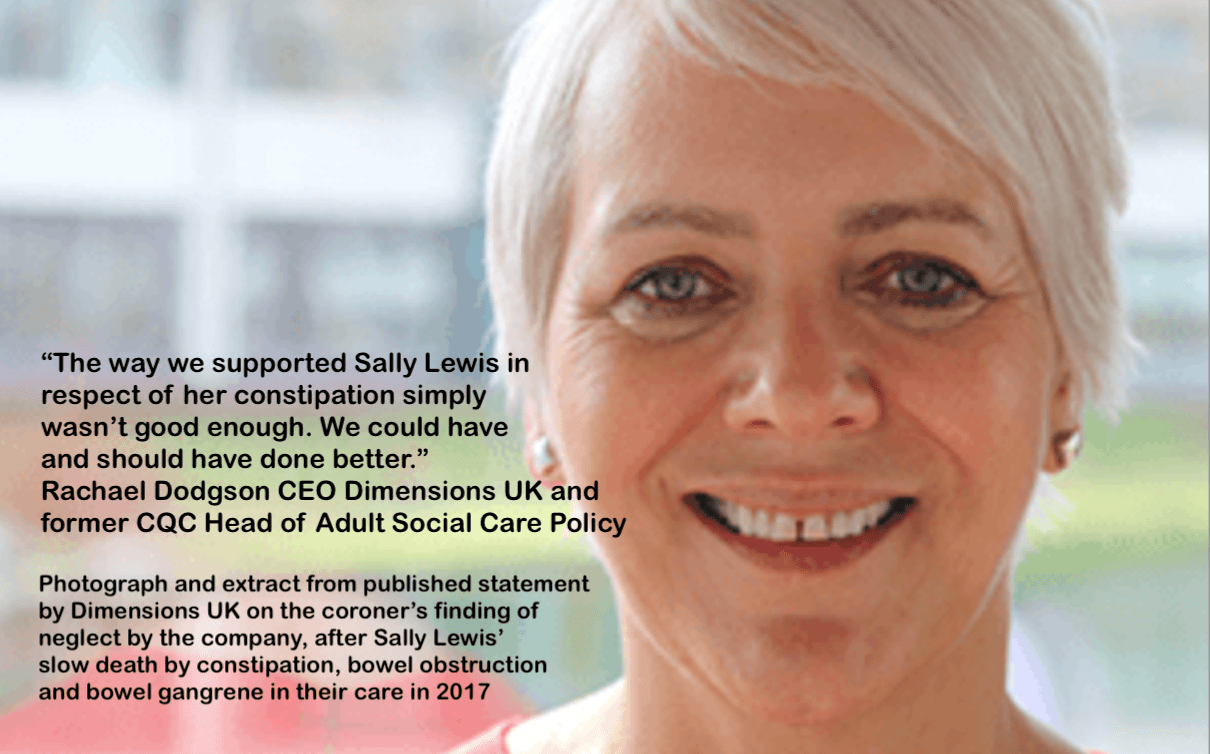
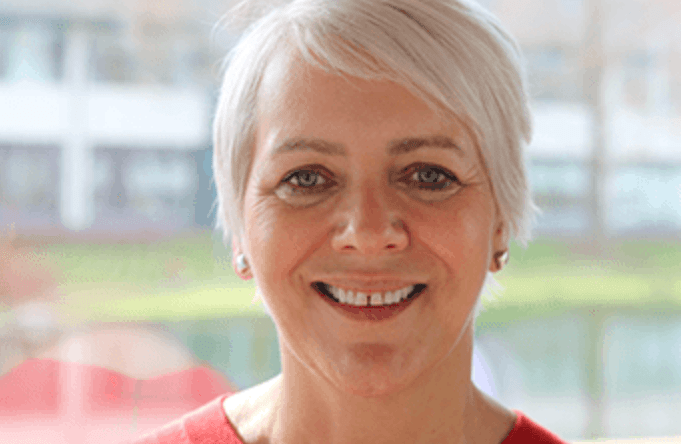
The apology was insensitively illustrated with this smiling image:
It was reportedly not even made personally to the family:
“As for suggesting you’d like to apologise to Sally’s family, if you really wanted to do that, you need to do it in person, to them, if they want to hear from you, not to the media. This is an almost carbon copy of how Southern Health behaved at the end of Connor Sparrowhawk’s inquest…”
But cutting through the distasteful corporatisation of an apology, there was some tacit if reluctant admission of the enormity of the failure: Dimensions UK admitted that serious harm from constipation is a Never Event. Although one would need to see their operationalised details to be sure that this is translated into future action.
This is the regrettable apology by Dodgson, which only makes the questions about the CQC reverberate even more loudly:
“Our response following the inquest into the death of Sally Lewis
“The way we supported Sally Lewis in respect of her constipation simply wasn’t good enough. We could and should have done better. For that I am truly sorry and would like to apologise again to Sally’s family.
Our last CEO previously set out what had gone wrong, based upon our understanding at the time. The inquest has undertaken a deeper examination of the circumstances surrounding Sally’s death; it is clear that our processes, systems, management oversight and day-to-day support for Sally’s bowel management were not what they should have been.
That was almost six years ago and, in that time, a huge amount of organisational energy has gone into making things better. In the second half of this blog I am going to talk about what is different at Dimensions now and, just possibly, what others can learn from our experiences. But first, I want to talk about Sally, who is the most important person in all of this:
We supported Sally for 20 years. Sally was known to be at risk of constipation. Her medical records and prescriptions made that clear. And yet bowel monitoring was not done consistently and robustly. Yes, there were some ticks put into some boxes but not routinely, and whilst our colleagues verbally discussed Sally’s bowel movements between them, that wasn’t enough to make sure they, or Dimensions’ management, understood what was happening. We did not make our expectations to colleagues sufficiently clear in terms of recording. Furthermore, our systems and processes to check the quality of records and support weren’t delivered effectively. And this meant that nobody put all the pieces together. When Sally died, no-one around her realised she was constipated. And as a result, she hadn’t been receiving her PRN (“as needed”) medicine.
From the start we have said that one of the key issues here is how to balance individual dignity, privacy and rights with safety. Sally found it difficult for people to accompany her to the bathroom and this could trigger significant behaviours of distress for her. This meant that we couldn’t monitor how often she opened her bowels and the consistency, size and shape of her faeces. That issue stands but the key issue here was our acceptance of this. We should have raised this as a risk with her GP, the care manager, her family and with all those around her so we could work together to identify a way forward. I don’t think we did enough to help Sally herself understand why it was so important to be accompanied to the loo. And I don’t think we did enough to ensure our colleagues supporting her understood clearly the risks associated with long term constipation. I would like to turn to what is different at Dimensions now. Sally’s death has had a profound effect upon our organisation, and we didn’t wait for the inquest to identify the lessons we needed to learn, although following the Coroner’s findings we will reflect and consider carefully if there is any more we can do. We acted swiftly to make the necessary changes. We now have mandatory training for everyone supporting a person at known risk of constipation. We have a Bowel Toolkit which includes bowel management plans, improved bowel recording charts, a constipation screening and referral tool, guidance on how to prepare for a constipation appointment and more. It is an organisational requirement that all people we support are regularly screened for constipation and bowel health. Specialist advice is available from our Health and Wellbeing Lead.
Our electronic daily records system which is now fully embedded means it is much easier for managers to scrutinise all records relating to the people we support. And families also have access to these electronic records at any time from their own homes. There are, simply, many more pairs of eyes able to see what is going on. And we know that partnership working with families and loved ones results in better outcomes for the people we support.
Constipation is now one of seven ‘Never Events’ at Dimensions. Never events are a well-known concept in the NHS. Quite simply it means that, with the right training, behaviours, systems and processes, an incident that carries a potential risk of harm, injury or death should never happen. Specifically, at Dimensions, we say that “No one should suffer any harm as a result of a failure to administer or monitor the medication prescribed, or to follow established processes, for the relief or avoidance of constipation.” And we work to provide the right training and processes, and ensure the right behaviours, accordingly.
Our CQC registrations, previously held at Operations Director level, are now held by Locality Managers across our organisation to ensure that those directly responsible for the oversight of delivery of individual care and support are closer to the people we support. That’s a critical change; if any providers reading this have yet to make a similar change, I urge them to do so.
We have also undertaken a great deal of work externally to raise awareness of the risks and issues surrounding constipation for people with learning disabilities, to enable us and others to do everything possible to keep people at risk of constipation safe and well:
We produced an animation for our colleagues which has been used by the NHS, and this accessible book, funded by Dimensions and co-produced with Beyond Words.
Many colleagues have also devised extraordinarily creative ways of delivering what we continue to believe is a very important message, and one that we will continue to deliver. Sally’s inquest is an incredibly sad but important and timely reminder that we must always make sure support plans are clear, followed by our colleagues in how they support people, and that checks take place to ensure all those things are happening, whether that’s in relation to people’s bowels or any other areas of support.
I will end this by simply saying, to Sally’s family, I’m truly sorry. Nothing can bring Sally back but I’m determined that we will continue to do all we can to minimise the risk of this ever happening to anyone else.”
Rachael Dodgson, Chief Executive, Dimensions”
Sally Lewis’ family had no highly paid corporate lawyers or publicists.
They fought for an inquest and the truth of a loved one’s death on private means, and also endured the extra years of limbo caused by CQC’s scandalously late and unsuccessful prosecution.
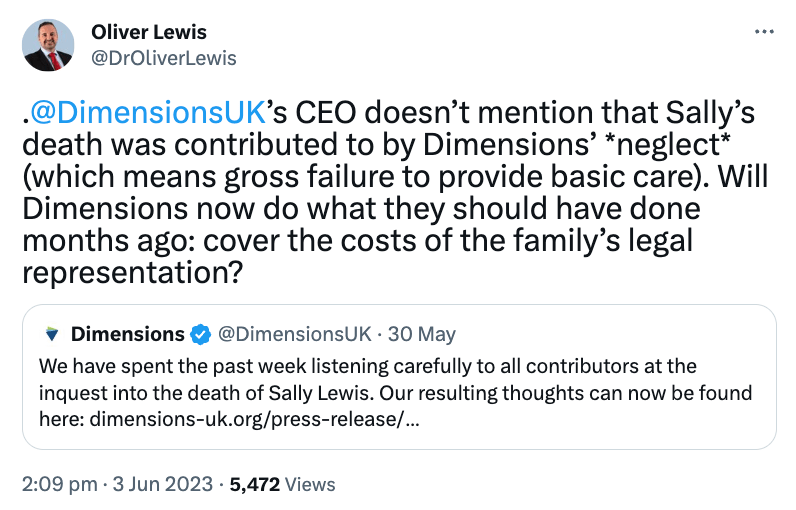
They have a crowdfunding appeal for help with inquest costs:
UPDATE 6 JUNE 2023
I have asked the CQC for information under FOIA regarding its response to Sally Lewis’ death, multi-agency warnings about Safeguarding failure and its failure to mount a time prosecution. I have also asked whether in the light of Sally Lewis’ case and others, CQC should audit its application of Regulation 12 and I have sent a copy of the questions to the parliamentary Health and Social Care Committee, with a request that the committee consider CQC’s application of its responsibilities under CQC Regulation 12 at the next CQC accountability hearing.
FOI correspondence to CQC and letter to Health and Social Care Committee 1 June 2023
UPDATE 8 JUNE 2023
Dimensions UK have removed the grinning photograph of Rachael Dodgson from their “apology” webpage.

 Alexander's Excavations
Thank you for reporting on this extraordinarily sad story. RIP the victim, Sally Lewis, processed to death within a system that failed at every opportunity.
Inevitably, reading through this scandal, I do ponder if the CQC’s inadequate response was, at some level, deliberate.
Had they have done what they could have done, what the public, and certainly the victim’s family would wish, they would have drawn attention to the huge gap between what should have happened and what did happen. And that may have led to questions that no one within our bureaucracies would wish to answer.
I also think that, taking its lead from our politicians who are only interested in the productive who can contribute financially to the nation’s coffers, the death of the fragile is, to say the least, of low priority.
Btw, regarding the thoughtless holiday snap appended to the Dimensions UK statement. In future, if they can’t offer a dignified portrait, perhaps a pastoral scene would be less jarring. On the other hand, perhaps the vulgar nature of the pic does indeed represent everything that Dimensions UK stands for.
LikeLike