By Dr Minh Alexander retired consultant psychiatrist 14 March 2026
Summary: This is a brief post to share a Prevention of Future Deaths report issued by the East London coroner on 5 March 2026 which identified serious, multiple failings by two NHS mental health trusts which contributed to the fatal stabbing by a patient of his mother. The trusts were North East London NHS Foundation Trust (NELFT) and East London NHS Foundation Trust (ELFT). The failings echo many previous failings in other mental health homicides. They once again suggest a lack of system learning. Moreover, the day after the coroner issued the PFD report, a murder investigation was announced into another attack by an ELFT patient on 28 February 2026.
The case:
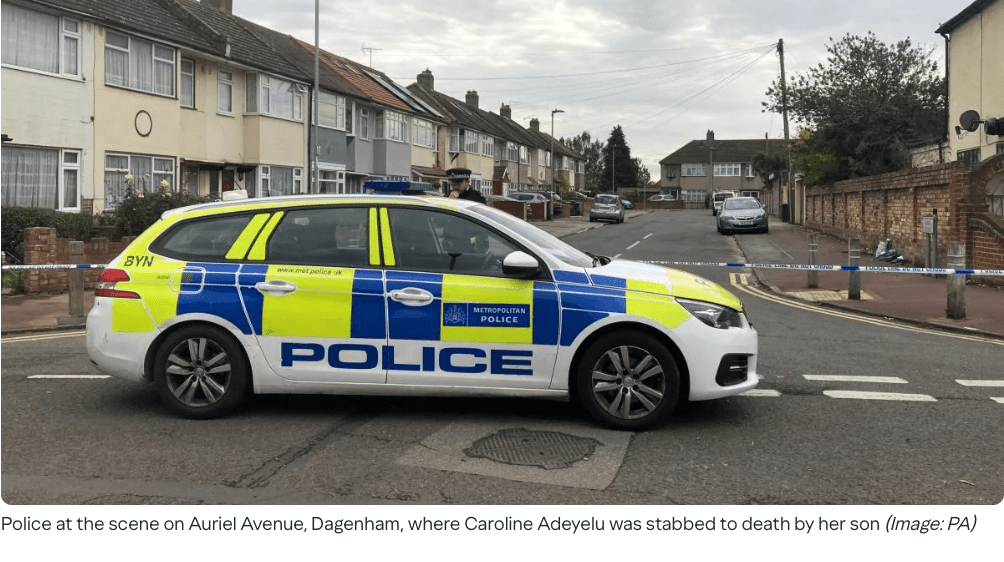
Nicholas Aina aged 31 was reported to have stabbed his mother Caroline Adeyelu aged 64 at their home in Dagenham in October 2022. He also injured his 23 year old sister, repeatedly stabbing her.
Caroline Adeyelu reportedly died protecting her daughter, and taking the brunt of the patient’s attack.
Woman stabbed to death by mentally ill son after failures by NHS trusts
The coroner’s PFD report states that at the time of killing, Nicholas Aina had been discharged from hospital with a diagnosis of “acute transient psychosis”.
But by the time his case was disposed at the Old Bailey in August 2023, it was acknowledged that he had a serious and enduring psychotic illness – paranoid schizophrenia, which required lengthy and possibly indefinite care in hospital.
Dagenham stabbing: Man suffering delusions detained for killing mother
Failures to recognise and manage risk can arise in part from situations where the differential diagnosis is wrongly or prematurely and firmly restricted to transient conditions, such as “drug induced psychosis” or “transient psychotic disorder”. This may lead to services not being sufficiently alert to severe illness or robustly monitoring for later relapses and deterioration.
This is the coroner’s report on Caroline Adeyelu’s killing:
Prevention of Future Deaths report on Caroline Adeyelu Ref. 2026-0129, 5 March 2026
The inquest jury identified a long list of serious risk management, care planning/ coordination and information sharing failures, which have featured in many NHS mental homicides since the Christophere Clunis inquiry panel reported in 1994.
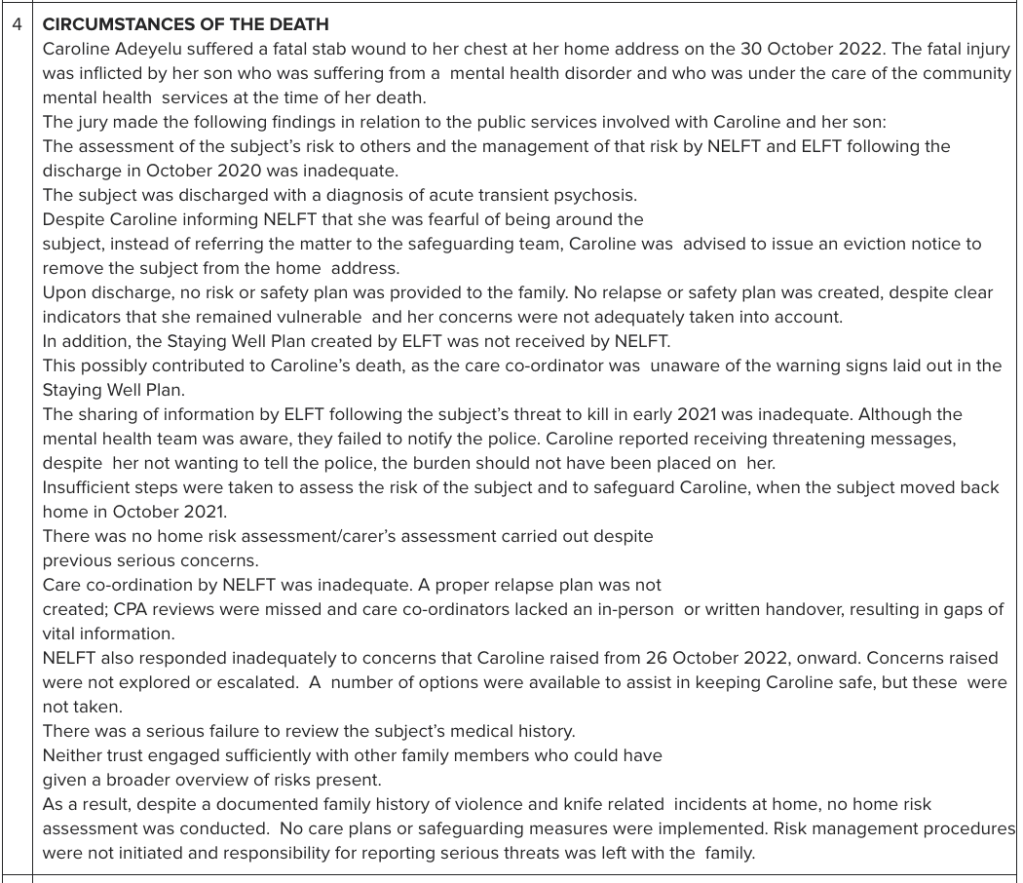
The coroner noted engagement with the coronial process by NELFT and ELFT but considered there was still sufficient concern to warrant the issue of a PFD warning.
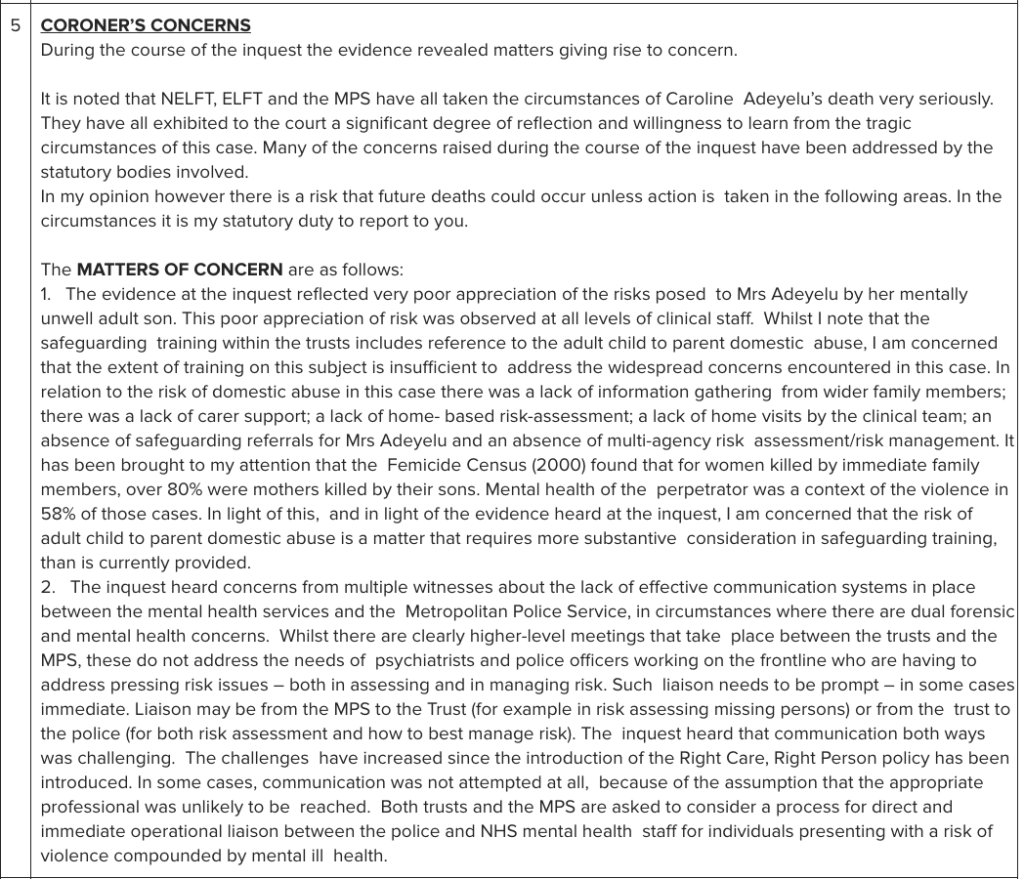
Poor recognition of risk, poor support of and protection for the family and poor communication with the family and between professionals were of particular concern to the coroner:
Similar failures are being enumerated at the statutory Nottingham Inquiry which opened on the 23 February 2026 into killings and serious injuries inflicted by the patient Valdo Calocane.
| Links to information on Nottingham Inquiry The Inquiry Chair and Counsel to the inquiry’s opening statements on 23 February 2026 can be found here. The evidence gathered so far by the Inquiry can be found here. |
The day after the Coroner issued the PFD on Caroline Adeyelu’s killing, the Metropolitan police announced that it was opening a murder investigation into the death of a patient who had been attacked by another patient at a “mental health facility” in Bancroft Road, Mile End.
Patient, 29, dies one week after attack at Mile End mental health facility
I asked ELFT to confirm if this facility was its Tower Hamlets Centre for Mental Health, at Mile End Hospital, and ELFT confirmed that it was.
Previous FOI work by the charity HundredFamilies which supports the families of victims of mental health homicides revealed that the NHS seems to be undercounting the number of MH homicides.
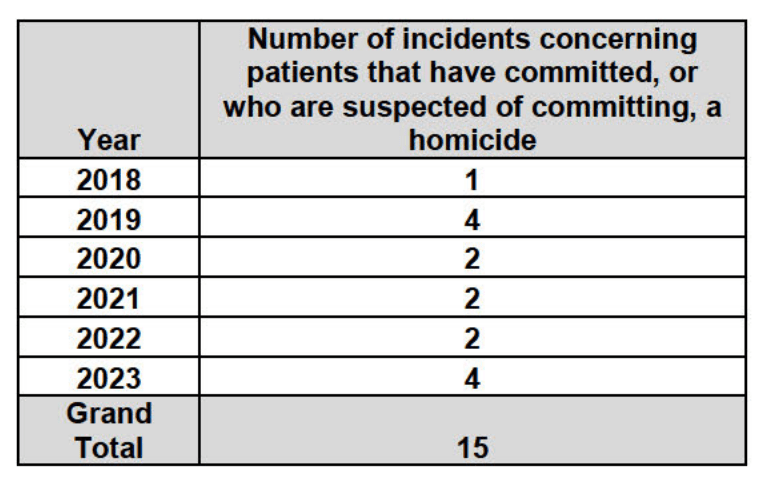
An FOI response published by ELFT on this matter shows the number of suspected and actual homicides for the period 2018-2023.
ELFT is currently rated “Outstanding” by the Care Quality Commission.
Lastly, there is a great danger that mental health patients who commit homicides are “monsterised”.
This has already happened in the case of Valdo Calocane.
But the killing of family members, as in the death of Caroline Adeleyu, raises hugely sensitive and complicated issues that swirl around these horrible events. The aftermath is unimaginably painful for survivors, including for some perpetrators. There are many different paths that families may follow.
And many mental health homicides are as much service failures of patient Safeguarding as they are of family Safeguarding and public protection. Allowing patients to deteriorate grievously and in some cases repeatedly, may accrue disability and damage long term prognosis and the degree of recovery possible from serious mental illness.
RELATED ITEMS
A common theme in mental health homicides is the ill-advised discharge of destabilising, disengaging patients who should in fact be assertively outreached.
This was a relevant factor in the Valdo Calocane attacks.
A member of the public very helpfully submitted a batch FOI on the What Do They Know website which yielded relevant data for the period April 2019 to March 2024. This covers the material period in which Valdo Calocane was discharged by Nottinghamshire Healthcare NHS Foundation Trust for missing appointments, and went on to kill and seriously injure the public.
Nottinghamshire Healthcare discharged thousands of other patients for disengagement, as did other mental health trusts.
I processed this FOI data and shared it in a previous post:
Nottingham and the risky business of discharging mental health patients who don’t engage. Some data.

 Alexander's Excavations