
Dr Minh Alexander retired consultant psychiatrist 12 January 2026
The House of Lords Appointments Commission (HOLAC) is responsible for vetting political parties’ nominees for life peerages:
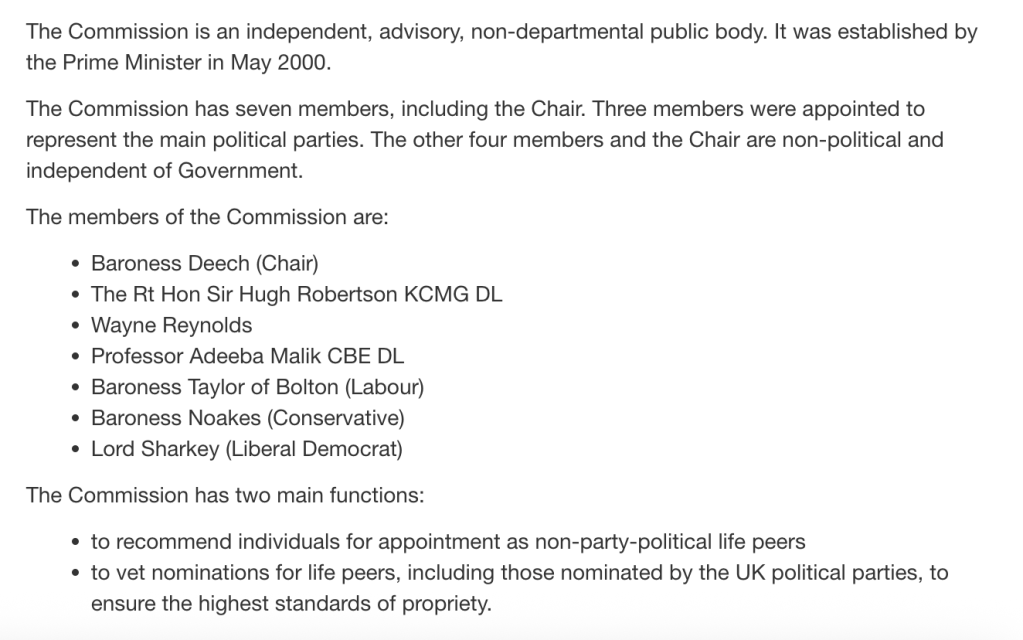
HOLAC’s efficiency was seriously called into question recently when the Sunday Times reported that one of Keir Starmer’s nominees for the House of Lords had admitted to falsely claiming to hold a PhD and an MA “with distinction” that she did not have.
She had donated £50,000 to the Labour party.
Accordingly, I asked HOLAC if it routinely checks nominees’ qualifications, or had arrangements for third parties to do so.
I also asked that if not, whether this would be corrected, and whether there would be any retrospective review to assess whether there were past cases where qualifications had not been checked. I also asked for documented reasons if there had been a decision not to undertake such a retrospective review.
The reply to my FOI request was that it would not be in the public interest to disclose how nominees’ qualifications are checked, with the following convoluted argument:
“The information that you have requested in question 1 falls within section 37(1)(b) of the Freedom of Information Act, which relates to the conferral of honours and dignities. A peerage is a dignity for the purposes of the Act. Section 37 is a qualified exemption which is subject to a public interest test. In favour of disclosing information, there is a strong public interest in knowing that the appointments process is accountable and transparent, and in maintaining public confidence in the peerage appointments system. In favour of maintaining the exemption, there is a strong public interest in limiting the level of detail about exactly what checks are carried out by the Commission, to ensure individuals are not able to tailor the information they provide once nominated. It would set a dangerous precedent to start providing precise detail of the checks conducted, which could allow individuals to selectively decide what information might be presented to both the Commission and the nominating Party.
Taking all of the relevant factors into consideration, including the fact that the Commission already places a great deal of information about its working practices and the checks it carries out in the public domain to reassure the public that these are sufficiently rigorous, I consider that the balance of the public interest lies in maintaining the section 37(1)(b) exemption in respect to confirming whether the Commission verifies individuals’ qualifications.”
I think this response would probably make even Sir Humphrey blush.
The rest of the world presents a curriculum vitae to prospective employers, which is checked, and educational qualifications are duly verified with the relevant institutions.
Straightforward, no?
But it seems that the arcane HOLAC is concerned that letting us know about its procedure for verifying qualifications will somehow give nominees some nebulous, nefarious advantage.
Or maybe they simply have no checking procedure and are too mortified, as very important individuals, to admit this to impertinent plebs.
Perhaps very important people are content to accept recommendations from other very important people. PLU to PLU.
With respect to the rest of the FOI request, it is maintained that:
“I have established that HOLAC does not hold any information in scope of questions 2,3 and 4 of your request”.
That is to say, there is no intention to correct any possible omission in HOLAC’s verification procedure nor to retrospectively review for any other naughty peers with non-existent qualifications. And there is no written record of the latter decision not to review.
All told, a very unsatisfactory and unaccountable position after such a major scandal.
This is the full FOI response:
This serf will now withdraw to her wattle and daub hut to appeal to the ICO and dispute HOLAC’s application of the public interest test.
Feudalism being what it is, the chances of success may be slim, but I was pleasantly surprised on a past occasion so we shall see.
Internal review request
Prior to appealing to the ICO, I have taken the preliminary step of requesting an internal review of the FOI response, which I have directed to Baroness Deech Chair of HOLAC:
FAO Baroness Deech
Chair House of Lords Appointments Commission
12 January 2026
Dear Baroness Deech,
Request for FOI internal review and query about governance on verification of nominees’ qualifications
I was concerned by the Sunday Times report about Ann Limb’s qualifications – or lack of – and asked for information via FOIA about HOLAC’s process, if any, for verifying nominees’ qualifications.
I received the attached FOI response which I take to mean that:
1) HOLAC does not wish to disclose the details of any verification process on grounds that it may somehow given undue advantage to nominees.
Indeed, the FOI response states: “It would set a dangerous precedent to start providing precise detail of the checks conducted, which could allow individuals to selectively decide what information might be presented to both the Commission and the nominating Party.”
I confess I do not understand this argument as past qualifications are something one possesses or does not, and that is the point of verification – to establish the truth of claimed qualifications.
What I am merely seeking is confirmation of whether or not HOLAC has within its process a means of checking that nominees have not fraudulently manufactured qualifications on their CV which they never earned. I do not see how providing confirmation of a process could prejudice the selection of nominees.
I would be very grateful if you could consider my query on this aspect to be a request for internal review under FOIA for disclosure of whether HOLAC has a procedure for verification of nominees’ qualifications, and for broad details of any procedure.
For example, does HOLAC (or a third party) routinely contact universities to establish that nominees hold the degrees that they claim to hold?
2) I further understand HOLAC does not intend to make any changes to its procedure – whatever it may be – or to retrospectively review for any cases where nominees’ qualifications may not have been verified. Also, there is no record of a decision not to retrospectively review for any cases where nominees’ qualifications may not have been verified.
If my understanding is correct, may I ask if this is the right approach in light of the seriousness of the Ann Limb matter?
HOLAC says that its purpose is to ensure the highest standards of propriety. Would not wider learning be important after such an incident?
I copy the FOI team for their information.
Many thanks
Dr Minh Alexander

 Alexander's Excavations