
Dr Minh Alexander 30 October 2023
What is MHPS?
NHS disciplinary processes are often unfair and arbitrary, with employers holding all the power. Procedural safeguards for staff are weak. There is often harsh and disproportionate discipline, with suspension applied too frequently when it is extremely harmful to health and should be used only as the last resort, for the shortest time. Reforms were advised by the National Audit Office twenty years ago, but were predictably ignored.
Doctors in the NHS are disciplined according to fig leaf procedure called Maintaining High Professional Standards in the Modern NHS (MHPS).
The procedure covers misconduct and incapability, whether due to competence or ill health.
In the process, the employer is investigator, judge, jury and executioner. There is no external scrutiny.
Even where disciplinary action is appropriate, MHPS procedure is often applied excessively harshly.
MHPS is also sometimes applied vexatiously, to unwanted doctors such as whistleblowers.
Application of MHPS in the cases of Dr Jasna Macanovic and Mr Martyn Pitman
Dr Macanovic’s whistleblowing case against Portsmouth Hospitals concluded in January 2023. She “won” comprehensively at all stages. The Employment Tribunal determined that Dr Macanovic was unfairly dismissed, expressly for whistleblowing to the General Medical Council.
Portsmouth Hospitals University NHS Trust gave “serious misconduct” – not “gross misconduct” – as the reason for dismissal.
The Tribunal rejected this and determined that Dr Macanovic did not in any way contribute to her own dismissal.
The Tribunal was refreshingly robust in pushing back against the trust’s claims that relationships had broken down irreparably as a result of Dr Macanovic’s whistleblowing.
The Tribunal determined that “It is no answer to a claim of whistleblowing to say that feelings ran so high that working relationships broke down completely…”
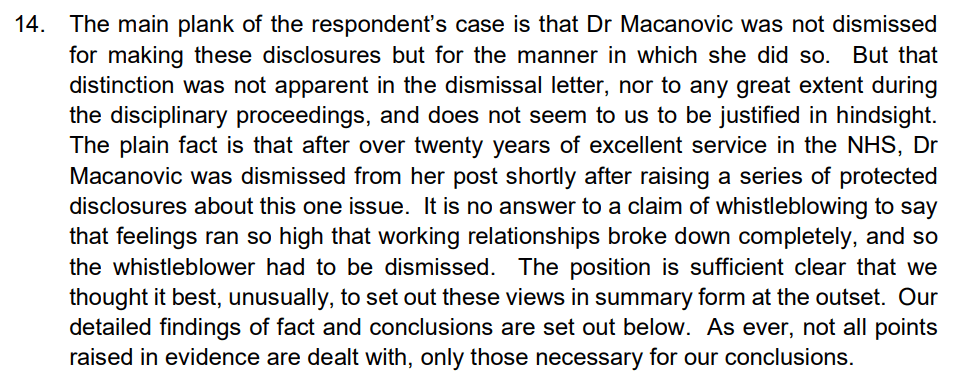
Reassuringly, the Tribunal gave serious weight to the patient safety issues raised by Dr Macanovic, and did not lose sight of them, keeping them central to its deliberations.
In the maternity safety whistleblowing case of Mr Martyn Pitman at Hampshire Hospitals NHS Foundation Trust, the trust’s purported grounds for dismissal was breakdown of relationships, with the technical route of “Some Other Substantial Reason” invoked.
SOSR is a classic method of dismissing whistleblowers where organisations are unable to make a case of misconduct or incapability.
Thousands of unwanted NHS staff in general have been wastefully dismissed via this route, in a system where the power lies almost entirely with employers.
Mr Pitman clearly made public interest disclosures, which the Employment Tribunal has recognised.
He suffered greatly and became very ill after prolonged suspension under MHPS.
He has two claims in the ET, one for whistleblowing detriment upon which the Tribunal has ruled, and a hearing scheduled for a claim of unfair dismissal.
The Tribunal, has concluded in Mr Pitman’s from the first hearing of his case that the harm which he suffered did not comprise detriment for whistleblowing.
It is relevant to note that regardless of the disputed issue about whistleblowing detriment, there was an NHS human resources “never event” in Mr Pitman’s case, as defined by NHS England guidance of May 2019:
“Where a person who is the subject of an investigation or disciplinary procedure suffers any form of serious harm, whether physical or mental, this should be treated as a ‘never event’ which therefore is the subject of an immediate independent investigation commissioned and received by the board. Further, prompt action should be taken in response to the identified harm and its causes.”
In contrast with the Tribunal in Dr Macanovic’s case, the Tribunal in Mr Pitman’s case gave more weight to his employer’s claims about his communication style than his patient safety concerns. It has reportedly accepted that his alleged communication style was the reason for the trust’s action against him, not his whistleblowing.
This is despite the trust’s failure to fully address Mr Pitman’s patient safety concerns and his concerns about reprisal for whistleblowing. Usually, Tribunals will take such failures into account, against employers, when ruling on whistleblowing cases.
The judgment is not yet published, and Mr Pitman and his advisors have yet to decide on next steps.
MHPS governance at Hampshire Hospitals NHS Foundation Trust
In the context of claims and counter claims about Mr Pitman’s case, I asked Hampshire about its governance of MHPS process.
I was especially concerned by the very long period for which Mr Pitman was excluded, two years.
In my view, this is was very bad practice. Suspension is an extremely harmful event, with serious risk to employees’ physical and mental health. It should be considered and managed as a human resources emergency, applied sparingly and for the shortest period possible. Long periods of suspension raise questions of punitive motives by employers. They are also very wasteful.
Hampshire Hospitals NHS Foundation Trust has responded evasively to my FOI request. This is the trust’s response:
FOI response by Hampshire Hospitals NHS Foundation Trust on MHPS Ref 23-24 342
The trust admits to fewer than five instances of MHPS being applied in the last five years. According to the trust, all MHPS cases in this period were upheld. The trust refused to give the range in the length of suspensions, claiming that this was due to small numbers. This raises questions about whether other doctors besides Mr Pitman may have suffered prolonged suspensions.
In the last five years, three Hampshire Hospitals NHS Foundation Trust board members have assumed the critical role of “MHPS designated board member”:
- Clancy Murphy – Non-Executive Director
- Jane Tabor – Non-Executive Director
- Dr Simon Holmes Non-Executive Director
MHPS designated board members have responsibility for overseeing the MHPS process, to broadly ensure fair play, to be a point of contact to whom suspended doctors can bring issues and in particular to ensure that MHPS process is timely and in accord with Article 6, the right to a fair trial.
Designated board members should not – in theory – allow organisations to punish doctors by keeping them in “MHPS jail” longer than is necessary.
At Hampshire, Jane Tabor trust NED was involved in Martyn Pitman’s case. A preliminary judgment notes that Mr Pitman raised concerns with her and with the trust Chair about his treatment, in an email of 26 February 2021:
“I would welcome the opportunity to meet with you virtually to feedback my experiences and reflections over the last 2 years, having been subjected to a Trust Disciplinary Investigation throughout this protracted time period. I also have recommendations that I wish to make that are relevant both to the Trust’s handling of my but also I believe, are potentially critical for the future health and wellbeing of every member of the HHFT workforce.”
The trust denied that this expression of concern was whistleblowing, and asked for this part of Mr Pitman’s claim to be struck out, but the judge wished to hear more detailed argument on the issue.
Regardless of the technicalities over the narrow legal definition of whistleblowing, it is disappointing that the trust minimised the concern raised by Mr Pitman, as it certainly falls within the NHS national whistleblowing (Freedom to Speak Up) policy.
As regards Simon Holmes acting as an MHPS designated board member, this is of concern in view of his past actions towards whistleblower Dr Jasna Macanovic. Holmes retired as medical director at Portsmouth in 2017 and later became at a NED at Hampshire.
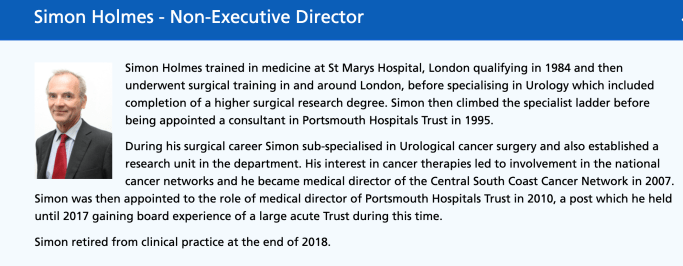
The Tribunal judgment in Dr Macanovic’s case shows that Holmes was the medical director who originally launched disciplinary action against Dr Macanovic after she whistleblew to the General Medical Council about unsafe practices by her medical colleagues. This was despite the fact that several other experienced consultants had raised similar concerns. Holmes also failed to share advisory correspondence from NCAS, the body which advises NHS trusts on the proper application of NCAS. NCAS always advises NHS organisations to disclose its correspondence to suspended doctors for fairness and transparency. Unfortunately, NCAS does not check that correspondence is shared.
I asked Hampshire if it had a process for ensuring that MHPS designated board members have no history of whistleblower reprisal, and how the trust assures itself that its MHPS processes are not in fact a form of whistleblower reprisal.
The trust’s responses were weak and evasive.
Where I asked if the trust had triggered MHPS after any doctors had made public interest disclosures, the trust replied off the point. It introduced the phrase “as a result of” and replaced “public interest disclosure” with “protected disclosure” (they are legally distinct).
Question: “Please indicate if any of the MHPS investigations in the last five years have been conducted against any doctors who had made public interest disclosures, and if so, how many?”
Trust answer: “No MHPS investigation has been triggered as a result of a member of staff making a protected disclosure.”
This trust response may hide other cases of MHPS action after whistleblowing by other doctors, besides Mr Pitman.
Hampshire Hospitals NHS Foundation Trust speciously claimed that its whistleblowing and disciplinary processes are “entirely separate”:
Question: “If so, did the trust take any special precautions to satisfy itself that the MHPS investigation(s) did not represent any form of whistle-blower detriment or reprisal?”
Trust answer: “The MHPS process and the whistleblowing/Freedom to speak up process are entirely separate processes. The Trust has never and will never use the MHPS process or any other disciplinary or investigatory process in detriment or reprisal against any member of staff who has raised concerns about the safe working of the hospital.
Hampshire Hospitals NHS Foundation Trust actively encourages its staff to raise any concerns that they may have and would never take any steps which would jeopardise this.”
It is disingenuous of the trust to claim complete separation between the MHPS process and NHS whistleblowing policy.
Firstly, NHS national whistleblowing policy at the time of Mr Pitman’s whistleblowing explicitly included zero tolerance of reprisal against whistleblowers:
“We will not tolerate the harassment or victimisation of anyone raising a concern. Nor will we tolerate any attempt to bully you into not raising any such concern. Any such behaviour is a breach of our values as an organisation and, if upheld following investigation, could result in disciplinary action.”
It follows that NHS trusts should have the means to identify and deter such harassment. This therefore links whistleblowing procedures and disciplinary procedures, which may be used vexatiously.
(NB. The clause about zero tolerance of reprisal seems to have been removed from the latest version of the NHS national whistleblowing policy.)
Secondly NCAS, now PPA, the body responsible for advising NHS trusts about the application of MHPS process has recently been consulting with NHS trusts about strengthened processes and procedural safeguards. This is to reduce the likelihood that whistleblowers are punished by organisations using MHPS vexatiously.
The trust’s defensive stance in insisting there is total separation between the two processes raises concern about its governance.
The trust also responded evasively to a question which partly related to NED Simon Holmes’ track record against a whistleblower, Dr Macanovic. The trust claimed that its processes addressed whether directors had a history of adverse behaviour towards whistleblowers:
Question: “Does the trust have any system of checks to ensure that any board member whom it appoints to act as an MHPS designated board member has no past history of detrimental behaviour to whistle blowers? If so, please give details.”
Trust answer: “All board members are subject to the Fit and Proper Person Test prior to appointment. The test considers someone’s behaviour in previous posts is to ensure that anybody seeking a board position is an appropriate person to hold the position. This would include whether any person seeking an appointment to the board has been found to have acted detrimentally towards anyone using the freedom to speak up policy.”
Indeed, the trust went on to flatly deny that any designated MHPS board members had harmed whistleblowers, despite the ET’s criticisms of disciplinary action against Dr Macanovic:
Question: “Please disclose if any MHPS designated board members appointed in the last five years have had, to the trust’s knowledge, any prior history of detrimental actions against whistle-blowers.”
Trust answer: “No member of the board has any prior history of acting detrimentally towards whistle-blowers.”
Hampshire also failed to account for whether it had evaluated the experience of trust doctors subjected to MHPS. It replied regarding only one case – likely to be Mr Pitman’s case – and it gave no evidence of wider evaluation. This is presumably because no general evaluation was done and because the trust does not concern itself with collecting data on doctors’ experience of its process.
Question: “In the last five years, has the trust undertaken any evaluation of the experience of trust doctors who have been subject to MHPS investigations? If so, please give details of how any evaluation has been conducted, and the broad outcome.”
Trust answer: “The Trust has reviewed the effectiveness of this process and its impact on an individual undergoing an investigation. We are assured that the process is robust and in compliance with all guidance in relation to safeguarding the wellbeing of individuals under investigation.”
Lastly, the trust flatly denied a concern by both Mr Pitman and the BMA which has supported him, that the trust was so opaque that an FOI request and a request for personal data had to be made in order for Mr Pitman to learn what was alleged against him.
“It has not been necessary for any member of staff to use the Freedom of Information Act to discover the nature of allegations made against them.”
Although the trust has for the meantime dodged a bullet and been given the benefit of the doubt by the Employment Tribunal, it hardly impresses on accountability and transparency. It is difficult to feel reassured that future whistleblowers will be treated fairly by Hampshire Hospitals NHS Foundation Trust.
RELATED ITEMS
Postscripts on Paula. NHS England’s apologia & regulatory reticence
Mr Tristan Reuser’s whistleblowing case: Scandalous employer and regulatory behaviour on FPPR

 Alexander's Excavations