
The conviction and imprisonment of Lucy Letby for killings at the Countess of Chester has set off a wider debate about the how the NHS is run.
A key issue is how NHS managers should be held accountable, given many scandals about failed managers evading accountability, being rewarded, and most crucially of all, being recycled repeatedly across the NHS to repeat harms.
The Labour Shadow Health and Social Care Secretary Wes Streeting has declared in favour of regulating managers.
Will this stand the test of time?
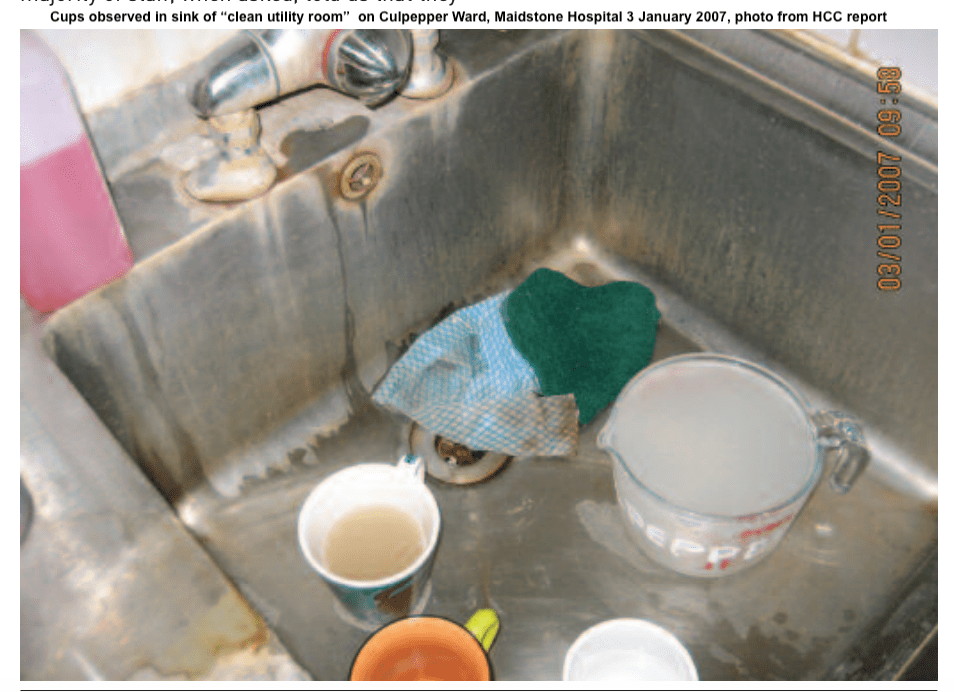
In 2007, Alan Johnson Labour Health Secretary placated the public, in response to a terrible NHS deaths scandal at Maidstone and Tunbridge Wells from poor infections control, by proposing to rid the NHS of incompetent NHS managers:
“…we need to ensure proper accountability throughout the system. In particular and as the hon. Gentleman suggests, we should be spotting these issues much earlier and getting rid of incompetent chief executives or chairpersons who, fortunately, are in the minority, rather than waiting for a report such as this, by which time, frankly, most of the damage has been done.”
This is the Healthcare Commission report on that disaster, which concluded that Clostridium difficile infections escalated without any managerial grip:
“….from October 2005 to September 2006 more than 500 patients developed the infection, and we estimate that there were approximately 60 deaths where C. difficile was definitely or probably the main cause.”
However, in 2009, Johnson appointed Cynthia Bowers the CEO of the notorious West Midlands Strategic Health Authority which was responsible for overseeing Mid Staffordshire NHS Foundation Trust, as the CEO of the newly formed Care Quality Commission.
The CQC failed, whistleblowers from care providers were ignored and CQC whistleblowers were harmed by the CQC board (later criticised by the Mid Staffs public inquiry). By 2012, Bowers and the CQC Chair Jo Williams were gone.
Perhaps he should have taken his own advice from 2007.
I have written to Wes Streeting to ask for more information about Labour’s current position on NHS managers, such as whether Labour will support full regulation, and for ALL NHS managers, so that no room for evasion is left.
I have also flagged the need to address all the other regulatory failures in the NHS, including the CQC, Labour’s legacy.
BY EMAIL
Wes Streeting MP
Shadow Health and Social Care Secretary
28 [sic] August 2023
Dear Wes,
Your comments about regulation of NHS managers under a future Labour government
The Guardian yesterday quoted you thus:
“The case for a proper system of accountability has been made again and again. Labour will introduce this in office, and make sure those found guilty of serious misconduct are disbarred.”
The Guardian also wrote:
“The party said it would consult on the details of the regulatory system once in power, including the roles it should cover, the most appropriate regulatory body, and the competencies themselves. These would include responding to whistleblowing and empowering staff to raise concerns.”
“Any system will be proportionate and supportive and aim to deliver excellent management and leadership throughout the NHS,” the party said.”
I am glad to hear that in principle you support the concept of regulation for managers. May I ask if you have any policy outline in mind yet, as this is a subject dear to many people’s hearts.
For example, do you commit to a principle that any regulation of managers should be as rigorous as that applied to clinicians, and not a diluted affair?
I ask as Amanda Pritchard NHS England CEO reportedly told the Times on 24 August 2023 she was reconsidering the possibility of NHS managerial regulation, but added that she was specifically focussing on systems for regulating teachers and bankers.
“She has told health chiefs she wants an urgent meeting next week to consider whether formal regulation is the right response to the Letby case and look at whether systems for overseeing teachers and bankers could be models to follow.” [my highlight]
Teachers and bankers
From the 2019 Kark report, my understanding of the regulation of teachers and bankers, which Amanda Pritchard proposes to possibly adopt in the NHS, is that it is not equivalent to the stringent level of regulation applied to clinical healthcare professionals. Professional regulation of clinical healthcare staff requires compliance with standards and ongoing revalidation. Instead, the regulation for teachers seems to be a reactive model that primarily responds only to reports of the most serious wrongdoing. The Teachers Regulation Agency deals only with the very most serious misconduct and reflecting this, it can only recommend permanent prohibition. This means that if this model is followed, a number of NHS managers guilty of lesser degrees of misconduct, even if repeated, would still slip the net.
Also, I see that the Financial Conduct Authority’s Fit and Proper Person test does not define what training is “applicable” for a suitable senior manager. This is a far cry from the way in which the competency of clinical healthcare professionals is strictly defined and regulated.
In his 2019 review Tom Kark recommended that the NHS should adopt a disbarment mechanism in order to expel senior NHS managers found guilty of misconduct (and to prevent them being paid any “golden goodbyes”). NHS England and the Department of Health resisted even this, until the outcry about the Letby scandal.
Importantly, Kark also recommended that if a simple disbarment arrangement proved to be insufficient, the government should proceed to full regulation of NHS managers:
“On the evidence currently available to us, we have not at this stage recommended that the HDSC [Health Directors’ Standards Council – a body proposed by Kark] becomes a full ‘regulator of directors’, accrediting training, registering and regulating directors, and operating a form of revalidation process. But we do recommend that the design of the HDSC allows for a more extensive remit should that prove necessary”.
I would very grateful to understand more about Labour’s policy position and whether you will seek full regulation as opposed to the partial models for regulating teachers and bankers that NHS England is scrabbling to offer as appeasement post Letby.
I have little confidence that NHS England left to its devices will do anything but protect the interests of power.
The lack of a level playing field between clinicians and non-registered managers is a significant part of what has fuelled managerial abuse against doctors, nurses and other frontline practitioners.
Indeed, some abusive professionally registered managers have taken themselves off register to evade accountability.
Unregulated managers have been free to enact unsafe political orders and to provide useful plausible deniability for the Department of Health by suppressing evidence of failures to resource the NHS safely and failures of bad policy. They have not been bound by a statutory professional code to put the public interest and the needs of patients first.
If NHS managers are to be regulated, why should they be regulated to a lesser degree? Real action is needed, not the semblance of action.
Also, all grades of managers should be regulated, and not just directors, giving parity with the way in which clinicians are regulated.
If you leave some managers unregulated, it is quite conceivable that more of the dirty work will simply be commissioned lower down the chain of command.
Is Labour committed to regulating ALL NHS managers?
We have already seen some profound failures of the Care Quality Commission that was established by Alan Johnson, which seems to have done everything in its power not to investigate the concerns of patients, families and whistleblowers on the spurious pretext that it does not have a remit to investigate individual “complaints”. CQC in fact has power to investigate serious incidents under CQC Regulation 12.
As a serious example, CQC has still not explained itself properly in the case of Sally Lewis, whose terrible death by neglect (as determined by the coroner) it failed to investigate for two years. There is still a need to fully understand the catastrophic systems failures at CQC which led to this appalling, mission-critical departure from its regulatory duties. The CQC has so far simply said it does not know how it happened, and refuses to disclose more information. This is just not good enough.
The CQC is hard to distinguish from the NHS which it is supposed to regulate. There is an endless revolving door between the two, and routine use of specialist inspection staff drawn from the NHS in the form of “specialist advisors” and importantly, NHS trust executives advising on CQC’s Well Led inspections as “executive reviewers”. The latter are appraising their own peers in a small community. (There are just over 200 NHS trusts). Such a lack of separation is surely very damaging to regulatory impartiality and public confidence.
The CQC has handled Regulation 5 Fit and Proper Persons (FPPR) most shockingly. It has accepted the most dubious assurance evidence from regulated bodies and it has also misrepresented this to parties who have referred directors under FPPR. For example, CQC told me that it closed down an FPPR referral on David Rosser the former CEO and medical director of University Hospitals Birmingham NHS Foundation Trust, based on an “independent” report. This turned out to be a report by a subordinate trust employee who was not even a board member, assisted by a lawyer from a firm retained by the trust. The CQC later admitted that it should not have claimed that it was an independent report.
I think based on all the evidence to date, it would be fair to ask if club culture masquerades as regulation in the NHS.
The charade has seriously failed the public and harmed patients and staff.
It is of critical importance that regulators are properly designed to be effective.
It is also of vital importance that regulators are properly overseen and that existing regulators are cleaned up.
I particularly ask you to note the recent BMA vote of no confidence in the seriously failing General Medical Council.
This is an extraordinary state of affairs and represents just how degraded our institutions have become. Moreover, the GMC admitted to me that it had only sanctioned a single medical director (Rosser) in the last five years with respect to flawed referrals to the GMC.
There is a yawning chasm of trust and probity to be repaired.
I hope to hear from you.
Yours sincerely,
Minh
Dr Minh Alexander
Retired consultant psychiatrist and NHS whistleblower
APPENDIX
These are the relevant excerpts from Tom Kark and Jane Russell’s 2019 review of the Fit and Proper Person test in the NHS, for Steve Barclay, which relate to the FCA and the TRA:
“Teaching Regulation Agency
11.30 We met with Alan Meyrick (Chief Executive Officer).
11.31 The TRA regulates the teaching profession by conducting misconduct hearings
and maintaining a database of qualified teachers.
11.32 The TRA takes action on receipt of allegations of serious misconduct pursuant to
the Teachers’ Disciplinary (England) Regulations 2012 as amended by the
Teachers’ Disciplinary (Amendment) (England) Regulations 2014. Serious
misconduct is conduct that is fundamentally incompatible with being a teacher or
could lead to the teacher being prohibited from teaching. The TRA does not
concern itself with cases of less serious misconduct, incompetence or underperformance
(which it leaves for the teacher’s employer to deal with).
11.33 An allegation of serious misconduct is heard by a three-person panel who decide
whether there has been: (1) unacceptable professional misconduct, (2) conduct
likely to bring the profession into disrepute, (3) a conviction, at any time, of a
relevant criminal offence. If the panel decides that there has been conduct falling
into any of those three categories it makes a recommendation to the Secretary of
State and a senior TRA official decides whether a prohibition order is appropriate.
A prohibition order applies for life and where an individual is prohibited, their
details will appear on the prohibited list.
11.34 In very serious cases, an interim prohibition order is imposed whilst the case is
being investigated. There is a right of appeal against a prohibition order via the
Queen’s Bench Division of the High Court pursuant to Part 52 of the Civil
Procedure Rules. Under some circumstances and after a minimum period of 2
years, the Secretary of State may allow a teacher to apply for the prohibition order
to be removed following a recommendation from another TRA panel. The test
applied by that panel is whether the individual has demonstrated “clear and
unequivocal insight into misconduct that led to prohibition and the extent to which
they can demonstrate a clear commitment to adhere to and exhibit the personal
and professional conduct elements of the Teachers Standards”.
11.35 The TRA does not have the power to impose lesser sanctions than a permanent
prohibition order save for the possibility of review after 2 years.”
Kark gave this account of Financial regulation:
“Financial Conduct Authority
11.10 We met with Richard Fox (Head of Cross-Sectoral & Funds Policy) and David
Blunt (Head of Conduct Supervision).
11.11 The FCA regulates financial firms providing services to consumers and maintains
the integrity of the UK’s financial markets. It regulates 58,000 financial services
firms and financial markets in the UK and is the prudential regulator for over
18,000 of those firms.
11.12 Under the Financial Services and Markets Act 2000 (FSMA), the FCA can prohibit
any individual from performing a ‘specified function’. In 2014 and 2015 prohibition
orders were issued to 25 and 27 individuals respectively. The kinds of behaviour
that have in the past resulted in prohibition have been: providing false or
misleading information to the FCA (including information relating to identity, ability to
work in the UK and business arrangements); failing to disclose material
considerations on application forms such as details of County Court Judgments,
criminal convictions and dismissal from employment for regulatory or criminal
breaches; serious acts of dishonesty (for example which may have resulted in
financial crime); and serious lack of competence.
11.13 The FCA applies a statutory ‘fit and proper person’ test to assess whether
individuals are suitable to perform a controlled function. When considering fitness
and propriety the FCA assesses the individual’s honesty, competence and
capability and financial soundness. For senior positions, when assessing fitness
and propriety, regard must be had to the individual’s qualifications, competence,
their personal characteristics and whether they have undergone training. The FCA
may withdraw an approval where it considers that a person is not a fit and proper
person to perform the relevant function.
11.14 Individuals must submit a detailed application to the FCA in order that their fitness
and propriety can be assessed. The application form’s fitness and propriety
section asks questions of fact requiring a ‘yes’ or ‘no’ answer about particular
actions. Some questions include the word ‘ever’, meaning that the required
answers are not restricted to a specified period.
11.15 The FCA has mandatory requirements about regulatory references which came
into force on 7 March 2017 (referred to in Chapter 8). Regulatory references must
cover the past 6 years from current or previous employers including overseas
employees. Further, matters to be disclosed include breaches of the FCA Conduct
Rules, the PRA (Prudential Regulation Authority) Conduct Rules and the Conduct
Standards and Statements of Principle and Code of Practice for Approved
Persons where such breaches resulted in disciplinary action (which is limited to
formal written warnings, suspensions as a disciplinary sanction and dismissal).”
UPDATE 16 SEPTEMBER 2023
Wes Streeting has not yet replied to the question about whether he will commit to regulating NHS managers as rigorously as clinicians are regulated.
He appeared on BBC Newsnight on 13 September 2023, when he stated that Labour would implement existing recommendations. This suggests that he is only looking to implement simple, reactive disbarment as recommended by Kark.
I have written to Streeting with evidence of serious middle management misconduct against a whistleblower and asked him to consider full regulation of ALL NHS managers, which will control training, accreditation and ongoing professional development.
My letter and Streeting’s comments to BBC Newsnight and a letter by him to the NHS Confederation and NHS Providers can be found here:
PETITION FOR REGULATION OF NHS MANAGERS
This is a Westminster petition calling for regulation of NHS managers:
https://petition.parliament.uk/petitions/642631
If the petition reaches 100,000 signatures, the government will consider a related debate in parliament.
RELATED ITEMS
Robert Francis appeared on BBC Newsnight on 11 September 2023 and supported NHS England’s claims that full regulation is not needed for NHS managers:
Francis suggested on Newsnight that NHS employers are unaware of errant managers’ histories. By doing so, he drew a veil over what is an organised system of mutual protection and recycling, which has NHS regulators at its heart. The system even has a nickname, “The Donkey Sanctuary”.
The case of Paula Vasco-Knight exemplifies the collusion running throughout the system:
Postscripts on Paula. NHS England’s apologia & regulatory reticence
Historically, Medway NHS Foundation was one of fourteen “Keogh” trusts found to have high mortality:
2013 Report out today will highlight major failings across 14 NHS hospital trusts
Letby murders: McLellan’s arse, NHS Stalinism and reported NHS management recycling at Devon ICB
Lucy Letby murders: Former Countess of Chester Non Executive Director James Wilkie

 Alexander's Excavations
The problem with NHS regulation, is that all the bodies with oversight duty, are inbred organisations with vested interests, where staff interchange roles. The patient never gets a look in and it’s nigh on impossible for their voice to be heard – until the problem is so big, hundreds of families have become involved, there is a national scandal – and the media get behind it. Without that, patients and whistleblowers, unheard, ignored, kept in the dark – and are ground into the dirt – as policy – so they give up and go away.
LikeLiked by 1 person