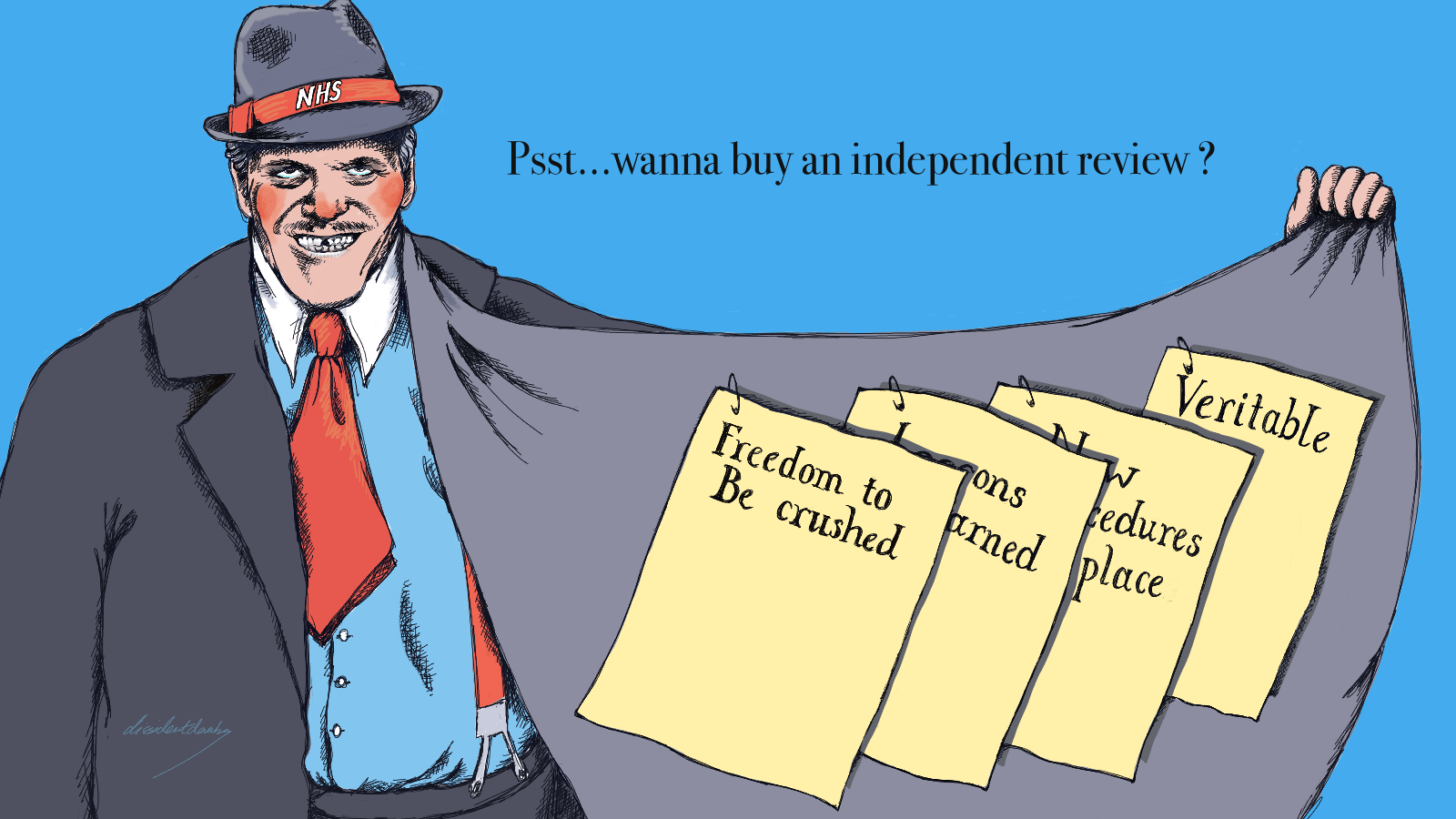
Dr Minh Alexander retired consultant psychiatrist 12 July 2023
| Summary: NHS England resisted concerns from several parties about the fact that it had appointed Marianne Griffiths former CEO of Sussex University Hospitals NHS Foundation Trust to investigate the deaths scandal at North East Ambulance Service (NEAS). It officially stood by her AFTER the police investigation into deaths at her former trust in Sussex became public in early June, stating that it was “content” with her. Her report today has been understandably dismissed by bereaved families as a whitewash. There are other concerns about the report. The credentials and suitability of Griffiths’ investigating team are not clear, especially with regards to the complex legal matters involved at NEAS. There is also still no sign of a persistently withheld report on bullying and whistleblowing governance at NEAS, only scant summary of findings of opinion without facts. As bereaved families have commented, “This is the NHS investigating the NHS”. |
NHS England’s investigation into North East Ambulance NHS trust has been published today:
It was led by Marianne Griffiths former NHS CEO despite multiple objections from bereaved families and several whistleblowers, including those who reported she failed them. I objected over a year ago, based on concerns about governance at her former trust in Sussex where she was CEO, and received the usual stonewalling from NHS England.
After fits and starts of correspondence and long silences, NHS England eventually spat out its reluctant response on 20 June 2023:
“In brief, NHS England is content with Dame Marianne Griffiths’ suitability to lead this review and expect it to conclude soon.”
This was remarkable as it came AFTER revelations about the police investigation at Griffiths’ former trust in early June.
Sussex is the subject of a police investigation into concerns about deaths which occurred on her watch, 2015-2020, and which may amount to gross negligence manslaughter.
There was nothing in NHSE’s response to address the governance issues I raised about her former trust at Sussex. Or any sign that NHSE had investigated the ongoing issues at Sussex, some of which were seeded during Griffiths’ tenure.
Importantly, NHS England confirmed in its response to me that Griffiths had received a copy of a review about bullying and poor whistleblowing governance at North East Ambulance Service, as part of her investigation into the trust.
Email from NHS England 20 June 2023:
“Hi Minh
Apologies for the delay in responding to your email. NHS England take all whistleblowing-related issues seriously and as such I have taken the time to review your concerns.
In brief, NHS England is content with Dame Marianne Griffiths’ suitability to lead this review and expect it to conclude soon.
With regards to the Stanley/Boylin report, it was shared confidentially with Dame Marianne Griffiths. NHS England does not intend to request investigation documents, nor to commence a review of the investigation contents. We await the findings of Dame Marianne’s review, and will then consider whether any action needs to be taken in response to that review.
I note you have also emailed recently about the ‘implications of governance failings at Sussex’ and I hope this response addresses the point you raise there too.
I am sorry again for the delay in responding to you. I know there is another matter I have yet to respond to you on, and will aim to do so next week.
With best wishes
Tom”
[My emphasis]
The review about bullying and whistleblowing failures at NEAS took place in 2020, and it was carried out by Jennie Stanley (née Fecitt) and Tracy Boylin.
The report has been suppressed by NEAS ever since.
Affected trust staff were only given superficial feedback about the outcome of the investigation, that concerns were partly upheld.
The trust has refused to disclose it under FOI, whether in full or as summary findings and recommendations.
Via FOI Reference FOI.22.188 on 5 August 2022, NEAS revealed that it made a payment to Stanley’s company Primary Healthcare Training, company number 07942875, of £35,354.75.
Stanley’s HSIB profile currently states that this training company “is regularly utilised by NHS trusts”.
Griffiths’ report on NEAS, unveiled today, is a woeful affair. It refuses, on a test of the balance of probabilities, to find that repeatedly altering original documents and withholding documents from the coroner was deliberate concealment.
Bereaved families have criticised the report as a whitewash. The Health Service Journal reports:
“‘Whitewash’
Tracey Beadle, Quinn’s mother, told HSJ that the report was a “complete whitewash” due to issues including its limited scope and key details being omitted from previous investigations, and that the review failed to examine why the Care Quality Commission did not take action when concerns were raised with them. She also questioned the suitability of Dame Marianne to lead the review, given cultural problems previously highlighted at her former trusts.
“This is the NHS investigating the NHS,” she said. “Therefore no impartiality exists.”
She added NEAS “have [been] afforded protection from [CQC and NHSE], putting their reputations before the safety and wellbeing of patients”.
Griffiths’ conclusions reduce NEAS’ use of illegal and unenforceable clauses in settlement agreements, which prevented whistleblowers from pursuing public interest concerns further (applied in one case and rejected in another), to a matter of “misinterpretation” and “perception”:
“In those two cases, the circumstances were sufficiently sensitive and contentious as to make any form of proposed settlement open to potential misinterpretation. NEAS accept that there were perception issues with that, and its processes have been strengthened.”
It is unclear what specialist expertise informed Griffiths’ investigation. The full credentials of the investigation team are not supplied:
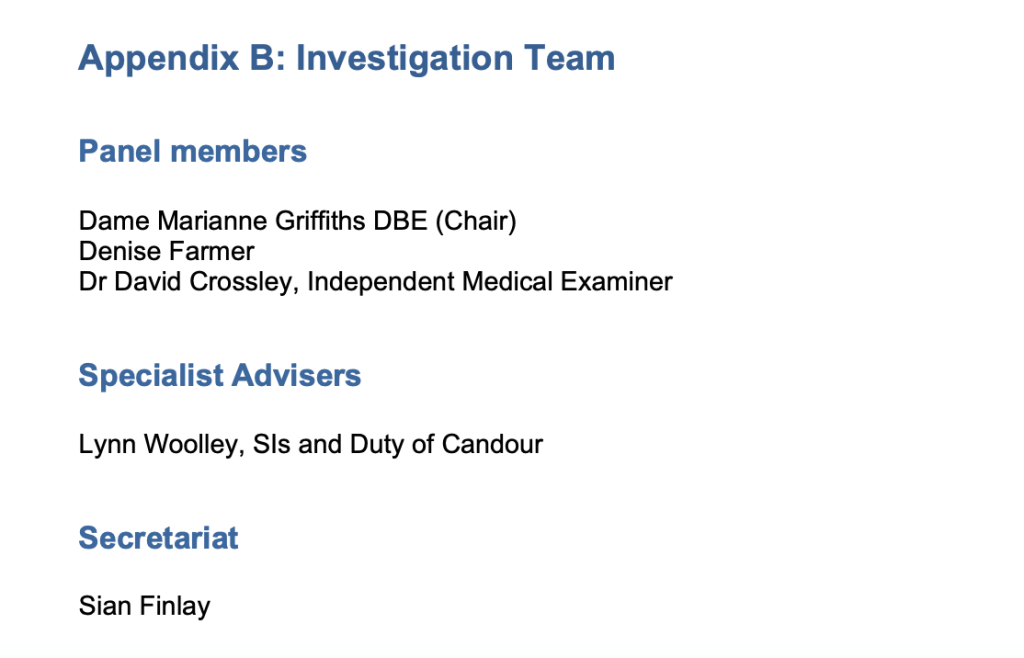
What credentials did the Griffiths investigation team have to make determinations on issues of whistleblowing, employment, coronial law and criminal law? It is not obvious that there were any practising lawyers on the team.
Griffiths’ analysis of NEAS’ general whistleblowing governance is staggeringly superficial and brief. The report’s section on Freedom To Speak Up was less than two pages long (see pages 62 and 63) and totalled 641 words. The specific section on the coronial whistleblowers tries to paint a “can of worms” type picture. This can be a technique that is sometimes used for misdirecting attention in whistleblowing matters.
I cannot find explicit mention of the Stanley/Boylin report’s outcome in Griffiths’ report.
I found this passage:
“6.34 Between 2019-20 there was a significant change in executive leadership; a new Chief Executive (CEO) (following a gap of 4 months), new Director of Quality and Safety, new Finance Director and new (and the organisation’s first substantive) Director of HR (HRD). The incoming CEO put the new executive team together including investing in Board development work. She also actioned the outcome of reports relating to behaviours and culture including meeting staff who had raised concerns.”
There were also these passages about an unspecified external Freedom To Speak Up commissioned by NEAS concluded in 2020, which would fit:
“7.38 The findings made clear that the functioning and leadership of HR, and relationships between senior staff, had been difficult for some time and had not been addressed effectively up to 2020.
7.39 Senior leaders had allowed dissent and factions to interfere with proper processes and therefore added to serious risk for HR and professional matters, and to the support given to the organisation, including to the staff raising concerns and grievances.
7.40 There was clear evidence of a lack of professional respect, and a lack of acknowledgement of professional duties and responsibilities and the consequent need to co-design processes.
7.41 There was a lack of transparency and consistency between the operational management of services and professional leadership.”
The facts supporting these opinions are not provided.
Opaquely, Griffiths gives no bibliography of the documents examined by her investigation.
A search of her report for the words “bully” and “bullying” yield zero hits, although she was tasked with examining culture.
Why has there been so much secrecy about the Stanley/Boylin report outcome?
Why has over £35K public money not been properly accounted for?
Why do private contractors undertake these types of reports without a clear condition that such reports will be openly published?
Is it because there would be no repeat customers if NHS organisations cannot cherry pick what is reputationally advantageous to publish?
Why are NHS bodies allowed to misuse public funds in the support of managerial self interest and against patients’, families’ and the workforce’s rights to transparency?
The bad, bad smell that still hangs over NEAS will likely intensify as the scandal at Sussex unfolds.
Perhaps NHS England will invite Helen Ray the NEAS CEO to review Sussex at some point. Only once CQC has confirmed improvement at NEAS and upgraded the trust to “Good” or “Outstanding”, of course.
But unaccountable senior NHS managers are bulletproof for now.
The Secretary of State has torpedoed the central Kark review recommendation of an ultimate sanction, of disbarment for serious misconduct such as whistleblower reprisal and cover ups.
But this serves to emphasise how perfectly unfit the NHS’ governance is when things go wrong, and how only hard law reform will suffice to protect whistleblowers.
RELATED ITEMS
I have written to the Secretary of State about the missing Stanley/Boylin report.
08.07
BY EMAIL
Steve Barclay
Secretary of State for Health and Social Care
12 July 2023
Dear Mr Barclay,
Suppressed report on bullying and poor whistleblowing governance at North East Ambulance Service
Marianne Griffiths’ investigation on North East Ambulance Service for NHS England was published today and references your predecessor’s announcement last year about this investigation.
One of the NEAS whistleblowers understandably declined to cooperate with this flawed exercise. The investigation was also criticised by the bereaved families.
I write to draw your attention to the fact that NEAS paid over £35K for a 2020 report on bullying and poor whistleblowing governance at the trust, which it has suppressed ever since. This was the so-called Stanley/ Boylin report. Its findings appear to be absent also from today’s Griffiths report.
NHS England confirmed in a note to me last month that Marianne Griffiths had been provided with a copy of this report.
However, I can find no clear mention of its findings in her report today. I could find only this paragraph:
“6.34 Between 2019-20 there was a significant change in executive leadership; a new Chief Executive (CEO) (following a gap of 4 months), new Director of Quality and Safety, new Finance Director and new (and the organisation’s first substantive) Director of HR (HRD). The incoming CEO put the new executive team together including investing in Board development work. She also actioned the outcome of reports relating to behaviours and culture including meeting staff who had raised concerns.”
Marianne Griffiths also provides no bibliography at the end of her report to transparently list the documents examined by her investigation. A search of her report for the words “bully” and “bullying” brings up zero hits.
The section of her report on Freedom To Speak Up is less than two pages long and comprises of 641 words.
The report claimed it could not say that the repeated alteration of original documents and withholding of documents from the coroner, which the trust had previously been warned were potential crimes, was a deliberate act of concealment.
I really do not think that the public interest has been served by this report. It is in my opinion a sample of what we should expect if the NHS is permitted to conduct its own “exit Fit and Proper Person tests”, as currently proposed by NHS England.
I forward below the correspondence from NHS England which informed me that Marianne Griffiths had been provided with the Stanley/Boylin report.
This brief response was the culmination of over a year of my raising concerns with NHS England about Marianne Griffiths’ suitability to lead the NEAS investigation given the previous concerns about whistleblowing governance at her former NHS trust in Sussex.
Additional concerns arose over the course of that year. You will see that none of this swayed NHS England.
With best wishes,
Minh
Dr Minh Alexander
NHS whistleblower and retired consultant psychiatrist
Cc Tom Kark KC
08.54
BY EMAIL
Steve Barclay
Secretary of State for Health and Social Care
12 July 2023
Dear Mr Barclay,
My apologies.
I need to correct my earlier letter today of 08.07.
I have found a further passage in Marianne Griffiths report which seems to give a brief outcome of the 2020 Stanley/Boylin report, although the report is not explicitly identified.
It is stated that an external report commissioned by NEAS concluded in 2020 with the following:
“7.38 The findings made clear that the functioning and leadership of HR, and relationships between senior staff, had been difficult for some time and had not been addressed effectively up to 2020.
7.39 Senior leaders had allowed dissent and factions to interfere with proper processes and therefore added to serious risk for HR and professional matters, and to the support given to the organisation, including to the staff raising concerns and grievances.
7.40 There was clear evidence of a lack of professional respect, and a lack of acknowledgement of professional duties and responsibilities and the consequent need to co-design processes.
7.41 There was a lack of transparency and consistency between the operational management of services and professional leadership.”
My understanding is that affected staff were advised that their concerns were partly upheld by the Stanley/Boylin investigation, but that they were given no other information. I have seen some of the feedback correspondence from the trust.
In Marianne Grittith’s above summary, opinions are given but the specific facts supporting them are not.
She provides little comment on the issues of whistleblowing governance examined.
Information relevant to mounting an effective Fit and Proper Person challenge remains largely withheld from affected parties.
Best wishes,
Minh
Dr Minh Alexander
Cc Tom Kark KC


 Alexander's Excavations