By Dr Minh Alexander retired consultant psychiatrist 21 June 2023
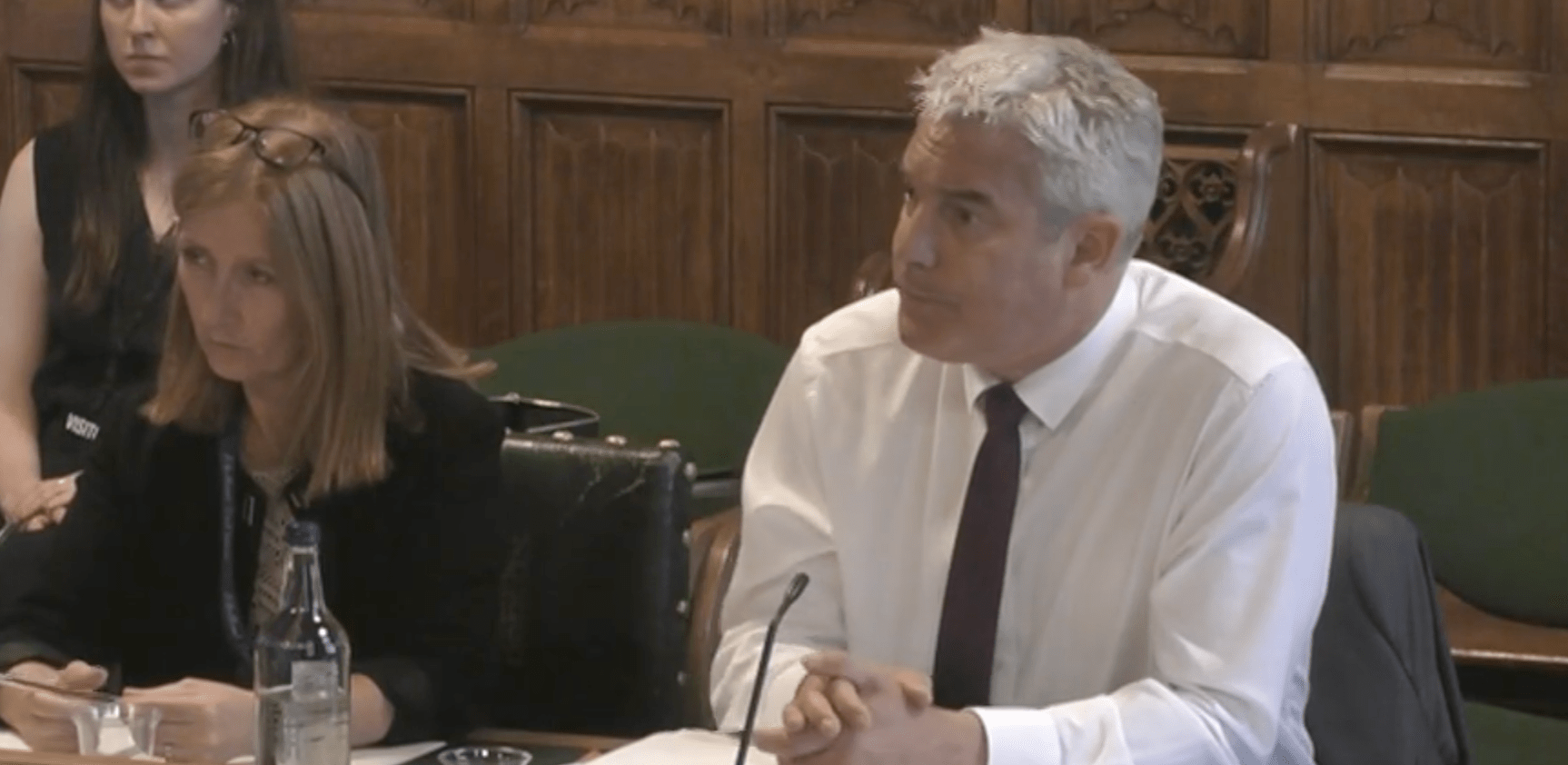
The parliamentary Health and Social Care Committee sat on 20 June 2023 and took evidence from Steve Barclay Secretary of State.
Mr Barclay appeared to start waffling when asked about failure of the Freedom To Speak Up project.
In his verbal perambulations he wondered out loud if bad NHS managers are recycled.
He knows the answer to this, of course, having commissioned the Kark review on this topic in 2018.
But to provide cognitive support, I have reminded him of his previous commission, of two recent unanswered letters on the topic and of a topical example of an NHS exec who resigned after being criticised for poor governance, who then sold governance services to the NHS and is now back in the NHS as a Director of – you guessed it – Governance.
But it is positive that MPs are now starting to speak openly about the failure of the Freedom To Speak Up project.
The danger is that it will be replaced with something equally ineffective that will be again be used for another eight to ten years for PR and to block real change.
Actors new to the whistleblowing landscape, who are not whistleblowers, have recently been clamouring for a central route of NHS disclosure, such as at DHSC or NHS England. I have advised against that notion but it has popped up again through a Committee member. I have warned the Committee against it.
These are the relevant exchanges at Committee on 20 June 2023:
Rachael Maskell MP: If I may Chair. I’d just like to turn to the complaints system. I’m really concerned about the reports coming out of University Hospitals Birmingham. We’ve seen the reports that have come out of a number of mental health trusts. These trusts are clearly not safe for patients as the data is showing, but also not safe for many of the staff who are raising concerns.
After the Robert Francis report we thought that this would come to an end. Duty of Candour very much [inaudible] the front, whistleblowing being accepted as part of the NHS culture, however we haven’t seen the culture move on, and risk still prevails. Even looking at the PHSO insufficiency in being able to have leverage over what’s happening and in their reporting, back of what’s happening at many of these trusts, I’m really concerned that we do not have a robust complaint system.
What steps are you taking to look into that and what measures have you taken to date to move that forward?
Steve Barclay MP and Secretary of State for Health and Social Care: I think it’s a hugely important issue and I think colleagues across the house when I was on the Public Accounts Committee as a member for four years, one of the things I particularly focussed on, which is on record, was gagging of whistleblowers, particularly in the NHS. And how we have more transparency and a culture of learning where things go wrong, you know. In a Department which is allocating over £180 billion and employing as many people as the NHS does, there will be issues that go wrong. The key is how we identify them quickly and how we learn from that.
And so I know the Committee will share my concern when we heard the reports of some of the sexual abuse data that was coming out. And that was something I very urgently met with NHS leaders to discuss to ensure that was being gripped. You allude to the issues of mental health and I hope to have more to say very shortly on that specifically, particularly in the context of the Essex issues. And I know that a number of members of parliament [inaudible] have discussions with them on that, not just in Essex, but there’s been concerns more widely so I think the point you raise is a very valid one. It’s one I take extremely seriously. It’s one that colleagues can see throughout my time as an elected representative I’ve taken very seriously and it is something that I have discussed with Amanda Pritchard the chief executive of the NHS and with senior leaders such as Ruth May the lead nurse, and others, to ensure that we are learning the lessons from these issues and ensuring that where an issue is raised whether that’s by patients, whether it’s by members of staff, whether it’s by others in the community, that we’re addressing it.
Rachael Maskell MP: Just my final question. Because of what has been described as quite a bullying culture in many of these organisations and bullying being very prevalent across the whole economy (27% of workers experience bullying) but when it comes into the Health context it clearly puts the system at risk and patients at risk as well. Not to mention the impact on staff and staff retention.
Will you look at a central place where people can raise concern independently, in order to be able to whistleblow safely and to be able to raise those those concerns so that they are properly investigated? And a top down approach can be put on trusts to deal with these issues, because without it, as hard as the Robert Francis report tried to address these issues, it hasn’t delivered.
Steve Barclay MP and Steve Barclay Secretary of State for Health and Social Care: I’m keen to understand where, if there are areas where the complaints system are not working, why that is and how we learn from it. I think it is an area that has already had lots of focus so one of the issues we’ve got to understand, we have a Patient Safety Commissioner, we have er Guardians, we’ve had a number of other initiatives over many years, in this space. You touched on cases such as Birmingham which still generates significant concern. So for me it’s about understanding why when issues are known about locally, too often they’re not addressed. And how where, we’re learning from that. So that includes things like the trust Board and what visibility, what line of sight does the Board have? What accountability is there for senior managers when wrong doing is established? Are they just rotated through the system? Or are people held to account? So I think there are a number of issues. It’s an issue sadly that’s been with us for quite a while, because I’ve spent a fair bit of time on it in a previous role. But I share your absolute desire to tackle it. I think you touched on it in the context of the wider duty we have to NHS staff and things like staff absence which is why these things then often manifest themselves in falling retention, because people vote with their feet and leave. It’s a hugely important issue. It’s one that we have a number of people involved in the NHS to tackle. It is also a role for the Royal Colleges and others in the wider NHS family and I’m extremely keen to work with them on it.
This is my letter to Steve Barclay which includes a formal request for information about the DHSC’s approach to the Kark review on Fit and Proper Persons in the NHS:
“BY EMAIL
Steve Barclay
Secretary of State for Health and Social Care
21 June 2023
Dear Mr Barclay,
Kark review implementation and disbarring unfit NHS senior managers
I watched your oral evidence to Health and Social Care Committee yesterday, and in particular your answers to concerns that the government’s Freedom To Speak Up model has failed to deliver.
Your response on being asked about the failure of the DHSC’s and Robert Francis’ 2015 Freedom To Speak Up project was thus:
“Steve Barclay MP and Steve Barclay Secretary of State for Health and Social Care: I’m keen to understand where, if there are areas where the complaints system are not working, why that is and how we learn from it. I think it is an area that has already had lots of focus so one of the issues we’ve got to understand. We have a Patient Safety Commissioner, we have er Guardians, we’ve had a number of other initiatives over many years, in this space. You touched on cases such as Birmingham which still generates significant concern. So for me it’s about understanding why when issues are known about locally, too often they’re not addressed. And how where, we’re learning from that. So that includes things like the trust Board and what visibility, what line of sight does the Board have? What accountability is there for senior managers when wrong doing is established? Are they just rotated through the system? Or are people held to account? So I think there are a number of issues. It’s an issue sadly that’s been with us for quite a while, because I’ve spent a fair bit of time on it in a previous role. But I share your absolute desire to tackle it. I think you touched on it in the context of the wider duty we have to NHS staff and things like staff absence which is why these things then often manifest themselves in falling retention, because people vote with their feet and leave. It’s a hugely important issue. It’s one that we have a number of people involved in the NHS to tackle. It is also a role for the Royal Colleges and others in the wider NHS family and I’m extremely keen to work with them on it.”
A number of points arise from your comments to Committee:
1. The Patient Safety Commissioner’s role
The Patient Safety Commissioner’s remit is restricted to medicines and medical devices.
She is not currently listed as a Prescribed Person to whom whistleblowers can make protected disclosures.
But if she is to be a Prescribed Person under UK whistleblowing law, within these narrow confines, I would be grateful if you could confirm that this is so.
2. Local NHS Freedom To Speak Up Guardians
Local FTSU guardians are toothless and importantly, defenceless. They themselves may become victims of abusive NHS organisations which employ them, and that has happened in some cases. Alternatively, some Guardians are appointed because they are willing to abuse whistleblowers. The model is a logically flawed and wasteful. It contributes very little. Testimony from two whistleblowers who have been failed by NHS trust Guardians can be found here:
3. Oversight by NHS boards
Oversight by NHS Boards is not the issue. It is abusive NHS Boards that are the issue, whether by actively and directly abusing whistleblowers or knowingly soliciting and/or permitting abuse.
4. Accountability for senior management wrongdoing
In your evidence to Committee you wondered out loud about whether there is accountability for erring senior NHS managers, or whether such individuals are recycled.
You personally commissioned the Kark review in 2018 on identifying unfit NHS managers and preventing their recirculation.
You will recall the immediate catalyst was the debacle in which failed trust managers were protected by NHS regulators after Mid Staffs style failures at Liverpool Community Health NHS Trust.
See Hansard: Capsticks Report and NHS Whistleblowing 13 July 2016
Upon reviewing the Fit and Proper Persons test in the NHS, Mr Kark KC found current systems wanting and made recommendations for improvement.
However, the implementation of the Kark review recommendations was entrusted to NHS England, an NHS regulator which has been responsible for much of the executive recycling and setting a culture of impunity.
There has been no sign yet of implementation of the Kark review.
Indeed, NHS England has claimed to me that there is no ministerial support for Tom Kark’s crucial recommendation of a disbarring mechanism for the worst and most unfit NHS managers.
I have written to you twice about this (7 February and 29 May 2023, forwarded below), asking you to reconsider this reported decision, but I received no reply.
A current example of NHS executive recycling
But to answer your question on whether erring senior managers are rotated through the system, the answer is ‘yes’. This is a current and topical example:
Darren Grayson resigned from a post as NHS trust CEO in 2015 after an extremely critical CQC report and allegations of management bullying and other governance failures. Mr Grayson went on to sell consultancy services to the NHS through a private company, the Good Governance Institute. This included work for a predecessor body of University Hospitals Sussex NHS Foundation trust, during Marianne Griffiths’ tenure as CEO. Partly on the basis of material produced by the Good Governance Institute, the CQC took the trust out of special measures and rated it “Good” in 2019. Last year Mr Grayson took up a substantive post at this same trust as Director of Governance. Staff whistleblowing to the CQC continued and the police are now making enquiries into concerns about patient deaths 2015-2020 that may amount to gross negligence manslaughter.
The longer the implementation of the Kark review is delayed, the more examples of such recycling will accumulate.
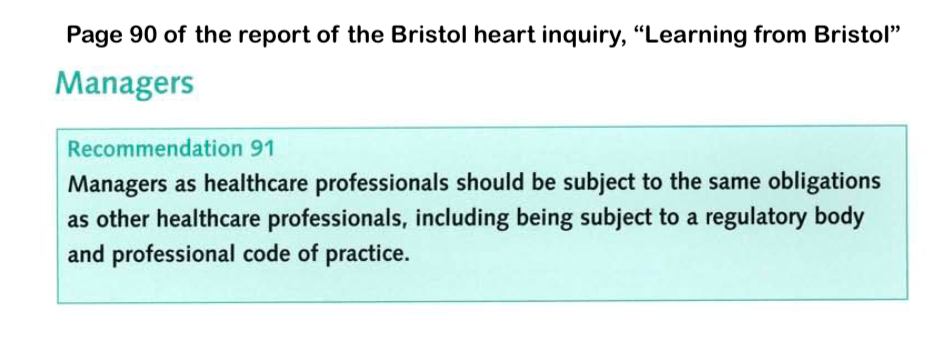
The Kark review stopped short of recommending managerial regulation, but reserved it as an option for the future. Please note that the delay in regulating NHS managers now spans decades.
The 2002 Bristol Heart inquiry recommended regulation for NHS managers:
I would be very grateful if under FOIA the DHSC could advise me of the following:
1. As of now, which of the Kark review recommendations does the DHSC accept and which does the DHSC reject?
2. Is it correct that there is no ministerial support for Tom Kark’s recommendation of a disbarring mechanism for unfit NHS managers?
3. Why did the DHSC decide not to pursue a disbarring mechanism? What directions/ instructions has the DHSC given to NHS England on this matter?
4. What is the DHSC’s timetable, if any, for implementating any of the Kark review recommendations that it has accepted?
Many thanks and best wishes,
Minh
Dr Minh Alexander”
This is my letter to the Health and Social Care Committee to register concern about the proposal for another NHS and government controlled whistleblowing body, and to ask that the Committee instead focuses on implementation of the Kark review.
RELATED ITEMS
Mr Tristan Reuser’s whistleblowing case: Scandalous employer and regulatory behaviour on FPPR

 Alexander's Excavations